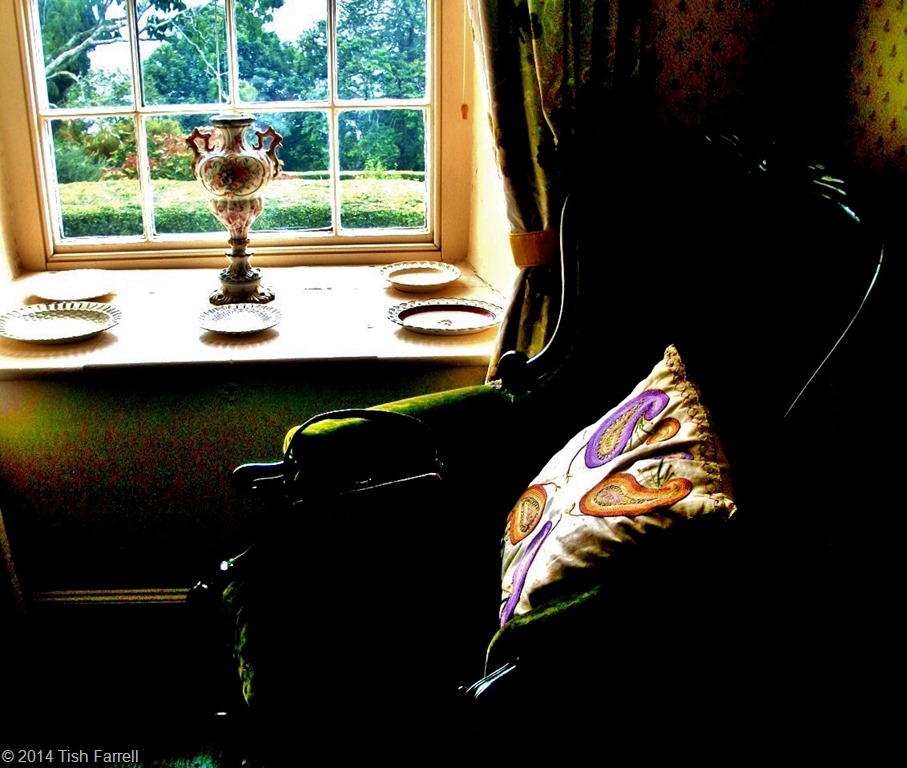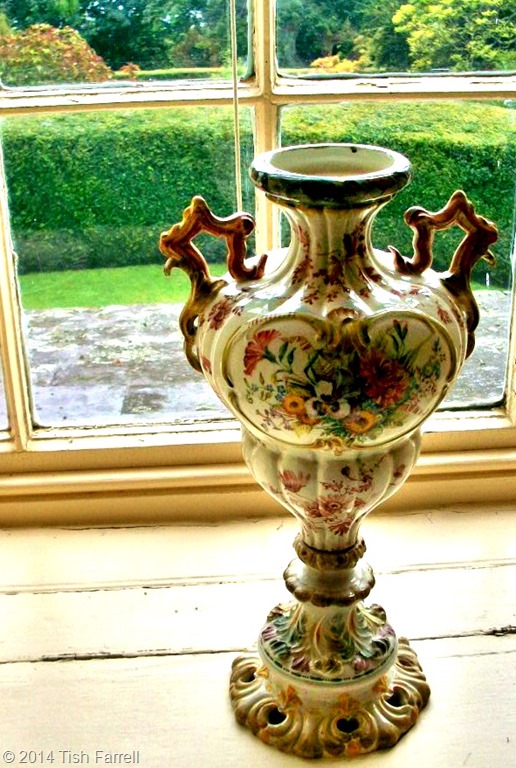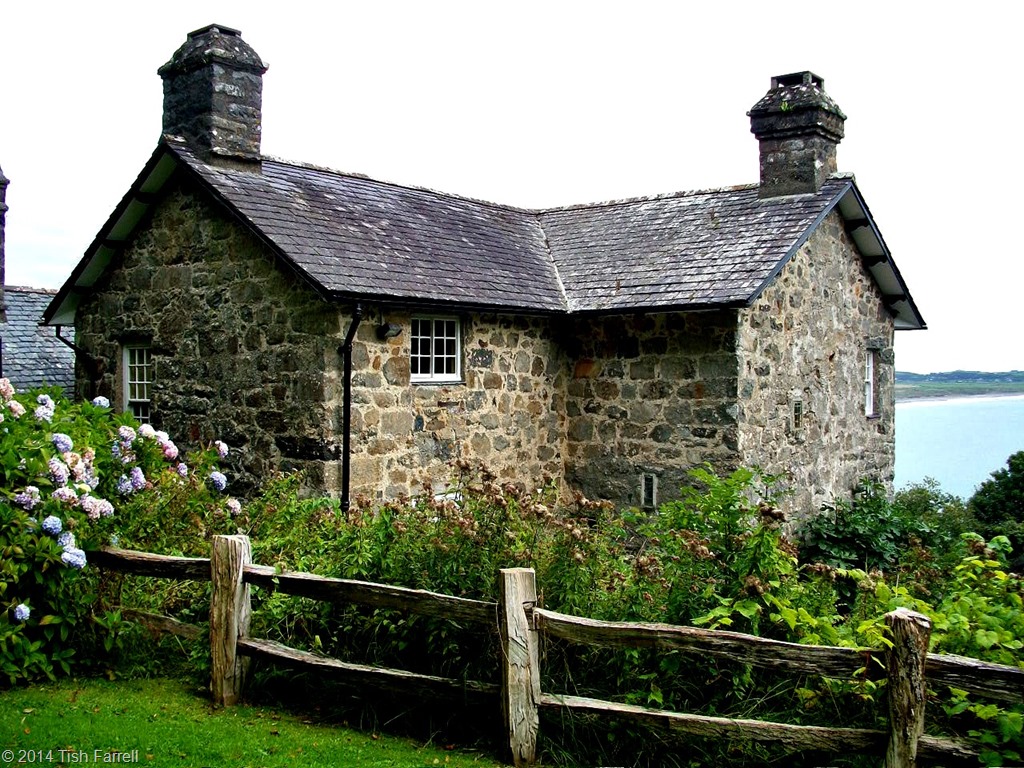
Gazing into Hell’s Mouth at Plas yn Rhiw

100_4811

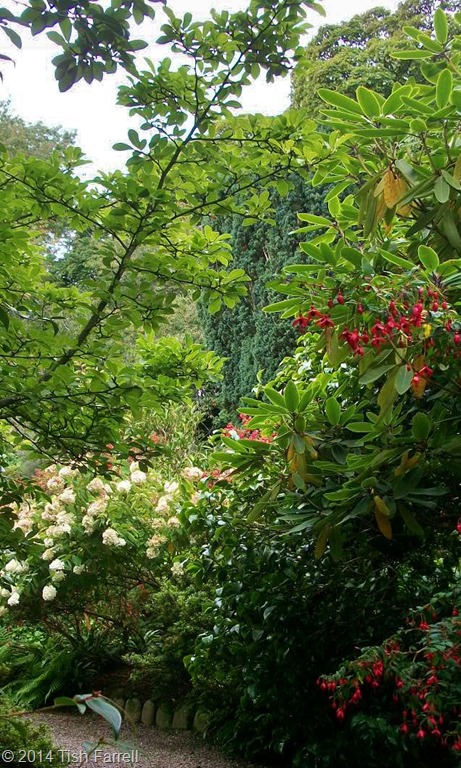
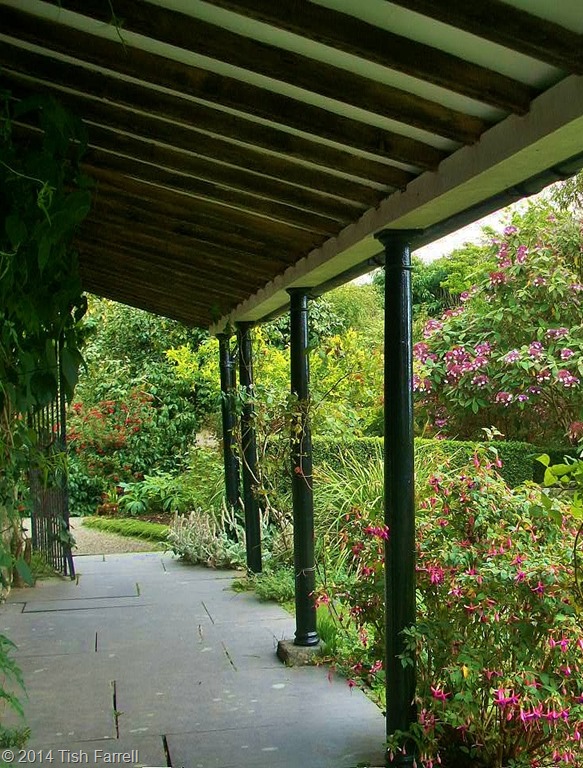
Surely Plas yn Rhiw is too lovely a place for visions of Hell? The ancient Welsh domain  on the road to Aberdaron has a benign and slumbering air; here are  gentle and delicate spirits.And it is not simply in the subtle shapes of the garden’s planting or the soft hues and scents of fading flowers;
100_4861

100_4865

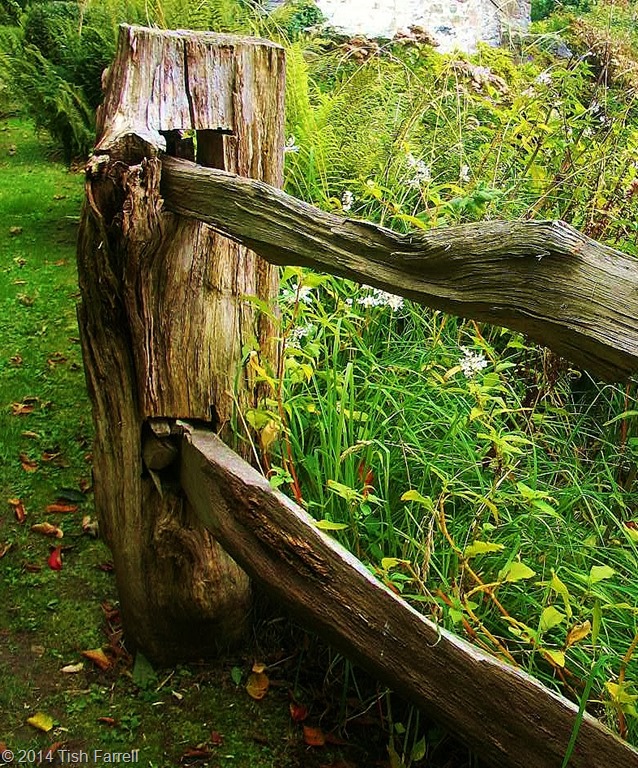
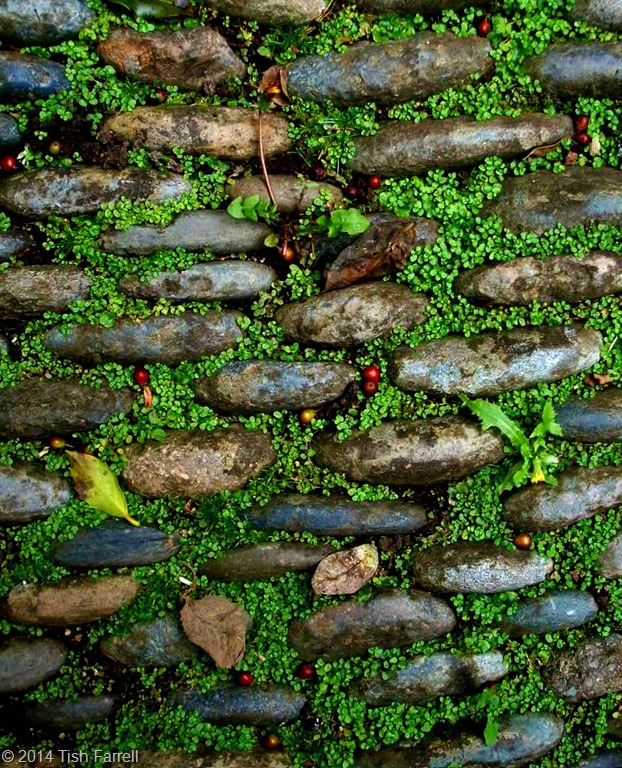
or in the  cobbled paths and woodland walks where wild strawberries and ferns grow alongside fuchsias and hydrangeas;
100_4822

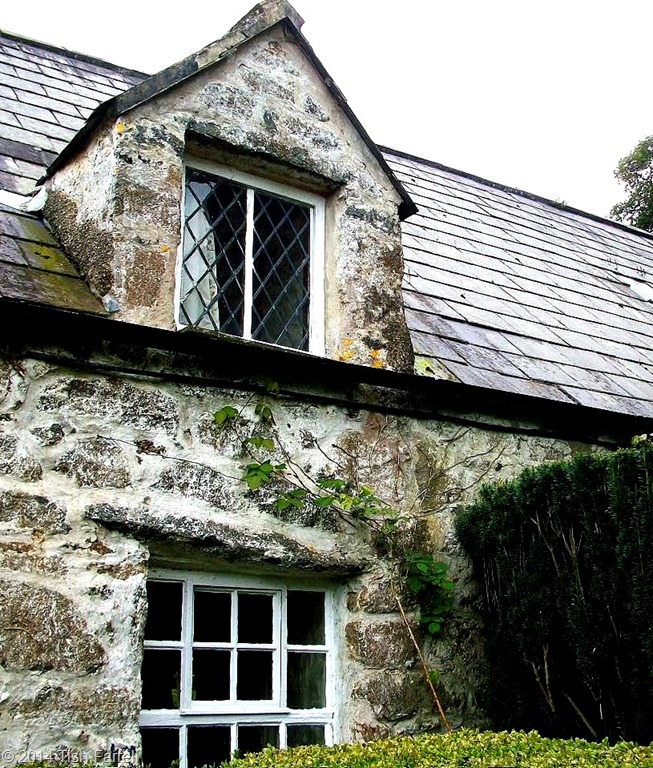
or in the fabric of this old, old house whose stones reflect the end-of-summer sky and the steely blue-greys of the sea below.
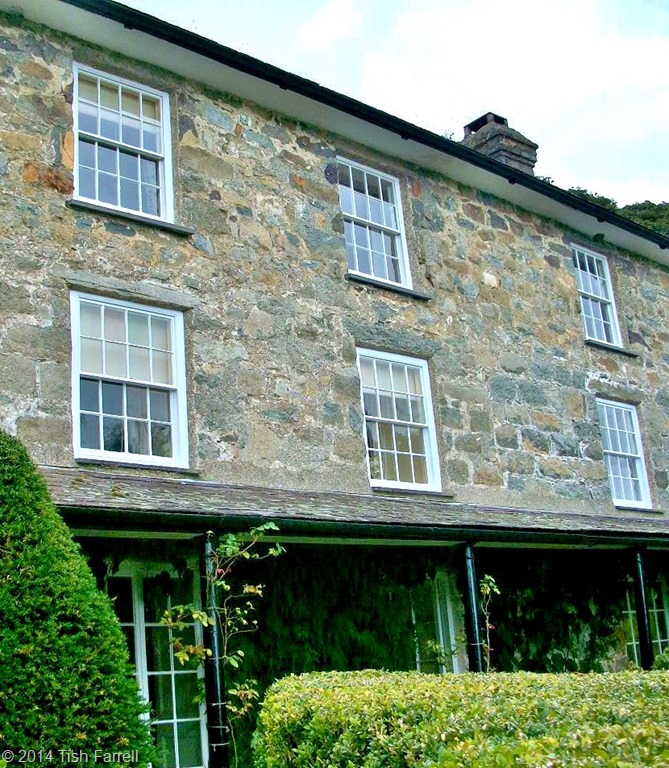
100_4824

Even the air around the house feels strangely soft. It is the kind of late September softness that makes you want to lie down in the grass and dream for days and years, listening only to insect hum and the chatter of sparrows.  The setting anyway is blissful; all enclosed by woodland at the foot of Mynyth Rhiw Mountain, and embraced by the seeming sheltering curve of Hell’s Mouth Bay (Porth Neigwl). So now you have it, an inkling that the tranquil surface overlays some deeper, darker currents.
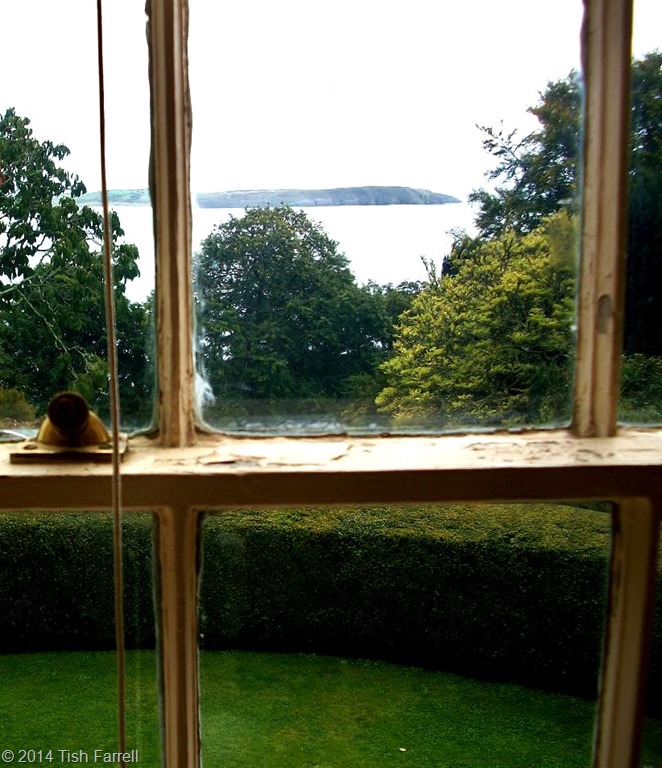
100_4830

Hell’s Mouth lies on the southerly tip of Llyn Peninsula, overlooking the broader sweep of Cardigan Bay. The calm view from Plas yn Rhiw  is transfixing. How can it have such a name? Yet watch this space and see a different scene. For when the south westerly gales come roaring in, this bay becomes a death trap. Over the years it is said that some thirty ships have been run aground, their holdfast anchors dragging before the driving storm. Wrecks include the Transit that foundered with a cargo of cotton in 1839. In 1840 it was the Arfestone carrying gold. An Australian ship was lost there in 1865, and in 1909 the sailing ship Laura Griffith was wrecked. And there is more.
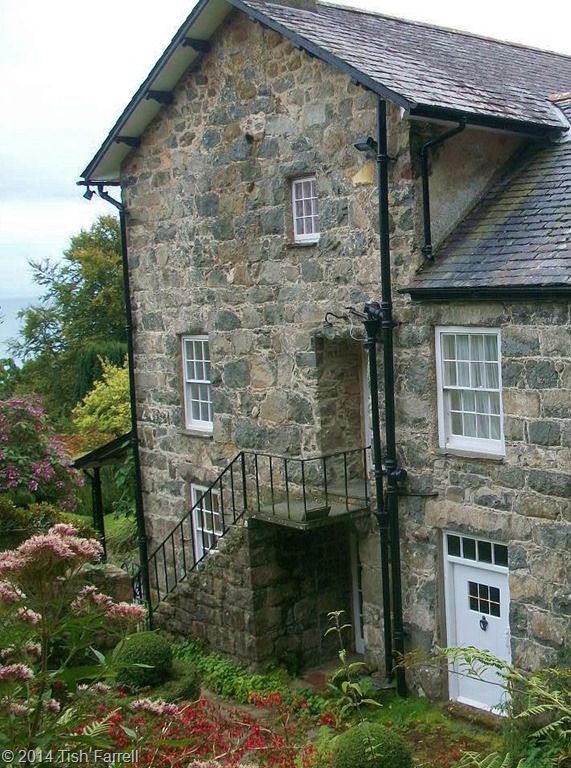
100_4862

Reel back to the 8-900s AD and Llyn was the scene of bloody raids. At this time the Vikings occupied coastal Ireland across the bay. Llyn was then part of the Welsh Kingdom of Gwynedd and  Powys and its prominent position made it seem an easy target from  over the Irish Sea.  The Welsh, under Rhodri Mawr (Rhodri the Great 844-878 AD)  fought valiantly to keep the raiders at bay, although accounts of the time attest to their terrifying attacks. But whatever the truth, the sight of a raiding party,  sixty five ships strong, and coming  fast into  the bay must have truly chilled the blood. By the 10th century Llyn was still holding its own against Viking incursion, but only through constant vigilance. And this is where Plas yn Rhiw comes in. Local history  has it that Meirion Goch, great-grandson of Rhodri Mawr, was instructed to build a fortified house at Rhiw and  hold the coast against invasion. It is also thought that this stronghold occupied the site of the present house, although no provable traces have been yet been found. The descendants from this royal dynasty appear then to have occupied Plas yn Rhiw for the next thousand years, eventually adopting, in  the English fashion, the surname Lewis. IrishSeaReliefmap[1] (2) The Llyn Peninsula is the finger of land above Cardigan Bay. Hell’s Mouth is due north of the ‘d’ in Cardigan. The port of Dublin in Ireland was founded by the Vikings, along with other coastal towns that they used as raiding bases. (Map: Creative Commons).

*
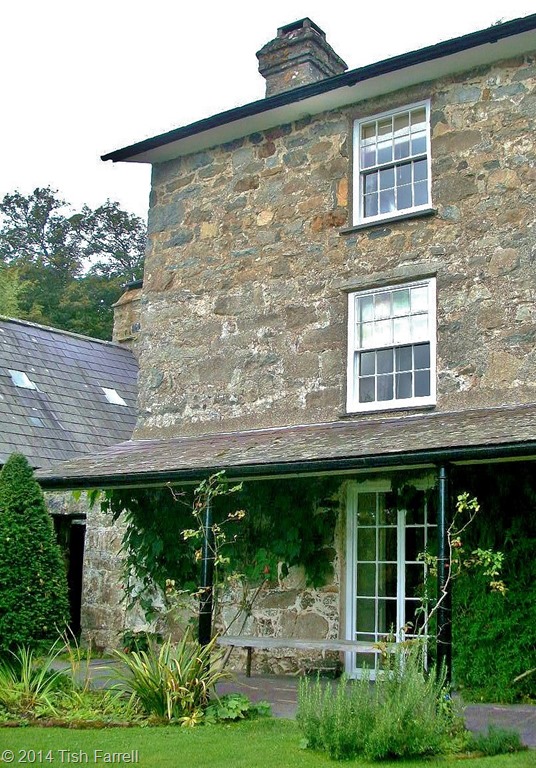
100_4819

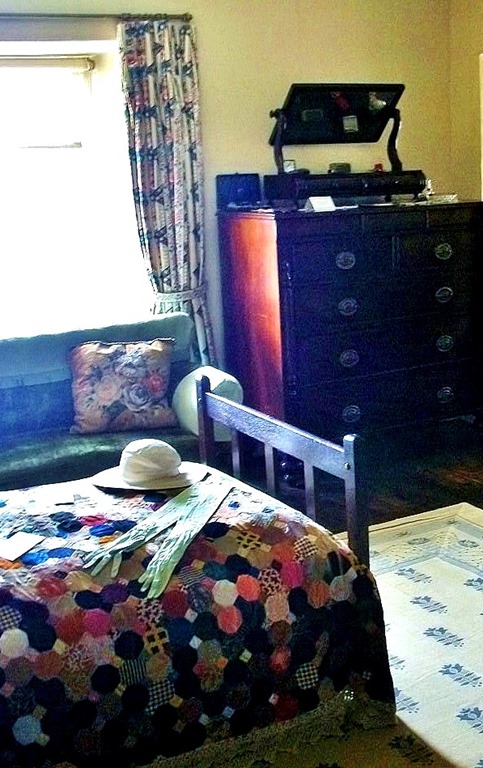
The house we see today, then, has its own stories – cycles of re-building, abandonment, decay, renewal. Now , as a National Trust property, it is frozen in time; as if its last elderly inhabitants, the Keating sisters, have simply popped out to the shops and left you to gaze upon their hats and gloves, and recently received letters. But more of these sisters in moment. First a quick history of the house. The lintel over the French window is carved with the date 1634, which probably marks the re-modelling of an existing medieval house by the then owner John Lewis. In 1820 the house was further extended and the grand Georgian facade and a further storey added. But in 1874 the long connection with the Lewis family ended and the house was sold for the first time in its existence. The new owner then let it to a succession of tenants, and it was possibly one of these, Lady Strickland, who created the gardens. She apparently also introduced the first bath tub to the district. And there is a tale of a ghostly visitation during her tenancy – a drunken squire roaming the house in search of a drink (lost spirits perhaps?). But by 1938, when the house was once more for sale, it was in a sad state of repair. The nearby millstream had left its bed and was running through the hall, rotting the staircase, brambles blocked the front door and the garden was a jungle. Enter the saviours,  Welsh conservationist  and architect, Clough Williams-Ellis (creator of Portmeirion ) and his friends the Keating sisters.
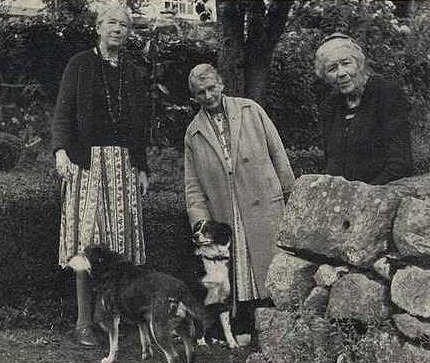
www.rhiw.com

In this newspaper photo of 1960 (www.rhiw.com/) we see Eileen, Lorna and Honora Keating at Plas yn Rhiw. It is down to them that Llyn does not have a nuclear power station. They bought up coastal land to prevent it, and than gave the land to the National Trust. They also opposed overhead power lines and caravan parks, and in 1939 Honora received an OBE for her work for the National Council for Maternity and Child Welfare. They were the daughters of a Nottingham architect who was killed in a traffic accident when they were small. Their 32-year old mother Constance was left to bring them up, and she ensured, among other things, that they received a good education. Every year  from 1904 the family spent their summers in Rhiw. In 1919 they bought a cottage above Hell’s Mouth, and it was from here that they first saw Plas yn Rhiw. In 1934, after Constance became an invalid, the sisters settled permanently with her in Rhiw. There are tales of them shunting mother around the locality in a wheeled bed.  By this time Plas yn Rhiw was abandoned, and although there were hopes of saving it, the owner could not be found. Then in 1938 a FOR SALE notice went up. Six hundred pounds was the asking price, and it was Clough Williams-Ellis who alerted Honora. He sent her a telegram: “Will you invest savings Plas”. She replied: “Yes, but haven’t got much.”
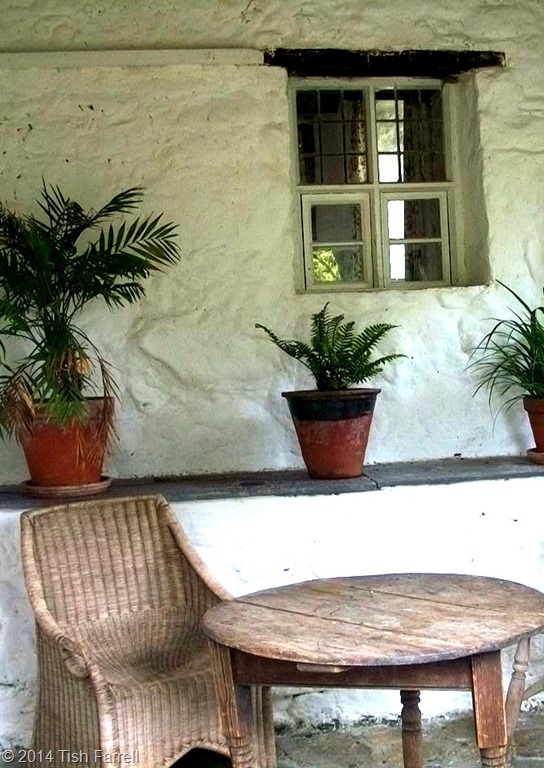
100_4845

The sisters bought the house, along with 58 acres of land that were all that remained of the original estate. With Clough Williams-Ellis to help and advise, the restoration began, and the following year the Keatings moved into the house. They then set about buying back the estate’s former land, which they gave to the National Trust in 1946 in memory of their parents. The house was donated in 1952, although the sisters lived there for the rest of their lives, the last and youngest sister, Honora, dying in 1981. Inside, the house has no pretensions to grandeur, although it is filled with personal treasures – everything from fine Meissen figures to the cottage vernacular of a Welsh spinning wheel.  Along with the family portraits and antique furniture are paintings by Honora who studied at the Slade, and  also works by M E Eldridge, the often overlooked artist wife of the poet R S Thomas. (When Thomas retired from being parish priest at nearby Aberdaron, the Keatings leased to him Sarn Rhiw, a stone cottage in the grounds below the house).

100_4836

The Yellow Bedroom

100_4827

100_4829

*

100_4838 - Copy

Honora’s room – alongside the Victoriana there is in the fireplace a c.1916 Royal Ediswan electric fire which operated by means of 250-watt bulbs. Beside the bed is an early Pifco Teasmaid.
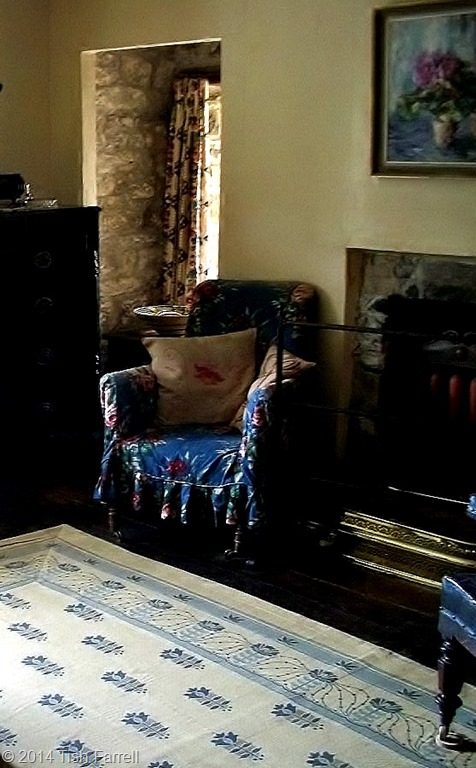
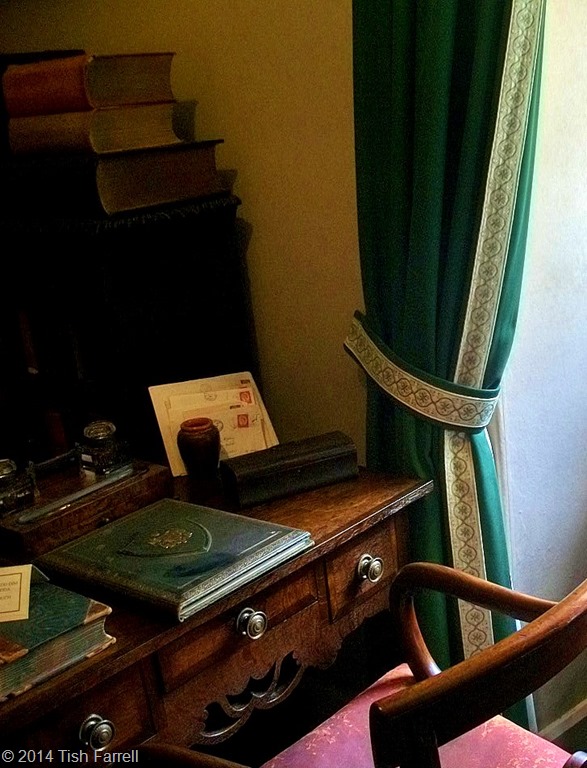
100_4838

100_4825

*

100_4858

100_4871

100_4823

Today the National Trust is continuing to restore the house while staying true to the Keating sisters’ aesthetic sensibilities and conservation principles. The garden has its striking seasons: carpets of wild snowdrops along the woodland walks in winter, a magnificently flowering Magnolia mollicomata in spring, the early summer azaleas, the September cascades of crimson magnolia fruits and fuchsias. So perhaps the final words should be left to Clough Williams-Ellis. In a letter  that now hangs framed in the hall, he writes to the sisters: “In these serene spring days your little kingdom must be heavenly indeed.”
100_4854

Related: Arch Wizard of Wales: Clough Williams-Ellis Bright Fields on Llyn Warrior Wind-Singer of Llyn   Post inspired by Sue Llewellyn’s A Word A Week: Delicate  
Vulcanicity ~ Welcome to the hot zone

Scan-130716-0008 (9)

I have long had a fearful fascination with volcanoes – probably ever since, as a young child in the 1950s, I saw a newsreel item of Mount Etna erupting. It seemed like a living nightmare. I remember especially the unstoppable flows of boiling lava that rolled over everything in their path.  Even in places where it had cooled I seem to remember people who walked on it found their shoes smouldering. It was perhaps my first apprehension of the fact that the earth could do things that mankind was incapable dealing with. I remember having a dream afterwards where the ground beneath my feet kept cracking open into ever widening fissures: my first anxiety dream perhaps.

With this in mind, you will understand how very deeply impressed I was when I first set eyes on Africa’s Great Rift Valley.

File:Great Rift Valley NASA.jpg

NASA non-copyright image

*

Here, on the surface of the earth, we have a 4,000 mile chain of connected fissures that extends from Lebanon in the Middle East to Mozambique in south east Africa. It comprises the Jordan Rift Valley, Red Sea Rift and the East African Rift, which itself divides into eastern and western arms with Lake Victoria Nyanza in between. The entire system has been described as a world wonder, the biggest rupture in the planet’s land surface, and the only geological feature that can be seen clearly from the moon. The East African Rift of course includes the great ice-topped volcanoes of Kilimanjaro and Mount Kenya that are mere remnants of their formerly gargantuan fiery selves.

So however you look at it, moon- or otherwise, the Great Rift is definitely a case of EXTREME geology. All that seismic shunt and shift. And it is still happening and at this very moment. One day the Horn of Africa and littoral East Africa will be an island.

*

The East African Rift is thought to have begun to pull apart around 40 million years ago. Scientists surmise that the environmental changes associated with fissuring may have had a significant impact on the evolution of humankind. So far, very many of the earliest fossils of (potential) human ancestors have been found in the Rift – Olduvai Gorge, and in the vicinity of Lakes Baringo, Turkana and Omo. On the other hand, this could simply be a reflection of the  decades of systematic searching in these areas, instigated largely by the Leakey dynasty of palaeontologists. But whether a good case of careful looking or not, I’m still prepared to believe that humans could have evolved here.

*

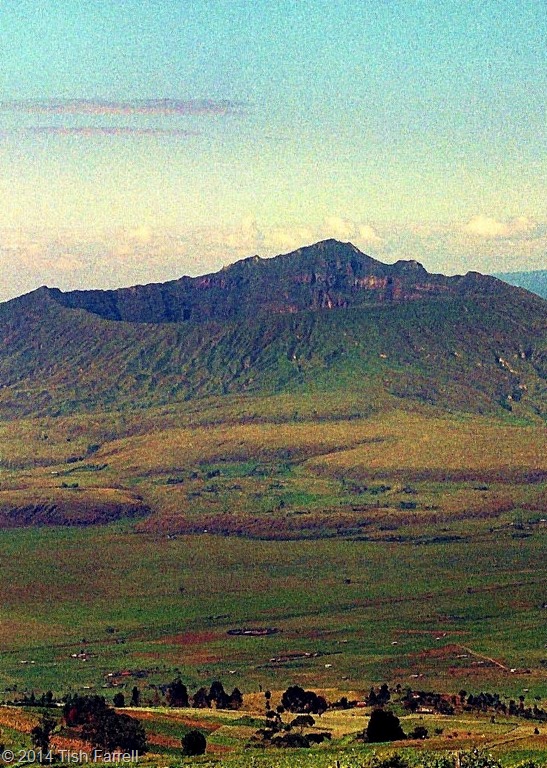
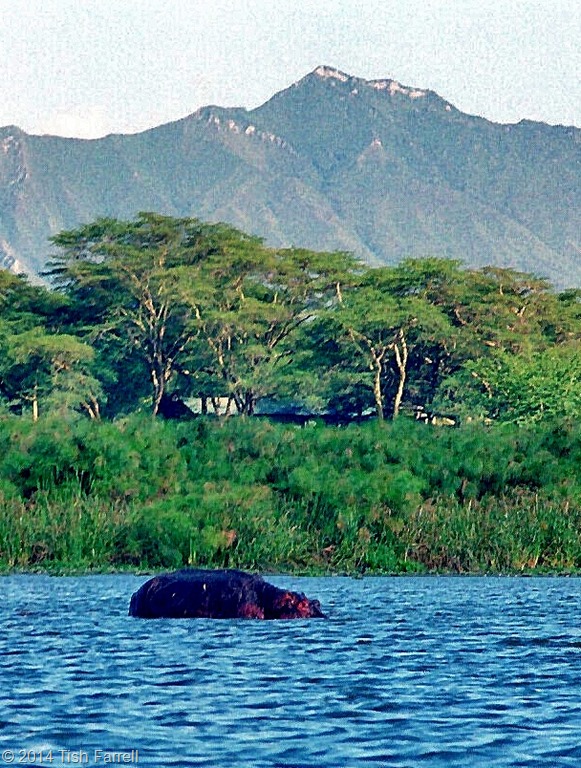
The photograph at the start of this post is of the old volcano, Longonot. It lies in the Rift between Nairobi and Naivasha in Kenya. In the next shot you can see it from Lake Naivasha (hippo added for purposes of scale Smile). Part of this lake is also formed within a submerged crater.
Scan-130716-0010 (2)
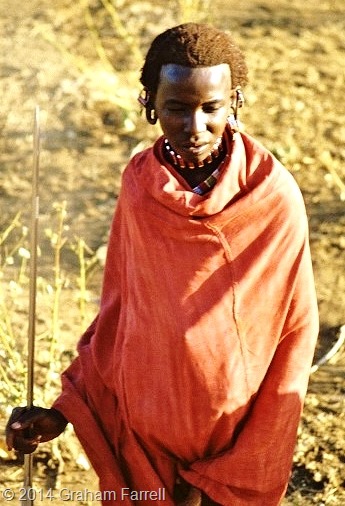
One key side effects of volcanic activity is highly fertile soil. In Kenya and Tanzania the Rift Valley floor supports the Serengeti grasslands that in turn are home to millions of herbivores, their following of big cat predators, and the whole wonderful species-rich eco-system. These plains also have long been the grazing grounds of the best known nomadic pastoralists on the planet, the Maasai.

2 Masai1

Before the British invaded East Africa in the late nineteenth century (intent on setting up the Imperial British East Africa Company) and concluded that any land not occupied by people at that point in time was EMPTY and thus FREELY AVAILABLE, the Maasai ranged over vast tracts of the Rift grassland system. It is believed that their ancestors moved out from the Horn of Africa about four thousand years ago. 

This means that the Maasai lived a life that suited them and apparently with little cost to the environment for 4,000 years before the British came along and herded them into a reserve where the land is least fertile and watered for human purposes, and otherwise known as the Maasai Mara. Europeans then set about destroying the plains’ wildlife on a breathtakingly ugly scale. The invaders, or their activities also became vectors for deadly disease – rinderpest that decimated native cattle, and smallpox and syphilis that took their toll on the human populations.

Rift Valley from Escarpment

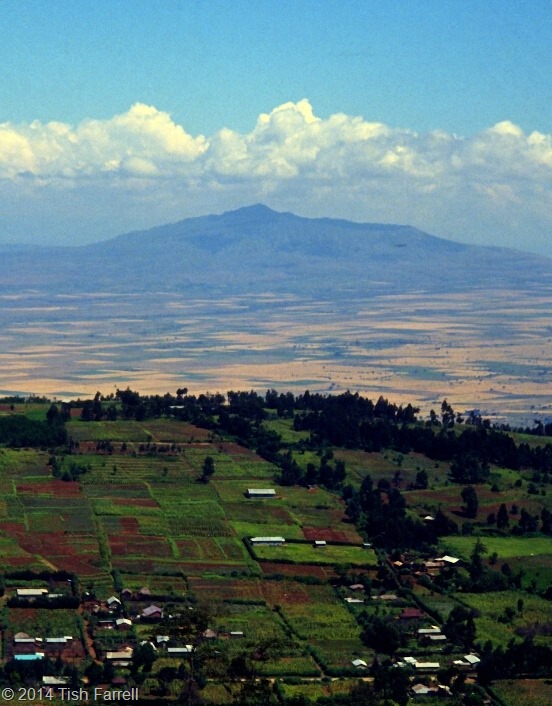
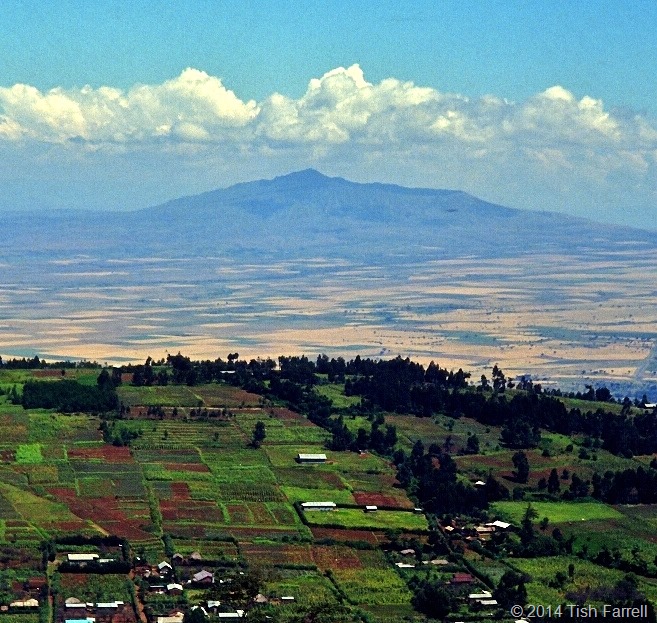
Smallholder farms at Escarpment just north of Nairobi. Mount Longonot beyond.

*

Once the British had staked their claim in British East Africa, the Bantu farming communities that inhabited the higher hillside zones of Kenya were also enclosed in Reserves. The occupants could only leave to work for Europeans. The justification for creating reserves with designated boundaries (and they were quite large areas) was to protect tribal land holdings from the incoming white settlers.

African farmers, being the successful cultivators they had been for several millennia, were naturally inhabiting the best and most covetable land. So in this sense, the British administration had a point. The early settlers were British aristocrats like Lord Delamere and  the sons of the Earl of Enniskillen, and thus the kind of men who expected to own vast acreages and begin farming/ranching on an industrial/landed gentry scale.

Meanwhile from 1896-1902, and as a result of military paranoia of epic proportions, the British had built a very expensive 600-mile railway  from Mombasa to Lake Victoria. It was called the Lunatic Line even at the time of its building. But as the strategic objective receded in importance during the early 20th century, so the Colonial Office needed settlers – well-heeled, gentlemen of means who would grow produce for export and so help pay for the railway.

colonyinmakingor00cranuoft_0023[1]

First page of Lord Cranworth’s A Colony in the Making: Or Sport and Profit in British East Africa, Macmillan 1912. A guidebook and general sales pitch to attract gentleman settlers. (Out of copyright).

*

Thus, in the wake of the adventure-aristocrats came retired military men, among them individuals who were variously set on nation-building, knocking the natives into shape and, in the process, getting rich from flax, ostrich feathers and coffee. The country’s fine shooting and fishing were definite lures, and made much of in the publicity brochures sent out from British East Africa. Other attractions included the notion of plentiful cheap farm labour and house servants, and thus the preservation of social status that was already well on the wane for the middle classes back in Blighty.

napier grass on the Rift

But now we come to the rub. Or in fact two rubs. Firstly, when the monsoon winds are blowing in the right direction, Kenya has the most benign climate imaginable,  providing two rainy seasons, and thus two and sometimes three growing seasons for some crops. The elevated plateau of Central Province in particular, and its Aberdares highlands are rarely too hot. The beauty of the great forests suggested Scotland or Wales rather than Africa to the newcomers. They set about building mini-baronial lodges and laying out English lawns and rose beds.

But then comes the other rub. The soil. As I’ve said, volcanic soils are very fertile, but they are also very fragile. Wholesale clearance of trees and bush will quickly create desert. The late, great Kenyan environmentalist, Wangari Maathai, has maintained that felling deeply rooting forest trees ultimately leads to desertification for a whole range of reasons. 

The forests not only attract rain but the trees shelter, stabilize and feed the soil (many tropical species fix nitrogen). Most importantly, she pointed out, the deep roots open up underground aquifers to water the land.

Traditional farmers of course made gardens within the forest rather than large fields. They cleared trees certainly, but they did not clear all trees. Some had sacred meaning, like the wild fig, and were protected. Others were valued for cropping purposes – for animal fodder, medicine, bee forage etc.

When the old colonials set out for Africa on a cash-cropping spree, full of the notions that they knew best how to farm, they singularly failed to understand that indigenous peoples, far from being ‘undeveloped’, had very good reasons for doing things the way they did them. Their objectives were more about living well than getting rich.

Pre-colonial accounts by explorers and missionaries show that the Bantu peoples were very successful farmers. They planned their planting to take into account the possible vagaries of climate. For instance, drought resistant millet might be the mainstay crop, and cultivated on the  drier soils in their territory. Squashes and beans would be grown near stream beds, and water-hungry maize would be the risk crop,  planted on a river bank on the off chance that seasonal floods would be small enough not to wash the crop away, but good enough to provide a bonus to the annual harvest.

Kikuyu farmer and sugar cane

The other important contingency depended on kinship and clan ties. As the Bantu communities moved out across the African continent over many centuries, pioneering into new territories as population growth or failing soil fertility dictated, networks of clan relationships became extended over quite large territories. If drought, disease or invaders struck, people would take their possessions and seek refuge with distant relatives until the threat had passed.

Pastoralists like the Maasai also relied on being able to move over large distances to secure grazing for their herds in times of drought. But once people were confined to reserves, bound by European constructs of land ownership, they could not move. Land in the Native Reserves where people farmed thus became overcrowded, degraded and overgrazed. Under colonial rule Africans were not allowed to acquire fresh land. This was one of the chief reasons for the uprising in 1950s Kenya when the Land and Freedom Army (dubbed Mau Mau) went to war against British rule.

Then there were the colonial agriculture officers trying to dictate the way the people on the Reserves grew their crops, pressing for mono-culture rather than the traditional way of mixing crops which helps to fool insect pests and utilizes advantages of companion planting.

As we left Kenya in 2000 I was interested to learn that some European agricultural aid project was actually advocating that smallholder farmers (which means most Kenyans) should use ‘kitchen-garden’ planting techniques to reduce crop pest damage and/or the need for pesticides. It had only taken a hundred years for outsiders to teach Africans what they had known all along, but doubtless been told to forget in the interim because their methods were considered primitive.

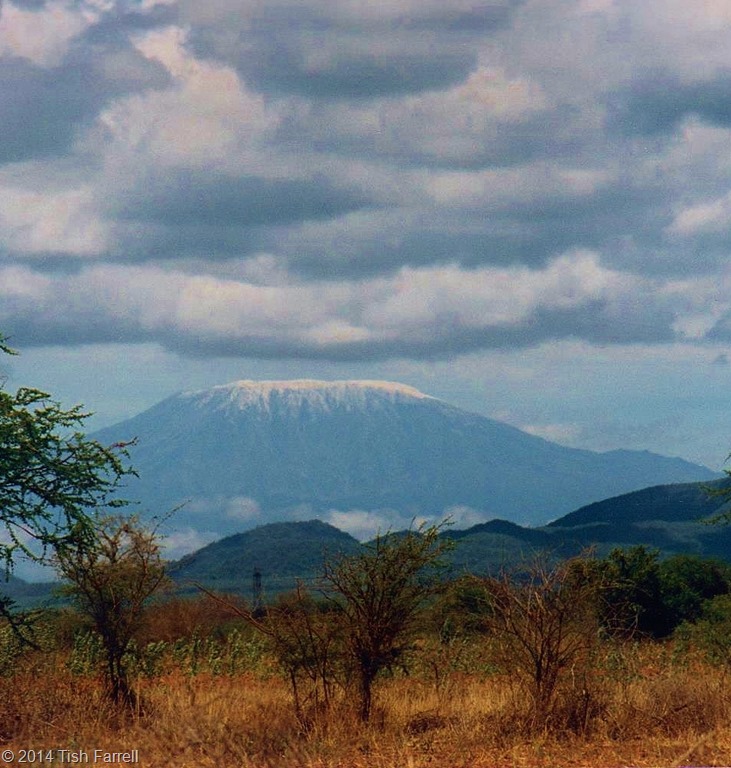
Sometimes the hypocrisy of rich world tinkering is enough to make this particular writer’s blood boil up in seismic fury.  Time to cool down with a view of snow-topped Kilimanjaro. Who’d have thought it: ice on a volcano. When in the 1840s German explorers and missionaries, Johann Ludwig Krapf and Johannes Rebmann, out exploring from their Mombasa mission, claimed to have seen snow-capped mountains at the Equator, no one back home believed them. Thought they were barking. There’s a lot, we outside Africa do not know about this vast, extraordinary continent even though its nations provide us with so many of our essential raw materials, fairly and otherwise; mostly otherwise…

002 (2)

copyright 2014 Tish Farrell


Flickr Comments Tagged ‘V’

Taking the slow road ~ tarrying not typing(#mywritingprocess)

Scan-130703-0009

On the road at #mywritingprocess with thanks to Tiny at tinylessonsblog.com

*

As others on this writerly blog tour have said, some writers are the bees’ knees at doing anything but write. I would be one of them. When the time comes to sit down at the desk there is the sudden compulsion to go somewhere else – anywhere else. This morning I left the computer to scrub the grout between the bathroom tiles. (So absorbing). Later I mooned over pots of recently sown runner beans, and what? Waited for them to grow? Of course. No writing skills needed in Beanstalk Land, only nifty footwork to elude man-eating giants. (Hm. And I could pick up a golden harp while I was there; learn to play, might inspire me to…) You get the picture.

So what is this doing something else all about? OCDD – obsessive compulsive displacement disorder? Why do we put ourselves through this? It was the first question I asked myself when Helen Kuusela aka Tiny at www.tinylessonsblog.com invited me to join this blog tour. I was so busy asking it, I forgot to thank her. So thank you again, Tiny, and hello to everyone on this fascinating writing safari. I forgive you, one and serially, for putting me on the spot.

As to the OCDD, I have a theory, one based on extensive personal observation. When procrastination sets in, and especially after an early full-of-promise burst, your inner truth-teller is trying to make contact with your writing brain. Something is not quite adding up. This is the moment for some pointed self-examination: are you writing yourself into a dead end? Have you started in the right place? Do the voice/situation/setting ring true? Is your plot/concept/premise sound, and does it truly have sufficient substance and energy to become the story/novel/poem you envisaged? Are you writing from within, or only from the surface?

These can be very painful questions and, rather than rolling them around your mind, I find asking them outright and OUT LOUD has better results. The inner truth-teller seems to respond better to vocalized interrogation. Also, the process of outlining the work to an audience, and by that I mean a willing listener who does not interrupt, can reveal both the intrinsic problems and the possible solutions. As you talk, the remedies to stuckness will likely pop out of your mouth. Listen out for them. A passive listening post is thus an essential aid. Your dog, cat or canary would be a good choice. Successful children’s writer, Michael Morpurgo, says he first outlines his stories to his sheep. And as I write this, I’m thinking that a Dictaphone could be a good idea too. If anyone has other notions on this, please tell me.

And now for THE questions:

1) What am I working on right now? In my head, filing cabinets and paper piles I have many works in various stages of creation: picture book scripts, teen novels, a grandiose scheme (possibly two novels for adults) set in colonial East Africa. This last project I’ve been working on for several years – stalled at various points by doubt; then by the annoying tick that says I need to do more research. (This can be another OCDD trap, so it’s wise to keep checking). I am heartened, though, when I hear writers such as Barbara Kingsolver say that it took her nearly thirty years to acquire the wisdom to write the magnificent Poisonwood Bible, or that Tolkein found himself stuck in the Mines of Moria for a whole year, wondering how to write his way out. Such admissions remind me (once I have checked back with myself AGAIN) that the time it takes to finish a piece of work, is the time it takes to finish it. Not everyone can write a book a year. And now I think of it, I’m sure I read  that the marvellous short story writer, Alice Munro, takes eighteen months to write a single story. And when you read her, you know why. She distils whole novels into her short form.

For now, I’m recycling my ‘back catalogue’ of published short stories, creating new editions as Kindle e-books. I have just kindled Losing Kui, a novella originally published by Cicada Magazine in the U.S. a few years ago. On one level it is a tragi-comedic view of everyday life in a fictitious East African country during the late ‘90s. On another, you might call it an allegory, but I leave it to readers to decide what I mean by that.

2) How does my work differ from others of its genre? I am truly not a fan of categories, although I know marketing persons insist on them. What matters to me as a reader and writer is a well-crafted story, whether it is a 300-word picture book, Hilary Mantel’s Booker winning Wolf Hall or a Lee Child thriller. Most of my published work comprises short stories/novellas that are accessible to both adults and teens, and so I suppose you could call them crossover literature. Books for young people are anyway not so hide-bound, and may combine several so-called genres: real-life and historical narrative inter-threading with fantasy/magic realism. I find myself increasingly attracted to this combination.

3) Why do I write what I do? I had always meant to be a writer, but it was only when I went to live in Africa during the 1990s that I found a REASON to become one. In Kenya I was confronted with big landscapes and big human issues in which my own country had long played a questionable part. Suddenly I had a viewpoint and a focus and a territory. I was incensed too, by the wholesale imposition of western ‘values’ that left young Africans thinking it uncivilised that their forebears lived in mud and thatch homes. That’s one of the things that spurred me to write contemporary fiction for African young people. See (Latest books).

Some 14 years after returning to the UK, I’m still teasing out stories begun in Africa. I keep meaning to head for other lands, and one of my Ransom quick-reads for teens, Stone Robbers, is set in Guatemala. I suppose I am driven by the desire to tell stories about people who do not have a voice in the wider world, or who live in ways that are fast disappearing. In the margins between tradition and consumer modernity there are the kinds of drama and conflict that every story needs to make it work.

4) How does my writing process work? My people always arrive first. Even if I can’t clearly visualise them, I have a strong sense of them and their particular dilemma. After nearly 20 years of writing I have amassed quite a crowd, all waiting for their stories to happen/move on/finish. To discover what their stories may be, I always do a lot of research – too much probably. But without fail, the ‘what happens’ always emerges from this reading. In that sense, I do not make things up. How the works come together thereafter depends on finding some sort of imperative. This could be a writing competition deadline, or a publisher’s call for a certain kind of work. As Tiny says in her post, you do need deadlines. And perhaps, to come full circle, a lot of writer’s OCDD is also down to not knowing who will want to read/publish the work once it is done. While it remains unfinished, both failure and success are forever postponed. Keeping to your chosen path is hard to do, and I’ve written more on this HERE. But now please meet Celestine Nudana from Ghana, West Africa. clip_image002 She will be heading out on the next leg of  the #mywritingprocess tour (26 May).  She has been blogging at Reading Pleasure since 2012: http://readinpleasure.wordpress.com/  and believe me it is always a pleasure to visit her there. 

Celestine is Senior Assistant Registrar at the University of Professional Studies, Accra, Ghana. She is married and has three boys. She attended the University of Ghana, Legon, where she read English and Theatre Arts, majoring in play writing. She also has a Masters in International Affairs. As well as being a passionate reader and book reviewer, she has also developed a special talent for writing haiku, although she says she is still at the learning stage. Even so, her work has been included in two recent anthologies: Western Haiku: A Collection, and Ballads, bothproduced by Dagda Publishing UK, an  independent publisher who aims to show-case the freshest poetry and literature by new writers from around the world. The works are available as e-books. She has also had her flash fiction published in1 Photo 50 Authors 100 Words edited by Madison Woods.

She says of herself, “I am a romantic at heart, and love a good romance story, though I shy away from erotica. Almost all my poems focus on love, or aspects of it.” Celestine has written romantic fiction for serialization in several Ghanaian newspapers, and deployed her play writing skills to produce radio serial dramas that deal with topics including child health and female sexual reproductive health. So here is a woman who writes on many fronts. I’m looking forward to hearing what she has to say about her writing life.

*

Now here is my second writer introduction. She was a bit held up, so this is a last minute addition. I’ll let her speak for herself:


Hello! My name is Vashti Quiroz-Vega. I’m a writer of Suspense, Fantasy and Horror. I also enjoy mixing in some Humour and Romance into my stories. From the time I was a young kid, writing has been my passion. I’ve always been a writer; I just didn’t know it until  much later. For me, it is easier to express my thoughts on paper than with the spoken word. I enjoy making people feel an array of emotions with my writing. I like my audience to laugh one moment, cry the next and clench their jaws after that. My love of animals and nature are often incorporated in my stories. You’ll read intriguing things about various animals, nature and natural disasters commingled with my character-driven novels. I love to read almost as much as I love to write. Some of my favourite authors are Stephen King, M. Night Shyamalan, Michael Crichton, Anne Rice, J. R. R. Tolkein, J. K. Rowling and Dan Brown.

Vashti's Web Photo (361x640)

http://vashtiqvega.wordpress.com

 *

RELATED POSTS:

This fiction writer’s path: five things learned along the way

Writing tips: Knowing your place

Errant muse? There’s still life at the allotment

TO SEE OTHER WRITERS’ POSTS IN THIS TOUR, GO TO THE READER AND USE THE SEARCH TAG: #mywritingprocess

On watch at Elmenteita–the lake that blows away

003 - Copy

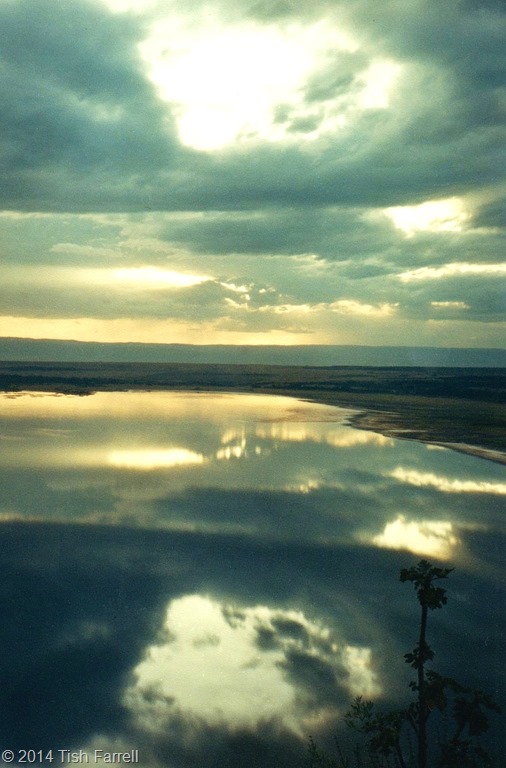
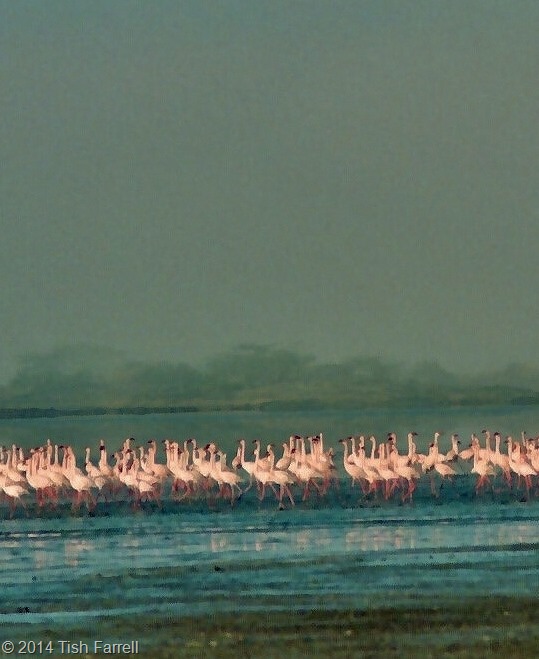
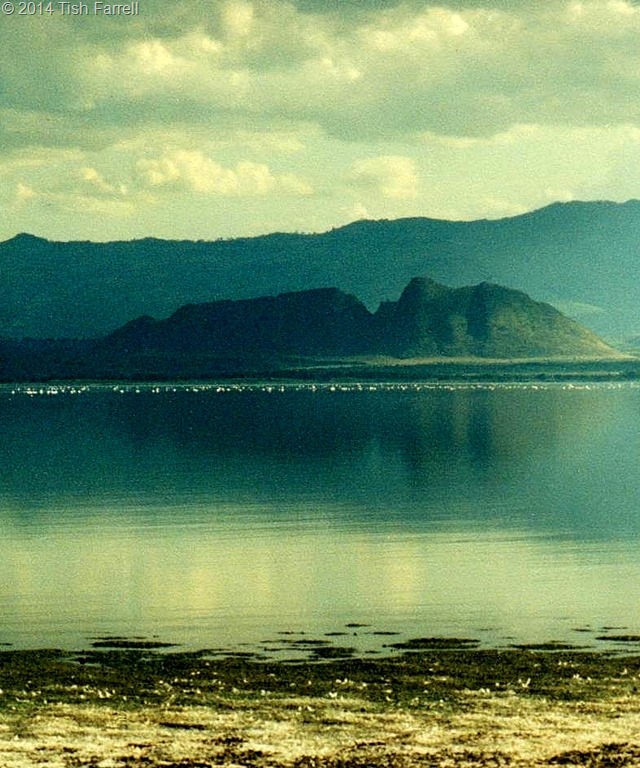
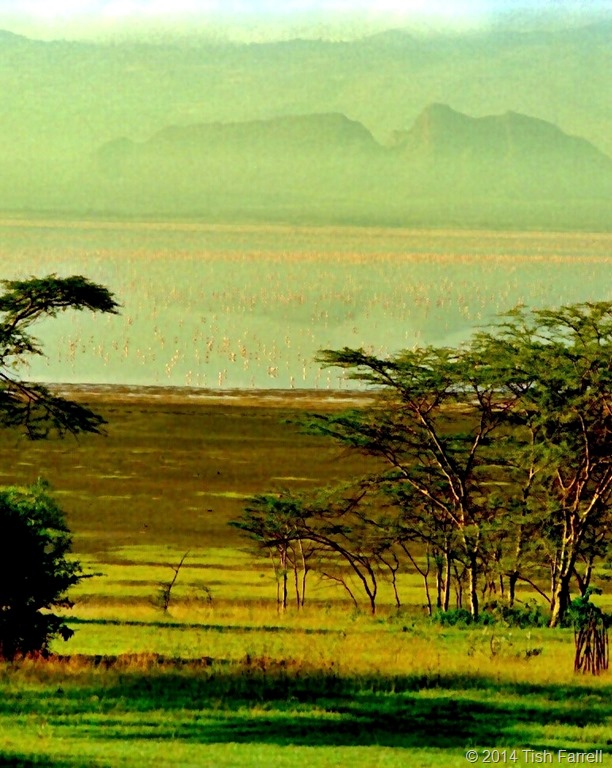
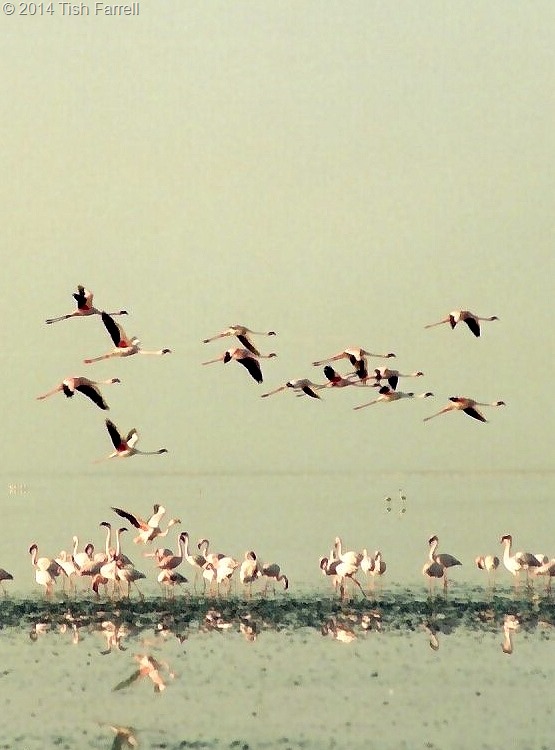
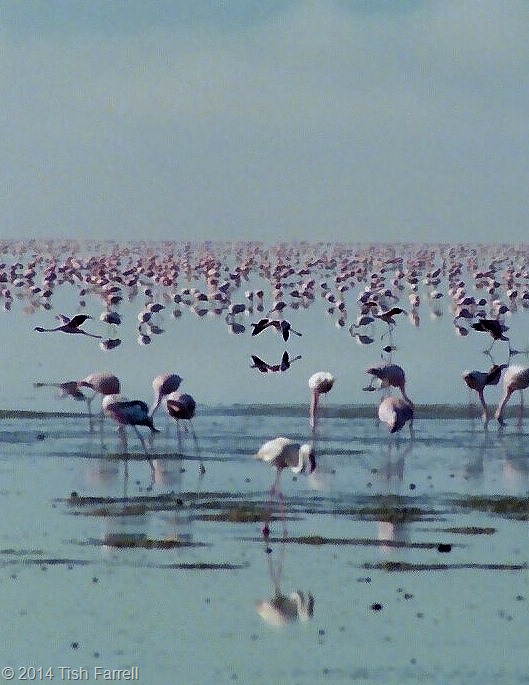
The light changes every second across the lake. From dawn till dusk there is always something to watch at Elmenteita in Kenya’s Great Rift. There are over 400 species of birds to spot for one thing – among them the endangered white pelican that breeds there. The main stars, though, are the surely the huge flocks of flamingos, both lesser and greater varieties, that turn swathes of the lake to rose-petal  pink. Even a passing glimpse  from the nearby  Rift highway  is enough to catch the breath. A pink lake – how can that be?

Scan-140503-0002

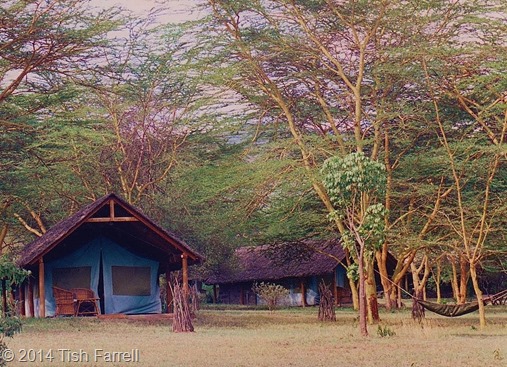
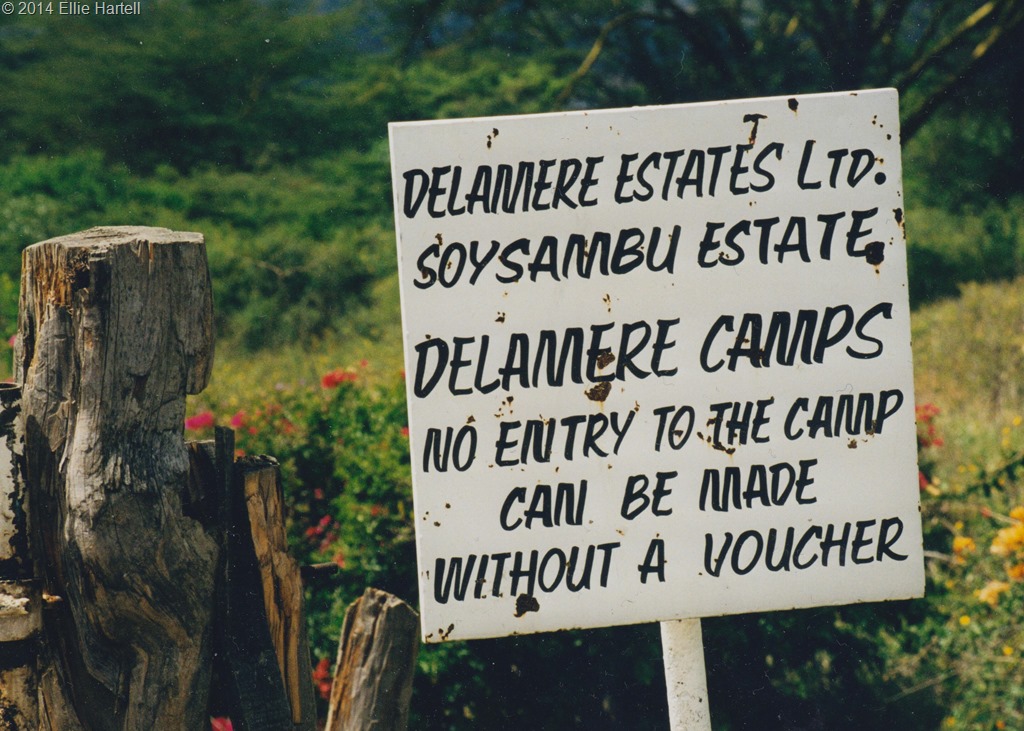
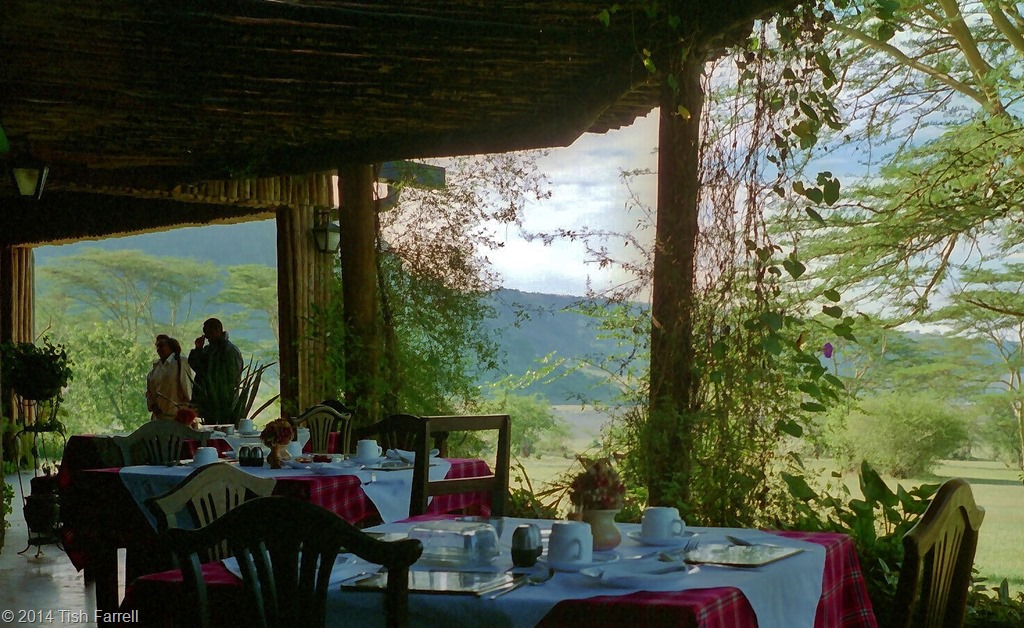
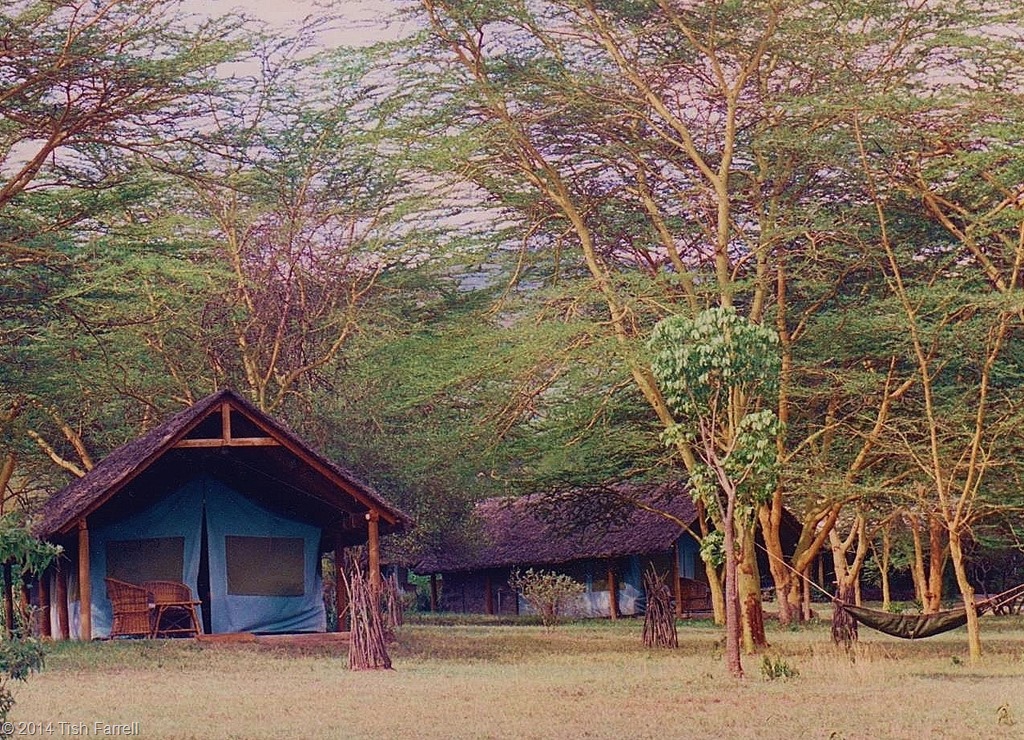
We came here often while we lived in Nairobi, staying at Delamere tented camp on the lake shore – a quirky, step-back-in-time establishment within its own nature reserve. The camp, itself was wholly unobtrusive -16 large tents, each sheltered by a thatched canopy and set out beneath fever trees that, here and there, hosted a sturdy canvas hammock.

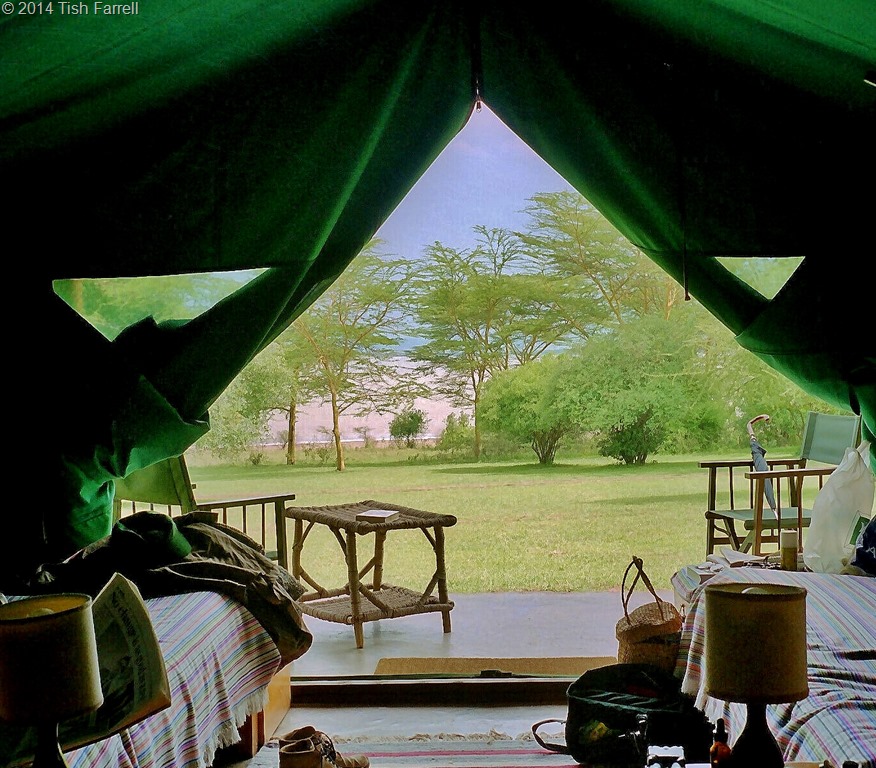
The tents were functional – two wood-framed beds, simple cupboards, rattan chairs all locally made. They came, too, with a plain little bathroom attached out back – running water, flush loo and shower – all facilities that would still be an unobtain-able luxury to millions of Kenyans. Inevitably, knowing this added to the discomforting ‘them and us’  awareness that accompanied us pretty much everywhere. 

005

For us wazungu, then, Delamere Camp was an idyllic spot. I once spent a week here by myself while G was at a conference. There were no other guests for most of that time, external and internal tourism having been hit both by El Nino rains that had caused weeks of havoc, and by widely reported bouts of pre-election violence.  Manager, Godfrey Mwirigi, treated me as if I were his personal house guest.

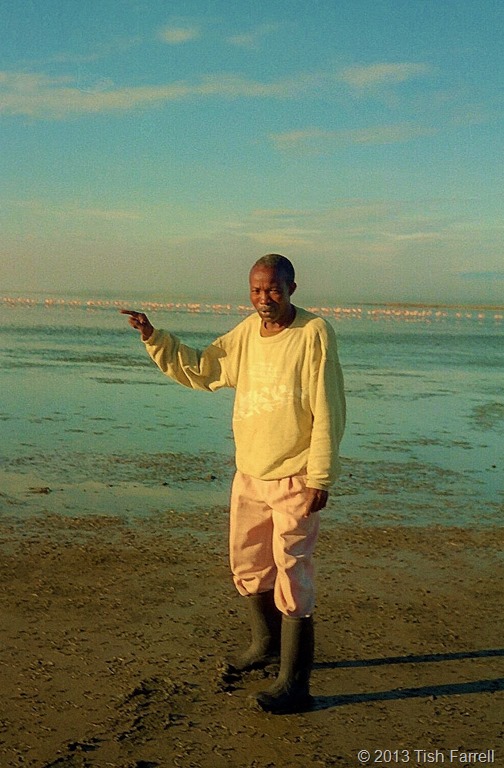
I thus spent my days and nights being driven around Soysambu nature reserve in a safari truck with zoologist, Michael Kahiga as my expert guide, or taken on early morning bird walks through  the bush, or on late afternoon hikes up through the sage-scented leleshwa brush to Sogonoi cliff-top to watch the sun set over the lake with a glass of wine in my hand. This, the daily late afternoon pilgrimage to the sun-downer cliff, was a pleasing piece of  hospitality thought up by  Paul Kabochi, the camp’s ethno-botanist. I have written about him in an earlier post, but here he is again on the lake shore at dawn.

Scan-130602-0001

On this solitary sojourn I was sorry to find that he was away setting up another camp. He is a man whose great fund of knowledge is sadly missed, and I would have been glad to have had another chance to speak with him.  Instead, I talked to Godfrey about tourism. He kindly ate his meals with me so that I did not have to  sit in the dining room alone.

Between times, hot water bottles and extra blankets appeared like magic in my bed, or indeed in the truck for the evening game drives. (Nights in the Rift can feel frosty). And all the time I watched and watched until my brain ached with sensory overload.

Scan-140502-0013

The camp overlooked the lake and the remnant volcanic cone that has long been known by the Maasai as the Elngiragata Olmorani, the Sleeping Warrior.  During colonial times it acquired a further name – Lord Delamere’s Nose, this apparently in tribute to the impressive dynastic proboscis of the third baron Delamere who, in the early 1900s, and as one of the first pioneer colonists, acquired  19 hectares (46,000 acres) of shore-land around the  the east, north and west of the lake.

His brother-in-law, Galbraith Cole, son of the Earl of Enniskillen, farmed the southerly shores at Kekopey. He was a man who was later exiled from British East Africa because he shot dead one of his labourers for stealing a favourite sheep. He later sneaked back to Kekopey disguised as a Somali, and his mother, Countess of Enniskillen successfully pleaded his cause. At the age of 48, and looking out over the lake, he shot himself, unable to bear the constant pain of his rheumatoid arthritis.

001

The descendants of these early settlers still live and retain most of their lands (including estates at nearby Lake Naivasha). In fact the only way to gain access to Elmenteita is to book into one of the exclusive safari lodges that now stand on the land that belongs to these old colonial families. This sense of British aristocratic exclusivity inevitably strikes a sour note. Doubtless these landowners will say they are custodians and that, without their dutiful care, the place would be wrecked by ramshackle trading operations and squatters, and the wildlife decimated.

001

Even in my home town in Shropshire we are still ruled by such feudal argument. ‘Keep Out’ signs exclude the people of Much Wenlock from the ancient Priory parkland that is  now owned by one family. In Great Britain we take for granted (or are even unaware of) the power of the self-appointed, self-aggrandizing elite who own most of our countries’ lands.  I imagine, though, that many people would be surprised to know that super-squiredom is also alive and well  in East Africa.

Scan-140502-0023

Before the British annexed East Africa in the 1890s, and all the (deemed) unoccupied territory became the property of the British Crown, and the locals obliged to stay forever  on the land where the British happened to find them,  land usage and territorial ownership was a much more fluid affair. For instance, up in the Rift highlands, and going back hundreds of years, the Kikuyu farmers had negotiated the legal acquisition of new land with the indigenous Okiek hunters, whom the Kikuyu judged to be the land’s original owners. Over the centuries this process of colonisation caused an occupational creep: as land became exhausted or overcrowded, so clan scions left their fathers’ homesteads and sought out fresh territories for their own families to cultivate. It is a similar story over much of the continent as the Bantu agriculturalists sought fresh ground.

As the boundaries of  allotted farm and pastureland nudged further into the Rift, so there was competition and conflict with the pastoral Maasai. The herders anyway believed themselves masters of the Rift, shifting up and down it as need for fresh grazing and water dictated. The farming communities with whom they traded and inter-married also at times presented an alluring target. This was inspired by the cattle herders’ belief that Enkai, the creator, had bequeathed all the cattle on earth to the Maasai. For young warriors intent on proving their courage and amassing cattle to augment family honour, armed cattle raids on their farming neighbours were a matter of necessity.

It is interesting, then, that colonial aristocrats such as Delamere, who established large stock ranches in the Rift, were inordinately admiring of the Maasai, seeing them as nature’s aristocrats. It is also tempting to put this down to a congruence of world vision: recognition of a mutual case of droit du seigneur? In fact in those early days, Delamere was the only white man for whom the Maasai would deign to work, although this did not stop them from making off with large numbers of his sheep and cattle.

Scan-140502-0067

That the Rift was once Maasai territory is indicated by the many place names – Naivasha, Nakuru included – that are European renderings of Maa originals. Elmenteita derives from  ol muteita,  meaning  “place of dust” and, from time to time, this shallow soda lake does turn to dust.  At the best of times it is only around 1 metre deep. It shrinks and expands depending on the rains. But when not blowing away to dust, it extends over some 19-22 square kilometres.

The alkaline waters are rich in the crustacea and larvae that the greater flamingos feed on, and in the blue-green algae that the lesser flamingos syphon up through the top of their bills. The former have white plumage with a pink wash; the latter are more the colour of strawberry ice cream. Both honk, and grunt and mutter in a continuously shifting mass. All night you can hear them as you lie awake in your tent.

Scan-140503-0058

A view to dine for: Losogonoi Escarpment and the lake shore

*

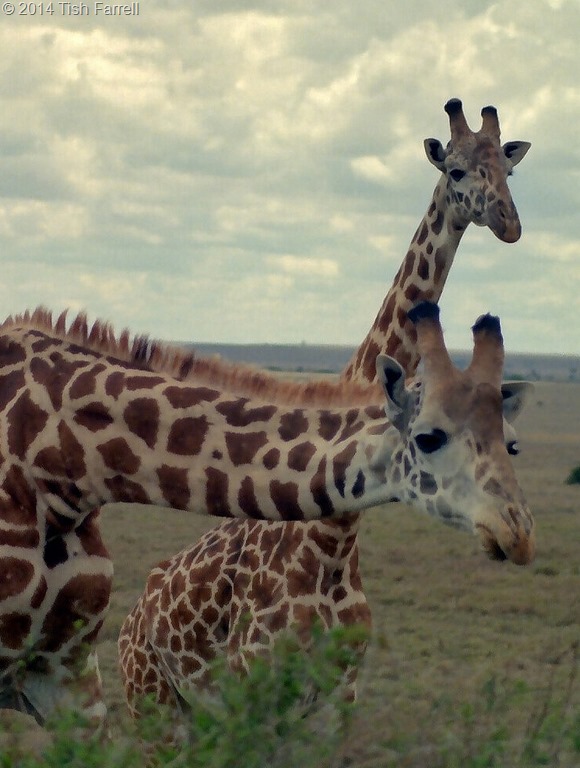
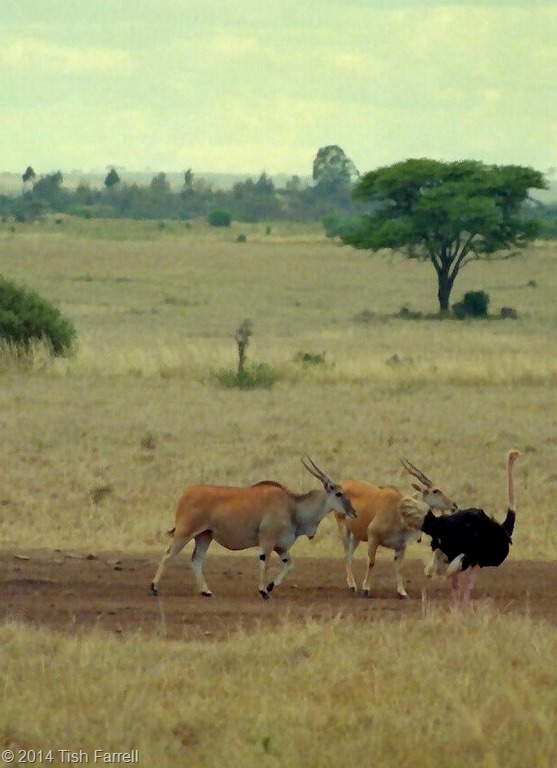
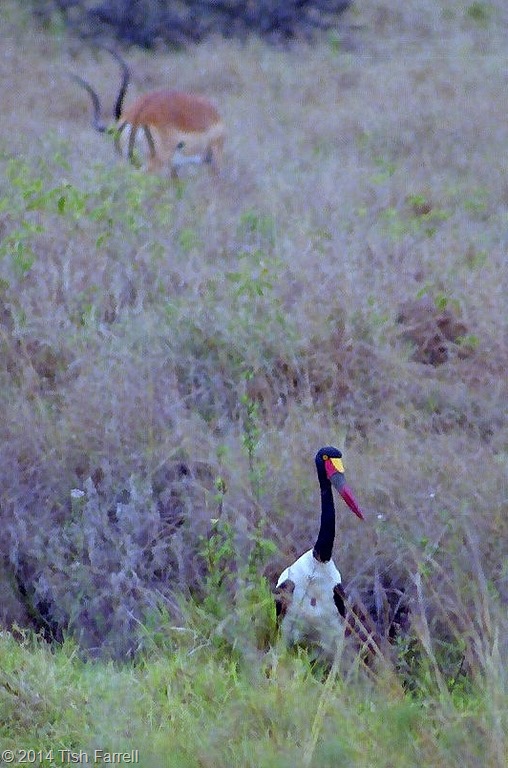
But it is not only the bird life that make this place so special. The traditional ‘big five’ may be lacking in this part of the Rift, but it is still home to Rothschild giraffe, eland, buffalo, zebra, ostrich, impala, gazelle and a host of smaller game – aardvark, zorilla, porcupine, African wildcat. Since our time in Kenya much has changed at Soysambu. In 2007 the private Delamere Estate began operating as a not-for-profit conservation organi-zation called Soysambu Conservancy.

Delamere Camp has long gone. In its place is a new enterprise, the very expensive Serena Elmenteita Luxury Camp, a sort of out-of-Africa manifestation with bells on, the kind of set-up that intrudes a different kind of exclusivity on this piece of Kenya. But then of course there’s always the usual argument: that the provision of luxury on this scale does at least provide many, many jobs for Kenyans. Across the lake, however, something of the original Delamere Camp ethos has been re-created at the Sleeping Warrior Eco Lodge and Tented Camp – all within the Soysambu Conservancy.

In fact things have not been going well with the Delamere family. The sheer mention of the name has been enough to evoke great fury among many Kenyans. In 2005 and again in 2006, Thomas Cholmondeley, sole heir of the 5th Baron and Soysambu’s manager, admitted to shooting dead an African. The first case involved a plain clothes officer working for the Kenya Wildlife Service, apparently on the Soysambu farm to investigate a poaching incident. Cholmondeley says he thought the man was robbing his staff. Action against him was dropped.

In the second case, he caught a group of poachers with a dead impala, and said he was shooting at their dog when he fatally wounded one of the men. Later he claimed it was his friend, Carl Tundo, who had shot the poacher, and that he was covering for him. The whole sorry story was featured in the BBC Storyville film Last White Man Standing. Later the charge of murder was changed to manslaughter, and in any event Cholmondeley spent 3 years in Kamiti Maximum Security Prison, Kenya’s toughest jail. To many, though, it was thought to be far too lenient a sentence. The high profile media coverage also  reminded  millions of landless Kenyans that certain individuals had in their sole possession unimaginably vast estates. The old skeletons of racism and colonial oppression came rattling out of the cupboard to fuel the general furore, as the poacher’s widow asked for justice.

And so what in the end are we left with – a beautiful place enmeshed in tales of human intrigue, slaughter and misadventure.

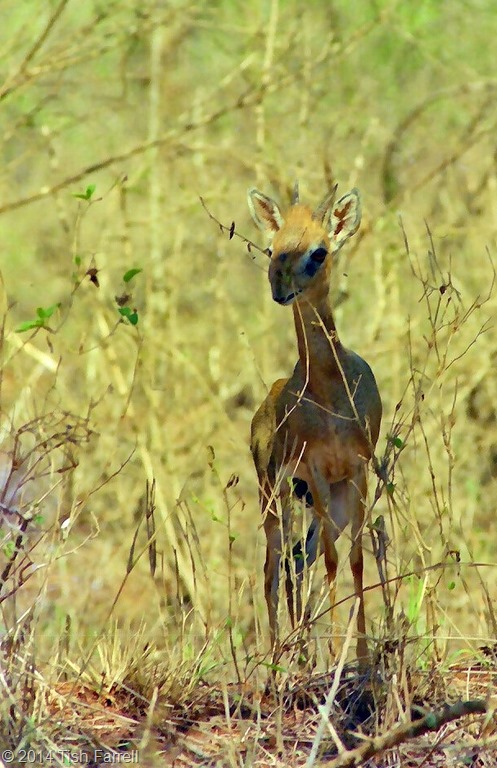
I know I was lucky to spend so much time there when I did, and to see it through the eyes of the Kenyan naturalists who were my guides. I hope that many of them still work there – for Serena or Soysambu. They taught me how to watch out in that landscape: to recognize tracks of genet cat and mongoose, to poke through the little piles of dik dik droppings that marked this tiny antelope’s territory, to identify a black-breasted apalis or shy tchagra, to listen for the calls of the red-fronted tinkerbird, to know that an infusion of bark from the muthiga or Kenya Greenheart tree is good for toothache and stomach upsets, and most especially not to fall into aardvark holes as I was walking through the thornscrub.

Finally then, a few glimpses of Soysambu’s beautiful creatures.

Scan-140502-0042

Scan-140504-0002

Scan-140504-0003

Scan-140504-0004

Scan-140504-0005

Scan-140504-0009

Scan-140503-0036

Photos from bottom up:

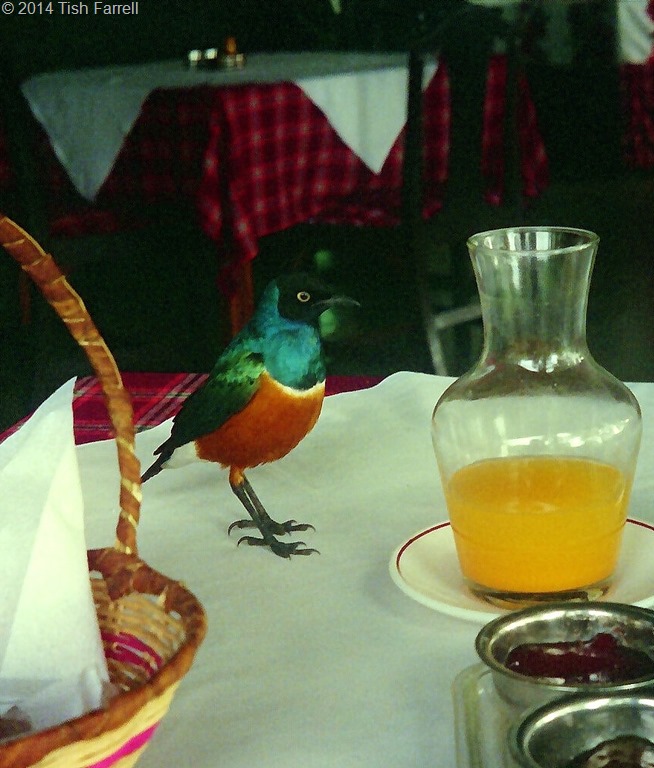
Superb starling comes to breakfast

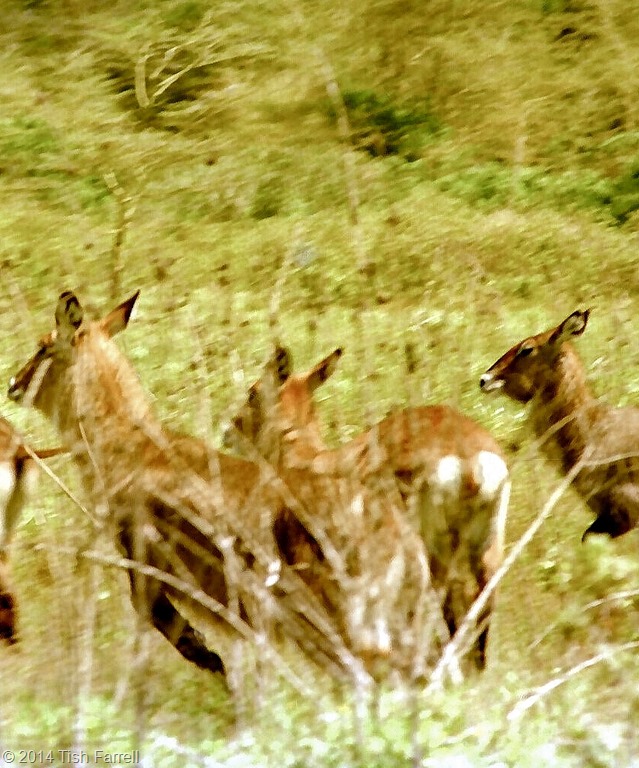
Waterbuck females

Dik Dik (one of the smallest antelopes, slightly larger than a hare)

Saddlebill stork, impala in the background

Eland (the largest of Africa’s antelope) and ostrich

Burchell’s zebra

Rothschild giraffe

Scan-140502-0046

© 2014 Tish Farrell

A Word A Week Challenge for more stories

This fiction writer’s path: five things learned along the way


068

1) Swimming not drowning: there will be (many) false starts

I associate intending to be a writer with learning to swim. I was ten, in my last year of primary school, when I told Mr. Williams, my very Welsh head teacher, that I meant to be a writer. I said it with great certainty, and he listened in all seriousness. He was someone I trusted implicitly. He was also the person who taught me to swim, and to me, decades later, the way he did it still seems a little miracle.

There were several non-swimmers in the senior class and one day Mr. Williams decided to remedy this life-threatening deficiency. Once a week for several weeks he drove us to the swimming pool in the school minibus. He made no concession to the occasion and still wore his smart grey headmasterly suit. Looking back, he probably did this on purpose. It showed he meant business and we were not there to play. The suit’s material had a soft metallic sheen and probably went by the name of Tricel. It somehow had a part to play.

After a couple of trips to the pool I had fully grasped the mechanics of swimming, but was unwilling to give up my rubber ring. Mr. Williams, however, was determined. He told me to walk twenty paces into the pool’s shallow end. He told me to take off the rubber ring. Then standing at the pool’s edge, he squatted down so low that his trousers strained across his knees and shone like silver. His eyes levelled with mine as I stood there – in the water – shivering – without my protecting ring. He told me to swim but I kept standing and staring at his knees, feeling silly and helpless. Then suddenly out flew his arms in a welcoming embrace. ‘Come on,’ he cried. ‘Swim to me. YOU.CAN.DO.IT.’ And such was his look of unconditional expectation that I took to the water and swam.

And the point of this story? Becoming a writer/maker/artist means learning to  grow and nurture your inner Mr. Williams. Along the creative path there may be few external expressions of encouragement. But without the deep-down core of self-belief you will not have the resilience to stay the course, bear the disappointments, handle the rejection slips, or to toil and toil alone for the days, months and years it will take to learn your craft. All of which is not to discourage, but to say that you really have to want to do this.

2) Having formed your intention, do NOT wait for inspiration to strike: you can wait till the crack of doom

Of course learning to swim is not the same as being a good swimmer who can swim fifty lengths with ease and feel quite at home in the water. To become a skilled artisan of any kind, there is the long haul of apprenticeship, probably one that will never end. I, though, and like many would-be writers, went for years, carrying in my head the apparently foregone conclusion that one day inspiration would strike and I would begin to write my own stories instead of reading other people’s.

It rarely, if ever happens this way. Besides which, inspiration is only the starting point, the ‘ah-ha’ moment when your attention fixes on an overheard conversation, or collides with a character on a bus, or gets hooked on some bizarre news event that starts you asking the kind of questions that kick off the story-making process. Mostly, though, you need to seek it out. Because the fact is, even if you are not actually writing, you must be doing the internal work, mentally exploring the stories that you might one day tell, gathering material, keeping watch, feeding that tiny flame of an inkling that says ‘I do have a story to tell’. ‘I do have something important to say.’

Inspiration, then, does not arrive ‘out of blue’ or occur in a vacuum; it needs one, two or several things to rub together. You could say it’s a bit like the slow-going process of rubbing dry sticks together, and trialling likely bits of kindling to get a fire started. In that initial whoosh of a blaze taking hold all is very exciting, but it is only the start. Now the hard work really begins – keeping the fire going, finding suitable material that will burn well – fast or slowly or long enough to cook your dinner. In other words, flash-in-the-pan, quick-fire notions (inspiration) are the easy part. Thereafter comes the sourcing of materials, planning, construction and general project management. You can only truly learn how to do this by doing it. So how to begin?

3) Do not fall into the trap of thinking that reading other writers will drown out your own small voice before you even start: read, read, read…

As an adult, my writing work was largely academic: dissertations, reports, preparing educational materials in various museums. Somewhere along the line I stopped reading fiction; I feared that to do so would distract me from finding my own inspiration, my own voice, my own stories. I have met other beginner writers who said they did the same thing, and especially when it came to books that they thought might ‘compete’ with their own ideas. Yet not to read widely is another form of writer’s self-sabotage. Writers need to read anything and everything they can, and across all genres, and they need to read with attention and discernment. For instance, you can learn a huge amount about story construction by studying an infant’s picture book that contains only around 30 words (Pat Hutchins Rosie’s Walk).

In fact some of the best-crafted storytelling on the planet is for young people – and here I’m thinking of writers such as Richard Peck, Sharon Creech, Robert Cormier, Kate di Camillo, Geraldine McCaughrean, Philip Pullman, Jennifer Donnelly, David Almond. Reading good books with all senses attuned is akin to having mental conversations with other writers; far from swamping your own style/voice/subject matter, listening carefully to what they say and how they say it can help release your very own form of creative expression. This is not about copying ; it is about finding your own truthful response to other writers’ work. Writing a book or a story or a poem is not a contest with anyone else. It is your book, story, poem. Only you can write it. And if in doubt, think ‘Mr. Williams’. At some point you have to get in there and swim.

But of course, having joined the fray, then comes the endurance testing and training, the honing of skills, and goal setting.

4) Being a good writer is not the same as being a good storyteller

Some people are natural storytellers, and especially so when they come from families or cultures where oral storytelling is still practised. Even so, and no matter how you treat them later, it helps to learn the storytelling basics: the beginnings, middles and ends of a story, their possibilities, the ways to build tension and interest, how to manage revelation, crisis and resolution, what it takes to create believable worlds (real-life or science fiction), to breathe life into characters who will then ‘speak’ to readers, to make effective and affective use of language.

All these skills can be learned to some extent by much well-directed reading, including studying a few how-to-write books on the way. But taking out a subscription to a good creative writing magazine or attending a class are the more interactive and less lonely options. The disciplines of entering magazine contests or doing class exercises – reading others’ work with interest rather than envy, writing to deadlines, word counts and prescribed themes are all worth cultivating. They all build the kind of writing muscles you need to best deliver ‘the what’ of the creative process – the  story.

5) Writing fiction does not mean ‘making things up’; it is all about building convincing worlds.

This is something that is easily misunderstood, and it took me some time to grasp explicitly. Fiction reveals imagined worlds and their inhabitants in ways that are truthful in. Integrity and authenticity are key objectives. The setting may be a medieval Russian monastery, a London secondary school, or a planet with two suns, but it must ring true for the reader. Its special characteristics will add depth and texture to the narrative, but above all, they will be dynamic – informing, shaping, adding drama to the characters’ behaviour/situation/dilemmas. This requires considerable research and construction work by the writer, but with the caveat that, at the end of the process, only the writer ever needs to know all this stuff. The reader wants only the most telling details, the ones that, like literary hyperlinks, will take them straight into that special place and engage them wholeheartedly with the characters’ lives. (A fine example of this is Hilary Mantel’s Wolf Hall where she uses historical, social and political contexts to reveal the life and times of Thomas Cromwell.)

To achieve this level of ‘reality’ requires the writer to have strong reasons for telling a particular story. As I’ve said, creating a story from start to finish requires drive and stamina. Passion, pain, compassion and anger are great spurs, but their energy needs to be channelled judiciously. (No ranting or heavy-handed moralizing required and the writer’s self should keep well out of the way). The research part of the project may also demand a whole new reading schedule (encyclopaedias, atlases, internet content, telephone directories, newspapers etc) and, where possible, physically immersing yourself in the places where the story is set.

This is all about knowing your territory as an expert guide would know it. Only then can the alchemy begin. Or perhaps shape-shifting is a better analogy. Because this is one of the most important of all the things I have come to learn from the practise of being a writer: the writing must come from the inside out; writers must inhabit their character’s minds, shoes and underpants; whatever it takes to get inside their skin. For me, this usually means starting with the feet rather than the knickers department. When I wrote about a street girl called Jessicah, she was conjured by a ‘feeling’ in the balls of my feet as she tramped in thin-soled shoes through the African highlands. Years later I can still summon that particular sensation and know it is Jessicah, and start seeing the world again through her eyes. All of which is very strange when you think about it, and probably the reasons why most writers keep writing. For the final truth is that even well-published writers struggle to make a living from book sales alone. Writing then, first and foremost and anyway, has to be done for the love of the thing.

© 2014 Tish Farrell


Tish Farrell writes short fiction to entice unkeen teen readers to read in the Shades series at Ransom Publishing. She also writes for Heinemann Junior African Writers, Zimbabwe Publishing House and Phoenix Publishers East Africa. Her short story Flight came third in last year’s International Bath Short Story Award.


Writerly Reflections

Looking inside ‘The House of Belonging’: remembering artist Sheilagh Jevons

House of Belonging detail i

The following is the account of a conversation I had with Sheilagh in 2014, a year before her death. She is sadly missed.

*

I thought it was time I welcomed good friend and artist, Sheilagh Jevons, to this blog. She lives a few miles from me along Wenlock Edge, in the little village of Easthope. There, and in her studio not far away, she creates arresting work that explores the sense of belonging that people have with landscape. From time to time she and I have involving conversations about the creative process – the stumbling blocks, the sources of inspiration, the way we work (or in my case, don’t work).

A few weeks ago she came round for coffee. I wanted to ask her about a painting I had seen in her studio. I had thought it striking and mysterious, and wanted to know what she meant by it. Besides which, it is hard to resist the opportunity to grill an artist when you have one captured inside your house.

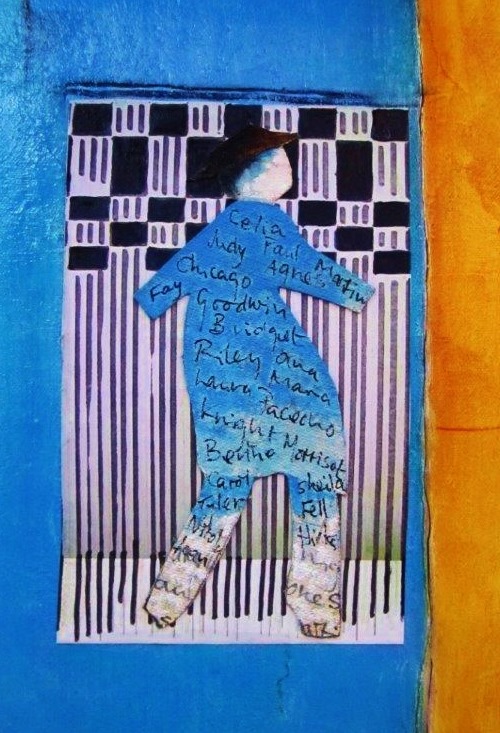
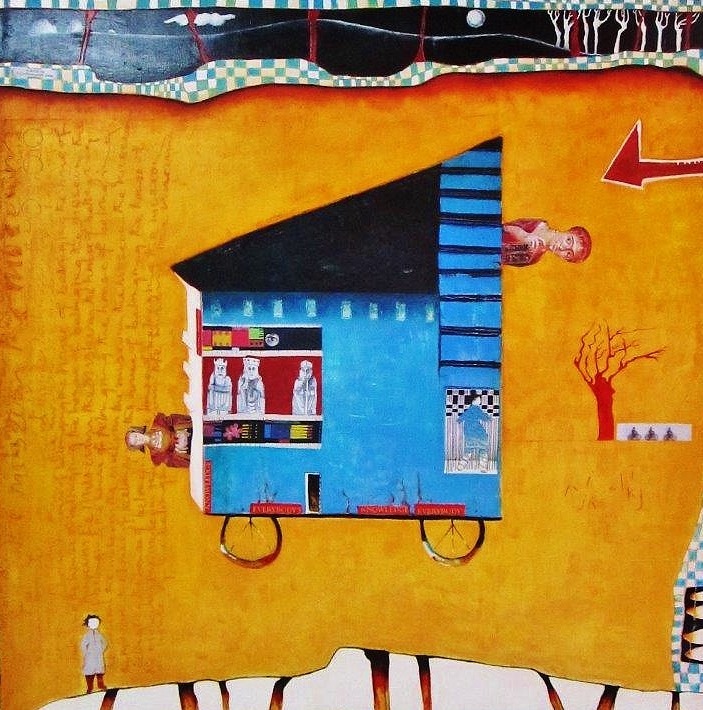
The header image is a small detail from a work called The House of Belonging. This figure has appeared in Sheilagh’s other works and represents women artists. Some of their names are written on the smock, artists perhaps not well known to the general public. Here she pays homage to their work, but also alludes to the fact that, overall, very little work by women artists is to be found in museums. The writing of names and of repeated key-words and equations is characteristic of many of Sheilagh’s pieces. It was one of the things I was going to ask her about. But first, the painting.

House of Belonging ii

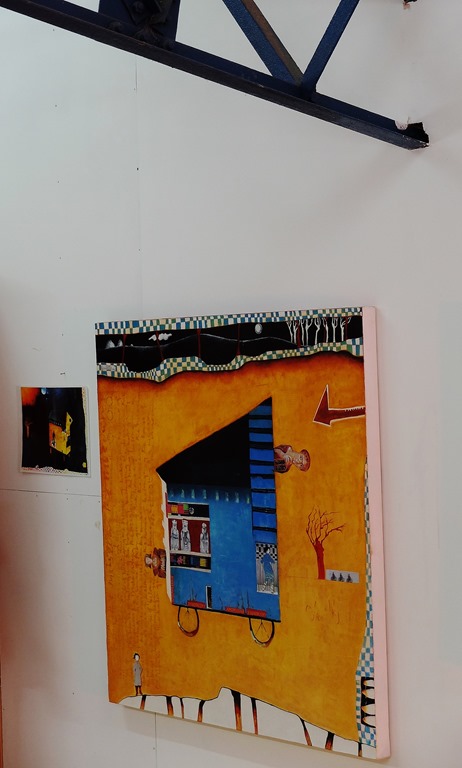
It is a large canvas, some 4 feet (120cm) square. The next photo gives a better sense of scale. Here it is hanging in Sheilagh’s studio:

Shelagh 003

I asked Sheilagh how the work began. She told me that some years ago the idea of belonging had become very important to her. As she says on her website:

Our ‘sense of belonging’ ripples out from our homes to our village, street, town, county, region and country and help to shape our identity…

Key, then, to her work is a sense of connection to land and how that relationship defines us. This in turn has physical expression in community repositories, the places where we keep artefacts, our history, the knowledge of ancestors – all the familiar things we recognise and which tell us something of who we are. In other words, the museum, or as Sheilagh describes it: the house of belonging. The script running down the left-hand margin of the painting in fact repeats over and over the words ‘the museum’, the house of belonging’. The repetition reflects the strong political stance of Sheilagh’s work.

To me this is ‘the writing on the wall’, a statement of collective ownership; The House of Belonging staking a claim. Its contents are manifestations of how humans have interacted with their landscape and the place they call home. Sheilagh also says that adding text creates a certain texture; that the sense of a hand moving across the work creates a connection with her, its maker. The wheeled blue structure, then, is the House of Belonging. The words written inside say ‘everybody’s knowledge’. This is written twice so there can be no mistake. It feels like something to stand up for, a rallying call.

It is also important, Sheilagh says, that the House can move across the landscape to where the people are, rather than the other way round; this makes it more egalitarian. Inside the House are images and artefacts, symbols of creativity. Some of them are stereotypical of ‘heritage’ and therefore instantly recognisable. For instance, the chess pieces (centre left in the painting) are derived from the Scottish Isle of Lewis Chess Set in the British Museum. The set dates from AD 1150-1200 and suggests Norse influence or origins.

House of Belonging Detail ii

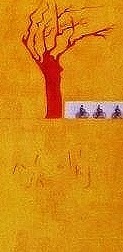
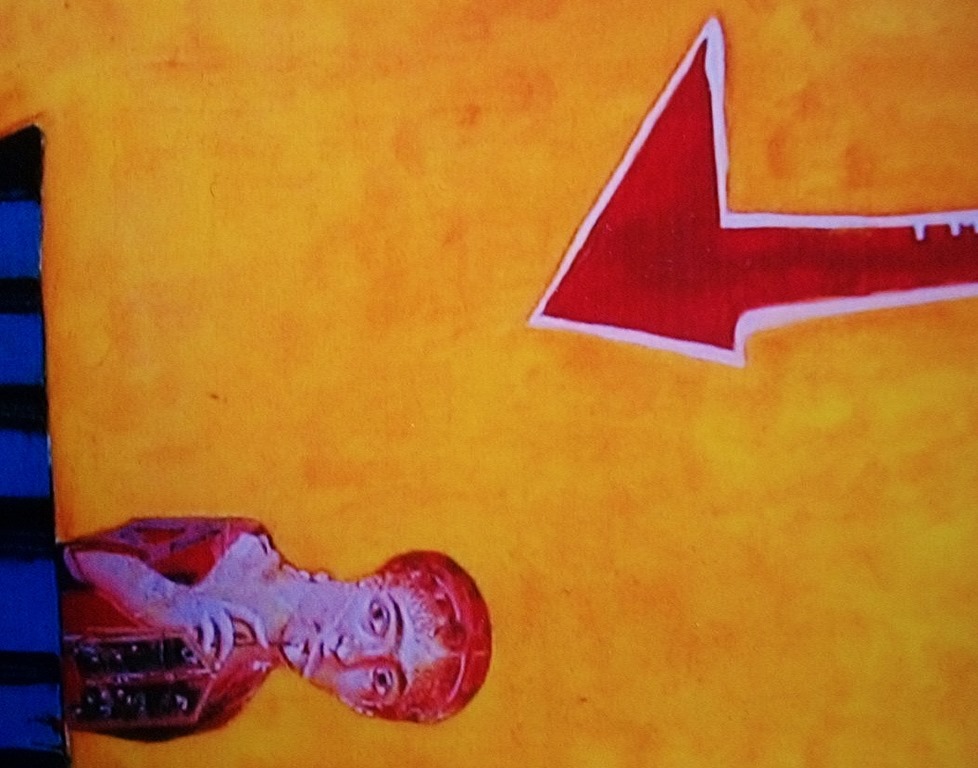
Sheilagh copied and simplified the images from a sales catalogue that specialises in heritage reproductions. The placing of the queen in the central position is also significant. She says she feels bound to redress an imbalance: the fact that in most of our media women only occupy centre stage when they are being commodified in some way. And then there is the mathematical equation painted in red beneath the red tree, centre right of the painting. 100_5291 The presence of equations in Sheilagh’s works adds a further layer meaning for her, and although she doesn’t think it necessary to explain them, she is always very pleased when people recognise them. This particular one refers to mathematical research by American academics in the 1920s called The Geometry of Paths. The appearance of equations in Sheilagh’s paintings also has more personal origins. She tells me she started to include them some years ago – after she had been helping her daughter revise for her Maths and Physics A’ level exams. It is another connection. There are many more signifiers in the work: motifs that have links and resonance with Sheilagh’s other works. The red tree above the equation is a symbol of timelessness, indicating ‘forever’ in human terms.  House of Belonging ii - Copy The red arrow in the top right creates a sense of energy and direction; a ‘look what’s here’ sign. There is the sense of a force field, drawing people to the House of Belonging. 100_5294

Finally, we talked about the overall composition. Sheilagh says that she began the work some years ago after she noticed that a small building denoting ‘museum’ often appeared in her landscapes. This time she wanted it to have it as the main subject, and to make it both an enticing and a mysterious place. At this point she also created the friezes at the top and bottom of the picture, these in order to suggest other layers of reality behind the surface painting. The top frieze is the wider, timeless landscape of which the museum is also symbol. The bottom frieze is deliberately ambiguous and suggestive; it invites the viewer to consider what might lie behind.

House of Belonging ii And having created the work’s essential structure, the painting was then abandoned. It was only some fifteen months later, when Sheilagh, looking for a large canvas to start another work, returned to it. She was fully intending to paint over it, but when she looked at it again she suddenly knew how to proceed and completed the work very swiftly. She says it probably is not quite finished, and suspects that something may still need to be added. In the meantime she has been occupied with a large body of work relating to Scotland.

*100_5111 100_5110

Notes and reference materials from Sheilagh Jevon’s studio

© 2014 Tish Farrell

Caught inside a Kikuyu garden: a memorial to Karen Blixen’s lover, Denys Finch Hatton

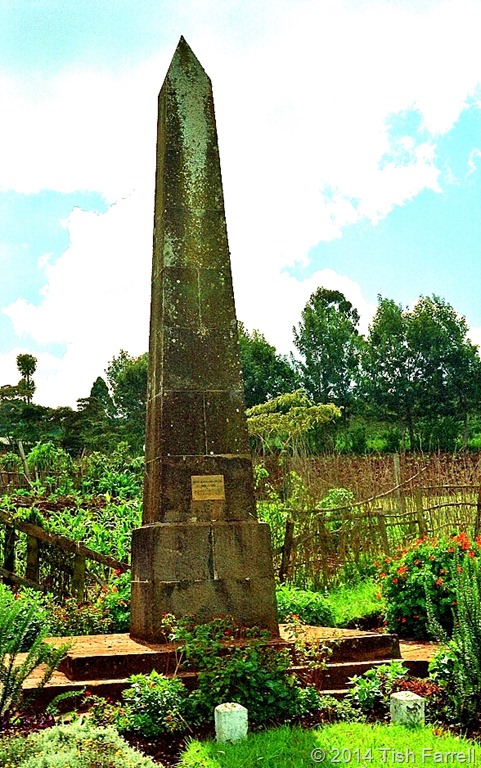
Denys Finch Hatton obelisk Ngong Hills

This was not supposed to happen. In fact you could say it adds insult to irony:  that a man so steadfastly dedicated to an unfettered life in the wilds should, in death, end up hemmed in, and so very domesticated within this small Kikuyu shamba. Yet here it is, the mournful stone obelisk, marking  the grave of Denys Finch Hatton,  son and heir of the 13th Earl of Winchilsea, Great White Hunter, and lover of two women far more famous than he is: writer Karen Blixen (Out of Africa) and aviator  and race horse trainer Beryl Markham (West with the Night). 

Finch Hatton's grave on the Ngong farm

Yet another woman, the one whose shamba this is, shows him a new kind of love, taking care of the garden around the obelisk.  If you want to visit the place it is not easy to find – either her little smallholding on the Ngong Hills, or the grave within. When we visited years ago we found only a hand-painted signpost nailed to a tree. We parked in a paddock outside the farmhouse door and were charged a few shillings. We could have bought a soda too, if we’d wanted. We could not see the grave though, and soon found that it was deliberately hidden from view by an enclosure of  old wooden doors. More irony here of course. More symbols of shut-in-ness. 

Denys spent most of his life in Africa avoiding any kind of confinement – out  in the Tsavo wilderness, running shooting safaris for the rich and aristocratic. His clients included the Prince of Wales (later Edward VIII) . In fact it was during the safaris for the Prince in 1928 and 1930 that Finch Hatton began to promote shooting on film rather than with a gun.

His lover, Karen (Tanne), Baroness von Finecke-Blixen lived in a small house below the Ngong Hills, some twelve miles outside Nairobi. By the time she started her affair with Denys she was divorced from her charming, but philandering husband, Bror, although they always remained friends. Her family had invested a great deal in the couple’s coffee farm, and Karen struggled to make a success of it. But the location was entirely wrong, and in the end she was forced to sell up and leave Kenya. It was during the period of selling the farm that she heard news of Denys’s death.

Scan-130429-0005

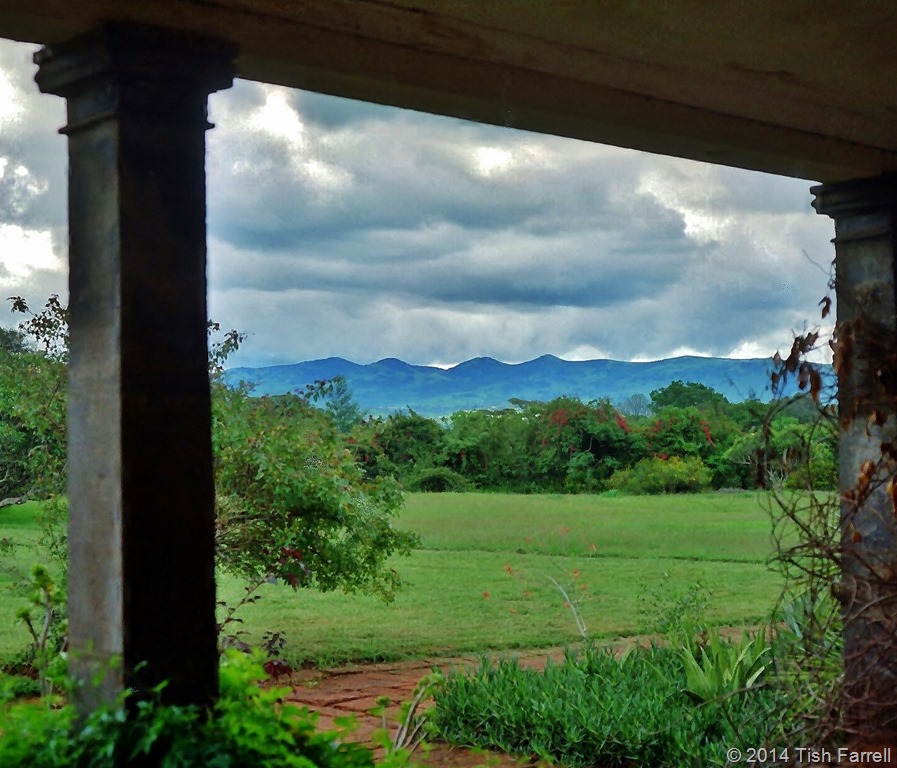
Looking towards the  Ngong Hills from inside the veranda at Karen Blixen’s house. The house now belongs to Kenya’s National Museums.

*

Scan-130429-0006

Denys Finch Hatton’s untimely end may be put down to his passion for flying. For those of you who remember Sydney Pollack’s 1985 film Out of Africa, some of the most elegiac moments of the film are when the celluloid version of Finch Hatton  (Robert Redford)  takes Karen Blixen (Meryl Streep)  into the skies above the Rift Valley.  Denys died in his Gypsy Moth in 1931, and in unexplained circumstances. He was taking off from the airstrip down in Voi in southern Kenya when his craft exploded. He and his Kikuyu co-pilot were killed. Denys was forty four.

Scan-130429-0018

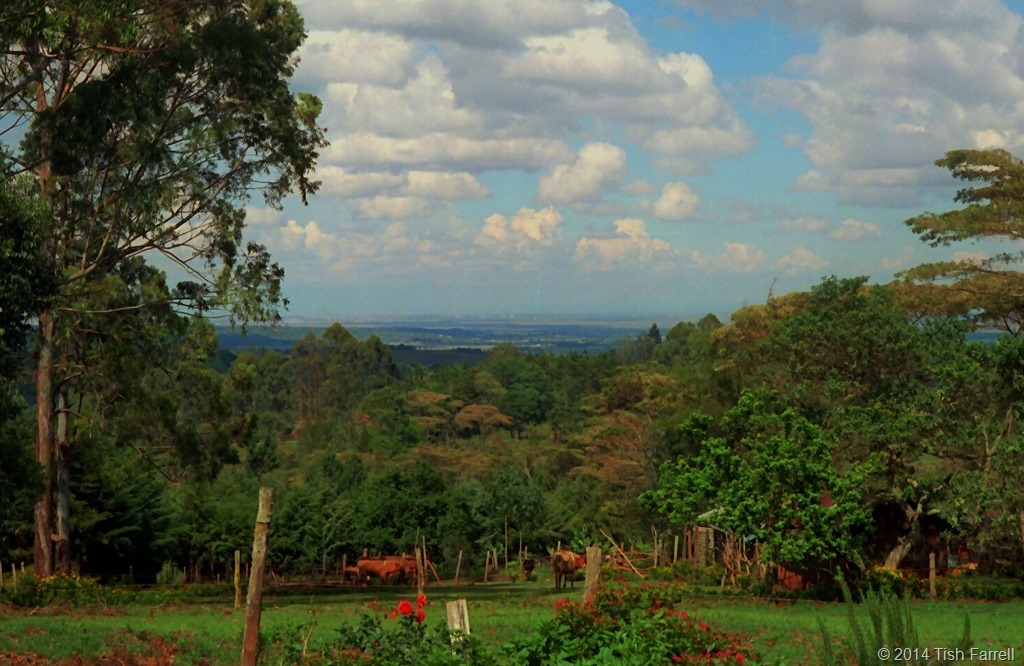
View towards Nairobi from Denys Finch Hatton’s Grave, and overlooking another Kikuyu smallholding.

*

By the time of his death, his relationship with Karen was  well on the wane, and he had already started an affair with the younger Beryl Markham. His biographer,  Sara Wheeler says in Too Close to the Sun, that there is circumstantial evidence to suggest that Beryl was pregnant with Denys’s child, but that she then had an abortion. To have known this would have truly broken Karen Blixen’s heart: her letters show that she had longed to have a child with Denys.

With yet another twist of irony, it was with his death, that Karen somehow reclaimed him, remembering that he had told her of his wish to be buried in the Ngong Hills. The spot he had chosen was one that Karen had decided on for her own grave.

013

Denys Finch Hatton

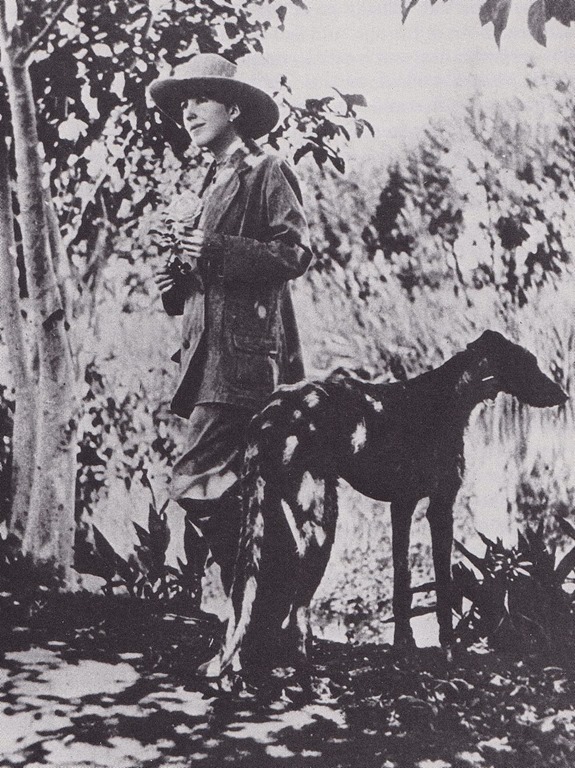
Karen Blixen with her deerhound Dusk

012

There was a place in the hills, on the first ridge of the Game Reserve, that I…had pointed out to Denys as my future burial-place. In the evening, while we sat and looked at the hills from my house, he remarked that then he would like to be buried there himself as well. Since then, sometimes when we drove out in the hills, Denys had said: ‘Let us drive as far as our graves.’ Once when we were camped in the hills to look for buffalo, we had in the afternoon walked over to the slope to have a closer look. There was an infinitely great view from there; the light of the sunset we saw both Mount Kenya and Kilimanjaro. Denys had been eating an orange, lying in the grass, and had said that he would like to stay there.

Out of Africa

The obelisk was only put up later by Denys’s brother. During Karen’s last days in Kenya she had the site marked with white stones from her own garden, and as the grass grew up after the long rains, she and Farah, her Somali house steward, erected a pennant of white calico so she could see the spot from her house, some five miles away.

Sometime after she had returned to Denmark she received a letter with some strange news about the grave:

The Masai have reported to the District Commissioner at Ngong, that many times, at sunrise and sunset, they have seen lions on Finch Hatton’s grave in the the Hills. A lion and lioness have come there, and stood, or lain, on the grave for a long time…After you went away, the ground round the grave was levelled out, into a sort of big terrace. I suppose that the level place makes a good site for the lions, from there thy can have a view over the plain, the cattle and game on it.

Out of Africa

Scan-131109-0048 - Copy

copyright 2014 Tish Farrell

*

Tish Farrell is an award winning writer for young people. Her latest novella is on Amazon Kindle (5 star review):

Secrets, conspiracies, tragedy, dark comedy – a fast-paced novella of interwoven tales set somewhere in East Africa. For young adults and adults alike.

Abandoned: Great Zimbabwe

Scan-130429-0005

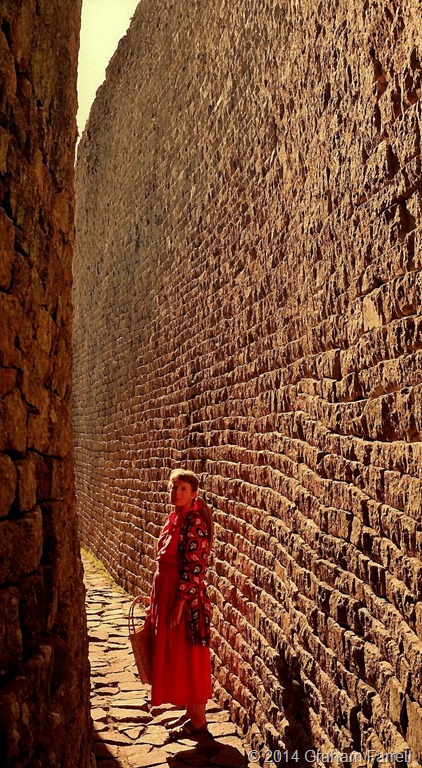
Inside the Great Enclosure of Great Zimbabwe. These magnificent walls have survived for nearly seven centuries, and not a lick of mortar to keep them standing.

Scan-130429-0010

No one knows exactly why this great African city  was abandoned. For some 350 years, until  around 1450 AD,  Great Zimbabwe had been a flourishing merchant centre that drew in from the surrounding country supplies of gold, copper, ivory, animal skins and cotton. The city’s entrepreneurs  then traded these goods on to the Swahili city states of Sofala and Kilwa on the East African coast. (You can read more about the Swahili HERE). In return, the traders brought back luxury goods –  jewellery, decorative pieces such as 13th and 14th century Chinese celadon dishes and Persian ceramics.

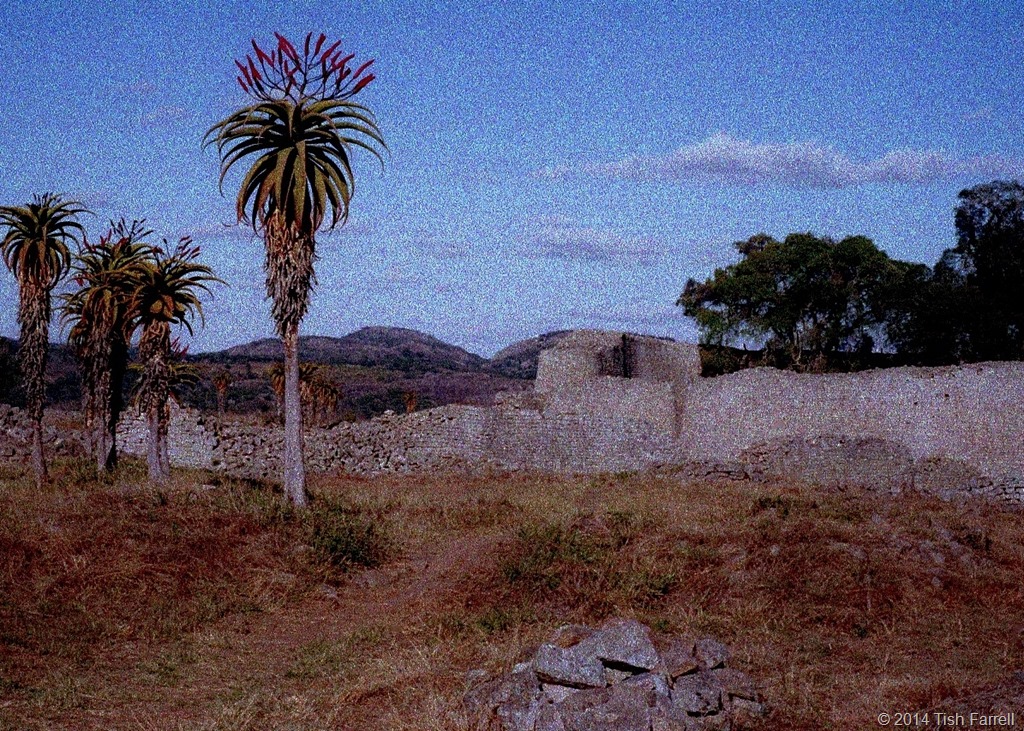
aloes and Great Zimbabwe

The city’s ruins cover 80 hectares, its many stone enclosures commanding the southern slopes of Zimbabwe’s High Plateau watershed between the Zambezi and Limpopo Rivers. The site is well watered with good grazing throughout the year. It is above the zone of the deadly tsetse fly that can infect both cattle and humans with sleeping sickness; and the plateau’s granite scarps provide plentiful building stone and other raw materials. Even so, these favourable circumstances do not explain why this particular settlement rose to such prominence.

For Great Zimbabwe was not a singular phenomenon. Contemporary with it,  and across the High Plateau region, are the remains of at least a hundred other mazimbabwe (houses of stone). Several were large enough to have been the capitals of rival states. Others may have been satellite communities occupied by members of Great Zimbabwe’s ruling lineage.

So who were the city’s builders?

During Zimbabwe’s colonial times, and until independence, the  Rhodesian government actively supressed  evidence that Great Zimbabwe was built by Africans.  Many of the other stone ruins were destroyed or re-purposed by European settler farmers. The official view claimed that the city was Phoenician, and that the Queen of Sheba’s fabled kingdom of Ophir had been discovered. Archaeologists, however, have long demonstrated  that it was the cattle-owning Karanga Shona who built Great Zimbabwe. The first phase of stone building began around 1100 AD. Thereafter, the city’s rising fortunes and successive building phases suggest its increasing control of the ancient High Plateau trade routes to the Swahili cities of Sofala and Kilwa.

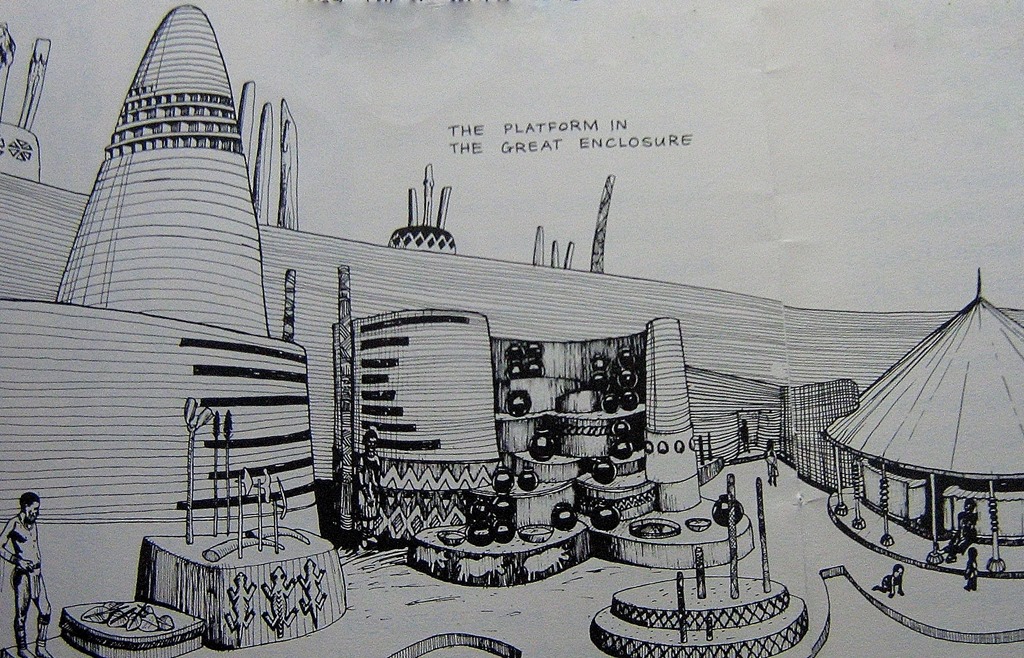
Gold was the key commodity, and it is likely that it was Great Zimbabwe’s successful cattle production that provided it with the trading power to secure gold supplies from mines some 40 kilometres away. The more prosperous the city became, the more sophisticated its demonstrations of prestige. In around 1350 AD  the Great Enclosure of finely dressed stone was built. This huge elliptical structure with its mysterious platform and conical tower is thought to be the royal court. There is no indication that the walls were defensive. This was  a regime confident in its power and authority.

IMG_0889

Peter Garlake’s reconstruction of the Great Enclosure Platform from Life at Great Zimbabwe,  Mambo Press 1982

*

Then why did the city decline?

There are various explanations: the people had let their herds overgraze the land; they had cut down all the trees; there was a prolonged period of drought as may happen in southern Africa. But somehow none of these theories quite explain why, after 350  flourishing years, a community of perhaps 20,000-plus people should simply pack up and leave. Did all these farmers, herders, miners, craftspeople, soldiers, traders, accountants, court personnel and the city’s rulers  leave on a single day, or did the city die slowly?  The archaeological evidence does not say.

But we do know there were disruptive external forces at work. In the 15th century the Portuguese invaded the Swahili coastal city of Sofala. They were on the hunt for gold and so pressed inland with Swahili guides. Their interfering presence drove the trading routes north, giving rise to the Mutapa state. This new state may well have been founded by people from Great Zimbabwe. Certainly by this time the Swahili traders were coming up the Zambezi to trade with the Shona directly, the old trade route through Great Zimbabwe no longer used. At this time, too, we see the beginning of another Shona city state  with the building of the stone city at Khami near Bulawayo in southwest Zimbabwe. In the following centuries this became the centre of the Torwa-Rozvi state whose other major cities during the 16th and 17th centuries included Naletale and Danangombe.

Great Zimbabwe entrance

The Great Enclosure entrance at Great Zimbabwe built c.1350 AD

*

And so into history…

Of course with the Portuguese incursions comes the first documentary evidence. From the early 1500s Zimbabwe’s royal courts enter the historic record in the accounts of the Portuguese conquistadores. In 1506 Diogo de Alcacova writes to his king, describing a city  of the Mutapa state

“called Zimbany…which is big and where the king always lives.”  His houses are “of stone and clay and very large and on one level.” Within the kingdom there are “many very large towns and many other villages.” 

The Portuguese historian Faria y Sousa also describes the King of Mutapa’s great retinue which included the governor of the client kingdoms, the commander-general of the army, the court steward, the magician and the apothecary, the head musician “who had many under him and who was a great lord”. Also noted were the vast territories over which the king ruled, the revenues and subject kingdoms of the king’s several queens.

And suddenly we have a true glimpse of what this land called Zimbabwe might have looked like in the past, a bustling, mercantile, metropolitan culture, supported by gold miners, farmers, cattle herders and craftspeople. And so it remained until well into the 18th century, albeit with a shift of Shona power to the southwest and the Torwa-Ruzvi state as the Portuguese presence caused increasing instability. Then in the 19th century came new invaders – the Nguni, the Ndebele and the British.

This centuries old heritage of royal courts is not a picture that the likes of Cecil Rhodes or, the later Rhodesian government of Ian Smith ever wanted anyone to see. And so in the end this is not so much a story of a city abandoned by its people, but of a people wilfully excluded from their past.  In 1980 when Zimbabwe became an independent state, some of this past was reclaimed: the new state took its name from the first great Shona city, and  adopted for its flag and coat of arms, an image of one of the city’s ceremonial soapstone birds. These are small steps forward, but there is still a long way to go before the world sees the indigenous histories of the Africa continent in their true perspective, and acknowledges their intrinsic cultural worth.

There is more about Great Zimbabwe in an earlier post HERE.

References: The classic work on the excavations of the city is Peter Garlake’s Great Zimbabwe 1973. For an overview of the mazimbabwe culture see Innocent Pikirayi’s The Zimbabwe Culture AltaMira Press 2001. For a wider historical perspective Randall L. Pouwels The African and Middle Eastern World, 600-1500 Oxford University Press.

© 2014 Tish Farrell

Looking for Smut on Kenya’s Highland Farms

For those of you who read my recent post Valentine’s Day Runaway this is one of the things Team Farrell got up to next; it had a lot to do with smut. And no: it’s not what you think.

Rift Valley from Escarpment

Smallholder farms on the Great Rift Escarpment, Kenya

*

For most of the 1990s we were based out in Kenya, where Team Leader Graham, food storage expert and all-round fix-it man, was one of several  British scientists running a crop protection project alongside Kenyan scientists at the National Agricultural Research Laboratories (NARL). This work was funded by DFID, Britain’s Department for International Development, which in turn is of course funded by British taxpayers.

image

Most of Kenya’s farmers are women. Their efforts feed their families and feed the nation.

*

Many of the project’s programmes of work were done on farms, and involved helping farmers to devise their own research methods for controlling the numerous pests that attack their crops both before and after harvest. Since just about every Kenyan, from the President down, is some kind of farmer, or has a farm in the family, this was an important project, and just about everyone was interested in the outcomes. (Next time you are buying French beans or mange tout peas in the supermarket, look where they have come from. Much of this kind of produce is grown under contract on small farms like the ones below.)

clip_image002

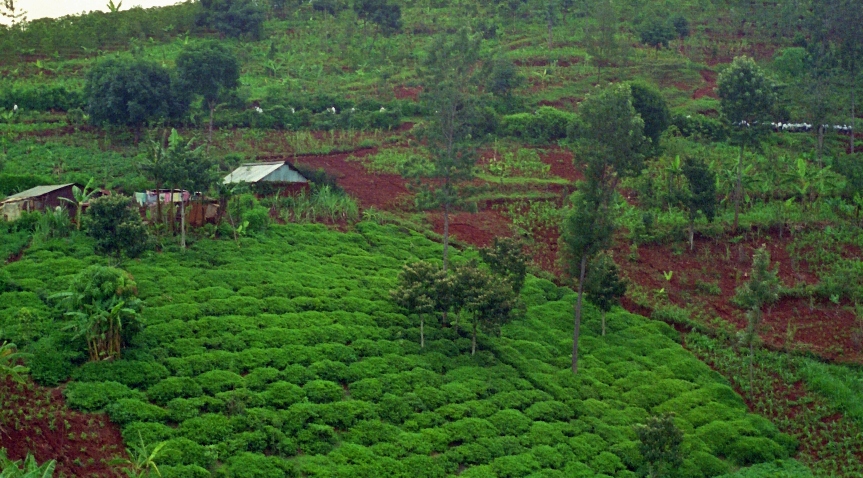
A typical farmstead in the Kenya Highlands north of Nairobi. The volcanic soil is very fertile, but also susceptible to erosion.

*

Today Kenya is undergoing a massive hi-tech revolution through the proliferation of cell phone and computer technology, but it still relies on agriculture for survival. When you discover that only 15% of Kenya’s landmass has enough rain or is fertile enough for arable production you may begin to see the scale of the problem for a nation that is only now beginning to industrialize. There are of course the big multinational outfits that grow wheat, coffee, tea, flowers and pineapples, but most of the food that Kenyans eat is grown on thousands of tiny farms, many less than an acre in area.

Escarpment lane

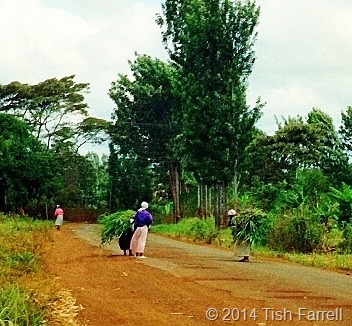
Gathering Napier Grass from roadside plots to feed ‘zero-grazed’ dairy cows. Most farms are so small that cattle are kept in small paddocks and their food is brought to them: yet another daily chore, along with gathering cooking fuel and attending to children and fields.

Kikuyu lane with woman carrying napier grass

Furthermore, most of Kenya’s farmers are women. Providing most of the the country’s food, they are in every sense the backbone of the nation. They stay in their rural homes, tending the crops and bringing up the children while husbands work away to earn extra cash to repair homes, buy fertilizer, educate their children and fund small business enterprises.

These men usually head to the cities where they work as security guards, clerks, hotel staff, house servants and drivers. Most take their annual leave at harvest and planting times so as to be back on their farms to help with the year’s most arduous tasks. So however you look at it, everyone in Kenya works very hard. Certainly in the nineties even most professional Kenyans believed that owning a plot of land to work at weekends was an essential insurance policy in a nation with no social services.

clip_image005

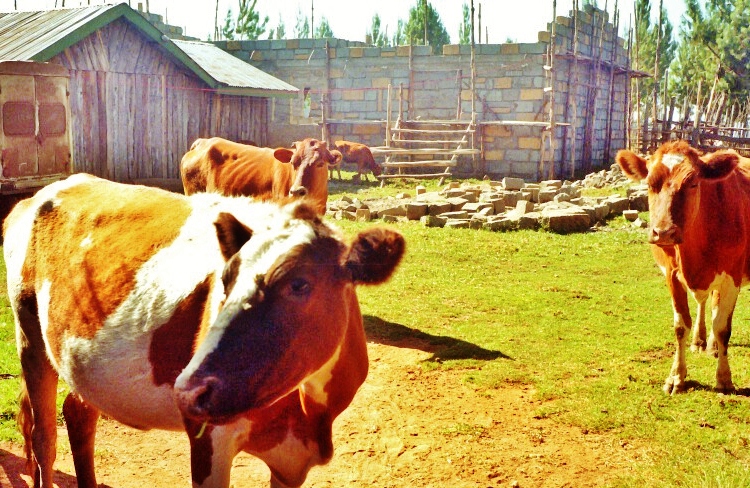
Most of the milk from smallholder’s cows is sold to provide cash to pay for children’s education and medical bills. While primary education has been free over the last few years, there are still expensive books and uniforms to buy, and secondary education is not free. On this farm the owner is also using any disposable income to bit-by-bit replace his timber farm house with a good stone house.

Kikuyu farmstead 24

*

So back in 1998, as part and parcel of protecting Kenya’s agricultural production, Team Leader Graham invited Nosy Writer (me) to accompany him on a fact finding mission around the farms north of Nairobi. We were on a quest to plot the incidence of SMUT, a fungal disease that was affecting Napier Grass, an important fodder crop. Most smallholders kept a small number of dairy cows because the selling of milk provided a valuable supplement to their income, helping to pay for school fees and medical expenses.

Most farms are too small to include pasture and so the cows are ‘zero-grazed’, that is, kept in small paddocks and their fodder (mostly Napier Grass) brought to them. This grass, if well-tended, grows into huge perennial clumps that can be cut at intervals. It can also be usefully grown on vertical banks to consolidate field terraces, or wherever the farmer can find a space, often on roadside verges. However, once smut gets a hold, the plant will gradually weaken and its food value decrease. Not only that, smut spores blow on the wind, and infect other plants. The only remedy is to root up the infected plants and burn them.

Graham and Kungu delighted to find smut on Waiyaki Way

Nothing pleases plant pathologists more than to find a nicely diseased plant. After a morning spent searching for smutted plants out on the farms, Doctors Graham Farrell and Jackson Kung’u are amused to spot a case back in the city. Here it is on a highway verge near the National Agricultural Research Laboratory in Nairobi. Smut lives up to its name and turns the flowering stems a sooty black. The fungus gradually weakens the plant and reduces it in mass and nutritional value.

*

My job on the smut quest was to hold the clip-board and the other end of the measuring tape while we sampled farm plots. Our third, and  most essential team member, (in fact he was the real team leader) was Njonjo. He was the one who heroically drove us up and down the hilly Kikuyu lanes that had recently been ravaged by torrential El Nino rains.

clip_image009

Rift lane after July downpour

As well as being one of NARL’s top drivers, Njonjo was himself a farmer, and so had a vested interest in getting to the bottom of the smut infestation. Since Graham’s Kiswahili was a bit rusty, and many of the older farmers preferred to speak Kikuyu, Njonjo provided them with on-the-spot lectures on what they should do with their smut-infected plants. He also talked our way onto every farm, where we welcomed in with huge courtesy, despite arriving uninvited.

clip_image011

Njonjo and Margaret the farmer. She was busy making compost when we arrived on her farm.

Kikuyu farmer and sugar cane

This farmer was so grateful to be told about his smutted Napier Grass he presented us with some sugar cane. We also came home with chickens, maize cobs and bags of pears

*

One of our tasks on the farm was to sample farmers’ Napier Grass plots to see how far they were infected, and to what extent the affected plants had lost mass. Njonjo organised a team of unemployed lads to help with the sampling.

clip_image015

clip_image017

clip_image019

Before the cell-phone revolution of recent years, farming information was hard to come by. Here Njonjo delivers his Smut Lecture to an impromptu gathering of smallholders who have spotted our arrival in their district and want to know what we are up to.

*

And here are three good reasons why Kenyans work so hard…

Kikuyu schoolboys

…education, education, education.

© 2014 Tish Farrell


The Tsavo Big Game Show: it’s a dangerous pursuit

lone elephant at twilight

Night comes swiftly in the African bush but never quietly. As the sun drops behind the Chyulu Hills, so the pipe and whirr of frog and bug ratchet up a few decibels. It is like a million high tension wires being pinged and twanged. If you listen with both ears it can drive you mad. Likewise, if you allow yourself to succumb to the night’s sticky heat and the hypnotic scents of thorn flowers, then do not be surprised when the sudden scream of a tree hyrax stops your heart.

But we are not going mad. And our hearts are just fine. We think we have cracked this Africa lark. Well sprayed with insect-repellent, all accessible parts covered as can be, anti-malarials ingested, it seems safe to sit out on our veranda at Kilaguni Lodge  and do some night-time big game watching. 

Below our room is a barren stretch of red volcanic earth, and a water-hole lit up by two search lights. The illuminated circle that the lights create is like a stage set. It seems we are seated in a mysterious wildlife theatre waiting for the cast to appear.

The contrast is disturbing. By day, this self-same set is furnace red, littered with volcanic spoil; it is the haunt of the cadaverous-looking marabou storks and the occasional zebra. By night, all is softer, surreal. You feel you might dissolve through the light into perpetual darkness; for out there the night goes on forever, doesn’t it?

And so we go on gazing at the scene. It takes some time to realize that small groups of impala are emerging from the gloom. Their stillness is mesmerizing. Perhaps they are not there at all.

And then…

And then…

The impala are wary. You can almost see the charge of anxiety ripple through the herd. We hold our breath and stare into the dark behind the lights.

And then we see them – black hulks gliding through the thorn trees. Elephants. They have come so silently, walking always on tiptoes, their heels cushions of fat to muffle their footfalls. Slowly they move in from the bush. Even in the dimness beyond the pool, their hides glow red, irradiated by the igneous dirt they have blown over themselves.

In the wings the elephants pause. It is hard to say how many are there. After a few moments two peel away and the rest of the group retreats again into darkness. Two large matriarchs now head for the pool. At the water’s edge they part, and in matched strides stake out the water-hole from opposite directions. There’s an angry trumpeting when an impala fails to withdraw fast enough, and only when the entire bank is clear do the elephants go down and drink. But they have hardly taken a couple of gulps when they move back and take up guard duty, one at each end of the mud bank.

We are transfixed. We cannot fathom the plot, but note that, despite the elephants’ aggressive stance, there has been a concerted gracefulness to their routine. It crosses my mind that the great choreographer, Balanchine, once made a ballet for elephants. Now we see they have dances of their own.

And so we wait.

Slowly the rest of the group reappears, moving as one in the tightest huddle. As they enter the spotlight we understand. Tucked safely between the legs of four large cows are three infants. Like precious celebrities surrounded by an escort of heavies, the youngsters are guided to the water. There, with tiny trunks they cannot quite control, they drink their fill. The whole thing takes only a few minutes. Then, with this life-and-death task accomplished, the sentinels re-join the group, and the small herd leaves as silently as it came, melting into the backdrop.

So: this drama is over; the stage empty. After the thrill there is anti-climax, a strange sense of banishment; depression even. We go to bed, suddenly overcome by the heat and with too many insects on the brain.

Inside, though, the room is hotter still; windows shut fast against malarial mosquitoes. Even so, and despite the rock-like pillows, we sleep for a time. At midnight it is the menacing whine of a mosquito that rouses us to a bleary-eyed seek and destroy mission. At 2 a.m. we are awake again as two waterbuck lock in high-snorting combat below our veranda.

G. huddles back in bed. I press my nose to the window. It’s at times like this that Africa looms largest, that you know you are out of your element. Night stretches ahead like a herculean trial. I stare once more at pale stage in the bush. The impala have drifted back to the pool again, but they barely move. It is like watching a Samuel Becket play where nothing much happens.

And yet…

Suddenly the antelope are on full alert – rigid stance, ears pricked, noses twitching. I stare and stare. At last I spot movement, a sinuous shape pressing through the low scrub. The impala rise on hoof-tips, torn between staying and fleeing, and then the lioness steps out from the grass and pads down to the water.

The impala draw back, still unsure of the big cat’s agenda. The lioness parades around the waterhole, but does not drink. Instead she finds a clump of grass and lies down, head up, still as stone, commanding the pool  – a heraldic lion couchant. Now it is clear. None of the animals can drink. The tension is visible. This is a new kind of drama: feline power play.

But I cannot wait for the denouement. Worn out, I return to my hard pillow and tangled sheet.

The next time I wake it is light enough to know that I can abandon all efforts to sleep. It’s a huge relief. While G. slumbers on, I step out into cool of the veranda. In the dawn light I see that last night’s set has mystically expanded into a vast new backdrop. Now the Chyulu Hills rise above the dry plains, a vision of impossible greenness that belies the violence of their birth. For these hills are new, erupting around the time Sir Francis Drake was bowling off Plymouth Hoe and ignoring news of the advancing Armada. It’s hard to believe.

But this is not all. To the west, the snow-capped crown of Kilimanjaro breaks free of the earth and floats high on a wreath of pink clouds. It makes me want to hoot with laughter. Who does this Africa think she is? Does she really expect me to be taken in by  all her absurd illusions? Poof! The mountain snuffs out and leaves only sky. (Is this possible?) And I, like the victim of some worming parasite, know I am becoming infected. All our defences are useless. This land is creeping under my skin and invading all my senses. More likely than not I will never be the same again.

© 2014 Tish Farrell

Kenya; Chyulu Hills; Campi ya Kanzi - Giraffe in the Chyulu Hills

Chyulu Hills. Photo: Abercrombie & Kent

Daily Post Prompt: write here, write now