Winterscapes on Wenlock Edge: Thursday’s Special

P1000361

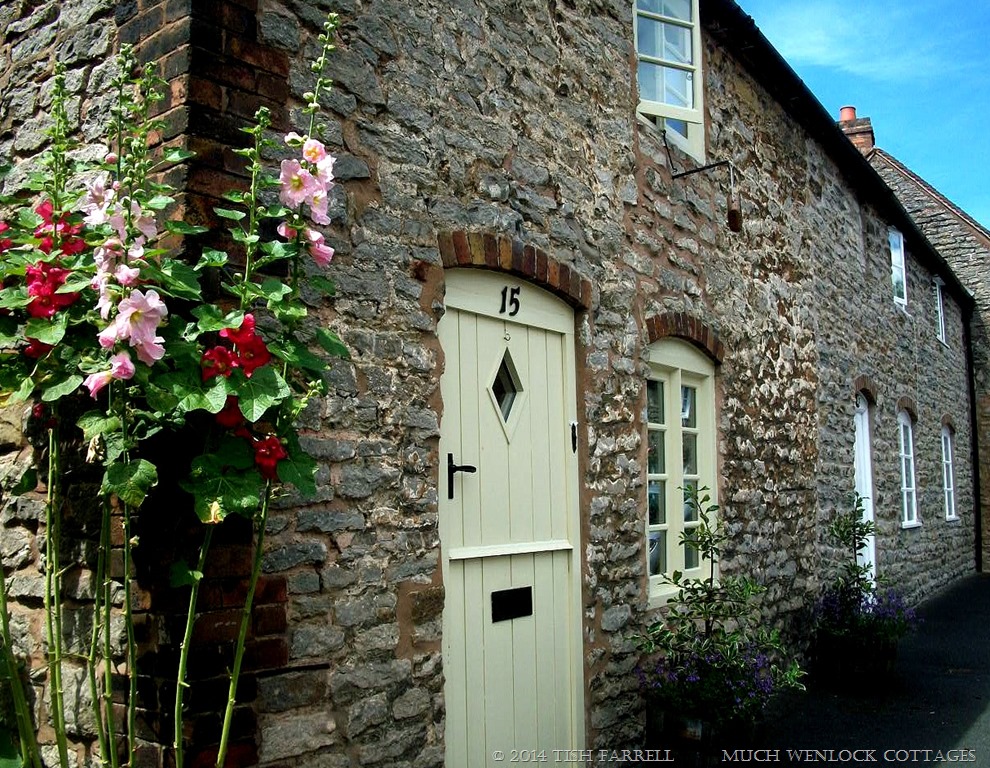
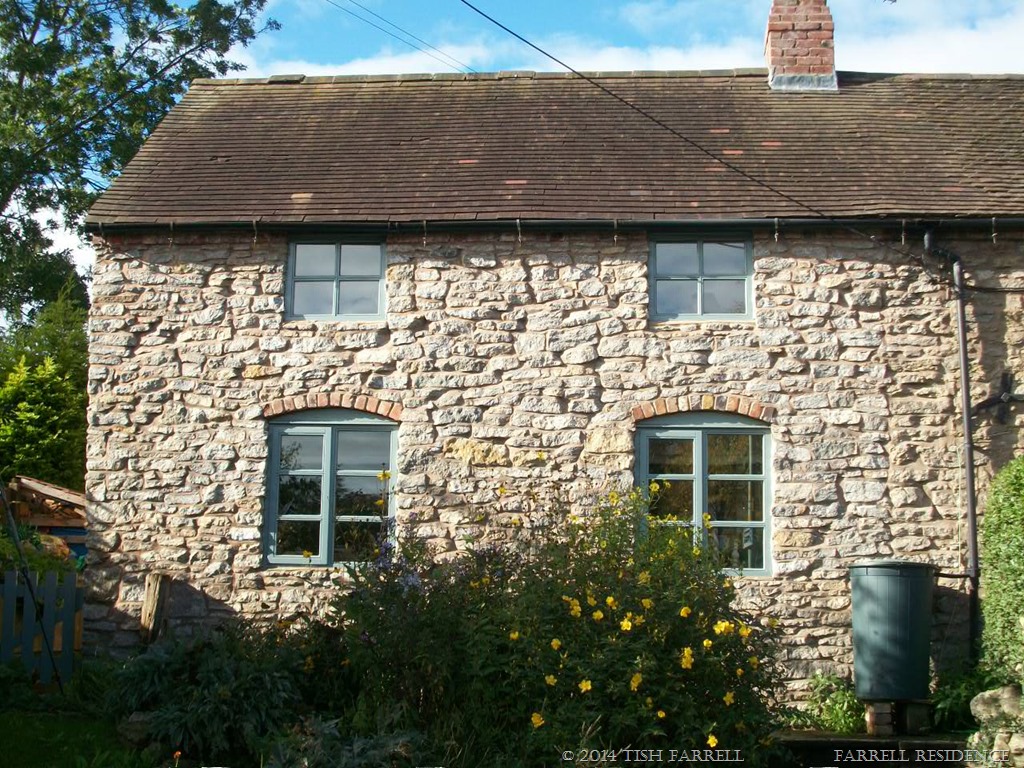
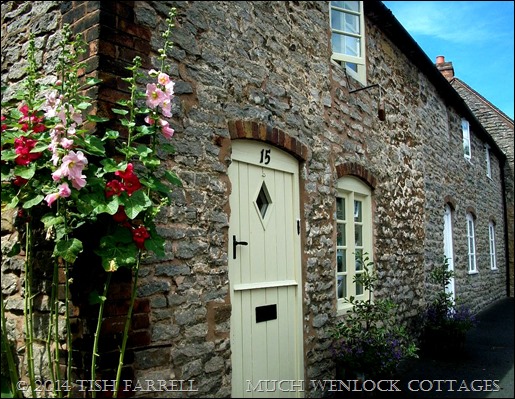
I have said elsewhere (In the old stones of Wenlock) how our cottage in Much Wenlock is built from a recycled fossil sea bed – the stony remnants of the 400 million year old Silurian Sea that once lay in the tropics off East Africa. If you want to know more of this extraordinary geological phenomenon, please follow the link.

Here in the midst of northern hemisphere weather, a warm sea in Shropshire is a hard concept to grasp, but then Shropshire was south of the equator back then. All the same, I would give much at this moment to soak myself in clear tropical waters – as long as giant Silurian water scorpions are not included.

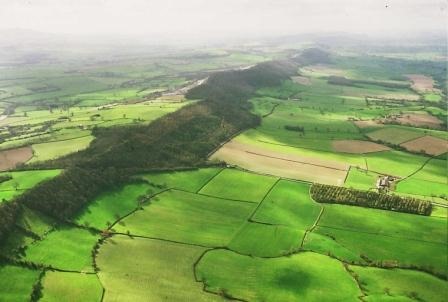
Anyway, this is the rear view from our cottage window. At the front we look at oversized passing heavy goods vehicles. In some ways I like the ambiguity of our position, poised between the rush and rumble of commercial imperative, and the monumental  immanence of Wenlock Edge – between the speeding trucks and a hard, quiet place. The Edge of course  is mostly made of limestone – the compressed remains dead sea creatures. At some point the sea bed was shunted upwards to make the long escarpment that is now a striking landmark across the south east of the county.

P1000378

From our house we look towards the back of the Edge. Some undulating ‘foothills’ obscure an actual view of it, but we see the big sky above the  escarpment, and have a sense of weather always moving behind the horizon. The cottage, then, is not only on the Edge and of the Edge, the Edge is the reason why it is here at all.

So far our researches have been rather patchy, but we think the house was built around 1830. It was probably a squatter cottage, meaning that  it was built on the local landowner’s property, and a rent or fine was paid to him by the inhabitants. The first occupants appear to have been lime burners, working at nearby limekilns. The limestone was burned to make quick lime that was used for fertilizer, for building mortar, and for lime wash for walls inside and out . It was an immensely important commodity.

It is hard to imagine, though, what the atmosphere of Much Wenlock would have been like in lime burning days. The town sits in a hollow, a frost pocket. On cold winter’s days one imagines a fog of fumes from roasted limestone shrouding the rooftops. Doubtless it would have been corrosive on the lungs too.

P1000297 - Copy

This last shot was taken in January from the top of Wenlock Edge. Here we have the cooling towers of Ironbridge coal-fired Power Station (its days are numbered), and the Ironbridge Gorge beyond. Limestone once played a crucial role in that locality too, used as a flux in the iron masters’ blast furnaces in Coalbrookdale. Along the River Severn just south of these steaming towers, the Industrial Revolution began with the first casting of iron using coke as a fuel. It is hard to picture I know, much like a fossil tropical ocean in Shropshire, but the technological breakthroughs made in this English backwater spurred on the world’s drive to industrialisation.

It would seem that the Silurian Sea and its petrified molluscs and sea lilies have much to answer for.

copyright 2015 Tish Farrell

Inspired by Paula’s Thursday’s Special: cold

Thursday’s Special: Dusk on Wenlock Edge

IMG_1147

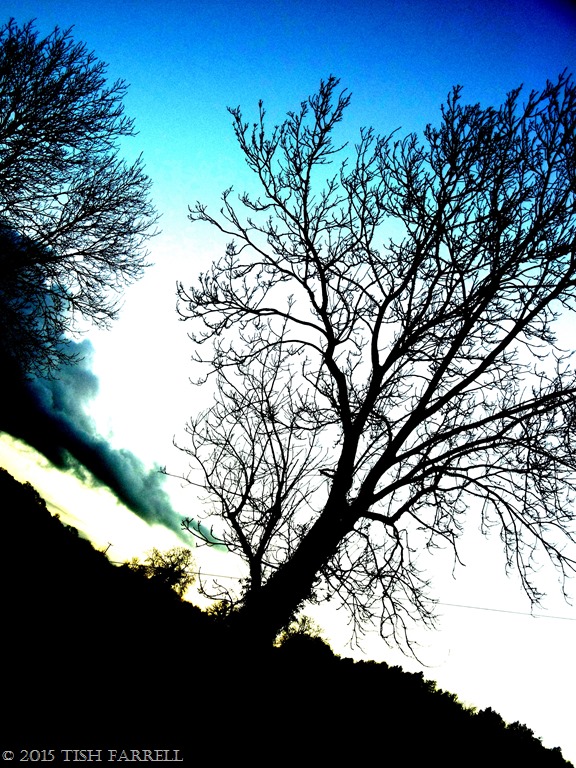
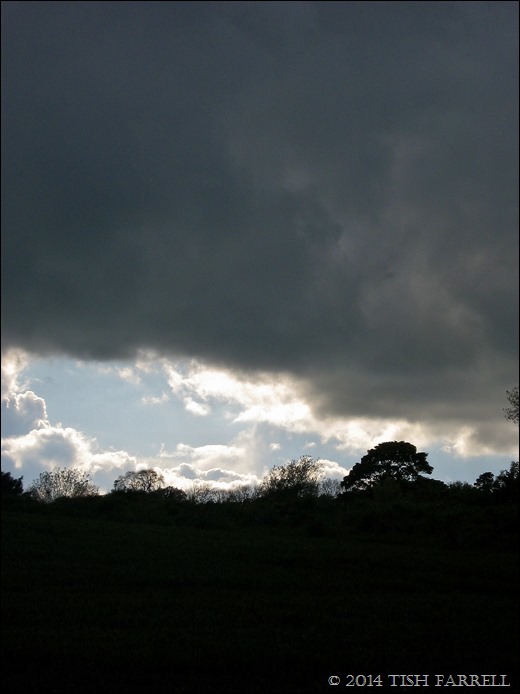
I may have mentioned once or three times that I spend a lot of time watching the sky from our house below Wenlock Edge. Silhouetted in this photo are the wooded slopes of Wilmore Hill which lies between us and the Edge. The land then dips, then rises again until it reaches the scarp, at which point the ground simply falls away alarmingly through a hanging woodland of giant beech, oaks and ash. Far below the trees stretch the farm fields of Shropshire. And so from our vantage point the Edge gives us a false horizon, providing a stage for much interesting weather-watching. Hours can slip away…days. There’s a real danger of finding oneself turned into Rip Van Winkle. Maybe it’s already  happened…

*

For more evocative dusky scenes, or to post your own please go to Paula’s Thursday’s Special and be inspired.

*

image

Over the Edge: Landscapes or Seascapes?

Rift Valley from Escarpment - Copy

Scan-130429-0001

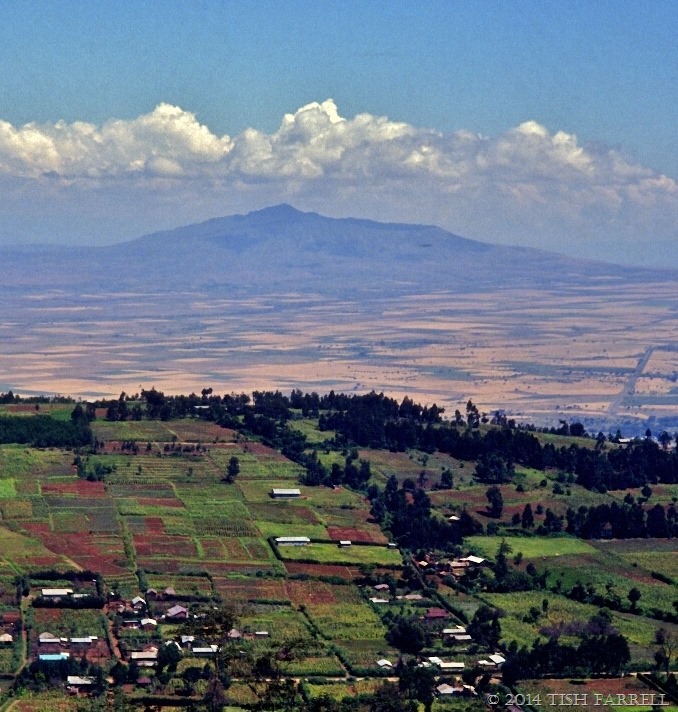
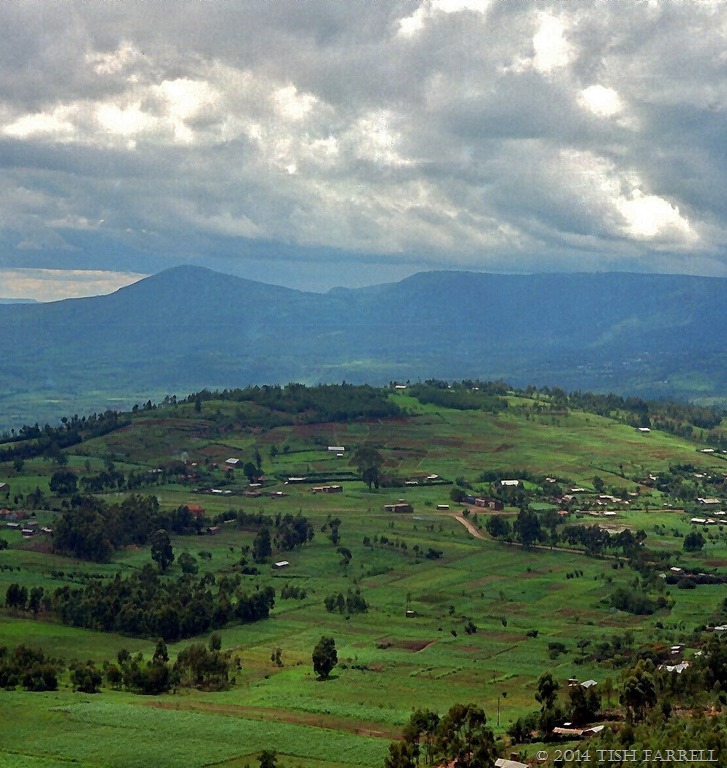
Looking down on the small holder farms of Escarpment in Kenya’s Great Rift Valley

*

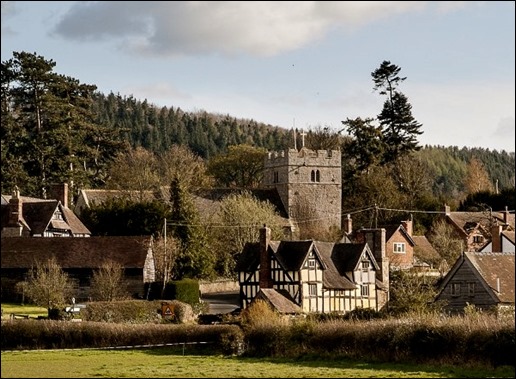
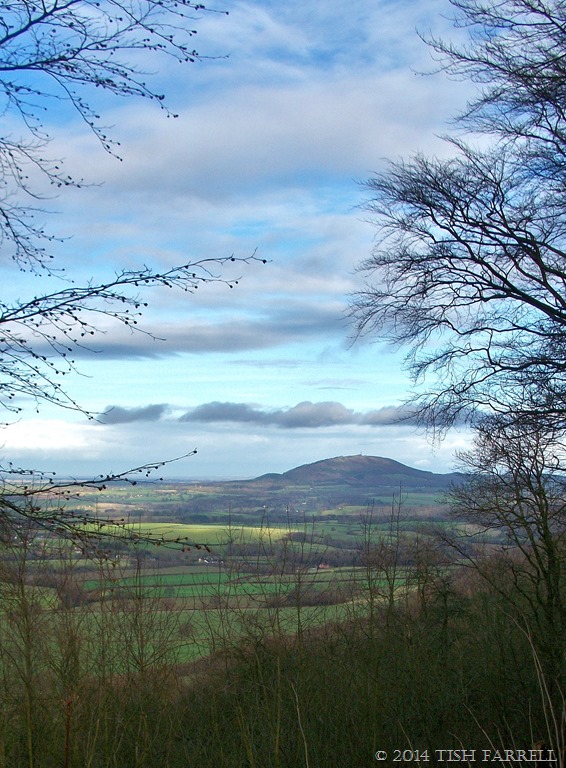
And on Shropshire farm fields from Wenlock Edge

IMG_1911

100_7057

It’s an interesting thought that in time the Great Rift Valley could become a seascape, for even now the earth’s crust is pulling apart along its 6,000 kilometre length.  The Horn of Africa, Somalia and the eastern half of Kenya would then become an island. Meanwhile these views of Shropshire show a landscape that was once covered in a shallow tropical sea. Also Wenlock Edge, on which I am standing to take this photograph, was once the bed of that sea before geological forces shunted it upwards. It makes you think, doesn’t it – the relentless forces of change?

And for the story that connects these vistas: First Post Revisited: By the Silurian Sea

For more about the Great Rift see an earlier post: Vulcanicity: welcome to the hot zone

Cee’s Fun Foto Challenge: Landscapes or Seascapes

First Post Re-visited: By the Silurian Sea

All is peripheral in the place where I live – our house beside the path, beside the field, whose name on the 1847 tithe map, Townsend Meadow, marks the old town boundary of Much Wenlock. The town, itself, is very ancient, and only in recent times has it outgrown the frontier along Sytche Brook. It anyway has a more remarkable periphery than this – the edge of Wenlock Edge under which it lies.

I cannot quite see the Edge from my house, but I see the big sky above it: the dramatic false horizon that the wooded scarp creates, and thus the endless movement of weather along it. Hours can be wasted sky watching: the breezy march of clouds across our roof lights, the flush of hundreds of rooks from Sytche Lane wood, peppering the skyscape at dusk; their raucous cries, their enigmatic feats of aerial choreography.
IMG_1147

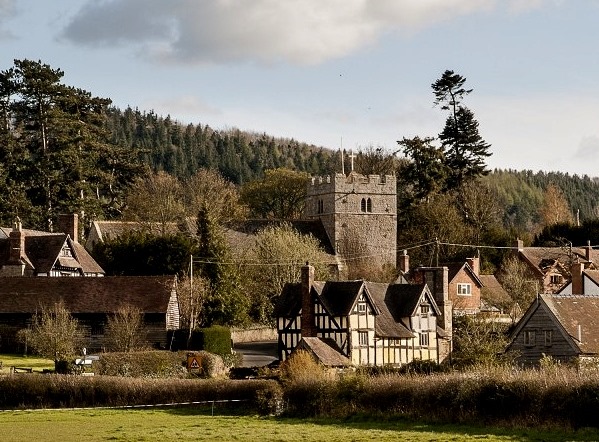
That you cannot see the Edge from the town is something of a paradox given that its massive presence has shaped the place in so many ways, and not least in the fabric of its cottages, parish church and ancient priory. To get a proper glimpse you need to leave Wenlock – take the steep hairpin-cutting down to Shrewsbury, or the tree-lined road that strikes across the Edge top to Church Stretton, or else meander along the labyrinth of lanes beneath it. The villages down there have old world names – Church Preen, Hughley, Rushbury, Longville. Above them the wooded ridge bristles like a giant hog’s back – a long, dark spine nearly twenty miles in length. It is all unavoidably mysterious.

photo National Trust

Photo: National Trust

Rushbury beneath Wenlock Edge

Photo: Rushbury Village below the Edge

The limestone flanks have been dug into for centuries, creating vast gaping wounds. As you take the road over the top, there are dizzying glimpses through verge-side trees where the ground shears away. All the quarries are unworked now, but in earlier times, for a millennium and more they were the source of most of the area’s building stone.
100_6035

Then there was the burning of limestone to make fertilizer – another important local industry. Lime is an essential additive to unlock the nutrients of the sticky clay soils that lie below the Edge. Today, you can still come upon the remains of many kilns on Much Wenlock’s outskirts. Once their fumes must have hung like an ill-smelling fog above the town.

But perhaps the most important use of Wenlock limestone – at least as far as the history of world technology is concerned – was the crucial part it played in the production of iron at nearby Coalbrookdale. This small Shropshire settlement, just across the River Severn from Wenlock, has been called “the birthplace of the Industrial Revolution”. It was here, in 1709, that the Quaker brass founder, Abraham Darby I, first smelted cast iron using coke instead of charcoal. Into his blast furnace went iron ore, coke and limestone, the stone to act as a flux and remove impurities that would compromise the quality of the smelted pig iron.

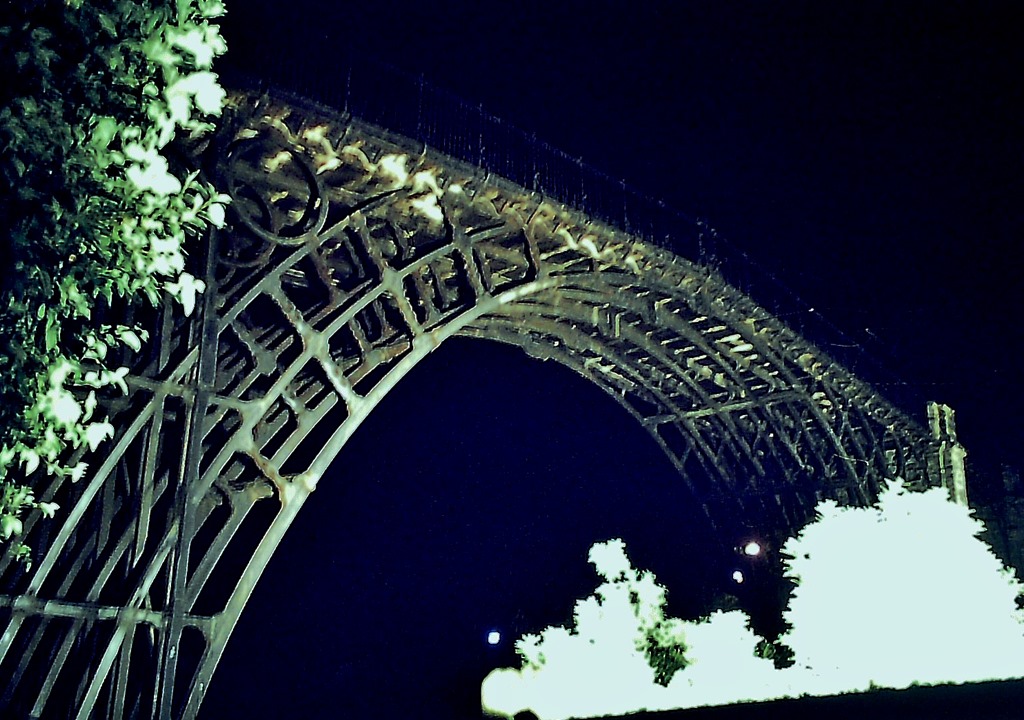
And this was only the start. It was in Coalbrookdale too, in 1779, that Abraham Darby III pulled off a monumental PR stunt to promote the family trade. He built the world’s first cast iron bridge across the River Severn at a place now called Ironbridge, and thereby spurred on huge innovation in construction techniques that spread around the globe – from cast iron garden seats and cannon to iron ships, railways and skyscrapers.
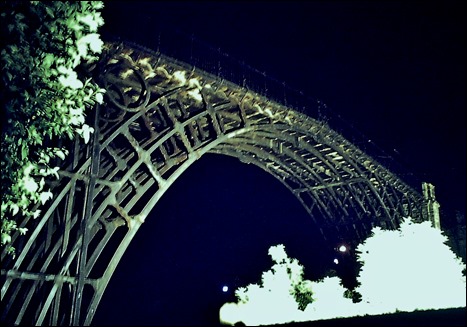
PICT0014

So it was that Wenlock limestone (from this now sleepy part of Shropshire) played its part in the great march to industrialisation.

In more recent times, only the quarry spoil has been used – crushed to produce aggregates for road building. It has been many years since Much Wenlock’s homes shuddered in a pall of white dust whenever the quarrymen were blasting, or the streets vibrated to the endless rattle of passing stone trucks.

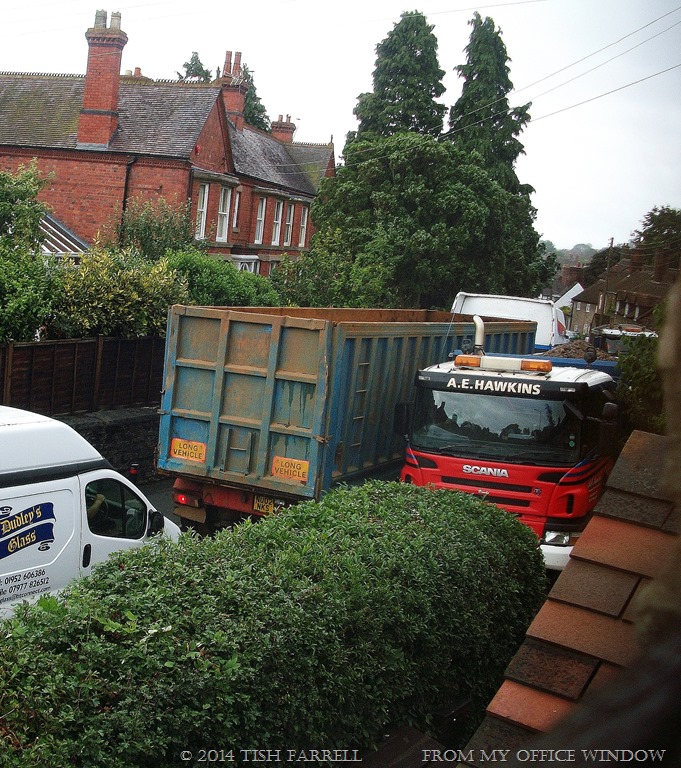
Of course there are other sources of disturbance on our mediaeval thoroughfares – over-sized farm vehicles and garden fencing trucks. They pass by on the other side of my house, which is not so scenic, although interesting in other ways.

For instance when I’m standing in the kitchen eating toast, I might look up to meet the serially startled gazes of a tour bus party as their coach nudges past our windows, brushing hard through our privet hedge in order to wheedle a way past another HGV. It is the only way to do it on a road too narrow for two large vehicles to pass.
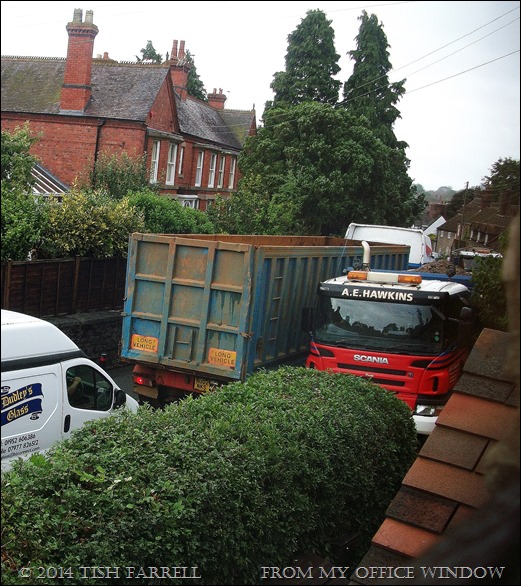
We locals amuse ourselves by taking photos of the trucks and buses that several times a day get jammed outside our homes. We send ‘the evidence’ to officers at Shropshire Council who shrug helplessly, quite unable to say what their predecessors were thinking when they upgraded a bottle-neck lane into an ‘A’ road. There’s nothing to be done, they say. It is hard to believe. One day, I tell them, a European mega-truck will drive down from nearby Telford and block the road forever. Then what will you do?

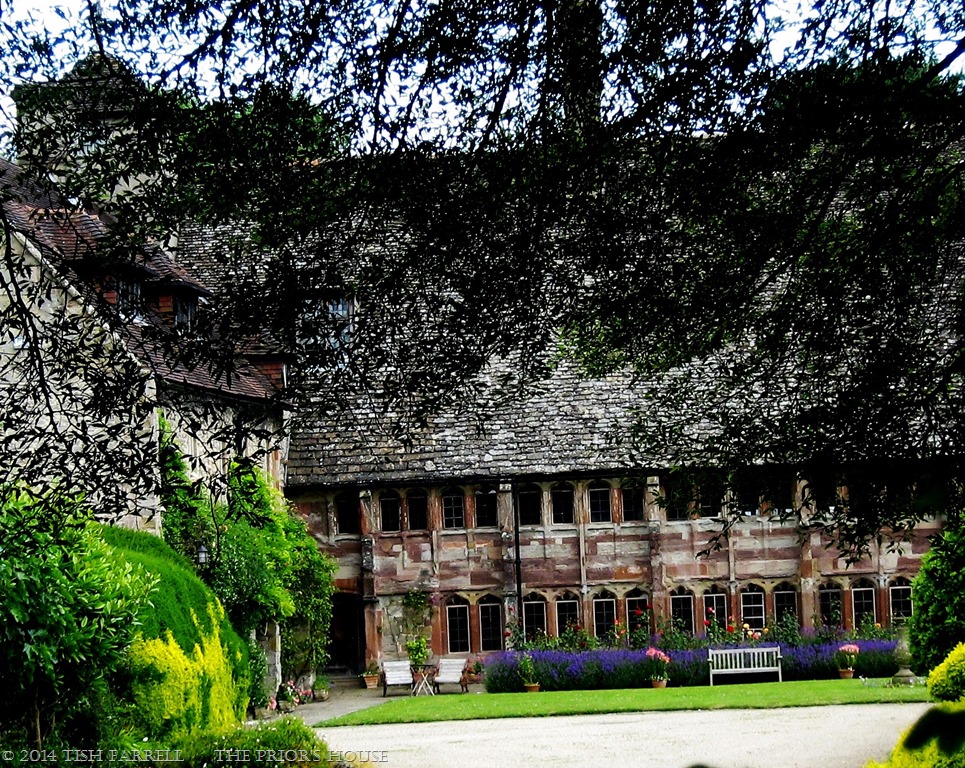
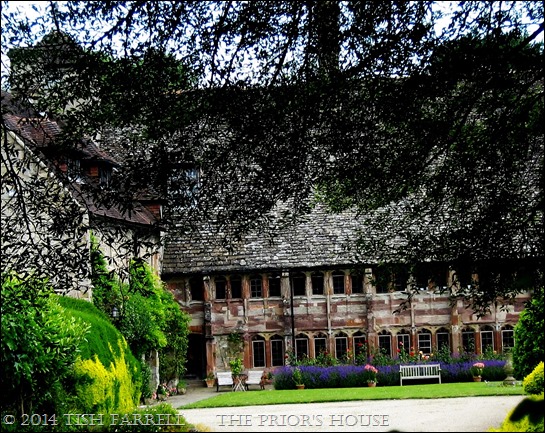
But for all the present day shove and shunt, there is still a sense of romance about the town and Wenlock Edge. Spirits from the past make their presence felt in all sorts of ways. Housman set the Edge in verse; Vaughan Williams rendered it in song; the explorer, Stanley, sat upon it, his dark heart brooding on his time in Africa as he surveyed the more benign Shropshire landscape below. Even Henry James and Thomas Hardy came visiting, James more than once, and it is said he worked on The Turn of the Screw while staying as guest of the Milnes Gaskells in the old Prior’s House. (When Henry James Came to Wenlock).

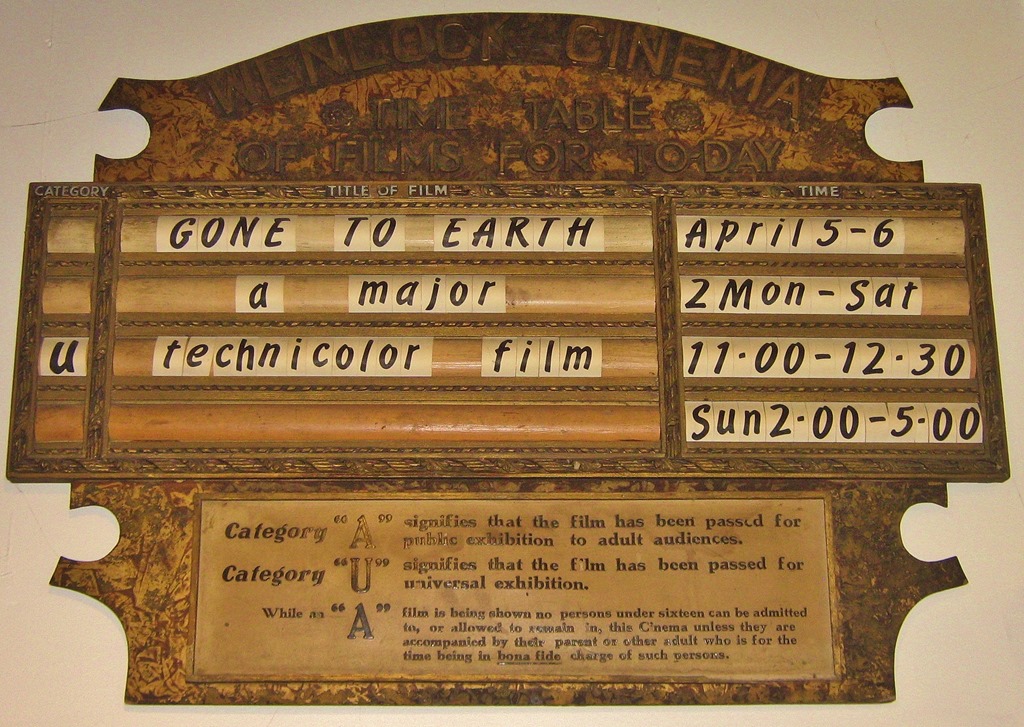
Then there is the Shropshire writer-poet, Mary Webb who spent her adolescent years living on the Edge at The Grange, and was well known about the town. When in 1949 her novel, Gone to Earth, was turned into a film by Michael Powell and Emeric Pressburger, some of the scenes were shot locally. In fact my neighbour tells me that one of the film’s extras used to live in our house, and that he was also the town’s projectionist. He would thus have shown Gone to Earth in the little town cinema that is now the museum, thrilled to bits as the scenes flickered on the screen: seeing himself and other townsfolk alongside Hollywood star, Jennifer Jones. (Jennifer Jones Comes to Wenlock).

IMG_1085

But the Edge itself has far older stories than these. Back in the Silurian Age, some 430 million years ago, it was a tropic seabed, and in rare moments when my mind can embrace such vast temporal constructs, I imagine my house on the shore of the Silurian Sea. (A Solaris moment perhaps). Of course back then the ground on which my house stands was not even in the Northern Hemisphere.

No. Back then the earth’s landmasses were still on the move, shifting up the globe from the South Pole. The English Midlands and Welsh borderlands, that I think I know so well, lay 15 degrees south of the Equator in what is now the Indian Ocean. They were part of the micro-continent of Eastern Avalonia that in turn bordered the Iapetus Ocean.

And so while Shropshire lay somewhere off Mozambique, the world warmed and the Ordovician ice caps melted, the low-lying lands filled to become the Silurian Sea. I like to imagine that, after living in East Africa for seven years, returning to settle in Much Wenlock is, in some convoluted sense, a return to the place where I was. It has a feeling of alchemy about it, and time travel, that lessens the loss of Africa.

Our much travelled escarpment is understandably a fossil hunter’s paradise and, as such, is the most famous Silurian site in the world. In its seaside days, warm, shallow waters were home to sea lilies, corals, multi-radiate starfish, trilobites, gastropods, brachiopods and fish. Indeed, somewhere over my garden hedge, there may have been some reef lagoon that hosted ammonites, squid and, horrifically, water scorpions five feet long.

My house is of course composed of these Silurian deposits, dug from those vast quarries along the Edge. I thus inhabit a re-purposed fossil seabed. There are crinoid stems and corals in the chimney-breast, all belonging to an age before the birth of amphibians or dinosaurs, or before there were mammals and birds in the world.

100_5035

While I can easily picture my house on a flat, gravelly shore beside a teeming shallow sea, it is hard to conjure the great absence of earth-life. We might easily imagine that the terrestrial world would have been a very quiet, still place, but this, I gather, would be a grave misconception. The land may have been lacking in life forms, but there was instead a perpetual wind. And because the paucity of land life meant there was little with which to bind the earth’s surface, the Silurian seashore would have been a dreadful place of roaring sandstorms and lashing gravel.

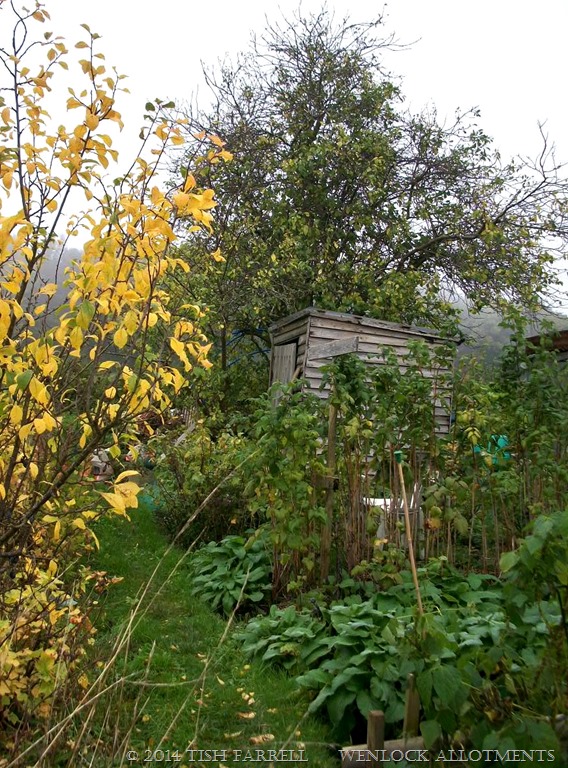
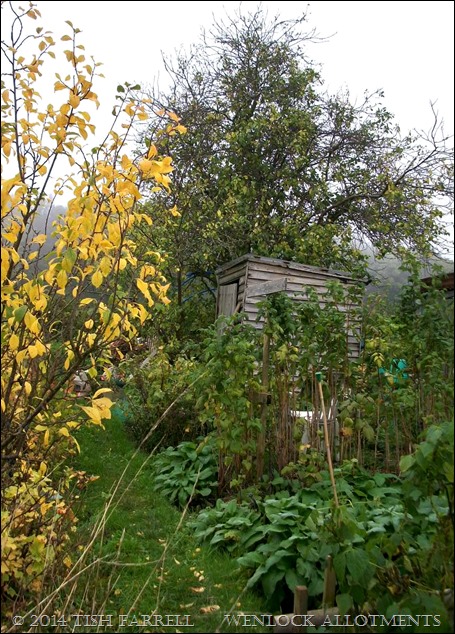
Not so now. Today, the farmland that surrounds the town is lush and homely. It has sheep and cattle, arable crops and pasture, woods and thickets, the old quarries and sundry ruins, remnant green lanes and farm cottages. There are deer and rabbits, foxes and rodents and also, as far as the town’s allotment owners are concerned, far too many birds. That said, though, it is good to hoe and dig to the mewing of buzzards, and cawing of rooks.
100_4944

Most of the land within the town boundary, and this includes Townsend Meadow behind our house, is still feudally owned and tenanted. It is within these little bounds of landowner imposition that the small market centre has grown up and been continuously lived and worked in for the last thousand years.

It is probable, though, that the first human settlement took place a few millennia earlier than this. Perhaps the first Wenlockians were Bronze Age Celts who, as venerators of water, would have been drawn to the many springs that rise below the limestone escarpment. The Celts were also skilled metal workers, and Wenlock Edge would have provided a natural, upland byway for itinerant smiths and metal traders going to and from the mineral-rich hills of Wales. Certainly Bronze Age hoards have been found in and around the nearby River Severn which, through many ages, was one of the country’s busiest inland trade routes.

There is certainly evidence for Roman settlement in the town – a large villa on the site of the Priory, and one which apparently had its own Romano-Christian chapel.
IMG_1265

Water, and sacred water at that, is another of the themes that runs through Much Wenlock’s settlement history. The town has many holy wells, including ones dedicated to St. Milburga and St. Owain. Milburga was a Saxon princess, who in 680 AD became abbess of a monastery for both monks and nuns, founded here by her father, King Merewald of Mercia. The monastery was built near the site of the Roman villa, perhaps chosen because of its already Christian associations. The invading Saxons established their authority by building chapels and monasteries. Later, the invading Normans did the same, but on a grander scale.
100_5886

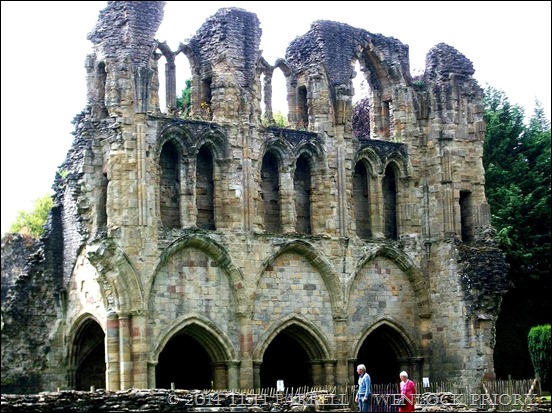
The Benedictine priory that succeeded the Saxon abbey in 1079  (and whose remains you see here) was part and parcel of the Norman master plan to control all aspects of Saxon life. Much Wenlock’s age-old reputation for holiness guaranteed that the local Norman earl, Roger de Montgomery, would choose the town for a big demonstration of power and piety. He invested heavily in the priory that was to become one of the most imposing religious houses in Europe. To ensure its future prosperity, all that remained was to annexe St.Milburga’s reputation for miracles, in particular her ability to strike holy springs from the ground. A new shrine was built to honour her sanctity, so ensuring a steady influx of  pilgrims and traders throughout the Middle Ages.

Roll forwards a few centuries and the town has another claim to fame, one that has significance to all of us today. In 1850 the town’s physician and apothecary, Dr William Penny Brookes (1809-1895) founded the Wenlock Olympian games that were to become the driving force behind the modern Olympic movement. Brookes fervently believed that exercise brought moral, physical and intellectual  improvement to all who took part in it. He was a campaigner of national standing, and responsible for the introduction of physical education into British schools.

His ideas spread, and in 1890 when Baron Pierre de Coubertin came to see the Wenlock Games for himself, Brookes shared with the young man not only his visions for everyone’s health and welfare, but also his wealth of experience from running the Games. He even designed and had made at his own expense wonderful medals for the winning competitors. Sadly, he did not live to see the first modern international Olympics in Athens in 1896, although De Coubertin did give him due credit as the inspiration behind the modern Olympic Games. Tribute was also paid to his home town in the 2012 Olympics when ‘Wenlock’ was the name chosen for one of the mascots. I hasten to say that this strange, one-eyed being bore little resemblance to any living Wenlock resident.

100_6677

The Linden Field ,where Brook’s Olympian Games first took place, is now a public park, bequeathed by a former feudal worthy for the pleasure and recreation of the people of Much Wenlock. Every July the Games are still held here, and with competitors from all over the world.

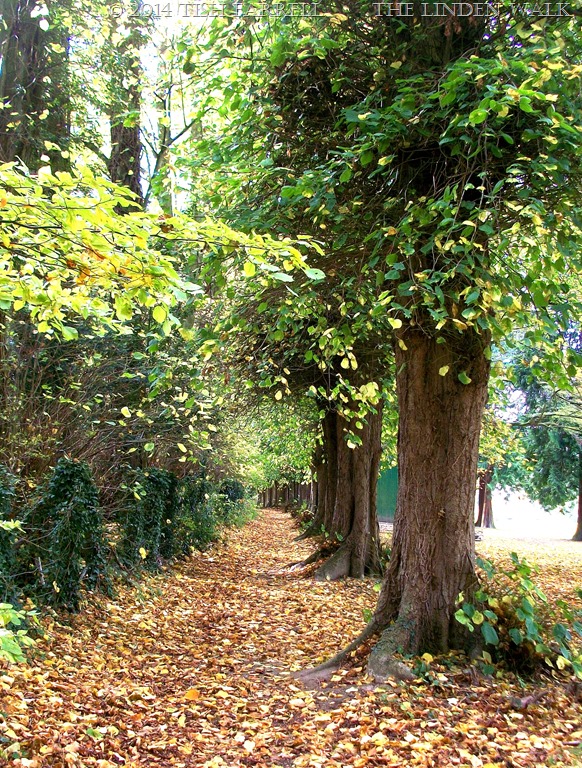
The field is only a step from my house, and I sometimes toy with idea of running down the avenue of lime trees that Dr. Brookes planted there 150 years ago. Musing on his notions that exercise breeds mental and physical improvement, I think the activity might relieve the creative doldrums, spur on the story-telling process, help me escape the peripheries, and finally get some work done.

Of course one of the hazards of being a writer, apart from devising ever new means of diversion and prevarication, is the hoarding of story ideas. Like the Silurian seabed, they go on accreting: stuff and more stuff, piles of notes and scribble and memory sticks slowly compacting on every surface in my office. Hopefully they do  not enfolding anything as alarming as a five foot water scorpion. And now that I’ve conjured this monster, I rather wish I hadn’t, although you never know: there’s maybe a story in it.

© Tish Farrell 2014


Afterthought:

I wrote the first version of this blog’s first post as the means of showing what ‘Writer on the Edge’ was about, namely the importance of evoking place (at least in some sense) in all creative writing. It is also a portrait of the place where I live and think; it is the edge on which I reside both physically and metaphysically. For although I lived in Africa for some years, Shropshire is where my roots are. At least I think this is the case. Once you have lived in foreign places for a time, it is often hard to know where home is.


*Historical source: Vivien Bellamy A History of Much Wenlock, Shropshire Books, 2001


Related:

When Henry James Came to Wenlock

Jennifer Jones Comes to Wenlock

Songs from and Inland Sea: “On Wenlock Edge”

Old Stones of Wenlock: Repurposing the Silurian Sea


#WenlockEdge #Shropshire #TishFarrellWriter #HenryJames

Seeking silence in the making of BBC Radio’s Soul Music: Remembrance

100_5858

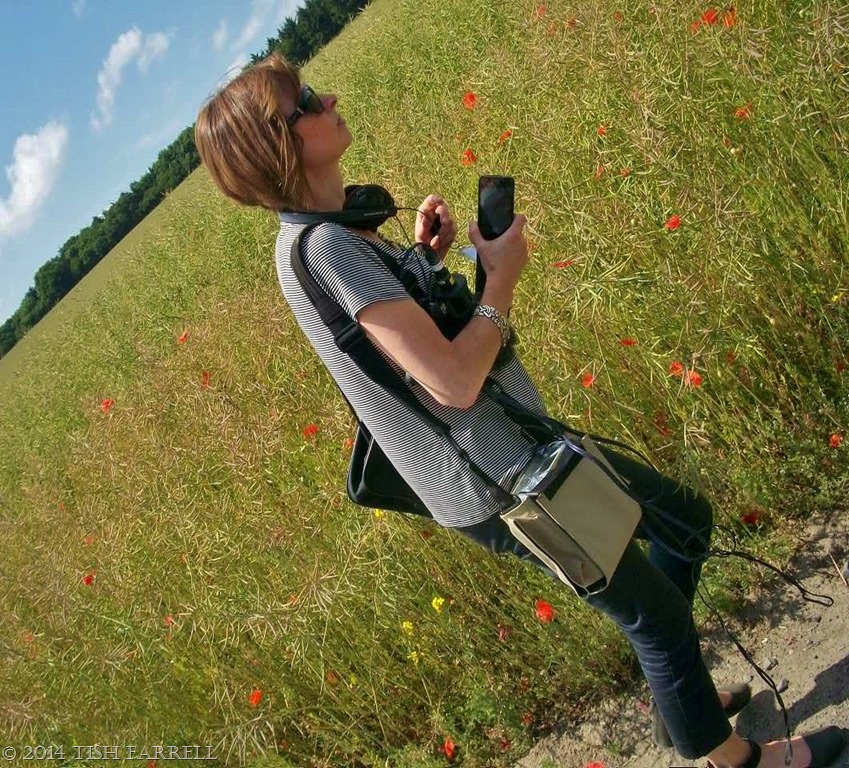
Out in the Shropshire fields below Wenlock Edge with Maggie Ayre, BBC Radio 4 Producer of Soul Music, and the Armistice Day 2014 edition A Shropshire Lad

*

So what is this all about? What has this writer to do with the making of a Radio 4 programme, broadcast today at 11.30 am? You  may well ask. It is one of those situations where one thing leads to another, and this in itself is apt, given the topic of the blog post that prompted my connection with the programme.

Last November I wrote a piece called  Songs from an Inland Sea: “On Wenlock Edge”.  It looked at the way the work of one artist can inspire the works of other artists. It was also about the place where I live, Wenlock Edge, the twenty miles of upflung fossil sea that features in the poems of A E Housman’s A Shropshire Lad.

This cycle of 63 ballad type poems, first published in 1896, has indeed inspired other works, in particular the music of composers Vaughan Williams  and George Butterworth. (You can hear excerpts of their works, and download a Guttenberg Press copy of A Shropshire Lad  on the link above.)

IMG_1373

Tis time, I think by Wenlock town/The golden broom should blow…”  ASL XXXIX

*

Last spring Maggie Ayre contacted me, saying she had read my post and was struck by the connections I had made with the Shropshire landscape. She said she was researching a programme that would possibly feature George Butterworth’s  Rhapsody, an orchestral work that expands his song version of the Housman poem Loveliest of Trees. She wondered if I would like to take part in the programme should it go ahead. Struck by a fit of ‘writer’s recluse’, I replied rather doubtfully that I might.

Soul Music is a long-standing Radio 4 series. Each programme usually features one piece of music, its performance intercut with the stories of several people for whom the work has special resonance. Today’s broadcast has further meaning, one that touches all of us: it commemorates Armistice Day.

I have written elsewhere about A E Housman and George Butterworth – Quoting Creatively: the “Out of Africa” Connection – but today, on 11th November, the connections are war-specific. Many of the Housman poems relate to the loss of young men going to war, of promising youth cut short. Indeed, sales of the work took off because of this, first during the Boer War, which in 1901 claimed the life of Housman’s younger brother, Herbert, and again during World War 1 when copies went to the front with many a recruit. Butterworth was one of those recruits. In 1911-1912 he had set eleven of the poems to music, and in 1913 seen the premier of the Rhapsody at the Leeds Festival. But by August 1916 the composer was dead, just another of the millions of casualties of World War 1. He was killed at Pozières, on the Somme, aged 31, his creative promise cut off in its prime.

073_001[1]

But back to Soul Music. I did not hear again from Maggie Ayre until the summer. Then in June, on a hot summer’s day, she came to my house in Much Wenlock and, since the rumble of traffic on Sheinton Street is ever intrusive, she suggested we drive up on to Wenlock Edge, and find a quiet spot to talk about Butterworth’s Rhapsody while looking out across the Shropshire landscape. It seemed a lovely idea.

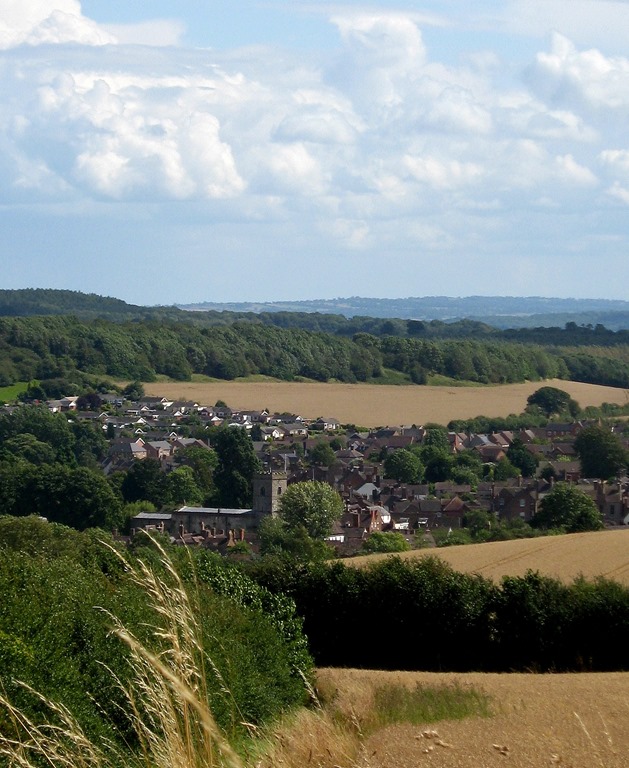
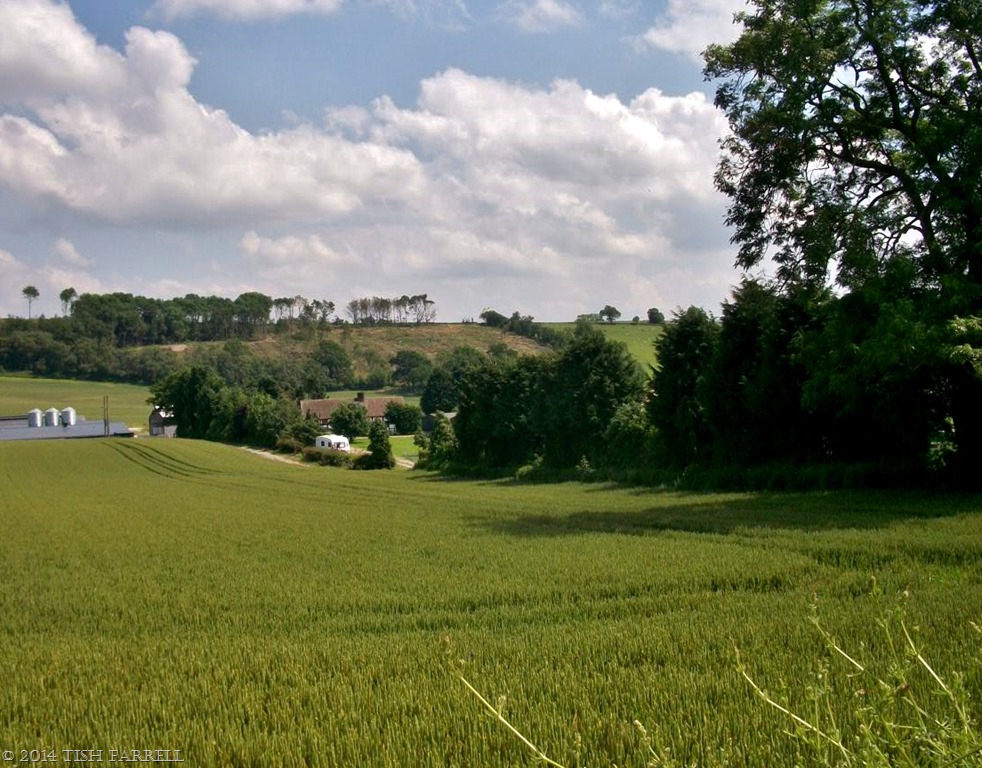
And so began our pursuit of silence across the countryside – silence, that is, from traffic, aircraft, chain saws and farm machinery. Who would have thought it would be so hard? It was not even harvest time. We drove over and behind the Edge and into the valley you can see in the next photo. We walked along farm tracks, and up and down fields of wheat. It was very hot. Always there was the grind of something mechanical resounding off the hillsides. Of course there would have been plenty of rural noise in Housman’s day – the rattle of carts, shouts of many farm labourers, the blasting of limestone at Wenlock Edge’s great quarries, but by now our pursuit of quietness was beginning to emulate A Shropshire Lad’s most poignant theme: the longing for the unobtainable, “the land of lost content.”

100_5856

Finally there was silence, apart that is from a buzzard’s call and the humming of bees, and so we sat down on the sun-baked ruts of a wheat field path, and Maggie put that big microphone near my nose and we began. By which time of course, my mind was in a whirl, and everything I’d thought to say dispersed to the four quarters. But in the end, enough was apparently said for Maggie’s purposes. (I should add that I was only one of several participants who include students from Bromsgrove School, where Housman was a pupil; they had recently been performing the Butterworth-Housman songs for a school concert.)

As we tramped back along the farm lane to the car, the quietness was broken by a bird singing in an ash tree. I think is was a robin. It stopped us in our tracks. We listened as it sang and sang. It was a moment of true remembrance: the notion of peace when the bombardment ceases. It is something we need to hang on to, and hang on to for dear life. It is the best and only reason why all European countries, or all humanity for that matter, should stand together, and stop pursuing pointless, ruinous, life-wasting conflicts.

copyright 2014 Tish Farrell

100_6893

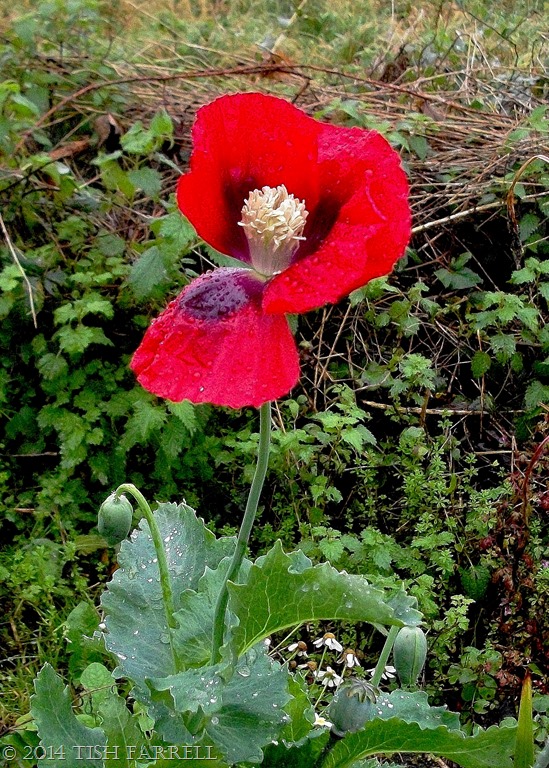
Not a Flanders poppy, but a wild poppy nonetheless, and quite extraordinarily it is flowering today, 11th November, in the field behind our house.

Remembering my own Great Uncle, Private Giles (Victor)  Rowles, who died at Gallipoli, aged 19 years and was buried at sea off Mudros Harbour in August 1915.

https://tishfarrell.com/2013/09/15/looking-for-giles-aka-private-victor-rowles-1896-1915/

https://tishfarrell.com/2013/11/11/thinking-of-gallipoli/  

*

Soul Music BBC Radio 4  A Shropshire Lad

The Housman Society

#nogloryinwar

One Word Photo Challenge: Scarlet

100_3415

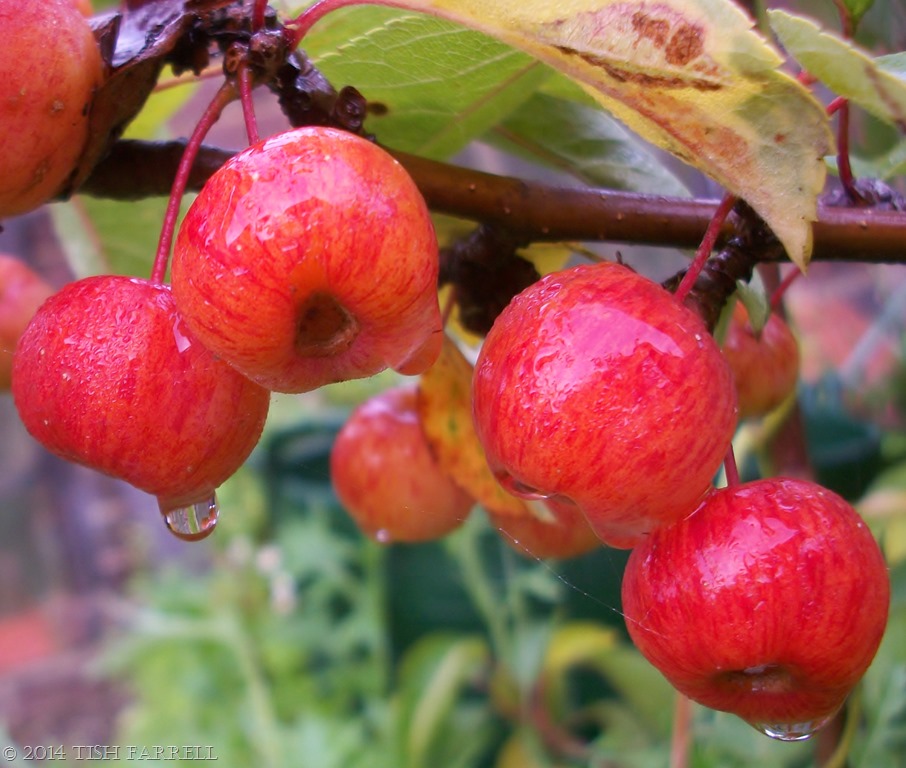
We planted the Japanese crab apple tree in the garden in 2006, not long after we moved into Sheinton Street.  Now is its season of fiery scarlet glory. Each fruit glows like a miniature lantern, brightening the gloomiest autumn day. And today is just such a day in Much Wenlock, my usual sky-view over Wenlock Edge, a blanket of grey mist. Even so, the apples glisten. I know, too, as we head into winter, we will have the pleasure of watching the blackbirds come to feed on the fruit, grey days then enlivened by their darting silhouettes foraging among the branches. Few of these tiny apples will be wasted. And then before you know it, the tree will be bursting with purple-pink buds that open in showers of pale blossom. Spring. Splendid how one thing leads to another.

copyright 2014 Tish Farrell

For more studies in scarlet, visit Jennifer at One Word Photo Challenge: Scarlet 


Quoting Creatively: the ‘Out of Africa’ connection

Ngong Hills, view of Rift Valley to the west

I may be wrong about this, but doesn’t John Barry’s Out of Africa film score owe just a little something to George Butterworth’s Shropshire Lad Rhapsody? Both works ride on a swell of yearning for a life, a love, a land that is lost or unobtainable. Both composers are English, and Barry probably knew Butterworth’s small body of very English song-cycles. (Butterworth died in 1916, a casualty of World War 1).

Of course, the influence of one composer upon another is common enough, and could well be subconscious. On the other hand, Barry might have chosen deliberately to nod to the earlier work. There are many reasons to do so, and it all begins with that other very English creation, the collection of poems called A Shropshire Lad, by A.E.Housman, the work that inspired Butterworth’s Rhapsody and the several Housman poems that he set to music.

I have written elsewhere how this collection of ballad-type poems inspired several composers in their works, and not only Butterworth, but also Vaughan Williams and Ivor Gurney. At the time when I wrote that post, I had not thought about the Out of Africa film connection. But now I have thought of it, my interest is rather personal.

Firstly, as a writer who has worked with several illustrators, I like the way one artist’s creativity can provide inspiration for other artists’ work. Indeed, when it comes to A Shropshire Lad, there is a veritable multiplier effect of allusion and quotation in other works throughout the twentieth century. This includes Dennis Potter’s disturbing play Blue Remembered Hills (A Shropshire Lad poem XL).

Secondly, Housman’s poems, and in particular the music they inspired, make reference to Wenlock Edge and the town of Much Wenlock where I live.

Thirdly, I have also lived in Kenya, the country that inspired Karen Blixen’s Out of Africa.

And fourthly, in the script of Sydney Pollack’s film of the same name, which derives more from the biographies by Judith Thurman (Isak Dinesen) and Errol Trzebinkski (Silence will Speak) than from Karen Blixen’s book, includes two very striking quotations from A Shropshire Lad.

Both arrive towards the end of the film, and both relate, directly and indirectly to Denys Finch Hatton, Karen Blixen’s lover who died in an unexplained plane crash at the age of 44. For more of their story go HERE.

The first and most heart-rending is at the burial of Finch Hatton up in the Ngong Hills. Meryl Streep as Karen Blixen reads, not from a prayer book, but from a book of poetry, and the poem she reads is poem XIX To An Athlete Dying Young. This is the final stanza:

And round that early-laurelled head

Will flock to gaze the strengthless dead,

And find unwithered on its curls

The garland briefer than a girls.

(You can read the whole poem HERE)

While I can find no biographical reference that supports the reading of the poem at the actual burial, I can only say that it could not have been more aptly chosen. In other words, if it is a Hollywood invention, then it is a good one. It adds to our understanding of both Blixen and Finch Hatton in real life.

Denys Finch Hatton had rare glamour.  He was man who was adored and admired by men and women alike. He was a consummate sportsman, a soldier, hunter. He was an elusive adventurer and the son of an English Lord. As a great lover of poetry  he would doubtless have known A Shropshire Lad very well. More importantly, he is said to have had a pathological fear of growing old, and was ever to be seen wearing a hat once his hair began to thin.

In her biography of him Too Close to the Sun, Sarah Wheeler makes the analogy with Icarus. This too is apt. With his shocking death, burned in his plane, the self-regarding sheen of aristocratic settler life was diminished. The film’s burial scene thus prepares us for Karen Blixen’s final exile from Africa. Loss piles on loss.

Before she leaves the country, the film shows her being treated to a drink in the ‘gentlemen only’ bar of Muthaiga Country Club, a restriction which she apparently infringed when first arriving in British East Africa. The toast she gives her hosts is one said to have been used by Denys:  ‘rose-lipt maidens, lightfoot lads’.  This comes from poem LIV:

With rue my heart is laden

For golden friends I had,

For many a rose-lipt maiden

And many a lightfoot lad.

                       *

By brooks too broad for leaping

The lightfoot boys are laid;

The rose-lipt girls are sleeping

In fields where roses fade.

So where are these quotations taking us? What exactly is being evoked by their appearance in the film script?

It all comes back to the unobtainable or unclaimable: of the lost life, love and land that I mentioned in the beginning. The settlement by British and European aristocrats of British East Africa (Kenya) in the early years of the last century was an epic romance, one filled with the notion of noble master and faithful ‘noble-savage’  servants. There was the pitting of human courage and wits against the African wilderness; a wilful dance of death wherein sporting valour was supremely admired.  There was a notion of overbearing entitlement; that East Africa was their own country; that only they understood it. As a dream, it was bound to fail. It is a visceral longing for something that cannot be possessed.

For Housman the loss was for a love he could not have: another man. He was a respected academic who ultimately lived as a recluse. He wrote the entire collection of 63 poems while living in London, and without setting foot in the part of Shropshire that he evokes. Of this anomaly he makes the terse comment that, having grown up in the neighbouring county of Worcester, “Shropshire was on our western horizon which made me feel romantic about it.”

And here is where Out of Africa – book, film, and the true lives behind, find common ground with A Shropshire Lad; the ‘I had a farm in Africa, at the foot of the Ngong Hills’ moment; the sense of tragic romance, ‘The happy highways where I went and cannot come again.’ Those ‘blue remembered hills.’ The human condition of longing for something we think we had, or should have, but never can.

Scan-130429-0005

And finally then the music. Below are renditions of Butterworth and Barry. (The first begins with the song Loveliest of Trees, poem II, from which the orchestral piece derives). Compare and contrast, or simply ride the emotional tsunami – across Africa, or Shropshire, or wherever you think your lost Paradise resides.

Related:

Songs from an Inland Sea: “On Wenlock Edge”

Caught inside a Kikuyu Garden: A Memorial to Karen Blixen’s Lover, Denys Finch Hatton

A E Housman A Shropshire Lad  A Gutenberg e-book

Copyright 2021 Tish Farrell


By Tish Farrell:

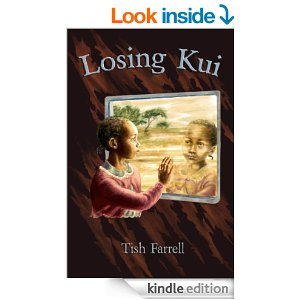
Things are going from bad to worse in Ingigi village. No one knows why five-year old Kui has gone missing. Nor does Sergeant Njau want to find out. He has his own problems, pressing matters that are far from legal. Then there is the endless rain. Will it never stop? Some Ingigi folk think it means the end of the world. Old man, Winston Kiarie, has other ideas. He senses some man-made disaster, and when it happens, it is worse than his worst imaginings. The fierce storms are causing landslides and throwing up British bombs, unexploded for forty years. Their discovery is giving the Assistant Chief ideas: how to make himself very rich. And then there’s young Joseph Maina and the primary school drop-outs thinking they have found treasure, and about to do something very, very foolish. Meanwhile, is anyone looking for Kui?

Losing Kui” is a fast-paced novella of interwoven tales. There are secrets, conspiracies, tragedy and dark comedy. The setting is a fictional East African country in the late 1990s, a time when El Niño rains were causing havoc. The author lived in Kenya during most of the 1990s, and much of the story was inspired by real events. 

Kindle Edition HERE

5 star reviewed

Polytunnel Vision

100_6616

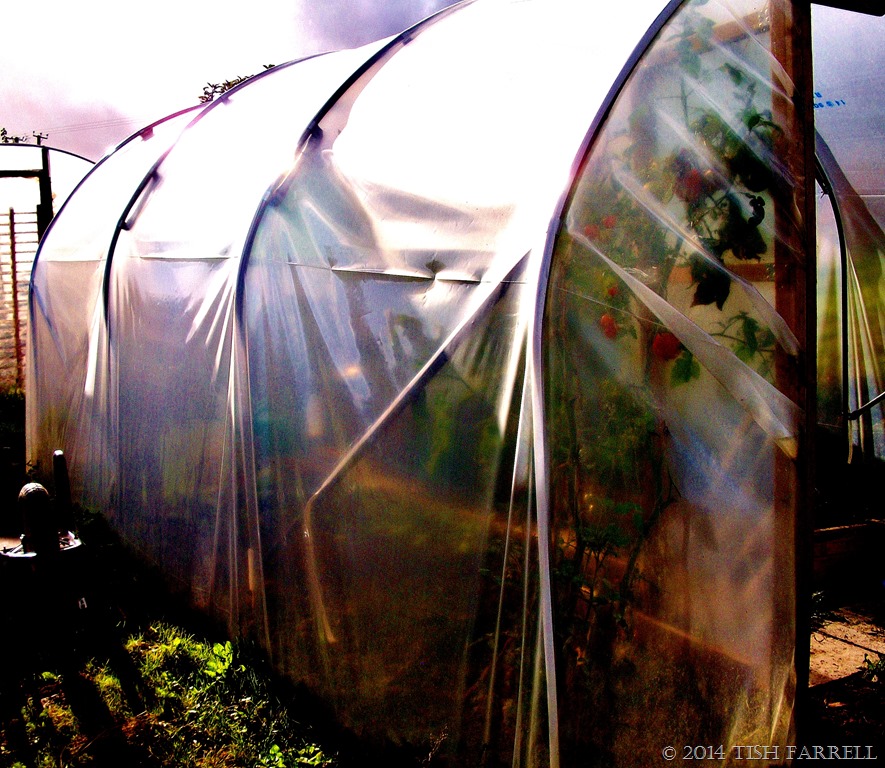
Oh all right, I know. As ambitions go, wanting to own a polytunnel might seem pretty odd. Also it’s not as if I don’t have enough housework in the house without having additional premises to tend elsewhere. But then sometimes in life you get precisely what you wish for, and most unexpectedly at that.

Ever since I took over my plot from Much Wenlock Allotment Society some seven years ago I have increasingly thought that a polytunnel was the very thing I needed. Gardening on the edge of Wenlock Edge can be challenging. The site is exposed, sloping, and often very windy. Much Wenlock is also in a frost pocket, and thus is a degree or so cooler than anywhere else in Shropshire.

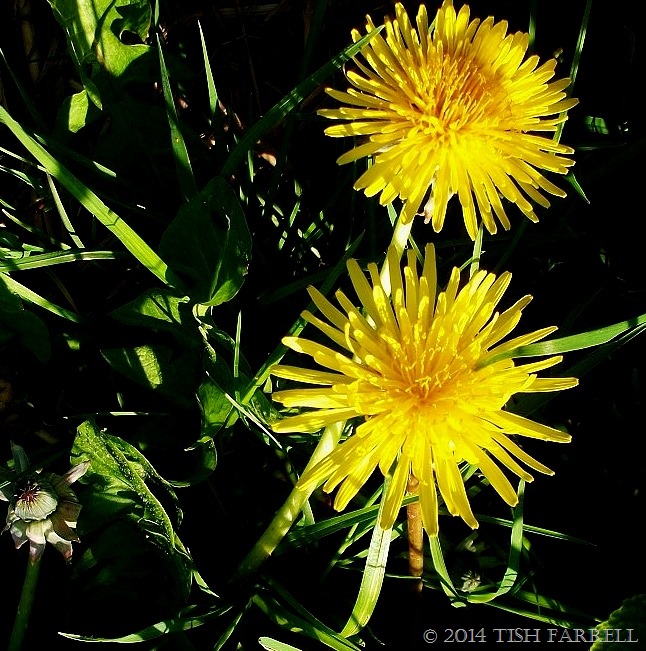
Worse still, the soil comprises a decaying fossil volcanic ash that is like wet cement when it rains, and hard baked cement when it doesn’t rain. It has thus taken seven years of digging, mulching, composting, green manuring, horse manuring, hacking and weeding to get the soil looking like something that vegetable plants might want to grow in. The dandelions, however, grow most verdantly, along with the creeping buttercups, sow thistles, docks, bindweed and couch grass. And so despite improvements, small vegetable seeds still find the soil heavy going. If they germinate at all, they struggle, the soil creating a bonsai effect on the roots, and then the slugs quickly finish them off. Most seeds thus need to be germinated under cover, and grown on before they can stand a chance after being planted out.

100_5367

And then, of course, there are the pigeons. They sit on the telegraph wires and watch what I’m doing. They especially like to eat cabbages and newly sprouted pea plants down to the roots. The rotters. In consequence I spend a lot of time making defensive systems out of environmesh and bits of wire fencing. This kind of protection also has to be applied to beds of leeks, garlic and onions due to the arrival in our part of the world of the allium beetle that likes to lay its eggs in the fleshy roots. The effect of these assaults on the leeks is especially dramatic: they unfurl in spiral fashion and develop rust-coloured stripes.

So you can see that to be an allotment gardener in Wenlock requires the same kind of pig-headed (idiot) tenacity it takes to be a writer. I have visions of deep, humus-laden beds bursting with lush, green spinach and broccoli, in much the same way I have visions of producing beautiful books that everyone wants to devour, and feel nourished by.

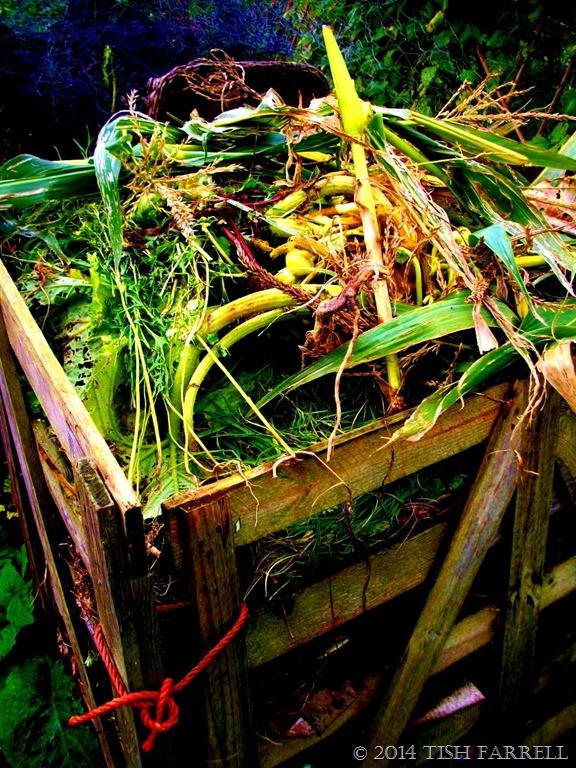
And that’s where the polytunnel comes in. I’m hoping I can crack both objectives in one fell swoop, this on the basis that if I can raise and eat more broccoli and spinach, my brain might produce writing with the requisite added enrichment. We can but hope. I might also say, as I probably have before, the contents of my writer’s brain have much in common with the contents of my compost bin, although at least they don’t smell. (Please note pallet structure installed by the Team Leader aka Graham who endlessly tries to bring order to my chaos).

100_4954

Anyway, back in the early spring when I was clearing my plot I noted, with a severe pang of envy, that my neighbours, Bob and Sally, were making preparations to erect a fourteen foot long polytunnel. I could see it was hard work, with foundation trenches to dig (in the aforementioned concrete soil) and the frame to erect. I watched them toil, hanging doors, and making beds. Next, I watched as my other neighbours, Pete and Kate, followed suit. Their installation was even more hard work, being on a slope. It took them weeks to complete. In the meantime I kept the Team Leader posted as to these events, from time to time mooting the possibility of us having a tunnel; perhaps something smaller, I hazarded.

100_5631

I have to say the response wasn’t altogether encouraging, even though we were by then falling out at home over whether the small conservatory on the back of the house was my potting shed and greenhouse, or his workshop. Increasingly my bean and sweet corn seedlings were having to compete with saws and wrenches and other man-things whose function I cannot identify. Nor was there the possibility of building either a man-shed to contain his stuff or a woman-greenhouse to contain my stuff since the garden at  home is too narrow.

Back at the allotment I watched the new polytunnels fill with tomatoes, cucumbers and peppers…I thought longingly of gazpacho that simply cannot be made from flavourless supermarket produce. Ho hum.

Then out of the blue in mid-summer, a little bird, otherwise known as ace fellow allotmenteer, Phoebe, told me that Bob and Sally were moving and were looking to sell their tunnel. She thought I should discuss terms with them.  Not long after this I received a small inheritance from my once passionately gardening Aunt Evelyn of whom I have written elsewhere.

And so to cut a long story short, a week last Sunday I became the proud owner of the Auntie Evelyn Memorial Polytunnel, complete with potting bench, garden chairs and an automatic watering system. My aunt would have loved it. Bob and Sally even left me the last of their tomatoes and cucumbers. Not only that, the plot comes with a new shed that does not lean, nor provide roosting space for snails as my old one does. Already the Team Leader has added a shelf and guttering. In short, my water butt runneth over…Or will do very shortly.

100_6619

I have started clearing the tunnel’s beds and planted out lettuce and oriental vegetables to extend the salad season. But from now on, it is all new territory on the gardening front. There’s a lot to learn about tunnel cultivation and management. Planning and forethought are required. Better get cracking with that spinach and broccoli then.

Related stories about my aunt:

The Many Faces of Evelyn Mary Ashford

Grand Girl: Great Prospects

The Birds; Who, Where, When?

      copyright 2014 Tish Farrell

Please do visit Flickr Comments  to read more bloggers’ ‘P’ stories, or to add your own.

Still Life at the Allotment

100_6630

Mid October and the marigolds are still blooming up at the allotment. I love the way they simply grow themselves amongst my vegetables. In a mild winter they may flower into December.  It was also good to see this bee out and gathering pollen. These days, every bee is precious. Once we have killed them all with agri-chemicals, we can expect to starve. It’s as simple as that. My allotment empire has recently expanded – more of which in the next post – so I’m intending to grow more varieties of late and early flowering plants on my plot. Or maybe I should simply stick to marigolds, and let them grow EVERYWHERE. The flower petals are lovely in salads, and a herbal tea of marigold flowers is good for warding off flu. Simply looking at them makes you feel better. All that orange straight into the brain, lighting up the little grey cells as the days darken.

‘Happy Autumn’ northern dwellers.

100_4930


For more vibrant treats visit Cee’s Fun Foto Challenge

The Man from Much Wenlock: Meet Ken Milner

It is a privilege to know Ken Milner, a gentle creative man with deep rooted sensibilities for the past in and around Much Wenlock. He is a treasure house of information on country lore, on the families who have lived for generations below Wenlock Edge, and on the novels of Shropshire writer Mary Webb which, incidentally, he only learned to read at the age of thirty five. He built the house you can see in the video, and he created this beautiful garden which brings joy to all who see it. Graham passes it twice a day, driving to and from work. It is a floral threshold between the town and Wenlock Edge.

Ken also paints, makes sculptures, and is a poet and storyteller. Here, though, is his living creation – his garden. The video content was created by Ken and Wenlock poet, Paul Francis, and the whole filmed by  Silva Productions, a Midlands production company. You are in for a treat.


https://www.youtube.com/watch?v=23lgFSQzvTw


#WenlockEdge

Flickr Comments: M words