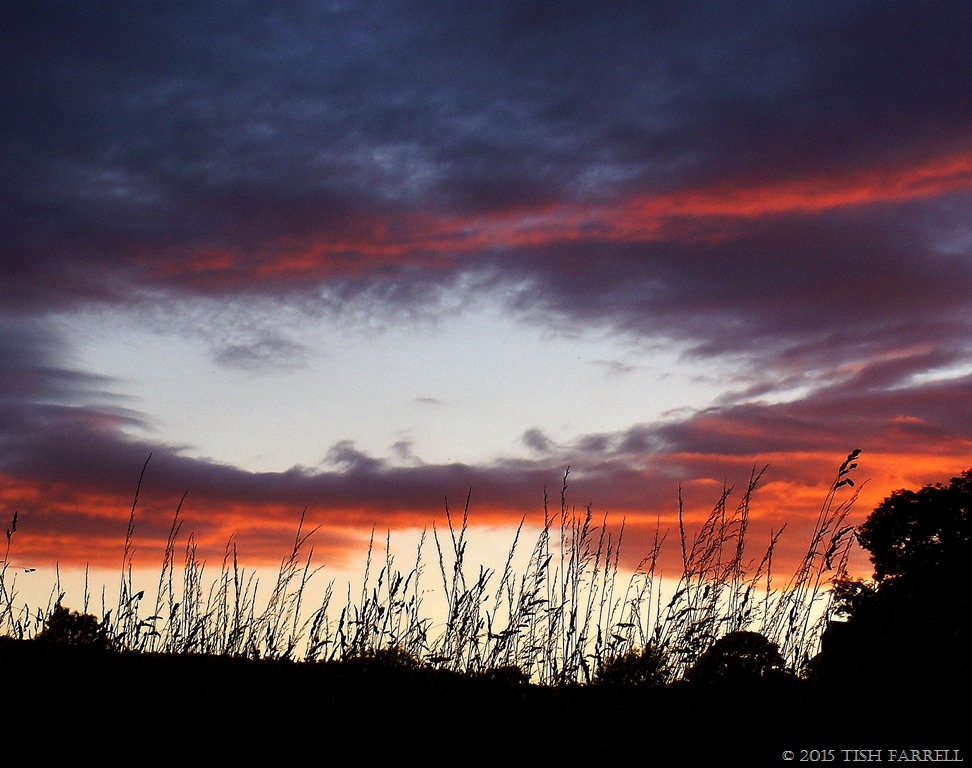
That sky-painting person has been abroad along Wenlock Edge again this week, redoing the sunset view behind our house. Good work.

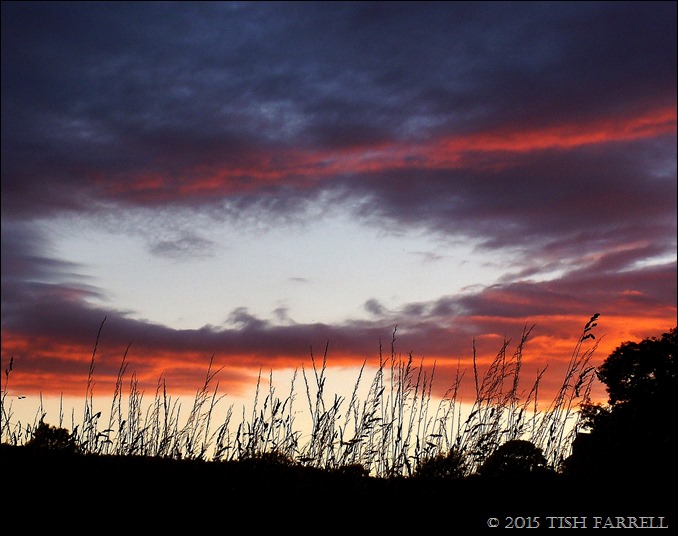
That sky-painting person has been abroad along Wenlock Edge again this week, redoing the sunset view behind our house. Good work.
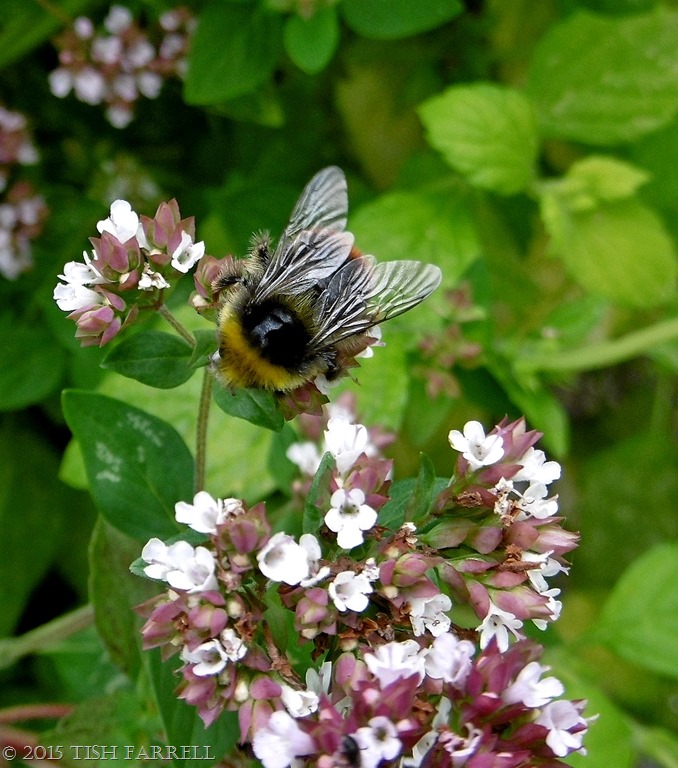
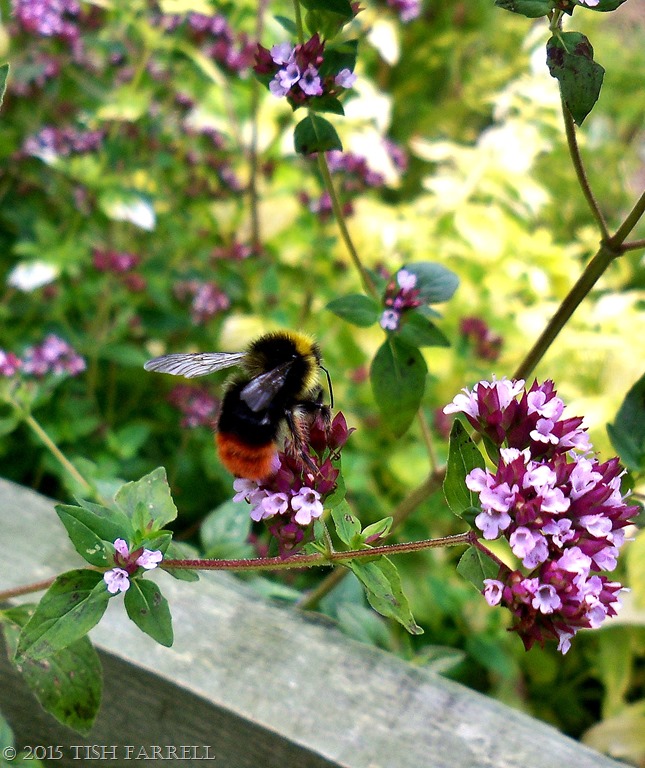
A couple of summers ago we took out a length of hedge between our back garden and the field. It was a thicket of alien snowberry and overgrown ash tree seedlings, and a nightmare to cut. Now we have a simple fence, a rampant herb and wildflower garden that grows itself, and a view. We also have masses of bees.
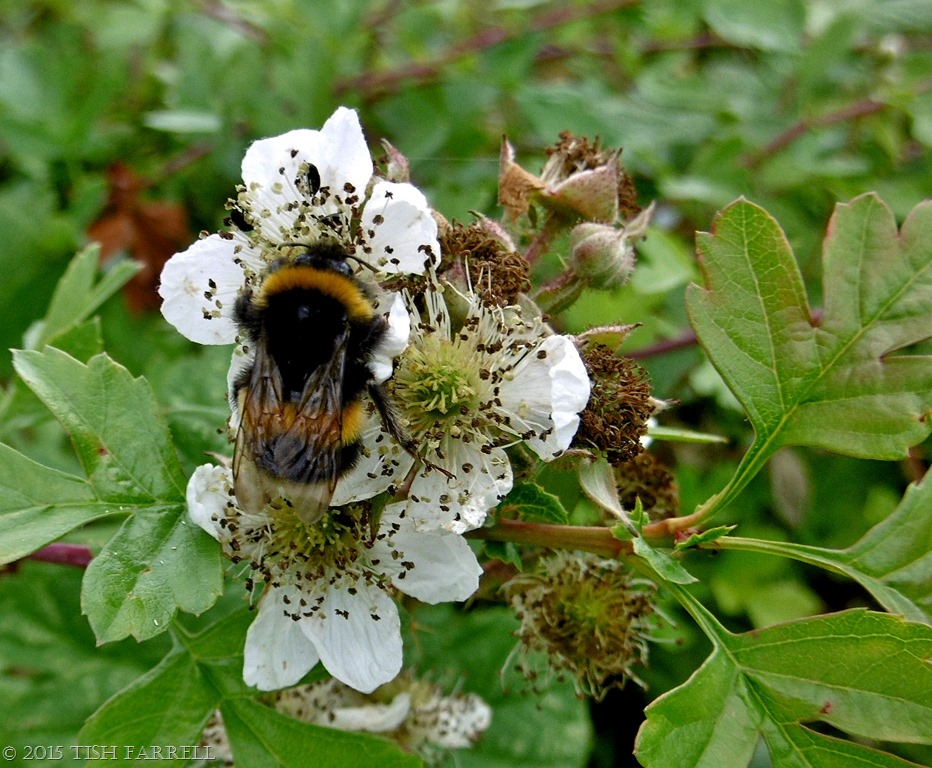
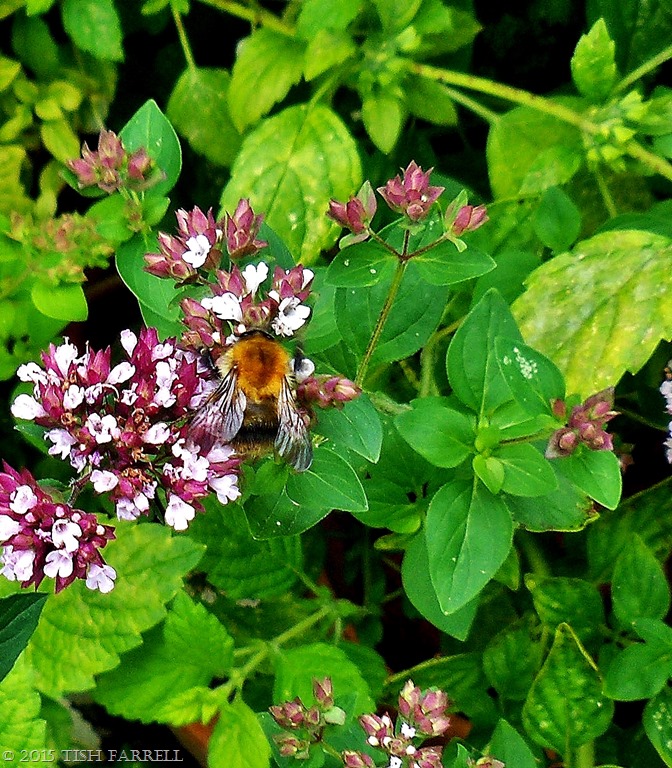
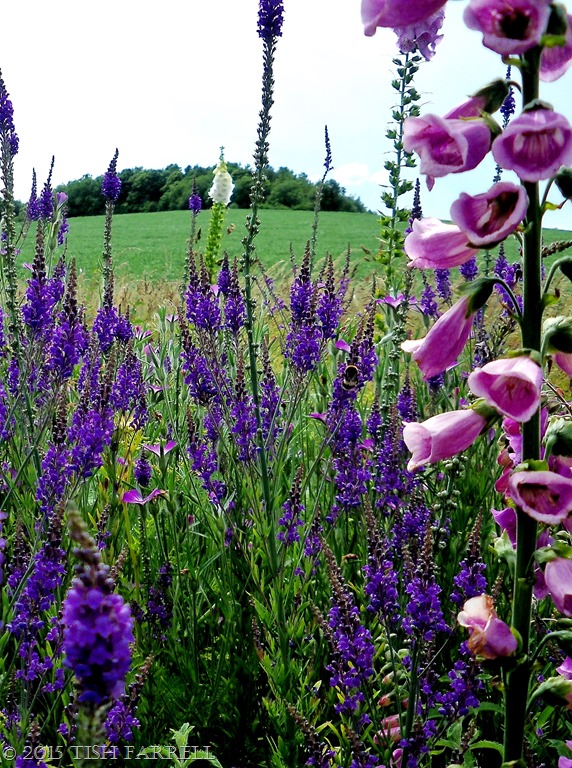
Back in the spring they foraged on the columbines; later on the spires of self-seeded purple toadflax and foxgloves. Now they are gorging on oregano and bramble blossom. I spotted at least three varieties of bumble bee this afternoon, but apart from the red-tailed bumble below, I’m having problems identifying them. For those of you who wish to try, there is an excellent identification page with a video at bumblebeeconservation.org
copyright 2015 Tish Farrell
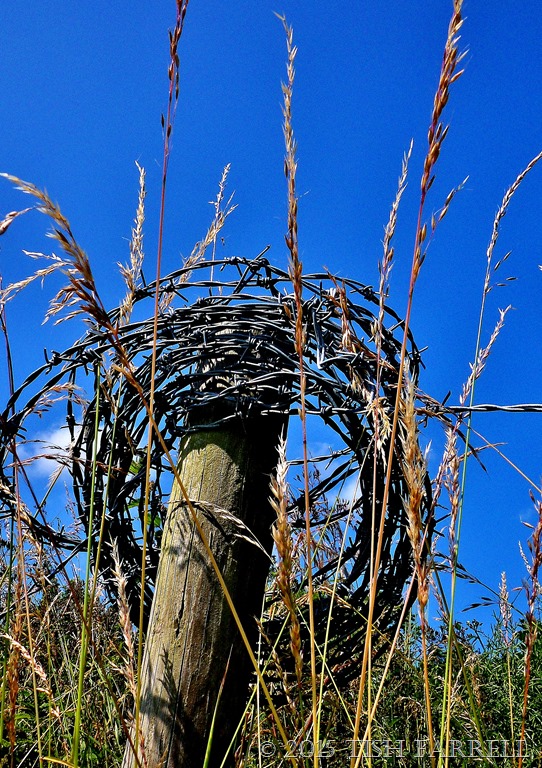
I keep going back to photograph this well crowned fence post. It is on the boundary between the allotments and the bean field. I first caught sight of it back in the spring when I was out using my Lumix on ‘dramatic monochrome’ setting. Then it was surrounded by drifts of Queen Ann’s Lace. Now the dying grasses have a nostalgic end-of-season look, and all before summer has hit its stride. But either way, spring or summer, colour or black and white, I find myself captivated by the image. I cannot say why.
copyright 2015 Tish Farrell
This post was inspired by Jithin at PhoTrablogger and his challenge: Mundane Monday #16 in which he urges to go out and find beauty in the ordinary things around us.

In this week’s Black & White Challenge, Cee is asking us to focus on subjects that are more than fifty years old. I’m pretty confident, then, that my home town of Much Wenlock more than fits the bill. As a settlement, it has been continuously occupied for the last thousand years.
The town windmill (seen above) is not quite that old. I’ve begun with it because it is the oldest structure near my house. It was busy grinding corn from around 1655. Then a lightning bolt struck it in 1850, and it has remained sail-less ever since – either a pity or not, depending on your views on historic conservation.
On the other hand, I perhaps needn’t have gone as far as the windmill. You might say my own house is something of a minor monument age-wise, much like its inhabitants (?). It’s original half dates from the 1830s. In the living room there’s a massive inglenook fireplace complete with bread oven that defies my attempts to photograph it well, so you’ll have to imagine it. Instead I’ll take you on a walk down Sheinton Street to see a few of the other sights.

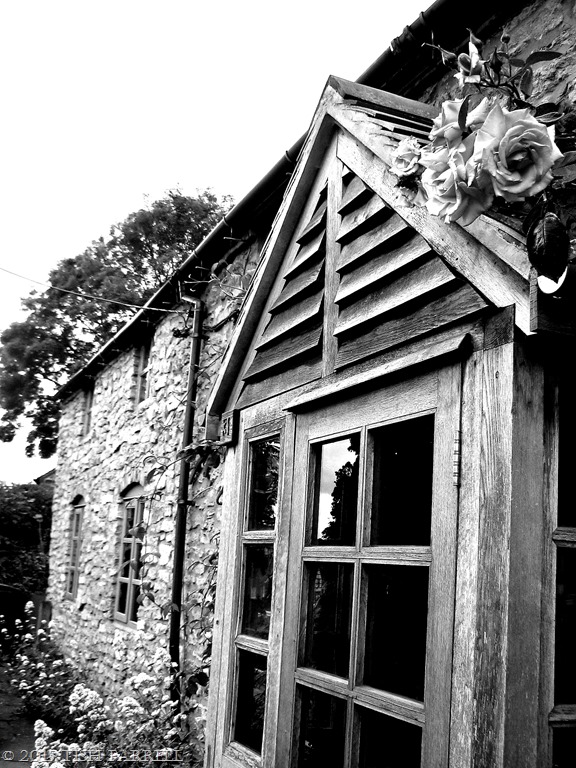
Heading into town, there are here-and-there signs of the medieval origins of many of the cottages, their timber frames concealed or disguised by brick and stone exteriors that have been added in more recent centuries.
Most of these cottages would have once housed artisans, their workshops opening directly onto the street to catch the eye of potential customers. The living quarters, and gardens would have been behind the workshops. In fact, the layout of long medieval burgage plots behind these Sheinton Street properties, and now pretty gardens, are still visible from the field path.
Today, Much Wenlock is a sleepy sort of place, much gentrified, and up-marketed. But step back a couple of hundred years, and much of it would have been grimy and industrial. Not only was there quarrying and limestone burning going on around the town, but within it were once the smoking kilns of the clay tobacco pipe manufacturers, stinking pits for the curing and tanning of hides for leather working, horses and carts churning up the dirt. Brewing was also a big local trade, as were slaughtering, pewtering, smithing, weaving, and hat and shoe making. The unmade streets were alive with taverns to wet the throats of dusty quarrymen, and the final touch, ambiance-wise, would have been provided by the malodourous effluvia of the Schetbroke, an open sewer of a stream which ran through the town (but now happily culverted).

I don’t know the particular history of this rather grand cottage seen above, but it’s a good example of a later stone frontage added to a much older building. Most of the town’s stonework has in fact been recycled from its medieval priory, dissolved by Henry VIII in 1540.
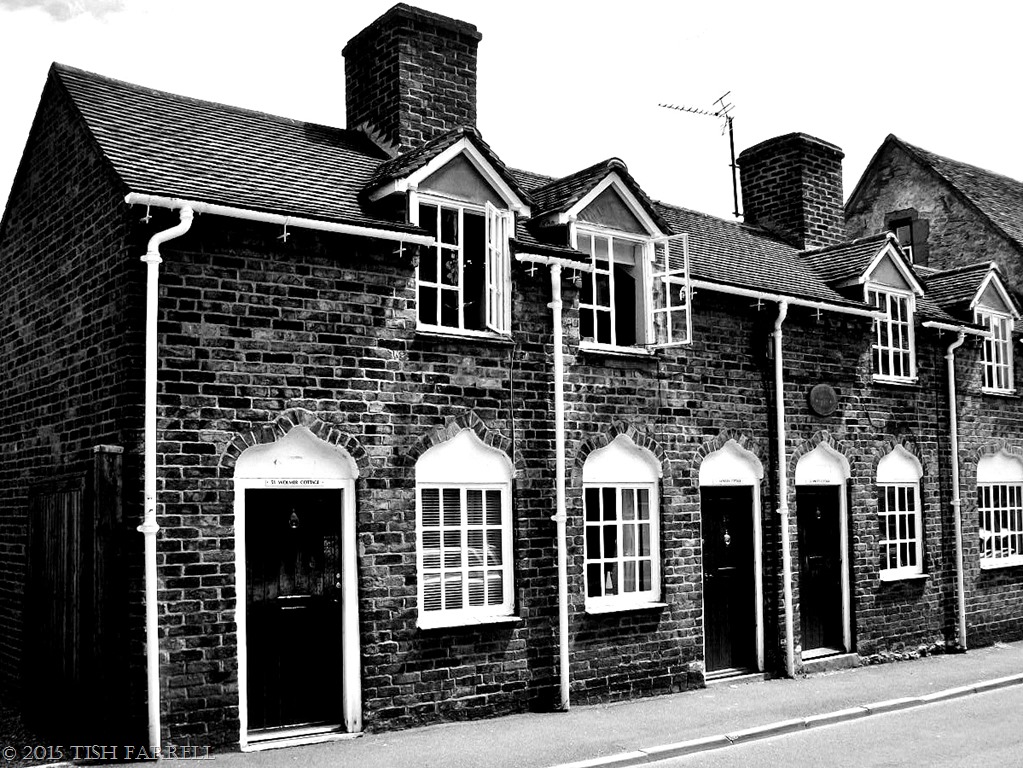
In amongst the antiquity we can also find more recent buildings. For instance, in the space between medieval neighbours is this little set of picturesque alms houses built in 1810. They are known as Wolmer’s Alms Houses, a charity founded in the town in 1485. They are still operated on a charitable basis for the elderly. I love the brick ogival arches over the doors and windows.
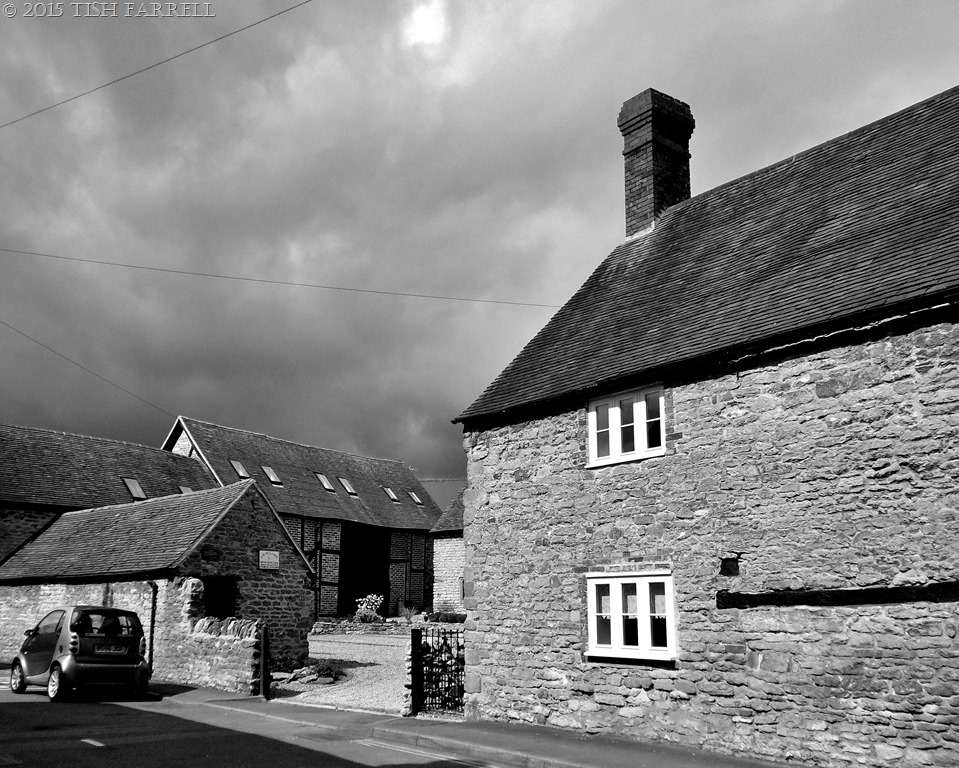
At the end of Sheinton Street is Brookhouse Farm. It is now a residential enclave of smart barn conversions, but until fairly recently was one of the last surviving examples of England’s town farms. I can still remember it in the 1990s as a very rustic farmyard with cattle in the barns. The farmhouse in the foreground was stone-clad in the early 1700s, and is one of several Much Wenlock houses with a medieval hall concealed within it. You might call this the Chinese Box school of architecture.
Then on the opposite corner from the farm is the Bull Ring…

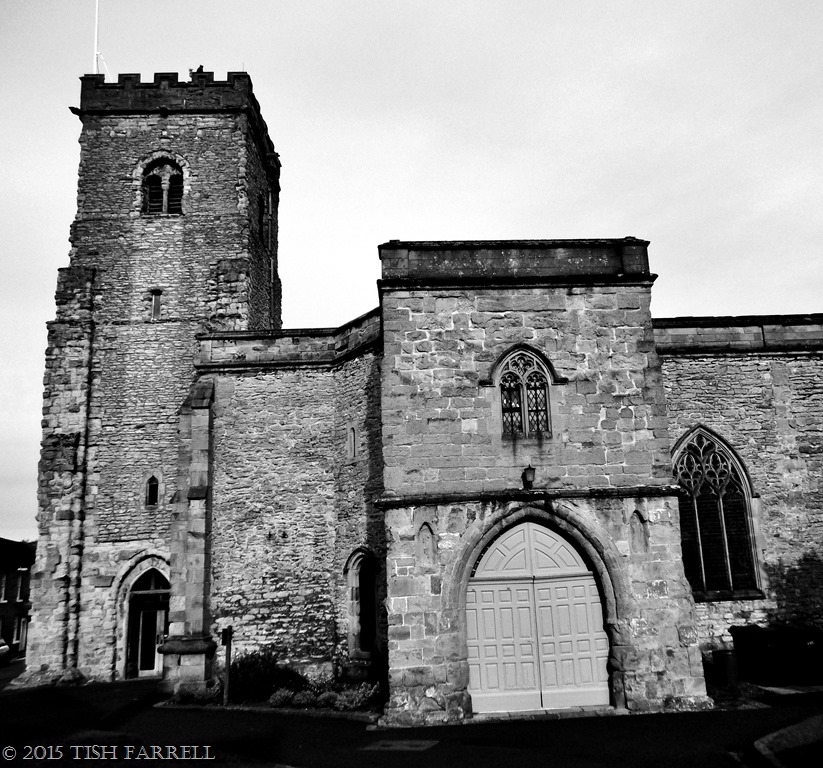
…so named after the unsavoury pursuit of bull-baiting that went on here until the early 1800s. By then the timber-framed building had stood for some 200 years, while Holy Trinity Church, seen behind and in the next photo, stands on the site the Saxon women’s church of St Milburga’s Abbey, founded in c.680 AD as a religious house for both nuns and monks. The oldest part of the present church is the nave which dates from 1150. Other parts were constructed in the 14th and 15th centuries.
During monastic times, Much Wenlock was ruled by the Prior under ecclesiastical law. After the dissolution in 1540 a new civil courthouse had to be built. It stands just across the Church Green, and marks the centre of the town. These days the ground floor is the venue for our various markets, while upstairs houses the original law court (now a gallery) and the council chamber which is still used for all Town Council meetings, and has to be one of the most uncomfortable, if august, venues in the whole town.

And now we’ll double back on ourselves. Please head under the arch (look out for the man with a camera) and cut across the Church Green for our last stop on this tour – a quick look at Much Wenlock Priory.

This is the view from the lane, where the site’s perimeter is shaded by soaring Corsican Pines. We’ll need more time to make it worthwhile buying a ticket to go inside, so I’ll leave you with a photo from one of my earlier visits: a close-up of the monks’ lavabo where they used to wash before entering the refectory to take their meals.
The carved panel dates from c.1180, which is odd, actually. I could swear one of the saints is on his cell phone. Not so much religious texts, as a direct call to the Almighty?

In Part 2 I’ll take you on a black and white stroll up the High Street.
copyright 2015 Tish Farrell
Related:
5 Photos 5 Stories Hidden Wenlock #1

There’s clearly something in the air over Wenlock Edge. Last night as we were sitting on the garden bench watching the sun go down – with our glass of wine and pot of olives – there it was. A rainbow. And it had absolutely nothing to do with rain. Most of the day had been hot and fine.
Fire rainbows are rare and technically called circumhorizontal arcs, and thus they are HORIZONTAL. i.e. More like this one, faintly seen, a little later and slightly north of the first iridescent cloud.

But if this isn’t a ‘fire rainbow’, but part of an ordinary rainbow, then the colours are the back to front, more as if this is part of a double rainbow, but with only the reflection visible. Curiouser and curiouser, but a wonder to see over one’s garden fence. Perhaps it is a Wenlock Edge phenomenon, the angle of the setting sun in relation to the cloud above it. Anyway, this is what was going on in the rest of the sky over the bean field. Someone has clearly been sky painting.
Happy Monday everyone.


I never grow tired of watching the rook and jackdaw ballet that takes place every twilight behind our house. I thought I’d share it once again.
copyright 2015 Tish Farrell

Before and after last summer’s wheat harvest.
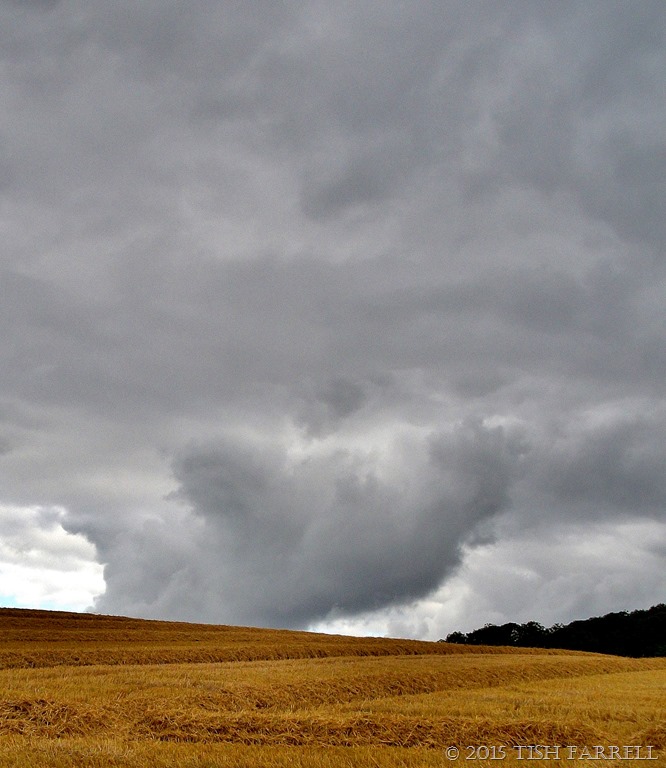
As I’ve mentioned once or several times, I spend much time watching the sky behind our house. I never cease to be fascinated by the false horizon created by this low hill. Behind it is a another false horizon created by Wenlock Edge which lies a half mile further on. Here in Wenlock, then, we see the movement of clouds in the westerly sky several hundred feet higher than do our neighbours below the Edge. It is a piece of geographic happenstance that makes for dramatic skyscapes. It’s a bit like watching a moving stage set.
I justify the time spent sky watching on the grounds that I need to make the most of this view. Doubtless the local landowner will get his way and one day build a sprawling housing estate here, this despite the fact the town has a Victorian drainage system that cannot cope with any more human effluent. Already, just to add an off-colour atmosphere to the scene, our sewage works is licensed to dump excess untreated waste into the stream which thence flows into the River Severn and through the World Heritage Site of the Ironbridge Gorge. This is clearly what is meant in England when certain politicians bang on about Victorian Values. Sometimes I wonder how, as a nation, we can be so very smug about ourselves.
The poor drains of course add to the town’s flash flooding risk, and to replace them would cost many millions. We do not appear to have a planning system in this country that says NO to development, even though there is insufficient infra-structure to support it. Developers of course pay a pro rata community levy on the number of houses built, but such amounts could not begin to cover the cost of the kind of remedial work that is necessary. When Wenlock’s population is less than 3,000, why would a water company spend 10 million pounds on such a venture?
The main problem is that the town sits in a hollow behind the summit of Wenlock Edge. The town centre is at the lowest point and thus one of the most vulnerable areas. In 2007 over fifty houses were damaged. Many afflicted families were still trying to restore their homes up to a year later. And while insurance cover may make good the bricks and mortar, it does not bring back the personal belongings that were lost, or quickly eradicate the memory of having a metre high flood rushing through your house.
Mostly of course, the town does not flood, although parts of it are prone to run-off from surrounding hills in times of prolonged wet weather. As far as we know, our house has never flooded, although given its position, built into the bottom of the hill, this is in some ways surprising. There is anyway a low earth bund along the back boundary and, after earlier flood incidents lower down the street, the landowner’s tenant farmer continues to leave a broad swathe of uncultivated ground behind our houses, and then ploughs in line with it.
In fact to create real problems it takes a certain kind of storm to hit our catchment area. But when it comes there is less than 20 minutes warning before a flash flood. The roads into the town become rivers. Every hard surface speeds up the flow, and given our antiquated system, all the storm water goes into the foul sewer. All of which is to say, as one of the flood alert wardens with the brief of forewarning elderly neighbours, I also have more pressing reasons for watching the sky, and keeping an eye on any storms brewing.
copyright 2015 Tish Farrell
Related:
In Much Wenlock An Inspector Calls
Please visit Paula’s place at Lost in Translation for more fascinating cloudscape photographs.

As I’ve been writing these pieces about the less obviously seen quarters of my home town, I’ve been aware that there is a danger of casting all in a glow of antique glamour.
It’s true that these days Much Wenlock is a very attractive place to visit. For a small town, the range of architecture (representing as it does a thousand years of continuous human habitation), is fascinating. There are grand medieval mansions, and small stone cottages, and many quirky vernacular details. The magnificent timbered Guild Hall glimpsed below, and dating from 1540, is still the town’s council chamber, and with seats that feel like the rock of ages to those of us who have sat through many a council meeting.
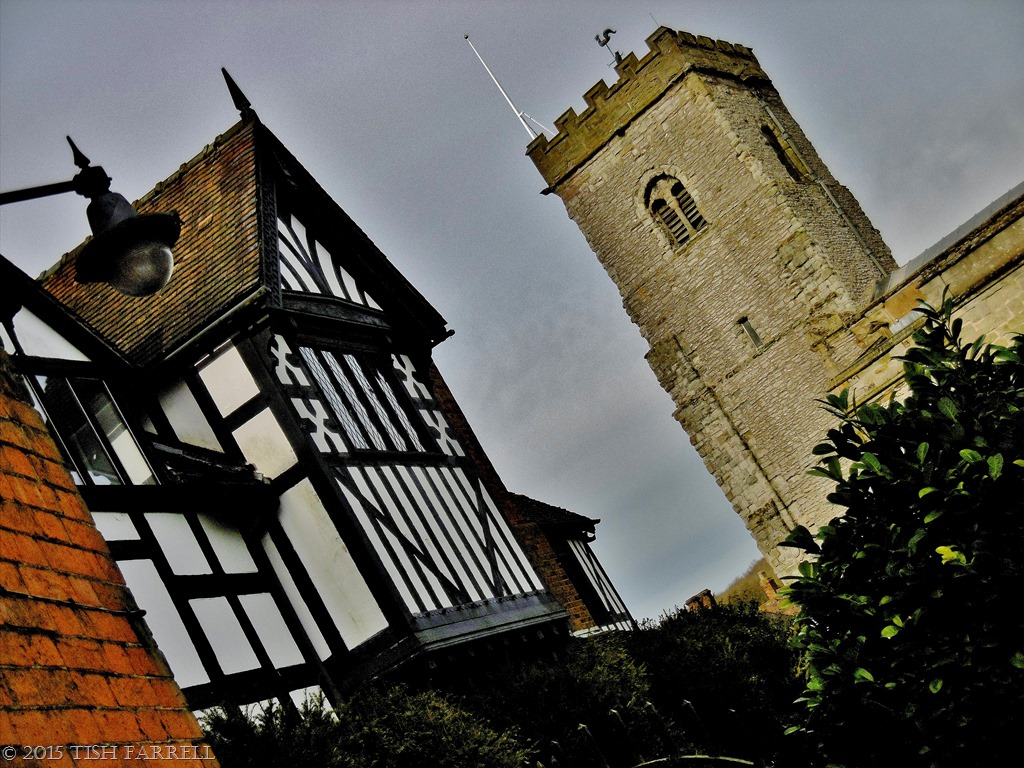
But this is all very well. For centuries, life for the labouring people of Wenlock must have been pretty grim, and one of the grimmest places to work must surely have been in the town’s many quarries, known locally as ‘the Rocks’, which I think says it all.
I’ve explained elsewhere how the town sits beneath the twenty-mile limestone scarp of Wenlock Edge, an up-thrust fossilised, tropical seabed. I’ve written, too, of how the limestone has been exploited for centuries, and at least since Roman times. Milburga’s Saxon monastery, parts of which survive beneath the parish church, was built of local stone, as was the grand Norman priory that superseded it. Later, after the Dissolution, much of the stone was re-purposed in many of the town’s buildings, and often used to clad earlier timber-framed buildings. So it is that many of the town’s oldest surviving dwellings, including a medieval hall or two, are quite hidden from view behind much later stone facades.
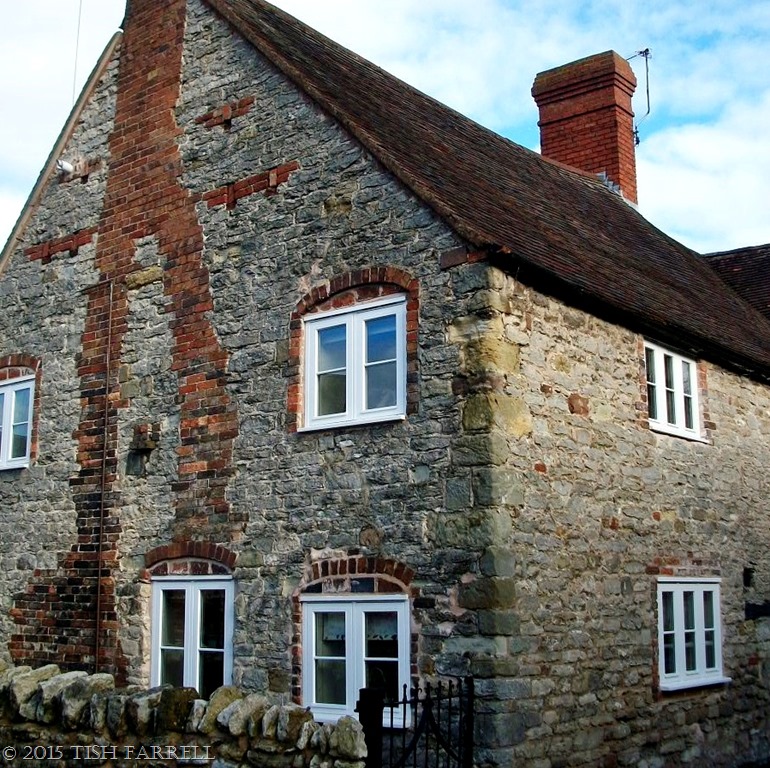
Other key uses for the quarried limestone were as a flux in the growing iron industry (i.e. from at least the late 17th century) and for lime burning to make fertiliser and building mortar.
For centuries quarrying would have been a manual task with heavy hammers, rammer bars, stone rakes and barrows as the quarrymen’s main tools. The use of black powder explosives, and then gelignite for blasting, was a much more recent practice, and not without its own serious hazards.
Lime-burners also had their kilns near the quarries, but operations were seasonal, and lime-burners did not appear to make much of a living despite the demand for their products.
The quarry featured in this post is Shadwell or Shady Well Quarry. It lies directly behind Windmill Hill, and is the nearest one to our house.


Workings here seem to have begun only in 1849 when Francis and John Yates of Ironbridge took a 14-year lease of a new quarry in Windmill Hill field, later called Shadwell Rock. They expected to dig 9,000 tons a year ( Glyn Williams Much Wenlock’s Limestone Quarries). In the 1860s the arrival of the railway plus the provision of a dedicated siding, saw Shadwell develop into an industrial operation. The South Wales & Cannock Chase Coal & Coke Company took over the lease, and in 1873 despatched 22,500 tons of iron fluxing stone to the Black Country in England’s industrial Midlands.
The quarry continued to be worked until 1996. Since then it has been left amid growing desolation. A few years ago there were plans to open a diving school with fifty cabins in the woods below the windmiill, but nothing came of it. The water has a strange blue-green hue which makes me think of Andrei Tarkovsky’s film Solaris. The pool is said to be over 70 feet deep and, from time to time, daft young men who have had too much cider, film themselves diving off one of the cliffs. There have been a few near misses survival-wise.
But at least some life forms have been making good use of the cliff faces. Since the blasting stopped peregrine falcons have begun to nest here. The same is apparently true for the other abandoned quarries along the Edge. There are ravens there too, although not yet at Shadwell. Perhaps they will come. It’s a pleasing thought: a case of positive re-purposing.
copyright 2015 Tish Farrell
Related:
Sun setting over Wenlock Edge: Or did the earth move?
Old stones of Wenlock: repurposing the Silurian Sea
5 Photos 5 Stories Challenge
Pauline at Memories Are Made of This nominated me to take up this challenge. The idea is to “post a photo each day for five consecutive days and attach a story to the photo. It can be fiction or non-fiction, a poem or a short paragraph, and each day nominate another blogger for the challenge”.
So today I would like to nominate Hanne T Fisker. She takes stunning photographs. Her blog is called Simplicity of Being, but her compositions brim with textural drama, and the light-and-shade complexities of the natural world. Please take a look at her work.

From my house I often watch the late-day sun slip behind the Edge. But which of us is moving: me, or the sun? It’s the sort of displacement-activity question I ask myself when I should be doing something more constructive. It also makes me think about the Edge, the fact that something so apparently static is, of itself, an embodiment of movement; a geological exemplar of extreme process and change.
The limestone ridge on whose foothills we Wenlockians dwell, is 425 million years old. It runs for some twenty miles while rising up to three hundred feet above the land. And so it goes without saying that a structure of this size cannot help but evoke a sense of monumental immobility.
How can it move?
Yet move it has, and move it does, although these days not on quite the colossal scale of the Silurian Age when it was formed. Its constituent parts, the sea-creature fossils that have fascinated the world’s geologists enough to earn them their own Wenlock Epoch, clearly indicate that our Edge is neither where it was, nor what it was in the aeons before fish were invented.
In fact during the Silurian era, and some 200 hundred million years before one cosmic hint of a Stegosaurus or Diplodocus was abroad, the strata that would become Wenlock Edge were quietly forming. Layers of dead and decomposing corals, sponges, sea lilies and molluscs were building up beneath a shallow tropical sea, and in a location somewhere off present-day East Africa and well south of the Equator.
Today, however, this former sea bed is an up-tilted escarpment, a steeply wooded ridgeway of ash, birch, hazel and oak trees. It bisects a temperate, rural Shropshire in the middle of England, which as most people know, is and often feels hugely north of the Equator. The power of tectonic shift and uplift is thus truly marvellous.
For the last couple of millennia, though, it has been humans who have been responsible for the Edge’s biggest movement. They have hacked, drilled, and blasted out the limestone with dogged persistence. At first the spoil would have been carried away on packhorses, then on carts, and finally by train and truck to wherever it was needed. Chunks of fossil sea bed hauled off to build grand monastic houses, feudal mansions, churches and cottages; limestone mortar to make them weather-tight; limestone to burn to make quick-lime for fertilizer; crushed limestone to pour into the top of massive blast furnaces, and so draw the impurities from smelting iron.
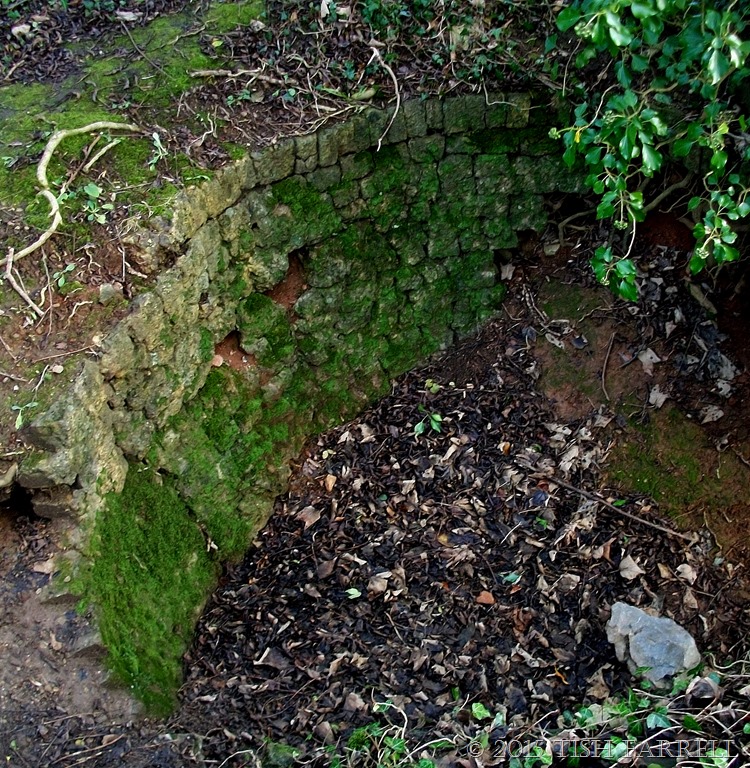
One of the many old lime burning kilns on Wenlock Edge
*
In such ways did Wenlock’s broadcast and reconstituted Edge come to play its part in Britain’s Agricultural and Industrial Revolutions. Yet way before this, in the late 600s AD of Saxon times, it probably also gave us our curious sounding name. In those days it was the habit to paint the early Christian religious houses with lime-wash so they glowed luminously white against surrounding terrain. It was also around this time that Milburga, daughter of a Mercian king, became abbess of a dual monastic house of monks and nuns that stood where the town’s parish church now stands . Gwen/Wen means white, and Loc/Lock means chapel or religious house. So there you have it – Wenlock – the place of the white church.
In more recent times, aggregates for highway construction have been the Edge-product of choice, and supplies are still outstanding in one of the quarries. At intervals convoys of motorway construction trucks come rattling through the town to fill up – and all this so more and more traffic can rush about the place.
The mopping up of the aggregates marks the end of quarrying, although the quarries themselves have now been occupied by other industries – garden fencing and woodchip fuel producers, paint and packaging companies – all taking advantage of the huge spaces left behind by the evacuated limestone.
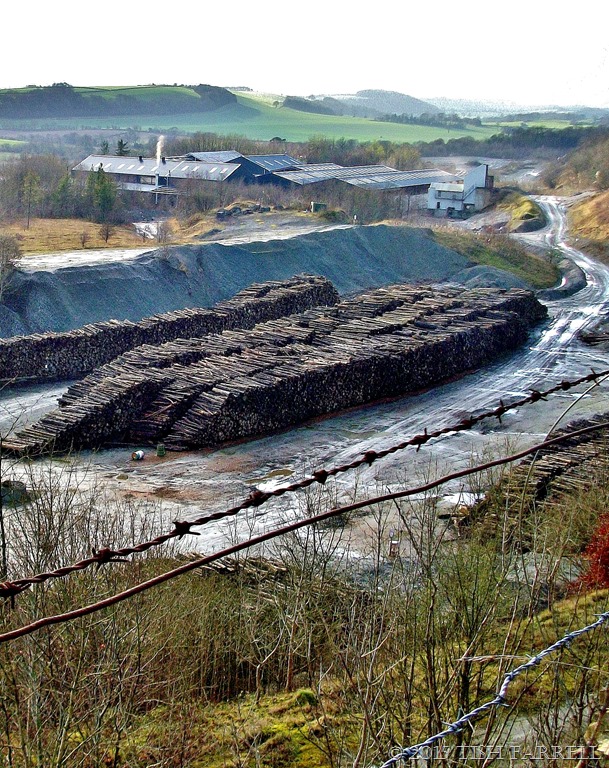
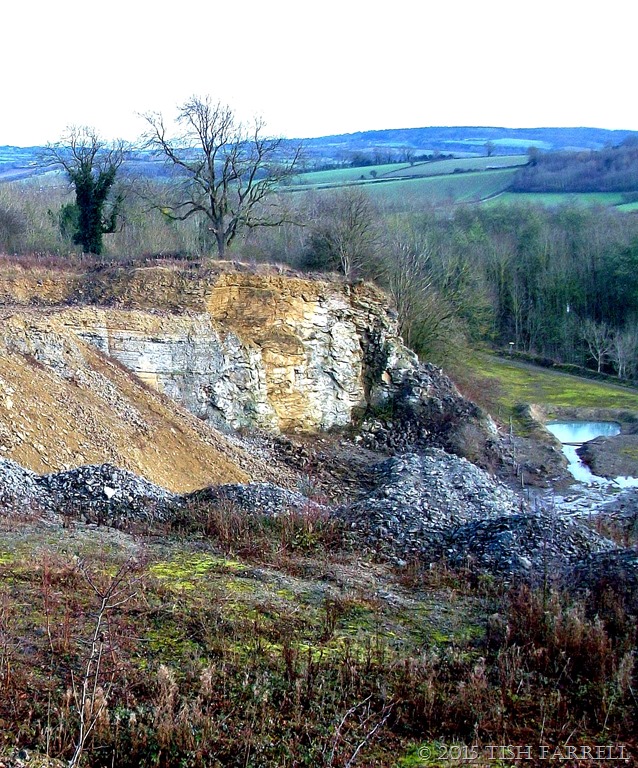
Yet where the old workings and exploded cliff faces have been left to themselves, there are signs that the vegetation is reasserting itself, slowly extending the habitat for the Edge residents: deer, badgers, hares, weasels and mice.
I find the old quarries fascinating in a morbid, Edgar Allan Poe-ish kind of way. Ravens like to nest there for one thing, which adds to their brooding allure. However, if you turn your back on the quarries, and look the other way, through breaks in the tree cover, you will see broad sweeps of Shropshire’s hills and farmland. And this, for most people, is the main reason why the twenty-mile-long vantage point is one of the county’s great treasures. The National Trust who own a long stretch of the wooded slopes, and manage the woods and paths, want to ensure it remains that way – a valued public resource.
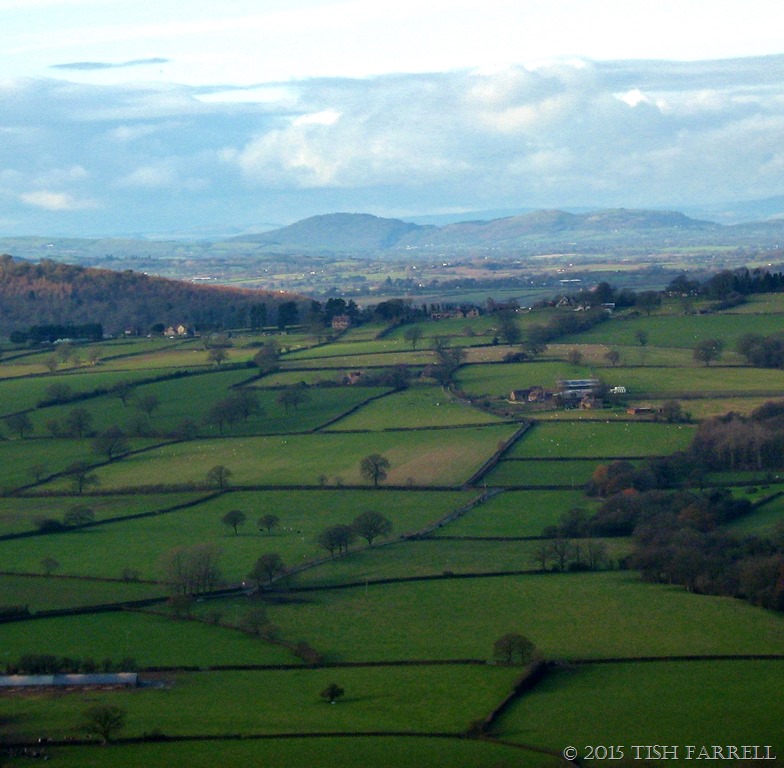
This view looks towards the Welsh borders and, in the past, would have been gazed on by writers such as Thomas Hardy and Henry James, and by Africa’s darkest explorer, Henry Morton Stanley, all of whom were, at various times, guests of the Milnes-Gaskells, Much Wenlock’s erstwhile gentry who lived in the Prior’s House at Wenlock Abbey. The Milnes-Gaskells were good hosts and tour guides and made sure that their visitors always took in the best views.
On reflection, though, I’d say that this particular fieldscape would have looked very different a good century ago – smaller fields, many more hedges and trees back then. Much bigger trees too, for all the huge oaks were culled by the late nineteenth century, and those of us alive today have never seen their like other than in old photos, where their magnificence has been felled and stacked up, ready to serve some apparently pressing human purpose.
Life for ordinary people would have been tough too – with many more labourers working the land, horses pulling ploughs, vistas of scenic rusticity that did not fool Thomas Hardy for one moment. He is said to have been mightily appalled by the impoverished state of Wenlock’s workers.

And so back to the setting sun/moving earth where this post began. The Edge then, is still in motion, although mostly in ways not much noticed by us. The limestone scarps are degrading. Rock becoming soil and mixing with the leaf mould to create new niches and microclimates, the old lime kilns, moss and ivy coated, weathering into the earth, the quarry scars and debris gradually being colonised by trees and plants.
Then there are the kinds of movement that I observe day after day behind our house: the march of clouds, weather; the change of light, dawn , dusk, the stars, the seasons, the rooks and jackdaws going out, and coming home. Everything shifting, transforming, recycling as the earth rotates around the sun. I find that thought – the revolving planet and the endless motion of its life forms – very joy-making. It is good to stand still and watch, and especially as the sun sets, or the earth moves.
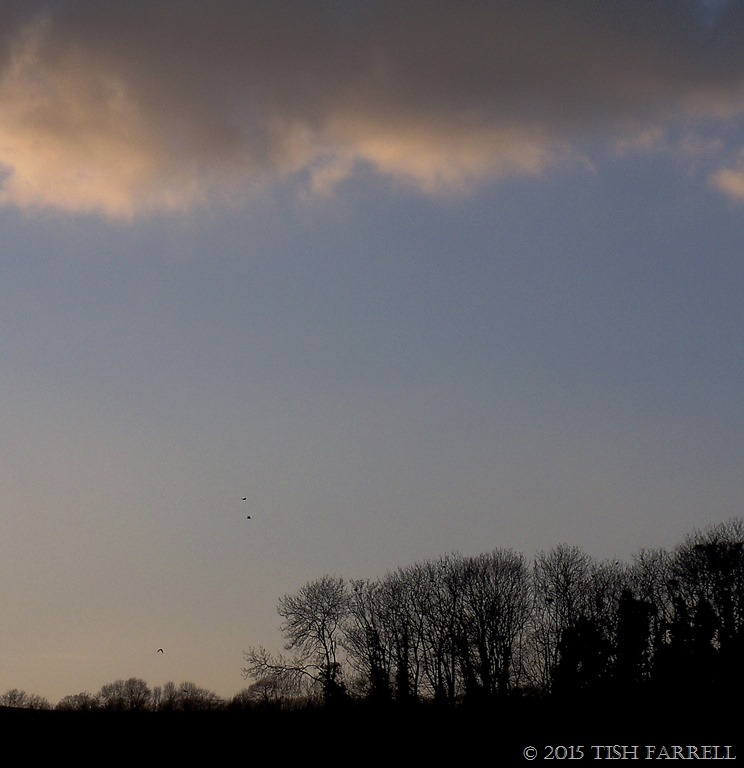
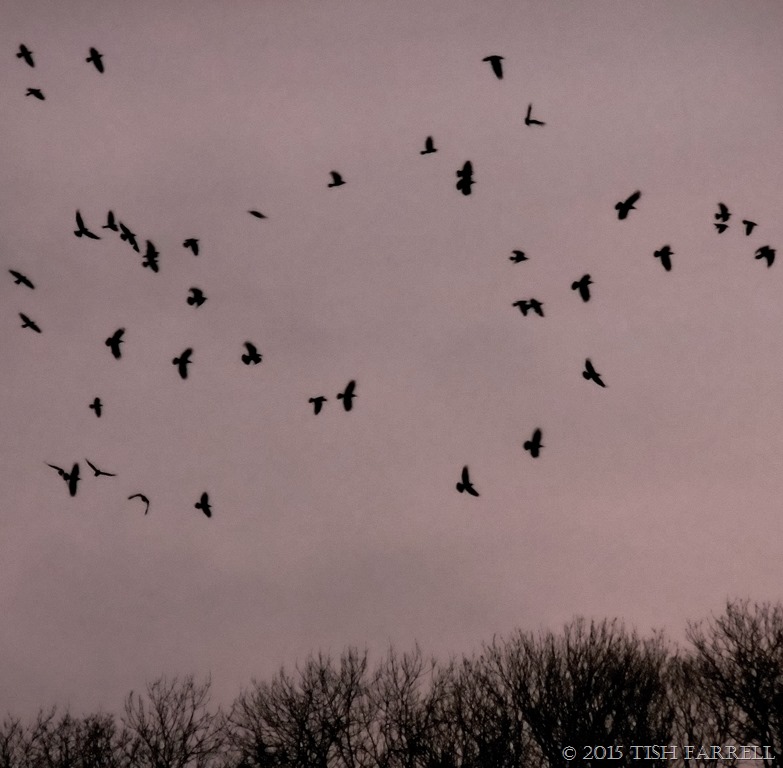
Rooks and jackdaws coming home
copyright 2015 Tish Farrell
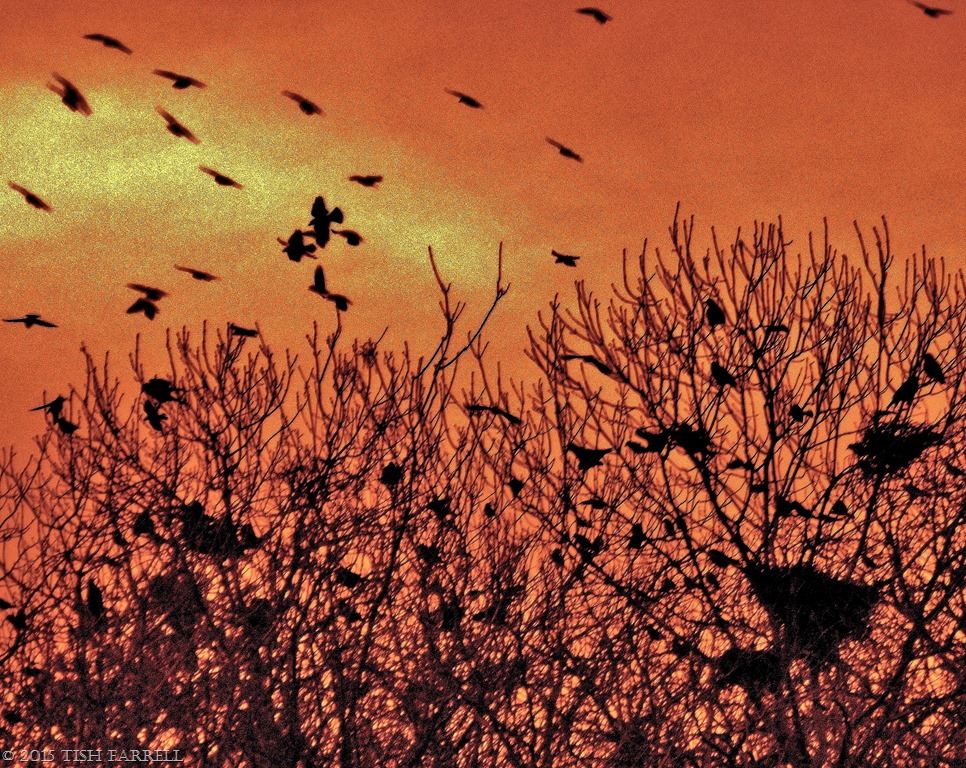
With sunset there is a general homecoming behind our house: hundreds of rooks and accompanying jackdaws return to the rookery in Limekiln Wood. The corvid air fleets head in from all points, returning from the day’s foraging grounds around the town. There are the strident greeting calls – a caw-cophony if you like – of passwords given and passwords received, as the early-bird returnees acknowledge the arrival of others. Sometimes, it seems, an incoming squadron ends up in the wrong tree, and then there is an avian explosion, black silhouettes shot into the sky. Much rook-shouting and abuse ensues.
They sort themselves out, and the wood soon echoes to sounds of companionable muttering.
As the year progresses we will be treated to elaborate twilight fly-pasts and synchronised acrobatics that resemble the murmuration of starlings. And, as the weather warms and we sleep with open windows, so the night will be sound-tracked by the chuntering of rooks. I know from the sleepless small hours that they talk all night. ALL NIGHT. Sometimes I want to tell them to settle down in their nests, and SHUT UP.
The collective term for rooks, of course, is ‘a parliament’, and anyone who has listened to the proceedings of Britain’s House of Lords or Commons on the BBC will have a rough idea of how a rookery sounds. Some might say the corvids are the more intelligent. I could not possibly say.
The rookery wood thus gives us much pleasure, but there are strains of melancholy too in the resonant kaah-kaahing, and the tchaka-tchak counterpoint of jackdaws. It evokes the kind of nostalgia that is so very English, the longing for a lost and perfect England that never existed; a feeling that A E Housman conjures so well in stanza XL of A Shropshire Lad:
Into my heart an air that kills
From yon far country blows:
What are those blue remembered hills,
What spires, what farms are those?
That is the land of lost content,
I see it shining plain,
The happy highways where I went
And cannot come again.
*
Post inspired by Jennifer Nichole Wells’ One Word Photo Challenge: Bittersweet, a colour that is roughly the colour of the sky in the photo.
copyright 2015 Tish Farrell
A Shropshire Lad by A E Housman – you can read the full work HERE courtesy of Gutenberg Press
To see/hear rook acrobatics click on the link below to my brief video …OF ROOK DANCING
