So What Is Your Reading Age? Believe Me: It’s All About Numbers

100_9945

On Saturday I had a very nice surprise. The usual post delivery person had been and gone at least an hour when along comes a courier with a neat, and quite unexpected package. Inside are my 6 author copies of the new edition of Mau Mau Brother. Yippee! Much jumping up and down in the kitchen. It’s always a thrill to have the freshly printed book clasped to one’s chest.

Some of you may remember that just over a year ago I was turning my brain inside out, cutting an already tightly written teen reader in half to make a new edition. The first version, bottom left, is a 6000-word, 64-page novelised short story aimed at struggling young adult readers with a reading age of 9-10 years. It is one of Ransom Publishing’s  Shades series of fast-paced, high interest teen fiction.

The new Sharp Shades 2.0 edition has the same number of pages, 3,000 words, larger font and the addition of several moody full-page, grey-scale  images. Its target audience are less able teen readers.

When it comes to reading age markers, it is worth pointing out that the average UK reading age (that includes everyone, adults and all)  is 9 years. The reading age for our best newspapers like The Guardian is 14 years, and the reading age for tabloids like The Sun is 8 years. But of course the ability to read, and the application of that ability, and using it to acquire information, learn or to nourish the mind, are not necessarily the same thing.

It’s quite simple too. Teens can struggle with the notion of actually picking up a book; are daunted by the size and word density of a 40,000 word novel. It can be tied in to a lack of self worth; some deep belief that if they attempt so big a book they will fail; that it will be yet another manifestation of their feeling of uselessness and inferiority; that so much dense text with no pictures is of itself BORING.

There are, after all, so many other more instantly engaging, loud and in-your-face-ears-eyes experiences to be had at the lightest press of a button, and every minute of the day. You can while away every spare moment on your smart phone with whatever teen version of TwitFace is currently cool. It’s like a continuous intravenous feeding – films, music, chat endlessly streaming into us. I think it was Margaret Atwood who, speaking of the addictive quality of the internet in the Observer, said that the problem is, every time you log on you expect WWW to deliver you an Easter Egg.

That’s it exactly. It’s how I feel. It must be how Margaret Atwood feels too!

All of which is to repeat that there is for many – adults and children alike – a big resistance to picking up a book in the first place, let alone losing themselves in it. Reading requires effort and application and being still. Which brings me back to my book. The aim of the Shades series is to engage teens with the process of reading; to help build a reading habit; to show that reading a story can deliver more than a tray load of Easter Eggs, something more meaningful that helps you grow within and without; to discover where your place is in the world. The stories, then, must be arresting, but their conveyance swift and affecting. Remember: we are up against competing intravenous streaming here.

Screenshot 2015-11-05 10.37.32 (2)

As you can see, I’ve taken some editing liberties with the covers in the intro photo. This is what the new Sharp Shades edition actually looks like.

The story is told in the first person, present tense by fifteen year old Thuo. And since the cover blurb already sets scene, I won’t say more. But to demonstrate something of the editing process involved in reducing one accessible text to an even more accessible text, here are excerpts from the two versions of Chapter 2. I think it’s anyway interesting to see what can be excised from a piece of prose and and have what’s left still carry the narrative. Of course in the process the whole tone may change. I actually found myself more engaged with the sparer version. But see what you think: the hard  pruned Sharp Shades first:


Bombers

The day we lose our home Mugo and I are taking our goats to graze. My little brother runs ahead, slapping the dewdrops from the grass. I stew on my anger.

Before the war, I was a schoolboy. I wore a smart white shirt and khaki shorts. I was studying hard to be someone. Then the British closed my school, and now I am a goat herder.

It’s another reason to hate Kungu.

I’m so busy fuming I don’t hear the Lincoln bombers. They come like giant birds.

Boom-boom-ker-boom.

Bombs fall. Trees fly apart. Hills sprout volcanoes. They are bombing God’s Mountain, bombing Mau Mau.

When the planes drone away and the smoke clears, Mugo grabs my arm.

‘Kungu?’ he chokes. ‘They’ve killed him.’

*

And now the here’s the original Shades version:


Bombers

On the day we lose our home, my little brother Mugo and I are taking our goats to pasture.

It is January, high summer. All around doves coo and cornstalks rustle, and I think: how can there be war on so fine a day?

The sun is just rising and Mugo runs ahead, slapping dew from the grasses, so the drops fly like jewels through the sky. I remember doing that too when I was younger.

But I was not minding goats. I was hurrying to school, wearing the white shirt bought four sizes too big from the Indian trader so it will last for years. And I am wearing khaki shorts instead of my kidskin wrap. It is my first day at the Kikuyu Independent School.

Father has taken me away from the Scottish Mission, saying the teachers there teach Africans to be nothing better than clerks and house servants. He says I will have a better future at KIS.

I don’t. With the uprising, the British close my school. I have been minding goats ever since. It is another reason to hate Kungu.

Mugo goes on swishing grasses, but I am so busy fuming I do not hear the planes. Then the world shakes to bits.

Boom-boom-ker-boom.

Mugo jumps like a spooked deer. And we run. At the top of the ridge we see the Lincoln bombers like giant birds above the forest.

Down come the bombs. One, two…five, more…till I want to vomit. The hills sprout volcanoes. Trees fly apart. Our goats shriek.

We stand and stare as if turned to stone. The bombers do not target our farms, only the forests outside the Reserve.

When  planes drone away the smoke clears, we stare at God’s Mountain. The jagged snow peaks, the dark forest slopes, are still there. It is hard to believe.

‘Kungu?’ Mugo’s eyes dart round in case there’s anyone to hear. ‘They have killed him?’

*

As you can see, nearly two thirds of the descriptive context has gone from the shortened version. It is easy to be sorry to lose these kinds of detail, but ruthless cutting of such passages was better than losing the story.

All fascinating stuff. I quite like seeing how many versions of a work I can come up with. And I really enjoy the challenge of a limited word count. After all, it’s not so much about how much you can hang on to, as how little you actually need to tell a well rounded and affecting story.

But there is a problem here for me as creator of fiction. If you produce work that is labelled for a specific purpose, then it is unlikely to be read by anyone else, i.e. those who consider themselves outside the target audience.  As a writer, I write for anyone who will read me, and tend to balk at categorisation of any kind. I especially dislike the category ‘educational writing’.

All the same, if the stories I write, and the different ways I can write them, will encourage unkeen readers to read and develop a love of reading, then I’m wholeheartedly for it. Not to read well is to be disenfranchised. Your options are shut down. You leave oneself vulnerable to those who would misrepresent, manouevre and manipulate the information-world we inhabit. Good reading promotes understanding, powers of discretion, a sense of autonomy; it strengthens mind and imagination, those attributes that make us keenly human; the very attributes we will increasingly need if we are to make something worthwhile of our lives on this planet.

In England we especially need to look to our laurels. In fact those laurels are down round our ankles like pants that have lost their elastic. We apparently have the lowest teen literacy rates, and second lowest numeracy rates of the world’s 23 most developed countries. Korea, Japan, Netherlands are respectively the first, second and third most literate and numerate nations. See The Spectator article HERE for more on this shaming state of affairs.)

In the meantime, more power to small publishing houses like Ransom who specialise in making books for struggling readers of all ages. Their extensive catalogue provides all the tools to tackle literacy. This particular writer is anyway proud to be a Ransom author: when it comes to better reading only the best writing will do.

*

Ransom blog on WordPress HERE

Numbers  – go here for the Daily Post Weekly Challenge
#RansomBooks  #literacy #NickyMorganSecretaryOfStateForEducation #NationalLiteracyTrust #Proud2BeARansomAuthor #BestWritingForBetterReading

Kenya’s Prolific Green Highlands ~ Thursday’s Special

napier grass on the Rift

Prolific

Nothing could have prepared me for my first glimpse of Kenya’s fertile uplands all  those years ago when I ran away to Africa. I’d flown out from Paris on the overnight Air France flight to Nairobi. It was my first long-haul flight, a good eight hours, and I did not sleep a wink despite being served a very delicious small-hours’ supper, and having a whole row of seats to myself.

I was pent up with the prospect of meeting up with Graham, whom I had not seen for some weeks, rather than wondering about my destination. Quite ridiculous I know. I was flying blind, having done not a scrap of  research on Kenya. In fact I had set out armed with only my brother-in-law’s comment: you’ll either love it or hate it; there’s no in between.

And so early one February morning as the great jumbo jet slid down the valleys of Central Province towards Nairobi, I could scarcely believe my eyes. Volcanic hillsides unfolded beneath us – every scrap of earth burgeoning green to their summits, the patchwork plots of Kenya’s smallholder farmers. Before we set down at Jomo Kenyatta International I was already in love. I did not know then that this was the start of an eight year affair with a land that could not be more different from my Shropshire homeland. I am still infected.

Some years after this arrival, when Graham was combining his project work at Kenya Agriculture Research Institute with some field work for his doctorate, I had the chance to visit many of those highland farms and meet the farmers and see at first hand the kind of crops that they were growing so prolifically – maize, tea, bananas, fodder grass, squash, beans, potatoes, plums, apples, cabbages and kale. This photo was taken on one of these expeditions, and like me it has aged somewhat. But it was the first image I thought of when I read through Paula’s list of word prompts as this week’s Thursday’s Special. Do drop in there to join in the ‘pick a word’ challenge.

For more of my Kenya story see also:

Valentine Day’s Runaway

Looking for smut on Kenya’s Highland Farms

“When I came last to Ludlow…”

P1020333

This week in her Black & White series, Cee gives us a free hand, and says we can post our favourite B & W images. Here is one of mine: Dinham Bridge over the River Teme, with Ludlow Castle above. For those of you who do not know England, Ludlow is a scenic market town in South Shropshire. All looks so tranquil here, and the town itself ever has a sleepy air.

Historically, though, Ludlow was an important border stronghold commanding the Welsh Marches to the west, and repeatedly the scene of bloody battles and political intrigue down the ages.

The castle is almost a thousand years old, having its beginnings on the crest of the hill in around 1075. The outer fortifications were added a hundred years later, and the castle continued to expand and become ever more grand over succeeding centuries.

I’ve mentioned before that one of the castle’s claims to fame is that it was here in 1501 that fifteen-year old Prince Arthur Tudor, son of Henry VII and thus Henry VIII-to-be’s older brother, spent his honeymoon with sixteen-year old Catherine of Aragon, and that Arthur caught a fever and was dead within the year, thus leaving Catherine to be betrothed to Henry.

Nearly thirty years later when Catherine was embroiled in Henry’s ugly attempts to be rid of her so he could marry Anne Boleyn (he demanded an annulment on the grounds that it went against biblical teaching for a man to marry his brother’s wife) she claimed that nothing had happened between her and Arthur at Ludlow; that their marriage was never consummated.

So much for Ludlow-past as a honeymoon destination.

100_6732 - Copy

But the castle has older more grizzly mysteries associated with it. They relate to the Wars of the Roses mentioned in the previous post. Ludlow Castle was one of Richard Third Duke of York’s key strongholds until it was lost to Lancastrian forces in 1459 at the Battle of Ludstone Bridge – the next bridge downriver from the one in the photo. Three years later in 1461, when his son defeated the Lancastrians and became Edward IV, the castle was restored to the Crown, and it was during Edward IV’s reign that both castle and town grew in political prominence.

And it was in Ludlow Castle where Edward IV’s sons, Edward and Richard, spent much of their childhood, and whence they were taken in 1483 to the Tower of London. Their father had died, and Edward aged twelve had been pronounced Edward V, but was not yet crowned. His father’s brother, Uncle Richard Duke of Gloucester, aka Richard Crookback and soon to be Richard III, was Lord Protector.

Then came news that Edward IV’s marriage had been proved invalid. His young sons were declared illegitimate, and Richard quickly had himself crowned. The boys, thereafter referred to as the Princes in the Tower,  were never seen again. Behind them only argument remained – did Richard III have his nephews murdered? Did the two small skeletons, later unearthed in the Tower,  belong to young Edward and Richard? When I think of them in the brooding Tower of London, which incidentally was then a royal palace and not a prison, it still gives me a pang. I sense their feelings of loss and displacement, a pining for Ludlow, ‘the hill beside loud waters’**, the forests and wide Shropshire vistas below the battlements; just the place for growing lads.

If Richard did kill the boys in a bid to secure his claim to rule, it didn’t do him much good. He was killed at the Battle of Bosworth in 1485  after only two years as king. His remains were buried in the church of a Franciscan Friary in Leicester, and in 2012 were re-discovered with much fanfare during an excavation of the site, which by this time lay buried under a city car park. Leicester University scientists then set out to prove the identity of the skeleton, an exciting piece of forensic archaeology and genealogy which is detailed at this link.

After Richard came Henry Tudor who won the day at Bosworth Field, the last significant conflict in the Wars of the Roses. So ended the Plantagenet Dynasty, and so began the Tudor Dynasty with the coronation of Henry VII – which is pretty much where this post began.

These days Ludlow Castle is a prime tourist attraction. It is privately owned by the Earls of Powys, and has recently been subject to much restoration work. If you can’t visit in person, then follow this link to do a virtual tour. But if you do get a chance to go there, the town itself is also a treasure. You will not be disappointed.

100_7941

copyright 2016 Tish Farrell


*  “ When I came last to Ludlow…” from A E Housman’s A Shropshire Lad  LVIII

** The name Ludlow is said to derive from the Old English meaning ‘the hill beside loud waters’

~

Related:

My Treat Today In Ludlow

A Five-Hundred-Year Old C.V.

See How Her Garden Glows ~ Thursday’s Special

IMG_1019

Here at our house on Sheinton Street – also spelled Shineton at the other end of the road, we try to live up to our location with as much shining and glowing as we can muster. This year the yellow tulips have certainly done their stuff, but now they are gone, and we’re waiting on the oriental poppies to keep the glow going.


Thursday’s Special: Glow

Please visit Paula to vote on last week’s park entries, and to add to this week’s glow

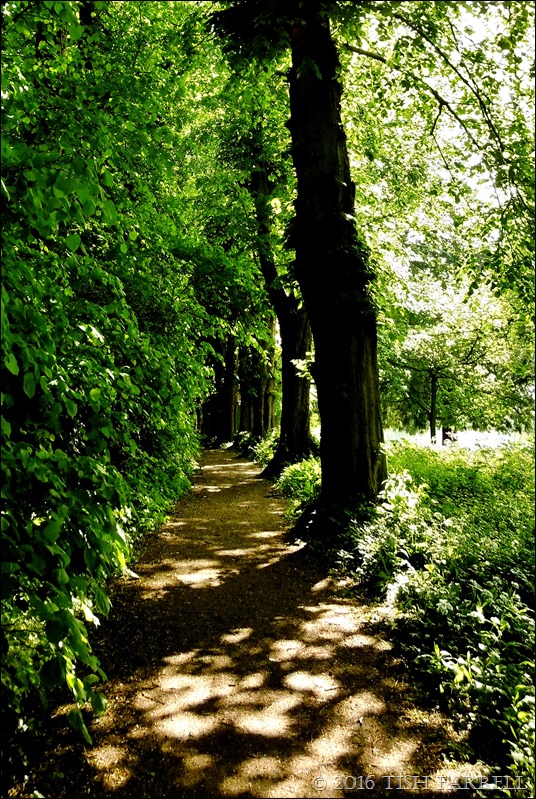
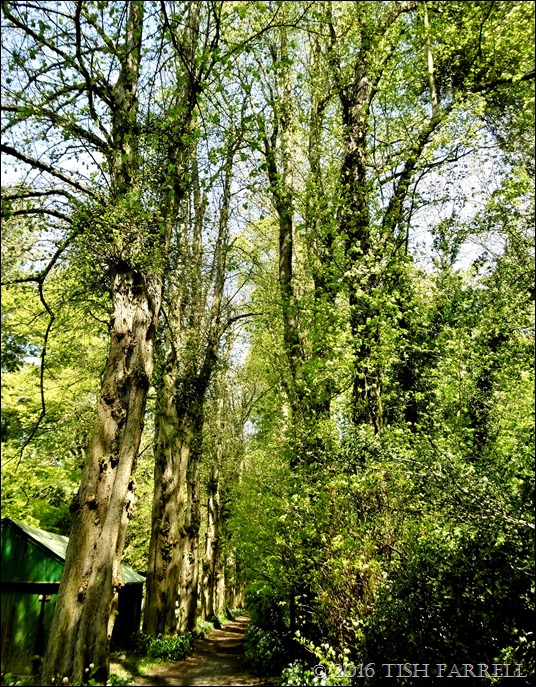
The Power Of Green And Dappled Sunlight This Morning On The Linden Walk

P1040281

P1040271

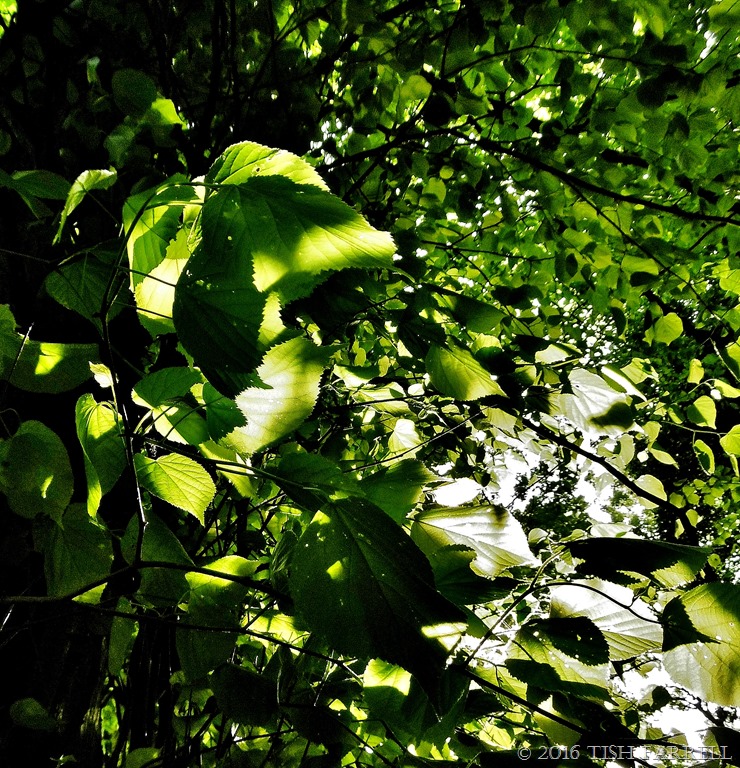
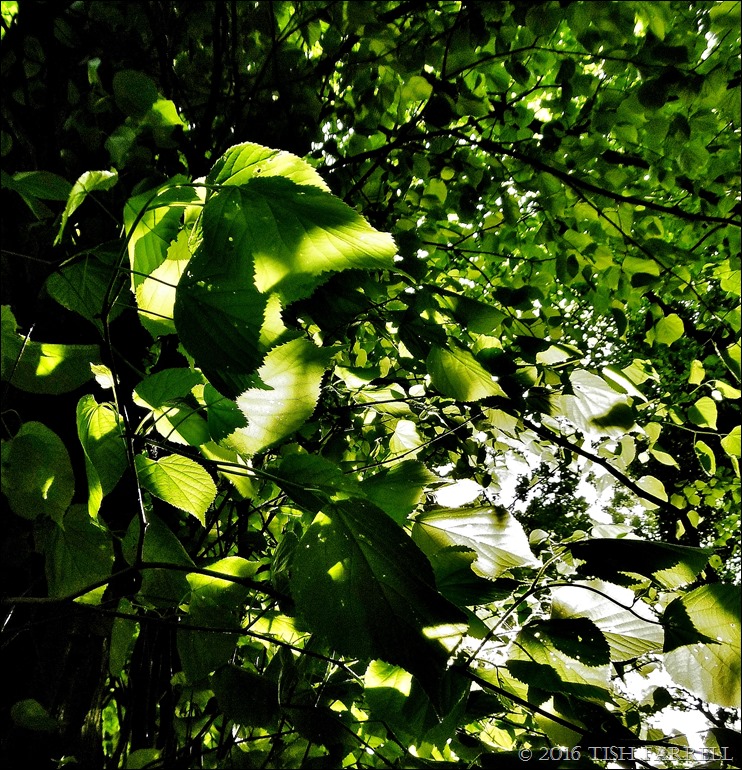
You can almost see the sap rising – gushing forth in fact to catch up after a slow-start spring. Anyway, walking amongst it this morning made the pursuit of allotment chores a complete and utter pleasure.

The chore in question is part of my on-going experiments with no-dig cultivation. So armed with my big green polypropylene bag I was out gathering up some of the piles of tree shreddings left around the Linden Field by the chap who comes to trim the lime trees’ overgrowth. I then haul them up to the allotment where I am covering a 6 feet wide x 20 feet section of uncleared plot with cardboard plus several inches of chippings on top. It’s rather a slow process, but I’m over half way there.

I’m hoping that by the time I get round to cultivating this section next year,  most of the worst weeds will have turned up their roots, and the mulch rotted down enough to produce a reasonable planting medium. Oh yes, and that in order to achieve all this both the cardboard and the mulch will have attracted a lot of very happy worms.

The thing is, though, once I’m out on the Linden Walk it is so easy to forget about heavy labouring, and slip into a complete green daze. And as you can see, I also had my camera with me. I was particularly taken by this fence post:

P1040256

And then at the end of the avenue near one of my target chippings piles, I noticed a nice flat area between the limes and the old railway line. I had not spotted it before, but it looked just the place for some qi gong. Secluded enough, I thought, not to frighten any of the Wenlock dog walkers who might otherwise come upon me in the midst of repulsing the monkey or being a wild goose flying.  So this is where I stood – beneath a canopy of limes and sycamores, accompanied by bird call and the soft flutter of pigeon wings. Aaaaah. Wishing you a similarly blissful, green-filled, sap-rising, sun-dappled day.

P1040265

*

This slideshow requires JavaScript.

Now please pop over to Jo’s Monday Walk for a truly inspiring excursion in beautiful rural Poland. And to add your own walks to Jo’s go HERE.

Textures Of My Ancestral Landscape

P1000999

These are some of the landscape textures that my maternal ancestors, the Fox family of Derbyshire’s High Peak would have known well – windswept moors and weathered scarps of millstone grit. They were yeoman farmers and lead miners, and they made a living from this bleak and beautiful country for hundreds of years.

Family legend has it that the Foxes arrived in England with William the Conqueror, but Fox is a name with Germanic origins so they may well have been Saxons, belonging to the conquered rather than to the conquering forces. The earliest records for Foxes in the Hope Valley, and Offerton in particular – where my Foxes farmed until the end of the nineteenth century, are around the thirteenth century, although I and my fellow Fox researchers are yet to establish direct lineage from these times.

There were centuries of prosperity when various family members lived in large stone farmhouses, made ‘good’ marriages, and owned land and lead mining concessions, but by the early twentieth century there was only one member of my Fox line left in the area, and he was living modestly in Eyam. The family farm of Callow where he was born, and by then owned by the Duke of Devonshire had been relinquished with a farm sale in 1892.   High rents were besetting many Derbyshire farmers at this time. The Mr Fox mentioned in the sale advertisement is my great great grandfather, George Brayley Fox:


The Sheffield & Rotherham Independent

Saturday 29 October 1892

Callow Farm Sale

Important Sale of 23 cows, heifers, steers and calves, two horses and foal, 30 sheep, hays stack, three wheat stacks, seven oat stacks, farm implements etc.

Mr Hattersley has been honoured with instructions from Mr Fox who is give up the Farm, to sell by Auction on Wednesday, Nov 3, 1892, the very superior LIVE and DEAD FARM STOCK, as briefly enumerated below:

Black Mare, believed to be in foal, excellent worker;

Valuable Brown Horse, six years old, with splendid action, believed to be sound, and quiet in all work;

Roan foal by Bedford;

One Cow in calf for December 25th, four in-calf cows for April, two barren cows in milk, four very choice heifers in calf for April, two barren heifer stirks, five strong bullock stirks, five spring-reared calves, 11 superior stock ewes, six fat sheep, one two-shear ram, 12 strong lambs, two very fine ducks, one fine drake.

Samuelson’s 2-horse combined mower and reaper, nearly new with additional shafts; wood tippler, horse rake, Cooke’s wood plough, set of wood harrows, nearly new; set of three harrows, swingtrees, fallow drag on wheels, stone roller, with shafts, horse turnip hoe, sheep troughs, joiner’s bench and tools, quarry tools, hay rakes and forks, 2 1-horse carts, winnowing machine, wheel chopper, with rising mouth, in excellent condition; corn chest, cart gears, stone cheese press, lever ditto, cheese rack and boards, nearly new; vats, garths etc, cheese pan, two brewing tubs, two oak chests, and a portion of furniture.

One stack of very prime new hay, three stacks of wheat, five stacks of white oats, two ditto of black oats and a quantity of table and other turnips.

Sale to commence 12 noon.

*

Every item here tells of great intimacy with the land. Just to read this notice gives me a painful sense of roots yanked up. I feel the touch and then the loss of the fine ducks, the strong lambs, the black mare in foal, the oats and the stone cheese press; even the turnips and the quarrying tools. But I would like to think, too, that somewhere in my bones are still traces of that High Peak millstone grit, the hardiness and courage that it took to carve a living from these uplands, and in my lungs the sharp, clean air of the moors of Longshaw where earlier generations of my family, so it is said, grazed four hundred sheep on their own run, and also owned the shepherd’s byre, that dating from 1399 was later sold and expanded into a handsome house for the Duke of Rutland’s agent, and is now the well known inn, Fox House, just outside Sheffield. Somewhere within this sturdy stone carapace is the earlier shepherd’s dwelling of quite another texture.

P1010003

copyright 2016 Tish Farrell


This week at Black & White Sunday, Paula has given us the theme of ‘texture’. She also included a quotation by novelist British Paul Scott, which is very much responsible for my take on the challenge:

“The past becomes a texture, an ambience to our present”

P.S. Paul Scott served in the Intelligence Corps of the British Army in India during the World War Two. He wrote the phenomenal Raj Quartet, set in India during these years, and which was made into a very excellent TV serial back in the 1980s. The TV version is available on DVD, and with its all star actors is well worth watching. But read the books too.

The Changing Seasons ~ May With Zest Of Lime And Cricket

P1040057

Only last week did the lime trees on Wenlock’s Linden Walk show any real signs of coming into leaf. The avenue itself was a faint haze of juicy green. The leaves may be late, but they sum up the sap-filled exuberance of spring.

Another sign of spring around English villages and towns, is the weekend sight of chaps in their whites lingeringly engaged in the friendly cricket match. It’s one of those things, cricket. I scarcely understand the game, but I’m glad someone does. Or to quote the chorus from 10CC’s Dreadlock Holiday  “I don’t like cricket, oh no, I love it”. At least I love the idea of it: a quintessential cultural marker layered with notions of perfect summers that never were.

It conjures ghosts too. The thwack of ball on willow. Resounding cheers at a good catch. An inexplicable sense of something lost. This doubtless explains why many cricketing poems are interwoven with strands of war. Here’s one such from A E Houseman’s A Shropshire Lad cycle, poem XVII. It alludes to young men lost in the Boer War:

Twice a week the winter thorough
Here stood I to keep the goal:
Football then was fighting sorrow
For the young man’s soul.
Now in Maytime to the wicket
Out I march with bat and pad:
See the son of grief at cricket
Trying to be glad.
Try I will; no harm in trying:
Wonder ’tis how little mirth
Keeps the bones of man from lying
On the bed of earth.

*

And now to relieve that sombre note, my May gallery in and around the Linden Field:


Related: Heading for the Light ~ Wenlock’s Linden Walk in Winter

To join in Cardinal Guzman’s The Changing Seasons challenges go HERE

Stinking Nanny Anyone?

100_9741

The shadowy margins of the Linden Walk near my house and the old railway line that runs alongside are presently lit by  white-star carpets. Ramsons. Stink Bombs. Stinking Nanny. Londoner’s Lilies. Thank you, Richard Mabey and your Flora Britannica for all these country names for wild garlic.

I know many people loathe the smell of this plant, and it can indeed be overpowering on warm days, but whenever I catch a whiff, it simply inspires me to cook. You can eat the leaves and flowers. On Friday I used them to make a pesto sauce to go with steamed carrots, assorted allotment greens and braised salmon.

This is what I did to make it:

  • Took a good handful of broken walnuts and lightly toasted them in a little olive oil
  • Roughly chopped a dozen flower heads and a small bunch of garlic leaves
  • Tipped all with the walnuts into a food processer
  • Added more olive oil to cover, salt, black pepper and squeeze of fresh lemon juice and blitzed. More oil can be added according to taste and requirements.

This is good with pasta, or spooned on the top of fresh-made soup, especially broad bean, or the classic pistou. In his Food for Free book Richard Mabey also quotes the sixteenth century writer, John Gerard, who writing in The Herbal (1597) says that in Europe the leaves are used to make a sauce to go with fish, and adds that these may:

very well be eaten in April and May with butter, of such as are of strong constitution, and labouring men.

And what about labouring women, good sir? This particular one has great liking for ramsons. In fact I’m thinking now of using them to lace a homemade tomato sauce. Bon Appétit , and happy foraging.

And please pop over to Jude’s Garden Challenge. This month she wants to see our wild flower photos.

100_9742