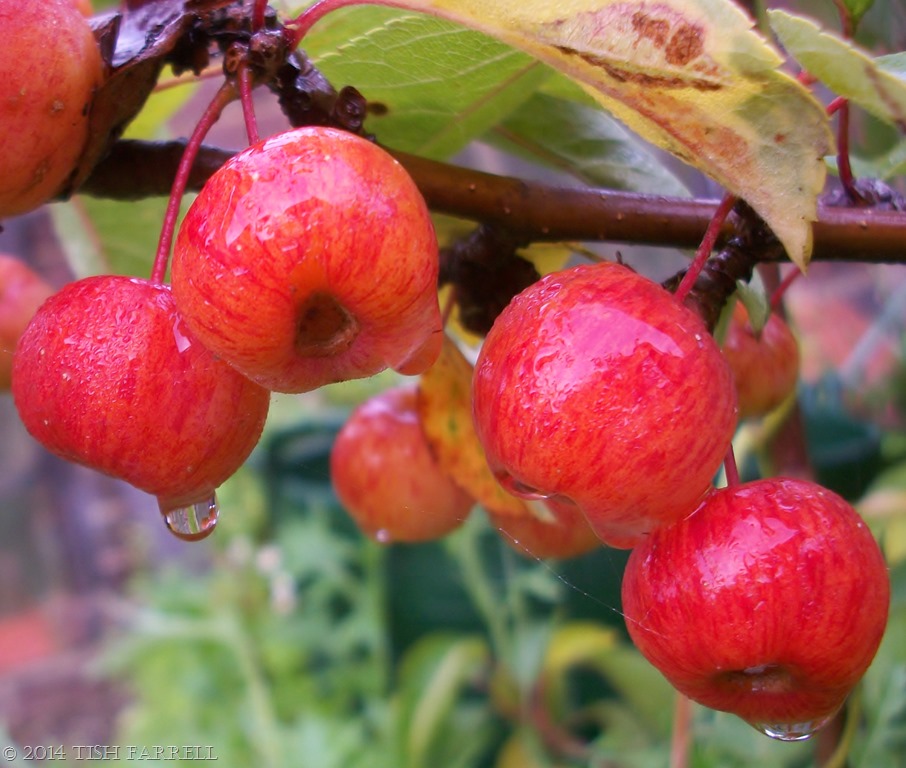
We planted the Japanese crab apple tree in the garden in 2006, not long after we moved into Sheinton Street. Now is its season of fiery scarlet glory. Each fruit glows like a miniature lantern, brightening the gloomiest autumn day. And today is just such a day in Much Wenlock, my usual sky-view over Wenlock Edge, a blanket of grey mist. Even so, the apples glisten. I know, too, as we head into winter, we will have the pleasure of watching the blackbirds come to feed on the fruit, grey days then enlivened by their darting silhouettes foraging among the branches. Few of these tiny apples will be wasted. And then before you know it, the tree will be bursting with purple-pink buds that open in showers of pale blossom. Spring. Splendid how one thing leads to another.
I may be wrong about this, but doesn’t John Barry’s Out of Africa film score owe just a little something to George Butterworth’s Shropshire Lad Rhapsody? Both works ride on a swell of yearning for a life, a love, a land that is lost or unobtainable. Both composers are English, and Barry probably knew Butterworth’s small body of very English song-cycles. (Butterworth died in 1916, a casualty of World War 1).
Of course, the influence of one composer upon another is common enough, and could well be subconscious. On the other hand, Barry might have chosen deliberately to nod to the earlier work. There are many reasons to do so, and it all begins with that other very English creation, the collection of poems called A Shropshire Lad, by A.E.Housman, the work that inspired Butterworth’s Rhapsody and the several Housman poems that he set to music.
I have written elsewhere how this collection of ballad-type poems inspired several composers in their works, and not only Butterworth, but also Vaughan Williams and Ivor Gurney. At the time when I wrote that post, I had not thought about the Out of Africa film connection. But now I have thought of it, my interest is rather personal.
Firstly, as a writer who has worked with several illustrators, I like the way one artist’s creativity can provide inspiration for other artists’ work. Indeed, when it comes to A Shropshire Lad, there is a veritable multiplier effect of allusion and quotation in other works throughout the twentieth century. This includes Dennis Potter’s disturbing play Blue Remembered Hills (A Shropshire Lad poem XL).
Secondly, Housman’s poems, and in particular the music they inspired, make reference to Wenlock Edge and the town of Much Wenlock where I live.
Thirdly, I have also lived in Kenya, the country that inspired Karen Blixen’s Out of Africa.
And fourthly, in the script of Sydney Pollack’s film of the same name, which derives more from the biographies by Judith Thurman (Isak Dinesen) and Errol Trzebinkski (Silence will Speak) than from Karen Blixen’s book, includes two very striking quotations from A Shropshire Lad.
Both arrive towards the end of the film, and both relate, directly and indirectly to Denys Finch Hatton, Karen Blixen’s lover who died in an unexplained plane crash at the age of 44. For more of their story go HERE.
The first and most heart-rending is at the burial of Finch Hatton up in the Ngong Hills. Meryl Streep as Karen Blixen reads, not from a prayer book, but from a book of poetry, and the poem she reads is poem XIX To An Athlete Dying Young. This is the final stanza:
While I can find no biographical reference that supports the reading of the poem at the actual burial, I can only say that it could not have been more aptly chosen. In other words, if it is a Hollywood invention, then it is a good one. It adds to our understanding of both Blixen and Finch Hatton in real life.
Denys Finch Hatton had rare glamour. He was man who was adored and admired by men and women alike. He was a consummate sportsman, a soldier, hunter. He was an elusive adventurer and the son of an English Lord. As a great lover of poetry he would doubtless have known A Shropshire Lad very well. More importantly, he is said to have had a pathological fear of growing old, and was ever to be seen wearing a hat once his hair began to thin.
In her biography of him Too Close to the Sun, Sarah Wheeler makes the analogy with Icarus. This too is apt. With his shocking death, burned in his plane, the self-regarding sheen of aristocratic settler life was diminished. The film’s burial scene thus prepares us for Karen Blixen’s final exile from Africa. Loss piles on loss.
Before she leaves the country, the film shows her being treated to a drink in the ‘gentlemen only’ bar of Muthaiga Country Club, a restriction which she apparently infringed when first arriving in British East Africa. The toast she gives her hosts is one said to have been used by Denys: ‘rose-lipt maidens, lightfoot lads’. This comes from poem LIV:
With rue my heart is laden
For golden friends I had,
For many a rose-lipt maiden
And many a lightfoot lad.
*
By brooks too broad for leaping
The lightfoot boys are laid;
The rose-lipt girls are sleeping
In fields where roses fade.
So where are these quotations taking us? What exactly is being evoked by their appearance in the film script?
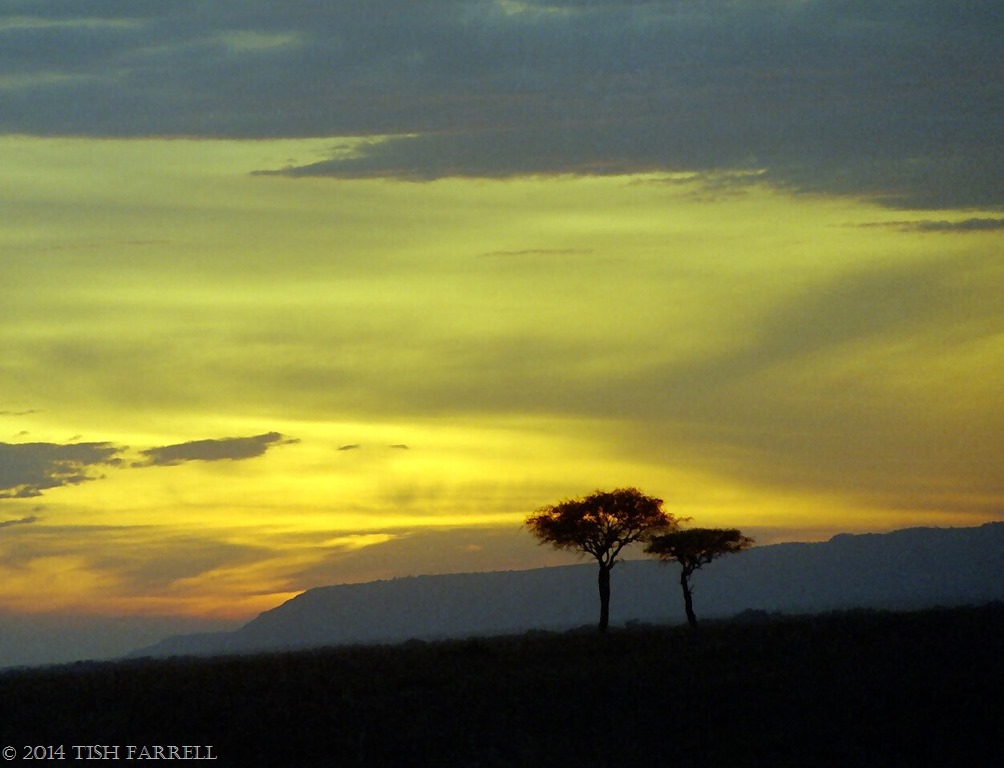
It all comes back to the unobtainable or unclaimable: of the lost life, love and land that I mentioned in the beginning. The settlement by British and European aristocrats of British East Africa (Kenya) in the early years of the last century was an epic romance, one filled with the notion of noble master and faithful ‘noble-savage’ servants. There was the pitting of human courage and wits against the African wilderness; a wilful dance of death wherein sporting valour was supremely admired. There was a notion of overbearing entitlement; that East Africa was their own country; that only they understood it. As a dream, it was bound to fail. It is a visceral longing for something that cannot be possessed.
For Housman the loss was for a love he could not have: another man. He was a respected academic who ultimately lived as a recluse. He wrote the entire collection of 63 poems while living in London, and without setting foot in the part of Shropshire that he evokes. Of this anomaly he makes the terse comment that, having grown up in the neighbouring county of Worcester, “Shropshire was on our western horizon which made me feel romantic about it.”
And here is where Out of Africa – book, film, and the true lives behind, find common ground with A Shropshire Lad; the ‘I had a farm in Africa, at the foot of the Ngong Hills’ moment; the sense of tragic romance, ‘The happy highways where I went and cannot come again.’ Those ‘blue remembered hills.’ The human condition of longing for something we think we had, or should have, but never can.
And finally then the music. Below are renditions of Butterworth and Barry. (The first begins with the song Loveliest of Trees, poem II, from which the orchestral piece derives). Compare and contrast, or simply ride the emotional tsunami – across Africa, or Shropshire, or wherever you think your lost Paradise resides.
Things are going from bad to worse in Ingigi village. No one knows why five-year old Kui has gone missing. Nor does Sergeant Njau want to find out. He has his own problems, pressing matters that are far from legal. Then there is the endless rain. Will it never stop? Some Ingigi folk think it means the end of the world. Old man, Winston Kiarie, has other ideas. He senses some man-made disaster, and when it happens, it is worse than his worst imaginings. The fierce storms are causing landslides and throwing up British bombs, unexploded for forty years. Their discovery is giving the Assistant Chief ideas: how to make himself very rich. And then there’s young Joseph Maina and the primary school drop-outs thinking they have found treasure, and about to do something very, very foolish. Meanwhile, is anyone looking for Kui?
“Losing Kui” is a fast-paced novella of interwoven tales. There are secrets, conspiracies, tragedy and dark comedy. The setting is a fictional East African country in the late 1990s, a time when El Niño rains were causing havoc. The author lived in Kenya during most of the 1990s, and much of the story was inspired by real events.
This shot was taken a couple of weeks ago from the ruins of a gold mine crushing mill at Cefn Coch, Dolymelynllyn. During the 1860s there was a gold rush involving the working of several mines around Dolgellau, on the southern edge of the Snowdonia National Park in Wales. It is a dramatic landscape, a hard place to toil, cracking open the earth in hopes of riches. The remains of the industrial buildings stand starkly against the hillsides, the moorland vegetation gradually reclaiming the stonework.
copyright 2014 Tish Farrell
Now hike over to Paula’s blog for more splendid landscapes: Lost in Translation’s Thursday’s Special
Oh all right, I know. As ambitions go, wanting to own a polytunnel might seem pretty odd. Also it’s not as if I don’t have enough housework in the house without having additional premises to tend elsewhere. But then sometimes in life you get precisely what you wish for, and most unexpectedly at that.
Ever since I took over my plot from Much Wenlock Allotment Society some seven years ago I have increasingly thought that a polytunnel was the very thing I needed. Gardening on the edge of Wenlock Edge can be challenging. The site is exposed, sloping, and often very windy. Much Wenlock is also in a frost pocket, and thus is a degree or so cooler than anywhere else in Shropshire.
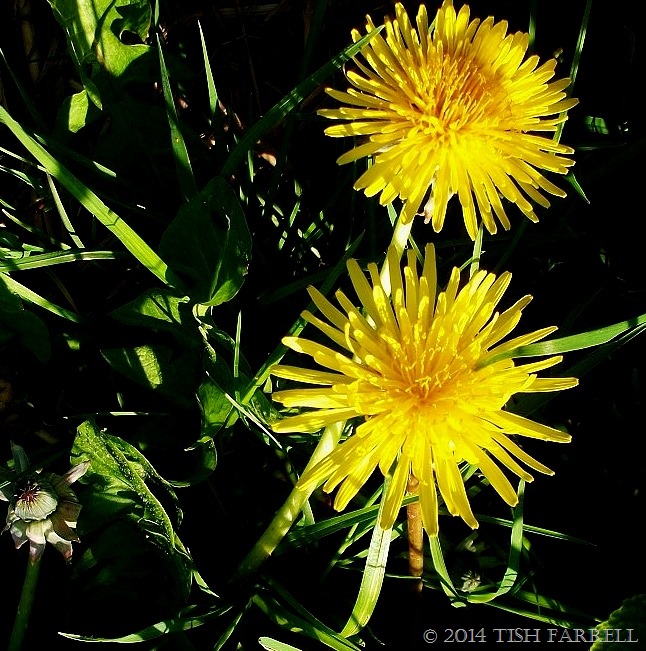
Worse still, the soil comprises a decaying fossil volcanic ash that is like wet cement when it rains, and hard baked cement when it doesn’t rain. It has thus taken seven years of digging, mulching, composting, green manuring, horse manuring, hacking and weeding to get the soil looking like something that vegetable plants might want to grow in. The dandelions, however, grow most verdantly, along with the creeping buttercups, sow thistles, docks, bindweed and couch grass. And so despite improvements, small vegetable seeds still find the soil heavy going. If they germinate at all, they struggle, the soil creating a bonsai effect on the roots, and then the slugs quickly finish them off. Most seeds thus need to be germinated under cover, and grown on before they can stand a chance after being planted out.
And then, of course, there are the pigeons. They sit on the telegraph wires and watch what I’m doing. They especially like to eat cabbages and newly sprouted pea plants down to the roots. The rotters. In consequence I spend a lot of time making defensive systems out of environmesh and bits of wire fencing. This kind of protection also has to be applied to beds of leeks, garlic and onions due to the arrival in our part of the world of the allium beetle that likes to lay its eggs in the fleshy roots. The effect of these assaults on the leeks is especially dramatic: they unfurl in spiral fashion and develop rust-coloured stripes.
So you can see that to be an allotment gardener in Wenlock requires the same kind of pig-headed (idiot) tenacity it takes to be a writer. I have visions of deep, humus-laden beds bursting with lush, green spinach and broccoli, in much the same way I have visions of producing beautiful books that everyone wants to devour, and feel nourished by.
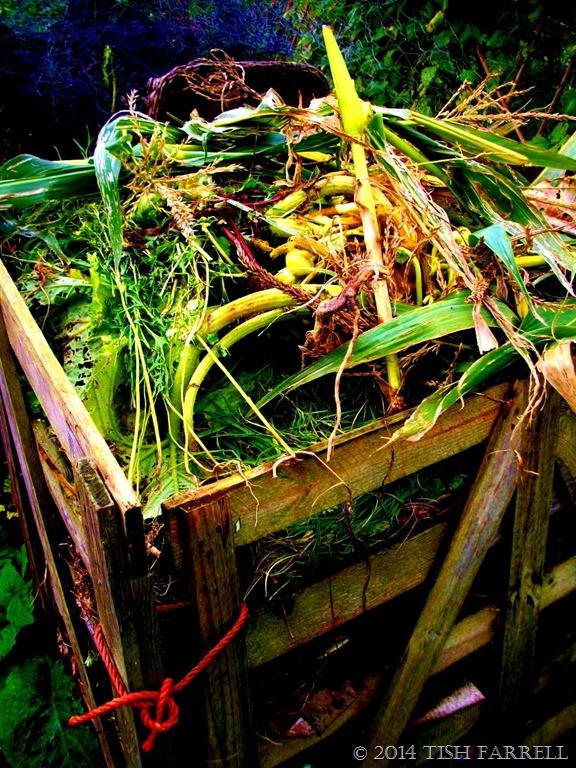
And that’s where the polytunnel comes in. I’m hoping I can crack both objectives in one fell swoop, this on the basis that if I can raise and eat more broccoli and spinach, my brain might produce writing with the requisite added enrichment. We can but hope. I might also say, as I probably have before, the contents of my writer’s brain have much in common with the contents of my compost bin, although at least they don’t smell. (Please note pallet structure installed by the Team Leader aka Graham who endlessly tries to bring order to my chaos).
Anyway, back in the early spring when I was clearing my plot I noted, with a severe pang of envy, that my neighbours, Bob and Sally, were making preparations to erect a fourteen foot long polytunnel. I could see it was hard work, with foundation trenches to dig (in the aforementioned concrete soil) and the frame to erect. I watched them toil, hanging doors, and making beds. Next, I watched as my other neighbours, Pete and Kate, followed suit. Their installation was even more hard work, being on a slope. It took them weeks to complete. In the meantime I kept the Team Leader posted as to these events, from time to time mooting the possibility of us having a tunnel; perhaps something smaller, I hazarded.
I have to say the response wasn’t altogether encouraging, even though we were by then falling out at home over whether the small conservatory on the back of the house was my potting shed and greenhouse, or his workshop. Increasingly my bean and sweet corn seedlings were having to compete with saws and wrenches and other man-things whose function I cannot identify. Nor was there the possibility of building either a man-shed to contain his stuff or a woman-greenhouse to contain my stuff since the garden at home is too narrow.
Back at the allotment I watched the new polytunnels fill with tomatoes, cucumbers and peppers…I thought longingly of gazpacho that simply cannot be made from flavourless supermarket produce. Ho hum.
Then out of the blue in mid-summer, a little bird, otherwise known as ace fellow allotmenteer, Phoebe, told me that Bob and Sally were moving and were looking to sell their tunnel. She thought I should discuss terms with them. Not long after this I received a small inheritance from my once passionately gardening Aunt Evelyn of whom I have written elsewhere.
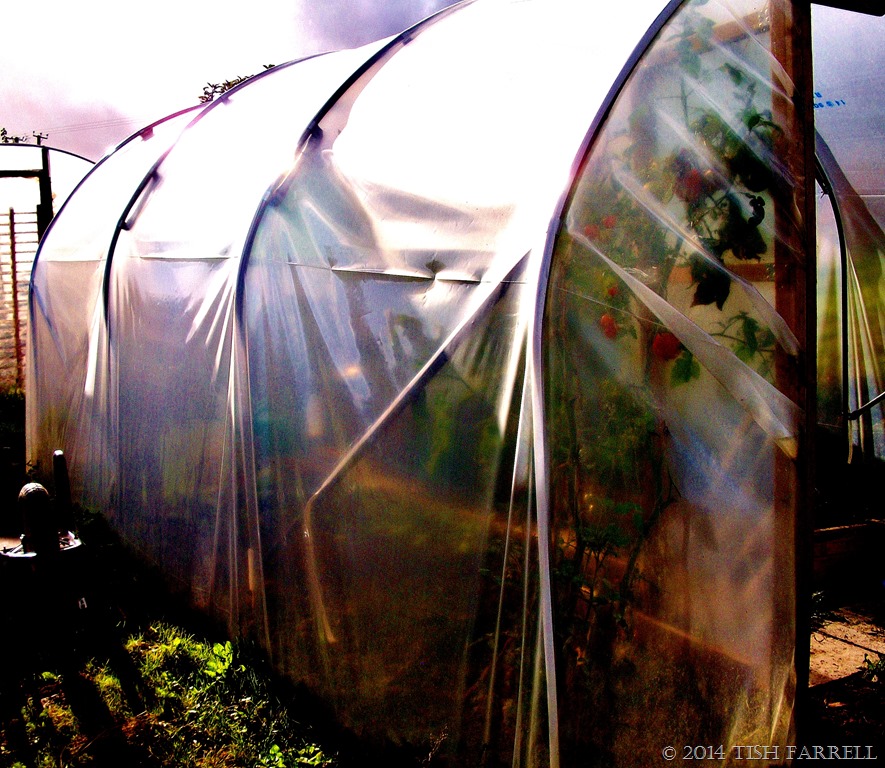
And so to cut a long story short, a week last Sunday I became the proud owner of the Auntie Evelyn Memorial Polytunnel, complete with potting bench, garden chairs and an automatic watering system. My aunt would have loved it. Bob and Sally even left me the last of their tomatoes and cucumbers. Not only that, the plot comes with a new shed that does not lean, nor provide roosting space for snails as my old one does. Already the Team Leader has added a shelf and guttering. In short, my water butt runneth over…Or will do very shortly.
I have started clearing the tunnel’s beds and planted out lettuce and oriental vegetables to extend the salad season. But from now on, it is all new territory on the gardening front. There’s a lot to learn about tunnel cultivation and management. Planning and forethought are required. Better get cracking with that spinach and broccoli then.
Mid October and the marigolds are still blooming up at the allotment. I love the way they simply grow themselves amongst my vegetables. In a mild winter they may flower into December. It was also good to see this bee out and gathering pollen. These days, every bee is precious. Once we have killed them all with agri-chemicals, we can expect to starve. It’s as simple as that. My allotment empire has recently expanded – more of which in the next post – so I’m intending to grow more varieties of late and early flowering plants on my plot. Or maybe I should simply stick to marigolds, and let them grow EVERYWHERE. The flower petals are lovely in salads, and a herbal tea of marigold flowers is good for warding off flu. Simply looking at them makes you feel better. All that orange straight into the brain, lighting up the little grey cells as the days darken.
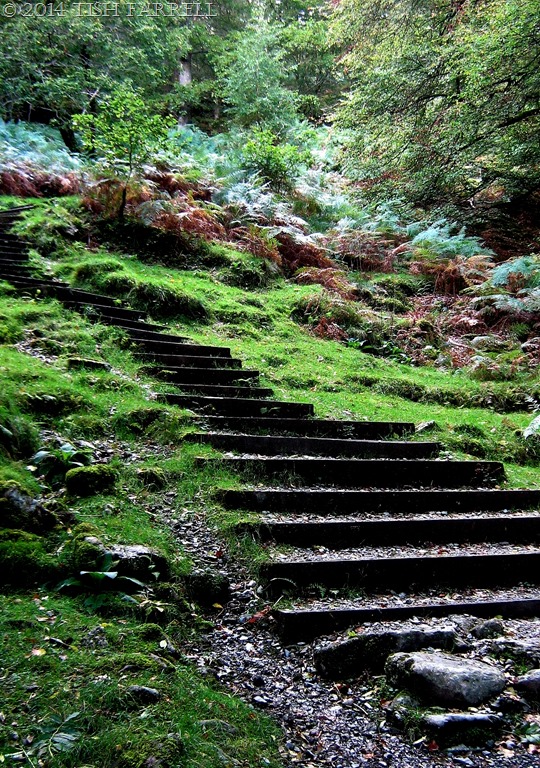
This photo was taken on a recent trip to Wales. On a sleepy October afternoon we took a stroll beneath Cadair Idris, one of Snowdonia’s most spectacular mountains. I wrote about the walk in an earlier post. You can follow in our footsteps here: Now that summer’s done, we take the Dol Idris Path…
Night on the Mara River – darkness wraps round, close as a Maasai’s blanket. It is cold, too, on the river’s bend. We press closer the campfire, our white faces soon roasting red. No one speaks. There’s too much to listen for. A hyena whoops across the water? It sounds close. It sounds unearthly, sending shock waves through vulnerable bones – mine, conjuring packs of predators, out there, circling our ring of light. And even as I think it the Maasai are on us. Six warriors, spears in hand and naked to the waist. Their leader tosses his ostrich-feather head-dress that looks like a lion’s mane. He is fearless. He is lion.
Then the singing starts, a nasal falsetto that resonates through time and space – the winds’ whine through Mara grasses. The Maasai girls trip lightly into the firelight, their wraps like flames – yellow, red; close-cropped heads hung with beads; chins jutting forward as the crescent necklets – tiny beads so patiently strung – rise and fall on skinny chests. The moran start to leap – higher, faster.
Multicoloured leaves along the street in a hill
Wood soaked and sweetened by the rain falling
Merciful water dripping onto quiet pavements
Dribbling slippery down the tarred thirsty road
A neutral sky where the air harbours no pressure
The rooftops and local windows leaking domestic
An uninspired dog lays heavy by an entrance hall
When there is nothing to do is there nothing to do
Flattened tired carpets still pretend to be luxury
Inside wooden walls of the same old thing again
Sometimes the coffee steaming will hold comfort
One of those days without a name to label it by
Forgotten picture frames capture some yesterdays
Glossy managed smiles and gestures from parties
The trolls and magnets and broken love messages
Settled into grown up life and ways of escaping it
The stale kitchen mood meets a crisp autumn air
Spring long dead visits the city to play some tricks