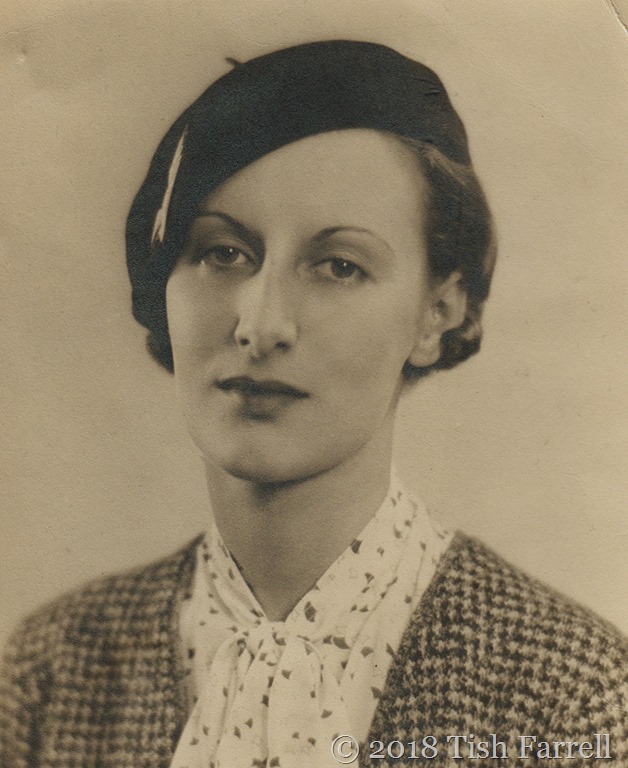
Miriam Wilkinson nee Hickling: 21st February 1914 – 17th March 2003
*
There was only one thing my aunt loved more than her Devon garden, and that was the Derbyshire Peak District – the lanes round Bradwell, Ashford and Hathersage, the byways of Fox and Bennett family forebears. To a child brought up in the suburbs of Manchester, the Peak District of spring and summer holidays seemed like heaven.
For most of her married life, Miriam was a nomad – living in 42 different rented flats. Each one she tried to make home, and always with much flair and limited funds, as she followed her engineer husband from one telephone exchange to another, whenever and wherever he was dispatched to oversee the upgrade of Britain’s telecommunications. They had married at the start of World War 2, and the header photo probably dates from around this time. After a makeshift marriage whither my grandmother had arrived wearing only her shopping clothes since she looked down on the whole affair, Miriam had been left married, but stranded with her unsympathetic parents while my uncle was posted off to West Africa.
Looking back, he must have been helping to provide British navel and military intelligence with radio surveillance capability since he had no service rank as far as I know. He apparently lived in some style out in Africa. But it was all change a year later when he was posted to Coventry during the Blitz, presumably to work on restoring bombed out telephone connections. And this is where married life actually began, in a dismal rent room smelling of boiled cabbage and with Luftwaffe bombs raining down.
My uncle did not cope well with either the bombing or the war-time privations. Miriam had to keep him together on all fronts, while she went to work in a munitions factory. I cannot imagine what it was really like for her. She had lived a life of quiet and modest gentility, though always within the orbit of rich relatives. She had endured her mother’s spirit-crushing jibes while doting on a father who, in her hearing, had once described her to a family friend as ‘a dud’. Neither her mother or father had the faintest idea about parenting or how to prepare their two daughters for adult life.
My grandmother had been mostly brought up by a housemaid and a slightly dotty aunt as her own twice widowed mother drifted around in black silk dresses, taking covert sips of gin, while presiding over a Cheshire Inn. Grandfather had been abandoned by his own mother, who apparently fled merchant-class respectability and ran off to be an actress. She deposited grandfather with his dour Victorian Hickling grandparents, though returned in later life from time to time, wafting in at the family firm for a cash injection from ‘master Georgie’.
You can well see how lives of ‘quiet desperation’ get handed on from generation to generation.
Miriam had a talent for drawing and writing but even this outlet was denied. She had poor eyesight and had terrible headaches, but my grandfather would not let her have spectacles. No visible signs of imperfection would be tolerated. She told me how once, when returning from a childhood trip to Derbyshire by train, she had developed a rash on her face. Her parents being highly alarmed, took themselves off to another carriage to complete the journey to Manchester leaving Miriam alone in a state of disgrace. By the time she was fourteen she had suffered four nervous breakdowns and had to be taken out of school. Both she and my mother, who was eight years younger, were sent to small private schools. My mother was not allowed take up a place at a prestigious girls’ high school despite gaining a scholarship. My grandfather would have no ‘blue stockings’ in his family. He had some notion that providential husbands would somehow materialise: both his daughters would ‘marry well’ and thus be taken care of.
They did not and they were not. But each in their own very different ways made the best of very bad jobs, though in my mother’s case her methods of choice were destructive and damaging to others. Miriam remained stalwart, loyal to a man whose nerves were fragile, and who, in extremis, once attempted to strangle her as she slept.
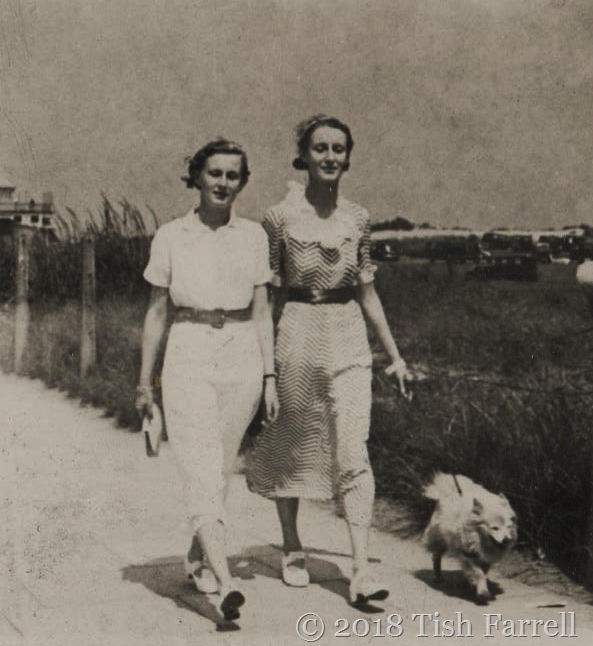
My mother, Peggy, probably sixteen years old, Miriam around the time of her marriage circa 1939. Both stepping out with so much intention.
*
Miriam did not have a home of her own until the mid-1960s. It was on top of the hill in Pinhoe, near Exeter. There she made a garden that was filled with wildflower reminders of girlhood Derbyshire holidays – dame’s violets, bloody cranesbill, saxifrage, cowslips, primroses, the wild yellow pansies of the limestone uplands. In their latter years, she and my uncle took to having an annual spring holiday in the Derbyshire Peak District. It was a source of great joy to both of them. Sometime later I took her ashes there.
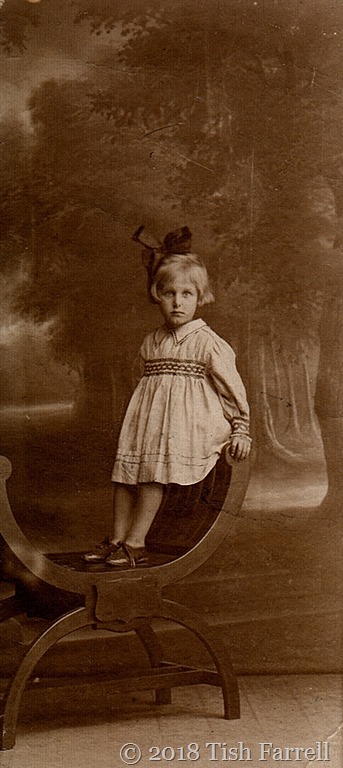
Miriam around 4 years old c 1918. The first time she met her father was when he returned from France at the end of the Great War. He had been an ambulance driver, and came home with gas-damaged lungs, which left him an invalid for the rest of his life. It left him the poorer too with years of medical bills to meet. He said wearing a gas mask got in the way when he was trying to pick up the wounded.
copyright 2016 Tish Farrell