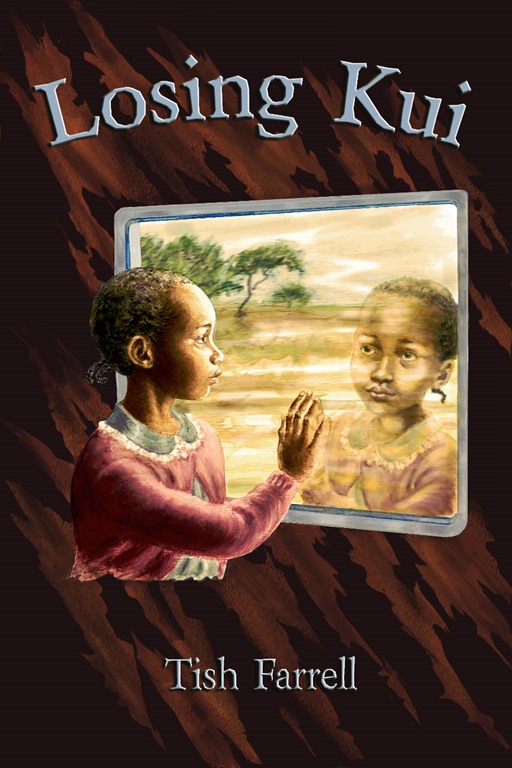
Losing Kui ~ an extract

Losing Kui-1First published as El Nino and the Bomb, Cicada Magazine 2008, now a Kindle e-book

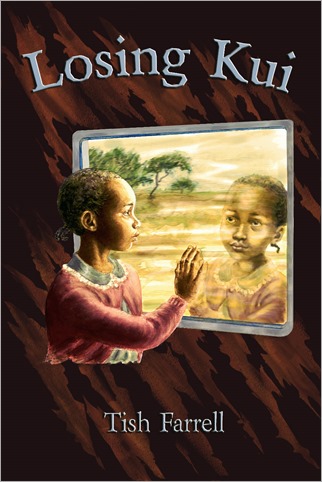
artwork: Kathleen Collins Howell


MONDAY

First light, Kimiti Farm, Ingigi

Kui wakes – a golden starburst in her head. When she opens her eyes the idea is there. She does not know where it comes from, but it seems to have something to do with Baba, her Daddy Julius, whom she rarely sees because he works in the city, far away from their village.

Thinking of Baba gives her a sickly, sinking feeling. Yesterday he came when she and Mummy were on their way to church. Kui spotted him first. There he was, so smart in his dark city suit, picking his way up the muddy lane. She wondered why he did not have on rubber boots as she and Mummy did, or carry a brolly since it had started to rain again. She wanted to run and hug him, but Mummy gripped her hand more tightly saying, ‘No, Kui. Stay under the umbrella. You will spoil your best clothes.’ And then Baba was there, standing over her, but before Kui could open her mouth to greet him, he and Mummy were face to face, and it was all stabbing words and hard eyes.

‘I am taking Kui to church,’ Mummy said, speaking the words in a way that gave Kui a crushing feeling in her chest. ‘We will return at supper time.’

Baba made a cross face. ‘You know what I think about that.’

Then Mummy said, ‘Yes, Julius. Your godless views are well known to me.’

That did it. Kui tried to twist her hand free and run back to the house, but Mummy’s hand gripped like iron claws. Next Baba was shouting, ‘For God’s sake, Faith. I’ve come to see you, don’t you understand? I’ve spent good money on fares and now you say you’re taking the child to wail and pray all day. Well dammit woman, I’m going to the pub.’ And he did too, striding off in the opposite direction towards the village shops. Kui watched him go, picturing him stepping inside Jimmy Mwangi’s bar where she knew many of the village men went on Sundays.

And so that was that. Baba had gone. No hello. No bye-bye. He did not even notice her new church dress that Granny had bought for her. For the rest of the day she kept thinking she had done something very bad. Pastor Benson’s loud shouting did not help. Sins came flocking round her head like swarms of biting flies, and the priest’s cries of Repent! Repent! sounded like curses.

When she and Mummy came home from church it was nearly night-time, and the rain had turned to a misty drizzle. While Mummy made their evening meal, Kui took Mummy’s big umbrella and went back to the farm gate to wait. In the growing darkness she heard the frogs in the hedgerows pipe louder and louder, and the crickets chatter like crazy, but Baba did not come. She and Mummy ate their ugali and greens alone as they usually did, and then Kui went to bed. For ages she lay very still in her little room, listening out for him. Then the songs of bugs and frogs filled up her head and she stopped listening.

It was the slamming house door that woke her. Then the rain came beating on the roof, and then there was a bad row with Mummy’s voice rising above the rain noise:

‘Drinking away Kui’s school fees again-

‘Treating the whole bar-

‘How can you be so irresponsible, Julius?

‘My God. Kui is five. She should be in school-’

At first Baba did not say much. Then he let out a roar that sounded just like Lois, Mzee Winston’s old cow, who often stood by their fence and bellowed like that when she was unhappy.

‘I’ll kill you, slut. Insulting me…your…your husband…how dare you-

‘Peasant. Whore

‘How’d I know that child is mine?’

Then the fight really started and Kui had to wrap her head in the blanket to shut it out. The next time she woke there was only the pounding rain and blackness and Baba snoring loudly next door.

Now, though, there is light at her window and she is wide awake, the idea shining like the Wise Men’s star. She will go and live with Granny. Then she will never again wake up to find a stranger-ugly-Mummy leaning over her bed with swollen eyes and crusty blood on her lips. Also if she stays with Granny, Baba will stop hurting Mummy, and Mummy can come on the bus and visit her at Granny’s house.

Kui’s heart flutters like a small bird against her ribs. She must hurry. Already Jo-Jo the cockerel is crowing good morning on the shed roof. Any moment Mummy might come to help her dress. But she does not need help, does she? She is a big girl now. Soon she will be going to school. Granny will take her. She slips out of bed, shivering in her vest and pants, and quickly pulls on the church frock she was wearing yesterday. She cannot reach all the buttons, but never mind. Granny will say Ah! My little princess, as soon as she sees her. The pale blue satin is soft as silky sky and the net petticoats float like clouds around her legs. As she pulls on the long white socks and fastens the straps on the patent shoes she thinks she is just like Cinderella going to the prince’s ball. Then she spots the big pink cardigan on her shelf. Granny made it for her birthday, along with the matching bonnet with its big fluffy tassel. She puts them on.

Next she wonders how to leave the house. She can tell from Baba’s snoring that he is on the sofa by the front door. If she creeps by on tiptoe he will not wake, but she doesn’t want to smell his breath. She turns to the window. One bar of the thief-grille is broken. It is wide enough to squeeze through. She climbs onto her bed and opens the window, then hitching up her skirts, wriggles through, and climbs down onto the wooden bench outside. Pleased at her escape, she waves at Jo-Jo, puts her finger to lips (Ssssh), then jumps lightly into the mud that make ugly splashes up her socks. Oh dear. She rubs the stains worse, then skates off down the rain-soaked path. She is glad she has on her best church shoes instead of the ugly rubber boots. The slippy soles are good for mud-skating, and Mummy is not there to tell her off.

Out on the lane it is foggy, but the rain has gone. She passes no one, although there are some big boys climbing the mango tree outside Mzee Winston’s gate. Then down at the corner by the tea collecting shed she sees the minibus Joybringer taking on passengers. She knows it is Joybringer because it has golden rain round the back window and Mickey Mouse is waving to her. She also knows that this is the bus that she and Mummy take when they go to see Granny. While the tout is on the roof tying down a bicycle, she slips aboard, dodging between a mama with a basket of eggs and a man waiting to load a large iron roof sheet. She worms her way through the forest of legs and bundles to a corner space on the back seat.

She has no money for the fare, but she will tell the tout that Granny will pay when she gets off. Also, she is not sure which stage to ask for except that Granny always meets them at the big shopping centre past the coffee farm. Kui looks forward to that bit of the journey. The shop by the bus stop has beautiful pictures of black and white cows painted on its walls, and Mummy tells her that the pictures are there so everyone can know it is the butcher’s shop, even people like Kui who cannot read yet. Granny will be waiting by the cows, and when she sees Kui she will cry, ‘See what joy the Joybringer brings me’ and give Kui a big hug. Then they will go hand in hand down the windy track to Granny’s little wooden house, and Granny will stir the coals on her hearth of three rocks and make the special porridge that she always makes, and give Kui a big cup of milky, sweet tea from her thermos flask.

Kui licks her lips, then hugs herself with excitement as Joybringer speeds off through the village. How glad she is to be visiting Granny. How grown up she is to be travelling on a bus all by herself.

~

5.30 a.m. Kiarie Farm, Ingigi

Even as daylight sifts through the bedroom curtains, Winston Kiarie knows there is something wrong. The worry that has haunted him for weeks now roots like a jigger under a toenail. All night he has lain awake, listening and wondering – on and on, as the clock ticked off the hours. All night the rain has burst like gunfire on his iron roof, boiling out his gutters, threatening to explode expensive window glass. In the black hour before dawn, with Rahab snoring beside him, he finally understood the meaning of water on the brain. He had it. Lying there in his own bed, trapped like a man inside a waterfall – the drenching, drumming deluge. Where did such rain come from? Never in his long life had he known weather like it, the short rains becoming long rains, the long rains forgetting to stop.

Then the jigger-fear started up. ‘They’re unnatural,’ it nagged, ‘these rains they call El Niño. Now is the time of soft mists to ripen winter maize, not of flood and tempest to devastate the land. Mark my words. Some great evil is abroad.’

And in the darkness Winston found himself muttering, ‘Yes. Yes. It’s what I thought. Some even say it’s the end of the world.’ This thought made him tremble, and quickly he probed the dark for more rational explanations. Fear, he knew, always loomed largest at night. The jigger was probably exaggerating. By day its pronouncements might not seem so ominous.

Yet with the dawn Winston finds that the word ‘unnatural’ still running round his head. He watches the curtains lighten by degrees. Hears the rain stop hammering, but still the fear is there. Sighing, he hauls himself from the bed where Rahab still snores, gently tucks the blanket round her. Not even the jigger fears can put off the morning routine: a trip to the latrine, milking, then a big mug of tea.

Through the crack in the curtains he can see that all is greyness out in the yard. He struggles stiffly into pants, shirt and the bright blue pullover that Rahab made for him in the days when she could still conjure knitwear from two steel pins, a fat ball of yarn and some secret inner vision that he could never fathom. At the kitchen door he pulls on the old English sports coat, up-ends and shakes his rubber boots before putting them on (so clammy on bony old feet) then, unbolting the door, steps into the yard.

Outside, his hands fly skywards. Thank Ngai. No rain. Only wet mist, and that at least is seasonal. He slip-slides through farmyard mud, heading for the path to the long-drop latrine. In the slow-going he thinks that, at their age, he and Rahab could probably do with one of those modern indoor bathrooms that may be found in smart hotels. But then it would be costly to build, and the drainage hard to manage with the farmhouse perched as it is above the Great Rift. Besides, the long-drop is conveniently downwind; it serves well enough if it is dug out regularly, although the thought of this chore makes him sigh. Like much else these days, such jobs get no easier.

Shunting across the yard, his boots are soon so caked with mud that they are hard to lift. This gives him the oddest sense of moving forwards only to slide back to where he started. For a moment he stands still to check progress and, glancing back to the kitchen door, suddenly sees the funny side.

Ha! Moving forward to slide back? Sounds like some joke government slogan. Well, isn’t that how life is now: everyone striving, but then ending up worse off than before? He must tell Rahab over their breakfast cuppa. Even she will see the humour of it. At least he thinks she might. Yes. Moving forward to slide back. What a joke.

He stops at the cattle pen to scrape the excess mud from his boots. At this rate he might never reach the privy in his lifetime. Two Ayrshire cows and three Jerseys push their faces at him over the fence. Five lots of breath make white plumes in the mist. Winston briefly pats each dewy nose in order of seniority: Lois, Lola, May, Primrose, Mumbi. All present. All correct. And yet?

He turns and looks around the farmyard, scanning the acanthus hedge where the fog hangs in shrouds. But it is not the fog that disturbs him; it is something else. It is silence. Not even a dove or starling calling. After the night’s thundering rain so much quietness is uncanny. He thinks of Rahab then, and wonders if she is awake yet. She sleeps so much these days; not even last night’s din disturbed her. Sometimes she seems to slip into another world, as if she is submerged in an old-age, silent fog all her own. He wonders if the endless rain is to blame (water on the brain?). All he can do is hope that she will come back to herself.

He presses on slowly across the yard, telling himself that he is not the only one to be worried by weather. Two days ago, during a lull in the rain, he and Rahab walked to Ingigi’s general store. They needed tea and maize meal. Along the lane the lantana bushes steamed under a misty sun, and people stopped to commiserate over the general quagmire. Not everyone was complaining though. Outside their neighbour’s Faith Muthoni’s place little Kui and another child were playing shop. They were having a fine time shaping rounds of mud and mango leaves, and setting them out on a banana leaf.

‘Mud pies,’ Kui cried when she saw them. ‘I will give you a good price.’ Then she dissolved into shy giggles when Rahab sparked into life and ordered ten. Winston at once repeated the order, trying to join in the children’s fun. The only problem was he could not be sure if Rahab was joking.

Further on at the market crossroads they found a big crowd trying to shunt Joybringer out of the mudslide that had spilled down the plum orchard above the bus stop. While the windows sparkled with old Christmas tinsel and Mickey Mouse grinned like a mad thing, tempers began to fray. City-bound travellers were suddenly sprayed in mud from a spinning back wheel, and this was the moment that Sergeant Njau turned up and tried charge the bus driver for causing a public nuisance. It was very poor timing on the sergeant’s part. Also Winston was astonished to learn there was such a crime. But Sergeant Njau had pressed his luck too far this time. The passengers, furious that any fine would be added to their fares, turned on him. The officer, faced with a mob of such unexpected ferocity, muttered something about ‘mitigating circumstances’, and quickly retreated to the Police Post.

Meanwhile Jimmy Mwangi, the local bar owner, caught Winston’s eye.

‘It’s like the Plagues of Egypt,’ he said, nodding at Sergeant Njau’s departing back. ‘If we’re not scourged by flood or drought or bugs eating our crops, it is swarms of bloodsuckers like him. Making money from other people’s misery. I ask you.’ But before Winston could think of a suitably non-committal reply, since he had learned from past experience not to voice opinions about officials in public, Samwel the butcher chipped in, ‘End of the world, that’s what this El Niño means. God is reminding us to repent, sending us these mudslides and floods. The Millennium will soon be upon us.’

By then Winston wished that he and Rahab had stayed at home, away from such alarmist forecasts. Even when they reached Quality General Store, Mrs. Kuria wailed that there had been no maize meal delivered and surely God was sending an absence of ugali to punish them for their wicked ways.

Winston could summon no suitable response to this either. Now, though, he thinks the doom-mongers may have a point, but only so far. God, he is sure, is not the culprit. Recently he has been reading the newspapers more carefully. He has learned, for instance, that the felling of the highland forests is changing the Rift Valley’s climate, lowering the water table, and loosening the light tropical soils so that they wash away with every rainstorm. On top of this, everyone knows that officials have been plundering the valuable hardwoods for years, and then clearing the rest for charcoal burning and bhang farming. And so, with the sacred soil thus exposed, El Niño strips the land as a slaughterman flays a carcass.

He knows where that soil ends up too. He discovered this quite by chance, three weeks ago when he called in at Jimmy Mwangi’s for a glass of home brew, something he did not usually do. As he stepped into the bar, there on the T.V. was a scene that stopped him in his tracks. An aeroplane was flying over the Tana Delta, and filming the vast red slick as it spread into the Indian Ocean. It did not take him long to realize that this was the outpouring of their very own river that rose in the High Rift hills; their own good earth flowing into the sea. The image of a severed artery sprang to mind. He began to feel faint. And that is when he knew. The homeland he had fought for in his youth was simply bleeding to death – kwisho and bye-bye. He turned on his heel and went home without ordering the drink.

Even now, recalling that scene gives him a stabbing feeling in his guts. He hurries onwards. When he reaches the drier ground of the hillside path he strides out, sidestepping the chickens coming the other way. (How the devil have they got out?) But there’s no time to think about that now. He throws back the wicket gate at the end of the path, takes the long-drop key from his trouser pocket, and steps into the field. But as lifts his hand to the place where the door should be, he finds there is no lock to open. No door either. Winston’s hand hangs in space. The latrine is gone. The ground it stood on too. Nothing left but a bloody mud slick.

It takes another second to sink in. Ngai, help him. Now he knows what the jigger meant. His life’s work is gone – the plots of coffee, tea, maize, the terraced banks of cattle grass – all swept away by a massive landslide from the hills above. Only the red subsoil remains. And something else. A big rusty egg lying in the dirt where the latrine should be.

Winston drops his trousers just in time. Dear Lord. Then finishing fast, he runs to warn Rahab. He knows what that giant egg can do. Forty-four years it must have been lying there on his farm. Forty-four years waiting to blow.

‘Rahab. Woman. Move!’


Losing Kui -Final

Available in Kindle at:

Amazon.co.uk

Amazon.com

YOU DON’T NEED A KINDLE READER TO READ OR DOWNLOAD E-BOOKS.

GET A FREE KINDLE READER APP FROM AMAZON FOR ALL OF YOUR DEVICES HERE


Secrets, conspiracies, tragedy, dark comedy – a fast-paced novella of interwoven tales set somewhere in East Africa

Things are going from bad to worse in Ingigi village. No one knows why five-year old Kui has gone missing. Nor does Sergeant Njau want to find out. He has his own problems, pressing matters that are far from legal. Then there is the endless rain. Will it never stop? Some Ingigi folk think it means the end of the world. Old man, Winston Kiarie, has other ideas. He senses some man-made disaster, and when it happens, it is worse than his worst imaginings. The fierce storms are causing landslides and throwing up British bombs, unexploded for forty years. Their discovery is giving the Assistant Chief ideas: how to make himself very rich. And then there’s young Joseph Maina and the primary school drop-outs thinking they have found treasure, and about to do something very foolish. Meanwhile, is anyone looking for Kui?


Available also on ePub Bud for Nook, iPod/iPhone etc HERE 

© 2014 Tish Farrell
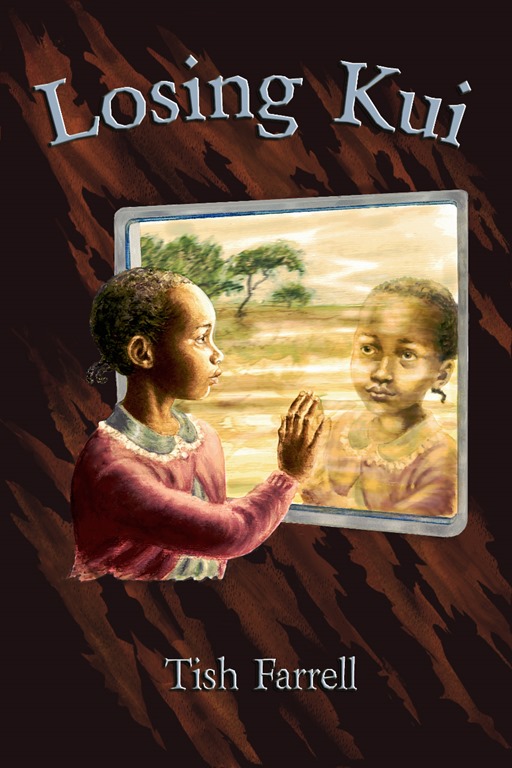
 

Unveiling ‘Losing Kui’: the story of the story, or how writers need good editors

Losing Kui -Final

Cover: Kathleen Collins Howell

YOU CAN READ AN EXTRACT HERE

*


I am trusting that this is the final version of this novella. But then with stories you never do know. It’s  both the pleasure and the pain of e-publishing: you can tinker with your text until the end of time, re-posting the updated versions. I anyway have a tendency to re-make earlier works: putting them into new forms, re-shaping them for different audiences and purposes.  With this story, though, only length and title have changed, oh yes, and  in this final version I have started at a different point from two earlier versions.

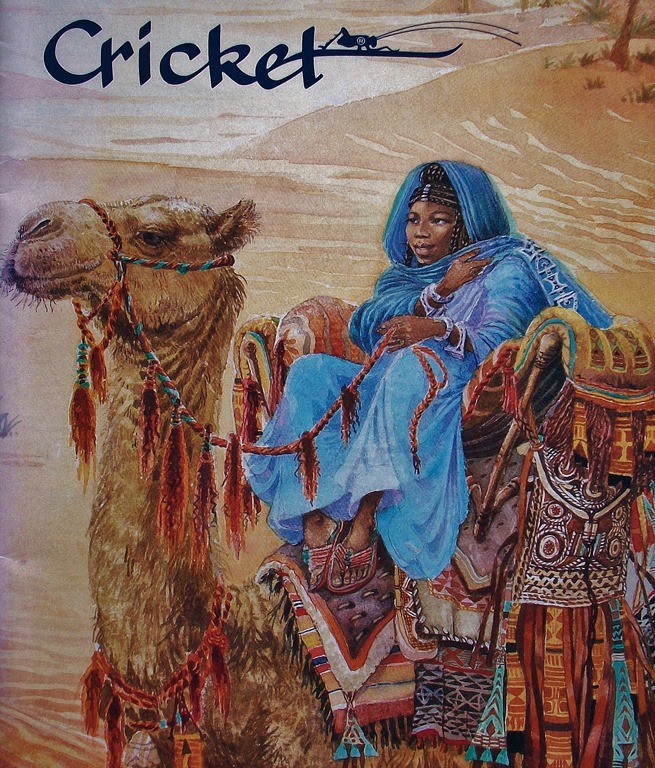
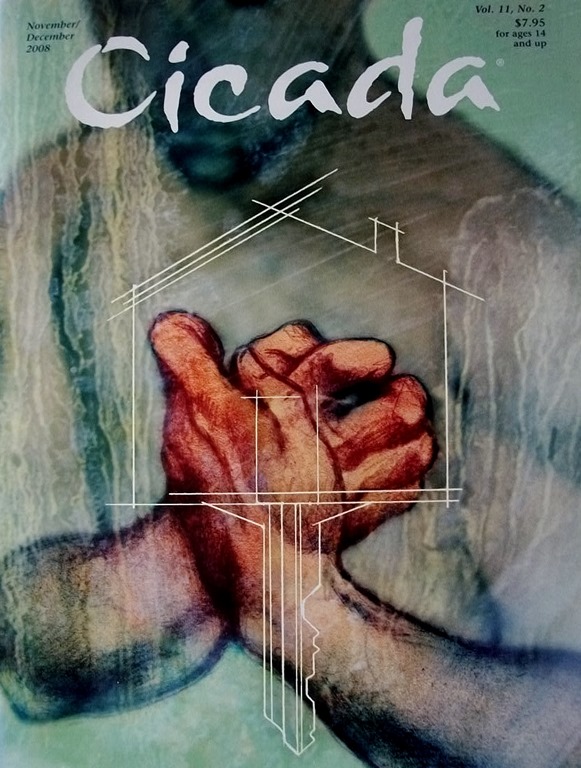
The first published version came out in 2008, in the  Nov/Dec issue of Cicada, a US literary magazine for teens to adults. The title then was El Nino and the Bomb. For those of you writers who do not know  about Carus Publishing/Cricket Magazine Group (founded by Marianne Carus in 1973 and “won more awards than any other children’s publisher”) you can find out more HERE. If you are learning your craft as a writer or illustrator, and have an interest in children’s and teen publishing, then you can learn a lot from these magazines. The general ethos is multicultural, and each  title – Babybug, Ladybug, Spider, Cricket, Cicada caters for a specific age group, thus nurturing a life-time’s habit of good reading.

100_3668

Cricket Feb 2001 vol 28 no 6;  Art: Ann Strugnell

*

Cicada have published a number of my short stories over the years, works that started off as 5,000-word entries for adult short story competitions. This was how Losing Kui began, although back in the early 2000s the title was Material Days. In this form it was short-listed in  Carve Magazine’s Raymond Carver Short Story  Contest. The then editor, Melvin Sterne, sent me a very sweet email, saying he was sorry that it did not make it to that year’s anthology. 

I still like the Material Days title, although it perhaps means more to me that to anyone else. When I was living in Kenya it was a phrase I read often in newspaper crime reports. At the time it chimed with my sense of indignation at the then government: the way it abused its people, and the poverty it so wilfully inflicted upon them.

And so, spurred on by Melvin Sterne’s email, and still nursing that sense of indignation over the state of things in East Africa (a situation that Great Britain and other donor nations have long had a hand in), I began an expanded version of the story with the idea of submitting it for Cicada’s novella slot. They accepted it too, although there was a wait of several years before it was actually published. In that long interval I was fortunate to work with Cicada’s then Senior Editor, Tracy C  Schoenle, and Executive Editor, Deborah Vetter. I learned a lot from their thoughtful and  respectful editing.

100_5686

Cicada Nov/Dec 2008 vol 11 no: 2.  Art: Home by Eamonn Donnelly

*

But there was a bigger lesson in store than seeing how best to trim excess words, or make meaning sharper. It was Marianne Carus, Editor in Chief, who was responsible for a major change in the story. She suggested, very delicately, that I had left the protagonist  Kui in too bleak a place and wondered if I might consider a more positive ending. At first I huffed to myself: I liked my ending. But then once I was over my fit of writer’s pique, I knew she was right. The last third of the story was thus written in response to Ms Carus’s comment. I remember it flowed out at some speed, as if my subconscious had also known that I had not finished the story. 

Time of course had passed by then, and I wasn’t quite so angry. Instead of hopelessness (relieved by elements of dark comedy) I saw possibilities for redemption; my characters began to take charge of their lives, and rise above their misfortunes. And that was the moment when I truly understood just how much writers can learn if they have the chance to work with a good editor.

More recently when I was working on cover ideas with my good friend, and illustrator Kathleen Collins Howell (Associate Professor of Art, Emeritus SUNY at Buffalo), I also began to see the story in quite a new way. I suddenly understood that the lost child Kui represents something far bigger than her own self. She is far from home, frightened and abused and yet…and yet…

Here’s the blurb:

Things are going from bad to worse in Ingigi village. No one knows why five-year old Kui has gone missing. Nor does Sergeant Njau want to find out. He has his own problems, pressing matters that are far from legal. Then there is the endless rain. Will it never stop? Some Ingigi folk think it means the end of the world. Old man, Winston Kiarie, has other ideas. He senses some man-made disaster, and when it happens, it is worse than his worst imaginings. The fierce storms are causing landslides and throwing up British bombs, unexploded for forty years. Their discovery is giving the Assistant Chief ideas: how to make himself very rich. And then there’s young Joseph Maina and the primary school drop-outs thinking they have found treasure, and about to do something very, very foolish. Meanwhile, is anyone looking for Kui?

Losing Kui -Final

READ AN EXTRACT HERE

Losing Kui by Tish Farrell

Out on Amazon Kindle

Available also on ePub Bud for Nook, iPod/iPhone etc HERE 

Frizz’s tagged ‘U’ for more bloggers’ stories

Errant Muse? But there’s still life at the allotment

100_4927

I’ve posted this photo of my last summer’s allotment produce to prove something. I thought it might be a good antidote to my dreary state of writing stuckness. (And may be yours too). For one thing it shows conclusively that if I can’t get to grips with the several novels now backed up in brain and filing cabinets, then I can at least produce beautiful vegetation. (In season of course). Most of it is edible too, although I would not recommend the zinnias. Marigolds are fine however – in salads and as herbal tea. Excellent for the immune system, or so a herbalist friend tells me.

100_4943

I sometimes think my allotment life is a metaphor for my writer’s life. Sometimes I think  it’s the other way around. This reminds me of the great Welsh poet, R S Thomas. In my post about him the film link shows him, in his elder years, out bird watching on the Welsh coast. Speaking to camera, and with a wry smile, the Nobel nominee says he is supposed to be a poet, but that when the poem is going badly, then he is a birdwatcher. Likewise for me, when the writing stalls, then I am a gardener. I am mostly a gardener.

100_4941

The common ground between growing and creating is obvious: seasons of  productivity followed by dead times when the creative flow seems to be, well, DEAD. This is the natural order of things. I know it. And so I am forgiving when it comes to the garden. I do not expect it to grow things in December and February (or at least not much). But when it comes to writing, I fret, fume and grow ever more despondent with myself because the ideas in my head cannot be rendered, as I would like them, to word, to screen, to finished work.  And I do not forgive this. I consider it a grave fault.

100_4945

Yet I know, too, that good growing and writing, require a fertile medium, one that is well turned and appropriately nourished. You need plans and timetables, while remaining open to alternative courses of action. You also need the right medium for the job in hand. All this takes time: years of learning, of preparation, and the application of improving strategies. You have to understand your ground from the inside out. And that brings me to another essential condition – good drainage. And  in my home town poor drainage is a problem; both brain and allotment, then, are equally afflicted. They are not free-draining. But at least I know how to improve the soil. Grit is good.

100_4954

In the absence of creative flow, ungoverned gathering of new material can start filling the gap. This in hopes of finding a  spark, some fresh inspiration to jump start the writing. The activity can of course have its good points. You may indeed find the very thing you need. Besides which, well rotted down and aerated compost improves content and structure for any future cultivation. On the other hand, ever growing stagnant piles of poorly decomposing matter simply overwhelm and add to the stalled flow problem. In other words, there comes a time when you simply have to give your brain a rest, leave the compost heap to rot down, and allow the period of dormancy to run its course. The hard thing is to keep faith during this process of seeming inactivity; to believe that you WILL recover and complete the works you began.

That wonderful woman, poet and Jungian psychoanalyst, Clarissa Pinkola Estés has some very heartening things to say about this. In her autobiographical exploration of the nature of story, The Faithful Gardener, she says that new seed is faithful, and that it roots most deeply where the ground is the most empty. In The Creative Fire she also says that everyone is an artist even if they have not lifted a brush to the canvass or opened a new Word file (I paraphrase). Finally she tells us that the only thing you need to create is to get out of the way.

And so in a bid to get out of the way, I leave you with some summer marigolds. Before your eyes they are passing through their natural cycle from bud, to falling flower to newly forming seed head. Perhaps if we stare at them long enough, absorbing all that very creative orangeness, we stalled creators will ‘hear’ what they are telling us.

100_4935

© 2014 Tish Farrell

*

Frizz’s Tagged E  Go here for more ‘E’ stories

*

Related:

Bright Fields on Llyn: windows in time, mind and space and other stories from Cymru

Onwards and upwards…the big New Year ‘do-over’

The Tsavo Big Game Show: it’s a dangerous pursuit

lone elephant at twilight

Night comes swiftly in the African bush but never quietly. As the sun drops behind the Chyulu Hills, so the pipe and whirr of frog and bug ratchet up a few decibels. It is like a million high tension wires being pinged and twanged. If you listen with both ears it can drive you mad. Likewise, if you allow yourself to succumb to the night’s sticky heat and the hypnotic scents of thorn flowers, then do not be surprised when the sudden scream of a tree hyrax stops your heart.

But we are not going mad. And our hearts are just fine. We think we have cracked this Africa lark. Well sprayed with insect-repellent, all accessible parts covered as can be, anti-malarials ingested, it seems safe to sit out on our veranda at Kilaguni Lodge  and do some night-time big game watching. 

Below our room is a barren stretch of red volcanic earth, and a water-hole lit up by two search lights. The illuminated circle that the lights create is like a stage set. It seems we are seated in a mysterious wildlife theatre waiting for the cast to appear.

The contrast is disturbing. By day, this self-same set is furnace red, littered with volcanic spoil; it is the haunt of the cadaverous-looking marabou storks and the occasional zebra. By night, all is softer, surreal. You feel you might dissolve through the light into perpetual darkness; for out there the night goes on forever, doesn’t it?

And so we go on gazing at the scene. It takes some time to realize that small groups of impala are emerging from the gloom. Their stillness is mesmerizing. Perhaps they are not there at all.

And then…

And then…

The impala are wary. You can almost see the charge of anxiety ripple through the herd. We hold our breath and stare into the dark behind the lights.

And then we see them – black hulks gliding through the thorn trees. Elephants. They have come so silently, walking always on tiptoes, their heels cushions of fat to muffle their footfalls. Slowly they move in from the bush. Even in the dimness beyond the pool, their hides glow red, irradiated by the igneous dirt they have blown over themselves.

In the wings the elephants pause. It is hard to say how many are there. After a few moments two peel away and the rest of the group retreats again into darkness. Two large matriarchs now head for the pool. At the water’s edge they part, and in matched strides stake out the water-hole from opposite directions. There’s an angry trumpeting when an impala fails to withdraw fast enough, and only when the entire bank is clear do the elephants go down and drink. But they have hardly taken a couple of gulps when they move back and take up guard duty, one at each end of the mud bank.

We are transfixed. We cannot fathom the plot, but note that, despite the elephants’ aggressive stance, there has been a concerted gracefulness to their routine. It crosses my mind that the great choreographer, Balanchine, once made a ballet for elephants. Now we see they have dances of their own.

And so we wait.

Slowly the rest of the group reappears, moving as one in the tightest huddle. As they enter the spotlight we understand. Tucked safely between the legs of four large cows are three infants. Like precious celebrities surrounded by an escort of heavies, the youngsters are guided to the water. There, with tiny trunks they cannot quite control, they drink their fill. The whole thing takes only a few minutes. Then, with this life-and-death task accomplished, the sentinels re-join the group, and the small herd leaves as silently as it came, melting into the backdrop.

So: this drama is over; the stage empty. After the thrill there is anti-climax, a strange sense of banishment; depression even. We go to bed, suddenly overcome by the heat and with too many insects on the brain.

Inside, though, the room is hotter still; windows shut fast against malarial mosquitoes. Even so, and despite the rock-like pillows, we sleep for a time. At midnight it is the menacing whine of a mosquito that rouses us to a bleary-eyed seek and destroy mission. At 2 a.m. we are awake again as two waterbuck lock in high-snorting combat below our veranda.

G. huddles back in bed. I press my nose to the window. It’s at times like this that Africa looms largest, that you know you are out of your element. Night stretches ahead like a herculean trial. I stare once more at pale stage in the bush. The impala have drifted back to the pool again, but they barely move. It is like watching a Samuel Becket play where nothing much happens.

And yet…

Suddenly the antelope are on full alert – rigid stance, ears pricked, noses twitching. I stare and stare. At last I spot movement, a sinuous shape pressing through the low scrub. The impala rise on hoof-tips, torn between staying and fleeing, and then the lioness steps out from the grass and pads down to the water.

The impala draw back, still unsure of the big cat’s agenda. The lioness parades around the waterhole, but does not drink. Instead she finds a clump of grass and lies down, head up, still as stone, commanding the pool  – a heraldic lion couchant. Now it is clear. None of the animals can drink. The tension is visible. This is a new kind of drama: feline power play.

But I cannot wait for the denouement. Worn out, I return to my hard pillow and tangled sheet.

The next time I wake it is light enough to know that I can abandon all efforts to sleep. It’s a huge relief. While G. slumbers on, I step out into cool of the veranda. In the dawn light I see that last night’s set has mystically expanded into a vast new backdrop. Now the Chyulu Hills rise above the dry plains, a vision of impossible greenness that belies the violence of their birth. For these hills are new, erupting around the time Sir Francis Drake was bowling off Plymouth Hoe and ignoring news of the advancing Armada. It’s hard to believe.

But this is not all. To the west, the snow-capped crown of Kilimanjaro breaks free of the earth and floats high on a wreath of pink clouds. It makes me want to hoot with laughter. Who does this Africa think she is? Does she really expect me to be taken in by  all her absurd illusions? Poof! The mountain snuffs out and leaves only sky. (Is this possible?) And I, like the victim of some worming parasite, know I am becoming infected. All our defences are useless. This land is creeping under my skin and invading all my senses. More likely than not I will never be the same again.

© 2014 Tish Farrell

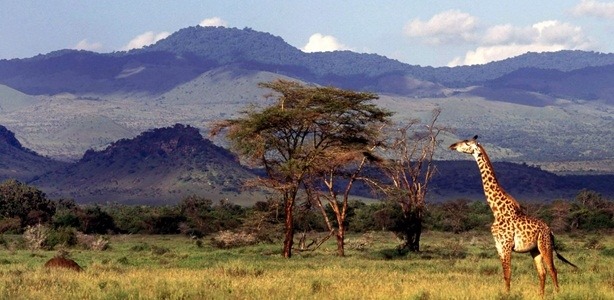
Kenya; Chyulu Hills; Campi ya Kanzi - Giraffe in the Chyulu Hills

Chyulu Hills. Photo: Abercrombie & Kent

Daily Post Prompt: write here, write now


Yum Kaax to the rescue? Or how to hook reluctant readers…


Z Boston Harvard 11

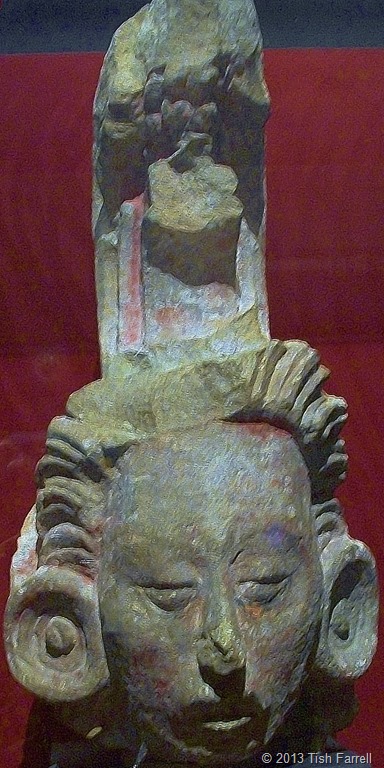
Yum Kax (Yoom Kosh) the Mayan Corn God

Peabody Museum, Harvard University

*

I may have mentioned once or three times that I write ‘quick-read’ fiction for  young teens who are not too keen on reading. For those of us who cannot imagine ever being without a book, it is often hard to understand why some people struggle to ever pick one up.


The thickness can deter some doubtful readers. Pages dense with text also intimidate.  Ransom Publishing  thus produce slim readers with plenty of white space on the page.  More importantly, perhaps, for teen readers, they are now also published in various e-book formats including Amazon Kindle, and e-pub and pdf versions at Hive.


The stories in the Shades 2.0 series are aimed at twelve-year-olds with a reading age of 9-10 years. They are around six thousand words in length, i.e. short story sized. But, to create interest and momentum, they are divided into  several chapters  (with cliff hangers), and then spread  unthreateningly over 64 pages.  The aim is to build reading muscles by creating works that are small in scale but big enough in content; mini novels if  you like: do-able and hopefully un-put-downable.

*

Shades covers for REPRO Batch 3_Layout 1

*

The stories in the series cover many challenging themes and in all genres – from the trials of an apprentice apothecary escaping London during the Black Death of  1665  (Plague  by David Orme) to Jill Atkins’ Cry, Baby which tells what happens when schoolgirl, Charlie, finds she is pregnant. 


And where does Yum Kaax come in? Well he features  in my story Stone Robbers, putting in a surprising appearance when Rico, the angry young hero of the tale, stumbles into a robber trench in an ancient Mayan city. But that’s all I’m saying, except to add that the part he plays in the story was  inspired by the real and accidental discovery of a magnificent Mayan mural at San Bartolo, Guatemala back in 2001.

Stone Robbers, then, is both an adventure and a quest.  Rico has a score to settle with an old adversary, Enzo. Then he discovers that antiquities thieves have been looting the ruined city near his home. Between Enzo and the stone robbers, lies yet another conflict: Rico’s fury at his Mayan heritage, this in a Guatemala where Mayan people are still second-class citizens. Suddenly it all seems too much to handle, and then the Corn God puts in an appearance…

*

Available on Amazon Kindle and on Amazon in book format.

Shades covers for REPRO Batch 2_Layout 1

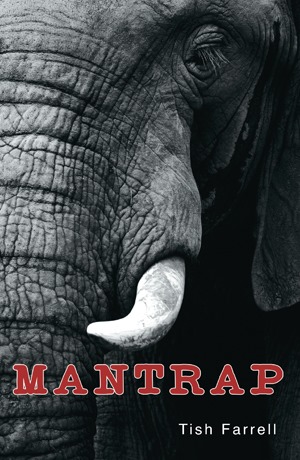
Also in the Shades 2.0 Series  Mantrap – a story about elephant poaching set in Zambia.


For more about Ransom and Shades 2.o series

Banner


See more bloggers’  YYY-stories at Frizz’s YYY-challenge 

Songs from an Inland Sea: “On Wenlock Edge”

This week’s Word Press writing challenge, with its musical theme, has set off a whole host of notions. In fact this may just be the post where all the strands of my  ‘writer on the edge’ blog come together. This, though, is only a proposition and by no means a promise.  One thing I can promise:  there is some very fine music at the end. And for those of you who do not know the  English composers Ralph Vaughan Williams (1872-1958)  and George Butterworth (1885-1916), then please consider this an early solstice gift. And if by chance you do not care for it, or indeed anyway, by all means pass it on.

So to return to the notions.  Those of you who  have read my past posts will probably know that I live on the edge of  Wenlock Edge, a twenty-mile limestone scarp that bisects the county of Shropshire from the River Severn above the Ironbridge Gorge, to Craven Arms on the borderland with Wales. Aeons ago this now wooded, much quarried ridge was once a shallow tropical sea lying somewhere off East Africa. Today, and especially now through bare wintery trees, you can look out from its summit and scan a great panorama – the farm fields, villages and hills of Shropshire.

*

As I’ve said in other posts, there is a lot of history in this place – over 400 million years’ worth. Too much to embrace. But in the recent past (geologically speaking), you might have looked out from the easterly end of the Edge onto the smog-laden valley of Coalbrookdale as the Quaker ironmasters stoked their blast furnaces and helped fuel an industrial revolution. Travel back a further 1500 years and to the north you would have gazed on the impressive public buildings and sprawling settlement of the Roman city of Viroconium. Or in earlier times still you might have witnessed the building of the great Iron Age hill forts on the Wrekin and in Mogg Forest, or perhaps glimpsed some Bronze Age smiths plying the ancient ridge-top trackway en route for Wales.

*

The Edge, then, is full of spirits, and  it is not surprising that it has long inspired artists, writers and composers. And so we come to the music, or rather, we come first to the work that inspired the music – A E Housman’s A Shropshire Lad.  This collection of sixty three poems has been described as a gift for composers. The poems are written in the style of traditional ballads. And if at first they seem too obvious in their rhyme and rhythm, then look again. These are songs of loss and fleetingness – lost youth, lost love, the soldier’s death. That they are set against some scene of suggested rural perfection only heightens their poignancy. The work, too, somehow anticipated the bleak waste of the Great War, and so it was that, when the time came,  A Shropshire Lad went with many a soldier into the trenches.

Housman’s  sense of melancholy and loss stem from his own life: his mother died when he was twelve, his brother Herbert was killed serving in the Boer War, and his deep love for another man was unrequited. Nor did his work A Shropshire Lad have a very good start. Although it has remained in print since publication in 1896, in the beginning Housman could not find a publisher and had to pay to have the first five hundred copies printed. At first, too, there was a lukewarm reception. But within a few years, and much to the writer’s surprise,  its popularity suddenly grew. This in part was due to the fact that several composers seized on some of the poems and set them to music.

In 1909 came Vaughan Williams’ song cycle On Wenlock Edge. The work’s title is taken from the opening line of poem XXXI: On Wenlock Edge the wood’s in trouble. You can hear the storm-driven trees in the opening of the first video clip where English tenor, Ian Bostridge goes on to talk about his recording of the work with Bernard Haitink.  You also see him in rehearsal singing one of the most moving poems. It is written in the voice of a ghostly young ploughman returning home to see how his girl is faring. Here are the first two stanzas.

XXVII

“Is my team ploughing,

That I was used to drive

And hear the harness jingle

When I was man alive?”

*

Ay, the horses trample,

The harness jingles now;

No change though you lie under

The land you used to plough.

*

The entire Vaughan Williams song cycle sung by Anthony Rolfe Johnson is performed in the third video below. Other composers inspired by the poems include Samuel Barber and Ivor Gurney (The Western Playland and Ludlow and Teme). I could not find clips of these works but I did find George Butterworth, who was a friend of Vaughan Williams. He set eleven of the poems to music including Is my team ploughing. He also composed the orchestral rhapsody A Shropshire Lad. It is yearning, elegiac piece, performed in the second video and accompanied by Shropshire scenes. Butterworth himself was killed on the Somme in 1916, his composer’s career barely begun.

So,  you may ask, how does this all fit with ‘Tish Farrell – writer on the edge’? Well I suppose it comes down to this. As a fiction writer, or indeed a blogger, my focus is ever on the evocation of place (both through time and space) and how it resonates through the lives of the people and events I write about. And so I love the fact that the place where I live and have known most of my life has inspired so much creative work. And, indeed, continues to do so. In fact, I’m planning to feature more of it on this blog – the artists of the Edge. I am, anyway, fascinated by the process by which, in wonderful synergy, one person’s work inspires another’s creative response, thus building into a  body of cross-referencing works. See what good things we can make when we listen in good faith to each other.

Wenlock Edge of course has its own music. I hear it most when I’m working on my allotment – the windrush in the woods, the mewing buzzards, the calls of rooks and jackdaws, and through it the chiming of the church clock. I screen out the traffic sounds of course. So here we have it: the rural idyll that never was, the music of Vaughan Williams and George Butterworth evoking the peculiarly human need to long for something we cannot have, and finally Housman’s  own words from poem XL:

   Into my heart an air that kills
From yon far country blows:
What are those blue remembered hills,
What spires, what farms are those?

That is the land of lost content,
I see it shining plain,
The happy highways where I went
And cannot come again.

*

And now, courtesy of Gutenberg Press, here is your copy of  A E Housman’s A Shropshire Lad.

100_2138

Frizz’s S-Challenge

Weekly Writing Challenge: Moved by Music

© 2013 Tish Farrell

 

Island of Old Ghosts

014

There are ancient, bloody-minded spirits here on Ynys Môn, the island where the Celtic druids made their last stand during the Roman conquest of Britain. This place, otherwise known by its Viking name of Anglesey, lies just off the coast of Wales, the narrow Menai Straits between. One Christmas morning we came here to Penmon on the island’s north-east tip. The light was very strange that day, darkness already gathering at noon. Then across the Straits, above the mainland, the sun bore down like a searchlight.

002.jpg

Penmon is the site of an early Christian monastery, founded in the 6th century by St Seiriol, but the roots  of Ynys Môn’s sacred, and now mysterious practices, are far older than this. Across the island there are Neolithic and Bronze Age chambered tombs, and then there is the spectacular Celtic Iron Age hoard from Llyn Cerrig Bach, a seemingly sacrificial lake offering of weapons, chariots, slave chains, and highly crafted regalia. The Romans claimed that in their groves the druid priests made human sacrifices, but little is known of these people beyond the gory account in the Annals of Tacitus. What is known is that the Romans conducted a ruthless campaign against the Celtic clans of Wales. Anglesey, with its powerful druid priests, was the last bastion of British resistance. Here is how Tacitus describes the Menai Straits battle of nearly 2,000 years ago. Suetonius Paulinus, Governor of Britain, was in command.

He therefore prepared to attack the island of Mona which had a powerful population and was a refuge for fugitives. He built flat-bottomed vessels to cope with the shallows, and uncertain depths of the sea. Thus the infantry crossed, while the cavalry followed by fording, or, where the water was deep, swam by the side of their horses.

“On the shore stood the opposing army with its dense array of armed warriors, while between the ranks dashed women, in black attire like the Furies, with hair dishevelled, waving brands. All around, the Druids, lifting up their hands to heaven, and pouring forth dreadful imprecations, scared our soldiers by the unfamiliar sight, so that, as if their limbs were paralysed, they stood motionless, and exposed to wounds. Then urged by their general’s appeals and mutual encouragements not to quail before a troop of frenzied women, they bore the standards onwards, smote down all resistance, and wrapped the foe in the flames of his own brands. A force was next set over the conquered, and their groves, devoted to inhuman superstitions, were destroyed. They deemed it indeed a duty to cover their altars with the blood of captives and to consult their deities through human entrails.

Annals of Tacitus translated by Alfred John Church and William Jackson Brodribb 1884.  XIV chapters 29-30. You can read the original work by following the link.

*

008

For more about Anglesey


Rain Dance: all together now – let’s sing!

100_1434.jpg

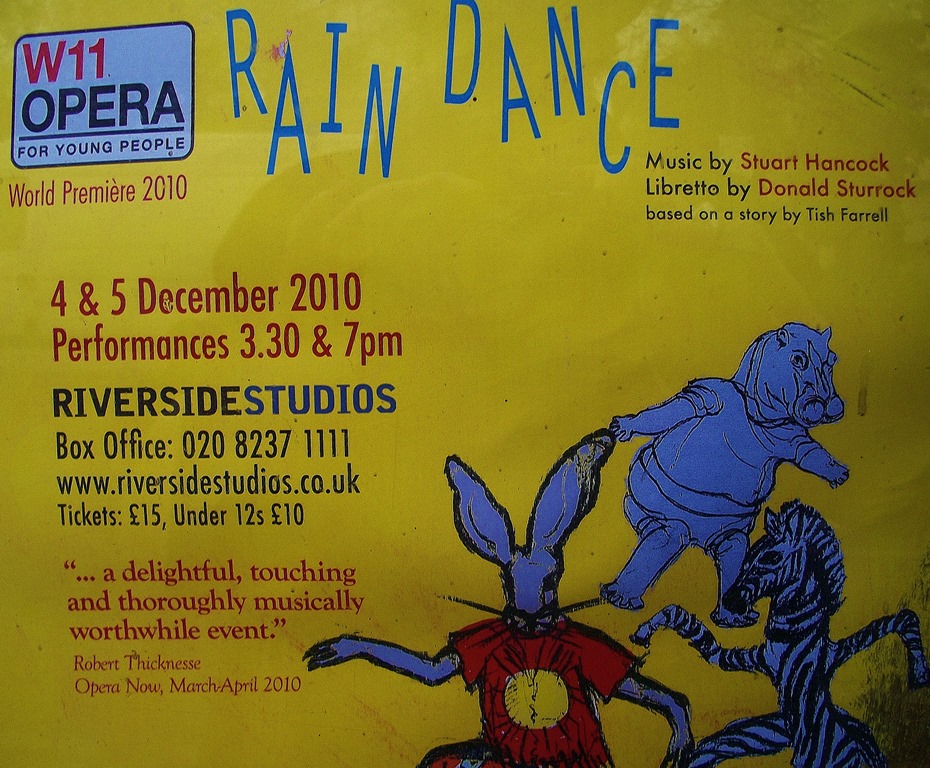
There are some African wise words that say: if you can walk, you can dance; if you can talk you can sing. And this is what the children’s opera, Rain Dance is all about, giving young people the chance to perform and tell stories through song and dance (emphasis on the singing).

The opera was created by librettist Donald Sturrock and composer, Stuart Hancock, and my own small contribution is the fact that my retelling of an African story, The Hare Who Would Not Be King, was the starting point for the project.  Sometime back in 2007, Donald Sturrock  wrote to me asking if he and Stuart Hancock could adapt my story for a children’s opera. Their intention was submit the work to the London-based WW11 Opera in hopes of winning a commission for one of the Opera’s annual productions.

Time passed, and more time passed, but win they did, and Rain Dance was performed at the Riverside Studios, Hammersmith, London in December 2010 to a packed house. I was there with G of course, sitting amongst throngs of excited children. By the time we came to the finale with its rousing Rain Dance theme, I was pretty much as excited as my junior neighbours. I might even have been jumping up and down in my seat: to think that my story had been the very small spark for this wonderful new work, and its exuberant performance.

The finale of Rain Dance. Photo: WW11 Opera

*

Of course this splendid show with 85 young performers (9-18 years) was only made possible under the auspices of the  W11 Opera for Young People. This is a London-based charitable trust, founded in 1971, to give young people from all backgrounds the chance to sing and perform. Every year a  new opera is commissioned with the aim of creating a repertoire of song-based works that can be staged by schools and community groups. W11 Opera also showcases the work of new and established composers, and its productions have seen the launching of star performers such as Sophie Ellis-Bextor.

And so, as may be imagined, I am incredibly pleased to find that the opera, which began life with the W11 Opera, will be performed once  more. In March 2014 Rain Dance will have its North American premier at the North Cambridge Family Opera Company, Cambridge, Massachusetts. The NCFOC has a slightly different approach to the W11 Opera: the cast includes both young people and adults, and thus is a chance for family members to perform together. That there are people who put their time, enthusiasm and creativity into making such things happen makes me want to burst into song as I write this.

*

Home

Performances March 29 & 30, April 5 & 6, 2014

*

As to my story, that had its own sources. It tells how the plains animals vote for a bullying lion to be their king and of the dire consequences of their actions. Hare, the familiar trickster of many African tales, is the reluctant hero of the piece, and nearly ends up as lion food. The plot is based on a story once told by the Akamba people of  Kenya.  I was living in Kenya at the time of writing, when the country was struggling towards a western-style democracy after years of one-party rule. This situation very much influenced the retelling. My version of the story was first published in the United States in Spider Magazine February 1999, accompanied by some fine illustrations by US writer and illustrator, Brian Lies. You can read an extract and see some of the original illustrations HERE.

In the meantime it is good to know that, in the last week of October, eager performers (young and older) will have been showing up for the Rain Dance auditions at the North Cambridge Family Opera.  The story that Donald Sturrock has created is far more complex than mine. It draws on another African story besides, creating a updated version of the race between Tortoise and Hare. The animal election has all the razzmatazz of a human election with full media coverage. There is also the theme of climate change and its effect on the water-hole, to say nothing of hilarious interludes with Hare’s family and four shopaholic lionesses. Throughout, Stuart Hancock’s musical score is utterly original and captivating with no hint of ‘African’ pastiche in his lovely melodies.

The NCFOC performances are scheduled for March 29 & 30, April 5 & 6, 2014. Go, if you have the chance. You won’t regret it. You’ll come away singing and dancing too.

© 2013 Tish Farrell
Frizztext RRR Challenge

RELATED: The Hare Who Would Not Be King

Elephants, E-books and Enticing Reluctant Readers

Two at once challenge – DP : Reel Talk and Frizztext’s  EEE

Everyone who comes to this page is a reader. Bloggers love to read as well as write: poems, flash-fiction, memoir, novel excerpts, reportage, long pieces, short pieces; it’s how the blogweb works: exchanges to entertain, enchant, enthuse, encourage and elucidate.

Some of my stalwart followers and followees boldly read and create in second and third languages, which for me who only has proficiency in English is a great source of admiration and envy. And if that’s not enough ‘Es’ already, I have some more. But first a question: what about those (old and young) who find reading a struggle? What about those who find a page loaded with text a total turn-off, or the average sized paperback too daunting in scale to broach?

And to answer my own questions, this is where the book cover below comes in, because one of the things I do besides loitering in cyberspace is to write good stories for unkeen teen readers, (or for anyone else I can corner for that matter).

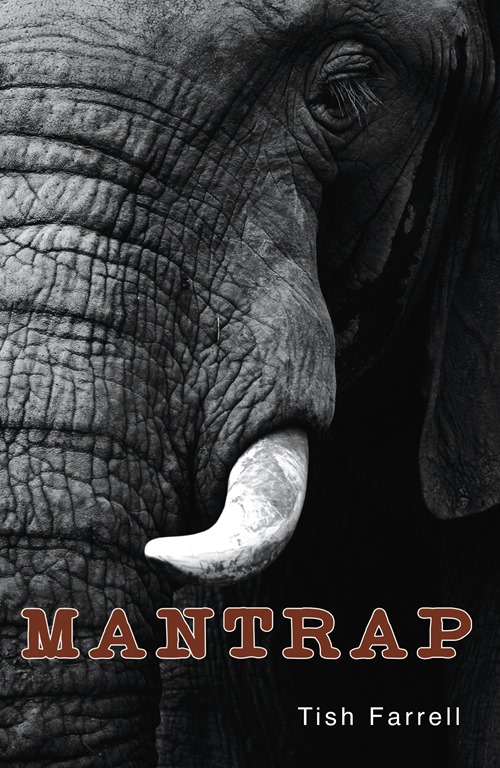
Shades covers for REPRO Batch 2_Layout 1

Cover: copyright 2013 Ransom Publishing.

The title of this new edition of my very short book Mantrap clearly begins with ‘M’ ( which means you can look forward to more mentions further down Frizz’s alphabet.) So what is it doing here now? The elephant is of course the excuse I needed to write this piece, also the fact that Ransom Publishing will shortly be bringing out  an e-book version for Amazon Kindle and Apple, as well as a paperback edition. It is part of their Shades series. Full details of this and other books in the series can be found HERE. The series is being printed as I write this and will be launched in August.

Interest-wise, the stories are aimed at readers of twelve years and upwards, but whose reading ability is deemed to be a few years younger. The text is a piece of short fiction but presented in a novel format i.e. 6,000 words divided into several chapters, and over 64 pages. There is plenty of white space on the page.

Banner 

Ransom publishes a wide range of fiction and non-fiction for all ages. Personally, I think the Shades’ quick-read formats are ideal for just about anyone who wants a good story, but has limited time to read it. You can slip these nice little books into your pocket. However, this is not so much a sales pitch as an explanation: the why, where and how this story about ivory poaching came into being. There’ll be an excerpt at the end.

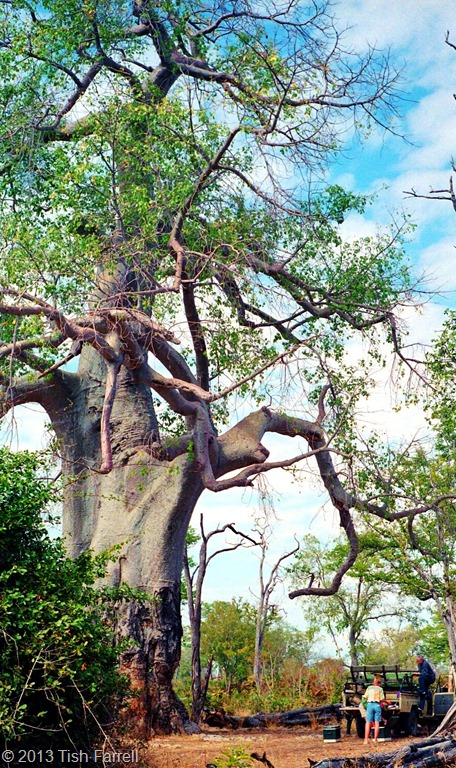
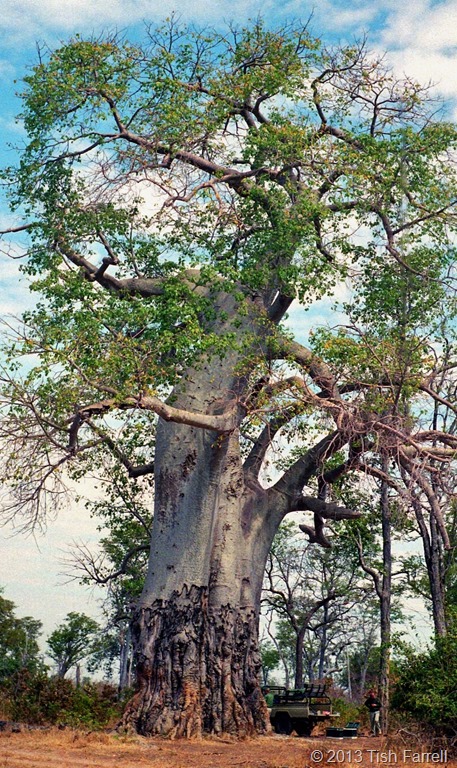
I can also tell you precisely where the Mantrap story began – under a baobab tree. And here it is, the very one:

South Luangwa - mighty poachers' baobab

The fact that it was in leaf at the time was perhaps auspicious. Baobabs are usually bare. This one could be a thousand years old. We stopped under it for a noonday picnic after a get-up-while-still-asleep and go on a dawn game drive. The location is South Luangwa National Park in Zambia. It is a glorious place with parkland vistas, much shaped by the local elephants who knock down the thorn trees, but rarely the baobabs, to encourage the growth of their favourite food – grass. 

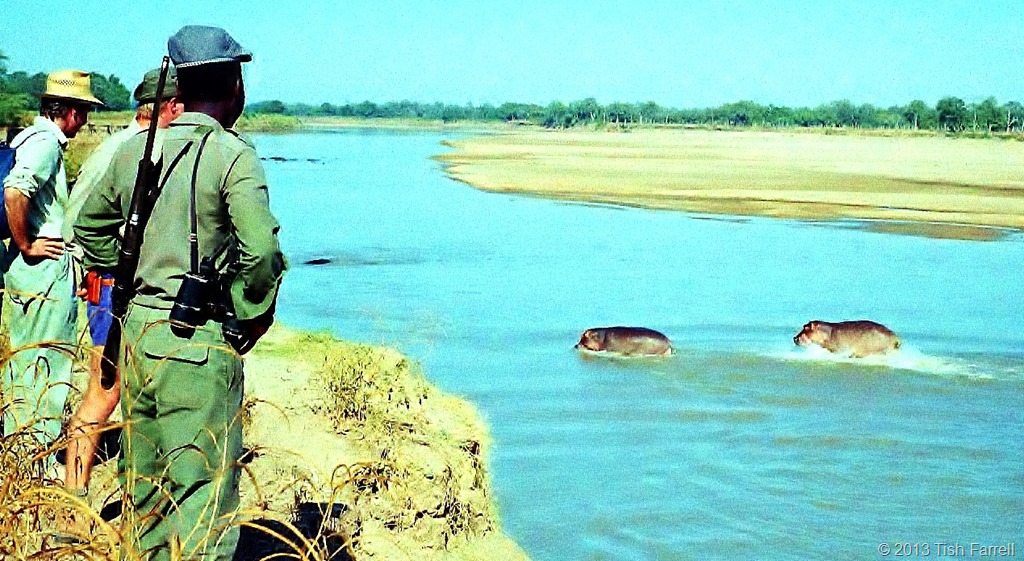
The other great shaper of the territory is the mighty Luangwa River as it endlessly carves new meanders through the bush country.

South Luangwa - dawn walk and hippos

*

As the river shapes a new channel, so the old meanders are left behind, some becoming stagnant lagoons where hippos wallow amongst the cabbage weed. The local people call such places Luangwa waffa or Dead Luangwa.

South Luangwa - lagoon with cabbage weed 2

But back to Mantrap. It was while I was standing under the baobab, and peeling a very English hard-boiled egg, that our guide happened to point out the narrow strips of wood that had been driven unobtrusively  into the tree’s hard, smooth trunk. 

South Luangwa - mighty poachers' baobab 2

“It’s a poachers’ ladder,” the guide told me. “Ivory poachers. This tree has been a look-out post for years.” He went on to tell me how earlier that week an elephant had been killed nearby. The tusks had been taken, but then later, when the coast was clear of poachers, the local villagers had come to grab the meat.

My spine tingled:  horror and pity, and not only for the elephant. I knew that rural Zambians were  in a poor state. This was the reason why we had come to Zambia. Team Leader Graham was responsible for the logistics of delivering EU food aid to drought-stricken villagers. (See Letters from Lusaka.) Also, elephants and other game can destroy a farmer’s whole crop in a single night. The conservation of wild game, then, and the protection of neighbouring people’s livelihoods are matters  not easily resolved.  Game parks across Africa generally do not have fences. Animals move about at will, and many farmers are maimed or killed by buffalo, crocodiles, hyenas and elephants. Their families rarely receive compensation.

South-Luangwa-Zambian-homestead.jpg

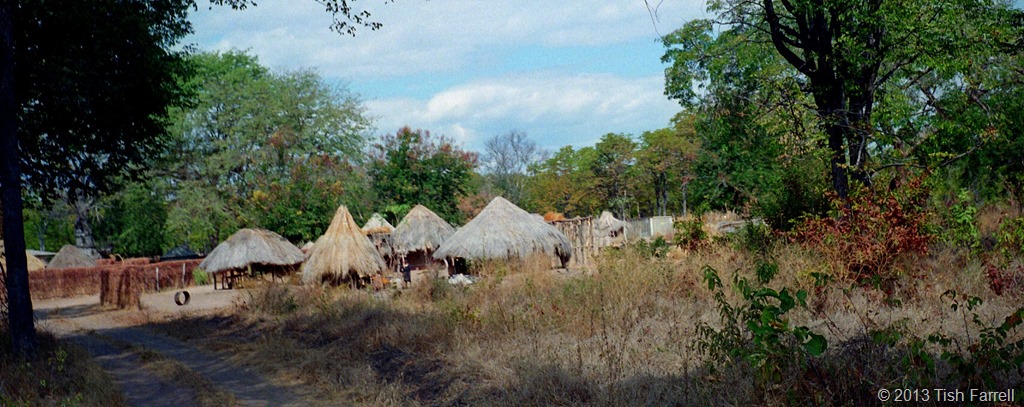
We, however, belonged to the fortunate segment of the world’s population that had no shortage of food and also the leisure to take a few days holiday, staying in a small tented camp run by Robin Pope Safaris. On the way to our campsite from Mufuwe airstrip we crossed a dried up river where a girl was digging deep into the sandy bed in hopes of scooping out some water. In the gardens of a nearby farmstead, the maize was blown to dust. It was hardly surprising that there was a poaching problem in the district. People were starving.

But then to my  mind, there’s a big difference between hunting antelope and small game for the pot, and particularly when the park and surrounding licensed hunting blocks occupy the local people’s former hunting territory, and the obscene and pointless slaughter of elephants solely for their ivory.

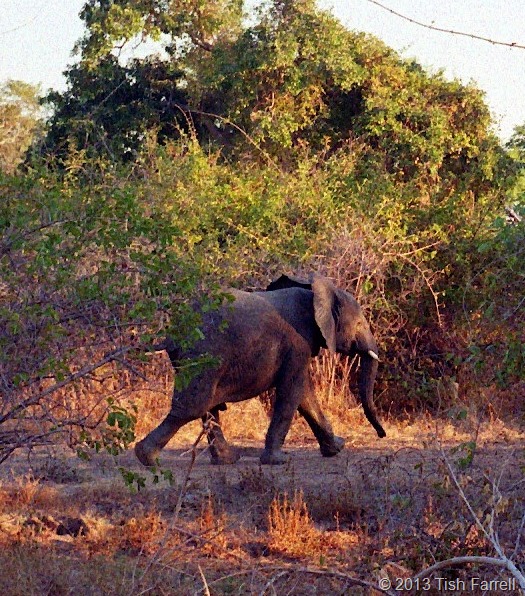
South Luangwa - young elephant

Yet the temptation to some locals must be enormous. They have families to support, children to send to school, medicine to buy. Big business cartels, especially in the Far East, are apparently more than glad to arm and fund local hunters in the pursuit of ivory and rhino horn. This means that park rangers are at great peril. Many are murdered in their attempts to protect wildlife so tourists like us may come and stare, and snap away.

One way to combat poaching is to give people good reasons to protect the game. Robin Pope’s Safaris have pioneered schemes to involve local communities in conservation.

Helping communities to gain from tourism

*

So these, then, were some of the things I wanted to explore in my story. What emerged was a life-and-death adventure that had its beginning the moment my fingers touched the rungs of the poachers’ ladder.

Here then is an excerpt – the opening scene. It is dawn in Luangwa. Hunger has finally driven Danny and his father, Jacob, into the National Park to hunt antelope. But Danny is a schoolboy, not a hunter; it is not surprising that, in his panic, he makes a mistake – a mistake that lands them in the clutches of a corrupt ranger who has a far more dangerous quarry in mind.

Chapter One: The Kill

Impala. A small herd among the sausage trees. Jacob stopped dead and held up a warning hand. Danny froze on the spot and this time, without a sound, dropped behind a potato bush. He peered through the leaves, fixing on a big ram. He was about twenty paces away, grazing the yellow grasses, his harem of females all round. Danny’s eyes stung with longing. There was that beautiful ram. So near, and yet so far. The smallest sound might send him bolting. Out of reach!

Danny willed Jacob to shoot. Now, Dadda, now. Then nearly howled when the ram raised his lyre-shaped horns and sniffed the breeze nervously. The ram had scented them. He had. Danny prayed and prayed. Please let our luck change. Please let Dadda shoot. Then we can get out of here. Before the sun comes up. Before the park rangers start their patrol. Before we’re caught and sent to jail…

And finally, here’s a short clip that shows Luangwa in all its rain-soaked glory. One of the earth’s most beautiful places, and over four hundred species of birds.

© 2013 Tish Farrell
Links:

http://dailypost.wordpress.com/2013/07/29/reel-talk-writing-challenge/

http://flickrcomments.wordpress.com/2013/07/30/eee-challenge/

Carnations, crooks and colobus at Lake Naivasha

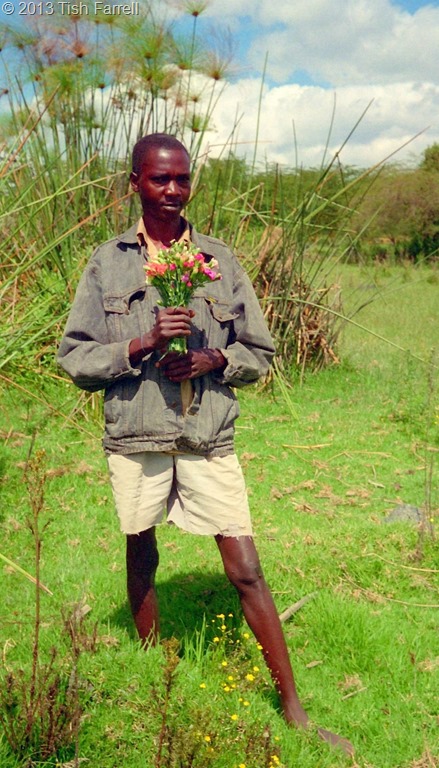
Even locals told us that  anything could happen in Kenya.  And  so one Lake Naivasha morning, when I thought I was  alone in the grounds of an old safari lodge, I was both surprised and unsuprised when a young man suddenly stepped out from the papyrus swamp clutching two bunches of carnations. Fifty bob, madame, he said after the customary greeting. He seemed nonplussed  when I started to laugh.

“Do you always keep your carnations in the papyrus,” I asked.

“Yes,” he said.

“What, waiting for people like me?”

“Yes,” he said.

Scan-130602-0001

This exchange seemed to seal the deal. I didn’t even bother to haggle. And although I have no idea why I would have 50 bob on me in such a place, I bought a bunch. Given the general lack of wazungu humanity in that particular location, I also wondered  how long he had been waiting for the likes of me to come along; or how long he would have been prepared to wait for a customer. Or if I was just the unexpected thing that happened to him, rather than he to me. (You could tie yourself in knots second guessing). The rest of the lodge guests, I knew, were male entomologists, engaged all day in seminars and workshops; only I was free to wander about the hotel’s straggling  grounds buying flowers for which I had no particular need.

*

Scan-130716-0012 (3)

*

We had driven up the Rift from Nairobi the day before. Team Leader Graham was to attend a four-day international conference on the Larger Grain Borer. Along with his Kenyan colleagues there were some forty delegates from such places as Honduras, Mozambique, Italy, UK, Benin, Zimbabwe.  Anyone who has read my post, Letters from Lusaka Part 1,will know that this small maize-grinding beetle, aka LGB, was introduced into Africa in a consignment of US food aid in the 1980s. Its natural habitat is in South and Middle America where it also has natural predators to keep it in check. In Africa it has no natural enemies and can thus eat itself silly while villagers, deprived of their staple crop, starve.  Seventeen years on from this conference, it is still a problem.

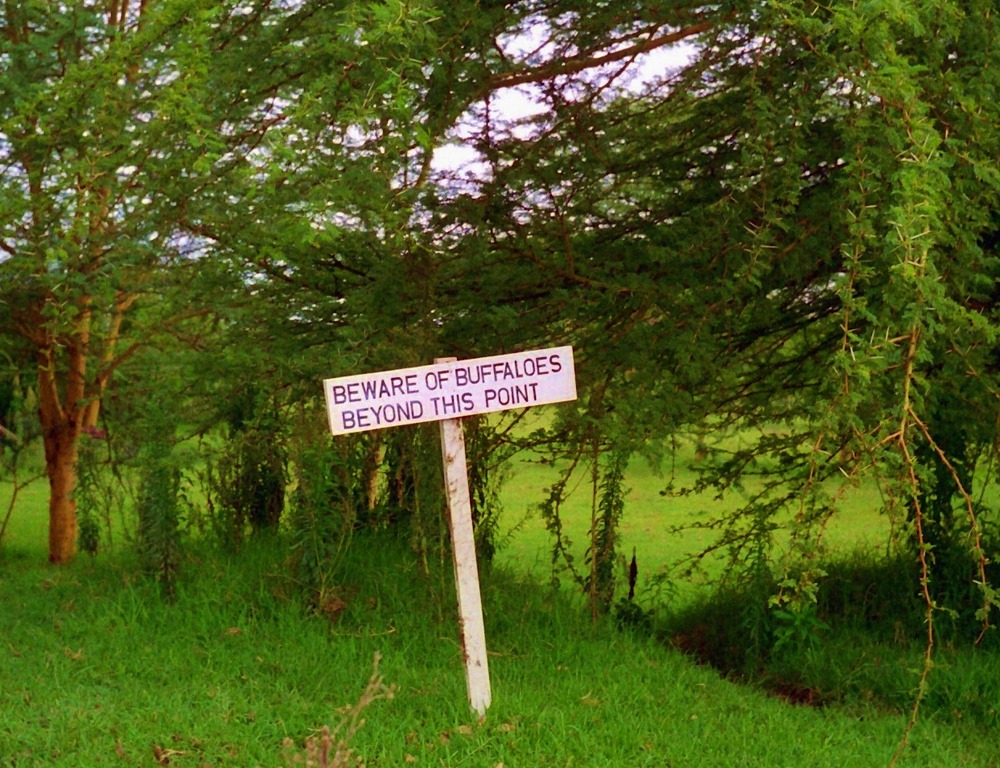
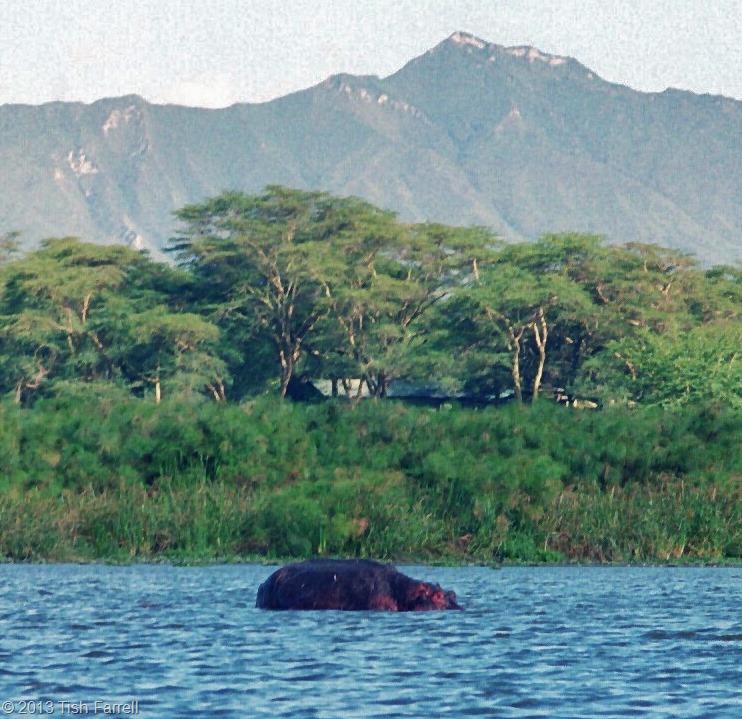
So: while delegates debated what might be done about the ravages of this particular storage pest, Nosy Writer, like some latter-day colonial ‘mem’, dilly-dallied about the lake shore and its hinterland. At the time I was recovering from some strange digestive malady, so wandering and bird watching were all I could cope with. When the young man popped out of the papyrus I was still weighing up whether or not I should be deterred by the sign I had just read amongst the fever trees.  I could anyway hear the hippo grunting, and having once been charged by a big angry bull in Zambia was already a little wary. The appearance of a boy with a bouquet, then, seemed like a piece of magic.

Scan-130602-0003

When I asked him where he got the flowers, he told me there was a flower factory ‘next door’. (Many international growers have their flower factories around the lake. There are strawberry and asparagus growers there too). At the factory (think acres of pink poly-tunnels under the tropical sun) he gathered the discarded side stems and inferior blooms from the refuse heap and made them up into bunches. Later, when I told this to Graham’s Kenyan boss, Gilbert, he told me that export stems had to be between 70-100 cm long, which meant there were probably plenty of rejects.

He also told me that the factory ‘next door’ was reputed to be owned by one of Kenya’s top crooks, a notorious Kenyan-Asian wheeler-dealer. Gilbert then added that he also owned the safari lodge where we were all staying. I could only blink in response. It seemed like another of those ‘anything can happen in Kenya’ moments; another of the endless moral conflicts. Here were a bunch of diligent, respectable scientists all funded by international development money patronizing the establishment of a member of the criminal elite who, from behind a front of untouchable respectability, was bleeding the nation on breathtakingly colossal proportions.

It’s the moment when you say, oh, bloody hell, I can’t cope with this, and go back to reading a book or bird watching, or listening to the plaintive call of a pair of fish eagles resounding off the water, or to the companionable  grunting of hippos.

Scan-130716-0012.jpg

Scan-130716-0010-2.jpg

I also tried to distract myself from thoughts of the flower factories around the lake. There was talk of them abstracting too much water, and polluting the only freshwater lake in Kenya’s Rift with pesticide residue  – all so the citizens of London, Paris, Amsterdam can buy the perfect, but scentless, long-stemmed rose, or metre-long carnations. Of course these places provide work for scores of labourers, and increasingly there are well qualified Africans in managerial positions.

The companies probably provide clinics and primary schools too, but the bulk of the profits from these huge concerns go to Europe and to their shareholders, not to Kenya whose human and natural resources are being exploited in the meantime. Then there’s the row about multi-nationals not paying local taxes. It’s the same old story – colonialism in a new form – the need for cheap labour to justify the cost of the daily absurdity of flying fresh-cut flowers out of Africa.

How do you begin to unpick all this. I can’t. It is easier to bird watch, and there are hundreds of species around the lake to look out for.
Scan-130716-0013

Scan-130716-0008.jpg

Scan-130716-0014-2.jpg

Scan-130716-0011 (11)

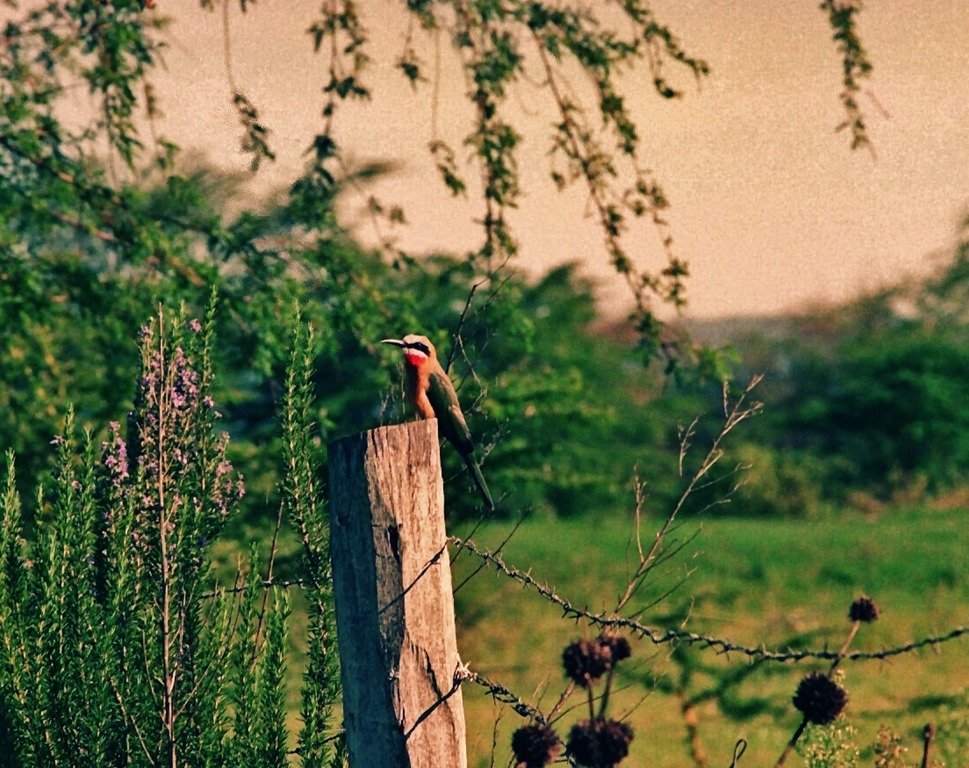
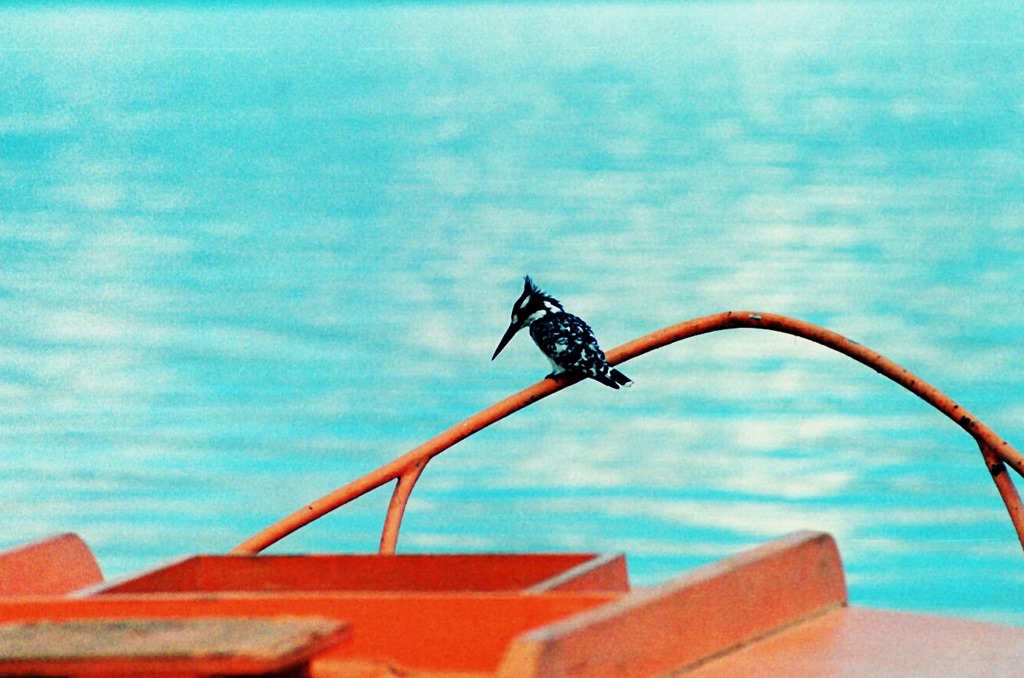
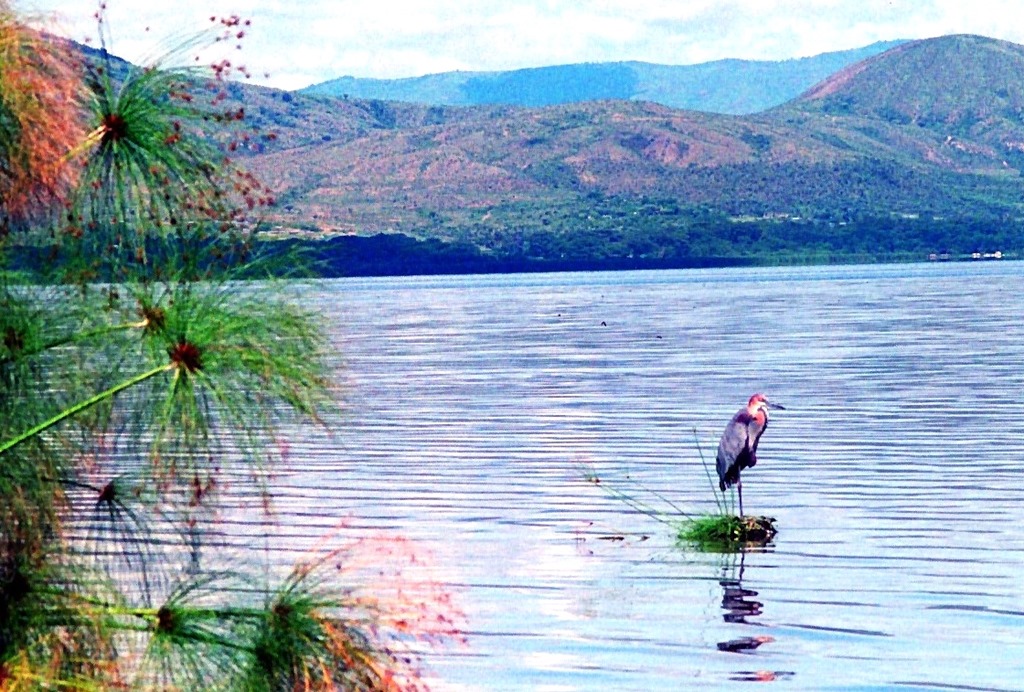
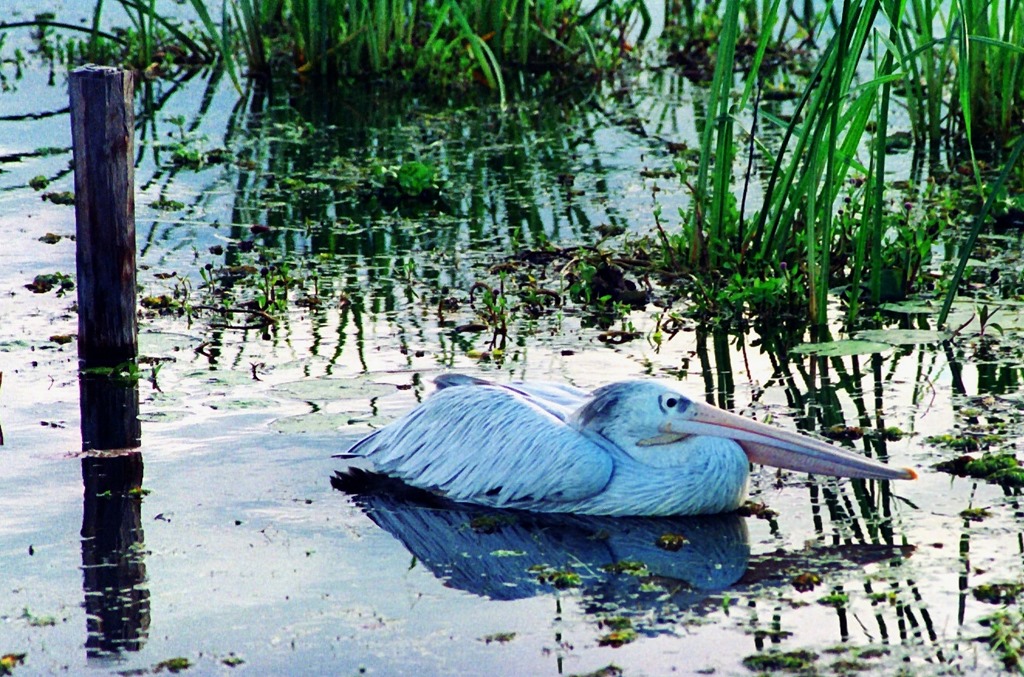
From the top down: pelican, bee eater, pied kingfisher, goliath heron – just a few of the 400 bird species around the lake.

*

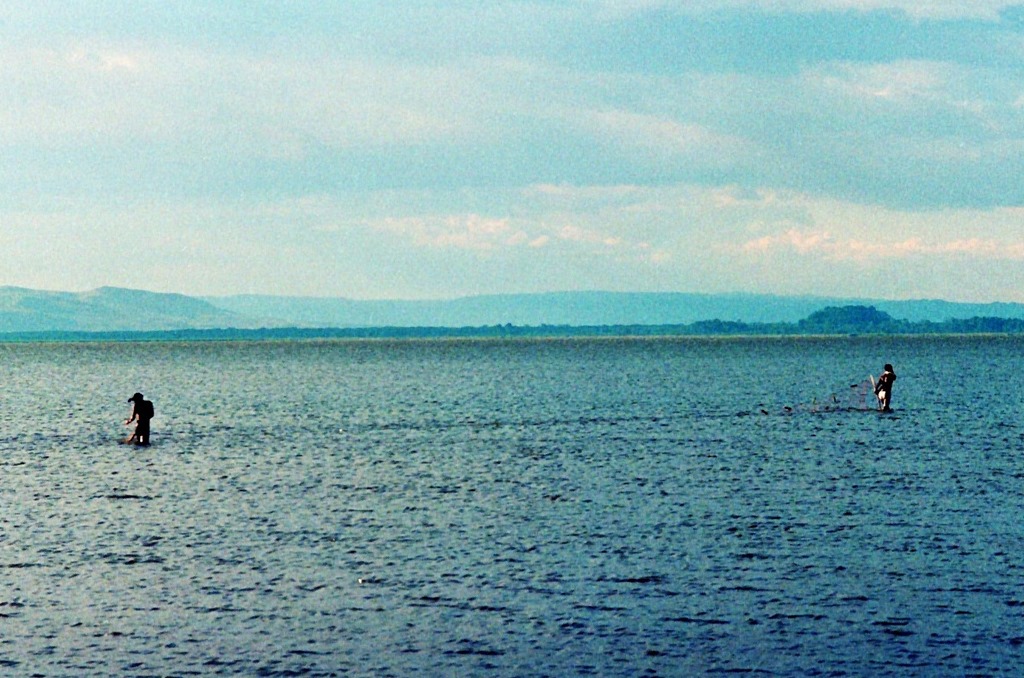
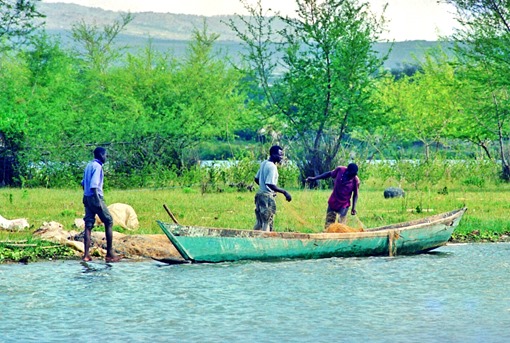
There are the fishermen too, seine netting and scooping up buckets of freshwater crayfish, although accidentally introduced carp is now the dominant fish species.

Scan-130716-0011.jpg

Scan-130716-0011-6_thumb.jpg

*

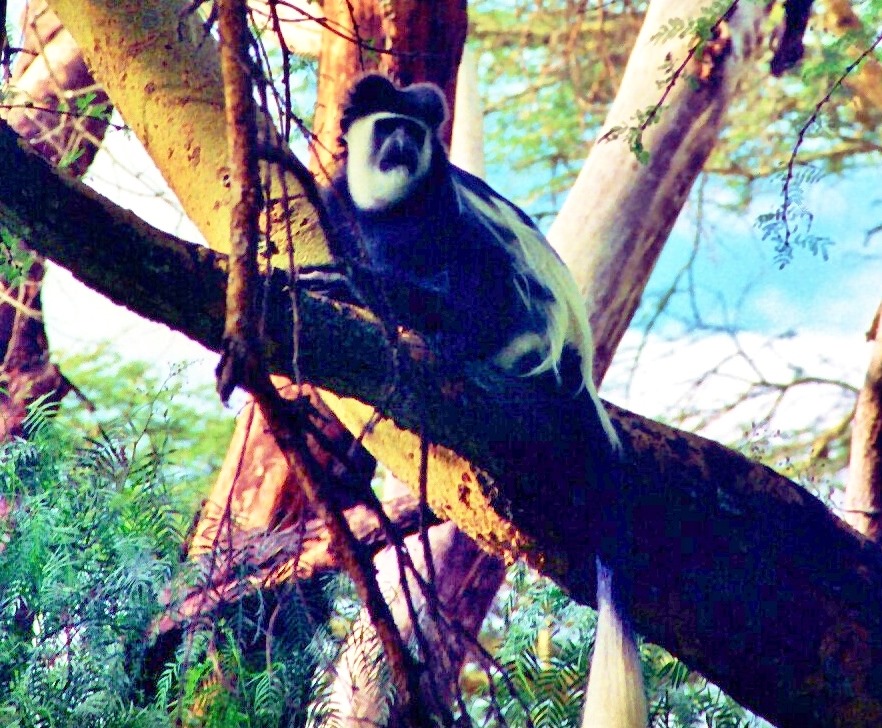
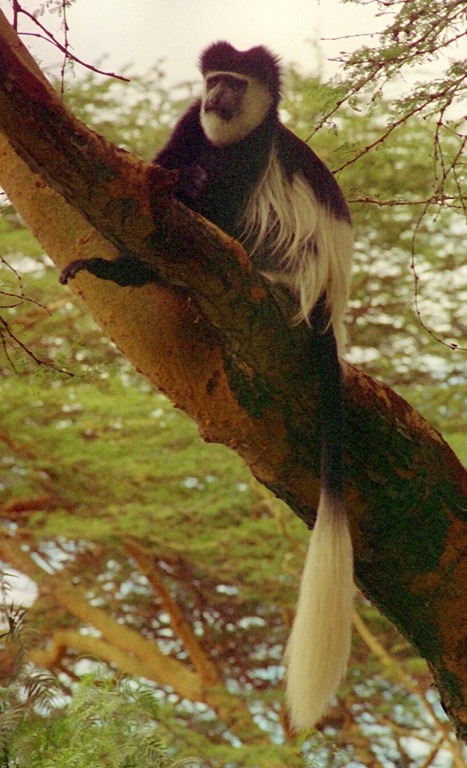
And finally every afternoon around four, a family of colobus monkeys come to the lodge garden and play on the guest cottage roofs. It’s easy to tell yourself that this is paradise.
Scan-130716-0012 (2)Scan-130601-0007.jpg

Refs:

Urban society and the fishery of Lake Naivasha, Kenya – Balancing ecosystem and stakeholder demands by Phil Hickley, Mucai Muchiri & Ros Boar

Kenya Birds Lake Naivasha

Flower power keeps Kenya’s Lake Naivasha blossoming – video Guardian 2012

Kenyan flower industry’s taxing question Guardian 2011

P.S. I took the carnations home to Nairobi where they lasted a further ten days. Excellent rejects.

© 2013 Tish FarrellScan-130602-0002Scan-130602-0004