
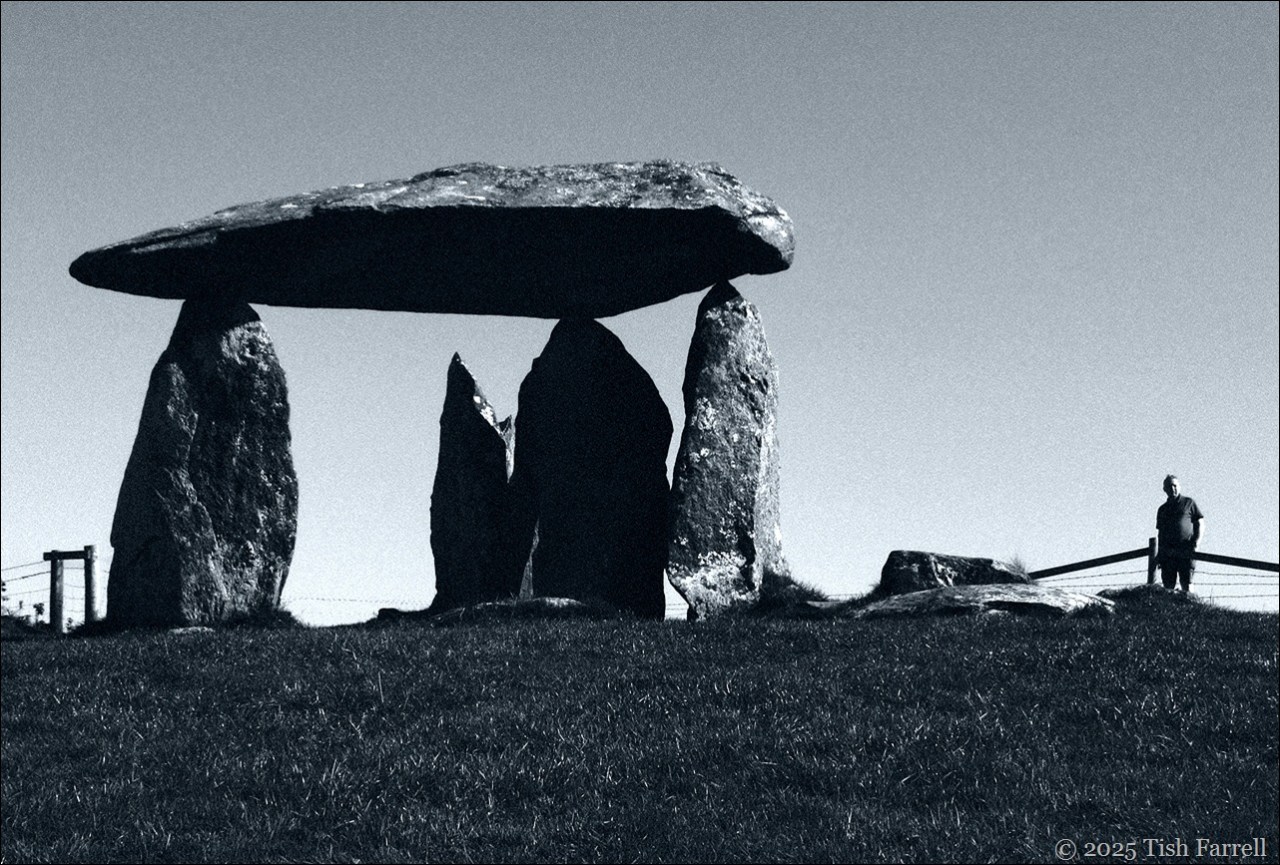
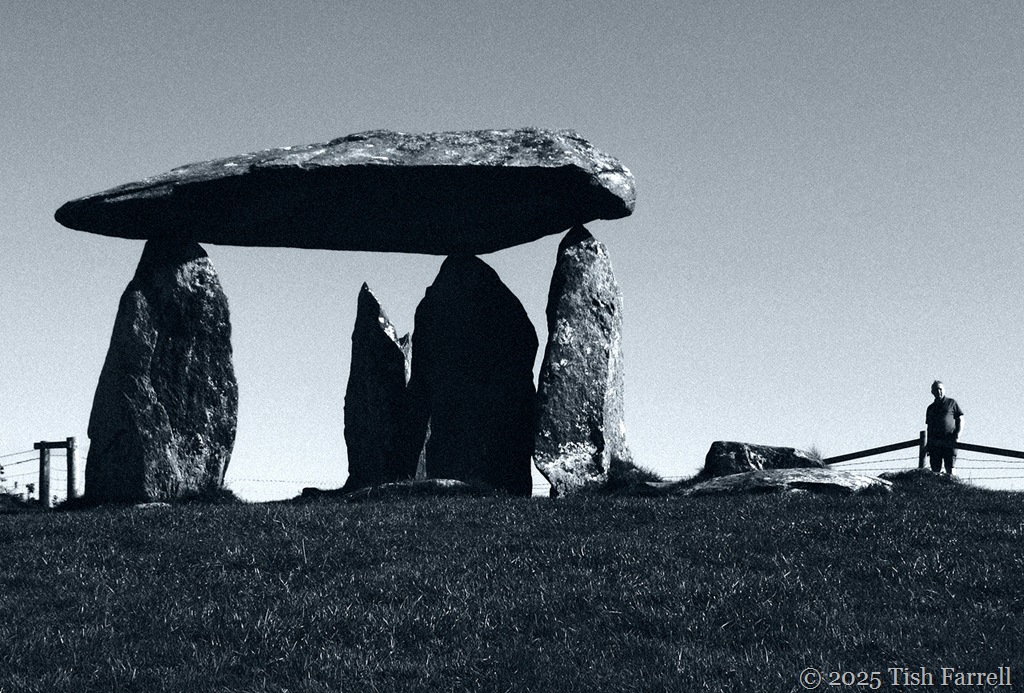
Remains of Pentre Ifan chambered tomb, Newport, Pembrokeshire c. 3,500 BCE
*
We humans have problems with time: too much of it; not enough; the wrong kind for a planned action or pronouncement; then there’s ever that tale of elders who forget what they had for breakfast, but recall in minute detail events of decades past.
We try to pin it down of course, have long done so with all manner of devices. Most likely the late ‘Stone Age’ people who constructed Pentre Ifan above, had contrived the means to keep track of it. For instance, the placement of so-called standing stones, the particular configuration of megalithic circles, the siting of tomb entrances, whence to observe the movement of stars, the angle of the sun, and so know where they stood in relation to the earth’s perceived cycles. A time to plant; to make a journey; to hunt; to trade; mark seasons for rites and festivals.
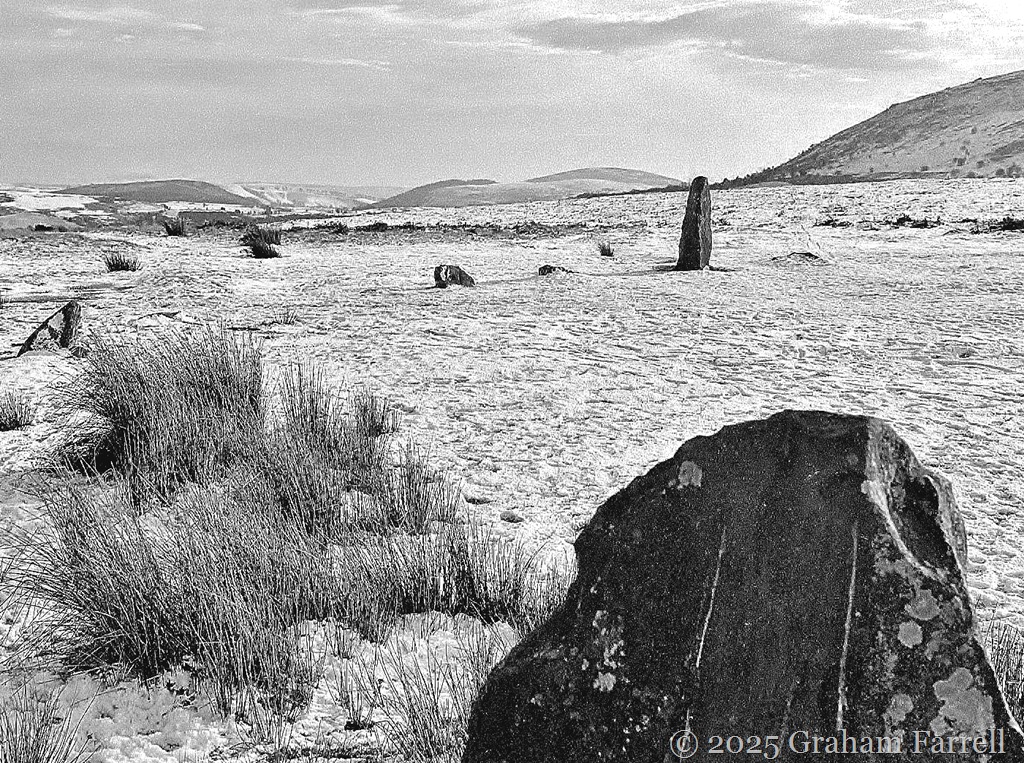
Mitchell’s Fold Bronze Age stone circle, Shropshire-Powys border
*
We don’t know who these prehistoric (pre-literate) people were. There is no apparent connection between us and them. How do we even begin to grasp what five and half thousand years actually means. Most of us, unless we spring from some dynastic household that records family pedigrees down the centuries, or derive from some close knit community where little has changed for generations, cannot name our four pairs of great grandparents without the help of genealogy.com. We certainly have no true idea of how they lived day to day, unless they kindly left us their diaries; and even then…
As L.P. Hartley says in the opening of his novel The Go-Between: ‘The past is a foreign country; they do things differently there.’ And for most of us, too, our generations of ancestors left no mark, but were ever caught up in ‘big people’s’ histories; the machinations of church and state.
*
There are anyway far bigger pasts than our human one. Here in my home county of Shropshire, in the borderland known as the Welsh Marches we have some of the planet’s oldest parts. Seven hundred million years old, in fact.
Set against such a monumentally unimaginable timescale, the history of humanity, including that of our primate ancestors, is not even a magnified dot on the horizon.
This is what Peter Toghill has to say about the Marches geology:
The beautiful landscape of the Welsh Marches
is underlain by a rock sequence representing ten of
the twelve recognised periods of geological time…
This remarkable variety, covering 700
million years of Earth history, has resulted from
the interplay of… (1) erosion and
faulting which have produced a very complex
outcrop pattern; (2) southern Britain’s position near
to plate boundaries through most of late
Precambrian and Phanerozoic time; and, most
importantly, (3) the incredible 12,000 km, 500
million year, journey of southern Britain across the
Earth’s surface from the southern hemisphere to
the northern, caused by plate tectonic processes.
An introduction to 700 million years of earth history in Shropshire and Herefordshire
*
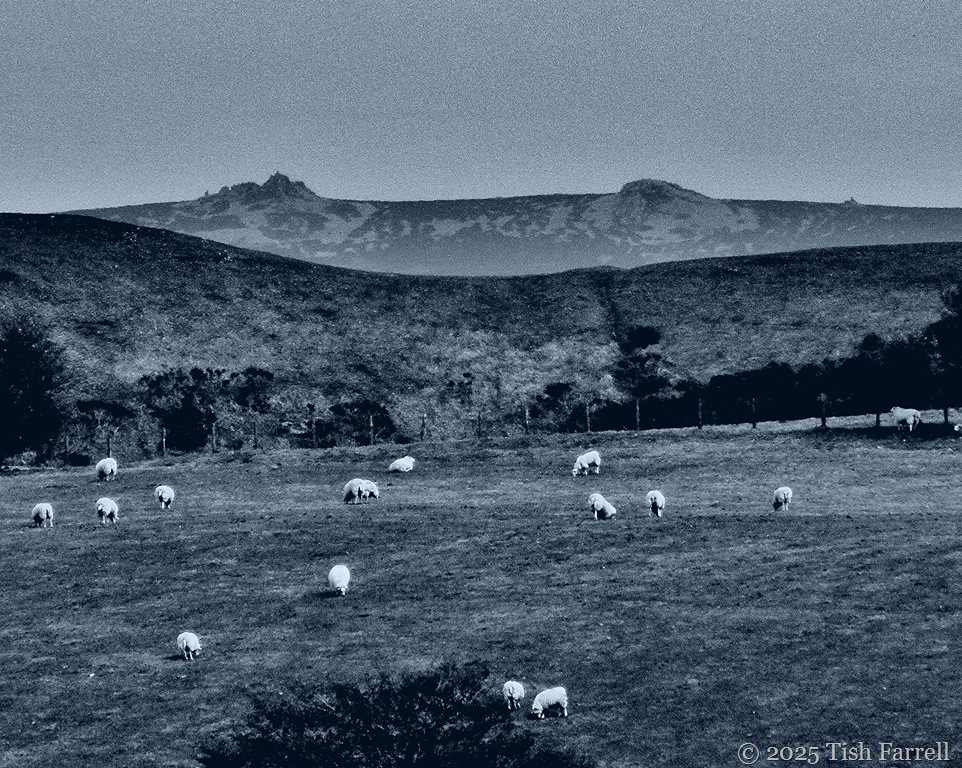
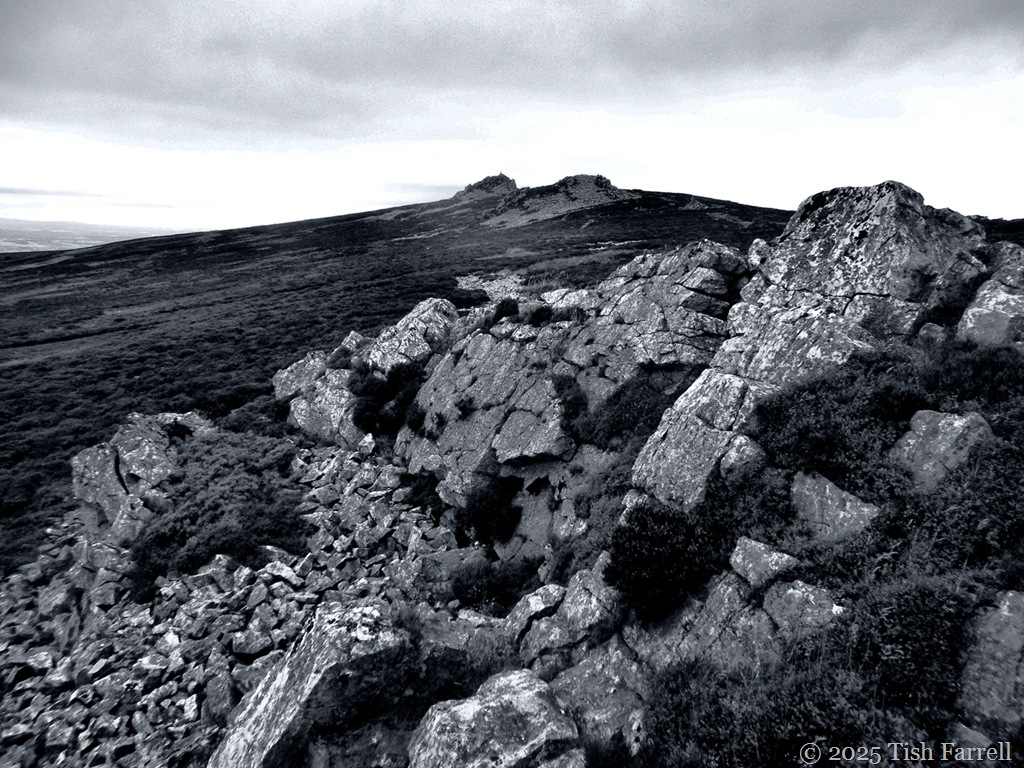
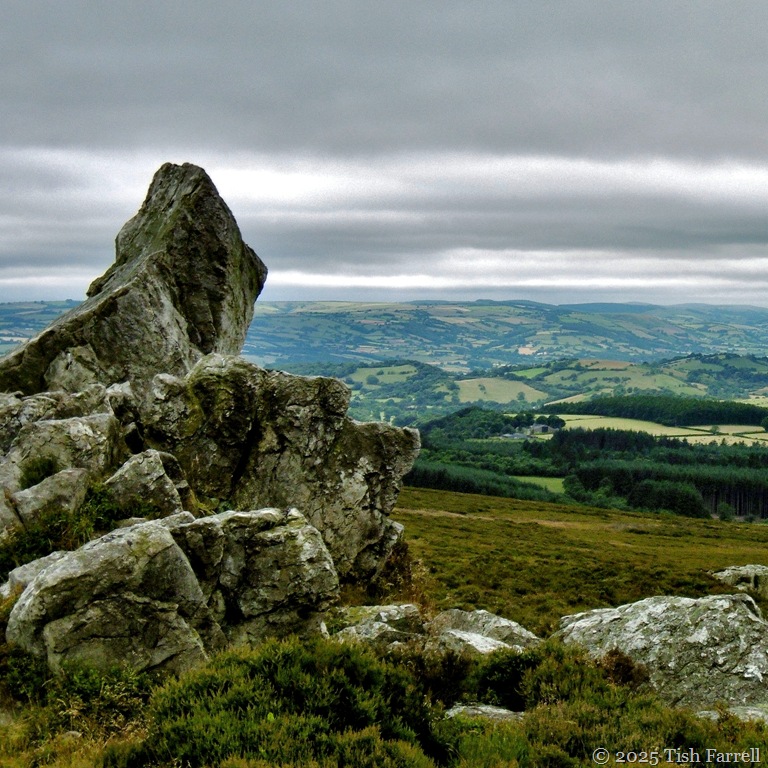
This distant view of the Stiperstones from Mitchell’s Fold stone circle, shows two of the Ice Age tors along the five mile summit, (Manstone the highest point on the left). This hill was probably formed from the laying down of quartzite sand when the whole of Southern England lay in the southern hemisphere, somewhere near the Comoros Islands in the Indian Ocean. That was around 500 million years ago, about the time when it began to move north. The tors themselves were exposed far more recently, by the repeated freezing and melting of glaciers that nudged up against them during the last Ice Age (115,000 to 12,000 years ago).
*
Makes me think we humans sometimes think too much of ourselves and what we think we have achieved. Maybe the planet has the edge on us by a few hundred million years. It’s certainly done some momentous shunting and shifting.

Nature certainly has the edge on us, we should listen to rocks more carefully
Yes, more listening is definitely required, Becky.
What a lovely – and thought-provoking piece. I love to stand in a landscape that shows us something of its long and varied past: rocks laid down by layer after careful layer: others folded and squashed by activity elsewhere; fossils suspended in what is now almost impenetrable stone. Thanks for reminding us of this – and of early human activity too. Posted on the Reader. WP won’t think of me communicating with you directly.
I knew you’d like a spot of Shropshire geology, Margaret. The Toghill paper has some nice diagrams in it, which makes understanding a tad easier. But I’m sorry WP won’t let you in.
Re. posting comments problem, Margaret. I’ve had a chat with a bot, and then with an engineer. There are no hitches on my side re comments. They think you may have a browser problem. You can get a browser report at https://www.whatismybrowser.com/ If you click on this link at the top of the page there’s a link to your unique URL
If you then forward this (unique URL) to the engineers when explaining the problem, they can then check your browser. Tx
Tish, thank you so much. I’ll do that. Chrome is my browser so who knows? Funnily enough I had a post this morning from someone whose blog has caused me problems …. and it was fine x
AND I for one can’t wait to get the whole picture someday..
Now that is a big ambition, Beverly 🙂
Excellent post Tish. Now a “hundred million years” is REALLY going back some! I’m with Margaret, really thought-provoking and very well said and shown.
So happy you liked this, Tina.
Great images and interesting historical subject Tish!
Thank you, Anne.
The earth speaks to us, but we refuse to listen. And only time will tell if humans ever do hear. Wonderful post.
I loved how you took us back in time with these photos and your writing.
Many thanks for time travelling with me, Egidio 🙂
Very nice
Thank you.
Wonderful read, Tish, your writing is beautiful. And we, humans, definitely think too much of ourselves all the time…
Many thanks, Sofia – both for your comments and this thoughtful challenge.
Interesting Tish.
Thanks, Agnes
A fascinating and thought-provoking post Trish 🙂 I’ve always been intrigued by that quote, ‘The past is a foreign country …’ and by looking back at what was so different then but also finding the similarities. Just as I do when I travel, I note that people living in very different circumstances (and yes, in different times) yet share certain characteristics – wanting to protect their family, have enough to eat, survive, mark important occasions. Maybe that’s true of these pre-historic people too?
As for the movement of land, that fascinates me too. One of the most interesting facts we were told in Svalbard was that this icy, glacier-covered land so far above the Arctic Circle once lay on the equator! Hence the presence of coal from long-ago carboniferous forests.
So much marvellousness about planet earth, Sarah – just simply the thought that at one time neither north or south pole had any ice. Interesting thought about the Carboniferous era in general – much of the world must must have been so warm and lush with all that vegetation growing and dying to make all those carbon-rich fuel sources!
Many thanks for your thoughtful comment. And yes, I’m sure humans have ever had like objectives on a day to day basis. It occurred to me too, that there is no particular biological advantage for humans to be able to mentally juggle with chunks of time past; only to remember not eat something that made them ill; or to recognise a dangerous situation after a past brush with something perilous.
I guess too that people have always needed to remember that certain times of year are best for certain activities, such as planting crops. But they didn’t need clocks to tell them that, they followed the seasons and weather. It was only with the Industrial Revolution that we started to rely on timepieces, as workers needed to start their factory shifts at the right time throughout the year with no account taken of season or weather.
Yes, factory hours – when time becomes a weapon – lock-outs and loss of pay for missing the works bell.
Another interesting and thought provoking post Tish. And I enjoyed reading the comments too, especially your conversation with Sarah. Indeed what is time? Since retiring I don’t wear a watch and usually guess the time of day from the position of the sun. Easier to do when in the countryside than a town or city. I sleep when I’m tired, get up when I wake and eat when I’m hungry regardless of time. And when I do have to be conscious of it for an appointment then I find I get anxious – what’s that all about?
Yes, getting anxious over appointments – maybe something to do with being dictated to by someone else’s time-zone, rather then following one’s own routines which are, after all, intimately ordered according to one’s needs.
Those ancient rocks have a story or two to tell. I can feel their mystical past as I look at those amazing photos. Very thought provoking and true words, Tish.
Thanks for reading, Flavia. Those rocks indeed have ‘presence’ even when photographed on a very low-lit day. It’s actually quite a disturbing place to visit.
I can imagine it would be. I felt that way when we visited ancient sites in Ireland. Very eerie for me.
Stunning.
Thanks, Jennie.
You’re welcome!
Puts everything in perspective, eh?
It does, doesn’t it 🙂
We are but a drop and a moment … beautifully written and captured, Tish!
Many thanks, Ju-Lyn. ‘But a drop and a moment’. Those are poignant images.