SHOT AT GALLIPOLI, BATTLE OF LONE PINE, 8TH AUGUST, 1915
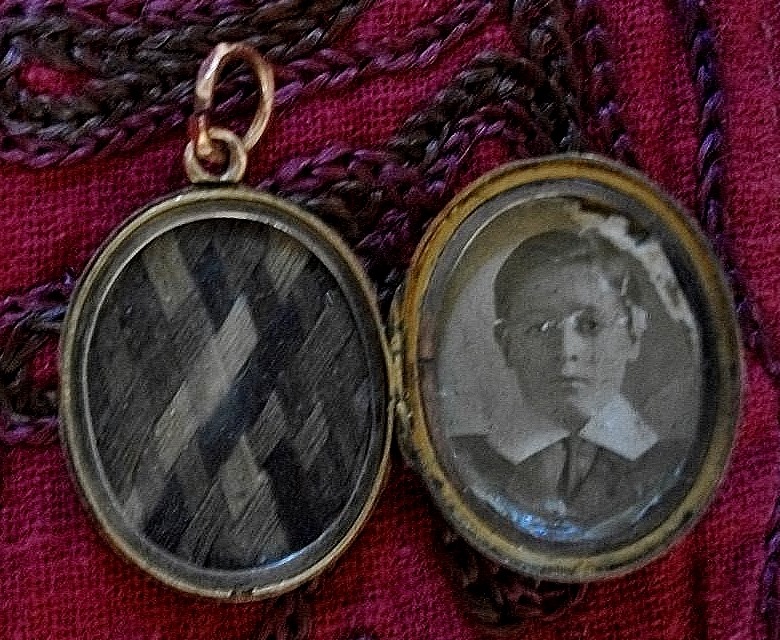
 My Great Uncle Giles (Victor) Rowles left little trace of himself on this earth. There is only this childhood photograph inside my great grandmother’s locket. For one thing he lived so briefly. Nineteen years. For another, he does not even have a grave. He was dropped from a hospital ship into the Mediterranean, two miles east of Mudros Harbour off the island of Lemnos. This happened around 10pm on the 10th August 1915 two days after admission. I know this only from the First Australian Imperial Force (1st AIF) records that the Australian National Archives have posted on the internet. I thank them for their dedication and care in making these records so freely available. I have written what little I know of Giles Rowles in two earlier posts, but I have reason to repeat it. On October 15th 1914, Cheshire born Giles (he later, and for unknown reasons, changed his name to Victor) enlisted in the 14th Battalion AIF in Melbourne, and then went directly for training at Broadmeadows. On 22 December 1914 he embarked for Egypt on HMAT ‘Berrima’, arriving there for further training in January 1915. In April the 14th Battalion took part in the landing at Gallipoli, and so began the hell-on-earth siege that achieved nothing but the pointless deaths of thousands of brave young men – Australian, New Zeleanders, French, British and Turkish.
 ![480_2[1]](https://tishfarrell.com/wp-content/uploads/2014/08/480_21_thumb.jpg?w=640&h=467 "480_2[1]")
Landing at Anzac Cove 1915. Photo: localhistory.kingston.vic.gov.au
*
Conditions at Gallipoli were unspeakable; it was a case of death by sniper, grenade or disease. Giles survived long enough to also take part in the August Offensive. This involved the Australian and New Zealand Army Corps moving up the coast from where they had been dug in for months to attack two peaks of the Sari Bair range while the British and French forces defended Helles. Giles it seems was hit by a Turkish sniper. In the military records he is listed as Private Victor Rowles no. 1402, admitted to the hospital ship Devanha with gunshot wounds. Two days later he was dead. There are several mysteries here. The first is how did this English lad end up volunteering with the AIF in Melbourne? The last certain record I have of Giles on English soil is from the 1911 census. He is listed as 15 years old and working as an apprentice clerk for a shipping broker in Cardiff. He is living with his widowed aunt, Louisa Rowles of 10, Despenser Gardens, where his older cousins, Beatrice a spinster, and John, a shipping agent also live. He is named after his uncle, Louisa’s late husband, Giles, a mariner. The Rowles family, it seems, have generations of seafaring connections. Giles’ own father, Charles, was a retired ship’s captain, and thereafter a pilot on the Manchester Ship Canal. He was my great grandmother’s second husband. As a young widow with three small children and a stepson, Mary Ann Williamson Shorrocks (née Fox) ran the Old Red Lion Inn and farm in Hollinfare (Hollins Green), Cheshire. Her father or brother, (both were named George Fox), had taken up the license in 1894, a year after selling up the family farm of Callow in Derbyshire. At this time Mary Ann would have still been in mourning for her first husband. He had died in his late thirties, a bankrupt shuttle manufacturer. It seems that the Fox family had secured the inn on Mary Ann’s behalf to ensure she had an income. It stood beside a then busy thoroughfare to Manchester, overlooking the new Ship Canal, which doubtless explains how the pretty young widow soon came to catch the eye of one Charles Rowles. 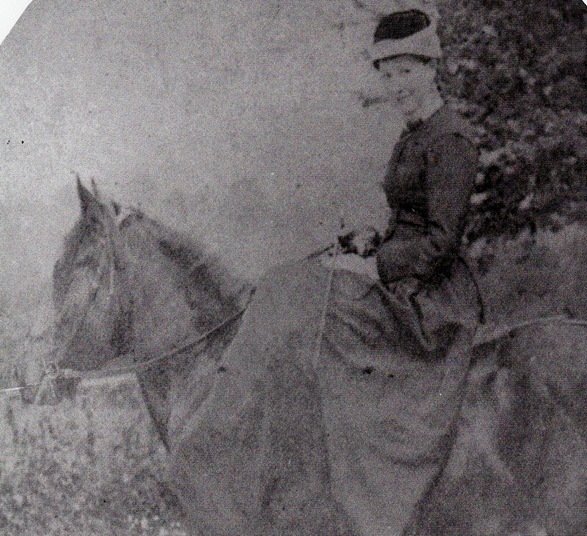
Mary Ann Williamson Fox at Callow Farm, Hathersage, Derbyshire sometime before her first marriage to Thomas Shorrocks, a Bolton spindle manufacturer.
*
The sea captain was much older than Mary Ann, a widower with two grown-up daughters. They married in 1895, but by 1903, when Giles was only seven years old, Charles Rowles lay buried in Hollinfare’s quiet little cemetery. Six years later, Mary Ann joined him. She was forty six. She had died of heart disease at her stepson’s house in Moss-side, Manchester, where her simple-minded sister, and the three Shorrocks children (including my grandmother) also lived. Whether Giles went to live with his Rowles relatives before or after his mother’s death is not known. Certainly he would have finished at Hollinfare village school at twelve years old, and the photo in the locket could well date from that time. It seems likely that the chance of a secure career in the shipping business prompted the move. In 1912 there is a passenger list record for one G. Rowles travelling as labour to Halifax, Canada on the SS Hesperian, but there is no conclusive evidence that this is Giles. I could anyway find no evidence of his arrival in Canada, although if he had signed on as crew, he could have sailed onwards to Australia. A comment by a now deceased aunt repeated the family story that he had chosen to settle in Australia, and this line of enquiry remains to be followed up. By the time Giles enlisted in Melbourne, he had changed his name to Victor. On the enlistment papers he calls himself a sailor, and responds to the question of whether he had ever served an apprenticeship, with a decisive ‘NO’. And perhaps this is the reason for the change of name. Perhaps he broke his apprenticeship, and used the knowledge gained in the shipping office to find a ship and run away to sea? The Broadmeadows medical officer records him as being eighteen years and seven months, 5 feet 5 and a quarter inches, and 135 pounds in weight. His complexion is described as ruddy, his eyes green and hair brown. His only distinguishing marks are two vaccination marks on his left arm. The reason he has given Aunt Louisa Rowles as his next of kin is also a mystery. She was not in fact a blood relative, and I know for a fact that his Shorrocks half-siblings adored him. It must have been they who had the tribute to Giles added to his parents’ gravestone in Hollinfare. 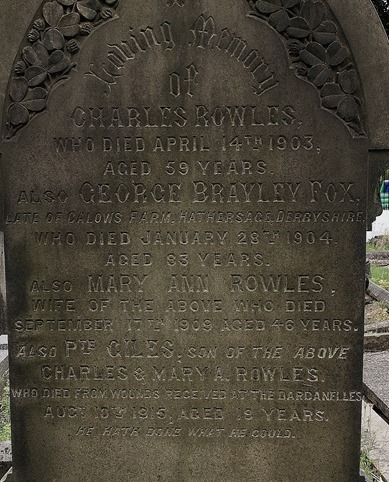 On his death, records say a brown paper package containing Giles’ few effects – a handkerchief, pipe, cigarette case, manicure-set, letters and photos, was later sent to Aunt Louisa, followed by his three service medals, a memorial scroll and plaque. All these items are now lost. He is nonetheless commemorated in his ill-fated name of Victor at Lone Pine Memorial, Turkey and on the Australian War Memorial at Canberra. On his parents’ and grandfather’s stone in Hollinfare it says: “Pte Giles son of the above Charles and Mary A Rowles, who died of wounds received at the Dardanelles on August 10th 1915 aged 19. He hath done what he could.” And why am I posting this story once again? Well surely someone knew Giles Victor Rowles? He must have had mates – at sea, at Broadmeadows, at Gallipoli. Did not some girl love him? Doesn’t his name occur in a fellow private’s letters home? Is there not some diary entry that mentions him? Doesn’t anyone know what happened to his medals? The photo in his mother’s locket shows a boy with determination. His gaze is direct. He looks cherished. And it is his photo in the locket, and not one of his half-siblings. On the other side of the locket, delicate strands of hair from all five children – Robert (stepson), Mary, Lilian, Thomas Shorrocks and Giles – are woven together. Mary Ann would have been able to identify each child from the varying shades of blond and brown. This small locket, then, contains the only physical evidence of Giles Rowles’ existence.
  #nogloryinwar
copyright 2014 Tish Farrell
BY ALL MEANS SHARE THIS POST, BUT PLEASE ACKNOWLEDGE MY COPYRIGHT

![Makokos-Floating-School-NLE-2[1]](https://tishfarrell.com/wp-content/uploads/2014/08/makokos-floating-school-nle-21.jpg "Makokos-Floating-School-NLE-2[1]")
![Makoko_approach-960x550[1]](https://tishfarrell.com/wp-content/uploads/2014/08/makoko_approach-960x5501.jpg "Makoko_approach-960x550[1]")
![_61618156_a1zaixbb[1]](https://tishfarrell.com/wp-content/uploads/2014/08/61618156_a1zaixbb1.jpg "_61618156_a1zaixbb[1]")
![NLEs-floating-school-casts-anchor-in-Lagos-Lagoon_dezeen_14[1]](https://tishfarrell.com/wp-content/uploads/2014/08/nles-floating-school-casts-anchor-in-lagos-lagoon_dezeen_141.jpg "NLEs-floating-school-casts-anchor-in-Lagos-Lagoon_dezeen_14[1]")
![ml_schoolatSea_Makoko_d2_600[1]](https://tishfarrell.com/wp-content/uploads/2014/08/ml_schoolatsea_makoko_d2_6001.png "ml_schoolatSea_Makoko_d2_600[1]")
![Makoko-Floating-School-5-606x400[1]](https://tishfarrell.com/wp-content/uploads/2014/08/makoko-floating-school-5-606x4001.jpg "Makoko-Floating-School-5-606x400[1]")
![Kunlé-Adeyemi_1c_Photo-by-Reze-Bonna-293x400[1]](https://tishfarrell.com/wp-content/uploads/2014/08/kunl-adeyemi_1c_photo-by-reze-bonna-293x4001.jpg "Kunlé-Adeyemi_1c_Photo-by-Reze-Bonna-293x400[1]")


![480_2[1]](https://tishfarrell.com/wp-content/uploads/2014/08/480_21.jpg "480_2[1]")