Derbyshire’s Arbor Low ~ They Call It The Stonehenge Of The North

IMG_3357

Unlike Stonehenge a visit to Arbor Low does not include accompanying hosts of fellow enthusiasts, tacky gifts and bad coffee, nor the parting with large sums of money to go in (adult ticket £16.50). In consequence there are absolutely no facilities, no opening or closing times, and thus no need to pre-book to avoid the rush.

There is, however, an honesty box by the farm gate, and a requested fee of £1 per person. This is fine by me. The monument, though scheduled, is on private land. The farmer has to put up with the repeated nuisance of standing stones devotees, although on the September afternoon of our visit, takings suggested that scarcely a couple of dozen others had preceded us that day, and as we set off from the car there were only three people ahead of us on the track.

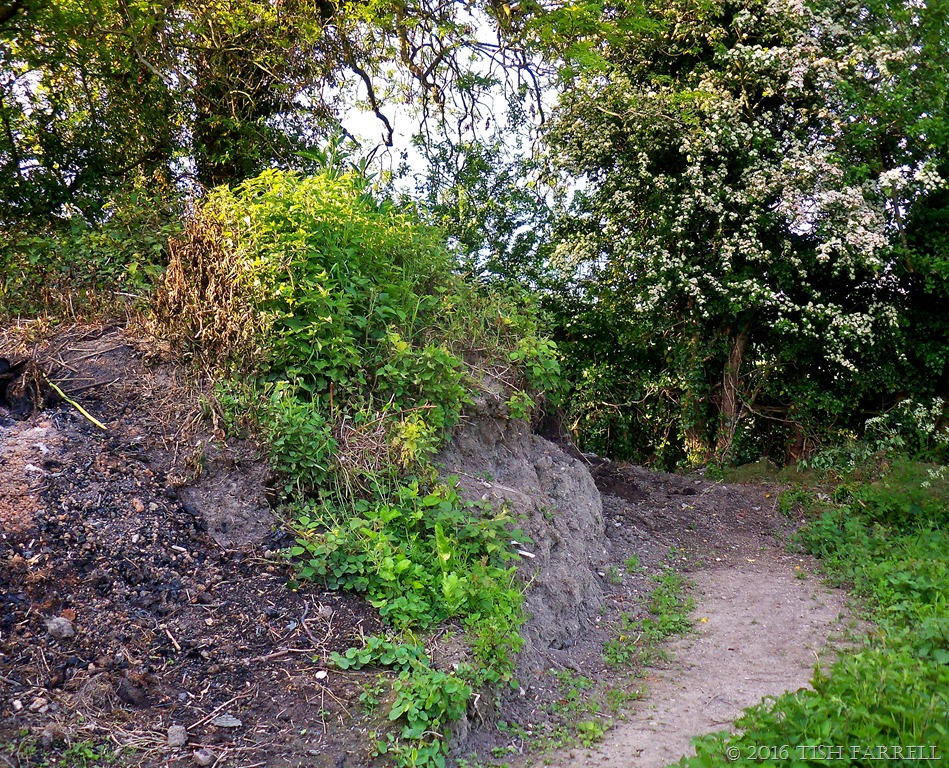
The only problem with Arbor Low is that once you’ve trekked through the farmyard and across the field to visit Derbyshire’s most important Neolithic henge (one’s head inevitably full of Stonehenge images, and lots of anticipation) it all looks decidedly flat when you get there, and so quite lacking in the upstanding drama of its more famous southern analogue. And while Arbor Low surely has considerable edge when it comes to setting (a thousand feet up on a limestone crest of the White Peak)  one wonders why the comparison has been implied at all. Isn’t Arbor Low its own special place?

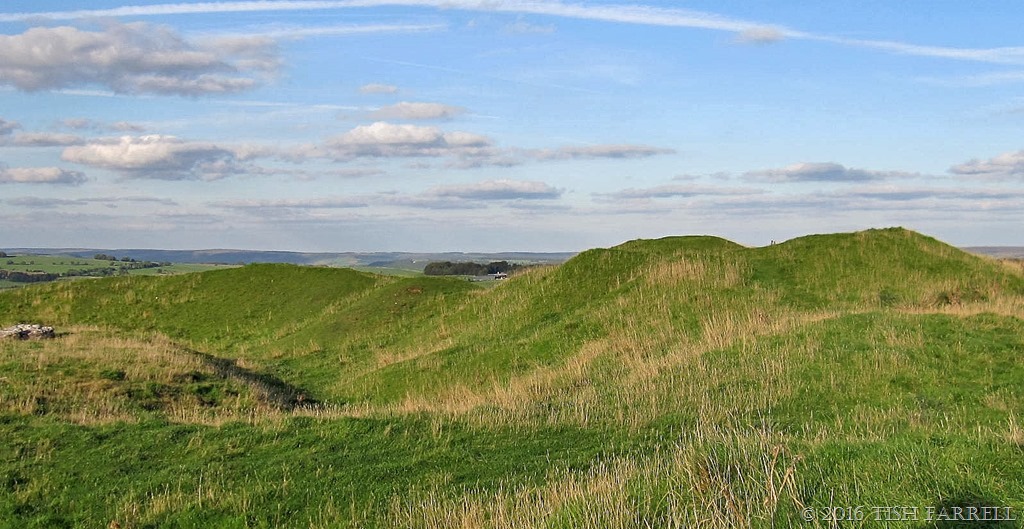
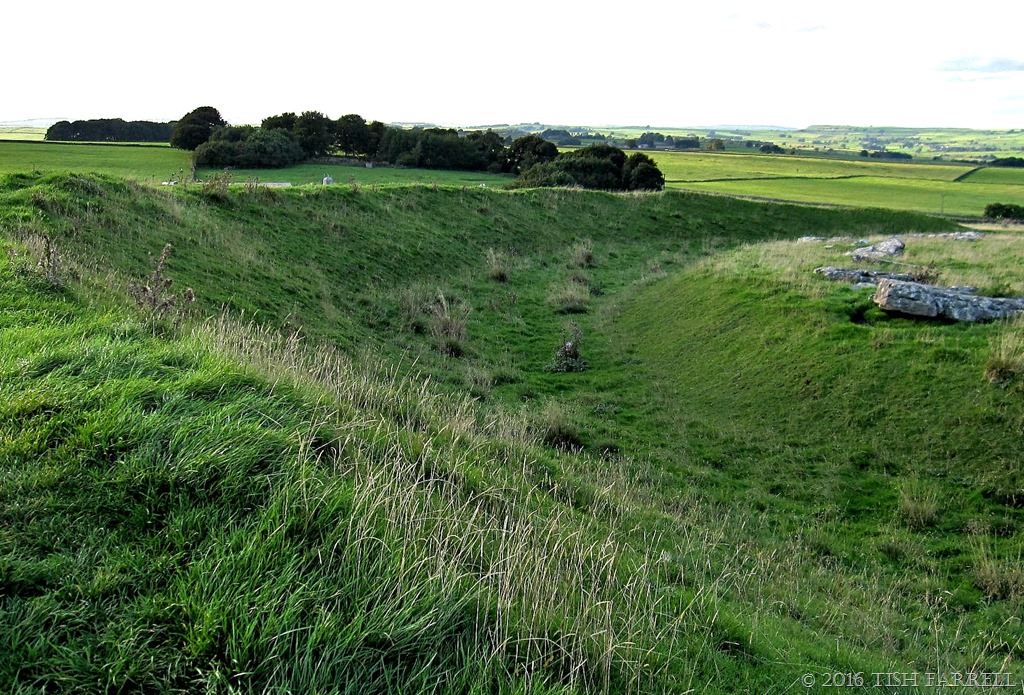
I suppose, then, that mentioning the two sites in the same breath is really more about emphasising their prehistoric importance than suggesting any correspondence in physical scale or appearance. Arbor Low is anyway a much smaller circle. But it does have its own unique features, apart from the recumbent stones that is. These include a very impressive encircling ditch and an outer rampart with the added extra of a later Bronze Age round barrow built across its southerly bank. You can see it on the right of the next photograph.
IMG_3358

So now that I’ve raised the vision of Stonehenge with its great sarsen lintels, I want you to forget it, and think about digging. The time is some four and half thousand years ago. I am the foreman, and I am handing you an antler pick, and maybe a cattle bone shoulder-blade to use as a shovel. We have marked out a circle some 70 metres across, and now you have to start digging 3 metres down into the limestone bedrock, while shovelling up your spoil to create the outer bank.

After many, many, many man-, woman-, and child-hours you can step back and regard the massive earthwork thus created. The freshly dug limestone of the rampart will doubtless have an unearthly white-grey glow. It will be visible from miles around, despite a more wooded landscape than today. At sunrise and sunset it will look spectacular against the skyline, the bank much taller and with a sharper profile that the present remains. In other words, it cannot be mistaken for anything other than a highly prestigious, and momentous man-made structure – the visual shock equivalent of coming upon a designer high-rise in the middle of a wilderness. Or maybe Starship Enterprise.
IMG_3354

After all the digging you are left with a central oval platform around 50 metres across. Perhaps the limestone slabs are already located there, set up on end, and bedded, after much hefting and shunting, in the rocky ground. They could have been worked during the making of the ditch, or sourced from somewhere nearby. In any event, they would have involved considerable effort given your limited toolkit of stone, wood and bone.

From outside the earthwork – and because of the height of the outer bank, you cannot see either the stone circle, or to observe anything that is going on within. Stepping through the entrance to view the newly built monument is thus perhaps a deliberately contrived catch-your-breath moment: the scene before you covert, unnerving, awe-inspiring, drama-filled. If some ceremony is in progress – a narrative declaimed or sung, the outer bank will amplify the sounds in mysterious ways – echoing, resonant, other-worldly; it may be a place of loud whispers.

There will perhaps be no grass cover, just an exposed limestone arena. Around the oval platform you will see some forty standing stones.

IMG_3347

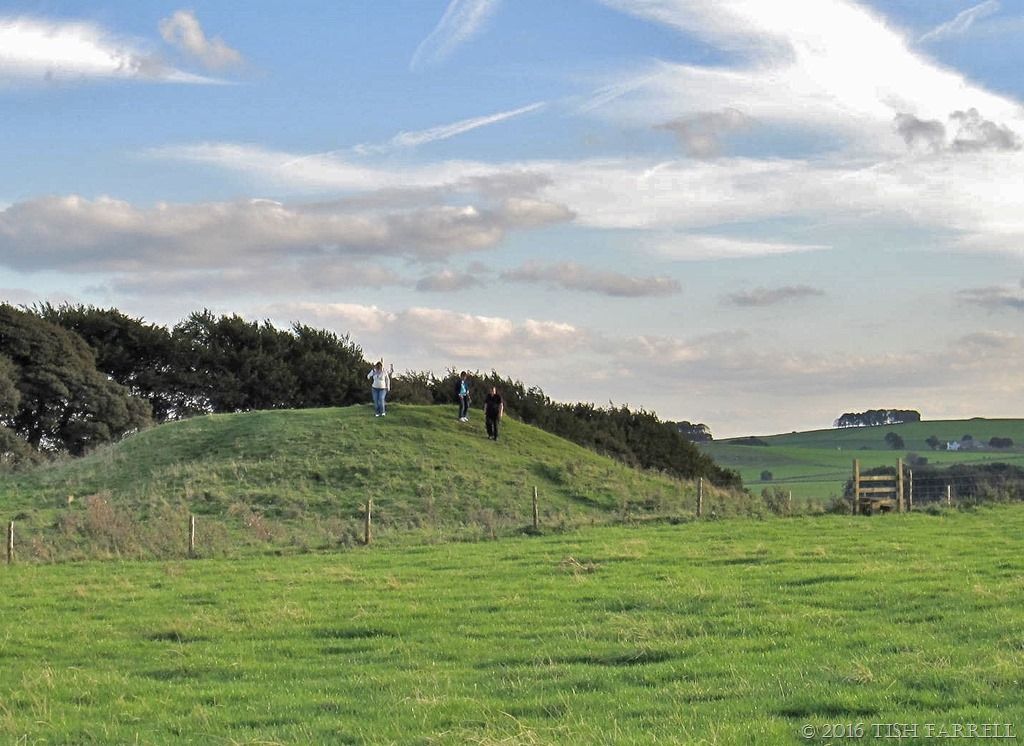
In the centre there is also some kind of sanctuary, a rectangular configuration of more standing stones. The barrow on the southern bank is not yet there. It will be another thousand years before this spot is used as a burial site – perhaps by strangers, perhaps by the distant descendants of  you henge builders. These newcomers have also built another barrow, Gib Hill, just across the field from Arbor Low. Here they raised their own tomb atop the long barrow built by your forebears, a monument that possibly long preceded the stone circle. And so although you can no longer remember the rites and customs of these ancestors, you do know that, like the great mediaeval cathedrals of Europe with their roots in Roman and Saxon times, this place was considered ‘sacred space’ for a millennium and more…

*

And so back to reality and the flattened circle we see today. No one knows when the stones were laid low or why. There are other so-called recumbent stone circles in Britain. Sometimes some of the stones have also been buried. Superstitious dread could have much to do with it: an attempt to neutralise the stones’ power perhaps. There is also archaeological evidence in other contexts that suggests that the prehistoric occupants themselves have ritually ‘closed’ particular sites, perhaps prior to moving to a new centre of operations. There are other more practical reasons too: later farmers came along and simply re-used or moved the stones because they were ‘in the way’.

I also seem to remember from my student field-trip days to Avebury stone circle in Wiltshire that one of the stones had been buried in mediaeval times to cover up a murder. When the stone was being restored to its upright position, beneath it was found the grisly remains of a surgeon-barber, identifiable by the tools of his trade that were still with him. More fanciful interpretations of this find could of course suggest the presumed continuing practice in pagan sacrificial offerings, i.e. the kind of activity that we modern folk so very much like to associate with all ancient stones.

IMG_3353

I suppose one of the most surprising things I discovered about Arbor Low is that there has been no archaeological exploration of this site since early Victorian times when the local antiquarian Thomas Bateman of Lomerdale Hall, and serial excavator of prehistoric barrows, tackled the place. It was he who discovered a human burial in the stone circle barrow and, during his Gib Hill excavation, uncovered a stone cist (a slab built tomb) in which the cremated human remains were placed along with an urn and offerings of meat and flint tools. And this, it seems, is all that is known.
IMG_3364

So many mysteries then, and no likely answers. Instead I’ll leave you with the words of Thomas Bateman and his description of Arbor Low from his Vestiges of the Antiquities of Derbyshire 1848:

…the solitude of the place and the boundless view of uncultivated country are such as to carry the observer back through a multitude of centuries, and make him believe that he sees the same view and the same state of things as existed in the days of the architects of this once holy fane.


copyright 2016 Tish Farrell
Maintaining A Web Presence Despite The Big Windows 10 Update Ambush

IMG_3601

The blogging schedule, and life as I knew it went haywire last week after Microsoft (welcome to the totalitarian state of cyberworld) inflicted on us the apparently much vaunted (though I actually didn’t know a thing about it until it happened) anniversary update of Windows 10, so sending thousands of worldwide users into a state of serial rebooting frenzy.

While it is true that my newish laptop made it through unscathed, my older PC, on which I do all my writing and blogging, was completely banjaxed web-wise. And not only could I no longer access the internet or my email for more than five minutes together, and then finally not at all, the update transformed my printer into a fax machine. Now that is clever. I do not own, nor have ever owned a fax machine. Needless to say, my virtual fax gadget would not print off Marilyn Armstrong’s corn bread recipe that I had downloaded from her blog. Rats and double rats.

I should have known that things were not going well for the PC when it took hours and hours and hours to complete the update. The temper was thus well frayed before I discovered what Microsoft had done to my settings. I mean, how dare they? HOW DARE THEY!

I was well into a second day of cursing and fretting and attempting all sorts of unnecessary and time-consuming procedures (defragmenting, dis-installing Google Chrome, rebooting, removing all weighty files from the PC to an external hard drive, re-setting the router, disconnecting from internet provider) when I finally went to the laptop and googled ‘Windows 10 update problems’. And low and behold, there revealed was the worldwide extent of the Microsoft mess-up.

In an article in Forbes Magazine  lovely, lovely Gordon Kelly addressed the problem of those inflicted with rebooting-itis, and in so doing revealed that it was possible to go into computer SETTINGS  and find the option to revert to pre-update settings.

Select and press enter.

Well, for goodness sake!

It sounded too simple for words. But, by Lucifer, it worked. Astonishing. One click, and my little corner of the internet universe was restored. The printer stopped masquerading as a fax machine and printed the corn bread recipe. The only problem is, will this work the next time Microsoft inflicts an unwanted all-system update on us? What settings might my machine revert to next time? Should I not risk it? Should I try to go back to Windows 7, which was perfectly adequate for my purposes? Is it even possible to do that now I’m infested with Windows 10, or will everything be screwed up?

Mr. Kelly says Microsoft really needs to unhook security updates from general operations, AND more importantly, give people an option. I should think so too. Mr. Kelly also informs us that Microsoft mean to instigate charges for the use of their wretched system with its overblown advertising and unnecessary apps and gizmos which take ages to clear out of one’s machine.

He says that to start with the $7 per month fee will only be charged to commercial users, but one can see where this is heading. Frankly, I would like a bit of compensation for two days of wasted time and utter fraughtness. Apart from which, what if I had been running a small business that was dependent on internet function; what if the laptop had been afflicted too, and I hadn’t found a solution that avoided calling in a computer expert and cost me money?

Mostly though I would like to be assured that Microsoft is NEVER, EVER going to do this again. No organisation should have this kind of power – to have total control of my machine on my desk  in my own home, and without a by or leave. I mean, what have we let in here? A cyber version of Pandora’s Box?

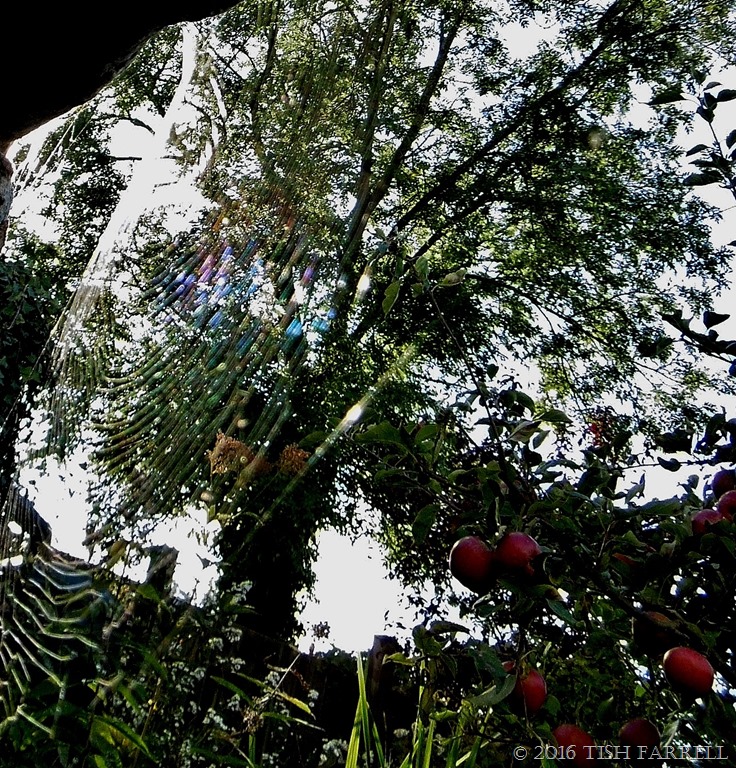
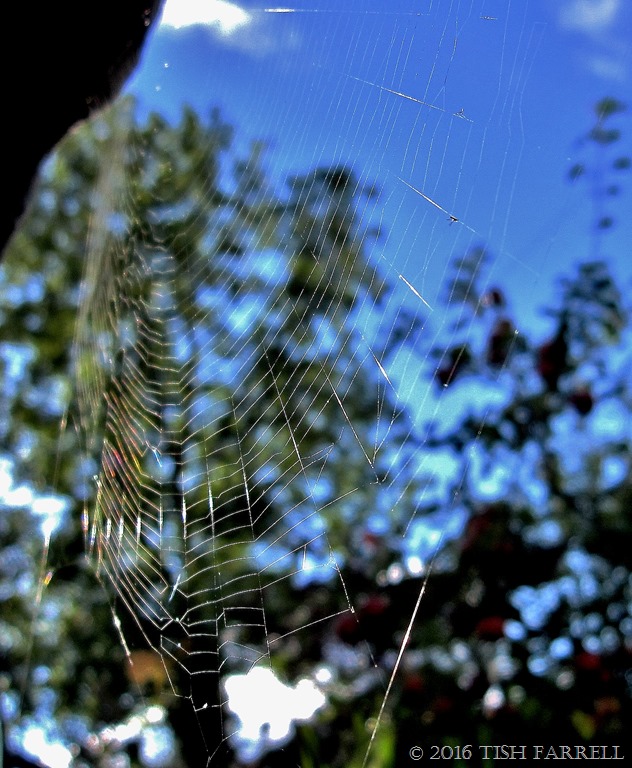
And now I’ve wound myself up again, I’ll go back to where I started with a soothing image of an untainted kind of a web, as seen yesterday in the corner of the kitchen door. This version even comes with its own rainbow and strangely displaced hydrangea reflections from across the garden. Looking at it now, the Luddite lifestyle option suddenly seems appealing – out with the hi-tech machines, back to the solitary writer’s garret and a quill pen? Hm. Maybe not. But perhaps I’ll log off and go and make Marilyn’s corn bread. Far more wholesome.

P1050810

copyright 2016 Tish Farrell

JANE EYRE WAS HERE? Or was she?

P1050620

I struck straight into the heath; I held on to a hollow I saw deeply furrowing the brown moorside; I waded knee-deep in its dark growth; I turned with its turnings, and finding a moss-blackened granite crag in a hidden angle, I sat down under it. High banks of moor were about me; the crag protected my head: the sky was over that.

Jane Eyre Charlotte Brontë 1847


Most people, who know anything about the Brontë family, will know that they lived in a gloomy vicarage in Hawarth, West Yorkshire, on the edge of the rugged Pennine uplands. Most of us, too, will have seen the windswept ‘Cathy come home’ film clip renditions of scenes from Emily Brontë’s dark romance Wuthering Heights. And so, if we think of it all, we probably imagine that Charlotte Brontë’s Jane Eyre is set in her home county too.

And we’d probably be wrong. Circumstances and too many clues suggest that it was Hathersage and its environs in Derbyshire’s Dark Peak that informed the landscape of Charlotte Brontë’s imagination as she wrote Jane Eyre.

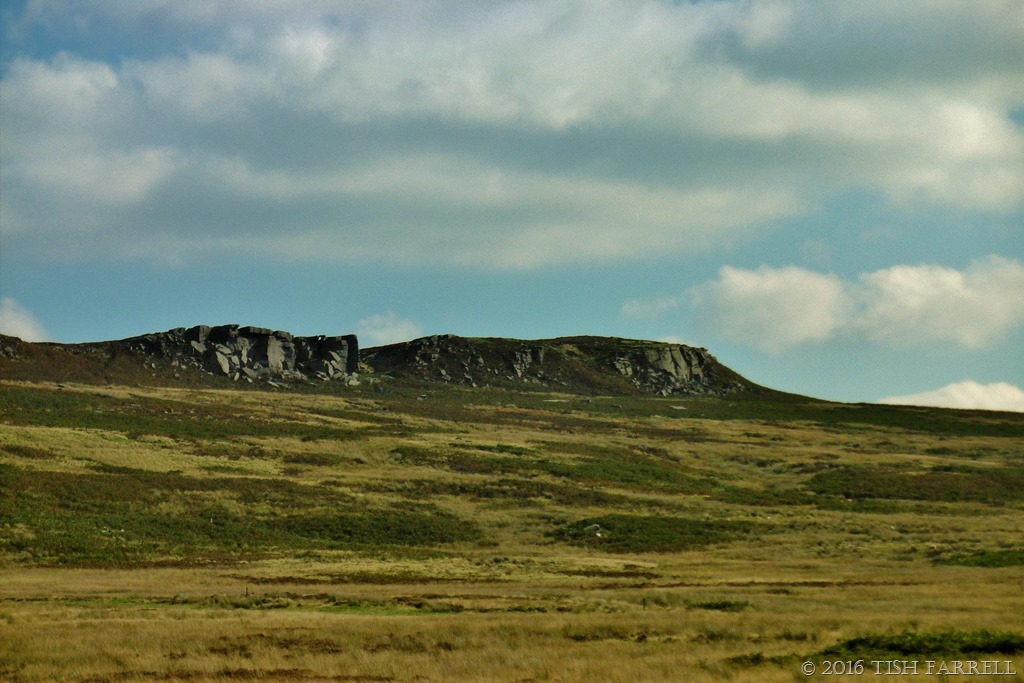
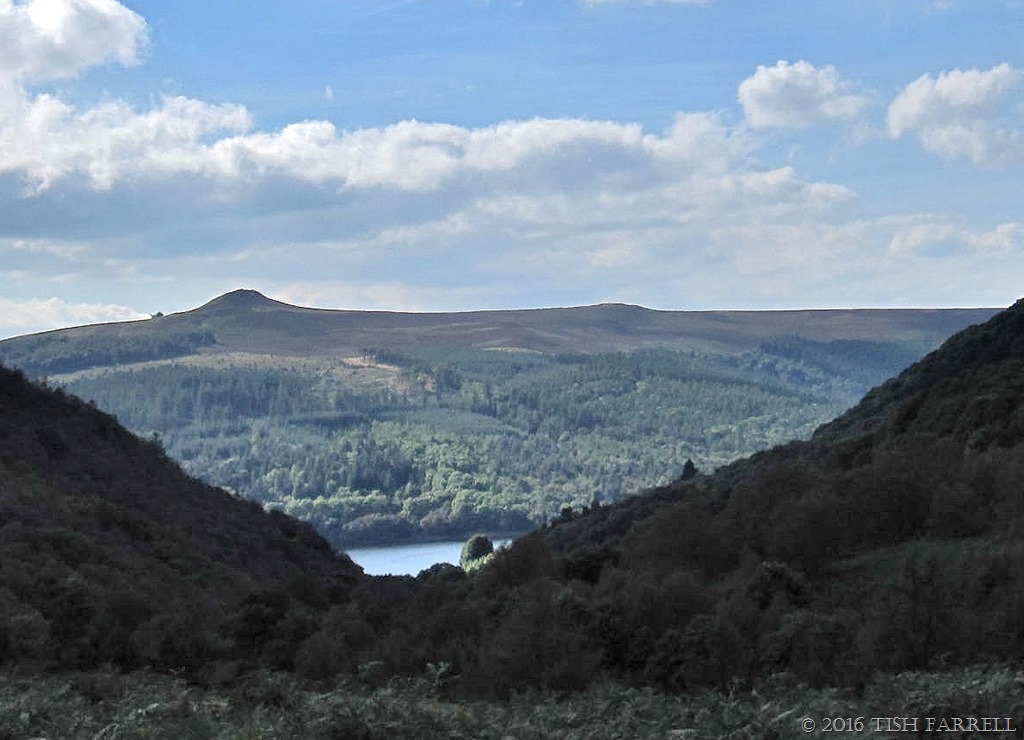
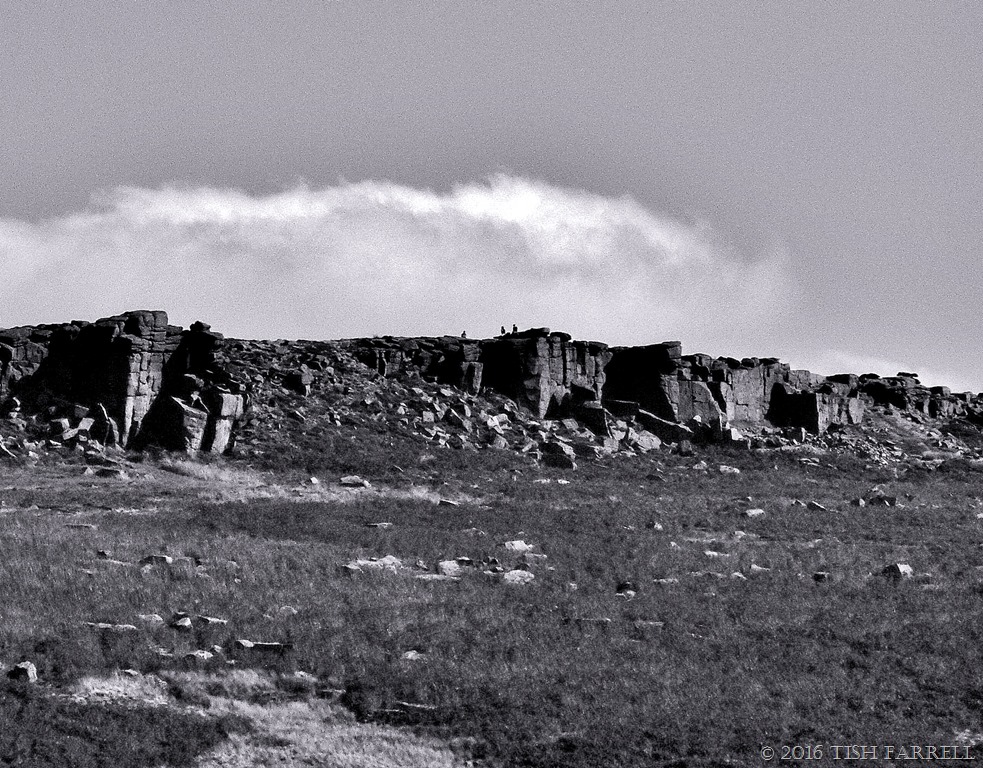
If you read my last post on the Seven Stones Bronze Age circle on Hordron Edge you will have seen the above vista – Stanage Edge above Moscar Moor. The path to this part of the moor begins at Cutthroat Bridge on the Glossop – Sheffield road just south-west of the old boundary stone at Moscar Cross. From here the hills fall away to the Derwent Valley and the vast Ladybower Reservoir built in the 1930s. You can just see a glimpse of the reservoir in the next photo taken from Hordron Edge.  It would have been a steep river valley in Brontë’s time. At the reservoir the road divides – west for Glossop and Manchester, and south for Bamford and Hathersage.

IMG_3310

This next quotation is one of the possible ‘real location’ clues. It describes Whitcross, the place that many now identify as Moscar Cross. This isolated spot is where Jane Eyre is dropped by the coachman because she hasn’t enough money to pay for the onward journey. So begins her desperate wandering and lonely night out on the moors. She has just run away from Thornfield Hall and her thwarted marriage plans. Husband to be, Edward Rochester, has been exposed. He is already married to a lunatic wife whom he keeps locked in the attic. Jane’s sense of shock, loss and emotional distress are heightened as she loses herself physically, choosing to walk away from all identifiable landmarks and into the wild unknown:

Whitcross is no town, nor even a hamlet; it is but a stone pillar set up where four roads meet: whitewashed, I suppose, to be more obvious at a distance and in darkness. Four arms spring from its summit: the nearest town to which these point is, according to the inscription, distant ten miles; the farthest, above twenty. From the well-known names of these towns I learn in what county I have lighted; a north-midland shire, dusk with moorland, ridged with mountain: this I see. There are great moors behind and on each hand of me; there are waves of mountains far beyond that deep valley at my feet.

And why, you might ask, are people so keen to think that Whitcross is Moscar Cross? Does it even matter?

Of course it doesn’t. That a writer was drawing on what they knew of actual places when creating their fictional settings doesn’t necessarily add to our enjoyment of the story. On the other hand, to know that they had a definite somewhere in their mind’s eye may offer a few insights into the nature of the creative process.

I’ve written elsewhere about the importance of PLACE in fiction, and that SETTING is more than just a location. In the best stories the evocation of place can be as crucial as the conjuring of believable characters to occupy it.

Writers need to do their world-building homework very carefully – the outcome of which is likely to be more successful if they are summoning places and situations that have already stirred their creative impulses. When they come to write, they are already firing on all senses: can walk in their character’s shoes; feel through their skin; see through their eyes.  And if the narrative warrants something more complex, there can be, by way of dramatic or comic irony, further interplay between what the reader may ‘know’ of the place and what the protagonists are seen to experience.

Of course all creative people make up things, but they also start their imagining from what they know: from people, places, things that have struck or affected them.

But to return to the Hathersage connections and Jane Eyre  and the real reason why I’m indulging in this piece of literary tourism. For those of you who have read my recent posts you’ll know that the small Peak District town of Hathersage has personal family connections. My ancestors farmed on its outskirts from at least the late 1600s to 1892 (see Stepping Stones Through Time and Ancestor Sleuthing in Derbyshire ).

My great great Fox uncles and aunts of Callow Farm were exact contemporaries of Charlotte Brontë, and some of them would have been around in 1845 when the writer spent three weeks in Hathersage, staying with her very close friend from school days, Ellen Nussey.

Ellen was the vicar’s sister, and he, Henry Nussey had just got married and was away visiting his mother with his new bride. At some stage Charlotte had apparently refused a marriage proposal from Henry (he who apparently liked to draw up lists of attributes for any potential wife) and so his absence was perhaps taken advantage of by Ellen. In any event, the two women spent this time going out and about and visiting local notables.

And while I don’t for a moment think that these outings included afternoon tea at Callow, I am quite enjoying the notion of them sharing the ‘same air’. In fact Callow may well have been a sad place in the summer of 1845. In March of that year, my 3 x Great Grandmother, Mary Ann Fox nee Williamson, had died of ‘general dropsy’ at the age of 57. She is a bit of mystery, possibly ‘a London lady’ who in circumstances unknown became engaged to local bruiser and fist-fighter, Robert Fox of Callow. They were wed by marriage bond in Southwell Minster in 1812. She was anyway survived by four daughters and three sons, and although some of the girls look to have been employed in households outside the area around this time, I’m thinking there may have been Fox family members at Hathersage church on those Sundays in July when Charlotte and Ellen doubtless attended.

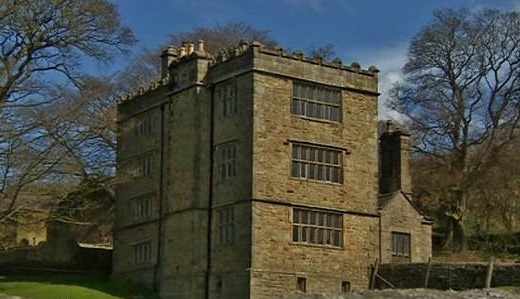
One of the places the two women definitely did visit on several occasions was North Lees Hall, below Stanage Edge, near Hathersage. It was lived in at the time by members of the very populous Eyre dynasty whose antecedents had built it in the 1500s.

North Lees BBC2Photo credit: BBC

The Eyres had occupied many such houses in the area over the previous several hundred years. In fact my Fox family legend (totally unsubstantiated) has it that the first ancestral Derbyshire Fox was the steward of the vanquishing Eyre who came to England with William the Conqueror in 1066, and that this relationship continued down the ages – from which you may also surmise that some of my ancestors told rather good, if dodgy tales. In fact they were still telling this one when Great Great Grandfather George sold up at Callow in 1892. I know, because it was picked up at the time and featured by several local and regional newspapers.

Nor was Charlotte apparently averse to recycling tales. North Lees came with its own legend that told of one Agnes Ashurst, a mad woman who was confined to a room on the second floor. This room had padded walls to stop her injuring herself, but like Rochester’s wife, Bertha, she also died in a fire.

Definitely it was too good a yarn not to re-use and develop then. It also well illustrates another aspect of the on-going writerly process – the jackdaw syndrome of gathering in every shiny fragment and titillating curiosity just in case such treasured little nuggets may one day serve some plot.

Anyway, I will finish this present ramble with the Jane Eyre description of Thornfield Hall. Take a look again at the photo of North Lees. What do you think – a convincing source for Rochester’s domain of dark secrets and the scene of Bertha Rochester’s shocking demise?

I stepped over the threshold. It was a fine autumn morning; the early sun shone serenely on embrowned groves and still green fields; advancing on to the lawn, I looked up and surveyed the front of the mansion. It was three storeys high, of proportions not vast, though considerable: a gentleman’s manor-house, not a nobleman’s seat: battlements round the top gave it a picturesque look.

copyright 2016 Tish Farrell

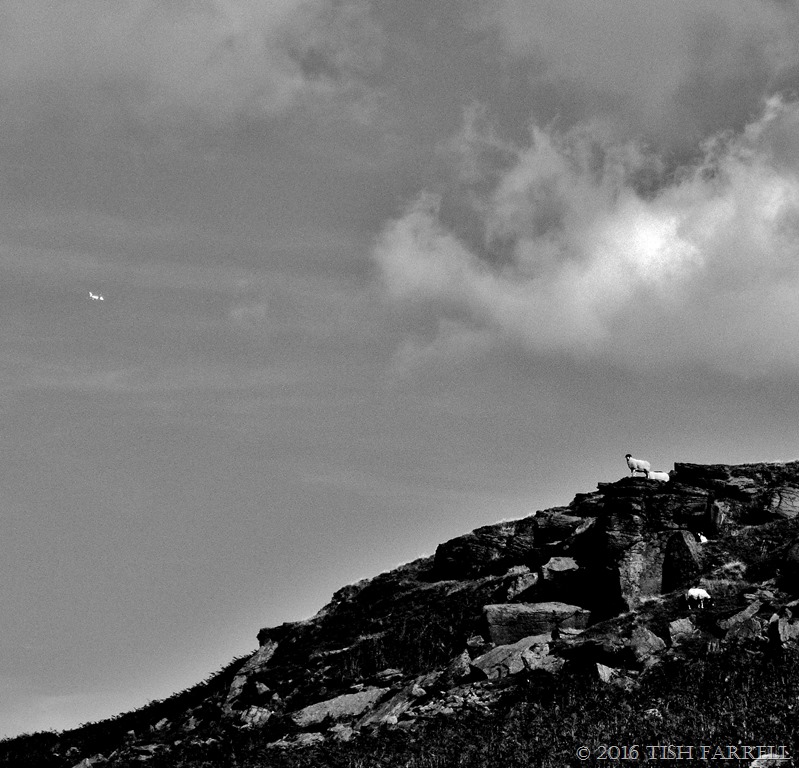
Disconnected Sunday: Plane…Sheep…Cloud…And Then…?

P1050650

I was attracted by the sheep doing an ovine impression of Landseer’s Monarch of the Glen –  as spotted last week during our short break in the Derbyshire Peak District. Its posing place of choice is Hordron Edge, below Moscar Moor and Stanage Edge. We were walking up here on what he-who-is-usually-the-team-leader suspected would turn out to be a Tish-type wild goose chase. In short we, or rather I was in pursuit of a Bronze Age Stone Circle, otherwise known as the Seven Stones despite the fact that there are apparently eleven stones in the circle, and three more besides nearby.

I should admit straight off that I’m not renowned for my accurate map-reading, and so once we’d passed the sheep, walked for ages in surprisingly hot sunshine for late September, and then found ourselves on a path which kept wending onwards and upwards with absolutely no sign of a megalithic monument anywhere on the sky-line where I was expecting it, even I began to think I’d misread the map, and that we were definitely on a wild goose chase. Worse still, we’d left the lunch picnic in the car, so there wasn’t even the possibility of making the best of a bad job. And it was just the day for a moorland picnic too, not a state of affairs you can rely on in England’s uplands whatever the time of year.

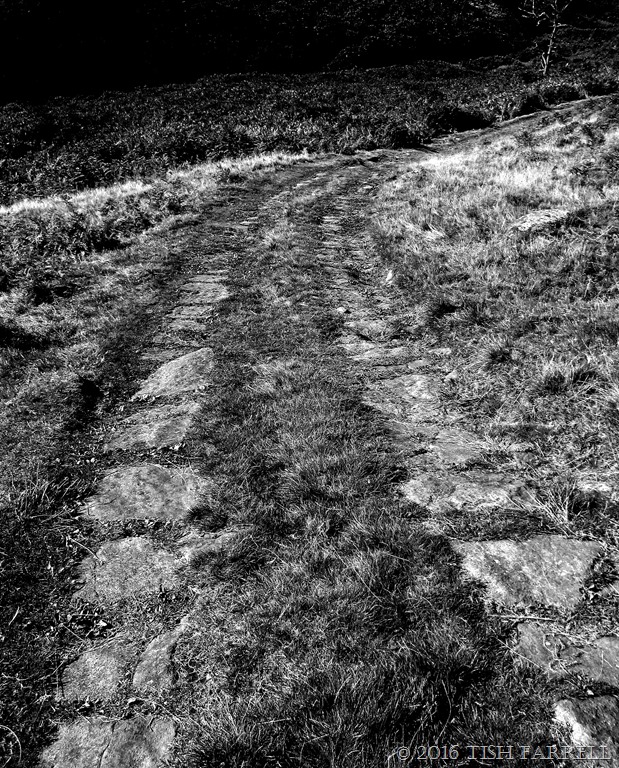
‘We’ll just go to the next bend’ – I said – ‘so we can see over the brow of the hill’. But as always happens in such situations, we never came to the bend’s end. In fact the path began to rise very steeply. Then we noticed that exposed here and there beneath the turf were signs of a stone-paved trackway. Very puzzling in this middle of nowhere, but at least it suggested that we were headed somewhere. (I surmised later that it must be the relic of an old packhorse road up to Stanage Edge whither the locals once went quarrying to make millstones and grind stones).

And so as we pushed on, drawn on by the stone road, and quite unexpectedly Moscar Moor and Stanage lay before us. It is an awe-inspiring landscape, and so it is scarcely surprising that this whole area is rich in prehistoric cairns, circles, and settlement remains.

Also, by now I could see that my map-reading had been spot on, although the stone circle really took some finding in the heather.

P1050637 (2)

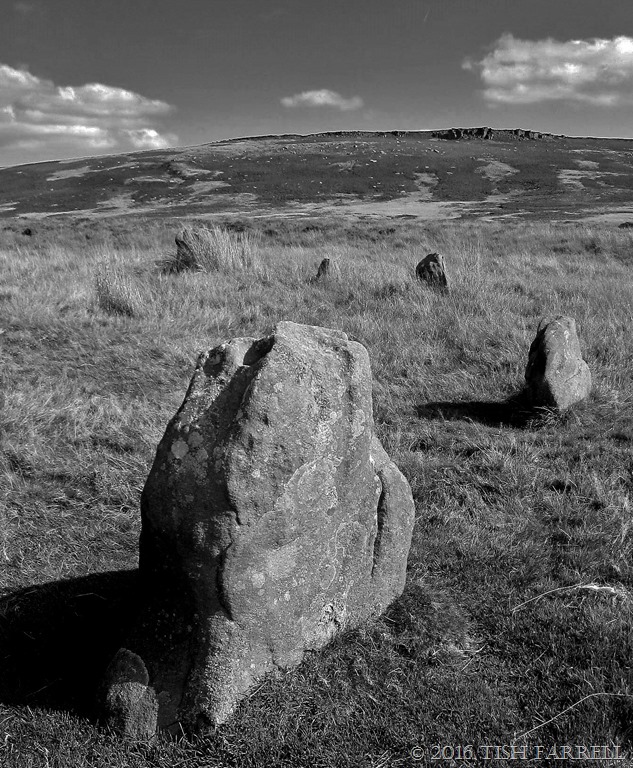
So I hope you weren’t expecting Stonehenge. Because here it is – the Seven Stones Circle of Hordron Edge, probably dating from around four thousand years ago.

IMG_3319

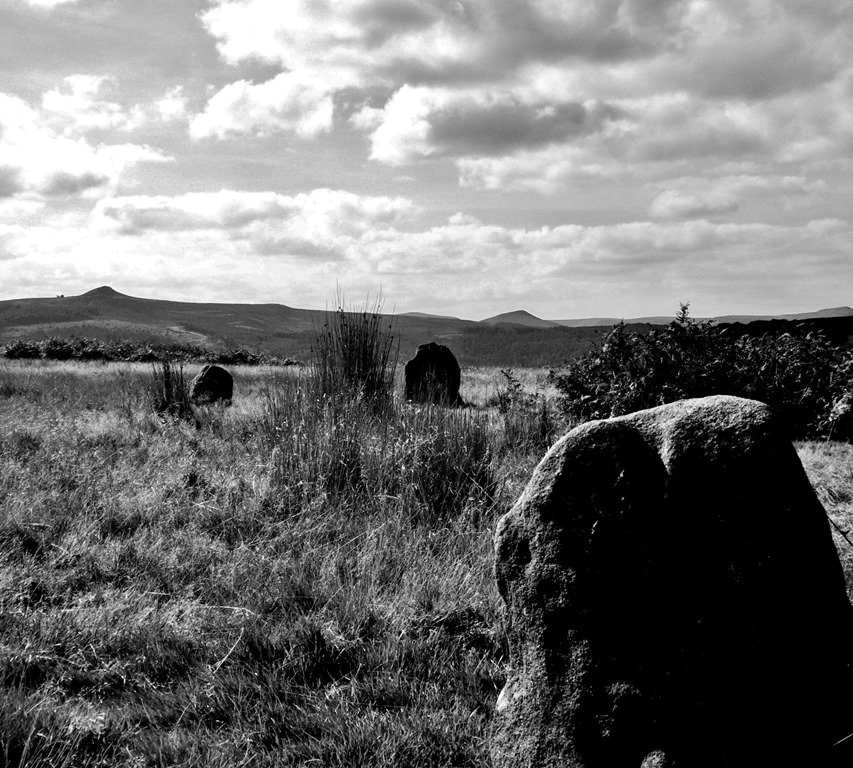
The tallest stone is the one seen here in the foreground, and is about 1 metre high. It stands on the south west edge of the 16 metre circle, and has been dubbed the Fairy Stone. You can see it on the far right in the middle ground of the next photo. P1050638

Its particular significance is taken to be its relationship to the two conical hill tops, Win Hill on the left and Lose Hill on the right, the top of the stone possibly mirroring the landscape features. Peak District archaeologist John Barnatt has apparently observed that at the traditional start of winter and spring, the times of age-old festivals, the setting sun appears to roll down Win Hill.

Perhaps the placement of stone had something to do with the gathering of sun-power? Or the marking of the seasons in relation to the farming calendar? We can never know. All we can be sure of is that these monuments were important to the people who created them – gathering places for discourse, rituals, trade, or all of these. More recent local folklore has its say too – hence the naming of the Fairy Stone, and tales of strange lights being seen around about it.

And what do these monuments say to me? Well the main thing is that we should never underestimate the capacities of our ancient antecedents. Also that we should never equate current technological whizz-kidery with intellectual superiority. These people  of the past  knew how to make a life in this challenging territory – a life charged with meaning and a deep sense of their place in the landscape. I feel too, we have lost much of our ancestors’ capacity for poetry and metaphor – the exchange between fellow humans that relied almost exclusively on language – the songs sung, the tales unfolded, the riddles set, the nuances of double and treble meanings.

But before I get too carried away with highfalutin notions, we decide that lunch is now too far away for comfort. We retrace our steps down the old stone trackway. It perhaps does date from much more recent medieval times. I’ve been unable to find out anything about it, although there is medieval packhorse road along the top of Stanage Edge.

As I descend the steep hill on a sunny Indian Summer day I wonder what it must have been like to urge pack horses up this route in a blizzard, the wind slicing under your cape, threatening to snatch your bonnet, the biting cold, the darkness. Just imagine…

IMG_3311 - Copy

copyright  2016 Tish Farrell

Hordron Edge Circle
Bronze Age Stone Circle
East of Ashopton, Derbyshire  OS Map Ref SK21528685
OS Maps – Landranger 110 (Sheffield & Huddersfield), Explorer OL1 (The Peak District – Dark Peak Area)

Shore, Reef, Ocean, Sky: Edge On Edge

dawn over Tiwi lagoon more contrast - Copy

Some of you will have already read the essay below. It won first prize in a Quartos Magazine competition years ago. The magazine is no more, but I’m posting the piece again for those of you in need of  a long, soothing wallow beside an African beach. Enjoy!

 Going to the Dogs on Mombasa’s Southern Shore

It’s a dog’s life on Tiwi Beach, the white strand where ocean roars on coral and trade winds waft the coconut palms; and where, best of all, as far as the local canines are concerned, there are quiet coves sparse in holidaymakers. It means they may do as they please. After all, it is their own resort, and every morning they set off there from the beach villages along the headland, nose up, ears blown back in the breeze, ready for the day’s adventures.

But the dogs are not churlish. They can take or leave the odd pale human wrestling to right his windsurfer on the still lagoon; ignore the sentinel heron that marks the reef edge beyond; pay no heed to the etched black figures of the Digo fishermen who search the shallows for prawns, parrot fish, or perhaps a mottled lobster or two.

But in this last respect at least, the dogs are smug. For the fishermen come down to the beach only to make a living. And when they are done hunting, they must toil along the headland from beach village to beach village, then haggle over the price of their catch with the rich wazungu who come there to lotus eat. Hard work in the dogs’ opinion.

The dogs know better of course; know it in every hair and pore. And each morning after breakfast, when they take the sandy track down to the beach, they begin with a toss of the head, a sniff of the salt air, a gentle ruffling of the ear feathers in soft finger breezes. Only then do they begin the day’s immersion, the sybaritic sea savouring: first the leather pads, sandpaper dry from pounding coral beaches, then the hot underbelly. Bliss. The water is warm. Still. Azure. And there can be nothing better in the world than to wade here, hour on hour, alongside a like‑minded fellow.

There’s not much to it; sometimes a gentle prancing. But more likely the long absorbing watch, nose just above the water, ears pricked, gaze fixed on the dazzling glass. And if you should come by and ask what they think they’re at, they will scan you blankly, the earlier joy drained away like swell off a pitching dhow. And, after a moment’s condescending consideration, they will return again to the sea search, every fibre assuming once more that sense of delighted expectation which you so crassly interrupted. You are dismissed.

For what else should they be doing but dog dreaming, ocean gazing, coursing the ripples of sunlight across the lagoon and more than these, glimpsing the electric blue of a darting minnow? And do they try to catch it? Of course they don’t. And when the day’s watch is done, there is the happy retreat to shore ‑ the roll roll roll in hot sand, working the grains into every hair root.

And if as a stranger you think these beach dogs a disreputable looking crew, the undesirable issue of lax couplings between colonial thoroughbreds gone native: dobermanns and rough‑haired pointers, vizslas and ridge‑backs, labradors and terriers, then think again. For just because they have no time for idle chit-chat, this doesn’t make them bad fellows: it’s merely that when they are on the beach, they’re on their own time. But later, after sunset, well that’s a different matter. Then they have responsibilities: they become guardians of the your designer swimwear, keepers of your M & S beach towel, enticing items that you have carelessly left out on your cottage veranda.

By night they patrol the ill‑lit byways of your beach village, dogging the heels of a human guard who has his bow and arrow always at the ready. And when in the black hours the banshee cry of a bush baby all but stops your heart, you may be forgiven for supposing that this bristling team has got its man, impaled a hapless thief to the compound baobab. It is an unnerving thought. You keep your head down. Try to go with the flow, as all good travellers should.

But with the day the disturbing image fades. There is no bloody corpse to sully paradise, only the bulbuls calling from a flame tree, the heady scent of frangipani, delicious with its sifting of brine. You cannot help yourself now. It’s time to take a leaf out of the dogs’ book, go for a day of all‑embracing sensation ‑ cast off in an azure pool.

And in the late afternoon when the sun slips red behind the tall palms and the tide comes boiling up the beach, the dogs take to the gathering shade of the hinterland and lie about in companionable couples. Now and then they cast a benign eye on you humankind, for at last you are utterly abandoned, surrendering with whoops and yells to the sun‑baked spume. They seem to register the smallest flicker of approval: you seem to be getting the hang of things.

copyright 2016 Tish Farrell

Edge

Sun And Shadows On The Linden Walk And Olympic Games Connections

P1040386

The Olympic Games begin in Rio today – cue views of Copacabana Beach and Corcovado Mountain with its astonishing statue of Christ the Redeemer. Now switch scenes to a small town in rural England, to a meadow in Much Wenlock, and turn back the clock to 1850, for this is where it began – the source and the inspiration for the modern Olympic Movement.

The town’s physician, Dr William Penny Brookes was the man behind the revival of the ancient Athenian games. His objective was clear:

for the promotion of the moral, physical and intellectual improvement of the inhabitants of the town & neighbourhood of Wenlock and especially of the working classes, by the encouragement of out-door recreation, and by the award of prizes annually at public meetings for skill in athletic exercise and proficiency in intellectual and industrial attainments.

He had already started the Agricultural Reading Society and been hard at work raising funds from Shropshire’s gentry to establish a working man’s reading room, while lobbying every famous writer of the day to donate copies of their works to the cause. Much of the library still exists in the town’s archives and includes some heavy-going and esoteric histories of far-flung lands. It is hard to guess the appeal of such books to farm hands and quarrymen after their long day’s labours, but at least they would have had decent light to read by. Brookes was also behind the founding of the town’s gas works.

Wenlock’s Olympian Society grew out of the Agricultural Reading Society. The very first games were held on the town’s race course but in later years took place (as they still do every year) on the field below Windmill Hill, now known as the Gaskell Recreation Ground, or as Penny Brookes himself called it, the Linden Field.

Nor was it any rustic village fete affair. The local MP J M Gaskell provided seating on Windmill Hill to give everyone a fine view, and the event was heralded with much ceremony, the town streets decked out from end to end, a parade of competitors, flag bearers and officials all marching with the local band. From the start, then, pageantry was a key part of the games, lifting people from their humdrum, hardworking existences. And although there were many fun contests and traditional country sports, the athletic events were taken seriously, and attracted competitors from all over the country. Prizes included silver cups and ink stands presented by local worthies and Penny Brookes designed elaborate medals – gold, silver, bronze, and had them made at his own expense.

News of the games spread far and wide, and indeed were spoken of in very high places. In 1890, when the French aristocrat Baron Pierre de Courbetin had been charged with finding ways to improve the fitness of the French Army, he was advised to go and see the Wenlock games. He stayed in Brookes’ house on Wilmore Street during his visit, and what he saw and also learned from Brookes inspired him to found the International Olympic Committee. The IOC held their first games in Athens in 1896, and although Brookes did not live long enough to see the extent of his influence, de Courbetin gave him due recognition:

If the Olympic Games which modern Greece did not know how to establish again is revived today, it is not to a Greek that one is indebted, but to Dr. W P Brookes.

We the people of Much Wenlock are also indebted to Dr. Brookes for his planting of the lime tree avenue alongside the Linden Field where the games took place. As I’ve said before, it is one of the town’s enduring treasures. The trees are over 150 years old, and still in fine form. There is no time of the year when this avenue is not beautiful. In winter it is deeply mysterious, a colonnade to another reality. But whatever the season, there is always a play of light and shadow. And there is windrush in the high canopies, and crow call. And in summer the soporific scents of tiny green lime tree flowers.

Here, then, are a few more views, and so when you see the grand and glamorous opening of the Rio Olympics, give a thought also to this place and the Shropshire doctor, who with the well being of his townspeople in mind, inspired the modern Olympic Movement:

P1040407

101_0301

100_8822

P1040025

P1000514


This post was inspired by Paula’s Thursday’s Special theme ‘shadow’. Please visit her blog and join in this week’s challenge.

#2016OlympicGames

A Peculiar Pursuit? Listening In On Star Land

100_5332

It was a frequent and rather sinister feature of my childhood: Sunday afternoon drives around the Cheshire lanes. Always winter. Flat fields empty of their dairy herds. Neat hedges and the metal railed fences typical of this county. Then the sudden glimpse of it – the great grey dish in the sky: the disturbing scaffold-like armature that held it aloft – sometimes the dish tilted one way; other times in quite another position. So that the first sight of it across the flatlands would always be a shock to the system. Science Fiction in action then. Scenes I remember only in black and white.

But if the sight of it aroused feelings of vague anxiety, as a five-year-old I was also quick to register the awe and excitement in my parents’ voices. It might be worrying to me but, I concluded, this monstrous machine was clearly ‘a good thing’.

This, the Jodrell Bank steerable radio telescope, had only just been completed. It was the largest in the world back in 1957 – the dish 250 feet (76 metres) in diameter. Sir Bernard Lovell – a radio astronomer at Manchester University – was its creator. He had worked on the development of radar during World War 2, and now wanted to study cosmic rays. The gun turret parts of two British warships were apparently re-purposed to drive the telescope.

It became operational in time for the launch of Sputnik 1 in October 1957. This was the world’s first artificial satellite launched by the Soviet Union. My parents were very excited about this too. While Jodrell Bank tracked the path of Sputnik’s booster rockets, my parents were staying up into the small hours, standing in the garden of Love Lane House, Sputnik spotting. They saw it too, and got their names in the local paper. Whizzy spinning sputniks on strings were, for some time to come, the toys to have. I received several. Cardboard ones came free in Cornflakes packets. In fact Sputnik was a frequently uttered word in our house. Perhaps it’s what predisposed me to want to learn Russian a decade later.

In 1966 the Soviet Union actually asked Jodrell Bank to track their Luna 9 moon lander spacecraft. Thus it would seem that the Cold War had its lukewarm moments, although relations were not so well fostered afterwards when the British Press got hold of, and published the Jodrell Bank photos ahead of the Russians giving their permission.

Later, in concert with US surveillance, the telescope was used to monitor Soviet spy satellites. And yes, in between spying activities, there was also some serious scientific research – time spent observing those esoteric out-of-space entities – pulsars, quasars and gravitational lenses. And please expect no further explanations of these matters. My studied viewings of the TV programmes by the very excellent theoretical physicist Professor Jim Al-Kalili have left no residue of knowledge in my brain cells, or at least none that I am aware of.

Today, the Lovell telescope has been joined by several others on the site – all part of Manchester University’s Jodrell Bank Centre of Astrophysics. It has a visitor centre, and all manner of exciting things going on there. This photo, by the way, was captured by chance last year when I happened to look out of the window of the Manchester to Crewe train. A veritable blast from the past then, but this time in full colour. I still find it worrying though – that great grey dish eavesdropping on space.

And before I go, there’s also a literary connection with Jodrell Bank. As a pre-teen I was a huge fan of Cheshire children’s writer Alan Garner, and in particular of his 1960s titles The Weirdstone of Brisingamen and its sequel The Moon of Gomrath. Garner didn’t think much of the first book, and it was only in 2012 that the third volume of the originally planned trilogy was published. But then Boneland is not for children. It is a fusion of science, prehistory, fantasy and psychotherapy whereby Colin of the first two books is now a professor at Jodrell Bank, trying to resolve the loss of his twin, Susan, and the loss of his memory. It’s a haunting work with many layers. Perhaps, like me, Alan Garner found Lovell’s Telescope a disturbing sight on the Cheshire Plain, raising more questions than the ones it was intended to answer.

copyright 2016 Tish Farrell

100_5333

For more Thursday’s Special posts please visit Paula at Lost in Translation. She asks us to pick a word from the following: Pursuit, Veneration, Effervescent, Personal, Peculiar. And then post a photo or photos. I think I’ve scored the 3 ‘p’s’ in this post plus a bit of veneration for Alan Garner.

Going Behind The Scenes In Wenlock Abbey

IMG_1979

We followed in the footsteps of long-gone celebrities on our recent, and I have to say, nigglingly exclusive visit to Wenlock Abbey. It was the first chance we have had to visit there, and it was done under the auspices of our Civic Society.

Without doubt this building is the architectural jewel of Much Wenlock. It lies at the heart of the town, but is usually only visible if you scramble around at the back of the church yard, and peek over the wall. It housed the erstwhile domestic quarters of the priors of Wenlock Priory and, since the Dissolution in 1540, has remained in private ownership. The adjoining priory ruins, however, belong to English Heritage, and are the town’s main tourist attraction. Somewhat confusingly the house has long been called The Abbey, although the priory from Norman times was always a priory, not an abbey. The Saxon religious house that preceded it, however, was an abbey of both monks and nuns and ruled over by an abbess.

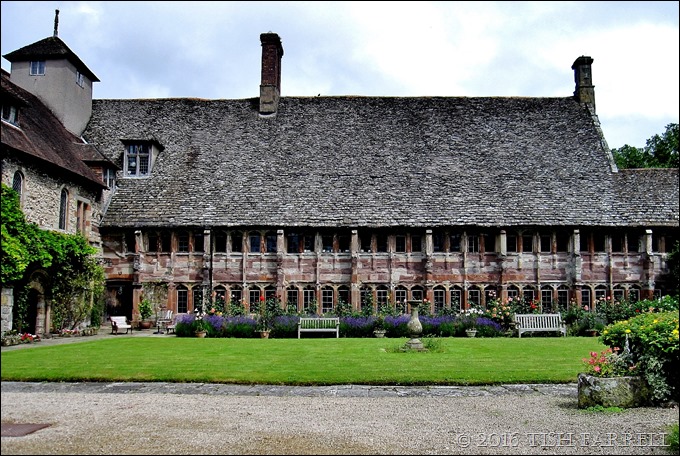
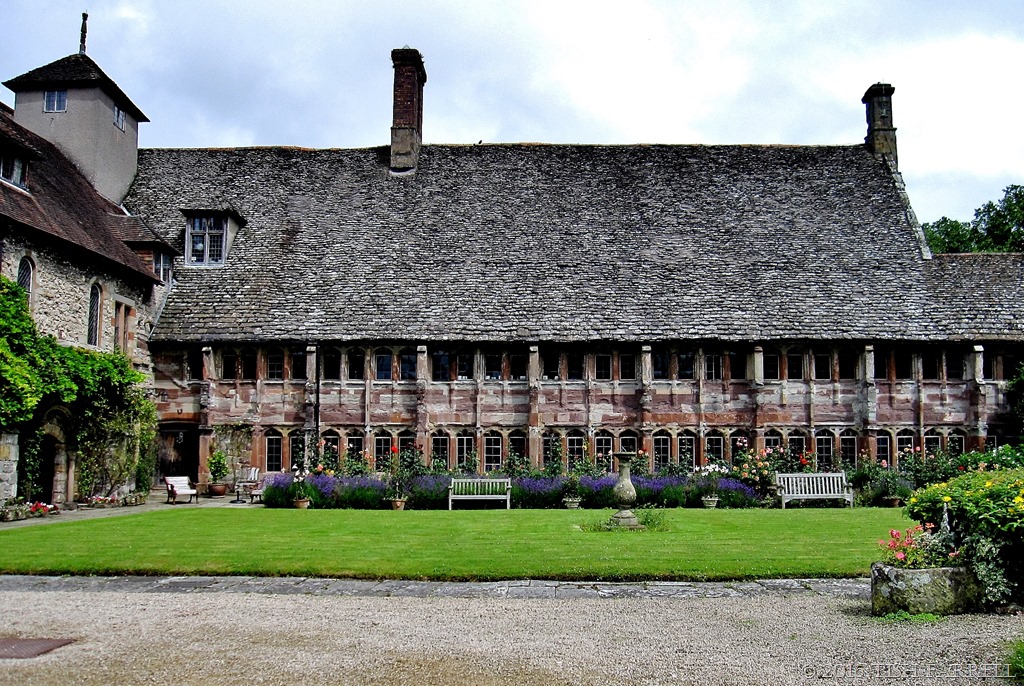
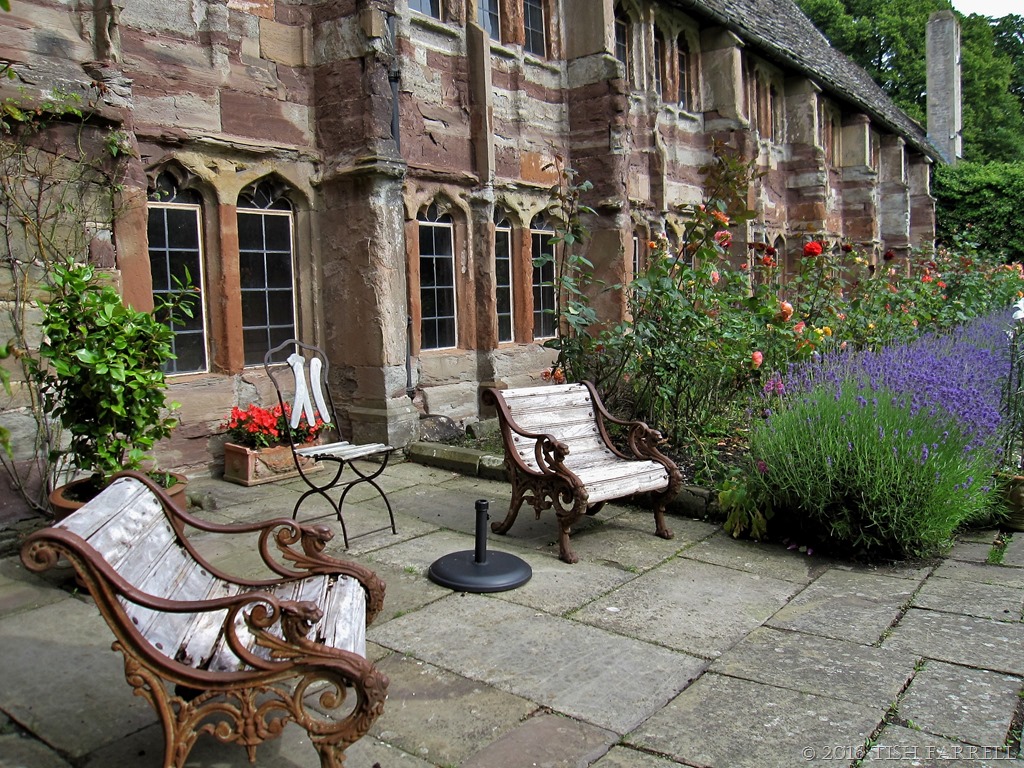
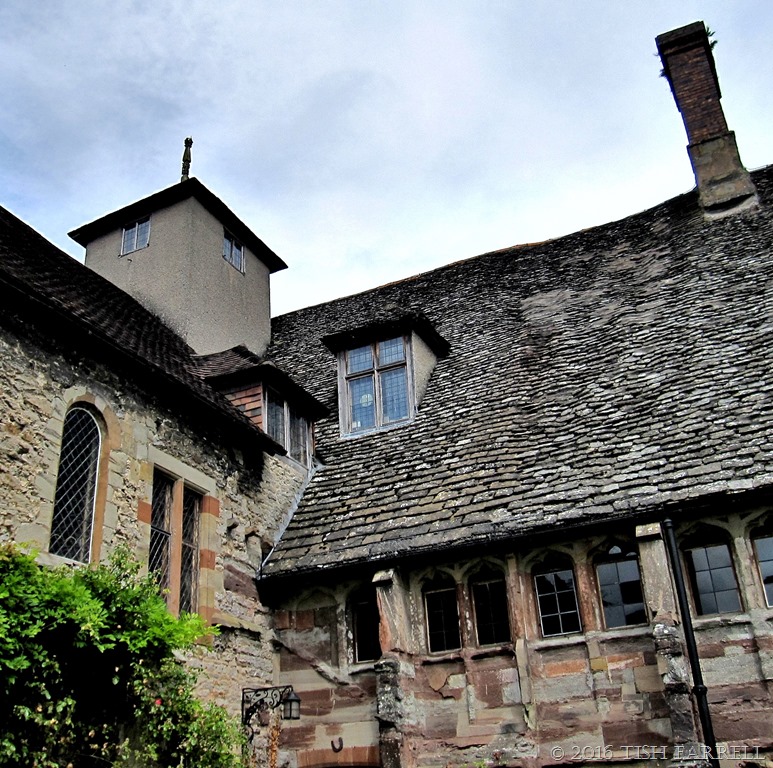
The range seen in the first photos is the most recent part of the house, built in the early 1400s. The limestone wing, just visible on the left, comprised both the monks’ infirmary and the original prior’s chambers, and are considerably older.

The present owners have spent the last three decades restoring the house, and creating interior settings that to many might seem outlandish and controversial. There will be more about this in a moment.

But first those celebrities of times past. I’ve written about his visits before, but one of the returning house guests in the days of the Milnes Gaskells’ ownership was Henry James. He came in 1877, 1878 and 1883 – and apparently drew much inspiration from the house and grounds when he was writing The Turn Of The Screw.  The little roof-top tower certainly puts in an appearance in the text.

At the time of James’ first visit, his hosts, Charles and the young Lady Catherine Milnes Gaskell, had not long been married and were expecting their first child.  The invitation had been secured through ‘lobbying’ by a mutual friend, Henry Adams, the American historian. He and Charles Gaskell had met as undergraduates at Cambridge, and before Charles’ marriage he had also been a frequent guest at The Abbey. Adams thought Charles, by then a prominent barrister, and Henry James had many interests in common and would get on well; and so it proved.

Charles’ father, James Milnes Gaskell, had been the Conservative MP for the Borough of Wenlock and had bought The Abbey (priory ruins included) in a derelict state from his wife’s cousin. The Gaskells senior appear to have held rather rustic and unconventional house parties there. (They naturally had other smarter homes elsewhere). Adams describes a visit in the autumn of 1864:

God only knows how old the Abbot’s House is, in which they (the Gaskells) are as it were picnic-ing before going to their Yorkshire place for the winter. Such a curious edifice I never saw, and the winds of Heaven permeated freely the roof, not to speak of the leaden windows. We three, Mrs. Gaskell, Gask (Charles) and I, dined in a room where the Abbot or Prior used to feast his guests; a hall on whose timber roof, and great oak rafters, the wood fire threw a red shadow forty feet above our heads. (1.)

One of the more unusual pursuits on such visits included the archaeological excavation of the Priory ruins.

IMG_1976

Adams describes his own contributions to the general exploration:

Whenever we stepped out of the house, we were at once among the ruins of the Abbey. We dug in the cloister and we hammered in the cellars. We excavated tiles bearing coats of arms five hundred years old, and we laid bare the passages and floors that had been three centuries under ground. (1.)

When Charles Gaskell took over The Abbey from his father, he and Lady Catherine set about restoring the property and making it a family home where they might energetically entertain notables from the world of arts and literature. Emphasis was on mind-improving activity, and an appreciation of the aesthetic in all its forms.  Visitors would be treated to extensive walks, drives and railway journeys to view all the surrounding great houses, and visit Shropshire’s many ancient churches and castles.  A trip to Wenlock Edge to take in the vistas was also obligatory.

Henry James documents his own many outings with Charles Gaskell in Portraits of Places.

Chapel Wenlock Abbey

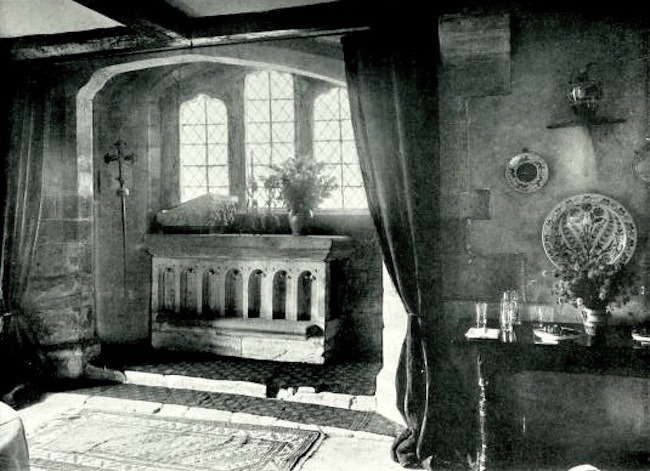
The Prior’s Chapel during the time of Lady Catherine Milnes Gaskell from her book Spring in a Shropshire Abbey  1904 (available to download on Gutenberg Press).

*

The Gaskells’ other guests included In Darkest Africa explorer, Henry Morton Stanley, architect, Philip Webb, Architect and Pioneer of the Arts & Crafts Movement, and Thomas Hardy and his wife. Hardy was apparently surprised to find himself lodged in the oldest part of the house, and declared that “he felt quite mouldy at sleeping within walls of such high antiquity” (2.)

The Hardys were also taken around the county, visiting Stokesay Castle and Shrewsbury. Florence Emily Hardy recounts how one Sunday Hardy and Lady C walked until they were tired, when

“they sat down on the edge of a lonely sandpit and talked of suicide, pessimism, whether life was worth living, and kindred dismal subjects, till we were quite miserable.”(2.)

The room wherein Hardy felt so mouldy was in the infirmary wing and is indeed very old, dating from the 1100s CE.  The original prior’s chambers were built adjoining the infirmary around a hundred years later, the scale of them doubtless dictated by the need to accommodate a series of royal visits. The deeply devout King Henry III, along with his own prestigious guests, was a frequent guest between 1231 and 1241.

100_5971

This photo shows the rear view of the infirmary and original prior’s lodgings, (the limestone range on the right) together with the side elevation of the upscaled prior’s lodgings that were added in the early 1400s (multi-coloured stonework to the left).

The king, as monarchs did, would arrive with a large retinue of servants, clerks, cooks, musicians and blacksmiths, all of whom had to be housed. There must have been some pretty good parties too, since a permanently appointed keeper of the king’s wine was required to manage the contents of the priory wine cellar in readiness for any royal visit. Supplies were  brought in from Bristol ( a hundred miles away) by the Sherriff of Shropshire and a record relating to the delivery of four barrels in 1245 states that the wine was to be placed ‘safely in the cellars there against the king’s arrival as he proposes shortly to come to those parts, God willing.’ (4.)

IMG_1996

The galleried facade of the more recent fifteenth century lodgings,originally unglazed, was constructed from stone from four different quarries.

IMG_1991

The catslide roof is tiled with stone flags.

Inside, on the ground floor, is the prior’s private chapel, while upstairs is the Great Hall with its great stone fireplace and high beamed ceiling mentioned by Adams, and next to it, though scarcely less grand, the Lesser Hall. Timbers in the Great Hall roof have been dendro-dated to 1425.

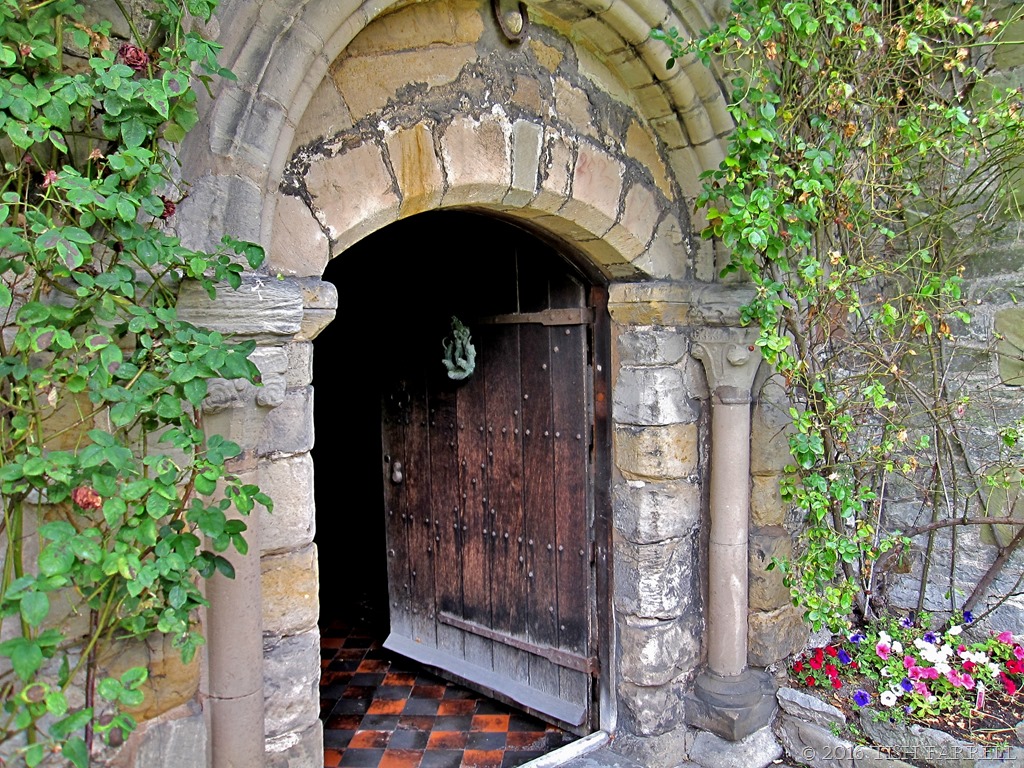
The front door to the left of this range, though, is considerably older, with its characteristic Norman arch. James describes it in his travelogue Portraits of Places (3):

IMG_1997

I returned to the habitation of my companion (Charles Milnes Gaskell)…through an old Norman portal, massively arched and quaintly sculptured, across whose hollowed threshold the eye of fancy might see the ghosts of monks and the shadows of abbots pass noiselessly to and fro…for every step you take in such a house confronts you in one way or another with the remote past. You feast upon the pictorial, you inhale the historic.

It was through this doorway we also went a few  Saturdays ago. As I said, this was a private tour, and our first such visit. Since 1983 the house has been the home of Gabriella and Louis de Wet. De Wet is an artist of some renown and Gabriella is better known to the wider world as theatre and television actor Gabrielle Drake. For the last 33 years, driven by Louis de Wet’s extraordinary artistic vision,  they have been restoring the house – carrying the building’s story on into the 21st century while revealing its ancient monastic roots in strikingly original ways. The project has been an epic labour of love, and involved the dedication of consummate craftsmen, working very much in the mediaeval guildsmen tradition.

I did not take photos. So if you want to see what lies behind this door, please follow this next link. It will take you to a 2 minute trailer of a very excellent film made by Gavin Bush in 2011: In The Gaze Of Medusa . I leave you to make up your own minds about the merit of the De Wets’ prodigious and unique enterprise. It is not straight forward by any means.

For now, here’s the one photo I did take – of the library, and still a work in progress. It gives a taste of the quality of the craftsmanship involved in the restoration-creation work, the newly made shelves that will house a life-time’s collection of books on art, philosophy and history. Also niggles apart, we did appreciate the gracious hospitality of Mrs. de Wet who showed us around with such enthusiasm, and then treated our party to tea and some very delicious cakes in the Venetian Room. So very English!

IMG_1994

copyright 2016 Tish Farrell

1. Ernest Samuels Henry Adams: Selected Letters  1992 p 69

2. Florence Emily Hardy The Later Years of  Thomas Hardy  1930

3. Henry James Portrait of Places

4. Vivien Bellamy A History of Much Wenlock  2001

Lady Catherine Milnes Gaskell Spring In A Shropshire Abbey  1904

Eminently Edible Or Too Much Like Hard Work: Plexit or Brexit Up At The Allotment?

100_5517

Some people – otherwise known as Graham – think I have secret ambitions to take over the whole of Wenlock’s Southfield Road allotment. He couldn’t be more wrong, although whenever I protest my intention to contract operations and reduce my current domain of one and half plots to a single half plot with polytunnel attached, he gives me that look. Oh yeah? The problem is, just like Britain leaving Europe, my exit strategy is complicated. But unlike Brexit, at least I do have a strategy for reducing my plot occupation. Indeed in this era of foolish contraction we could even call it Plexit.

The story of my initial expansionist tendency begins nine years ago, not long after we moved to Wenlock. I had known the town for much of my life, and lived for a long time in a neighbouring parish, but I had not known that the town had an allotment. It is well hidden behind a row of houses, a relic of much earlier times when a railway ran by our neck of the Edge, and railway workers had the right to demand that their company provide, along with their houses, some sizable garden plots on which to grow their own food.

It was a chance remark at a neighbour’s Christmas party that made me realize that the shed roofs that I could just see across the field from our new home were not in a row of private gardens as I had first thought. The hunt for a plot was on. When I finally tracked down the chairman of the Wenlock Allotment Society it was March, and I was champing at the get-gardening bit since our cottage garden was not big enough for vegetable growing. Though charming, the chairman told me all the plots were taken, and he would add me to the waiting list that already had several people on it. He did not sound hopeful, and disappointment descended. Yet by April he was on the phone saying that I clearly had a fairy godmother: my pumpkin dreams had come home to roost. Several plots had been unexpectedly surrendered, and there was a half plot left if I still wanted it. The rent was £20 per annum. So I said yes, site unseen, and we arranged for a convenient moment a few days later when he might introduce me to my new land holding and collect the rent.

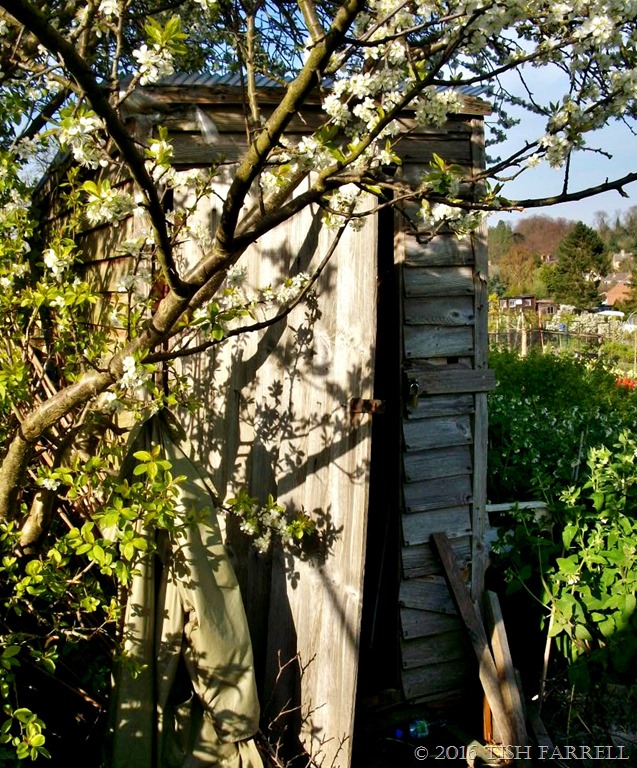
Thus began allotment my life – with an inherited leaning shed, an ancient greengage tree just then in bloom, and a plot full of couch grass, sow thistle, docks, dandelions and buttercups that the previous incumbent had clearly been nurturing for some considerable time.

100_5374

And that’s the problem with allotments. Too many would-be cultivators take them on only to find themselves overtaken by the amount of labour involved. Yet the idea of allotment growing remains beguiling, and so time passes as they decide whether or not to abandon the plot. The upshot of this is that everyone gets the fall-out from the weeds on neglected plots. Also the general tendency to disorder that breaks out in such communal enterprises provides havens and harbourage for pests and diseases that then become endemic. It takes much gritting of teeth not to resort to a host of chemical applications.

The upside of allotments is of course the camaraderie – the like-minded people who will be there to commiserate over one’s sorrow at slug and allium weevil devastation, or to swap ideas for pest control, share the joy of success and in the ensuing excesses in crops, or generally to keep an eye on neighbours’ plots while they are away. All good stuff.

Also when I first started, there was one old gardener still hard at work. Crook-backed, and slightly crippled, he travelled by bus from another village. This also involved him in quite an uphill hike from the bus stop which he could only accomplish very slowly, and with a few stops for a cigarette. But once on the allotment he tended three full 20 by 5 metre plots on behalf of other elderly tenants or their widows who lived on Southfield Road. He was there most days too, and I think he had probably been there for centuries. He gardened in the way my grandfather would have done.

Often in the winter, when we still had a few really cold ones, we would be the only people there, and I would take the opportunity to quiz him over his tried and tested methodologies. I especially took note of when he sowed particular crops. His repertoire was limited, but he grew in bulk: broad beans, runner beans, beetroot, onions and potatoes. I don’t remember his growing much else. He knew what worked best, and he knew those crops that were within his capacities to manage on such a scale.

IMG_1740

And that’s another big lesson to be learned at the allotment. When you have your first plot – which can seem so large and roomy – and you have finally cleared all the weeds, it’s too easy to assume that anything will grow there. It won’t . Not unless you have been lucky to take on a well worked, and hugely well composted and sheltered site. It took me a while to learn that it’s best to start by taking a good look at what the seasoned growers are growing; see what thrives in the face of endemic pests, the plot’s micro-climate, the general environmental conditions, and soil structure limitations. That way you can be sure to get one or two decent crops of something, and these successes will keep you going while you get to grips with your plot’s potential and/or deficiencies.

For instance another experienced allotmenteer showed us newbies that the only way to grow decent carrots and parsnips on our heavy soil was to dib individual root shaped holes at sowing time, fill them with good compost and then sow the seeds on top. It’s a rather time-consuming process but worth it if you don’t want to waste packets of seed. For carrots it also reduces the need for a lot of thinning, and the plants can be left to grow throughout the season covered by horticultural fleece, so avoiding attacks by carrot root fly. I have now adapted this idea by using moveable raised bed, which Graham originally made for me as a cold frame. I place it on top of the existing soil level. Fill it with a good six inches of fine compost mixed with coir fibre and sow into that, and then cover the lot with enviromesh.

In those first years it was tough going. I thought I was a moderately experienced gardener, but there was  much unforeseen trial and error. The plot took monumental amounts of clearing, digging, and composting. Crop successes were patchy, apart from colossal amounts of black currants and broad beans. The heavy soil proved almost impossible for sowing anything other large seeded vegetables, and even then there was a tendency for them to rot if we had a spell of cold, wet weather. Or if they germinated, the roots became compacted and the plants effectively bonsai-ed themselves, and then got eaten by slugs or infested with aphids.

All the time I was casting covetous eyes on the other half of the plot. It had clearly been well cultivated over the years, and the soil looked lighter and much more promising. I saw it produce masses of strawberries and fine looking French and runner beans. It was also nearer the water point, a serious consideration given our erratic weather patterns which often involve a spring or summer drought. I watched two other gardeners come and go there before finally making my bid for it. At last. Now I could grow decent potatoes, strawberries, runners beans, leeks, carrots, and leave the old plot to produce what it did best – raspberries, blackcurrants, rhubarb, artichokes, and swathes of very useful comfrey for feeding the rest of the plot.

100_9865

The half plot I began with nine years ago, this year growing cover crops of field beans. I should perhaps have dug some of them in before they flowered – this as a green manure. But I didn’t, and the blossom kept the bees very happy. And now I have tons of mini broad beans – to eat, and to dry for autumn sowing.

*

So now I had 70 feet of plot, and I had only just begun to get the measure of it when I rather recklessly found myself with a further half plot. This was two years ago. I was so fixated on taking over the polytunnel that Bob and Sally had erected there the previous season that I neglected to notice that it stood on an especially wide piece of ground that had once been the domain of the aforesaid aged gardener, and thus long neglected. And so quite apart from learning the new art of polytunnel cultivation, it was back to tackling another dense carpet of dandelions, buttercups and couch grass.

Even I could see the daft side. He who disbelieves in Plexit (that would be Graham), simply raised his eyebrows and saw (as with Napoleon’s invasion of Moscow) only evidence of wilful territorial overreach. ‘You’ve taken on too much,’ the look said.

‘But I have a plan,’ I said. ‘I mean to contract. It’s my ultimate objective.’

More raised brows.

‘It’s raised beds that I really need,’ I said. ‘Then I can start the retreat from the old plot.’

Being the kind soul he is, Graham agreed to making me some beds, though leaving me with the distinct impression that he was humouring a mad woman.

Last year then, and before I’d discovered ‘no dig gardening’ approach (see earlier post HERE), I started clearing the new plot, basically by skimming several inches of weedy compacted ground off the top and dumping it in compost bins where it might just rot down by the end of the century. I covered the bare ground with  the limited amount of compost I had available, sowed some trefoil for a green manure and inter-planted it with sweet corn, which to my surprise grew a magnificent crop of large cobs. I also planted out brassicas next to the corn and produced some rather fine purple cauliflowers, which also surprised me. Meanwhile Graham set about on the first consignment of raised beds, made from recycled pallets which he picked up for free from work.

100_9260

The new plot in early spring this year. Beds provided by Plexit sceptic, and planted with over-wintering onions, lamb’s lettuce and winter purslane. Behind the polytunnel the open bed has not been dug apart from some spot-weeding of dandelions, but covered with six inches of recycled soil from the allotment’s communal heap of ages (see next photo). It has been planted with Early Onward peas (just being harvested this week. See second photo above). These were pre-grown in 4 inch pots, five or so seeds to a pot, to avoid mouse devastation. I find that transplanted peas do really well, although it’s a bit of a faff having loads of pots. They also need to be well defended from pigeons as soon as they are planted out.

100_9876

This heap was apparently some 40 years in the making. At the end of the winter, before some of us began to recycle it,  it extended beyond the weeds on the right, and was 6 or 7 feet high. I suspect I have moved around 100 barrow loads. Unavoidably, given that the allotment is a weed haven, the soil is filled with weed seeds, but at least it is lighter and more free draining, and gives crops a chance to get going. So far the crops in the new raised beds, or on areas where I’ve not dug, but covered the soil with several inches of stuff from my own compost heaps, are far superior to anything grown on existing dug-over soil. And while no-dig proponents claim that this method means fewer weeds, I don’t think this holds for a very weedy allotment, but at least perennials like dandelion and nettle are easier to remove from lighter soil.

IMG_1752

This year’s Lark sweet corn, growing next to the peas on a no-dig plot.

IMG_1751

Nautica French beans in a raised bed on recycled compost heap soil. So far so good, though a few nettle seedlings popping up.

*

And now for Plexit, and my plan for plot downsizing.

Ideally in terms of work load it would have been better if I had already relinquished the half plot I first started with nine years ago – along with the leaning shed and the greengage tree that only fruits every nine years. Despite all my compost input, pony poo additions and green manure growing, the ground is still the least promising. The only remedy would be to cover it with the rest of the communal soil heap, but then I reckon that (along with effort needed to move it) it would be far better deployed on the new plot where I’ve just started making a no-dig experimental bed by covering the weedy, long uncultivated ground with cardboard and six inch layer of soil, and then sowing it with cover crops – fenugreek and phaecelia. I’ve no idea how this will turn out. It’s also adjacent to my other experimental section of cardboard covered by 6 inches of tree shreddings – another unknown quantity with regard to next year’s cultivation potential.

But the main block to immediate downsizing is the fact that the much loved raspberry patch is at the top of the old plot, and I can’t give it up until I’ve got a new bed going. The present one keeps us in fruit the year round, so can’t be surrendered lightly. I started a new bed behind the polytunnel last winter, but the canes are being very slow to get going, and I may need to replace some of them – all of which will put Prexit on hold.

IMG_1765

Nor am I keen to give up the bottom half of the old plot just yet because it’s doing rather well, and I also have my three massive compost heaps there, and several leaf mould silos. And anyway it provides plenty of room for potatoes and winter veg. And then well…

In the end I suppose it’s more than obvious. The Prexit sceptic has a point: I won’t be yielding territory any time soon.  But then that’s my point. I’m busy negotiating, doing essential groundwork, ensuring that what I give up will be in reasonable shape when I do so. Only when conditions are the best they can be, or I’ve run out of steam, will I start the retreat. Makes you wonder about Brexit, doesn’t it?

In the meantime, if don’t have a garden…

100_9851

Lots of vegetables grow well in containers – leeks, garlic, carrots, spinach, salad stuff, tomatoes. A bucket with a few holes in the bottom makes an easily portable garden.

copyright 2016 Tish Farrell

Related: Trying not to dig the plot and 30 minutes of weird weather


This month Jude at The Earth Laughs In Flowers wants to see photos of the edible garden. Visit her to find out more and see her splendid allotment gallery.

So What Is Your Reading Age? Believe Me: It’s All About Numbers

100_9945

On Saturday I had a very nice surprise. The usual post delivery person had been and gone at least an hour when along comes a courier with a neat, and quite unexpected package. Inside are my 6 author copies of the new edition of Mau Mau Brother. Yippee! Much jumping up and down in the kitchen. It’s always a thrill to have the freshly printed book clasped to one’s chest.

Some of you may remember that just over a year ago I was turning my brain inside out, cutting an already tightly written teen reader in half to make a new edition. The first version, bottom left, is a 6000-word, 64-page novelised short story aimed at struggling young adult readers with a reading age of 9-10 years. It is one of Ransom Publishing’s  Shades series of fast-paced, high interest teen fiction.

The new Sharp Shades 2.0 edition has the same number of pages, 3,000 words, larger font and the addition of several moody full-page, grey-scale  images. Its target audience are less able teen readers.

When it comes to reading age markers, it is worth pointing out that the average UK reading age (that includes everyone, adults and all)  is 9 years. The reading age for our best newspapers like The Guardian is 14 years, and the reading age for tabloids like The Sun is 8 years. But of course the ability to read, and the application of that ability, and using it to acquire information, learn or to nourish the mind, are not necessarily the same thing.

It’s quite simple too. Teens can struggle with the notion of actually picking up a book; are daunted by the size and word density of a 40,000 word novel. It can be tied in to a lack of self worth; some deep belief that if they attempt so big a book they will fail; that it will be yet another manifestation of their feeling of uselessness and inferiority; that so much dense text with no pictures is of itself BORING.

There are, after all, so many other more instantly engaging, loud and in-your-face-ears-eyes experiences to be had at the lightest press of a button, and every minute of the day. You can while away every spare moment on your smart phone with whatever teen version of TwitFace is currently cool. It’s like a continuous intravenous feeding – films, music, chat endlessly streaming into us. I think it was Margaret Atwood who, speaking of the addictive quality of the internet in the Observer, said that the problem is, every time you log on you expect WWW to deliver you an Easter Egg.

That’s it exactly. It’s how I feel. It must be how Margaret Atwood feels too!

All of which is to repeat that there is for many – adults and children alike – a big resistance to picking up a book in the first place, let alone losing themselves in it. Reading requires effort and application and being still. Which brings me back to my book. The aim of the Shades series is to engage teens with the process of reading; to help build a reading habit; to show that reading a story can deliver more than a tray load of Easter Eggs, something more meaningful that helps you grow within and without; to discover where your place is in the world. The stories, then, must be arresting, but their conveyance swift and affecting. Remember: we are up against competing intravenous streaming here.

Screenshot 2015-11-05 10.37.32 (2)

As you can see, I’ve taken some editing liberties with the covers in the intro photo. This is what the new Sharp Shades edition actually looks like.

The story is told in the first person, present tense by fifteen year old Thuo. And since the cover blurb already sets scene, I won’t say more. But to demonstrate something of the editing process involved in reducing one accessible text to an even more accessible text, here are excerpts from the two versions of Chapter 2. I think it’s anyway interesting to see what can be excised from a piece of prose and and have what’s left still carry the narrative. Of course in the process the whole tone may change. I actually found myself more engaged with the sparer version. But see what you think: the hard  pruned Sharp Shades first:


Bombers

The day we lose our home Mugo and I are taking our goats to graze. My little brother runs ahead, slapping the dewdrops from the grass. I stew on my anger.

Before the war, I was a schoolboy. I wore a smart white shirt and khaki shorts. I was studying hard to be someone. Then the British closed my school, and now I am a goat herder.

It’s another reason to hate Kungu.

I’m so busy fuming I don’t hear the Lincoln bombers. They come like giant birds.

Boom-boom-ker-boom.

Bombs fall. Trees fly apart. Hills sprout volcanoes. They are bombing God’s Mountain, bombing Mau Mau.

When the planes drone away and the smoke clears, Mugo grabs my arm.

‘Kungu?’ he chokes. ‘They’ve killed him.’

*

And now the here’s the original Shades version:


Bombers

On the day we lose our home, my little brother Mugo and I are taking our goats to pasture.

It is January, high summer. All around doves coo and cornstalks rustle, and I think: how can there be war on so fine a day?

The sun is just rising and Mugo runs ahead, slapping dew from the grasses, so the drops fly like jewels through the sky. I remember doing that too when I was younger.

But I was not minding goats. I was hurrying to school, wearing the white shirt bought four sizes too big from the Indian trader so it will last for years. And I am wearing khaki shorts instead of my kidskin wrap. It is my first day at the Kikuyu Independent School.

Father has taken me away from the Scottish Mission, saying the teachers there teach Africans to be nothing better than clerks and house servants. He says I will have a better future at KIS.

I don’t. With the uprising, the British close my school. I have been minding goats ever since. It is another reason to hate Kungu.

Mugo goes on swishing grasses, but I am so busy fuming I do not hear the planes. Then the world shakes to bits.

Boom-boom-ker-boom.

Mugo jumps like a spooked deer. And we run. At the top of the ridge we see the Lincoln bombers like giant birds above the forest.

Down come the bombs. One, two…five, more…till I want to vomit. The hills sprout volcanoes. Trees fly apart. Our goats shriek.

We stand and stare as if turned to stone. The bombers do not target our farms, only the forests outside the Reserve.

When  planes drone away the smoke clears, we stare at God’s Mountain. The jagged snow peaks, the dark forest slopes, are still there. It is hard to believe.

‘Kungu?’ Mugo’s eyes dart round in case there’s anyone to hear. ‘They have killed him?’

*

As you can see, nearly two thirds of the descriptive context has gone from the shortened version. It is easy to be sorry to lose these kinds of detail, but ruthless cutting of such passages was better than losing the story.

All fascinating stuff. I quite like seeing how many versions of a work I can come up with. And I really enjoy the challenge of a limited word count. After all, it’s not so much about how much you can hang on to, as how little you actually need to tell a well rounded and affecting story.

But there is a problem here for me as creator of fiction. If you produce work that is labelled for a specific purpose, then it is unlikely to be read by anyone else, i.e. those who consider themselves outside the target audience.  As a writer, I write for anyone who will read me, and tend to balk at categorisation of any kind. I especially dislike the category ‘educational writing’.

All the same, if the stories I write, and the different ways I can write them, will encourage unkeen readers to read and develop a love of reading, then I’m wholeheartedly for it. Not to read well is to be disenfranchised. Your options are shut down. You leave oneself vulnerable to those who would misrepresent, manouevre and manipulate the information-world we inhabit. Good reading promotes understanding, powers of discretion, a sense of autonomy; it strengthens mind and imagination, those attributes that make us keenly human; the very attributes we will increasingly need if we are to make something worthwhile of our lives on this planet.

In England we especially need to look to our laurels. In fact those laurels are down round our ankles like pants that have lost their elastic. We apparently have the lowest teen literacy rates, and second lowest numeracy rates of the world’s 23 most developed countries. Korea, Japan, Netherlands are respectively the first, second and third most literate and numerate nations. See The Spectator article HERE for more on this shaming state of affairs.)

In the meantime, more power to small publishing houses like Ransom who specialise in making books for struggling readers of all ages. Their extensive catalogue provides all the tools to tackle literacy. This particular writer is anyway proud to be a Ransom author: when it comes to better reading only the best writing will do.

*

Ransom blog on WordPress HERE

Numbers  – go here for the Daily Post Weekly Challenge
#RansomBooks  #literacy #NickyMorganSecretaryOfStateForEducation #NationalLiteracyTrust #Proud2BeARansomAuthor #BestWritingForBetterReading