From The Old Africa Album: 5 ‘Best’ Shots

Lamu Mzee Lali

This week at Lens-Artists, Steven Hyde asks to see our 5 best ever photos. So how to choose? On the one hand I have a large archive of scanned photos (the Old Africa Album), taken in the 1990s when we lived in Kenya(7 years) and Zambia (ten months). On the other hand, I have an even larger file of digital shots taken over the last 20 years. The scanned images come from slide and film negatives that were processed a decade or more after the originals were taken; they are not as sharp as the original prints (and some of my scanning was distinctly incompetent).

So it is perhaps a touch perverse to choose my five ‘best’ from this scanned collection. And also to further to discount photos from the ‘on safari’ archive (i.e. the so called Big Five wildlife attractions).  Instead, then, here are five, mostly chance photos of local people. These are encounters that often hold many memories, far bigger than the sum of visual parts captured here.

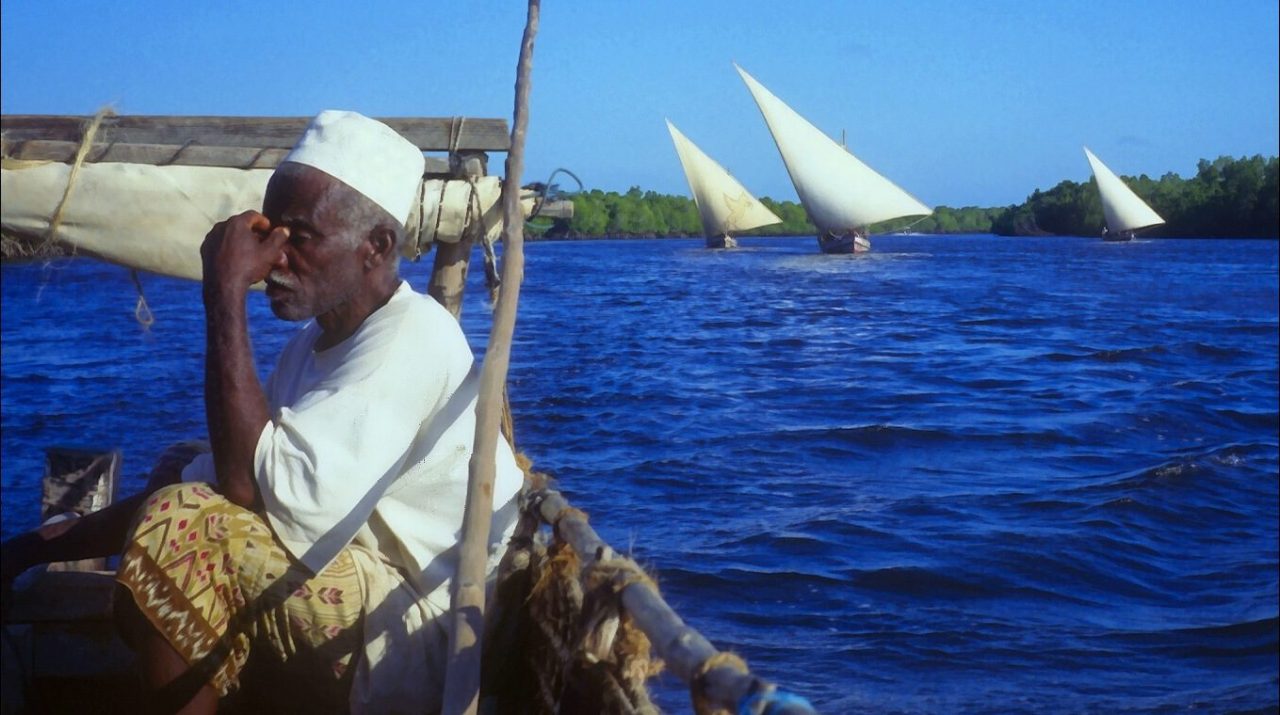
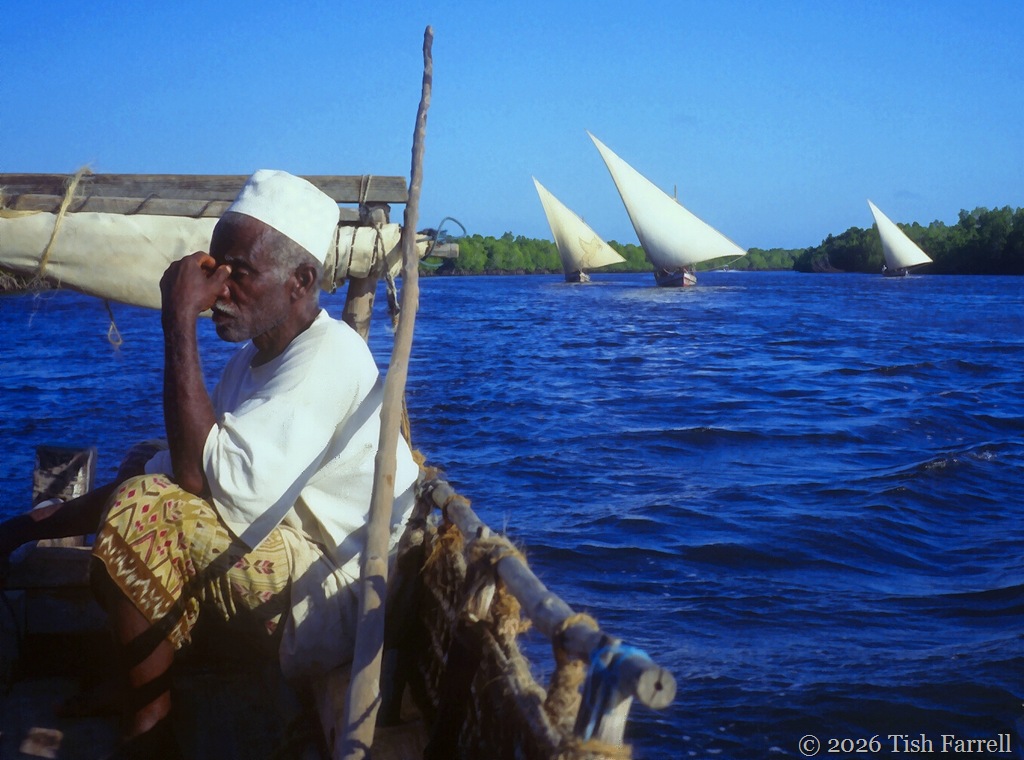
The header photo was taken during a too brief Christmas-time stay on the island of Lamu. We had spent Boxing Day on a small fishing dhow, sailing through the mangrove swamps of the Manda Strait and out to the reef where some of us had fished for our lunch. The owner of the boat, seen dozing here, was Mzee Lali, a Bajun man who spoke no English, a devout Muslim and father of twelve. His youngest boy, ten year old Miski, came with us on the trip. He said not one word that I overheard for the whole trip. Meanwhile, Lali’s nephew, Athman, our guide, and for official tourism purposes, the boat’s captain (since he spoke English, Kenya’s official language, and could sit the necessary captain’s exams) told us much about island life, of livelihoods dependent on tourism and fishing now that the big Arab trading dhows no longer plied the East African coast.

*
Esther and Tom best

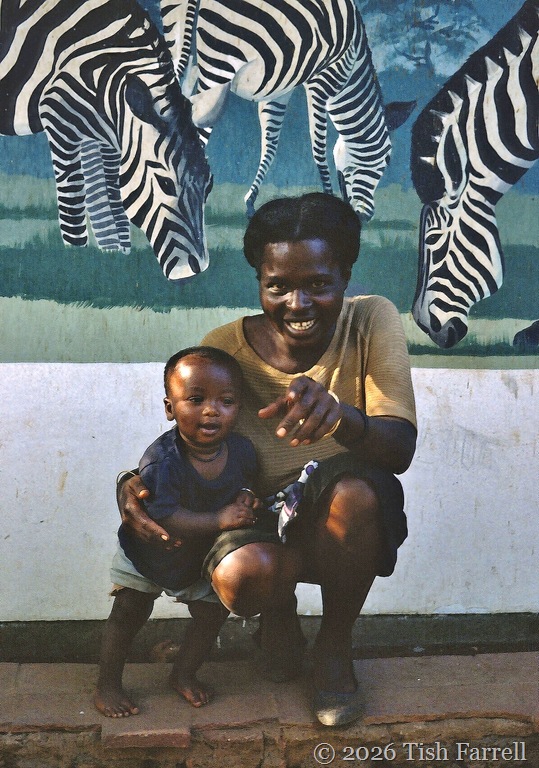
This is Esther and Tom. Esther had a curio stall on the roadside in Kiboko, on the Mombasa Highway some hundred miles south of Nairobi. I saw her now and then when we were staying at nearby Hunter’s Lodge. (Graham had a project in progress at the Kiboko agricultural field station). She was very keen for me to trade any spare clothes for some of her Akamba wood carvings. She also had a notion about where she wanted to have her photograph taken, and took me along to the Kiboko petrol station where there was also a cafe with this zebra mural. She then told me her address in nearby Emali where I could send the photos.

A young woman with a plan, or indeed several.

*
Digo girls better

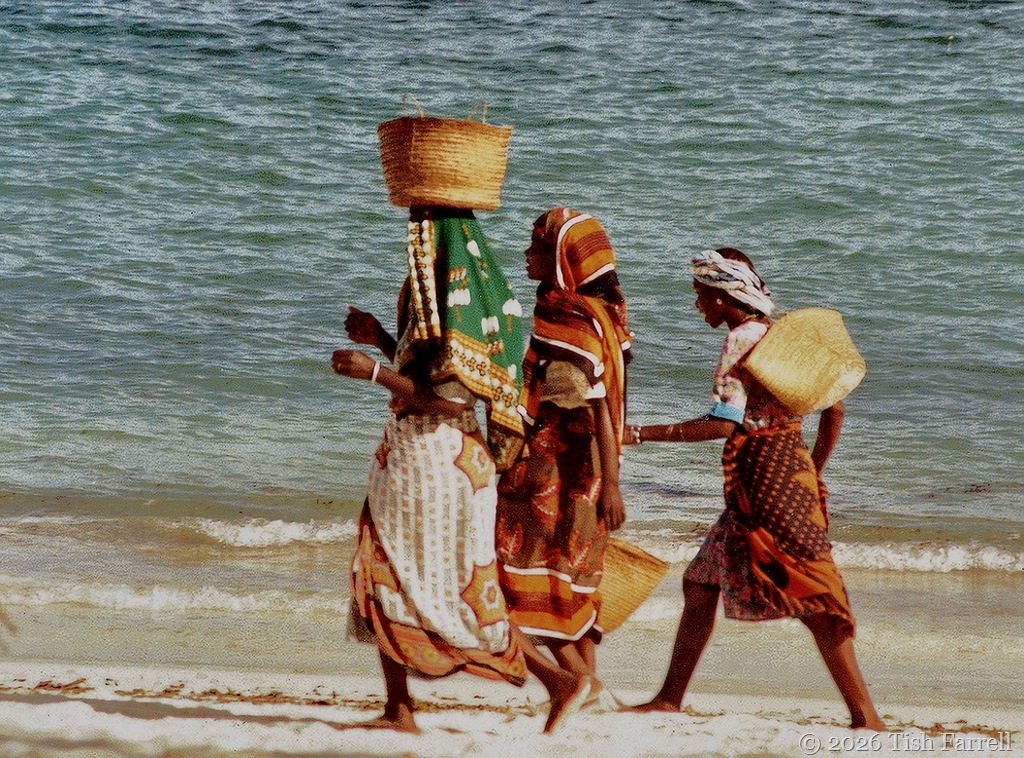
While Graham worked, went to seminars, visited Kenyan farmers, I camp followed. And so here I was passing time, sitting in the garden of a Mombasa beach hotel with a fine view of the shore. Some of the transactions taking place there were tawdry to say the least – everything for sale at a good price, but then these Digo girls came laughing by. Probably going shopping, but so brilliant in their kanga wraps…

*
img20241008_11580324ed2_thumb

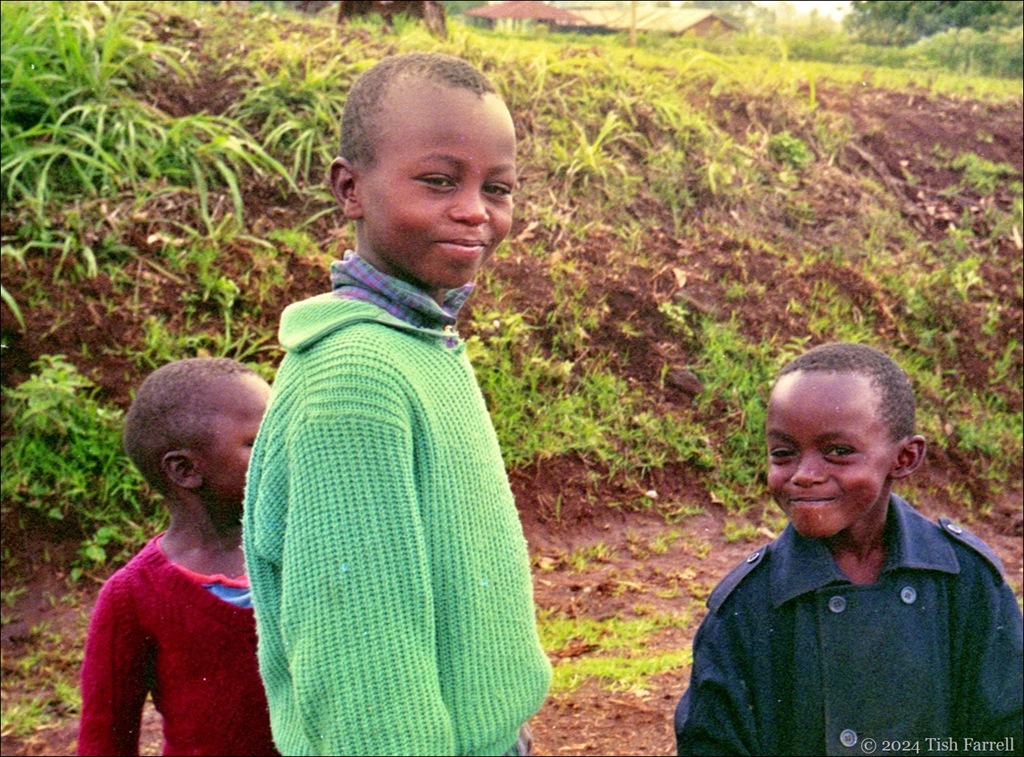
Taking photos of sweet Kikuyu lads wasn’t the idea. I was supposed to be manning the fieldwork clip board and recording data. Or when required, holding the end of a large surveyors’ tape while Graham measured a plot of Napier grass. (There’s clump in the top left corner).

Napier grass is a staple fodder crop in the highlands above Nairobi, essential to smallholder farmers who, lacking access to pasture, must zero-graze their animals i.e. take feed to cattle and sheep kept in pens or small paddocks. The grass grows quickly and could be found planted out on any ground not given over to human food crops. This included roadside reserves. It’s a vigorous plant, but can also be susceptible to a fungal smut disease, which happened to be the subject of Graham’s field research.  Our visits to the Kikuyu farms and the welcome we always received there, even when we told the farmers that some of their grass had smut and should be burned, were some of the best times of our years in Kenya. We always came home with gifts – sugar cane, orchard plums and pears, a live cockerel…

*
Harare night guards

Another country.

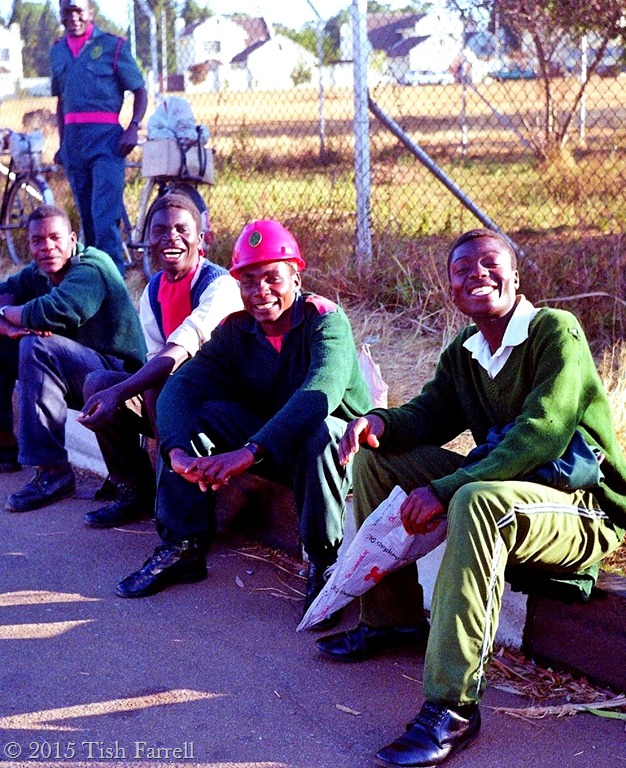
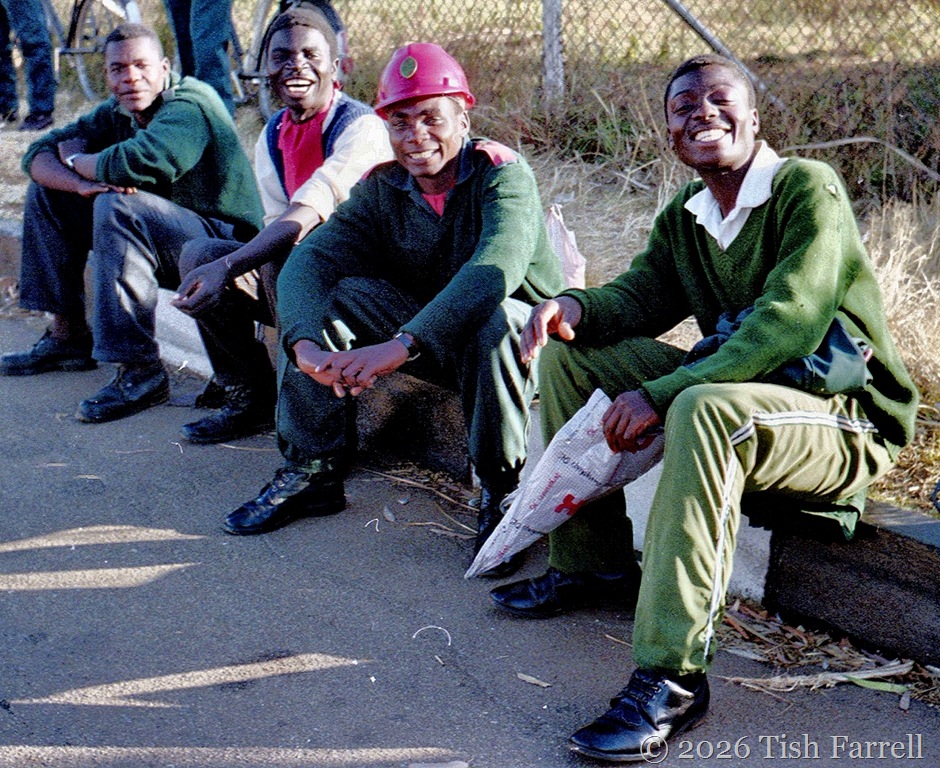
While we were living in Zambia, we took a road trip south into neighbouring Zimbabwe. This snap was taken one early evening in Harare. I wasn’t even intending to take any photos; for one thing the light wasn’t very good. We were coming back from the post office, but the young man with the biggest grin, spotted the little Olympus-trip in my hand, and asked me to take a photo. These are security house and shop guards waiting for the night shift pick up to take them to work.

Those smiles remind us of much that we miss.

*

Copyright 2026 Tish Farrell

*

Lens-Artists: Five of the best  This week Steve Hyde asks us to post our 5 best ever photos. Now there’s a challenge.
Roadside Creations

Harare soapstone carver mono

It’s back to the old Africa album for Cee’s ‘made by humans’ theme because it was while I was thinking what to post, that I suddenly remembered here was something I really missed from our years living in Kenya and Zambia: the roadside artists and artisans who, day in and day out, made some truly wonderful creations.  In fact we did most of our best shopping on the pavement – from the decorative to the solidly functional.

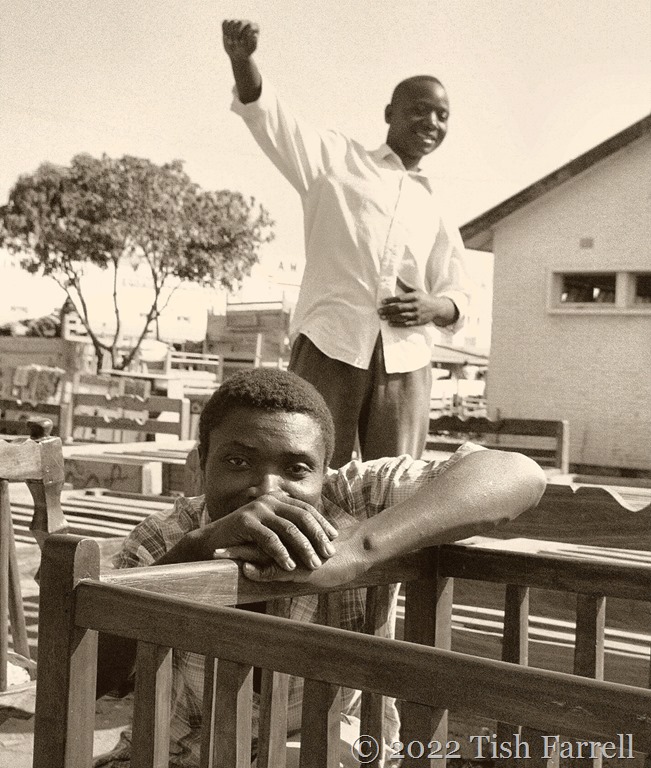
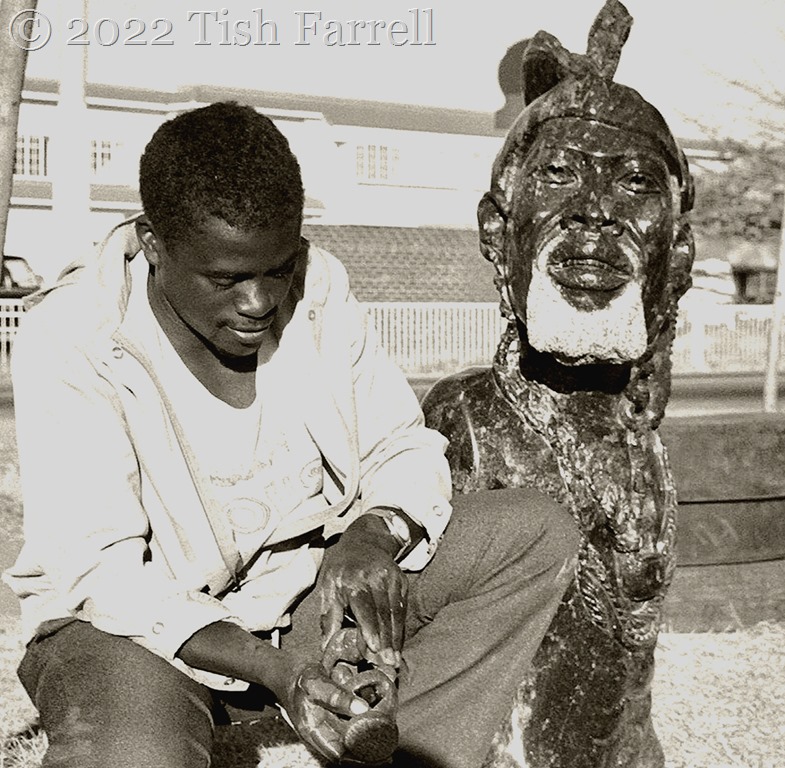
The header photo is a young soapstone sculptor in downtown Harare, taken during a road trip to Zimbabwe from Zambia. Meanwhile in Lusaka, here are the furniture makers who made beds of every kind, including ours, from repurposed air freight cases:

Kamwala roadside furniture market mono

*

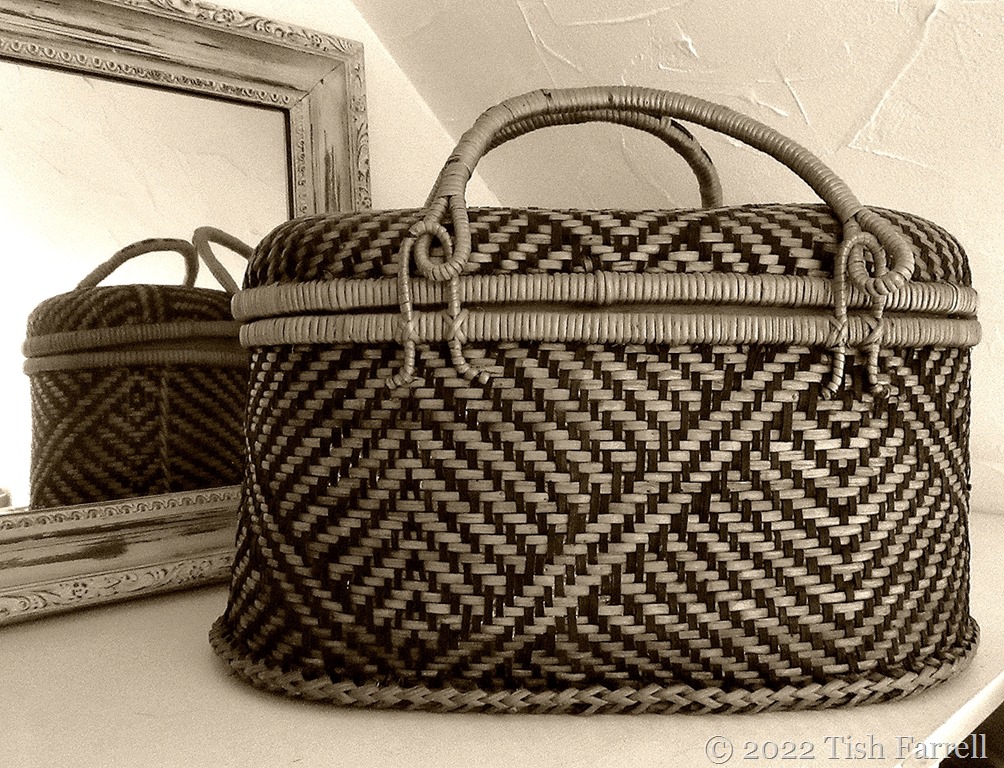
And while I’m here,  a more recent shot of one of my favourite baskets, made by the Tonga women of Zambia’s Southern Province. I use it for storing sewing and knitting bits and bobs.

mono

Cee’s Black & White Photo Challenge: Human-made

Many Shades of Grey in Africa

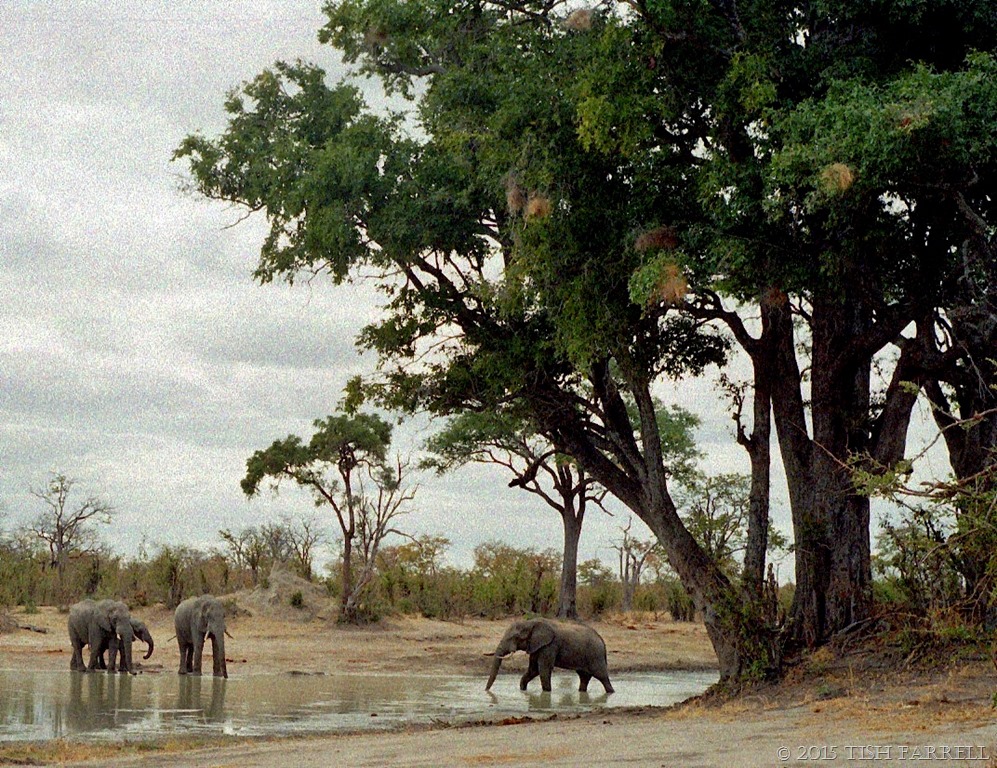
Hwange - waterhole and elephants 3

Grey days in Africa can be incredibly dull. It is a strange effect: as if the light has been sucked out, but without it actually turning dark. This photo was taken around noon on a July day – Southern Africa’s winter. The sky weighed down in a way that was almost palpable; like walking through a Welsh sea mist, except it was dry; or as if you were looking at the world through gauze.

We had driven down from Lusaka in Zambia to spend a couple of weeks exploring Zimbabwe. The objective was to meet up with two Kiwi friends who were flying into Harare, and take them sightseeing before heading with them (via Victoria Falls) back to our house in Lusaka. The day this photo was taken we had just spent the night in one of the guest bungalows in Hwange National Park, and assembled a picnic of sorts in the Park shop.

Hwange Park has metalled roads which detracts somewhat from the notion of wild Africa, and so whenever a dirt track presented itself we took it.  Even so, we saw very little game apart from some kudu. It was mostly dry bush, and more dry bush, which soon grew rather boring. In the end we pulled up by the dwindling waterhole in the photo, and ate our lunch.

The waterhole had been empty when we arrived, and then quite suddenly, as is usually the way with elephants, this small family group appeared. The photo looks like a water colour, or a colour plate in a vintage travel book. I only had my little Olympus Trip, and I often had it on the wrong setting. But the other thing about elephants (and I think this image captures it) is that even when you are there, and can see them with your own two eyes, and are close enough to catch a whiff of their musky hides, it is still hard to believe in them. They come and go like mirages, walking always on the tiptoes, their heels supported by fatty pads that deaden the sound of their footfalls. It is thus very easy to be sneaked up on by an elephant.

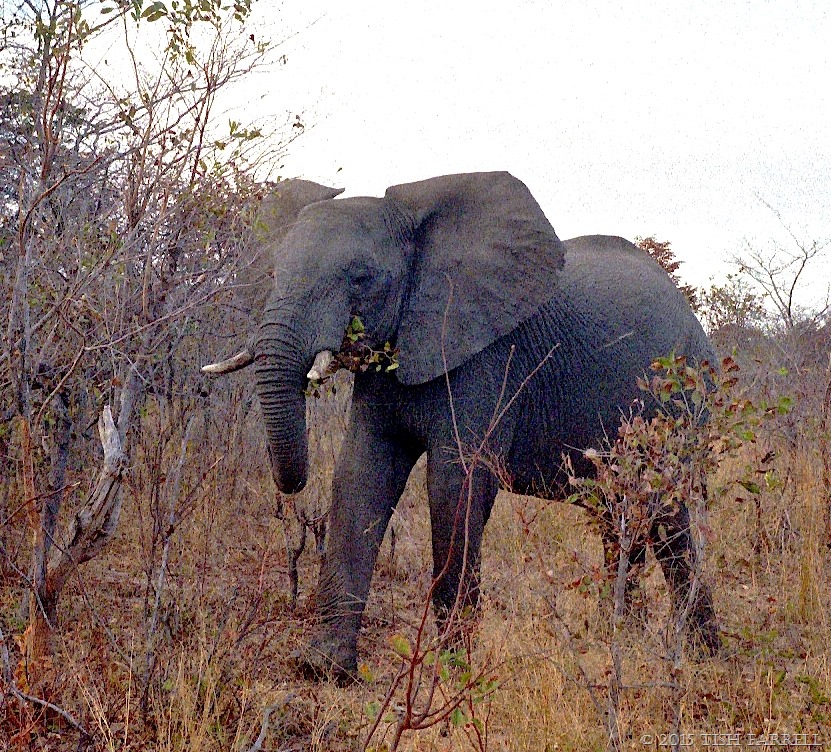
Of course if they’ve decided to do a little tree felling, since they like to clear land to encourage their favourite grass to grow, or are seeing off some deemed intruder, then you hear them alright. Indeed, there is nothing quite so alarming as a trumpeting matriarch, clearing a waterhole of potential threats to the family’s infants. On this day, though, all was dreamy peacefulness, and concluded surreally enough in the Game Reserve Hotel at Dete where we were the only guests, and the only food on the menu were pieces of very tough meat  that took an hour to chew.

Hwange National Park - elephant in the bush 6

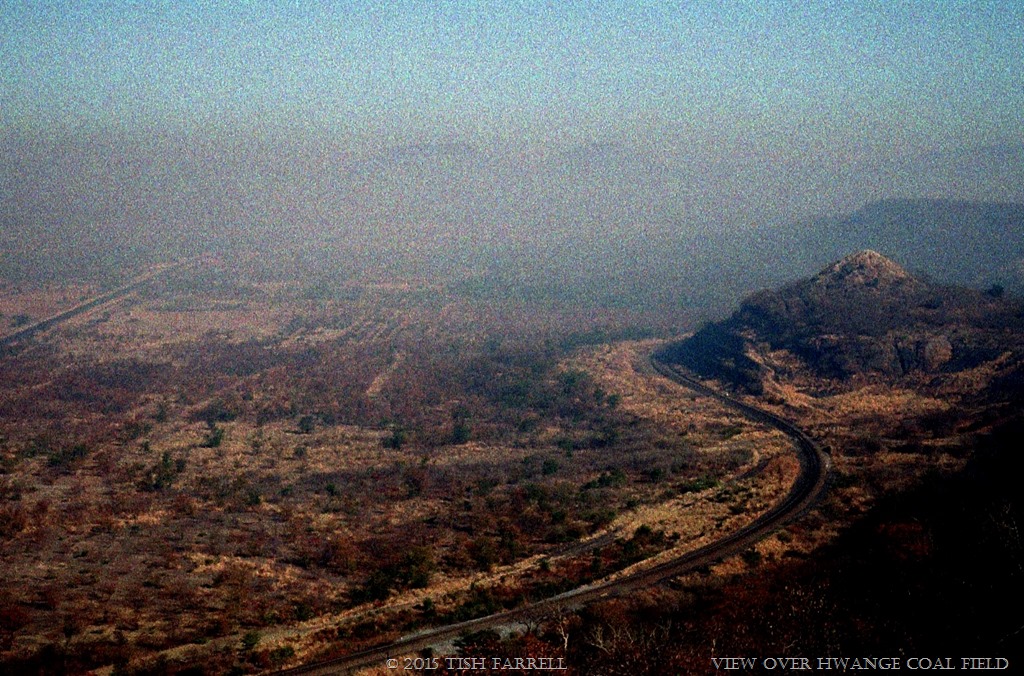
The next day, though, we woke to a new kind of dream – golden sun through a mist of coal dust that hangs like a heat haze over the vast Hwange Coal Field. And so we quickly turned our noses from the industrial smog and headed for the border and Victoria Falls.

Hwange - smog over the coalfields

copyright 2015 Tish Farrell

For more shades of grey please visit Ailsa at Where’s My Backpack

The Night Guards, Downtown Harare

Harare night guards waiting to go on duty

A big thanks to Yvette who is Paula’s guest over at Thursday’s Special for giving me the chance to post this photo again. Her challenge is street portraits, and this is one of my favourites, taken on a brief trip to Harare in Zimbabwe.

We were living in Zambia at the time, and had driven down to Harare to meet friends who were flying in from the UK  to spend two weeks with us in Zim and Zam. At the time, life was a bit tense in Zambia. The first year of multi-party democracy had already yielded one attempted coup. Destabilisation by stirring up a crime wave was part of the strategy. The national football team had been killed in an air crash and left the country devastated (see link * below for this story). There was cholera in the townships and members of the unpaid Zairian army were coming down to Lusaka on looting sprees. It was thus a relief to find ourselves in a city where the atmosphere felt so open after Lusaka. This was in 1993 I might add. I know Zimbabwe’s seen some bad times since, and Zambia’s fortunes have greatly improved. Things can change so rapidly on the African continent.

But it’s the spontaneity of the security guards’ reaction that I love. I’d just crossed the road from the post office, and they were about to start the night shift and waiting for a lift.  Smiling faces like these are what I remember most from our eight years spent living in Zambia and Kenya.

copyright 2015 Tish Farrell


Related:

Letters from Lusaka part 1

Letters from Lusaka part 2

Once in Zambia: in memoriam*


Street Portraits Lost in Translation