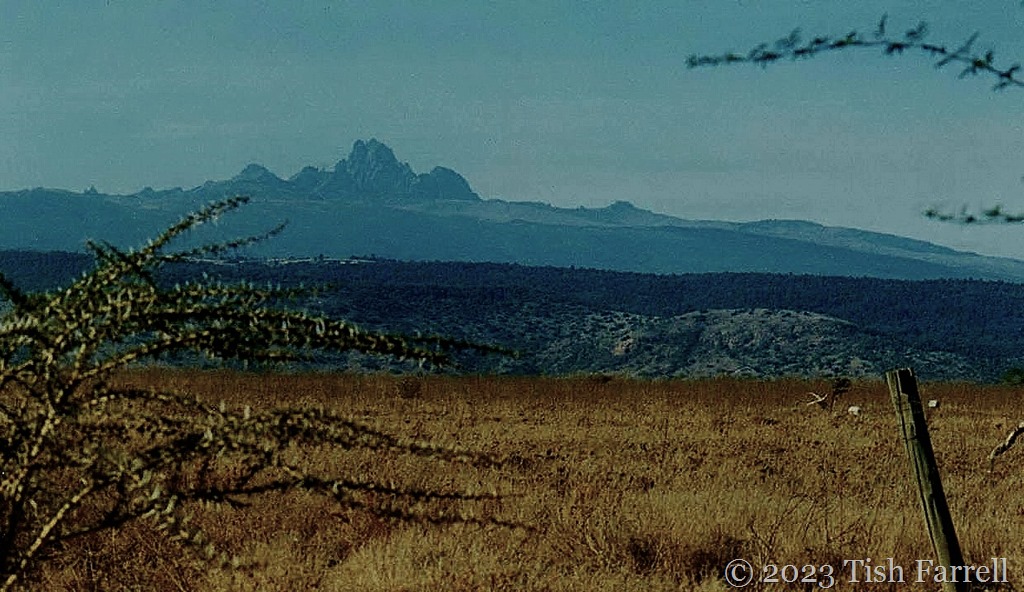
…this is one of his domains – the craggy summit of Kere-Nyaga, Mountain of Brightness, better known outside East Africa as Mount Kenya.
And the supreme being concerned is Ngai, maker of earth, the cosmos and everything. And it was to Ngai that the Kikuyu farmers of Mount Kenya’s southerly foothills once offered their sacrifices and prayers. Although they only did this in times of great crisis, since it was generally held that Creator was a remote figure, little concerned with human affairs. When his help was sought, he was addressed as Mwene-Nyaga, possessor of brightness (Jomo Kenyatta, Facing Mount Kenya 1938). Nyaga also has figurative connotations, meaning ostrich, but in this context suggestive of the white plumes of the male ostrich, a visual analogy for the glaciated zones among the dark mountain peaks.
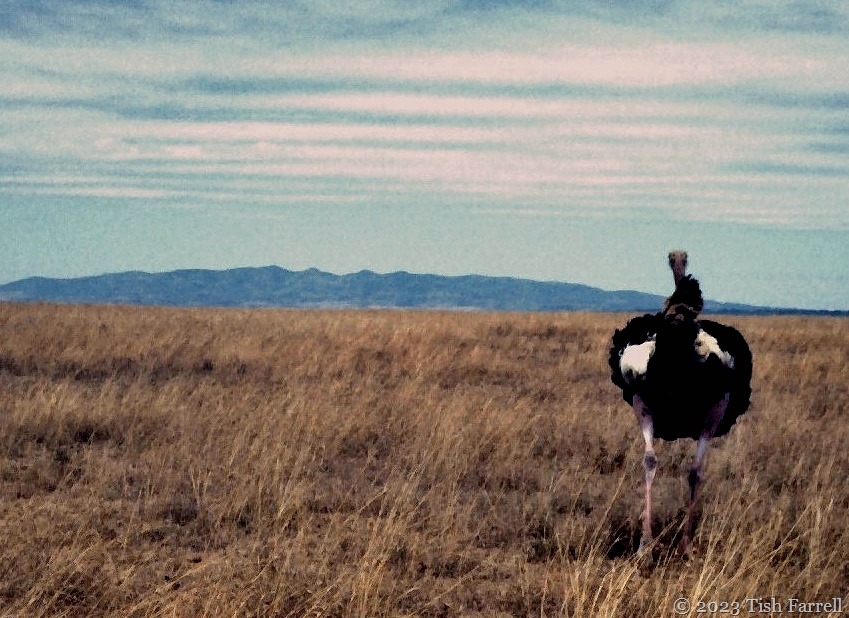
You’ll see the thinking in this next photo:
This shot of a retreating male ostrich also captures a distant view of the Ngong Hills, another landmark of spiritual significance, not least in recent times to Out of Africa writer Karen Blixen and her lover Denys Finch Hatton whose burial place it is. For that story see Caught inside a Kikuyu garden.
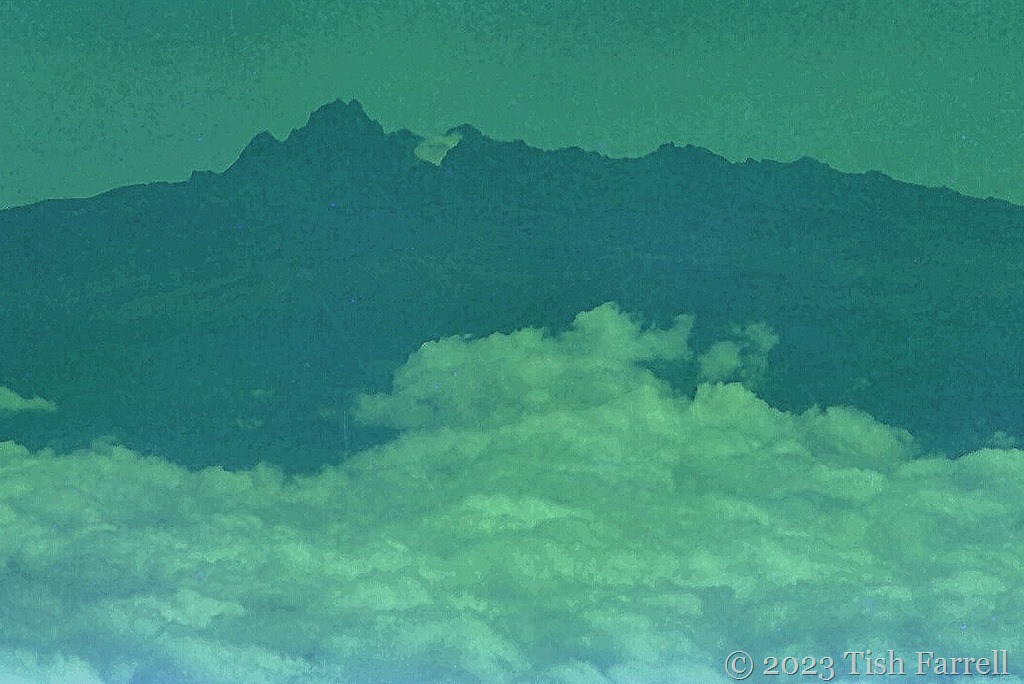
I’m sorry I don’t have more and better photos of Mount Kenya. The ones I do have are a little odd, as if the mountain meant to tease by showing off parts of itself at times and in places where it was not expected to be. I remember spotting it early one morning as I stood in the garden of the Outspan Hotel in Nyeri, the jagged summit floating gauzily above the horizon.
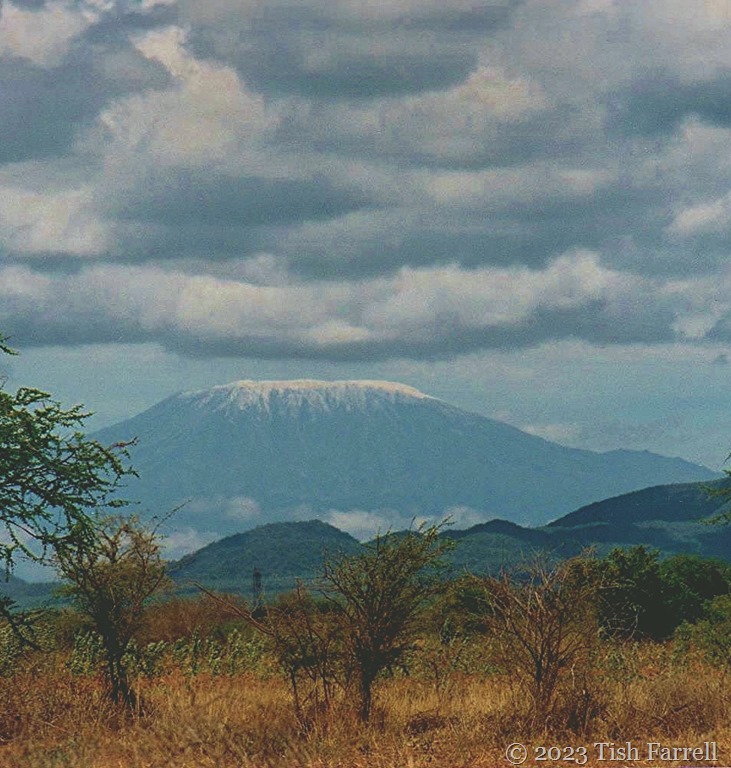
For several moments I was fixed to the spot. By the time I thought of taking a photograph it was gone – only empty sky in the place where it was, and a visceral sense of loss. Kilimanjaro just over the border in Tanzania, plays the same trick. Both mountains spend much of their time being mysteriously invisible. Yet there are travellers’ tales that claim occasions when, looking north and south, both mountains appeared simultaneously. Just imagine!
*
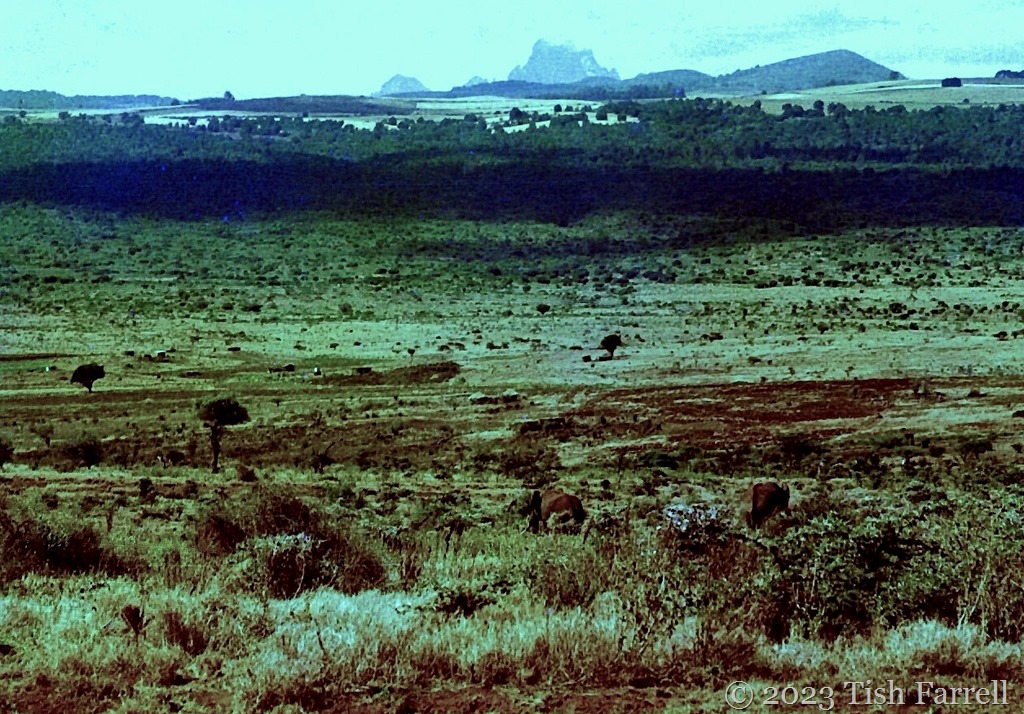
And now for the Mount Kenya photos I do have. The first one was taken from a small plane on our way to Lewa Downs:
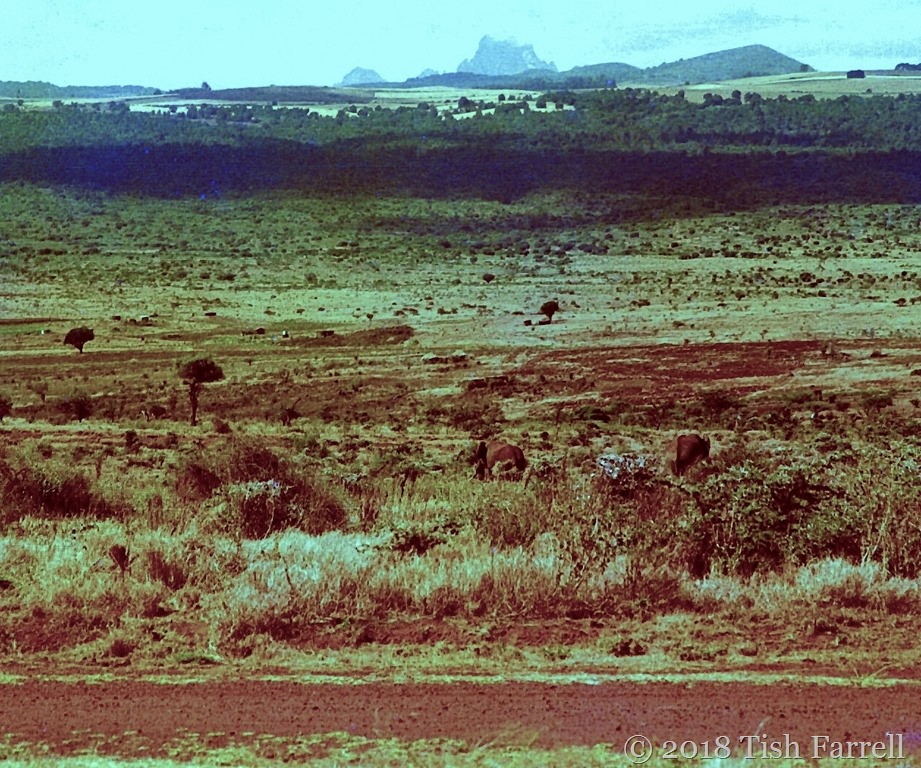
This photo was taken beside the Lewa Downs air strip. At the time, it was the two elephants, just visible in the foreground, that caught my eye. It was only when I was scanning the image that I noticed the odd geographical juxtaposition of Mount Kenya’s summit. What are its lofty peaks doing just there, and so sneakily? They are over 17,000 feet high.
*
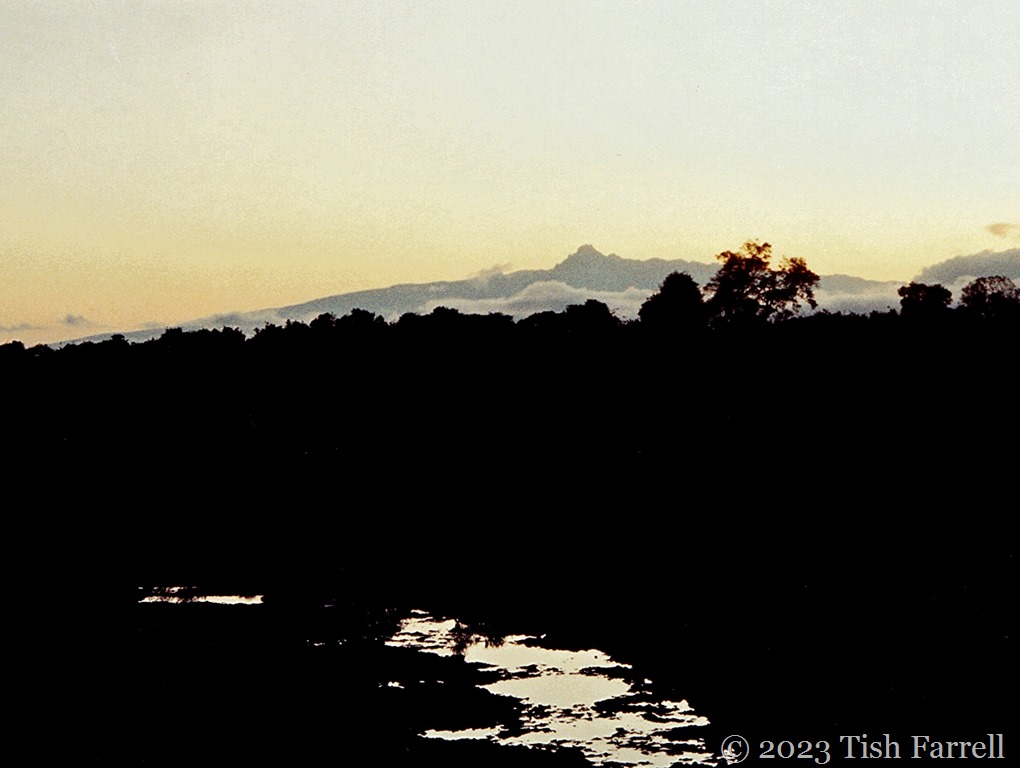
And finally a sunset view of Mount Kenya from the neighbouring Aberdares National Park. The Aberdare Range is also one of Creator’s dwelling places when he is checking out earthly doings. Its Kikuyu name is Nyandarua, which I believe means place of the crumpled hide – another interesting metaphor. Here’s an aerial view:
These vivid names for spiritual landscapes remind me that in traditional pre-literate societies, the natural world provided humans with unlimited scope for pondering, creating and observing. Its diverse parts were sources of inspiration and expression, things to think by, a resource for metaphor, analogy, riddles, song, dance and story telling as means for making sense of existence.
Particular mountains, trees, rocks, lakes, chosen as places to make sacrifices or pray to Creator, are gateways to congress with the divine, and so may be taken as sacred in the same way a church is sacred space for a Christian. More broadly, though, all land may be seen as sacred since it was made and given to humans by Creator.
And in this sense, then, there is no divide between spiritual and physical; all states exist in the same plane, which is interesting, if somewhat difficult for some of us to think about. We might call it respect. We might even call it love.
In another life-time I ran away to Africa and fell in love with light. I must have noticed light before, but I do not remember this kind of rapture. There’s the land too: the visceral, eviscerating redness of the earth. It strikes the eye, fires every neuron in the cerebral cortex, then jabs you in the solar plexus. The hue of life and death then; no wonder traditional peoples make so much use of this pigment. There were times when I felt I could eat it.
The place I ran from is very near the town of Broseley where we have recently come to live. There’s an odd sense of ‘full circle’ and a musing of: should I be worried about this unexpected retracing of steps; is there a reason I’m back here; some unfinished business to be dealt with now that I’m ‘older and wiser’? Etc. etc. I decide this line of thinking is a distraction, although it has me looking back through thirty years.
The place I ran (or rather flew) to was Nairobi, Kenya and so to a nine month stint of roaming up and down the Mombasa highway, accompanying a plant pathologist who worked both at the Kenya Agricultural Research Institute (KARI) in the city and at the Kiboko field station, a KARI outpost, a hundred miles south in Ukambani, homeland of the Akamba people.
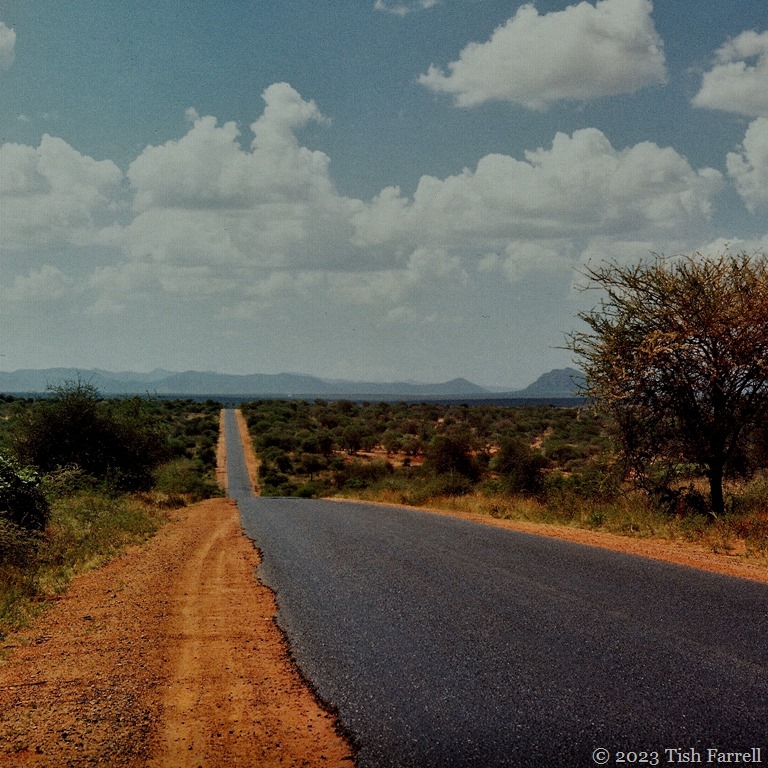
Mombasa highway, looking north from Kiboko
*
Said plant pathologist, aka Graham, was working on a British government funded project to eradicate a maize-gobbling beetle known as LGB, the larger grain borer. (Everything you need to know about the science is at this link).
The pest had no known predators in Africa, having been introduced from South/Central America in consignments of US food aid in 1980s. And so finding itself free to infest the granaries of people who subsisted on grains, and on maize in particular, it quickly established itself across the southern and eastern continent, then in West Africa, travelling along major railway routes.
The aim of the project was to breed up stocks of a (safely) introduced predator beetle as a biological control and then release it in LGB infected areas. Meanwhile, the habits and destructive capacity of LGB were being monitored in various store experiments at Kiboko and at the coast near Mombasa.
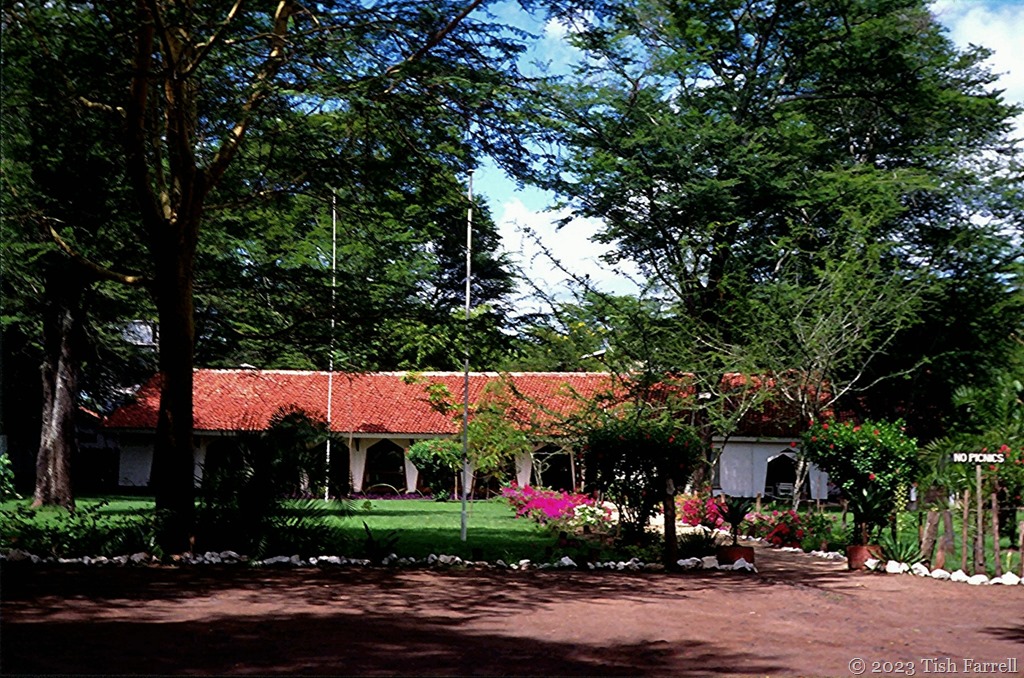
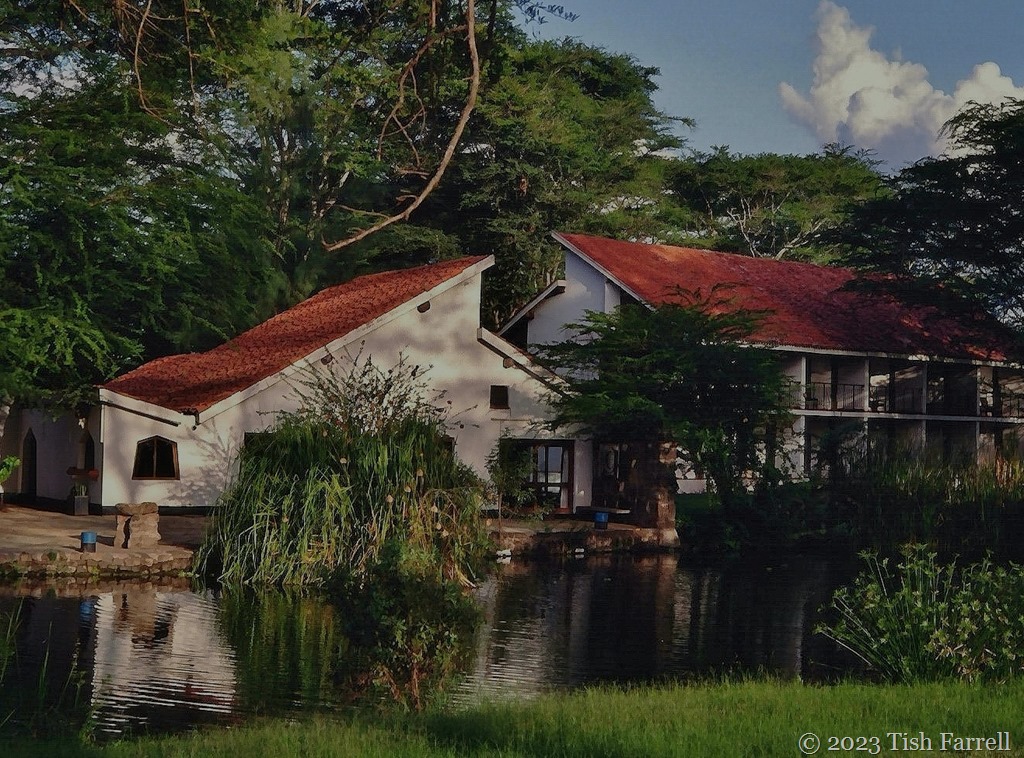
On days when Graham was working at Kiboko, we stayed at Hunter’s Lodge. In our time it was an eccentric hostelry that seemed to survive for the benefit of its staff; there were rarely other guests there. Once it had been the home of John Hunter, Great White Hunter and doyen of the colonial grand safari era, friend of Baron Bror Blixen and Denys Finch Hatton, guide to sultans and European princes.
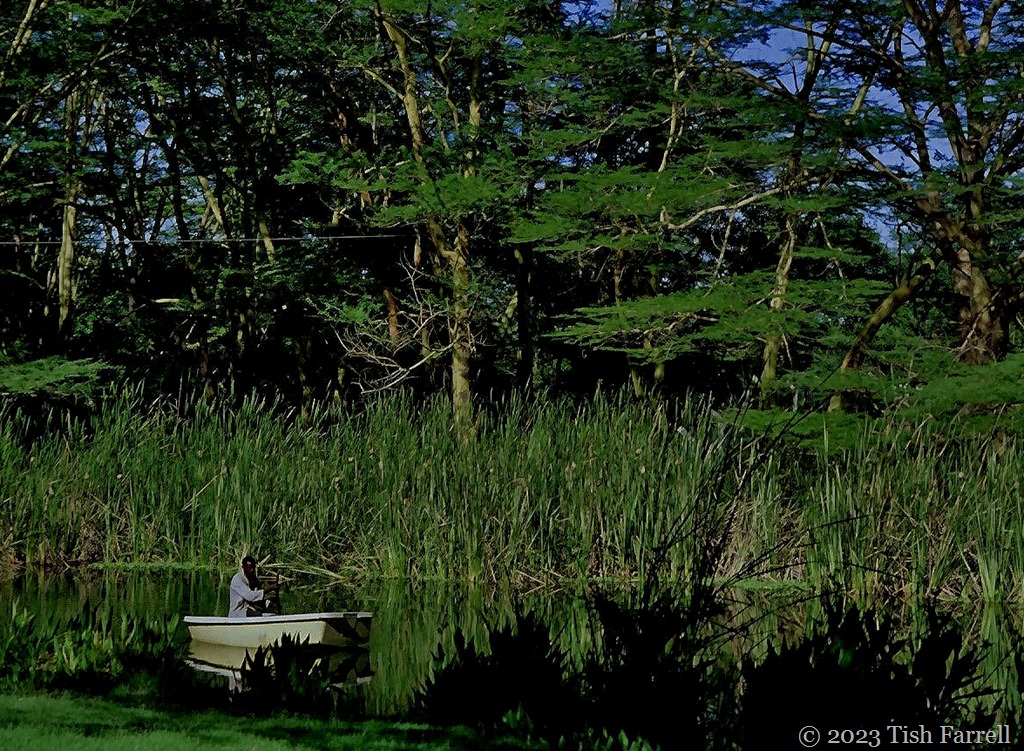
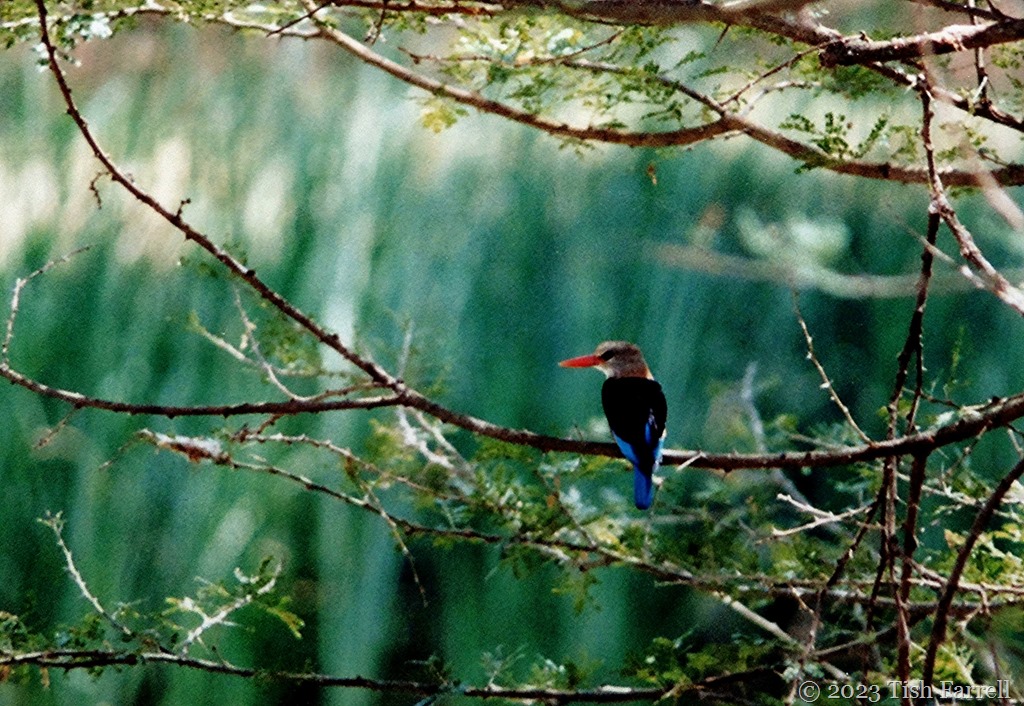
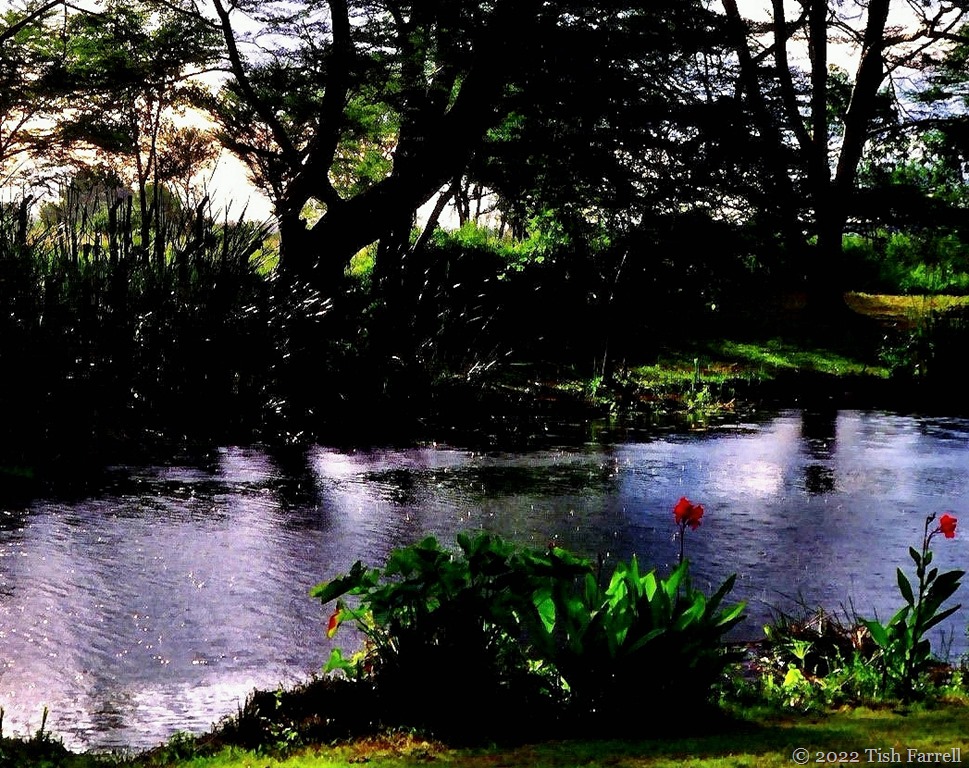
He had chosen the spot to build the house near the Kiboko River, at a place where elephant once came to drink at sundown. He also made a pool by diverting the river, and so created a marvellous haven for birdlife (some 3-400 species recorded there). I spent hours watching night herons, grey herons, weavers, pied, giant, brown headed kingfishers, ibis, white eyes, and storks. I took few photos: it was beyond my Olympus Trip’s capacity.
There are no elephant photos here either. They no longer came, nor would be welcome. Anyway, Hunter did a thorough job of official game clearance in Ukambani, where the colonial authorities deemed elephants a nuisance to settler farmers’ plantations. The nearest herds these days are an hour’s drive south in the vast national parks, Tsavo East and Tsavo West.
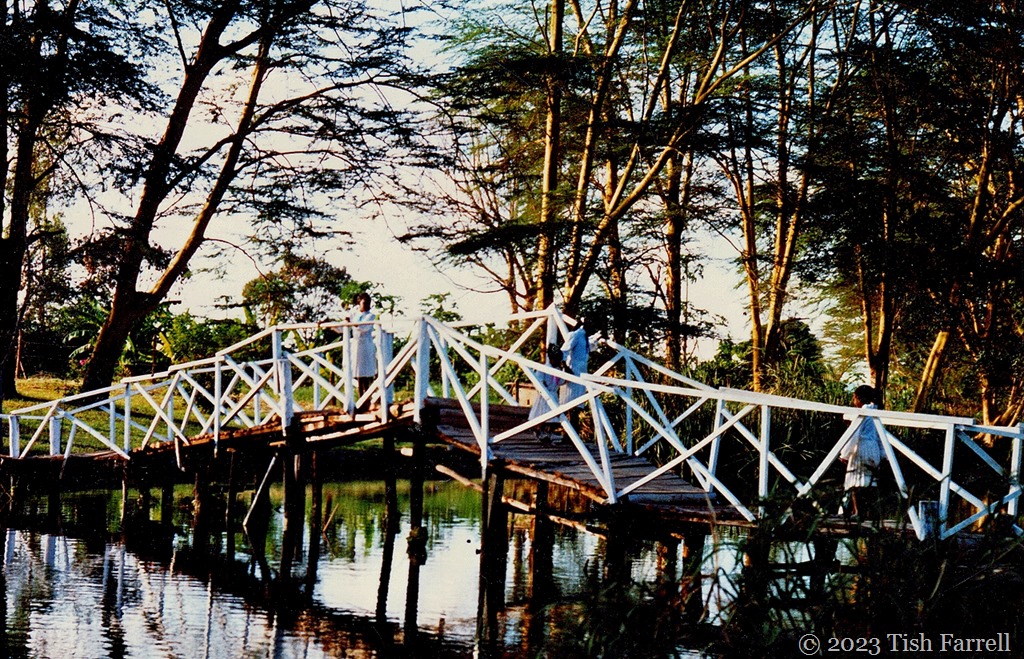
The bridge led to the hotel’s fruit and vegetable shamba
*
Rain and sunshine together: ‘a monkey’s wedding’
*
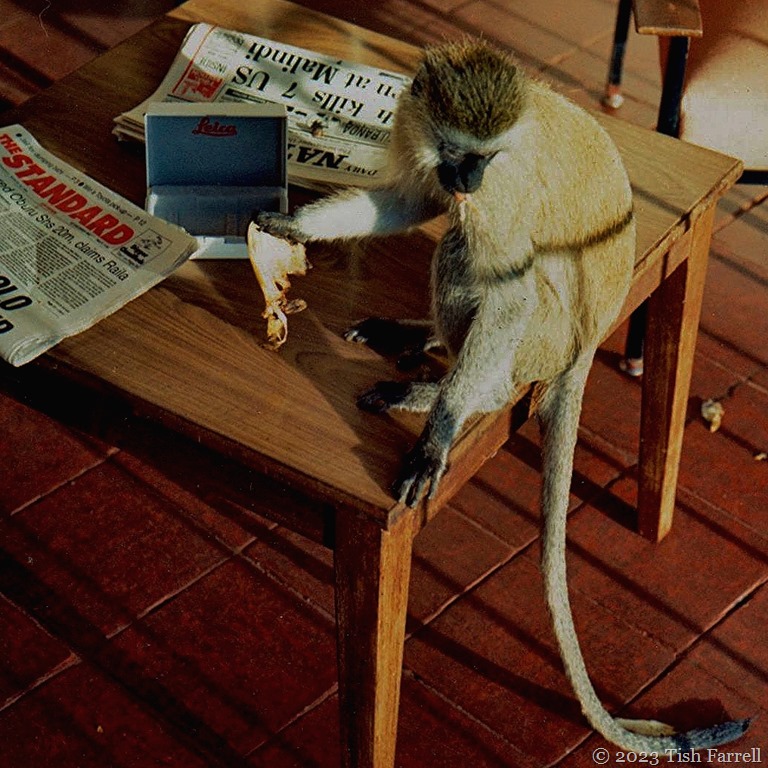
And speaking of monkeys, the garden was home to a troop of vervets, who soon learned we had a stash of food in our room. They were quick to relieve us of anything they could grab:
*
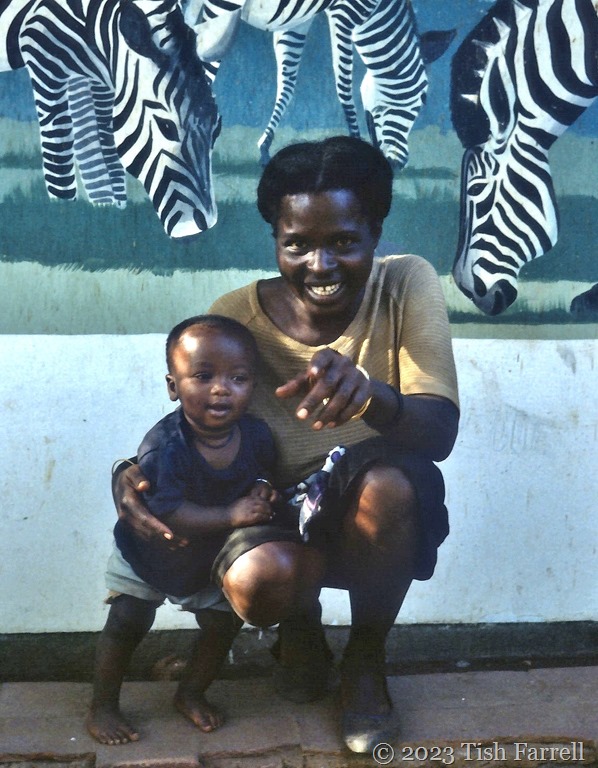
While I was staying at Hunter’s Lodge I met Esther, a young Akamba woman who had a stall selling wood carvings out on the highway. She also dealt in second-hand clothes and, an astute business woman, soon had me exchanging some of mine for her carvings. I think she had the best of the deal. I was useless at bargaining. She also had a notion that I would like to take a photo of her with young son Thomas. She knew exactly where she would pose, and took me along to the nearby petrol station where there was a cafe with a zebra mural. So please meet Esther and Thomas:
*
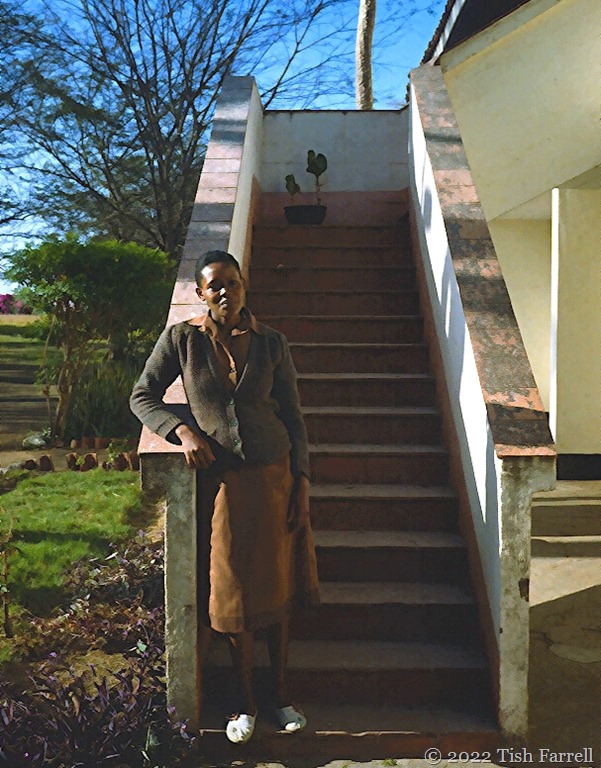
And here’s lovely Joyce who, on our return to Kenya a year later, used to keep our room tidy:
*
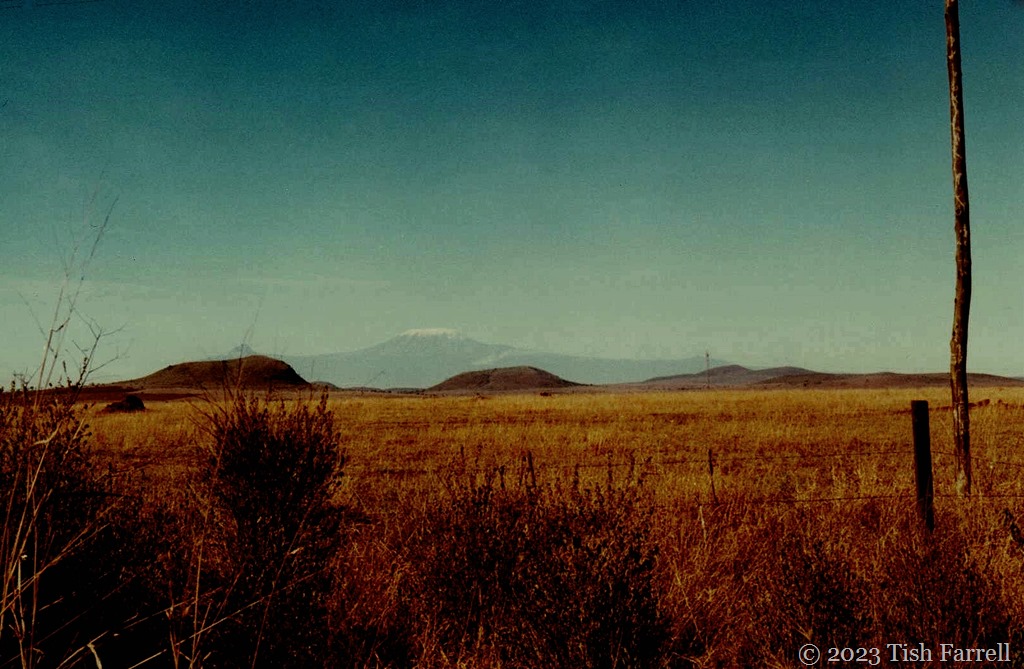
There were times, usually in the early morning, when we were leaving Kiboko that we’d catch sight of Kilimanjaro. There it rose on the horizon like a mirage. In seconds it would be gone, like a snuffed flame but without the tell-tale drift of smoke. You’d be left wondering if you dreamed it.
*
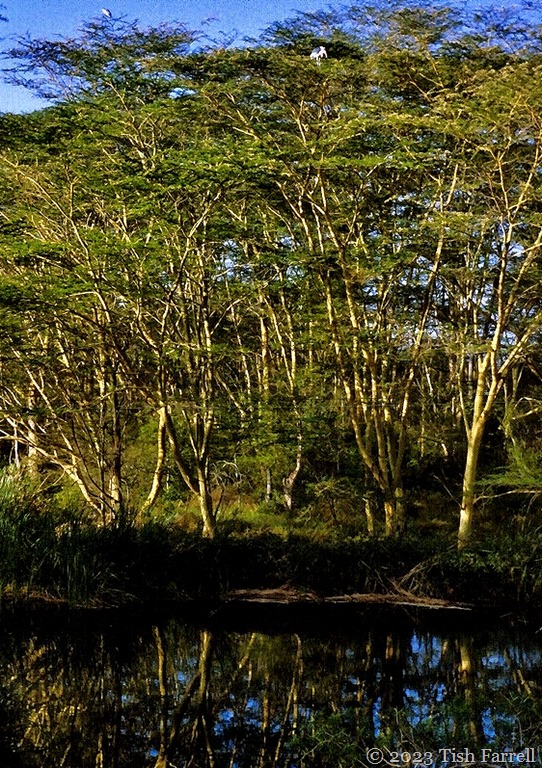
I fell in love with fever trees too, the graceful acacias that, incidentally, have no disease-bearing capacity, although the watery places where they live may well do so. The bark and foliage has a warm spicy scent that is unforgettable, and as for their looks in sundowner light, well, what is there to say…
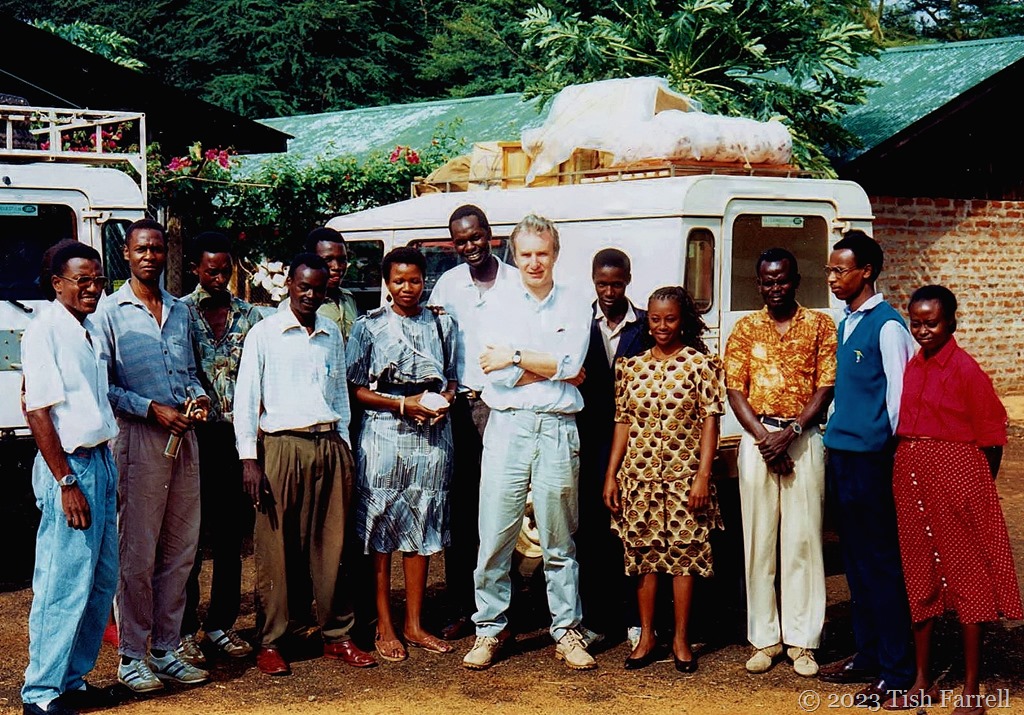
When, at the end of our nomadic nine months, we went to live in Zambia (a very fresh-airy state) I truly missed the scent of fever trees. I couldn’t believe our luck when Graham was posted back to Kenya. It was then he had the rather dismal job of winding up the LGB project at the Kiboko field station. He threw a long, loud party for the lab staff at Hunter’s Lodge, and the next day everyone lined up to have their photo taken.
Most had other jobs to go to and were heading back to Nairobi and beyond. Only Paddy, then a young researcher, remained to carry on monitoring LGB movements and checking the insect traps on the nearby Range Station. He lived on the station in a remote staff house, up a long, long dirt road. These days he is Doctor of Agricultural Entomology at a research institute in Nairobi:
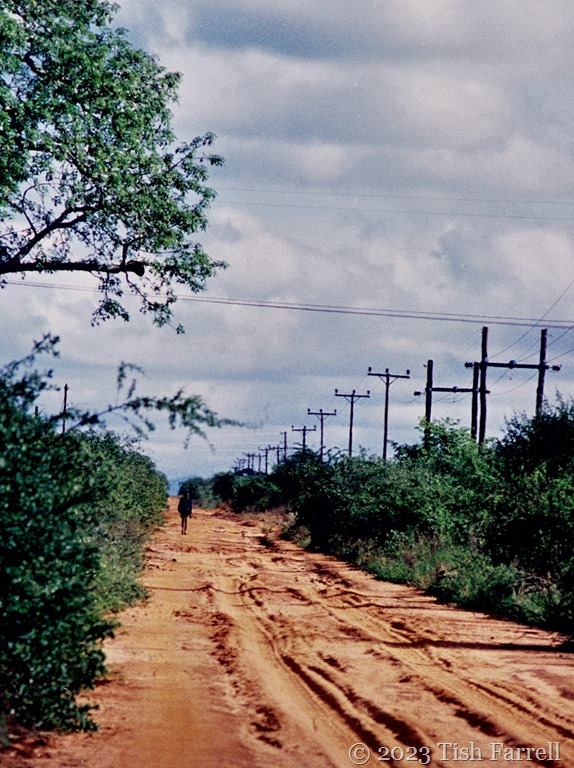
The road to the Range Station. I think this land was once a colonial (failed) sisal plantation. We heard that the thorny wilderness it had later become was the haunt of buffalo, an animal you definitely do not want to meet at close quarters.
*
After our return to Kenya in late 1993, we stayed on a further six years. This time Graham was involved with on-farm crop protection experiments, engaging the smallholder farmers in the process. As for LGB eradication, it seems attempts to use a biological control have not been especially successful, although the predator has naturalized and does have some limited effect on LGB numbers. Scrupulous cleaning of granaries between harvests plus chemical applications, e.g. dusting the stored crop with a pyrethroid insecticide does work, but otherwise it can be a sorry tale for subsistence farmers, who may not be able to afford the stuff. In the worst infestations up to 40% of stored grain can be lost, and up to 80% of dried cassava, a staple crop in West Africa.
So: some dark clouds on these horizons. It’s a lot to mull over. All these years on, I’m still trying to process it.
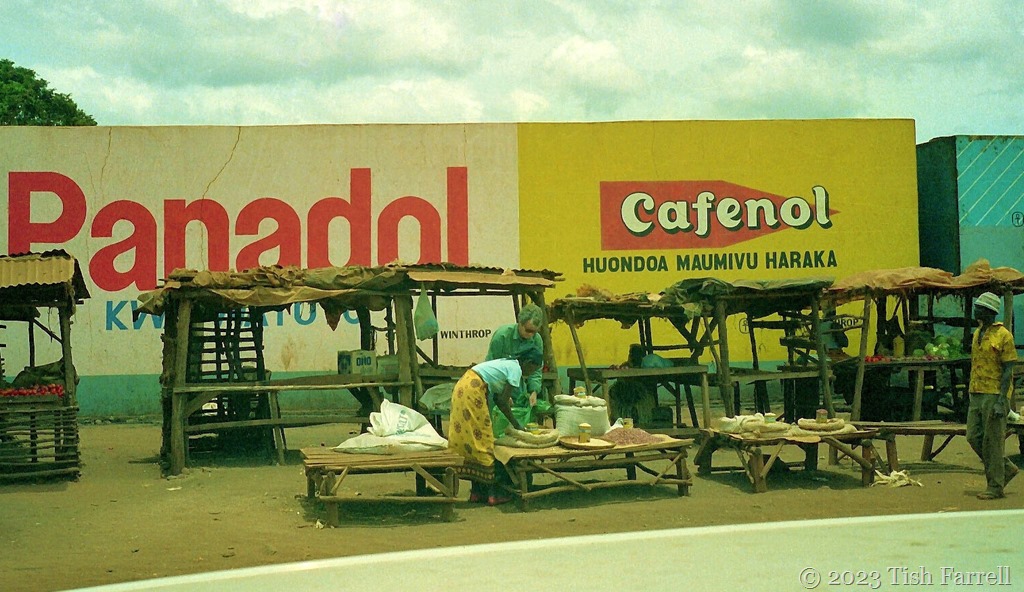
Graham at Emali market, buying maize for the Kiboko grain store experiments.
There are the experiences we had, and the ones we think we had: so many versions of the ‘truth’. And much like conscious memory, the Kodak negative from which this image comes, is much degraded; the colours distorted. I’ve had to do some de-saturating to reduce the negative’s livid cast. Not very successful, but the result, I think, is all my own ‘Out-of-Africa-nostalgia’ effect.
Naturally my writer-self loves the romance of this and related yarns of the old safari era. And yet these are not the real story. They never were. That’s one of the problems with nostalgia, particularly the Anglo-African variety. It’s usually a longing for something that never was. It was the kind of longing that brought British settlers of the gentry class out to East Africa in the first place. Anything would grow there, they said. Fortunes would be made. And until the predicted riches rolled in – from ostrich feather farming, flax, wheat, coffee and tea – the hunting potential for the sporting man (and sometimes woman) was limitless – herds of wild game from sky to sky, and a country full of cheap household servants and farm labourers. And all so handily available just when home supplies of both (animal and human) were on the wane.
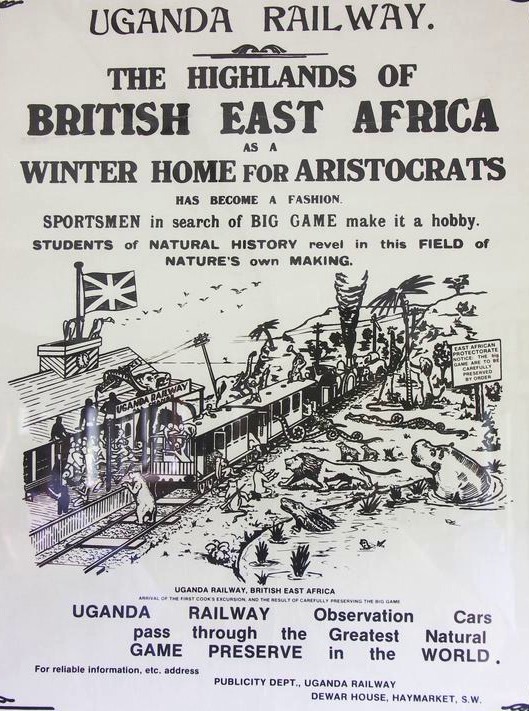
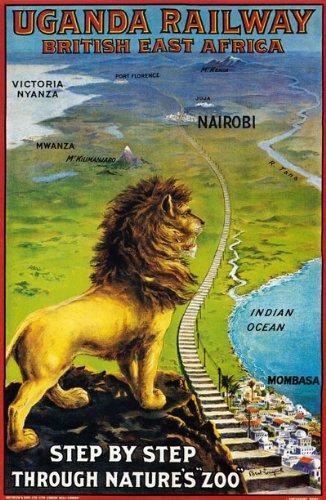
Here’s a poster of the time, pre-1920, summing things up. The similarity to a Punch Magazine cartoon was apparently deliberate.
As railway advertisements go, this one truly takes the biscuit, and on so many fronts. Please note the very small print towards the bottom: ‘Arrival of the first Cook’s excursion and the result of carefully preserving the big game’. Also I’m not sure what the bipedal beast behind the train is meant to be. It looks like a bear to me. Perhaps he came with the aristocrats, captured on one of their North American shooting expeditions – also popular at the time.
So: elite settlerdom in East Africa seemed a fine idea. And as long as the European lower classes were kept out, the incomer Indian labourers and traders kept in their place (these mostly the survivors of the 18,000 ‘coolies’ imported from India in 1896 to build the Mombasa-Uganda Railway), and the local Africans did the field work for minimal pay while their own traditional hunting practices were outlawed, then, by Jove and St. George, it would be paradise on earth. The British East Africa Protectorate (Kenya Colony after 1920) was, and forever would be, a dedicated White Man’s Country. A lordly sporting estate writ large. The happy hunting ground of new white landowners who believed that only they, gentlemen (and under certain circumstances, gentlewomen) had the god-given right to hunt. All the game was theirs.
But hang on a minute. In this safari story the real protagonists are invisible, or overlooked, deliberately excluded; these, the many African hunters and expert trackers who facilitated the pursuits of their white overlords on the imperial safaris of the early 20th century; they who risked arrest for the crime of poaching if they dared to hunt for their own pot as their people had done for countless generations before the British invaded.
It is not for nothing that the settlers referred to their African workers as boys, reducing them to beings of little or no account. From such aristocratic notions of superiority and entitlement – a mind-set that persisted among many until Independence in 1963 – does the modern state of Kenya derive. In some ways little has changed. Ever since Uhuru, the post-colonial rulers (and with a similar sense of dynastic entitlement) have been intent on commandeering all resources for themselves, and ignoring the needs of those they rule.
*
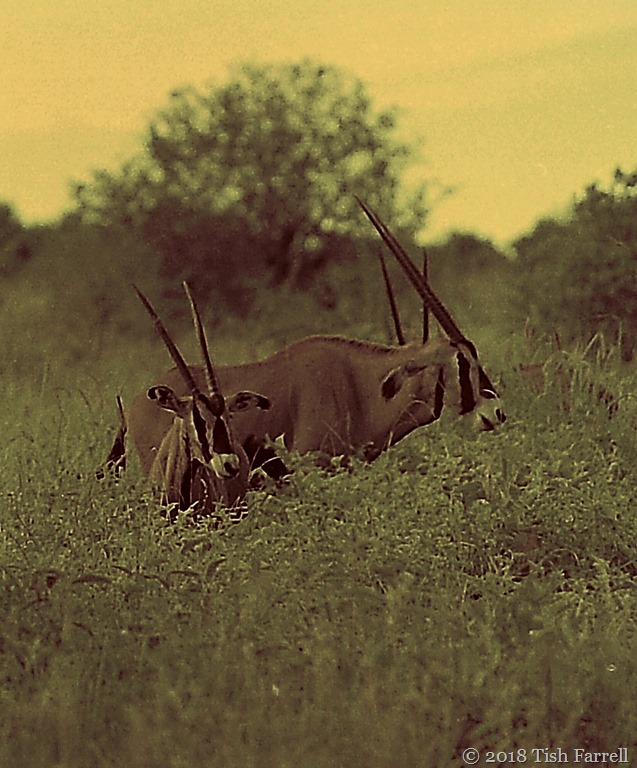
But back to the aging photo of magnificent beisa oryx. It was taken nearly 20 years ago. The Farrells were, in the manner of Kenya’s well-honed, post-colonial tourism model, ‘on safari’; flown in a twenty-seater plane – out of Nairobi and into Lewa, winging left at Mount Kenya. Touching down on the airstrip cut from bush you could spot elephant and the strangely foreshortened view of Mount Kenya’s summit.
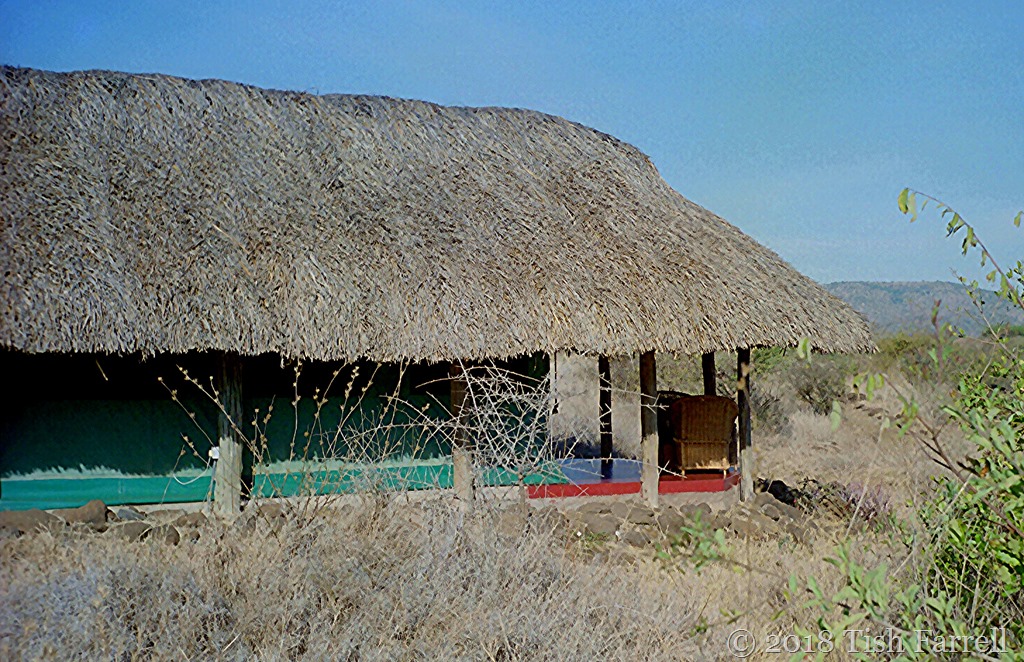
Our destination was a small tented camp in Laikipia, northern Kenya, a three night sojourn out in the wilds. I should say at once that when we stayed at the Lewa Downs safari camp it had not accrued the expensive, life-style look it has now, nor the uber-nouveau-colonial glamour of Lewa House and its secluded guest cottages. (Prince William apparently proposed to Kate Middleton while staying there as a family guest). In our day we had a big green tent, one of a dozen. There was a small shower room and WC attached, and the whole lot camouflaged by a thatched canopy. When the flaps were back we could lie in our bunks and gaze at miles and miles of Africa and inhale the sweet aromatic scent of thorn brush. The accommodation was simple and functional although we naturally thought a tent with its own clean, running water and a flush loo was a great luxury. But then as many travellers in Africa before us, and in pursuit of our own pleasure, we chose to ignore any moral issue associated with this provision. The camp was otherwise low-key, mostly set up to attract birding photographers, and one of several similar small camps run by the East African Ornithological Society.
*
The camp we stayed in occupied a small corner of the Lewa Downs estate, once a colonial cattle ranch staked out from former Maasai grazing territory in 1922 under the British government’s post-war Soldier Settlement Scheme. The colonial administration’s plan at that time was to double the colony’s European population. Meanwhile the Africans’ side of the story was as follows. All Kenya’s indigenous peoples had to live on their allotted tribal reserves unless they were working for Europeans. They could not acquire land outside the reserves. All men over the age of sixteen had to wear the kipande pass book containing their work record. All Africans paid poll and hut taxes, which had just then been increased to recoup costs from the European war effort. Taxation also had the aim of impelling Africans into the labour market. Africans who had served in the Great War were not eligible for the new settlement land (10,000 soldiers, 195,000 porters of whom 50,000 had perished).
For Europeans, however, that it is to say for ‘men of the officer class’, there was on offer by lottery or at cheap rates, large blocks of land in the fertile Central Highlands and the Laikipia Plateau below Mount Kenya. Officials apparently believed that such men, newly returned to civilian life and most with little or no practical farming experience, would in an untried African environment, produce export quantities of cash crops. This trade in turn would fund the upkeep of 600 miles of now largely purposeless, but very expensive Mombasa-Uganda railway that the colonial administration had built between 1896 and 1901. (Also known as the Lunatic Line).
The railway’s original purpose was to provide access to land-locked Uganda, then believed to be the future source of vast natural resources. There were strategic reasons too. In the last decades of the 19th century, during the big European land grab of Africa, relations with Germany had become increasingly scratchy, and especially over possession of Uganda. British paranoia raised the spectre of the Germans sabotaging the source of the Nile at Jinja in Uganda, thereby scuppering Britain’s major shipping lanes in the faraway Suez Canal which relied on Nile water. Once thought of, only a railway would serve to bring troops swiftly to the scene to defend the vulnerable head waters.
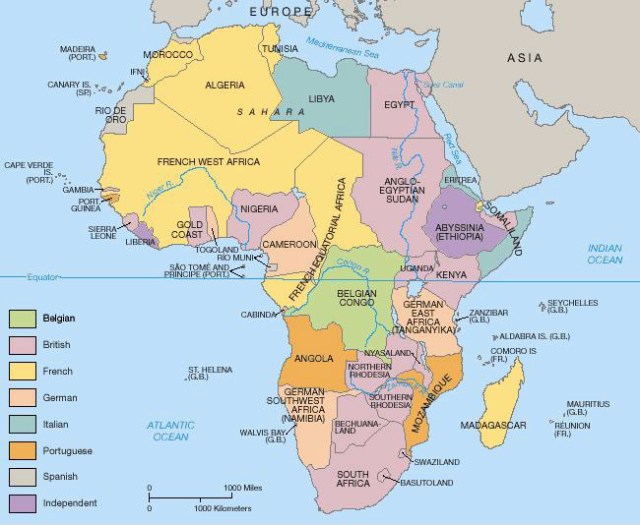
Africa 1914 (St. Francis High School website)
*
Twenty years later, these functions unrealised or redundant, only large-scale European settlement would make the best of a bad job. Along with this ‘House that Jack Built’ mode of thinking was the idea that veteran officers, used to handling men, would be well fixed to manage and ‘civilise’ (i.e. instil discipline in) African labourers, this despite knowing nothing of their employees’ traditions or way of life or their language. Also if things went wrong at some future time, an uprising for instance, the officer chaps would usefully know how to handle a gun and not be afraid to use it.
As I’m writing this, I’m thinking that it sounds like a very bad joke with a dollop of Wodehouse daftness thrown in. But this is how the British Empire did things in East Africa. They were not prepared to invest in indigenous Africans, but they were prepared to take a punt on the ‘right sort’ of Europeans of whose farming prowess they knew not one single thing.
*
Roll forward 96 years…
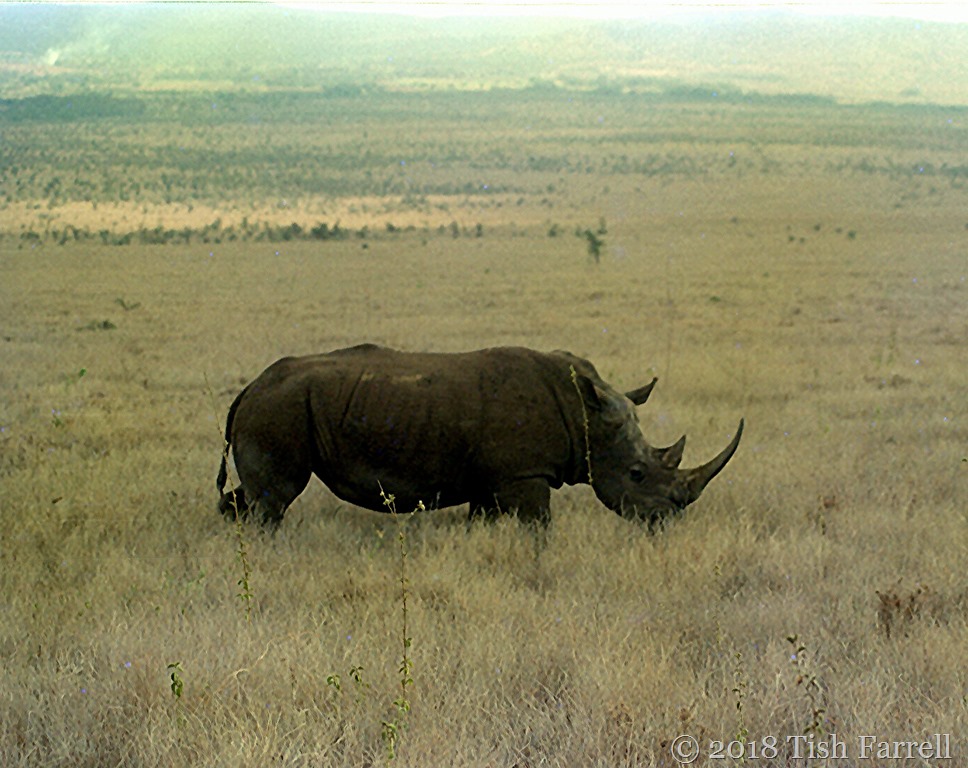
Today Lewa Downs is still owned by descendants of the Craig/Douglas families who began the ranch. But now, and in cooperation with local indigenous communities, and the Kenya government, the owners use their 62,000 acres not for farming, but to protect threatened wildlife. Among their wards are populations of black and white rhinos whose territory is watched over around the clock by vigilant rangers, and whose horns are defended from poachers by armed Kenya Police Reservists.
It is an award-winning, avowedly non-profit-making enterprise that has set out to demonstrate that up-scale tourism can serve both wild life conservation and local community development. Other funding comes from donation and sponsorship, and a big proportion of the total income is spent on community projects including clinics, education, water management schemes, and low-interest loans to kick-start women’s small businesses.
Anyone who stays at Lewa Conservancy can be guaranteed unforgettable experiences – the full-on African wilderness, magnificent game viewing in breath-taking country, the chance to see how some of the tourist dollars are being spent. There are bush breakfasts, night game drives, camel riding, and star bathing. It would seem to be the 21st century eco-socio-sensitive take on the self-serving champagne safaris of the 1920s and ‘30s when white hunters – John Hunter, Bror Blixen and Denys Finch Hatton et al – ran commercial shooting expeditions for the elite of Europe, India and America.
And while the trophies these days are photos and memories, and not elephants’ feet, tusks and antelope heads, and while the safari guests’ presence may help to fund laudable causes, and not the free-booting life-styles of maverick aristocrats and misfit adventurers, still the packaging of today’s safaridom evokes something of the old elitist romance. If we don’t watch out it clings like a parasitic infection and blinds us to the many ironies.
But have a look for yourself at what the Lewa Conservancy is doing for people and wildlife. The model is not without its critics. Other settler descendants have pointed out that big landowners who stayed on in Kenya after Independence have been increasingly under pressure to start sharing their acres if they were not seen to be doing something very useful with them. The Craigs and their management team seem to have come up with quite a solution. The safari story continues…
Caught inside a Kikuyu garden: a memorial to Karen Blixen’s lover, Denys Finch Hatton
I wrote this piece back in March. Every day since several people have clicked on it, and on one single day in the summer this rose to 170 viewings. I have no idea why this happened, or why, judging by the search terms, Denys Finch Hatton’s grave in Kenya’s Ngong Hills is of particular fascination. I thought it was just me who was fascinated. Anyway, here is the post again – a tale of loss and romance in the tropics. It is timely perhaps too, since in the UK at least, now is the season for showing Sydney Pollack’s film Out of Africa once more on TV. Happy Holidays everyone.
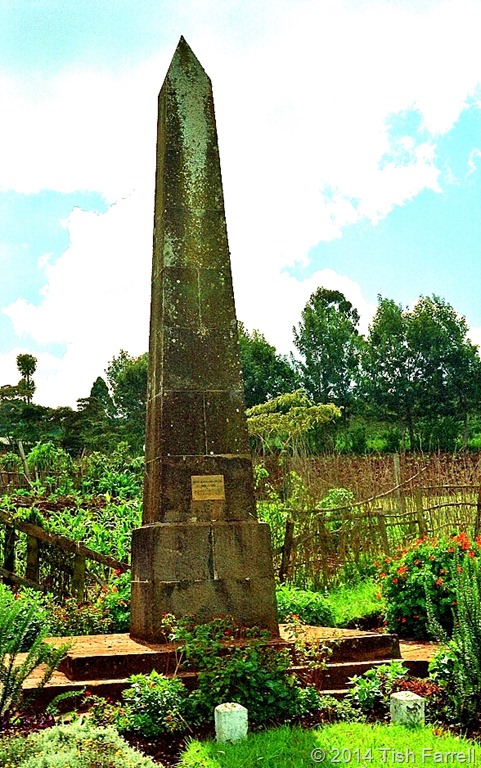
This was not supposed to happen. In fact you could say it adds insult to irony: that a man so steadfastly dedicated to an unfettered life in the wilds should, in death, end up hemmed in, and so very domesticated within this small Kikuyu shamba. Yet here it is, the mournful stone obelisk, marking the grave of Denys Finch Hatton, son and heir of the 13th Earl of Winchilsea, Great White Hunter, and lover of two women far more famous than he is: writer Karen Blixen (Out of Africa) and aviator and race horse trainer Beryl Markham (West with the Night).
Yet another woman, the one whose shamba this is, shows him a new kind of love, taking care of the garden around the obelisk. If you want to visit the place it is not easy to find – either her little smallholding on the Ngong Hills, or the grave within. When we visited years ago we found only a hand-painted signpost nailed to a tree. We parked in a paddock outside the farmhouse door and were charged a few shillings. We could have bought a soda too, if we’d wanted. We could not see the grave though, and soon found that it was deliberately hidden from view by an enclosure of old wooden doors. More irony here of course. More symbols of shut-in-ness.
Denys spent most of his life in Africa avoiding any kind of confinement – out in the Tsavo wilderness, running shooting safaris for the rich and aristocratic. His clients included the Prince of Wales (later Edward VIII) . In fact it was during the safaris for the Prince in 1928 and 1930 that Finch Hatton began to promote shooting on film rather than with a gun.
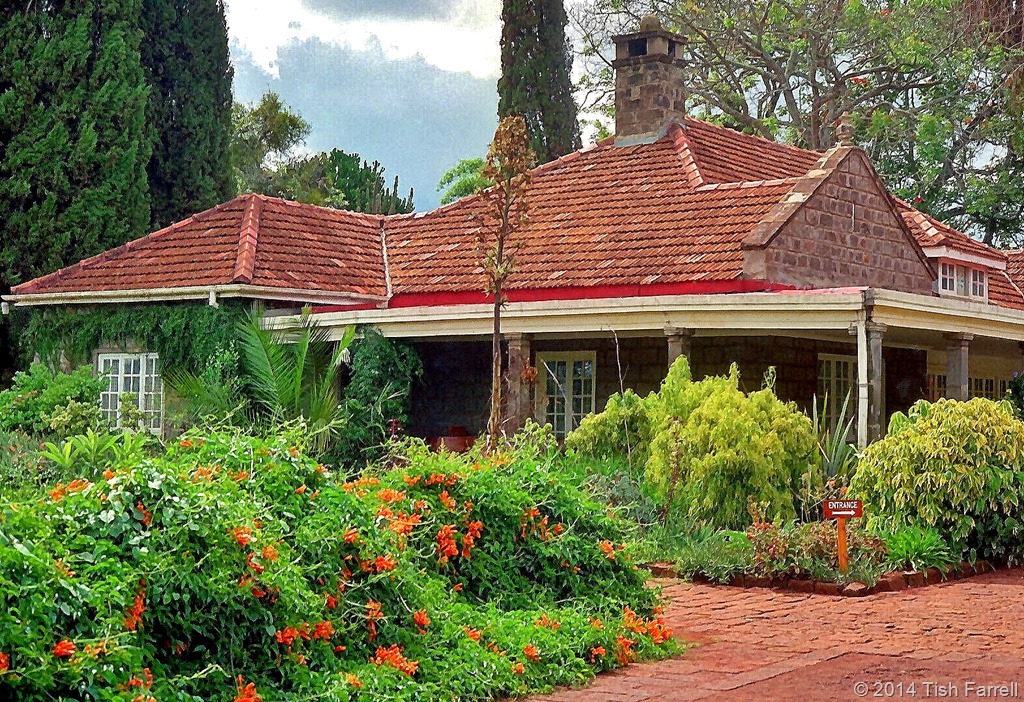
His lover, Karen (Tanne), Baroness von Finecke-Blixen lived in a small house below the Ngong Hills, some twelve miles outside Nairobi. By the time she started her affair with Denys she was divorced from her charming, but philandering husband, Bror, although they always remained friends. Her family had invested a great deal in the couple’s coffee farm, and Karen struggled to make a success of it. But the location was entirely wrong, and in the end she was forced to sell up and leave Kenya. It was during the period of selling the farm that she heard news of Denys’s death.
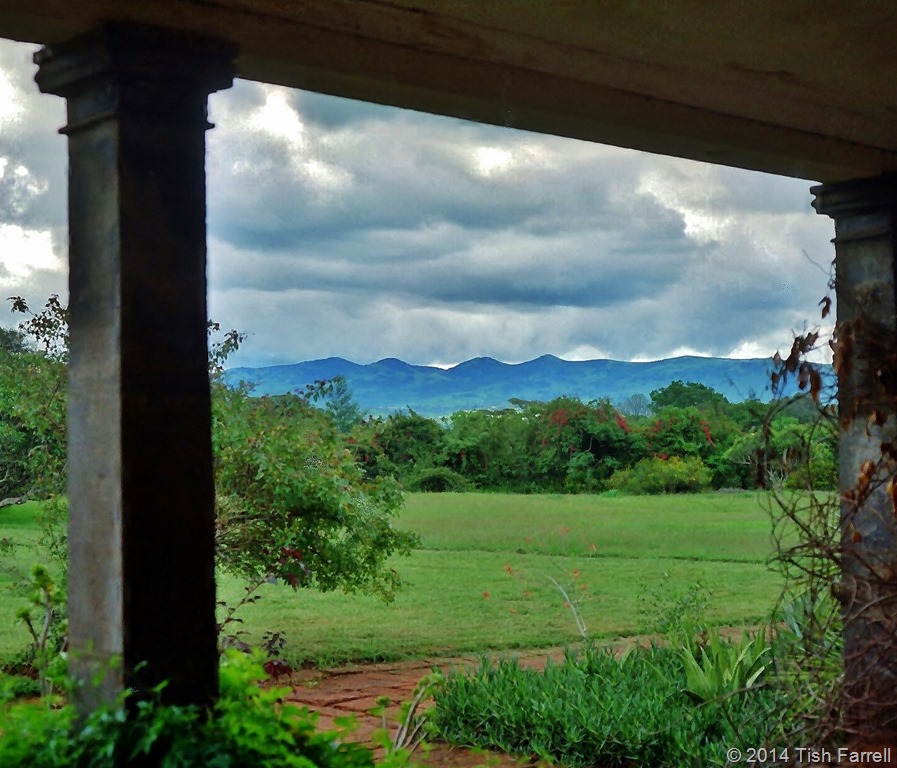
Looking towards the Ngong Hills from inside the veranda at Karen Blixen’s house. The house now belongs to Kenya’s National Museums.
*
Denys Finch Hatton’s untimely end may be put down to his passion for flying. For those of you who remember Sydney Pollack’s 1985 film Out of Africa, some of the most elegiac moments of the film are when the celluloid version of Finch Hatton (Robert Redford) takes Karen Blixen (Meryl Streep) into the skies above the Rift Valley. Denys died in his Gypsy Moth in 1931, and in unexplained circumstances. He was taking off from the airstrip down in Voi in southern Kenya when his craft exploded. He and his Kikuyu co-pilot were killed. Denys was forty four.
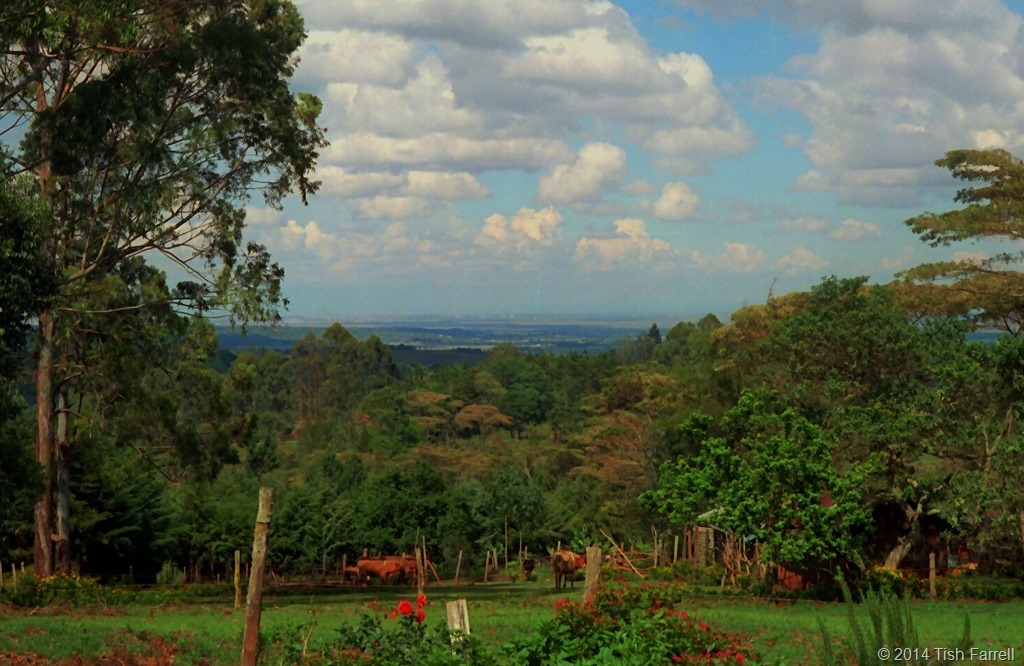
View towards Nairobi from Denys Finch Hatton’s Grave, and overlooking another Kikuyu smallholding.
*
By the time of his death, his relationship with Karen was well on the wane, and he had already started an affair with the younger Beryl Markham. His biographer, Sara Wheeler says in Too Close to the Sun, that there is circumstantial evidence to suggest that Beryl was pregnant with Denys’s child, but that she then had an abortion. To have known this would have truly broken Karen Blixen’s heart: her letters show that she had longed to have a child with Denys.
With yet another twist of irony, it was with his death, that Karen somehow reclaimed him, remembering that he had told her of his wish to be buried in the Ngong Hills. The spot he had chosen was one that Karen had decided on for her own grave.
Denys Finch Hatton
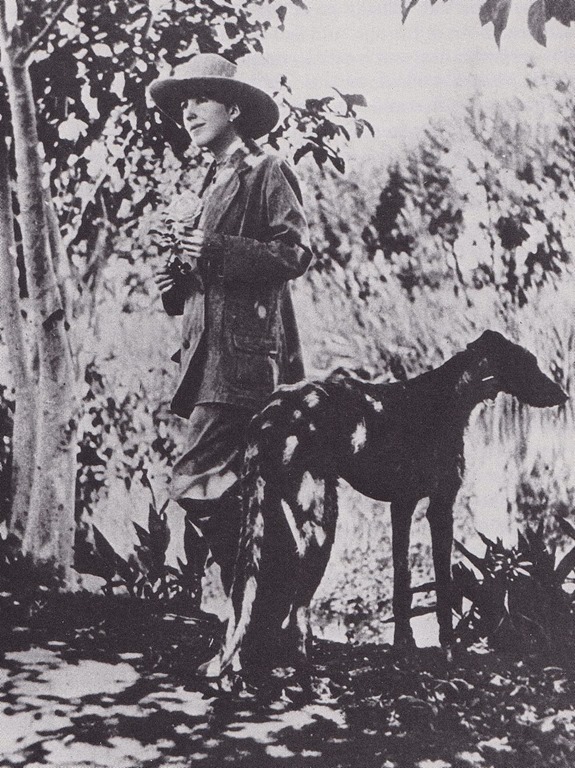
Karen Blixen with her deerhound Dusk.
“There was a place in the hills, on the first ridge of the Game Reserve, that I…had pointed out to Denys as my future burial-place. In the evening, while we sat and looked at the hills from my house, he remarked that then he would like to be buried there himself as well. Since then, sometimes when we drove out in the hills, Denys had said: ‘Let us drive as far as our graves.’ Once when we were camped in the hills to look for buffalo, we had in the afternoon walked over to the slope to have a closer look. There was an infinitely great view from there; the light of the sunset we saw both Mount Kenya and Kilimanjaro. Denys had been eating an orange, lying in the grass, and had said that he would like to stay there.” Out of Africa
The obelisk was only put up later by Denys’s brother. During Karen’s last days in Kenya she had the site marked with white stones from her own garden, and as the grass grew up after the long rains, she and Farah, her Somali house steward, erected a pennant of white calico so she could see the spot from her house, some five miles away.
Sometime after she had returned to Denmark she received a letter with some strange news about the grave:
“The Masai have reported to the District Commissioner at Ngong, that many times, at sunrise and sunset, they have seen lions on Finch Hatton’s grave in the the Hills. A lion and lioness have come there, and stood, or lain, on the grave for a long time…After you went away, the ground round the grave was levelled out, into a sort of big terrace. I suppose that the level place makes a good site for the lions, from there thy can have a view over the plain, the cattle and game on it.” Out of Africa
I may be wrong about this, but doesn’t John Barry’s Out of Africa film score owe just a little something to George Butterworth’s Shropshire Lad Rhapsody? Both works ride on a swell of yearning for a life, a love, a land that is lost or unobtainable. Both composers are English, and Barry probably knew Butterworth’s small body of very English song-cycles. (Butterworth died in 1916, a casualty of World War 1).
Of course, the influence of one composer upon another is common enough, and could well be subconscious. On the other hand, Barry might have chosen deliberately to nod to the earlier work. There are many reasons to do so, and it all begins with that other very English creation, the collection of poems called A Shropshire Lad, by A.E.Housman, the work that inspired Butterworth’s Rhapsody and the several Housman poems that he set to music.
I have written elsewhere how this collection of ballad-type poems inspired several composers in their works, and not only Butterworth, but also Vaughan Williams and Ivor Gurney. At the time when I wrote that post, I had not thought about the Out of Africa film connection. But now I have thought of it, my interest is rather personal.
Firstly, as a writer who has worked with several illustrators, I like the way one artist’s creativity can provide inspiration for other artists’ work. Indeed, when it comes to A Shropshire Lad, there is a veritable multiplier effect of allusion and quotation in other works throughout the twentieth century. This includes Dennis Potter’s disturbing play Blue Remembered Hills (A Shropshire Lad poem XL).
Secondly, Housman’s poems, and in particular the music they inspired, make reference to Wenlock Edge and the town of Much Wenlock where I live.
Thirdly, I have also lived in Kenya, the country that inspired Karen Blixen’s Out of Africa.
And fourthly, in the script of Sydney Pollack’s film of the same name, which derives more from the biographies by Judith Thurman (Isak Dinesen) and Errol Trzebinkski (Silence will Speak) than from Karen Blixen’s book, includes two very striking quotations from A Shropshire Lad.
Both arrive towards the end of the film, and both relate, directly and indirectly to Denys Finch Hatton, Karen Blixen’s lover who died in an unexplained plane crash at the age of 44. For more of their story go HERE.
The first and most heart-rending is at the burial of Finch Hatton up in the Ngong Hills. Meryl Streep as Karen Blixen reads, not from a prayer book, but from a book of poetry, and the poem she reads is poem XIX To An Athlete Dying Young. This is the final stanza:
While I can find no biographical reference that supports the reading of the poem at the actual burial, I can only say that it could not have been more aptly chosen. In other words, if it is a Hollywood invention, then it is a good one. It adds to our understanding of both Blixen and Finch Hatton in real life.
Denys Finch Hatton had rare glamour. He was man who was adored and admired by men and women alike. He was a consummate sportsman, a soldier, hunter. He was an elusive adventurer and the son of an English Lord. As a great lover of poetry he would doubtless have known A Shropshire Lad very well. More importantly, he is said to have had a pathological fear of growing old, and was ever to be seen wearing a hat once his hair began to thin.
In her biography of him Too Close to the Sun, Sarah Wheeler makes the analogy with Icarus. This too is apt. With his shocking death, burned in his plane, the self-regarding sheen of aristocratic settler life was diminished. The film’s burial scene thus prepares us for Karen Blixen’s final exile from Africa. Loss piles on loss.
Before she leaves the country, the film shows her being treated to a drink in the ‘gentlemen only’ bar of Muthaiga Country Club, a restriction which she apparently infringed when first arriving in British East Africa. The toast she gives her hosts is one said to have been used by Denys: ‘rose-lipt maidens, lightfoot lads’. This comes from poem LIV:
With rue my heart is laden
For golden friends I had,
For many a rose-lipt maiden
And many a lightfoot lad.
*
By brooks too broad for leaping
The lightfoot boys are laid;
The rose-lipt girls are sleeping
In fields where roses fade.
So where are these quotations taking us? What exactly is being evoked by their appearance in the film script?
It all comes back to the unobtainable or unclaimable: of the lost life, love and land that I mentioned in the beginning. The settlement by British and European aristocrats of British East Africa (Kenya) in the early years of the last century was an epic romance, one filled with the notion of noble master and faithful ‘noble-savage’ servants. There was the pitting of human courage and wits against the African wilderness; a wilful dance of death wherein sporting valour was supremely admired. There was a notion of overbearing entitlement; that East Africa was their own country; that only they understood it. As a dream, it was bound to fail. It is a visceral longing for something that cannot be possessed.
For Housman the loss was for a love he could not have: another man. He was a respected academic who ultimately lived as a recluse. He wrote the entire collection of 63 poems while living in London, and without setting foot in the part of Shropshire that he evokes. Of this anomaly he makes the terse comment that, having grown up in the neighbouring county of Worcester, “Shropshire was on our western horizon which made me feel romantic about it.”
And here is where Out of Africa – book, film, and the true lives behind, find common ground with A Shropshire Lad; the ‘I had a farm in Africa, at the foot of the Ngong Hills’ moment; the sense of tragic romance, ‘The happy highways where I went and cannot come again.’ Those ‘blue remembered hills.’ The human condition of longing for something we think we had, or should have, but never can.
And finally then the music. Below are renditions of Butterworth and Barry. (The first begins with the song Loveliest of Trees, poem II, from which the orchestral piece derives). Compare and contrast, or simply ride the emotional tsunami – across Africa, or Shropshire, or wherever you think your lost Paradise resides.
Things are going from bad to worse in Ingigi village. No one knows why five-year old Kui has gone missing. Nor does Sergeant Njau want to find out. He has his own problems, pressing matters that are far from legal. Then there is the endless rain. Will it never stop? Some Ingigi folk think it means the end of the world. Old man, Winston Kiarie, has other ideas. He senses some man-made disaster, and when it happens, it is worse than his worst imaginings. The fierce storms are causing landslides and throwing up British bombs, unexploded for forty years. Their discovery is giving the Assistant Chief ideas: how to make himself very rich. And then there’s young Joseph Maina and the primary school drop-outs thinking they have found treasure, and about to do something very, very foolish. Meanwhile, is anyone looking for Kui?
“Losing Kui” is a fast-paced novella of interwoven tales. There are secrets, conspiracies, tragedy and dark comedy. The setting is a fictional East African country in the late 1990s, a time when El Niño rains were causing havoc. The author lived in Kenya during most of the 1990s, and much of the story was inspired by real events.
This was not supposed to happen. In fact you could say it adds insult to irony: that a man so steadfastly dedicated to an unfettered life in the wilds should, in death, end up hemmed in, and so very domesticated within this small Kikuyu shamba. Yet here it is, the mournful stone obelisk, marking the grave of Denys Finch Hatton, son and heir of the 13th Earl of Winchilsea, Great White Hunter, and lover of two women far more famous than he is: writer Karen Blixen (Out of Africa) and aviator and race horse trainer Beryl Markham (West with the Night).
Yet another woman, the one whose shamba this is, shows him a new kind of love, taking care of the garden around the obelisk. If you want to visit the place it is not easy to find – either her little smallholding on the Ngong Hills, or the grave within. When we visited years ago we found only a hand-painted signpost nailed to a tree. We parked in a paddock outside the farmhouse door and were charged a few shillings. We could have bought a soda too, if we’d wanted. We could not see the grave though, and soon found that it was deliberately hidden from view by an enclosure of old wooden doors. More irony here of course. More symbols of shut-in-ness.
Denys spent most of his life in Africa avoiding any kind of confinement – out in the Tsavo wilderness, running shooting safaris for the rich and aristocratic. His clients included the Prince of Wales (later Edward VIII) . In fact it was during the safaris for the Prince in 1928 and 1930 that Finch Hatton began to promote shooting on film rather than with a gun.
His lover, Karen (Tanne), Baroness von Finecke-Blixen lived in a small house below the Ngong Hills, some twelve miles outside Nairobi. By the time she started her affair with Denys she was divorced from her charming, but philandering husband, Bror, although they always remained friends. Her family had invested a great deal in the couple’s coffee farm, and Karen struggled to make a success of it. But the location was entirely wrong, and in the end she was forced to sell up and leave Kenya. It was during the period of selling the farm that she heard news of Denys’s death.
Looking towards the Ngong Hills from inside the veranda at Karen Blixen’s house. The house now belongs to Kenya’s National Museums.
*
Denys Finch Hatton’s untimely end may be put down to his passion for flying. For those of you who remember Sydney Pollack’s 1985 film Out of Africa, some of the most elegiac moments of the film are when the celluloid version of Finch Hatton (Robert Redford) takes Karen Blixen (Meryl Streep) into the skies above the Rift Valley. Denys died in his Gypsy Moth in 1931, and in unexplained circumstances. He was taking off from the airstrip down in Voi in southern Kenya when his craft exploded. He and his Kikuyu co-pilot were killed. Denys was forty four.
View towards Nairobi from Denys Finch Hatton’s Grave, and overlooking another Kikuyu smallholding.
*
By the time of his death, his relationship with Karen was well on the wane, and he had already started an affair with the younger Beryl Markham. His biographer, Sara Wheeler says in Too Close to the Sun, that there is circumstantial evidence to suggest that Beryl was pregnant with Denys’s child, but that she then had an abortion. To have known this would have truly broken Karen Blixen’s heart: her letters show that she had longed to have a child with Denys.
With yet another twist of irony, it was with his death, that Karen somehow reclaimed him, remembering that he had told her of his wish to be buried in the Ngong Hills. The spot he had chosen was one that Karen had decided on for her own grave.
Denys Finch Hatton
Karen Blixen with her deerhound Dusk
There was a place in the hills, on the first ridge of the Game Reserve, that I…had pointed out to Denys as my future burial-place. In the evening, while we sat and looked at the hills from my house, he remarked that then he would like to be buried there himself as well. Since then, sometimes when we drove out in the hills, Denys had said: ‘Let us drive as far as our graves.’ Once when we were camped in the hills to look for buffalo, we had in the afternoon walked over to the slope to have a closer look. There was an infinitely great view from there; the light of the sunset we saw both Mount Kenya and Kilimanjaro. Denys had been eating an orange, lying in the grass, and had said that he would like to stay there.
Out of Africa
The obelisk was only put up later by Denys’s brother. During Karen’s last days in Kenya she had the site marked with white stones from her own garden, and as the grass grew up after the long rains, she and Farah, her Somali house steward, erected a pennant of white calico so she could see the spot from her house, some five miles away.
Sometime after she had returned to Denmark she received a letter with some strange news about the grave:
The Masai have reported to the District Commissioner at Ngong, that many times, at sunrise and sunset, they have seen lions on Finch Hatton’s grave in the the Hills. A lion and lioness have come there, and stood, or lain, on the grave for a long time…After you went away, the ground round the grave was levelled out, into a sort of big terrace. I suppose that the level place makes a good site for the lions, from there thy can have a view over the plain, the cattle and game on it.
Out of Africa
copyright 2014 Tish Farrell
*
Tish Farrell is an award winning writer for young people. Her latest novella is on Amazon Kindle (5 star review):
Secrets, conspiracies, tragedy, dark comedy – a fast-paced novella of interwoven tales set somewhere in East Africa. For young adults and adults alike.