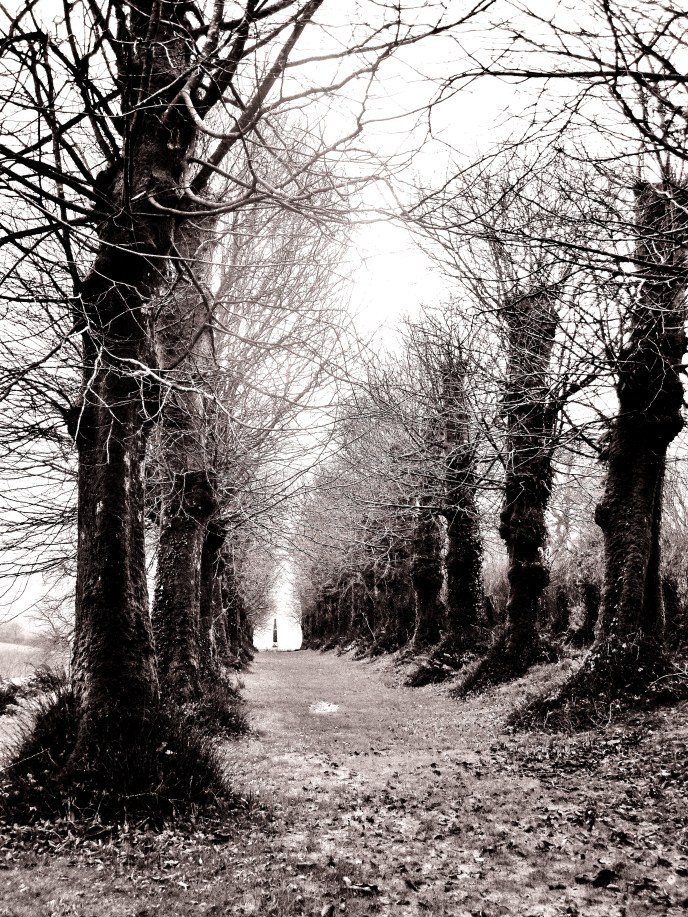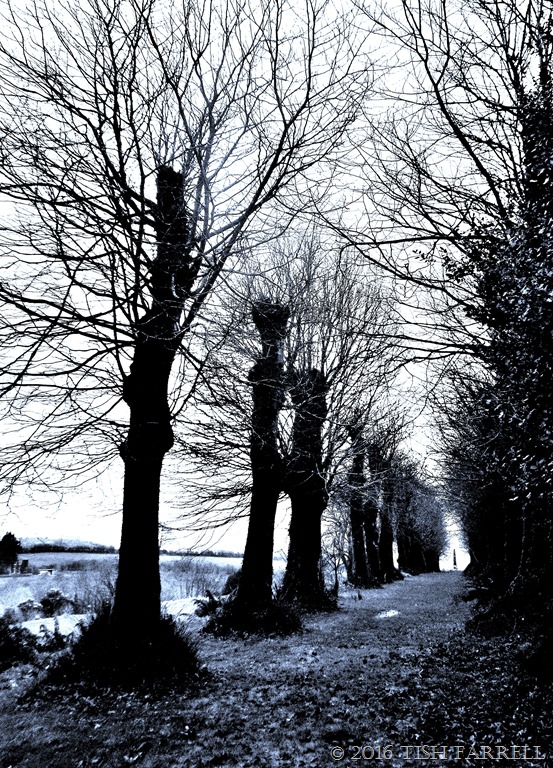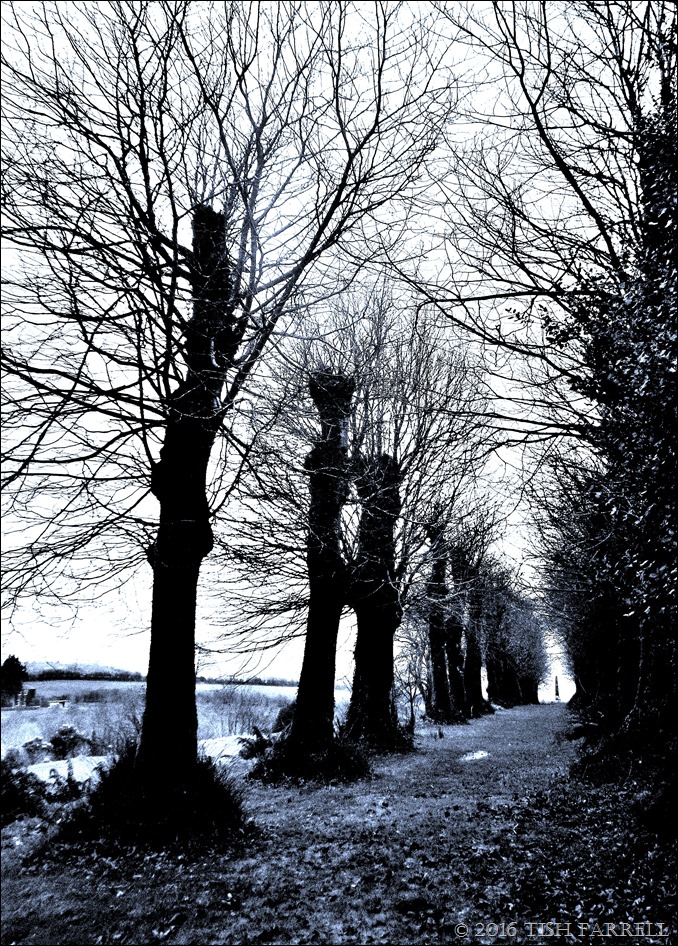
This image could be symbolic. You see the real problem is my mind keeps leaping ahead. Already it knows what is waiting for it beyond that distant obelisk. There is the final scene: redemption for a lost, old soul; rain falling in a rainless land. There is even the final sentence. The last full stop. I can see them all. But then, curiously perhaps, the mind’s-eye place that I rush towards is nothing like the place in the photograph – this rain-logged Cornish avenue of cropped limes. How could it be? My body may live in England now, but my mind still wanders in Africa where it endlessly struggles to create.
The yarn (aka the novel) that’s been churning in my head for countless months (years maybe) has its source in the thorny, arid plains of East Africa. And if ever it rains there, it smells nothing like the rain in temperate lands. In Africa you know your life depends on it – the fickle falling of rain. In England you simply expect it while grumbling at forever getting wet. This is one manifestation of the great divide between the famished and the over-fed.
And yet…
And yet there is congruence here.
When I discover the avenue at Christmas I am instantly fascinated. It’s like coming upon a lost garden, or some ancient megalith. I want to know where the path leads: simply to the obelisk, or is there something more beyond? The avenue itself, with its period formality, anyway evokes expectation of some pleasing and diverting progress along it.
But it isn’t the time for promenading. The weather is so gloomy and wet the avenue is almost too dark to photograph, let alone walk along. But still I return several times more, and pick my way back and forth among the trees, noting the clumps of daffodils and crocus, sprouting densely among the roots. I even patrol the grassy bank beside it, trying to grasp the avenue’s measure and meaning. Is it simply some vanity-planting by long-ago denizens of the small manor house that is now converted into holiday flats? And even though I can see it clearly issues from the carriage circle outside the house, does it actually go anywhere at all?
I can ask similar questions of my current work. Is it a piece of vanity writing, or something of substance? A story that is going somewhere special, or not? I am becoming aware, too, that knowing the ending (being in love with it almost) could be an (overwhelming) handicap: why bother to create what comes before it? Isn’t it all too hard? But then, on its own, that final scene has no meaning, no matter how much it may excite and lure my imagination away from the job in hand; snatching concentration from the down-and-dirty toil of how to get there.
So yes, yes, and yes. Of course it is the journey that counts; the grand excursion that must be planned and undertaken. Undergone. Borne. The delineation and experience of what happens on the way are key; in that yawning space between departure and arrival great transformations must take place. This, after all, is the point of fiction. Verbal alchemy.
When I finally slither and slide to the obelisk, I find the avenue strangely truncated. Behind the monument whose commemorative purpose is not obvious, I find a small wrought iron seat for two and, a step beyond and directly facing it at right-angles, a hedge. This is puzzling. How can the avenue end here? Surely it was once part of the main drive to the house. From its earliest days in 1690, and through the Victorian period, Duloe Manor was the rectory. And so, whether by carriage or cart, on horseback or on foot, parishioners must have approached its front door somehow.
A cursory scanning of the landscape suggests that any onward stretch of drive must have turned sharply at the obelisk and descended downhill to the lane. Now it is lost in an open meadow tailored for holiday guests who wish to exercise their dogs or simply amble. I also ponder why the seat looks onto a hedge. Then I see that, beneath the recent unseasonal growth spurts, the hedge had been shaped to allow a vista as if it were a balcony. As I stand beneath dripping lime trees, I conjure a clear day when rainclouds aren’t snagged on the fence tops. The panorama of Cornish countryside will be magnificent, I think; perhaps a distant glint of sea?
Looking at the photo now, I see only my task ahead – the making and moulding of the many stages through which a piece of work must pass. I have made a good start. Written many thousands of words. I know where I’m heading. Clearly then it is time to commit myself to the hardest part – the middle.
But here’s the rub – the discomforting, unnerving questions that this little excursion has sparked. Ones that must be answered before I take another step.
1: How seriously do I take my writer-self? Seriously enough to bring off this task?
2: Does the work itself have energy enough to make, or even warrant the journey?
3: Do I have energy enough?
4: And how will I feel if I never give myself the chance to write that final scene?
On reflection, an answer to this last might serve for the other three. It depends on the answer.
Later – today in fact – I discover that in times past one of the house guests at Duloe Manor was Charles Dodgson, aka Lewis Carroll. It is said he was working on Alice in Wonderland at the time. Suddenly this knowledge brings new possibility. Never mind the navel-gazing and writer-angst. Of course it is exhausting inhabiting two realities, and never being quite in either – body in one place, mind half a world away. Surely, then, what I need is Alice’s rabbit hole – to submerge, to blooming well get down there and on with it. In fact, look out there. I think I see him. Isn’t that the White Rabbit dodging through the lime trees? Quick, quick, I mustn’t lose sight of him.
Wait for me-eeeee, White Rabbit!
copyright 2016 Tish Farrell