…of a domestic goddess

Domestic Goddess by Wren Miller

Domestic Goddess by Wren Miller

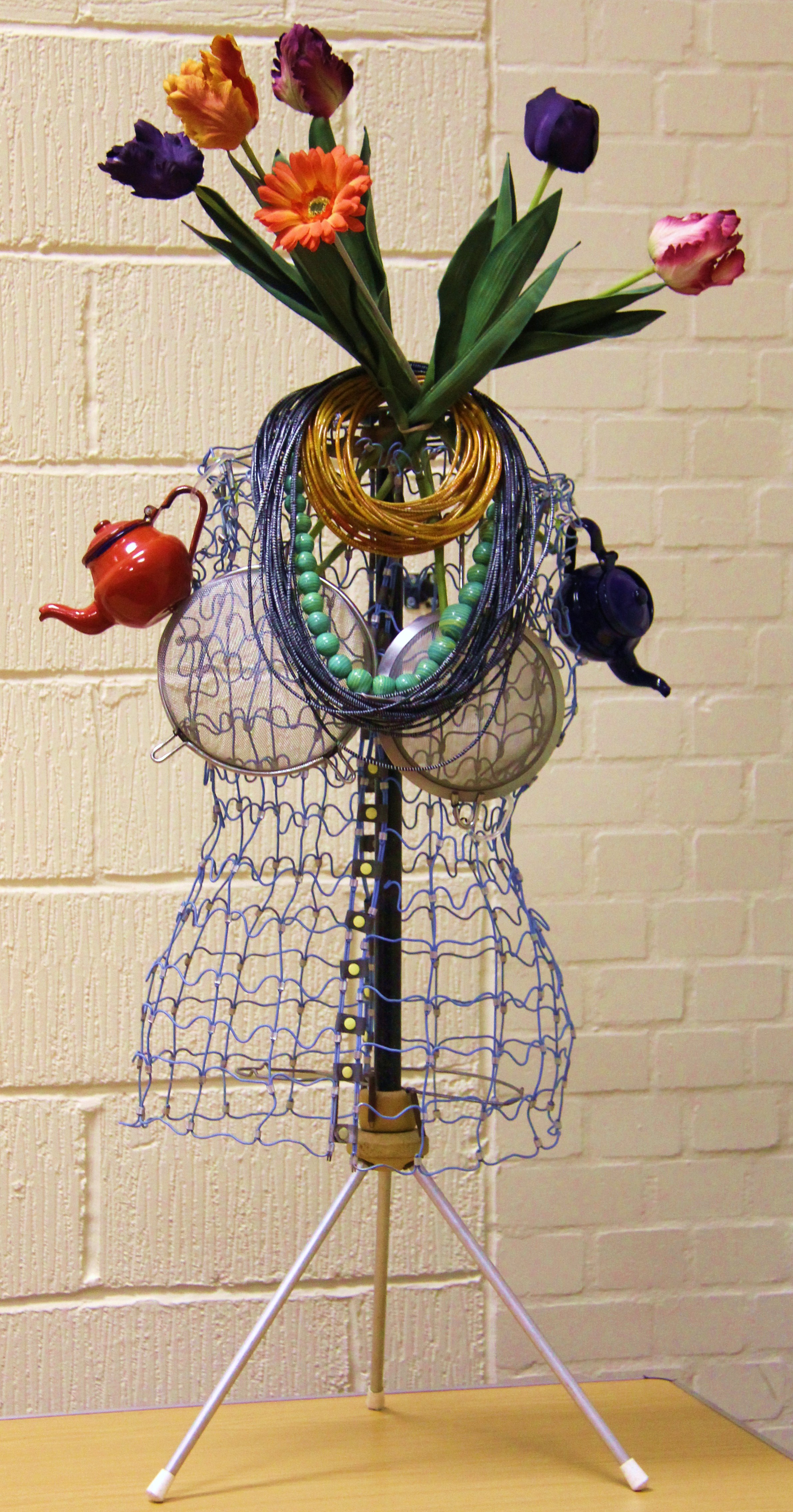
Women (men too if you like), why not wear our sieves with pride? Who knows what forms of household transcendence it could lead to.  In fact it is clear to me that this particular  manifestation of the Domestic Goddess (Wren Miller’s tribute to International Women’s Day) has much to teach us. But more of that in a moment. First a little about her creator, fellow Shropshire-dweller and eco artist, Wren Miller.  Wren is a specialist in large-scale sculptures (i.e. bigger than this one which is a domestic piece in more ways that one). Her materials are found things, or donated possessions such as books or even old trainers. They are not altered in any way, but ‘compiled’ into witty and spirit-raising structures somewhere on a landscape near you (if you’re lucky). She also creates art works in Mali, West Africa. The resultant creations are usually temporary, with the aim of sending the component parts on to a good home. For instance, Wren’s children’s book sculptures have later been shipped off to Mali where many children would otherwise never see a story book, let alone get to hold one in their own two hands. Through her ‘Send a Book to Mali’ scheme she collects books in both English and French. For more about Wren and her creations go to: http://www.wrenmillerart.co.uk/

Now to get back to to why Wren’s domestic goddess so took my fancy. Well quite apart from the fact she is beautiful and made me laugh, which are two good reasons for sharing her, it seemed to me that there were  several points of congruence with my ‘womanplace’ posts.  As is often the way with goddesses, this one gave me a whole new slant on things. She made me look at what I had written, but this time in relation to my own usually negative attitudes towards housework. For isn’t it an irony that in the industrialised world where we have more labour-saving, domestic gadgets than time or spare hands to use them, we generally consider doing housework an act of drudgery that makes us both ratty and resentful? We see the whole thing as an imposition that denies us the leisure time we believe we are owed.  So when we see women in non-technologised rural communities filling every waking hour with heavy manual labour we are appalled. We identify with their plight, in our minds multiplying our own sense of oppression several times over. It is a concerned/outraged/kindly response: the  ‘why should they still live like that?’

Now this is in no way to deny that millions of rural women work grindingly hard. But along with their labours they also take great pride in their domestic practices and skills. This may seem perverse to many of us, but an African woman might well be offended if a man offered to carry her heavy load of firewood; she might take it as a slight that she is not capable of doing her work properly. Indeed research has shown that African women carry loads on their heads that should not, at least in theory, be physically possible in relation to the deemed weight-bearing capacity of their spinal columns and their often poor levels of nutrition. Yet in the face of all the scientific data that tell them they can’t, carry those loads they do.

Here’s another instance. By our standards we might think it unquestionably good that village women are saved long trips to fetch water from the river by  constructing a well near their homes. But again, this might not be wholly true. A good friend in development agriculture once told me how, in a village where he worked, the women were very put out by the provision of a new well. It meant they could no longer justify spending hours away from home, time they spent meaningfully with other women as they drew water, or did the washing, or bathed their children. How could they discuss all the personal matters they usually discussed, and at the length they discussed them, in the middle of the village with all the men around? All of which boils down to being careful how we think other people’s problems can best be fixed.

Of course once we realise this, there is also a possible payoff, at least for us, the housework haters. In fact we could well learn something of great utility from the women we feel sorry for. It’s obvious really, but if we honour the fact of doing our ironing in the way a Maasai woman honours the building and maintainence of her home, or take pride in the hoovering of carpets in the way a Kikuyu farmwife scrupulously sweeps her compound, we might well find ourselves on the path to domestic deification; at the very least we’d feel happier in the doing of such work: ‘our day’s career’ as Faith Waithera says in my Power-play poem (…of womanplace). So as I said at the beginning, let’s wear our sieves with pride, but before I go here’s another image of transcendent womanhood:

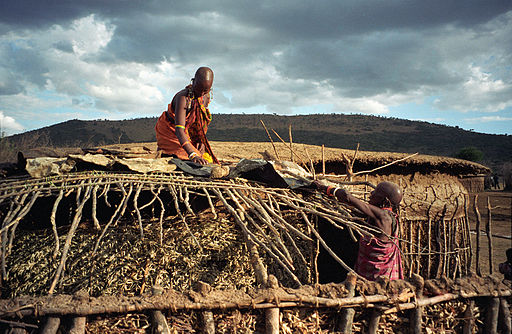
Maasai womanphoto: Creative Commons: javic (www.flickr.com/photos/javic)

Maasai woman
photo: Creative Commons: javic (www.flickr.com/photos/javic)

text: copyright Tish Farrell 2013

International Women’s Day 8 March

House BuildingCreative Commons photo: Jerzy Strzelecki

House Building
Creative Commons photo: Jerzy Strzelecki

I’m thinking of women whose life is immeasurably harder than mine. Could I, for instance, walk the Maasai woman’s barefoot daily trek across wild bush country, searching for firewood, fetching water, taking produce to market? Could I have reared children in the dung and wattle hut that I had built myself? Could I live obeying a husband’s commands even when I thought them wrong? What kind of bravery, tenacity and inner strength would I need to live this way, and to still live well? These days, things are slowly changing for Maasai women, not least because campaigners from their own communities are pressing for girls’ education, the end of genital mutilation and forced teen marriages. But for outsiders visiting the Mara it is all too easy to see only the grinding poverty and the reconstituted, fit-for-tourist shreds of former warrior glamour. But before jumping to too many conclusions about what is really going on, here is my version of a Maasai traditional story that sheds some light (literally) on their own views of the man-woman relationship.

And the moon still shines

Long ago Sun wanted a wife
so he married Moon and they made a pact,
to ply the sky in endless round,
Sun ahead, Moon behind.
And each month, tiring of the trek,
Sun carried Moon-Wife on his back.

But then one day they came to blows.
Moon crossed Sun and Sun lashed out,
beating his Moon-Wife black and blue.
Moon struck back. She slashed Sun’s brow.
He gouged her cheek, plucked out an eye.

Later Sun fumed: I’ll shine so hard
that none will ever see my scars.
While Moon tossed her head:
Why hide my wounds?
I still light up the night sky.

Creative CommonsPhoto: William Warby (flickr.com)

Creative Commons
Photo: William Warby (flickr.com)

Text: Copyright 2013 Tish Farrell

…of womanplace

photo: Oxfam International, Eddy Mbuyi 2013

photo: Oxfam International, Eddy Mbuyi 2013

Still mindful of last week’s International Women’s Day and the fact that many rural women all over the world spend much of the day hauling firewood to cook by, here’s a poem about it. I wrote it after visiting farms in Kenya’s Central Province in 1997. There had been elections at the start of that year and the farming community concerned had given financial support to a local politician on the understanding that he would bring electricity to their farms. He didn’t. So here’s what happened: it’s a case of woman living creatively or the triumph of art over adversity.

Power-play

 Joe Maina, small-time farmer

says before the polls he paid

some local boss three thousand bob

to bring the power lines down the Rift.

Their broker won, but now as ever

Faith Waithera Maina cooks githeri,

bending at her hearth,

three rocks to hold the pot,

sleek skin cured  hide in smoke-house fug.

Next, slogs like an ox to fetch more wood.

Our days’ career – she shrugs.

Till dusk she lights her sofa room with fumy lamps,

where hanging on the wall,

with keep-safe snaps and family memorabilia,

a cast-off city sixty-watt

has second lease –

recharged, of course,

to make a perfect vase

for trailing sprays

of purple

Tradescantia.

On the farm in Kenya's Central Province

On the farm in Kenya’s Central Province

Text and photo collage: copyright Tish Farrell

…of knowing your place

Or how to start creating good settings in fiction – read other people’s.

MorningTide[1]

So far I’ve not included writing advice in my blog, but since the posts are about writing and a sense of place, perhaps it’s time to look at the ‘where and when’ of story, otherwise known as ‘setting’. In fact, when I think about it, setting is not an inspiring term when it comes to story making; to me it suggests the rigid immobility of hardened concrete, or the strict placement of cutlery for formal dining. It conveys the kind of feeling you get when a writer (possibly me) churns out paragraphs of leaden description in the hopes that ‘more’ equals ‘more believable’. It doesn’t of course. In fact somewhat oddly too much detail obscures rather than illuminates.

Perhaps ‘world building’ is a more creative way of thinking about scene setting. This term is most commonly applied to the mechanics of science fiction and fantasy writing wherein the writers create speculative worlds that operate in ways outside our common experience. I’m thinking now of Tolkein’s Hobbiton in The Hobbit or Le Guin’s planet of perpetual winter, Gethen, In the Left Hand of Darkness. These are extraordinary places, intrinsically and comprehensively imagined. And to give such worlds existence, the breath of authenticity, the writer must journey there endlessly – in mind and spirit. Much like a pioneer in uncharted territory, they must map, document, and experience all they find there through every sense, compile their own Rough Guide if you like. Only then can they begin to bring their world to life in narrative form.

Of course the great advantage of speculative fiction is that writers can put what they like in their worlds so long as they can make it seem true in some sense. By contrast, and somewhat paradoxically, the created worlds of realistic fiction can be far trickier to construct; readers may well have knowledge of, or at least an opinion on what would or would not be present in, for example, Thomas Cromwell’s bedchamber (Hilary Mantel’s Wolf Hall), Jack London’s Arctic (White Fang) or Ian McEwan’s Venice (The Comfort of Strangers). Here the writer must rely on personal, concentrated experience and/or on scrupulous research in order to construct their story’s setting with acceptable faithfulness.

Having just re-read Philip Pullman’s Subtle Knife in the Dark Materials Trilogy I am struck by the obvious analogy between writers creating believable fictional worlds (whether of fantasy, realism or something in between), and Pullman’s mystical knife that can open windows from one parallel universe to another. Creating your story’s world is much like this. It is like finding a door to a room in your mind that wasn’t there before. Once you open that door you begin to furnish and populate the space you find behind it. If you happen to open the door on a shipwrecked boy drifting at sea with a Bengal tiger in tow (Yann Martel’s The Life of Pi), you will have to do some pretty nifty conjuring (as Martel indeed does) to take the reader with you every wave tossed mile and on so perilous a voyage.

But in the end, having said all this, setting is perhaps rather less about physical qualities – the obsidian tower on the hilltop or the crimson flock wallpaper in the Chinese take-away, and more about the sensation, mood and resonance that these details can evoke. The best stories aim for an intricate interplay between place, characters and action. The knack of successful world building, then, is to know everything you need to know to make the story fly, but reveal only those details that will whisk the reader away with it, all their senses firing. It’s a hard skill to learn: not to overload the kite. It takes a million words of practice.

Here are some examples of story beginnings that I think work well, luring you straight into the character’s landscape, and making you want to know more. The first is from Edgar Allan Poe’s The Fall of the House of Usher.

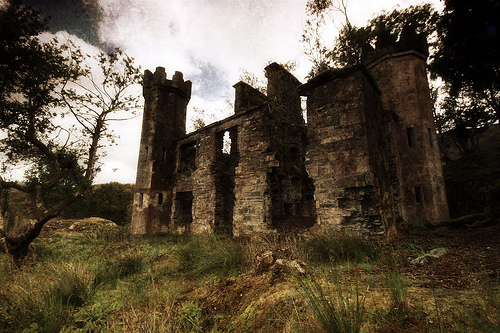
“During the whole of a dull, dark, and soundless day in the autumn of the year, when the clouds hung oppressively low in the heavens, I had been passing alone, on horseback, through a singularly dreary tract of country, and at length found myself, as the shades of evening drew on, within view of the melancholy House of Usher.”

So it is, with the mounting gloom of these few sentences, that Poe starts building suspense, the repeated ‘d’ consonant like a hammer blow or a tolling bell, foreshadowing the horror to come.

kT LindSAy
Photo: kT LindSay flikr Creative Commons

By contrast, the start of Neil M Gunn’s Morning Tide has quite a different mood:

“The boy’s eyes opened in wonder at the quantity of sea-tangle, at the breadth of the swath which curved with the curving beach on either hand. The tide was at a low ebb and the sea quiet except for a restless seeking among the dark boulders.”

Here we are instantly transported to the sea shore, the ‘breadth of the swath’ and the ‘curved with the curving beach’ sweeping our gaze out along the bay, while the ‘restless seeking’ of the sea among the rocks invites us to seek too. It makes us want to know: what is this place we have come to and who is this child whose wide eyes we are now looking through?

In both these openings, description of place is used to set the tone and introduce the characters. We know nothing about these people, but their circumstances are fascinating enough to make us want to find out more.

But setting can do more than this. In the following extract from Going Down River Road, Meja Mwangi uses description of place to tell us more about his protagonist. This is how he describes the Nairobi building site where Ben Wachira is working as a casual labourer:

“Work was just underway. Dark cement dust rose from the giant concrete mixer accompanied by loud squeaking and rattling and the old truck’s incessant whining. A ragged, dusty figure wrestled with the mixer’s monstrous wheel. Another scarecrow dangled in a bucket on the fourth floor and nailed wooden planks to the concrete wall. The sound of the hammer carried pathetically weak through the din below.

Ben looked up at the craggy building and shook his head. They had raised the building by four floors in eight months. They still had another sixteen to build. And the damned thing was already too high for comfort.”

fmasi_54941[1]
Photo: Felix Masi     http://felixmasi.wordpress.com/

At first sight, this passage is only about the hazards of working on a construction site. But something else is suggested by Ben’s detached view of the one scarecrow fighting with the cement mixer, and the other dangling in a bucket from the fourth floor, and then his reaction to the prospect of a further sixteen floors. There is resignation here, the lot of poor men who have no choice but work in this place. But as the passage proceeds, this situation is amplified, and we soon see that Ben is not so pliant as his work mates. He might be anxious about working four floors up, but he is furious when he goes to the site clerk and finds he is again assigned ground duties. Through his angry response we learn more about the building site, only this time it’s personal.

“‘Bullshit…’
Ground duties included manning the antique concrete mixer and eating half the dust on the site. One’s eyes and nose got plugged with the dust while the noisy looping machine slowly drove him uncomfortably close to insanity. Besides, one was always in sight of Yussuf, the drug-crazed foreman, and in this July smog the man could be bad tempered.
‘I am not doing ground again,’ Ben said.”

And now, for the sake of a complete contrast and another change of continent, let’s look at Colette’s Ripening Seed, first published in 1923. This short novel is set in Brittany where Vinca’s and Philippe’s families have long spent their summer vacations together. The two young people are on the brink of adult love, and their formerly easy childhood relationship has become fraught with unexpected moods and misunderstanding. Then suddenly into their self-absorbed midst that sees all adults as Shades, comes the mysterious Mme. Dalleray. She is beautiful, and she asks Philippe to visit her at her villa, and he finds he cannot resist. In the following scene Colette briefly evokes the scent and juiciness of carefully prepared fruit to show precisely what the older woman intends.

“Mme. Dalleray was not expecting him, or so it seemed, for he found her reading. He felt assured of his welcome, however, when he saw the studied half-light in the salon and noticed the almost invisible table from which rose a pervasive aroma of slow-ripening peaches, of red cantaloupe melon cut in slices the shape of crescent moons, and of black coffee poured over crushed ice.”

Who else but Colette could write such a scene of calculated seduction? Elsewhere in the book she is not always so economical. Ever the sensualist, she conjures her intimate knowledge of the wild Breton coast to echo Vinca’s and Phil’s turbulent feelings. It is often overblown, just as the emotions of adolescence are often overblown.

rocks-on-the-breton-coast-1888.jpg!Blog[1]
Paul Gaugin Rocks on the Breton Coast

As summer heads towards autumn when the couple must separate, so the pain, regret, jealousy and disillusionment of growing self-knowledge creeps in with the mists and the chillier nights. In this next extract Phil, despite his betrayal of her, seeks out Vinca, the sudden spell of bad weather reflecting his guilt and acute awareness:

“A fine impalpable sea-mist drifted through the air and clung to his skin without wetting it. A yellow aspen-leaf detached from its branch, hovered for an instant with intentional grace in front of Philippe’s eyes…He cocked one ear and listened to the winter sound of coal being shovelled into the kitchen furnace. From another room rose a shrill protest from little Lisette that ended in a whimper.
‘Lisette,’ he called. ‘Lisette, where’s your sister?’
‘I don’t know,’ wailed a small voice blurred with tears.
A gust of blustery wind whipped a slate off the roof and hurled it crashing at his feet, where Philippe stared at it in stupefaction, as if before his very eyes fate had smashed to smithereens the mirror that brings seven years bad luck.”

And finally, and fittingly for this writer on the Edge, I come home and finish this piece by turning to a writer who once lived in my town, and indeed in a house on Wenlock Edge. People have mixed feelings about Mary Webb and often dismiss her as a writer of romantic fiction. But there is far more to her work than this, although it is true that her prose is often overwrought for current tastes. Her settings, however, always have the ring of truth, and passionately too. Here are the opening paragraphs from her short story of elder love, Caer Cariad:

“In the Red Valley were only two houses – that of Zedekiah Tudor, ferociously scarlet, and that of his God, coldly grey. The valley, bird-scorned since Zedekiah had lopped the trees and pleached the hedges, would have been mute but for the dark music of the weir, lamenting.

It was a bitter night when Zedekiah stood with Dinah, his wife, in the graveyard. They were hidden, except for the greenish moonlight, in inky gloom. When the moon tore suddenly through the driving wrack, the shadows of the graves seemed to Dinah to spring at her like creatures out of an ambush. The wind drove down the valley, howling, and Zedekiah spoke even more loudly than usual.
‘Woman, confess yer sin, by the chyild’s gave!’”

And do not tell me that you don’t want to know what happens next.

Gizmo Bunny 1
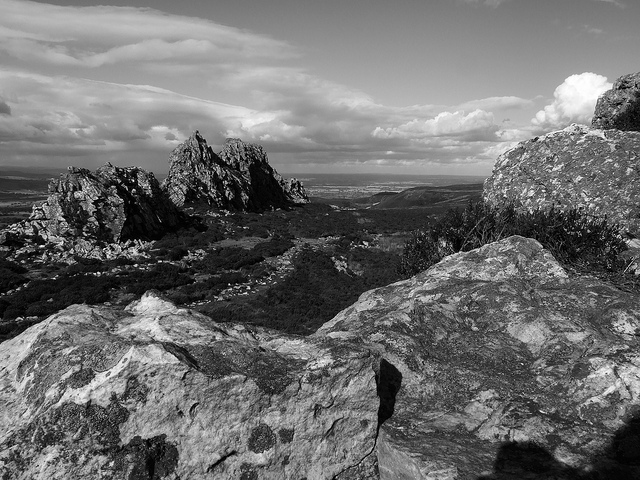
Mary Webb territory, The Stiperstones Photo: Gizmo Bunny flikr Creative Commons

Now it’s your turn. Here’s a writing work-out.

World building: where to start

Consider the images on this page and choose one or more that particularly strike you. Take time to explore them, then for ten minutes scribble down your first thoughts about the place/situation. Review what you have written, and if a character, or narrative thread is starting to emerge, then brainstorm each of these in the same way. You now have the raw materials for world building. Next come musing, dreaming and constant interrogation of all you have gathered. This can take time. Lots of time. For now you need to fathom all the nooks, crannies and potential layers of this provisional setting, and work out how circumstance and character will interact with it. If, however, you find that a character has emerged far more strongly than either setting or circumstance, then start interrogating them. Do this in a situation where you are relaxed, like a meditation. Ask the character what they are looking at and how they feel about it, and what they are about to do, and where they are going, and what kind of place it is, and who else will be there – on and on – till your story-scape starts coming into sharper focus. Then it’s up to your creation what happens next.

Happy journeying.

MaryWebbPosterSmallRGB-224x300[1]

text©Tish Farrell 2013

…of wolf farts, windmills and the Wenlock Olympics

It has to be said that wolf farts are pretty hard to find, even with expert guidance. And yet I had been led to believe (and by the Guardian no less) that if I visited a certain, well-known location near me, I would most surely discover them. And so, on a sunny winter’s day last week, when I set out on the curious quest, I was not anticipating difficulty. Far from it. The ground was dry underfoot and visibility good and I had been well primed by Paul Evans’ Wenlock Edge column (Guardian 10 January 2012) which not only gave me full details of said quarry, but also included a very good photo for accurate identification. The piece seemed unequivocal too. Wolf farts were to be found on Windmill Hill, and in January too. What prospect could be more beguiling for the writer-prevaricator, and especially in the after-Christmas lull when not much is happening in the natural history line? So I pulled on boots and woollies and set out in search of them. It’s amazing how many ways there are to avoid writing the novel.

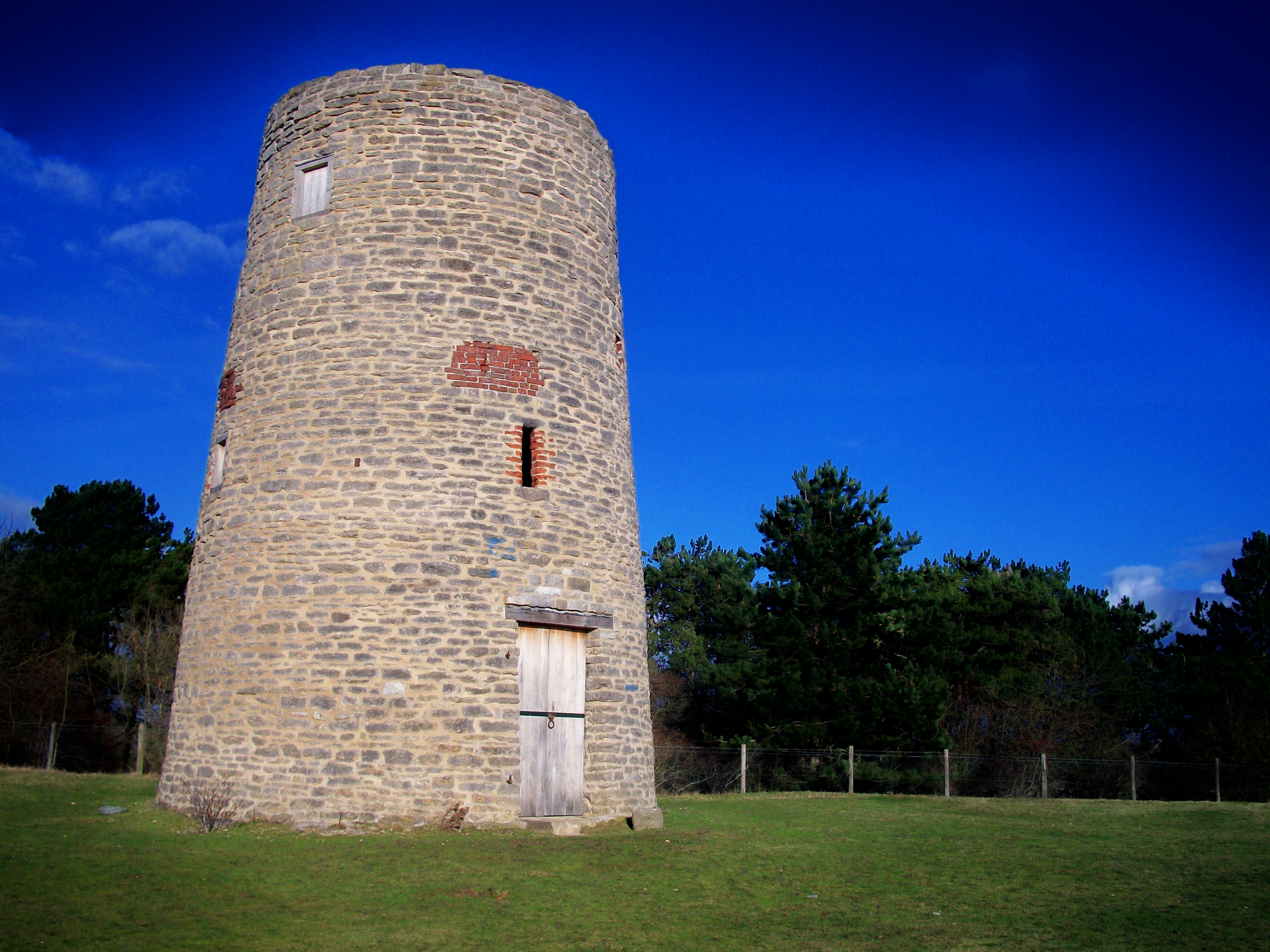
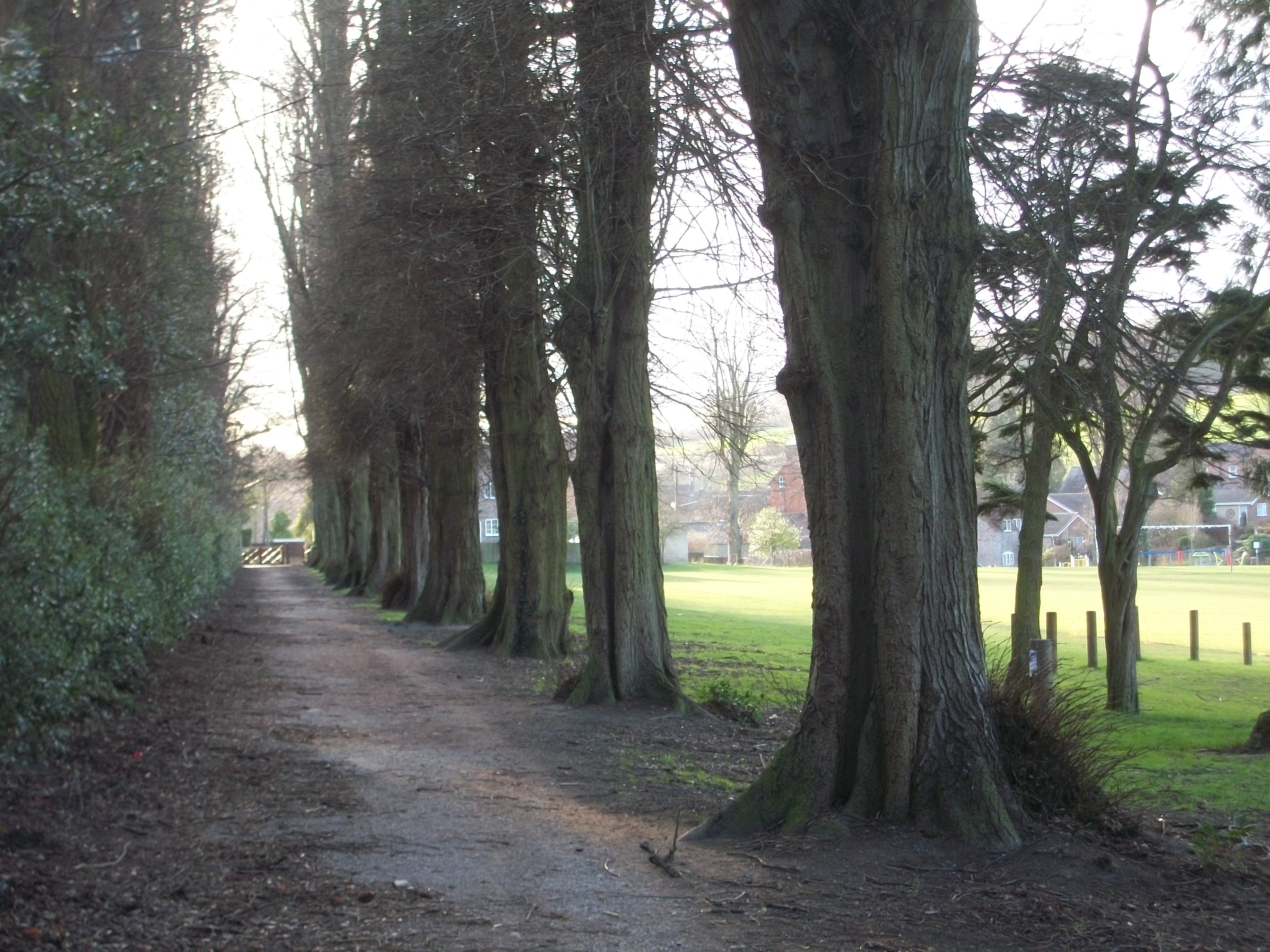
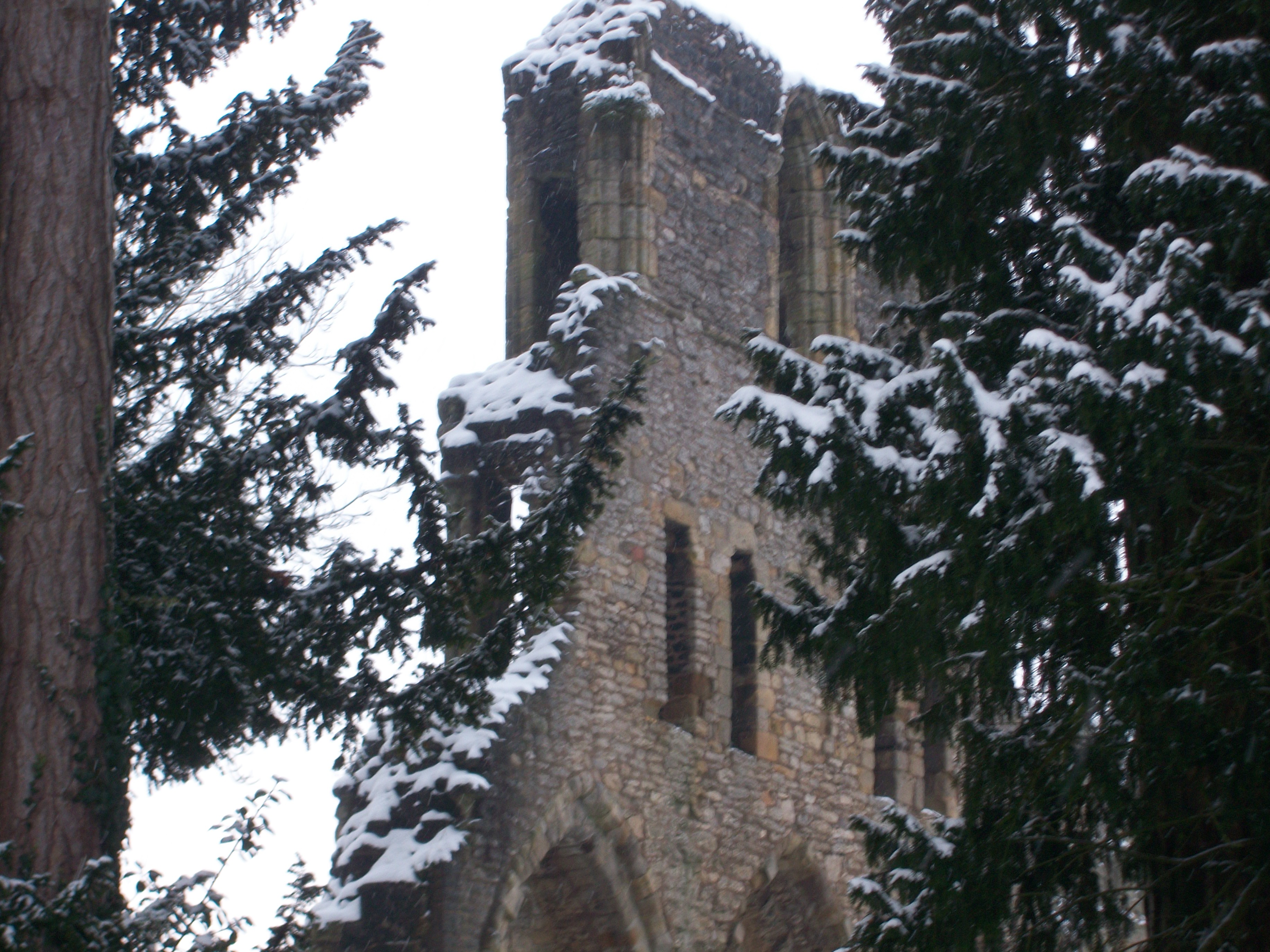
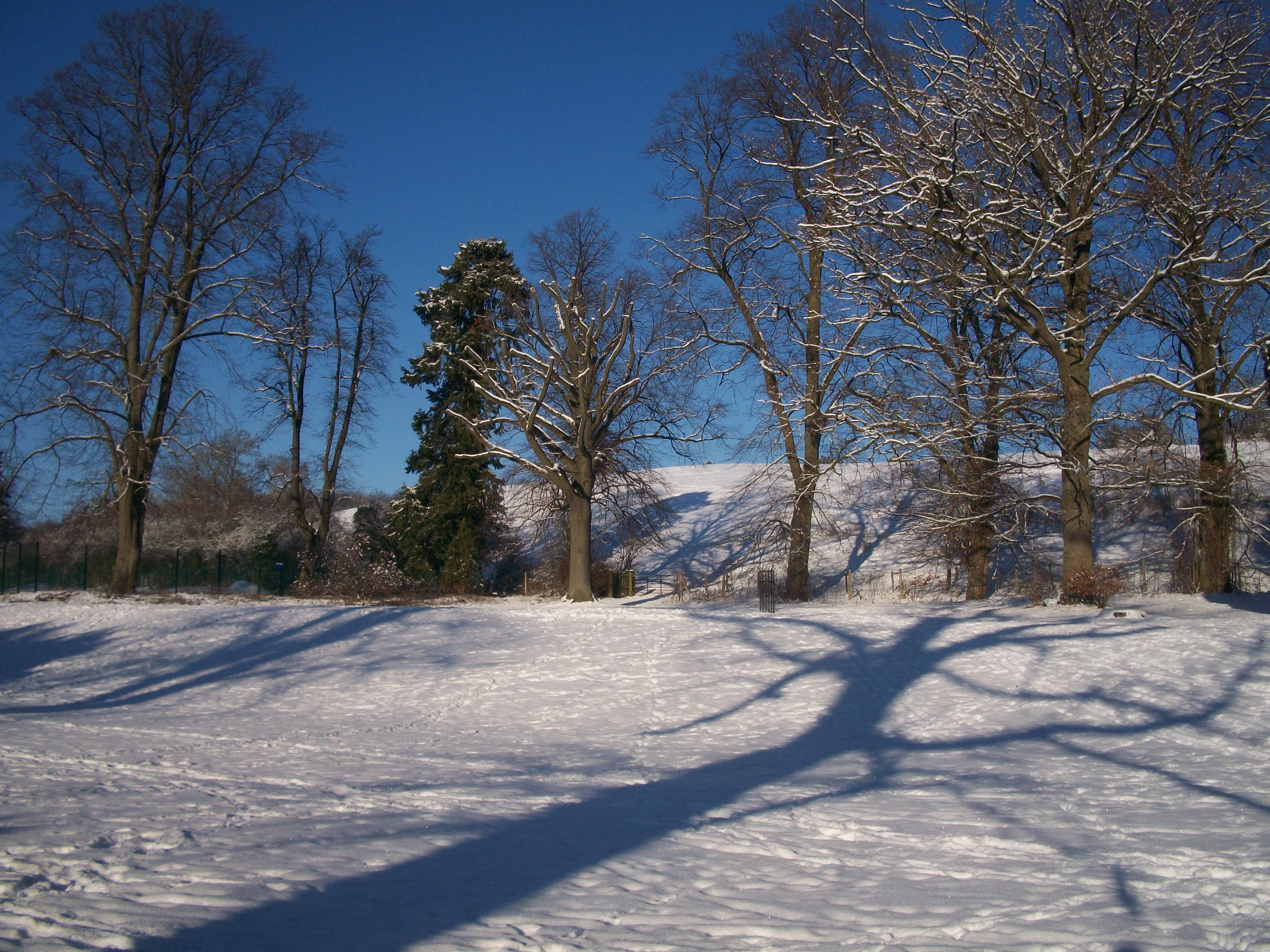
Finding Windmill Hill is the easy part of the enterprise. The old stone tower on its summit makes it a striking local landmark, though something of a mystery since there is no record of how this tower looked when complete and few clues as to what kind of windmill it once was. The limestone ridge on which it stands, with the disused Shadwell Quarry at its back, is a five-minute walk from my house. You can reach it either by striding across the Linden Field beside the new William Penny Brookes School, or you can follow the path beneath the towering limes of the Linden Walk. The trees form a cool sweet-scented arch of greenery in summer and Doctor Brookes, a trained herbalist and therefore well versed in the calming properties of lime flowers, planted them there over one hundred years ago. According to tree experts the limes could last another hundred and fifty years, although they wag their fingers at local cricket enthusiasts who, in season, drive over the roots while parking their cars for a good view of Sunday cricket on the Linden Field. The case of trees versus cars is guaranteed to raise tempers in the town.

The Linden Field once belonged to the Gaskell family, the town’s local worthies who lived in the Abbey beside the ruined Wenlock Priory, but in 1935 it was bequeathed to the people of Much Wenlock for their enjoyment and recreation. That the townspeople have problems hanging on to their rights as beneficiaries is another source of local irritation. But then the most important fact about the field is that it is the site of the Wenlock Olympian Games. These were begun in 1850 by the town’s doctor, William Penny Brookes, in a bid to improve everyone’s health and wellbeing, and later provided Baron Pierre de Coubertin with the model for the modern Olympic Movement. People argue about this too, but at the top of the field is the oak tree planted in 1890 to commemorate the Baron’s reconnaissance visit to the town to see the games for himself. Today, visitors who come to the field say there is nothing to see in the Linden Field. But then that’s history for you; invisible for the most part. However, should the see-nothings feel like returning between 12-15 July 2012 they will find the 126th Wenlock Olympian Games in full swing, with a wide range of serious athletic contests to be watched and enjoyed.

The old Penny Brookes games also included all the familiar events – pentathlon, archery, football, hurdles and long jump (called the running long leap), but there were also bicycle races on penny farthings and tilting at the ring, a mediaeval jousting sport wherein a galloping horseman speared a ring with his lance. Prizes were lavish with olive wreaths to crown the victors and Dr. Brookes himself designed and paid for the gold and silver medals. Then there were also the fun events – blindfold wheelbarrow racing, climbing the greasy pole and chasing the piglet. Something for everyone in fact and not a hint of a risk assessment. As might be expected, the games were hugely popular and spectators and competitors came from far afield, many arriving by train, since the line ran conveniently beside the field. And for those who wanted the best possible view of the games, then Windmill Hill provided the perfect spectator vantage point.

Which brings me back to the wolf farts. Not forgotten, but by the time I’ve hiked up the steep hill to the windmill, I’m a little out of breath and thinking I need to get into training, perhaps with some piglet chasing?  I begin to comb the limestone meadow that was cropped in autumn by a fleet of russet-coated Shetland ponies. This is where the wolf farts are supposed to be. Somewhere. It’s not a very big hill after all, and I can walk across the top in less than two minutes. I scour the northerly slope first, rooting among the weathered pony droppings and coarse vegetation from which, in late spring, will sprout spotted purple orchids, and later, agrimony, harebells and knapweed.

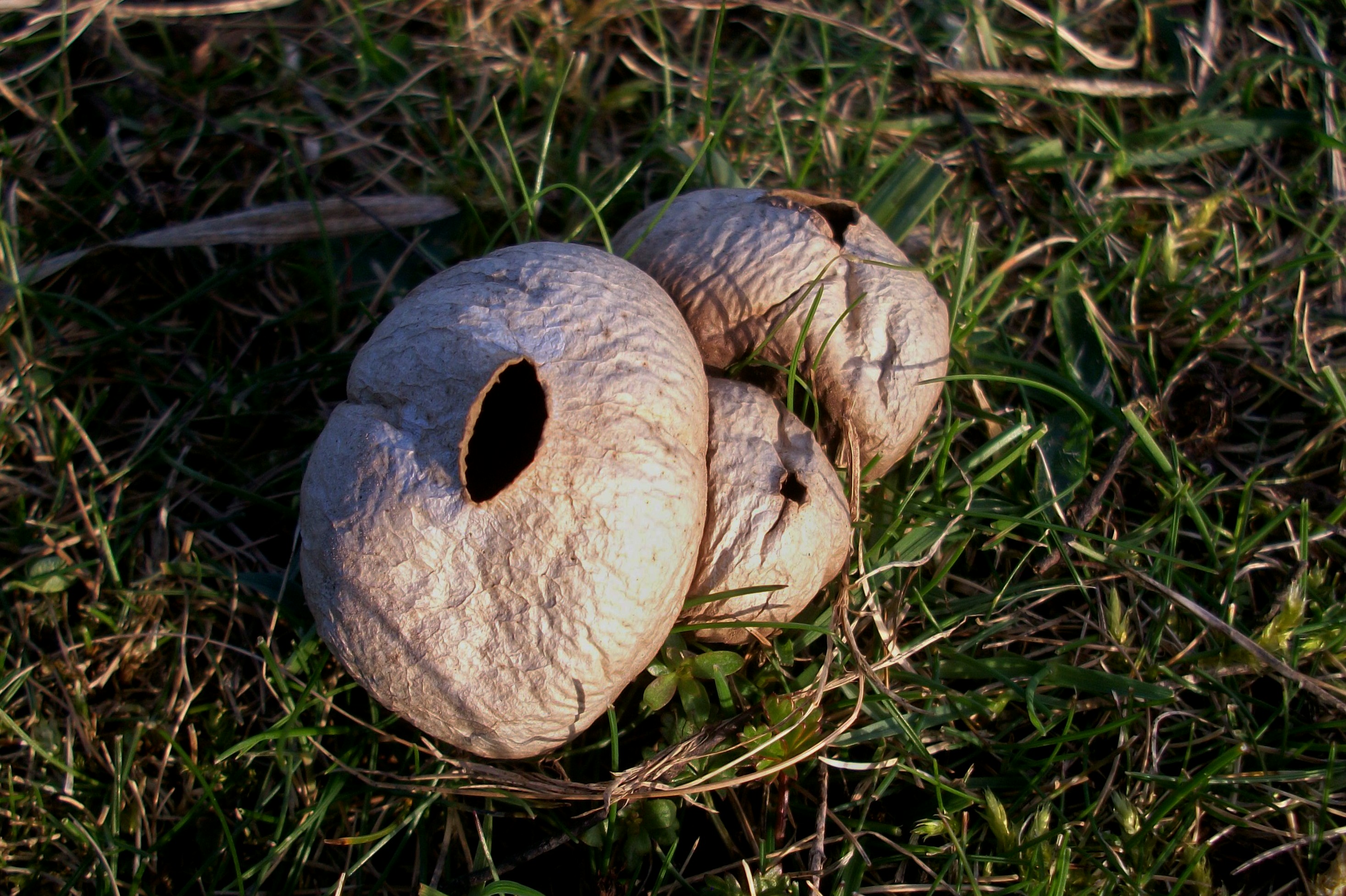
I decide that Paul Evans has been pulling my leg, but anyway work my way back in a southerly direction. And this is what I’m looking for:

the common puffball, Lycoperdon (from the Greek lycos wolf and perdomai to break wind). It has other names too, including the devil’s snuffbox. And finally I get my eye in. I had been seeking something altogether too substantial, imagining the white, marshmallow-like fruiting bodies of autumn. In fact the first one I find is quite tiny, paper-thin and bone coloured, the size of my fingernail. Then there are others – cigar coloured, a couple of centimetres across and yes, very like Shetland pony droppings. They are empty husks now, barely clinging to the thin soil, their spores spent, leaving tiny orifices like shocked little mouths. Then I find one still containing some spores and squeeze the sides. Out puffs the brown-black dust, as fine as photocopier ink. Later I read that inhaling too many spores can lead to lycoperdonosis, a life-threatening respiratory condition caused by the spores lodging in the lungs.  Won’t do that then. Won’t breathe them in. And that seems all there is to be said and done concerning wolf farts. Quest done, I lose interest, stand up and survey the old quarry behind the windmill. There’s a deep pool of unearthly blue water, apparently some seventy feet deep, and the surrounding land is going to be developed with holiday chalets and a dive centre. It’s then, as I’m looking for signs of building work, that I see large segments of the quarry have been staked out with low green plastic fencing. Later I discover this is newt fencing. Why it is there is another story, one that I don’t entirely believe – something to do with separating opposing amphibian gangs and newt fights. Oh come on! At this rate I’ll never get back to the novel. It’s far too exciting outside.

Copyright 2012 Tish Farrell

Paul Evans @ www.guardian.co.uk/environment/thenortherner/2012/jan/10/country-diary-wenlock-edge/

Wenlock Olympian Society @ http://www.wenlock-olympian-society.org.uk/

…of Maasailand

I wrote this piece around 2000 after several visits to the Maasai Mara. It was long-listed in the Brandt Travel Guide travel writing competition.

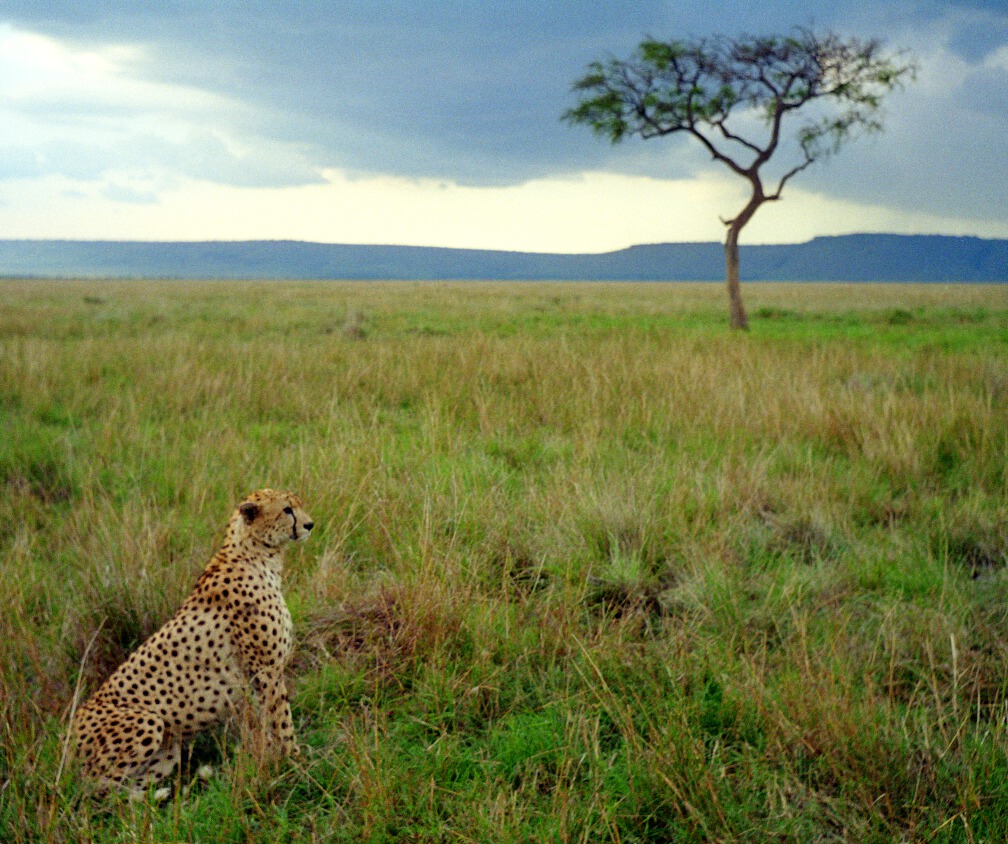
Cheetah

Dances with warriors

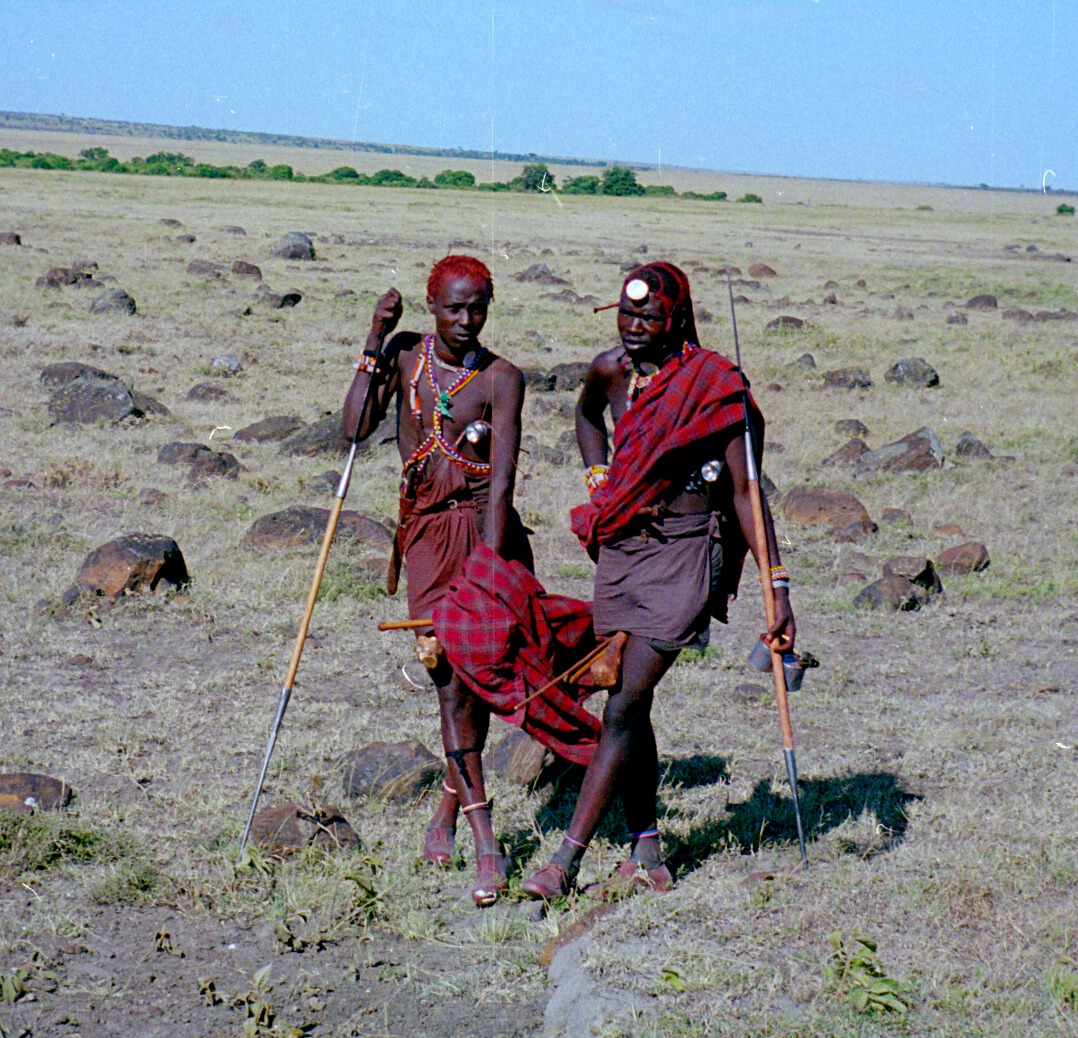
Night on the Mara River – darkness wraps round, close as a Maasai’s blanket.  It is cold, too, on the river’s bend. We press closer the campfire, our white faces soon roasting red. No one speaks. There’s too much to listen for. A hyena whoops across the water?  It sounds close. It sounds unearthly, sending shock waves through vulnerable bones – mine, conjuring packs of predators, out there, circling our ring of light. And even as I think it the Maasai are on us.  Six warriors, spears in hand and naked to the waist.  Their leader tosses his ostrich-feather head-dress that looks like a lion’s mane.  He is fearless.  He is lion.

Then the singing starts, a nasal falsetto that resonates through time and space – the winds’ whine through Mara grasses.  The Maasai girls trip lightly into the firelight, their wraps like flames – yellow, red; close-cropped heads hung with beads; chins jutting forward as the crescent necklets – tiny beads so patiently strung – rise and fall on skinny chests.  The moran start to leap – higher, faster.

Their dance fires the blood as it was once meant to in the days when the young morani proved their courage by killing a lion; but we see the collecting box left discreetly in the grass.  These kids are from the nearby settlements, but before I unravel the question of exploitation – theirs or ours – the dancers pounce, dragging us into a conga, pastoralist-style.  I let the Maasai girl take my hand.  She’s about fourteen years old and she is boss. After all, this is her land – the big skies and the rippling oat grass, and our small camp in the outer reserve remains there only on her clansmen’s say-so.  The hand that grips mine is small and hard.

So I follow her, graceless in the rhythms I cannot fathom, wend with the snake of dancers on and round the camp. The dancers know we’re squeamish and should not be put at risk, so we stray no further than the firelight’s edge, never crossing the bounds of the vast out there.

And of course, being on safari, and staying at a luxury, tented camp, we have been taken to visit the vast out there. We went earlier that day and naturally, being tender wazungu, we ventured only in daylight, with the rising sun at our back, and we went, not on foot, but in the Land Rover whose solid sides we were sure would protect us from too much closeness with the wilderness.

Mara country

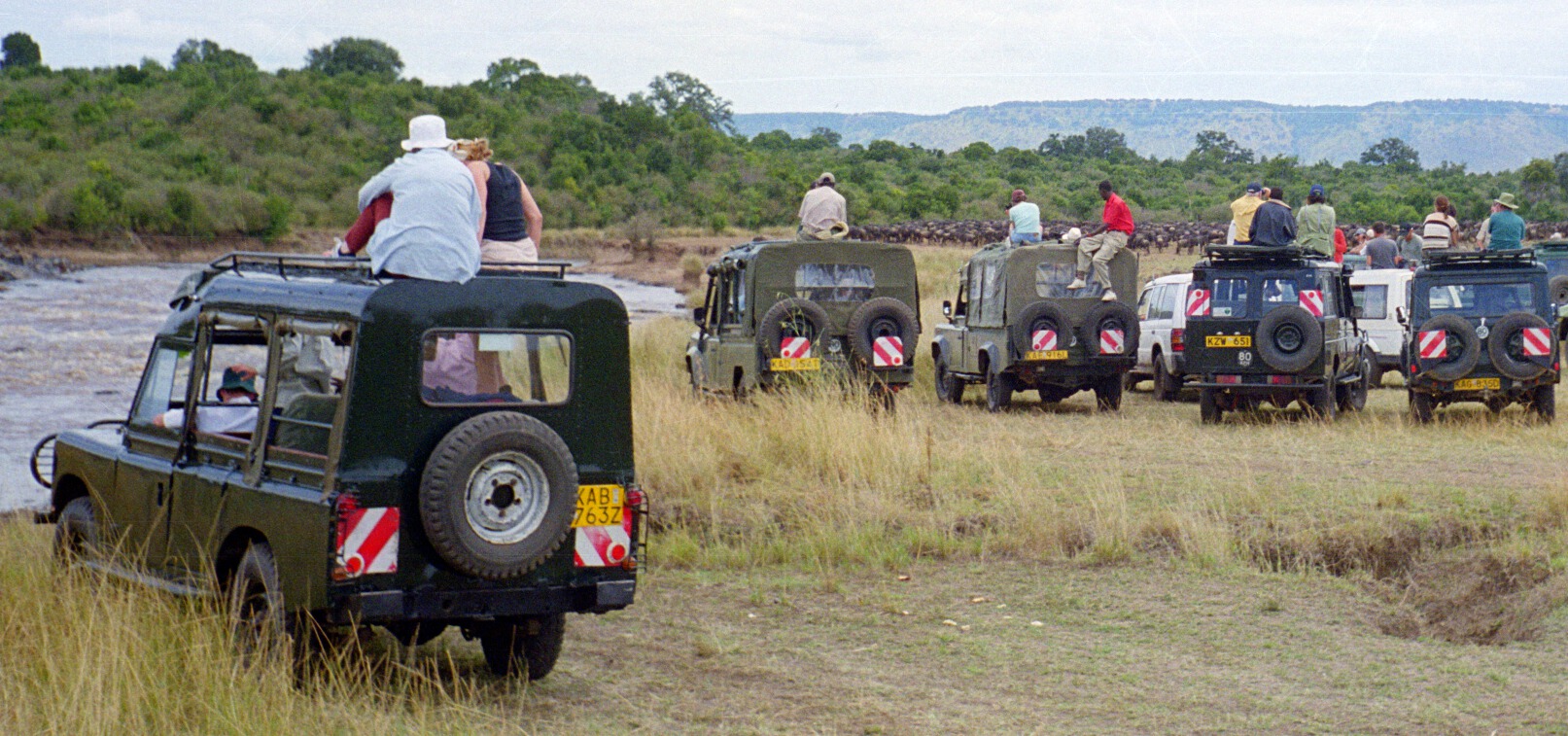
Our driver-guide, Sammy, had decided to take us to the famous river crossing where, over several days, tens of thousands of migrating wildebeest had been piling up, snorting and stamping on the dusty bank. For days they had been steeling themselves to make the seasonal Russian roulette dash that would take them over the river to much needed grazing.

Waiting for the wildebeest to cross the Mara River

“Perhaps they will cross today,” Sammy said as he found a good vantage point and stopped the Land Rover. At first, infected with the drama of the thing, we scrambled up through the viewing hatch with binoculars and cameras. The beasts unlucky enough to find themselves pushed to the head of the queue, teetered nervously on the brink. Eventually the sheer weight of numbers behind would force the vanguard to cross. It was a case of stand your ground and starve, or risk the gaping reptilian jaws of the massive crocodiles that were watching and waiting in the water.  Even leopard, we were told, would dare some daylight hunting and crouch in the brush across the river and wait for lunch to arrive. We did not see one.

But we did see the remnant corpses of earlier wildebeest meals snagged on riverside branches and we did see the flocks of ever-watchful vultures. We also realised that a dozen tourist trucks from other safari camps had now joined ours, their occupants craning with camcorders primed, willing the show to start. In the end we could not look. It was time to leave.

As we drove off our mood was swiftly lightened by a close encounter with the famous wildlife photographer, Jonathan Scott. We could add him instead to the morning’s, ‘seen’ list. He pulled alongside in his jeep to talk Marsh Pride movements with Sammy. After that we headed back to camp for our own feeding time, a large lunch that promised outrageous gluttony compared with the Maasai’s simple milk-based diet.

Maasai boys mind the clan's herds on the Olololo Escarpment

As we jolted back across the Mara grasslands we marked the pastoralists’ bleak brushwood corrals with their dung-plastered hump-backed huts; saw the distant red dots of herds boys’ shukas; heard the tinkling bells of shifting herds; watched the shaven-headed, much beaded women setting off on their long daily trek for water. And all of them seemingly at ease in the vast out there, walking each day where lion and leopard walk, fetching water, doing washing amongst crocodiles and hippos, sharing the grassland with elephants, buffalo and wildebeest. And all we could wonder was, how? How can they live here, so unchanging, while our world presses round and people like us come in droves on our own seasonal migrations?

But then, when we look more carefully, we can see changes. There’s a big thatched house that is not at all traditional and with an old jeep parked outside. There is talk of the womenfolk settling in one place (while their husbands move the cattle herds) so the children can go to the schools and clinics that tourist dollars fund. Near our camp is a new stone-built trading centre where the Maasai sell chickens and beer.

For a people so long resistant to change even these small innovations seem remarkable. Ever since1883 when Scottish explorer, Joseph Thomson, introduced red blankets and coloured glass beads to the Maasai, in return for safe conduct across their territory, outsiders have tried to “develop” the Maasai.  Now, it seems, they are doing it for themselves and in their own way. And so it is fitting that, before we leave Maasailand, we visit the Mara curio shop and, in a bid to hang on to the spirit of place we are drawn to buy red ‘Maasai’ blankets (polyester, made in China) and locally beaded jewellery. As I hug the tacky blanket and put on the beaded bracelet, I begin to smile deep down. The absurdity of my transactions is pleasing: somehow the dance has come full circle.

Maasai moran

© Tish Farrell 2011

…of Mombasa Beach

In 1992 I ran away to Africa. I meant to stay only three months, but it was eight years before I came back to live again in England. When I first arrived in Nairobi on a hot February morning, stepping off an Air France jumbo jet that had taken far too long to park, I felt as if some unseen hand were striking matches on my cerebral cortex – the sky, the bush, colours, smells, so many beautiful faces: it was as if I’d woken up for the first time.

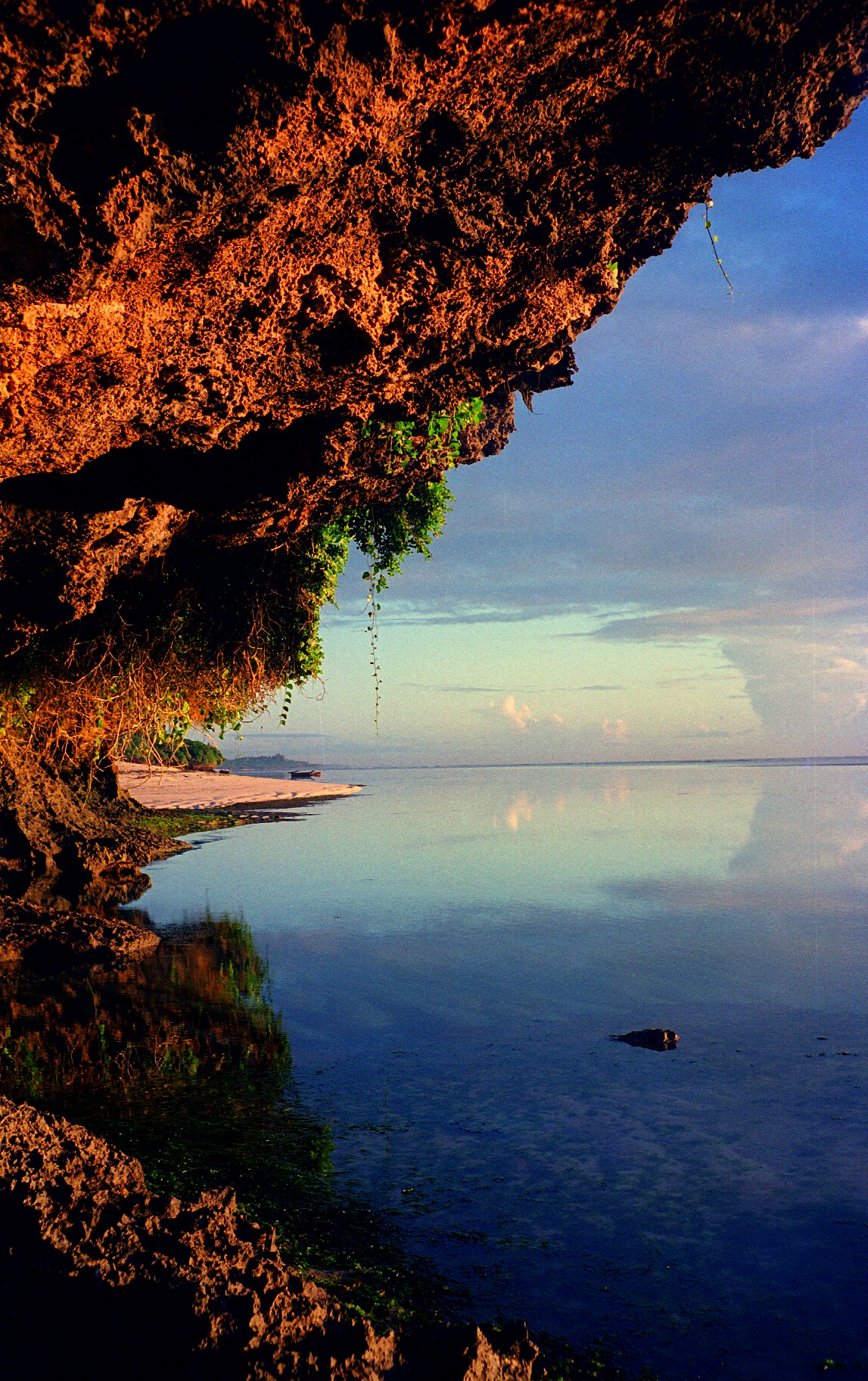
But if Nairobi was the place I woke up, Mombasa beach was always the place of waking dreams. It does not matter how well focused your eyes or how alert the brain, in the tropic light your perceptions turn to molten honey. Is this place real? I still don’t know.

sea and sky on the reef at Tiwi

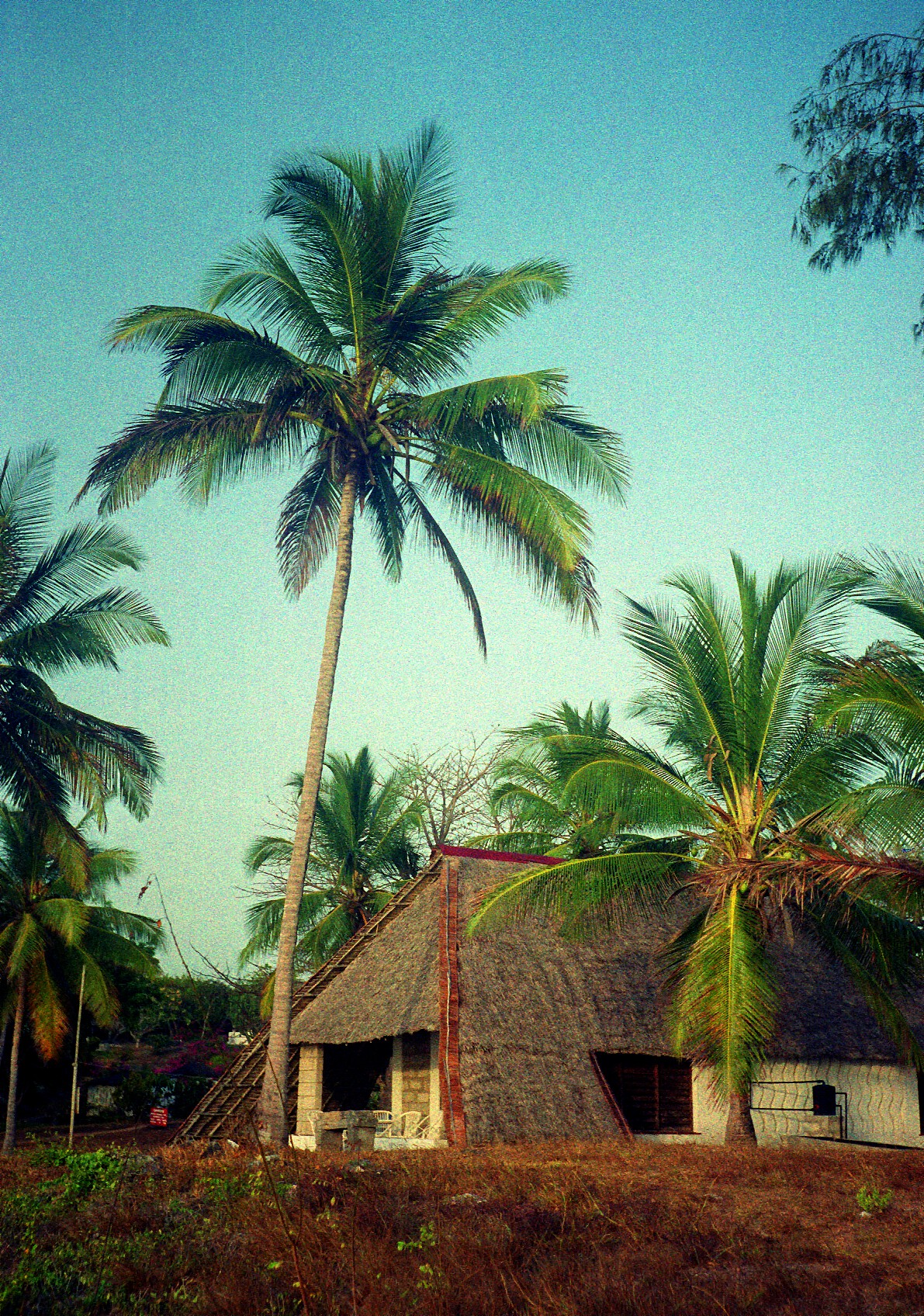
During the 1990s we often stayed at Swahili-style beach cottages that were owned by German or British expatriates. These little villages, strung out along Tiwi’s headlands, were low-key in every sense, and their bohemian, beach-combing ambience made them popular places to stay with long-term aid workers and mixed race families. Tanzanians came across the border to stay there too. Although at any one time, there never seemed to be many people staying there and the nearby beaches were often empty but for the local fishermen.

Capricho our house in Feb '92 b

The beach village owners were at pains to be part of the local community, encouraging Digo fishermen and vegetable sellers to call round the cottages with the day’s produce, and employing locals as cooks and gardeners. At night, though, there were often concerns about security. (The 90s were unsettled times in Kenya).  And this is where the village dogs came in. From dusk to dawn they patrolled with armed guards. But in broad daylight, their time was their own, and they generally spent it, unsupervised, down on the beach.

I wrote the following piece for Quartos Magazine in 1995. It won first prize in their article writing contest and was published in January 1996. 

                               Going to the dogs on Mombasa’s southern shores

It’s a dog’s life on Tiwi Beach, the white strand where ocean roars on coral, and trade winds risp the palms along the headland; and where best of all, as far as the dogs are concerned, there are quiet coves sparse in holidaymakers. It means they may do as they please. For after all, it is their own resort.

But the dogs are not churlish. They can take or leave the odd pale human wrestling to right his windsurfer on the still lagoon; ignore the sentinel heron that marks the reef edge beyond; pay no heed to the etched black figures of the Digo fishermen who stalk the shallows for prawns, parrot fish, or perhaps a mottled lobster or two.

But in this last respect at least, the dogs are smug. For the fishermen come down to the beach only to make a living. And when they are done hunting, they must toil along the headland from beach village to beach village, then haggle over the price of their catch with the rich wazungu who come there to lotus eat.  Hard work in the dogs’ opinion.

The dogs know better of course; know it in every hair and pore. And each morning after breakfast, when they take the sandy track down to the beach, they begin with a toss of the head, a sniff of the salt air, a gentle ruffling of the ear feathers in soft finger breezes. Only then do they begin the day’s immersion, the sybaritic sea savouring: first the leather pads, sandpaper dry from pounding coral beaches, then the hot underbelly. Bliss. The water is warm. Still. Azure. And there can be nothing better in the world than to wade here, hour on hour, alongside a like-minded fellow.

There’s not much to it; sometimes a gentle prancing. But more likely the long absorbing watch, nose just above the water, ears pricked, gaze fixed on the dazzling glass. And if you should come by and ask what they think they’re at, they will scan you blankly, the earlier joy drained away like swell off a pitching dhow. And, after a moment’s condescending consideration, they will return again to the sea search, every fibre assuming once more that sense of delighted expectation which you so crassly interrupted. You are dismissed.

For what else should they be doing but dog dreaming, ocean gazing, coursing the ripples of sunlight across the lagoon and more than these, glimpsing the electric blue of a darting minnow? And do they try to catch it?  Of course they don’t. And when the day’s watch is done, there is the happy retreat to shore – the roll roll roll in hot sand, working the grains into every hair root.

And if as a stranger you think these beach dogs a disreputable looking crew, the undesirable issue of lax couplings between colonial thoroughbreds gone native: dobermanns and rough-haired pointers, vizslas and ridge-backs, labradors and terriers, then think again. For just because they have no time for idle chit-chat, this doesn’t make them bad fellows: it’s merely that when they are on the beach, they’re on their own time. But later, after sunset, well that’s a different matter. Then they have responsibilities: they become guardians of the your designer swimwear, keepers of your M & S beach towel, enticing items that you have carelessly left out on your cottage veranda.

For by night they patrol the ill-lit byways of your beach village, dogging the heels of a human guard who has his bow and arrow always at the ready. And when in the black hours the banshee cry of a bush baby all but stops your heart, you may be forgiven for supposing that this bristling team has got its man, impaled a hapless thief to the compound baobab. It is an unnerving thought. You keep your head down. Try to go with the flow, as all good travellers should.

But with the day the disturbing image fades. There is no bloody corpse to sully paradise, only the bulbuls calling from a flame tree, the heady scent of frangipani, delicious with its sifting of brine. You cannot help yourself now. It’s time to take a leaf out of the dogs’ book, go for a day of all-embracing sensation – cast off in an azure pool.

And in the late afternoon when the sun slips red behind the tall palms and the tide comes boiling up the beach, the dogs take to the gathering shade of the hinterland and lie about in companionable couples. Now and then they cast a benign eye on you humankind, for at last you are utterly abandoned, surrendering with whoops and yells to the sun-baked spume. They seem to register the smallest flicker of approval: you seem to be getting the hang of things round here.

Maweni beach at dawn

© Tish Farrell 2011

…of Silurian Shores

Overlooking Townsend Meadow: on the edge of Wenlock Edge

All is peripheral in the place where I live – my house beside the path beside the field whose name on the 1847 tithe map, Townsend Meadow, marks the old town boundary of Much Wenlock. The town, itself, is very ancient and it has long outgrown the town’s-end frontier along the Sytche Brook. It also lies below its own impressive periphery – the long limestone scarp of Wenlock Edge.

I cannot quite see the Edge from my house, but I see the big sky above it, the dramatic false horizon that the Edge creates and thus the endless movement of weather along it. Hours can be wasted sky watching: the breezy march of clouds across the roof lights, the flush of hundreds of rooks from Sytche Lane wood at dawn and at dusk, peppering the skyscape.
Sky over Wenlock Edge

In fact most inhabitants of the town cannot quite see the Edge. This is something of a paradox given that its massive limestone presence has shaped Much Wenlock in so many ways, and not only in the fabric of its many stone cottages. You need to be outside the town to get a proper glimpse of it and, even then, it is hard to get the full measure of it. Nevertheless, as landmarks go, it will not fail to make an impression however you come at it: whether wending up the hairpin bends from Shrewsbury; or taking the road over the top from Wenlock to Church Stretton and the Shropshire Hills beyond, or yet meandering down below it along the narrow lanes through Kenley, Hughley, Church Preen and Longville. From the lowland, the Edge’s steep north-west slopes look so heavily wooded that they bristle up like a giant hog’s back. For some fifteen miles this dark spine stretches, bearing down on the scattered hamlets and farm fields. It is unavoidably mysterious.
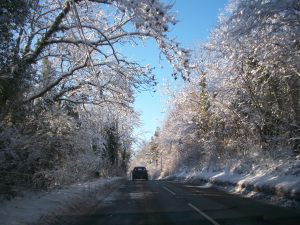
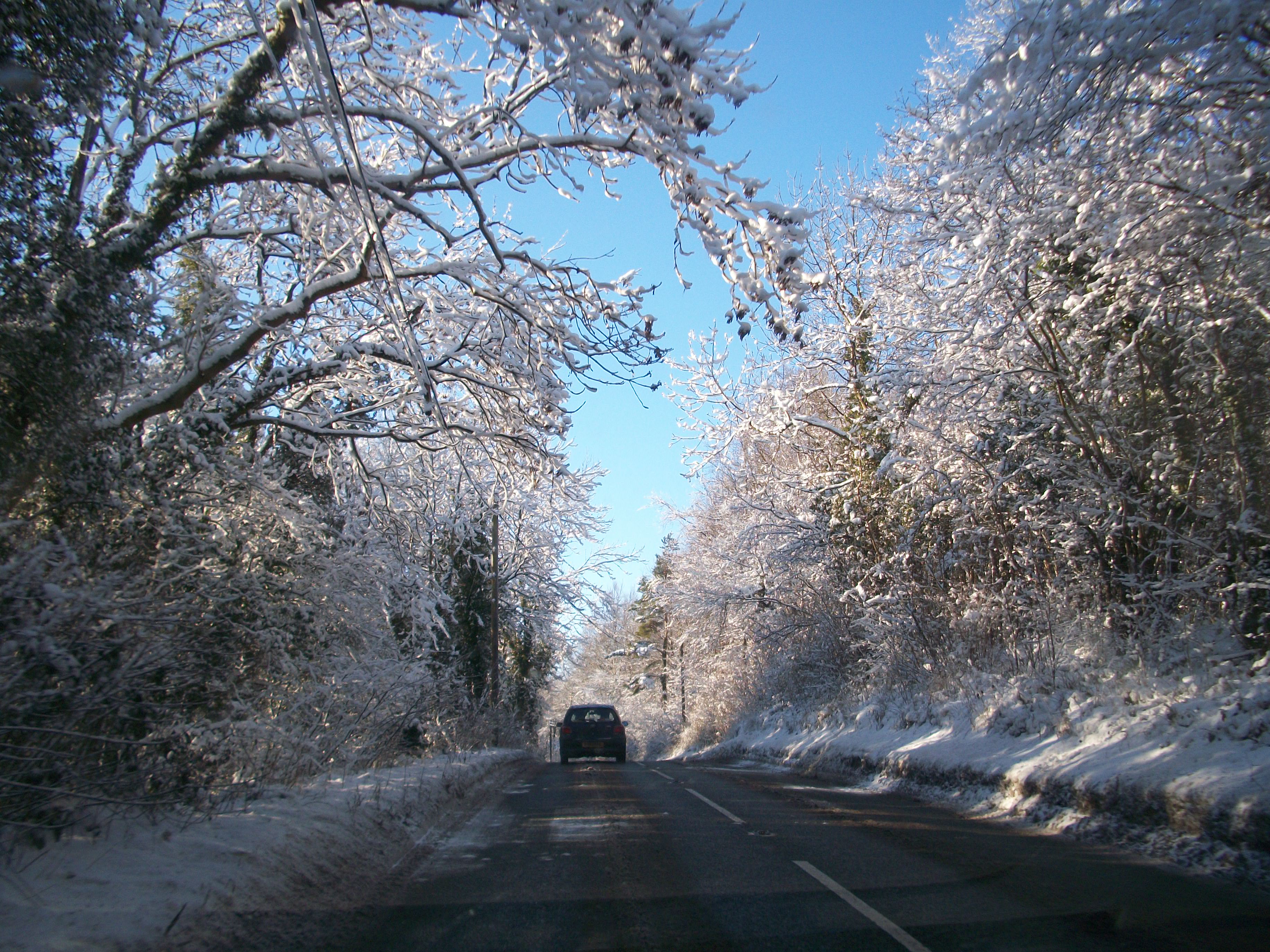
Driving along the Edge on Christmas Day

The south-east slopes, by contrast, have a more domesticated feel, and something of an industrial air, having been dug into for centuries. The road that cuts along the top passes beside vast quarries (now mostly hidden by hedges and woodland and visible only to walkers). These quarries yielded limestone for building and for the iron works of Coalbrookdale where it was used as a flux in smelting, and for burning in lime-kilns to make fertiliser. In more recent times most of the stone went for road building. But now quarrying has stopped and Much Wenlock’s houses no longer shudder in a pall of white dust as they once did whenever the quarrymen were blasting; nor do the streets vibrate with the endless rattle of passing stone trucks.

There are other sources of disturbance of course – over-sized farm vehicles and garden fencing lorries. They pass by on the other side of my house, which sitting as it does on the A4169 is not so scenic, although it is interesting in other ways. For instance when I’m standing in the kitchen eating toast, I might look up to meet the serially startled gazes of a tour bus party as their coach nudges them past our windows, brushing hard through our privet hedge in order to wheedle a way past another HGV. It is the only way to do it on a road too narrow for two large vehicles to pass. We locals amuse ourselves by taking photos of the trucks and buses that several times a day get jammed outside our homes while officers at Shropshire Council shrug helplessly, quite unable to say what their predecessors were thinking of when they upgraded a bottle-neck lane into an ‘A’ road. There’s nothing to be done, they say. One day a European mega-truck will drive down from nearby Telford and block the road forever.
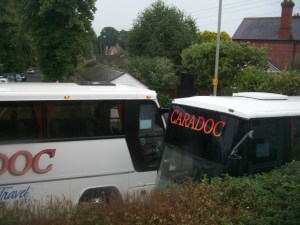
Coaches getting stuck on Much Wenlock’s narrow streets

But for all the present day shove and shunt, there is still a sense of romance about the town and Wenlock Edge. Spirits from the past make their presence felt in all sorts of ways. Housman set the Edge in verse; Vaughan Williams rendered it in song; the explorer, Stanley, sat upon it, his dark heart brooding on his time in Africa as he surveyed the more benign Shropshire landscape below. Even Henry James and Thomas Hardy came visiting, (James several times and said to have worked on Turn of the Screw while staying in the old Prior’s House that adjoins the Priory ruins).

Last but certainly not least, Shropshire writer-poet, Mary Webb spent her adolescent years living upon the Edge at The Grange and was well known about the town. When, in the 1950s, her novel, Gone to Earth, was turned into a film by Michael Powell and Emeric Pressburger, some of the scenes were shot in and around Much Wenlock. In fact I’m told by my neighbour that one of the film’s extras used to live in our house and was also the town’s projectionist. Perhaps he even showed Gone to Earth in the little cinema that is now the museum, thrilled to bits as the scenes flickered on the screen: seeing himself and other townspeople alongside Hollywood’s Jennifer Jones.

Wenlock Edge, of course, has much older stories than this to tell. Back in the Silurian Age, some 430 million years ago, it was a tropic seabed, and in rare moments when my mind can even begin to consider such vast temporal constructs, I imagine my house on the shore of the Silurian Sea. (A Solaris moment perhaps). Of course back then the ground on which my house stands was not even in the Northern Hemisphere. Back then the earth’s landmasses were still on the move, shifting up the globe from the South Pole. The English Midlands and Welsh borderlands that I think I know so well thus lay south of the Equator; 15 degrees south in what is now the Indian Ocean, where they were part of the micro-continent of Eastern Avalonia that in turn bordered the Iapetus Ocean. And so while Shropshire lay somewhere off Mozambique, the world warmed and the Ordovician ice caps melted and the low-lying lands filled to become the Silurian Sea. I also like to imagine, that after living in East Africa for seven years, returning to settle in Much Wenlock is like coming back to the place where I was; for I miss Africa very much. Also it gives a new connotation on the phrase ‘world travel.’

Wenlock Edge, then, is a fossil hunter’s treasure place and, as such, is the most famous Silurian site in the world. In its seaside days, warm, shallow waters were home to sea lilies, corals, multi-radiate starfish, trilobites, gastropods, brachiopods and fish. Indeed, somewhere over my garden hedge, there may have been some reef lagoon that hosted ammonites, squid and, horrifically, water scorpions five feet long. In fact, my house is composed of these Silurian deposits, dug from those vast quarries along the Edge. I thus inhabit a re-shaped fossil seabed. There are crinoid stems and corals in the chimney-breast, and all belonging to an age before the birth of amphibians or dinosaurs, or before there were mammals and birds in the world.

While I can easily picture my house on a flat, gravelly shore and a teeming shallow sea beyond, it is hard to conjure the great absence of earth-life. We might easily begin to think that the terrestrial world would be a painfully quiet and very still place, although this, I gather, would be a grave misconception. The land may have been lacking in life forms but there was instead a perpetual wind. And because the paucity of land life meant there was little with which to bind the earth’s surface, the Silurian seashore would have been a dreadful place of roaring sandstorms and lashing gravel.

Today, the farmland that surrounds the town is lush and homely. It has sheep and cattle, arable crops and pasture, woods and thickets, the old quarries and sundry ruins, remnant green lanes and farm cottages. There are deer and rabbits, foxes and rodents and also, as far as the town’s allotment owners are concerned, far too many birds. That said, though, it is good to hoe and dig to the mewing of buzzards.
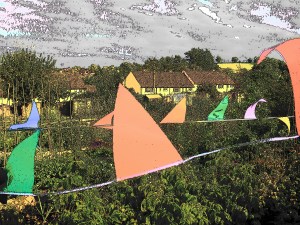
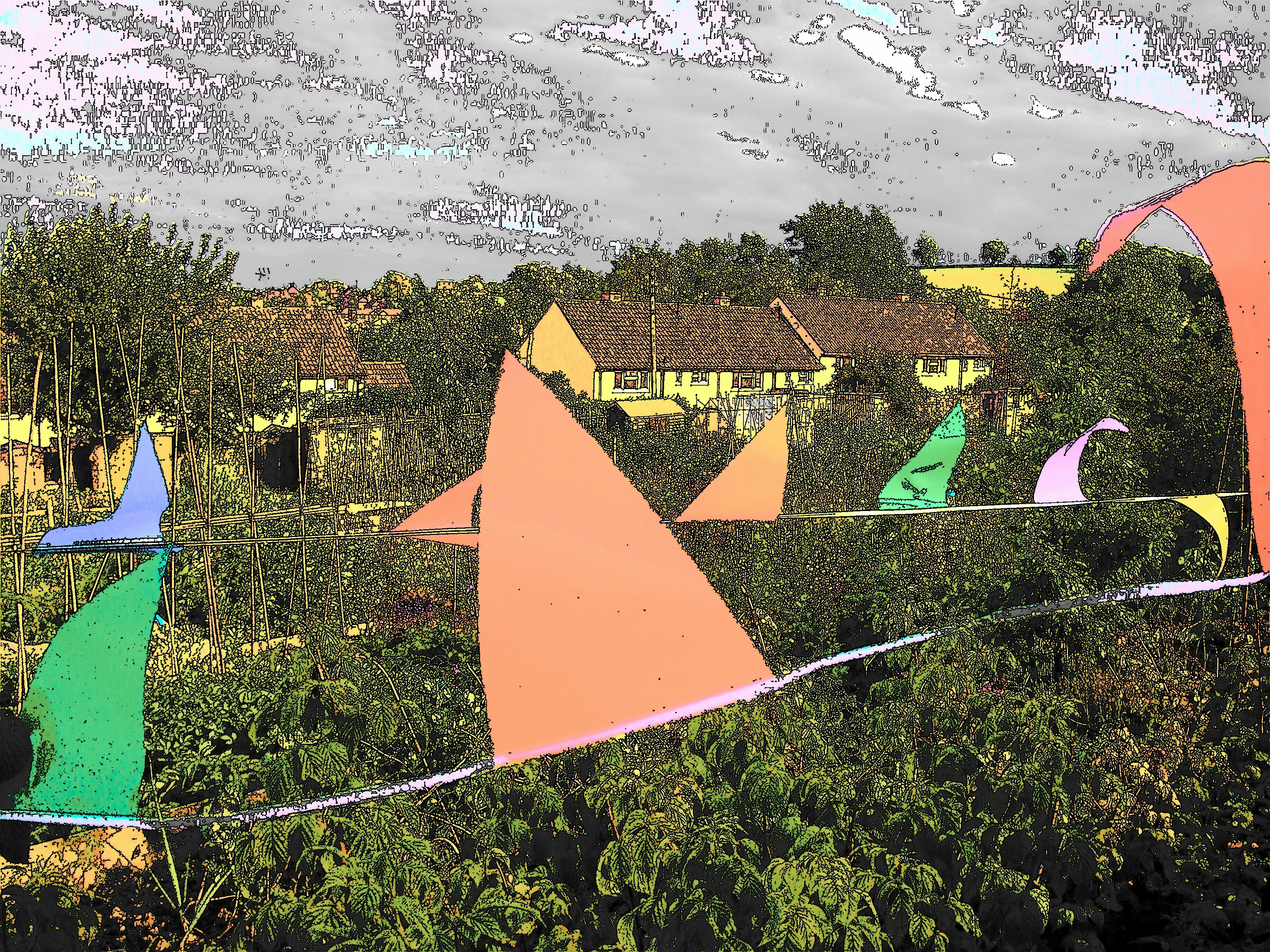
Bird-scaring bunting at the allotment

Most of the land within the town boundary, and this includes Townsend Meadow, is still feudally owned and tenanted and, within these little bounds of landowner imposition has grown a small market centre that has been continuously lived and worked in for the last thousand years.

But then that is only the historical record.* Archaeological investigations show that humans settled this valley by the Edge from at least the Bronze Age. These first Wenlockians were probably early Celts, and as venerators of water, were doubtless attracted to the many springs that rise below the limestone escarpment. The Celts were also skilled metal workers and Wenlock Edge would have provided a natural, upland byway for itinerant smiths and metal traders going to and from the mineral-rich hills of Wales. Certainly Bronze Age hoards have been found in and around the nearby River Severn which, through many ages, was one of the country’s busiest inland trade routes.

After the Celts came Roman and Saxon settlers, Viking and Norman invaders, and the town not only still has substantial ruins of an eleventh century Benedictine Priory, but many of the present houses and cottages are built from stone plundered from the monastery after its dissolution in 1540. The medieval Prior’s House, however, largely survived this recycling. It adjoins the Priory ruins, from where it may be glimpsed, and has been restored as a breathtakingly beautiful private house.

The common theme, then, that runs throughout Much Wenlock’s settlement history is the belief in sacred water. The town has many holy wells. Excavations of the Priory that sits beside a brook that runs off the Edge yielded not only the carving of a Celtic deity but also a substantial Romano-British residence that seems to have its own Christian chapel. In Saxon times, around 670 A D, Merewald, King of Mercia, founded an abbey there, and his daughter, Milburga, after training at Chelles, near Paris, became the foundation’s second abbess. She is also our saint and the heroine of a local legend that tells how she escaped an assault on her honour by a rapacious suitor. She is known, too, for striking holy springs from the ground and for her miracles of healing. The water from her well near Barrow Street was reputed to cure eye diseases.
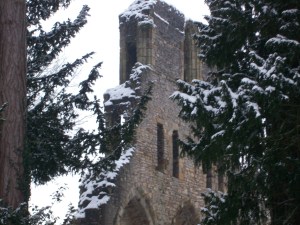
Much Wenlock Priory ruins

The Benedictine Priory that succeeded the Saxon Abbey in 1079 was part and parcel of the Norman master plan to control all aspects of Saxon life. Much Wenlock’s age-old reputation for holiness guaranteed that the Norman earl, Roger de Montgomery, would choose the town for a big demonstration of power and piety. It was he who invested so heavily in the priory that was to become one of the most imposing religious houses in Europe. And to ensure the new priory’s prosperity as a lucrative place for pilgrimage, St.Milburga’s reputation for miracles was duly annexed to the cause and a new shrine to her established.

Today, most of the pilgrims to Much Wenlock are tourists, stopping off briefly en route for Wales. But this coming year we are expecting many more visitors, as news of Much Wenlock’s further claim to fame spreads around the world. For it was here in 1850 that the town’s physician and apothecary, Dr William Penny Brookes (1809-1895) founded the Wenlock Olympian games that were to become the inspirational force behind the modern Olympic movement. It was he who in 1890 (six years before the 1896 Athens modern Olympics) passed on to a young Baron Pierre de Coubertin not only a wealth of experience gained from running the town’s annual games, but also his passionate belief that exercise wrought moral, physical and intellectual improvements in all who took part.
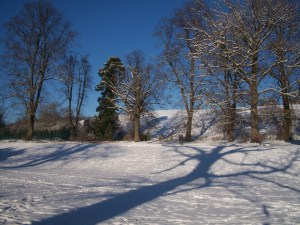
The Linden Field, Much Wenlock: birthplace of the modern Olympic Games

The Linden Field where the Wenlock Olympian Games were held amid crowds of up to 10,000 spectators is still there and is now a public park, bequeathed by a former feudal worthy for the pleasure and recreation of the people of Much Wenlock. Since it is only a step from my house, I sometimes toy with idea of running down the avenue of lime trees that Dr. Brookes planted there one hundred and fifty years ago. Perhaps such active activity would improve my mind. Perhaps it would spur on the story-telling process. Perhaps I would escape the peripheries and finally get some work done…finish a new edition of my one-time award winning African novella, Jessicah the Mountain Slayer, finally create some new tales from my backed-up story-making stock. Or perhaps, like the Silurian seabed, I will simply go on accreting: stuff and more stuff, piles of notes and scribble and memory sticks slowly compacting, although hopefully not enfolding anything as alarming as a fossilised giant water scorpion. That is a worrying thought.

© Tish Farrell 2011

www.tishfarrell.co.uk

* for many historical details I am indebted to Vivien Bellamy. See her book A History of Much Wenlock, Shropshire Books, 2001