Off-Centre In Lamu

Mzee Lali cropped

Once, a long time ago when we were living in Kenya, we spent Christmas on Lamu Island. I wrote about our brief stay HERE.  It seemed like a dream when we were there. And here in this photo (posted a few times before) Mzee Lali, dhow captain, also dreams, the late-day breeze bearing us along the Manda Strait back to Shela village.

Scan-130429-0029ed

Scan-140802-0010ed

Scan-130428-0053 - ed3
Stone Town: a World Heritage site

*

Scan-130428-0128ed

Shela Beach above, and Shela Village below. Donkeys were ‘parked’ under the thorn tree until needed for transport.

Scan-130428-0140ed

Scan-140801-0011ed2

Scan-130428-0024 - Copyed

Crossing Manda Strait to the air field in a sudden squall

*

Scan-140802-0015ed

Lens-Artists: Asymmetry    This week Donna sets the theme and shows us how asymmetrical framing can give compositions a different kind of balance.

Nice Symmetry ~ Symmetrically Nice

On the front

A flight of fancy was needed on this drizzly Shropshire day. So why not skip off to Nice for some dreaming Cote d’Azur light. And (somewhat loosely interpreted) take up Sofia’s this week’s challenge at Lens-Artists to look for all manner of things symmetrical.

The Promenade des Anges beside the glimmering Mediterranean seems a good place to start – glorious under the sun even in late October. And what could be more cheering than an azure avenue of beach brollies…

100_1248ed

*

…glamorous by night:

Hotel Negresco, Promenade des Anglais

*

…vibrant in its old town streetscapes, markets, palaces, churches, museums….even a sudden cloudburst doesn’t dampen its spirits…

Place de Masena en pluie

100_1208ed

100_1173ed

*

and when the sun comes out again…oh, that light, shades of Matisse, Chagall, Dufy…

Mamac

100_1268ed

Olive orchard at Cimiez

*

…and then it’s back to the beach for some symmetrical sunbathing:

100_1234ed

Lens-Artists: Symmetry   This week Sofia shows us many exquisite examples of symmetry. Please visit her blog and be inspired!

So Where Is The Castle In Bishop’s Castle?

IMG_4090ed

This is a very good question. Where indeed is Bishop’s Castle’s castle? In its last years (during the early 1600s) the stone towers of keep and bailey would have loomed high above the town. Given the steepness of the hillside approach, it could not be a more dramatic setting. It must have looked very much like our vision of a fairy tale castle from a children’s picture book.

The outer bailey walls extended to the top of today’sHigh Street. See the next photo. If you home in on the on-coming red car below the brown building facing downhill, you’ll be in roughly the right spot.

IMG_3642

*

Of the actual castle, there is little left to see. The Old Castle Land Trust has secured a portion ground that lay outside the inner bailey, and here you can see a surviving portion of bailey wall. It’s also a pleasing place to sit and stare at the top of the town.

IMG_4017ed

IMG_4021ed

*

The original castle keep would have been much further back and up, on the hill’s summit in fact. The site is now occupied by the town’s bowling green which was created over the keep’s footprint some time in the 18th century. A pleasing feature here is the octagonal pavilion, presumably built when the green was constructed. It is oak framed and, during restoration, the centre post was found to be octagonal in section. No expense spared then.

IMG_4028

*

So why was there a castle here at all?

The answer is law enforcement and taxes.

The earliest version was constructed not long after the Norman Conquest, put up between 1085 and 1154, at the behest of the Bishops of Hereford, they who ruled the local roost – spiritual and temporal. As with most early Norman castles, it would have comprised an earth mound or motte, topped by a wood framed keep, and the surrounding inner and outer baileys defended by timber palisades. The lower flanks were then surrounded by a defensive ditch or moat, complete with drawbridge.

IMG_4093

*

The stone-built phase began around 1167 – including stone keep, curtain walls with towers and gatehouses to both bailey perimeters. Further fortifications and likely refurbishment of living quarters took place around a century later, following on the brutal attack by a bellicose neighbour, the Earl of Arundel, Lord of Clun in 1281.

The castle premises at this time were equipped to provide accommodation for the visiting Bishops of Hereford plus their retinues of some 30 horses and men. The outer bailey would have included stables, stores, smithy and brewhouse.

The bishop came at regular intervals to hold court, impose fines on wrong doers and infringers of local laws and regulations, and to exact taxes from the local populace. By this time, there was a well-established town on the hillside between castle at the top and parish church at the bottom.

The bishops’ authority was finally overruled by Elizabeth 1, who simply took Bishop’s Castle for the Crown and then in 1573 issued a royal charter  (see earlier post HERE) that handed executive control of the town’s affairs to an elected bailiff and 15 burgesses.

From this time on it seems the castle was left to its own devices, apparently ruinous by the 1600s. And so it is obvious what happened next: there was a general repurposing of the castle fabric as the market town grew in scale and prosperity.

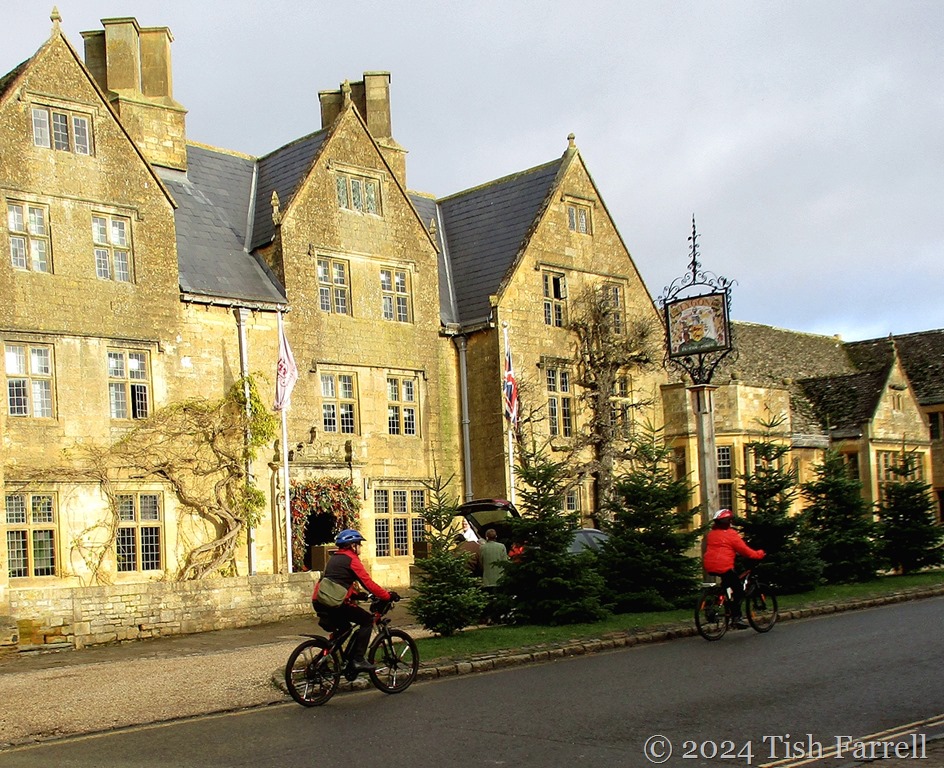
One beneficiary was the Castle Hotel, built in the 18th century inside the former outer bailey:

IMG_4035

*

If you stand in the hotel gardens, as I did in sunny interval this week, you are treated to the kind of sweeping vista that castle-dwellers-past might have enjoyed from their bastions, though I’m guessing there would have been rather more forest than the wide-open fields of this next photo.

IMG_4067ed

IMG_4066ed

*

If you then turn through 180 degrees and look up the garden, you are now facing the spot where the inner bailey gatehouse would have stood. I’m thinking the huge ash tree makes a handy simulacrum for a castle tower:IMG_4070ed

*

The bowling green is just beyond the tree. It used to belong to the hotel, and there’s a path through the garden to reach it. (Closed now for the winter season).

The late 17th and 18th centuries were a time when many townscapes had their ancient timber-framed houses clad and/or replaced in stone or brick. This certainly happened in Bishop’s Castle. Many of the 1700s and 1800s stone and rendered frontages will contain remnants of earlier wattle and daub dwellings. It was all part of growing urban show and gentrification.

IMG_3649

*

And so the castle fabric has doubtless found its way into many a house and garden wall.  The Moat House on Welsh Street seems a particularly obvious candidate, both by name and siting on the original castle defences.

IMG_4008

A plaque on the wall also names it as no.41 of Bishop’s Castle’s town trail of lost inns, having been known variously as The George or The White Swan from around 1700. (Surprising to note that the town has hosted some 46 public houses over the last 400 years, but that’s a story for another day.)

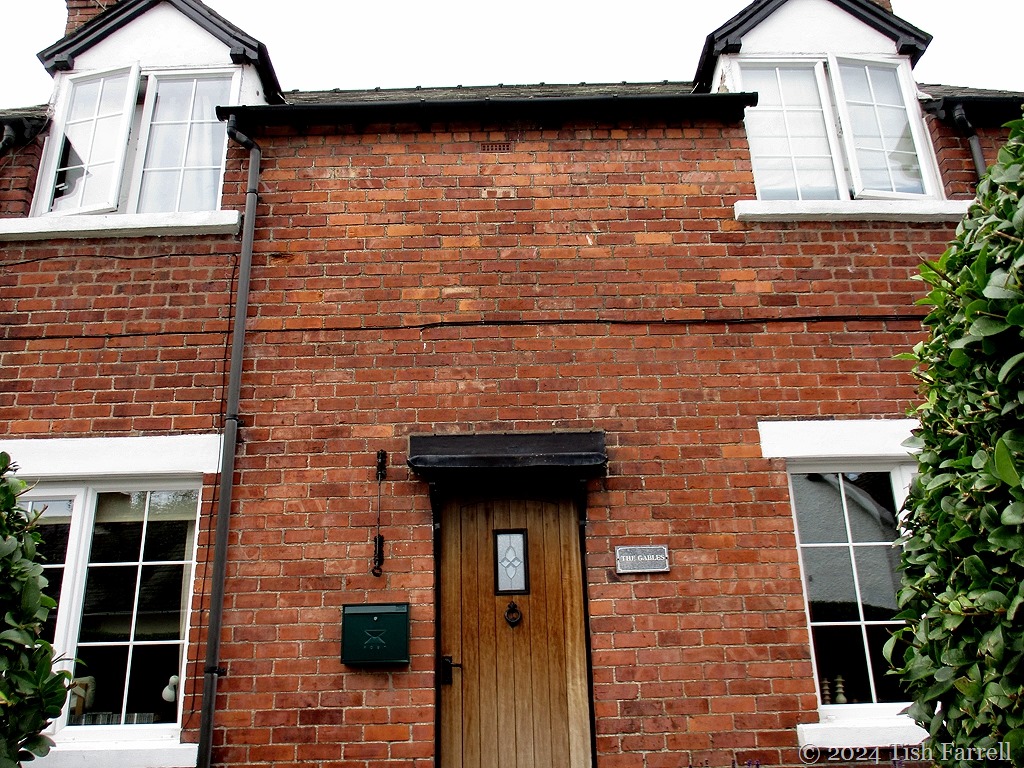
I do know for certain that our house wasn’t built from castle remains. It’s all red brick, locally made, I think, and put up around 1922 by local builder George Nicholas. It stands in a corner of land formerly owned by the smithy and then by the Hit or Miss public house, which is three doors up from us. What a great name for a tavern. Now a private house, its plaque lists it as no. 38 in the lost pub trail, 1832-1915. These days it’s rather nicely ‘draped’ in laburnum fronds since it stands next to Laburnum Alley, one of the town’s intriguing shuts and pathways. Again, more of these in a future post.

IMG_4056

For now, a view of our street and the former Hit or Miss  public house. (You can just glimpse our red brick side elevation and chimneys furthest left).

And another view from the Castle Hotel garden, this time looking up motte, across the inner bailey, to where the castle keep would have once dominated the entire background. Interesting how things change:

IMG_4062

IMG_4090ed

In A Winter Light

P1000056 - Cropped

This week Amy at Lens-Artists wants us to show her contrasts. Here are some of mine from winter sojourns on the island of Anglesey in North Wales – a favourite destination for family Christmas gatherings.

And a favourite place for photo-taking too. The combination of solstice sun, cold air, mountain weather and light off the sea creates some striking effects, especially along the Menai Strait between island and mainland.

2

IMG_2427ed

100_7161

P1060390ed

P1060416ed

IMG_2294ed

IMG_6210ed

4

Lens-Artists: Contrasts    Amy sets the challenge with some fine contrasting compositions. Go see!

Bunting, Banners, A Zip-Up House…?

IMG_3860ed1

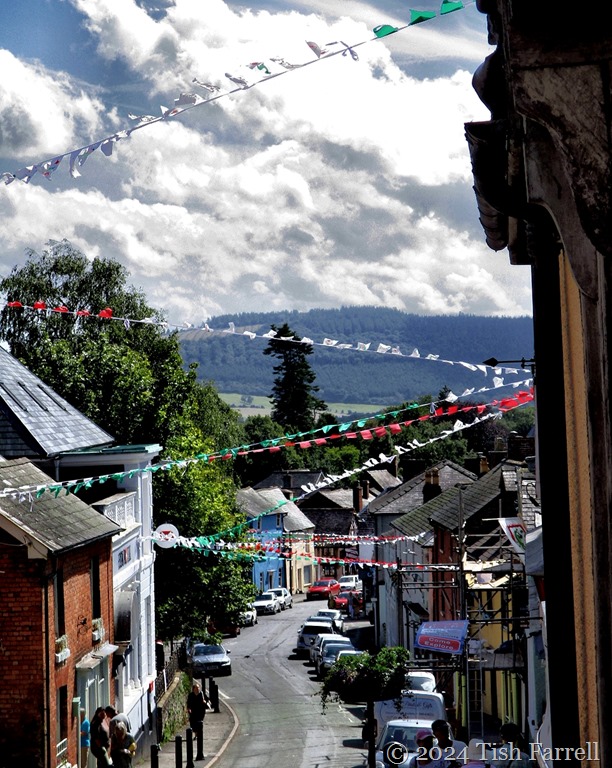
Display is this week’s theme from Ann-Christine at Lens-Artists, so I thought I’d show you a few more views of Bishop’s Castle. It seems like a town that wants to party, or it might do, if it could stop feeling so sleepy. But then somnalent or not, it puts on a bright face.

IMG_3841ed

And yes, the Six Bells inn truly is that vibrant shade of coral. It’s the first building you see as you enter the town.

IMG_3842ed

*

There’s also a welcoming sign on the wall to any passing elephant who might fancy a pint of this hostelry’s best brew:

IMG_3907ed

*

Across the street the houses cut quite a dash, colour-wise. This pair comes joined at the zip, so to speak:

IMG_3910ed

*

And then next door is a bit of a puzzle:

IMG_3839

*

IMG_3642

Back up the hill into town there’s another coral-fronted tavern…

And three doors up, opposite the Town Hall, is Bishop’s Castle’s very own Poetry Pharmacy, an independent bookshop emporium wherein a carefully curated selection of poetry and fine prose works are on sale to heal whatever ails. It has a cafe too, and a physic garden with a writing cabin that may be reserved at no cost. The poetry pharmacist also offers personal consultations, with suitable verses prescribed. I’m sure I’ll be writing more about this nourishing alternative health service.

IMG_3644

*

And one last image: this from a cottage at the bottom of our street. I’ve posted it before, but it gives me a lift whenever I pass it. Up, up and away…

IMG_3670

Lens-Artists: On display  Please go and view Ann-Christine’s lovely images for this challenge. They’re a real treat.

From The Grave Of The Good Burgess ~ Speaking Truth To Power

IMG_3897cr

My last post featured a recent visit to Bishop’s Castle’s parish churchyard and the mystery surrounding the grave of an unnamed African who died in the town in September 1801. This week I returned to the visit another intriguing grave. It stands in sight of the great Norman tower of 1291, and marks a death that occurred in May 1802, a few months after I.D.’s burial, and also the year of a general election.

And what an epitaph it is. What a swingeing ticking off of the town’s ‘worthies’; very much in the vein of ‘you know who you are’.  (And doubtless everyone else in the town knew too).

Here’s what the headstone says:

To the memory of Matthew Marston. He departed this life May 29th 1802 aged 81, the oldest Burgess of the Borough.

His steady and uncorrupt conduct presents an examples to his brother Burgesses for perpetual imitation and a useful lesson to the Parliamentary Representatives of the Borough that Opulence and Power cannot alone secure universal suffrage.

*

IMG_3903ed

*

And to what particular corrupt practice is the Marston stone referring?

Bribes for votes, that’s what, and the fact the town’s burgesses controlled the electoral roll. Only they could vote in elections, and only they had the power to admit new burgesses to the roll. And these were the men who managed all aspects of the town’s affairs, from market trading to judicial and coroner’s courts.

In 1802, when there were around 170 burgesses on the roll, the going rate for a vote was 25 guineas – well over a thousand pounds by today’s values, and enough then to buy 2 horses or 5 cows or employ a skilled tradesman for 173 days (National Archives currency converter).

For a small rural town, Bishop’s Castle seems to have earned itself a big reputation for shady political dealings: a ‘rotten borough’ from 1690-1763, and a ‘pocket borough’ from 1763 – 1832. During these years the town returned two parliamentary representatives, all members of the landowning class, or in the case of the pocket borough, all relatives or favoured associates of Robert Clive. (He had returned from India, where he had risen from lowly agent in the East India Company to Governor of the Bengal Presidency, amassing a fortune equivalent to 48 million pounds). Only with the Reform Act of 1832, did the parliamentary borough of Bishop’s Castle meet its end. We now have 5 regional county representatives.

During the rotten and pocket eras, parliamentary representatives were obviously intent only on furthering their own and sponsors’ interests and causes. This situation was compounded by the fact that several times the entire manor of Bishop’s Castle changed hands with the new owners seeking to secure a seat for their own man. In 1683 it featured in a marriage settlement between one Anne Mason and the Earl of Macclesfield. It was Anne’s ne’er-do-well cousin Richard Mason, seemingly the Earl’s ‘placeman’, who then bribed and bullied his way to Parliament, standing as M.P. for 30 years.

In 1718 the new Bishop’s Castle owners, the Harleys, appalled that their own candidate had failed to win a seat, roundly condemned the town’s burgesses (‘profligate wretches’) for their ‘villainous roguery’ and ‘perfidy’ in voting for Mason. They sold the manor on to the Earl of Carnarvon (Duke of Chandos)  who then, after considerable expense, secured his own placeman at the next by-election. His purposes doubtless served, he then sold the manor to his nephew, local landowner, John Walcot of Walcot Hall, who then found the means to further his interests through favoured candidates.  And so it went on. On and on.

But what of Bishop‘s Castle’s ordinary folk? Over all these centuries of political vested-interest, one might well wonder how did life go for the ploughman, dairymaid, tavern keeper, clerk, cowhand and stonemason, or for the cooper, brewer, carpenter, apothecary, farmwife, cook, curate and chamber maid? How indeed?

You can well see that the Marston family had a point when they erected this headstone to their kinsman, the good burgess: a lone voice of integrity?

IMG_3900ed

previous post The Man from Africa: I.D. unknown

source: The Story of Bishop’s Castle eds David Preshous, George Baugh, John Leonard, Gavin Watson, Andrew Wigley  2018 Logaston Press


The Man From Africa ~ I.D. Unknown

IMG_3848ed

Last week I went to pay my respects to I.D. He is one of Bishop’s Castle’s mysteries – the man from Africa, who was laid to rest in the parish churchyard of St John the Baptist on the 9th September 1801. Origins and life story unknown.

IMG_3846ed

Here lieth the Body of I.D.

A Native of Africa who died in this Town Sept 9th 1801

God hath made of one Blood all nations of Men  Acts 17 verse 26

*

I’ve written about him before, but the mystery continues to niggle, and especially now that I’ve come to live in the town. Who was this man? Where did he come from, and how had he arrived in the isolated small farming town of Bishop’s Castle? What led to his death? Was he slave, originally from West Africa or the Congo, and a possession of some Shropshire plantation-owning grandee. Or was he a free man; or employed as a servant?

The headstone, if sparse in details, is a fine one; it suggests a certain status; someone must have paid for it. There’s also a presumption that the deceased was a baptised Christian since the grave is sited in a prominent spot beside a well used path.

If the man had been a well regarded servant, then one might expect more personal details; a name at least; the years of his service and the name of his employer. (Slaves were usually given their owner’s names.) If he were merely a passing traveller who happened to die in the town, then who took it upon themselves to give him a decent burial? The parish records throw no light on the matter, and only repeat the text on the stone.

But there is a clue in the biblical quotation: God hath made of one blood all nations of men. This was a trademark text used by campaigners for the abolition of slavery.

At the time, Shropshire had its own fierce anti-slavery movement, driven by the dogged determination of one Archdeacon Joseph Plymley who lived not far away at Longnor. From 1791 until abolition in 1807 he worked tirelessly, alongside his sister, Katherine Plymley, travelling the county, raising petitions, urging Salopians to boycott sugar. So perhaps a local abolitionist sympathiser paid for the funeral. And perhaps, too, that well-wisher had the sensibility not to bury the man with his full slave name, but not knowing his birth name, chose to identify him solely by the initials I.D.

So many questions about a man, identity unknown, cut off from family, culture and community, lying in this quiet, but alien burial ground at the foot of the town, late summer cyclamen under the trees, the drift of cool air in from the hills and fields. Africa far far away.

IMG_3843ed

September Harvest

IMG_3868ed

Warm winds this afternoon, and a flurry of Red Admiral butterflies about the garden. Also out on the lawn, the alcoholic waft of gently fermenting apples – windfalls from our gnarly trees. The trees are in need of serious remedial work – if reclaiming them is even possible. Most of the fruit is spoiled before it falls – lots of pests and diseases, and some very spotty articles. But that said, there’s been enough good fruit to make a few pots of cinnamon and honey poached apple. And more to come.

As for this Red Admiral, it was spending a lot of time supping from a very rotten apple. I wonder if butterflies get squiffy. It might account for all the whirling about that was going on as I hacked away on project-liberation-greenhouse. It’s almost free from the overbearing hedge, but a lot of broken panes where hawthorn and ivy branches have leaned too heavily. For now, though, it’s good enough to shelter two bucket-planted tomato plants brought from Broseley. They’re still fruiting, if sporadically.

Our other tomatoes are an outdoor container variety, Tumbling Tom. They ripened very nicely on the terrace wall during our week of hot September weather. Here they are doing just what it says on the packet: cascading from their pots in profusion – out of summer and into fall.

IMG_3702ed

Raptor Rapture: Meet The Sparrowhawk

sparrowhawk

photo credit: https://www.goodenberghleisure.co.uk/sparrow-hawk-at-the-hide/

*

I couldn’t have taken this photo, or one very like it, for all sorts of reasons. I’d just popped outside to do some qigong and soak up a bit of late-day sun.  All was still in Bishops Castle: the light dreamy; the glow of old gold. There was of course the quarter-hour chime of the townhall clock, and then from across the street, the tones of convivial chatter between two neighbours’ were also finding their way into the garden.

And so to qigong. I was more than halfway through the shibashi set, performing ‘wave hands like clouds’, when the hawthorn tree over the hedge suffered a missile strike. Swift crash through vegetation. Something aerial shot down our path and landed on the rail by the garden steps. And there it stayed – only a few yards away, while I froze mid-cloud waving, right arm skywards, flamenco-style.

Posed thus, I of course thought of my camera. Silly. It was in the house, and I dared not move. So instead, I watched, while the sparrowhawk (a young male I think) sat on our fence, looking like it owned the place, from time to time turning its head as if to eavesdrop on the chatter across the road. It ignored me though, yet it surely must have spotted me with those sharp raptor eyes.

On the other hand, it was possibly busy gathering itself after a failed assault on some lucky bluetit. I watched for several minutes. Until it wheeled off over the hedge into town, the distinctive barred tail feathers, spread like a fan against the sun.

IMG_3704

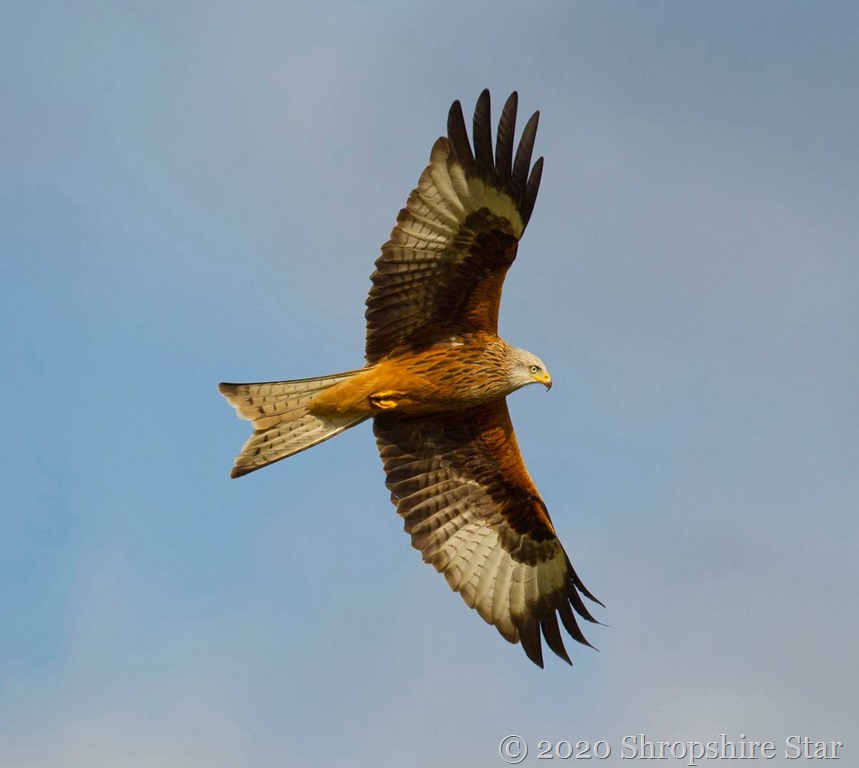
The Farrells’ new back garden. There’s an awful lot to sort out, but in the meantime, visiting sparrowhawks are a welcome addition. Some days we have red kites too, wafting high overhead.

You can find out more about sparrowhawks HERE.