The Grateful Gardener

IMG_6486ed

We have snow here in the Castle. We woke up to it early yesterday. What a shock. Snow in November. It’s much too soon. I’d seen the weather forecast of course, but was expecting only a spot of sleet that would soon melt away with the global boiling, not several inches of real snow, the sort perfect for snowballs.

Anyway, it’s not the snow I’m grateful for, but I do love the brilliant blue sky it’s brought with it. And also this golden Rowan tree in its white cocoon. It stands just outside our garden, and provides us with some borrowed treescape. And it, in turn, has recently been much loved by the birds, especially the blackbirds. Before the snow came they were busily stripping the stems.

IMG_6457

*

I’ll miss the berries when they’ve gone. On bright autumn days they light up like jewels. This is how they looked in early October. A tree full of joy. Thank you, Rowan.

IMG_6424ed

*

The snow fall also focused my eye on the latest garden addition: a Jelly King crab apple tree. Yesterday morning while sitting at the kitchen table eating my porridge, I could see its clutch of red apples glowing like little beacons at the bottom of the garden. Time for a photo then, and to say how very pleased I am with this Halloween birthday gift from my other half. Thank you, Graham.

IMG_6489ed

It came a few days before my birthday, delivered in a tall box to the front doorstep, whither I was directed to investigate the new arrival. Once I’d broken through the cardboard, I was surprised to find the little tree had come with eight tiny apples still firmly attached. There were also a dozen loose ones in the bottom of the box, sadly not quite enough to make crab apple jelly, but filling me with high hopes. I decided to keep them as a spur to locating a wild tree. I thought I knew where there was one. And so it proved. Last week I found a fine crop of fallen apples in a patch of woodland on the way to the builders’ merchants. We now have crab apple jelly. No need to wait for the little tree to do its stuff then.

*

And speaking of stuff – we still have some of the salad variety growing outdoors and in the greenhouse.

IMG_6466

This year I’ve grown Red Radicchio endive. For the past few weeks it’s been growing fatter by the day, and as temperatures lower, the more red it becomes. I’ve been plucking the outer leaves with hopefully plenty more to come. In the greenhouse I have tubs of red Chinese mustard, Moroccan Cress which grows like a cut and come again lettuce and a few oakleaf lettuces. Also some lettuces out in the garden, though they may have succumbed to the snow. Likewise the marigolds. But it makes me very happy to find a bowl full of fresh salad leaves in late November. Thank you, garden.

And one little plant that is standing up to the snow, once I’d dug it out it earlier today:

IMG_6508

These sweet little hearts ease type pansies have been flowering for weeks and weeks in a pot on the garden steps. And they’re still going strong. They were a gift from my sister. Thank you, Jo.

Lens-Artists: Gratitude  This week Tina sets the theme, both timely and thoughtful. Please visit her ever lovely blog.

The Silence Of Stones

100_6999ed

This is Shadwell Quarry on  Windmill Hill, Much Wenlock, part of the Wenlock Edge Silurian reef system.

There’s an air of brooding here, even on a bright winter’s day: of violation survived, albeit roughly; scrub and small silver birch trees recolonising the horizontal shelves. It’s a silence all its own, cupped by sheered off walls and the mysterious deep pool below. Then there is my own silence: awe at the scale of this one-time endeavour now shut down, truncated, closed as if it never mattered: the hard lives of the men who worked here, their injuries and doubtless deaths, unrecalled.

P1000657 Shadwell

Half a century ago, this hillside and the nearby town of Much Wenlock rocked with every quarry blast. Then came the soft fall of lime dust that clung to every surface.

The quarry closed in the 1980s, but in its heyday in the late 19th-early 20th centuries, steam powered goods trains huffed and clanked up the incline from the Ironbridge Gorge to the quarry’s own siding, there to take on stone to use as flux in iron smelting at the Coalbrookdale Works and the furnaces of the Black Country; industries that are also long defunct, or exported to China along with the roar of red-hot hearths, the crucibles’ hiss of pouring iron, shouts of foundrymen.

But then there’s another absent soundscape here, one so ancient it is hard for human minds to grasp. The limestone reef exposed in this quarry began to form over 400 million years ago in a shallow tropical sea somewhere off the Comoros Islands in the Indian Ocean. In waters teeming with corals, sea lilies (crinoids), bony fish, sponges, trilobites and molluscs began the depositing, compacting and solidifying of decomposing animal parts. And while this was happening there was apparently no terrestrial life, but instead there were endless howling gales rampaging across the landmass; brutal winds terrifying in their loudness.

Good that they’ve gone then. Instead we are left with other ungraspable events, for instance, envisaging how vast land masses shunted around the planet, ending up in places many thousands of miles from where they began; the slow, slow scrunch of tectonic plates; the gradual upthrusting and folding of ancient strata; a world we somehow think is in our power!

The stones beneath our feet, the rocky uplands maybe silent, but they have wider, wiser perspectives to impart if we choose to pay attention. I think our ancestors may have understood something of this.

IMG_1947 ed

Wenlock Edge quarry

*

Lens-Artists: Silence  This week Egídio explores the principles of silence in the work of American photographer, Robert Adams. Please see his photo essay and be inspired.

Tales From The Lake Shore ~ Of Hot Springs, Cold El Nino Rains And A Leopard

img20241001_19513812ed

Elmenteita December 1997

*

I’m having camera problems when I take this first photo, but in its way, it speaks of the times. It is early December 1997, our sixth year in Africa. There have been recent months of crazy weather with Kenya awash from El Niño floods and devastating downpours. When the rain rolls into the Great Rift, a lugubrious twilight descends, lowering in all senses. It feels cold too, and especially for a month that is usually hot; the equatorial summer in fact. Normally, too, October to December is the time of the short rains, the season for seed sowing. But instead of hopeful cultivation, there are reports of whole hillsides, entire farmsteads, being swept clean away.

The day I take this photo I’m with a Kenyan ecologist, Michael, a quietly spoken young man whose community belongs to the Central Province highlands. He has driven me out from Delamere Camp for a day’s excursion across the westerly reaches of Lake Elmenteita. We don’t have rain, but the light is poor and the landscape, at times, looks as dreary as an English November. We are heading south to an area of the lake known for its hot springs. But that story comes later.

*map

*

And the reason this trip is happening is because my other half is some twenty miles further north up the Rift Valley, attending a three-day Crop Protection workshop at Lake Nakuru. And since he must drive past Elmenteita to get there, he’d had the kind thought to book me into the Soysambu Delamere Camp; once the workshop was done he would join me there for a couple more nights.

scan-140502-0013

*

When I am dropped off on a Sunday afternoon, I find the camp sorely lacking in visitors. The bad weather, plus political tensions in the run up to the general election, including riots and a killing spree down at the coast back in August, are keeping tourists away. The only other guests are an English couple who have won the Kenya trip in a charity raffle. They are well-heeled, with connections in publishing and arms dealing, but know nothing of Kenya’s current political unrest. Having flown to the tropics out of a wintery England, they are put out to find they should have packed sweaters, raincoats and sturdier shoes.

img20241004_11430944ed

View from Soysambu Delamere Camp: rain in the Rift and the Sleeping Warrior, a volcanic plug also known as Lord Delamere’s Nose.

*

img185 Godfrey Mwirigi

*

I find myself in the care of Godfrey Mwirigi, the camp manager.  He quietly ensures I do not eat alone, and joins me at every meal. Like the best party host he also presides over the clifftop sun-downer that happens each day at around 5.30. It is part of the camp ritual, guests are driven up through the sage scented leleshwa scrub to a high terrace above the lake. There they are met by the catering team presiding over a full bar and trays of tasty hot canapes. There is no stinting even though there are only three of us to please.

It is more than a touch surreal, both of itself and the Great Rift setting. Below us, the Sleeping Warrior sinks into blackness, while the lake slips through many shades of washed out pink and grey, and the day drops swiftly behind the Mau Escarpment. It is both beautiful and unsettling, one of those many times in Africa when I ask myself: where am I exactly?

img343 sundowner ed

*

Come nightfall and it’s time for a game drive around the reserve. The truck is roofed but open sided. We’re given blankets to fend off the chill. The air is dank, and the lakeside tracks perilous even with 4 wheel-drive. Now and then, disagreeable swarms of tiny hard-cased beetles fly in our faces. But then discomfort dissolves as the night theatre begins. While Michael drives, Dominic, another expert guide, rakes the trackside vegetation with the spotlight.

Eyes glow in the dark: eland, Africa’s largest antelope that can leap its own height over farm fences; buffalo, the most vengeful of all the big game; impala; waterbuck and, then among the fever trees and sheltered by underbrush, a shy steinbok. Out on the flood plains, spring hares, curious jumping rodents, bounce in every direction, creating their own mad light show before our spot-lamp. We come upon a genet cat and an African wildcat out on their night prowl. Then mongooses, a zorilla, porcupine parents with tiny porcupine twins in their new quill coats. And then Michael stops the truck and slowly reverses as Dominic scans along a grassy ridge.

The damp vegetation glistens, and in the halo of light a face looks back at us. A large leopard face. We’ve clearly disturbed him, lying in the grass, the intrusion prompting him to lift his head to check us out. For several moments he simply regards us. I’ve no idea if he can make us out behind the spotlight, but I have a sense of amber eyes looking deep inside my head: a non-consensual injection of leopardness; it does change me.

Finally, he blinks and lies back in the grass. The audience is over.

*

img20241003_19453803 weaver birds and nests

Masked weaver and nests

*

By day, the camp runs other activities. If you opt for the early morning bird walk, a tray of tea and biscuits is brought to your tent at 5.30. At six you set off with Dominic or Michael for an hour or two’s ramble around the camp perimeter. You can find yourself walking among impala and waterbuck while your guide runs off the names of all the birds that may be heard calling from trees and bushes.

If a bird reveals itself, you are told where to look for it, and the characteristics that define it. A morning walk thus can yield grey back fiscal shrikes, rattling cisticolas, Ruppell’s starlings (in brilliant violet and turquoise), the shy tchagra, a scarlet chested sunbird, and blue-naped mousebirds. You might also spot fish eagles or hear a golden oriel call or the song of an olive thrush or a robin chat whose repertoire makes me think of an English blackbird. There are 400 species to choose from here.

Later, after breakfast, there is usually a two-hour game drive, but on my third morning there is only me to be entertained. Godfrey says he has arranged for Michael to take me on a longer drive to the hot springs. We can take a picnic lunch.

*

As we set off along the estate’s perimeter road, Michael gives me the background on the Delamere Estate. He tells me there are 10,000 beef cattle on the Soysambu ranch, which adjoins the reserve. The name Soysambu is a Maasai word meaning mottled rock. He tells me, too, that the reserve was set up  by Lord Delamere in 1990 as a means of protecting the lake shore from developers.

The estate had also included land on the East Rift escarpment behind the camp, but this had been sold off cheaply, and was now settled by some 15,000 people, each family farming 5 acre plots. Most of Delamere’s 200 employees have smallholdings there. But this has caused problems. Game that once lived in the former wilderness has now moved onto the ranch. And so his lordship’s cross-bred cattle also share their pasture with 600 eland, 300 buffalo and 200 zebra. It is literally a bone of contention among big landowners, that they are not allowed to cull the game for food.

img20241008_12180805 eland and cattle 2

Eland graze with Lord Delamere’s cattle

*

Michael also spots wildlife as he drives: a secretary bird, an augur buzzard, hoopoe, wheatear, Grant’s and Thomson’s gazelle, open-billed storks. There are zebra, giraffe and ostriches. The pink haze of flamingos across the water.

As we head out behind the lake, it looks as if we’ll be lucky with the weather. No rain, but very overcast. In a moment of brightness, as we rattle through thorn scrub, Michael spots a Kirk’s dikdik and I remember he has told me on an early morning walk how these tiny antelopes are fiercely territorial. They create middens where they go to defecate and urinate. While visiting, they scratch up the dung heap so their hooves can deposit their scent and reinforce the boundaries of their domain. It sounds a touch grubby for a creature so daintily pretty, but then that’s my problem.

img014dikdik

Kirk’s dikdik – not much bigger than a hare

*

We drive past the Sleeping Warrior. The skeins of power lines running by take me by surprise. Electricity is often in short supply. That year there are daily three hour cuts in Nairobi, and most rural areas anyway have little or no access to the grid. Michael tells me the lines import electricity from Uganda.

img20241001_19534122 lord delamere's nose 97

*

Then suddenly, as if fallen in a time slip, we are among the Maasai. I have noticed a settlement, an ‘enkang with its mud domed dwellings. Now an elder in red kilt and blanket passes by us with a herd of goats. There is no obvious exchange. I see the dark bare legs, ebony hewn; not a pinch of flesh.

When we roll up at the hot springs on the southern lake edge, Maasai women are finishing up their washing in the hot water. Children, fully clad, are whooping and wallowing in the shallows. All soon retreat as if they have never been. When I look back I see the elder standing on a ridge with his goats, the red shuka against a stormy sky. I do not attempt to photograph any of this.  This is not my place.

img20241001_19542210ed

The Eastern Rift from the hot springs in Lake Elmenteita

*

We sit under thorn trees and chat over the packed lunch. At some point the subject of Princess Diana’s death back in August crops up. I say am touched at how sorrowful Kenyans were, how they queued to sign the condolence book at the British High Commission, and how Graham’s colleagues at the research institute came to his office to offer their condolences. Michael tells me that his wife’s prized possession was a  video of the royal wedding, although the only place they could play it was at the pub in their home village. You can guess the name of our daughter, he says.

I ask him where he worked before joined the team at Delamere Camp. He tells me that soon after he graduated with a degree in wildlife management, he was posted, as deputy wildlife district officer, to the remote quarter of mainland Lamu, in north-east Kenya. Somali cross-border bandit country, in other words. There, his job was to coordinate anti-elephant poaching operations, using local police or military, whoever he could rope in, sometimes using helicopters. He said that whenever he went into the bush, he never knew if he was coming back. The gangs were often 20-30 men strong, and with an official policy of shoot to kill, the stakes were high.

I am shocked as I listen to this account, told with such detachment: that an ecologist should be expected to do this kind of work. But Michael simply says he is finding Elmenteita much more to his liking, and especially as his wife and family are not far away. In the quiet understatement, I sense a man who has seen too much.

I feel uncomfortable too – some people don’t know they are born, do they, with all their sheltered good fortune. That would be me of course. Though I am learning. Kenya’s gracious people never stop teaching me. They teach me even now as I retrace my steps down the years.

*

img20241004_11051850 east escarpment near camp

copyright 2024 Tish Farrell

Looking Back: African Dawn

img20241008_12561103dawn flamingos ed

These last few weeks I’ve been immersed in a major displacement activity – both actually and metaphorically. While trying to find a good place to store Graham’s newish photo scanner, I decided I’d quite like to use it and revisit our old Africa negatives.

The Epson, however, was unknown territory. I’d done my original scanning using technology long since deceased, and I wasn’t altogether happy with the results, or with my editing. So first stop meant downloading software and all the nonsense that goes with it (compatibility/senescence issues – not mine – since both scanner and PC are only a few years old as far as their owners are concerned, but they are obviously superannuated in techno-ageist terms).
After several efforts, and two different apps later, I’m finally set to go, but then there is the issue of dealing with negatives that are twenty and thirty years old, were processed in Africa, have thus moved continents, survived several house moves, and not been stored very carefully. My original prints are in far better condition, some astonishingly sharp, but they are stuck in albums. So yes, as I said, a major displacement activity.
Yet it’s serious time travelling too, and every now and then a frame emerges and I am transported. The image may have lost clarity, but I’m there at first light, on the shores of Lake Elmenteita in Kenya’s Rift Valley.

The greater and lesser flamingos that inhabit this shallow soda lake never stop honking and grunting. It’s a seamless shifting soundscape that you hear all night if you are camping nearby. The loudness ebbs and flows, depending on where the flocks are feeding, but always strangely amplified across the shallow waters. At dawn though, you forgive the din, just for the sight of them through the mist. In the distance they look like scattered rose petals, and since the air is frosty at this hour, this sparks thoughts of celebratory champagne and ice bowls of strawberry sorbet…

img20241004_11291465 flamingo dawn

*

But let’s not get too carried away. If you venture out on the lake mud for a better view, beware. It’s slithery with flamingo guano, and the acrid smell of it, along with the soda, stings the nose, throat and eyes.

And yet…and yet these vistas have to be the most entrancing of all the many scenes in my memory archives.

*

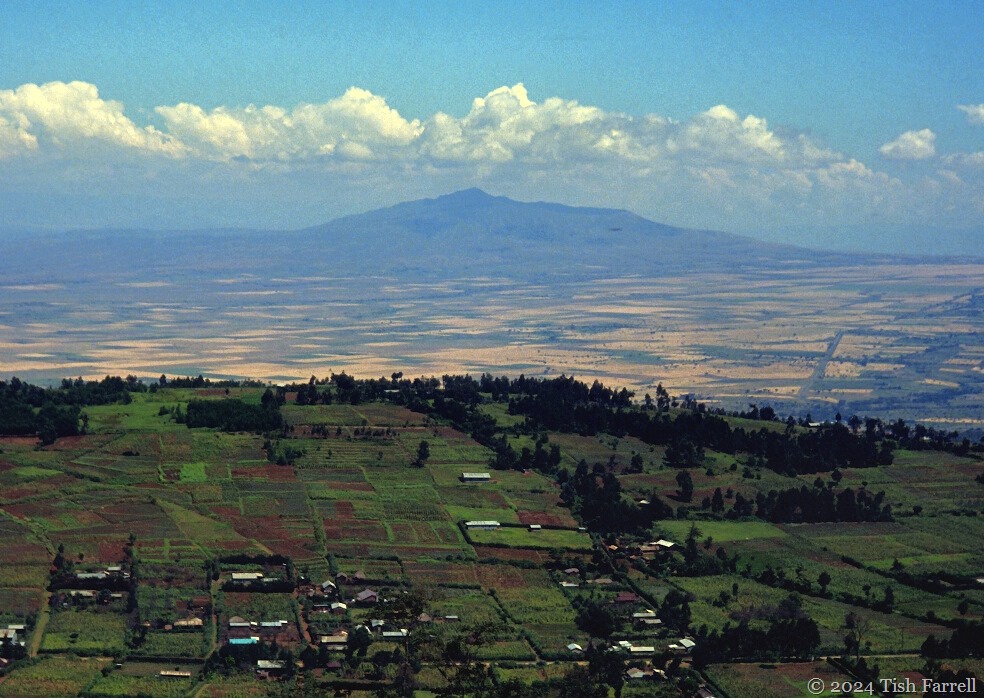
When we lived in Nairobi during the 1990s we came here when we needed a break from city living, staying at Soysambu tented camp. The drive up the Great Rift had its own thrills, both the astonishing views of the Rift volcanoes, and the hair-rising truck driving along the way.  It was always a relief to turn off the tarmac and bump along dirt tracks to the camp. img20241003_14405356ed

*

The lake and its surrounding land is mostly in the hands of the Delamere family. From the late 19th century to the 1930s, the third baron Delamere was both an agricultural pioneer and prime mover in the shaping of the then British colony. Among other land holdings, he acquired 46,000 acres around the lake in the early 1900s. At some stage there were attempts to grow wheat there, but the soil was too shallow and the land reverted to bush. In our day, the fifth Lord Delamere, managed the place as a private game reserve (more recently the Soysambu Conservancy) and cattle ranch.

img20241005_19451737 flamingo dawn

*

The camp back then was sheltered by fever trees, sixteen tents each with its view of the lake and the remnant volcanic cone, known by local Maasai as the Elngiragata Olmorani, the Sleeping Warrior.  There was always something to look at. The light on the lake changed every second and there were 400 species of bird to watch out for not least the campsite superb starlings, weaver birds, orioles, babblers, herons and storks – and then you might look up to see impala slip noiselessly through the trees or waterbuck out on the flood plain…

It could all have been a dream of course.

img20241005_19075173 Sleeping Warrior

img20241008_12580861ed

*

Lens-Artists: Looking back  This week Sofia wants to see the things and places we treasure and would like to revisit.

img20241008_12561103dawn flamingos ed header

Letters From Lusaka #7: South Luangwa Continued ~ Walking In The Wilds At Nkwali

img20240926_17333197sq

In 1992-1993, during the first years of Zambia’s multi-party democracy, we were posted to Lusaka, Zambia’s capital. Graham was charged with organising the distribution of European Union food aid to drought-stricken Zambians. (Part 1 is HERE, part 2 HERE, part 3 HERE, part 4 HERE, part 5 HERE, part 6 HERE)

*

Zambia-map_thumb11

*

July 11th 1993

After two days at Tena Tena camp it’s as if we have fallen into a dream. As Robin Pope drives us across the game park to Nkwali camp, he talks about the problems of elephants ring-barking and uprooting trees. Their drive to create more grassland where once there was open forest is gradually changing the ecosystem right down the nature of the soil. It’s something to ponder on. Then we see two village men cutting sheaves of vegetation, and Robin says the dry season is thatch-mending time and local people are allowed in the park to cut the grass.

I’m trying to focus on his words, but my eyes are scanning the landscape. We pass through a zone of recent burning. The place is alive with birds mopping up the roast remains of insects and other small creatures. There are crowds of storks and a flock of stunningly coloured lilac breasted rollers. Flashes of purple, royal blue, turquoise and unlovely squawking.

One thing Robin says penetrates the reverie. He happens to mention that the current paramount chief for the district is a woman. That gives me something to think about.

*

Nkwali Camp is on the banks of the Luangwa, outside the park, but within a designated hunting block. Our new temporary ‘home’ is very ‘open plan’, one of six cabins, with a high sheltering thatch, open at both ends, and a large unglazed window overlooking the river. Out back, the flush loo is housed in its own thatched cubicle, but the shower is open to the sky, the water heated up in an oil drum on a charcoal fire.

There are three other guests, and in late afternoon we are driven to a spot on the Luangwa where migrant carmine bee eaters flock to breed along the sandy bank. Again I long for a camera that might capture the startling flurry of colours – brilliant Titian reds with turquoise caps and rumps. Instead, I watch them until the sun goes down and wonder, will I always remember this?

img20240926_15450597ed

*

That night in our cabin, it isn’t hippos that keep us awake, but elephants. In the early hours they gather in the trees all around us, come there to eat chinzombo fruit. Now they are anything but silent. There are rumbling bellies and crashing vegetation and much munching. The cabin seems to shudder. I’m relieved when just after 5.30, our English guide, Hugh, comes to call us for the morning walk. He tells us he had to do much clapping before he could exit his own cabin; there was an elephant mother and child outside his door. He found three more in the camp bar, eating the thatch.

img20240926_17353051_thumb7

In the early hours our cabin is surrounded by chinzombo chomping elephants

*

img20240926_17344961ed_thumb[7]

Nkwali camp bar as it was in ‘93. These days camp facilities are far more luxurious

*

I hear angry trumpeting from across the river, and find I am happy to not see the elephant visitors at close quarters. Even so, after breakfast, Hugh says we will go and look for them. Graham and I follow, along with James the ranger and tracker Reuben bringing the tea things. It’s a beautiful morning and we begin our walk through tall grasses, yellow hibiscus, white jasmine and orange turbaned Leonotis (Turkish pompoms) that sunbirds love.

As we go, we are watched by a young kudu antelope. Hugh says it is an orphan, but it has attached itself to a herd of eland. Next we are watched by ten Thornicroft’s giraffe, a subspecies found only in Luangwa. They move quietly around us. It is like walking into one’s own wildlife film complete with knowledgeable narrator.

img20240926_17340984ed

*

There are blue helmeted guineafowl everywhere, the land all round resounding with their raucous calls. There are also yellow canaries and more sightings of eagle owls. We examine a termite mound that has evidence of an aardvark assault. Their heavy duty claws are built for demolition, and their thick skin impervious to termite bites and ant stings.

Hugh soon has Graham crumbling aardvark dung that has been deposited nearby, inspecting the contents through the wrong end of our binoculars, picking out beetle and soldier ant parts. We then taste the fruit of the  ebony tree, the fleshy part reminding me of lychees; we pick up porcupine quills; learn about the towering vegetable ivory palm, whose nutty kernel  is worked into small items like earrings and passed off as elephant ivory; regard the leaves of the mahogany tree that are stuffed into pillows to induce sleep.

James and Hugh between them test the wind and manoeuvre us into safe viewing distance of our early hours elephant visitors. Later Hugh finds a warthog hole and, stationing us well back, throws a rock in to dislodge the resident. Warthogs, he says, go into their holes tail first, enabling a speedy exit. This morning, though, the usual occupant is abroad. Instead, out comes a cloud of brown and mauve butterflies.

img20240926_17224534 Nkwale

*

And then in early afternoon, after a scrambled egg brunch, it’s time to leave. We’re driven to Mfuwe airport, and soon we’re airborne above the Luangwa, and this time, thanks to something Hugh has said, I recognise features I missed before. The hippo trails striking through the bush from the river, their night-time paths to grazing. I think of the angry young bull who stayed out of the water too long. And I think about the fisherman killed by a hippo and wonder how it happened. And I remember a piece of vital safari wisdom I have read somewhere: never find yourself between a hippo and the water.

But now I realise I’m exhausted from the sights and sounds, the tramping, the bone jarring rides, the sleepless nights and early mornings. Come late afternoon, it’s a relief to find ourselves back in our little house on Sable Road. Perhaps none of it actually happened.

Copyright 2024 Tish Farrell

*

img20240926_17224534header

P.S. You can see the bee eaters here:

This year’s arrival of carmine bee eaters in South Luangwa – a short video clip

And the  video after it explains the history of South Luangwa National Park and the legacy of game ranger Norman Carr who developed walking safaris and was passionate that local people should gain some benefit from tourism. Robin Pope trained with Carr and his company carries on  vision for community orientated conservation.

https://www.youtube.com/watch?v=J4Q-ikCUiwU

Seven for September

Letters From Lusaka #6: Of South Luangwa, Elephant Gardeners, A Charging Hippo

img20240926_17260578ed

In 1992-1993, during the first years of Zambia’s multi-party democracy, we were posted to Lusaka, Zambia’s capital. Graham was charged with organising the distribution of European Union food aid to drought-stricken Zambians. (Part 1 is HERE, part 2 HERE, part 3 HERE, part 4 HERE and part 5 HERE)

*

Zambia map

*

July 9th 1993

At 19,000 feet we look down on a red-brown world of low escarpments, ridges and valleys. The brown is the tree cover, the scattered miombo and mopane woodland loosing its leaves; the red, the earth exposed between parched grasses. From  the cabin window the wilderness looks to run forever. Abstract the gaze and it could be copper sheeting, crumpled, etched and pecked: a visual metaphor for a land long plundered of this valuable mineral.

It is winter in Southern Africa, the dry season. Now and then ribbons of smoke drift up to us. Charcoal burners. The afternoon sun turns remnant streams to silver filaments. And then the plane banks and we’re over Luangwa. Sky blue shot with gold, the main channel looping between wide, pale beaches and exposed sand bars.

It is quite a sight. Even shrunk to its dry season flow, this river impresses. I wonder at the scale of it in rainy season spate. From above you see how it endlessly remakes itself, carving out new ox-bow meanders, stranding the old as stagnant lagoons that later, we learn, are called Dead Luangwa, Luangwa wafa, yet are important wildlife refuges at this time of year.

img20240926_15462570ed

*

We are on the afternoon flight from Lusaka to Mfuwe – destination Tena Tena Camp, in South Luangwa National Park in Eastern Province. The park lies along the river valley, itself part of the Great Rift system,  and covers 9,050 square kilometres. The southern park and its North Luangwa counterpart are renowned for their wealth of wildlife, not least 450 bird species as well the big game.

The camp is run by Robin and Jo Pope, he a Zambian zoologist, and specialist in walking safaris in Malawi, Zambia and Zimbabwe; she a British expatriate and zoology graduate. The full scale walking safaris last a week and more and we can afford only a long weekend, 2 nights at Tena Tena, and one night at Nkwali, the sister camp outside the National Park.

Our plane is a 50-seater. We are welcomed with slices of Madeira cake and shortbread, iced Fanta or Cola. Later, coffee is brought round in a big jug. Somehow it feels more like a train ride than a flight. Touch down, we are told, is in one hour fifteen minutes.

Mfuwe turns out to be a tiny airport, there to serve National Parks’ visitors. Sammy, a young African, Tena Tena’s trainee manager, ushers us, along with a Dutch couple, into the open sided Land Cruiser. Our driver is the camp cook, a South African girl. We’re told it’s an hour’s drive. The Dutch couple are repeat visitors and they are very excited. There is much loud chatter. It’s somehow blurring the landscape.

Soon we are leaving the tarmac for dirt roads, passing by homesteads of thatched houses. The roofs, made of thickly laid grass bundles, overhang red and white painted walls and are supported on tree posts. All around are well swept compounds. I also notice the refurbished granaries. After the previous years’ drought, this year’s rains have yielded good maize crops. There will be no further need of Graham’s services when his contract ends in September.

img20240926_16283638 village

But then comes a dose of reality. As we lurch across a dried up stream, I see a village girl digging into the sandy bed, waiting for a cupful of murky water to well up. A new strand braids-abrades in my consciousness. Why does it take such sights to teach me my good fortune?

I distract myself from inconvenient discomfort with the beauty of the mopane woodland. The trees are graceful and grow widely spaced, as if orchard-planted. The afternoon sun filters through, and I’m oddly reminded of an English beech wood; the suffused russet light on a late October day.

We are in the park now, and park is somehow the right word. There are green swards along the river’s flood plains where puku antelope graze. The disposition of trees in their winter tints suggests an overgrown country estate somewhere in my home county of Shropshire. Except the trees here are winter thorn acacias, lead woods, ebonies, mahoganies, sausage trees and baobabs.

img20240926_15414181ed puku

*

Tena Tena sits on a high bank above the Luangwa, its six thatched roof tents sheltered by trees. The name means temporary home in Nyanja, and we soon learn that, according to park regulations, the  camp may only be used in the dry season; no permanent structures allowed. So the whole enterprise (including the tents’ showers and loos) must be packed away before the rains.

img20240926_16210951Tena tena camp

The Farrell tent is under a Sausage Tree (Kigelia africana), a stone’s throw from the shelving river bank and within close hearing of much hippo grunting. We’re served tea and cake and told to take a siesta until late afternoon. At sunset we’re back in the truck, and being driven to one of the lagoons, where we stop for sundowner drinks and to watch for any wildlife. Our fellow guests, along with Dutch couple, are Jo Pope’s parents. The foursome are old friends. It feels like a family party, and again there is much noisy chatter. But then the light in lagoons is so breath-taking, it’s hard to be too irritable. Instead, as I watch a flight of Sacred Ibis on a tangerine sky, I long for a camera with rather more range than my little Olympus-trip.

img20240926_16243268ed

img20240926_16230700ed

The lagoons, Luangwa wafa or ‘dead’ Luangwa

*

img20240926_16214688 tena tena dining room

Tena Tena dining room sheltered by a winter thorn

*

When darkness falls we set off across the park. Overhead a million stars. The universe. I find the Southern Cross and, not for the first time that day, wonder if I’m really there, seeing it. The truck is open sided with raised seats. But it’s chilly and dank by the river. I’ve put on all the clothes I have with me but, even with a thoughtfully provided rug, it’s not quite enough. Jo Pope stands beside the driver, wielding the spot light as we rumble into the night. When we brush by clumps of Vick’s bushes, their camphor scent sifts through the night air.

Out on the flood plains, the spotlight picks up hosts of wary eyes – herbivores – puku, impala, a pair of hippos lumbering out for their night-time grazing. We visit a hyena den. A young male cub comes out to look at us. On his second visit he whoops pitifully, a sound that makes the spine quiver.

As we head down riverside tracks, nightjars flutter up from the ground at wheel-height, plumage translucent when caught in the spot light. They look like giant moths. And while we’re focused on smaller things we also look down on elephant shrews going about the nocturnal business of bug hunting.

*

That night in our tent the hippo snorting is ceaseless. I believe I have scarcely slept when hot water is brought to the washstand outside our tent and the 5.30 wake-up drum sounds. Fifteen minutes later there’s a second drum call. The sky is steely grey with the first cracks of dawn. Breakfast is help-yourself tea, toast and cereals from a table by the river. There’s a camp fire to warm us up. As I stare down at the shadowy river, munching toast, I’m suddenly aware of the hippo just below me. It is on the bank, probably too close for comfort, but it’s too soon in the day to believe in such encounters.

By 6.15 we are again in the truck, bouncing on bone-jarring tracks. The light is gauzy so it’s hard to know if I’m  truly awake when two hyenas approach through the scrub. They are so gorged on the night’s pickings they can barely move. They slump in the open while we watch.

img20240926_15442838 hyena

*

This morning there are many birds to see, pretty Fischer’s lovebirds (bright green with flame coloured heads, yellow bibs), saddle bill storks, eagles, a hammerkop. Then comes a huge herd of buffalo. For a full ten seconds we see it, and then it melts into the bush as if it had never been there. Another mirage then? Later, we have more certain views of warthog, baboon, eland, wildebeest, Burchell’s zebra.

After an 8.30 tea break by a lagoon we head out onto an open plain. It’s an eerie place in the wintery light. A forest of wrecked trees spreads out before us, nothing but burned out trunks, white-grey spikes, strangely luminous. Our guide, Guy, says this landscaping is down to elephants and their driving ambition to have more grassland. They ring-bark the mopane trees which slowly die and then when a bush fire comes through, it finishes them off.

We drive to the salt pan, another strange locale, where salt water gushes forth at near boiling point. As we arrive, a flock of crowned cranes take flight with mournful mu-um cries. We inspect the spring and, it ‘s as we drive away, that we see the lions.

img20240926_15430429ed

At the salt pans. That’s me in the back of the truck

*

They are lying in heaps under brown bushes, possibly seven in all. Guy says we will take a closer look, but we must keep quiet and stay seated within the profile of the truck. That way the lions will see only the truck, which presents no threat to them.

And so it proves. The lions could not care less. Sleeping time amounts to some twenty hours a day. There are many more hours to get through. We leave them in peace.

img20240926_15434749ed

*

By now the sun has broken through the cloud, the day growing hot. Lunch is served under a massive baobab, perhaps a thousand years old, Guy says. While we eat coronation chicken and rice, he points out the old wounds on the baobab’s trunk. They were made by elephant poachers hammering in footholds so they could use the tree for a look-out post.

img20240926_16263110baobab

This baobab was once an elephant poacher’s look-out tree

*

That night on the drive we see a great eagle owl, two honey badgers, a genet and six porcupines. The porcupines seem to whiffle along, spines shimmying under the spotlight. Then there’s a moment when I look down from the truck into the dull yellow eyes of a crocodile. It is right alongside. There are two of them, each a metre or so in length, and they are shunting along a shallow channel.

It’s a surreal moment – looking in the eyes of a crocodile. Whatever is being registered there, you surely don’t wish to know. And then in the darkness, we find ourselves snarled up with elephants. They are crossing the track at a point where there are dense bushes either side. But they are moving slowly, since they are also browsing as they go, and there’s no knowing how many there are. But we see their huge shadows, and spot some smaller shadows, and then there’s always that odour. Musky. Earthy. Like nothing else. We quietly reverse and make a wide detour.

*

On Sunday morning we eat breakfast beneath a half moon and the morning star. At 6.30 we set out on a five hour walk. Sean, the South African zoologist is our guide. We also have with us a tracker with the tea things, and White, a national park ranger who carries a rifle. We set off across a dried up lagoon where the previous early evening we had glimpsed two leopard. It is a golden morning as we walk among sausage trees and lead woods whose leaves, we are told, are a cure for asthma. As we go, a grey headed bush shrike calls its mournful one-note call. It is a strange sensation to be walking rather than driving. For one thing, it’s hard to see very far ahead.

img20240926_18134026ed

The sausage tree is considered sacred by local people

*

Sean is following buffalo spore, this with a view to establishing the exact location of the herd we had glimpsed the previous day. But instead of buffalo we come on a big bull elephant, standing alone in a woodland glade. He is rheumy eyed and elderly. Sean speaks softly and says the elephant is wary: he can make out our shapes but can’t tell what we are. We see his head held high, trying to catch our scent. The trunk lifts and twists, the tip moving like a periscope. We only need worry, Sean adds, if his ears fan out and his trunk swings sideways.

We are all right then. It seems he is not thinking of charging. Then a herd of impala appears behind us and starts barking the alarm. ‘I hope he doesn’t think we’re lion,’ says someone. We retreat quietly.

Now it’s the vegetation that holds our attentions. We walk through tall grass savannah. There are potato bushes, daisies with mauve flowers and salt bushes that we are told are crushed like sugar cane to produce salt. And then, against the distant tree line, we see the huge buffalo herd that had done the vanishing trick yesterday. And  at the same moment the nosey impala herd backtracks to have another look at us.

Sean says if they bark again the buffalo may run. We step back among the trees just in time to see eight elephants, including a calf, moving quietly across the grassland, eating as they go. It’s like watching a silent film. We cannot hear them, and so then we are told that elephants effectively walk on tip-toe, the front foot supported by a bed of gristle much like a padded high-heeled shoe. We watch them go.

Sean kicks the dust to check the wind. He’s had it mind to show us some lion. Where there are buffalo, he says, lion are not far behind. But with all the detours, he gives it up and says we’ll have a tea break at a fisherman’s camp outside the park.

img20240926_17292984ed

The camp is on the bank of a dried up lagoon. The fishermen who spent the night here are long gone, but their fire smoulders on, and one of our party tries out the bamboo sleeping mat. There’s a hippo skull for a neck support. There are also bamboo sheds with racks for drying the fish. Sean says some of the lagoons still hold bream, which are caught using dug out canoes and conical bamboo fish traps. In passing, he says it can be dangerous work; a few days earlier a fisherman was killed by a hippo.

We could take this last remark as a warning. Except we don’t.

By the time we leave the camp and head back to main river, the sun is hot. From some distance away we spot a bull hippo trying to return to the water. He’s left it late after a night out grazing, and has come back to the river where the bank is high and steep. Being out in the sun risks serious burning and he is growing increasingly distressed with every failed attempt to descend.

We think ourselves well out of range as we watch his antics. Sean says he is probably a young bull expelled from his group, unable to win a herd of cows for himself. Someone laughs at another botched descent. And he hears.  And then he turns.

img20240926_17284698hippo charge

The bull hippo that charges us is on the bank under the small tree

*

Sean and White react at once. They move forward clapping their hands, but when the hippo keeps coming, White ushers us back towards the fisherman’s camp, telling us to take refuge behind a beached dug-out. Meanwhile Sean is still clapping. White joins him, rifle at the ready.

img20240926_17272601

White guides us to a suitable refuge, then returns to the river to deal with the charging hippo

*

It is a nerve-wracking few minutes. But then after the initial rush, the hippo runs out of steam and veers off into the bush. We regroup and Sean says White was indeed prepared to shoot the hippo if he had not backed down. It’s a disturbing thought – that our safari-goer carelessness might have warranted the bull’s despatch.

But then we see the problem is not resolved. We are near the camp, yet now there is an angry hippo somewhere in the scrub between us and it. We have to do a massive detour. It’s approaching midday by now, and I’m starting to know how the hippo felt in his overheated state. I’m hungry too, and only briefly diverted by the sight of fish eagles and African skimmers. And besides, too, I have already seen enough of hippos for one day.

img20240926_17252587hippo walk

*

On Sunday afternoon we transfer to Nkwali. It’s outside the national park near Kopani, a good hour’s drive and we’re lucky to have Robin Pope as our personal chauffeur-guide.  He tells us so much, but by now it’s becoming hard to process. Later, though, I find the things I learn that afternoon inform a short story, Mantrap, published first in the US children’s magazine, Cricket, in 2003, and then in later teen quick-read chapter versions for Evans and Ransom Publishers.

Shades covers for REPRO Batch 2_Layout 1

*

That night, in our new temporary home by the Luangwa, it is not hippos that keep us awake…

To be continued.

South Luangwa - Luangwa River header

copyright 2024 Tish Farrell

#SevenForSeptember


Letters From Lusaka #5 ~ The Road To Petauke And The Man With The Yellow Maize

Eastern Provinceed

In 1992-1993, during the first years of Zambia’s multi-party democracy, we were posted to Lusaka, Zambia’s capital. Graham was charged with organising the distribution of European Union food aid to drought-stricken Zambians. (Part 1 is HERE and part 2 HERE and part 3 HERE and part 4 HERE)

zambia-political-map

Early in April 1993 Graham has another upcountry mission, this time to check on the arrival of maize at the Ukwimi refugee settlement area near Petauke, Eastern Province. The initiative, in an area north of the Mozambique border, is managed by the Lutheran World Federation, an organisation overseeing some 25,000 refugees in 73 villages spread over 300 square kilometres, an area that also includes several indigenous Zambian communities.

The incomers are village farming folk who have fled the civil war in their own country. Many among them share both language and cultural traditions with Eastern Province Zambians (i.e. communities historically divided by colonial map makers). At Ukwimi they are settled on parcels of land and given every assistance to become self-sufficient. In April 1993, with peace negotiated between Frelimo and Renamo forces, most recent cross-border arrivals in Ukwimi have been driven there by hunger.

*

It’s a 400 kilometre drive to Ukwimi HQ*, and another Monday morning appointment. We set out on Sunday at midday, leaving Lusaka on the Great East Road. The sky is overcast and it’s rather cool.  As we pass by large dairy farms, among them Waterfall Farm owned by mining conglomerate Lonrho, the sight of green fields with Friesian cattle tells the brain we’ve somehow been flipped to Cheshire in the English Midlands.

But no. Now there are here-and-there banana thickets, palm trees with swollen boles and dishmop tops. And now we’re in bush country and the road stretching out. And now there are no other vehicles, but there are people, and we soon find that Zambians have many uses for highways beyond driving on them. We begin to see many people carrying palm fronds. It is Palm Sunday and the devout are walking down the middle of the road. And why not choose a smooth path.

Young lads sit on the road edge, leaning back, hands on the tarmac. They simply seem to sit and sit.

At Changwe there is a roadside trading centre with a few stores and a smart hacienda style bar and restaurant. We pass a bicycle race there.

At one point we bowl over a crest in the road and come on a big church gathering, filling both carriageways. People are singing and drumming. The crowd parts like magic and with great good humour, they wave us through.

*

Bush country flanks the asphalt, tall grasses on either hand and beyond them glimpses of shaggy thatched roofs, clusters of dwellings under thorn trees, small plots of maize. In places where the bush meets the tarmac there are hand-painted signs announcing the presence of bus stops, the gates to small farms: Mulenga, Mulaliki, Mulawzi; to the local medicine man.

We are travelling along a low ridge, to the south the land falls away in lightly wooded plains; to the north is a spine of blue hills. There are road-side stalls selling pumpkins and squashes of all shapes and sizes. There are wigwams of sugarcane, neat cords of firewood, sacks of charcoal. A woman walks by with a large zinc bath on her head. As she stops to adjust the load, a wave slooshes over the edge. The sight takes my breath away. I feel my spine contract.

And still there are few other moving vehicles along the road although we see many stranded broken ones.

Now the countryside is more hilly and densely wooded. There are roadside flowers, deep yellow daisies, pale yellow hibiscus, and a plant that looks like broom (also yellow). The villages have little thatched gazebos on the top of knolls with seats so you can look out to the blue hills. Meanwhile, the road that was good is not so good. There are big potholes, and to add to the driving confusion, some are filled with red dirt and others not. Where the road cuts through rock, it is carmine red and glinting with quartz.

Eastern Province Luangwa Valley 2 ed

We cross the broad expanse of the Luangwa River between wooded gorges. There is a suspension bridge opened in 1968 by former President Kenneth Kaunda. It looks sturdy enough, but a sign instructs drivers that only one vehicle at a time may cross, speed limit 10 kph. And so we cross.

About 50 km from Petauke we drive through a small village and fail to stop at the police check point. There is no one manning it. But ahead a khaki figure dashes from a roadside hut and waves us back. My heart sinks. We’ve had some uncomfortable moments at Kenyan checkpoints. But the young officer is charming. He apologises for not being in the road where we would have seen him. He had been growing too hot standing there, he says. We can see his point, but he still wants to see some I.D.

As Graham fumbles with his brief case, trying to find something that might serve, he says he works for the European Union. Ah, says the policeman, the man with the yellow maize. Some of your trucks have already gone through.

Graham says he is going to Petauke to check on their arrival. The officer smiles broadly and asks Graham for his name, salutes me with a “Madame” and bids us farewell, all without need of paperwork.

Further on at the turn for Petauke there is another road block. This time we are questioned by a young man who is clearly not a policeman. He tells us he is acting on his brother’s behalf.  “Just to be friendly”, he says, “my brother needs to know who you are.” He is happy with Graham’s business card, finally retrieved from the brief case.

Now the roadside shopping opportunities include furniture, items parked in splendid isolation in the bush – a bed,  a dining table, a row of Adirondack chairs.

Most striking of all is a lone Welsh dresser – the full deal, cupboards below, shelves above. There it stands, surrounded by elephant grass, challenging me, like one of the White Queen’s six impossible things before breakfast. And I wonder from what colonial or mission original was this piece so faithfully copied? And who does its maker think will buy it, here on the road to Petauke where so few people with the means to transport it seem to pass?

I’m still wondering when we check into the Nyika Motel and are shown to our bungalow. The bedroom walls are turquoise with orange paintwork, the chandelier green with most of its drops missing, curtains blue, the bedspread blue and black nylon, dark green cloths on the coffee table and sideboard – a colour scheme to jangle the nerves. But it does not matter. The place is scrupulously clean, with plenty of hot water, although we have to improvise a bath plug.

By now, the late day sky has seen off its gloom. There are magnificent cumulus cloud formations against the blue. We sit on the doorstep and watch the sun go down over the bush country, strange rocky outcrops to the south. There are rufous swallows, drongos, mousebirds, the bubbling call of the water bottle bird. The crickets tune up. There is lightning, wind in the thorn trees. I’m so glad to be there.

Eastern Province sq

Copyright 2024 Tish Farrell

*Ukwimi HQ is now a Trades Training Centre for Zambians, the refugee centre no longer needed.

Eastern Province heaader

Six On Saturday: Of Flying Saucers, Scorpionweed And An End To The Great Gobbling

IMG_6143

And no, we have no extra-terrestrial sightings here in Bishop’s Castle, at least not over The Gables, but I do have a few Flying Saucer Morning Glories. They are late on parade, growing up my obelisk of butter beans in the front garden.  I wasn’t really expecting them: the seed was several years old. Yet here they are, busy luring insectkind.

IMG_6145

*

Also in the front garden, in the opposite bed, the phacelia has been flourishing for the past few weeks, every day alive with bee hum.

IMG_6172ed

IMG_6166ed

This borage family member hails from North and Central America where it also goes by the name of Scorpionweed, which sounds hair-raising. So far there has been no sign of cohabiting scorpions (no doubt a huge comfort to other half who was bitten on the foot by one while overlanding in the Sahara.)

I sowed the seeds quite late, probably around the beginning of July. As with the Flying Saucers, I was prepared for them not to germinate. The packet was left over from Wenlock allotment days. I grew it back then either as green manure or a cover crop. But then on a trip out in late June I’d spotted fields of it around Ludlow. I’d never seen it growing on an agricultural scale before. It was in full bloom and the fields seem to float in a mauve haze. More than a good enough reason to try it.

These days there is much farmer emphasis on improving soils and attracting insects on land taken out of food production (food security no longer seems to be a priority in government policy for British agriculture). Hairy crops like phacelia, vetch, linseed have been found to improve worm populations, this even in light and sandy soils.

I decided to try it on the ground where we had lifted paving slabs and left behind a layer of old mortar which had mostly been broken up into the soil. It looked very unpromising territory, and I wanted to see if anything would grow there. And it did. The seeds sprouted in a few days.

Usually if you’re growing phacelia to provide green manure, it should be dug in before it flowers to stop self seeding. But I thought never mind about that. The flowers are so pretty, their scent so subtle and, while they last, their kindness to insects immeasurable. The first frost will doubtless fell the plants, and I’ll probably leave them to dig in before spring.

*

IMG_6271ed

And here’s another insect friendly plant, doing its end of season feeding duty while looking lovely too: Caryopteris ‘Heavenly Blue’, a fairly compact hardy shrub bought back in the spring. It clearly loves our garden and has opened its branches so generously. The flowers are scented too, and it’s taken over catering duties from the neighbouring purple agastache, which is now a mass of dusky seed heads and no longer of interest to the bees.

Much of the rest of garden has a look of late-summer weariness. We had a couple of real summer days earlier this week, but there’s a real sense of autumn in the offing. My runner beans simply stopped producing at the end of August, for no reason that I can fathom. Although I did notice yesterday that a single plant has decided to grow a couple of strands worth. Perhaps one last small meal then.

Meanwhile, the Flying Saucers’ hosts, the butter beans are still flowering like mad up the front garden obelisk. There are many pods but they are being very slow to fatten, doubtless down to the lacklustre summer and cold-spring start. I’m now hoping for an amiable October that might give the beans the chance to finish off. And for now, the blossom is still performing essential services.

IMG_5976

*

The good news, though, is that the horrendous brassica gobbling has ceased, this after the cabbage white caterpillars ate every kale plant down to the stalks. It did not matter that I’d covered crops with so-called butterfly netting and fine grade enviromesh. Somehow the butterflies sneaked in to lay their eggs. Patrolling the plants even twice a day proved a losing battle. They made inroads in the pointy cabbages too, but I’ve managed to save some of those.

Ever hopeful, I’ve replanted Russian and Tuscan kale plantlets under extra-fine mesh. The butterflies are still about, but not in the flocks we experienced earlier in the summer. Fingers crossed.

IMG_6282

There are other bright corners in the garden, and especially this towering clump of helianthus, a perennial sunflower. Back in the spring when I planted it out, it was three single small stems with only a few roots between them. The cuttings came from my sister’s Little Stretton garden, descendants from plants that grew in our Aunt Miriam’s Devon garden. I’m so pleased to have it. I did not have a chance to grab a segment or two of my Wenlock helianthus before we moved. It used to be the star of the late summer guerrilla garden there. It’s growing even more vigorously in Bishop’s Castle.

And last but not least, but definitely with an eye to autumn in its new russet foliage, this is a newcomer to the Farrell garden, Japanese cherry kojo-no-mai. (Posing here with some very sweet violas).

IMG_6254

It will eventually grow into a small tree, but for now seems happy in this pot.

*

Six on Saturday  Please visit Jim at Garden Ruminations. He needs some get-well wishes.

Oh, What A Perfect Day…

IMG_6231ed

Yesterday felt as if all our missed summer days had been rolled into one. It was warm, the light golden, the sky a flawless blue in every quarter. In the afternoon I took myself off for a walk – up Laburnum Alley and into Welsh Street, and thence up a green lane out of the Castle and onto the uplands.

IMG_6233ed

IMG_6220

IMG_6191

*

There’s little to hear but the bleating of sheep, the thrum of a combine harvester just over the hill and rook call. The town lies quietly below.

As I climb, I stop to scan the changing vistas. From the highest point there is a near 360 degree ring of hills surrounding Bishop’s Castle, the most obvious for its length being the Long Mynd. Whenever I see the Mynd I always give a mental wave to sister Jo, who lives on the other side. I sometimes thinks it’s odd to have this very big and ancient hill between us; some of the oldest rock in the world in fact.

IMG_6195

Looking east-ish towards the Long Mynd

*

And towards the opposing quarter…

IMG_6221

*

I need a Castle local to teach me the hills, particularly those to the north and west and into Wales. I know the names – Corndon, Lan Fawr, Roundton, Todleth …and I’m guessing they are in the next photo moving from right to left (?) and that the big wood below is Saddler’s Big Wood.

IMG_6228

*

For now, some other scenic spots…

IMG_6223ed

IMG_6196ed

copyright 2024 Tish Farrell

Letters From Lusaka #4: Of The Smoke That Thunders And Walking Over The Zambezi

Zambia's Victoria Falls looking along knife-edge to Zimbabwe's falls header

In 1992-1993, during the first years of Zambia’s multi-party democracy, we were posted to Lusaka, Zambia’s capital. Graham was charged with organising the distribution of European Union food aid to drought-stricken Zambians. (Part 1 is HERE and part 2 HERE and part 3 HERE)

*

It is early December 1992, barely two weeks into our Zambia posting, when Graham is despatched ‘on mission’, the European Union Delegation’s term for out-of-town business. He is told to attend a Monday morning meeting at a railway depot in Livingstone, some 300 miles south of Lusaka, a six hour drive away.

zambia-political-map

And the actual mission? To inspect a newly arrived shipment of maize from South Africa, via Zimbabwe, part of the 100,000 tonnes of food aid being brought in by the European Union. There has been talk of organised theft along the line of rail, of some local big man who has the power to divert trains to his own mill. It is thus important to check the consignment is intact.

Graham’s boss, Bernard, suggests he drives down the weekend before. He further suggests that I go too. It is a chance to see Victoria Falls, he says, and not to be missed. Later I suspect he is also being kind. We’ve scarcely adjusted to Lusaka living and he will not unnerve us by spelling it out: that Lusaka’s diplomatic quarter is a regular target for cross-border armed raids by unpaid members of President Mobutu’s Congolese army.

But on the Saturday morning as we leave the city under big skies, I’m not thinking about this; only of the journey ahead, of what we might see.

*

Once out of the city we head ever onward on the South Road. The single carriageway is wide and straight with few pot holes, and for the most part empty of traffic. After nine months of bumping along the ragged tracts of the Nairobi-Mombasa highway, stuck behind fumy trucks, it is sheer luxury. On either hand the savannah woodland runs green and lush and reminds me more of central France than of Africa. At Kafue we cross the wide expanse of the Kafue River, wooded uplands all around. But as I find later, this is the only significant landmark until Livingstone some five hours later.

South Road

A view of Zambian savannah miombo woodland, Southern Province

*

We pass through neat small trading centres – Mazabuka, Monze, Kalomo, Zimba. Sometimes we glimpse thatched roofs through the roadside vegetation. Sometimes there are lads holding out fistfuls of mushrooms, their caps big as dinner plates. But over all there is a sense is of quietness, an undramatic treescape sparse in humanity.

And then we’re in Livingstone, once Zambia’s capital, back in the days when Northern Rhodesia was a British Protectorate. In 1992 it strikes us as little more than a village. Its wide main street has a colonial air; all is neat; tree-lined pavements, arcaded stores; whitewashed, zinc-roofed, verandaed bungalows. When we check into the Intercontinental Hotel the time-warp feeling thickens. We are served afternoon tea on the tree-shady lawn, watched by ducks, guinea fowl and vervet monkeys.

By now I can wait no longer. The light may be poor, the sun blanked out, but there’s a world wonder to see, and the hotel’s garden path takes us right there…

Victoria Falls

*

I don’t know whether to laugh or cry. It is too hard to absorb, this bare basalt cliff. The mighty Zambezi reduced to a trickle.

The long drought has much to do with it. But Zambia also abstracts large quantities of water to run its hydroelectricity scheme. Graham then tells me the best view of the Falls is on the Zimbabwe side of the cataracts, and that if we’d remembered to bring my passport we could have walked over the bridge to see them.

Ah, well. Another time perhaps. We walk along the path beside the waterless precipice, but this alien landscape soon has me thinking of Tolkein’s Mordor; I expect the eye of Sauron to burn through the cloud any second. We give it up and go back to the hotel.

004 (2)

The Falls as seen by  David Livingstone in 1855. Engraving from Missionary Travels and Researches in South Africa 1857

*

It was David Livingstone who named the Falls after Queen Victoria. This was in 1855, and probably he was the first European to clap eyes on them. Of course they already had local names, Mosi-oa-Tunya, the smoke that thunders, being the Tonga people’s name for them. These somewhat reclusive farming folk inhabited much of the Zambezi Valley including the portion now occupied by Lake Kariba. It’s pleasing to learn that the UNESCO World Heritage citation at least gives precedence to the Tonga name.

*

In theory our hotel room has a river view, but all we see is a vast expanse of dry bed with odd clumps of palm trees and scatters of huge boulders. But on Sunday afternoon, under a bright sun, I notice people picking their way across. I persuade Graham we should join them.

We’ve hardly started out when a boy appears from nowhere and offers to guide us ‘to the best Falls’ viewpoint.’ And so we follow, but it’s not easy going, picking our way around oily pools and stagnant crevices, clambering through a maze of mammoth boulders, trying to ignore piles of fresh elephant dung.

We are so busy watching our feet we don’t notice the storm clouds gathering. And when I do, I’m suddenly nervous. I’ve read about flash-floods engulfing dried up river beds. I keep glancing upstream as if that will do any good. I worry, too, about rounding a boulder as big as an elephant and meeting an actual elephant.

Then the rain comes and that’s all I can think of – the fat freezing drops that stab the skin. (How can African rain feel so cold?) We follow the boy to cover, crouch under trees on Livingstone Island, the very spot from where the explorer had first viewed the Falls in 1855 (see the engraving: island in the foreground). For ages we crouch with the boy under dripping trees until, thoroughly cold and soaked, Graham asks him if the good view is much further.

No, no, it is close by. We make a final dash. And here it is. The view:

Victoria Falls, looking over the knife edge in a rainstorm ed

*

Not much to see with spray rising up and rain pouring down. Except there we were on the knife-edge with a 300 foot drop below. I quickly take this photo, and stow my camera. Then hold my kanga-wrap (which I’d brought to keep off the sun) over my head to stem the downpour. And it’s then a sudden gust of wind snatches the sopping cotton. I feel the slight lift and step back in shock. I’ve had more than enough of Mosi-oa-Tunya.

So has the boy.  We turn to see him sprinting away without waiting for a tip, and now I really am worried. Leaving without his kwacha? What does he know that we don’t? Watching him go, my heart sinks. The hotel looks very far away, the boulder-strewn riverbed between us and it, increasingly nightmarish. Overhead the sky is black, now and then fractured by great shafts of fork lightning. We slip and slide on wet rocks. More phantom elephants. More imaginary flash floods. More scrambling out of megalithic cul de sacs.

Of course it’s all panic and little substance. After a hot shower and a bottle of Mosi beer back at the hotel, it seems like a great adventure, though we do wonder if the part of Livingstone Island  where we’d sheltered was in Zambia or if we’d  entered Zimbabwe without the necessity of passports.

That night I am taken ill, probably the start of an amoebic assault that is later diagnosed in Lusaka. And so the next day when Graham has to visit grain depots, first in Livingstone, and then two Red Cross grain stores on the way back to Lusaka, I am happy to sit in the car and doze. It will be another seven months before I finally see the western cataract of Mosi-oa-Tunya.

Food aid consignment 3

Maize consignment safely arrived in the Livingstone depot

Copyright 2024 Tish Farrell