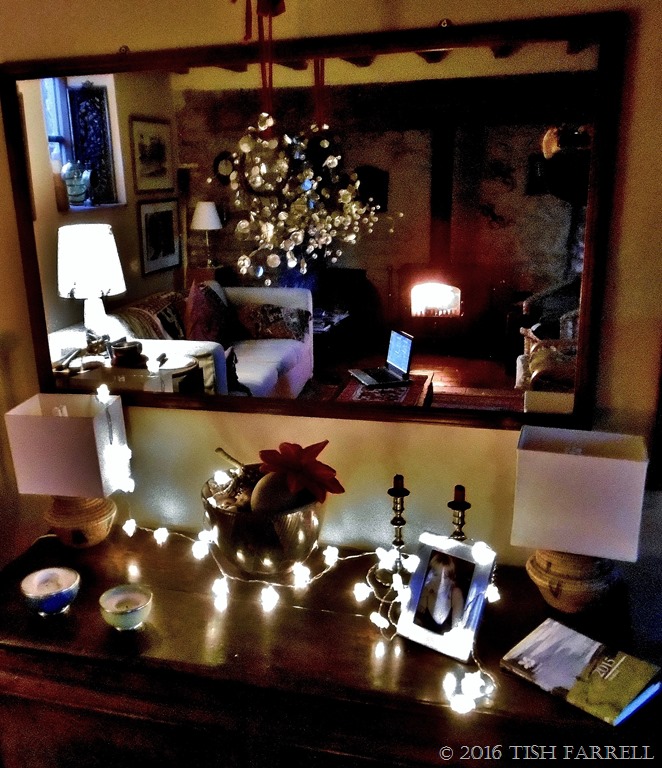
Reflected worlds are endlessly fascinating. I often wonder what kind of people live on the other side of our sitting room mirror.
Thursday’s Special: Mirroring Please visit Paula for further reflections on this theme.

Reflected worlds are endlessly fascinating. I often wonder what kind of people live on the other side of our sitting room mirror.
Thursday’s Special: Mirroring Please visit Paula for further reflections on this theme.

These are some of the landscape textures that my maternal ancestors, the Fox family of Derbyshire’s High Peak would have known well – windswept moors and weathered scarps of millstone grit. They were yeoman farmers and lead miners, and they made a living from this bleak and beautiful country for hundreds of years.
Family legend has it that the Foxes arrived in England with William the Conqueror, but Fox is a name with Germanic origins so they may well have been Saxons, belonging to the conquered rather than to the conquering forces. The earliest records for Foxes in the Hope Valley, and Offerton in particular – where my Foxes farmed until the end of the nineteenth century, are around the thirteenth century, although I and my fellow Fox researchers are yet to establish direct lineage from these times.
There were centuries of prosperity when various family members lived in large stone farmhouses, made ‘good’ marriages, and owned land and lead mining concessions, but by the early twentieth century there was only one member of my Fox line left in the area, and he was living modestly in Eyam. The family farm of Callow where he was born, and by then owned by the Duke of Devonshire had been relinquished with a farm sale in 1892. High rents were besetting many Derbyshire farmers at this time. The Mr Fox mentioned in the sale advertisement is my great great grandfather, George Brayley Fox:
The Sheffield & Rotherham Independent
Saturday 29 October 1892
Callow Farm Sale
Important Sale of 23 cows, heifers, steers and calves, two horses and foal, 30 sheep, hays stack, three wheat stacks, seven oat stacks, farm implements etc.
Mr Hattersley has been honoured with instructions from Mr Fox who is give up the Farm, to sell by Auction on Wednesday, Nov 3, 1892, the very superior LIVE and DEAD FARM STOCK, as briefly enumerated below:
Black Mare, believed to be in foal, excellent worker;
Valuable Brown Horse, six years old, with splendid action, believed to be sound, and quiet in all work;
Roan foal by Bedford;
One Cow in calf for December 25th, four in-calf cows for April, two barren cows in milk, four very choice heifers in calf for April, two barren heifer stirks, five strong bullock stirks, five spring-reared calves, 11 superior stock ewes, six fat sheep, one two-shear ram, 12 strong lambs, two very fine ducks, one fine drake.
Samuelson’s 2-horse combined mower and reaper, nearly new with additional shafts; wood tippler, horse rake, Cooke’s wood plough, set of wood harrows, nearly new; set of three harrows, swingtrees, fallow drag on wheels, stone roller, with shafts, horse turnip hoe, sheep troughs, joiner’s bench and tools, quarry tools, hay rakes and forks, 2 1-horse carts, winnowing machine, wheel chopper, with rising mouth, in excellent condition; corn chest, cart gears, stone cheese press, lever ditto, cheese rack and boards, nearly new; vats, garths etc, cheese pan, two brewing tubs, two oak chests, and a portion of furniture.
One stack of very prime new hay, three stacks of wheat, five stacks of white oats, two ditto of black oats and a quantity of table and other turnips.
Sale to commence 12 noon.
*
Every item here tells of great intimacy with the land. Just to read this notice gives me a painful sense of roots yanked up. I feel the touch and then the loss of the fine ducks, the strong lambs, the black mare in foal, the oats and the stone cheese press; even the turnips and the quarrying tools. But I would like to think, too, that somewhere in my bones are still traces of that High Peak millstone grit, the hardiness and courage that it took to carve a living from these uplands, and in my lungs the sharp, clean air of the moors of Longshaw where earlier generations of my family, so it is said, grazed four hundred sheep on their own run, and also owned the shepherd’s byre, that dating from 1399 was later sold and expanded into a handsome house for the Duke of Rutland’s agent, and is now the well known inn, Fox House, just outside Sheffield. Somewhere within this sturdy stone carapace is the earlier shepherd’s dwelling of quite another texture.
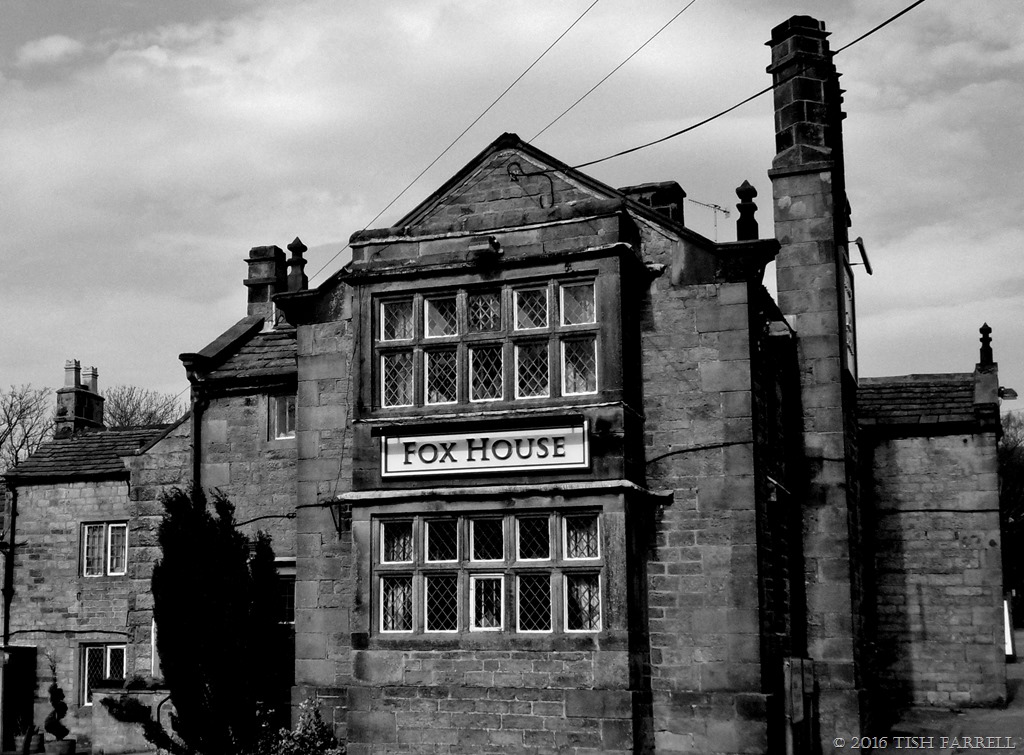
copyright 2016 Tish Farrell
This week at Black & White Sunday, Paula has given us the theme of ‘texture’. She also included a quotation by novelist British Paul Scott, which is very much responsible for my take on the challenge:
“The past becomes a texture, an ambience to our present”
P.S. Paul Scott served in the Intelligence Corps of the British Army in India during the World War Two. He wrote the phenomenal Raj Quartet, set in India during these years, and which was made into a very excellent TV serial back in the 1980s. The TV version is available on DVD, and with its all star actors is well worth watching. But read the books too.
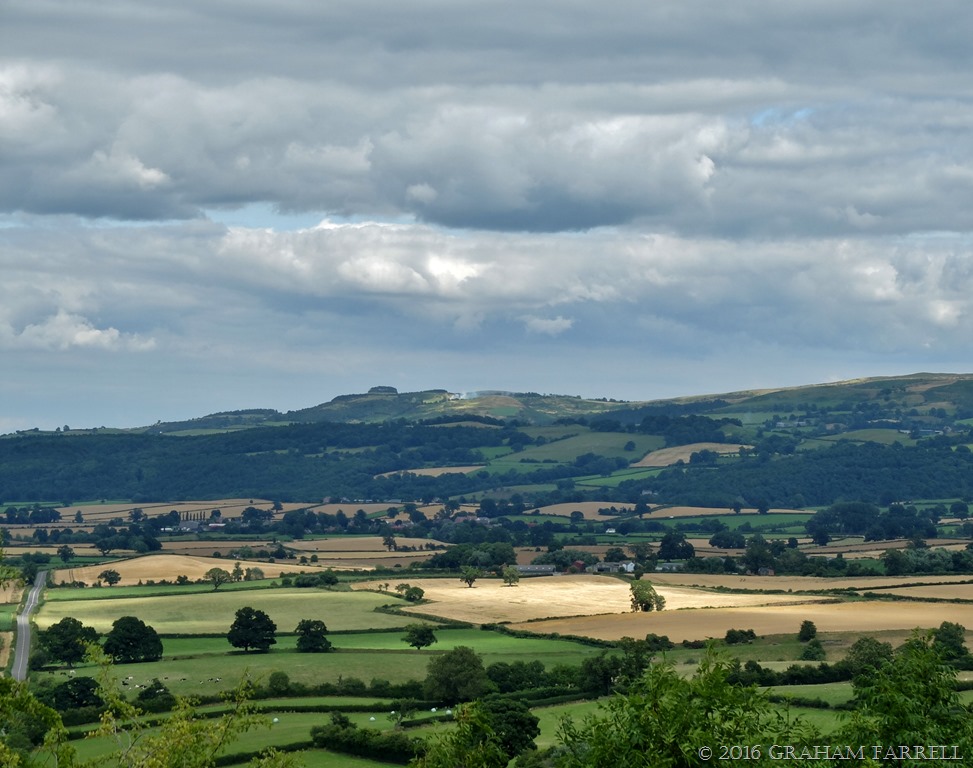
View of the Shropshire-Welsh borderland, a landscape shaped by farming communities since at least the Bronze Age some four thousand years ago
*
“I have seen the sun break through
to illuminate a small field
for awhile, and gone my way
and forgotten it. But that was a pearl
of great price, the one field that had
the treasure in it…”
Excerpt from the The Bright Field by R S Thomas
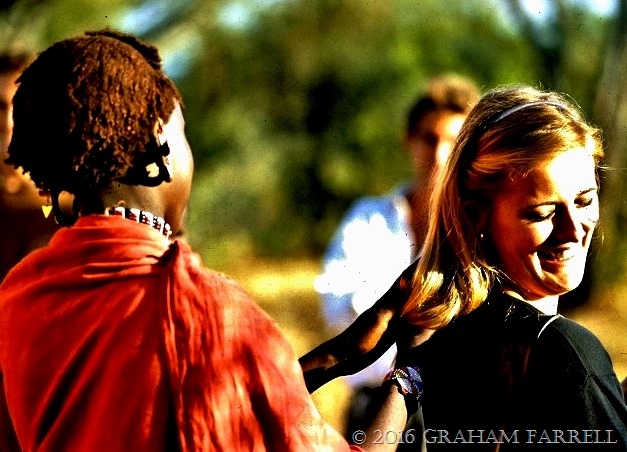
This shot of one of Graham’s fellow travellers was captured long ago in Tanzania when he was on an African overland trip. I find the gentle, almost reverential way in which the young Maasai moran is holding the girl’s hair very touching. There is some irony too. Usually when a Maasai warrior turns up anywhere, it is he who is the focus of everyone’s admiration. It goes with the territory: the glowing red shuka and the fine beads. He even expects it.


Thinking that just maybe it’s never too late to be a ‘poster girl’, and especially if some serious photo-editing is involved, I thought I’d give myself the Warhol treatment for this week’s Daily Post Photo Challenge. It’s perhaps also a metaphor for the state of me – spreading myself in too many directions at once.

We Brits are renowned for an unbridled capacity to talk about the weather, and this month there has been so much of it, and sometimes all at once. In the Farrell household the question has been hourly batting back and forth between he and she who live in our house: have you seen the weather forecast?
He has a major earth-moving project in the back garden – dismantling a raised bed, and sawing up next winter’s firewood supply since we keep using the logs that have already been chopped. She has a major earth-moving project up at the allotment – filling raised beds with a recycled compost mountain. There is also seed sowing, hardening off and planting out of vegetables to consider, all of which are dependent on weather conditions in general, and knowing how long arctic winds and icy rain will last in particular.
But what can one say about British weather that our greatest poet, William Shakespeare has not already said, since even he, with all he had to write about, was somewhat climate-fixated:
With hey, ho, the wind and the rain…
For the rain it raineth every day.
He’s not too heartening for next month either:
Rough winds do shake the darling buds of May.
Oh well. Better hang on to the woolly hats and vests, wellies and waterproofs.
*
Cardinal Guzman The Changing Seasons April 2016 Go here to see the Cardinal’s take on April, plus his rules for the challenge. Then join in!

Even if I say so myself, with radishes as beautiful as these, you can see why Mother of Rapunzel so craved them that she sent poor Father of Rapunzel scrabbling over the witch woman’s garden wall on nightly radish-scrumping missions.
We all know what trouble that led to, and hopefully there will be no similar repercussions (whether the enforced letting down of over-long hair from tall towers or the scratching out of princely eyes ) from eating these dear little Cherry Belle radishes. Because eaten them we have. They took pride of place in the salad that accompanied Friday night’s dinner.
And the secret of this particularly successful, if small-scale production, was to grow them in a large plastic flower pot inside my allotment polytunnel. You can see them growing in the bottom left-hand corner, along with the component parts of many other future dinners:

This week at the Daily Post photo challenge the theme is:
Dinnertime
Apologies to Robert Burns for the radish intrusion.
Also I don’t think Jude has yet featured radishes in her April garden close-ups challenge.
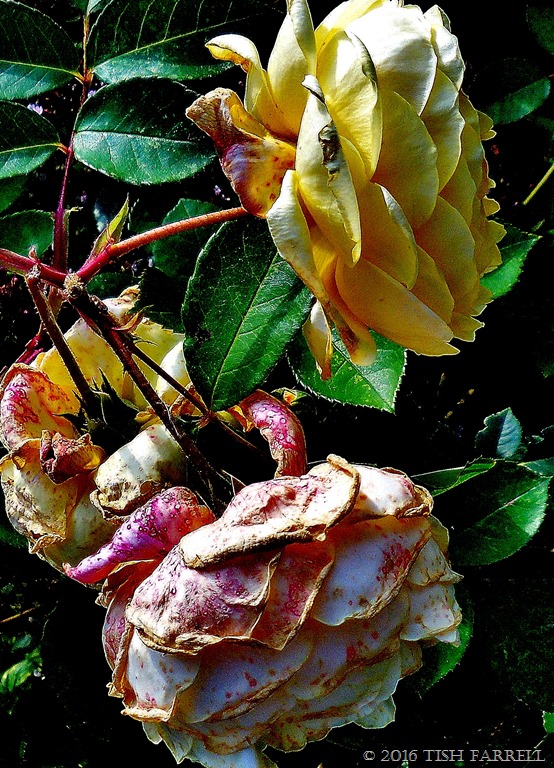
This lovely rose grows up the wall in our back garden. Please meet Gloire de Dijon, also known less picturesquely in English as Old Glory. It’s a cross between an unknown tea rose and Souvenir de la Malmaison, an old Bourbon rose, and was introduced to the world by one Pierre Jacotot in 1853. He lived in Dijon, France, a place also famous for its mustard.
When the rose is fully opened it has dense whorls of pale peachy-pink petals that change colour as they age. Their scent is mesmerizing – notes of clove and jasmine that transport me back to Zanzibar where jasmine sprigs were nightly placed beside our plates at the hotel where we ate dinner.
And once the roses have passed their best, even dead-heading them is a delight – crushing fading petals between my hands, inhaling their last fragrance that also soaks into the skin, and can be smelled for hours.
Like Sue Judd at WordsVisual, I’m drawn to the aesthetic of decaying plant life. I think there is great beauty here – these lingering shades of erstwhile glory.
*
Thursday’s Special: Three of a kind
Please visit Paula to see her own lovely study for this challenge. And definitely go and see Sue Judd’s stunning daffodil study at the link above

“There’s magic in the web of it”
The quote is from Shakespeare’s play Othello. And the web is from a shady corner in my garden, captured on a foggy morning last autumn. It’s also my interpretation for this week’s Black & White Challenge at At Lost in Translation. Paula is inspiring us towards a delicate frame of mind.
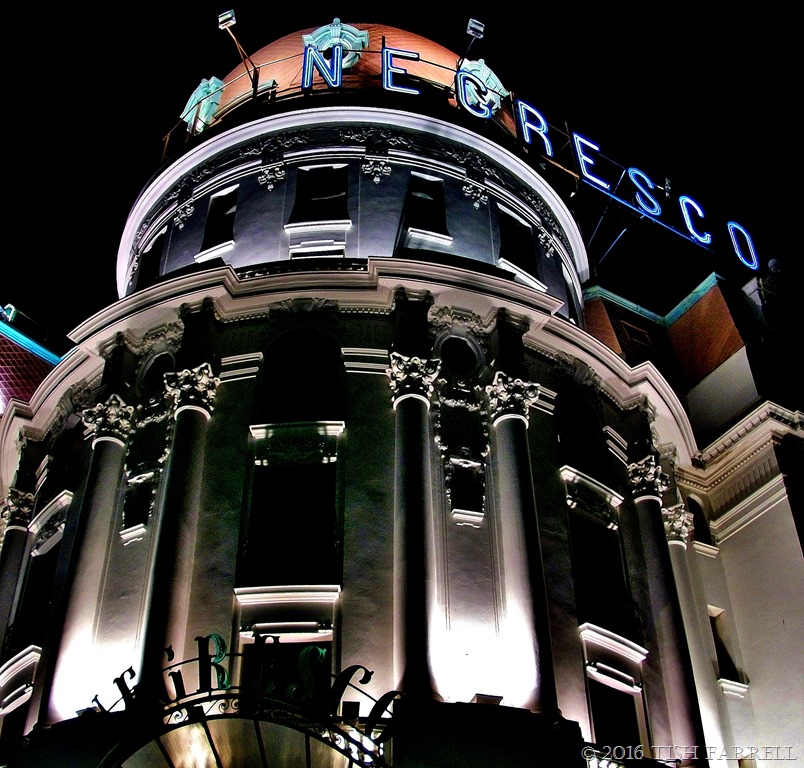
“If only I were at Nice, I would recover.”
So said Queen Victoria on her deathbed in 1901. She has a point. Who would not feel better after a stroll along La Promenade des Anglais, one’s gaze filled with the perfect Côte d’Azur blue of the La Baie des Anges. For a monarch, who had made a career of mourning the death of her consort, Prince Albert, Nice was the one place where she sparked into life. She would travel there under the name of Lady Balmoral, and go exploring the backstreets of Nice in a donkey cart. The Hotel Negresco, however, was after her time, opened in 1913. It dominates the La Promenade des Anglais. Past guests include Salvador Dali, Princess Grace of Monaco, Duke and Duchess of Windsor, Ava Gardner, and Edith Piaf. This night shot looking up to the characteristic terracotta cupola, and the cool blue of the illuminated sign, somehow sums up the Nice-ness of Nice.
*
This week Paula’s guest is Cardinal Guzman. He challenges us to post some night photography, and provides lots of useful tips.
