Some People Don’t Like Spanish Bluebells

IMG_4281

Naturally I would have to say that nothing compares with the hazy woodland swathes of British bluebells; their slender spires gently nodding; the subtle fragrance that not quite like any other scent.

By contrast, the garden-escaping Spanish sort are much more upright and chunky, more like a skinny hyacinth. They have blue pollen too, or so the Woodland Trust site tells me. And it also says they are a big MENACE. People hate them in their gardens and so dig them up and dump them round the countryside, where they have relations with our native species, so changing them forever.

Without doubt, losing our native species would be a great a shame, but I still have time for the Spanish cousins that pop up around our garden. Admittedly I used to try to dig them up and compost them – until I learned that it was a pretty impossible task to excavate every part of them.

Now when they flower, I pick them. They make excellent house flowers, their bells opening wider and the blue fading over the days. They smell nice too. I’m thinking that cutting them off at the roots might also put a stop to fraternisation, and ultimately weaken the plant. In the meantime, I have the pleasure of them indoors.

Picking the native species is of course very much forbidden. But those of you who live in the UK will soon have the pleasure of spotting them in a wood near you. Reports have it that they will be flowering early this year.


Six Word Saturday Now pop over to Debbie’s for more SWS posts.

After The Rain It’s Party Time!

IMG_4256

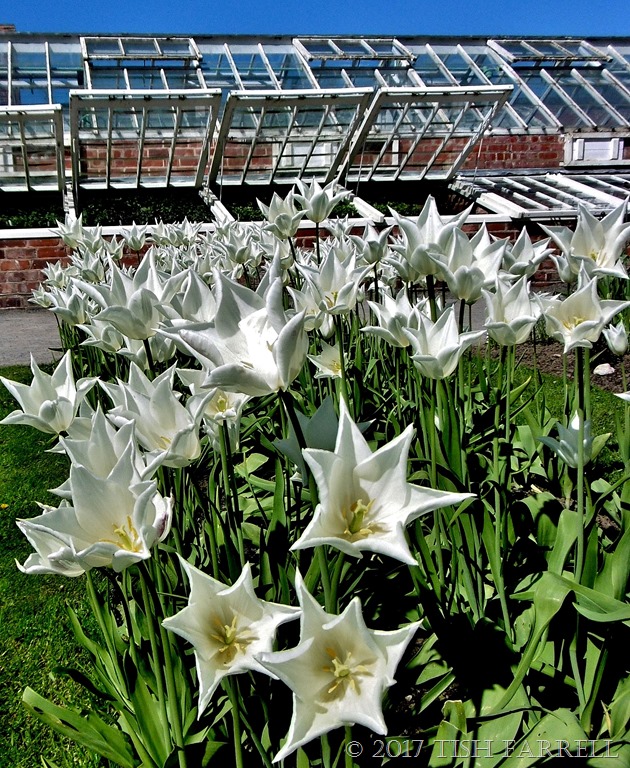
You simply can’t beat tulips for exuberance. They are presently bursting from pots and beds in my back garden – the result of a couple of cheap packs of bulbs from  my local  market stall bought back in the autumn.

I like the tulips that most resemble the wild forms – lily like, low-ish growing, and with several flower heads per bulb. These are one of the praestans varieties – possibly Bloemenlust. I threw the pack label away before pressing enter on the memory save button. Anyway, they are beautiful, whoever they are. And I especially love the way they throw their petals wide to catch the sun.

P1070557

Six Word Saturday  Please visit Debbie at Travel With Intent. She is the new host of SWS with the new rule of Six Words Only In The  Title.


Marvellous Magnolias ~ And More From Bodnant Garden

IMG_4169

You could say that one of Britain’s loveliest gardens grew from a cosmetic nicety – the means to make white soap from brown. This new Victorian product was invented by one Henry Pochin (1824-1895), an industrial chemist who developed a process to clarify rosin, a brown resin that was used to make soap. He then sold the rights to white-soap-making to fund a new development: the production of alum cake from china clay, so creating a vital ingredient for the manufacture of good quality paper.

After that it was full steam ahead for Mr. Pochin, and literally too. He bought up china clay works in Cornwall and South Wales, and the Cornish Gothers works had its own tramway system on which ran a fleet of small steam locomotives, known at the time as Pochin’s Puffing Billies. And so he became a major industrialist, with further interests in iron, steel, and coal. He was also an all round pillar of the community, including serving for a time as a Liberal Member of Parliament. His wife, Agnes Pochin, was also politically active and a passionate suffragist.

P1070470

In 1874, Pochin bought the Bodnant Estate in the Conwy Valley, North Wales. The estate included Bodnant House,  25 farms and 80 acres of gardens, and for the next 20 years Pochin set about acquiring specimen trees from around the world.  He employed the notable landscape gardener Edward Milner, and together they re-landscaped the steep gorge below the house, planting American and Asian conifers along the banks of the River Hiraethlyn that runs through the gardens.

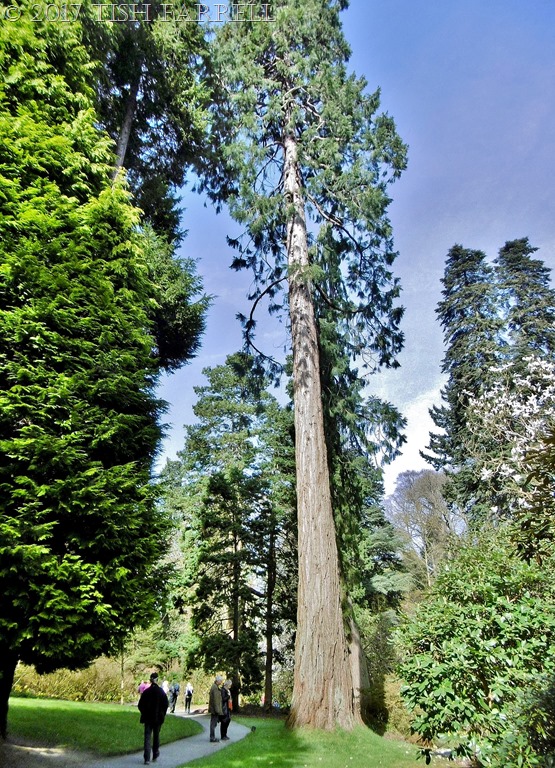
Some 140 years on, you can see the astonishing results – towering Douglas Firs, Giant Redwoods, Japanese Umbrella Pines. This part of the garden, known as The Dell, has over 40 champion trees, now on the UK list of notable and ancient trees.

As we wandered through the pinetum we wondered at the vision of these men – to plant trees whose full glory in that setting they would never live to see. It struck us too, that the world could well do with more of this forward, long-term planning, the creation of a living legacy for future generations.

P1070431

When Pochin died, his daughter Laura McClaren inherited Bodnant, and since that time the gardens have been developed by successive generations of the McClaren family, in particular Pochin’s grandson, Henry McClaren, who created the more formal gardens and the astonishing laburnum arch. (We were too soon to see it in bloom.) It was also he, who in 1949, gave the garden to the National Trust, although it is still managed on behalf of the Trust by a member of family. And it is still growing and expanding, with new areas being planted and opened to the public this year.

P1070478

This is the view from the house (still privately owned) – the Carneddau mountains of Snowdonia as a backdrop. What a setting. And what a garden. Here are a few more glimpses:

IMG_4182

IMG_4172

IMG_4204


“Life, Jim, but not as we know it”?

IMG_3993

I don’t know about you, but I find this close-up shot of a daffodil a bit disturbing. It was sitting in a jug with other daffodils on our kitchen table, full lit by a pendant light. We’d just had dinner and I thought I’d capture some floral detail.

But somehow daffodils by night don’t quite make sense. And there’s a worrying ‘otherness’ about the too-close-quarters; rather like the first time you looked up someone’s skirt when you were a child.

Hm. It makes me think though – what a wonderful mystery is this thing we call life. And in this case, so very yellow!

February’s Changing Seasons ~ Shots From The Plot


Way-hay – it’s spring, or so it seems, and now I feel I need to garden on the run in order to catch up. Much earth moving must be done at the allotment – all the jobs it was too wet to do in the autumn. All the jobs that it’s still to wet to do now. But at least the temperatures are kinder.

And the light is so promising. I’m celebrating that fact in the re-composed top shot of an allotment sunset, captured through the neighbouring hedgerow.

In fact every day now you can see the over-wintered plant life responding as light levels and temperatures rise: purple sprouting sprouting, cauliflowers hatching inside their leaf-folds, chives shooting, rhubarb unfurling, spinach expanding. Then there are carrots to pull from their bucket in the polytunnel, and Chinese mustard and Russian Kale; the autumn sown lettuce are starting to fill out.

Meanwhile inside the polytunnel a big makeover is also afoot. He-who-makes-raised-beds-out-of-old-pallets has been dragooned  into  commissioned to reorganise the planting zones. Instead of wide beds along each side and a path up the middle, the plan is to have one continuous narrow but deep bed on one side, a narrow raised bed down the centre for tomatoes, and three separate raised beds down the far side.

After two days slog establishing the first and second phases, HWMRBOOOP heroically informs me that the stage 3 separate beds are now ready, flat-pack style, for the final part of the installation. The only problem is that it is now windy and raining and we don’t feel like leaving the house. Also this last part of operations will require shifting tons of soil from the old side bed into the new beds, and there’s only so much heaving and hauling one can do in a week.

I’ve already shunted and prepared the soil in polytunnel beds 1 and 2, turned over three big squidgy compost heaps (my compost making technique leaves a lot to be desired), sifted out enough usable stuff to cover several outdoor beds, while starting a new heap with all the stuff that needs to go round again. I have another six heaps to deal with.

At the moment I have one and half allotment plots, but I’m aiming to dispense with the top half of my oldest plot this March when the rents are due. Ultimately, I’d like to retreat altogether to my polytunnel half plot, by which time I should have a fully functioning NO DIG raised bed/terrace system. The theory is that since this system will be more manageable and productive, a half plot should be more than sufficient for our needs. However, as I’ve mentioned several times in other posts, this approach does rely on making loads of compost every year, and that takes up space. Anyway, one step at a time.

And in between compost turning,  moving the gooseberry bush, and pruning the autumn raspberries, there is always time to take a few photos. So here follows a gallery of shots from the February allotment, one of which makes me realise that my polytunnel now also needs a good wash. Heavens to Betsy – is there no end to the gardener’s toil:

To take part in the monthly Changing Seasons challenge please visit Max aka Cardinal Guzman.

Thursdays Special ~ Les Quatre Saisons En Rouge et Noir

P1000335

P1030851

100_9963

100_8119

From top to bottom: winter witch hazel, spring tulips, summer oriental poppy, autumn crab apples.

*

The flowers on our little witch hazel tree are already brown and shrivelled. It was flowering back in January, and on bleak grey days the ragged clusters of russet petals made it look much like a tree invented by aliens. A welcome sight nonetheless. Otherwise the garden is presently dank and soggy – a scatter of snowdrops and one or two hellebore flowers opening.

But there are other signs of spring – tulips and daffodils shooting up several inches tall, and the oriental poppies making their first leaves. Also the  Evereste crab apple tree which we moved last year, and feared we had killed in the process, is covered in tight little buds; so fingers crossed.

Indoors, I’m fretting to start sowing – packets of seeds, old and new, in piles on the window sills, seed potatoes set out in trays in the conservatory. But it’s all too early to do much outside – the Shropshire soil still too cold and wet for sowing. I’m told by a fellow allotmenteer that the acid test for knowing if the soil is warm enough for growing is to sit on it with your pants down. Yep. Bare bottom pressed to the earth. If you can bear the baring, then it’s OK to plant. But this is not a procedure I could recommend for communal gardens, not unless one’s fellow gardeners are suitably forewarned.

And so, keeping my pants well pulled up, I’m stemming my impatience by starting off globe artichokes, coriander and basil in the kitchen, and nurturing my sweet pea seedlings. They don’t mind the cold conservatory, and probably could go outside now. I shall also sow some leeks in pots, and maybe do the same with beetroot.  And if I were truly organised I could also sort out my seed packets into month order so as not to miss the boat as I did with several things last year.

But it’s all so exciting – another seasons’ round in the offing. More things to learn; more things learned to put into practice. It is, after all, the gardener’s way – to travel hopefully.


Paula’s Thursday’s Special ~ le rouge et le noir

Changing Seasons ~ January To And From The Allotment

P1060888

The field path behind the house is littered with skeleton apples – windfalls thrown out from a neighbour’s garden. The apples were whole, if a little bruised, back in October when they were tossed there, but it is only this month that the birds have been truly feasting on them. Blackbirds mainly. Little by little the flesh is being pecked away until all that is left is the thinnest skin, and perhaps some fibrous filaments around the core.  I was thinking of fellow blogger, Sue Judd at Words Visual as I shot and edited this ‘still life’. She captures beauty in decay with great flair. Anyway this painterly edit sums up January for me.

But then today I decided to go the long way round to the allotment. There was misty sunshine, and so the chance to get enough shots to make a gallery in line with Cardinal Guzman’s  alternative version for his monthly challenge. Pay him a visit to find out more.

The long way round involves going up Sytche Lane that skirts the field behind our house. In the top corner Shropshire Council is busy digging us an attenuation pond to slow down the flash flooding when a storm hits our catchment. The town has a long history of flooding, and the Sytche Brook, a generally nondescript trickle of a watercourse, can become treacherous, and has been known to add considerably  to the deluge that hits the town centre from neighbouring hillsides. Another pond is being built at the other end of the town. Neither are seen as total solutions, and some would argue that these measures are not suitable in a steep catchment such as ours. Only time will tell. In the meantime, the big digger driver posed to have his photo taken before I trudged onward through the mud.

The path behind the excavations then wends on along the field boundary and into a wood. You are right above the town here, so in the gaps between the trees are some good viewpoints for photos. From the wood I can then drop down to the allotment.

The following gallery shows all the things that caught my eye today. These include – apart from the ‘views’, Jenny’s watering can hung in a cherry tree, Simon’s wheel barrow, Phoebe’s budding rhubarb, my leaning shed with globe artichoke, and Ron’s much smarter blue shed. On the way home the sun was setting in the wood.


This slideshow requires JavaScript.

copyright Tish Farrell 2017

Traces of the Past ~ Tools Of My Grandfather’s Trade

P1060192 - Copy

I hasten to say these are not my grandfather’s actual tools, but when I spotted this gardening paraphernalia in the gardeners’ bothy in the walled garden at Attingham Park yesterday,  I instantly thought of Charlie Ashford. He was head gardener at Redhurst Manor in Surrey from around 1921. I have written about him in the Tales from the Walled Garden. The links are at the end.

Attingham is one of Shropshire’s grandest stately homes, once home of the Berwick family, but now in the care of the National Trust. I did have photos of the house, taken on an earlier visit, but the computer seems to have eaten them, and yesterday the walled garden was my only objective. There has been a monumental restoration project going on there since 2008, and this was our first visit. (Always the same with places on the doorstep.)

I think this is probably the hugest walled garden I have ever seen, and I truly cannot imagine why one household would need to produce quite so much food for itself even if it did include feeding all the servants. Here is one corner:

P1060183

And yes, it was perverse to chose December for our first visit – a time when there is hardly anything growing. However, I was very taken with the climbing bean frames, just visible towards the back wall. Here’s a better view. I think they’re made from hazel whips. Ideal for sweet peas too.

P1060181

The path  around them leads to an adjoining much smaller walled garden. This is where we found the gardeners’ bothy, cold frames and glass houses, hot beds and hot walls – the kind of territory wherein my grandfather spent much of his working life:

P1060188

P1060189

P1060186

Charlie Ashford served his apprenticeship in an establishment as grand as Attingham. The position of head gardener was akin to the role of butler within the house. The training was long and there was a strict hierarchy of under-gardeners and garden boys. Redhurst, though, was a much less grand affair – a modest country manor by comparison. You can see it in the background in the next photo – grandfather in the dahlia and delphinium bed. IMG_0012

And here’s a glimpse of his working life from one of the talks his daughter, my Aunt Evelyn, gave to her gardening club. She was born in the gardener’s cottage at Redhurst and spent her earliest years in the garden there. I’ve posted excerpts before, but this is a longer version:

Imagine that we are standing in the holy of holies, my father’s potting shed. It was not all that large and the space was taken up with deep shelving on three sides of the shed. There was a door into the kitchen yard and another into the garden itself. On the back of one door were three large coat hooks to take the jackets that my father needed and also his green baize apron. On the other door hung his clean alpaca jacket which was worn when he went into the house, a dust coat to be used in the fruit room and his leather pruning apron with its thick, left-handed coarse leather glove sticking out of the pocket. These garments comprised his head gardener’s uniform; there was almost a ritual about putting them on for the various tasks.

My father’s own tools were hung in neat and spotless order on hooks to the left of the garden door. He insisted on clean tools and, after every task, the men had to be sure to wash, and then rub dry on old sacking any tool that had got even the slightest bit dirty. A little spot of oil was rubbed into the spades and trowels and forks until the metal shone. Wooden handles were treated with linseed oil which was thoroughly worked in. Only then could the tools be stored away. That is why probably to this day I am still using a well worn spade and fork that belonged to my father. There have been times when, if in a hurry I have hung my spade up dirty, I have gone scurrying back to give it at list ‘a lick and a promise’. I can almost hear my father saying, ‘That won’t do, miss. Dirty tools make bad workmen.’

The potting shed was filled with a wonderful mixture of smells of the sort you find in a ‘20s hardware store. Tarred string was the main one. Then there was the strange jungly smell of the raffia hanks hanging on the door. It suggested faraway places. There was bone meal, fish meal, sulphate of ammonia, Clays fertilizer, Fullers Earth, Hoof and Horn – everything to help bring in good crops – and all stored in wooden bins with brass bands and rivets and a wooden bushel or half-bushel measure on top.

*

There was the annual ritual of sowing seeds for vegetables, preparing the asparagus beds, pruning and shaping the fruit trees, getting the cold frames ready, going over the tennis courts to prepare them for the summer season. There would be glass to replace in the long glass-houses or hot houses. The herbaceous beds required a lot of work in autumn: overgrown plant clumps to be carefully split and replanted, all to be mulched with well rotted manure from the stable yard, or a sweeter mixture of well rotted compost and peat for plants that did not like manure.

Wages were low, and hours were very long, but there were seldom any complaints. Early in the year one man would be set the task of planting out young tomato plants in one section of the glass house. In another section another worker might be potting up seedling chrysanthemums. And so the cycle of work went on.

Dad had his own specialist greenhouse in which he grew plants for the house. Primulas were a particular speciality but he was careful to see that whichever of his men was put to work here that he was not allergic to the plants. Primulas can secrete a substance from the leaves that causes a painful and persistent rash not unlike shingles.

The kitchen garden was walled on three sides by a wall at least eight feet high. On the south side was some rustic fencing over which climbed roses, clematis and honeysuckle – all in a tumbling profusion that looked natural, but was carefully managed throughout the year.

Much of the equipment that the men used was made on the estate. There were sturdy wooden wheelbarrows made in the wood yard behind the stables. The wheels turning at a touch with never a squeak allowed. On busy grass cutting days an extra section fitted onto the top of the largest barrows so that the men could trundle the piles of cut grass away to the ‘frame yard’ to be spread on compost heaps there. Here there was also a long low open shed in which all the mowers were kept: a hand mower for paths and border edges; a small motor mower for the terraces and the little lawn areas; a large sit-on mower for the long stretches of lawn and the rough grass places; and a huge wide mower with a heavy roller, which a horse from the home farm used to pull across the beautifully kept lawn at the front of the house.

Cucumbers were also grown in the cold frames and never cheek by jowl with tomatoes in the hot house. It was a job for two men getting the frames ready early in spring. The frames were built of brick with solid wooden supports or runners to hold the strongly built wooden lights. When I was older I could just about help my father to open or shut the frames. It was important to keep the cucumbers at just the right heat and to give them sufficient ventilation. Grown like this they always tasted succulent. This was not surprising as they were grown in a deep, deep bed of well rotted stable manure mixed with peat and compost and leaves – anything to make the mixture ‘hot’.

Thinking back on the work done in those gardens everything had its use and nothing was wasted – especially time.

At the big house, it was important that gardeners should maintain a succession of lovely flowers – all year if possible, and especially those with scents. As soon as anything special bloomed, like Winter Jasmine or Viburnum fragrans, a spray or two went into the house early in the morning for madam’s breakfast tray, or the desk in the Major’s study. This was quite a ritual. Into the house we would go, but not into kitchen because that was Cook’s domain. We go around the house and in through a side door and into the Butler’s Pantry. Here Johnny the Butler ruled supreme. When we arrived with Dad’s offering for the day, the exchange would go something like this.

“What have got today then, Charlie? Do you want two silver holders or one cut glass?”

“Oh, I think two silvers, please, Johnny. I’ve got some fine sprays of Winter Jasmine.”

Then Dad would take the delicate sprays from the shallow basket that he always used and arranged them in the vases with great artistry. Thanks for such offerings reached him without fail: “Please tell Ashford that the flowers were just what madam likes. The colours matched her dress today.”

Evelyn Ashford Gibbings

Tales from the walled garden

Tales from the walled garden ~ back to the potting shed

Tales from the walled garden ~ when Alice met Charlie

Tales from the walled garden ~ more about Alice

*

Black & White Sunday ~ Traces of the Past