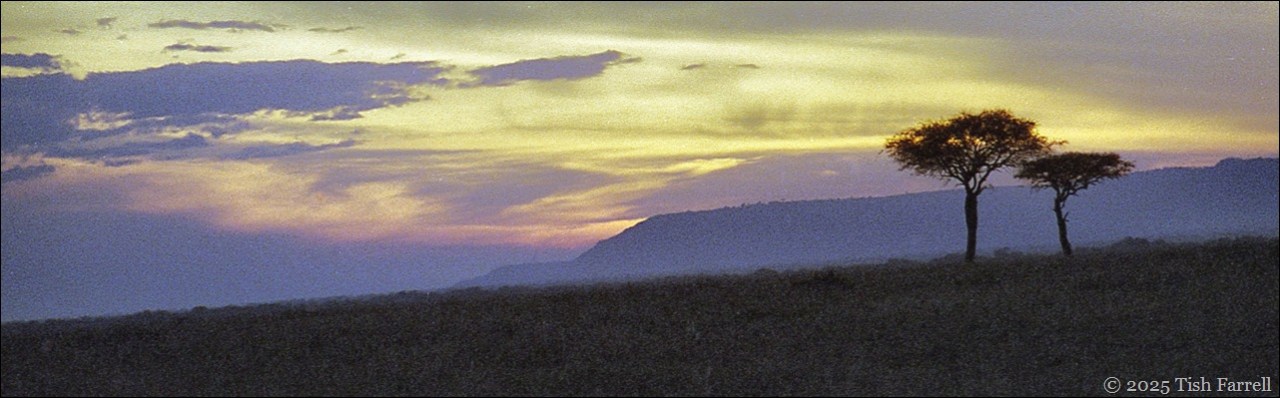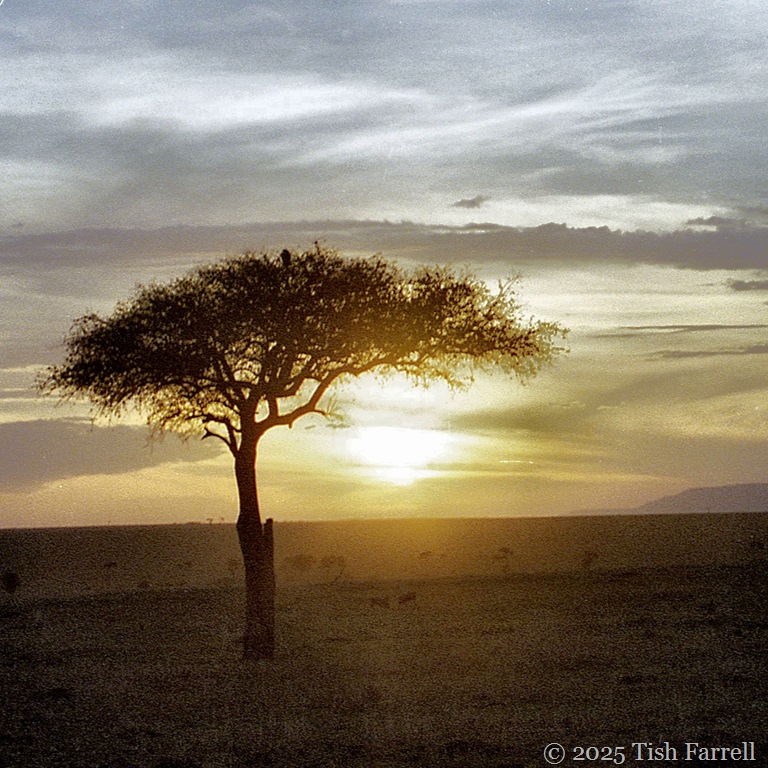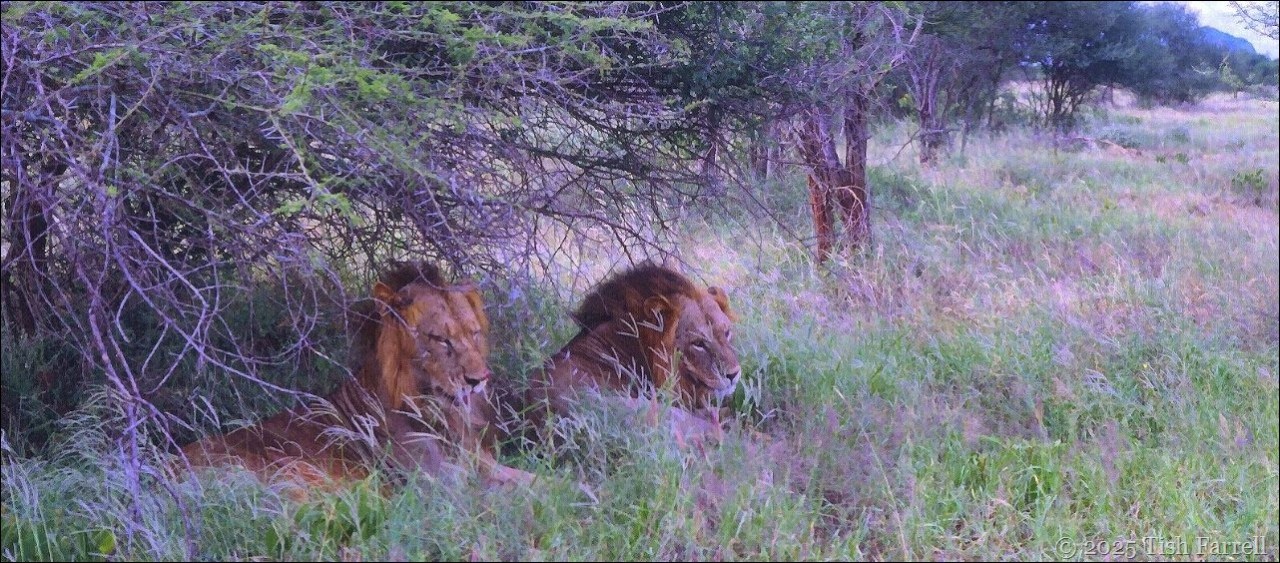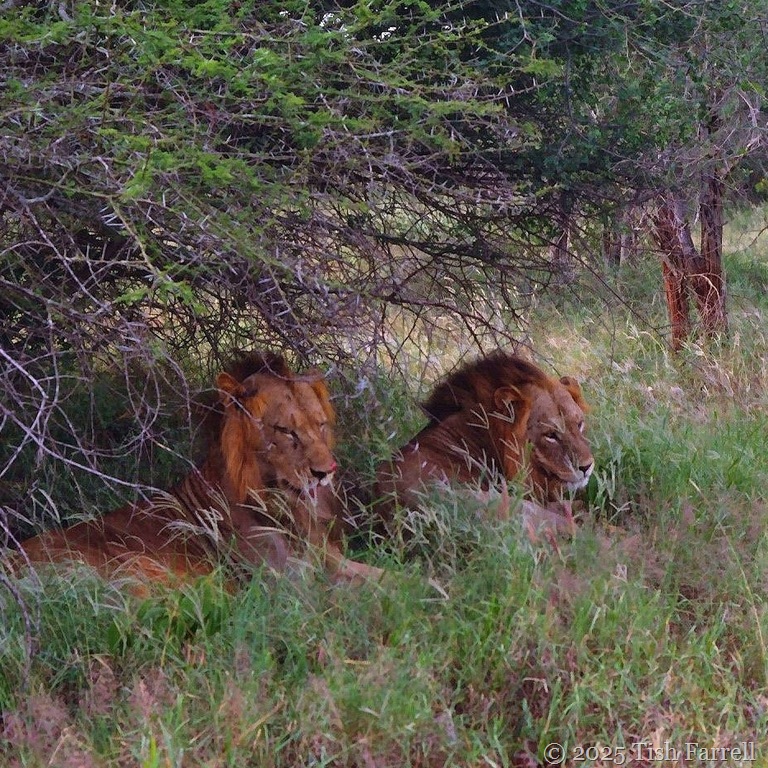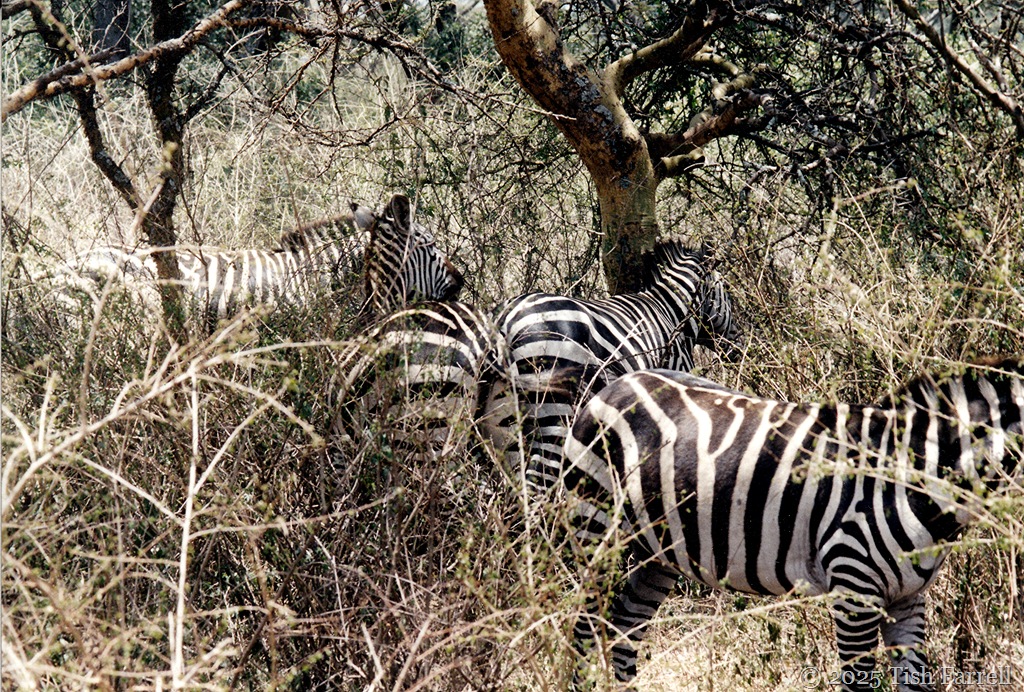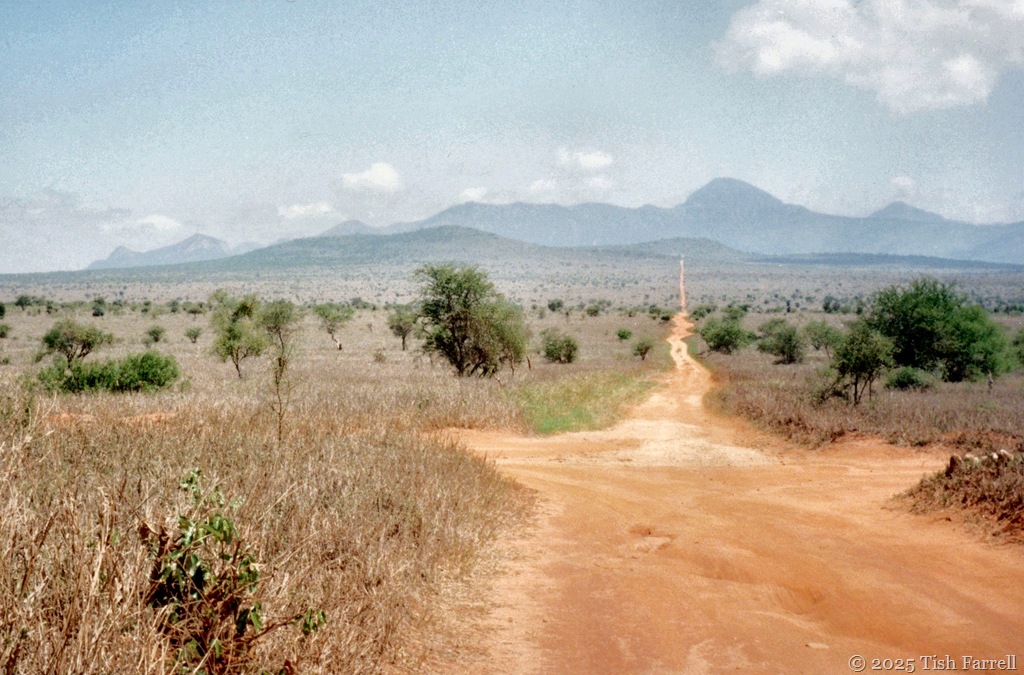
Mara Sundowner: Plains’ Shadows

Maasai Mara sunset

Back to the Farrell ‘once in Africa’ archives for this final ‘shadows’ post.

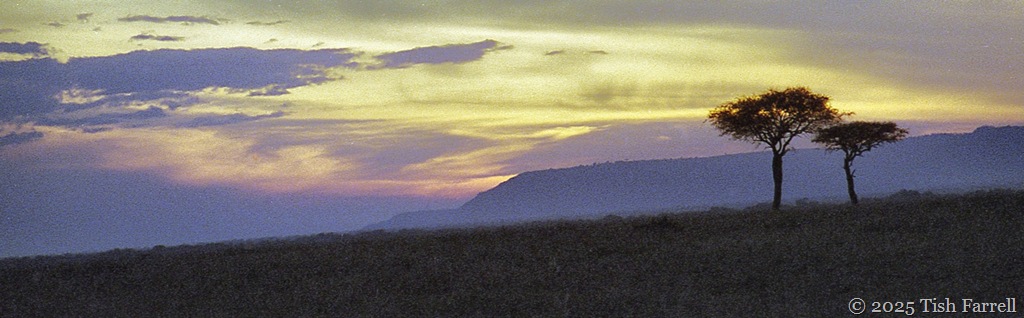
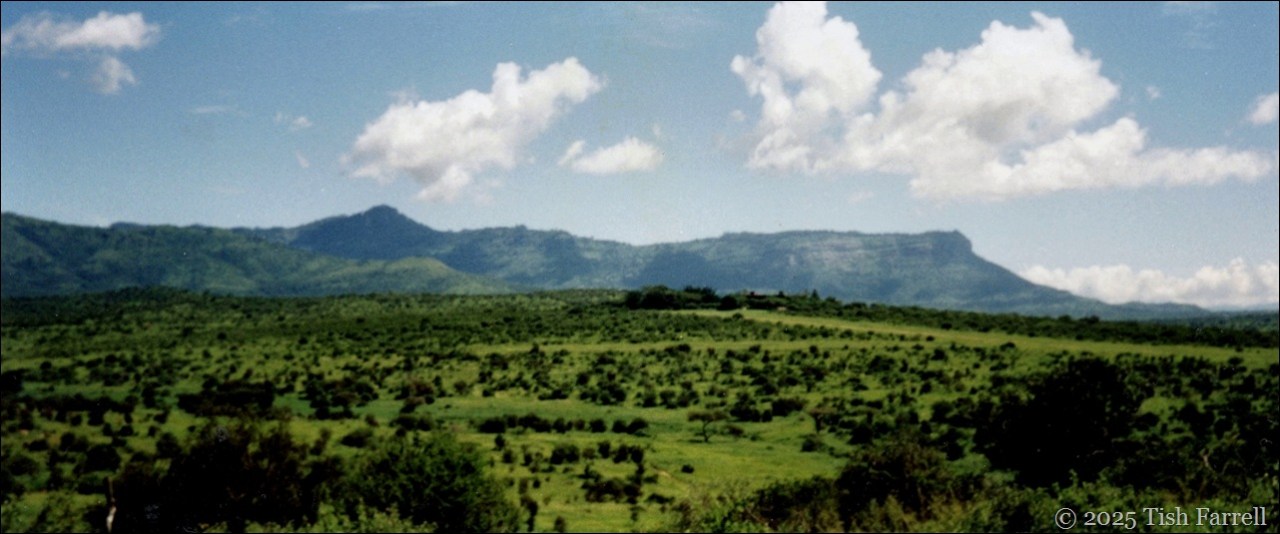
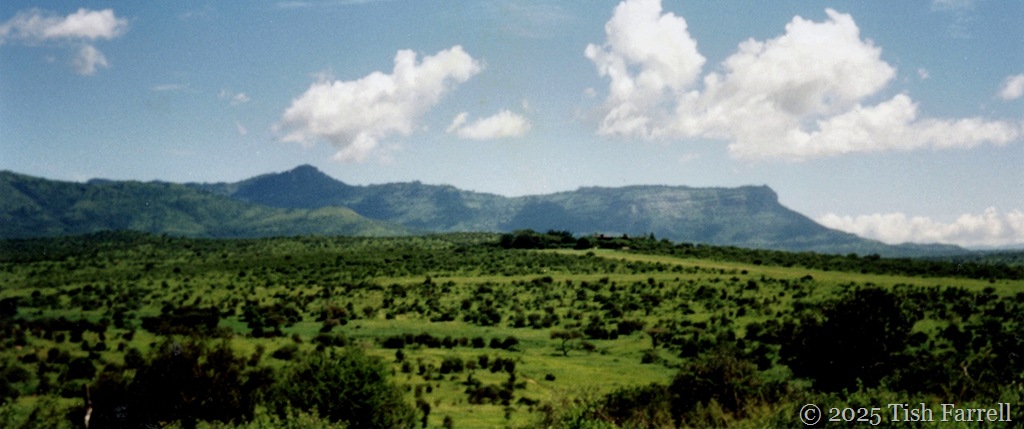
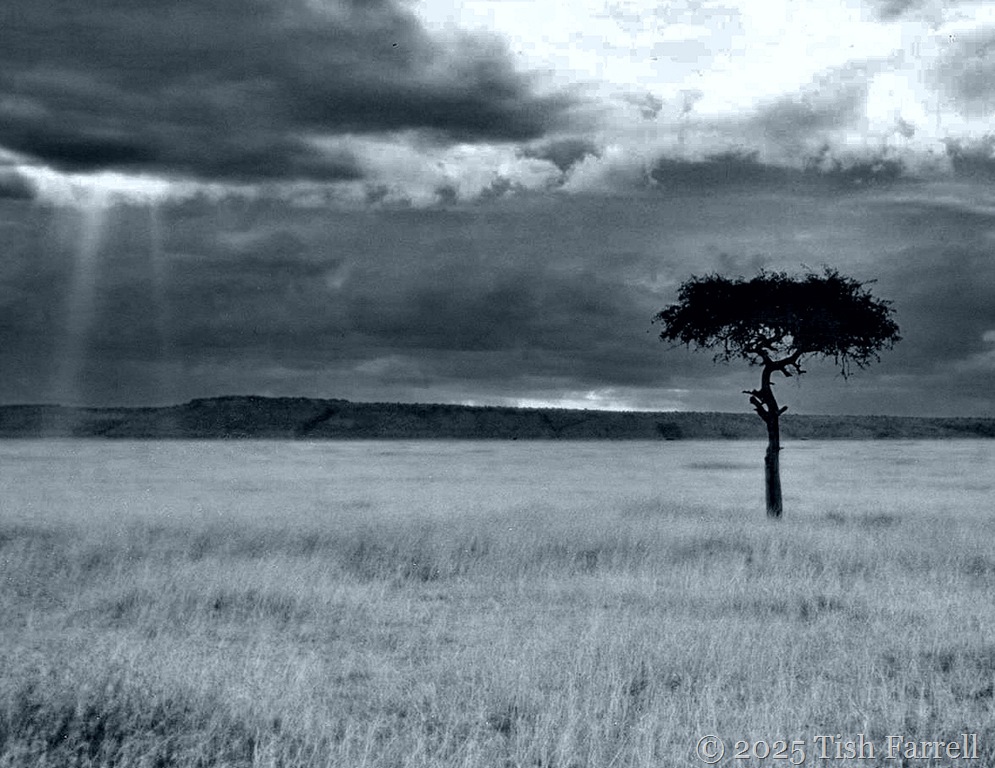
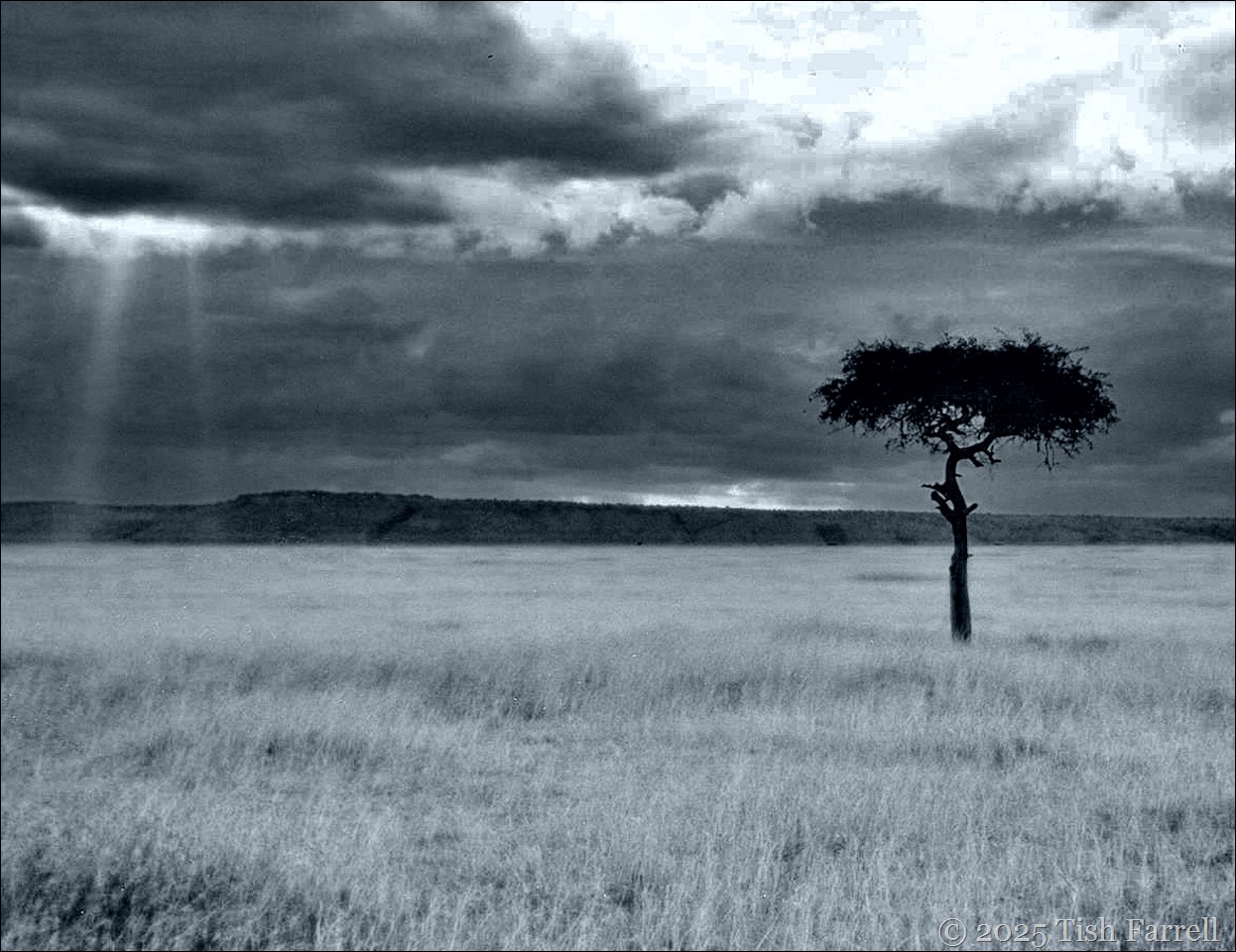
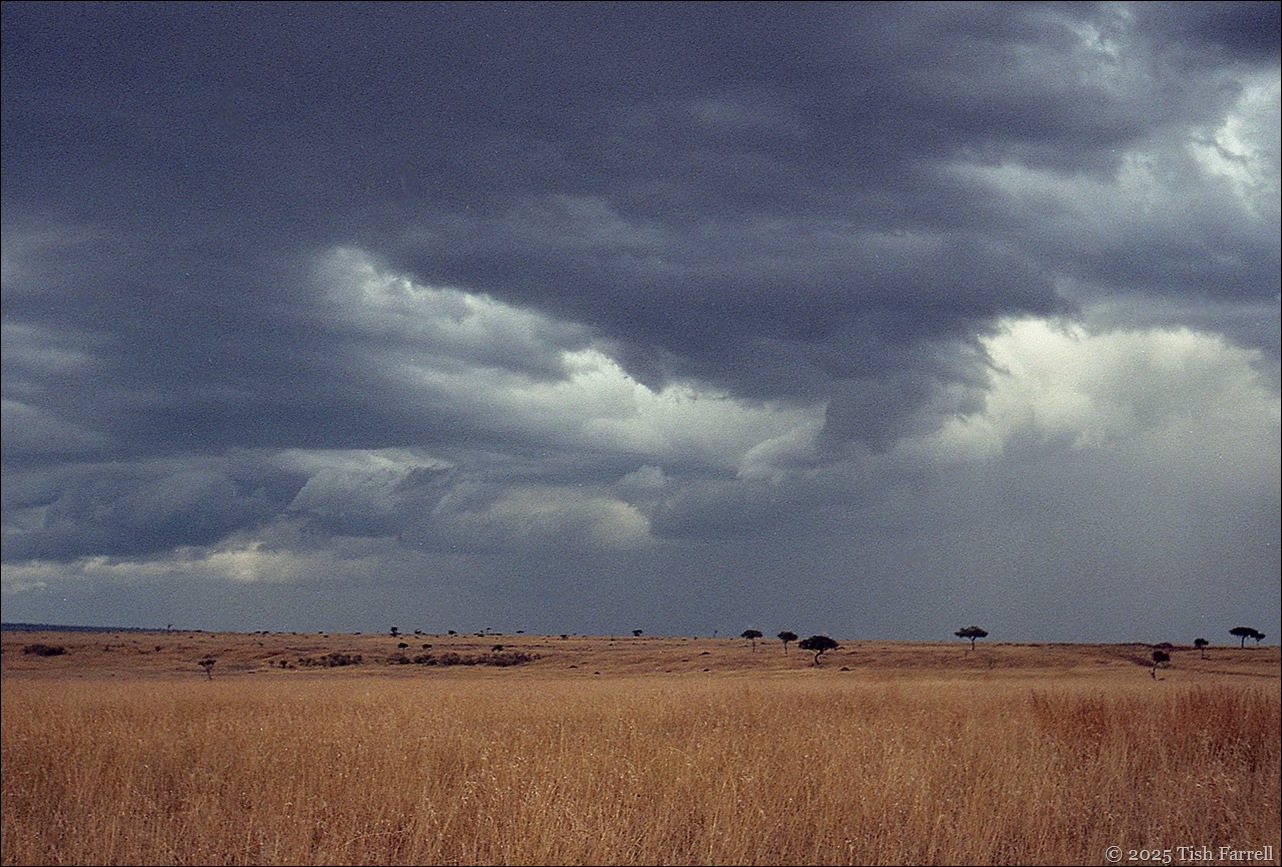
Here we have the Maasai Mara in December, a desert date tree, a shadowy glimpse of the Oloololo Escarpment, lots of stunning memories invoked, plus a few pangs for Kenya days long gone.

And talking of gone, where did this month go? Now as ‘November Shadows’ draw to a close, a big round of applause for Becky who has kept so many of us so well occupied.

Cheers, my dear!

November Shadows #30

Desert date sunset header

Scavenging The Old Africa Album

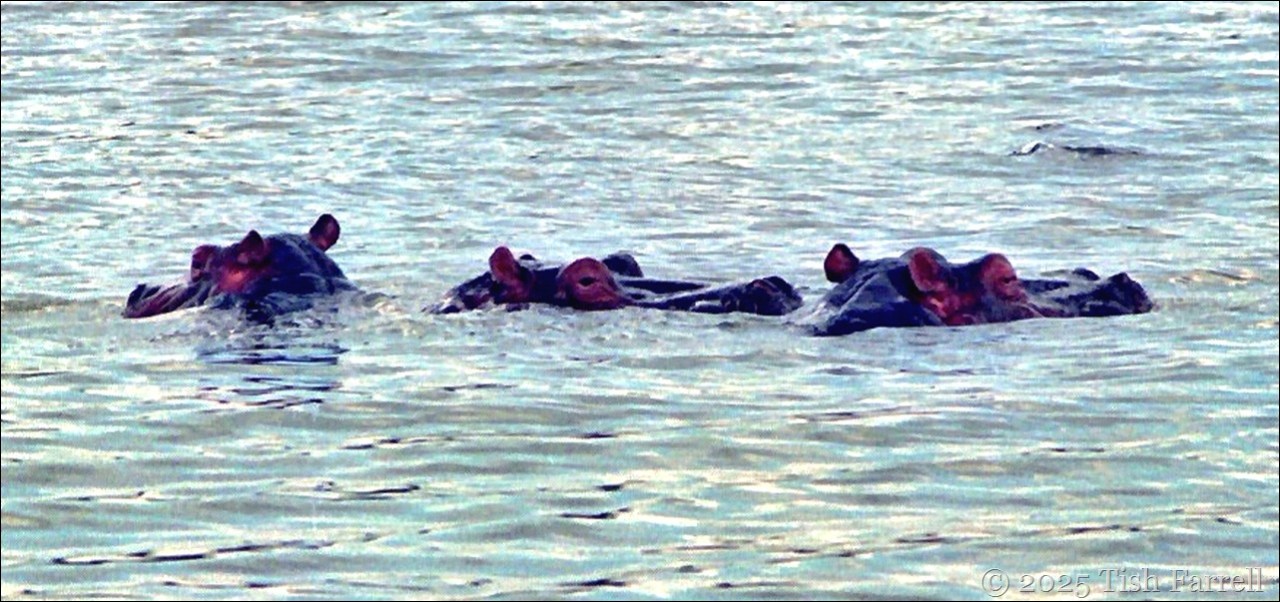
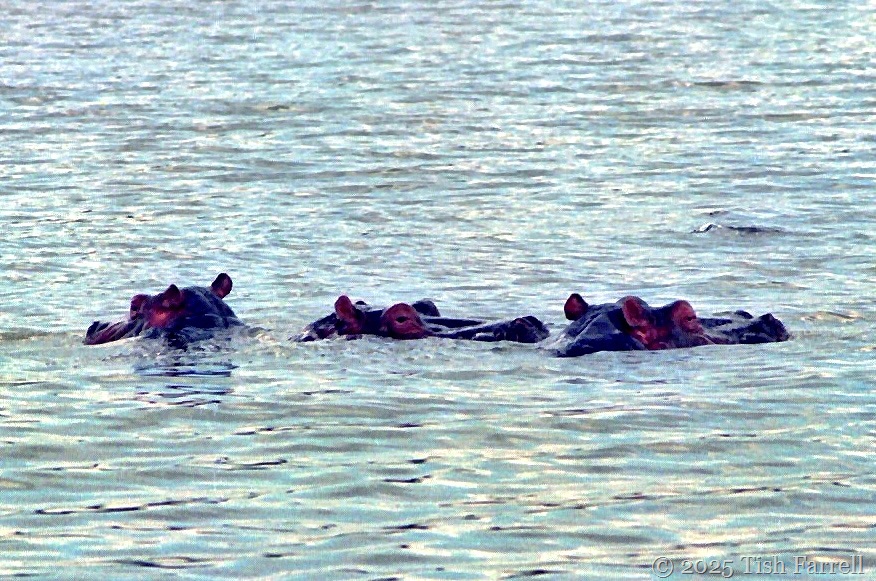
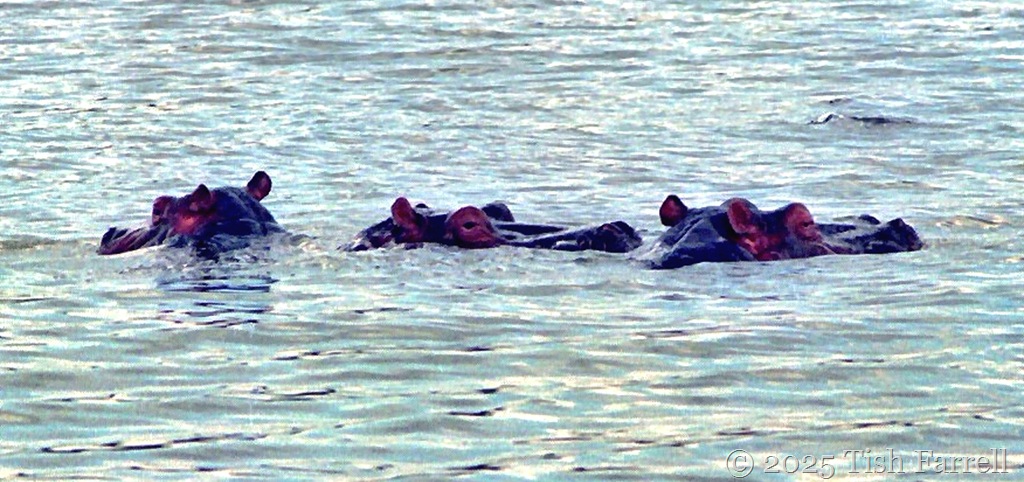
Hippos Naivasha

This week at Lens-Artists, Anne from Slow Shutter Speed sends us on a virtual scavenger hunt. I haven’t been in the old Africa album for a while, so I thought I’d have a rumage there. A virtual mini safari as well then.

‘Wavy lines’ tops the list. The header thus features a wavy profile of hippo ears, eyes and noses in a wavy Lake Naivasha in the Kenya Rift Valley.

*

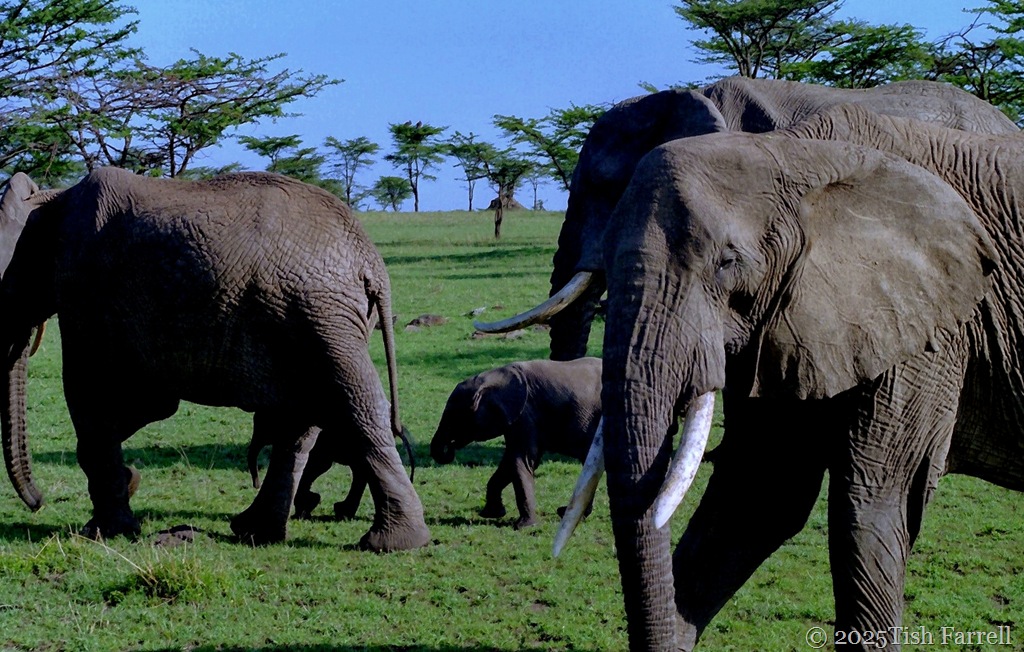
Maasai Mara elephants

This herd of Maasai Mara elephants was in a very peaceable mood. They walked around us as we were parked up eating a picnic breakfast. I’m thinking elephant hide would feel pretty ‘bumpy’ should one ever dare to try it, especially the trunks.

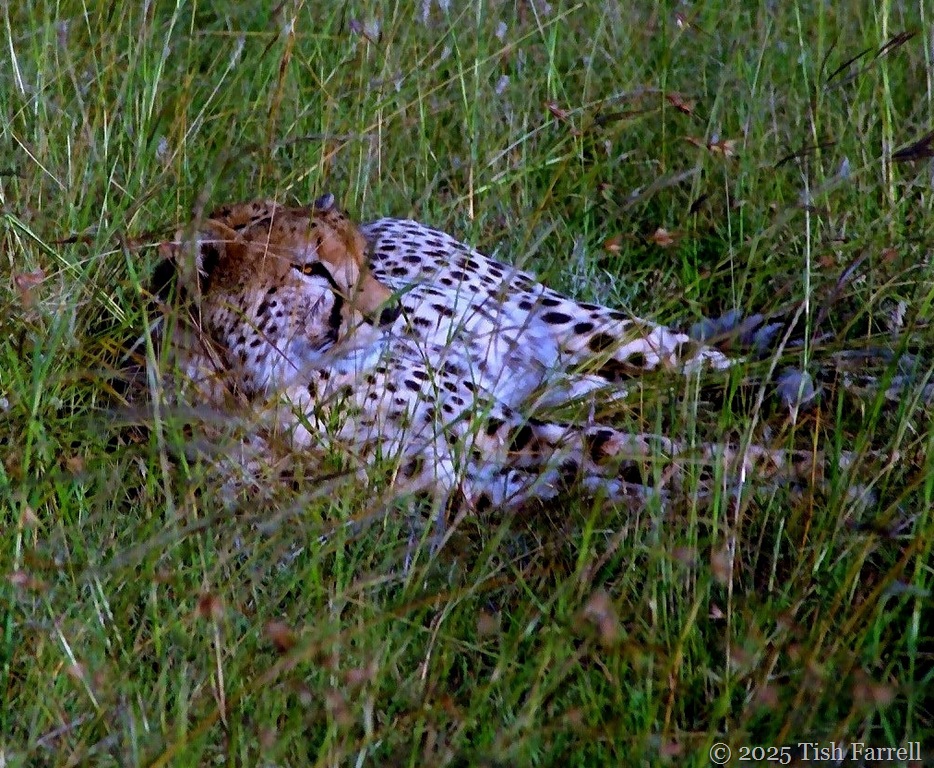
Whereas cheetahs must be wonderfully ‘soft’. They also wear nice ‘circular’ spots. This female was having an afternoon siesta when we pulled up beside her in a safari truck. She didn’t look at us, but simply posed like a professional, well used to having her photo taken.

cheetah

*

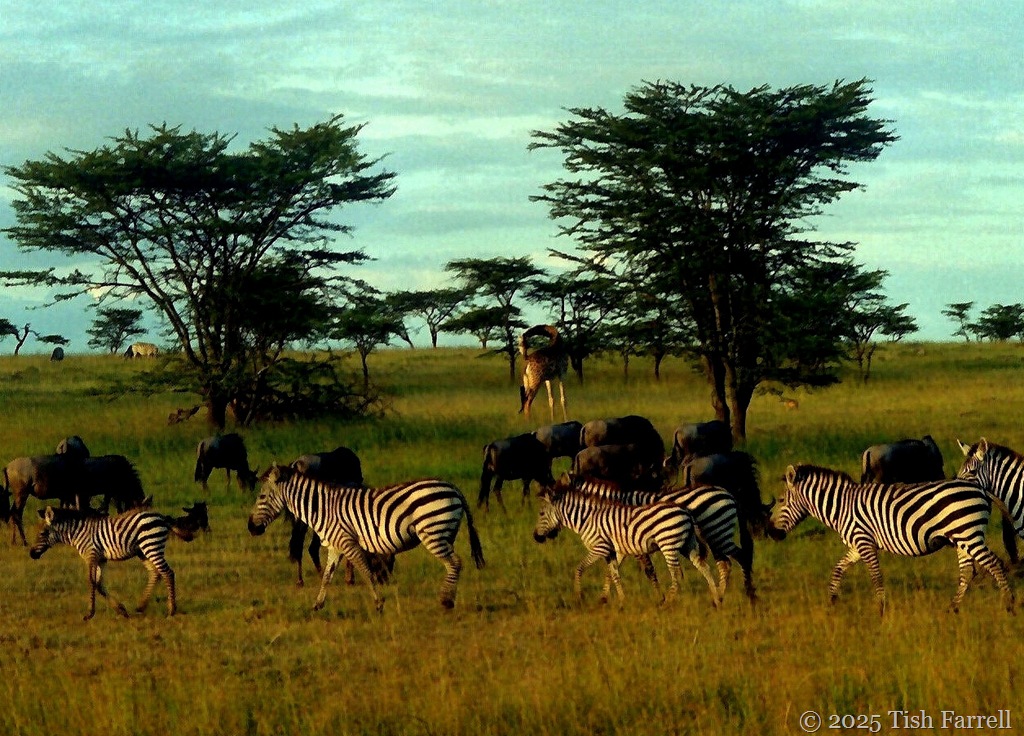
And more ‘patterns’. This time stripes. Zebras come with wavy ones:

Zebra sunset Maasai Mara

And then there’s another Kenyan speciality, patterns-wise:

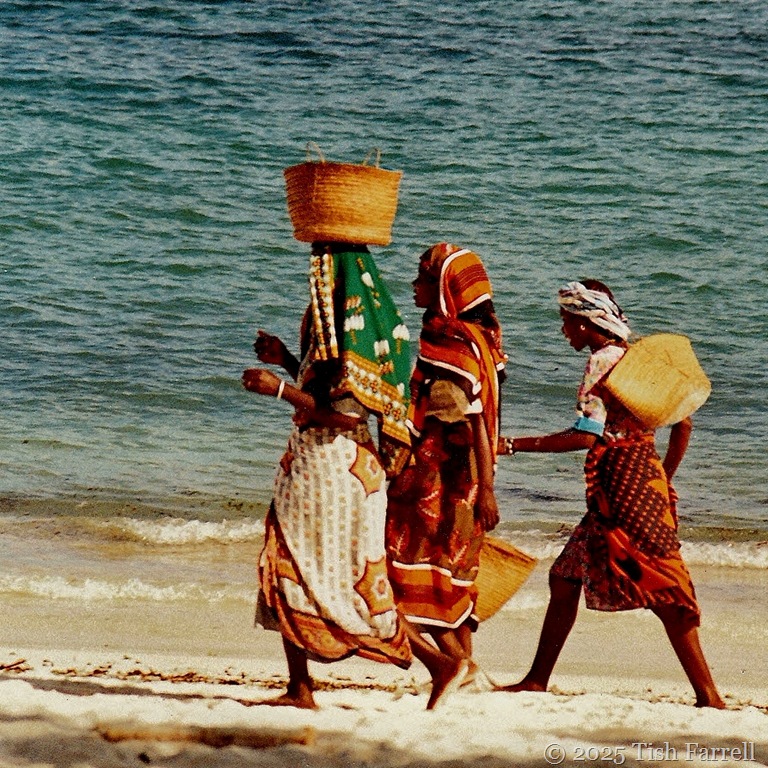
Digo girls in kanga wraps

Cotton kanga wraps come in pairs with vivid designs and snappy Swahili slogans on the hems, here worn by Digo girls on Mombasa Beach.

*

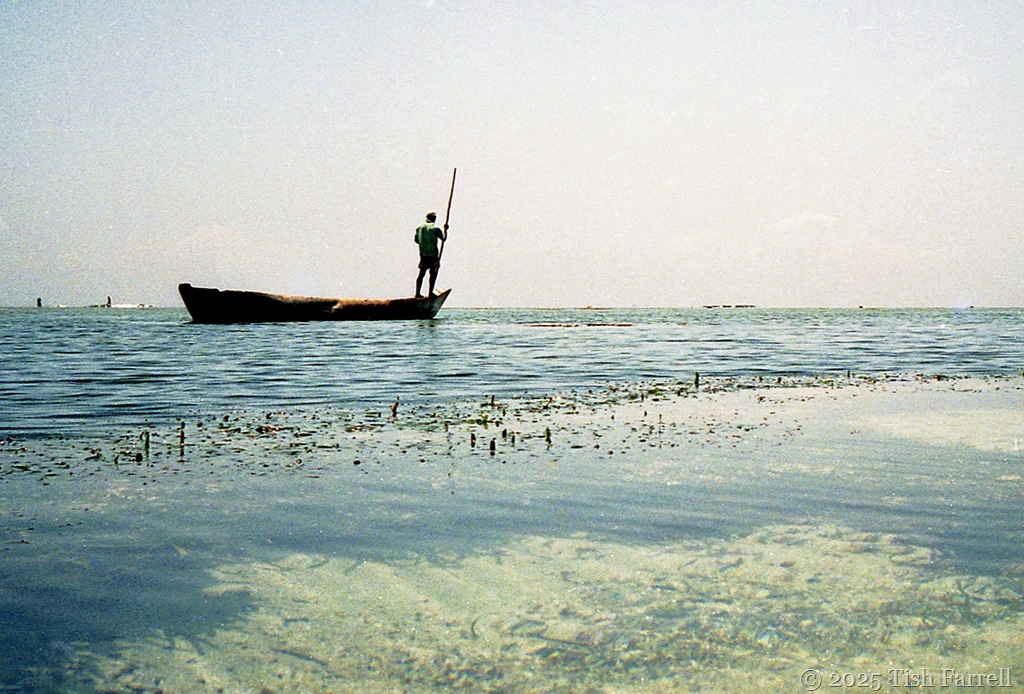
Tiwi fisherman

Now for ‘smooth’ water and a smooth dug-out canoe on Tiwi lagoon. A Digo fisherman under the midday sun. I’m guessing he’s looking for reef lobster.

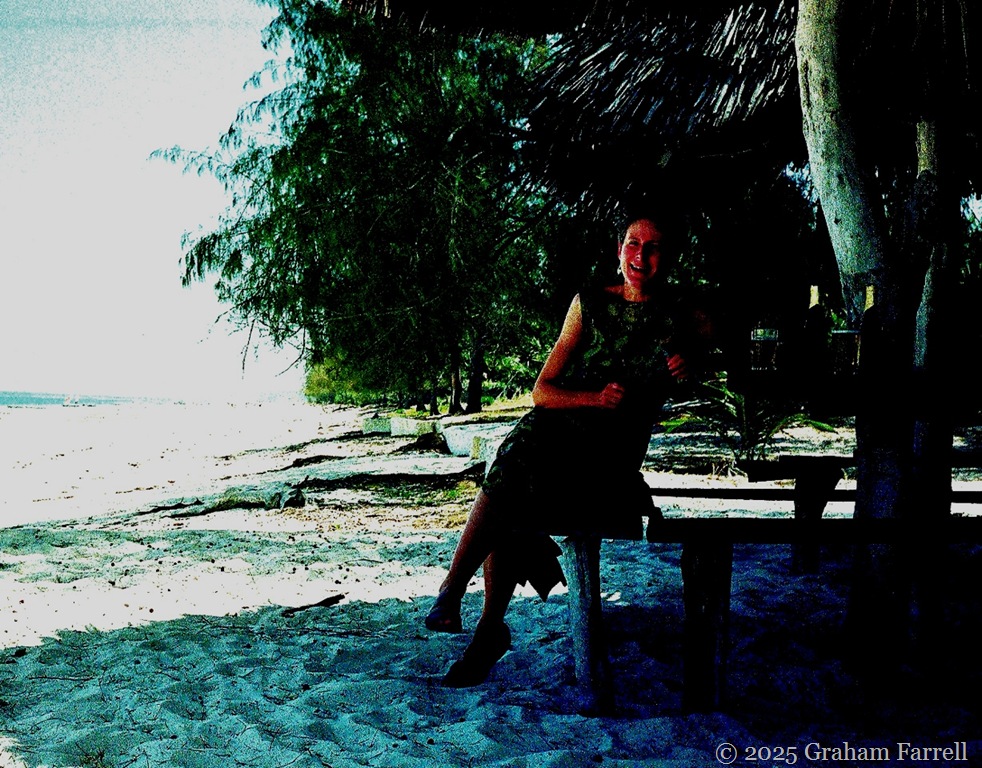
And as for ‘cool shadows’,  here’s me escaping to some at a Tiwi beach bar. Not so much too hot, as too bright to see out on the white coral sand. Aaah! Those were the days.

Cooling shadows

*

Lens-Artists: Virtual Scavenger Hunt  This week Anne at Slow Shutter Speed sends us on a photo quest, five to ten of the following: wavy lines, bumpy or soft texture, patterns, things circular, rectangular, smooth, made of glass, something with water in it, with green eyes, a wheel, a camera, cool shadows or jewellery…

Hippos Naivasha header

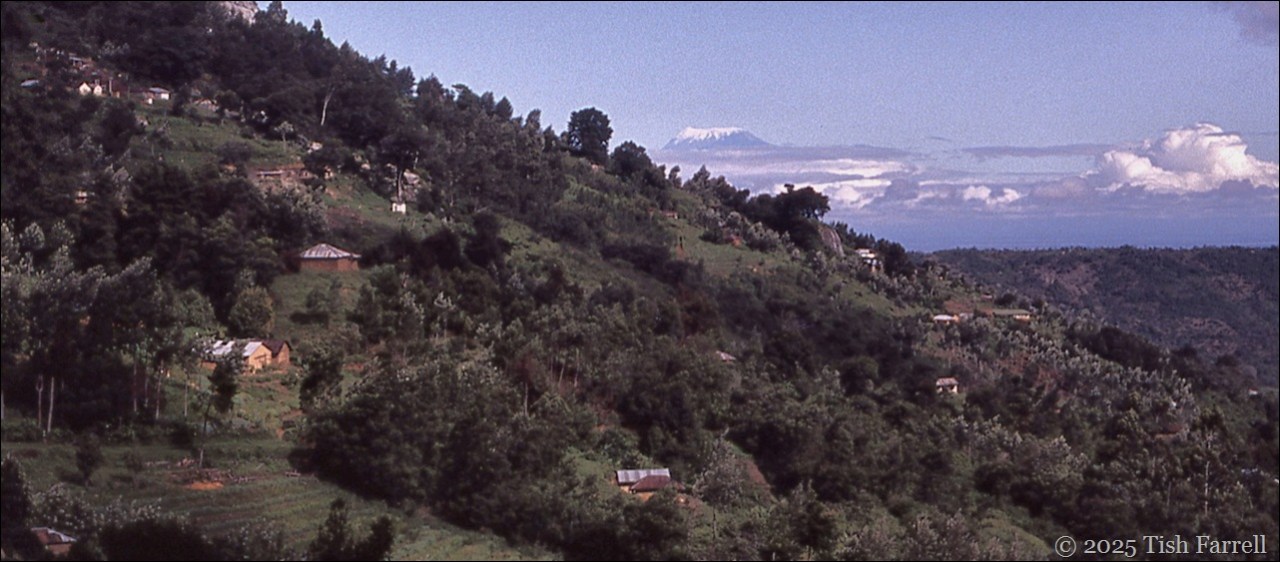
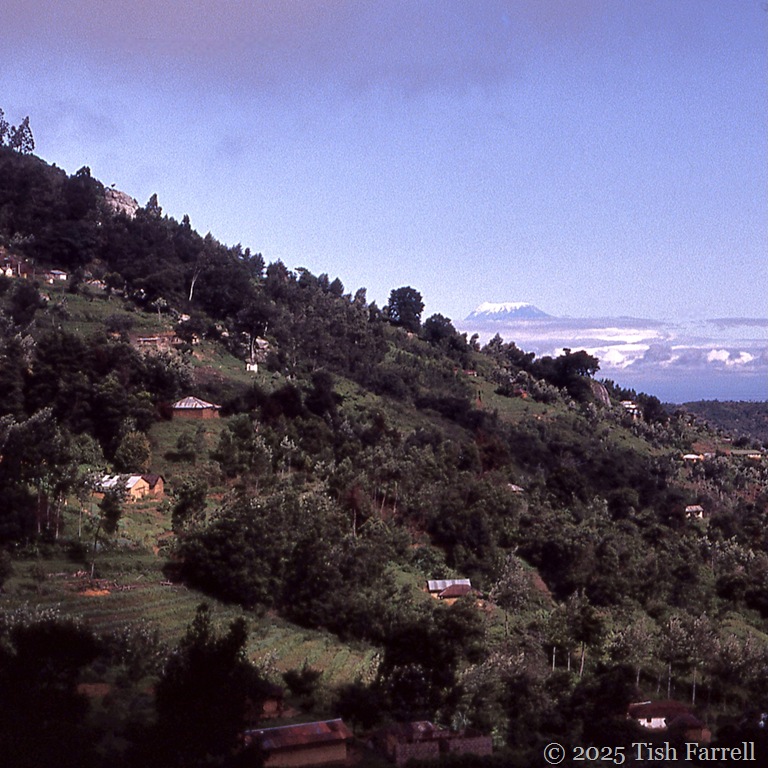
A Red Letter Day ~ Glimpsing Kilimanjaro

kilimanjaro sq

We were up in the Taita Hills. It was the final phase of the Larger Grain Borer (LGB)project (see previous post). Graham was checking on the on-farm release of predator beetles,  Teretriosoma nigrescens  (TN). There were high hopes that TN would be a viable control for LGB, a voracious (and imported) pest in grain stores. (In the project’s trial stores you could actually hear the gathered tiny entities grinding through maize cobs, one of Kenya’s essential food crops being turned to dust).

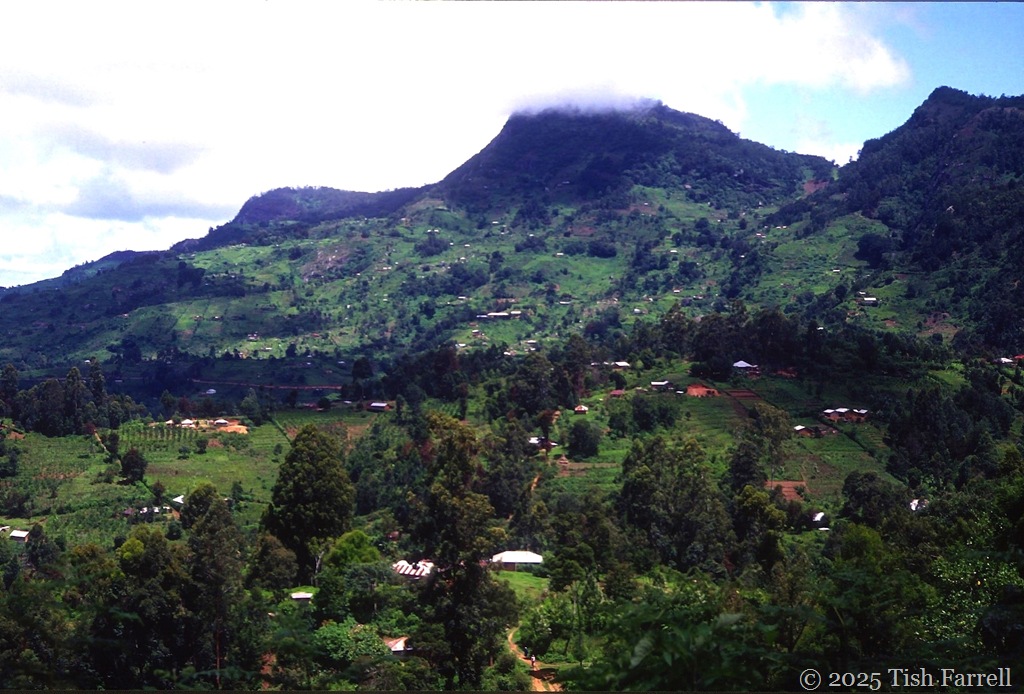
I was along for the ride. And what a ride it was up from the hot plains: hairpin bends and a rapid climb through 1500 metres, verges bursting with wild flowers – black-eyed Susan, wild hibiscus, morning glory, goats grazing, hillside farms steeply terraced, the scattered plots of maize and banana, the cooling presence of cypress forest. Everywhere along the road people walking, transporting something; jerrycans of cooking oil, sacks of maize flour, women hauling firewood, bundles of sugar cane, mamas with infants.

Scan-130520-0003 - Copy

The Taita Hills comprise three massifs formed during the Precambrian era – i.e. between 650 and 500 million years ago. The peaks range from 700 m to 2,208 meters above sea level, and are covered with remnant cloud forest, which also has very ancient origins. The land is mineral rich and highly fertile. The flora and fauna include species endemic only to these hills, butterflies and orchids among them.

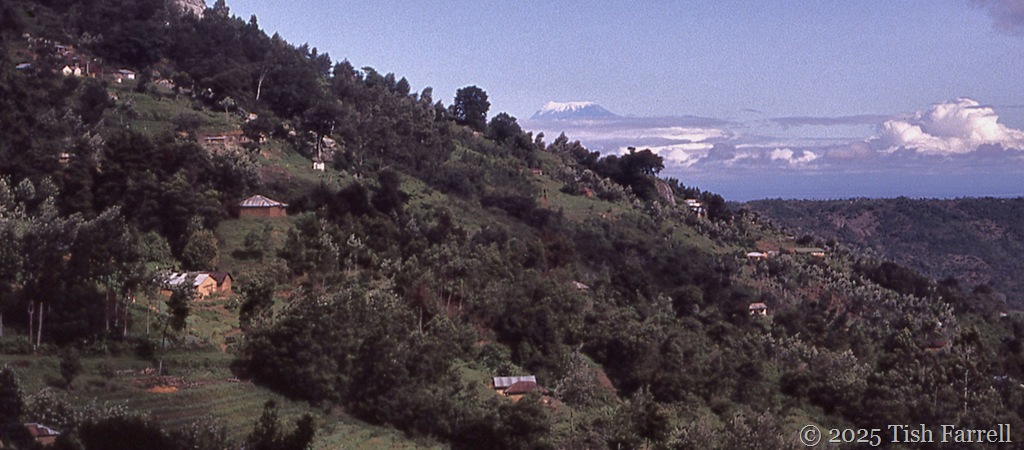
It is a landscape that scarcely fits the usual visions people may have of Kenya. And on top of that, if you choose your spot, there can be moments there when Kilimanjaro (just over the border in Tanzania) deigns to show itself. It is a capricious mountain, coming and going in a matter of seconds, dissolving impossibly into a blue and cloudless sky. It changes size too. Some days it can appear huge, shimmering in the sky with all the substance of a giant soap bubble; other times, as in the photo, it is more discreet. But however one sees it, it changes the day. The nervous system fizzes from head to toe: we’ve seen the mountain! We have!

Kilimanjaro header

#SimplyRed Day 26

Red In Tooth And Claw?

Taita lions sq

Well, it had to be done, didn’t it – that particular ‘red’ title for Becky’s month of #SimplyRed squares, and this despite the apparent lack of ‘red’ in the photo. But then, if you look very carefully, the dozing lion does appear to have a bloody nose.

Of course I’ve posted this photo a few times before. It’s probably one of my best ‘caught moments’ from the old Africa album. We were staying at the Taita Hilton in May 1992. Our other bolt-hole, when Graham was working in the Taita Hills, was the very basic Danish Guesthouse in upland Wundanyi, but on this occasion a room wasn’t available. Oh dear. That meant five days of wall to wall luxury down in the bush country, although that said, I loved the simplicity of the guesthouse too. The Taita hill country is anyway very beautiful.

And the reason we were there at all, Graham was supervising the release of predator beetle Teretriosoma nigrescens (TN for short) at sixteen highland farms. There were high hopes that it would begin to control the spread of larger grain borer (LGB), locally known as dumuzi, which had been introduced to the continent around the 1980s in cargoes of food aid maize sourced in LGB’s native South America. (For those who want the scientific details there’s a short abstract here of a related project in  West Africa. It gives the gist of the experiment.)

Our stay coincided with a weekend, so on Sunday afternoon we thought we’d take a drive around the hotel’s small game reserve. It was the start of the dry season and a time in Kenya when skies are often overcast, the light lacklustre. We bounced along the dirt tracks scanning every tussock of brown grass for big cats. That day at the hotel there had been talk of lion sightings. We felt hopeful, but instead, we spotted zebra, hartebeest and waterbuck, all grazing peacefully.

IMG_0013

We were giving up on the quest when a park truck pulled up in front of our land rover. I thought the ranger wanted to check our tickets, but he only wanted a chat. When he discovered that we hadn’t seen the lions, he told us to follow him, and zoomed off track and into the bush. We trundled behind. Soon he had us lined up by a thorn bush. There, beside my car door was a slumbering lioness. She opened her eyes to check me out and then went back to sleep. (Lions sleep around 23 hours a day). The ranger then pressed on to the next bush, and there were the two males. I leaned out of the car window and simply took the photograph – just like that. It’s still hard to believe. I think I was there.

Taita Hills reserve

copyright 2025 Tish Farrell


#SimplyRed Day 23

Taita lions header

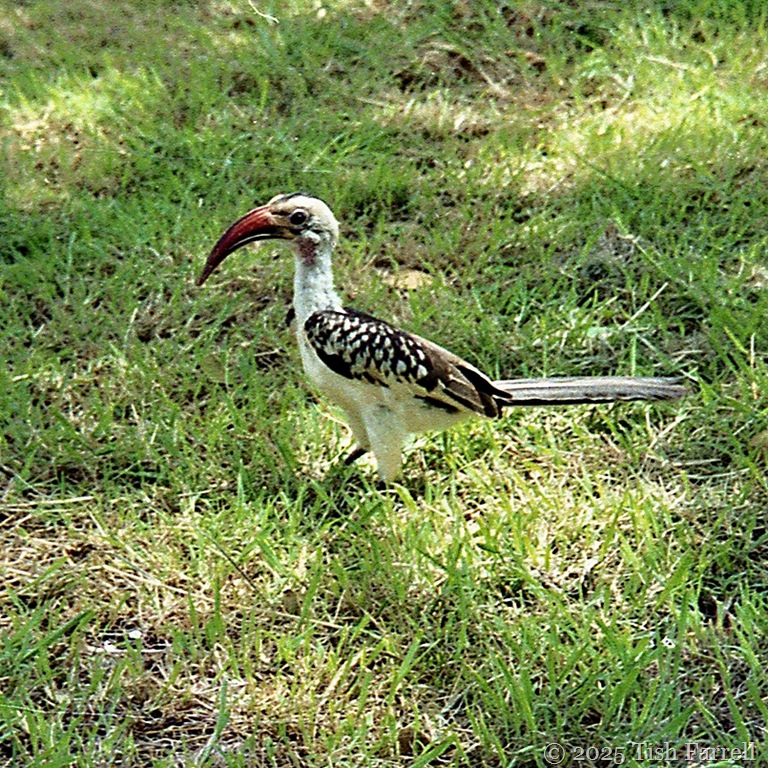
Taita Continued ~ Of Red-Billed Hornbills

img055 red billed hornbillsq

The hornbill in the photo is not the one I’m going to talk about – for reasons that will shortly become clear.

*

It was a quiet afternoon at the Taita Hills Hilton. The lunch-time safari vans had come and gone. I’d been writing letters, sitting in the shade by the teardrop pool (see previous post). Its heavenly blue, the shimmer of it, was mesmerizing, as were Robert’s passes with the pool net. The lack of guests meant he could take his time sifting out the tiny acacia leaves and assorted bugs. He moved quietly and with ease. My attention drifted.

And then Robert was at my side. Would madam like to see something very interesting. I must have looked doubtful because he assured me I did not need to go far. I then noticed he was holding a moth between thumb and forefinger. It looked dead. But this wasn’t it. He led me to the largest of the poolside flame trees, had me stand directly in front of the trunk. Look, he said, holding the moth towards the tree. In a trice it was gone. Something had moved, but I could not see what.

Robert pointed to a slit in the bark. I leaned forward and saw that behind the slit was a hollow. A very dark hollow. Except for two bright, beady eyes looking straight back at me. It was a very odd experience – to be watched from inside a tree. It was then I noticed how close my nose was to a shadowy scimitar bill. I stepped back.

Robert found another bug and held it near the slit. Another twitch of the air. And that’s when he told me about the remarkable nesting habits of the hornbill family. The mating pair find a suitably hollow tree, he said. The female then allows herself to be imprisoned, the male building up a mud and dung walled nest around her. A small opening is left so he can deliver food. And there the female stays until the eggs are laid and hatched. When all becomes too crowded in the nest, the female breaks out, and the parents then rebuild the mud wall and continue to feed the chicks through the slit until they are ready to fledge.

Well!

Robert then alerted me to the fact that the male was hovering nearby, waiting with the food delivery. We quietly withdrew. And then my new wildlife guide wanted to know what I was doing in Kenya. I told him how Graham was working on a project to control the Larger Grain Borer (LGB), an imported pest of grain stores, and that there were plans to introduce a predator beetle to reduce its numbers. Robert then said he hoped the predator would not cause harm to Taita’s butterflies. I assured him that it had been meticulously screened to have no impact on anything but LGB.

It was some eighteen months later when I talked to him again. In the interim Graham and I had been in Zambia, and when we returned to Taita Hills I found that the hornbill tree had been felled,  was nothing but a stump. I was so surprised I remarked on it to the pool attendant, at which point we recognised each other. Robert then recounted all I had told him about the LGB project in the Taita Hills. I was very touched. It was as if he had thought often about our one previous conversation, as day in and day out he gracefully sieved bugs and leaves from the teardrop pool that shimmered like a mirage.

*

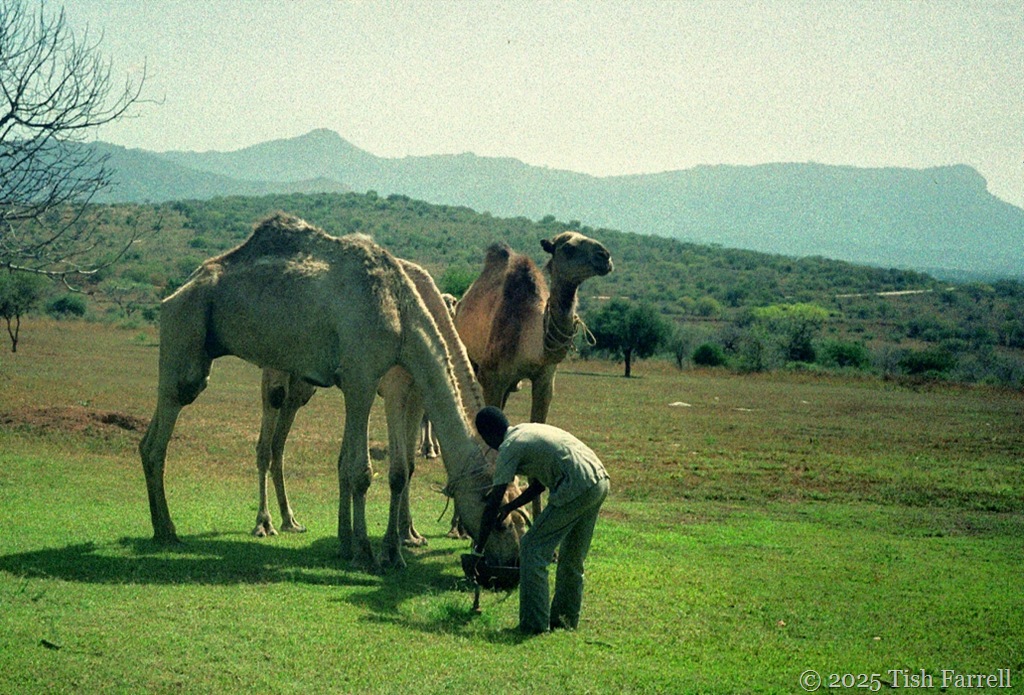
Taita Hilton - camels in the garden ed

P.S. On later visits we found Robert had been promoted to camel handler; at least one assumes it was a promotion. The camels in question were ever surly creatures. Here he is in the hotel garden; the Taita Hills during the short rains.

*


Birds of the Week

#SeeingRed Day 22

Taita after rain header

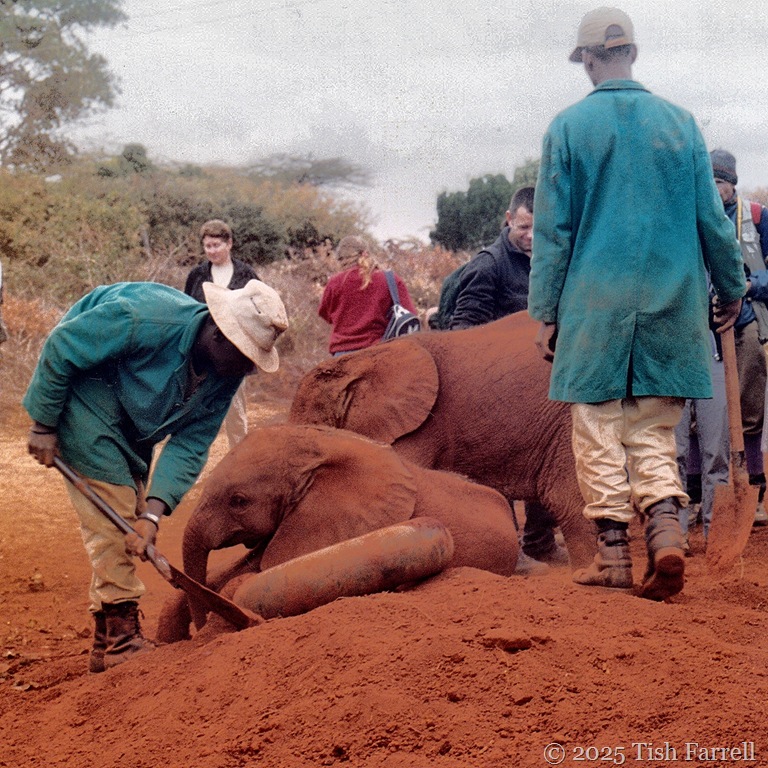
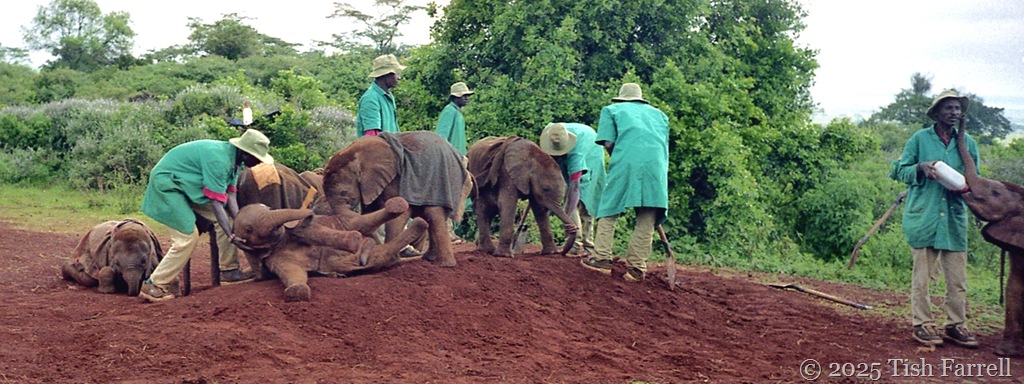
The Nairobi Elephant Orphans

ele 3

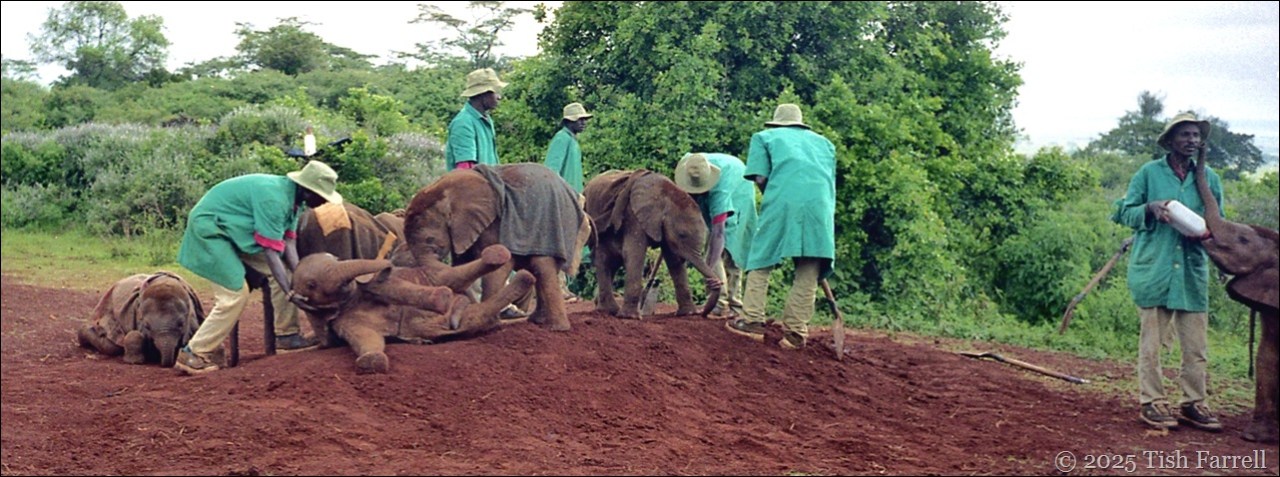
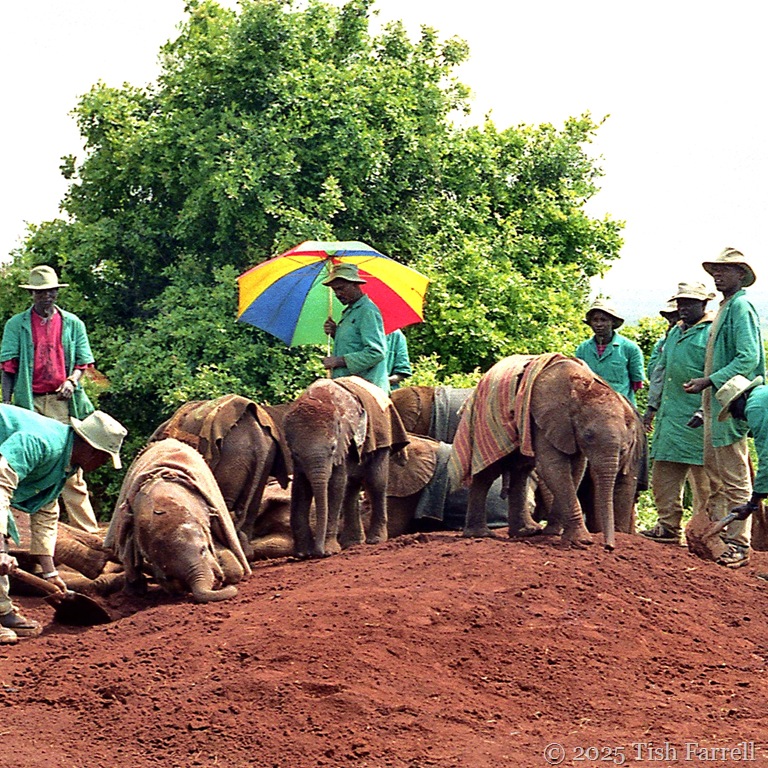
Undoubtedly an ‘aaaah’ moment, but don’t be misled. Nairobi’s elephant orphanage is not about elephant pets. It’s about rearing orphaned infants so they can be returned to the wild. This is a painstaking process, using techniques derived from years of experience by Daphne Sheldrick. She established the orphanage in 1977 in memory of her husband, David Sheldrick. He was the founding warden of Tsavo East National Park (see previous post), appointed to the task of creating the park out of the Taru Desert thornscrub in 1948. For the next 25 years he, with Daphne alongside, laboured there to create access to the 5,000 square miles of wilderness reserve that visitors can enjoy today.

img983sq

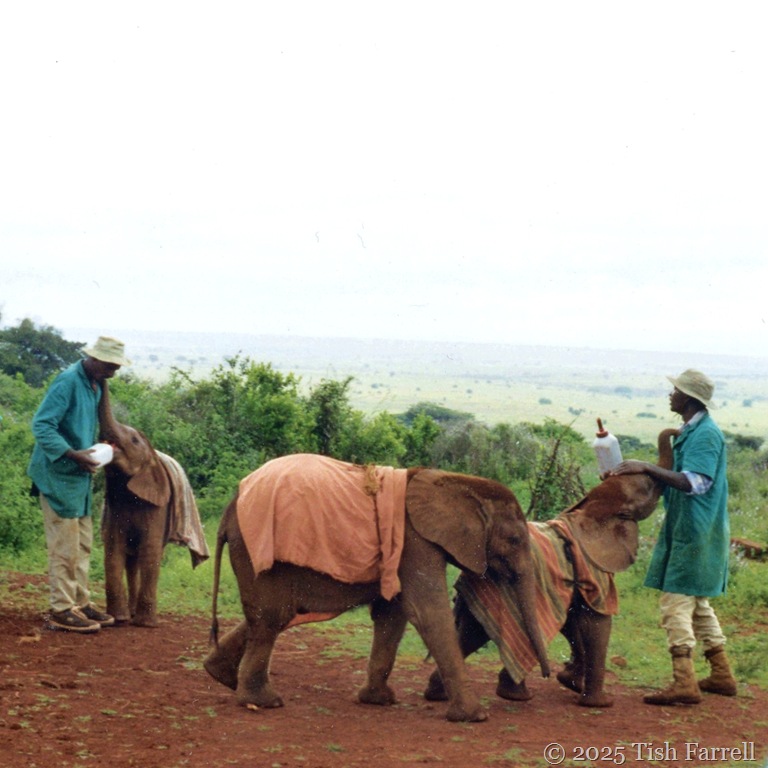
Part of the Sheldricks’ day to day living at Tsavo involved rescuing orphaned and injured animals. There were losses as well as successes but this work sowed the seeds of the orphanage to come. Daphne had learned that elephant infants die without constant emotional support. She also struggled to make an appropriate milk formula. Finally she evolved the system that provided each infant with its own keeper who, as surrogate mother, would be with it at all times, including sleeping with it.

ele 4 better

Once the infants begin to thrive and grow, they are taken out for walks in nearby Nairobi National Park to begin their bush education. Later, when they grow too big for the orphanage, they are transferred to Tsavo East to continue their education. So far over 300 elephants have been returned to the wild.

Daphne died in 2018 and the enterprise, which extends to conservation initiatives beyond the orphanage, is now run as the Sheldrick Wildlife Trust by her daughter Angela Sheldrick. The website is well worth browsing.

*

But for the process of raising an infant and re-establishing it in the wild go HERE

For more about the pioneering work of David Sheldrick go HERE.

#SimplyRed Day 18


ele orphanage header

Once On Mombasa Beach

img059sq

Our first stint in Kenya was meant to be for three months. It stretched to nine, a long time to be away from home when none of it had been planned. On our return to the UK in September ‘92 we weren’t sure what would happen next. But come November we were flying off to Lusaka, Zambia, on another short-term contract.

This time Graham was seconded to the EU Delegation to take charge of the Commission’s food aid distribution. Zambia had been suffering a prolonged drought, but as it happened, and fortunately too, our arrival coincided with a return of good planting rains; food aid was only needed to bridge the gap until harvest time. And so once again, like strange migrating birds, we left Africa in September. And once again, two months later, we were heading back again, to Kenya on yet another short-term contract, this time to close down the Larger Grain Borer project based at the Kiboko research station. This was the project Graham had been attached to as a consultant in 1992. (See previous post).

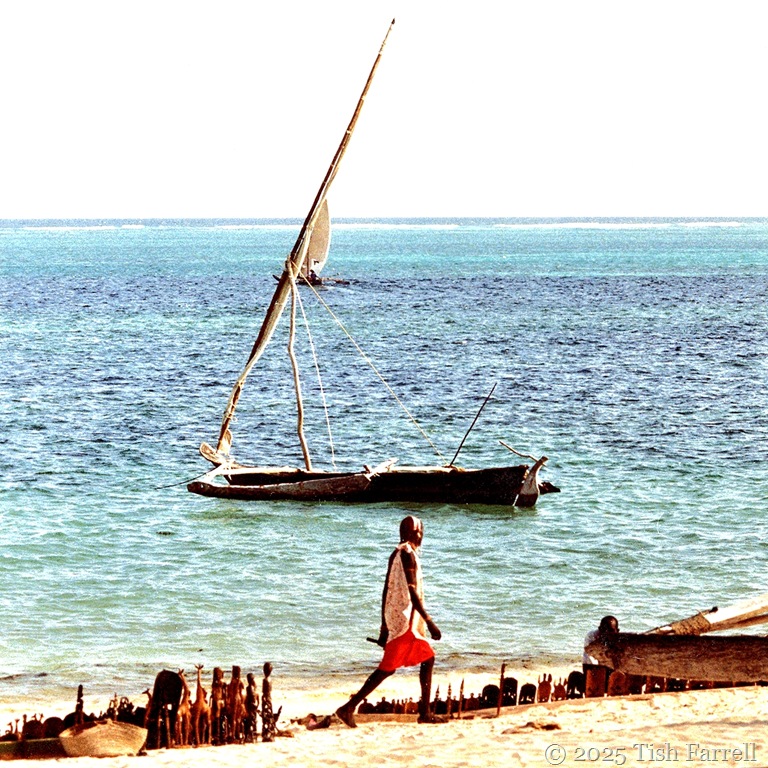
A year later, we were still in Kenya, one contract having evolved into another. In December ‘94 Graham, as head of the UK crop protection project, had to chair a three-day agriculture conference in Mombasa. I went too and, as I had the use of a rather good camera,  I spent my days sitting under a palm tree in the hotel garden, looking out on a slice of Indian Ocean, sometimes taking photos of the passing beach traffic.

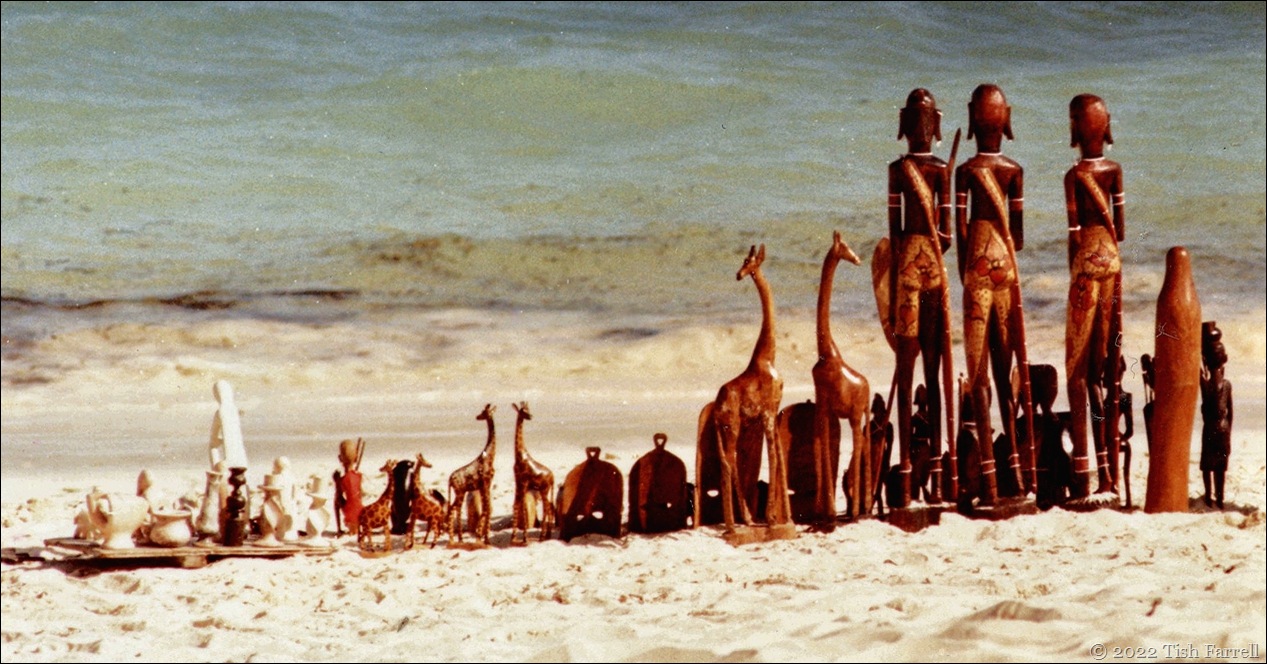
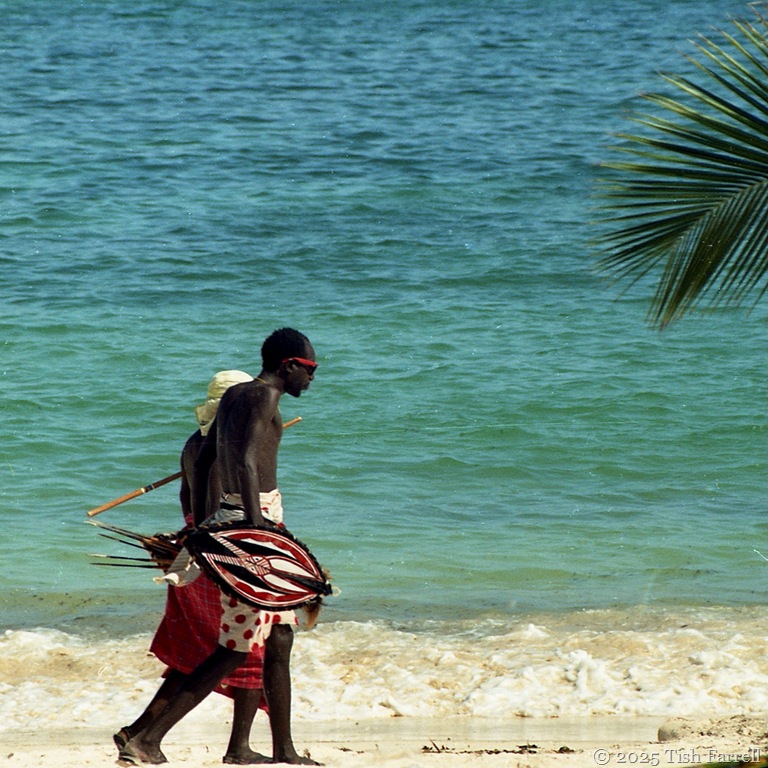
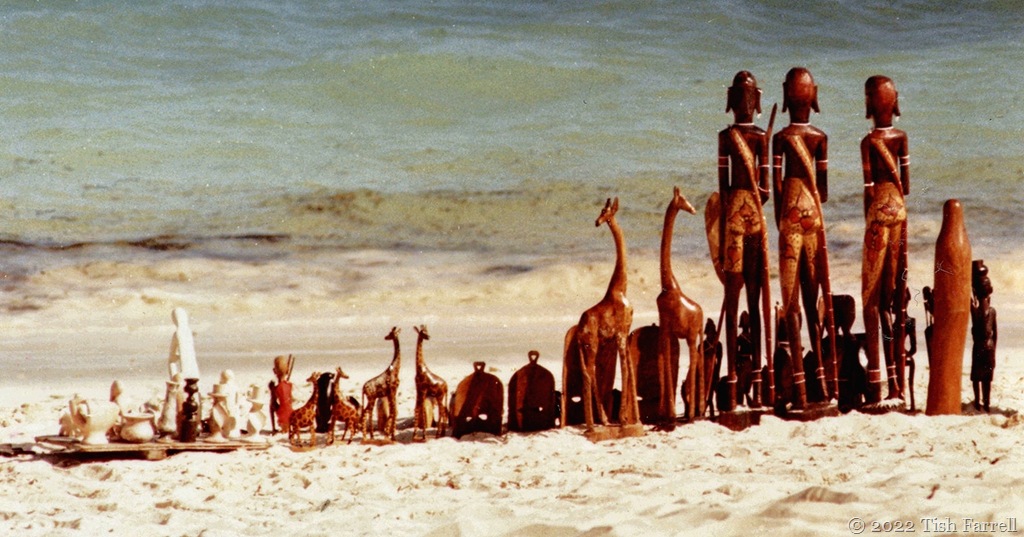
Hotel beachfronts around the world are places where business is done. Mombasa beach is no different and young Kenyan traders are smart, quick to cater to all tourist wants. The Akamba wood carvings and makeshift stalls of kanga wraps are among the more innocent lines of merchandise, although often the means of making contact and enabling further transactions.

Needless to say the deemed exoticism of Maasai morani (young men of the warrior age set) can hold a particular appeal to visiting women of a certain age. So much so, enterprising lads of other upcountry communities might don the gear and pass themselves off as Maasai, or so a Kenyan friend told me.

That said, I’d bet that the young man in the header is Maasai, that lilting stride and spare frame. He could be a member of one of the traditional dance troupes employed by the big hotels. These next guys, though, look more like beach-wise traders with their made-for-tourists weaponry. Very cool sunspecs and matching kanga wrap though:

Mombasa beach traders

img049 header


#SimplyRed Day 16


Caught Red-Handed

Kiboko ed vervet raid

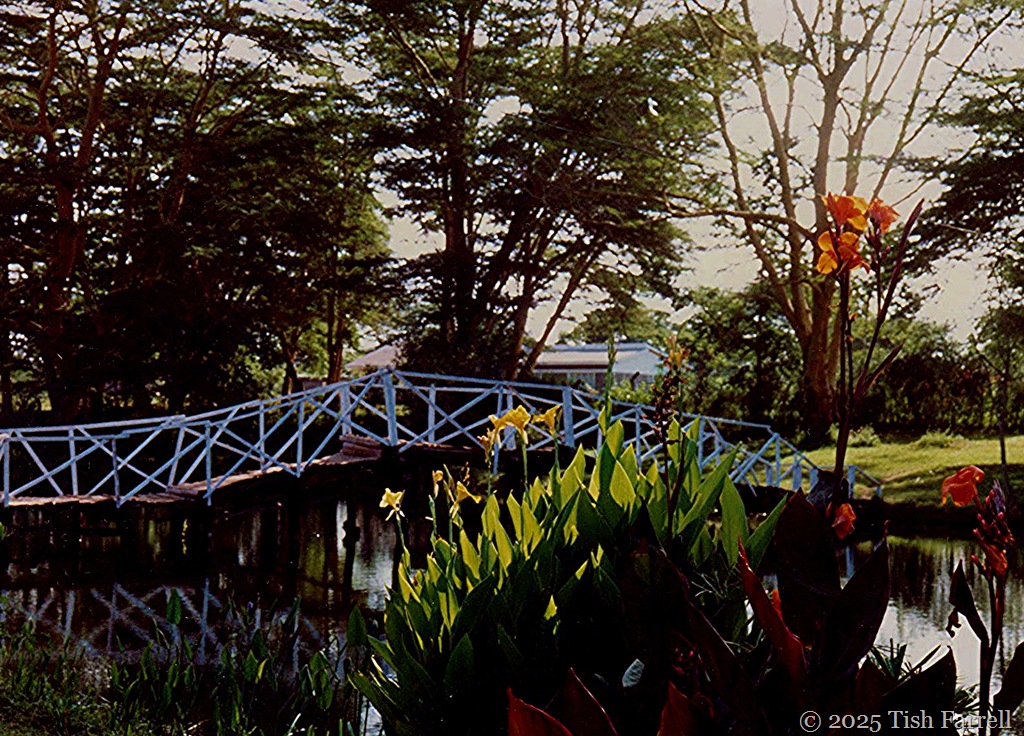
Whenever Graham had work to do at the Kiboko research station we stayed at Hunter’s Lodge. It was just next door, and the hotel manager allowed Graham a key to the back garden gate so he could come and go on foot rather than driving the long way round. The Lodge had been built around the late 1950s for the big game hunter, John Hunter. It was sited near his favourite waterhole, beside the Nairobi – Mombasa highway, just north of Makindu, and this was the place he chose for his retirement after a long career as safari guide and game controller.

Scan-140828-0013jpeg

At some time in the sixties the site was expanded into a motel with a small block of architect designed guest rooms overlooking the pool. (In his day, Hunter had dammed the Kiboko River that fed the waterhole and so created a garden lake). For a time the place had a heyday, being the weekend spot for British expatriates, or the main overnight stopover for anyone driving to or from Mombasa. Then the highway was improved with a layer of tarmac, and the clientele drove on by.

008

*

When we stayed there in the ‘90s it was unusual to find any other guests. The Lodge staff anyway had their own regime that ticked over nicely irrespective of visitors. Now and then some Kenyan government agency might hold a seminar there or an overland truck might be allowed to park up and its occupants to camp on the lawn. Once I met an Israeli water engineer who was consulting on a nearby project. Otherwise, my main companions by day were Joyce the chambermaid and an astonishment of birdlife.

007

*

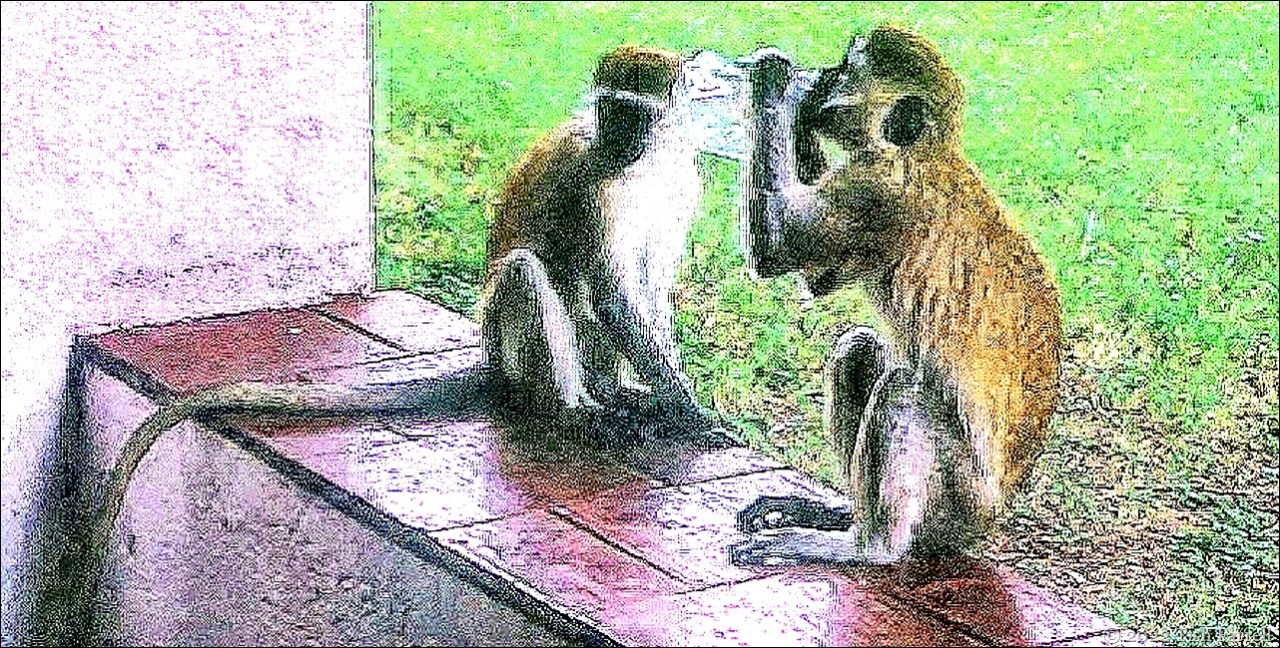
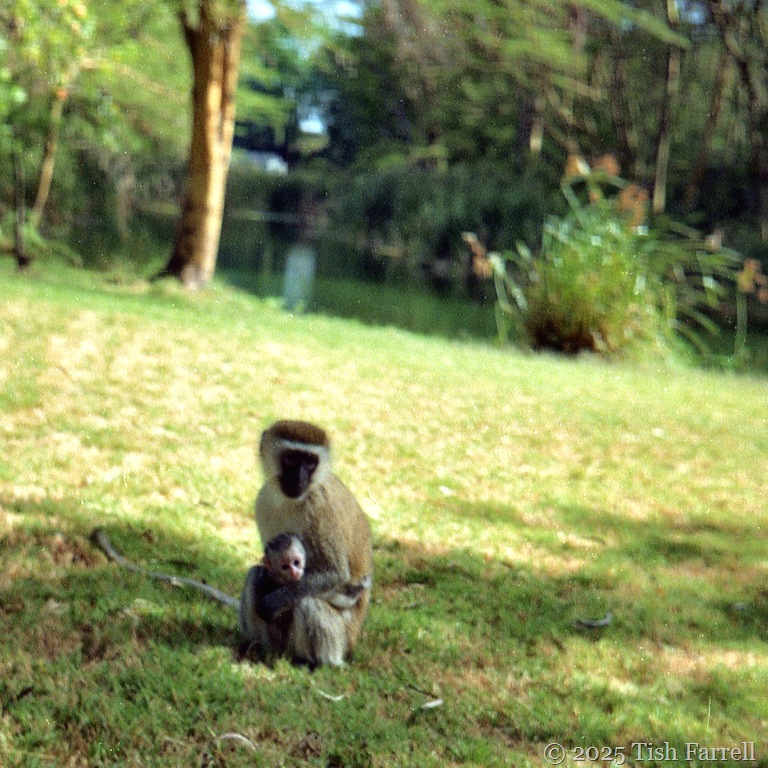
And vervet monkeys.

vervet and child ed

*

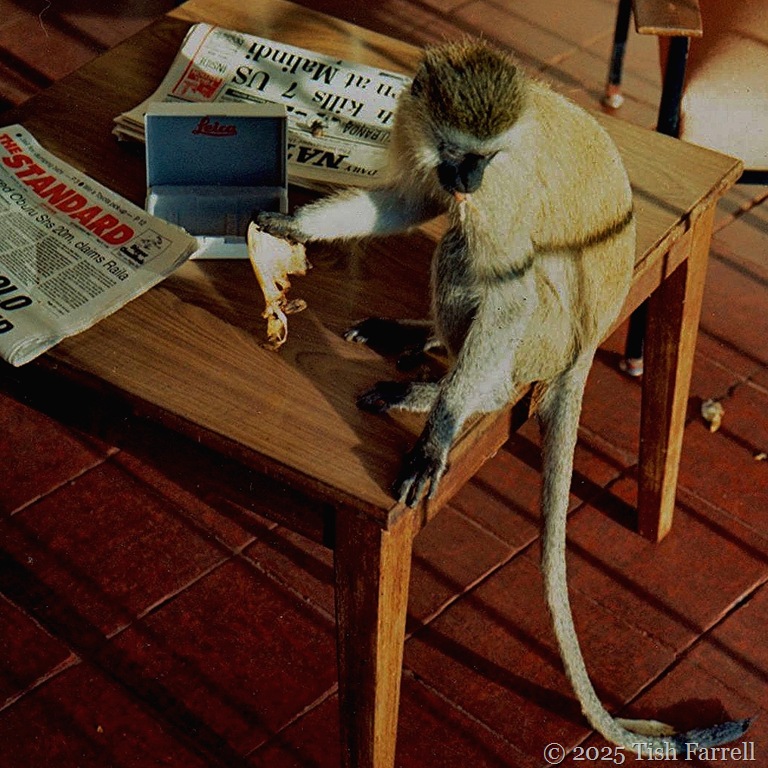
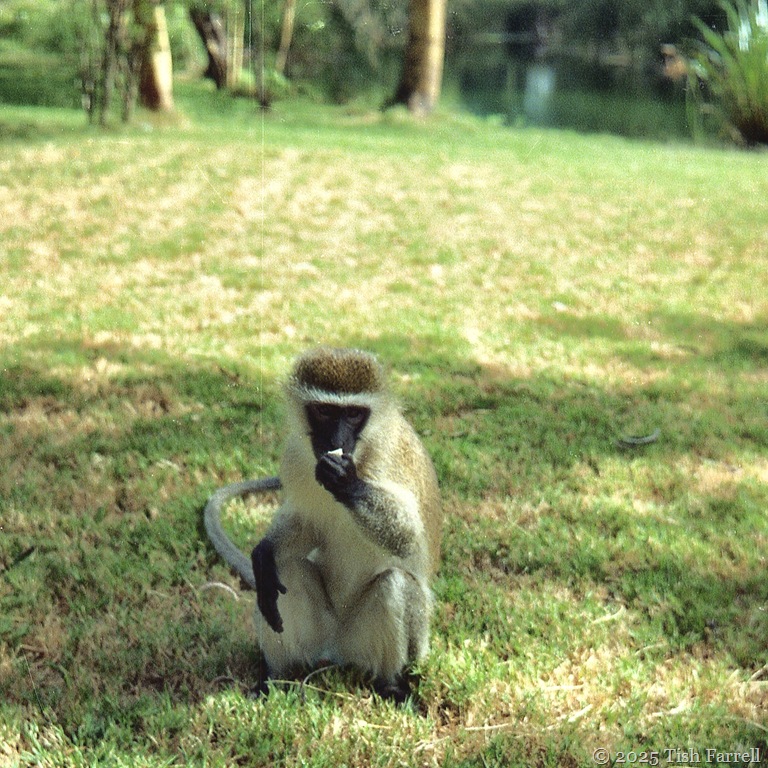
The vervets kept a keen eye on us. They soon learned we had supplies in our room – especially highly desirable bananas, and packs of raisins and nuts. We brought these to make up for the limited Lodge menu of cheese sandwiches, omelettes and steak and chips. But any unguarded moment and there would be a raid. I once came out of the bathroom to find three monkey faces peering up at me from under the bed.

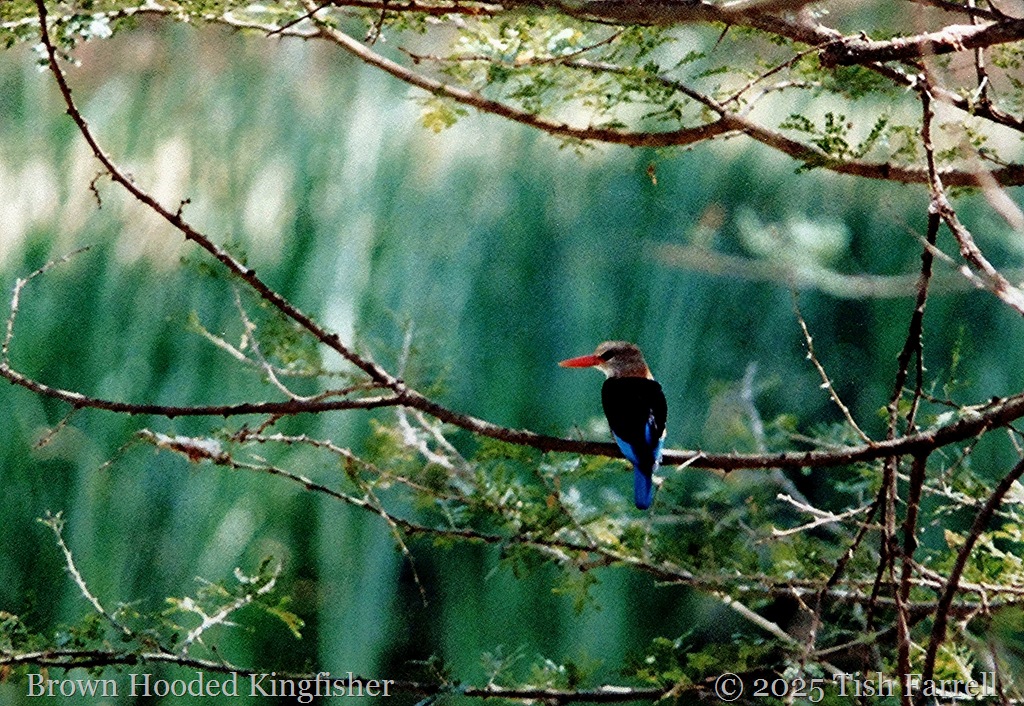
The vervet in the header had clearly pounced while I was distracted with some bird watching out on the lawn (viz. empty binoculars case). And with over 200 local species, the distractions were many – from tiny malachite kingfishers to the giants whose diving technique seemed set to empty the pool. There were also pied and brown hooded kingfishers, ibis, storks, herons and weaver birds, and once, a lone pelican that dropped in from who knows where.

brown hooded kingfisher

*

Days at Hunter’s Lodge were like a waking dream, soundtrack the high-tension whine of insects, muffled rumble of trucks along the highway, clatter of stork bills up in the fever trees and sometimes the chime of a bell calling the gardeners and chamber-maids to their tea breaks.

vervet


#SimplyRed Day 13

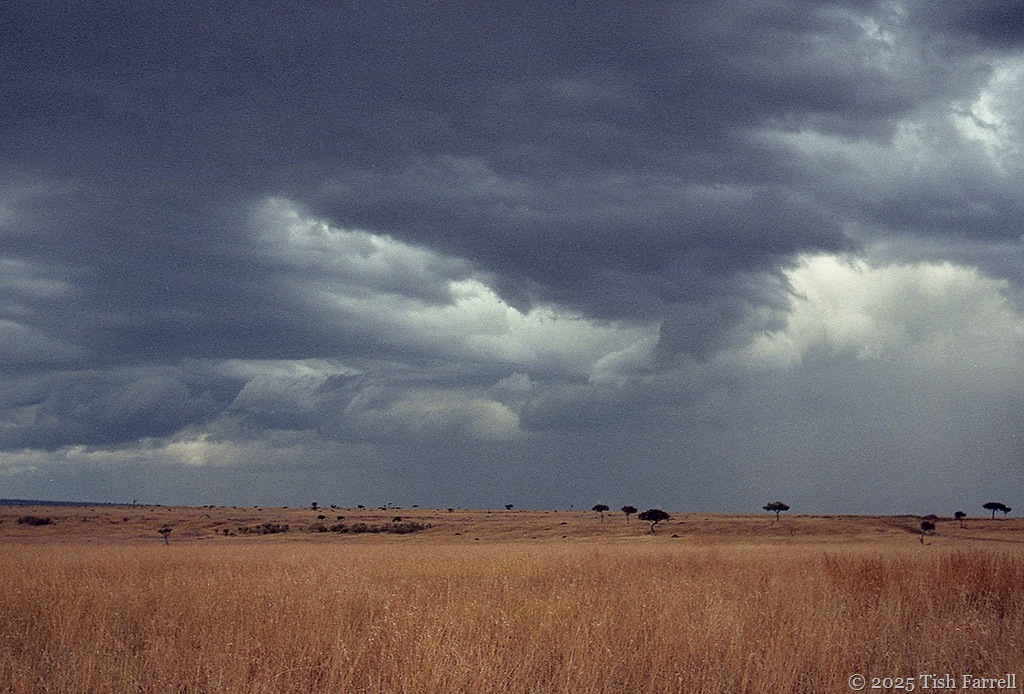
Waiting For Rain…In Kenya Past And Shropshire Present

desert date mulului tree

Maasai Mara with desert date tree

*

We’ve been living back in the UK since 2000, our years in Africa increasingly faraway. And yet…

And yet this spring and summer in Shropshire we’ve been very short on rain. The temperatures, too, have recently risen after a cold and windy spring. My gardening self grows anxious. Several times a day I do the rounds of my vegetable plots, checking on the kales, chard, beans and potatoes, the onions and leeks, examining the greenhouse tomatoes and cucumbers for signs of stress. My hands are always dirty, soil crushed under nails, as I prod the soil, testing for moisture levels around the plants.

It makes me think of Kenya days, pastoralists like the Maasai depending on rain to replenish the grasslands for grazing, cattle their life-blood in every sense;  village farmers waiting for the November-December small rains for sowing; for the long rains March to May to bring the crops to harvest: lives and livelihoods dependent on monsoon weather systems that are nothing if not capricious.

Nor is this new. Oral history accounts, some going back two or more centuries, make reference to periods of drought and famine. One type of oral record is the memorized male circumcision list that survives in some communities. The rite  was carried out every ten years or so, and the given year commemorated by some notable event. Food shortages were often inferred.

For instance the list for Maragoli in Western Kenya has 1760 as the time of Kgwambiti. Our Maragoli house steward, Sam, interpreted this as people behaving selfishly like animals, suggesting a food shortage. Likewise Vuzililili  for the year 1800, a time when small insects fed on large insects. Then in 1900 Olololo-Lubwoni – refers to a time when jigger fleas (olololo) infested people’s feet, implying that that households were dusty and not swept properly. Lumbwoni is a very thin sweet potato, also suggesting drought and lean times.
img120 ed

Another remarkable source of rains failure evidence is the revised historical events calendar used in the enumerators’ guide to the 1969 Kenya census. At this time many rural householders would have been born in the 19th century, or else reckoned family chronology according to particular past occurrences. For semi-arid Ukambani, a drought-prone region in southern Kenya, it was generally agreed that there had been six significant periods of famine in the 19th century: Ngovo (1868); Ngeetele (1870); Kiasa (1878); Ndata (1880); Nzana (1883) and Ngomanisye or Muvunga (1898).

In the past, too, it transpired that the Akamba people had established emergency strategies via extended kinship allegiances. This involved moving from the worst stricken areas and, for a time, living with relatives who were not so badly affected, or who had their own water-holes. Rules of reciprocity of course applied; this was not charity.

It was important, too, that in pre-colonial times the Akamba had a sphere of far-flung connections through their hunting and trading activities, one that extended into what is now Tanzania. This increased the scope for finding sanctuary from drought-stricken regions, but of course was curtailed when the colonial administration consigned each ethnic group to a designated reserve, basically drawing a line around the territory that each community apparently occupied at the time when the British arrived; self-determination being duly cancelled by a line on a map.

But perhaps the most compelling evidence for the enduringly random state of weather across East Africa is the deeply embedded cultural phenomenon of the rainmaker. Every community had them; perhaps still does. They were often rich and powerful individuals. And contrary to what may be imagined, the forecast of rain was mostly based on informed careful observation of natural phenomena, including the movement of clouds, wind directions, dew formation, the behaviour of particular hygroscopic plants and trees that respond to rises in ground water, the arrival of particular species of birds and insects. Such observations informed planting decisions, the particular crops chosen, the times and places they were sown.

It’s tempting to think our Met Office could learn and thing or two.

And so I ponder again on our lack of rain. Our lives do not depend on the success of our garden produce. The Co-op’s daily deliveries of fresh food are two minutes’ walk from the house. I anyway have an outside tap and a clutch of watering cans. The water is always there. (Or at least it is for now). A luxury however you look at it. But even so, the daily sight of parched soil does seem to trigger some bred-in-the-bone alarm system, all those generations of farmers and gardeners in my family tree worrying…

And so the sky-watching continues, the hopeful eyeing up of every darkening cloud.

And probably also, in the not too distant future when the rain comes, there will be the ungrateful complaint that it doesn’t seem to know when to stop.

*

copyright 2025 Tish Farrell

Lens-Artists: Stormy This week Beth wants to see scenes of storminess.

Hippos Under The Carpet…

img039ed2

This past week at Lens-Artists, Tina has wanted to know what we were thinking as we took our photos. This led me back to the old Africa album of vintage slides and photos from when we lived in Kenya.
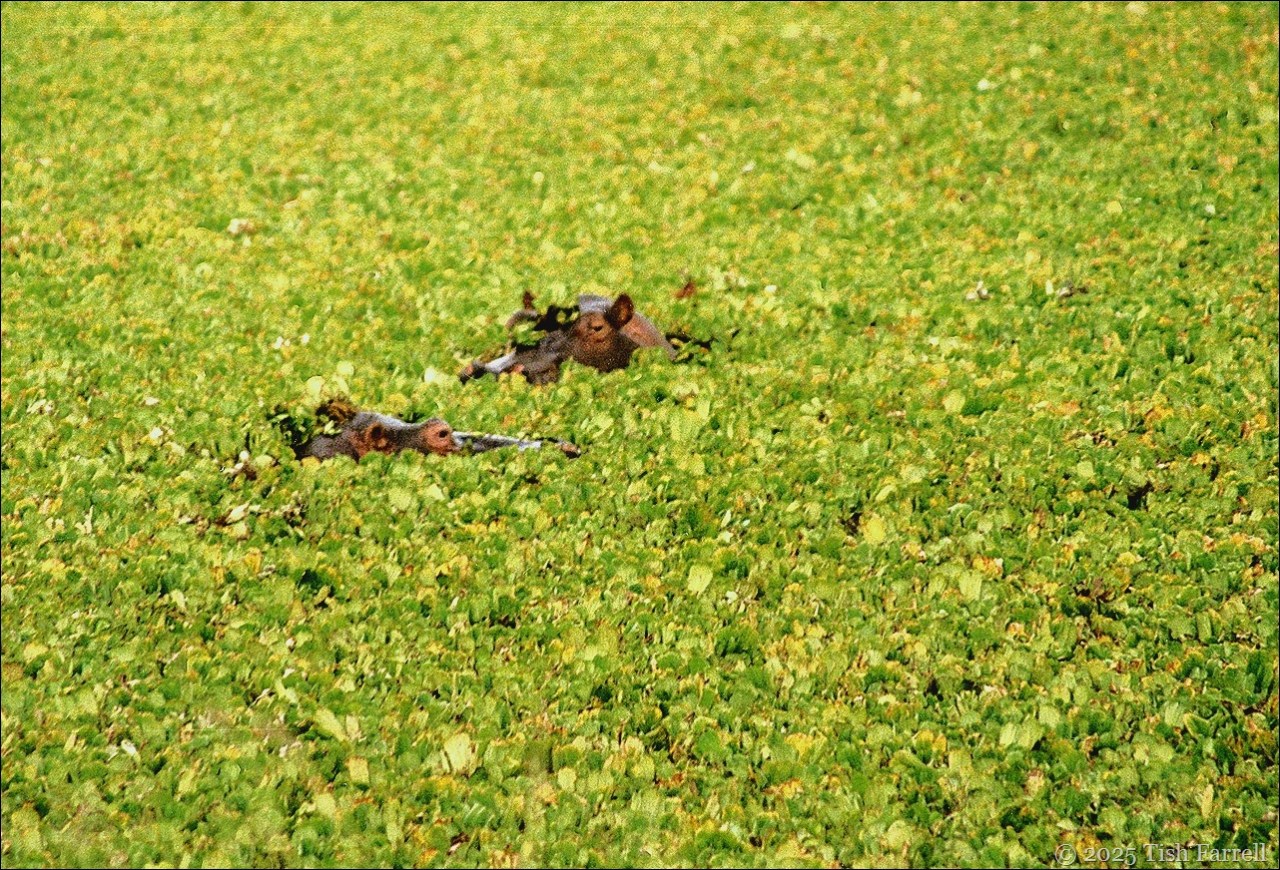
The header photo did not scan too well, but it was such an unexpected moment, it still makes me laugh.

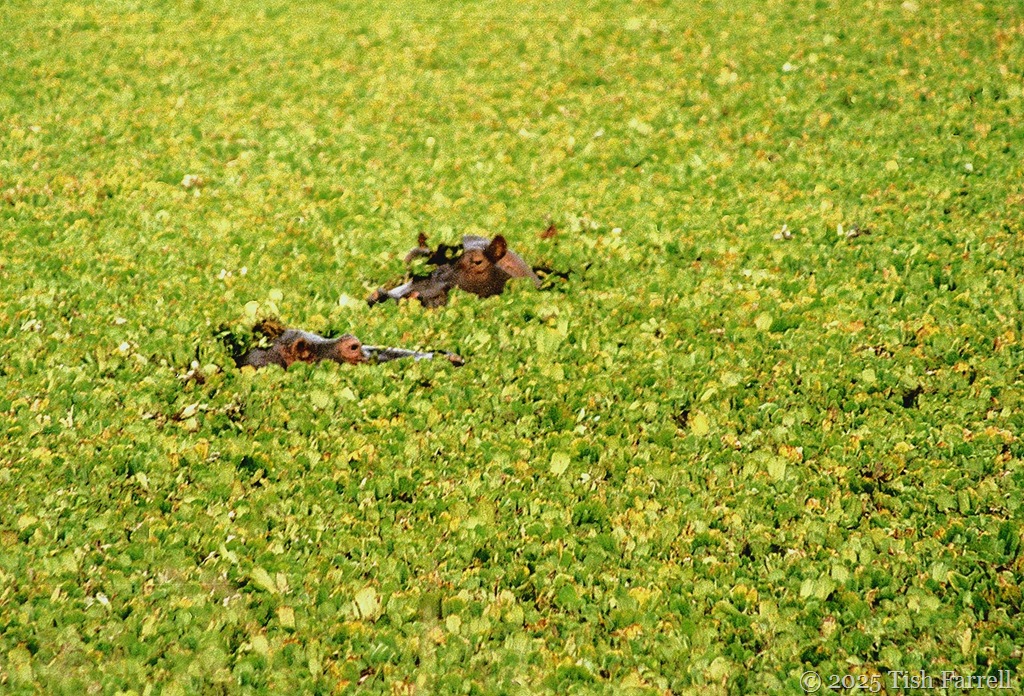
There we were driving along a dry savannah track in the Maasai Mara, the only water (or so we thought) some distance away in the Mara River, when suddenly we were alongside an even spread of water-loving cabbage weed. Weirdly, it seemed to be growing on a level with the grassland. No sign of the water underneath though, and so no sense of depth…

…until up popped the hippos to give us the once over as we passed. It was hard to take in. How could such huge animals have squeezed themselves under this seeming thin layer of weeds. It conjured a surreal image of a large living room with a huge pile rug and numberless unseen hippos lurking underneath.

*

maasai mara_0004ed

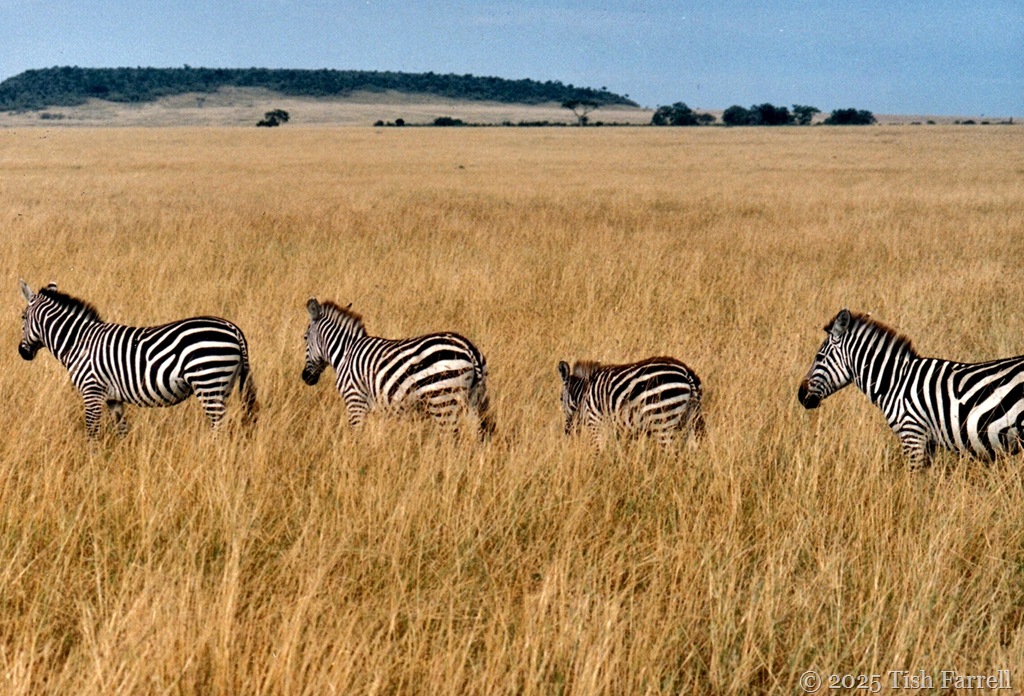
Of course you can tell what I was thinking here: African plains with zebra crossing.

*

cheetah 6

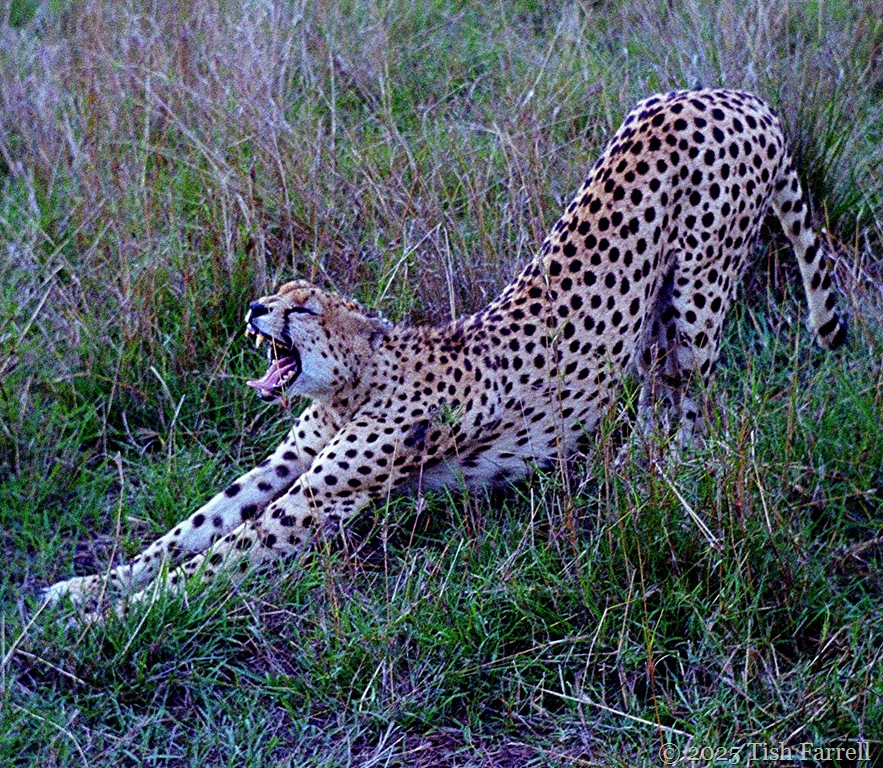
A spot of yoga anyone?

*

Mara 8

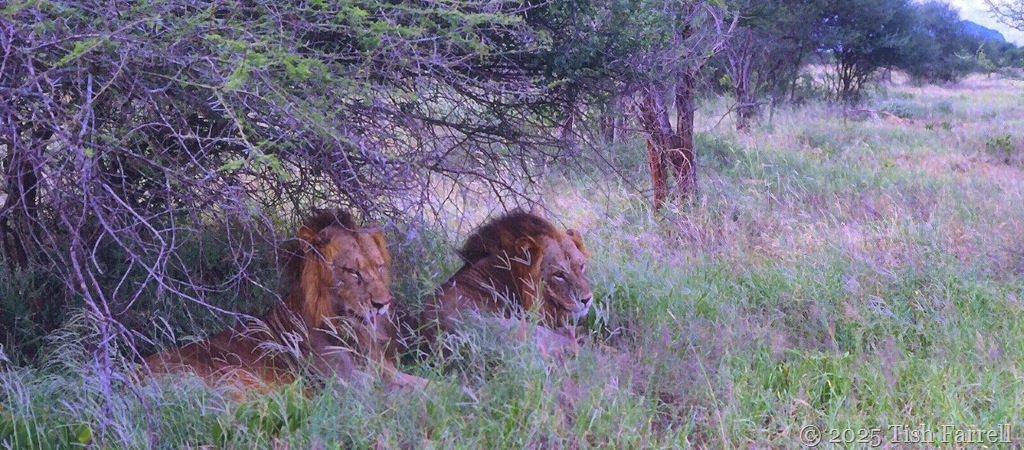
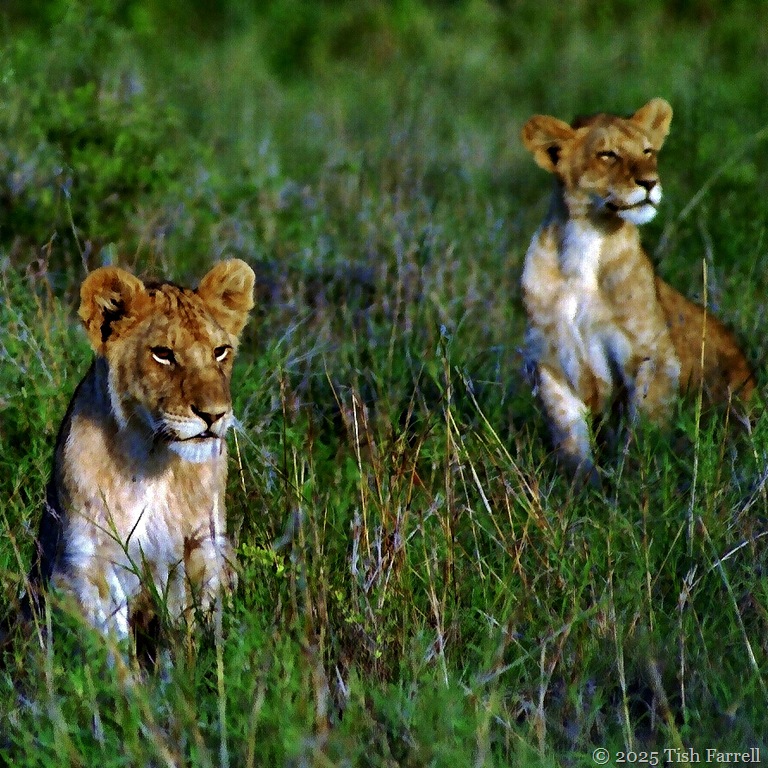
And now who remembers the Bisto Kids advert? That young lion on the right seems to be savouring some delicious aroma; probably not gravy…Aaah! Wildebeest!

Lens-Artists: The first thing I thought of…  This week Tina sets the challenge. What were you thinking when you took the photo.