
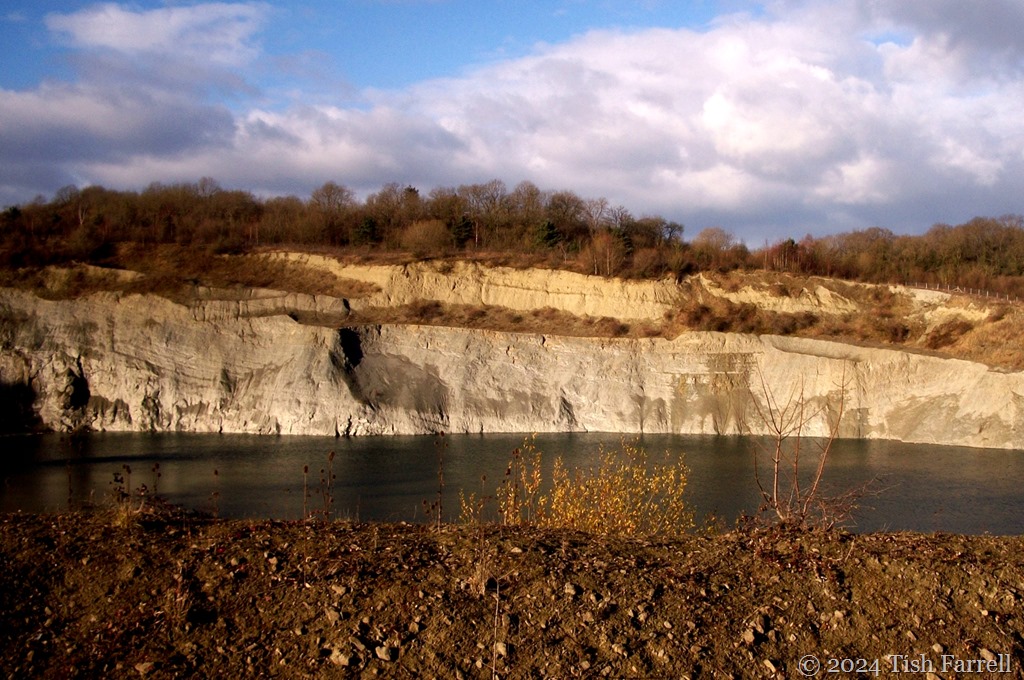
This is Shadwell Quarry on Windmill Hill, Much Wenlock, part of the Wenlock Edge Silurian reef system.
There’s an air of brooding here, even on a bright winter’s day: of violation survived, albeit roughly; scrub and small silver birch trees recolonising the horizontal shelves. It’s a silence all its own, cupped by sheered off walls and the mysterious deep pool below. Then there is my own silence: awe at the scale of this one-time endeavour now shut down, truncated, closed as if it never mattered: the hard lives of the men who worked here, their injuries and doubtless deaths, unrecalled.
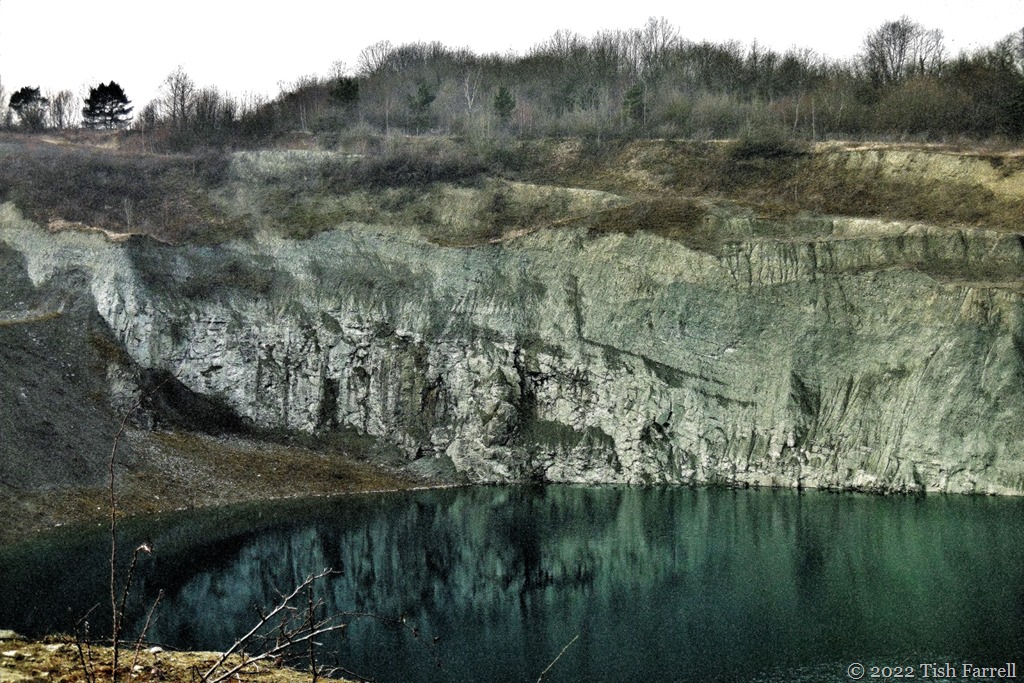
Half a century ago, this hillside and the nearby town of Much Wenlock rocked with every quarry blast. Then came the soft fall of lime dust that clung to every surface.
The quarry closed in the 1980s, but in its heyday in the late 19th-early 20th centuries, steam powered goods trains huffed and clanked up the incline from the Ironbridge Gorge to the quarry’s own siding, there to take on stone to use as flux in iron smelting at the Coalbrookdale Works and the furnaces of the Black Country; industries that are also long defunct, or exported to China along with the roar of red-hot hearths, the crucibles’ hiss of pouring iron, shouts of foundrymen.
But then there’s another absent soundscape here, one so ancient it is hard for human minds to grasp. The limestone reef exposed in this quarry began to form over 400 million years ago in a shallow tropical sea somewhere off the Comoros Islands in the Indian Ocean. In waters teeming with corals, sea lilies (crinoids), bony fish, sponges, trilobites and molluscs began the depositing, compacting and solidifying of decomposing animal parts. And while this was happening there was apparently no terrestrial life, but instead there were endless howling gales rampaging across the landmass; brutal winds terrifying in their loudness.
Good that they’ve gone then. Instead we are left with other ungraspable events, for instance, envisaging how vast land masses shunted around the planet, ending up in places many thousands of miles from where they began; the slow, slow scrunch of tectonic plates; the gradual upthrusting and folding of ancient strata; a world we somehow think is in our power!
The stones beneath our feet, the rocky uplands maybe silent, but they have wider, wiser perspectives to impart if we choose to pay attention. I think our ancestors may have understood something of this.
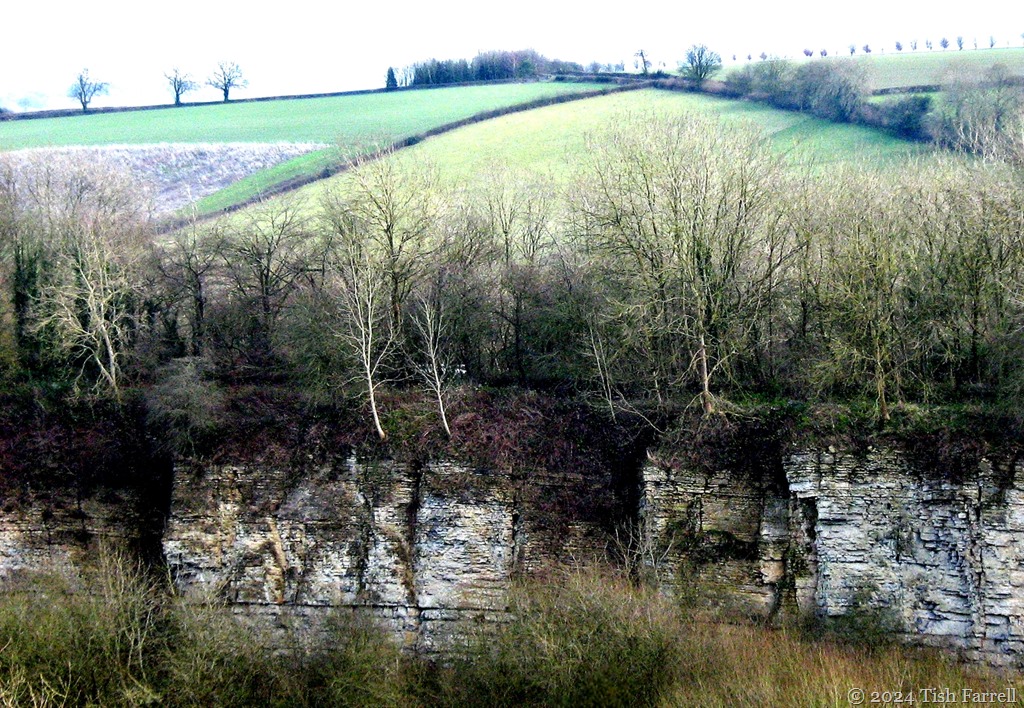
Wenlock Edge quarry
*
Lens-Artists: Silence This week Egídio explores the principles of silence in the work of American photographer, Robert Adams. Please see his photo essay and be inspired.

Lovely imagery, Tish.
Tell me, have fish and other wildlife been introduced to the pool and the surrounding area?
The quarry has gone through a series of owners, with plans to develop it as a resort of some sort, e.g. cabins and a diving school (the pool is very deep). Before we left Wenlock, there’d been a huge clearance operation, grubbing up a lot of the tree and scrub cover. But there had been a peregrine falcon pair nesting there for some years, on a rock face away from potential development. Hopefully still there.
If memory serves I’m sure you have mentioned the falcon before? Did you ever get to see it? But no fish?
I’ve never heard anyone mention fish. The pool looks inert somehow. And as to seeing the falcon, it whisked by me once at the allotment – a there-it-was-gone moment.
Wiser, wider are good words to remember, Tish, at this difficult time! Sarah
Many thanks, Sarah.
And even today those tectonic plates are still on the move, who knows where we will end up!
Nice story Tish as you say hard to imagine what this place must have been like.
Yes, still moving after all these years 🙂
E.g. I like that fact that Scotland is still rising, recovering from being weighed down by previous ice ages. 10,000 years on and still sorting itself out. It’s quite a thought. Our human timescale perspective is so miniscule.
I felt that silence. Thank you.
Gosh Tish you pack a proverbial punch with this post – oh the silence of the stones – then history brought to life with such activity and clamour of the revolution that brought industry and urban dwelling and further back in time to geology and the almost unbelievable movement of the seemingly immovable beneath our feet
So happy this hit the spot, Laura. I’m loving that word ‘clamour’. Thinking now of clamorous Silurian winds. Though I do wonder how geologists can posit their noisy existence. Fossil wind, now there is truly something to conjure with 🙂
Tish, your photos tell an amazing story. The text is clear is forms the perfect companion for these beautiful photos. Thanks for sharing a piece of history of that area. Fascinating!
You do write such v. appreciative comments, Egidio. Thank you very much. It’s been a splendid challenge. I need to think about it some more.
Excellent, and informative. 👏
Cheers, John.
Beautiful images and informative narrative Tish. Mother Nature knows she will outlast us.
Mother Nature certainly will, Anne. Many thanks.
😊
I enjoyed the narrative, Tish, but it did bring to the fore my doubts about climate change. Not doubts that it is changing, nor necessarily about our impact on the changes. Just our damned conceitedness in thinking we can outwit nature.
Absolutely agree, Jo. Climate is chaotic and always has been.
Very interesting and what an amazing place.
Many thanks, Flavia.
Great photos with some lovely reflections, but it’s your text that really grabbed me. How inspired to think of contrasting today’s silence with the activity of the past as men quarried here for stone, and then to go back through the millennia to when this was all under the sea. A timely reminder that the earth is ever-changing and we are just a tiny part of its story!
Many thanks for that thoughtful response, Sarah. We are such a tiny part of the earth story, though that’s not to say we don’t make some pretty big messes as we go about things, but then most can be fixed when we put our minds to it.
I really enjoyed your post, Tish. The photos are great but it was the text that got me going, wanting to know more. Did you find any fossils or you just know of their existence? The whole post is superb.
Many thanks, Sofia. So pleased you found this post interesting. I didn’t find fossils in Shadwell quarry because it’s not possible now to get at deposits. But our cottage was nearby and being built of Wenlock limestone was full of fossils – mostly sea lilies and small shelled creatures.
There are some photos of them in an old post:
Thank you so much, Tish, for the link. That is a high concentration of fossils, I’ve only seen something like it near my grandparents house in Portugal. Fascinating post.
🙂
A wonderful enjoyable read. The way planets have evolved amaze me and you have to wonder what our world will look like in 60,000 years. We have inevitably changed the speed of climate change, but it’s constantly changing. I wouldn’t object to us moving back south 😉
Back south definitely has its attractions, Jude 🙂
What a complete change. Silence is golden, and your photos are wonderful.
Many thanks, Jennie.
You’re welcome!
I’ve always though of disused quarry lakes as mysterious, errie portals to the realm of monsters, perhaps not scary ones but ones that children (as I was the first time I encounted such a pond) ought not to swim with, just in case. 🙂
Yes, eerie portals – that’s my feeling too. Places to feel wary.
Fascinating places, old quarries, and often the last resting places for unwanted cars.
Yes, I guess they attract quite a few grim deposits as well as old cars.
They certainly do on Vera!😉
A wonderful post. So much time locked up under our feet.
Many thanks, I.J. I love the way you put that ‘so much time locked up under our feet’.
Lovely photos, and a fascinating back-story.
Many thanks.
A very inspiring post Tish, beautifully and scientificly described, thank you. To think of our little blue dot having undergone and still undergoing such dramatic changes is totally awesome.
Thank you, Agnes. It is astounding how the earth as we know it has gone through so many transformations. And continues to do so….