Peroulia Dreaming 2 ~ The Promise Of Rain

It was a family celebration that brought the six of us to the Peloponnese in late September. Thoughts of Greek sunshine lured us too – after a lacklustre English summer. But as the departure date drew near, and the scanning of world weather forecasts stepped up in the hopes of better news, it was clear that the weather in Messenia was set to change.  With the equinox, daily temperatures were to drop by several degrees. Now there would be cloud, rain and storm along with the sunshine. Ah, well. Better pack the waterproofs.

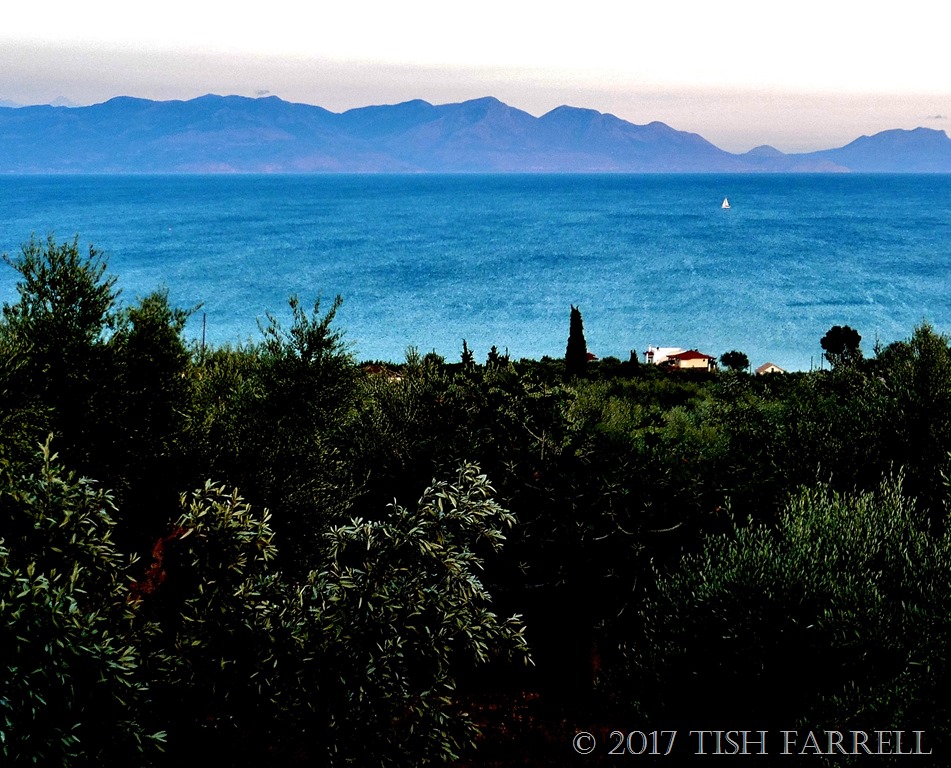
Yet when we came into land at Kalamata airport  on Sunday lunchtime all was blue. The plane banked over the Gulf of Messenia heading out to the Mediterranean before flying back up the Mani peninsula, following the Taygetos Mountains into the airport. Blue sea. Blue mountains. Blue sky.

We stepped off the plane into high-summer warmth to be met by Dimitri, who whisked us  off in his smart Mercedes people carrier. You have chosen a good time to visit, he said; not too hot.

And so it proved.

*

Hinterland Messenia is not pretty. It is a rugged, crumpled upland with deep valleys and winding roads, the vegetation parched from summer heat. Grass burned brown, bare earth between the trees and vines; wherever you look, the grey-green haze of olive groves spreading up and down hillsides and gullies, the dun colour palette spiked here and there: white-walled farmhouses, red tiled roofs, the odd designer villa, black spires of cypress  and, at the roadside, soaring clumps of phragmites grasses with their parchment coloured plumes. There is stuff and clutter among the trees – old tyres, beach loungers, broken down farm machinery, dead cars and stranded boats. Ramshackle stalls offer pumpkins and oranges. And then the road bends towards the Gulf and you glimpse the sea, glinting like jewels, the woodcut frieze of the Mani mountains beyond.

The road south from the airport to Koroni follows the coast – we pass by Messini, Velika, Petalidi, Hrani, Nea Koroni, Vounaria – more work-a-day farming communities than high-profile tourist territory. We know that when we reach Harakopio we must leave the main road and wend up the hillside above Peroulia Beach.  Michael and Maria, our hosts at the Iconpainter’s Villas, have provided a map, but in real life nothing looks straightforward. I’m relieved when it turns out that Dimitri mostly knows where he’s going.

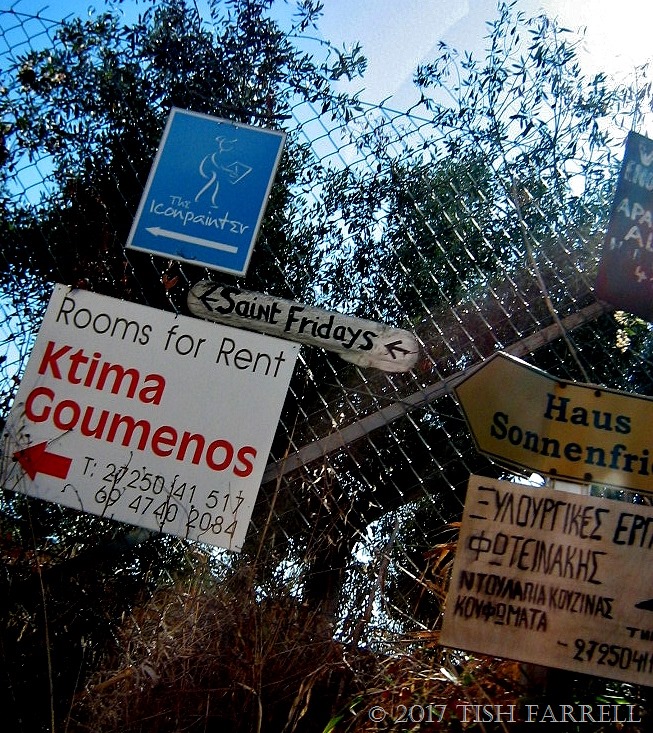
The turn is not obvious despite the clutch of signs on the fence, and almost at once we are ‘off the beaten track’ and seemingly in someone’s front yard. The road narrows so quickly I breathe in, and next we’re zigzagging round house ends, nudging round blind corners, Dimitri tooting the horn (not too loudly), then climbing up beside a whitewashed church, then on through olive groves.

The road is single track, mostly concrete, but in places broken down to rubble. It undulates with bold intention.There are small ravines and gullies. At one point there’s a frisson of alarm from Dimitri as he fears for his Mercedes. This is no game, he says, and we agree. But he is a game lad, and he presses on. IMG_2925
And suddenly we are turning into a smart gateway, pulling up the drive to a tall white house, and there is Michael to greet us and show us to three lovely little houses that will be home for the next seven days.

The bright turquoise doors are a good start. In our respective kitchens we find welcome boxes for lunch and the following day’s breakfast – tomatoes, oranges and figs from the garden, Maria’s home-made lemonade and bottled baby oranges, fig jam and chutney. In the fridge there are mini bottles of Ouzo, the Iconpainter’s own white wine, local yogurt, feta cheese and honey. There is also bread, milk, butter, ground coffee and tea, iced water, brown eggs, little fruit pastries, sesame biscuits, plums and bunches of grapes. It seems we have flown straight to heaven.P1020274We put out of our minds the fact that on Thursday there will be a big storm, and side line Michael’s apologies that the likelihood of rain is high. We have been longing for it, he tells us. All the olive farmers  are waiting. I know it’s not what you want.

We shrug. For now the sun is shining and it is time to eat our picnic lunch under the terrace awning hung with grapes. And then…And then it is time to throw off our travelling clothes, put on something looser and cooler and so take the path to Peroulia Beach…IMG_2919copyright 2017 Tish Farrell
PS I know I said I’d take you walking to Koroni. But that little trek will have to wait till the weather is cooler.
 Peroulia Dreaming Part 1

Peroulia Dreaming Part 1

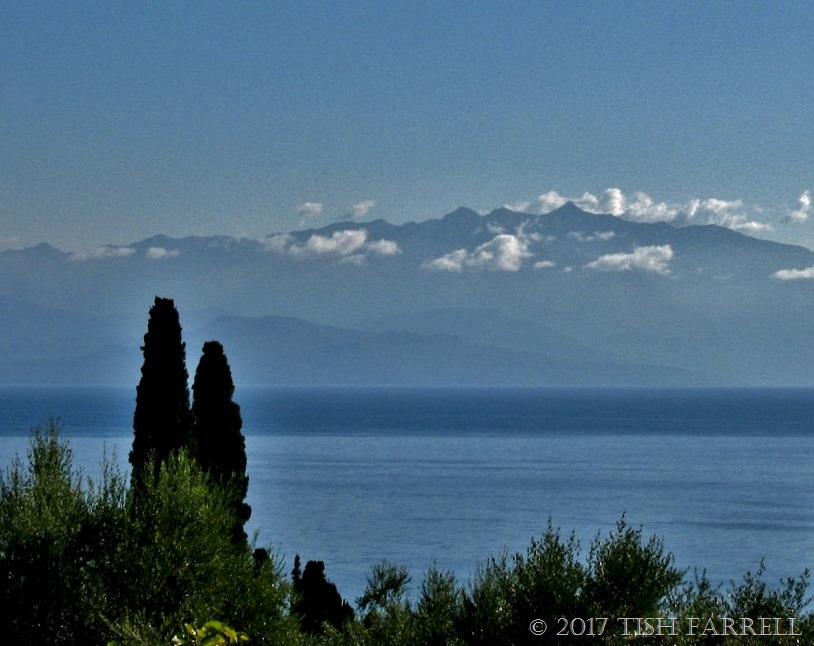
It was hard to leave, yet if we had stayed longer we might never have come home. We drank light, red wine pressed this summer from the ancient Greek Agiorgitiko grapes grown at our door, ate olives picked last autumn from the garden trees, laced our food with fragrant oil, drizzled honey over little clay pots of fresh yogurt, bit into sun-warmed figs, breathed in lavender, rosemary, oregano, rose geranium, then gazed, quite mesmerised, over the olive groves to the sea and the blue spine of the Taygetus Range. And then forgot. Everything.

We were here for seven days. On the Peloponnese (Πελοπόννησος) – the place where legend has geographical existence and the gods once roamed and made mischief. One of the gateways to the underworld is at the foot of the Mani penisula, another is at Lerne (Λέρνη) in the Argolis, where Heracles also slew the multi-headed serpent Hydra. Before that he had been in Nemea, slaying the Nemean lion. This is also the area from which Agiorgitiko vines are said to originate, and so the wine is also dubbed Blood of Hercules since it is believed to have fortified the hero before he vanquished the big cat.

Later he travelled across the northern Peloponnese in pursuit of the Ceryneian Hind and the Erymanthian Boar, while in the west he diverted the rivers Alfeois and Pineois to clean out the monumentally filthy Augean Stables. (Don’t you find it pleasing to know these fantastical events occurred in real places).

This is also the land of the Bronze Age Mycenaeans – they who were the builders of palaces, cities and tholos tombs – their centre the city of Mycenae in the north-east – until their mysterious disappearance in 1100 BCE. Homer’s tales in the Iliad have their beginnings here too, in Sparta, whence Paris eloped with Helen, and set off the whole bloody conflict that was the Trojan War.

In the Common Era, and especially from the early Middle Ages, the shores of the Peloponnese suffered serial conquests, falling under Byzantine rule twice, invaded by Slavs, Franks, Ottoman Turks (twice), Venetians (twice) – all of whom, one way and another, have left traces of their passing. And yet for all this and the many following upheavals, including the War of Independence against the Ottoman Empire in 1821 -1832, and the Civil War of 1946-49, one has the sense, at the very heart of things, that the Greeks have, and always will, remain true to their authentic selves. They live for, and of, and by land. For many, that living may be tough, and especially by cosy 21st century standards, but still they live well. You sense this as you wander the lanes past the ramshackle farms with their litter of tractor parts and decomposing cars. And here we come to the crux of the matter – the smiles and exchanges of kalimera (good morning) as we pass: for if the true measure of a civilised people is their capacity to welcome strangers, then the Greeks continue to show us the way. Indeed, many of us could learn a great deal from them.

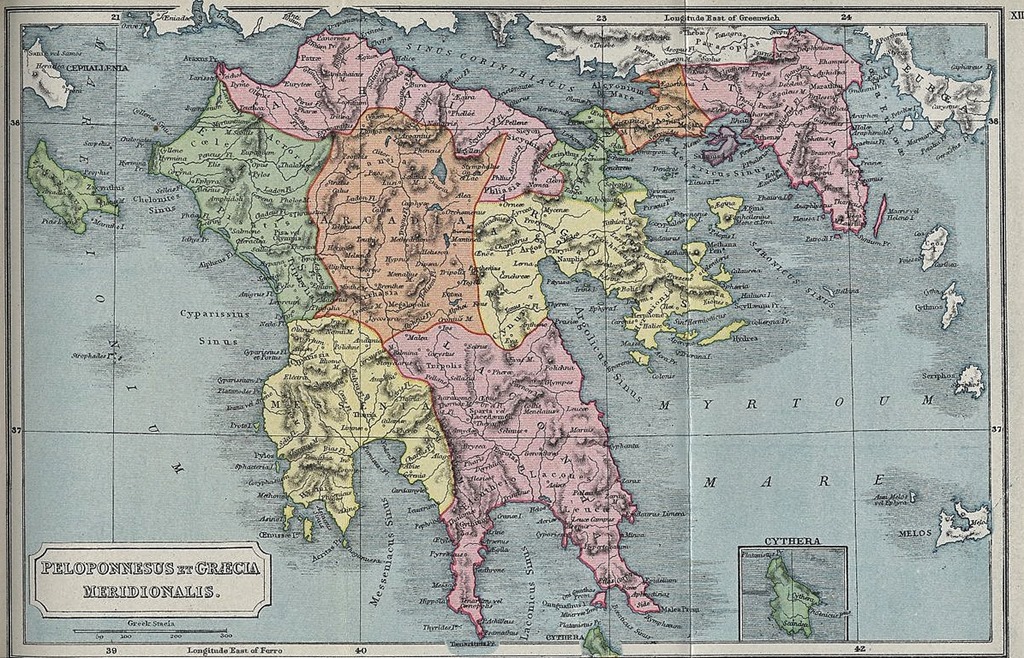
Samuel Butler (1774-1839) - The Atlas of Ancient and Classical Geography  Project Gutenberg

Samuel ButlerThe Atlas of Ancient and Classical Greece, Project Gutenberg

*

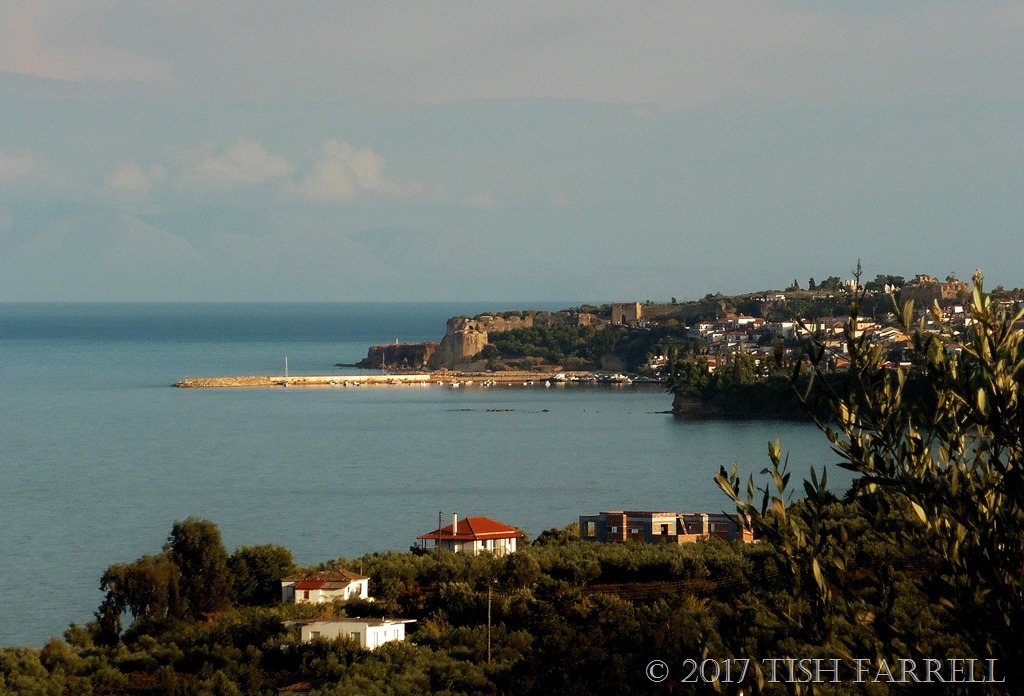
But in case you are wondering where exactly was the location of our collective forgetting – we were staying above Peroulia Beach, among the olive groves between Kombi and Harakopio villages, 6 km north of Koroni (Κορώνη) on the easterly tip of the westernmost peninsula. Our little house at the Iconpainter’s Villas had a veranda that looked east on the Gulf of Messinia and the mountains of the Mani across the water, and south to Koroni – a hillside fishing village hugged around its harbour, the promontory behind dominated by the monolithic bastion of a huge fortress built by the Venetians in the 13th century and added to by the Ottomans in the 16th. Perhaps I’ll take you there in the next post. But be warned: it is a fair hike through the olive groves.

copyright 2017 Tish Farrell

P1020381

The Changing Seasons ~ September ~ In The Garden Early This Morning

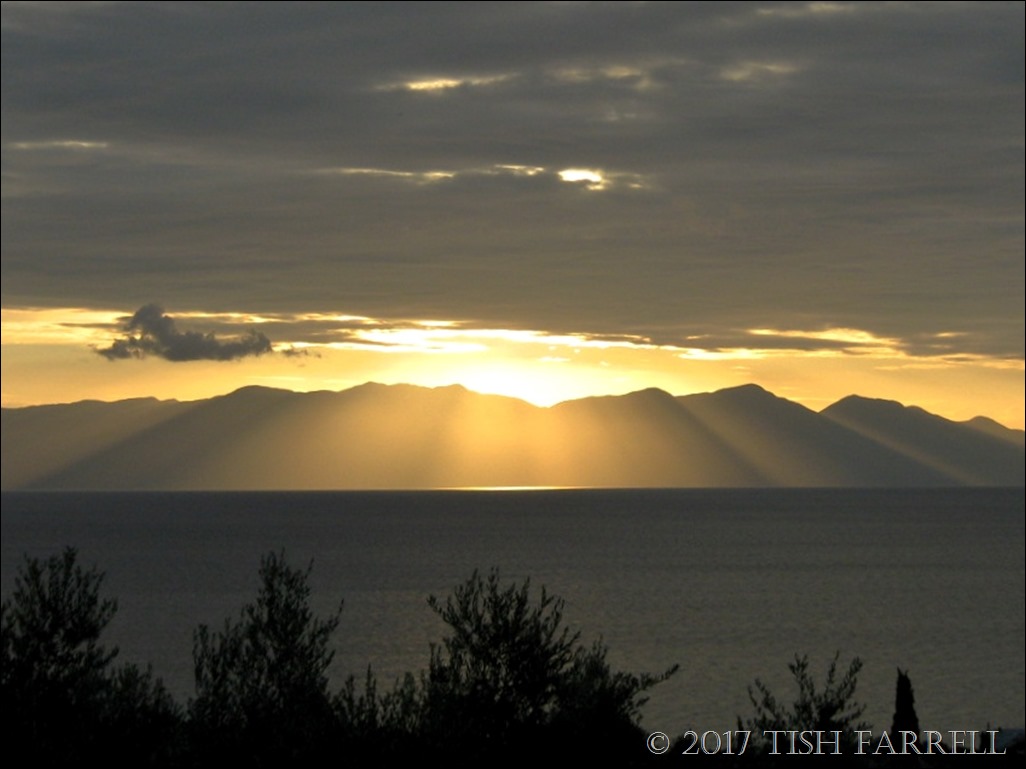
Bright and early do not figure in my repertoire these days, at least not if it means vacating the bed. This morning, though, if there had been larks, I would have been up with them. Just before 7 am the light was magical. It was a case of grabbing cardie and camera, and setting off in my nightie (black silk in case you wanted to know, and so chic with scarlet woolly, motley scarf and green rubber clogs). It had to be done though, and just as well there were no neighbours to see, or early morning walkers on the field path. So here are the pix, hot off the memory card.

Out in the garden Teasing Georgia was all dewy buds and drooping petals. She’s having a second flowering, although this time round the roses have a slumberous air even when freshly opened. As if to say, ‘Don’t like us too much. We’re not staying long’.

Over the fence in the field the light is golden. For the first time I notice the change in leaf colour in the wood on the hill. I also notice that the farmer looks to have sown the field with a green manure after harvesting the wheat. If so, heavens be praised. It’s about time the land had a real nutrient fix along with the chemical cocktails. The speed the seedlings are growing I’m guessing it’s a mix of rye grass and mustard. We’ll see.

Our garden is long and narrow, and several steps up from the house. At the top corner we have a gate onto the field path, and just over the fence we have our ‘guerrilla garden,’ planted with insect pleasing plants in mind and to make some reparation for all the pesticides used on the far side of the path. I’m making a similar unofficial planting along the outside of our neighbours’ fence. A floral gallery approach to gardening. We could also call it a flood alleviation measure, given the field’s tendency to create run-off. At the moment it is the season of Michaelmas daisies and tiny russet crab apples, along with the last of the sweet peas, sunflowers, helenium and rudbeckia. Most of the year I leave the border to its own devices, apart from some thistle, nettle and couch grass removal. It gives us a lot of pleasure through the changing seasons.

Another summer-long feature that has dominated the garden chez Farrell is Project Shed. He who has been building it, aka Graham, has finally finished the job apart from having the electrics expertly checked. He has built it from scratch from his own design, including re-purposing  next-doors’ cast-off windows and door glass from another chum.  The curved railway truck roof is both a nod to the fact that the Great Western Railway, before Mr. Beeching killed it, once ran across our road, and also to reduce the shed’s height so it doesn’t loom over our neighbours. Now that he has practised I think I must insist on one for me – a cosy hideaway in which to muse and snooze, and write word or two. Beside the gate would be nice…I could watch the field grow, the bees in the guerrilla garden and the comings and goings of rooks…

The Changing Seasons: September Please visit Max to see his fab September gallery, and to share your own changing seasons photos.

copyright 2017 Tish Farrell

This slideshow requires JavaScript.

Views From the Morville Lych Gate

P1010959

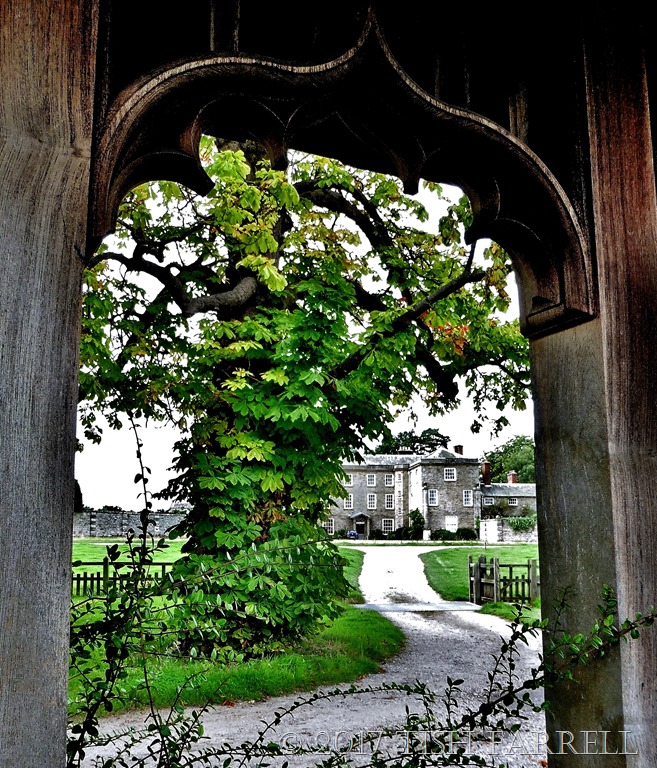
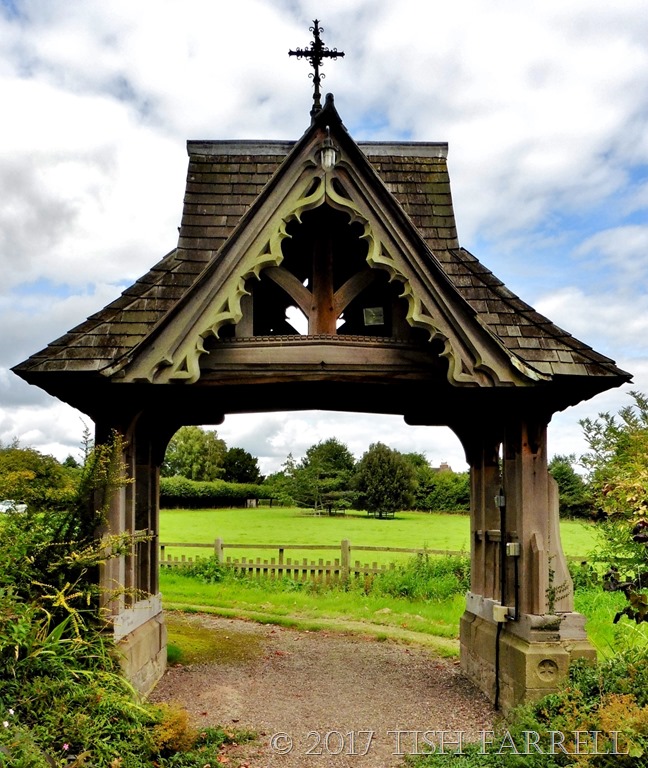
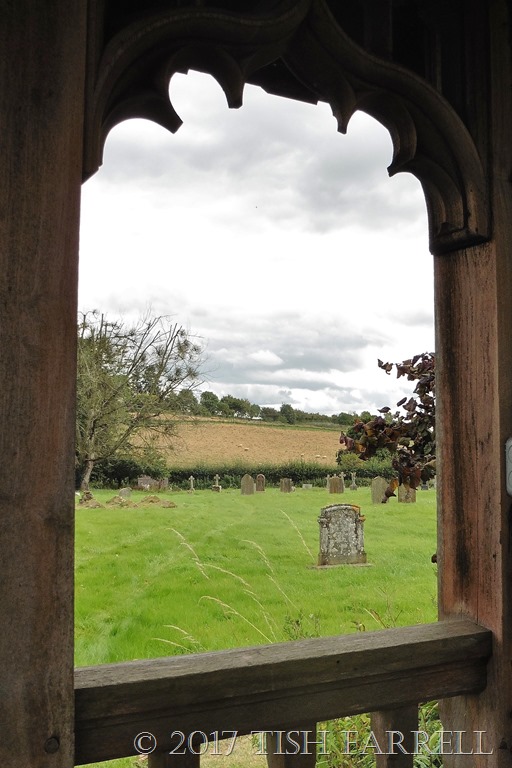
The lych gate is of course the corpse gate, the covered entrance wherein the dead might be laid until a funeral could take place in the parish church. In the past there was often a several day wait for this essential ceremony, during which time the deceased must be shielded from bad weather, robbers and worse.

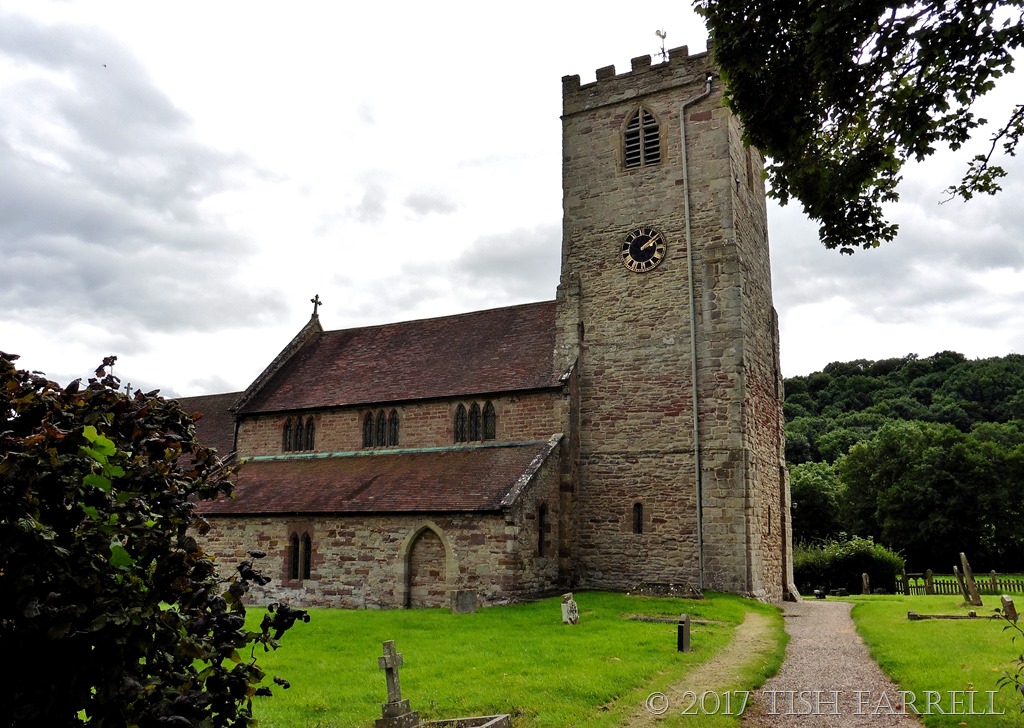
This particular lych gate stands on the path to Morville’s parish church of St. Gregory.  Morville, itself, is a small hamlet on the main road between Much Wenlock and Bridgnorth, and like Wenlock has a monastic past, although the church is all that remains of this period. I suspect that the fabric of the actual monastery may well have been re-purposed in the building of the next-door Morville Hall, which began hot on the heels of Henry VIII’s Dissolution of the Monasteries in the 1540s.

P1010964

In Saxon times the place was a thriving manor, and after the Norman invasion of 1066, continued to be so, its existing church and associated  lands bandied about as pieces of valuable real estate in deals between kings, earls and churchmen, its native inhabitants bound by fetters of superstitious dread and the obligation to provide wealth and labour for their overlords.

The Norman earl Roger de Montgomery took over Morville (along with most of Shropshire) in 1086. Here he had built a Benedictine monastery, an outpost for his more prestigious Shrewsbury Abbey some twenty miles away. He also had Wenlock’s Saxon priory remodelled on a monumental scale, and ordered the building of numerous other religious houses in every adjacent small community across the county.

I do not think this extensive building programme had much to do with piety. This was first and foremost about stamping Norman authority over the land. It was also an overlord’s means to control people, the wealth they created, and by the ordering of good works from the wealth accrued, so ensure his own place in heaven. It was his insurance policy in an era when everyone lived with a mortal terror of hell and the devil. As Baldrick in Black Adder might say it was a very cunning plan – political, physical and psychic control all of a piece – a top-down wealth management strategy.

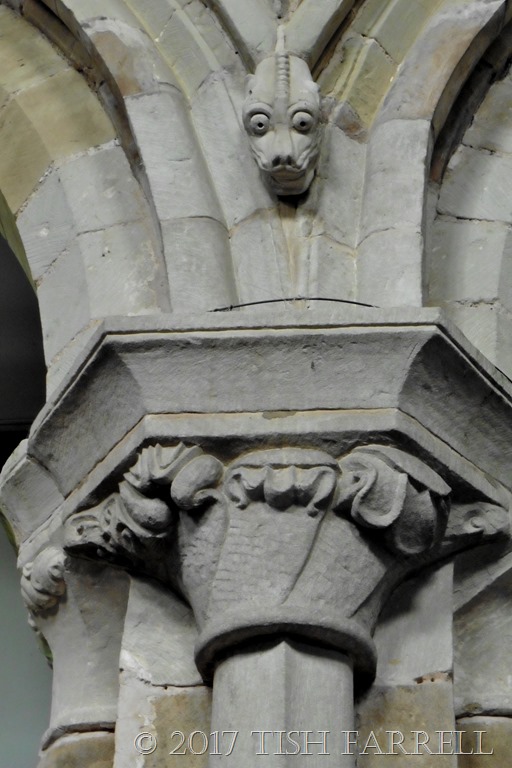
If you go inside the church you may see, as you will in many old churches, the evidence of the psychic tyranny. The present building dates from the 1100s. Between the column arches on both sides of the nave, serpents slither down – an early medieval manifestation of ‘fake news’ perhaps? Imagine having them breathing down your neck every Sunday from infancy to grave. There was no opting out of the experience. Your very soul was in peril should you try to, and anyway this and the other snakes are endlessly hissing at the horrendous cost of becoming an outcast.

P1010985

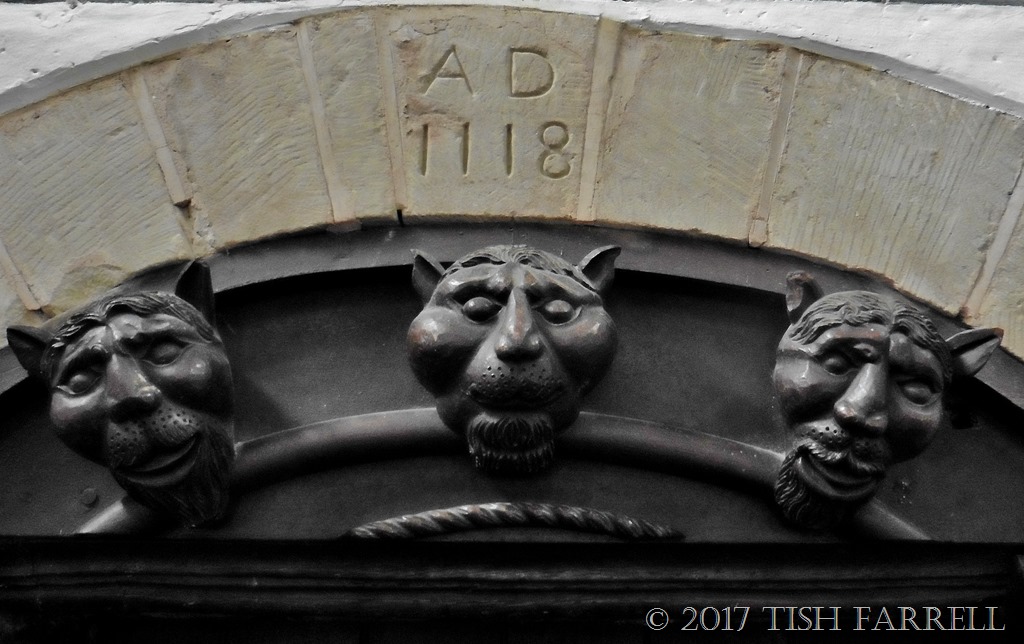
Even when the service is over – the mysteries of it conducted in a language you do not know, you are sent on your way by this jolly trio, just to reinforce the sense of threat for the rest of the week:

P1010983

*

Today, the church in its country churchyard and the nearby hall  are quintessentially scenic. My senses tell me that this is a lovely spot. But I confess, too, that increasingly I struggle with the rustically picturesque and the meaning I take from it.

P1010963

*

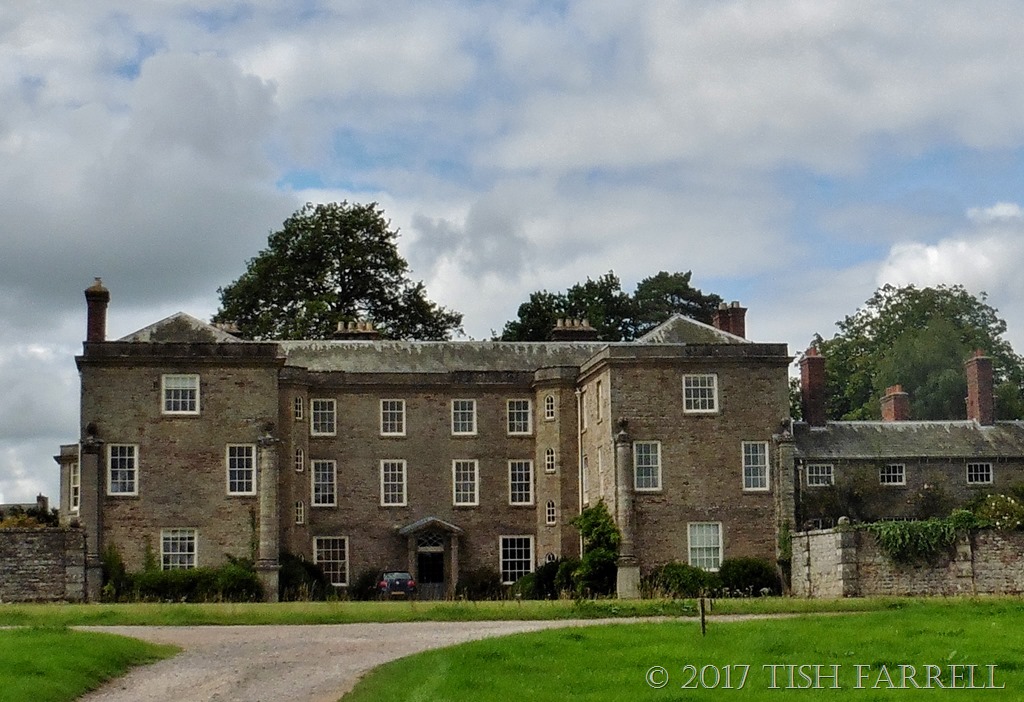
For one thing, I still detect traces of susceptibility. The view of the hall, though presently owned by the National Trust, is still likely to induce a fit of the Downton Abbeys…P1010953

…that ultimately distasteful sense of nostalgia for a fake past of benign lords and grateful retainers. We may have Henry VIII to thank for loosening a little the stranglehold of the ruling elite, and broadening the class of major players to include merchants and professional men, but nearly five hundred years on, most of the country is still owned by small and powerful factions including the monarchy.

The fascinating thing is most of us don’t seem to notice, or realize how the way land continues to be controlled affects our lives in critically fundamental ways – the cost of a home – to buy or to rent – and the acceptance of ever-rising property ‘values’, the acceptance of mortgages for life. It is not for nothing that these holdings are referred to as ‘land banks’, or that any release of land for development is minutely managed to ensure maximum return from high priced, often poorly built, overcrowded properties.

We no longer have to plough milord’s fields, or give him our tithes in wheat and eggs, or bow to his whims, and tug forelocks, but the vestiges of feudalism are alive and well and residing in Britain, and more particularly, idling in its well-worn seats in the House of Lords, currently the focus of ‘a bit of a scandal’ as reported by the Electoral Reform Society. Of course we could do something about all this – if we really wanted to – if we stopped romancing about the past and started planning for a present that embraces everyone’s needs. It’s an interesting thought anyway.

P1010961

Thursday’s Special: Traces of the Past

copyright 2017 Tish Farrell

Have We Reached Peak Stupidity Or Is The World Just Pants?

100_8967

This was the challenging early Monday morning query  that greeted me today on my return from the dentist. He Who Lives In My House had just spotted a  headline in the Independent newspaper. This is the headline:

High-tech boxer shorts protect men’s sperm from smartphone and wifi radiation damage

New pants are a cage for your crown jewels, protecting them from the ravages of the modern world  (rest of  Ben Chapman’s article HERE)


It seems French entrepreneur, Arthur Menard, had become so concerned about the health of his and other men’s testicles that he set up SPARTAN, so providing a new brand of chaps’ protective undergarment.

After much research, he and his team have come up with a knicker fabric that combines cotton and silver. This, they say, “blocks more that 99% of mobile phone and wifi radiation”. The silver also “has anti-bacterial properties meaning the pants should stay odour-free.”

This is all highly commendable of course. The reproductive health of present and future generations is clearly at stake here. We cannot have a scenario wherein the human race is wiped out due to obsessive compulsive Smartphone, laptop and tablet usage. That would be too daft, wouldn’t it? Except somehow, you can see it coming can’t you – our endlessly driven pursuit of pleasure gizmos and our too small grasp of the unintended, multiplying consequences; the outcomes – like ‘fake news’, ‘fake presidents’, social  media tyranny and manipulation of reality that, to my mind, truly are pants. No cotton and silver mesh to shield us from that kind of fall-out.

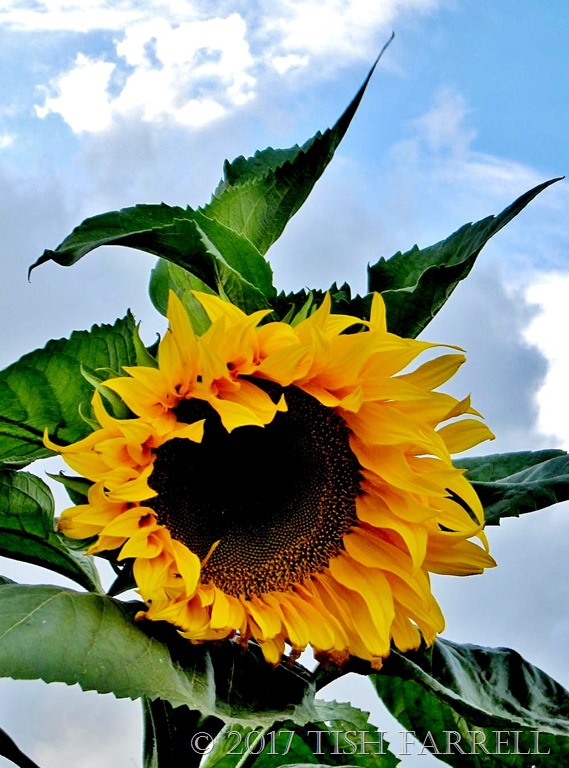
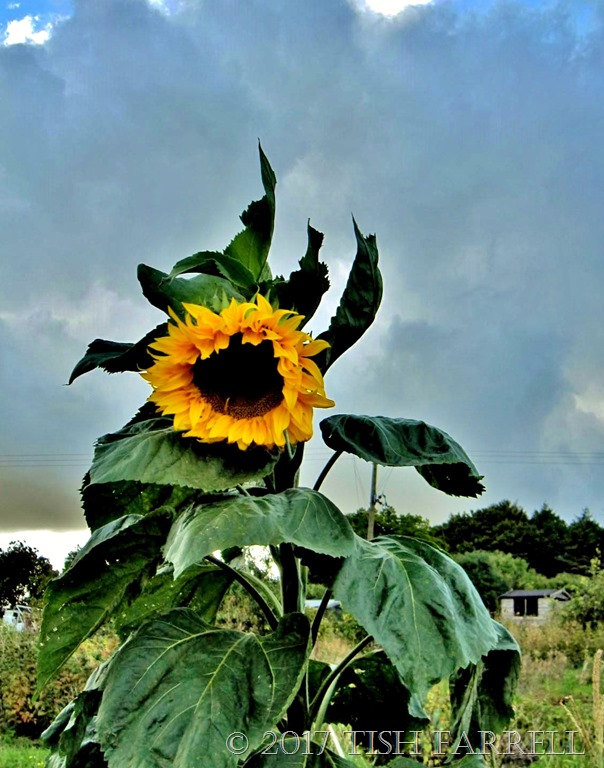
Look Out For The Giant Sunflower!

IMG_6034

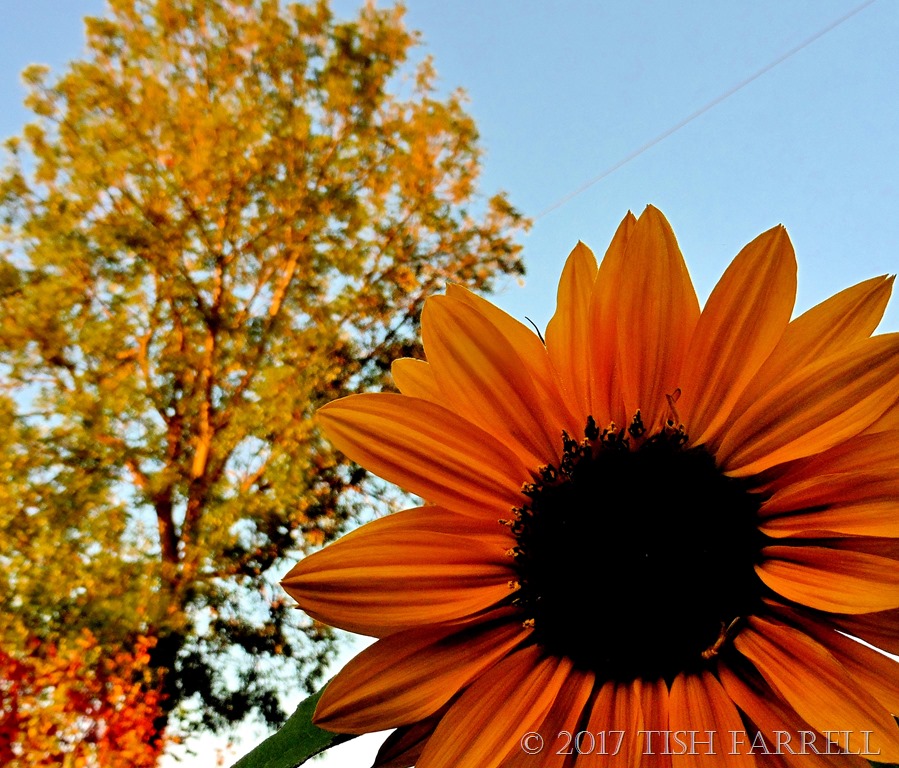
Out of the blue it came, a sunflower the size of a small tree, and towering over my bed of dwarf French beans. I think I must have a mouse or bird to thank for dropping a seed from someone else’s plot in my compost heap, whence it was transported to the bean bed early in the summer. I have certainly never grown a monster like it. Anyway, its suddenly overbearing presence hasn’t deterred the beans – a variety called Ferrari which have been more than living up to their name.

I’ve read conflicting reports as the companionability of sunflowers and beans, some sources saying that climbing beans will grow up a natural trellis of sunflowers, others saying that bush beans and sunflowers both should, and should not be grown together. Ah well. All I can say is beans and sunflower are doing well, the beans still producing even as autumn approaches, and despite some chomping by slugs. But it goes to show, anything can happen out on the plot.

IMG_6035