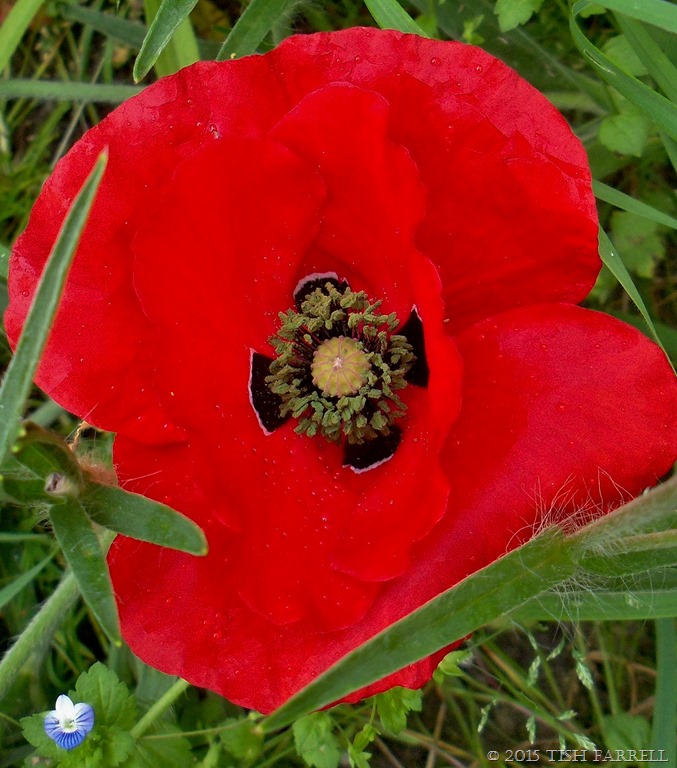
Field Poppy also known as the Flanders Poppy. I found it growing beside the field path on my way to the allotment. Its tiny blue neighbour is speedwell.
Nancy Merrill’s A Photo A Week Challenge: Fill the Frame
#NoGloryInWar

Field Poppy also known as the Flanders Poppy. I found it growing beside the field path on my way to the allotment. Its tiny blue neighbour is speedwell.
Nancy Merrill’s A Photo A Week Challenge: Fill the Frame
#NoGloryInWar
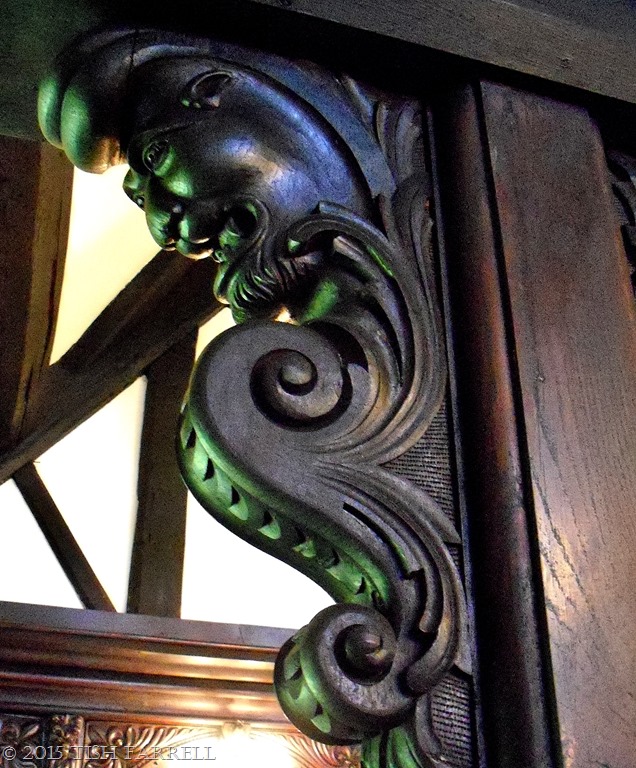
This is not the sort of chap you expect to find at a town council meeting (lion or devil, I’m not sure which) but then Much Wenlock’s council chamber is no ordinary place. It was built in 1577 as an extension on the 1540 civil courtroom. The two chambers on the upper floor of the Guildhall thus became the judicial and administrative centre for the 70 square miles that had once been ruled by the Prior of Wenlock. Underneath was the town lock-up, and an open space for a corn market. Behind is the churchyard, and next door, Holy Trinity parish church. The hub of the town then.

But perhaps the most surprising thing about the council chamber is that it is still in use today, although anyone sitting through a council meeting may well be left with distinctly unfavourable impressions of the past, and physically too: the seating is a torture on both knees and nether regions. I guess it was designed to keep everyone awake.
I’m afraid these upcoming interior shots look a bit woolly because of the spotlighting. On the other hand, they perhaps convey some sense of the antique residue that pervades the place.

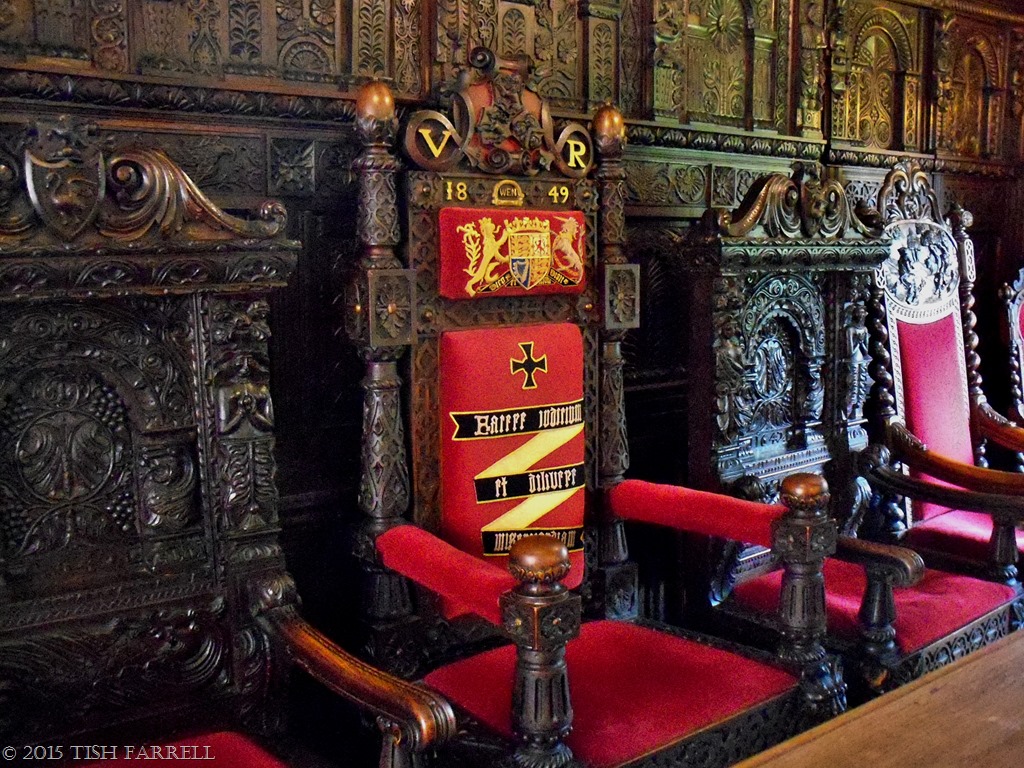
The panelling around the walls is 17th century, and was bought from elsewhere and installed in Victorian times by the town’s doctor and benefactor, William Penny Brookes, he who invented the modern Olympic Games (a fact I may have mentioned a few times.). The mayoral and officers’ chairs are especially awe-striking, and the said august personages truly do need to have on all their robes , wigs and paraphernalia if not to get lost inside them. These days this usually only happens on Mayor Making Day, once every four years.
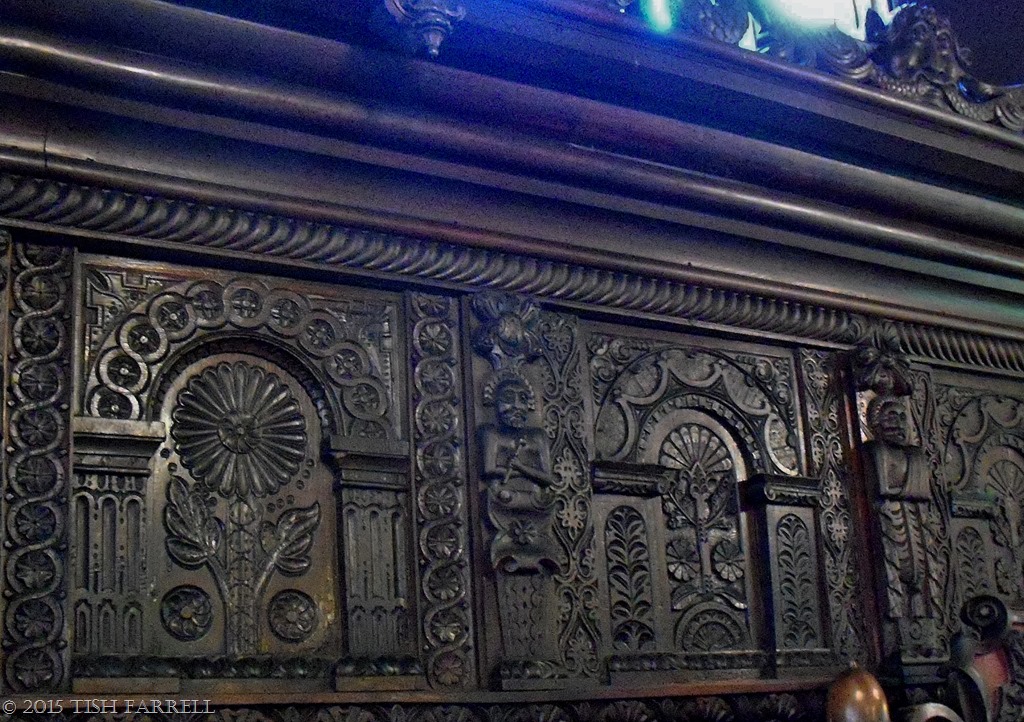
Here’s a closer view of the panelling behind the officers’ chairs. (There’s another scary entity up in the top right hand corner). Then coming up is the panel above the fireplace. Something to do with the Garden of Eden perhaps:

And now for a glimpse of the Church Green, along with the grave of William Penny Brookes. The blue painted surround is comprised of Olympian victors’ garlands. The Green is the venue for all the town’s fairs.
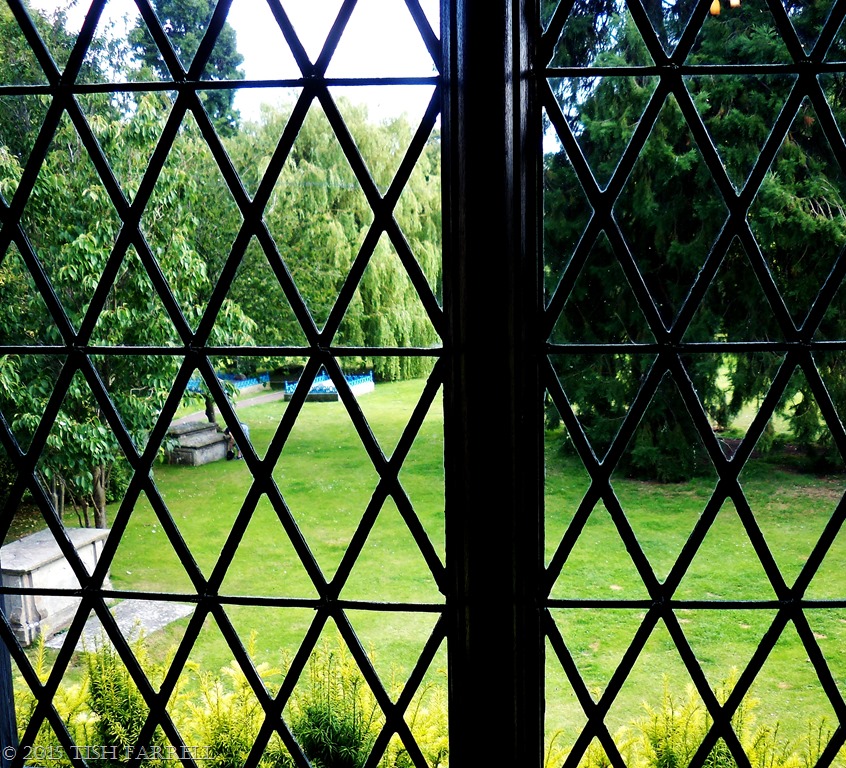
This next shot is taken from the Green. It’s hard to capture both the Guildhall and the church at one go:
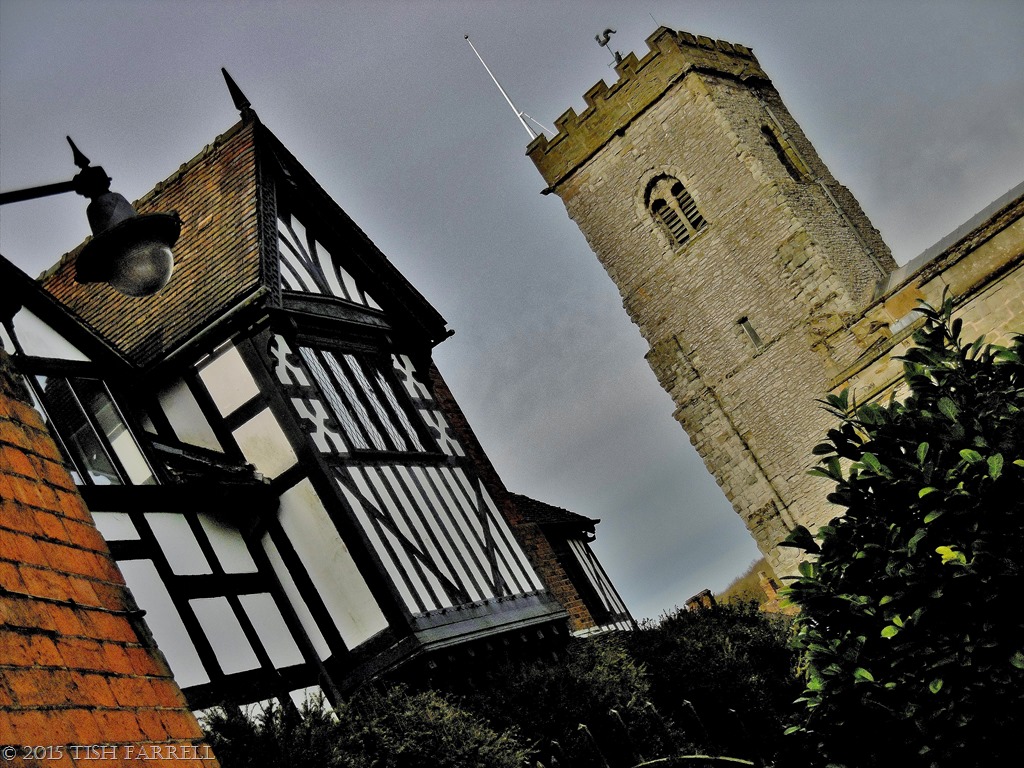
Of course the question that has doubtless surfaced in many of your minds is does the antiquated setting of the council chamber affect the quality of the thinking that goes on in there, and likewise the kind of decisions arrived at?
A few years ago I would have said that it certainly did. Some of the councillors back then had served for fifty years. These days, though, we have some very hardworking representatives. They are not paid either, since the once impressive Borough of Wenlock with its two members of parliament is no more, and the current town council has no more status than a parish council. But paid or not, our councillors still have some pretty big headaches to wrestle with, one of them being the continued upkeep of the Guildhall, including the roof over their own chamber.
It is perhaps a good example of the past becoming a public burden. Doubtless it is an amazing relic, and full of history, but it is no longer functional in modern terms. For one thing, there is no access for anyone with disabilities, or for the elderly who simply might have difficulty mounting the handrail-less stairs. As a listed building, the cost of installing some kind of lift would be astronomical, even if it were actually feasible. This situation immediately excludes quite a segment of the town from the democratic process. The uncomfortable seats probably do for the rest.
As to who foots the bill for running costs, then it is ultimately us, the council tax payers of Much Wenlock. If we did not pay to keep it going, it’s hard to know what anyone else would do with such a building. So here we have it – listed, listing, leaking energy, and generally not fit for purpose.
Attempts to raise some revenue by charging a modest fee to visit the old court room and council chamber did not work. Few people wanted to pay to go in. Now the court room is a small museum and art gallery, and entrance is free.
All of which leaves us with an impossible, but fascinating building, and one that probably no one in Wenlock would wish to be without. It gives the town its identity, and so maybe, at the end of the day, it’s only right that its citizens continue to support it, whatever way they can. At least the old corn market is still well used, and much for the purpose it was originally intended.
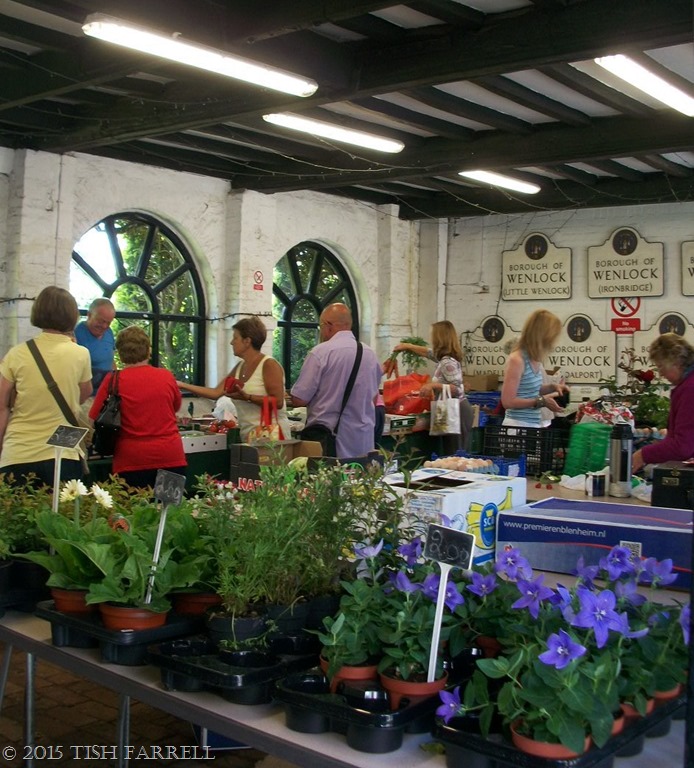
copyright 2015 Tish Farrell
This week at Thursday’s Special, Paula is inviting us to post traces of the past. Please visit her blog to find out what she and others have come up with.

Ladybirds seem to have been in short supply this year, so I was pleased to find this one nestling in my sage bush. Like bees, we absolutely need ladybirds. They are our natural pest controllers, preying on aphids and scale insects that can otherwise cause massive damage to food crops. As I was taking this photo, I was also delighted to scare off the harvestman spider that was creeping up on the ladybird. If you look in the bottom right corner above the copyright notice, you can just see the spider’s legs. Yikes!
*
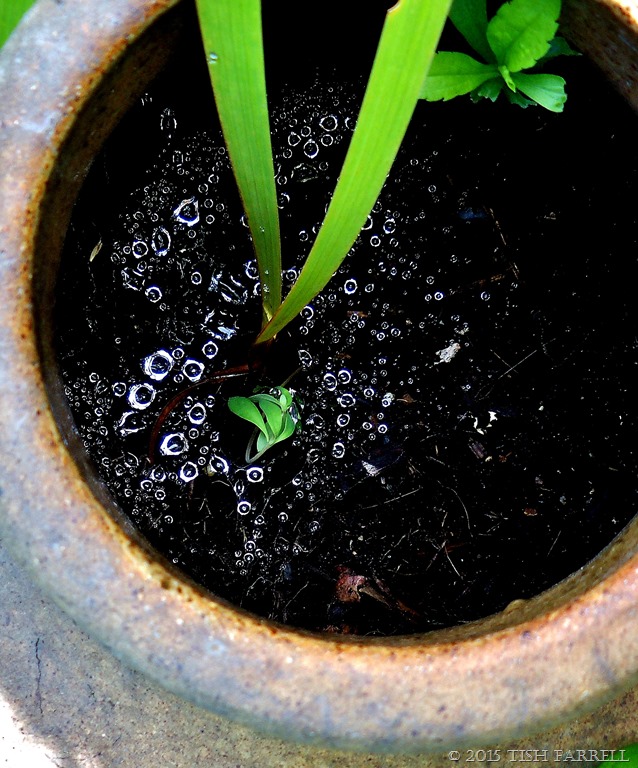
And here’s more evidence of spider activity: ambush exposed by raindrops in a garden pot.
*

Now for one of my favourite plants in the garden. The flowers of this later flowering phlox remind me of jasmine and are half the size of the usual cottage garden varieties. It has just the faintest subtle scent, and doesn’t mind shade.
*

Heuchera is another wonderful plant, and especially for ground cover. It comes in several hundred variations, and although understated on the floral front, it more than makes up for this with colour-bursting leaves that last all spring and summer. Also I see there’s spider lurking top left. I think it’s another harvestman. The bright green leaves amongst the heuchera are self-sown aquilegia seedlings. More granny’s bonnets to look forward to next year then. You never know what colour the flowers are going to be either – mauve, purple, pink, red, white. It’s one of the best things about plants that do their own gardening.
*
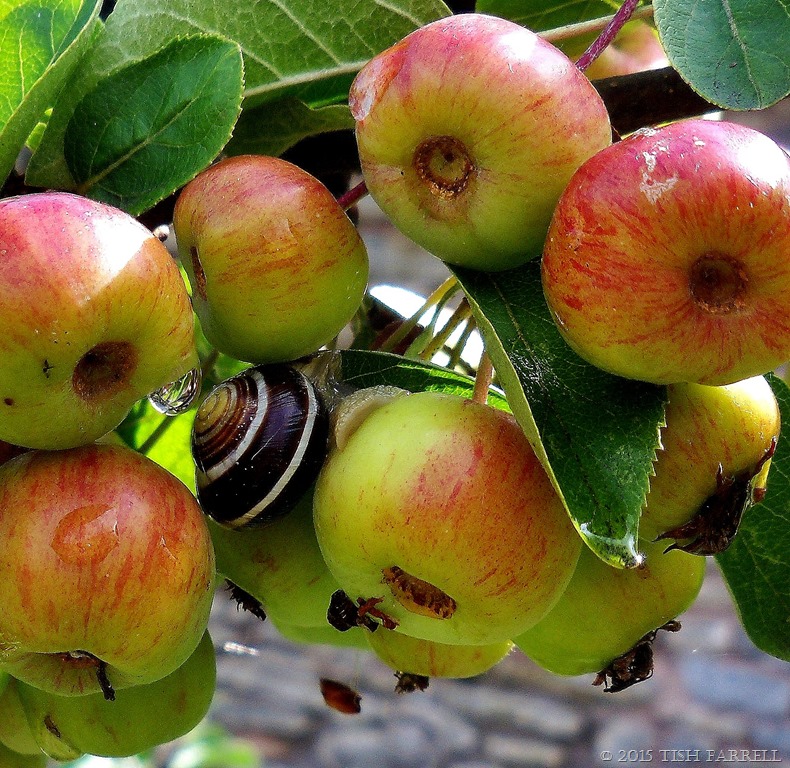
The tiny fruit on our Japanese crab apple are just beginning to take on their autumn colour. Soon they will be a deep russet red. I don’t think snails eat apples. At least I’m giving this one the benefit of the doubt; it’s probably just been sheltering from the rain.
*
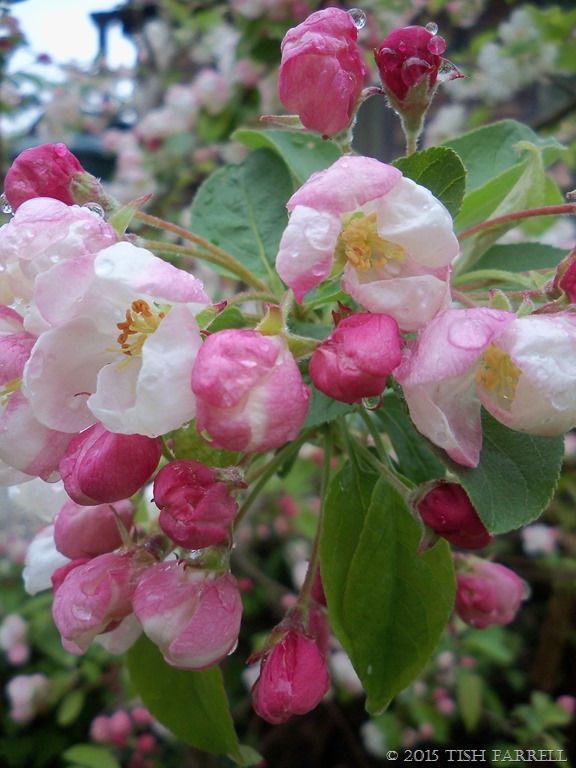
And now for a flashback-fastforward: the crab apple tree in April – spring past, spring to come…

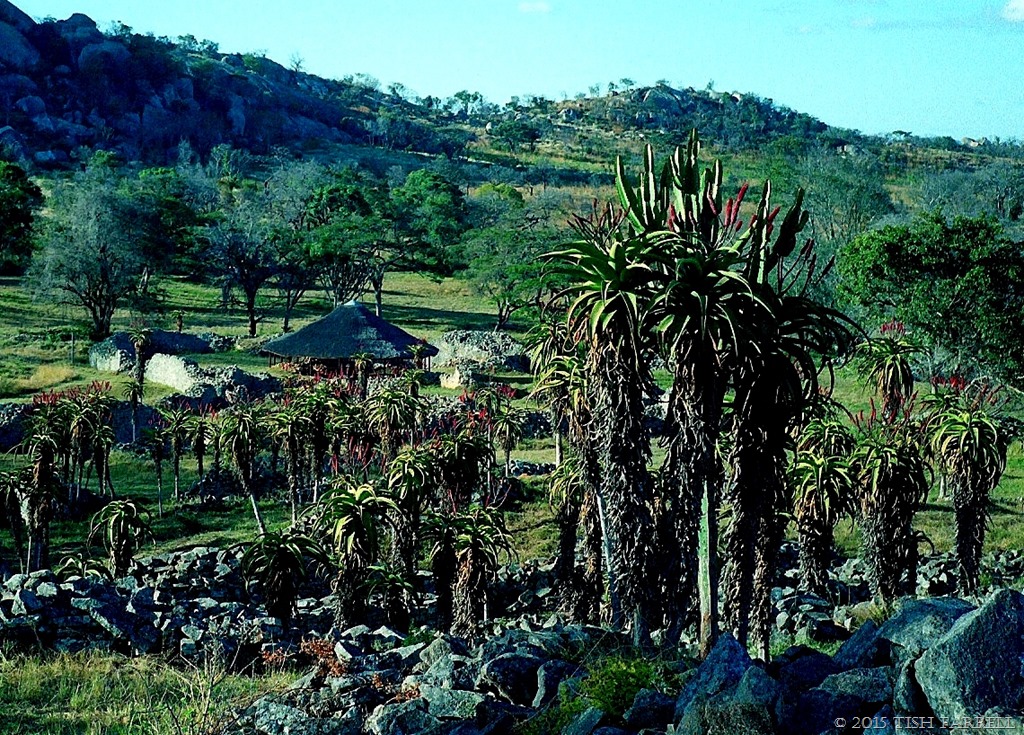
I’ve posted this photo before, but then it was a very good day all those years ago in Africa. And it’s also good to remember days when I looked a lot younger. (Or maybe not).
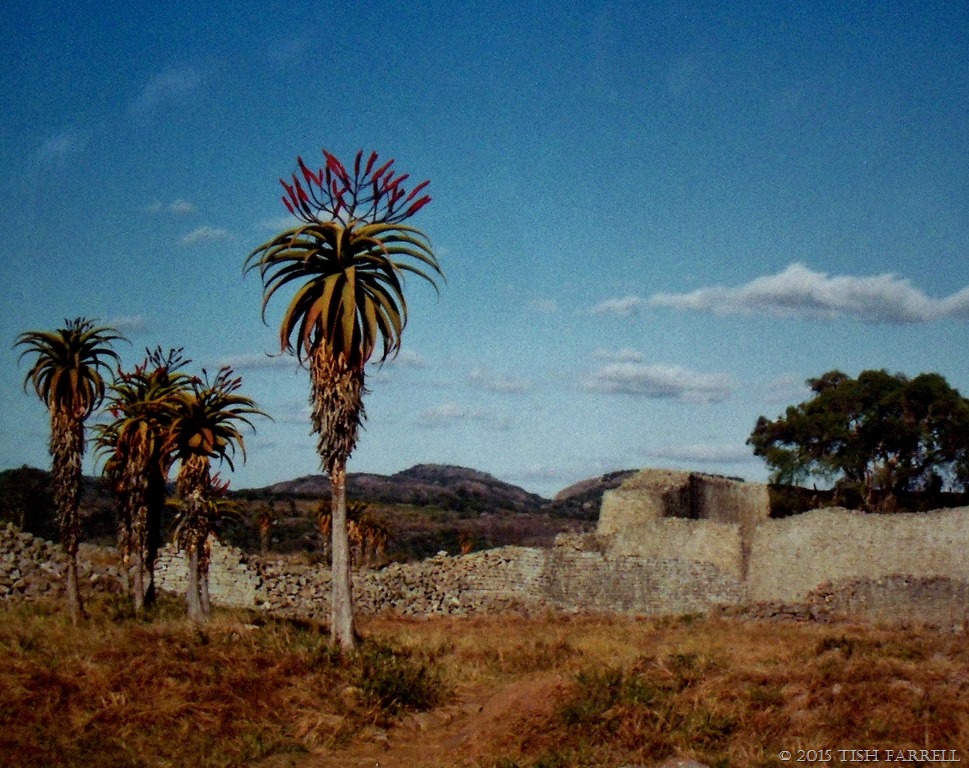
As you can see, all was bathed in old-gold light at Great Zimbabwe. The air was dreamily soft – much like a September Indian Summer day in England when all is drowsing except for the buzzing of wasps and bees.
Surprisingly, we had the place to ourselves. There we were, utterly free to wander about, seeking out the spirits of this once thriving African city of cattle herders and gold traders.
I remember pressing my palms on the granite blocks of the Great Enclosure and feeling their warmth, and wondering, too, at the sheer height of the walls that had no mortar to hold them fast for 700 years. Just imagine the skills needed to build walls like this, and think, too, how the white elite that once ruled Southern Rhodesia attributed this astonishing structure to Phoenicians, Ancient Egyptians, the Queen of Sheba, in fact to pretty much anyone who was not a member of the local Shona people who did construct it.
It was at times like these that I discovered that archaeology was not the benign, gently antiquarian discipline that I had spent three years of my life studying. No indeed. In certain quarters archaeological ‘evidence’ can be grossly perverted to sell false credentials to justify the rule of unjust rulers. I find it both sad and shameful that amongst such self-appointed elites even old stones can become the object of racist bigotry.
But wait. Such thoughts are spoiling the day, and there is still so much to see. There are mysteries too. Why were these city walls raised up so high when there is no evidence that the entrance gateways were ever closed, or even defendable? What was the purpose of the extraordinary stone tower? Why was this place abandoned, left amid the granite hills as the people simply gathered their cattle and belongings and walked away?
For more of Great Zimbabwe’s history see my earlier post:

copyright 2015 Tish Farrell
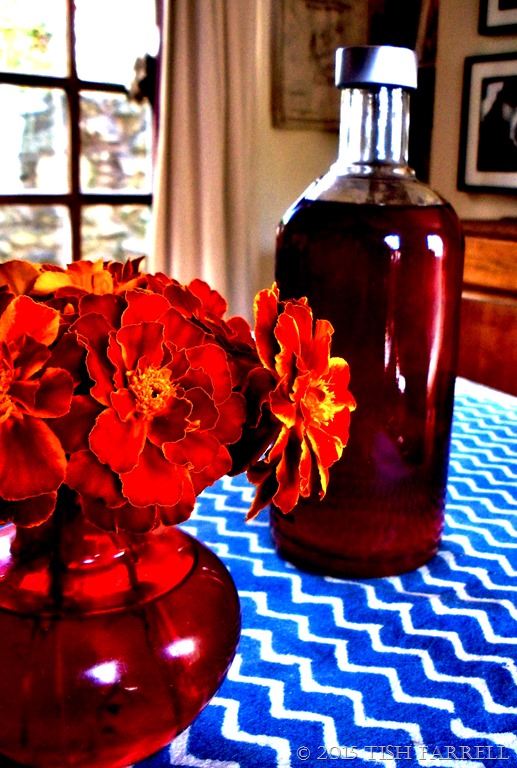
Some of you will remember that back in early July I posted Jane Grigson’s recipe for Strawberry Vodka. A good six weeks on, it has been duly shaken not stirred, kept in a dark, cool place, drained and strained, and here is the result – back in the vodka bottle (not the vase, although the liquid contents do look similar). Obviously during the decanting process we had to have a little sip or three. All I can say is this stuff is sure to add gleam, both inside and out. Also the only travel involved in procuring this shot was the trek between allotment and kitchen (me), and off licence and kitchen (Graham), and then to the sofa for a lie down (me again).
P.S. And if you are groaning because you missed the strawberry season, then this recipe will surely work with late summer fruits: plums, damsons, black currants, autumn raspberries, although you might need to add a little more sugar.
For more shimmer and shine please visit Ailsa at Where’s My Backpack where this week her theme is ‘gleaming’.
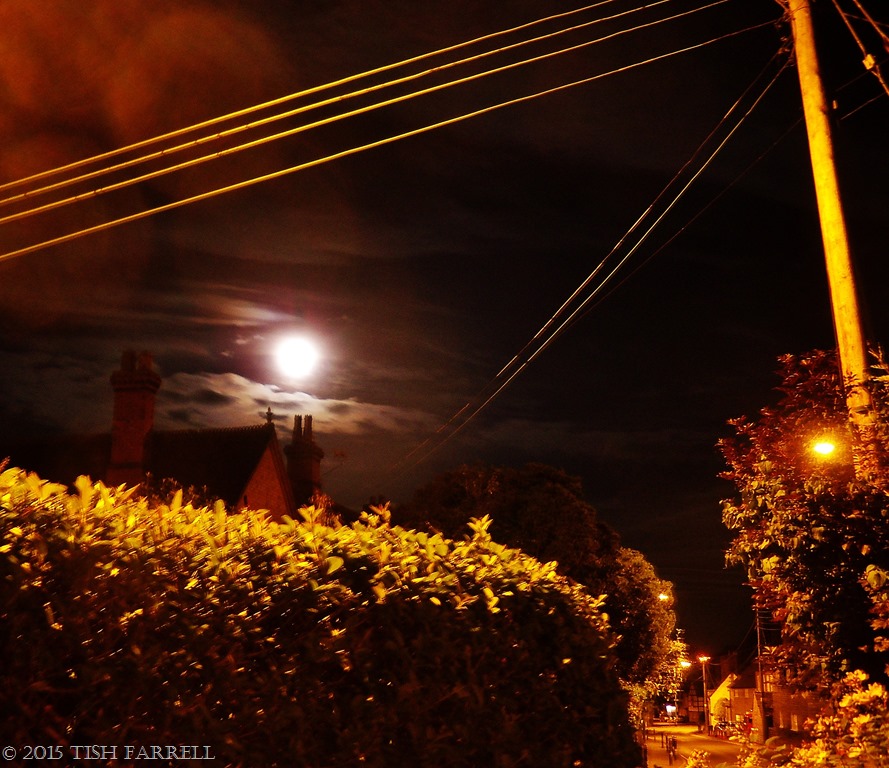
There’s all sorts of flare going on in this photo, not least around the moon. The pink smoke, and golden hedge effects are courtesy of a tall street light out of shot top left. I was trying to capture a blue moon. I even used a tripod. I’m not sure where the light on the right came from as there isn’t an actual street lamp on that side of the road. Anyway, if you peer hard you can look down the curve of Sheinton Street towards the town centre. It looks a bit like a film set. In fact isn’t that Mary Poppins coming along the road? Chim-chiminee, chim-chi…
Please visit Paula at Lost in Translation for more flare
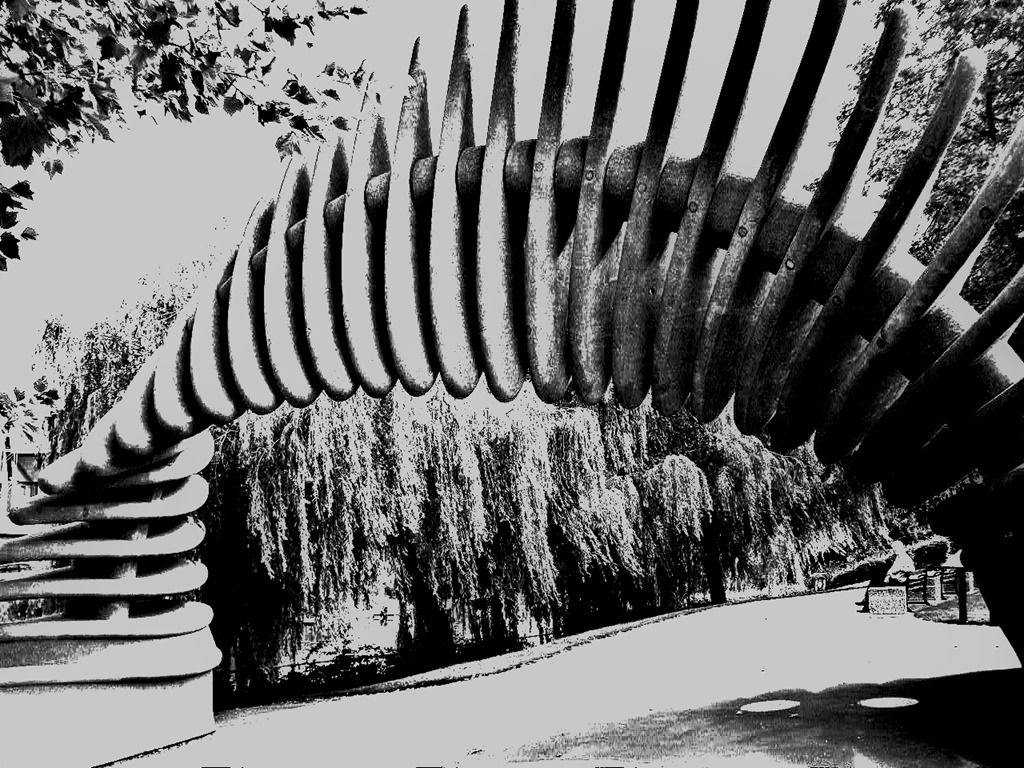
Earlier in the week I wondered what readers might make of this piece of public art, aka the ‘Shrewsbury Slinky’. Many of you picked up on the dinosaur bones, and the allusion to the double helix of DNA, both of which, we are told on the accompanying notice board, did indeed inform the thinking of the architectural designers, Pearce & Lal who conceived the structure. Some of you also guessed, or knew about the Charles Darwin connection.
Anyway, the work is called Quantum Leap, and as the explanatory board also states : “this geo-tectonic piece of sculpture has been designed through the influence of objects and materials central to the development of Darwin’s thought: rock, fossils, zoology…”
It was commissioned originally by Shrewsbury & Atcham Borough Council to commemorate the bicentenary of Darwin’s birth in 1809, and to mark the 150th anniversary of the publication of On the Origin of Species , both events well worth celebrating. The original cost to the public was expected to be around £200,000. But somehow, between the concept and its physical manifestation, things went awry on the costing front. More of which in a moment.
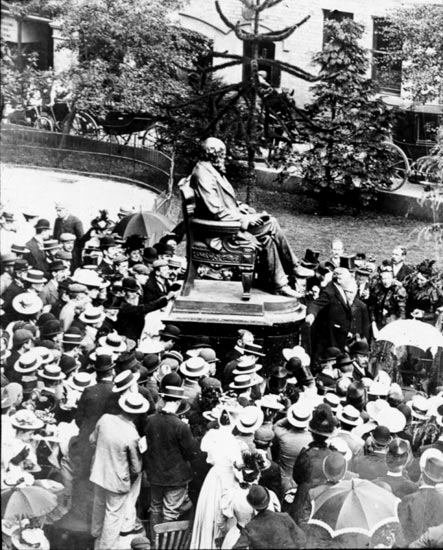
First, though, here is the man himself, sitting in his armchair outside the old Shrewsbury School, where as a youth he was student boarder. This more traditional tribute in bronze was unveiled in 1897:

Here you can see the 1897 unveiling. By then the prestigious Shrewsbury School had moved to larger premises across the River Severn, and Darwin’s old school become the town museum and reference library. This photograph is from the Shropshire Museums collection.
I don’t suppose many know that Charles Darwin was a Shropshire lad, born and brought up in Shrewsbury. If we picture him anywhere at all it is probably voyaging around the world on HMS Beagle (1831-1836), surrounded by a myriad of fascinating specimens, or else lost in deepest thought, unpicking thorny issues on his Thinking Path at Down House, Kent where he lived with his family for the last forty years of his life.
The Darwin family lived on The Mount in Shrewsbury. Darwin’s father was a doctor and financier, and also a free thinker. Charles’ paternal grandfather was Erasmus Darwin, physician, natural philosopher, inventor and leading light of the Midlands Enlightenment. His maternal grandfather was Josiah Wedgwood, potter industrialist extraordinaire, and inventor. Both grandfathers were staunch slave trade abolitionists. Darwin thus grew up within the orbit of men for whom it was the norm to challenge and think outside the bounds of convention.
While his mother still lived, Charles and his siblings worshipped at Shrewsbury’s Unitarian Chapel. Charles also went to the preacher’s day school, and by an early age was already absorbed with his own natural history collections. But after Susannah Darwin’s death, Charles and his brother, Erasmus were sent off to board at Shrewsbury School. Later both would go to Edinburgh to study medicine, and Charles apparently spent the year of 1825 acting as apprentice to his father, and treating the poor people of Shropshire.
However, he found medicine dull, and seems to have spent his time in Edinburgh studying marine invertebrates and learning taxidermy from a freed slave called John Edmonstone, a man whose company he much enjoyed. An annoyed parent wisely chose not to press his son into the family profession, but sent him to Christ’s College Cambridge; he would get his degree and become an Anglican minister instead.
But once more Doctor Darwin’s plans for his son foundered. While at Cambridge, Charles continued to pursue his interest in natural history. When he graduated in 1831 he took the chance to embark on a ‘gap year’ to end all gap years, and set sail on HMS Beagle, travelling as the ship’s gentleman naturalist. The planned two year voyage turned into five. The rest, as they say, is history.
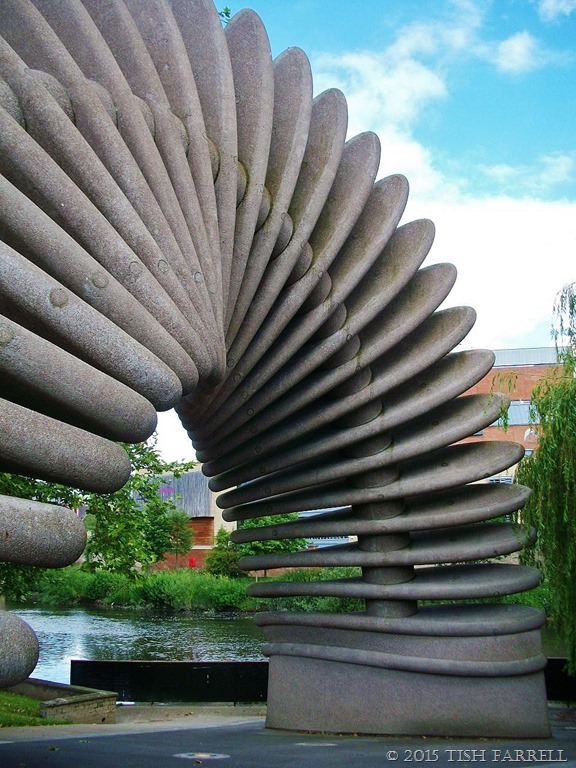
And so back to Quantum Leap, a project that was indubitably inspired by the very best of intentions – to honour the life’s work of a native son. I’ve already mentioned the unsuitable setting, in a cramped little garden between the River Severn and the town’s busy inner ring road. It is not a part of the town where many visitors are likely to find themselves, or even wish to be. But perhaps my main objection is the material. Concrete seems such a rigidly dull substance with which to evoke structures from the natural world. I can also foresee it acquiring a slimy algal coat, which though admittedly a life form, is unlikely to add a life-enhancing effect from the viewer’s point of view. And given all the cuts in Local Authority funding, it seems unlikely that someone will be paid to come along and scrub the thing. Where would you begin?
I’m trying to think, too, what that magician of installation, Anish Kapoor, could do for it, if called on to do some remedial work. I’m imagining something in cast iron here, or in wrought iron, or polished steel. Or even wood. Or perhaps, as Marilyn Armstrong suggests in the comments on So what’s this all about?, people will just hate it so much it will be taken down. My own feeling is that it will simply be forgotten, and that is the worst outcome of all. So much for commemoration.
This brings me to the most shocking aspect of the project. As we headed into the unveiling year of 2009, Shropshire was becoming a Unitary Authority, and the Borough Council passing into obscurity. There followed various problems with the contractors assigned to construct the monument. Costs rocketed. There was a court case. According to press reports there was a chance for the Council to settle the bill when it hit £600,000. They declined. In the end the 2012 accounts revealed that the final cost had amounted to over £1,000,000. As one Labour councillor acidly pointed out, this was considerably more than the cost of Antony Gormley’s epic, acclaimed and truly colossal Gateshead landmark, Angel of the North.
However you look at it, the final bill is staggering. In the face of austerity measures that have reduced some Shropshire residents to relying on Food Banks, and threatened so many social services, it is appalling to think of so much wasted money. But money aside, the whole enterprise now seems rather sad and silly. The original design concept for Quantum Leap has much to be said for it, but when it comes down to it, public art should serve the public who paid for it. It should be placed where everyone can enjoy it. It should be life-enhancing, spirit-raising, thought-provoking, a piece of wit or wisdom that becomes a point of attraction for locals and visitors alike. In other words, there should be returns on the investment, material and immaterial. It doesn’t of course mean that everyone has to like it. That would be too much to ask.
My other thought is that the town already has its monument to Charles Darwin. They got it right back in 1897. And although the statue might these days seem unadventurous, not to say a bit stuffy, it does at least show us the man – his intelligence, modesty and humanity – qualities that cannot be too highly valued. Not even the town’s incontinent pigeons detract from them. And so christened with bird lime he may be, but Charles Darwin looks a pretty decent old gent. His thinking changed the way we think. It took on superstition, and narrow-mindedness, and continues to challenge the scientific world to explore ever new ways to understand life on the planet. We Salopians can feel justly proud that he is one of ours.
copyright 2015 Tish Farrell
This is a follow up on my post for Paula’s Black & White Sunday theme of sculpture: So What’s This All About?
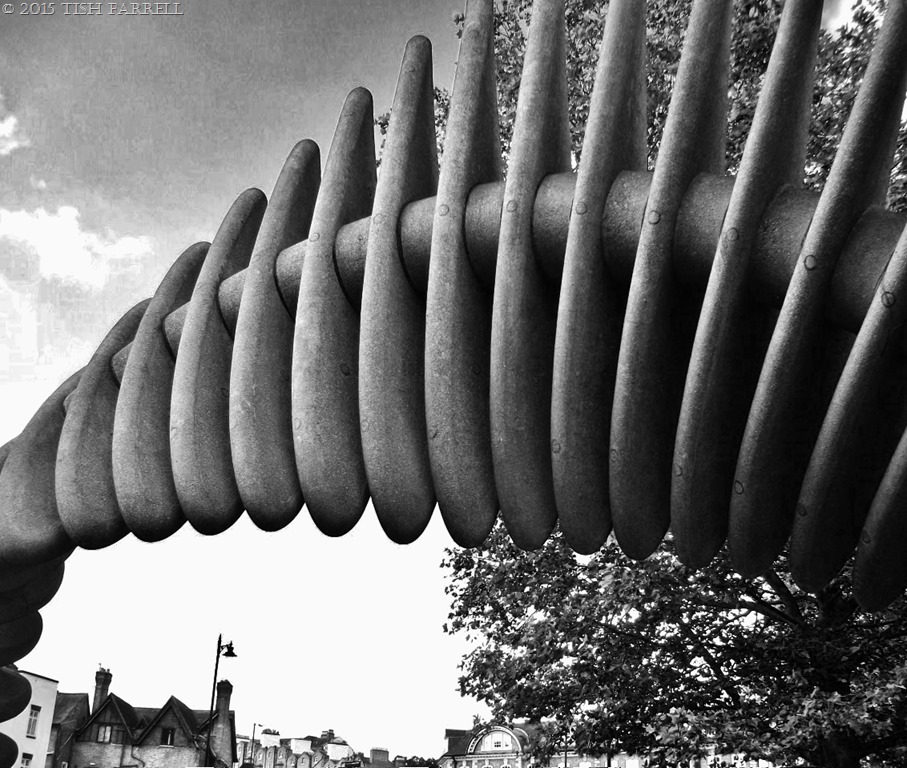
I truly would like to feel more enthusiastic about this monumental piece of public art. I mean I can see it is interesting – in its way – and the more so with the application of some photo editing. This has at least relieved us of the sickly mud-brown colour. Also the cast concrete takes on a little more texture than seems apparent in the original. But perhaps the most serious problem with this sculpture is its setting – squeezed into a little triangle of municipal garden between Shrewsbury town’s inner ring road and the River Severn.
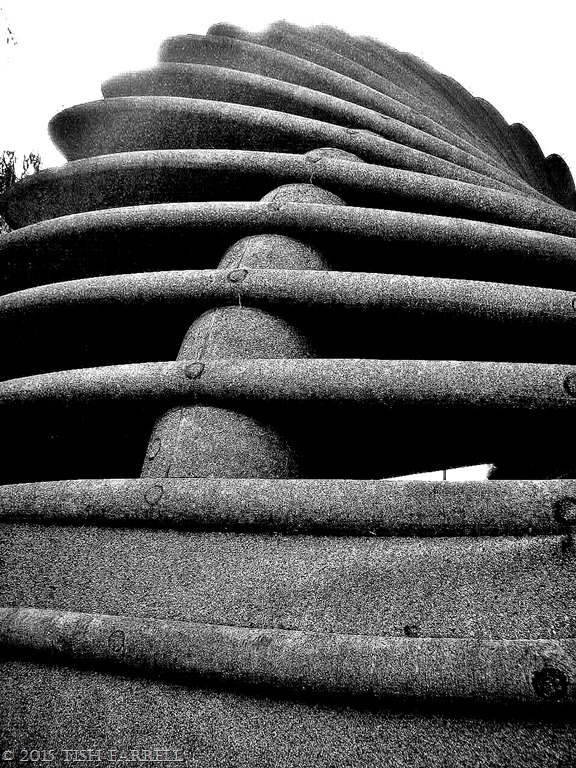
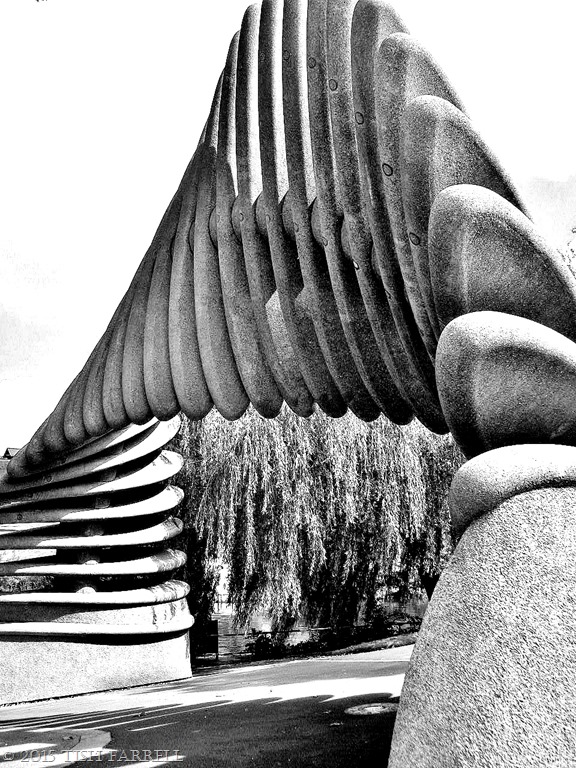
And so given that its siting was down to town councillors, and not to the artist whom they commissioned to do the work at great public expense, I tried approaching the work from different angles. As you can see, it is incredibly well made:

*
I even tried including some human interest, but this next shot only added to the sense of crammed in-ness, with too many planters, and a poorly situated explanatory panel:
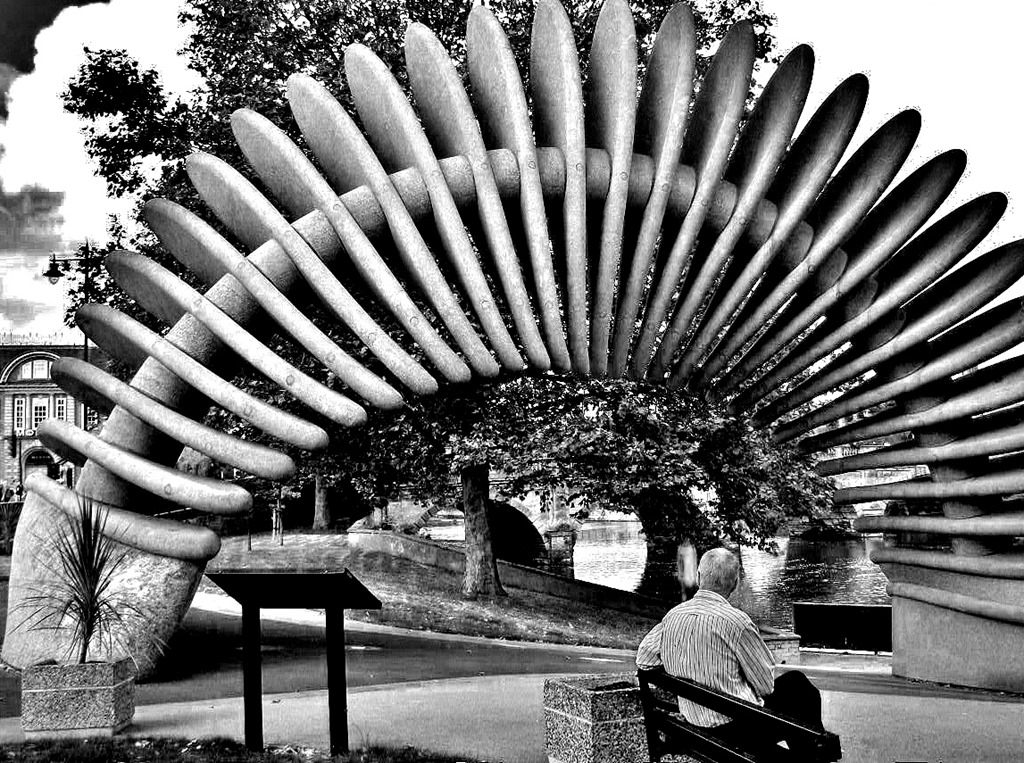
And so what do you think this work is commemorating? (I know that at least one person who reads this blog knows it person). Otherwise, all answers on a postcard to the secret WordPress post box.
Before I go, I will at least tell you that it is something very important, and relates to all of life on this planet, and that all may well be revealed in an upcoming post.
copyright 2015 Tish Farrell
Please also drop in on Black & White Sunday, where this week Paula’s theme is sculpture.
The season of mists and mellow fruitfulness has arrived in Much Wenlock on the coattails of spring, missing out summer altogether. Perhaps we’ll have it at Christmas instead, the barbeque months that, back in March, the tabloids were screaming we were in for, along with prolonged drought and associated mayhem that would, shock-horror, stop people from watering their lawns, or hosing down their Range Rovers. Mind you, these are the sorts of rags that would have us believing it is raining migrants. (That would be people so desperate that they risk all to run away from home).
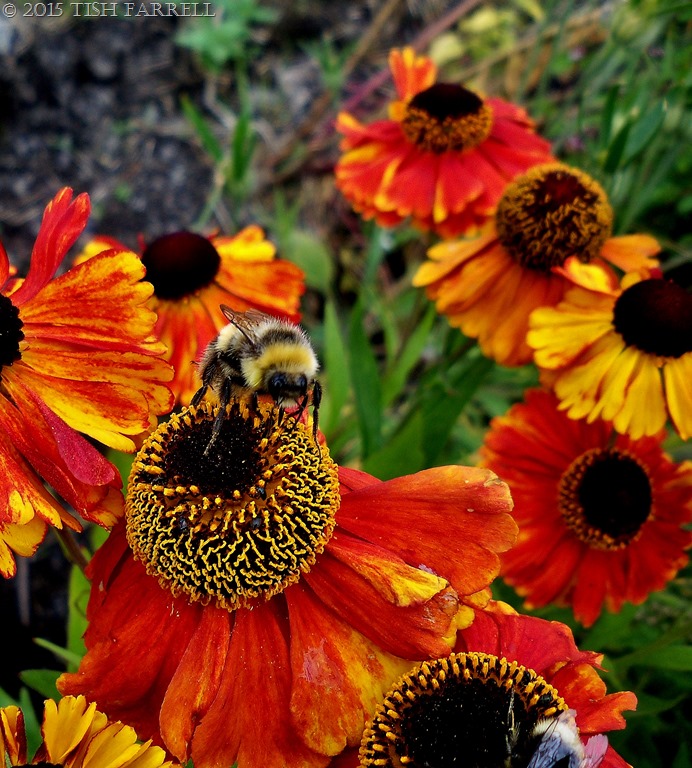
Anyway, whatever’s going on with the climate, the upshot is that much of the garden and the allotment has a very ‘left-over’ look, which is why I almost want to dash out in the garden and hug the sneeze weeds – bees notwithstanding – for being so vivaciously red and yellow as too much autumn dullness descends.
How can a plant so glorious be real? All the flowers in the photos, in all their wonderful variation, are growing on a single plant. And, as you can see, the bumble bees are gorging themselves. There are also some very tiny emerald beetles in amongst the pollen. Sneeze weed, by the way, is a country name for Helenium, which is a far more gracious name for such a generous plant, although one rarely used in the Farrell household.

And it’s thanks to the bees and other precious pollinators that we are at least having fruitfulness, if not harvest-hot weather. Up at the allotment apples are already weighing down the trees. They look like jewels:


Even the ornamental crab apples look good enough to eat raw. They’ll make brilliant jelly after a touch of frost, which hopefully won’t happen yet.
Then there are the brambles:
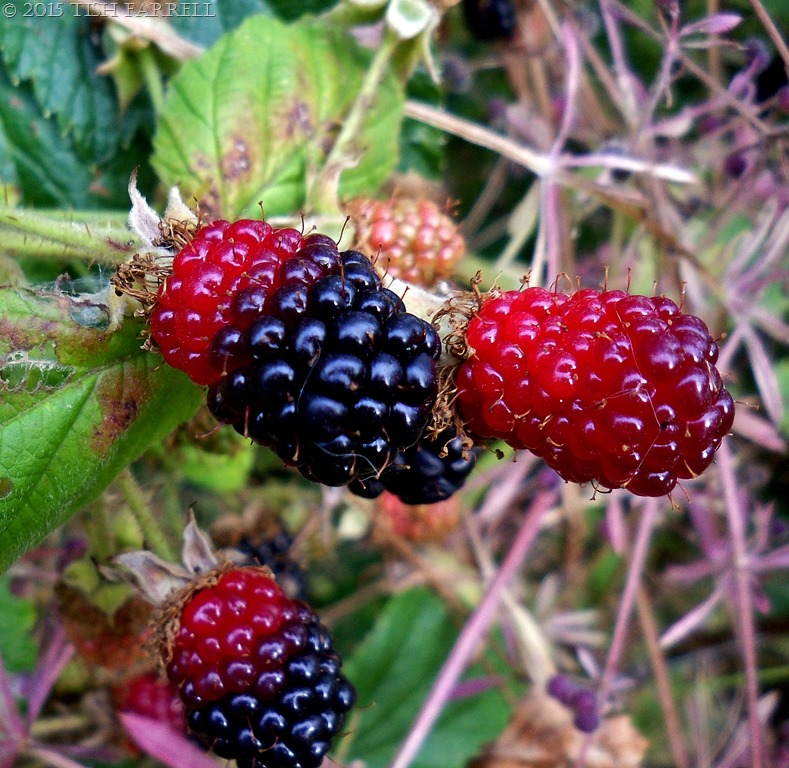
And the little yellow squashes that look like flying saucers:
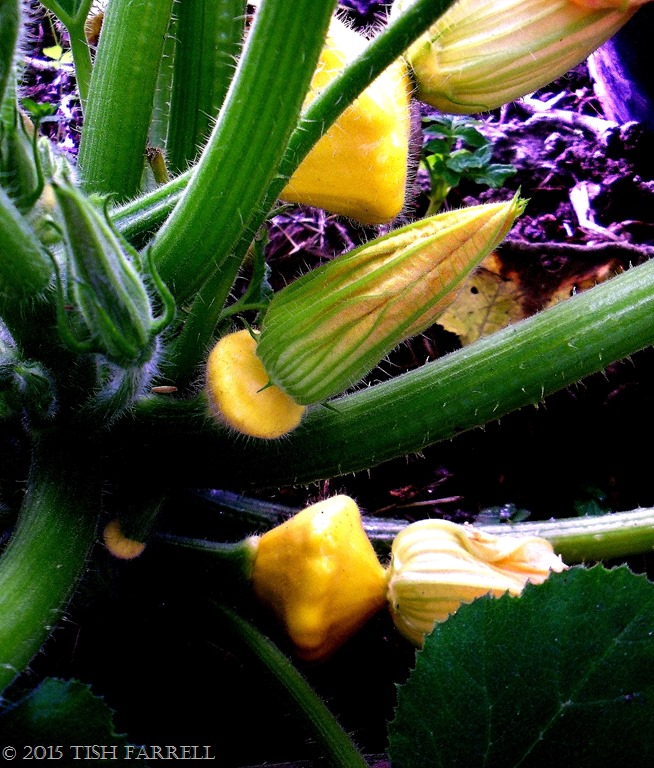
And the runner beans have started to crop (this photo was taken a week or so ago). The sweet peas on the end of the row are there to attract pollinators:

Of course, when it comes to weather, we Brits are never happier than when we’re grumbling about it: too hot, too windy, too wet, too dry. But then even if someone did steal summer, we still have so much to be thankful for. Feeling mellow, however, may not be an appropriate response these days. There may well be some hard lessons to learn when it comes to adapting to an increasingly erratic world climate, and not only for ourselves, but for the people who find their own lands are no longer habitable. We should not be surprised if they risk all to make for the lands of plenty.
copyright 2015 Tish Farrell
Steep Hill in Lincoln has seen a lot of history its time. The invading Romans built the first road around AD 48 to link their legionary fort of Lindum Colonia on the top of the hill with the riverside Iron Age settlement at bottom. After the Romans came marauding Vikings, who then gave up pillage for commerce, and so turned Lincoln into a thriving trading centre. Next in 1066 came the invading Normans. All have left traces of themselves around the city.
Today, Steep Hill ranks among the most scenic streets in Britain. It now links the city’s historic Cathedral Quarter in Bailgate, with the bustling shopping centre down by the river.
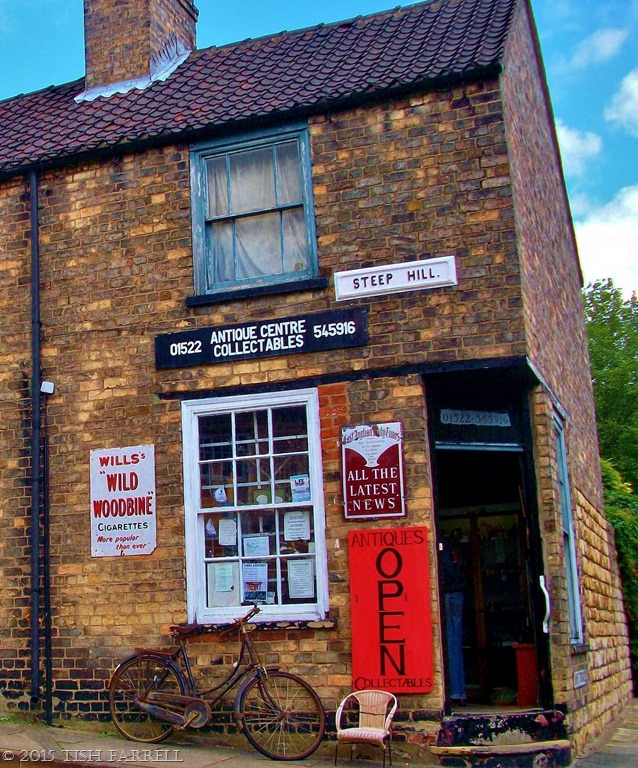
But a word of warning. You definitely need to take plenty of time to walk up it. In the lower reaches it rises seven feet for every one foot (just over 2 metres for every 0.6 metres). In fact I was so concerned about staying alive on the ascent, I forgot to take any photos until I stopped for a breather outside this curio shop (above). The building itself is unremarkable, probably nineteenth century, but it struck me that it has many things of its own to say about the passing of time. I like the worn steps and the old bicycle. I also imagine that it might once have been a corner shop where you popped in for your milk and bread and a packet of tea.
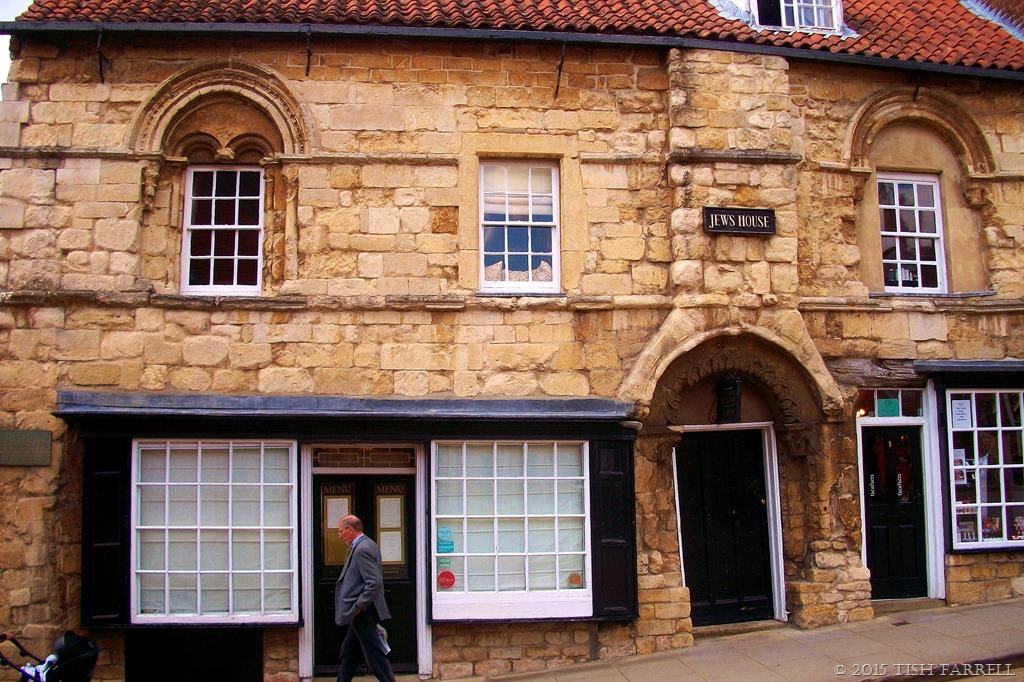
Heading on, though, you come upon these astonishing old sandstone buildings. The Jews House is 12th century, and dates from the time when the city had a strong Jewish community. But like many others in medieval England they fell foul of bigotry and false accusations, and the entire community was expelled in 1290. The Norman House below it is also 12th century, and said to be one of the oldest surviving domestic buildings in Britain.
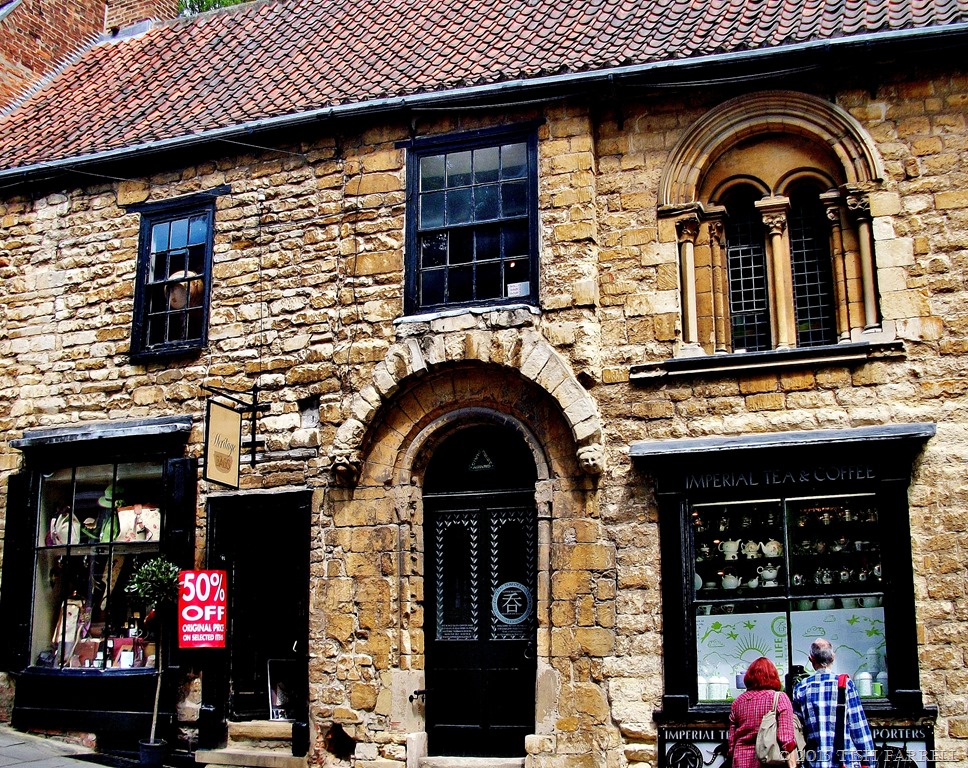
And it’s at this point we reach the part of the street that is seriously concerned with a preoccupation of our own time – shopping:
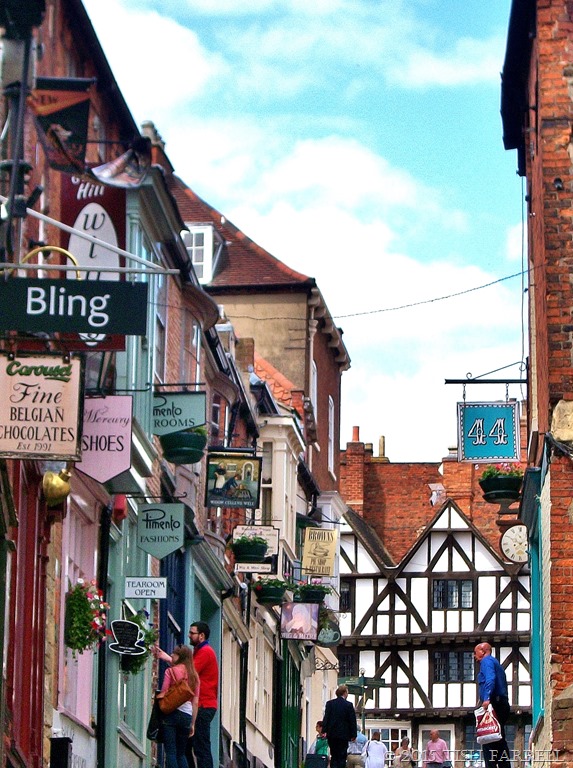
At the top of the hill is Castle Square. The castle was built by the Normans on the site of the Roman fort, but it was under wraps and being restored when were there so I couldn’t photograph it. Ahead, though, you can see the fine timbered 16th century building that was once a Tudor merchant’s home, and is now the Tourist Information Centre.
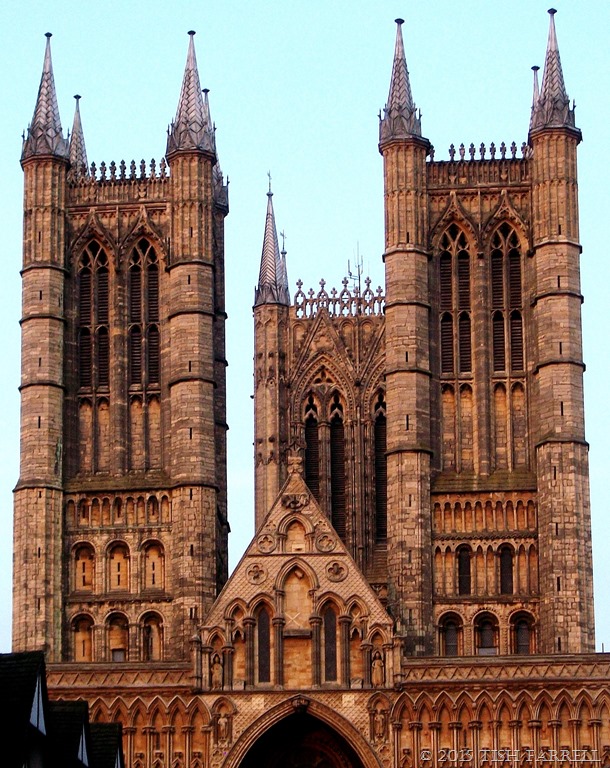
And finally, coming up is the building we’ve been struggling up the hill to see – Lincoln Cathedral in all its splendour. Work began on it in 1088, and continued through several phases over the following centuries. The towers, for instance, were raised and improved upon during the early 1300s. All in all a breath-taking feat of architectural engineering, to say nothing of standing the test of time. It is Britain’s third largest cathedral:
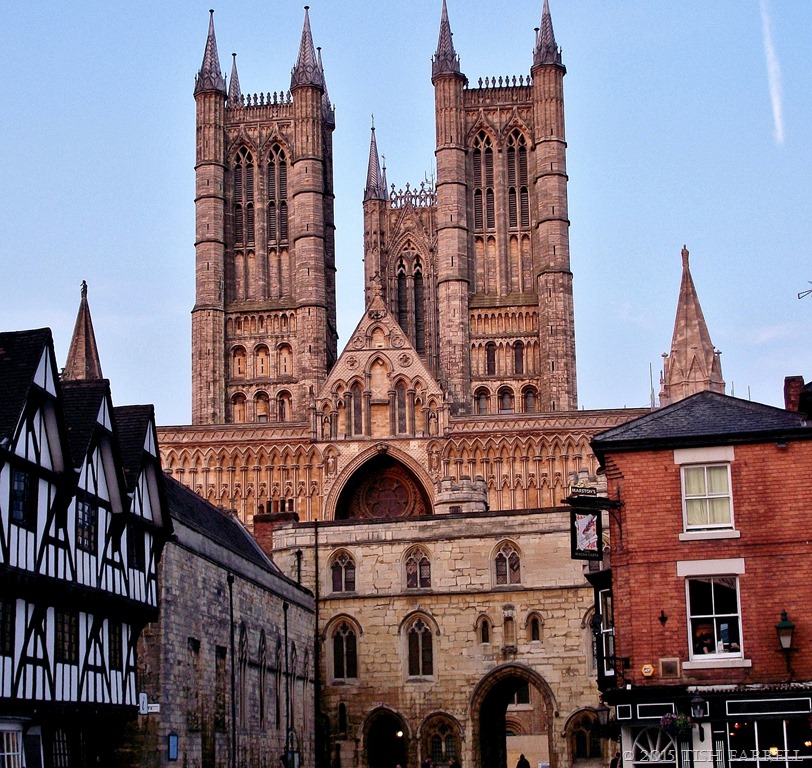
And so if any of you are thinking of visiting the UK, Lincoln is definitely a must. It is a city to wander around, layers and layers of time revealed at every turn. There are museums and galleries and even a surviving town windmill. Pleasingly, too, the cathedral towers now provide nesting sites for peregrine falcons. As you walk around the precincts their mournful calls echo off the leaded roofs. These sounds, too, give one a wistful sense of times past.
Today Paula’s guest, Debbie Smyth, at Thursday’s Special is asking us to think about time. Please visit Debbie and Paula for their own interpretations of the theme.
