WordPress Photo Challenge: Inside

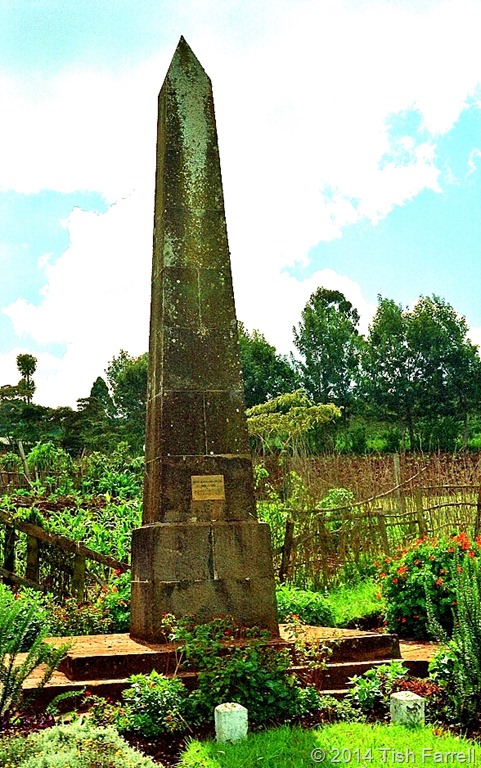
This was not supposed to happen. In fact you could say it adds insult to irony: that a man so steadfastly dedicated to an unfettered life in the wilds should, in death, end up hemmed in, and so very domesticated within this small Kikuyu shamba. Yet here it is, the mournful stone obelisk, marking the grave of Denys Finch Hatton, son and heir of the 13th Earl of Winchilsea, Great White Hunter, and lover of two women far more famous than he is: writer Karen Blixen (Out of Africa) and aviator and race horse trainer Beryl Markham (West with the Night).

Yet another woman, the one whose shamba this is, shows him a new kind of love, taking care of the garden around the obelisk. If you want to visit the place it is not easy to find – either her little smallholding on the Ngong Hills, or the grave within. When we visited years ago we found only a hand-painted signpost nailed to a tree. We parked in a paddock outside the farmhouse door and were charged a few shillings. We could have bought a soda too, if we’d wanted. We could not see the grave though, and soon found that it was deliberately hidden from view by an enclosure of old wooden doors. More irony here of course. More symbols of shut-in-ness.
Denys spent most of his life in Africa avoiding any kind of confinement – out in the Tsavo wilderness, running shooting safaris for the rich and aristocratic. His clients included the Prince of Wales (later Edward VIII) . In fact it was during the safaris for the Prince in 1928 and 1930 that Finch Hatton began to promote shooting on film rather than with a gun.
His lover, Karen (Tanne), Baroness von Finecke-Blixen lived in a small house below the Ngong Hills, some twelve miles outside Nairobi. By the time she started her affair with Denys she was divorced from her charming, but philandering husband, Bror, although they always remained friends. Her family had invested a great deal in the couple’s coffee farm, and Karen struggled to make a success of it. But the location was entirely wrong, and in the end she was forced to sell up and leave Kenya. It was during the period of selling the farm that she heard news of Denys’s death.
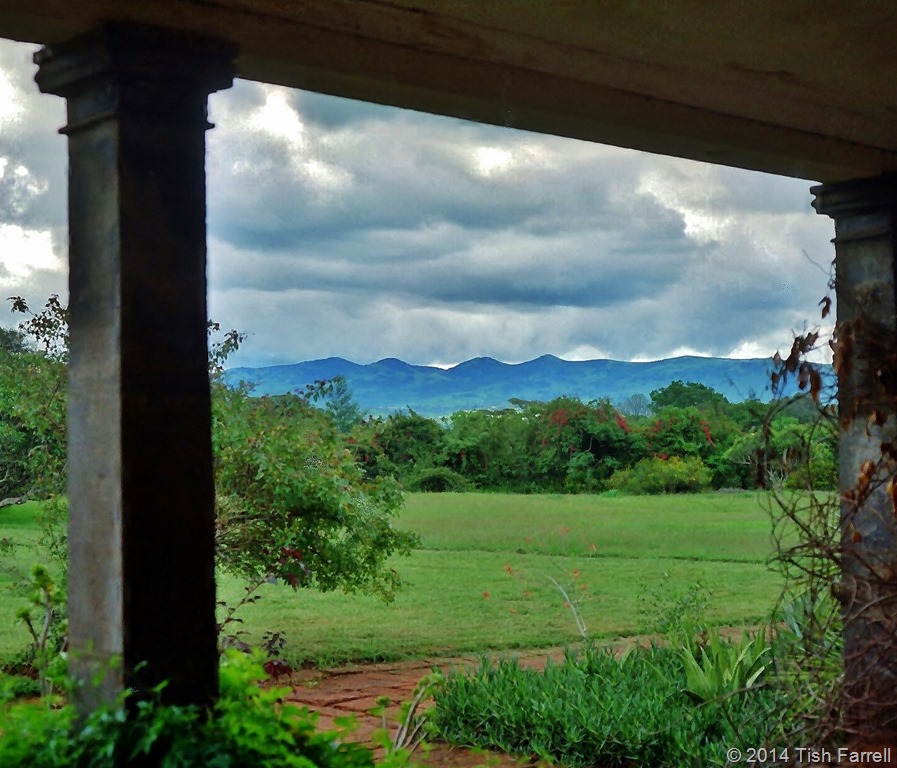
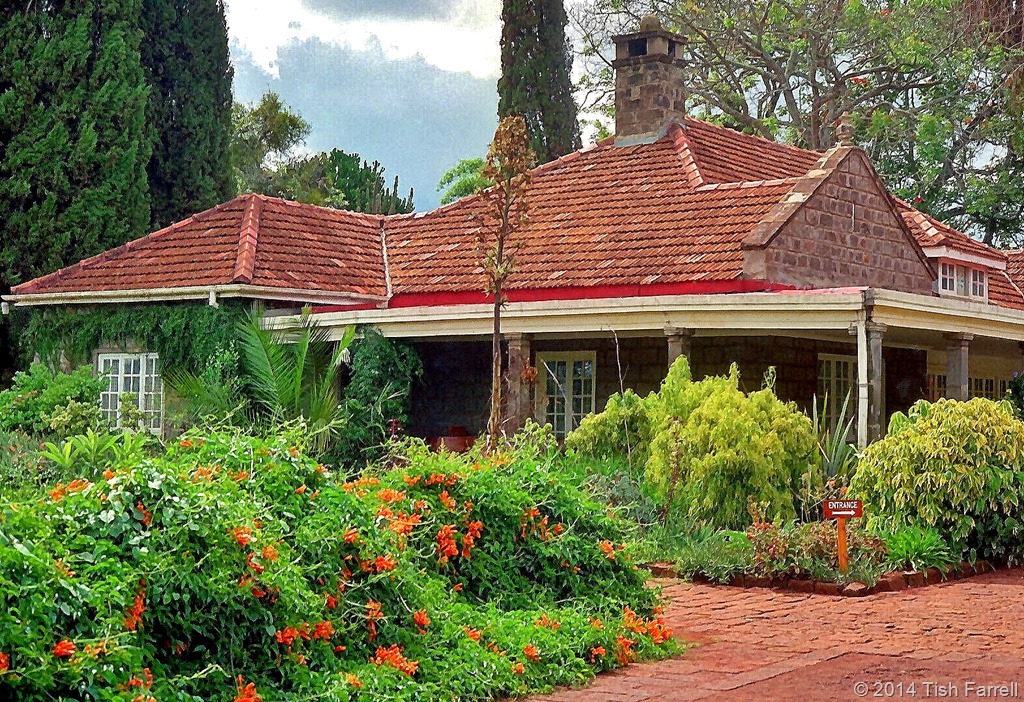
Looking towards the Ngong Hills from inside the veranda at Karen Blixen’s house. The house now belongs to Kenya’s National Museums.
*
Denys Finch Hatton’s untimely end may be put down to his passion for flying. For those of you who remember Sydney Pollack’s 1985 film Out of Africa, some of the most elegiac moments of the film are when the celluloid version of Finch Hatton (Robert Redford) takes Karen Blixen (Meryl Streep) into the skies above the Rift Valley. Denys died in his Gypsy Moth in 1931, and in unexplained circumstances. He was taking off from the airstrip down in Voi in southern Kenya when his craft exploded. He and his Kikuyu co-pilot were killed. Denys was forty four.
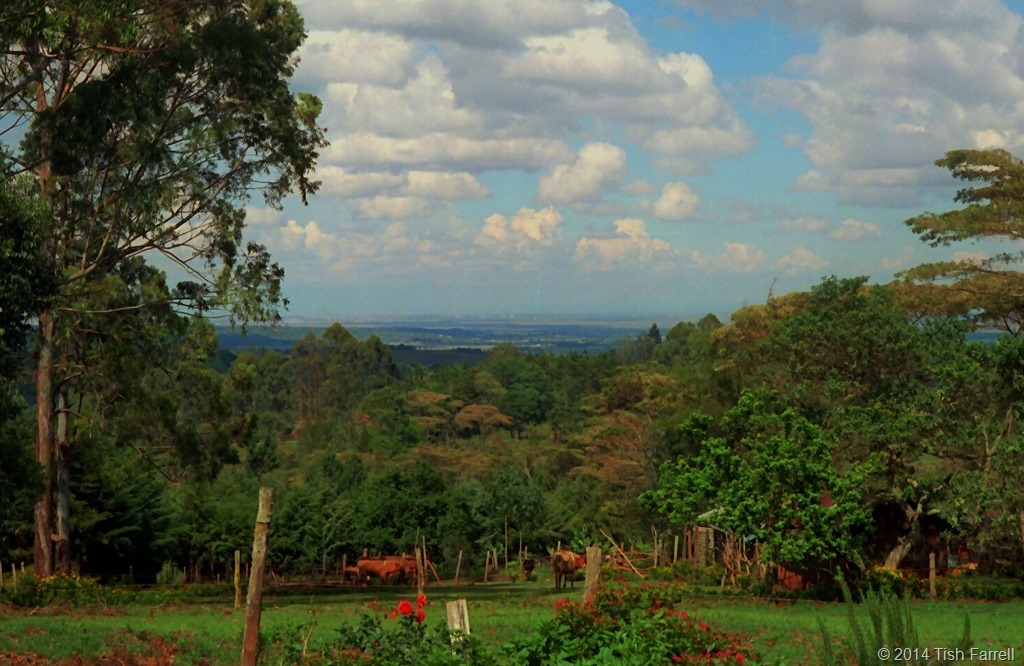
View towards Nairobi from Denys Finch Hatton’s Grave, and overlooking another Kikuyu smallholding.
*
By the time of his death, his relationship with Karen was well on the wane, and he had already started an affair with the younger Beryl Markham. His biographer, Sara Wheeler says in Too Close to the Sun, that there is circumstantial evidence to suggest that Beryl was pregnant with Denys’s child, but that she then had an abortion. To have known this would have truly broken Karen Blixen’s heart: her letters show that she had longed to have a child with Denys.
With yet another twist of irony, it was with his death, that Karen somehow reclaimed him, remembering that he had told her of his wish to be buried in the Ngong Hills. The spot he had chosen was one that Karen had decided on for her own grave.

Denys Finch Hatton
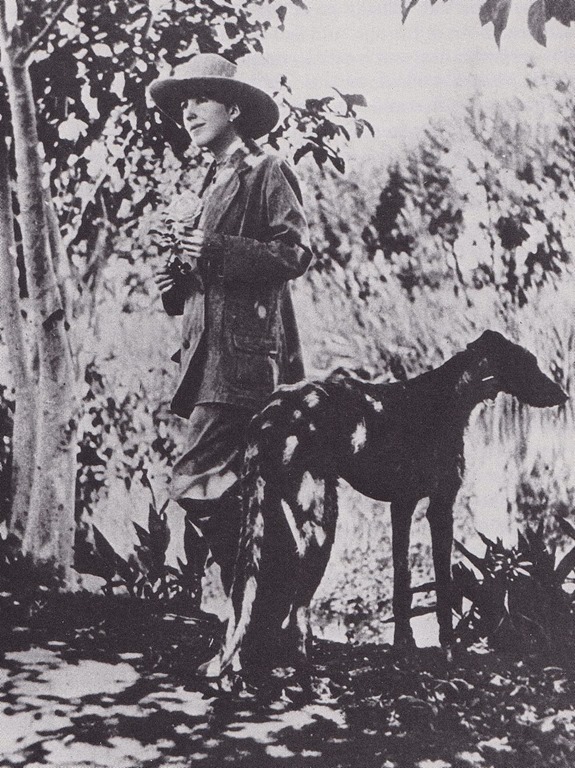
Karen Blixen with her deerhound Dusk
There was a place in the hills, on the first ridge of the Game Reserve, that I…had pointed out to Denys as my future burial-place. In the evening, while we sat and looked at the hills from my house, he remarked that then he would like to be buried there himself as well. Since then, sometimes when we drove out in the hills, Denys had said: ‘Let us drive as far as our graves.’ Once when we were camped in the hills to look for buffalo, we had in the afternoon walked over to the slope to have a closer look. There was an infinitely great view from there; the light of the sunset we saw both Mount Kenya and Kilimanjaro. Denys had been eating an orange, lying in the grass, and had said that he would like to stay there.
Out of Africa
The obelisk was only put up later by Denys’s brother. During Karen’s last days in Kenya she had the site marked with white stones from her own garden, and as the grass grew up after the long rains, she and Farah, her Somali house steward, erected a pennant of white calico so she could see the spot from her house, some five miles away.
Sometime after she had returned to Denmark she received a letter with some strange news about the grave:
The Masai have reported to the District Commissioner at Ngong, that many times, at sunrise and sunset, they have seen lions on Finch Hatton’s grave in the the Hills. A lion and lioness have come there, and stood, or lain, on the grave for a long time…After you went away, the ground round the grave was levelled out, into a sort of big terrace. I suppose that the level place makes a good site for the lions, from there thy can have a view over the plain, the cattle and game on it.
Out of Africa

copyright 2014 Tish Farrell
*
Tish Farrell is an award winning writer for young people. Her latest novella is on Amazon Kindle (5 star review):

Secrets, conspiracies, tragedy, dark comedy – a fast-paced novella of interwoven tales set somewhere in East Africa. For young adults and adults alike.
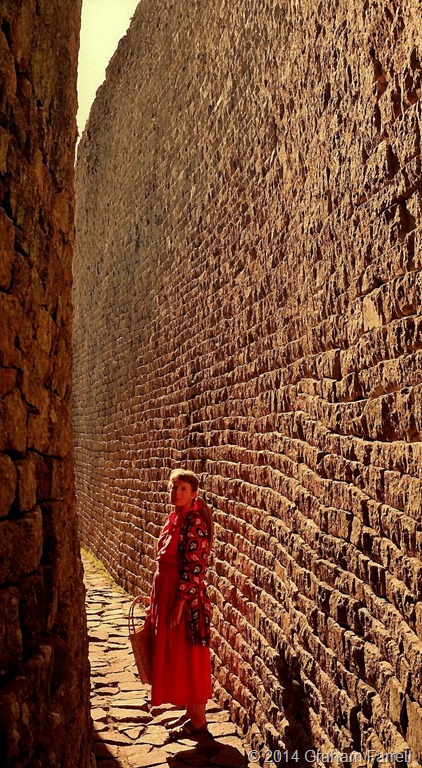
Inside the Great Enclosure of Great Zimbabwe. These magnificent walls have survived for nearly seven centuries, and not a lick of mortar to keep them standing.

No one knows exactly why this great African city was abandoned. For some 350 years, until around 1450 AD, Great Zimbabwe had been a flourishing merchant centre that drew in from the surrounding country supplies of gold, copper, ivory, animal skins and cotton. The city’s entrepreneurs then traded these goods on to the Swahili city states of Sofala and Kilwa on the East African coast. (You can read more about the Swahili HERE). In return, the traders brought back luxury goods – jewellery, decorative pieces such as 13th and 14th century Chinese celadon dishes and Persian ceramics.
The city’s ruins cover 80 hectares, its many stone enclosures commanding the southern slopes of Zimbabwe’s High Plateau watershed between the Zambezi and Limpopo Rivers. The site is well watered with good grazing throughout the year. It is above the zone of the deadly tsetse fly that can infect both cattle and humans with sleeping sickness; and the plateau’s granite scarps provide plentiful building stone and other raw materials. Even so, these favourable circumstances do not explain why this particular settlement rose to such prominence.
For Great Zimbabwe was not a singular phenomenon. Contemporary with it, and across the High Plateau region, are the remains of at least a hundred other mazimbabwe (houses of stone). Several were large enough to have been the capitals of rival states. Others may have been satellite communities occupied by members of Great Zimbabwe’s ruling lineage.
So who were the city’s builders?
During Zimbabwe’s colonial times, and until independence, the Rhodesian government actively supressed evidence that Great Zimbabwe was built by Africans. Many of the other stone ruins were destroyed or re-purposed by European settler farmers. The official view claimed that the city was Phoenician, and that the Queen of Sheba’s fabled kingdom of Ophir had been discovered. Archaeologists, however, have long demonstrated that it was the cattle-owning Karanga Shona who built Great Zimbabwe. The first phase of stone building began around 1100 AD. Thereafter, the city’s rising fortunes and successive building phases suggest its increasing control of the ancient High Plateau trade routes to the Swahili cities of Sofala and Kilwa.
Gold was the key commodity, and it is likely that it was Great Zimbabwe’s successful cattle production that provided it with the trading power to secure gold supplies from mines some 40 kilometres away. The more prosperous the city became, the more sophisticated its demonstrations of prestige. In around 1350 AD the Great Enclosure of finely dressed stone was built. This huge elliptical structure with its mysterious platform and conical tower is thought to be the royal court. There is no indication that the walls were defensive. This was a regime confident in its power and authority.
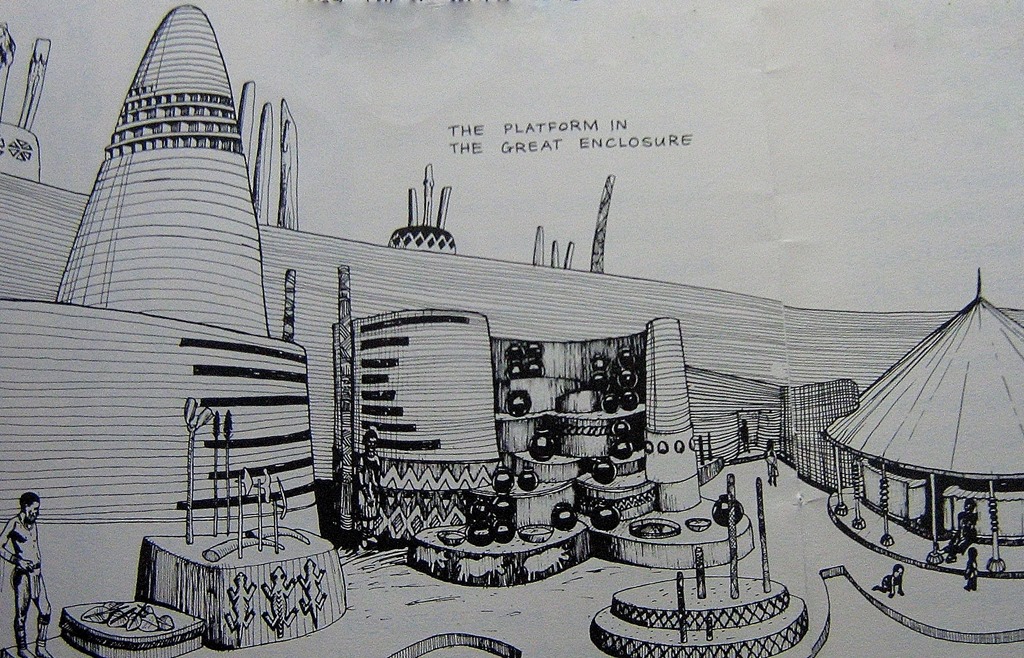
Peter Garlake’s reconstruction of the Great Enclosure Platform from Life at Great Zimbabwe, Mambo Press 1982
*
Then why did the city decline?
There are various explanations: the people had let their herds overgraze the land; they had cut down all the trees; there was a prolonged period of drought as may happen in southern Africa. But somehow none of these theories quite explain why, after 350 flourishing years, a community of perhaps 20,000-plus people should simply pack up and leave. Did all these farmers, herders, miners, craftspeople, soldiers, traders, accountants, court personnel and the city’s rulers leave on a single day, or did the city die slowly? The archaeological evidence does not say.
But we do know there were disruptive external forces at work. In the 15th century the Portuguese invaded the Swahili coastal city of Sofala. They were on the hunt for gold and so pressed inland with Swahili guides. Their interfering presence drove the trading routes north, giving rise to the Mutapa state. This new state may well have been founded by people from Great Zimbabwe. Certainly by this time the Swahili traders were coming up the Zambezi to trade with the Shona directly, the old trade route through Great Zimbabwe no longer used. At this time, too, we see the beginning of another Shona city state with the building of the stone city at Khami near Bulawayo in southwest Zimbabwe. In the following centuries this became the centre of the Torwa-Rozvi state whose other major cities during the 16th and 17th centuries included Naletale and Danangombe.

The Great Enclosure entrance at Great Zimbabwe built c.1350 AD
*
And so into history…
Of course with the Portuguese incursions comes the first documentary evidence. From the early 1500s Zimbabwe’s royal courts enter the historic record in the accounts of the Portuguese conquistadores. In 1506 Diogo de Alcacova writes to his king, describing a city of the Mutapa state
“called Zimbany…which is big and where the king always lives.” His houses are “of stone and clay and very large and on one level.” Within the kingdom there are “many very large towns and many other villages.”
The Portuguese historian Faria y Sousa also describes the King of Mutapa’s great retinue which included the governor of the client kingdoms, the commander-general of the army, the court steward, the magician and the apothecary, the head musician “who had many under him and who was a great lord”. Also noted were the vast territories over which the king ruled, the revenues and subject kingdoms of the king’s several queens.
And suddenly we have a true glimpse of what this land called Zimbabwe might have looked like in the past, a bustling, mercantile, metropolitan culture, supported by gold miners, farmers, cattle herders and craftspeople. And so it remained until well into the 18th century, albeit with a shift of Shona power to the southwest and the Torwa-Ruzvi state as the Portuguese presence caused increasing instability. Then in the 19th century came new invaders – the Nguni, the Ndebele and the British.
This centuries old heritage of royal courts is not a picture that the likes of Cecil Rhodes or, the later Rhodesian government of Ian Smith ever wanted anyone to see. And so in the end this is not so much a story of a city abandoned by its people, but of a people wilfully excluded from their past. In 1980 when Zimbabwe became an independent state, some of this past was reclaimed: the new state took its name from the first great Shona city, and adopted for its flag and coat of arms, an image of one of the city’s ceremonial soapstone birds. These are small steps forward, but there is still a long way to go before the world sees the indigenous histories of the Africa continent in their true perspective, and acknowledges their intrinsic cultural worth.
There is more about Great Zimbabwe in an earlier post HERE.
References: The classic work on the excavations of the city is Peter Garlake’s Great Zimbabwe 1973. For an overview of the mazimbabwe culture see Innocent Pikirayi’s The Zimbabwe Culture AltaMira Press 2001. For a wider historical perspective Randall L. Pouwels The African and Middle Eastern World, 600-1500 Oxford University Press.
© 2014 Tish Farrell
“Encompassed by a world of tangible, visible things – animals, plants, and stars – mankind has from time immemorial perceived that deep within these beings and things dwells something powerful, yet indescribable, that gives them life.”
Cosmic view of the Fulani people of West Africa
*
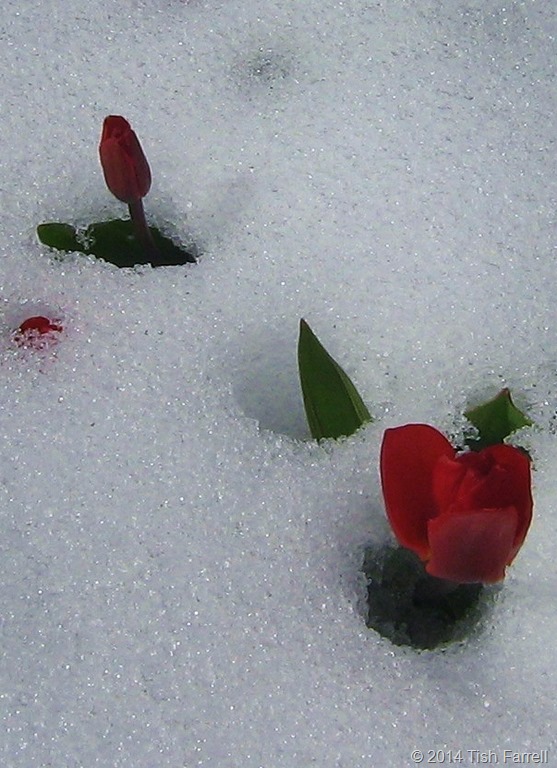
I took this photo last spring, in March when we were plunged into a sudden and unexpected winter. In seemed that the tulips were burning their way through the snow – biological imperative incarnate: come hell or high water, these tulips will BECOME.
In some ways, though, I find the image disturbing, especially the bud just breaking through the snow, and the dark little shadow at the centre top where another seems to be welling just beneath the surface like a bruise. Is the earth bleeding?
Of course, in no time my mind flies to that wintery scene with the good queen, Snow White’s mother. There she sits with her embroidery at the castle window. There she pricks her finger as she sews, the blood drops falling on the snowy whiteness. And there she makes the pledge that calls into being a beautiful child, but in the process brings about her own end.

The queen pricks her finger. Snow White illustrated by Charles Santore 1997
*
And so by degrees I start thinking of the creative process, that is to say, my creative process or seeming lack of same. And while I am sure that many creative people (which is all of us) will be facing the New Year with renewed vigour and hopefulness at the journey ahead, there are others of us who remain intent on endlessly hunting round the same old circles that take us nowhere. We are of course woozle hunting and A.A. Milne sums up the entire predicament perfectly.
*
‘One fine winter’s day when Piglet was brushing away the snow in front of his house, he happened to look up, and there was Winnie-the-Pooh. Pooh was walking round and round in a circle, thinking of something else, and when Piglet called to him, he just went on walking.

“Hallo!” said Piglet, “what are you doing?”
“Hunting,” said Pooh.
“Hunting what?”
“Tracking something,” said Winnie-the-Pooh very mysteriously.
“Tracking what?” said Piglet, coming closer
“That’s just what I ask myself. I ask myself, What?”
“What do you think you’ll answer?”
“I shall have to wait until I catch up with it,” said Winnie-the-Pooh.”
Winnie-the-Pooh 1926, A A Milne, illustrated by E H Shepard
*
Next then comes the question of how, creatively speaking, does one get off the treadmill of woozle hunting (which can of course become perversely absorbing despite the fruitlessness of the quest) and lift off into the stratosphere with the high-octane thrust of tulips breaking bounds?
Perhaps to begin to answer this, it is first important to know that human creativity has its cycles in much the same way as the natural world, or indeed tulips. In her audio compilation The Creative Fire, poet, storyteller and Jungian psycho-analyst, Clarissa Pinkola Estés puts it this way:
“Creativity goes through many different cycles: of birth, rising energy, reaching a zenith, declining, further entropy, death, incubation, quickening, rebirth…”
She then elaborates on this process by retelling two versions of the Persephone story , the Greek myth that, among other things, explains the origins of winter and spring.

In other words, a period of dying down, gathering in resources, dormancy, are all essential before strong new growth can occur. The tulips, after all, had some nine months of dying down and re-growing their bulbs.
CPE has other words of wisdom too:
“The main struggle that people have with creativity is that they stop themselves from doing what comes naturally.”
And:
“We all cover miles and miles of territory looking for the starting line when it’s inside of our minds the entire time.”
She also deals with the deep-rooted fear that most of us have: that our creative impulse/spirit/inspiration has died or deserted us. She likens it to la chispa, the hearth ember that seems quite dead until you breathe upon it, fanning the flames so that once more it bursts into a blazing fire. If we feel stifled and blocked she suggests that the causes are probably fear, the lies that people have told us about our creativity, and the fact that we have paid way too much attention to our internal critic.
“The creative function,” she concludes, “ is the centre of the soul and the psyche; it can never be destroyed.”
So there we have it. Less woozle hunting, and more blowing on dead wood. Also listen to your internal wisdom, then make like a tulip. Who knows what it will lead it.
Or as the Nigerian writer Chinua Achebe said:
“Art is man’s constant effort to create for himself a different order of reality from that which is given to him.”
There are no rules and regulations on the number of times that we must re-do a piece of work before we have made it to our liking. The only rule is to give yourself a break, then go to it.
*
Wishing you all a happy and floriferous 2014
*
Weekly photo challenge: beginning: go here for more Daily Post beginnings
© 2014 Tish Farrell
Weekly Photo Challenge: Horizon
DP Daily Prompt: The Golden Hour
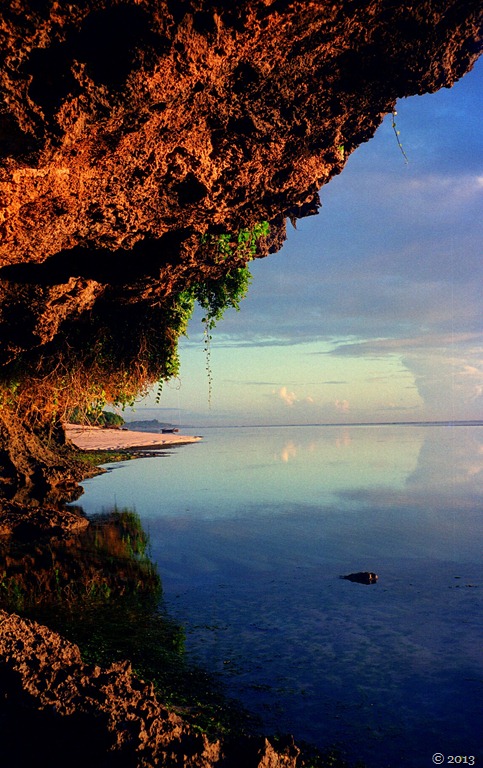
Beyond the shore, the reef, the sea, and then the sky: dawn one Christmas off Tiwi Beach, Mombasa
*
Other striking horizons:
copyright 2013 Tish Farrell
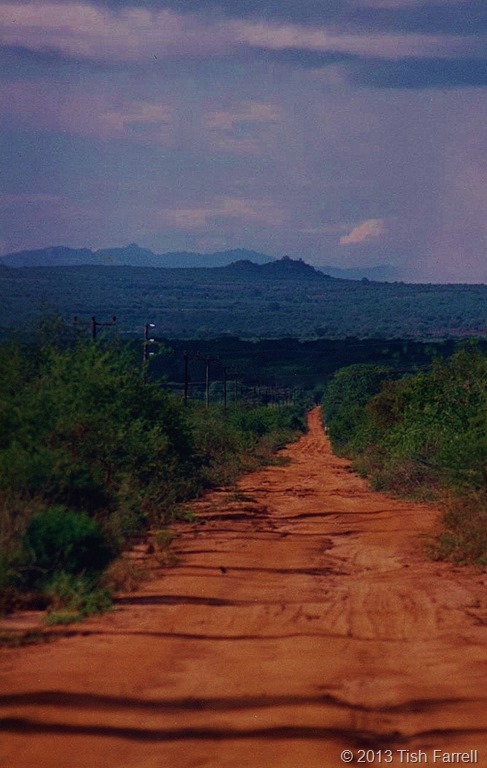
The road from the Range Station to Kiboko
*
I can pretty much bank on it. Once you have been in Africa you will never be the same. Nowhere else will you feel so alive, or so in love, or so entranced or indeed, afraid. In the physical sense, your blood and guts may well bear traces of the diseases and parasites you encounter there for years to come. Certainly the psyche will be forever afflicted by acute withdrawal symptoms, the loss of sensation, the no-longer-state of being always in the present – the only way to live back there.
In elemental ways too, standing, for instance, in East Africa’s Rift Valley, you could well find yourself confronting your genetic heritage for the very first time: the dazzling revelation that this is the land where your ancestors stood up on their apes’ hind legs and marched onwards to the age of technological development that we like to call civilization. It is the moment that you understand that you and this landmass are intimately connected through every pore, cell and bone.
And the reason I can say this, daring such unbridled presumption, is because it happened to me, and to G, and to all who know us and visited us there. Africa gets under your skin and, to quote a dear old friend “up your nose and into your soul.”
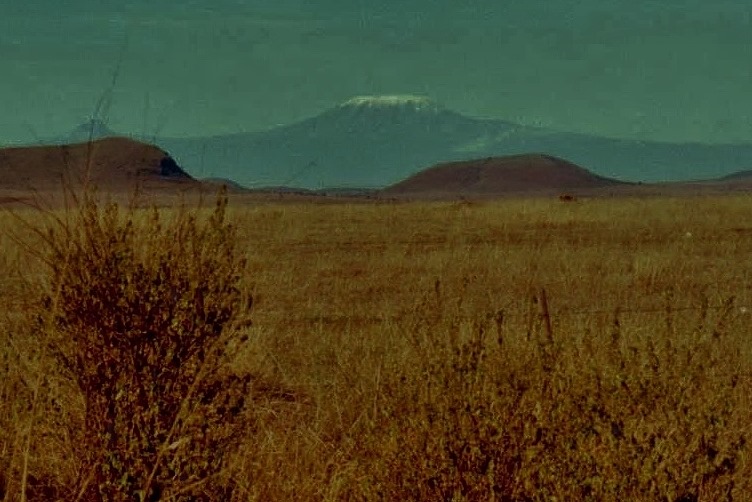
Kilimanjaro caught from the Mombasa highway just south of Kiboko
*
For me the journey into Africa began, with auspicious timing, on the 14th February 1992. This was the day I ran away – to Kenya to be precise, leaving home, possessions, accountant spouse and several labradors in order to travel with a roving entomologist who had no home, no possessions – neither in Africa nor in England. He had recently been in Mexico researching the habits of the Larger Grain Borer (LGB), a small maize-eating beetle that ravages stored crops. Before this he had worked for two years in Tabora, Tanzania, as a volunteer Agricultural Extension worker, also advising farmers about LGB. (See earlier post On Kenya’s Farms)
In the 1980s this pest had arrived in Africa (where it has no known natural predators), introduced on consignments of food aid from the Americas. In 1992, then, G was on a new LGB mission: to monitor the beetle’s spread from Mombasa on the Indian Ocean coast to Nairobi in the Kenya’s central highlands. For the next nine months we would lead a nomadic life, travelling up and down the Mombasa highway, which back then was little more than a ribbon of ragged tarmac running through the bush.
The road was fraught with dangers – from gargantuan potholes to car-jackers lurking in the thorn scrub. There were also successions of stranded trucks left where you least expected them, and the possibility of some belligerent buffalo insisting on a standoff in the middle of the highway; and then there were policemen flagging us down for lifts, or to give us speeding tickets when we had not been speeding.
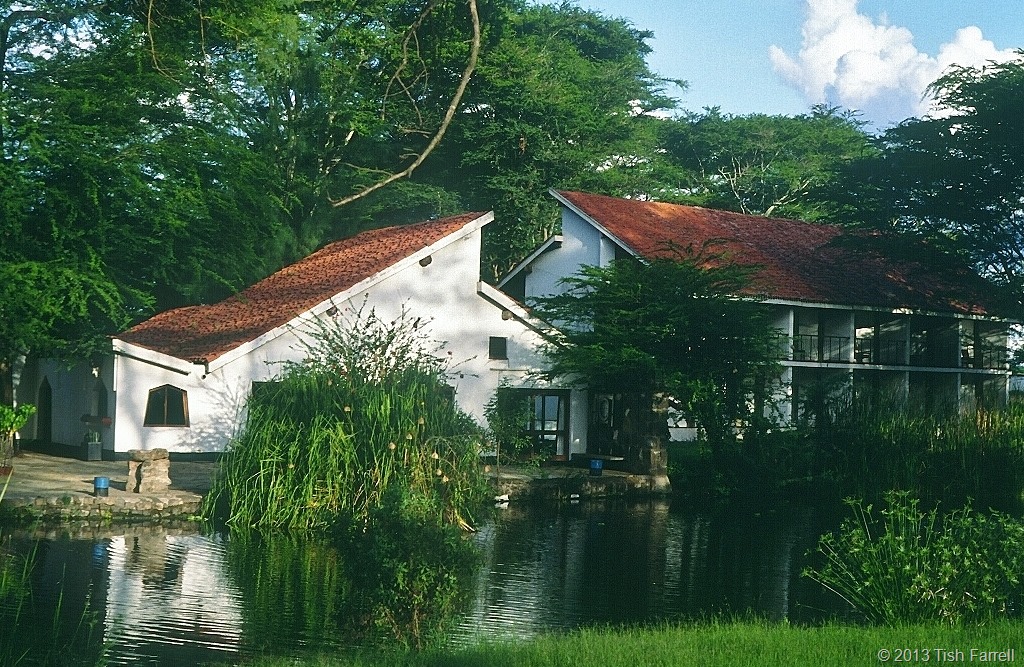
Hunter’s Lodge, Kiboko
*
During these nine months we stayed in roadside hotels, safari lodges, beach cottages, a Danish development workers’ guesthouse, and, best of all, at Hunter’s Lodge where we were usually to be found for three or four days each week. This one-time home and small hotel was begun by Great White Hunter, John Hunter, at a small place called Kiboko, some hundred miles south of Nairobi. The place had once been a regular resort for expatriates taking a weekend break from the capital, or a convenient overnight stop en route for Mombasa beach. This was in the days when the road was still an un-metalled cart track, and it took all day to get there (needless to say, covered head to toe in red plains’ dust). The coast was a further 200 mile-drive, including the long stretch of desolate Taru thorn scrub south of Voi.
Kiboko, then, was in every way an oasis. John Hunter had long had his eye on the location before he moved there in his retirement in 1958. He had arrived in British East Africa in 1908 in the wake of the first European settlers, and made a career of clearing unwanted game: first lions from the Uganda railway that ran nearby and later, on behalf of the colonial game department, elephant from settler farms, and marauding hyena from the African native reserves.
He also ran private safaris for counts and maharajas, and therefore rubbed shoulders with the likes of Karen Blixen’s white hunter husband, Bror Blixen, and her lover, Denys Finch Hatton (Out of Africa). In his time, Hunter was personally responsible for despatching over 1,400 elephants, and nearly as many rhinoceros. Local myth had it that Hunter gave up repairing the hotel sign which a vengeful rhino was intent on flattening. Besides, in those days, everyone who was anyone knew where Hunter’s Lodge was.
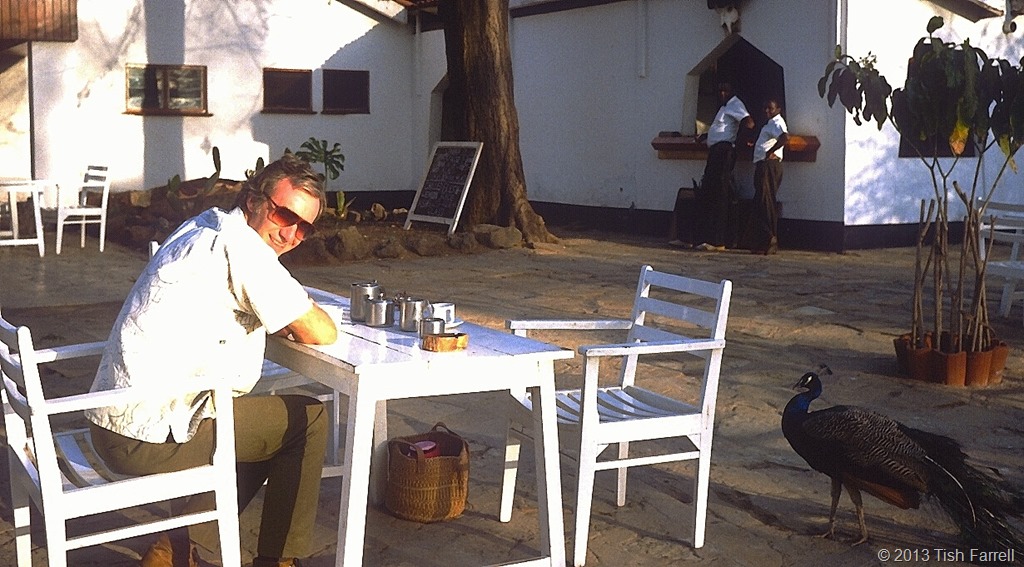
Afternoon tea with the sugar-stealing peacock
*
The reason Hunter chose Kiboko to settle was because it had fresh water: a volcanic spring, and the only one for miles around. In the old days he had often watched elephant coming there at sundown to drink. He, however, set about damming the stream to make a small lake, this surrounded by a grove of graceful fever trees and wild figs. Given the general aridity of the surrounding bush country, it truly is a beautiful place, a resort not only for human travellers, but for some three hundred species of bird. When we were there, there was also talk that a leopard haunted the upper reaches of the pool, but we never saw it: only baboons and vervet monkeys, a bushbaby and a monitor lizard.
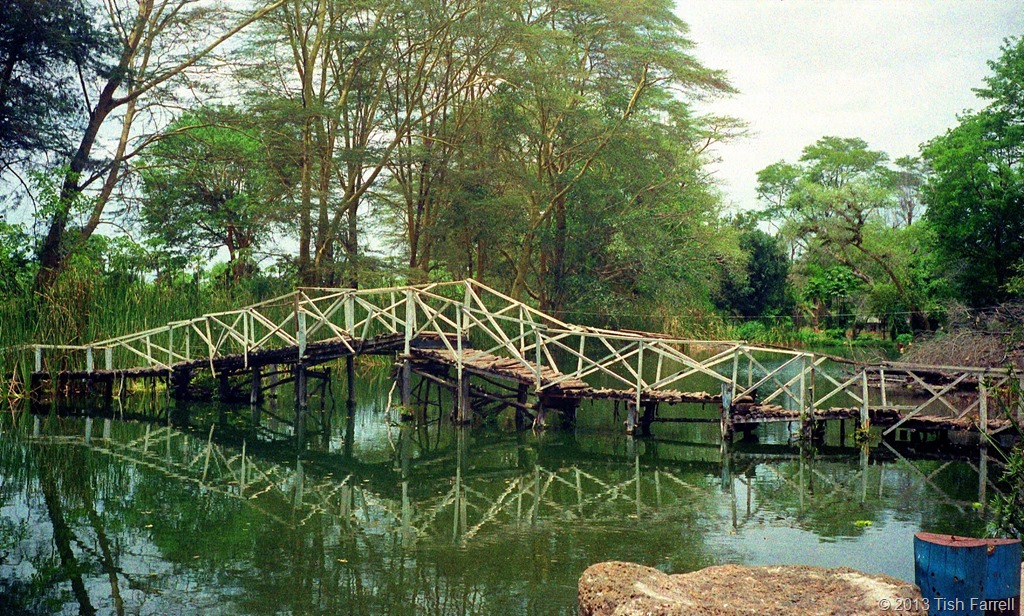
The bridge to the vegetable shamba
*
And the reason that we often stayed there was because the Kenya Agricultural Research Institute had a small research station and laboratory just behind the lodge. On starting his job, Graham was gravely entrusted with a key to the back garden gate, so that at 7.30 am he could walk to work, and then walk back again for lunch at noon. The lab employed a dozen technicians, all working on the LGB project.
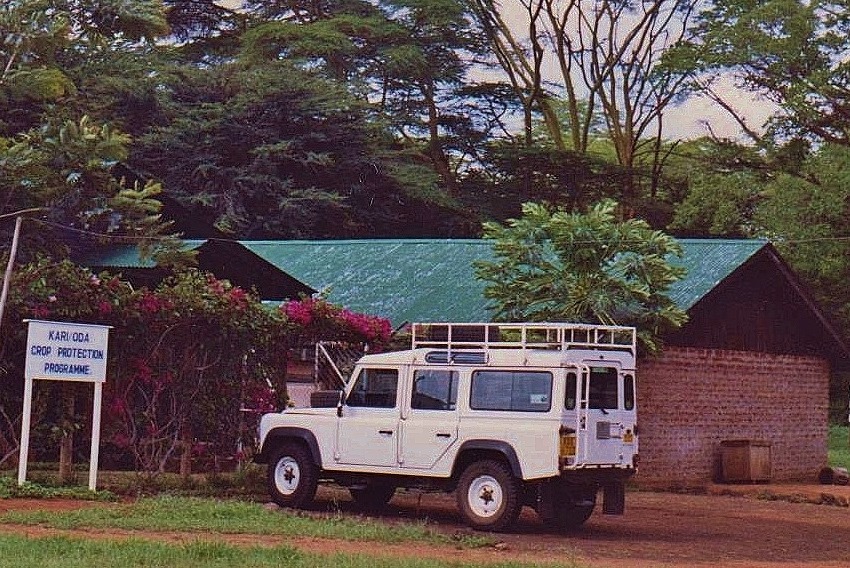
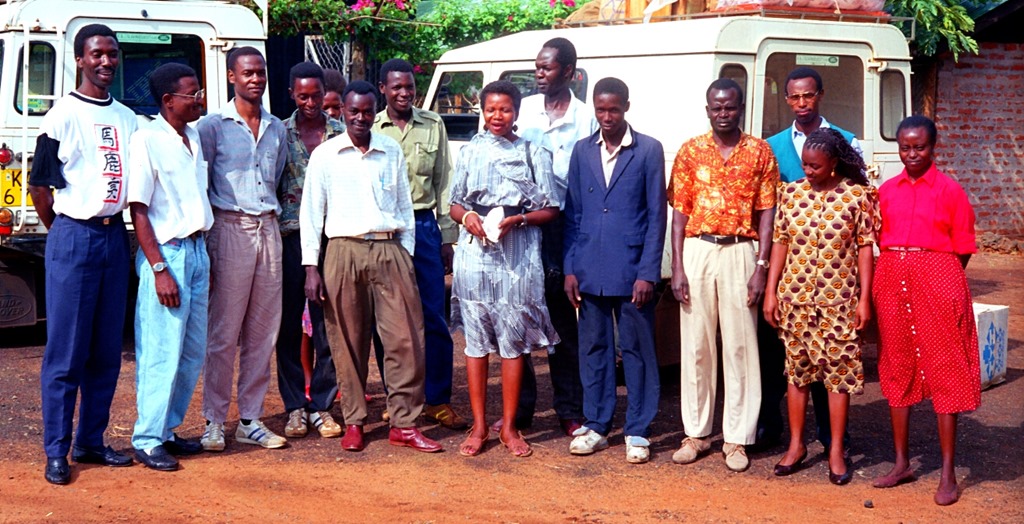
Kiboko lab and staff
*
In 1992 Hunter’s Lodge rarely had many overnight guests. Sometimes G’s boss would be stay; sometimes a travelling salesman; sometimes an aid worker or two. Once, an Intermediate Technology N.G.O held a two-day seminar there. Once, a large group of Nairobi Asians came for a weekend party. The main trade, however, comprised passing travellers who dropped in throughout the day for snacks and drinks. These were served by smart bow-tied waiters on the bar terrace where you would be stalked by a bedraggled peacock, which sorely depressed since its mate had been swallowed by a python, sought pleasure in raiding the sugar bowl whenever it had the chance. It was a sad old bird.
The menu was limited: cheese sandwiches, steak and chips and omelettes. But the cook did prepare an amazing fresh lemon juice made from the lodge garden’s own lemons. It was sour enough to curl your teeth, but extraordinarily sweet too. We also soon took to carrying a plastic tea strainer around with us – to sieve the skin out of the milk, both from the breakfast wheatie flakes, and before we poured it into our tea.
The milk was brought daily by Maasai women and their donkies, and boiled within an inch of its life. Even so, it still tasted of the ash-scrubbed gourds that it was delivered in. This milk, coupled with the sulphurous water from the spring, made afternoon tea a daily strange experience. Only the lack of other things to do when G came home from work at five o’clock made us persist with it. Going for tea on the terrace was, after all, an outing – a different experience from the lunch and supper outing to exactly the same spot, or to the breakfast outing which was to the lodge dining room with its strange ogival doorways.
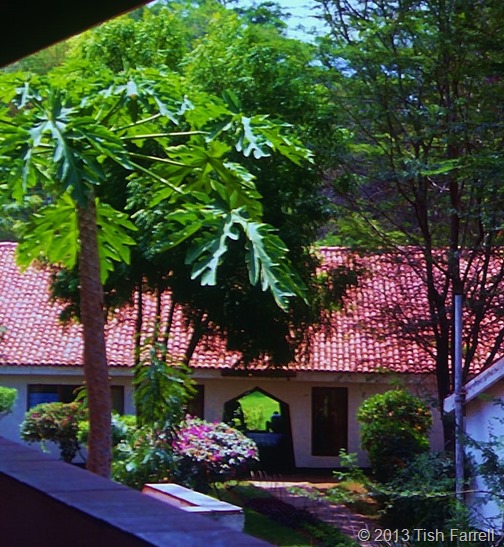
Looking toward the Lodge dining room
*
The best pursuit of the day, so long as there had been a calor gas delivery, was at sundown to resort to the shower in our room. The shower fittings went under the manufacturer’s name of Steamy Steamy. After a dusty drive up or down the Mombasa highway, a good Steamy Steamy was the only thing we could think of.
Then by seven when it was quite dark, and we were duly steamed and dressed, the next treat would be to sit on our veranda and wait for the firefly display up and down the garden lake. This was followed by a trip to the bar and a couple of Tusker beers. If John, the young Maasai barman, was on duty, then we were in for some good conversation. He had opinions on everything. The local Akamba waiters would stand about and gaze at him in awe, whether he was talking to us or to them. He told us he owned 150 cattle, and had two wives. He had not wanted to marry a second time, he explained, but his parents had urged him because his mother had kidney disease and needed more household help. He had accepted the situation philosophically.
Once, John offered to take me on the back of his bicycle into the bush to his family’s ‘enkang and to see a female circumcision ceremony. I wished I’d had the guts to accept. He told me his home was only two hours away, as if I would manage the ride over bush tracks quite easily, me who had never ever balanced myself on a bicycle parcel rack.
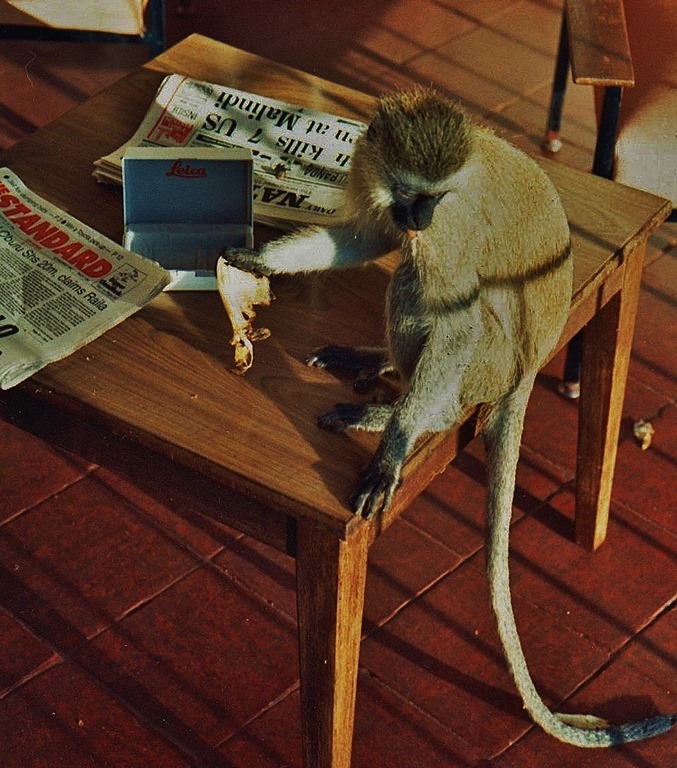
Caught red-handed, a vervet raider eating our bananas
*
While G was at work, I wrote letters and read. But mostly I watched. I soon realized that the Lodge was run, not for guests, but for the benefit of its staff. Their daily routine of cleaning and tending went on whether or not there were any guests. The garden staff wore brown overalls. They mowed the lawn, and worked in the vegetable shamba across the lake. Around ten in the morning a bell rang and everyone disappeared for a tea-break. The manager wore a smart khaki Kaunda suit, and marched hither and thither, but to no apparent purpose.
Then there was Joyce, the chambermaid. Her husband worked down at Kibwezi and was a forestry officer. She lived with her two little boys in the staff bandas at the bottom of the garden. On her days off she went home to the family farm. She told me that I should learn Ki-Swahili since it was very easy. I agreed, but only learned a smattering. The hello, how are you: jambo, habari yako?
Between the gentle staff activity, there was only the wildlife to observe, vervet monkeys planning raids on our room, pied kingfishers diving, yellow weavers endlessly weaving, herons clattering their bills in the thorn tree heronry, marabou storks lurking like spectres on the lawn, hadada ibis winking out grubs with their curvy bills. And over all, the high-tension whine of crickets that could drive you mad when you were not feeling well.
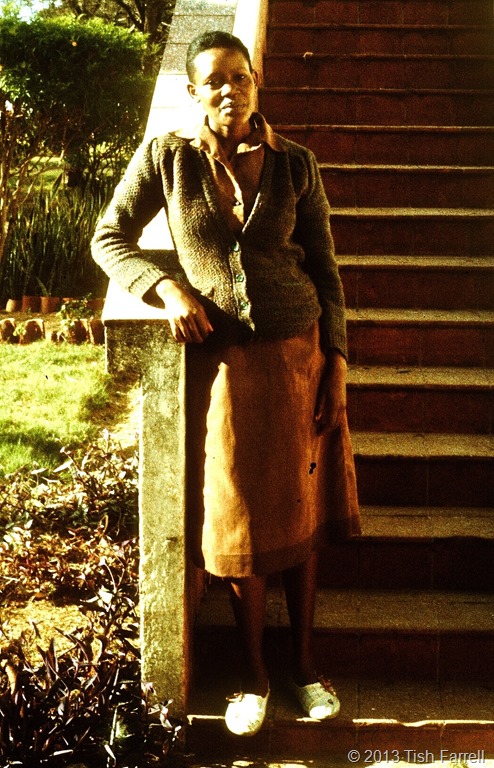
Joyce
*
One of the features of Kiboko, I soon discovered, was the wood carvers’ stalls opposite the Lodge. Sometimes I took my clothes down to Esther who ran such a stall, and traded them for Akamba carvings. She struck a hard deal, and I was a simpleton when it came to haggling. G was nonetheless impressed since it lightened the contents of my two bags.
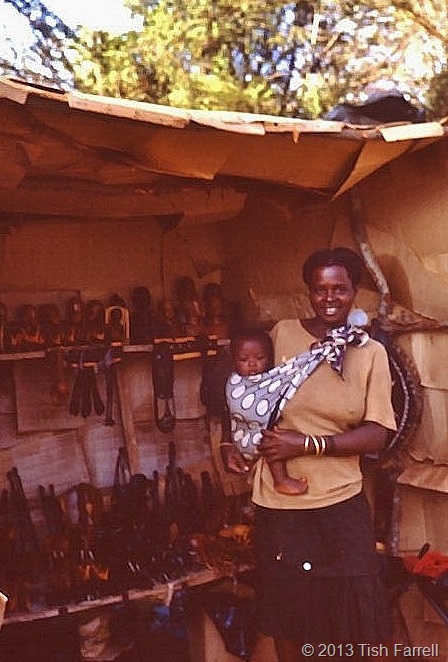
Esther at her stall with son, Tom
*
And so it was that Hunter’s Lodge became a home of sorts. Whichever way we approached it on the Mombasa highway, my eyes would fix on the green grove of fever trees, and my spirits would lift as we turned off the road. There was Steamy Steamy to look forward to, the smoky taste of the tea, Reuben the breakfast waiter who always asked us if we were having eggs though we never did. Only later did we discover that we had paid for a full breakfast in with our room rate. There was the birdlife to watch, and the sleepy routine of the hotel staff to keep tabs on; there were the steaks that our weak teeth found impossible to process, the fireflies and the vervets, and there were the brief African sunsets as the light turned through lavender and orange to black, black night. There was irony too, for it was of course the metalled road that turned Hunter’s Lodge from oasis to backwater, making the coast accessible in a single day: an unintended consequence of progress.
I remember the long nights I lay awake, listening to the whine of insects, the drone of trucks on the Mombasa highway, the hoot of the train on Uganda railway. We are in Africa, I would tell myself. And even when I was there, so very much present in every sense, it still seemed like a dream. Perhaps this land was the original Garden of Eden. When we left it, we took our self-regarding selves to material greatness. Maybe the price for this knowledge was the loss of wisdom. Even now, so many years on, I still travel the road to Kiboko, at least in spirit, and ponder this conundrum. The great safari continues…

Letter from Kathleen Collins Howell, illustrator and best friend
© 2013 Tish Farrell
Weekly Photo Challenge: Saturated
*
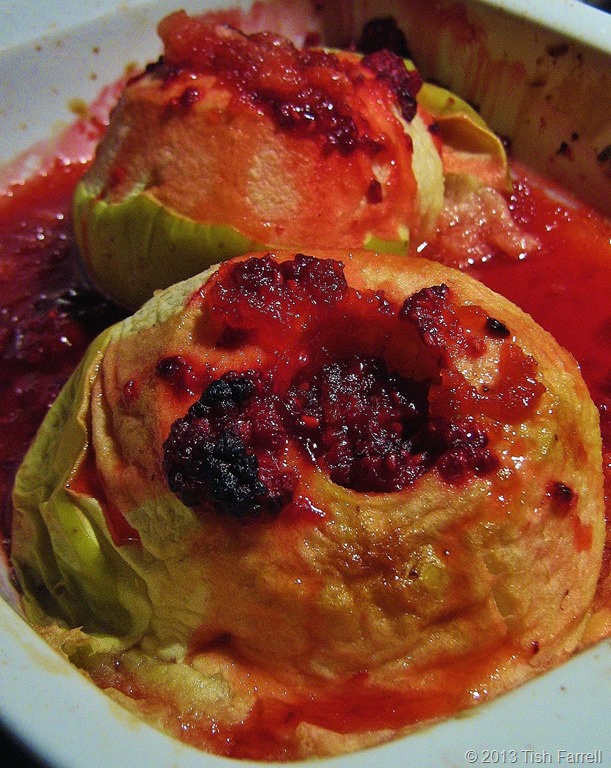
The fat Bramley apples came from the Women’s Institute market, held in Much Wenlock every Thursday morning. The trestle tables are set out in the old Corn Exchange outside the library and are invariably laden with home-baked cakes – Lemon Drizzle, Rich Fruit, Iced Ginger, Millionaire’s Shortbread. Then there are the jams and marmalade.
But in recent weeks – this being the season of over-laden fruit trees – there has also been garden produce, and in particular bags of Bramley cooking apples. And what better thing to do with a Bramley than to bake it, stuffed with the last of the allotment raspberries?
The raspberries are called Autumn Bliss, and deliciously live up to their name; and especially so when added to apple. The synergy of hot, fruity flavours hits every taste bud with a satisfying zing.
This is how I cooked them.
*
Baked Apples
*
Per person: one apple, a handful of fruit, a good teaspoon of honey, a sliver of butter
Set oven to 200 C, 190 C for fan versions
With a corer or sharp knife carefully remove the apple middles, making sure all tough core bits are excised.
Remove the peel from the upper half of the fruit, then place in a greased oven-proof dish.
Stuff the apple centres with raspberries, adding a good teaspoon of runny honey to each apple. I used fair trade wild Zambian honey, which is cold-pressed, and has a rich, slightly smoky flavour.
Scatter any spare raspberries over the top.
Slather a small nugget of farmhouse butter over each apple.
Add half a cup of water to the dish.
Bake for around 30 minutes, basting with the juices half way through. Bramleys have a habit of exploding, as mine were about to do, so keep an eye on them.
*
Desert apples can also be baked, though they need longer, slower cooking and must be well basted. The result is not as ‘fluffy’ as a Bramley, and it’s better to remove all the peel. But desert apples often have a more distinctive flavour. Dip them first in in water with a squeeze of lemon to stop them discolouring.
Of course there are endless variations when it comes to stuffing apples. A good old English version is to use sultanas and raisins with a dollop of Golden Syrup. You could make my version more sophisticated with a drizzle of an appropriate liqueur. Armagnac springs to mind. Or Creme de Cassis. And serve with some toasted almond flakes. But however you make them, they always go well with Greek yoghurt. (Or thick farmhouse cream…)
© 2013 Tish Farrell
First off, before the best bits, I should say that there’s a bug in the Word Press system, so dear followers and followees, please check your SPAM for any comments from me or other afflicted bloggers and (only if you want to of course) upspam them. Otherwise, on most blogs, my comments are currently going straight to SPAM. It’s a cunning way to stop us from talking to each other. Curses on the joyless little bug that is doing this.
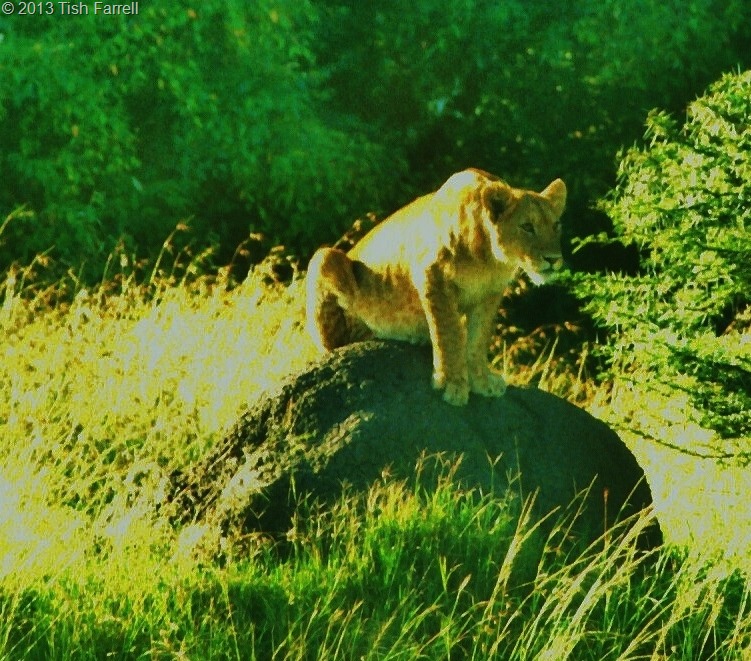
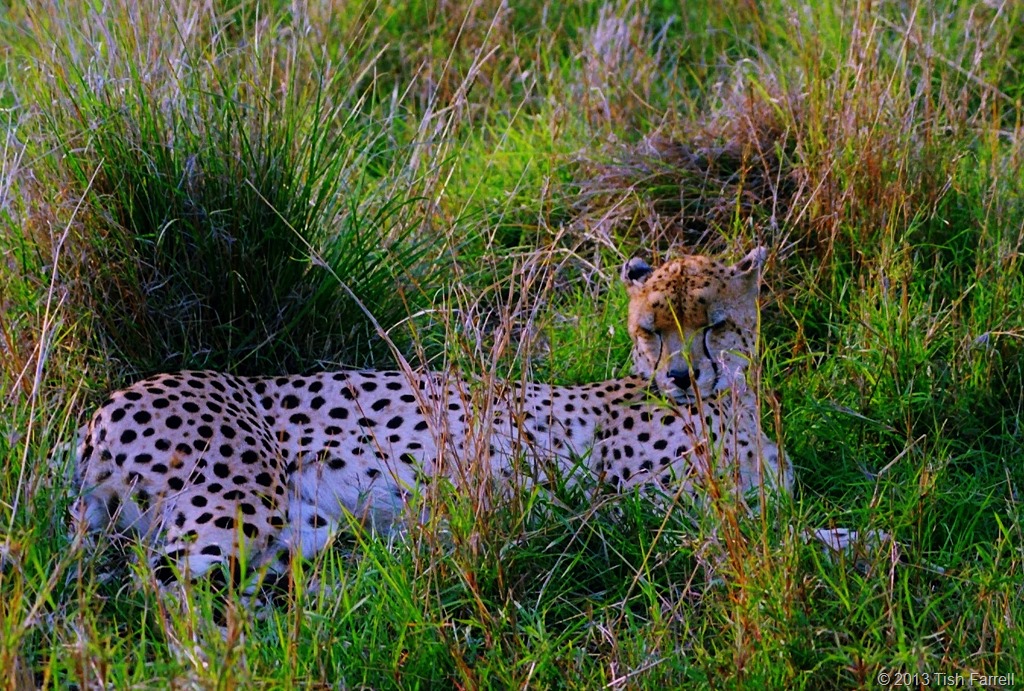
Now for some late afternoon views of big cats and other animals in the Maasai Mara. This photo shows just how easily lion conceal themselves in quite short grass. Here, as sunset approaches they are becoming watchful, although they could scarcely care less about us watching them. Soon it will be time to go hunting.

*

Just to the right of the lioness is another lion. It makes you appreciate how intrepid are the Maasai who daily have to graze their herds, and also fetch firewood and water out on these plains. (For more about this you can read my short story ‘Flight’ HERE. It was one of the Bath Short Story Award winners and tells the story of a Maasai girl’s life in this extraordinary land.) Doubtless the herders keep an eye on where particular prides are spending their sleeping hours, but even so, walking into a laid-out lion seems a distinct and chilling possibility.
*



Notes from an aid nomad’s life in Zambia
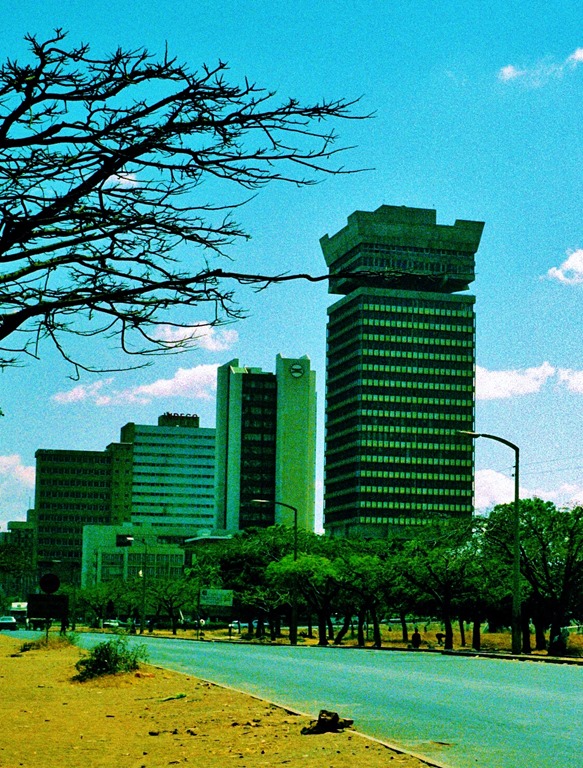
October 1992 and I’m expecting to start a new life in Medway, Kent, but instead I find we are off to Lusaka. It is hard to take in. I am barely back in England after nine months in Kenya where we lived out of a Land Rover, plying the Mombasa Highway. My heart is still in the Ngong Hills, the knuckle-shaped peaks that were my last view of East Africa before the plane rose through the clouds and headed for London via Bahrain. In that moment I find myself weeping for the loss of the Ngongs, recognising, with a twinge of shame, I would never weep like this for my homeland.
Due to ticket problems I have to travel back to the UK alone. G will follow the day after. When we say goodbye at Nairobi airport there is no inkling of another overseas contract. Yet two days later when we meet up in England, the first thing G says is: how would you like to go to Zambia?
Zambia, I echo blankly. How would I know if I want to go there? But with barely a pause, I say yes; I’m up for it. I’ll find out later if I’m going to like the place. Besides, whatever happens, it’s bound to be interesting.
When we tell friends and family where we are going, they also look blank. Zambia, they say. What did it used to be? It is only months afterwards that I see how loaded is this seemingly simple question, how unfathomable the answer. What indeed did Zambia used to be – before it was Northern Rhodesia – before David Livingstone passed through it in search of lost souls and the Nile’s source, and claimed the falls known as Mosi oa Tunya (The Smoke that Thunders) for Queen Victoria; before the south’s Zulu Wars that pushed many displaced communities across the Zambezi?
We’re expected to leave within the month, but due to various administrative foul-ups, this stretches to two. It gives us time to unpack our Kenya life, catch up on dental work, have the jabs we have not already had, say hello and goodbye to relatives, and to get married. This last event takes place briefly before a handful of guests in a Bridgnorth building society office where the registrar has occasional premises. Our little marriage party finds itself queuing for attention alongside Friday morning withdrawers and depositors. It all seems fittingly bizarre for a life that no longer fits the norm.
At this point I am still no wiser about our destination. In these pre-Google days there is little time for research. To my annoyance, too, I find there are no handy books on Zambia, not in the public library, nor in the bookshops. By the time we come to leave, we have only the sparse Foreign Office briefing notes to go on. They speak of the climate and the kind of clothing we will need, and of the possibility of having to take a driving test if we want to drive in Zambia. No clear picture of the country emerges. I am becoming increasingly irritated at the lack of information, as well as at my own ignorance. How can I, an English woman, not know a thing about a land that Britain ruled and exploited for over sixty years, a land we only quitted in 1964 while I was in still at school? Why wasn’t it on the curriculum along with Cicero and Chekhov? How can the existence of a former protectorate pass so swiftly from the protecting nation’s consciousness? How can it become so very unimportant?
Then suddenly it’s too late for righteous indignation; it’s all down to family farewells, and wondering if the right things have been packed, when there is no way of knowing what the right things should be. Of necessity, it becomes a matter of travelling hopefully and telling ourselves that the contract is for ten months only. And ten months isn’t long, is it?
*
So, November 1992 and we fly into Lusaka with the rains. It seems like a good omen – to arrive with rain. There has been severe drought over southern Africa for at least a year. Crops have blown to dust, rivers run to sand, and the granaries lie empty. In remote districts, we later learn, villagers have been surviving on a diet of wild mangoes. To add to their misery, the wildlife is hungry too. In one district villagers have been barricading themselves into their homes. The local lions have developed a taste for canine flesh and are breaking down house doors at night in order to snatch the dogs from the midst of their terrified human families.
And of course, this is why we are going to Zambia; famine is taking us there. G has been seconded from the Natural Resources Institute in Kent to the E. U. Delegation in Lusaka to supervise the distribution of European Union food aid to starving Zambians. The country’s then new President, Frederick Chiluba, tells the Head of Delegation that he does not trust his ministers to do the job. The consignments of maize meal and cooking oil must therefore be distributed through church missions and the Red Cross. Zambia is a big country, the size of France and the Low Countries combined. G will be in charge of logistics: checking the contents of grain stores, getting trucks on the road and ensuring that loads reach their intended destination. His boss at NRI is sure he is fitted for the task, although he has never done anything like it before.
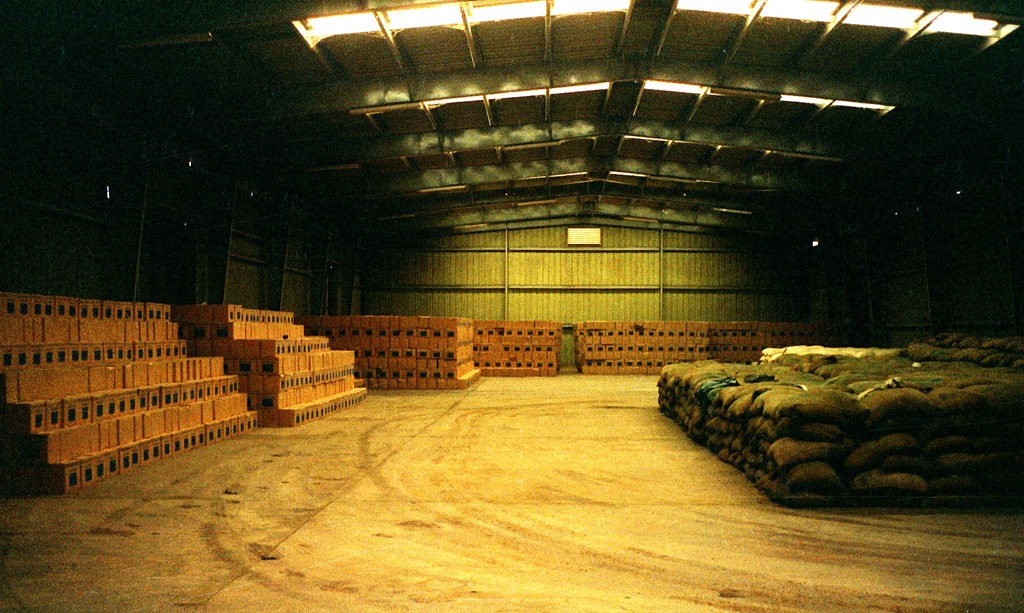
Food aid awaiting distribution in a Zambian warehouse.
*
In Kenya, as a crop storage specialist, he had been dealing with another kind of food crisis – the spread of a voracious pest that gobbles up maize – the Larger Grain Borer. This beetle is a native of South and Central America, and (ironically) came to Africa in the 1980s in a food aid consignment from the United States. It has no natural predators in its new homeland and, across a continent where maize is many peoples’ staple crop, it also has all the food it can eat. If a grain store is infested you can hear the jaws of these tiny creatures gnawing the cobs to dust. In Zambia we find the beetles are already there too, spreading out into villages along the line of the Tazara Railway that links land-locked Zambia to the port of Dar es Salaam. The Chinese built the line in the 1970s to provide Zambia with an external trade route through Tanzania after Ian Smith’s Unilateral Declaration of Independence in Southern Rhodesia cut the country off from all points south. Now the Tanzam is a handy vector for crop pests and thus, through such unintended consequences, is the frequent folly of donor good intention compounded. It is the sort of thing that happens in African countries all the time. It makes us question then (as we will do many times over the next few years) the ethics of our presence on the continent.
*
That November morning, then, as we make our descent through grey skies into Lusaka International Airport, I note only how flat and tamed the landscape looks: large square fields of European-owned ranches (Lonrho, for one, is a big player here); service roads and farm buildings laid out in orderly grid patterns. It is also very green and looks more like France than the Africa I have come to know. I suppose I feel a little disappointed. It is bush country that I have fallen in love with, the smell of it triggering some ancient genetic memory that tells me that such landscapes mean home.
Once down on the tarmac, and as a matter of courtesy so we will not get wet in this welcome downpour, a bus arrives to ferry us the short distance to the low white terminal building. Our fellow travellers are European businessmen, each shouldering his laptop bag. By contrast, a tall African in a well-cut suit emerges from the First Class cabin wielding only a shiny new golf club. It seems utterly incongruous, as if he has just stepped out of a London taxi after visiting a golfing shop rather than flying half way across the world. It crosses my mind that I like his style.
By now I am both jet-lagged and deeply anxious about the forthcoming immigration process. Still fresh in my mind is the stony-faced inscrutability of Kenyan officialdom when I twice visited the notorious Nyayo House immigration department to extend my three-month travel visa; I recall the hours left in limbo, sitting amongst distressed Somalis and Ethiopians, all trying to secure sanctuary away from troubled homelands. But suddenly I see it’s not going to be like this. The officers, as they take their seats at the immigration desks are all smart young women. They are laughing and chatting and, when we hand them our passports and paperwork, they are still smiling, and at us.
Next we have our first, but fleeting taste of the diplomatic life, as G’s new boss steps up and introduces himself. His name is Bernard. He is French, frenetic and instantly engaging. He whisks away our paperwork and deals with it in minutes. There is then a worrying delay before we can claim our bags. Bernard tells us that British Airways on this route are well known for leaving cases behind in London. Finally, though, we have our luggage and are propelled into Bernard’s Peugeot, Bernard talking non-stop. He apologises for his poor English, saying that this is his first posting to an English-speaking country. Mauretania and Madagascar were his previous postings. Worryingly, he adds that he hopes we will speak some French. Beside me, looking wan, G winces; he does not fly well. He can barely speak. When he does, it is to utter a customary response in KiSwahili. I’m beginning to feel hysterical.
Soon, though, all smooths out as we cruise along the Great East Road into Lusaka. There is little traffic (not like Nairobi), and the place has a small-town provincial air – wide streets lined with jacarandas shedding mauve petals and acacias with russet coloured flowers, red-roofed villas. We pass the turn to the University of Zambia, the entrance to Lusaka’s agricultural show ground. The side walks are filled with people walking – young men in loose shirts and smart front-pleated pants striding out, country women in ankle-length chitenge wraps, city girls in high heels and sleekly cut frocks, and who seem to flow along the street. There are roadside stalls selling garden surplus – mangoes, tomatoes, okra, spinach.

EU Delegation, Lusaka
*
And I am just thinking that I can cope with this when we swing into the grounds of the five-star Pomodzi Hotel, and Bernard’s car is instantly lassoed in chains whose ends the hotel porter quickly padlocks to an adjacent post. I have never seen nor imagined anything like this. Bernard explains that this is a necessary procedure even though it will only take a few minutes to escort us to reception. I see that other guests’ cars are similarly chained. It is then that my one sure piece of Zambia information surfaces. All along we have been ignoring it, that in that year of 1992 the country has a big security problem. Some months later the reasons for this become clear, but for now I am struggling to absorb this apparent evidence of an expected car-jacking – in broad daylight, and in such orderly and upmarket surroundings. I gaze, bemused, at the tail-coated porter who is now ushering us into the hotel foyer. After the humid warmth of outside, the hotel is frigid with air conditioning. The reception area is cavernous, all grey-white marble. A trolley appears and our cases are stacked upon it. They look shamefully shabby in these austerely smart surroundings. The porter politely motions me towards a comfortable armchair while G registers. This always takes ages, and by now it is lunchtime and I am hungry and yet too tired to want to eat. Then suddenly there are Englishmen everywhere. They seem to issue as one from the lift.
“Hello. I’m David…Peter…Tim…Paul…Alan. We’ve not been introduced but…”
As welcoming committees go, it is well meant but too much, and I wonder if I’m responding sensibly. They turn out to be G’s fellow consultants from the Natural Resources Institute, out on short-term missions relating to crop storage and food security. They include G’s head of section, the man who seconded him to the E.U. Delegation. He’s just off to Zimbabwe, and hardly have we reached our room than the phone rings, and G is summoned to an impromptu meeting and a trip round a Lusaka grain store that has flooded, none of which has anything to do with his present posting. He goes off looking terrible while I collapse on the bed, trying to come to terms with my new surroundings.
Here we are back in Africa, back in the so-called developing world, here to help deal with a food crisis. Yet now I find myself in a room that has more of comfort and opulence than I’m used to in England. There is a huge colour television that shows American and British world service programmes. There is a telephone by the bed and another beside the lavatory. The ivory tiled bathroom has abundant hot, clean water and piles of soft white towels. The flask of drinking water is chilled. We have our own veranda. The room service menu offers club sandwiches, burgers and steaks. A polite notice on the writing desk requests guests not to tempt the staff by leaving their valuables unattended.
This is a hotel designed not so much for travellers and tourists, but to cater for the expectations of international entrepreneurs. Its luxury is hard to reconcile with the hardship that G has been brought here to relieve. This is only the first of the multiple contradictions that we will encounter over the next ten months. We learn not to dwell on them, and so become part of the contradictions.
*
Now in Lusaka, we find ourselves dropped into a diplomatic no-man’s-land. Although G works for a British government institution and has been deployed by them on official business, neither the EU nor the British High Commission want to altogether acknowledge our presence in the country. We gather that the BHC has some bee in its bonnet about the cost of air-lifting us back to the UK in the event of some great ill befalling us. This is a puzzling response when all G asks for is some anti-malarial pills. They are not keen to give us any, since this establishes responsibility.
There is also a problem about finding us somewhere to live, this despite the fact that both missions have their own staff accommodation. We have been sent out with a stash of travellers’ cheques to pay for ten months’ rent and to buy a car, but house rents in Lusaka are twice the allowance we have been given. A Delegation secretary, a white Zambian, takes pity on us and directs us to a small company compound of eight houses where local Zambian Europeans and Asians live.
There is one house vacant, and we can just about afford it. The accommodation is very lowly by diplomatic standards, and full of dog-haired furniture, but we still manage to upset BHC consular etiquette because the compound has a swimming pool. Only officials of the higher orders may be allocated houses with pools. BHC staff kindly let us know of our gaff at social functions, although we wonder what it has to do with them since they were so unwilling to acknowledge our existence. Clearly the swimming pool has got under somebody’s skin.
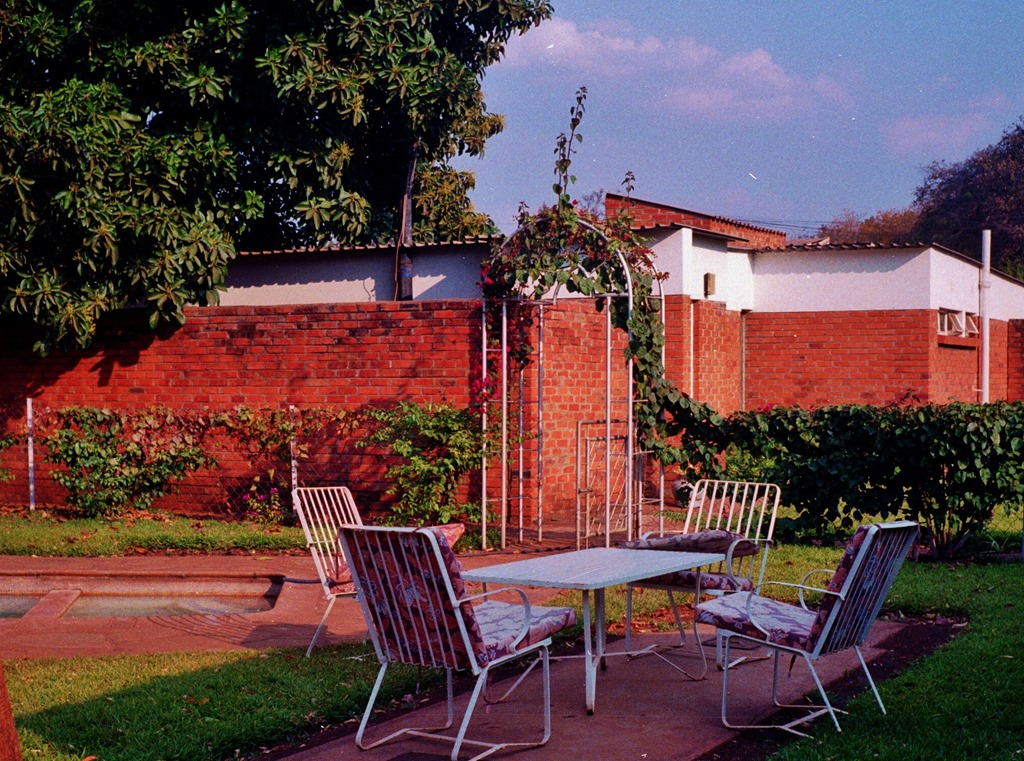
Home on the Sable Road compound.
*
Then, when we are among EU Delegation officials and their white Zambian staff, we are constantly regaled with tales of car-jackings, house break-ins, muggings and murder. At his house, Bernard has been newly issued with a gun and a short-wave radio to summon security in case of attacks by the locals. We presume that we are not important enough to warrant this scale of protection. When, after some weeks, I return to Zambian Immigration to renew my passport, and once more am treated with only good-hearted African courtesy, I consider switching my nationality to Zambian.
To be continued…
http://dailypost.wordpress.com/2013/07/07/daily-prompt-travel/ Daily Prompt: Rolling Stone
© 2013 Tish Farrell

Weekly Photo Challenge: In the Background
There’s always a lot of background in Africa: MMBA as the colonial British frequently referred to it – Miles and miles of bloody Africa. The origin of this expression is variously attributed to Winston Churchill, Ernest Hemingway and Robert Ruark. In any event MMBA is always difficult to capture in a photograph.
The shot above was taken from the hilltop ruins above Great Zimbabwe. The original negative has degraded a little, but the photograph was also taken in winter-time when the landscape of southern Africa anyway takes on the aspect of an ‘old master’ oil painting.
As ever when Team Farrell go travelling, Team Leader Graham was striking out in front – ‘Our Man in Africa’, while Nosy Writer was busy being nosy and fumbling with the settings on her Olympus Trip. Inevitably, TL ended up walking into NW’s line of sight. Here, though, I’m glad he did. He may be in shadow, but he provides a handy foil for the backdrop. It could be a stage set, couldn’t it? There’s definitely a sense of unreality.
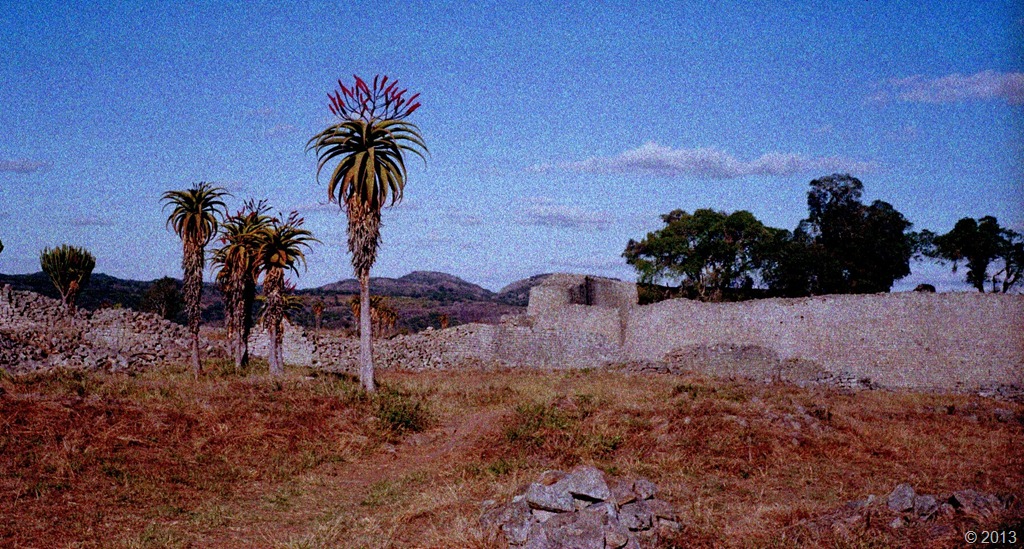
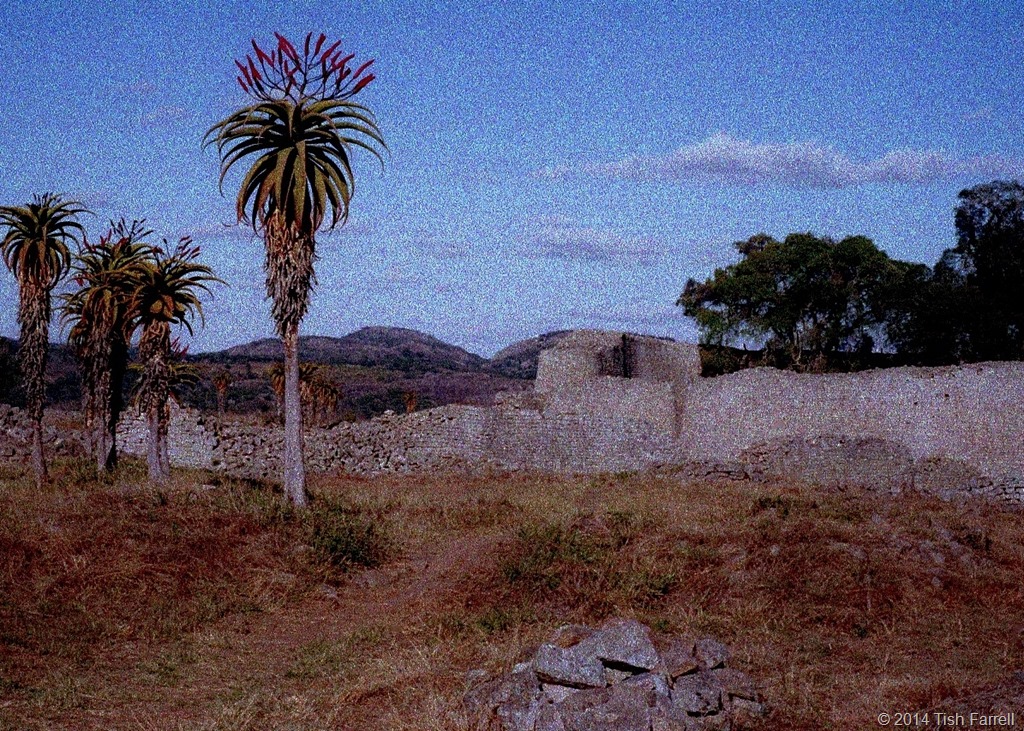
And here’s another painterly ‘in the background’ view: the Great Enclosure of Great Zimbabwe with giant aloes in the foreground. Of course, when it comes to the history of this World Heritage site, ‘in the background’ could well have another and wholly insidious meaning. When geologist, Carl Mauch, first visited the site in 1871 he was convinced that the massive dry-stone granite walls were the remains of the Queen of Sheba’s lost city of Ophir. (See also my post on The Swahili). For some decades this view persisted. It was not in the interests of pioneer imperialist Cecil Rhodes for it to be known that Africans had a sophisticated historical heritage. He financed the first excavation by James Theodore Bent whose brief was to ‘prove’ that the complex had been built by the Phoenicians or the Ancient Egyptians. In 1928-9 British archaeologist, Gertrude Caton-Thompson refuted this conclusion, pronounced it African-built but “the product of an infantile mind.”
Some people may be surprised to know how often archaeology is used as a political tool, but it was, and still is.
In the 1960s-70s when Zimbabwe, then Southern Rhodesia, was under the white rule of Ian Smith’s regime, history was again re-written. Any historians who dared to state that Great Zimbabwe was built by indigenous Africans put themselves at risk, and their work was censored. This led to the departure from the country of many prominent Rhodesian archaeologists including Peter Garlake, both an expert on the ruins, and Rhodesia’s then Senior Inspector of Monuments. His excavations in the 1960s, and those of Paul Sinclair in 1986 fully demonstrate that from around 1200 AD to c. 1500 AD when it was abandoned, the Shona-speaking Karanga people built and lived in this extensive settlement.
Estimates for the population over this period range from 5-30,000. It was a wealthy centre for cattle rearing and for cereal and cotton growing. Gold from mines further inland was brought into Great Zimbabwe, its rulers acting as middle-men in the trade that extended to the Swahili city of Sofala on the Mozambique coast. In return for gold and ivory, the Karanga imported luxury goods – fine textiles, Persian and Chinese wares, including Ming porcelain.
So much for Cecil Rhodes and his racist agenda. Although even in death this man manages to still make his presence felt. He chose to be buried in the Matobo Hills, territory of Ndebele people, and at a place known as Malindidzimu, Hill of Spirits. From here, also known as World’s View, I imagine that he thought he could continue to ‘rule’ Africa. The locals find the presence of his spirit here in their own sacred place quite offensive.
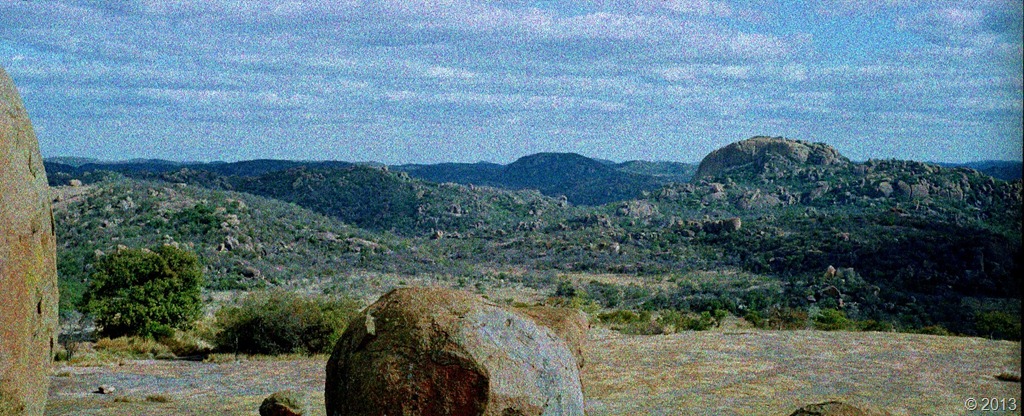
View from Cecil Rhodes’ grave in the Matobo Hills, and his stated aim: “I contend that we are the finest race in the world and that the more of the world we inhabit the better it is for the human race. Just fancy those parts that are at present inhabited by the most despicable specimens of human beings what an alteration there would be if they were brought under Anglo-Saxon influence, look again at the extra employment a new country added to our dominions gives.”
From his 1877 Confession of Faith
And as an antidote to that dispiriting diatribe here are some more ‘in the background’ views in Zimbabwe:
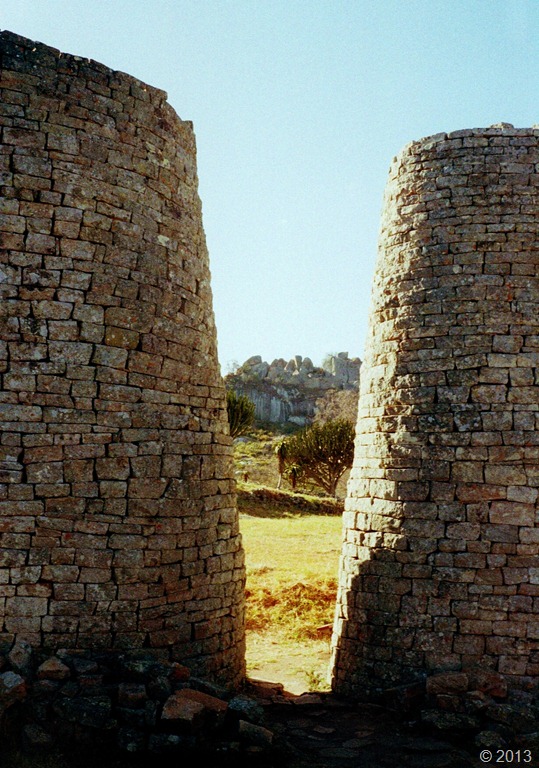
Gateway in the Great Enclosure, Great Zimbabwe
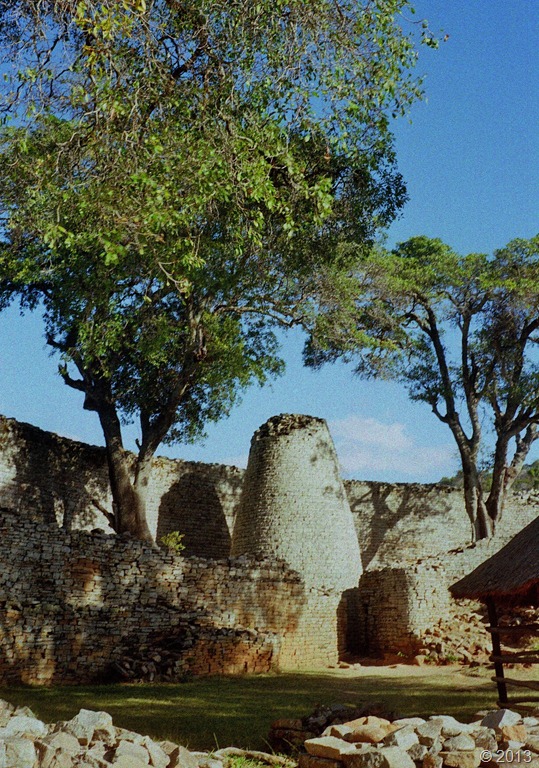
The mysterious tower inside the Great Enclosure

Me looking small and very young inside the Great Enclosure. The walls are dry-stone granite – not a lick of mortar.
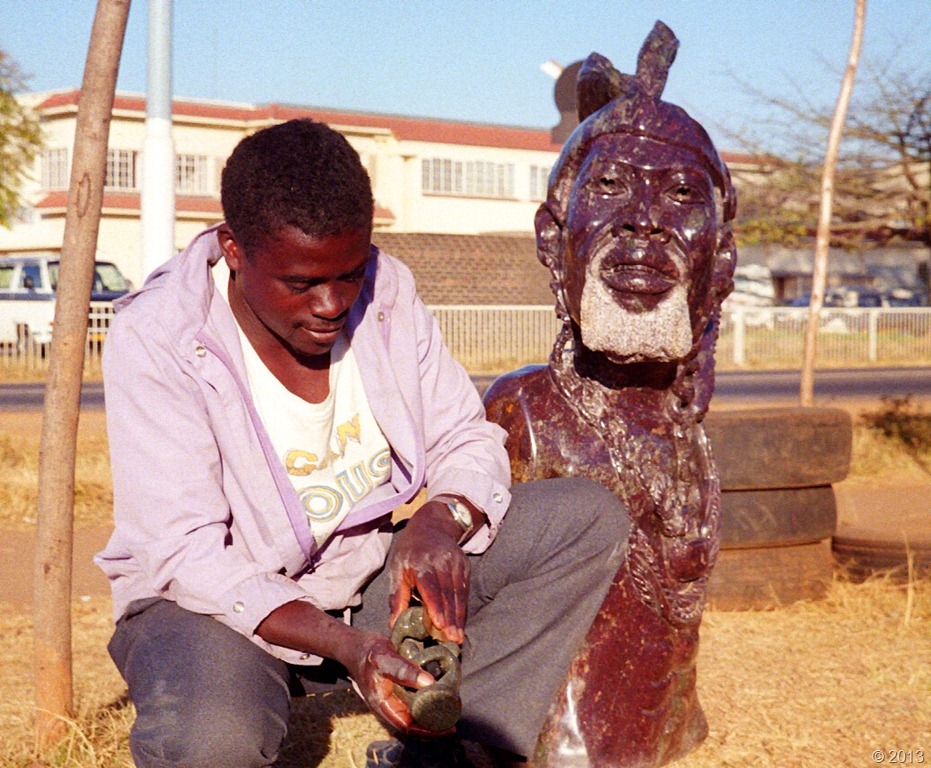
A roadside soapstone artist in Harare. This bust of a Shona elder is a common subject. Zimbabwe has produced some of the world’s outstanding sculptors.
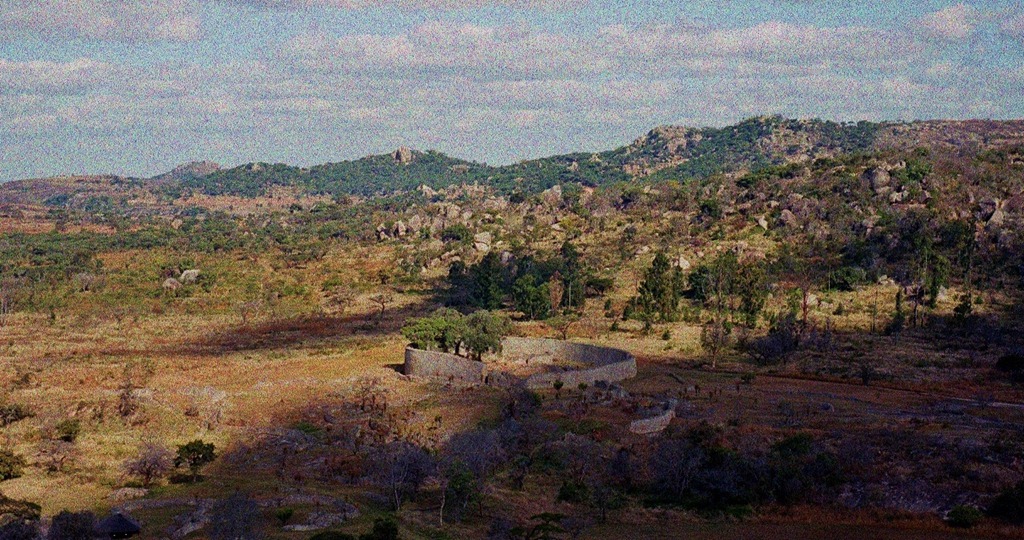
Looking down on the Great Enclosure. For decades many Europeans refused to believe Great Zimbabwe was an African settlement.

Victoria Falls through a misty spray of mighty Zambezi.

Victoria Falls from the Zambian side. Most of the water on this side of the Zambezi is abstracted. My wet kanga wrap nearly took me hang-gliding off the knife edge in a rainstorm, but that’s another story.

Dete school girls, with a train in the background!
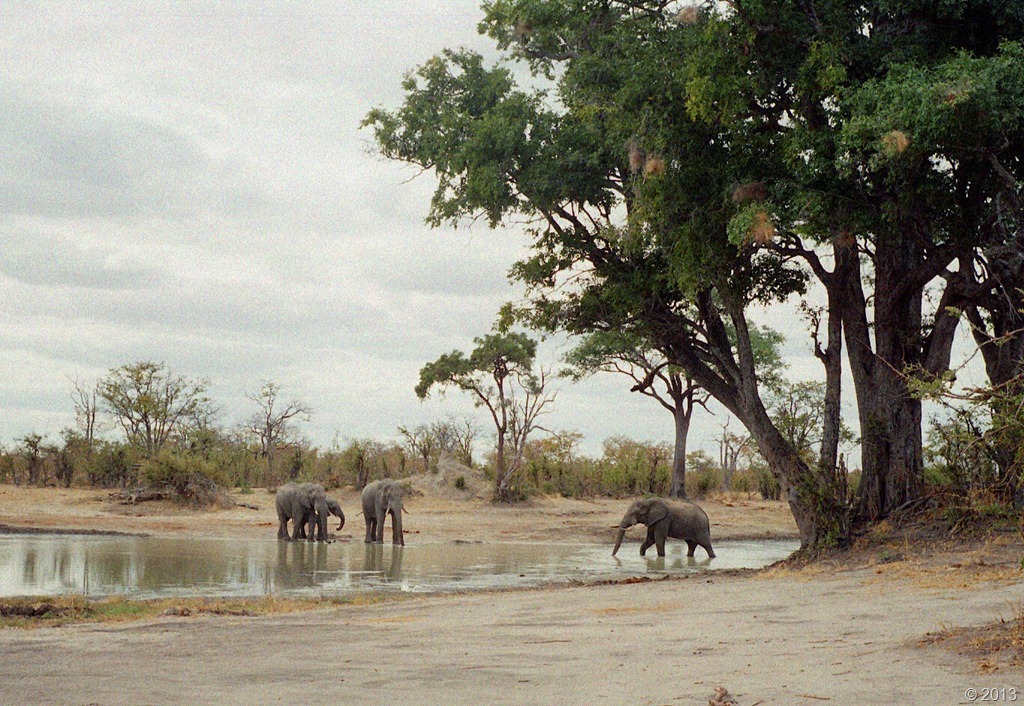
And finally, because this is Africa, there has to be shot with some elephants in the background. Taken in Hwange National Park.
© 2013 Tish Farrell