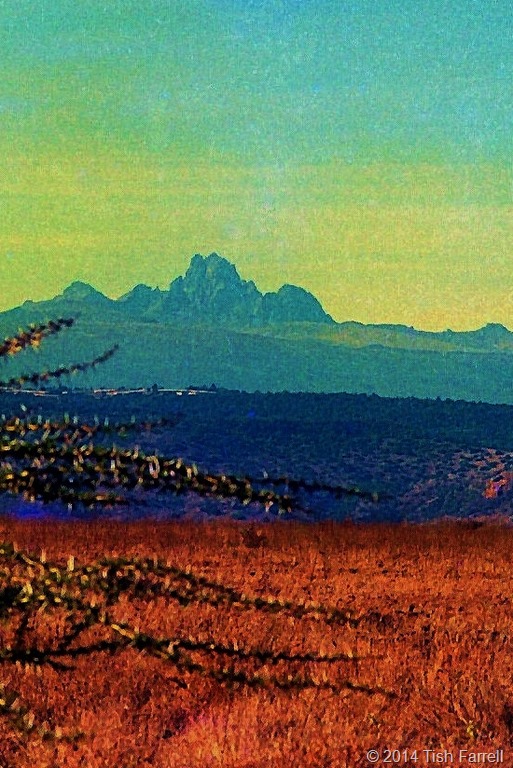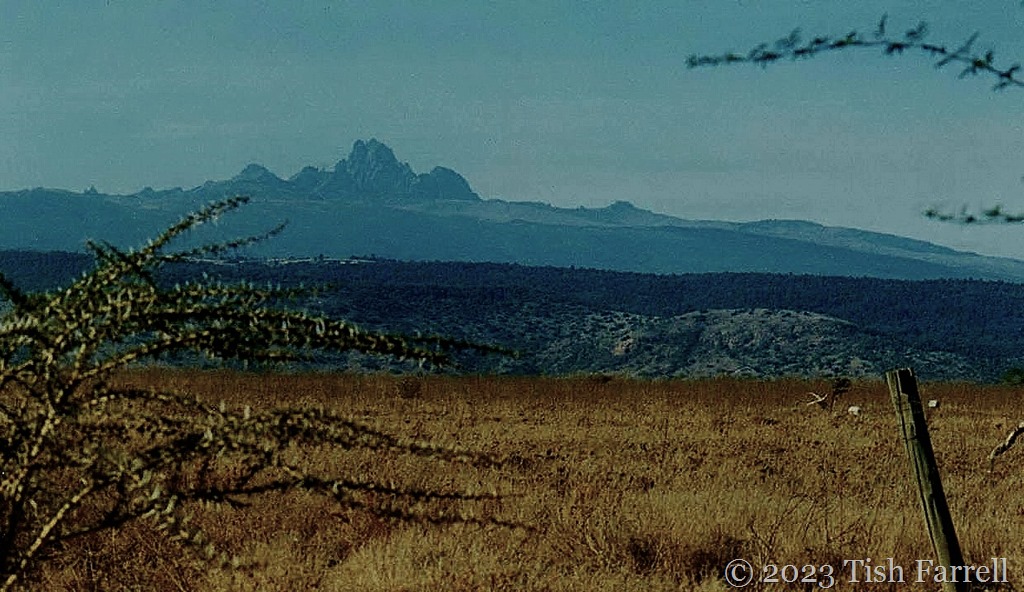
…this is one of his domains – the craggy summit of Kere-Nyaga, Mountain of Brightness, better known outside East Africa as Mount Kenya.
And the supreme being concerned is Ngai, maker of earth, the cosmos and everything. And it was to Ngai that the Kikuyu farmers of Mount Kenya’s southerly foothills once offered their sacrifices and prayers. Although they only did this in times of great crisis, since it was generally held that Creator was a remote figure, little concerned with human affairs. When his help was sought, he was addressed as Mwene-Nyaga, possessor of brightness (Jomo Kenyatta, Facing Mount Kenya 1938). Nyaga also has figurative connotations, meaning ostrich, but in this context suggestive of the white plumes of the male ostrich, a visual analogy for the glaciated zones among the dark mountain peaks.
You’ll see the thinking in this next photo:
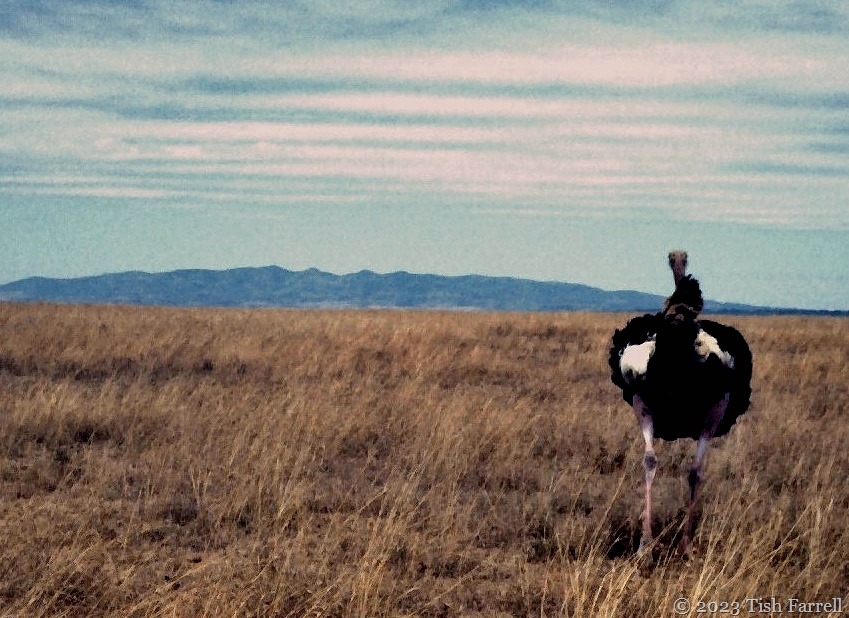
This shot of a retreating male ostrich also captures a distant view of the Ngong Hills, another landmark of spiritual significance, not least in recent times to Out of Africa writer Karen Blixen and her lover Denys Finch Hatton whose burial place it is. For that story see Caught inside a Kikuyu garden.
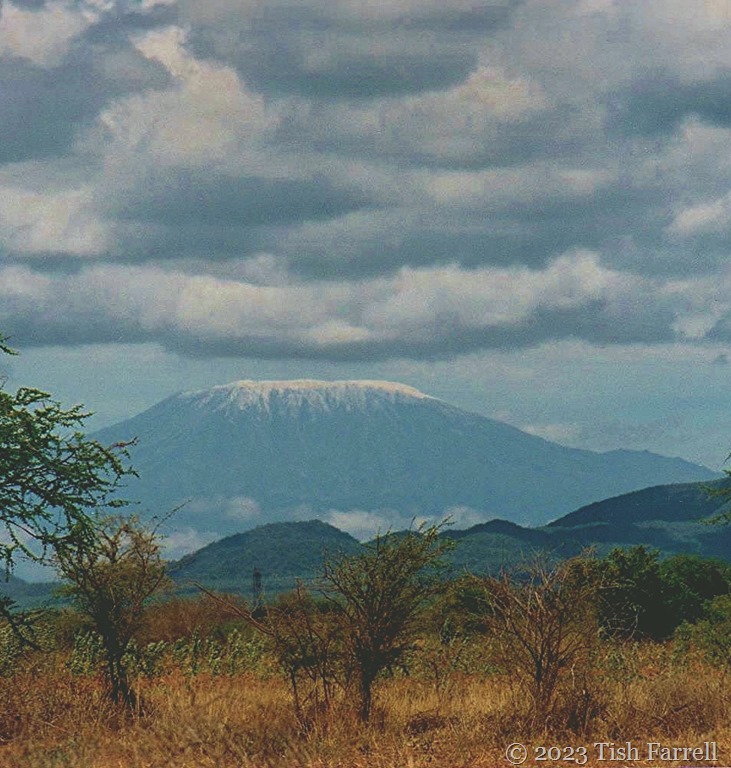
I’m sorry I don’t have more and better photos of Mount Kenya. The ones I do have are a little odd, as if the mountain meant to tease by showing off parts of itself at times and in places where it was not expected to be. I remember spotting it early one morning as I stood in the garden of the Outspan Hotel in Nyeri, the jagged summit floating gauzily above the horizon.
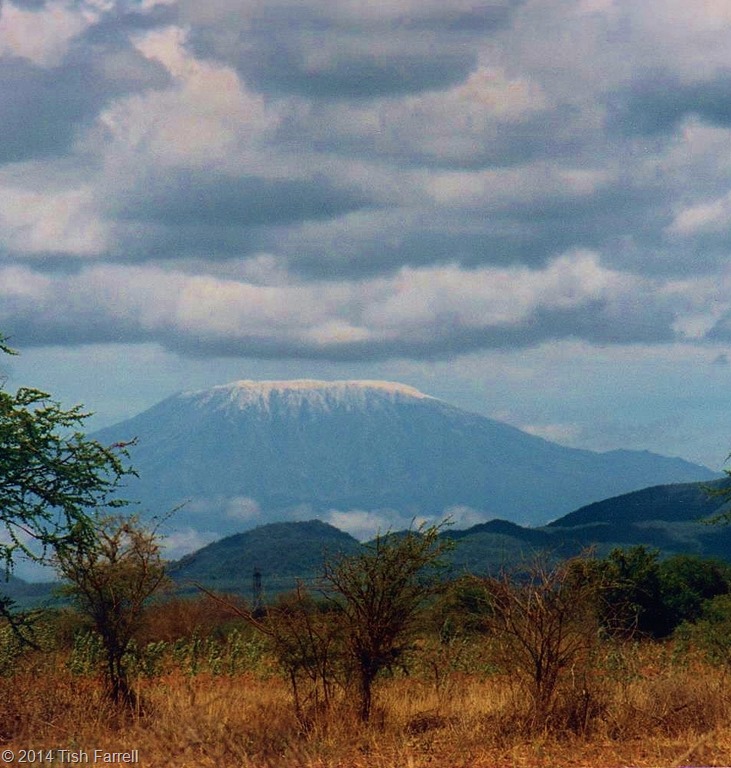
For several moments I was fixed to the spot. By the time I thought of taking a photograph it was gone – only empty sky in the place where it was, and a visceral sense of loss. Kilimanjaro just over the border in Tanzania, plays the same trick. Both mountains spend much of their time being mysteriously invisible. Yet there are travellers’ tales that claim occasions when, looking north and south, both mountains appeared simultaneously. Just imagine!
*
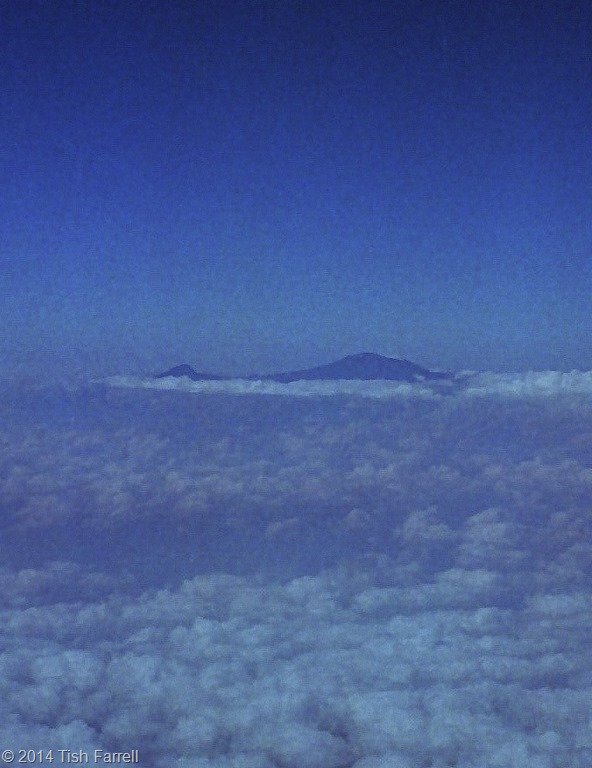
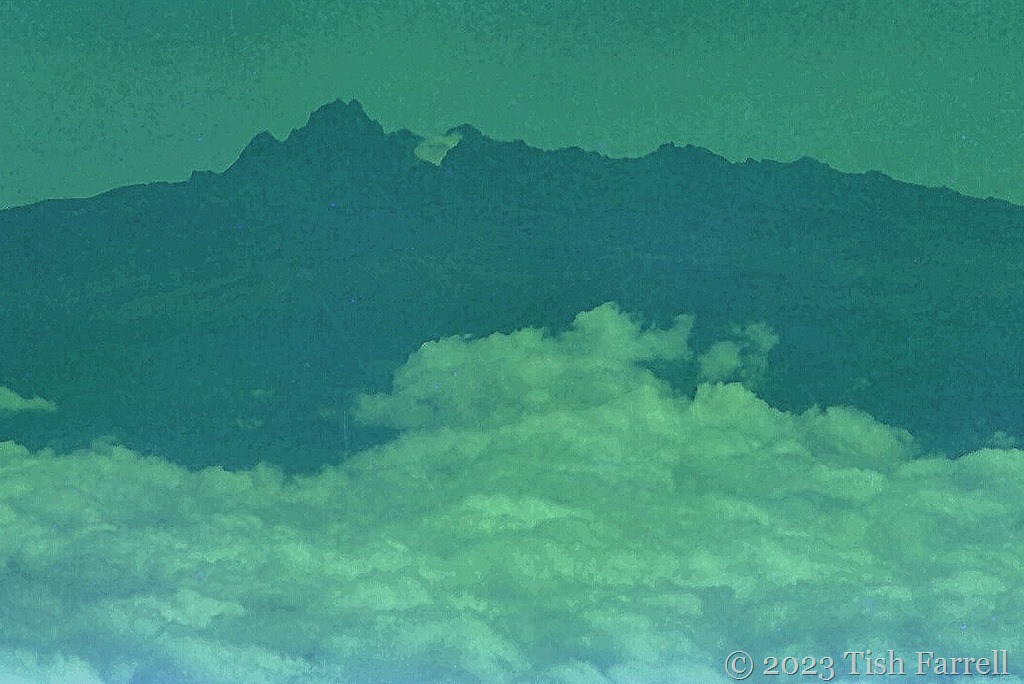
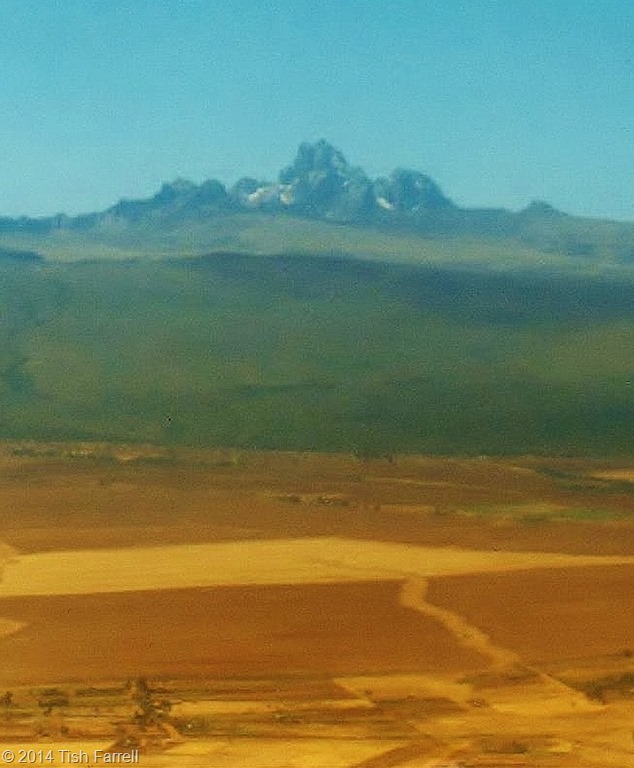
And now for the Mount Kenya photos I do have. The first one was taken from a small plane on our way to Lewa Downs:

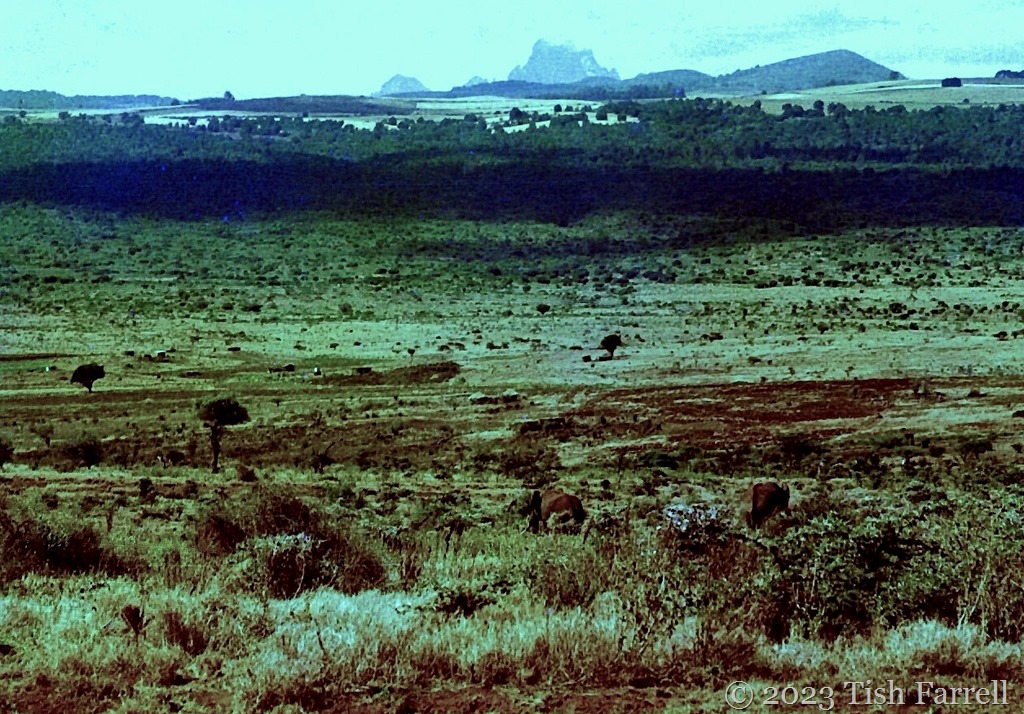
This photo was taken beside the Lewa Downs air strip. At the time, it was the two elephants, just visible in the foreground, that caught my eye. It was only when I was scanning the image that I noticed the odd geographical juxtaposition of Mount Kenya’s summit. What are its lofty peaks doing just there, and so sneakily? They are over 17,000 feet high.
*
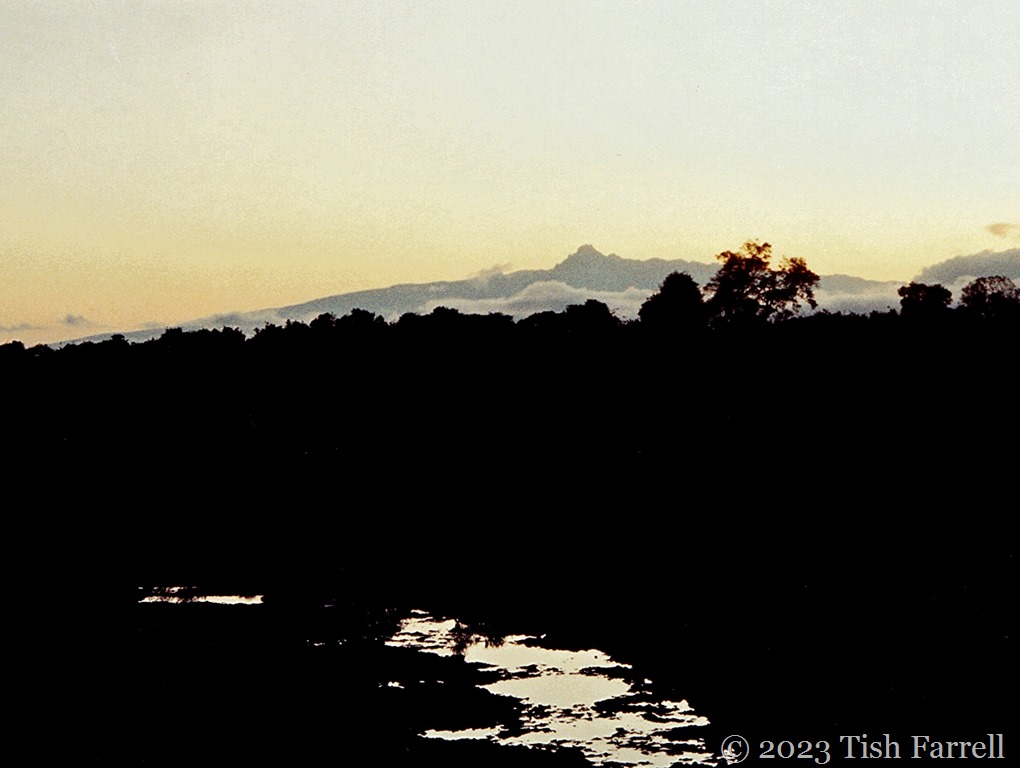
And finally a sunset view of Mount Kenya from the neighbouring Aberdares National Park. The Aberdare Range is also one of Creator’s dwelling places when he is checking out earthly doings. Its Kikuyu name is Nyandarua, which I believe means place of the crumpled hide – another interesting metaphor. Here’s an aerial view:

These vivid names for spiritual landscapes remind me that in traditional pre-literate societies, the natural world provided humans with unlimited scope for pondering, creating and observing. Its diverse parts were sources of inspiration and expression, things to think by, a resource for metaphor, analogy, riddles, song, dance and story telling as means for making sense of existence.
Particular mountains, trees, rocks, lakes, chosen as places to make sacrifices or pray to Creator, are gateways to congress with the divine, and so may be taken as sacred in the same way a church is sacred space for a Christian. More broadly, though, all land may be seen as sacred since it was made and given to humans by Creator.
And in this sense, then, there is no divide between spiritual and physical; all states exist in the same plane, which is interesting, if somewhat difficult for some of us to think about. We might call it respect. We might even call it love.
*
Lens-Artists: Spiritual Sites Tina sets this week’s fascinating theme. Please take a look at her inspriting post.

![4e1bbcd8-9af9-95ca[1]](https://tishfarrell.com/wp-content/uploads/2014/04/4e1bbcd8-9af9-95ca1.jpg "4e1bbcd8-9af9-95ca[1]")