In Looking Glass Land in Kensington Gardens: Anish Kapoor Revisited

100_1453

100_1453 - Copy

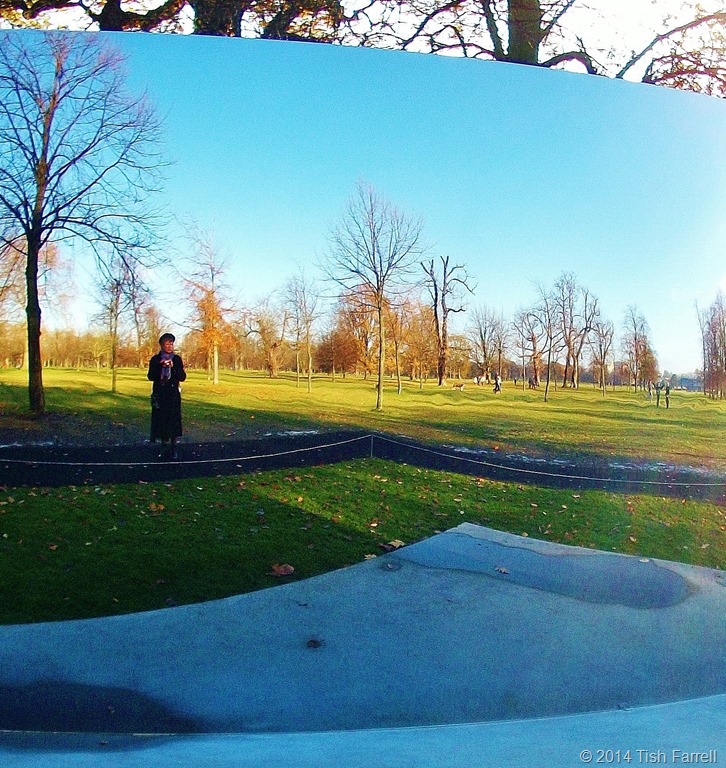
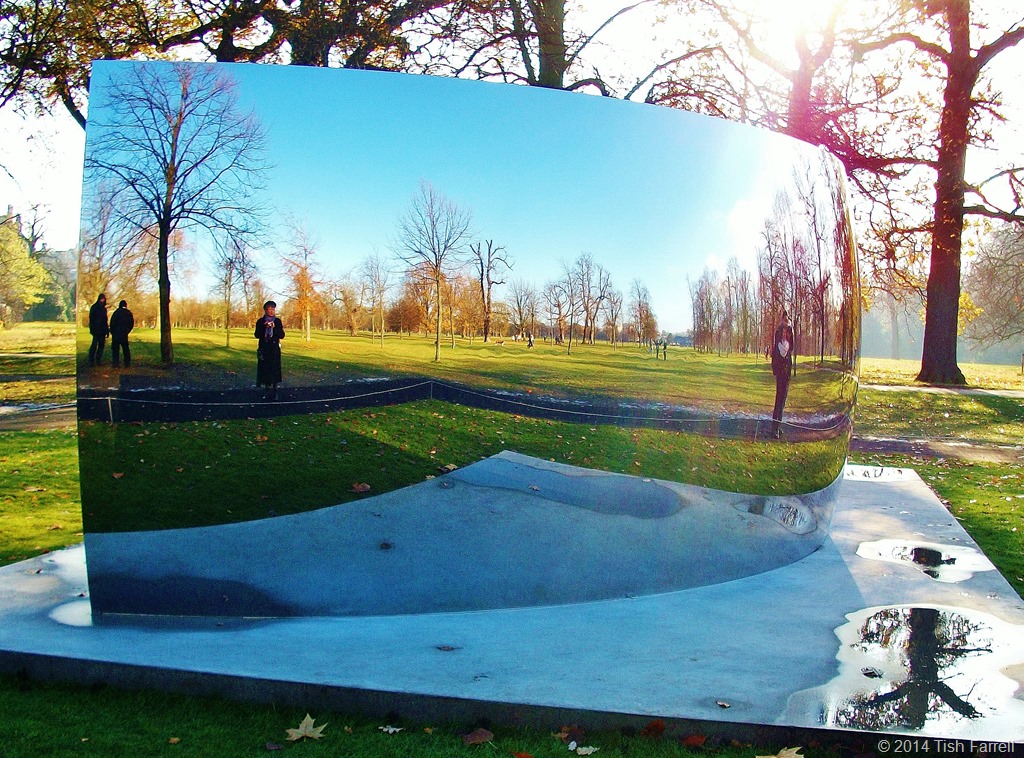
Yes, this is me in the hat, snapping myself inside Anish Kapoor’s wonderful C-Curve installation. To see more of the C-Curve go HERE and join me in Looking Glass Land.  And yes, this was just an excuse to show again this brilliant piece of public art – the kind that invites you in makes you part of the picture.

Related: Object, subject, object: who cares when it’s this much fun

Weekly Photo Challenge: Selfie go here  for more self portraits.

Nice Family? En famille at the Massena Palace

The family who lived in the Palais de Masena

100_1225.jpg
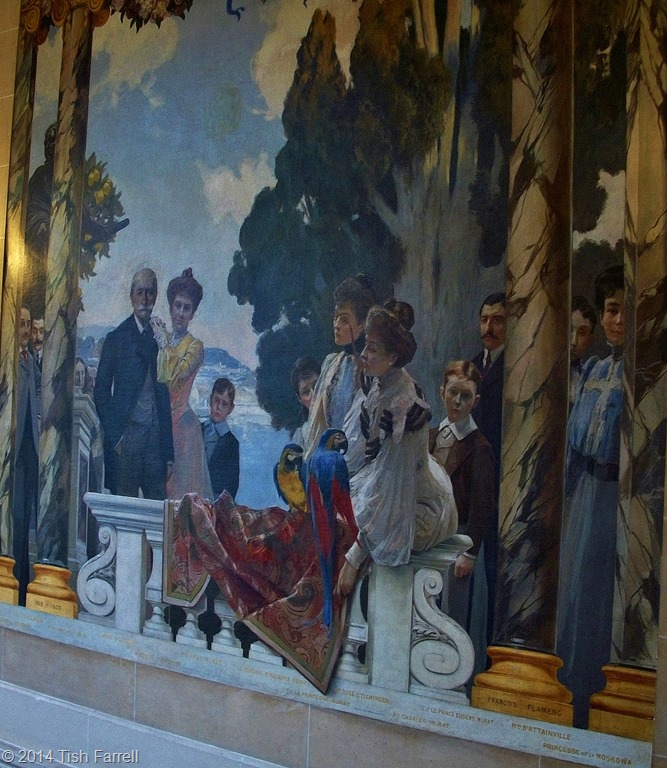
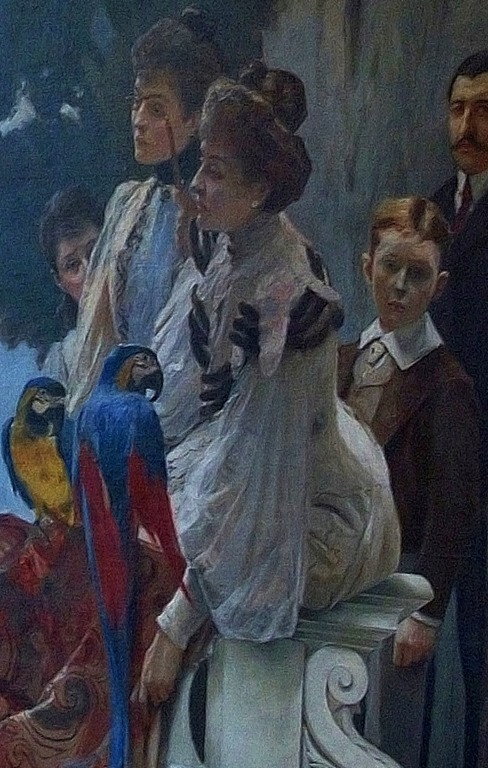
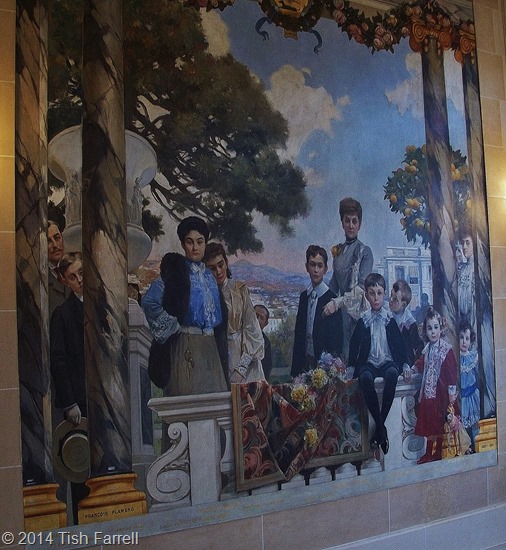
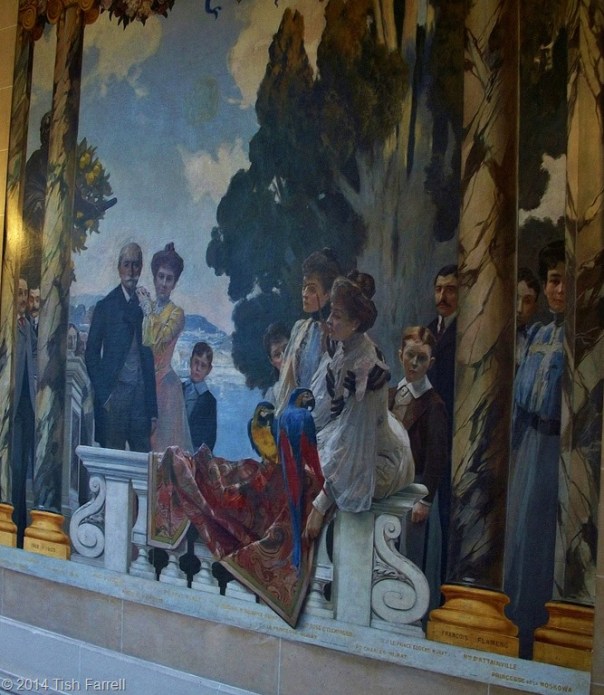
Believe me, the family gathering depicted in these two murals has more tales to tell than most. They could be the very depiction of Tolstoy’s famous opening to the tragic novel Anna Karenina: (and I paraphrase) all happy families look alike, but the unhappy ones are unhappy in their own inimitable way. I leave you to decide which sort we have here.

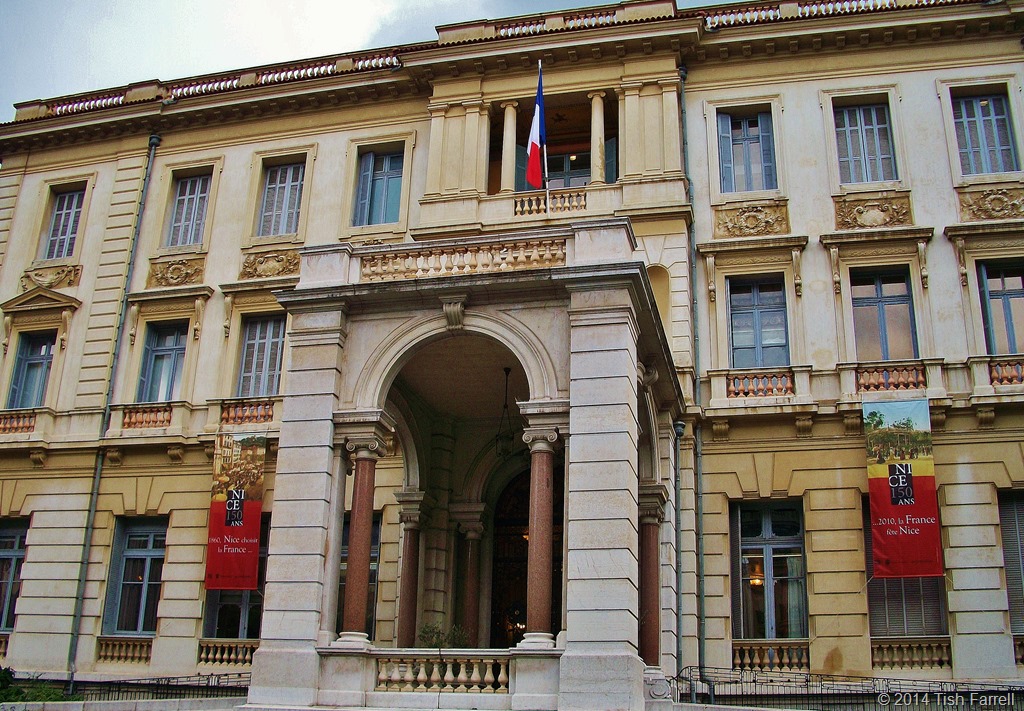
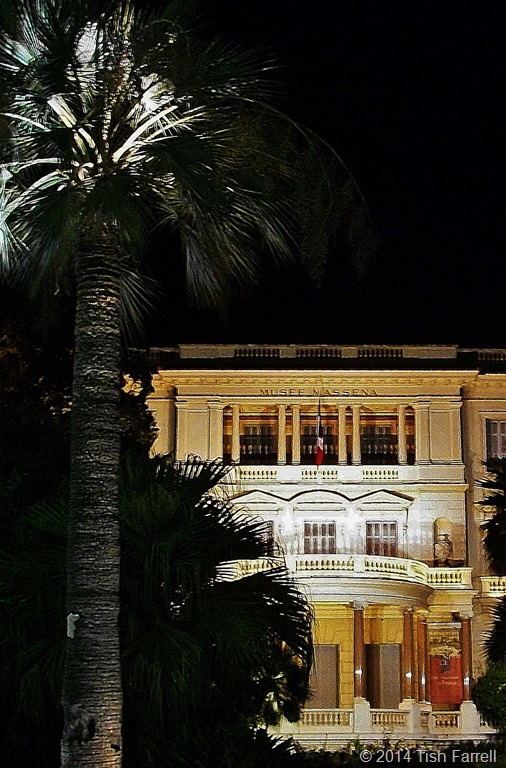
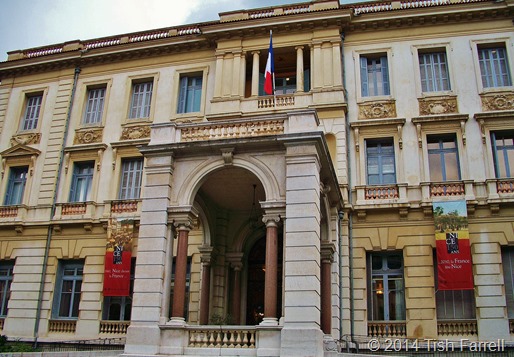
But before the stories, first a little about the murals’ setting. They face one another across the top of the grand staircase in the Palais Masséna in Nice. This imposing house was one of the last of its kind to be built on the Promenade des Anglais, looking
Palais de Masena

out on the sparkling blue Mediterranean.  It was designed by Danish architect Hans-Georg Tersling (1857-1920),  and  finished in 1901. By then Nice had long been a thriving upper class resort, a trend begun in the 1730s when British aristocrats such as Lord and Lady Cavendish first began to gather at Nice and along Côte d’Azur for the winter season. Back then Nice was an ancient fishing town. The Scottish poet, Tobias Smollett describes it in 1764. He went there in hopes that the benign winter climate would help improve his consumption:

“This little town, hardly a mile in circumference, is said to contain twelve thousand inhabitants. The streets are narrow; the houses are built of stone, and the windows in general are fitted with paper instead of glass. This expedient would not answer in a country subject to rain and storms; but here, where there is very little of either, the paper lozenges answer tolerably well. The bourgeois, however, begin to have their houses sashed with glass. Between the town-wall and the sea, the fishermen haul up their boats upon the open beach.”

As time went on the Tsars of Russia and the Romanov family made the South of France their second home, which circumstance, in 1912, prompted Tsar Nicholas II to build the Russian Orthodox Cathedral in Nice to serve the Russian nobility. Even Queen Victoria came on holiday to Nice, staying in the magnificent  Excelsior Régina Palace which looks down on the city and the sea from the hill of Cimiez. It was apparently built in response to her requirements for a place to stay that matched her status. And so the hotels and palaces grew up around the old town of Nice to provide for the royal, rich and famous.

Le_Regina_à_Cimiez_6_Fi_09_0041[1]

Excelsior Regina Palace built 1895-7; Photo: Nice Archives copyright expired

*

Angelo Garino Promenade des Anglais 1922[1]Detail from Promenade des Anglais 1922 by Angelo Garino  (1860-1945)

*

Some of these elite visitors and palace owners acquired their riches and nobility by rather questionable means, and this includes the erstwhile owners of the Palais Masséna. It was built for Victor Masséna, 3rd Prince d’Essling, 3rd Duc de Rivoli and the grandson of  André Masséna, son of a Nice shopkeeper who acquired wealth and royalty while serving and plundering in Bonaparte’s army.  More of him later.

The two family murals are dated 1902-3 and include members of the intermarried Masséna, Murat and Ney families. The reason for the elevated positions and princely titles is entirely due to Napoleon Bonaparte and his ambitions of military conquest.  The founders of their ennobled dynasties were three ordinary men from ordinary backgrounds who joined the French army. All three proved to be brilliant and courageous soldiers who ascended rapidly through the ranks to become Marshals of Empire.

Joachim Murat, an innkeeper’s son, married Bonaparte’s youngest sister, Caroline, and for services rendered was made the King of Naples. He ruled between 1808 and 1815. File:Murat2.jpg

*

Michel Ney, a public notary and surveyor of mines, gave up being a civil servant and enlisted in the hussars. After great battle victories he became 1st Prince de la Moskowa, 1st Duc d’Elchingen.

File:Marechal Ney.jpg

*

As mentioned above, André Masséna earned the titles 1st Duc de Rivoli and 1st Prince d’Essling.

File:Renault - André Masséna, duc de Rivoli, prince d'Essling, maréchal de France (1756-1817).jpg

*

But status and wealth are not everything. Nor were they enjoyed for long. Masséna, long suffering from ill-health, died in retirement after being serially dismissed by Napoleon, first for excessive war looting, and then (after reinstatement) for military failures against the British in the Peninsular War. In his last days before his death in 1817, he supported the restoration of King Louis XVIII to the French throne. Doubtless a wise move for his descendants.

In 1815, after the capture and  exile of Napoleon Bonaparte, both Murat and Ney were executed by firing squad for treason. Murat’s two sons went to North America in the 1820s; the elder stayed and became a citizen, but the younger, Napoléon-Lucien-Charles returned to France in 1848 when his title as Prince Murat was recognised by Napoleon III under the Second Empire.

*

And so we come back to the descendants of the three brave Marshals on the walls of the Palais Masséna. The more you look at these murals, the more curious they seem. They were painted by the then successful French artist François Flameng (1856–1923). He later went on to paint Great War battle scenes, and document new kinds of families, the close-knit comradeship of companies of men under siege.

300px-A_Machine-Gun_Company_of_Chasseurs_Alpins_in_the_Barren_Winter_Landscape_of_the_Vosges._painting_by_Francois_Flamenge[1]

A Machine Gun Company of Chasseurs Alpins in the Barren Winter Landscape of the Vosges, François Flameng, photo Wikimedia Commons.

*

DSCN4945[1]

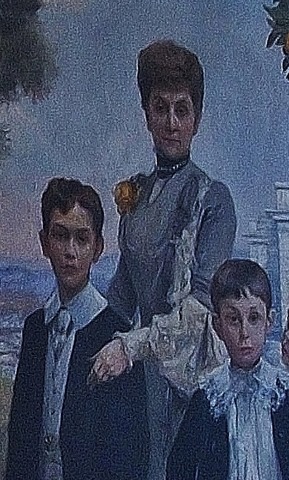
I suppose my first question is why would the mural people wish to have themselves depicted in this way? Certainly there is a sense of entitlement and much self-regarding, but at the same time it is also as if they are not quite self-aware. Flameng verges on caricature for most of his subjects.  For surely there are suggestions of secrets, collusion, factions, conspiracy, loss of status within the gilded circle.  There are shared misfortunes and private sorrows; anxiety and repression; no one smiles; the children look utterly constrained. And then there are simply too many people peering round pillars, or only half seen despite their prestigious titles.

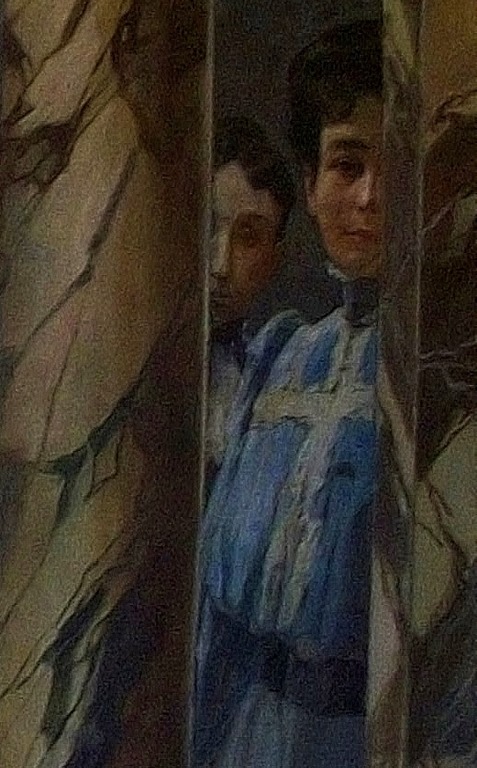
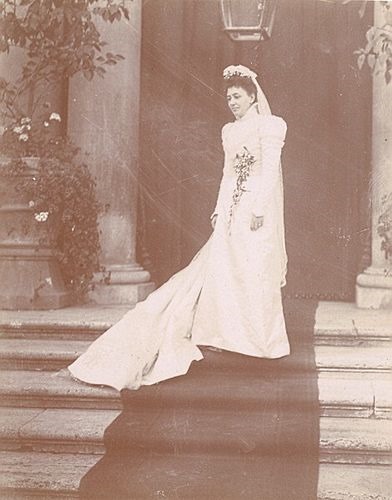
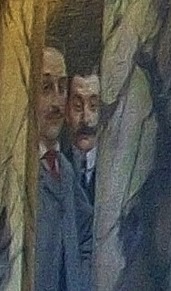
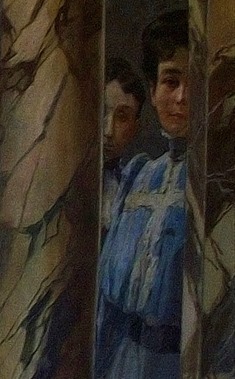
The two men on the far left of the second painting look distinctly rascally, their almost-smiles, sardonic, malicious.  They are related, brothers I think; the nearest to the viewer is Napoleon Ney, Prince de la Moskowa; behind him Claude Ney, Duc d’Elchingen. In 1903, the year the murals were completed, the Prince and Princesse de la Moskowa were divorced. La Princesse is the sad woman in the blue gown at the other end of the mural, only partially seen behind the column. Is Flameng intimating her loss of status in relation to the others? She is Eugénie, youngest daughter of Napoleon Bonaparte. She married the Prince in Rome at the Villa Bonaparte in 1898, and with all the Ney family in attendance. The couple had no children.
100_1225 (2)

100_1225 - Copy

Here is Eugenie on her wedding day. The photograph is attributed to Count Guiseppe Primoli.
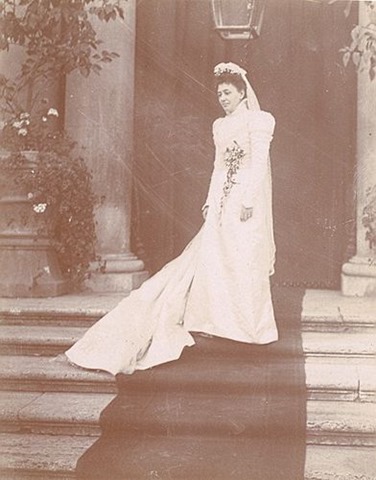
Eugenie Bonaparte 1898

*

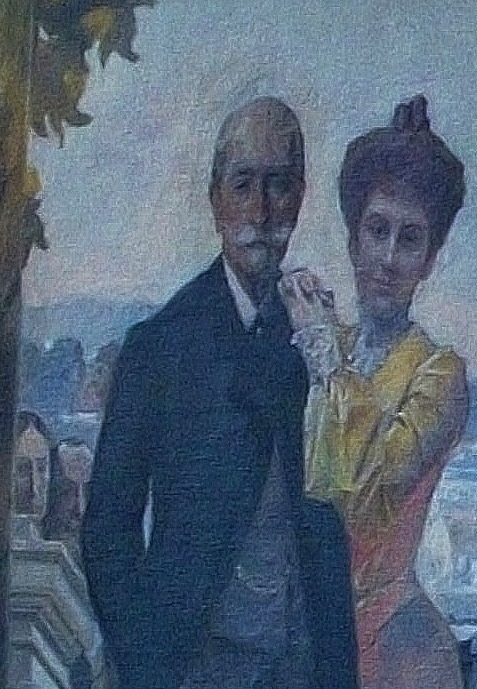
Further along the mural from the Ney brothers is Victor Masséna, Prince d’Essling, the builder of the palace. His eldest daughter, Anne, has a proprietorial hold on his shoulder. He will die in 1810 in a Paris nursing home after an operation, and she will marry the Duc d’Albufera. The two faded souls at Victor’s elbow are his long-dead parents, also named Anne and Victor.
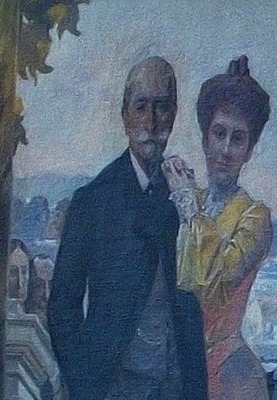
100_1225

The only calm and truly sympathetic face among the whole gathering is that of Rose Ney d’Elchingen. She leans over the balustrade accompanied by two macaws and an expensive tapestry. Beside her (with the pince nez) is the Princesse Joachim Murat, born Cecile Ney d’Elchingen, probably Rose’s sister. Her husband, Prince Joachim Murat, is across the stairs, lurking between a pillar and a large urn.  Rose, herself, will marry the distinguished Italian politician Duca Guiseppe Lanza di Camastra, and he will die prematurely in 1927 at the age of 31. Before that though, a 1916 newspaper photo will show Rose La Duchesse in full nurse’s gear, apparently assisting the surgeon with the war wounded at Val-de-Grâce military hospital in Paris. She is well-known for her beauty and philanthropy.
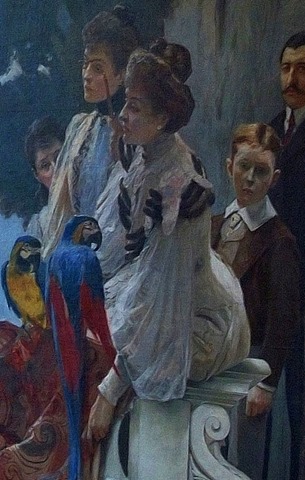
100_1225

Also in this mural detail is Prince Eugene Murat and the boy Charles Murat. The prince will die, aged 30, in 1906 when he overturns his car  while driving to Karlsbad. The report says he lived in Paris and left three children. It does not mention that he was married to the notorious Violette Ney d’Elchingen, Princesse Eugene Murat, and Rose’s sister. We are about to meet her across the staircase. They could not be less alike, at least in their demeanour.
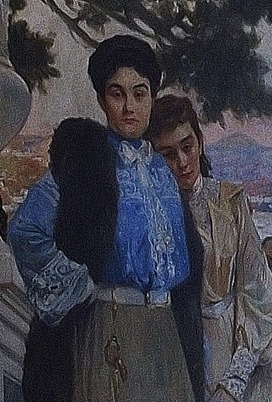
The family who lived in the Palais de Masena

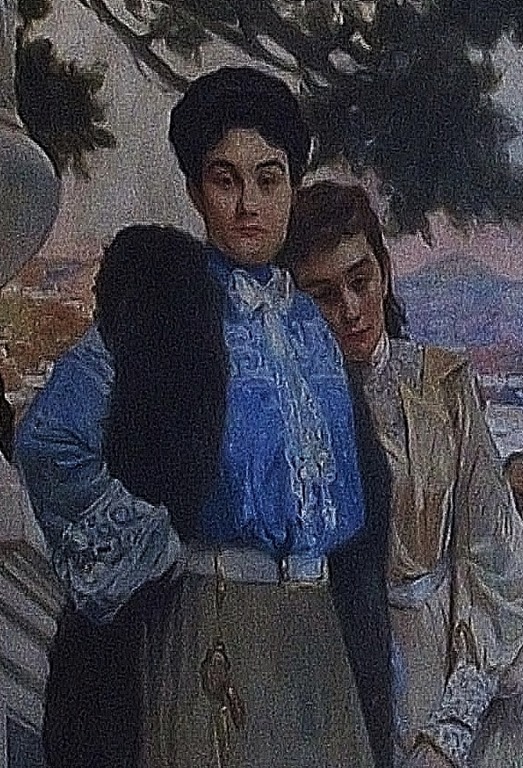
In fact you can hardly miss her, can you, Madame in the royal blue blouse. She seems to dominate the gathering on both sides of le grand escalier. The hand on hip gesture looks coarse, suggestive more of a nicoise fishwife than a princess. She is also the only one taking an active, indeed aggressive stance. She looks out at us visitors as if we were something unpleasant she has stepped in.

But what did the artist Flameng mean us to understand from this image? And what is going on with sad, submissive girl who leans against the redoubtable Violette? After all, this is not mother and daughter. The girl is Victoire  Masséna, younger daughter of Victor. She is around 14 years old here. In 4 years she will be married to the Marquis de Montesquiou. She will have two sons and at 30 she will be dead. Perhaps she foresees her future. Perhaps when you know that Violette, besides being a mother of three, is also a predatory bisexual, you might think there is something more sinister here. But then maybe one should not jump to conclusions.

tumblr_m74mcdKjfO1qjm0dlo1_500[1]

Princess Eugene Murat c.1929; photo Berenice Abbott

*

In the decades of her widowhood, after the car-crash death of Eugene, Violette led a very gay life, and in all senses of the word. She was part of the Paris and Harlem Jazz Age scene. She entertained the likes of Stravinsky and Cocteau in her Paris home. She was a friend of the artist Augustus John who sketched her quite pleasingly while she introduced him to novel ways of taking hashish. In his autobiography he says:

“I had already tried smoking this celebrated drug without the slightest result. It was Princess Murat who converted me. She contributed several pots of the substance in the form of a compôte or jam. A teaspoonful was taken at intervals.”

She famously stormed out of a very famous Paris dinner party, held in 1922 for Europe’s artistic elite. The guests of honour included Diaghilev, Stravinsky, James Joyce, and Picasso. But it was the appearance of the reclusive Marcel Proust that evinced Princess Murat’s all too visible disfavour. At the time everyone who was anyone was trying to identify themselves and others in the characters of Proust’s À la Recherche du temps perdu. Violette, who was renowned for meanness had seemingly provided the model for an extremely miserly individual.

She was, in fact, exceedingly generous with the cocaine, or so we discover in Sebastian Faulks’ book The Fatal Englishman, which includes the biography of the English artist, Christopher Wood (1901-30). In it he describes Violette as “an enormous drug-addicted lesbian with a hunger for company.” She goes around with a bag of cocaine and lays out lines for Wood when he is struggling to complete a piece of work. Faulks tells, too, of Wood’s claim that she lost £5 or 6 million in the 1929 Stock Market crash. She ended her days, living in squalor, having overcome an earlier obsession with maintaining cleanliness, and died of barbiturate poisoning at the age of 58. A sad end to a damaged life.

And what was at the heart of this – sibling jealousy perhaps? Does that explain Flameng’s placing of the players in the murals – the beautiful Rose on one side of the stairs, blissfully unaware of her allure, and beloved even by the two family macaws? While opposite, the portly, coarse featured sister tries to outface her, and indeed the whole world that pays court to her much prettier sister. It’s a theory.

Finally, there is a more pleasing story, at least as far as the palace is concerned. Below on the left we see Victor Masséna’s heir, André, the future Prince d’Essling beside his mother, Princesse d’Essling. In 1919, with his father dead nearly ten years, he hands the Palais Masséna to the city of Nice on the understanding that it will be open to the public. Today it is the city’s local history and art museum.
The family who lived in the Palais de Masena

And so what is there left to say about this self-aggrandizing family. With hindsight one could say that in real life, when these murals were painted, the Belle Époque was drawing to its close. Did Flameng already sense this? The world was changing. Soon there would no longer be the annual winter retreat to the Palais Masséna.  Somehow, then, the murals do have a Proustian feel, perhaps a missing story thread from À la Recherche du temps perdu; the last moment of a perfect, and rarified age caught in two wall paintings, and now gawped at by the passing public.

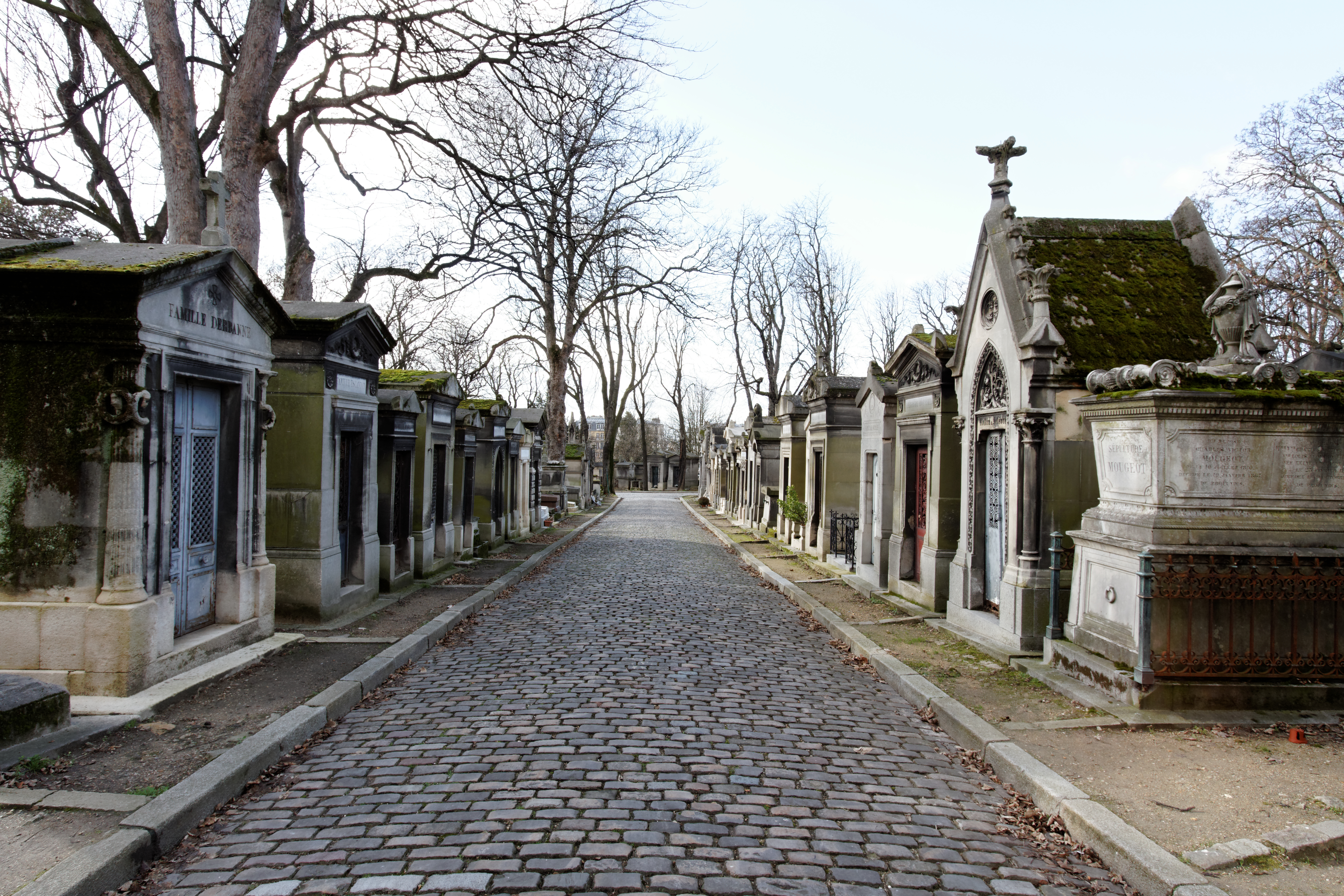
And as for the three Marshals of France whose derring-do started all this social climbing, you  may find them lying quite close to one another in the Père Lachaise Cemetery, Paris. There they have long since made their residence – among the great and growing family of the dead.

File:Père-Lachaise - chemin 01.jpg

Père Lachaise Cemetery, in Paris.Photo: Pierre-Yves Beaudouin / Wikimedia Commons / CC-BY-SA-3.0

*

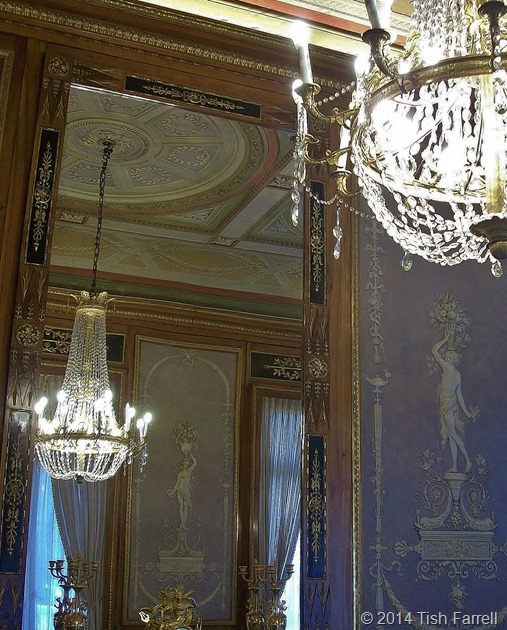
Last but not least, I leave you with glimpses of former winter season glory chez Masséna.
Nice is filled with chandeliers

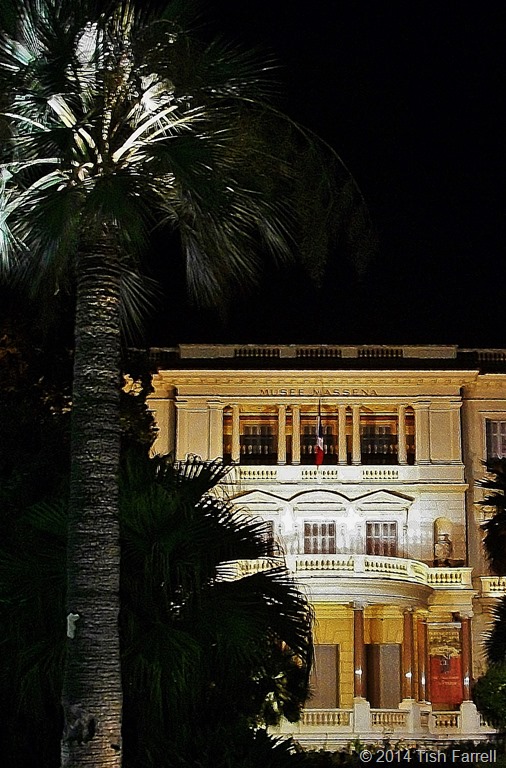
Palais de Masena, now a museum

© 2014 Tish Farrell


Bright Fields on Llyn: windows in time, mind and space and other stories from Cymru

 The-bright-field-cropped_thumb9.jpg

Oh all right, I confess. My take on the WP photo challenge is a little tangential. Also I have combined it with Ailsa’s travel theme ‘illuminated’ and Frizztext’s ‘B’ challenge (links below). But for me, photographs are windows in their own right, focusing the eye, mind and sensibility. The ones in this post seem to reveal a glimpse of something that require my special attention. And while some shots do in fact include actual windows, most are about those tiny ah-ha moments: the event, image, artefact that opened a window in my mind, whether a crack, or a full-blown throw-back-the-shutters moment.

And so it was stormy September, and the holiday-season well and truly over when Nosy Writer and the Team Leader headed to Wales for a few days. G. had a brand new camera to learn. I, as ever, was happy to snap whatever caught my eye.

We stayed in an odd, but well-meant  B & B in Llanbedrog, and set off each day to explore North Wales’ Llŷn Peninsula. The weather was deeply discouraging. Wales has much wet weather, and, with it, an oppositely equal lack of indoor places to visit, especially out of season. The first day it rained so hard there was no choice but to head for the nearest large town in hopes of finding something to do under cover.  We drove up the coast to Caernarfon,and once there sat  in a car park for an hour while the rain teemed down on the windscreen. Finally, it eased off enough to venture out. By then, the ludicrousness of coming on holiday to sit in a Welsh car park watching supermarket deliveries was beginning to grate.

100_4474

Swathed in raingear we trailed around an impressive but dreary Caernarfon Castle, the remnant expression of Edward I of England’s systematic oppression of the Welsh people. In 1283 he extended a small Norman motte and bailey castle into a massive fortress – all the better to assert English rule over the Welsh and their princes. In design it is said to recall the walls of Constantinople, seat of Roman imperial power, thus invoking memories of more ancient times when the Romans also subdued the Welsh. These earlier invaders built the nearby fort of Segontium and, like the castle, it commanded the Menai Straits and the island of  Ynys Môn (Anglesey) beyond.

Segontium was built in AD77 by the Roman governor of Britain, Gnaeus Julius Agricola, in preparation for the capture Anglesey (see Island of Old Ghosts). Over a thousand years later the castle was built as one in a circle of mighty fortresses to control the people of North Wales. In 1284 Edward’s heir,  later Edward II, was born there, and thus proclaimed the first English Prince of Wales. Though English born and bred, I find this hard to swallow.

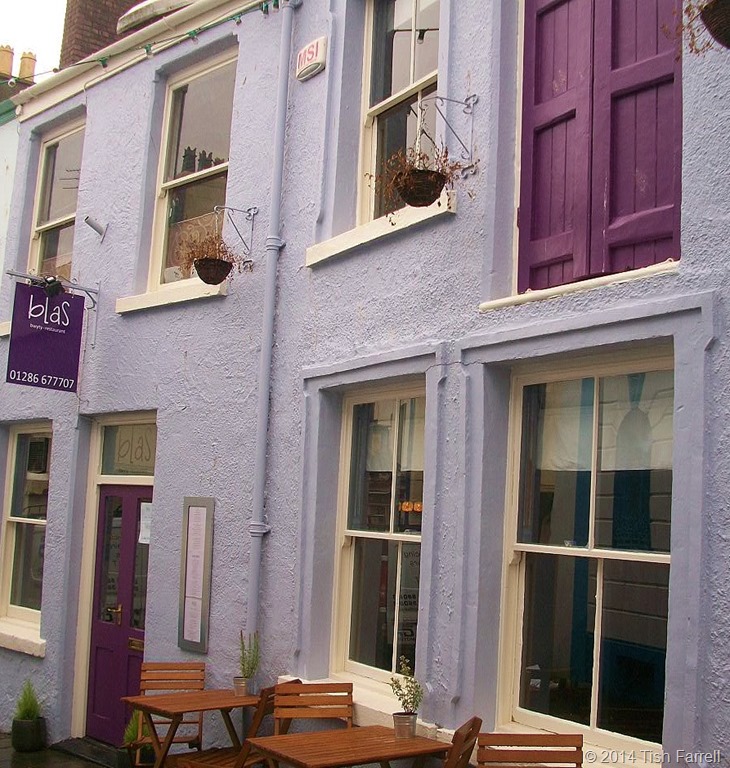
And so I think I would have found Caernarfon Castle depressing even in broad sunshine – too much death and domination. The best part of the day was definitely lunch in one of the town’s meandering back-streets. At the bistro Blas they welcomed us in from another downpour, and kindly allowed us to drip on their carpet while feeding us delicious food. Not only that, it was so soothingly lavender, both inside and out.

100_4493

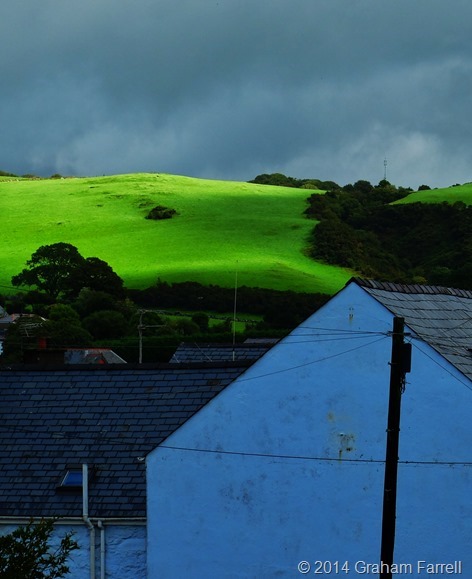
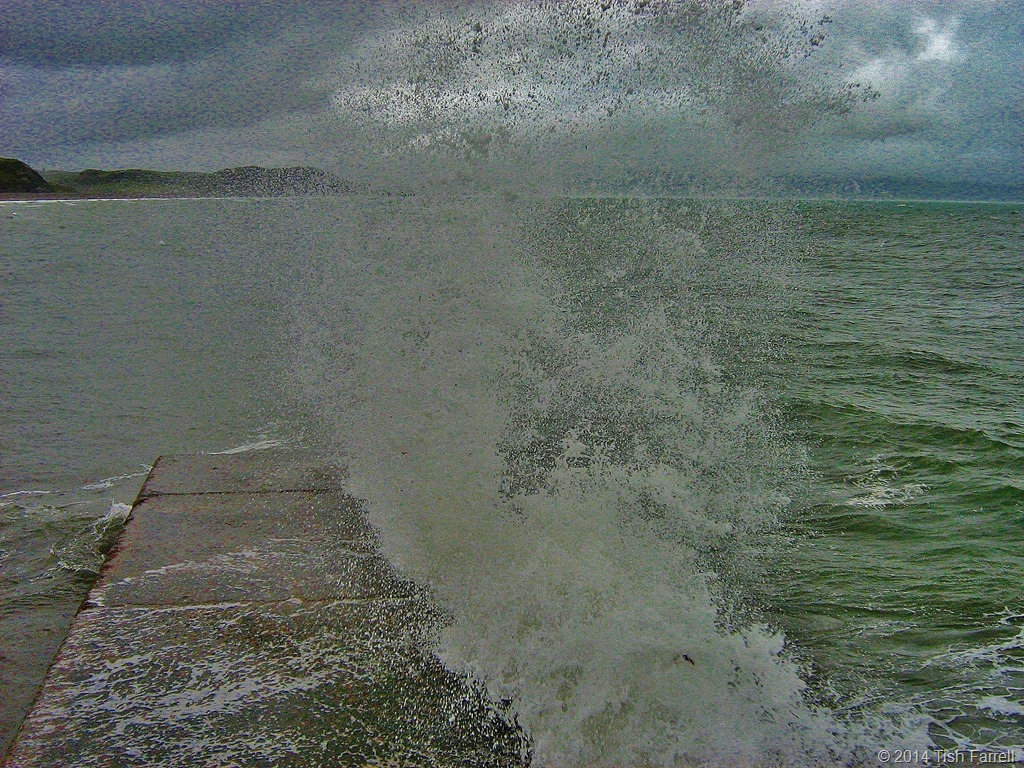
It was the next day, with the rain abating and the sea roiling over the Cricieth breakwater (beneath another Edward I castle) that we spotted the bright field in the first photo. G. thought it was a good opportunity to start getting to grips with his Fujicamera. I snapped the sea.

IMG_0620

But seeing that bright field, so astonishingly luminous against the grey sky, reminded me of the poem of the same name, written by the great Welsh poet-priest R.S.Thomas. This craggy, slab of a man was as redoubtable as one of Edward Longshanks’ castles.

In fact he might have been hewn  from the bed-rock of his native Wales. And like all such formations he had his fissures, faults and flaws. Many thought him morose, cantankerous, and rife with ambiguity and contradiction. For one thing, he abhorred the Anglicisation of Wales, yet he wrote in English despite being a Welsh speaker. In 1996 he was nominated for the Nobel Prize for Literature, but  lost out to Seamus Heaney. 

As a priest he was kindly and sympathetic to the hardships of his parishioners, although this would not stop him from hectoring them from the pulpit, urging them to foreswear any yearning for consumer durables such as refrigerators and washing machines. He could also be judgemental and, as a fierce Welsh Nationalist and political activist, withering about the failure of the Welsh to resist being swamped by Englishness.

Thomas’s poetry, then, can be both trenchant and transcendent. While I do not subscribe to his religion, I honour the spirit of his words. His poems are among those I love most. Here it is then:

The Bright Field

*

I have seen the sun break through

to illuminate a small field

for a while, and gone my way

and forgotten it. But that was the pearl

of great price, the one field that had

the treasure in it. I realize now

that I must give all that I have

to possess it. Life is not hurrying

*

on to a receding future, nor hankering after

an imagined past. It is the turning

aside like Moses to the miracle

of the lit bush, to a brightness

that seemed as transitory as your youth

once, but it is the eternity that awaits you.

R.S. Thomas

*

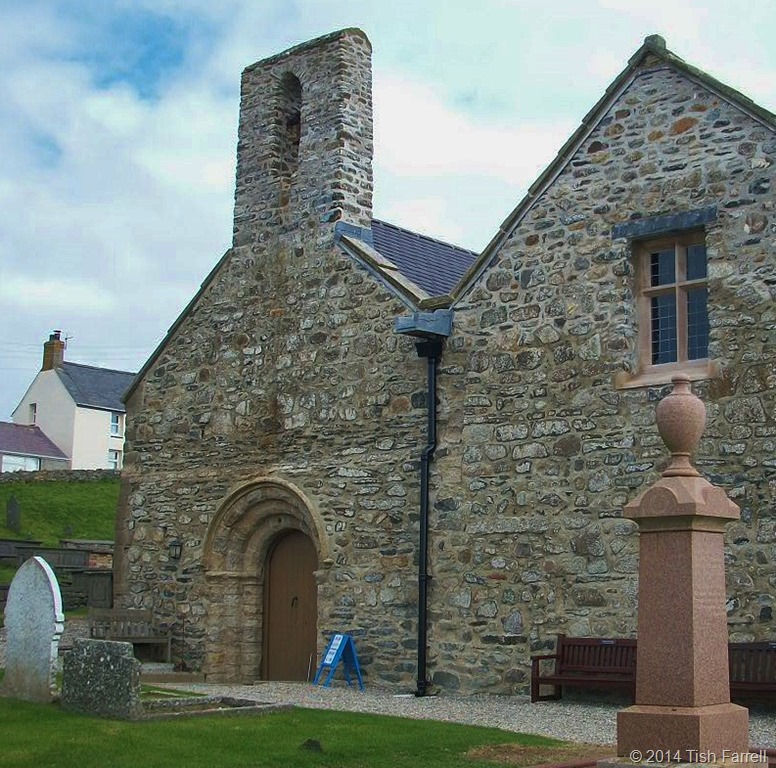
On our final day it was with R.S. Thomas in mind, and with a little sun at last, we drove down the narrow lanes of the Llŷn Peninsula  to Aberdaron where the poet served as a parish priest between 1967-78.

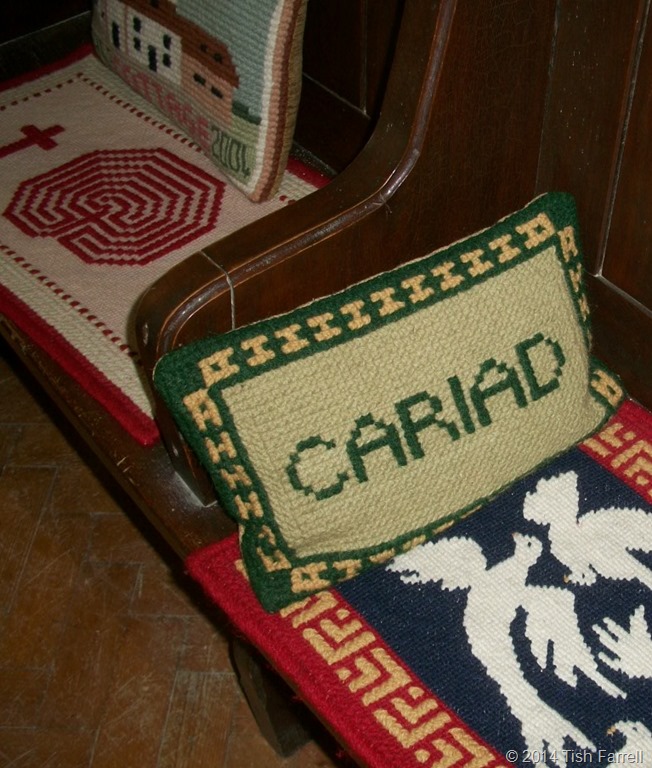
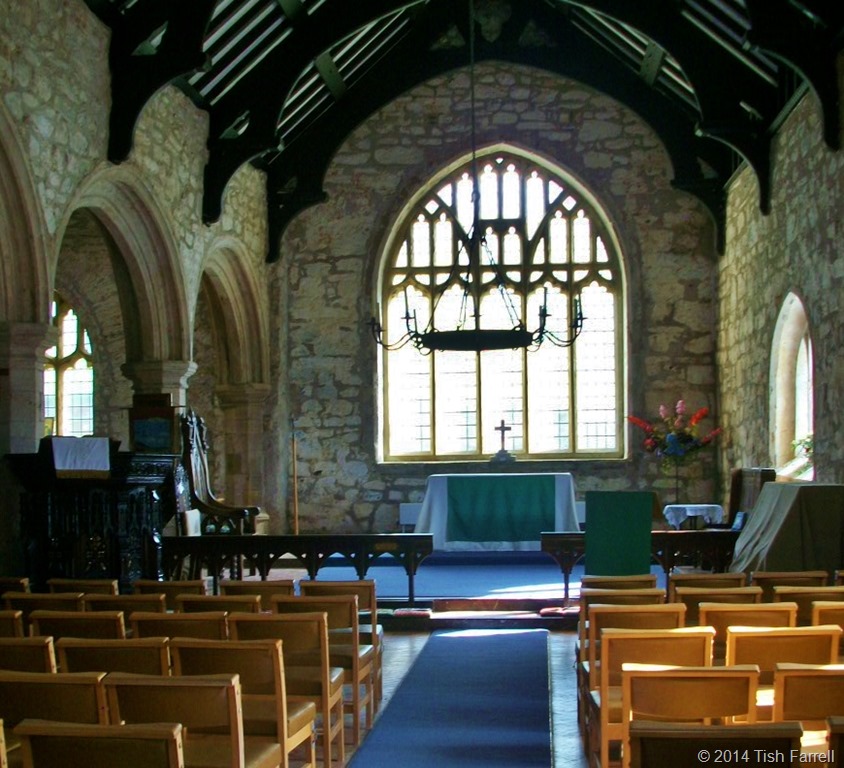
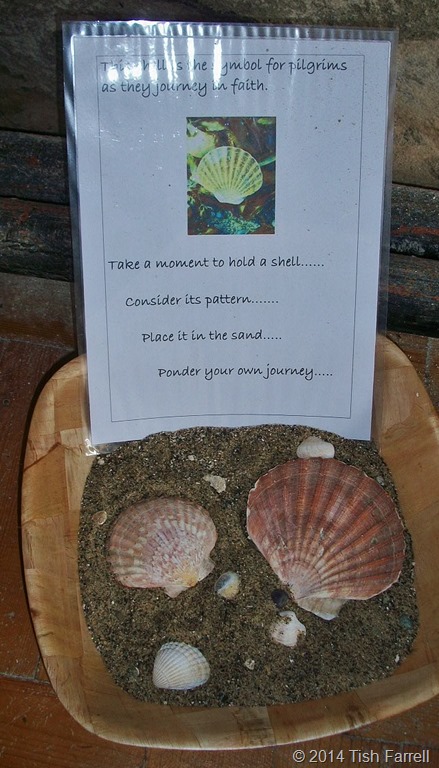
The ancient church of St. Hywyn’s stands right beside the sea. Since the Middle Ages, pilgrims have come there on their way to Bardsey Island, Ynis Enlli, Island of 20,000 Saints. Inside the church are two ancient grave stones belonging to Christian priests of the late 5th/early 6th century. There is also a welcome there: a bookshop full of R.S. Thomas’s poetry books; even a poem to take away. There are also piles of sea pebbles, shells for contemplating your journey, a kneeler that has been stitched with the single word cariad, beloved.

100_4798

100_4782

100_4779

100_4791

100_4797

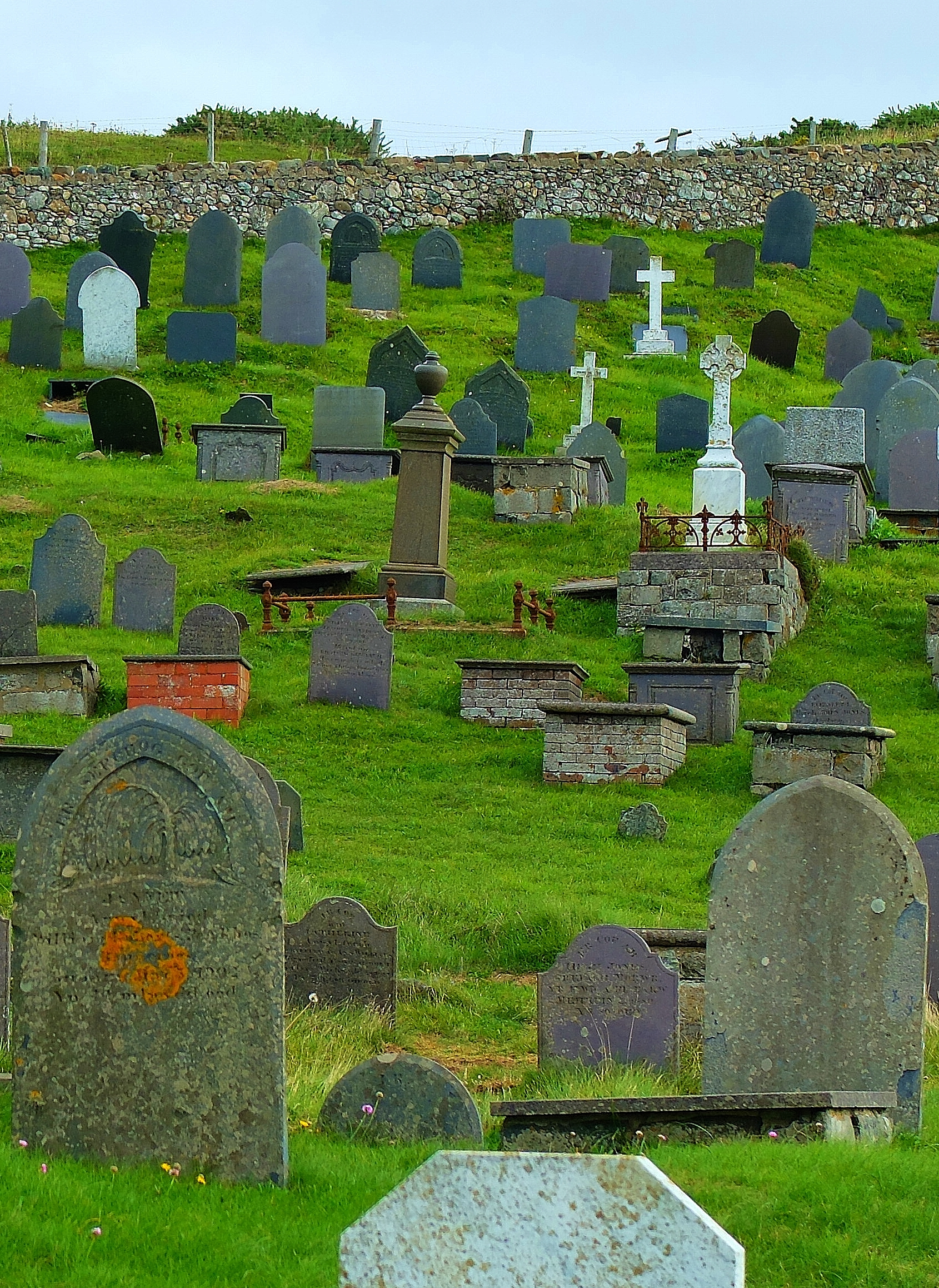
And beside the knave the clear glass window that needs no further embellishment looks out on the sea and islands of Gwylan Fawr and Gwylan Fach. And outside in the sea wind is the graveyard whose stones seem to cluster like a meeting of villagers in their own bright field. And so it is, as we ponder on all these things that our creedless souls, one atheist, one agnostic, know that we too are on a pilgrimage – to seek out the things that truly matter.

holiday 130

RS Thomas

R.S. Thomas 1913-2000 Photo: BBC Cymru Wales Walesart

See this brief biography of the poet, made in 1996 when it was thought he would win the Nobel Prize for Literature.

Related: Warrior Wind-Singer of Llŷn

© 2014 Tish Farrell

Flikr Comments Tagged ‘B’

Weekly Photo Challenge: Windows 

Ailsa’s travel theme: illuminated

Onwards and upwards…the big New Year ‘do-over’

IMG_0453 - Copy

“Encompassed by a world of tangible, visible things – animals, plants, and stars –  mankind has from time immemorial perceived that deep within these beings and things dwells something powerful, yet indescribable, that gives them life.”

Cosmic view of the Fulani people of West Africa

*

I took this photo last spring, in March when we were plunged into a sudden and unexpected winter. In seemed  that the tulips were burning their way through the snow – biological imperative incarnate: come hell or high water, these tulips will BECOME.

In some ways, though, I find the image  disturbing, especially the bud just breaking through the snow, and the dark little shadow at the centre top where another seems to be welling just beneath the surface like a bruise. Is the earth bleeding?

Of course, in no time my mind flies to that wintery scene with the good queen, Snow White’s mother. There she sits with her embroidery at the castle window. There she pricks her finger as she sews, the blood drops falling on the snowy whiteness. And there she makes the pledge that calls into being a beautiful child, but in the process brings about her own end.

The queen pricks her finger. Snow White illustrated by Charles Santore 1997

*

And so by degrees I start thinking of the creative process, that is to say, my creative process or seeming lack of same. And while I am sure that many creative people (which is all of us) will be facing the New Year with renewed vigour and hopefulness at the journey ahead, there are others of us who remain intent on endlessly hunting round the same old  circles that take us nowhere. We are of course woozle hunting and A.A. Milne sums up the entire predicament perfectly.

*

  ‘One fine winter’s day when Piglet was brushing away the snow in front of his house, he happened to look up, and there was Winnie-the-Pooh. Pooh was walking round and round in a circle, thinking of something else, and when Piglet called to him, he just went on walking.


      “Hallo!” said Piglet, “what are you doing?”
“Hunting,” said Pooh.
“Hunting what?”
“Tracking something,” said Winnie-the-Pooh very mysteriously.
“Tracking what?” said Piglet, coming closer
“That’s just what I ask myself. I ask myself, What?”
“What do you think you’ll answer?”
“I shall have to wait until I catch up with it,” said Winnie-the-Pooh.”

 Winnie-the-Pooh 1926, A A Milne, illustrated by E H Shepard

*

Next then comes the question of how, creatively speaking, does one get off the treadmill of woozle hunting (which can of course become perversely absorbing despite the fruitlessness of the quest) and lift off into the stratosphere with the high-octane thrust of tulips breaking bounds?

Perhaps to begin to answer this, it is first important to know that human creativity has its cycles in much the same way as the natural world, or indeed tulips. In her audio compilation The Creative Fire, poet, storyteller and Jungian psycho-analyst, Clarissa Pinkola Estés puts it this way:

“Creativity goes through many different cycles: of birth, rising energy, reaching a zenith, declining, further entropy, death, incubation, quickening, rebirth…”

She then elaborates on this process by retelling two versions of the Persephone story , the Greek myth that, among other things, explains the origins of winter and spring.

In other words, a period of dying down, gathering in resources, dormancy, are all essential before strong new growth can occur. The tulips, after all, had some nine months of dying down and re-growing their bulbs.

CPE  has other words of wisdom too:

“The main struggle that people have with creativity is that they stop themselves from doing what comes naturally.”

And:

“We all cover miles and miles of territory looking for the starting line when it’s inside of our minds the entire time.”

She also deals with the deep-rooted fear that most of us have: that our creative impulse/spirit/inspiration has died or deserted us. She likens it to la chispa, the hearth ember that seems quite dead until you breathe upon it, fanning the flames so that once more it bursts into a blazing fire. If we feel stifled and blocked she suggests that the causes are probably fear, the lies  that people have told us about our creativity, and the fact that we have paid way too much attention to our internal critic.

“The creative function,” she concludes, “ is the centre of the soul and the psyche; it can never be destroyed.”

So there we have it. Less woozle hunting, and more blowing on dead wood. Also listen to your internal wisdom, then make like a tulip. Who knows what it will lead it.

Or as the Nigerian writer Chinua Achebe said:

 “Art is man’s constant effort to create for himself a different order of reality from that which is given to him.”

There are no rules and regulations on the number of times that we must re-do a piece of work before we have made it to our liking. The only rule is to give yourself a break, then go to it.

*

Wishing you all a happy and floriferous 2014

*

Weekly photo challenge: beginning: go here for more Daily Post beginnings

© 2014 Tish Farrell

Christmas on Lamu: views of a Swahili Community

Scan-130428-0010

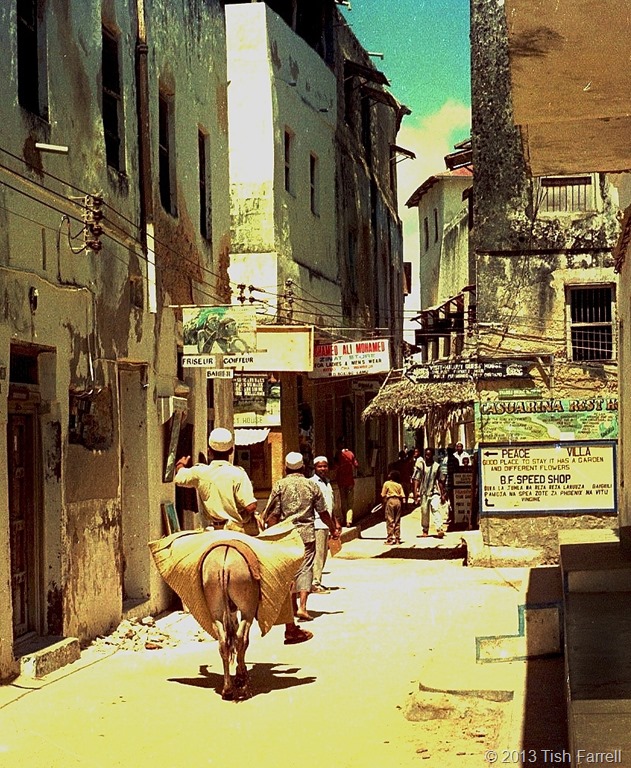
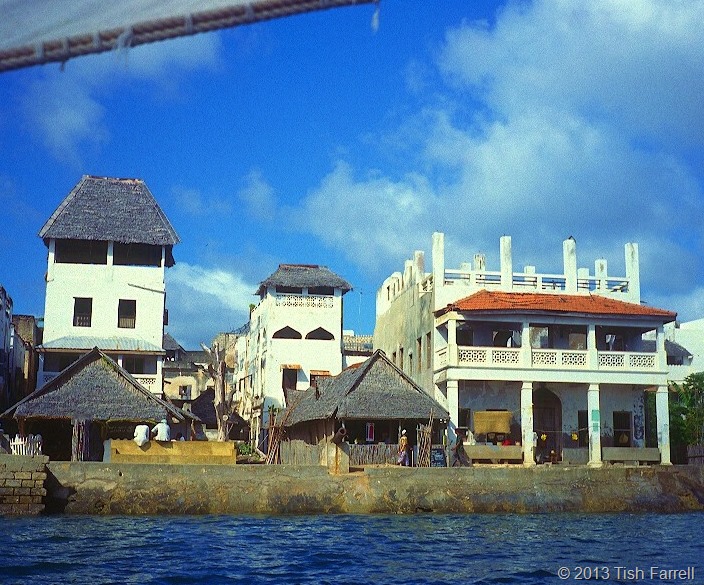
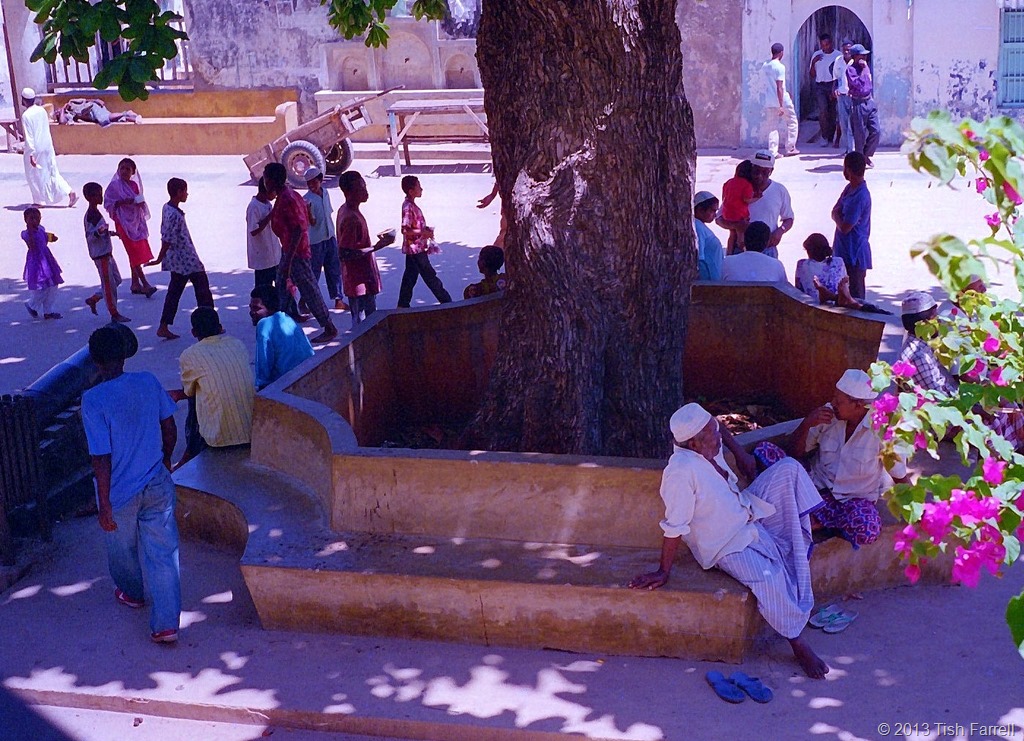
Main street, Stone Town, Lamu. No cars only donkey transport.

*

I learned a great deal about community when I was living in Kenya where it meant not only an affirmation of cultural identity, but also an expression of hospitality; the call to an absolute stranger of  “karibu,” “come on in!”

And so it proved to be one Christmas, when we spent a few days on the Indian Ocean island of Lamu. I suppose, in amongst the excitement of organising our flight there from Nairobi, I had wondered what it might be like to spend a Christian festival within a strongly Muslim community. Or perhaps I had gone there expecting simply to forget it. I know I had thought about clothing, packing only things that would not cause offence by too much inappropriate exposure.

Scan-130426-0012

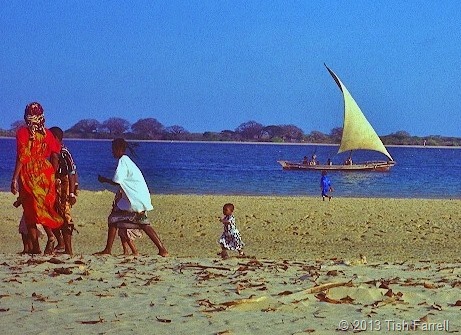
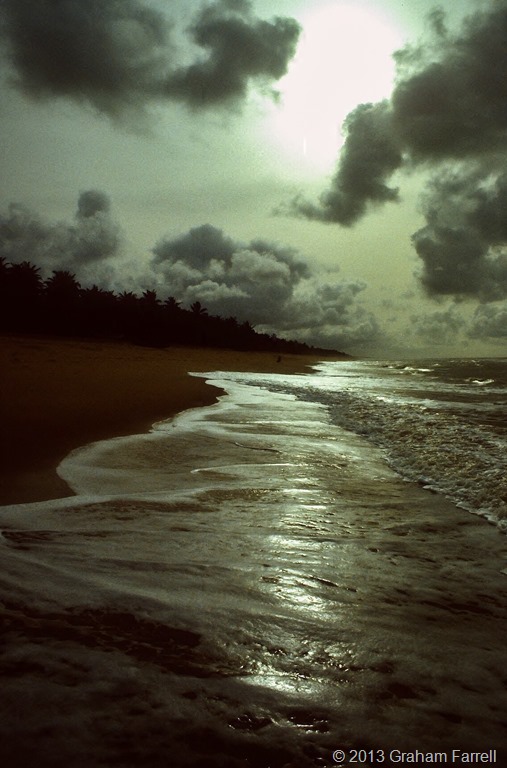
Christmas Day on Shela Beach, Lamu

*

But I had not expected to feel so  ‘gathered in’. From the moment we were picked up from the tiny Manda Island air field, and taken by dhow taxi to the Island Hotel in Shela Village we were quietly embraced by the locals.

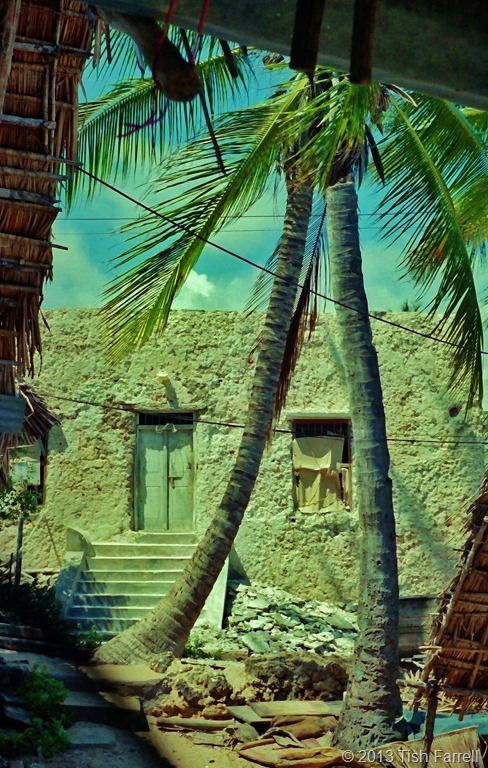
Sensation was anyway heightened: it had just stopped raining as we stepped ashore and followed our guide up damp sandy paths. The sense of unobtrusive acceptance somehow fused with the scent of jasmine, the touch of steaming coral walls of deserted gardens and tumbled village houses, the warm salt breezes. 

Scan-130429-0029

At five a.m. on Christmas Day we woke to the call to prayer at the local mosque.  Allahu akbar  filled our room, and unavoidably so when the roof was only a thin layer of palm thatch and three of the walls were open to the elements. It seemed a transforming moment somehow. I lay in the little Lamu bed, and listened to the village stirring to life around us, hee-hawing donkeys, the clatter of kitchen pots and pans, radios quietly playing. It seemed a community well set in its ways, and for many generations. Yet later, when we set out to walk along the long strand to Stone Town, we were greeted from every side by smiling locals. “Happy Christmas!” they cried. “Happy Christmas!”

Scan-130426-0010

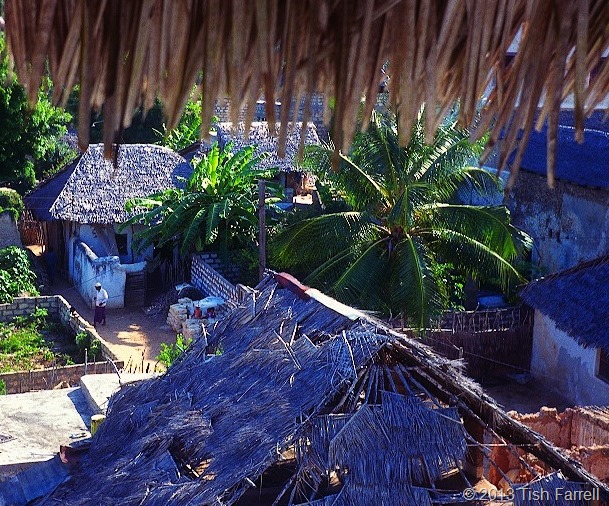
View from ‘the pent-house suite’, the Island Hotel, Shela

*

Scan-130426-0004

Stone Town, Lamu, now a World Heritage site

*

Scan-130428-0063

Christmas Day afternoon: a time for strolling, snoozing, chatting.

*

Scan-130426-0019.jpg

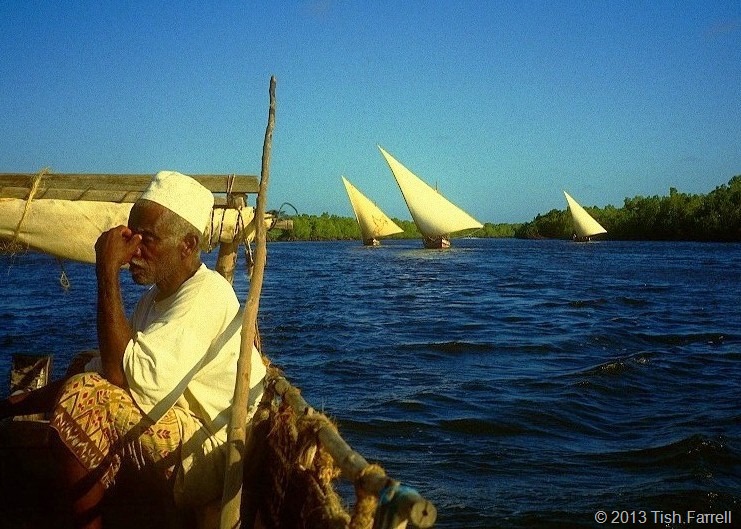
We went sailing with Uncle Lali: I see three ships…

Weekly Photo Challenge: Community

Daily Prompt: Memories of holidays past

Related:

Sleep (Lamu Dreaming)

Culture: the Swahili

© 2013 Tish Farrell


Once in Zambia: in memoriam

Mara boys 2

On the Road in Africa

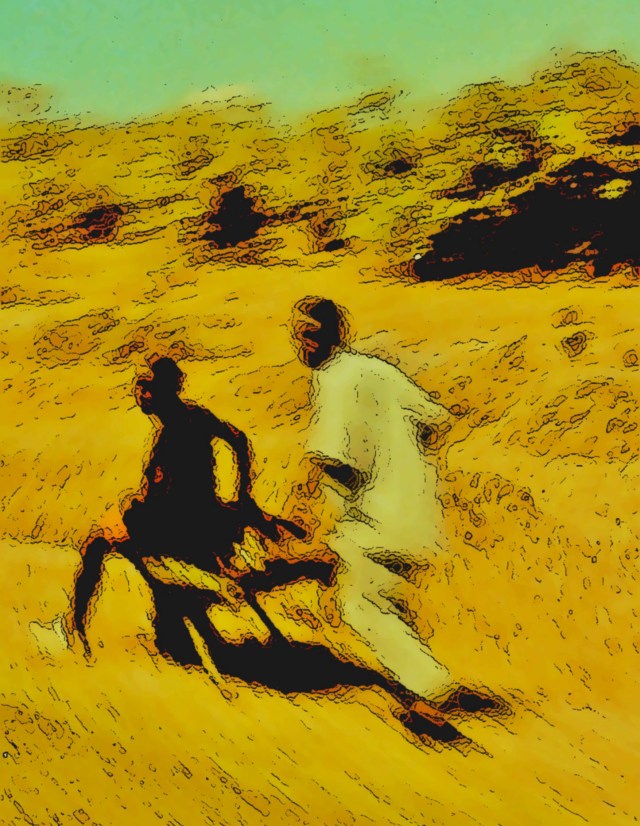
You could say that both this image and the survival of its medium (old film)  is fleeting. The original photo was taken from a passing Land Rover on a dirt road. As you can see, I’ve been playing about with it. But it struck me, too, that there is a deeper meaning here. Life can be all too fleeting in the non-industrial world, and especially on bad roads. See for instance Jujufilms , a blog that shows both the dark side and wondrous vivacity of Nigerian life.

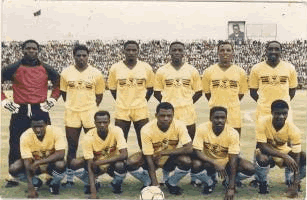
But this reminds me of another kind of disaster. When Team Farrell was living in Zambia in 1992-3 there was too much dying going on  – from famine, TB, malaria and cholera. And then there was one especially tragic event that touched all Zambians. Our passing connection with it began when we did something that we have never done since – we went to a football match. On 30th January 1993 Zambia was playing Namibia in the World Cup qualifying round at Lusaka’s Independence Stadium.

The reason we were in Zambia was because  in November 1992  Team Leader, Graham, had been seconded from the Natural Resources Institute, Kent, to the EU Delegation in Lusaka to manage the distribution of European food aid to upcountry Zambians. There had been a bad drought in southern Africa during that year, and President Chiluba, who had recently succeeded Kenneth Kaunda in the first multi-party elections since Independence in 1964, did not trust his ministers to distribute the maize flour and cooking oil fairly, or even at all. Instead, he said, international donors were to use Missions and NGOs to reach the starving villagers.  And so this was Graham’s own mission – organising food deliveries to far flung corners of the Zambia.

Famine, though, was not the only problem at that time. There were guerrillas from Mozambique spilling over Zambia’s remote eastern borders to predate on poor villagers. Then from the north came the unpaid members of Mobuto’s Zairian Army. To make up for a lack of salaries, they would drive down into the Copper Belt, or even as far as Lusaka, for a spot of night-time looting and pillaging. (It will be remembered that Mobutu was another dismal world leader put into power by Western governments). Last but not least, Son of Kaunda, doubtless suffering the loss of the family power-base, was plotting a military coup.  All seemed precarious, then, a situation made much of by British-born locals and EU diplomats who never tired of telling us of their hair-raising confrontations with rapacious gunmen stealing even their curtains, or how our Suburu would surely be car-jacked if we were silly enough to drive into the city.

Going to a football match, then, suddenly took on an element of foolhardiness. It was one of Graham’s colleagues, David Walker, visiting Zambia for a short stint of crop storage consultancy, who said we must go. And since his enthusiasm was so infectious, go we did, although it took much persistence to get tickets; none of the European Zambians had any idea how we might buy them; nor could they imagine why we would want to. It was Wilfred, the EU Delegation’s driver who told us when and where to go for them.

And so, come match day, on a hot Saturday afternoon, we set off in the Suburu that was ‘bound to be car-jacked’. Independence Stadium is a little way from the city, out on the Great North Road. There were no signs, only two brick gateposts in the middle of nowhere. We simply followed the trucks and pick-ups jammed with excited fans, and the thousands and thousands of pedestrians. It was a real family outing – mothers, fathers, children, alert but placid babies tied to their mamas’ backs.

When it came to parking, Graham soon struck a deal with two boys to ‘guard’ the car. A young police woman politely asked if, Madam, could she see what I had in my basket, and briefly explored our picnic. Soldiers checked our tickets. And as the ugly concrete stadium filled, the Namibian team entertained the crowd with a synchronized warm-up to rhumba rhythms.  The only dint in the general good humour came  when a Zambian team official began to announce line up changes over the PA system. The whole stadium groaned.  “Now just listen!” said the official in the manner of a thwarted school teacher. And everyone did, while he spelled out the reasons for the substitutions.

At five minutes to kick off, the presidential motorcade swept round the ground, releasing the diminutive President Frederick Chiluba in front of the grandstand to greet the teams. The military band struck up the national anthems, the President was installed in his executive armchair, and the TV camera woman atop her scaffold was ready to roll. Zambia needed four goals to qualify. There was a general air of speculative optimism: was it too much to ask? But fifteen minutes in, with the first goal scored, everyone was certain. Their heroes would not fail. This was the team that had thrashed Italy 4 –0 at the 1988 Seoul Olympics. This was the team set on winning the first Africa Cup of Nations trophy. They were going places, taking with them, Zambians’ highest hopes.

It was not the greatest match.  There were groans, then laughter at many missed chances. Being no football expert I would have to say that the Namibian team’s best moment had probably been during the rhumba warm-up. But when the fourth Zambian goal was scored the stadium exploded with cheers of delight – everyone on their feet, babies held above the crowd so that their infant eyes might witness the scene of victory. A man in front of us  then threw up his arms and began to dance. And when that was not joyful expression enough, he turned, shaking our hands as he moved along the row. “My own young brother,” he said in disbelieving tones. “It was my own young brother who scored the fourth goal.”

The match won, the fans left quietly. We returned to the Suburu that had not been car-jacked, and paid the boys their kwacha. Leaving by car, though, was not so easy. We found ourselves locked in a vast sea of humanity. As we slowly edged forward, people rested their arms on the car window sills in a companionable way, exchanged a few words with us. Finally, a kind policeman waved us out onto the Great North Road where we joined the dash of fan-filled trucks, the smelly old bus that was transporting the military band back to barracks, and finally the Zambian team bus, that pulled alongside before overtaking. “My God!” Graham cried. “We’re in the procession.” We gave the team a cheer. It had been a thoroughly good-hearted afternoon.

Three months later the entire Zambian team was dead. On 27th April they were on the way to play Senegal when their plane crashed off Gabon. We had been out of the country when it happened, and returned to a nation that had had the stuffing knocked out of it. President Chiluba declared a week of national mourning. The radio played only funereal music and, on the 3rd May 1993, Zambia’s team and Zambia’s hopes were buried in state on ground near Independence Stadium. The tens of thousands of people who attended wept. The President wept – real tears, not like the ones his predecessor was wont to weep. 

“Today we inter our heroes,” he said, “but we do not bury their dreams and aspirations.”

And so the building of a new team became a touchstone for the greater struggle of building a new nation. I thought of the man who had danced his joy and shaken our hands, and wondered how he was. Cool Britons that we were, we had not asked his brother’s name.

Now, twenty years on, Zambia is a nation on the up, and when the Zambian people finally receive the full value of the mineral wealth extracted from their land by international companies, they will surely do a lot better. But when it comes to the 1993 disaster, the families of the dead team and air crew still do not know why the crash happened. The aviation report is yet to be released. Somehow it means the grieving just keeps on going.

© 2013 Tish Farrell

File:Lusaka Heroes Acre - memorial.jpg

Heroes Acre Memorial, Lusaka

Francis Alisheke / zambianfootball.net  Wikipedia Commons gabon+pyra.jpg

Memorial to the 1993 Zambian team. Both photos: Lusaka Times

Footballers
Efford Chabala (goalkeeper)
John Soko (defender)
Whiteson Changwe (defender)
Robert Watiyakeni (defender)
Eston Mulenga (midfielder)
Derby Makinka (midfielder)
Moses Chikwalakwala (midfielder)
Wisdom Mumba Chansa (midfielder)
Kelvin “Malaza” Mutale (striker)
Timothy Mwitwa (striker)
Numba Mwila (midfielder)
Richard Mwanza (goalkeeper)
Samuel Chomba (defender)
Moses Masuwa (striker)
Kenan Simambe (defender)
Godfrey Kangwa (midfielder)
Winter Mumba (defender)
Patrick “Bomber” Banda (striker)

Coaching staff
Godfrey “Ucar” Chitalu
Alex Chola
Wilson Mtonga (doctor)
Wilson Sakala

Others
Michael Mwape (FAZ Chairman)
Nelson Zimba (public servant)
Joseph Bwalya Salim (journalist)

Crew
Colonel Fenton Mhone (pilot)
Lt Colonel Victor Mubanga (pilot)
Lt Colonel James Sachika (pilot)
Warrant Officer Edward Nambote (fitter)
Corporal Tomson Sakala (steward)

Weekly Photo Challenge: UP (in NYC)

New York 200 (2)

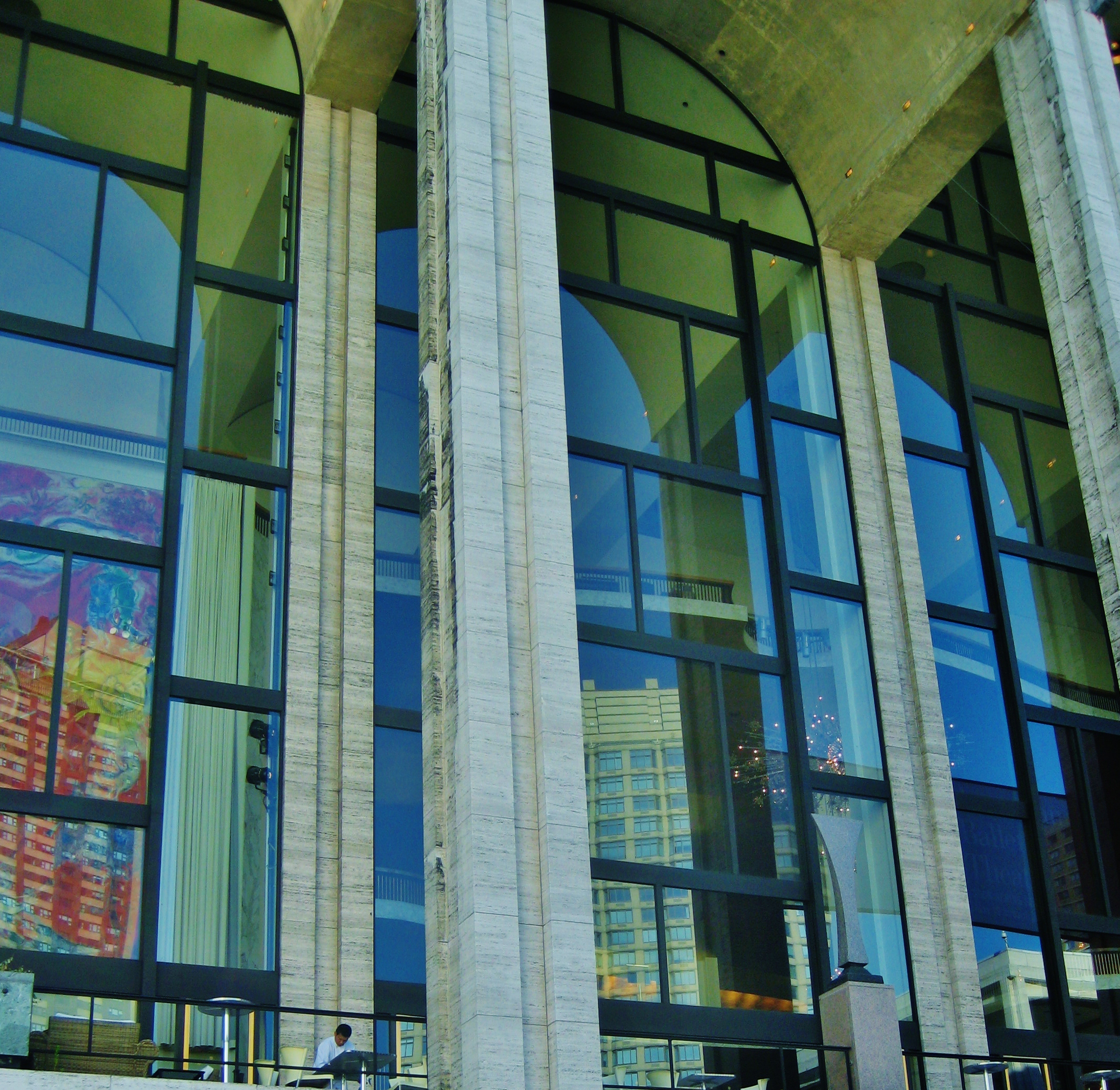
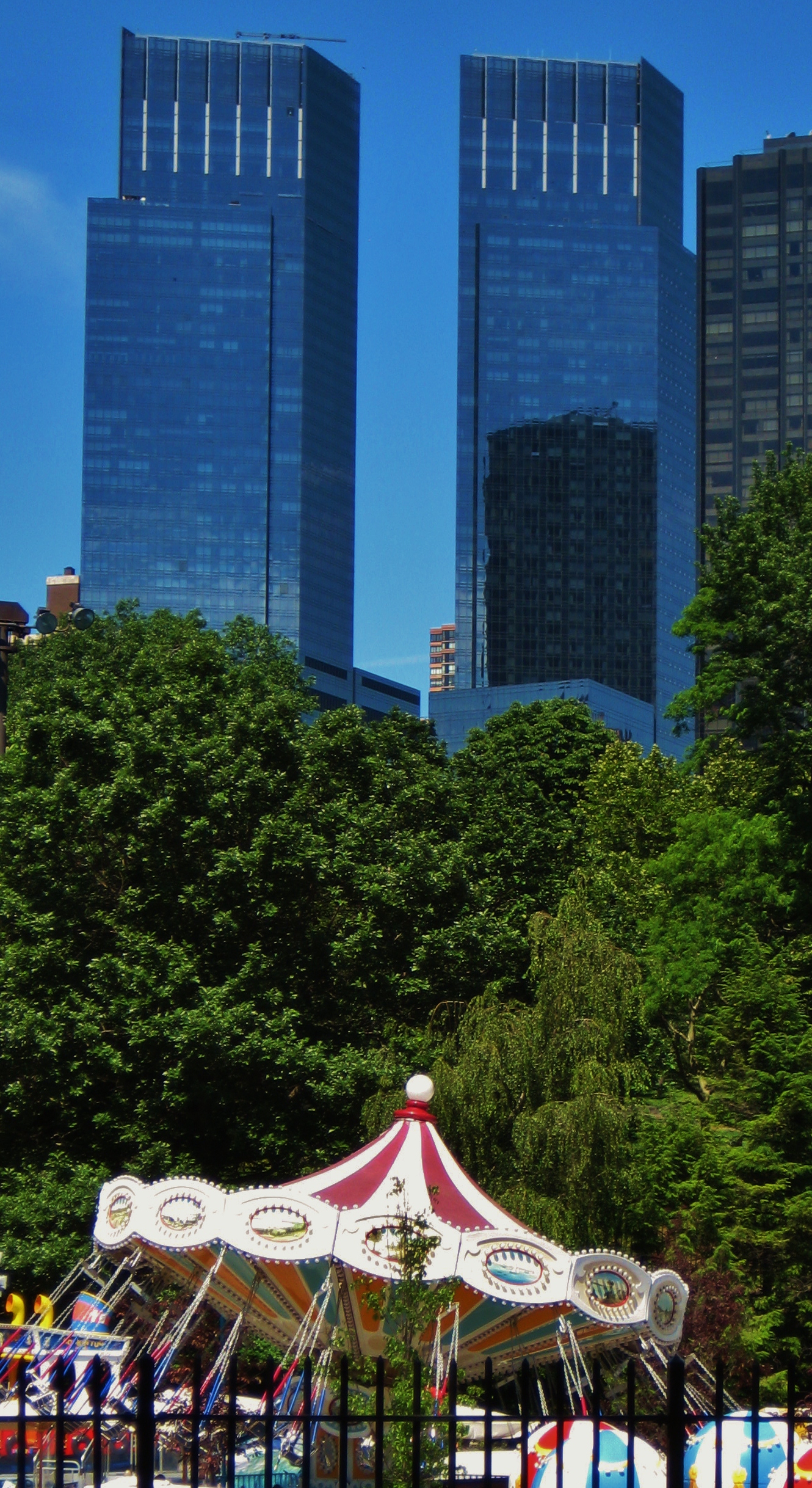
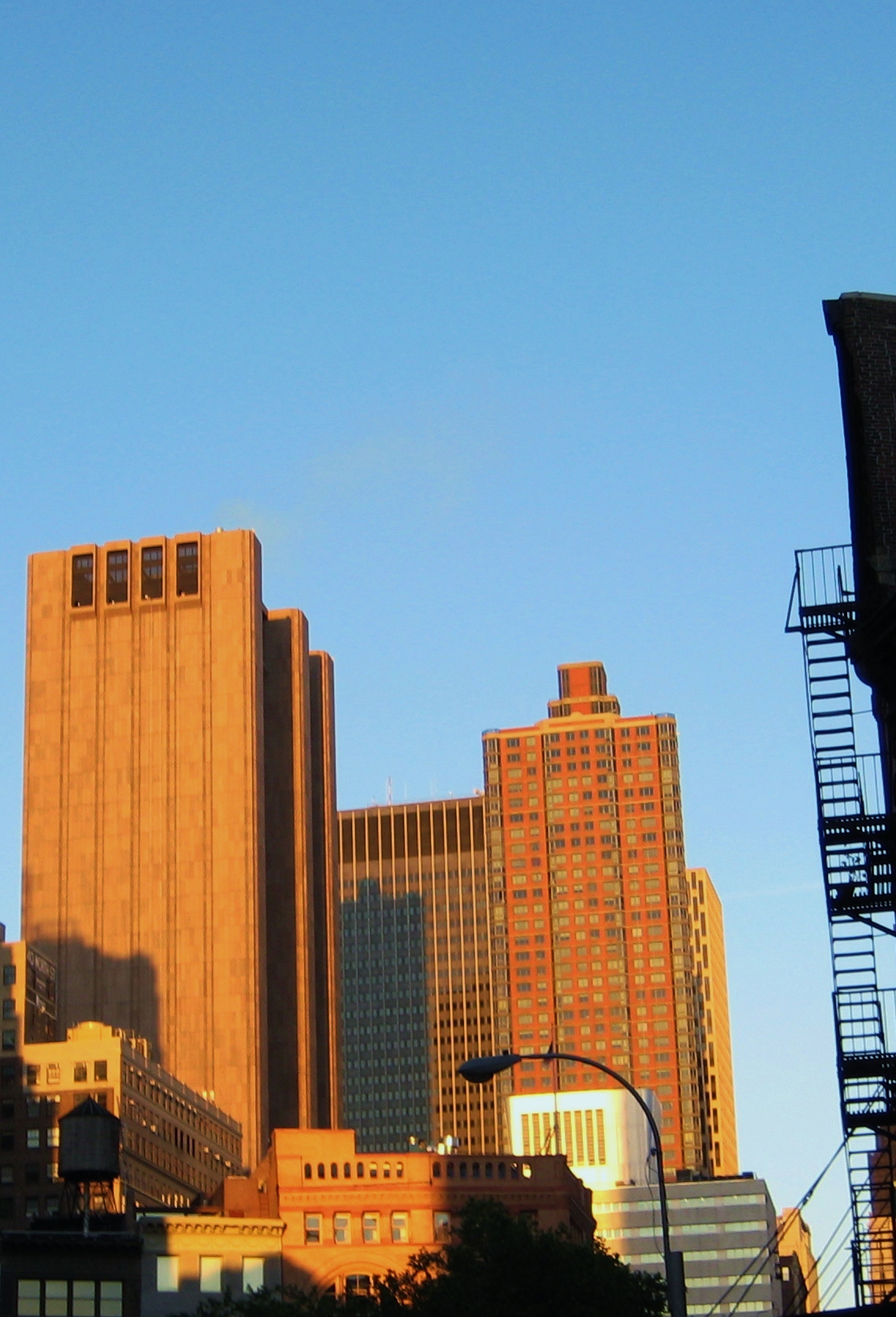
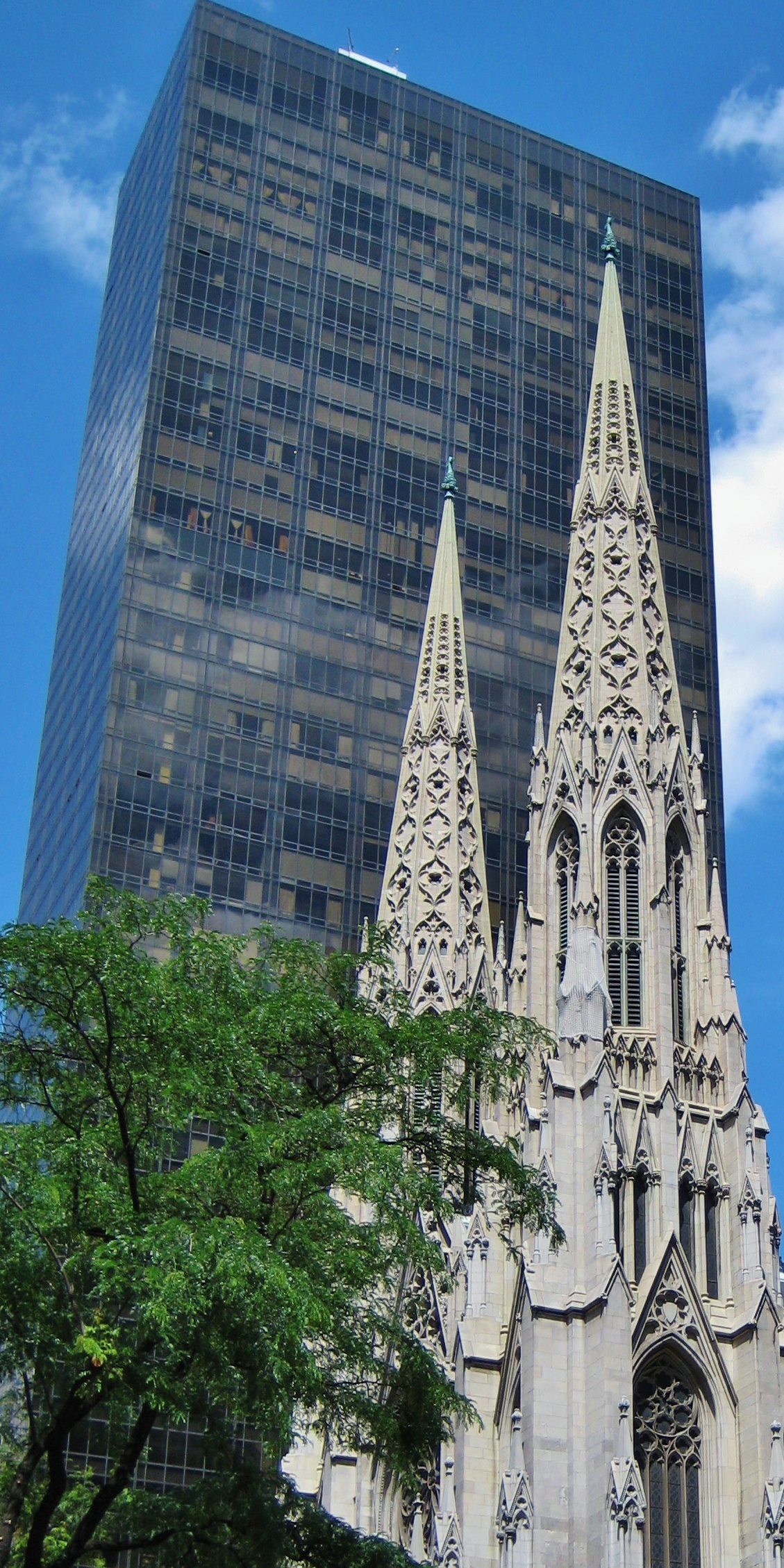
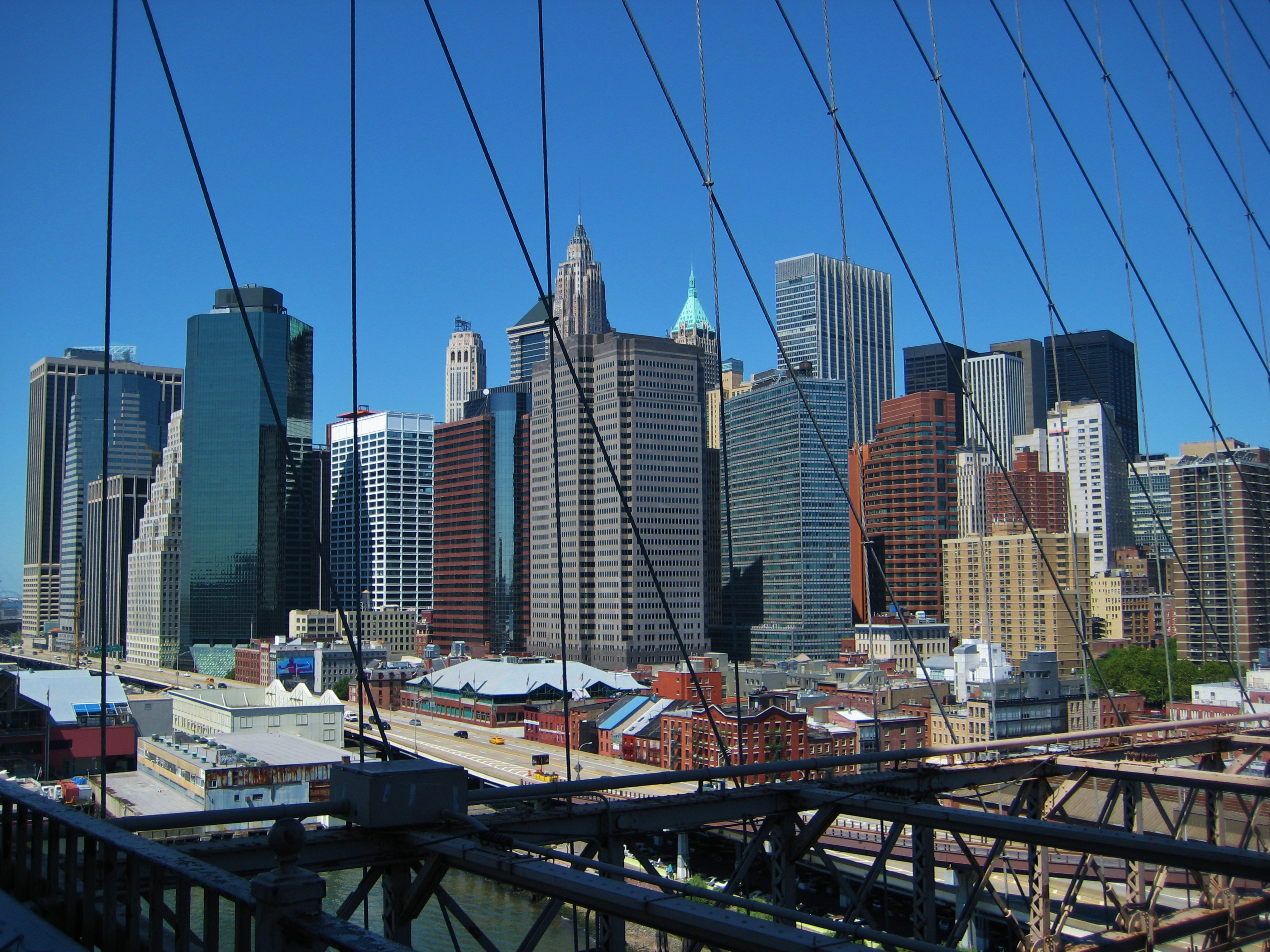
Of course NYC has been a city on the rise ever since its origins as Dutch New Amsterdam in the seventeenth century. And when you visit Manhattan, what else can you do but look UP. This photo, though, was a true  happenstance shot: I just happened to look up as we were going into Grand Central Station.  Here are some more ‘up’ views. Guess the locations.

New York 049

New York 144

New York 208 - Copy

New York 179

New York 214

As the baseball caps and tee-shirts sold on every street corner would  have it: it’s hard not to love NYC; a city that led the way in up-ness.

© 2013 Tish Farrell