
The Changing Seasons: June 2025

IMG_7887 wall border

My last post perhaps gave the impression that there’s little room for flowers in our small garden; that all my attention has been on growing stuff to eat. But not so. June has been wonderfully floriferous, especially in the border atop the terrace wall. And beneath it, while the geraniums, centaurea, foxgloves, valerian and St. Cecilia rose came to full bloom, Graham sat on a chair, suitably hatted, and methodically chipped off the failed and peeling plaster. Our builder, Alan, says he’ll come and re-do it in autumn. And while he’s here sort out the old back garden steps. The house improvements continue.

IMG_7792 wall border

St. Cecilia rose, Ann Thomson geranium, Sherbet Fizz pot marigold

*

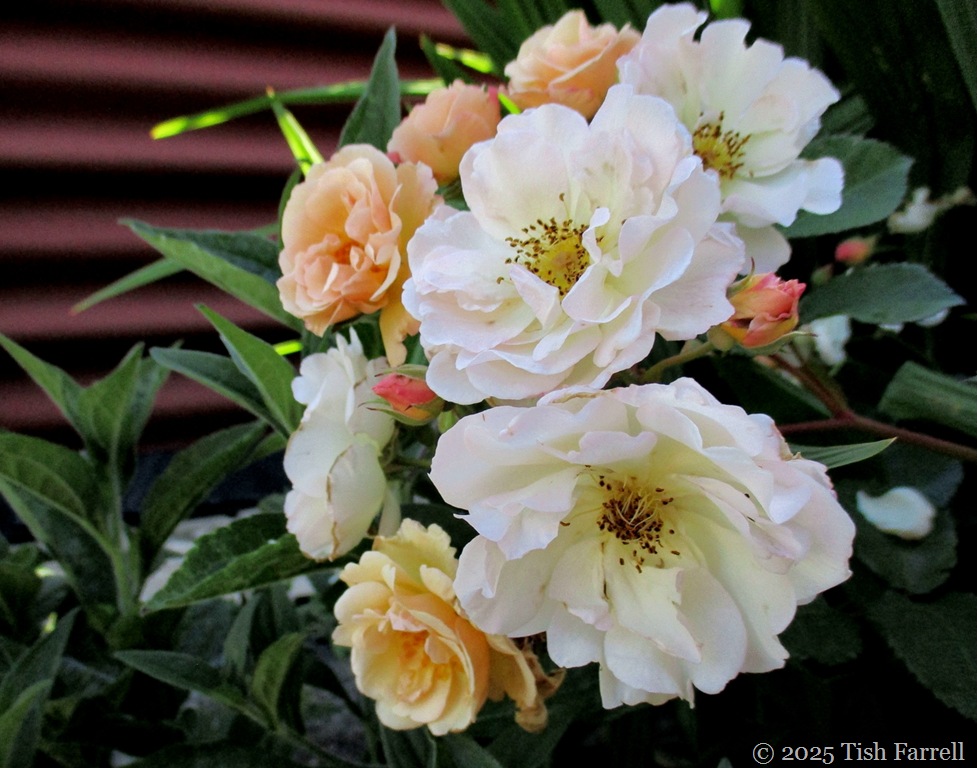
Looking from the top of the garden towards the kitchen door, the border runs between the far end of shed and the right hand path. It also includes two miniature apple trees planted  back in the autumn. The rose, St. Cecilia, was languishing there when we moved in nearly two years ago, but she’s had a good feed and a hard prune, and this June has been flowering wonderfully. She may be a tad wishy-washy colour-wise, but she has an exquisitely delicate scent.

IMG_7715 back garden

IMG_7950 st cecilia

IMG_7797 wall border 2

Self-sown foxgloves among the geraniums at the path end of the border

*

The garden peripheries have also bloomed over the last couple of weeks, surprising given our near total lack of rain for many weeks. In the northerly corner the medicinal herb, St. John’s Wort is now soaring into the apple tree. I grew it from seed donated by a supporter of the Bishop’s Castle Seed Bank. The seed packets sit in a tray at the Town Hall and are free, although donations are welcomed.

IMG_8037 st john's wort

*

Also blooming for the first time is this dreamy perennial foxglove. It has a tendency to flop somewhat in warmer temperatures, and has been struggling in the dry soil under the big apple tree. Mulching with hot-bin compost helped. And some hand watering of course.

IMG_7777 perennial foxglove

*

And another cool looking plant that’s just started to flower. A white mallow. She’s been in several spots around the garden, but is now in the rear westerly corner, behind the Rooster potatoes and in front of a very nice miniature crab apple tree. The moves seem to have left her unscathed:IMG_8011 Mallow

*

At the front of the house we have two biggish square beds, created after removing ugly paving (recycled into shed base and new back garden steps), but they are very much a work in progress. In the southerly one, I have some currently very small shrubs growing on, a couple of escallonias and a cistus, and in the meantime there’s a mix of herbaceous perennials and annuals, cosmos and zinnias, filling the spaces.

I was missing my Evereste crab apple tree, and managed to find a miniature one. It’s planted in a small circular raised bed of corten steel which I’m expecting to rust. Around it are some assorted small plants, including a white rock rose and Santolini rosmarinifolia, which are evergreen, Salvia Salavatore, and a trailing plant, Oregano Kent Beauty (centre front). This last was a wonderful plant discovery courtesy of Jude at Cornwall in Colours. I’d never seen it before I saw it on her blog. It really seems to like our garden, so thank you, Jude.

IMG_8047 front garden

In the background right, not yet flowering, are three alcalthaea – a cross between mallow and hollyhocks. They are apparently short-lived perennials, but we’ll see. Last year they grew very tall and had to be curtailed, but their peachy pale flowers were very pretty.

Plants apart, the main activity in June was having our drive dug up by Justin, Bishop’s Castle’s professional excavator sans pareil.  He mostly had to use a pick, this because the exact location of our water main pipe was uncertain. And this was happening because we wanted our rusted hundred year old, cast iron water pipe replaced with a plastic one. To say this was one heavy duty task is an understatement. Order is restored, but the drive now needs to be resurfaced.

IMG_7729 water pipe

*

Out beyond the garden gate:

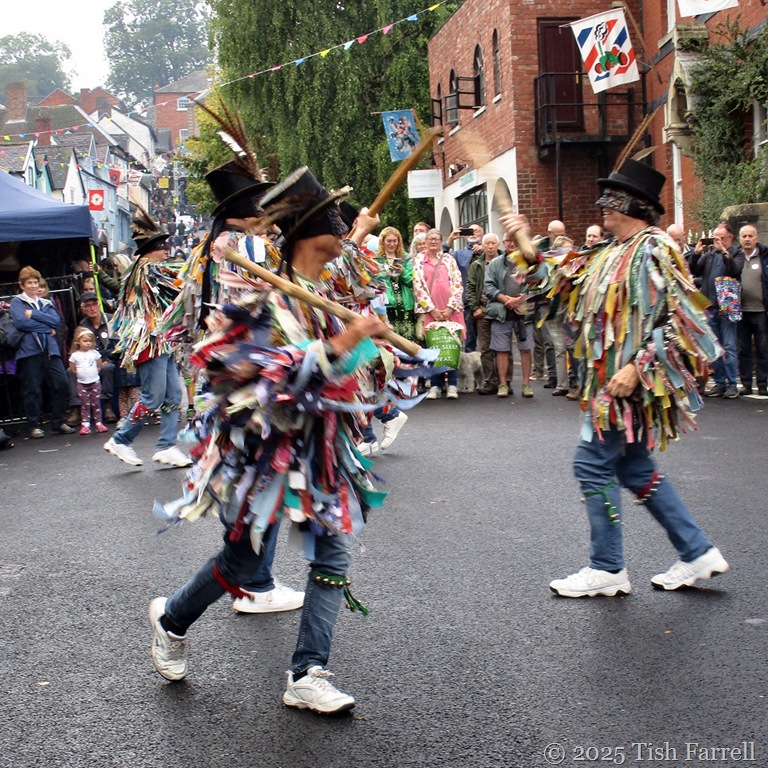
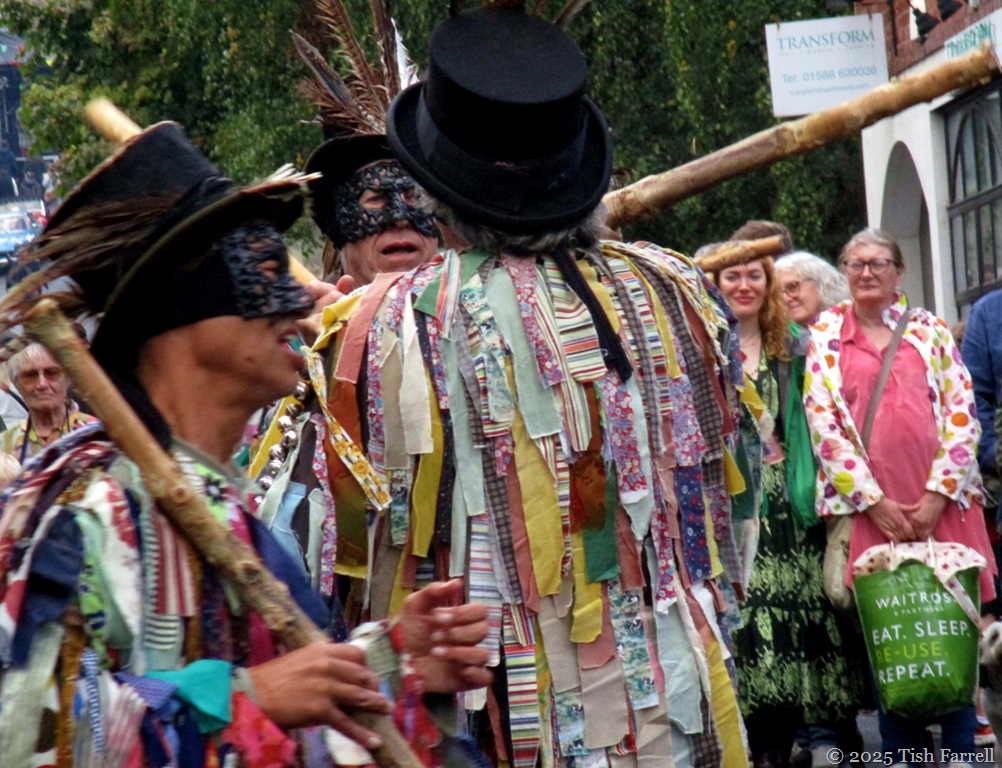
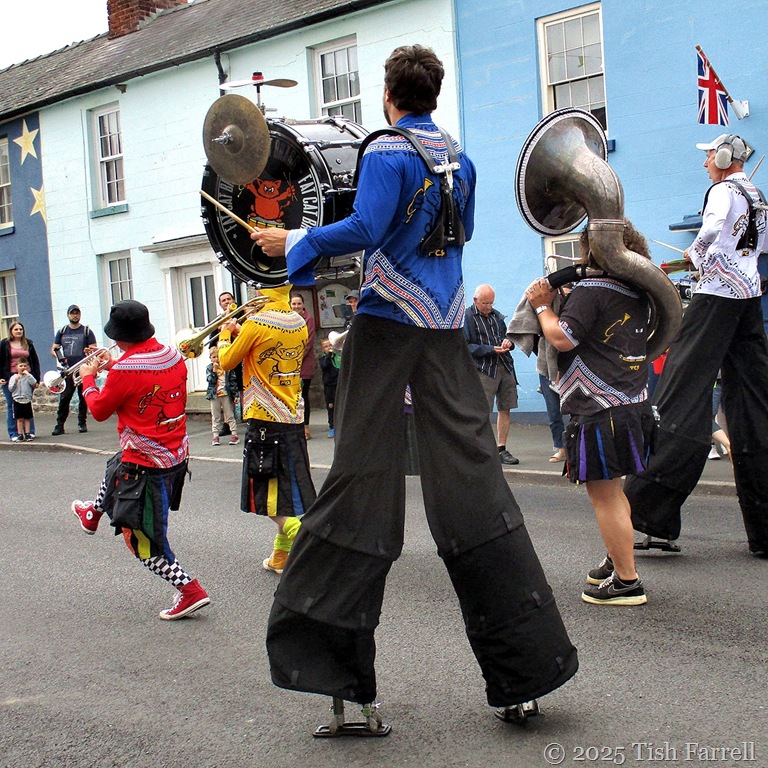
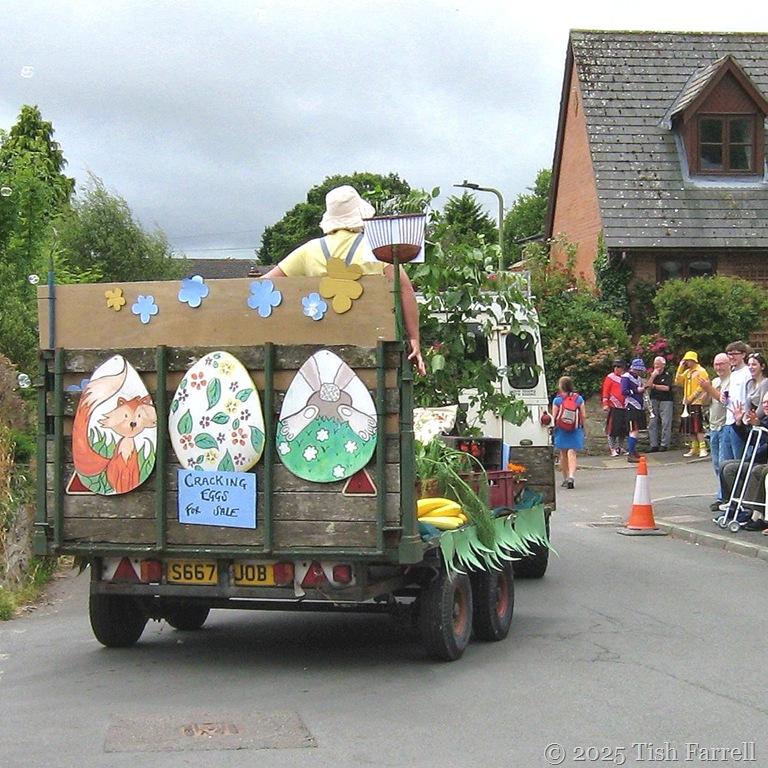
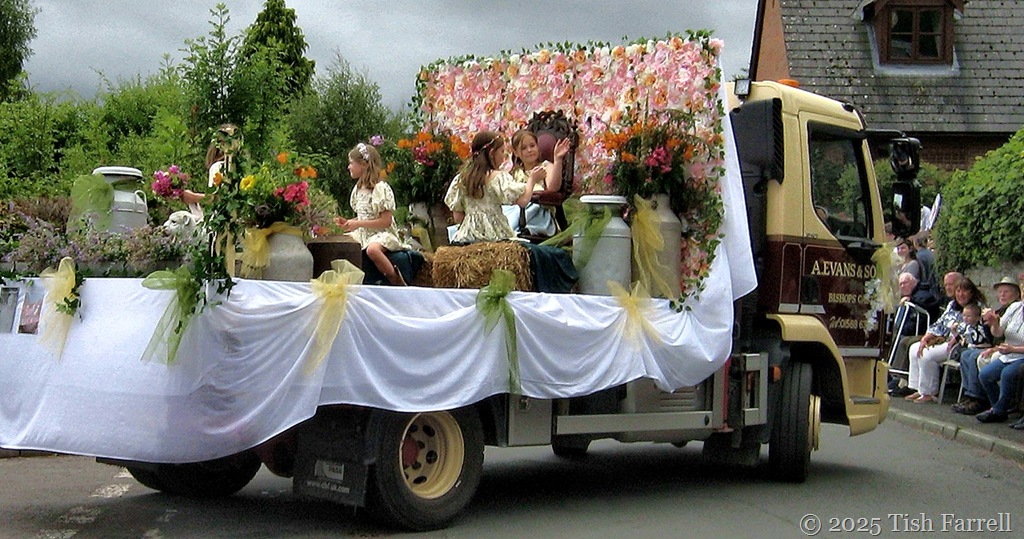
A week last Sunday in Bishop’s Castle we had midsummer celebrations in the form of a gathering of Morris dancing troupes, local and further flung. They started on Sunday morning with rousing performances and much drumming at the next door care home, after which they streamed up the road past the house to continue performing at the top of the town. Later when we tried to drive out of the town by our usual route, we found the road ahead full of dancers and musicians, and were advised that they might be there for some time and so would we mind making a detour. We didn’t. It was all good fun and surely makes a change from having multiple local roads closed for cable laying.

IMG_7916 midsummer morris

*

And yesterday (Sunday)  we treated ourselves to another local institution – climbing to the top of the town to visit the House on Crutches Museum. (I forgot to take a photo of the outside so click on the link to see it). We hadn’t been for two years, but it’s a wonderfully quirky collection, revealing many aspects of Bishop’s Castle history, in particular how it featured on  the ancient drovers’ route out of Wales, a way of life and of making a living that survived some 800 years. At the top of the rickety stairs that we both managed to fall up, I stopped to take this view down the High Street: a sleepy Sunday in Bishop’s Castle.

IMG_8065 Biahop's Castle high street

*

Today as I write this, on the last day of June, we are having our hottest day so far this year, apparently 29 degrees C (84 degrees F) at 3 pm this afternoon at Shropshire’s weather station in Shawbury. Now at 6 pm it’s 26 degrees in the house, but there’s a pleasant breeze in the garden, as there has been all day. Tomorrow, temperatures begin to fall, and in fact by next Sunday it will be 12 – 15 degrees C, this according to YR the Norwegian Met Office, which is pretty good on UK weather. And this may also mark the beginning of rain. At last!  Yesterday, we had a few sprinkles and the plants all stood up tall, as if expecting a good drench. They were duly teased.

IMG_7757 snapdragon

And so I’ll round this up with a shot of the snapdragons that have flowered heroically all through June, and with not a drop of water from me. They are pretty much over now and making lots of seed. I think I’ll give them their heads. Next June I could have a whole bed of snapdragons. How wonderful would that be.

*

The Changing Seasons is hosted monthly by Brian at bushboys world and Ju-Lyn at Touring My Backyard. Please pay them a visit.


IMG_7792 wall border header

Six On Saturday ~ Produce!

IMG_7953 back garden

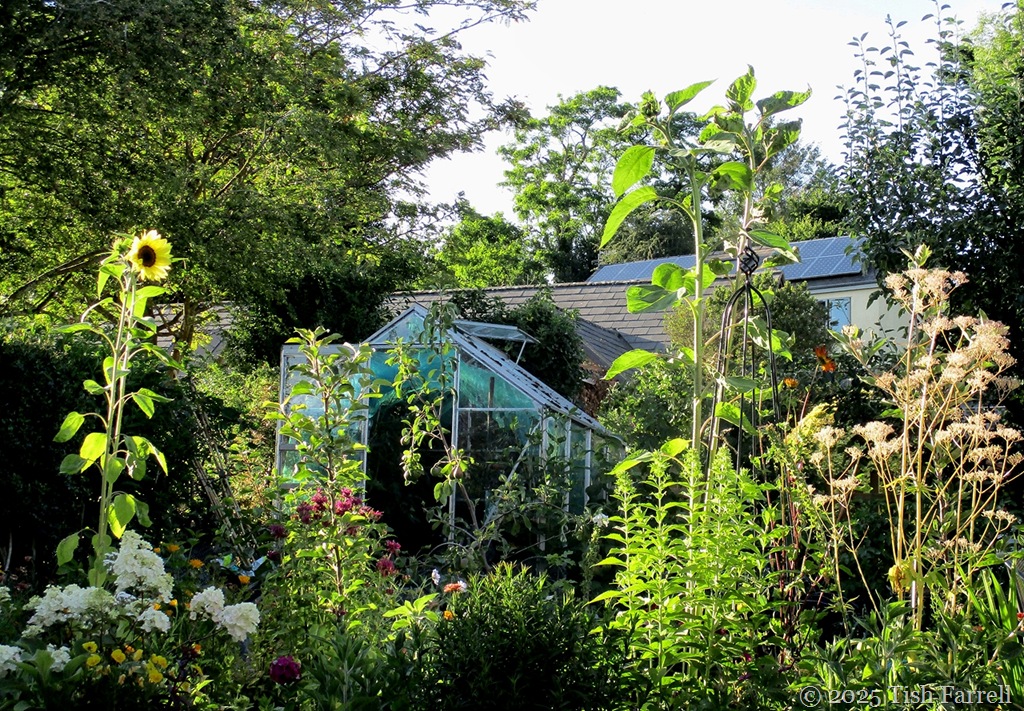
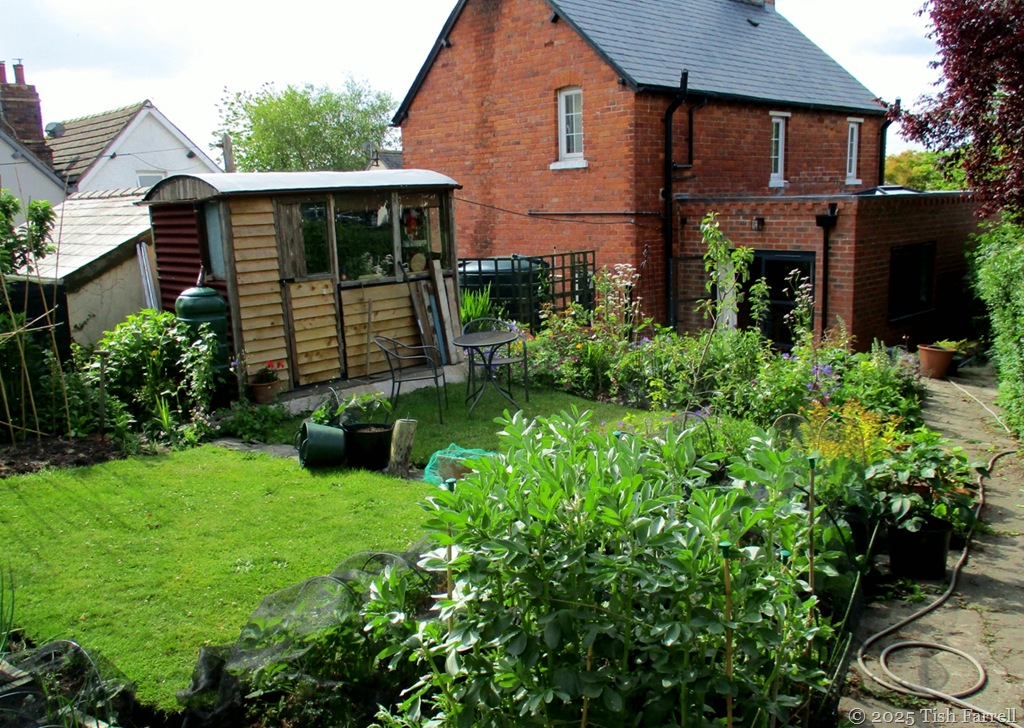
As you can see, the ‘upstairs’ garden behind our house is really rather modest. And here, currently, and probably for the foreseeable future, chaos reigns; this courtesy of a gardener who still thinks her growing spaces comprise two seventy by 15 foot allotment plots  plus the home garden with its adjacent stretch of ‘guerrilla gardened’ field over the back fence. Heigh ho! Those were the days when we lived beside Wenlock Edge.

IMG_7954 back garden 2

Now, mostly settled in our new home, I do know I must cut my cultivating cloth according to the physical means of production. (The lawns, though, do seem to keep shrinking). Also this year there’s been the matter of watering through the mostly rainless months of spring and early summer. This has been quite hard work. (I know mulching is much of the answer, but my hot compost bin can only yield so much stuff, and so far it’s spread rather too thinly). And then there are birds and cats and insects to contend with which means everything edible has to be netted, which is not very attractive. So, as I say, chaos presently reigns, but with a few organised segments in between.

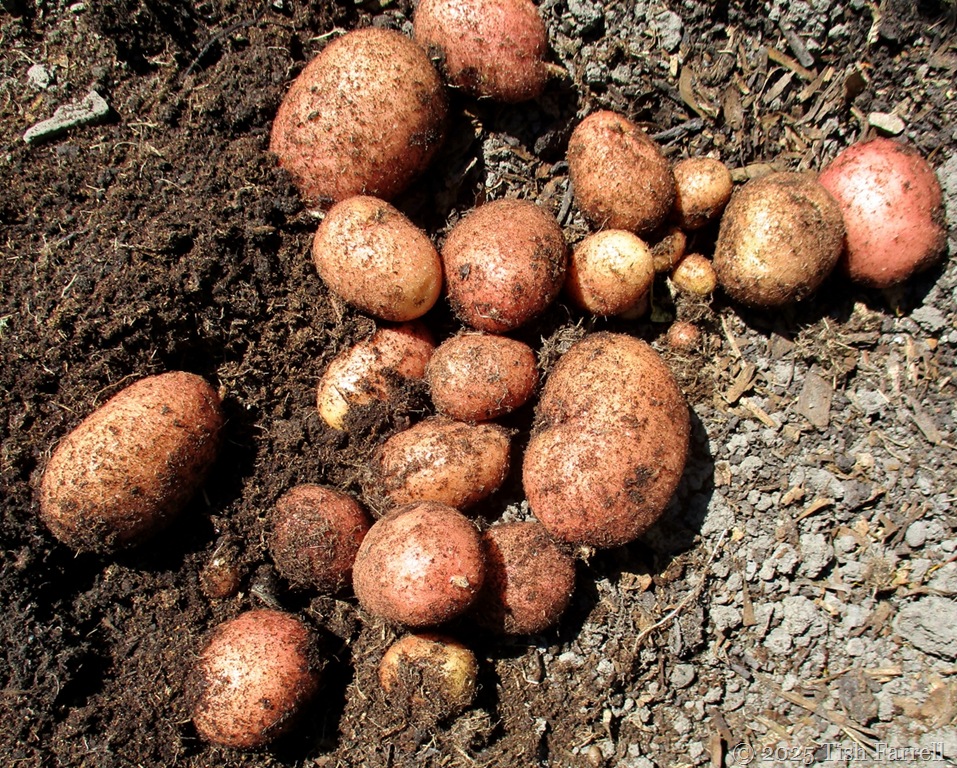
1.) The first of these to produce excitement in the Farrell household are the two short rows of potatoes. They were planted at the end of March, ten in each row. Even with little rain, and not much watering, the Belle de Fontenay have produced some lovely salad potatoes. (They’re also a main crop variety if left longer, but that’s unlikely to happen).

IMG_7943 belle de fontenay 2

Behind them is a row of Rooster red spuds, also main crop. The plants have grown astonishingly tall, given the weather, while the Belle de Fontenay have flopped flat in front of them. I think the Rooster must have commandeered the downward flow of any available groundwater from the hill above.

IMG_7971 rooster potatoes

*

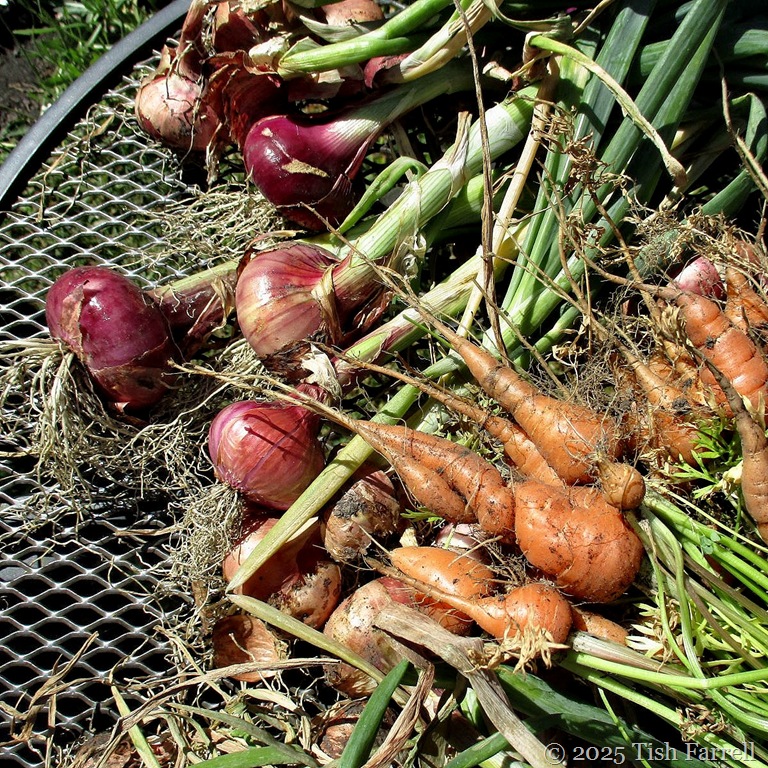
2.) The next excitement this week was a bunch of carrots, and not a single sign of carrot root fly in any of them. I have attempted to protect the rows by growing them in a raised bed, between onions and covered with some fine mesh. Last year all my carrots were root-flied.

IMG_7964 carrots

*

3.) We eat a lot of greens, and this year I’ve grown some different varieties of kale, including, pink frilly, Tuscan, and a crossed Tuscan and Daubenton’s perennial kale, the seed produced by a forest gardener on eBay. (There’s also some Swiss chard in the bunch below.) I know kale isn’t to everyone’s taste, and I’ve yet to try this, but I recently learned you can roast it till crispy. This involves ripping up the washed and dried leaves (without the stalks), tossing the pieces in oil, spreading them on a baking sheet and cooking for 15-20 minutes in a fairly hot oven. Sesame seeds and favourite spices along with sea salt and black may be added.

IMG_7965 greens

*

4.) Yesterday we ate our first homegrown courgette (zucchini), and very nice it was too, sliced and lightly browned in the fat from cooked lardons and then added to a salad.IMG_7999 courgette 2

IMG_7982 courgettes

I put the plant in beside the compost bin, a position that clearly is suiting it. I have some yellow courgettes coming on nearby.

*

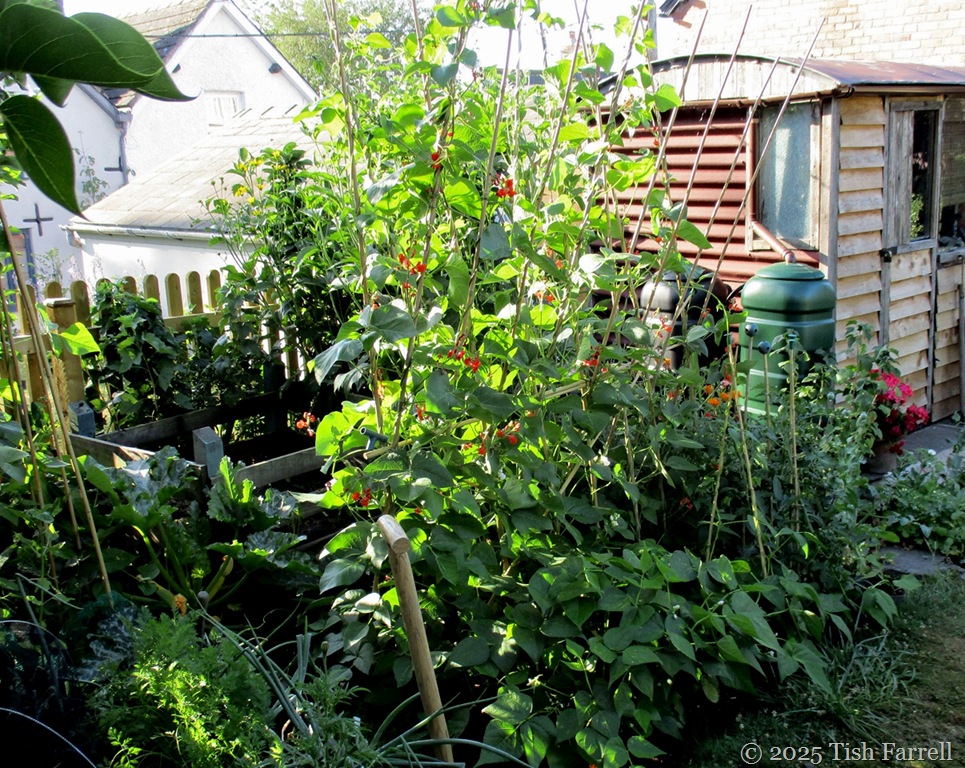
5.) Also in last night’s salad were the first of the field beans. These are a variety of broad (fava) bean, grown mostly in the UK as animal feed or as a green manure, ploughed back in the soil before producing beans. This, I feel, is a lost opportunity. The plants grow four or five feet and taller, while the beans themselves are little bigger than peas. But then the plants are prolific, and so ideal if you haven’t a large enough space to grow their bigger cousins. My field bean plot is around a square metre/yard.

They have anyway, become something of a summer staple in the Farrell household. Picked at the right moment they are deliciously tender and can work as a rather good imitation of guacamole. If they get over-ripe and a bit floury, they make excellent soup and refried beans. The downside is they are fiddly to pod. But then the mass of little pods is good fodder for the hot compost bin, as is all the vegetation (chopped up) when the plants are done.

IMG_7977 field beans 2

IMG_7975 field beans 3

IMG_7992 field beans

*

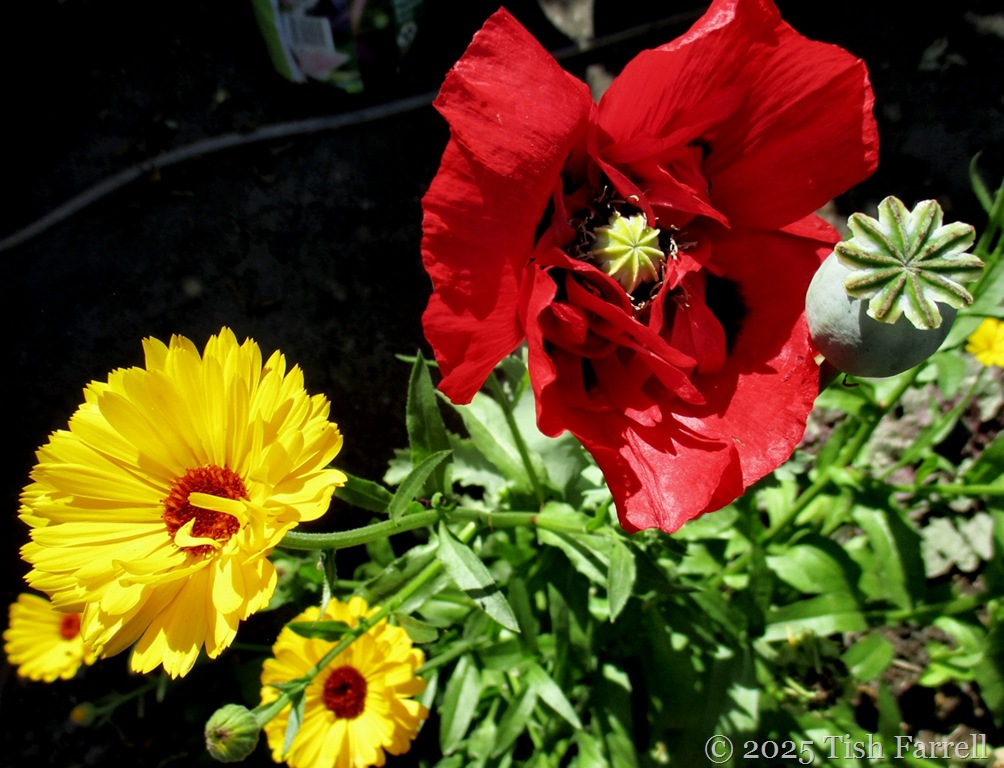
6.) Last but not least on the garden foraging front are the marigolds (Calendula officionalis). I use them in herbal tea. They contain all sorts of therapeutic properties, known and made use of for a couple of thousand years. But mostly I add the petals to salads, taking care not to include any passing hoverfly. This particular variety is called Sherbet Fizz. We also have lots of self-seeded bright orange and yellow ones from last year’s crop. I love them all. They have to be one of the most heartening of flowers. Simply to gaze on them lifts the spirits.

IMG_8007 marigold sherbet fizz

IMG_7961 marigolds

Six on Saturday: Please call on Jim. There’s always lots to look at and discover in his Cornish garden.

Ructions At The Roost

IMG_7897 jackdaw header

I don’t know what’s going on with the jackdaws who roost in the big ash tree on the hill above our house. Lately they’ve been bursting over the garden with much clamour and commotion. The eruptions can happen at any time, which is very disturbing when one is hanging out the washing.

Usually big aerial displays of corvids take place at dusk. This seems different though. A bit of a fracas perhaps: the newly fledged offspring coming to terms with their established community, and vice versa. Anyway it strikes this human onlooker as one big family row. Well, just imagine having to live in one tree with this crowd.

IMG_7905 jackdaws 5

IMG_7898 jackdaws 4

IMG_7894 jackdaws 2

Waiting For Rain…In Kenya Past And Shropshire Present

desert date mulului tree

Maasai Mara with desert date tree

*

We’ve been living back in the UK since 2000, our years in Africa increasingly faraway. And yet…

And yet this spring and summer in Shropshire we’ve been very short on rain. The temperatures, too, have recently risen after a cold and windy spring. My gardening self grows anxious. Several times a day I do the rounds of my vegetable plots, checking on the kales, chard, beans and potatoes, the onions and leeks, examining the greenhouse tomatoes and cucumbers for signs of stress. My hands are always dirty, soil crushed under nails, as I prod the soil, testing for moisture levels around the plants.

It makes me think of Kenya days, pastoralists like the Maasai depending on rain to replenish the grasslands for grazing, cattle their life-blood in every sense;  village farmers waiting for the November-December small rains for sowing; for the long rains March to May to bring the crops to harvest: lives and livelihoods dependent on monsoon weather systems that are nothing if not capricious.

Nor is this new. Oral history accounts, some going back two or more centuries, make reference to periods of drought and famine. One type of oral record is the memorized male circumcision list that survives in some communities. The rite  was carried out every ten years or so, and the given year commemorated by some notable event. Food shortages were often inferred.

For instance the list for Maragoli in Western Kenya has 1760 as the time of Kgwambiti. Our Maragoli house steward, Sam, interpreted this as people behaving selfishly like animals, suggesting a food shortage. Likewise Vuzililili  for the year 1800, a time when small insects fed on large insects. Then in 1900 Olololo-Lubwoni – refers to a time when jigger fleas (olololo) infested people’s feet, implying that that households were dusty and not swept properly. Lumbwoni is a very thin sweet potato, also suggesting drought and lean times.

img120 ed

Another remarkable source of rains failure evidence is the revised historical events calendar used in the enumerators’ guide to the 1969 Kenya census. At this time many rural householders would have been born in the 19th century, or else reckoned family chronology according to particular past occurrences. For semi-arid Ukambani, a drought-prone region in southern Kenya, it was generally agreed that there had been six significant periods of famine in the 19th century: Ngovo (1868); Ngeetele (1870); Kiasa (1878); Ndata (1880); Nzana (1883) and Ngomanisye or Muvunga (1898).

In the past, too, it transpired that the Akamba people had established emergency strategies via extended kinship allegiances. This involved moving from the worst stricken areas and, for a time, living with relatives who were not so badly affected, or who had their own water-holes. Rules of reciprocity of course applied; this was not charity.

It was important, too, that in pre-colonial times the Akamba had a sphere of far-flung connections through their hunting and trading activities, one that extended into what is now Tanzania. This increased the scope for finding sanctuary from drought-stricken regions, but of course was curtailed when the colonial administration consigned each ethnic group to a designated reserve, basically drawing a line around the territory that each community apparently occupied at the time when the British arrived; self-determination being duly cancelled by a line on a map.

But perhaps the most compelling evidence for the enduringly random state of weather across East Africa is the deeply embedded cultural phenomenon of the rainmaker. Every community had them; perhaps still does. They were often rich and powerful individuals. And contrary to what may be imagined, the forecast of rain was mostly based on informed careful observation of natural phenomena, including the movement of clouds, wind directions, dew formation, the behaviour of particular hygroscopic plants and trees that respond to rises in ground water, the arrival of particular species of birds and insects. Such observations informed planting decisions, the particular crops chosen, the times and places they were sown.

It’s tempting to think our Met Office could learn and thing or two.

And so I ponder again on our lack of rain. Our lives do not depend on the success of our garden produce. The Co-op’s daily deliveries of fresh food are two minutes’ walk from the house. I anyway have an outside tap and a clutch of watering cans. The water is always there. (Or at least it is for now). A luxury however you look at it. But even so, the daily sight of parched soil does seem to trigger some bred-in-the-bone alarm system, all those generations of farmers and gardeners in my family tree worrying…

And so the sky-watching continues, the hopeful eyeing up of every darkening cloud.

And probably also, in the not too distant future when the rain comes, there will be the ungrateful complaint that it doesn’t seem to know when to stop.

*

copyright 2025 Tish Farrell

Lens-Artists: Stormy This week Beth wants to see scenes of storminess.

Garden Treasures: The Salvaged And The Self-Seeded

IMG_7726 variegated yellow flag

Well, this was a big surprise last week, and a very lovely one too. It is the unexpected outcome of a little rescue job performed over a year ago, not long after we’d moved into The Gables. Back then, in the August of 2023, I was making a start on de-jungling various flower beds and found some rhizome fragments swamped by phygelius and euonymus and assorted weedy thugs. They had small spikes of green and white leaves and I thought they might be Japanese iris so I replanted them in a cleared corner and pretty much forgot about them. They certainly didn’t do anything last summer, and when I looked at them early this spring I decided that they weren’t likely to either.

So it just goes to show what can happen when you’re not paying attention.

IMG_7720 variegated iris 2

The spot where they’re growing is fairly sheltered, between Graham’s shed, a blackcurrant bush, the path and the hot composting bin. They are also being encroached on by some super-charged perennial helianthus ‘Lemon Queen’ (more of which in a moment). And here’s the puzzle.

When I first spotted the opening iris I couldn’t quite believe my eyes. It looked exactly like the wild yellow flag that grows in and near ponds and marshes. The only difference appeared to be the green stripy leaves. Some internet sleuthing was thus required, and this soon revealed that the iris was indeed a variegated cultivar of the wild form. But how come? There is no standing water in its vicinity. Until last week we’ve been many weeks without rain, and on sunny days, out of the wind, it’s been quite hot, leaving other herbaceous plants in parched beds.

Then I considered the size of the neighbouring helianthus clump. The first shoots are waist high already and the leaves huge. I then began to wonder if the hot compost bin has been having a hand in things. It does make a quantity of liquid gloop which, if I haven’t drained it, dribbles onto the path and onto the flower bed (?). Also the soil there is largely unimproved and thus dark and heavy; slow to dry out where the shed shades it.

Hm. Who knows? I’m just hoping that the iris will decide to stay. There are signs that the plant with the flowering stem is beginning to clump up. The smaller cuttings, in amongst a spreading geranium and rudbeckia,  are also beginning to look promising. And now we’ve installed a nearby water butt, I’ve no excuse not monitor watering requirements.

All the same, all the gardening sites do call the variegated yellow flag a wetland plant, and also warn that it, too, can develop thuggish tendencies. A watching brief then.

*

IMG_7776 geranium phaeum alba

I rescued this geranium phaeum album early last summer. I discovered it behind the compost bin, lurking mostly under the fence with next door’s garden. It’s now growing under the apple tree at the bottom of the garden, though it’s a spot prone to drying out. It’s doing better in an open sunny border along with geranium Anne Thomson. Damp shadiness is supposed to suit it best.

*

The recent downpours have bruised many of the geranium faces, but the rescued clumps of Johnson’s Blue (I think that’s what they are) have been putting on a good show and pleasing the bees.

IMG_7765 blue geranium and bee

Here they are with this year’s number one self-seeders: white foxgloves. They are everywhere about the garden, although there was no sign of white ones over the last two summers. I love their cool and stately demeanour.

IMG_7764 white foxgloves

*

And at the hotter end of the colour palette, in the front garden we have a row of snapdragons, self-seeded along the wall in a remarkably orderly fashion. Anyone would think I’d put them there.

IMG_7758 snapdragon 3

IMG_7756 snapdragon and bee

They glow in late afternoon sunshine.

*

Throughout May we had profusions of columbines, mostly pink and dark mauve. They are actually too much of good thing on the self-seeding front, and I spend much time rooting seedlings out of the vegetable beds. But then amongst them were two plants of delicate lavender, each with a different ‘frock’, one by the green house, and another in the far corner behind an apple tree.  They are over now. But I know where they are.

IMG_7562 columbine lavender

IMG_7554 columbine lavender 2

*

Six On Saturday  Please visit host Jim’s lovely garden – so many treats to be found there.

Hippos Under The Carpet…

img039ed2

This past week at Lens-Artists, Tina has wanted to know what we were thinking as we took our photos. This led me back to the old Africa album of vintage slides and photos from when we lived in Kenya.

The header photo did not scan too well, but it was such an unexpected moment, it still makes me laugh.

There we were driving along a dry savannah track in the Maasai Mara, the only water (or so we thought) some distance away in the Mara River, when suddenly we were alongside an even spread of water-loving cabbage weed. Weirdly, it seemed to be growing on a level with the grassland. No sign of the water underneath though, and so no sense of depth…

…until up popped the hippos to give us the once over as we passed. It was hard to take in. How could such huge animals have squeezed themselves under this seeming thin layer of weeds. It conjured a surreal image of a large living room with a huge pile rug and numberless unseen hippos lurking underneath.

*

maasai mara_0004ed

Of course you can tell what I was thinking here: African plains with zebra crossing.

*

cheetah 6

A spot of yoga anyone?

*

Mara 8

And now who remembers the Bisto Kids advert? That young lion on the right seems to be savouring some delicious aroma; probably not gravy…Aaah! Wildebeest!

Lens-Artists: The first thing I thought of…  This week Tina sets the challenge. What were you thinking when you took the photo.

Serenity ~ Inside And Out

P1060459 - serenity

There are vistas that manifest serenity – at least as seen through human eyes. (I mean who knows what fervid biological imperatives are playing out beneath the calm surfaces of things).

This distant view of the Great Orme from Anglesey was shot on a late December day, the air so still there is barely the hint of a tide. No clouds either, and the sun warm enough to go coatless and believe the seasons have fast-forwarded to June.

*

Another ‘still waters’ scene. An end-of-summer sunset in Kalamata. I watch a naked man wade into the rose-tinted shallows of the Messenian Gulf, talking on his cell phone.

serenity

*

And a third sea-serenity scene: another December, this time long ago, a tropic summer afternoon on the Manda Strait; Lamu, dhow captain Mzee Lali dreams.

Scan-140801-0001serenity

*

Then there are things that induce a sense of serenity in me. This unruffled cloud for instance…

IMG_6932

*

The close-up view of hawthorn blossom and the scent of lilac…

IMG_7582

*

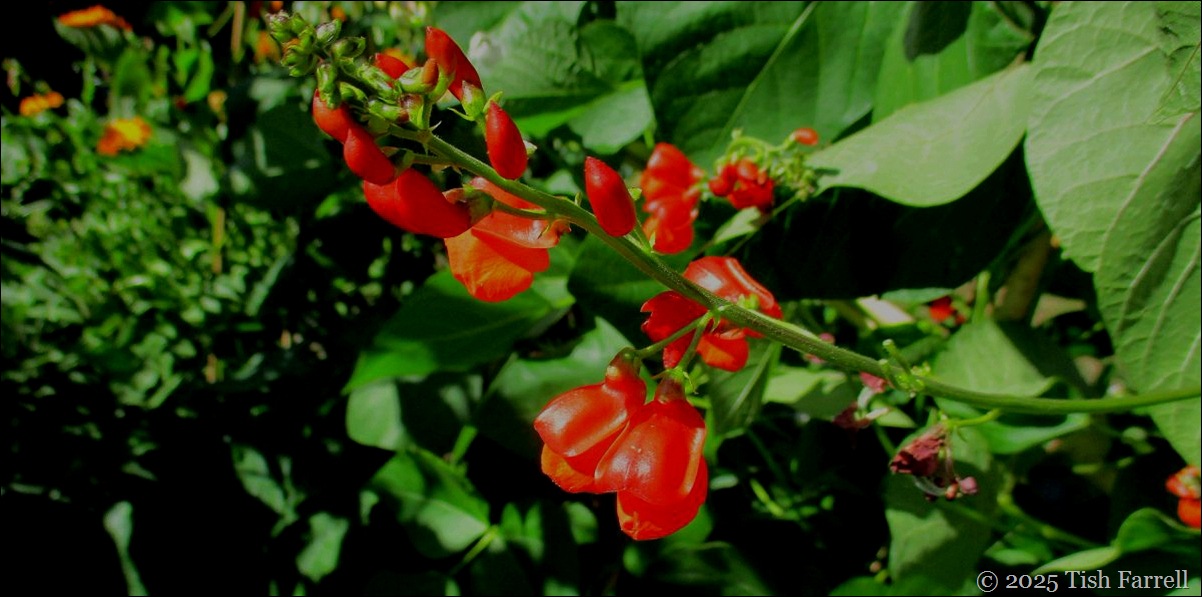
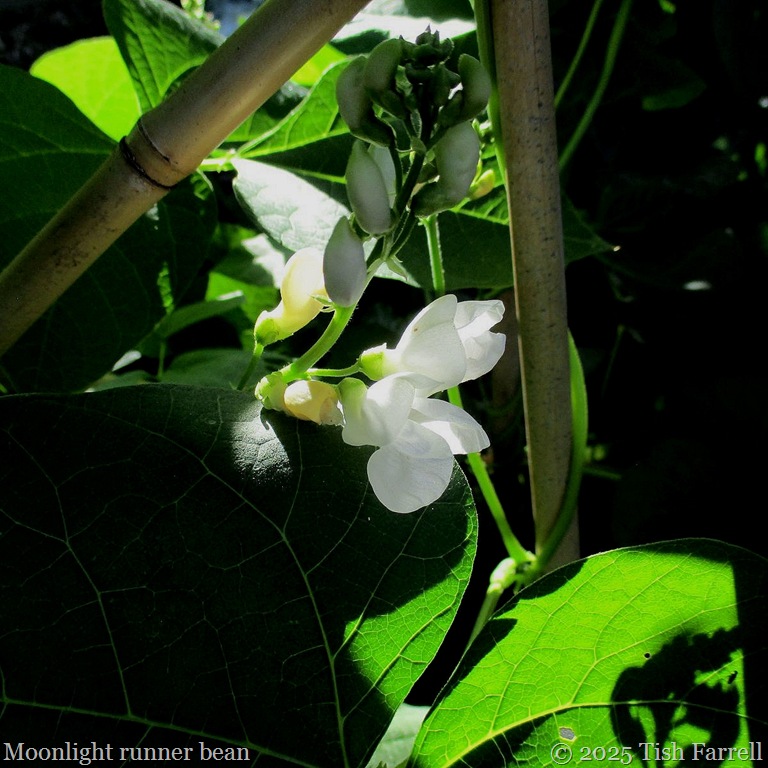
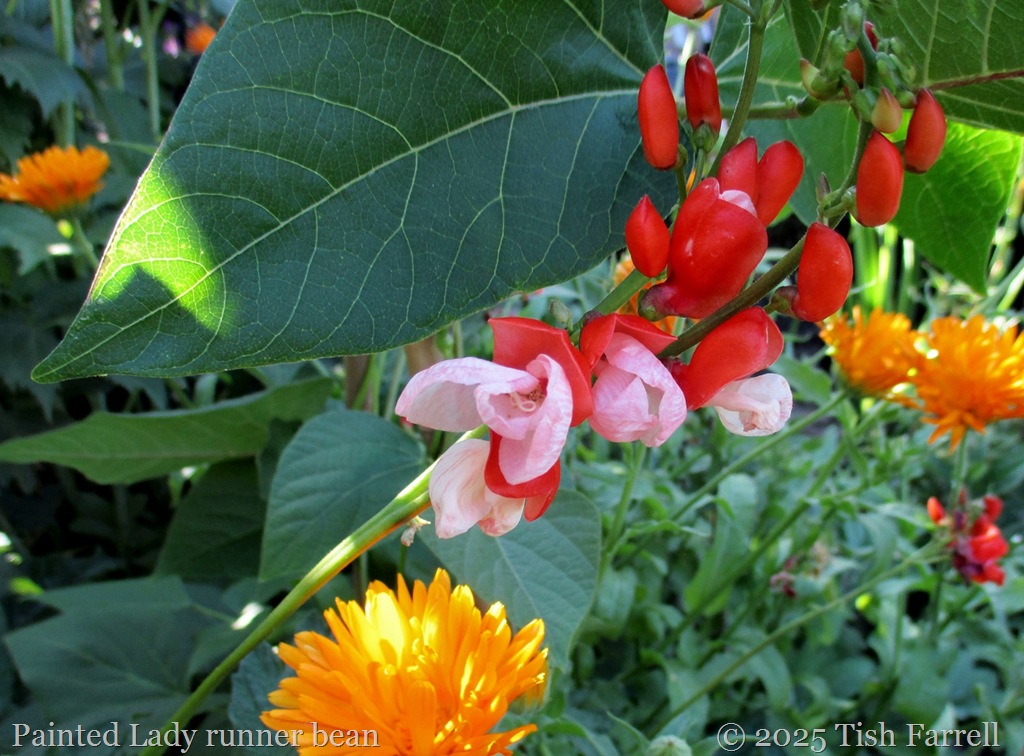
The gentle fragrance of bean flowers and pleasing thoughts of beans to come…

IMG_7640

*

And the all embracing company of trees…

100_5864ed

*

…whatever the season…

P1050998ed

P1030637

Lens-Artists: Serenity  This week Egidio at Through Brazilian Eyes sets the theme. Please pay him a visit.

Breaking the rules: more by accident than on purpose…

P1060350ed

I’m not sure what was going on when I took this photo. An unintended composition, methinks: camera aslant; subject leaving the scene; shooting into the sun.  An all round combination of errors, but then I also quite like the end result.

*

P1060737 (2)n

Here both the camera person and the subject were on the move, in other words, me snatching this shot of an uphill cyclist through the car windscreen; caught on a bend in the  Llanberis Pass, North Wales.

*

Next at Plas Newydd, Anglesey in late December, taking a photo when there wasn’t enough light and leaving a twig in the way:

P1060709

*

IMG_7108

Taken on Newborough Beach back in March: too much negatives space; subject out of focus and also leaving the frame. But then that’s kite-flying for you.

*

And camera on the wrong setting for a winter’s day on Seaton Beach, Cornwall. It seems to have created an oil painting effect:
P1020711ed

And last but not least of strange creations:

IMG_2134ed

It took me a while to work out what I’d done here. Basically it’s a photo of a frosted spider’s web stretched outside the window of other half’s old Wenlock shed. But you can see both the shed interior and the reflection off the window which seems to show neighbouring rooftops and some of the garden.

Lens-Artists: Break the rules  This week Ritva tells us to break the rules. See her post for some inspiration.

Cinematically Cornish

P1080012cheesewring Bodmin

This week at Lens-Artists Sofia calls for a cinematic approach to our photography.

This is what she says:

“There are a few things that give a photo that cinematic feel: camera angles, bold and high-contrast colours, light, locations, just to name a few. The main objective is to take a shot that is part of a story, there’s mood and a sense of location; our image is but a snapshot of a much wider situation.”

The first four photos here were taken one bleak spring day on the edge of Bodmin Moor near Minions in Cornwall. This, Great Britain’s most south-westerly county is a land of dramatic vistas: of high moors and rugged shore-lines. There are stories everywhere, layered through time like the ‘pillows’ of this granite tor, known locally as the Cheesewring.

The tor has its own stories of course. The first is one of weathering over millions of years, wind and rain driving into its crevices. Then there is the Dark Ages tale, from the post-Roman times when Christian missionaries  were beginning to make their presence felt. The proponents of new faith were not always welcomed, and so the formation of the Cheesewring is explained as the result a quoit-throwing contest between Uther the giant and a saintly missionary named Tue. If Uther won, then the Christian must go. Th giant lost of course.

The Cheesewring name itself has different derivations – either a straining device for making cheese, or else relating to cider brewing wherein the press of apples to a pulp is referred to as cheese.

There also some mystical notions, for it’s said that if you come to the Cheesewring as day dawns you will see the top ring turn three times. Which makes me wonder if that crow might have something to say on the matter.

*

Below the Cheesewring we step back into the remnants of a prehistoric landscape: three Neolithic stone circles called the Hurlers. But as to that figure apparently hovering on the horizon – who knows what time stratum he belongs to.

P1070982ed

P1080022ed

Looking through the Neolithic circle we come to another narrative: one belonging to the 1850s – 1890s when the South Phoenix Mine was churning out train loads of copper, a time when over 3,000 people were employed here – women and children included.

P1070983ed

There is more about these stories at an earlier post: ‘Hurlers and Miners: 6,000 years of heritage on Bodmin Moor’ HERE.

*

Cornwall does have its own cinematic history. Several Cornish based novels by Daphne du Maurier have made it to the big screen, some in duplicate versions – Rebecca, Frenchman’s Creek, Jamaica Inn, My Cousin Rachel. Her deeply disturbing short story,The Birds, is also set in Cornwall, although Hitchcock chose to transpose it to San Francisco. Du Maurier’s works are usually classed as romances, but they also have dark undercurrents, sometimes touching on the paranormal, their settings the wilds of Bodmin Moor, brooding mansions, sheer-drop sea cliffs, rocky coves and crashing surf.

So here are some more Cornish photos, taken one gloomy December, and with a little nod to Daphne du Maurier’s sensibilities.

P1020701ed

*

P1020927 ed

*

P1020611ed

Lens-Artists: Cinematic This week Sofia at Photographias sets the theme.

It’s All Birds And Bees In Our ‘Castle’ Garden

IMG_7447ed

Well, they do say an Englishman’s home is his castle. And for this English woman, this stronghold must obviously include the garden. At least I like to think the garden is my domain; my own small fiefdom.

The wildlife, of course, has other notions. This mama blackbird, for instance, is quite sure my purpose in life is to provide her with fresh feeding stations. As soon as I begin work in the garden she’s there, poised to snatch a worm or grub. If I do not provide quickly enough, she fixes me with that beady eye, and starts her own digging.  This has led to us falling out somewhat. I’ve had to net all my vegetable beds to stop her rooting out my seedlings.

But she did keep me company while I cleared the boundary wall with our neighbour’s garage. It was a horrendous job, hacking out ingrowing and overgrowing hypericum (Rose of Sharon) that years ago had been planted along the top of the wall, and since turned itself into a stretch of brutal anti-tank wire, while inviting Spanish bluebells, ash trees and willow herb to join in the fray.

IMG_7328 ed

I’d been tackling the job on and off since last summer. But now it’s done.

IMG_7332 ed

I’ve planted the road end with a couple of trailing blackberries designed for hanging baskets and also some foxgloves which had grown themselves in the back garden. As for the rest, for this year I’m thinking of putting in various kales and perhaps courgettes; nothing permanent in other words. I’ve discovered that hypericum shoots and roots from the tiniest scrap of itself, so it will probably take a few seasons to clear the bed.

Meanwhile mama blackbird has been well fed, and the feeding clearly paying off. Two days ago, while planting a hornbeam sapling to fill a gap in our rear hedge of horrors, I had the sense of being watched. When I peered into the tangle of privet, holly and sycamore, there she was, sitting still as stone, on a very neat nest, looking straight back at me. I left her in peace.

As blackbirds go, I suspect she is rather elderly. Her tail feathers look more than a touch bedraggled. But she has us weighed up as non-threatening entities, choosing to nest right by the path that we use all the time. She is not afraid to leave it either, when she sees me with a spade. Yesterday,  when I was unearthing some ash tree saplings further down the hedge, she was right there, just in time to gobble up a big juicy worm.

IMG_7417

Male blackbirds don’t do nest duty, but I’m assuming this is papa. He’s taken to singing sweetly in the hawthorn tree just over the hedge. He shows up when I’m digging too, but not if mama is around. (She sees him off). He actually comes very close and tweets at me, if I’m not providing worms.

Earlier in the year it was the robin who would come nagging as soon as I set foot in the garden. He/she was especially pleased with operation dig-out-compost-bin, but now is perhaps too busy with egg minding to be around so much.

IMG_6911ed

IMG_6843

*

Other birdlife, as in pigeons, I’m not so pleased to see. They’re another reason for having netting all over the vegetable plots, though it doesn’t stop them from nibbling through the fine mesh if the plants grow too close to the edge. They like spinach, brassicas, chard, chicory, beetroot leaves, lettuce, young field bean leaves and lemon sorrel.

IMG_7437

IMG_7434

IMG_7508

The garden is very much ‘a first draft’; there’s much to sort out (tidy) and much trial and error (given the lack of an actual plan). Next week a paling fence will start going up around the perimeter (from behind the greenhouse and round). It won’t be too tall but will create a boundary for fresh planting which might help focus this gardener’s mind.

For now we are enjoying the apple blossom, and especially the little tree which is flourishing between the compost bins, one open, one hot. I think it’s a Crispin. The black hot bin is not a pretty sight, but the mass of flowers is lovely and, in a spot of warmish afternoon sun, is alive with bee hum. Just look at the pollen sacs on the bees’ legs.

IMG_7478

IMG_7474sq

IMG_7427

*

And there’s not only apple blossom. On the terrace wall we have tulips. They are presently looking rather glamorous:

IMG_7426ed

IMG_7425

So: spring is here in the Farrell domain aka Castle (also the locals’ name for the town), and in moments when the wind drops and you stand in the sun where the air is less frigid, it feels like it too. Cheers, fellow gardeners! Happy planting!

Six on Saturday: blackbirds, robins, bird defences, apple blossom, bees and tulips

copyrithg 2025 Tish Farrell