Reflections on Wolverhampton

IMG_0916 - Copy

Sometimes we rural Much Wenlock souls get to visit the city, our nearest one being Wolverhampton. A couple of Sundays ago we were lucky enough to have tickets to see the Tord Gustavsen Quartet at Wolverhampton University’s Arena Theatre (Jazz at the Arena). It was the final night of their British tour, and what a night it was – utterly captivating musicianship. You can see Peter Bacon’s review at The Jazz Breakfast.

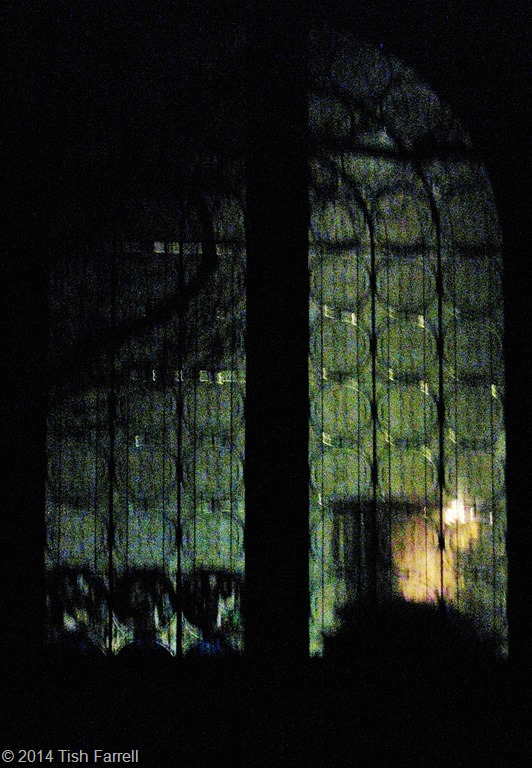
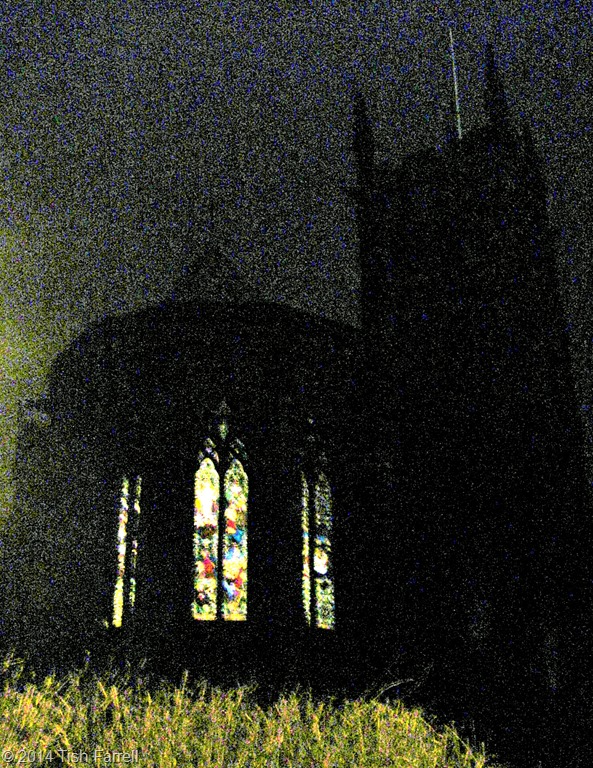
En route to the concert, and to prepare  myself for some Nordic introspection and reflection, I thought I’d dabble in a little West Midlands Noir. I used my Canon Powershot A430, bought on Ebay for twenty quid, and then fiddled about on Windows Live  Photo Gallery. The shots were taken near the theatre and include St Peter’s Church and  other University of Wolverhampton buildings. While I was in the Arena bar I also happened to notice that it had a reflective ceiling.

IMG_0901

IMG_0912

IMG_0911

IMG_0907

IMG_0905

IMG_0914

IMG_0904

Weekly Photo Challenge: reflections

TORD GUSTAVSEN QUARTET: THE WELL

https://www.youtube.com/watch?v=_3A6ziUPbdk

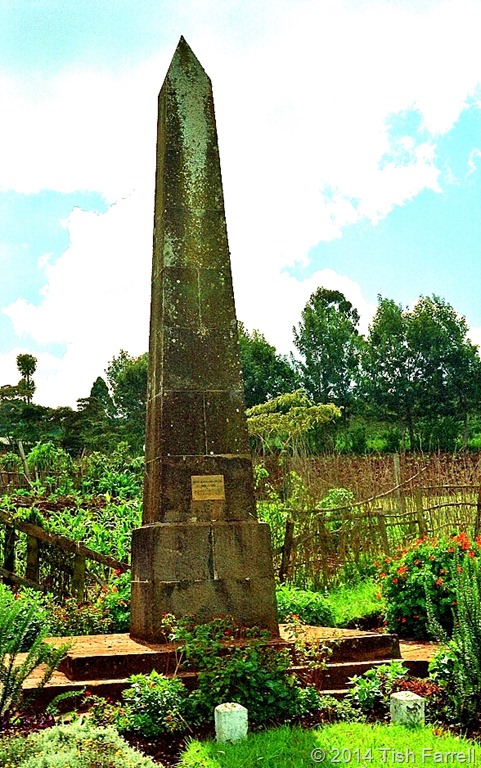
Caught inside a Kikuyu garden: a memorial to Karen Blixen’s lover, Denys Finch Hatton

Denys Finch Hatton obelisk Ngong Hills

This was not supposed to happen. In fact you could say it adds insult to irony:  that a man so steadfastly dedicated to an unfettered life in the wilds should, in death, end up hemmed in, and so very domesticated within this small Kikuyu shamba. Yet here it is, the mournful stone obelisk, marking  the grave of Denys Finch Hatton,  son and heir of the 13th Earl of Winchilsea, Great White Hunter, and lover of two women far more famous than he is: writer Karen Blixen (Out of Africa) and aviator  and race horse trainer Beryl Markham (West with the Night). 

Finch Hatton's grave on the Ngong farm

Yet another woman, the one whose shamba this is, shows him a new kind of love, taking care of the garden around the obelisk.  If you want to visit the place it is not easy to find – either her little smallholding on the Ngong Hills, or the grave within. When we visited years ago we found only a hand-painted signpost nailed to a tree. We parked in a paddock outside the farmhouse door and were charged a few shillings. We could have bought a soda too, if we’d wanted. We could not see the grave though, and soon found that it was deliberately hidden from view by an enclosure of  old wooden doors. More irony here of course. More symbols of shut-in-ness. 

Denys spent most of his life in Africa avoiding any kind of confinement – out  in the Tsavo wilderness, running shooting safaris for the rich and aristocratic. His clients included the Prince of Wales (later Edward VIII) . In fact it was during the safaris for the Prince in 1928 and 1930 that Finch Hatton began to promote shooting on film rather than with a gun.

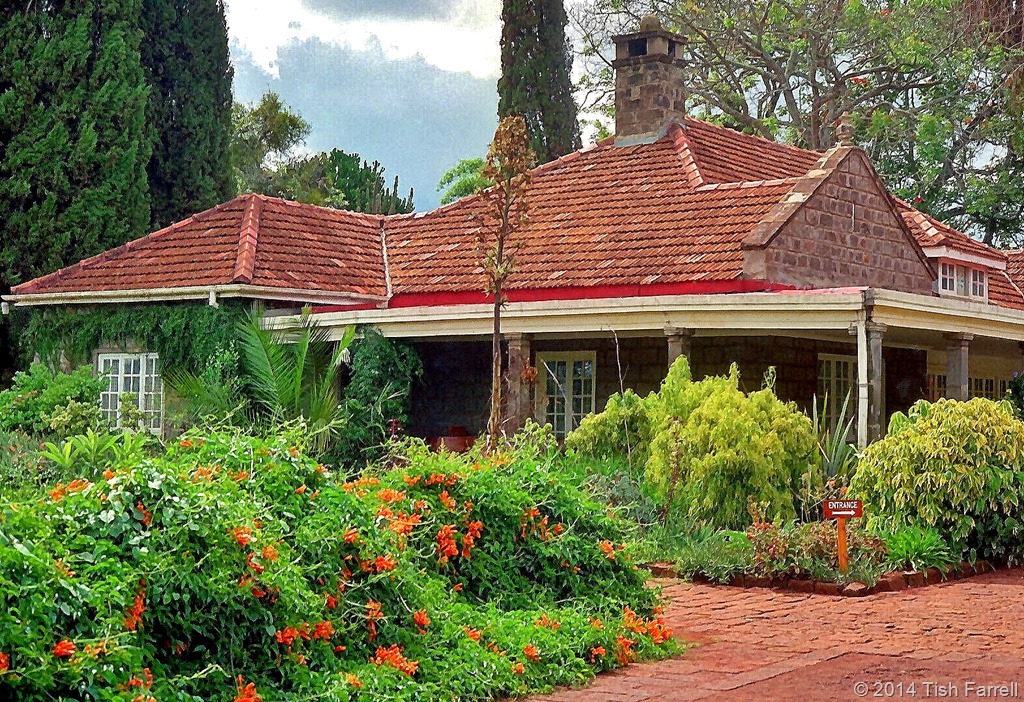
His lover, Karen (Tanne), Baroness von Finecke-Blixen lived in a small house below the Ngong Hills, some twelve miles outside Nairobi. By the time she started her affair with Denys she was divorced from her charming, but philandering husband, Bror, although they always remained friends. Her family had invested a great deal in the couple’s coffee farm, and Karen struggled to make a success of it. But the location was entirely wrong, and in the end she was forced to sell up and leave Kenya. It was during the period of selling the farm that she heard news of Denys’s death.

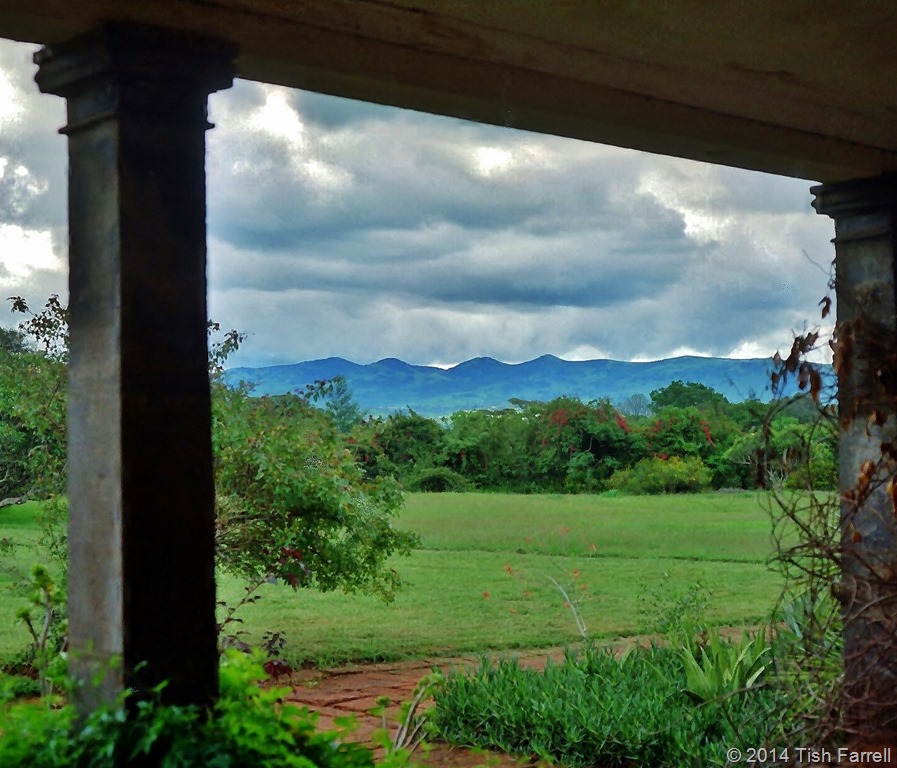
Scan-130429-0005

Looking towards the  Ngong Hills from inside the veranda at Karen Blixen’s house. The house now belongs to Kenya’s National Museums.

*

Scan-130429-0006

Denys Finch Hatton’s untimely end may be put down to his passion for flying. For those of you who remember Sydney Pollack’s 1985 film Out of Africa, some of the most elegiac moments of the film are when the celluloid version of Finch Hatton  (Robert Redford)  takes Karen Blixen (Meryl Streep)  into the skies above the Rift Valley.  Denys died in his Gypsy Moth in 1931, and in unexplained circumstances. He was taking off from the airstrip down in Voi in southern Kenya when his craft exploded. He and his Kikuyu co-pilot were killed. Denys was forty four.

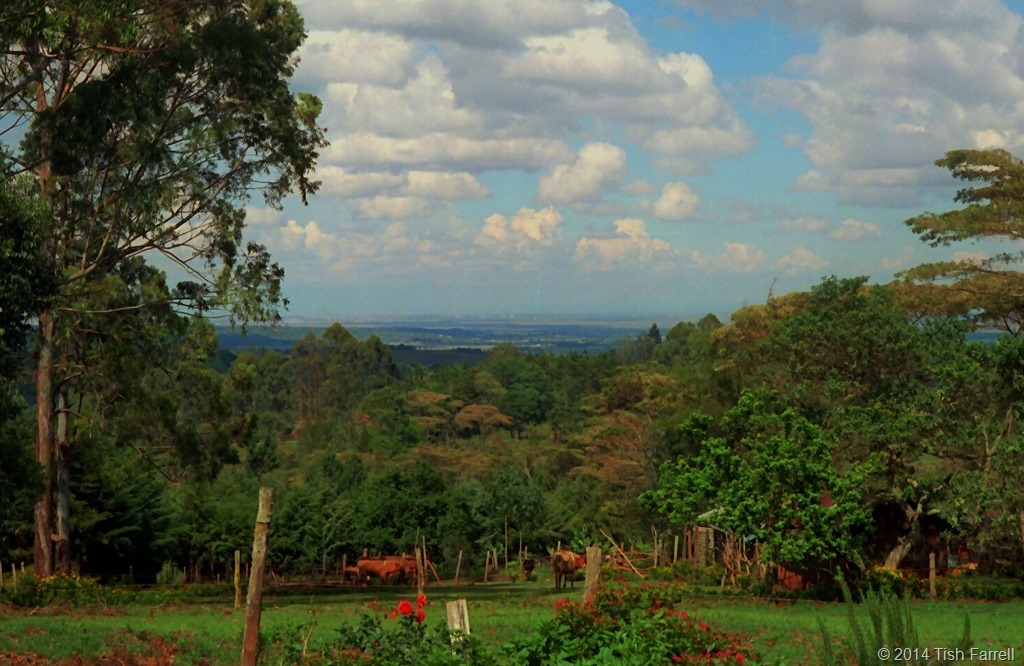
Scan-130429-0018

View towards Nairobi from Denys Finch Hatton’s Grave, and overlooking another Kikuyu smallholding.

*

By the time of his death, his relationship with Karen was  well on the wane, and he had already started an affair with the younger Beryl Markham. His biographer,  Sara Wheeler says in Too Close to the Sun, that there is circumstantial evidence to suggest that Beryl was pregnant with Denys’s child, but that she then had an abortion. To have known this would have truly broken Karen Blixen’s heart: her letters show that she had longed to have a child with Denys.

With yet another twist of irony, it was with his death, that Karen somehow reclaimed him, remembering that he had told her of his wish to be buried in the Ngong Hills. The spot he had chosen was one that Karen had decided on for her own grave.

013

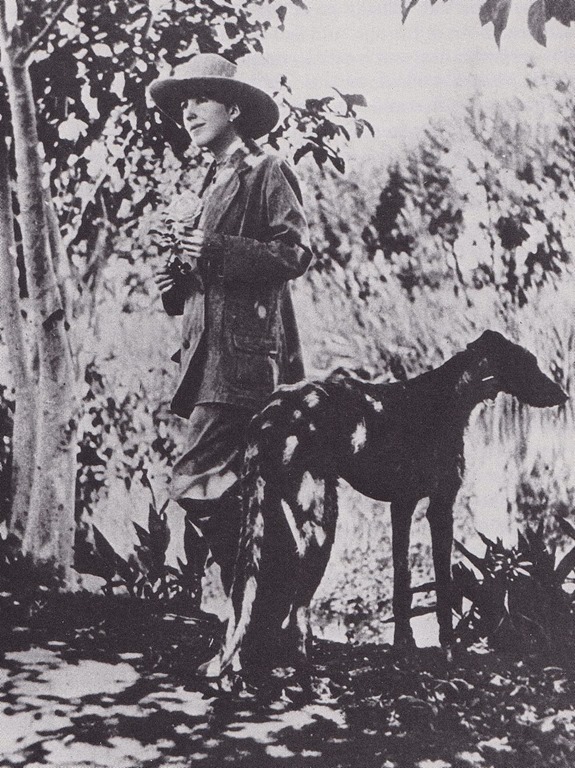
Denys Finch Hatton

Karen Blixen with her deerhound Dusk

012

There was a place in the hills, on the first ridge of the Game Reserve, that I…had pointed out to Denys as my future burial-place. In the evening, while we sat and looked at the hills from my house, he remarked that then he would like to be buried there himself as well. Since then, sometimes when we drove out in the hills, Denys had said: ‘Let us drive as far as our graves.’ Once when we were camped in the hills to look for buffalo, we had in the afternoon walked over to the slope to have a closer look. There was an infinitely great view from there; the light of the sunset we saw both Mount Kenya and Kilimanjaro. Denys had been eating an orange, lying in the grass, and had said that he would like to stay there.

Out of Africa

The obelisk was only put up later by Denys’s brother. During Karen’s last days in Kenya she had the site marked with white stones from her own garden, and as the grass grew up after the long rains, she and Farah, her Somali house steward, erected a pennant of white calico so she could see the spot from her house, some five miles away.

Sometime after she had returned to Denmark she received a letter with some strange news about the grave:

The Masai have reported to the District Commissioner at Ngong, that many times, at sunrise and sunset, they have seen lions on Finch Hatton’s grave in the the Hills. A lion and lioness have come there, and stood, or lain, on the grave for a long time…After you went away, the ground round the grave was levelled out, into a sort of big terrace. I suppose that the level place makes a good site for the lions, from there thy can have a view over the plain, the cattle and game on it.

Out of Africa

Scan-131109-0048 - Copy

copyright 2014 Tish Farrell

*

Tish Farrell is an award winning writer for young people. Her latest novella is on Amazon Kindle (5 star review):

Secrets, conspiracies, tragedy, dark comedy – a fast-paced novella of interwoven tales set somewhere in East Africa. For young adults and adults alike.

Abandoned: Great Zimbabwe

Scan-130429-0005

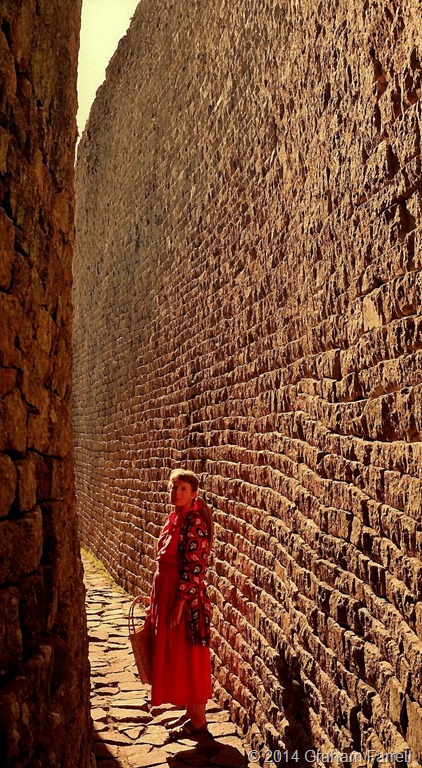
Inside the Great Enclosure of Great Zimbabwe. These magnificent walls have survived for nearly seven centuries, and not a lick of mortar to keep them standing.

Scan-130429-0010

No one knows exactly why this great African city  was abandoned. For some 350 years, until  around 1450 AD,  Great Zimbabwe had been a flourishing merchant centre that drew in from the surrounding country supplies of gold, copper, ivory, animal skins and cotton. The city’s entrepreneurs  then traded these goods on to the Swahili city states of Sofala and Kilwa on the East African coast. (You can read more about the Swahili HERE). In return, the traders brought back luxury goods –  jewellery, decorative pieces such as 13th and 14th century Chinese celadon dishes and Persian ceramics.

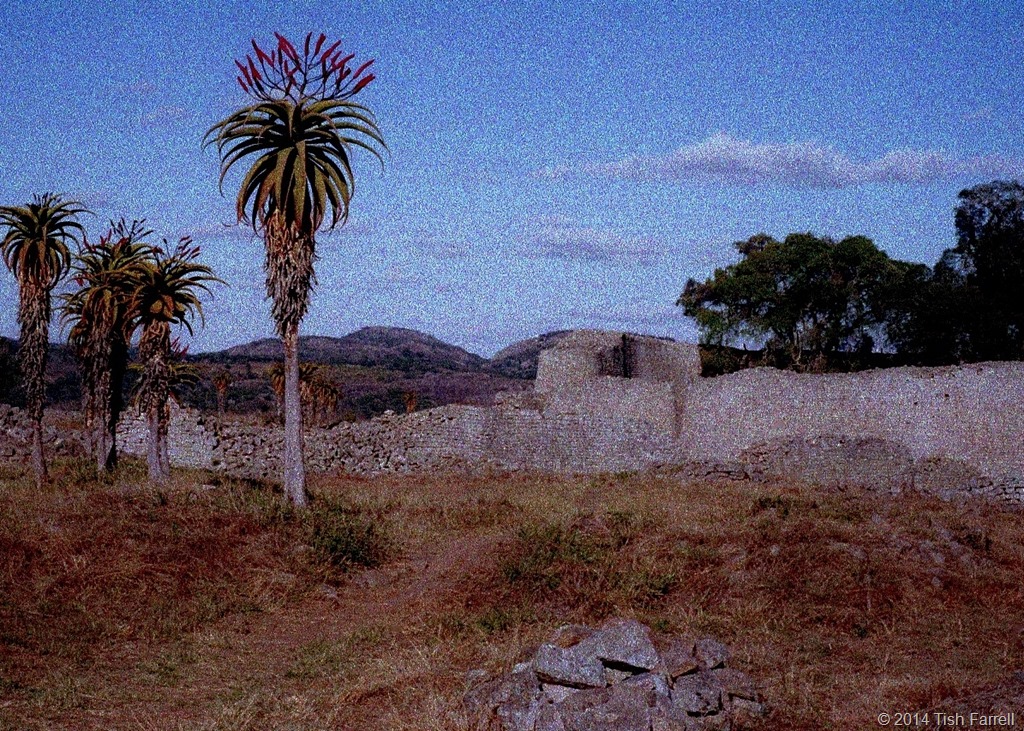
aloes and Great Zimbabwe

The city’s ruins cover 80 hectares, its many stone enclosures commanding the southern slopes of Zimbabwe’s High Plateau watershed between the Zambezi and Limpopo Rivers. The site is well watered with good grazing throughout the year. It is above the zone of the deadly tsetse fly that can infect both cattle and humans with sleeping sickness; and the plateau’s granite scarps provide plentiful building stone and other raw materials. Even so, these favourable circumstances do not explain why this particular settlement rose to such prominence.

For Great Zimbabwe was not a singular phenomenon. Contemporary with it,  and across the High Plateau region, are the remains of at least a hundred other mazimbabwe (houses of stone). Several were large enough to have been the capitals of rival states. Others may have been satellite communities occupied by members of Great Zimbabwe’s ruling lineage.

So who were the city’s builders?

During Zimbabwe’s colonial times, and until independence, the  Rhodesian government actively supressed  evidence that Great Zimbabwe was built by Africans.  Many of the other stone ruins were destroyed or re-purposed by European settler farmers. The official view claimed that the city was Phoenician, and that the Queen of Sheba’s fabled kingdom of Ophir had been discovered. Archaeologists, however, have long demonstrated  that it was the cattle-owning Karanga Shona who built Great Zimbabwe. The first phase of stone building began around 1100 AD. Thereafter, the city’s rising fortunes and successive building phases suggest its increasing control of the ancient High Plateau trade routes to the Swahili cities of Sofala and Kilwa.

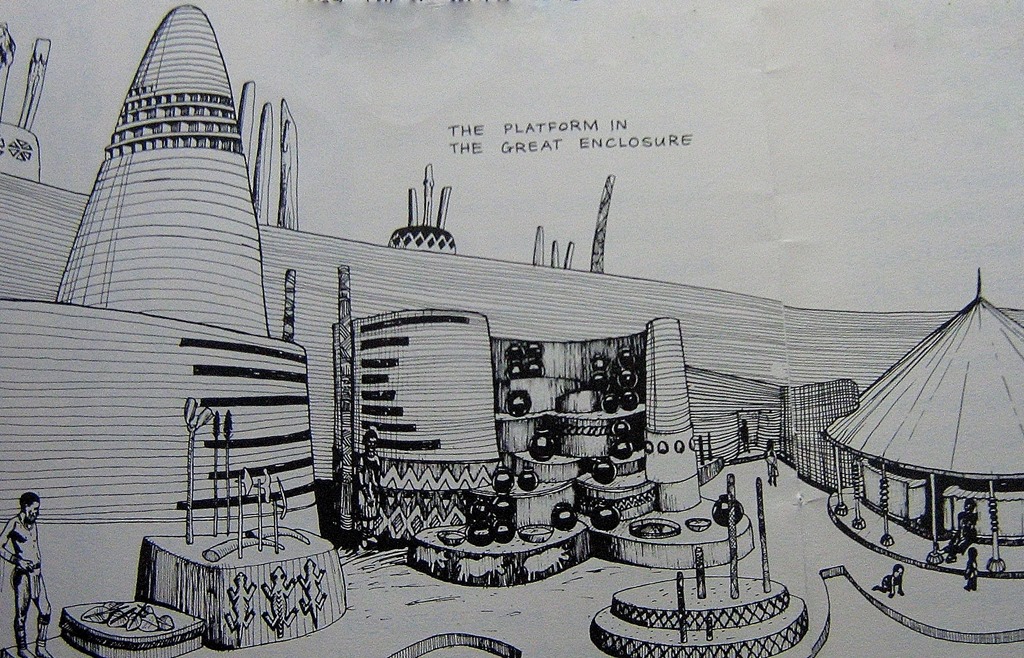
Gold was the key commodity, and it is likely that it was Great Zimbabwe’s successful cattle production that provided it with the trading power to secure gold supplies from mines some 40 kilometres away. The more prosperous the city became, the more sophisticated its demonstrations of prestige. In around 1350 AD  the Great Enclosure of finely dressed stone was built. This huge elliptical structure with its mysterious platform and conical tower is thought to be the royal court. There is no indication that the walls were defensive. This was  a regime confident in its power and authority.

IMG_0889

Peter Garlake’s reconstruction of the Great Enclosure Platform from Life at Great Zimbabwe,  Mambo Press 1982

*

Then why did the city decline?

There are various explanations: the people had let their herds overgraze the land; they had cut down all the trees; there was a prolonged period of drought as may happen in southern Africa. But somehow none of these theories quite explain why, after 350  flourishing years, a community of perhaps 20,000-plus people should simply pack up and leave. Did all these farmers, herders, miners, craftspeople, soldiers, traders, accountants, court personnel and the city’s rulers  leave on a single day, or did the city die slowly?  The archaeological evidence does not say.

But we do know there were disruptive external forces at work. In the 15th century the Portuguese invaded the Swahili coastal city of Sofala. They were on the hunt for gold and so pressed inland with Swahili guides. Their interfering presence drove the trading routes north, giving rise to the Mutapa state. This new state may well have been founded by people from Great Zimbabwe. Certainly by this time the Swahili traders were coming up the Zambezi to trade with the Shona directly, the old trade route through Great Zimbabwe no longer used. At this time, too, we see the beginning of another Shona city state  with the building of the stone city at Khami near Bulawayo in southwest Zimbabwe. In the following centuries this became the centre of the Torwa-Rozvi state whose other major cities during the 16th and 17th centuries included Naletale and Danangombe.

Great Zimbabwe entrance

The Great Enclosure entrance at Great Zimbabwe built c.1350 AD

*

And so into history…

Of course with the Portuguese incursions comes the first documentary evidence. From the early 1500s Zimbabwe’s royal courts enter the historic record in the accounts of the Portuguese conquistadores. In 1506 Diogo de Alcacova writes to his king, describing a city  of the Mutapa state

“called Zimbany…which is big and where the king always lives.”  His houses are “of stone and clay and very large and on one level.” Within the kingdom there are “many very large towns and many other villages.” 

The Portuguese historian Faria y Sousa also describes the King of Mutapa’s great retinue which included the governor of the client kingdoms, the commander-general of the army, the court steward, the magician and the apothecary, the head musician “who had many under him and who was a great lord”. Also noted were the vast territories over which the king ruled, the revenues and subject kingdoms of the king’s several queens.

And suddenly we have a true glimpse of what this land called Zimbabwe might have looked like in the past, a bustling, mercantile, metropolitan culture, supported by gold miners, farmers, cattle herders and craftspeople. And so it remained until well into the 18th century, albeit with a shift of Shona power to the southwest and the Torwa-Ruzvi state as the Portuguese presence caused increasing instability. Then in the 19th century came new invaders – the Nguni, the Ndebele and the British.

This centuries old heritage of royal courts is not a picture that the likes of Cecil Rhodes or, the later Rhodesian government of Ian Smith ever wanted anyone to see. And so in the end this is not so much a story of a city abandoned by its people, but of a people wilfully excluded from their past.  In 1980 when Zimbabwe became an independent state, some of this past was reclaimed: the new state took its name from the first great Shona city, and  adopted for its flag and coat of arms, an image of one of the city’s ceremonial soapstone birds. These are small steps forward, but there is still a long way to go before the world sees the indigenous histories of the Africa continent in their true perspective, and acknowledges their intrinsic cultural worth.

There is more about Great Zimbabwe in an earlier post HERE.

References: The classic work on the excavations of the city is Peter Garlake’s Great Zimbabwe 1973. For an overview of the mazimbabwe culture see Innocent Pikirayi’s The Zimbabwe Culture AltaMira Press 2001. For a wider historical perspective Randall L. Pouwels The African and Middle Eastern World, 600-1500 Oxford University Press.

© 2014 Tish Farrell

Feeling shy, but darned if I’ll show it

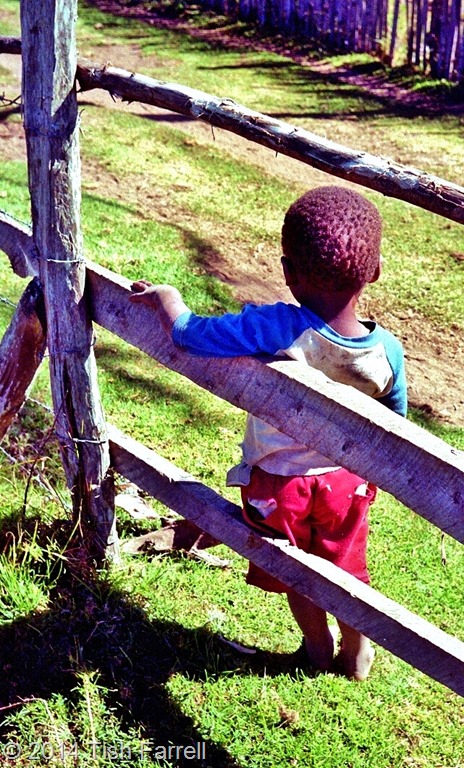
Kikuyu child

I took this photo while we were out on  Kenya’s highland farms looking for smut infested napier grass. You can read the full story HERE. This little boy was torn between wanting to know what we were doing on his farm, and not wanting to talk to us. I love the nonchalant drape of his arm on the fence post.

*

Go here for more bloggers’ compositions in response to the Daily Post photo advice: http://dailypost.wordpress.com/2014/02/27/rule-of-thirds/

Horsemen of the Maghreb: the Berber

Morocco Berber9_019

They call themselves i-Mazigh-en ‘the noble people’ and they have inhabited western North Africa for at least 12,ooo years. Or as the 8th century Tunisian historian Ibn Khaldun put it:

“The men who belong to this family of peoples have inhabited the Maghreb since the beginning.”

This might be mythically ‘true’ but scientific enquiry has produced other scenarios. For instance DNA tests show that i-Mazigh-en have common traits with the Sami reindeer herders of Scandinavia. They seem to have arrived in North Africa from the Near East back in the Mesolithic era, in other words before the development of agriculture. Over the millennia they have absorbed many different ethnic groups, including Neolithic farmers, Romans and much, much later, the Bedouin Arabs who began to invade the Maghreb from the mid-600s AD  and, in the process, largely converted the Berber to Islam.

The name Berber appears first in Roman accounts, and probably derives from the Roman habit of calling non-Latin speakers barbarians. (At least this is the sort of thing my Latin teacher used to tell us). The ancient Berber kingdom of Numidia (202 B.C. – 46 B.C.) once extended along Africa’s western Mediterranean seaboard including territory that is now part of modern day Morocco, Algeria, Tunisia and Libya. Numidia’s border effectively cut off Roman Carthage from the African hinterland, which may explain why the Romans were set on annexing the kingdom. During the last two centuries BC,  Numidia became highly Romanized, at different times serving as either a Roman province or a client state.

Morocco Berber2

Today the are  some 9 million Berbers in Morocco,  4 million in Algeria as well as significant populations in neighbouring countries. Most Berbers are farmers. They grow wheat, barley, fruit, olives, nuts on lowland farms and graze their flocks of  goats and sheep  in mountain pastures during the summer months. They also keep mules, oxen, camels and horses for  work and transport.  Then there are the nomadic pastoralists. These include the Tuareg of Mali, Niger and Burkina Faso, who though sometimes seen as a separate people, in fact carry Berber genetic markers that suggest they may be members of the founding Berber population.

Morocco Atlas_mountains1

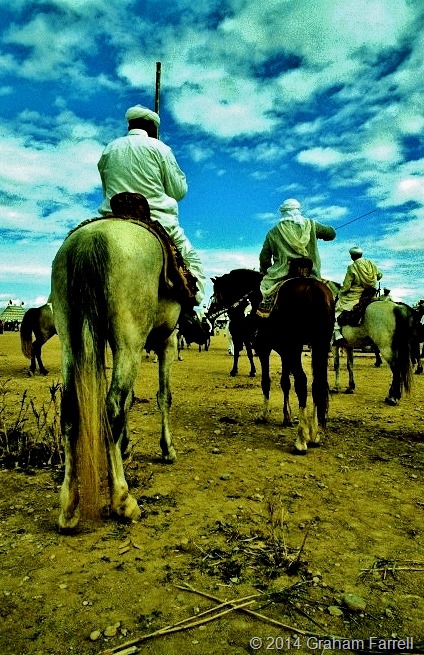
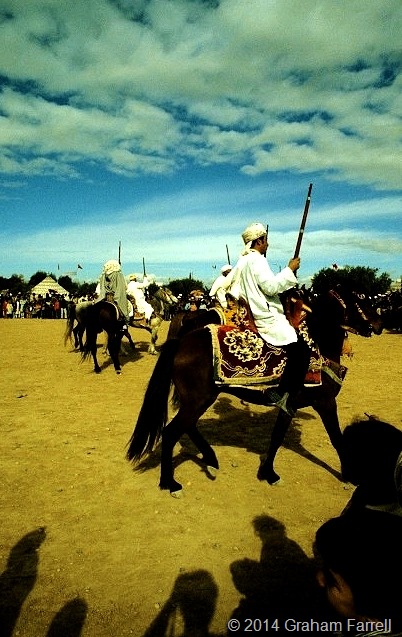
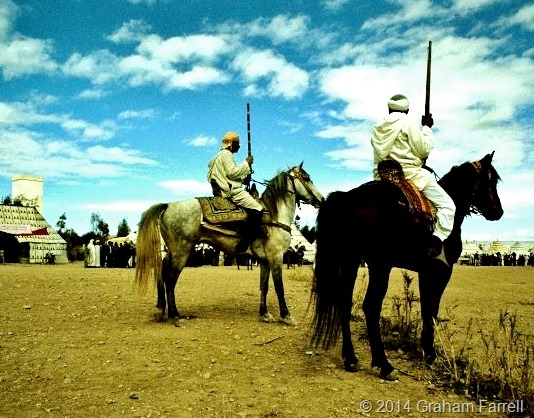
These photos, however, were all taken in rural Morocco, somewhere on the road from Marrakech to Fez  (Atlas mountains in the distance). Again they come from G’s slides of his overland trip, and they show a traditional Berber performance of the Fantasia, known locally as  lab el baroud  “the gunpowder play”. On this occasion village people were commemorating  the  25 years rule of King  Hassan II (1929-1999), but the Fantasia can also mark the conclusion of wedding celebrations, and other seasonal festivals.

Morocco Atlas_mountains6_016

Morocco Berber1

Morocco Berber6

Morocco Berber10_020

Morocco Berber8_018

Morocco Berber4

The performance harks back to past days of warfare, mimicking the charge formation by Berber and Arab desert riders. It hardly needs me to say that the synchronised charge, followed by the firing into the sky of antique muskets or muzzle-loading rifles, requires great riding skill. The horses also are especially bred and selected for the purpose. Lab el baroud has become the equivalent of a martial art. Each region in Morocco may have several fantasia groups or serba, amounting to thousands of riders nationwide. The 19th century image below shows how little has changed, at least at the time when these photographs were taken.

File:Detaille - Fantasia de spahis.jpg

Édouard Detaille painting : Fantasia de Spahis (1886)

But in other ways, Berber culture has moved on. Well, it has and it hasn’t. Make up your own mind with this performance of desert blues from the Tuareg band Tinariwen.

Frizz’s Tagged ‘H’

Looking for Smut on Kenya’s Highland Farms

For those of you who read my recent post Valentine’s Day Runaway this is one of the things Team Farrell got up to next; it had a lot to do with smut. And no: it’s not what you think.
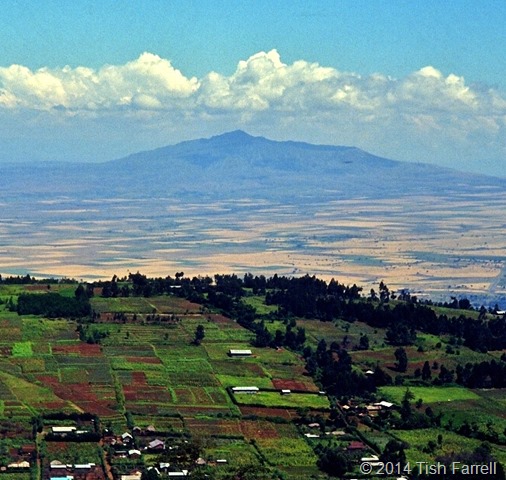
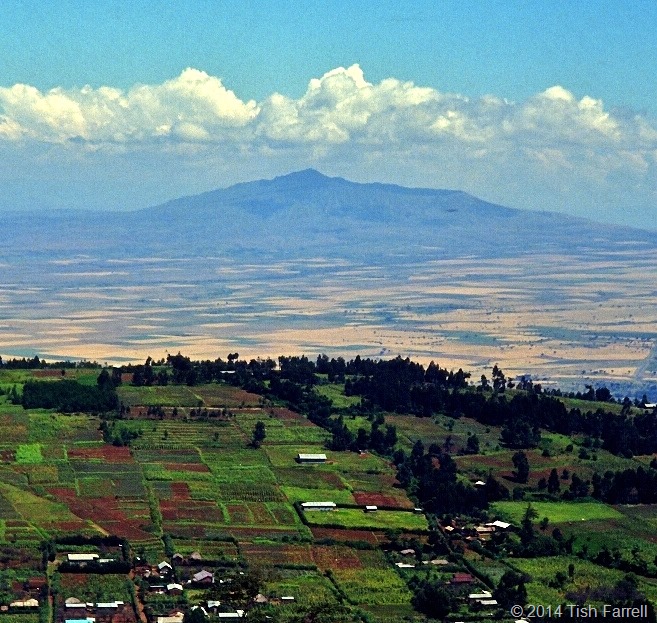
Rift Valley from Escarpment

Smallholder farms on the Great Rift Escarpment, Kenya

*

For most of the 1990s we were based out in Kenya, where Team Leader Graham, food storage expert and all-round fix-it man, was one of several  British scientists running a crop protection project alongside Kenyan scientists at the National Agricultural Research Laboratories (NARL). This work was funded by DFID, Britain’s Department for International Development, which in turn is of course funded by British taxpayers.
image

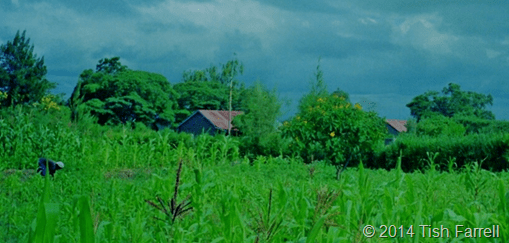
Most of Kenya’s farmers are women. Their efforts feed their families and feed the nation.

*

Many of the project’s programmes of work were done on farms, and involved helping farmers to devise their own research methods for controlling the numerous pests that attack their crops both before and after harvest. Since just about every Kenyan, from the President down, is some kind of farmer, or has a farm in the family, this was an important project, and just about everyone was interested in the outcomes. (Next time you are buying French beans or mange tout peas in the supermarket, look where they have come from. Much of this kind of produce is grown under contract on small farms like the ones below.)
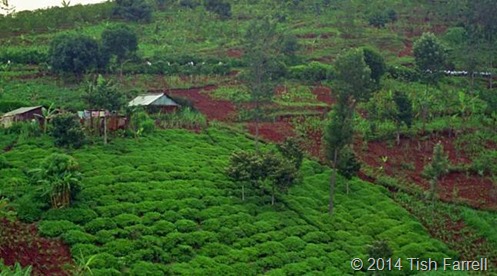
clip_image002

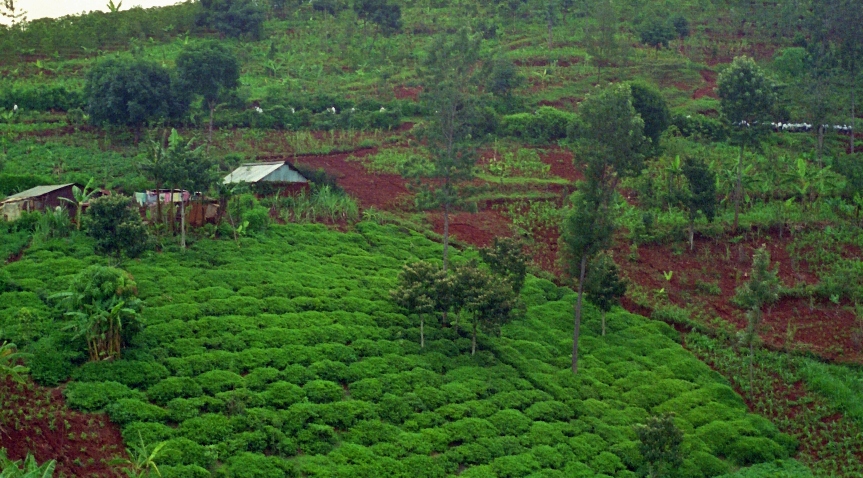
A typical farmstead in the Kenya Highlands north of Nairobi. The volcanic soil is very fertile, but also susceptible to erosion.

*

Today Kenya is undergoing a massive hi-tech revolution through the proliferation of cell phone and computer technology, but it still relies on agriculture for survival. When you discover that only 15% of Kenya’s landmass has enough rain or is fertile enough for arable production you may begin to see the scale of the problem for a nation that is only now beginning to industrialize. There are of course the big multinational outfits that grow wheat, coffee, tea, flowers and pineapples, but most of the food that Kenyans eat is grown on thousands of tiny farms, many less than an acre in area.
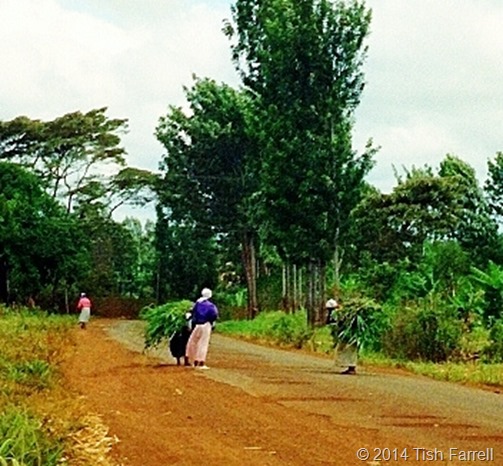
Escarpment lane

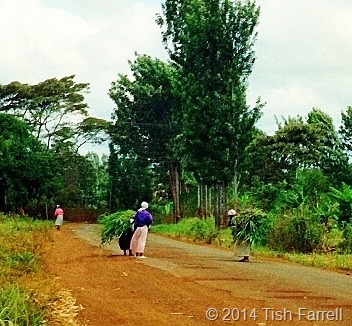
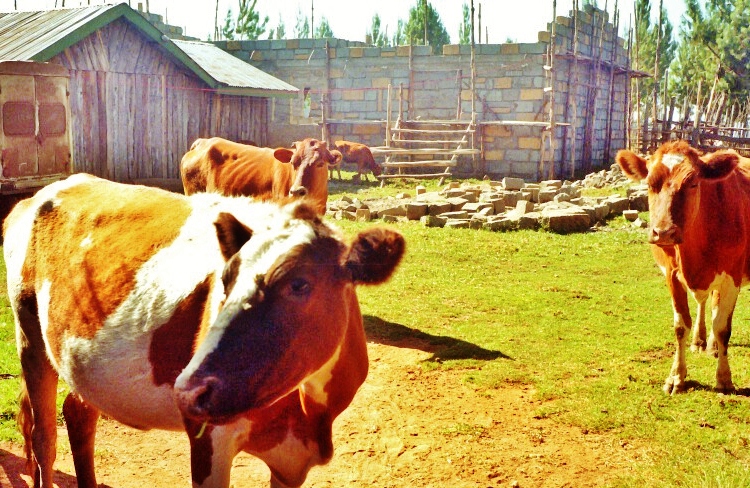
Gathering Napier Grass from roadside plots to feed ‘zero-grazed’ dairy cows. Most farms are so small that cattle are kept in small paddocks and their food is brought to them: yet another daily chore, along with gathering cooking fuel and attending to children and fields.
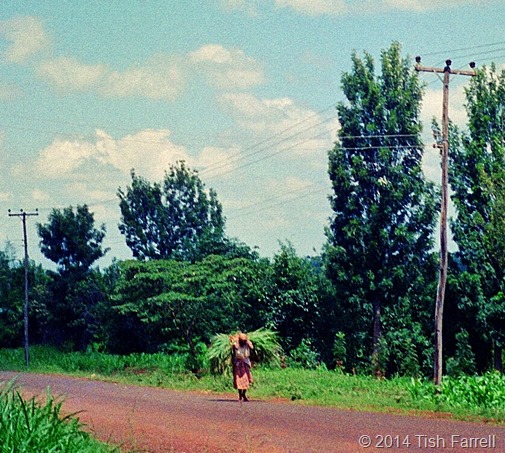
Kikuyu lane with woman carrying napier grass

Furthermore, most of Kenya’s farmers are women. Providing most of the the country’s food, they are in every sense the backbone of the nation. They stay in their rural homes, tending the crops and bringing up the children while husbands work away to earn extra cash to repair homes, buy fertilizer, educate their children and fund small business enterprises.

These men usually head to the cities where they work as security guards, clerks, hotel staff, house servants and drivers. Most take their annual leave at harvest and planting times so as to be back on their farms to help with the year’s most arduous tasks. So however you look at it, everyone in Kenya works very hard. Certainly in the nineties even most professional Kenyans believed that owning a plot of land to work at weekends was an essential insurance policy in a nation with no social services.
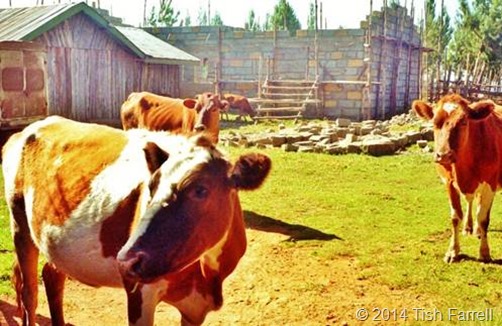
clip_image005

Most of the milk from smallholder’s cows is sold to provide cash to pay for children’s education and medical bills. While primary education has been free over the last few years, there are still expensive books and uniforms to buy, and secondary education is not free. On this farm the owner is also using any disposable income to bit-by-bit replace his timber farm house with a good stone house.
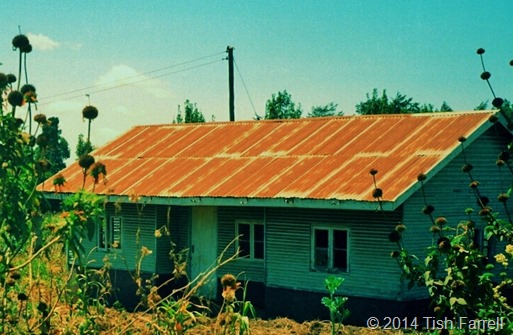
Kikuyu farmstead 24

*

So back in 1998, as part and parcel of protecting Kenya’s agricultural production, Team Leader Graham invited Nosy Writer (me) to accompany him on a fact finding mission around the farms north of Nairobi. We were on a quest to plot the incidence of SMUT, a fungal disease that was affecting Napier Grass, an important fodder crop. Most smallholders kept a small number of dairy cows because the selling of milk provided a valuable supplement to their income, helping to pay for school fees and medical expenses.

Most farms are too small to include pasture and so the cows are ‘zero-grazed’, that is, kept in small paddocks and their fodder (mostly Napier Grass) brought to them. This grass, if well-tended, grows into huge perennial clumps that can be cut at intervals. It can also be usefully grown on vertical banks to consolidate field terraces, or wherever the farmer can find a space, often on roadside verges. However, once smut gets a hold, the plant will gradually weaken and its food value decrease. Not only that, smut spores blow on the wind, and infect other plants. The only remedy is to root up the infected plants and burn them.
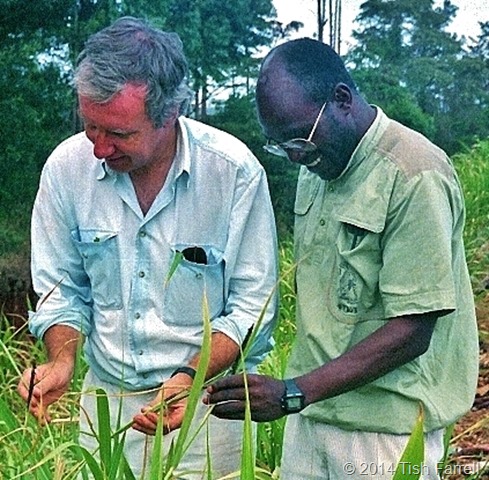
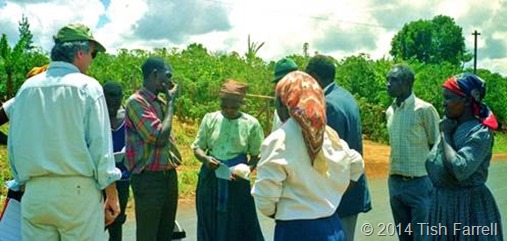
Graham and Kungu delighted to find smut on Waiyaki Way

Nothing pleases plant pathologists more than to find a nicely diseased plant. After a morning spent searching for smutted plants out on the farms, Doctors Graham Farrell and Jackson Kung’u are amused to spot a case back in the city. Here it is on a highway verge near the National Agricultural Research Laboratory in Nairobi. Smut lives up to its name and turns the flowering stems a sooty black. The fungus gradually weakens the plant and reduces it in mass and nutritional value.

*

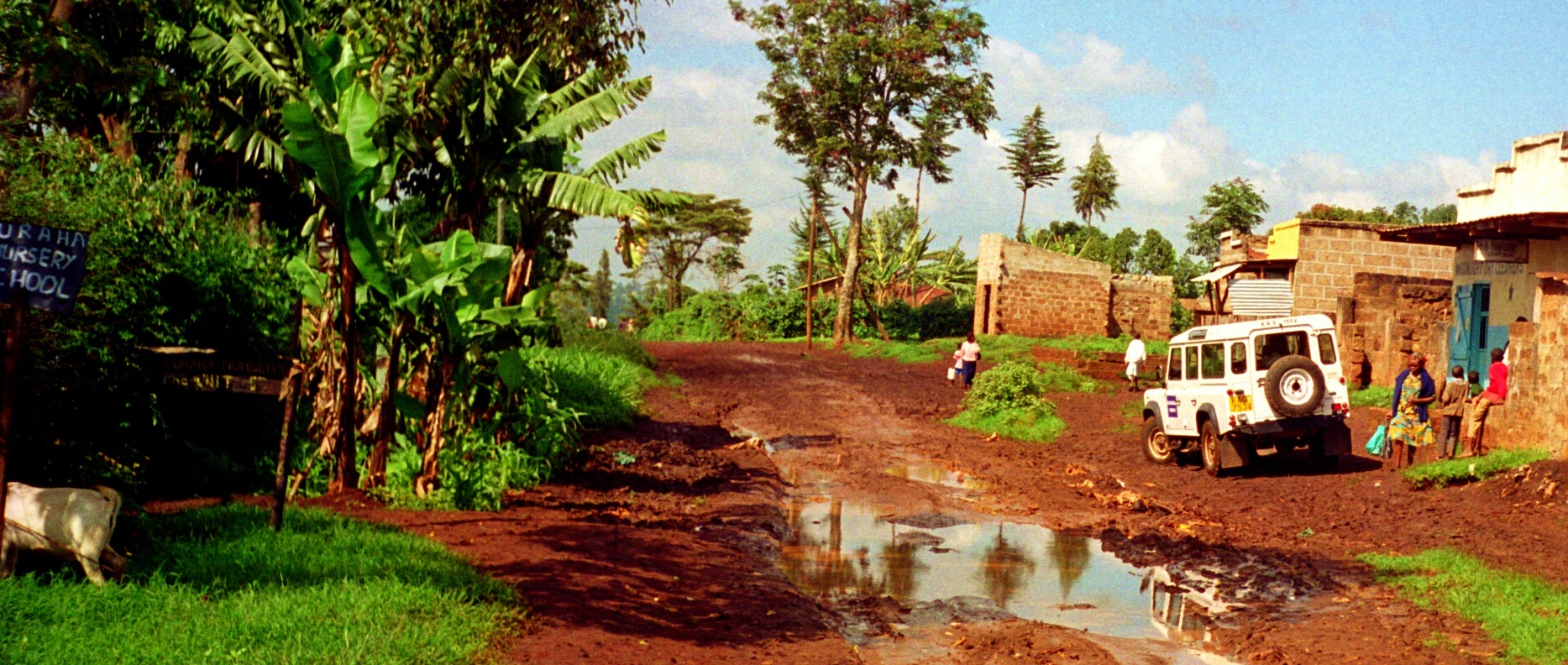
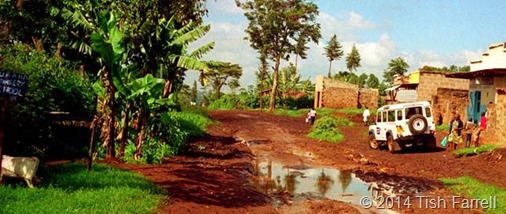
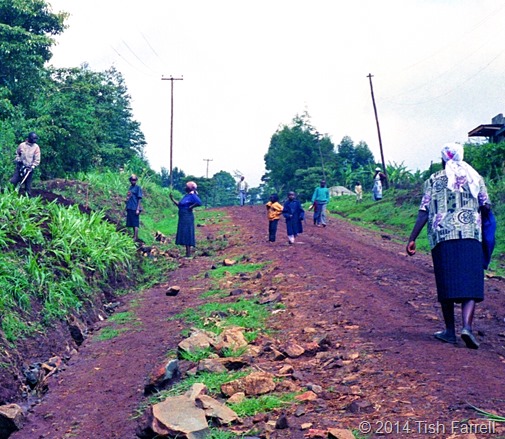
My job on the smut quest was to hold the clip-board and the other end of the measuring tape while we sampled farm plots. Our third, and  most essential team member, (in fact he was the real team leader) was Njonjo. He was the one who heroically drove us up and down the hilly Kikuyu lanes that had recently been ravaged by torrential El Nino rains.
clip_image009

Rift lane after July downpour

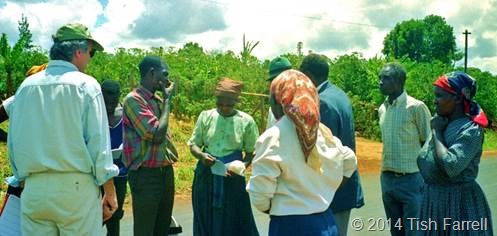
As well as being one of NARL’s top drivers, Njonjo was himself a farmer, and so had a vested interest in getting to the bottom of the smut infestation. Since Graham’s Kiswahili was a bit rusty, and many of the older farmers preferred to speak Kikuyu, Njonjo provided them with on-the-spot lectures on what they should do with their smut-infected plants. He also talked our way onto every farm, where we welcomed in with huge courtesy, despite arriving uninvited.
clip_image011

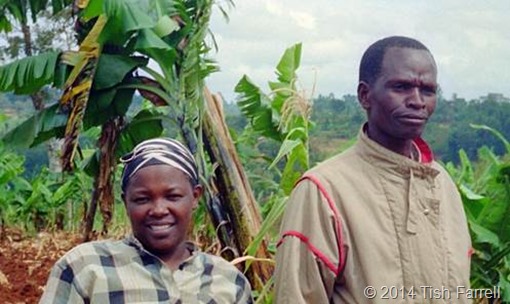
Njonjo and Margaret the farmer. She was busy making compost when we arrived on her farm.
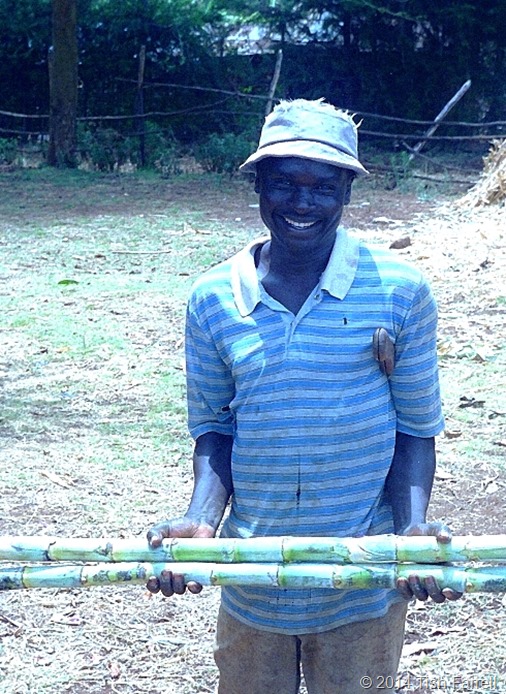
Kikuyu farmer and sugar cane

This farmer was so grateful to be told about his smutted Napier Grass he presented us with some sugar cane. We also came home with chickens, maize cobs and bags of pears

*

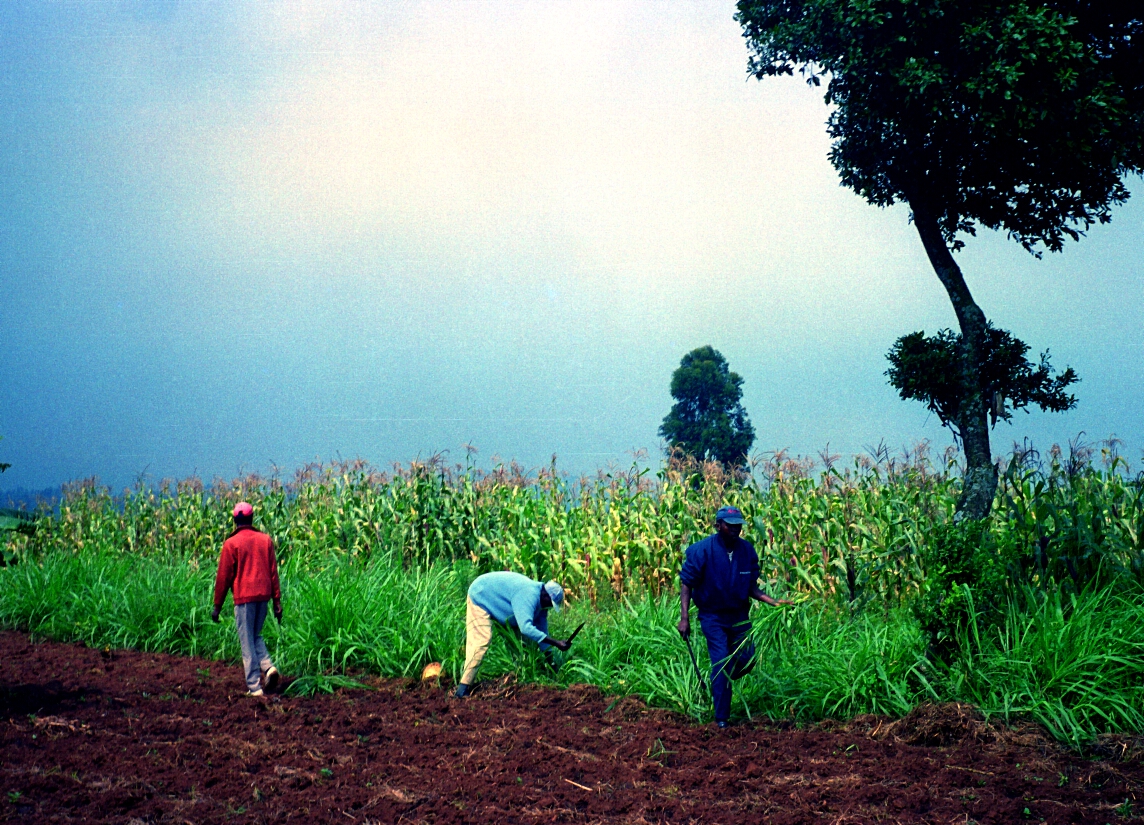
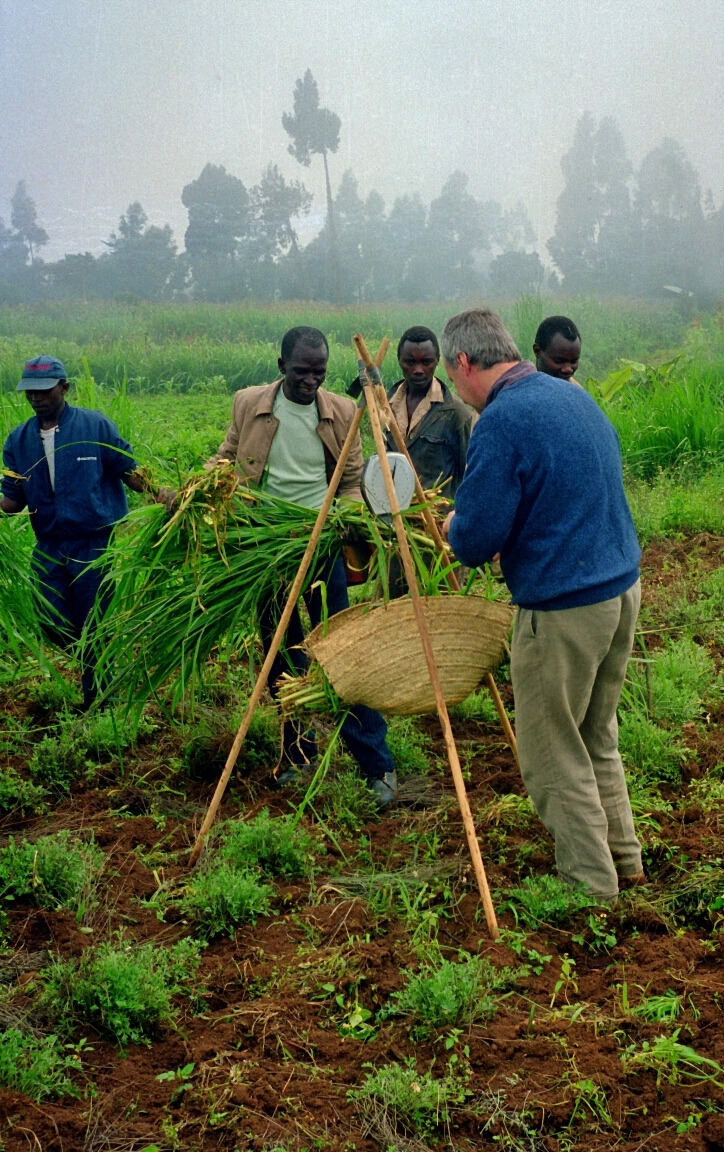
One of our tasks on the farm was to sample farmers’ Napier Grass plots to see how far they were infected, and to what extent the affected plants had lost mass. Njonjo organised a team of unemployed lads to help with the sampling.
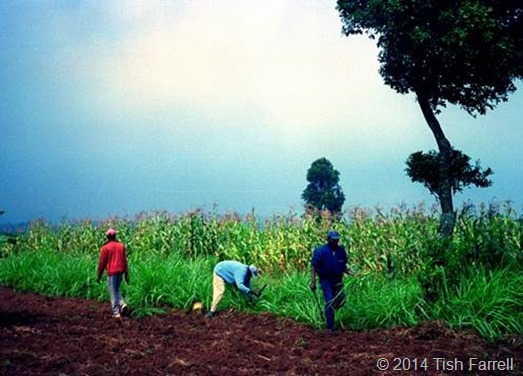
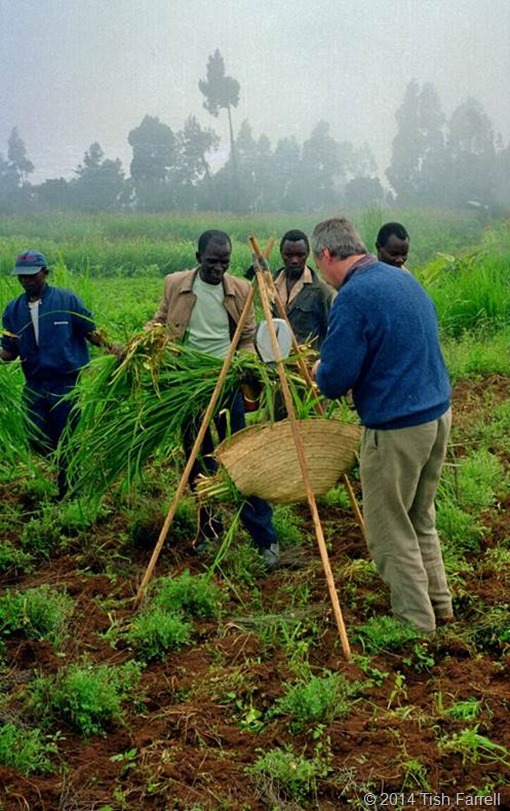
clip_image015

clip_image017

clip_image019

Before the cell-phone revolution of recent years, farming information was hard to come by. Here Njonjo delivers his Smut Lecture to an impromptu gathering of smallholders who have spotted our arrival in their district and want to know what we are up to.

*

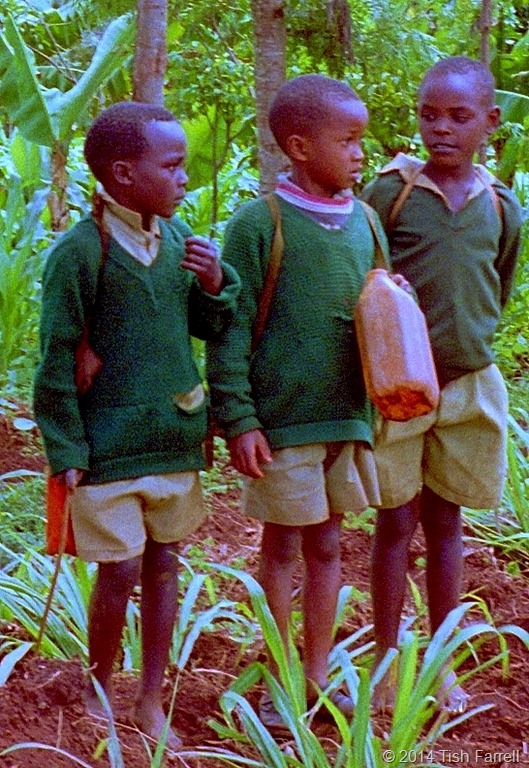
And here are three good reasons why Kenyans work so hard…
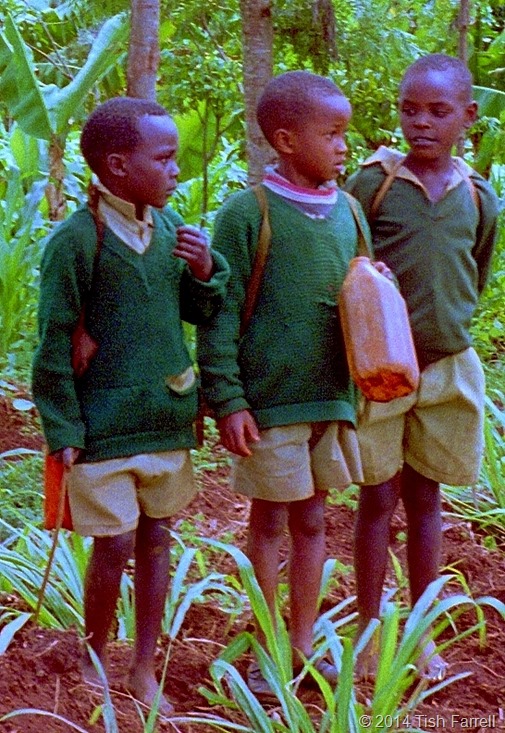
Kikuyu schoolboys

…education, education, education.

© 2014 Tish Farrell

 

Gorilla Guards in Virunga

Scan-130703-0012

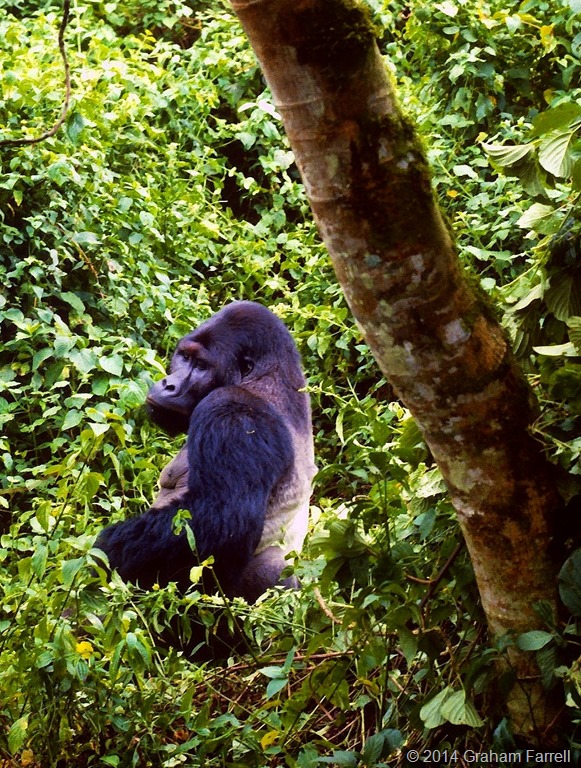
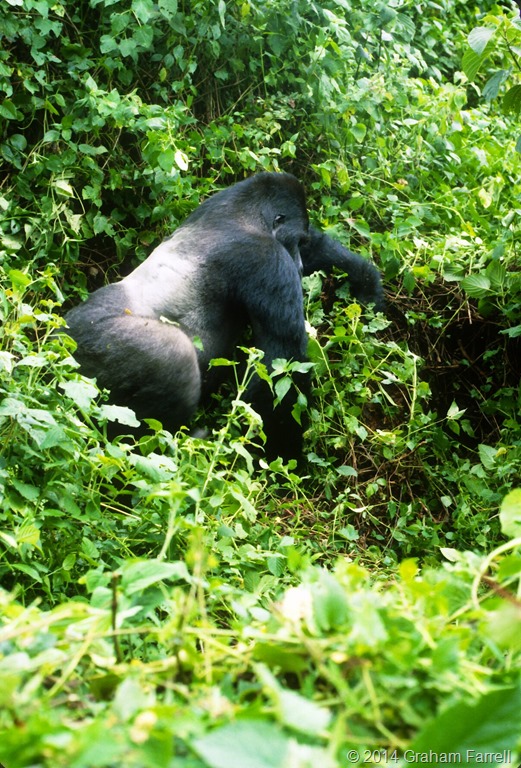
I’ve been rifling through the Team Leader’s photo file again, and trying not to wish I had taken these shots. As I said in an earlier post about the Congo, Graham went on an Africa overland trip a long time ago. He calls this era TBT – Time before Tish. He knows that I am deeply aggravated not to have visited all the countries he travelled through back then. Still, it means that you and I can at least enjoy these glimpses of one of the world’s most magnificent creatures.

Scan-130703-0004 (5)

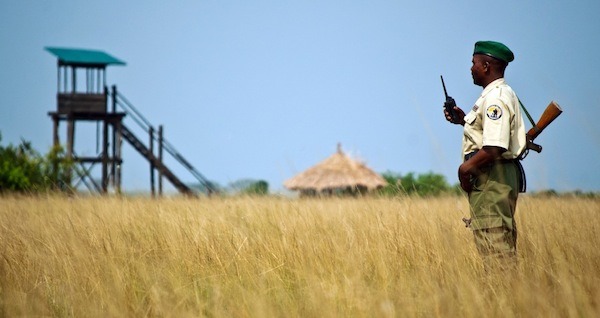
These photos were taken in the Virunga National Park, in the north east corner of the Democratic Republic of Congo. They were taken in peaceful times. Tragically, in the last few decades since the Rwandan genocide of 1994, this vast park has become a haven for armed militias. (The background to this situation is covered in the Congo post).  By 2008 it looked as if Virunga, one of the most  bio-diverse places on earth, had been destroyed. But since then the park has been restored and much of this is down to the brave Congolese rangers who continue to risk their lives to protect the wildlife, including nearly 500 mountain gorillas. Parts of Virunga are even safe once more for tourism.

Virunga ranger

Photo: Gorilla.CD  Virunga National Parks official website

*

The Gorilla.CD site is the best place to go for up-to-date reports on the Virunga National Park and its gorillas. Also see their gorilla blog for more fantastic pictures. And take a look at the fund-raising projects which need everyone’s support. Some one hundred and fifty rangers have been killed by militias. The most recently reported attack was in January this year (Virunga National Park Ranger Killed in DRC). Gorilla.CD has a project to support the rangers’ widows and children.

And yes, I did say it: tourism in this area is being revived. It takes place in part of the park where there is no militia threat. The Virunga National Park (3,000 square miles) is run by the Institut Congolais pour la Conservation de la Nature and is a UNESCO world heritage site. May be one day I will go there too.

© 2014 Tish Farrell

Frizz’s Tuesday Challenge: tagged ‘G’