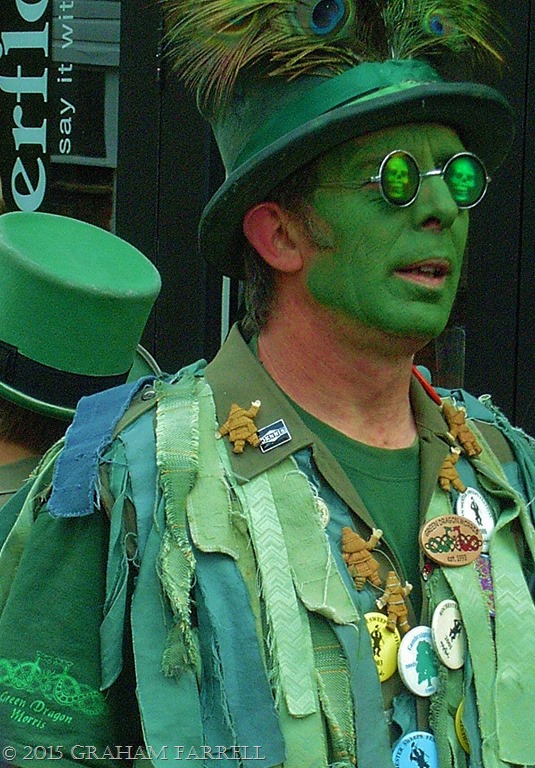
…Green Man/Morris Dancer/Goth at the annual Rochester Sweeps’ Festival.
To find out more go to “Unexpected with bells, sticks and hankies at the Sweeps Festival” HERE

…Green Man/Morris Dancer/Goth at the annual Rochester Sweeps’ Festival.
To find out more go to “Unexpected with bells, sticks and hankies at the Sweeps Festival” HERE

This batch of colanders made smile. They were spotted in a cook shop window in Portsmouth, Massachusetts, where we had stopped en route for Boston. I was entranced. Like a child eyeing shiny new building blocks, I wanted them all. What was the point of buying only one colander when they looked so good in a crowd? And which would I choose – the red, or the mauve, or the sky blue, or…? My companions walked off without me. Lunch was calling. So in the end I simply snapped them, and now they seem just right for Paula’s Multicoloured prompt at Thursday’s Special.

Christmas morning and we find ourselves in a general pilgrimage of families and dogs. We have all had the same idea: to trek along Anglesey’s Newborough Beach to Ynys Llanddwyn, the island sanctuary of Dwynwen, Welsh patron saint of lovers.
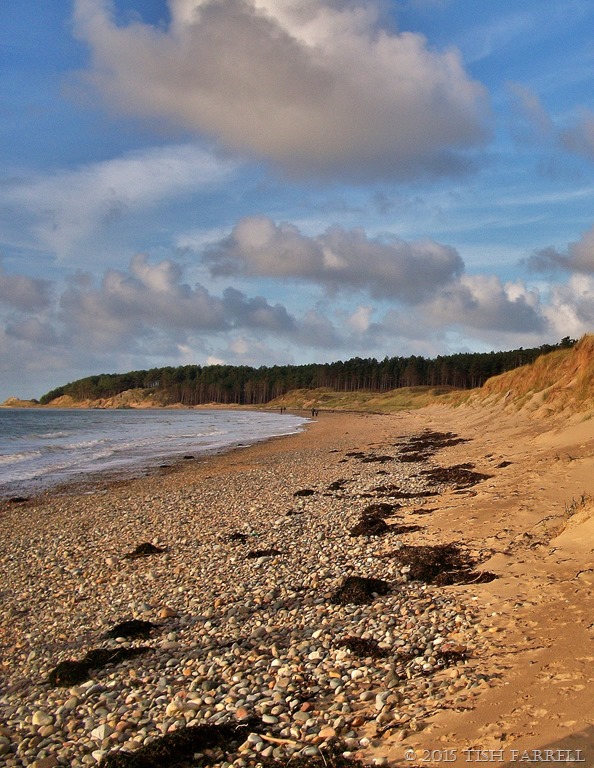
As you can see, the day was brilliant, but down on the shore the wind was bitingly cold. It was a challenge to take photos, but taken they must be. For one thing, the views across the Menai Strait to the mainland’s Llŷn Peninsula were mesmerizing, and had to be captured.
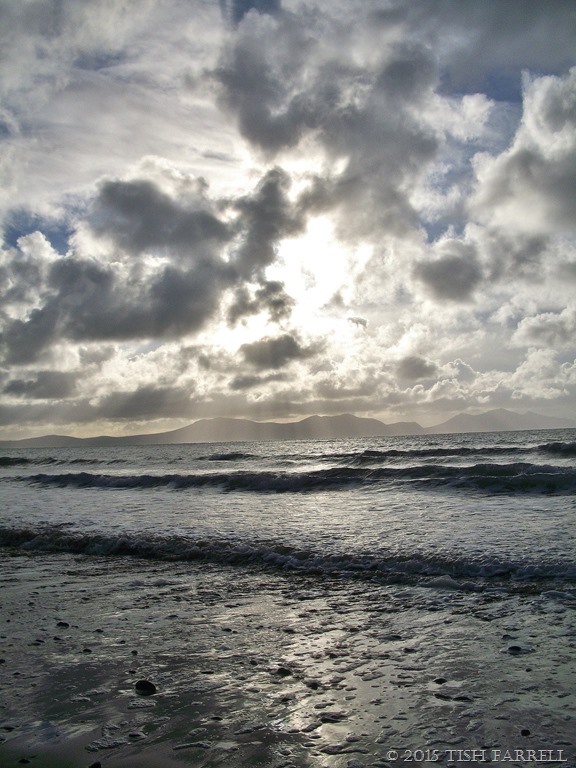
For another, there were some rather shocking scenes of coastal erosion. I promise, though, when we reach the island I will tell you the story of Dwynwen.
First things first. Newborough Beach is some two miles long and ends at the promontory that forms Llanddwyn Island. It is famous for its dunes which apparently arrived there in the great storm of 1331. It was the Feast of St Nich0las (December 6) when the disaster struck, and on that day the wind and sea rose to such a pitch that they drove, from the shores across the Strait, great mounds of sand and deposited them on the once fertile fields and dwellings of the medieval Newborough.
Ever since, many of the dunes have continued to shift, although there have been various strategies to stabilize them. In the sixteenth century marram grass was planted, and this gave rise to a successful local industry wherein the grass was cropped to weave into mats and baskets. Far more recently, in the 1940s, the Forestry Commission planted the promontory with conifers. The small forest that has thrived there since is home to ravens and red squirrels.
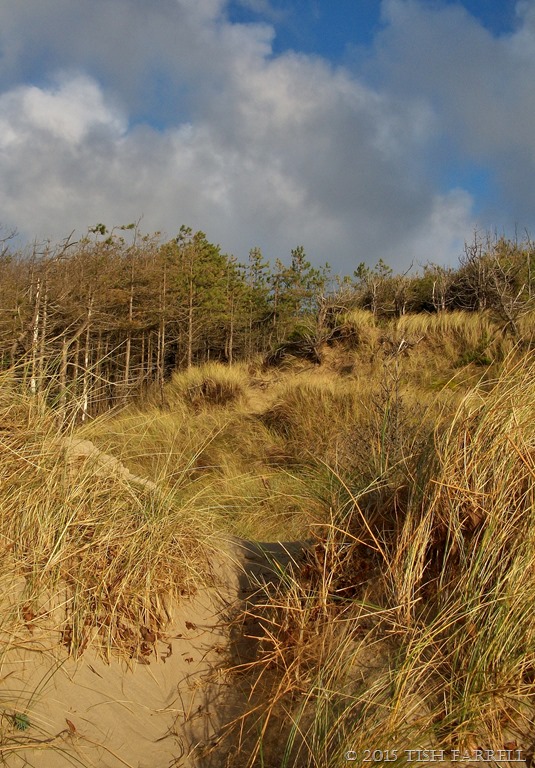
Now, though, there are new threats from the weather. Last winter severe storms lashed the Welsh coast, causing great damage and much local concern about a future where rising sea levels and erratic storms are likely to figure more prominently.
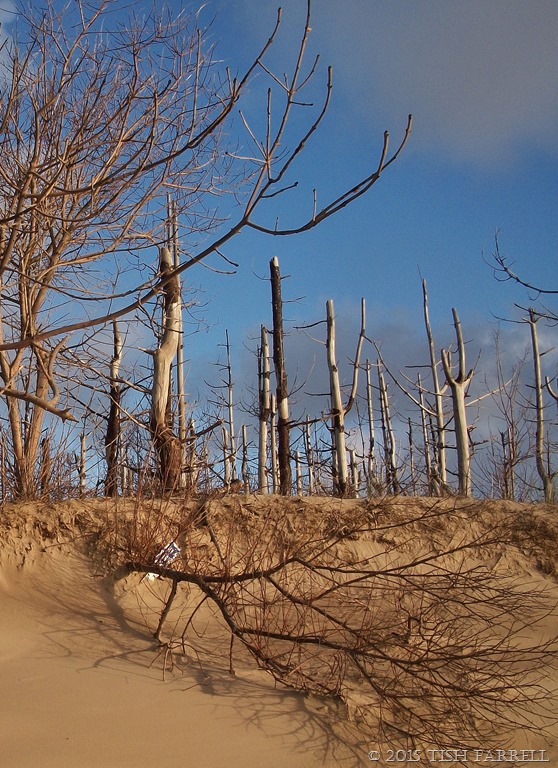
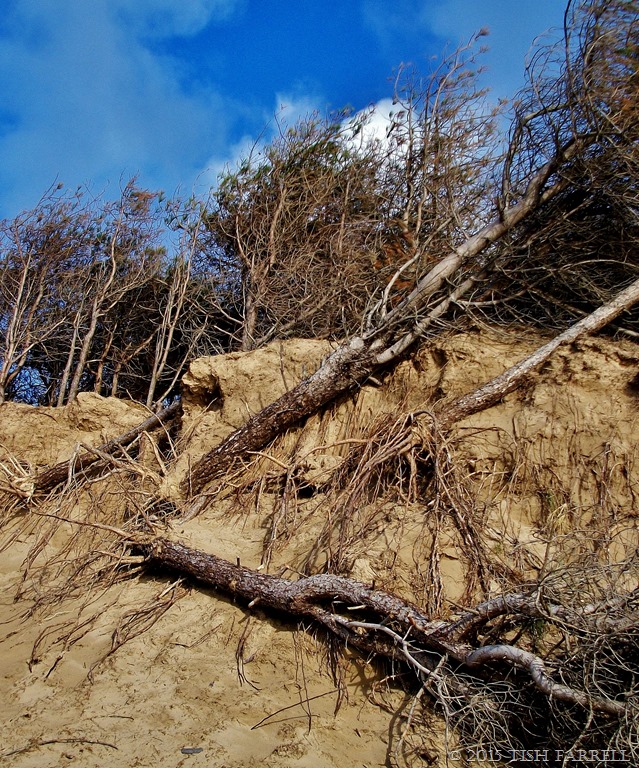
It is a simple demonstration of the power of weather, and instead of arguing about its precise causes we should perhaps be wondering what is best to be done. At the present, the people of Newborough are doing just that. There is an on-going public consultation as to how the forest and nearby salt marsh may be protected. This whole corner of Anglesey is a much treasured resource to locals and visitors alike.

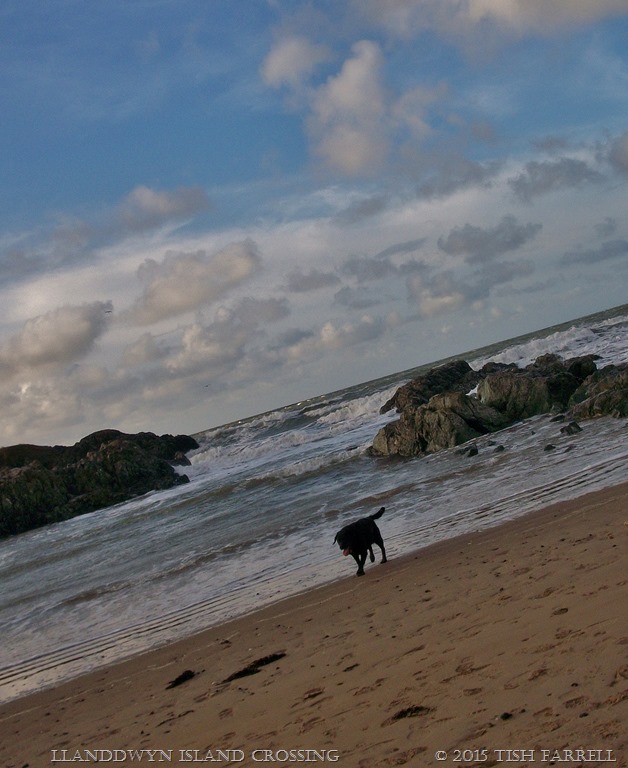
Meanwhile, sister Jo’s labrador Molly is hardly concerned with matters of coastal erosion. Nothing a dog likes more than sand in its paws, wind in its ears, some smelly crabs and dead fish to nose, and also to lay claim to everyone else’s stick.

She always wins. ALWAYS. Bad luck, Graham.

When we reach the crossing place to the island, the tide is still too high to walk across. So we ponder the rocky deposits of pillow lava, that were apparently blown up from undersea volcanic eruptions in the Precambrian era, and wonder if Dwynwen really did choose this exposed promontory for her sanctuary some fifteen hundred years ago. There is no doubting the elevating beauty of the place.
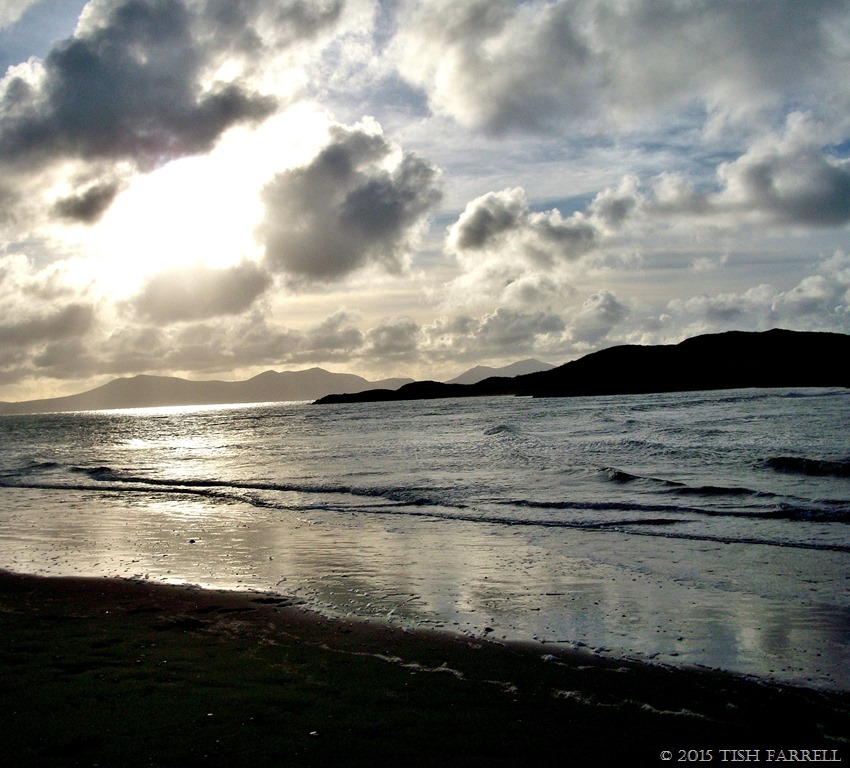

And so, as I promised, to Dwynwen’s story. She lived in the fifth century CE, and was one of Prince Brychan’s twenty four daughters. She fell in love with a young man called Maelon Dafodrill who apparently returned her feelings. Yet in a fit of caprice, Dwynwen refused his proposal of marriage. Some say it was because she wished to remain chaste. Others say it was because her father had arranged for her to marry another man. For his part, Maelon made his displeasure at the refusal known by spreading tales that cast doubt on Dwynwen’s honour.
In a frenzy of anguish, she thus took herself off alone to a wood where she prayed to be cured of her passion. And so it was that an angel appeared to her in a dream and gave her a potion that not only erased her feelings of love, but also transformed the spurned lover into a block of ice. Heaven also granted her three wishes. Dwynwen thus asked that Maelon be unfrozen. She then requested that if any true-hearted lover invoked her name, they should be granted their heart’s desire or relieved of their painful emotions. Finally, she sought never to be married, and thence withdrew from the world, founding a convent on Llanddwyn Island which, after her death in 465, became a place of pilgrimage. Her feast day is 25 January, and is celebrated by many in Wales with cards and flowers in the same way Saint Valentine’s Day is marked in many European countries.

And so unable to complete our own pilgrimage and reach the island with its ruined church, we retraced our steps, thinking more profanely of a turkey to be roasted, presents to be opened, and a glass of champagne to drink.

And it was under this patch of marram grass, as we left the beach, that my Kodak EasyShare gave up the ghost. You could say, then, that this post is its last post. Just as well I still have the memory…
copyright 2015 Tish Farrell
Inspired by Jo’s Monday Walk
See her latest post and other bloggers’ walks at Roker Pier
*
![Losing Kui -Final[1]](https://tishfarrell.com/wp-content/uploads/2015/01/losing-kui-final1.jpg?w=164&h=240 "Losing Kui -Final[1]")
Secrets, conspiracies, tragedy,
dark comedy – a fast-paced
novella of interwoven tales set
somewhere in East Africa


We spent our Christmas with my sister, Jo, and chap, Bob, and their labrador Molly, staying in a cottage in the grounds of Henllys Hall on Anglesey. These huge sculpted dogs guard the entrance drive to the cottages, and are caught here in light shadow with the sun on the scene behind them. I find them intrinsically noble, and they unavoidably remind me of the story of the great dog Gelert, owned by the thirteenth century Welsh prince, Llywelyn of Gwynnedd. But beware, this tale does not end well. Here it is.
One day Llywelyn went hunting with his court, leaving his faithful hound, Gelert, to guard the stronghold, and in particular to watch over the Prince’s young motherless son who was still only an infant. At sunset when Llywelyn returned to his castle, Gelert rushed to meet his master, but something was horribly wrong. The dog’s muzzle was all smeared with blood. Filled with alarm, Llywelyn ran to his son’s chamber and, seeing the cot upturned, and bed clothes strewn about and streaked in blood, he leapt to conclusions, and drawing his sword, he killed his beloved dog. As the dog yelped his last, so a child’s cry rang out from under the cot. When Llywelyn ran to right it, he found his son quite safe beneath. But he also found the corpse of a large wolf that Gelert had killed to save the child. Filled with remorse, Llywelyn built a cairn of stones to honour his faithful friend, and the place where it may be seen is at Beddgelert (grave of Gelert), beside the River Glaslyn, on the road to Porthmadog.
copyright 2015 Tish Farrell
Daily Post Weekly Photo Challenge: Shadowed
Secrets, conspiracies, tragedy,
dark comedy – a fast-paced novella
of interwoven tales set somewhere in
East Africa
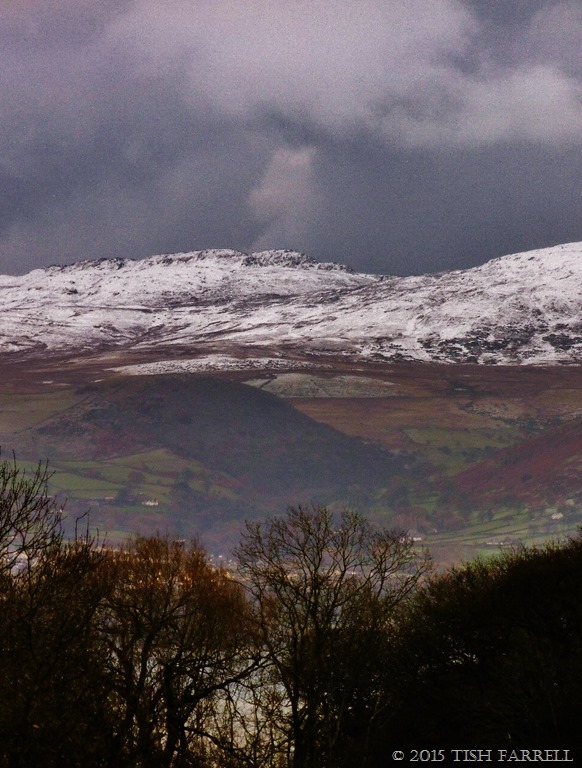

Storm lashed
Wind wrought
Winter’s tracery
*
Inspired by Laura Bloomsbury at Tell Tale Therapy who was in turn inspired by Linda G Hill’s Friday prompt for Stream of Consciousness Saturday. I love the way one blog leads to another. Go to both links for quick-fire creative responses to Linda’s prompt: the letter ‘T’. The rule is no forward planning. Just write.

Badge by: Doobster @ Mindful
*
Secrets, conspiracies, tragedy, dark comedy
– a fast-paced novella of interwoven tales
set somewhere in East Africa
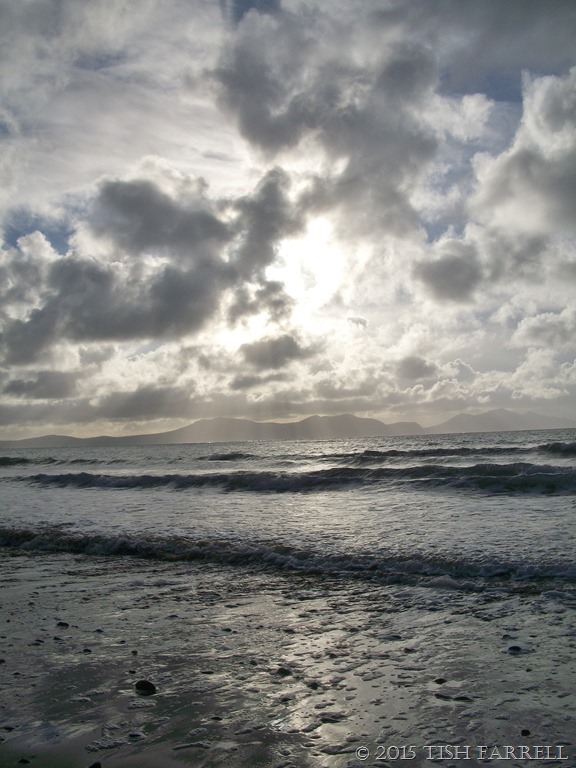
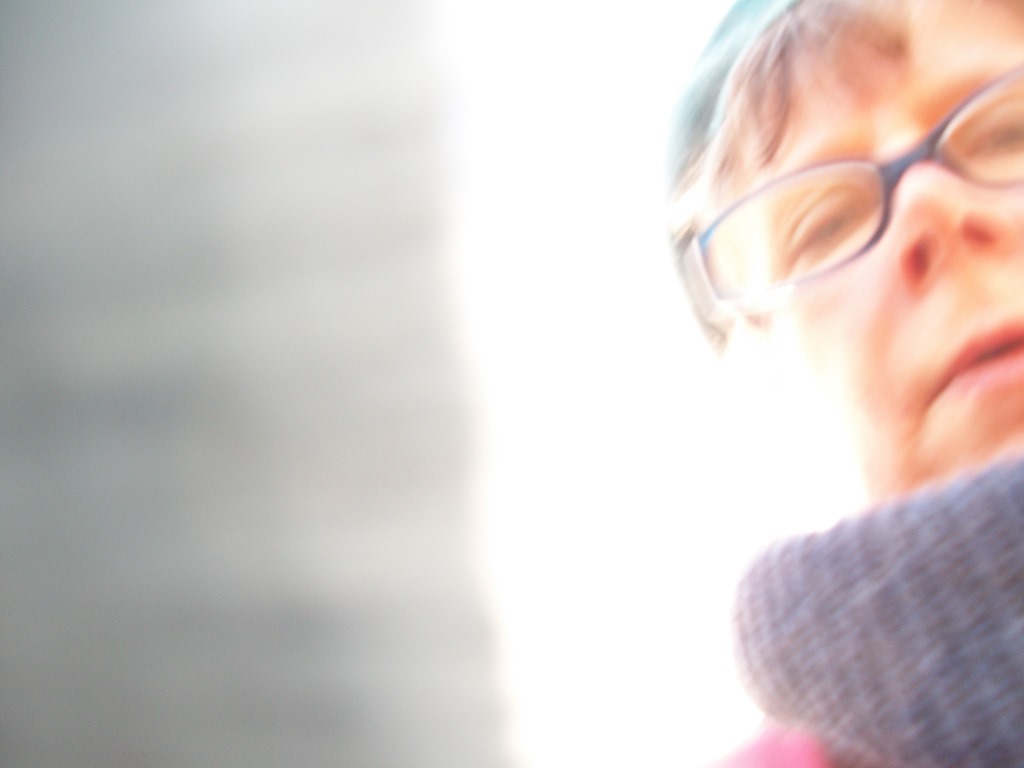
My trusty Kodak EasyShare camera died on Christmas morning. We were striding along Newborough Beach on Anglesey, in North Wales, me happily snapping away here and there. As you can see, the light was wonderful, and the mountains of Snowdonia across the Menai Strait, a mystic blue-grey. And then the camera began to die. Touchingly, it’s last shot is of me with my specs on, peering down at its lens, and wondering what on earth was going on with it. Under the circumstances, I’m not sure how the photograph happened, but happen it did. (An unintended selfie?) And so there you have it, little Kodak’s last click. Aaaah.
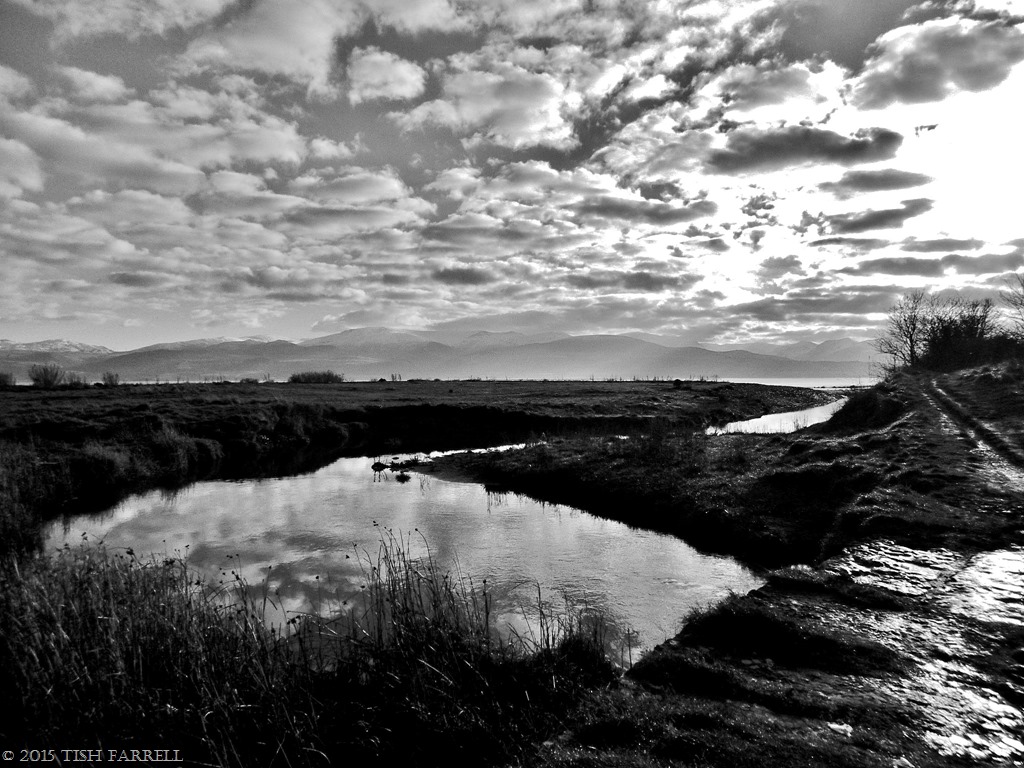
Perhaps it knew what was coming; that I was about to desert it for a smarter, whizzier model. For yes, when we got back to the house, and the present opening, it was to find that Santa, aka the Team Leader, had bought me a new Lumix Panasonic. Oh, so many more modes and functions. But at least it has forced me to make one New Year’s Resolution: to learn how to use it properly. There! Now I’ve committed myself in print. Anyway, here’s a preliminary attempt in monochrome mode: looking towards mainland Wales.
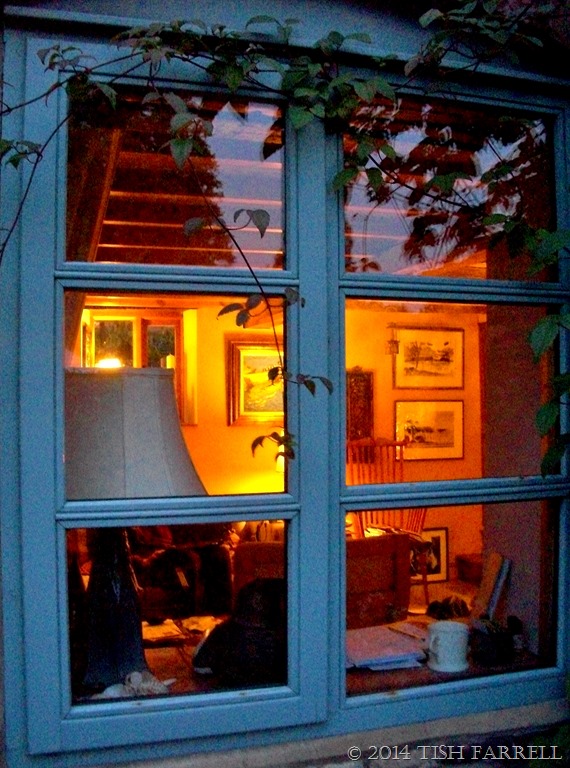
Solstice Greetings everyone, wherever
you are on our wonderful planet.
Wishing you all the very best for 2015
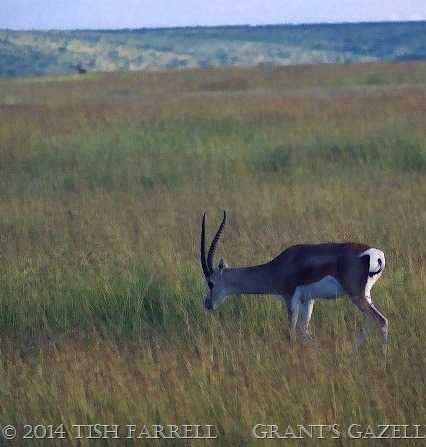
Here is one of the finest poems I’ve read in a long time, Ode to a Drum written by American poet, Yusef Komunyakaa. Please accept it as a festive gift and pass it on.
Gazelle, I killed you
for your skin’s exquisite
touch, for how easy it is
to be nailed to a board
weathered raw as white
butcher paper. Last night
I heard my daughter praying
for the meat here at my feet.
You know it wasn’t anger
that made me stop my heart
till the hammer fell. Weeks
ago, I broke you as a woman
once shattered me into a song
beneath her weight, before
you slouched into that
grassy hush. But now
I’m tightening lashes,
shaping hide as if around
a ribcage, stretched
like five bowstrings.
Ghosts cannot slip back
inside the body’s drum.
You’ve been seasoned
by wind, dusk & sunlight.
Pressure can make everything
whole again, brass nails
tacked into the ebony wood
your face has been carved
five times. I have to drive
trouble from the valley.
Trouble in the hills.
Trouble on the river
too. There’s no kola nut,
palm wine, fish, salt,
or calabash. Kadoom.
Kadoom. Kadoom. Ka-
doooom. Kadoom. Now
I have beaten a song back into you,
rise & walk away like a panther.
Source: Internet Poetry Archive
For more works by award-winning American poet, Yusef Komunyakaa
![384px-Yusef_Komunyakaa_2011_NBCC_Awards_2012_Shankbone[1]](https://tishfarrell.com/wp-content/uploads/2014/12/384px-yusef_komunyakaa_2011_nbcc_awards_2012_shankbone1.jpg "384px-Yusef_Komunyakaa_2011_NBCC_Awards_2012_Shankbone[1]")
Yusef Komunyakaa Photo: David Shankbone, Creative Commons
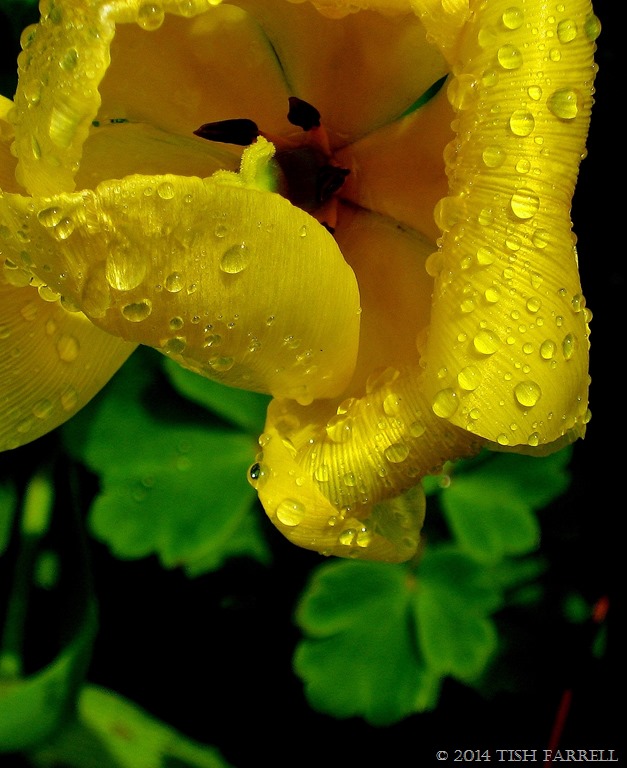
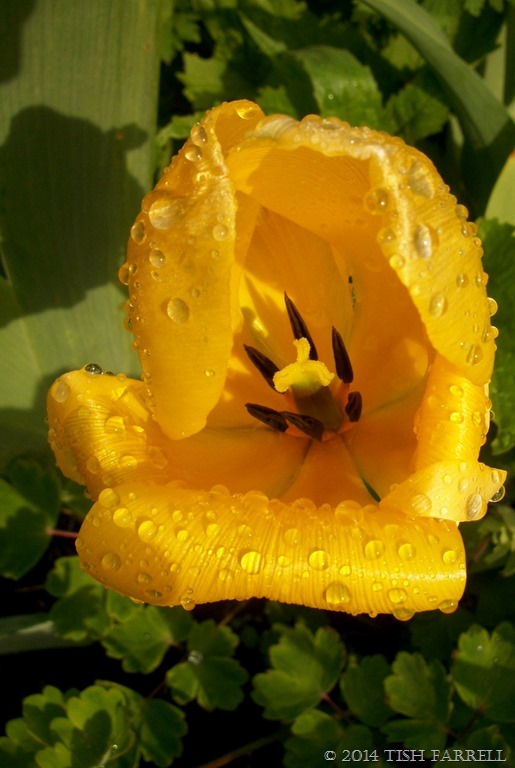
Thinking of spring to come, except I realise now that I forgot to plant any bulbs, so these memories of tulips past will have to serve. They were snapped at very close quarters in my garden last April, and with a Kodak Easy Share. The poor little camera has lost its zoom, but it’s quite good on macro. The same might be said of the photographer.
