Incy Wincy Wenlock Crab Spider For Ark: Macro Monday

IMG_1823

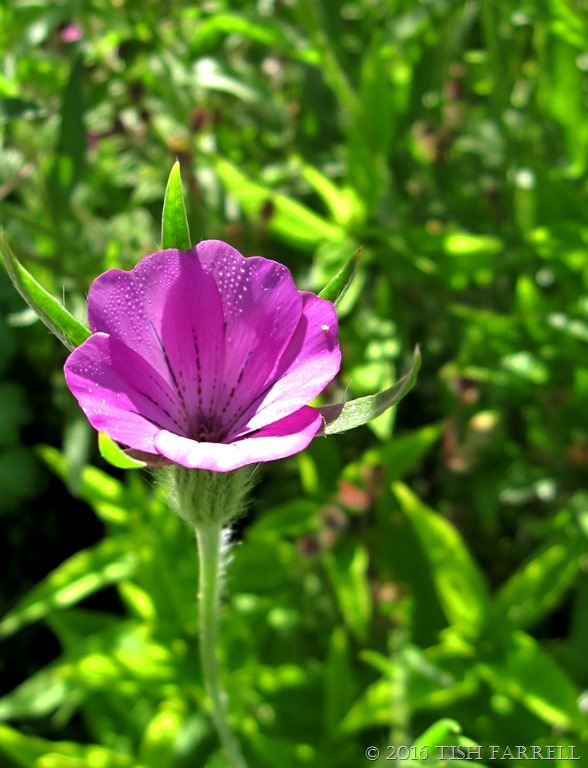
The flower is a wild corn cockle, and in real life it’s around an inch across,  or two and a bit centimetres in alternative dimensions. The spider is utterly minute then, and the smallest I have spotted so far in the Farrell garden on Sheinton Street. In fact I only started noticing this species at all after Ark at A Tale Unfolds introduced me to the ones in his Johannesburg garden. Please check out his blog for more of his astonishing garden photos, though be warned – some of his close up arachnid shots might give spiderphobes a turn.

Also please visit Jude at her Macro Monday slot for more wonderful work. She’s featuring geraniums whose intricate beauty we perhaps do not appreciate enough.

Now here’s a less macro shot of the spider though it’s still larger than real life: hard to spot it beside the dewdrops:

IMG_1816

Black & White Sunday: Delicate

P1020250

“There’s magic in the web of it”

The quote is from Shakespeare’s play Othello. And the web is from a shady corner in my garden, captured on a foggy morning last autumn.  It’s also my interpretation for this week’s Black & White Challenge at At Lost in Translation. Paula is  inspiring us towards a delicate frame of mind.

Black & White Sunday: Delicate

Nature Photo ~ Day 3

100_9214

The Wood Anemone (Anemone nemorosa)  is one of the loveliest of Britain’s wild flowers. The delicate white blooms have bell-like heads that open to the sun as this one is doing. It’s about 3 cm across. They are also among the earliest spring flowers, carpeting ancient woodlands before the trees come into leaf and make too much shade. The flowers nod in the April breeze, which distinctive habit doubtless inspired their country names of Wind-flower and Grandmother’s Nightcap.

As ever, I am indebted to Richard Mabey and his magnificent (and very large) book Flora Britannica for further intriguing details about this plant.

I found this particular anemone yesterday. It was growing below Windmill Hill, on the edge of the Linden Field. I’d not noticed anemones there before, and the sparse little colony hardly made a carpet. They were also growing  under trees that I know have been planted in the last hundred years to commemorate various events associated with the Much Wenlock Olympian Games. Before that, in Victorian times anyway, the field was, well, a field. This, then, presents a bit of mystery.

Mabey says that in Britain the Wood Anemone only very rarely produces viable seed. Instead it spreads by means of its root system, six feet for every hundred years, which is pretty slow going. When you find them, they are thus a pretty good indicator of ancient woodland since they rarely extend beyond these age-old sites. All of which makes me wonder how the little group of Wind-Flowers found its way to the Linden Field. Perhaps they are relic rootstock from times when the ground in question did host ancient tree cover. Mabey suggests that this could be a explanation for the more open-growing colonies now to be found on the limestone pavements of the Yorkshire Dales.

Anyway, however they got there, I was very pleased to see them. More power to their root systems is all I can say. Faster. Faster. We can’t have too many Wind-Flowers.

*

Anna nominated me for this challenge, so please take a look at her cloud scenes at Una Vista di San Fermo. Also Meg has posted some magnificent Warsaw tree-scapes; Ark at A Tale Unfolds gives us stunning bee and other flying insect shots; while Sylvia at Another Day In Paradise takes the absolute biscuit with parting shots of her erstwhile (too close for comfort) neighbour, alligator Mr. A.


#7daynaturephotochallenge

The Carrion Crow

100_7827

A large black bird that feeds on the carcasses of beasts

Dr Samuel Johnson


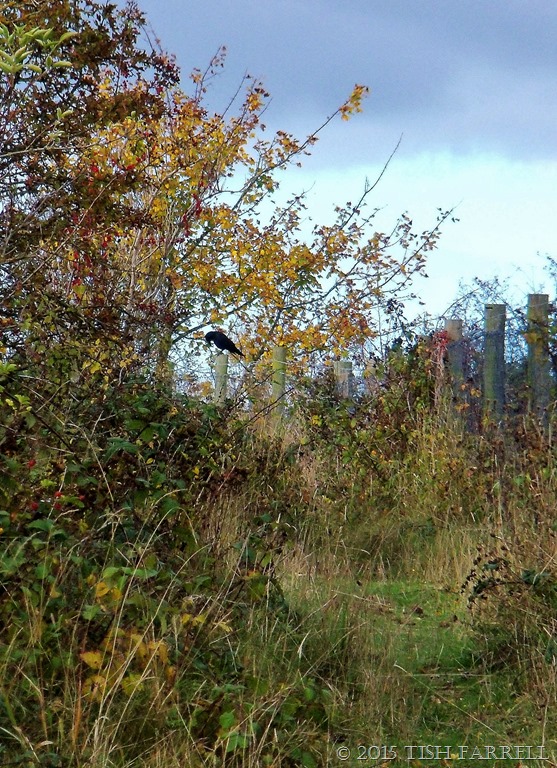
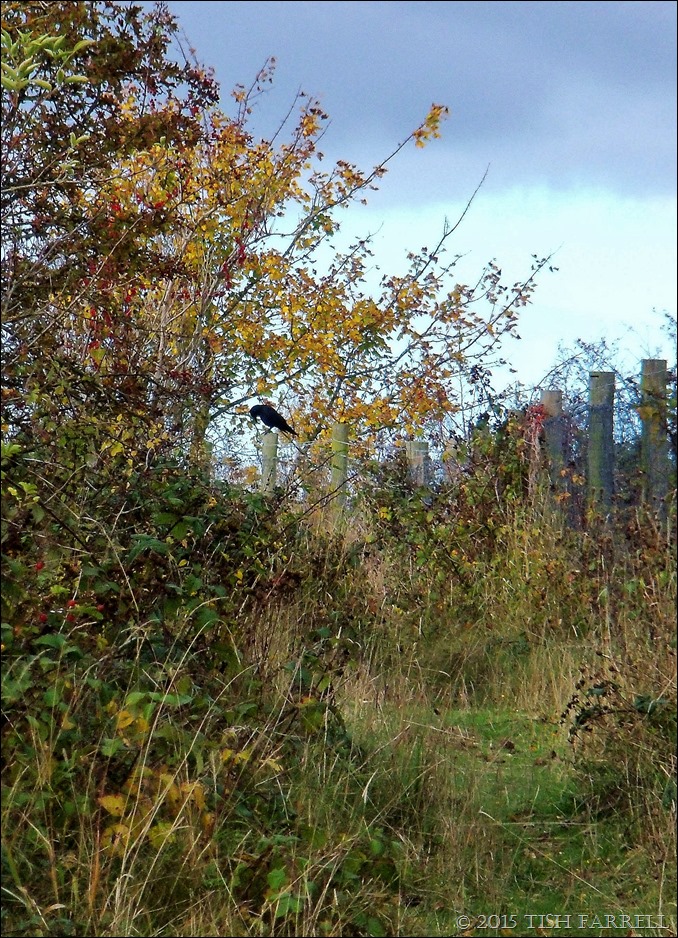
I didn’t think this shot would work. My little Kodak EasyShare was on maximum 5x zoom. But when I looked at the image on screen, I decided it was worth posting. It anyway illustrates an important fact about carrion crows. They are very hard to sneak up on, which is why I couldn’t get any closer and take a better shot.

The next second it was gone, flying off with its guttural ‘kraaar’ call.

Carrion crows are solitary birds unless, that is, they have a mate. This one does have a consort. The pair’s territory includes Windmill Hill, the Linden Field and Townsend Field behind our house; at least this is where I see them foraging together. They are usually a little way apart, rooting  through the grass. They are also notorious egg thieves and snatchers of poultry and pheasant poults, and so are much despised by country folk in general, and game keepers in particular.

When separated, the crows call one to the other. The single ‘kraaar’ that echoes through the trees, or across the fields. It is  a melancholy sound, but also a wake-up call. I find myself instantly responding, scanning the landscape, tuning in to its resonance. What’s going on out there?  Perhaps I have crows in my ancestry.

These birds are very clever. In nest-building season they perch in the tops of trees and watch where the other birds are building their nests.  They also, as their name and Dr Johnson suggests, eat dead animals. Well somebody has to clean up the environment.

You can tell them apart from rooks by their longer, sleeker profile. Rooks are altogether shaggier with a long, greyish bill and a face-patch. Rooks of course hang out in crowds, some of their rookeries being known to have several thousand nests.

But all in all, I like the crows best. They teach me to be watchful.

copyright 2015 Tish Farrell