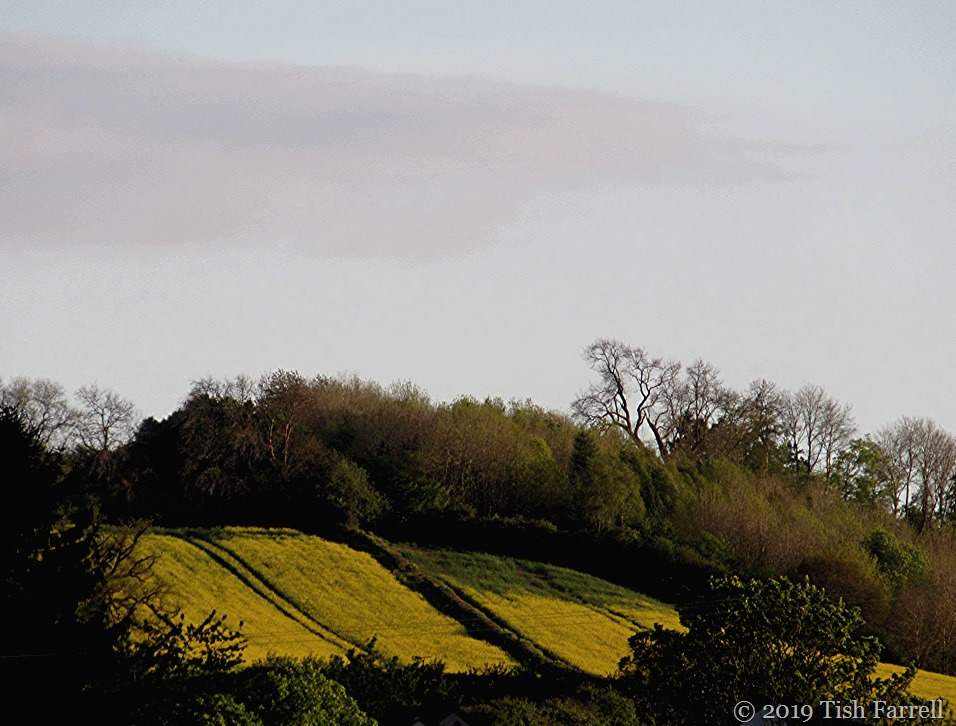
Last May the field behind the house was a yellow sea of oil seed rape flowers. This May the rape has only been visible on more distant hillsides around the town and I’ve rather missed having it on my doorstep and walking the golden arcade through the crop where the farmer’s big tractor had left a barren track during spraying. This year the rape bloomed extra early too, is already running to seed – which perhaps means chances of a better harvest; last year’s crop was scorched in the heat wave and shed much of its seed before it could be cut.
Elsewhere around the town we’ve been watching greenery happen. This next photo shows the Linden Walk on the 30th April. The one below it was taken yesterday, the 31st May. I noticed the pale flowering wings are already well formed, though the tiny buds were still tight shut, and I thought of their heavenly scent to come.
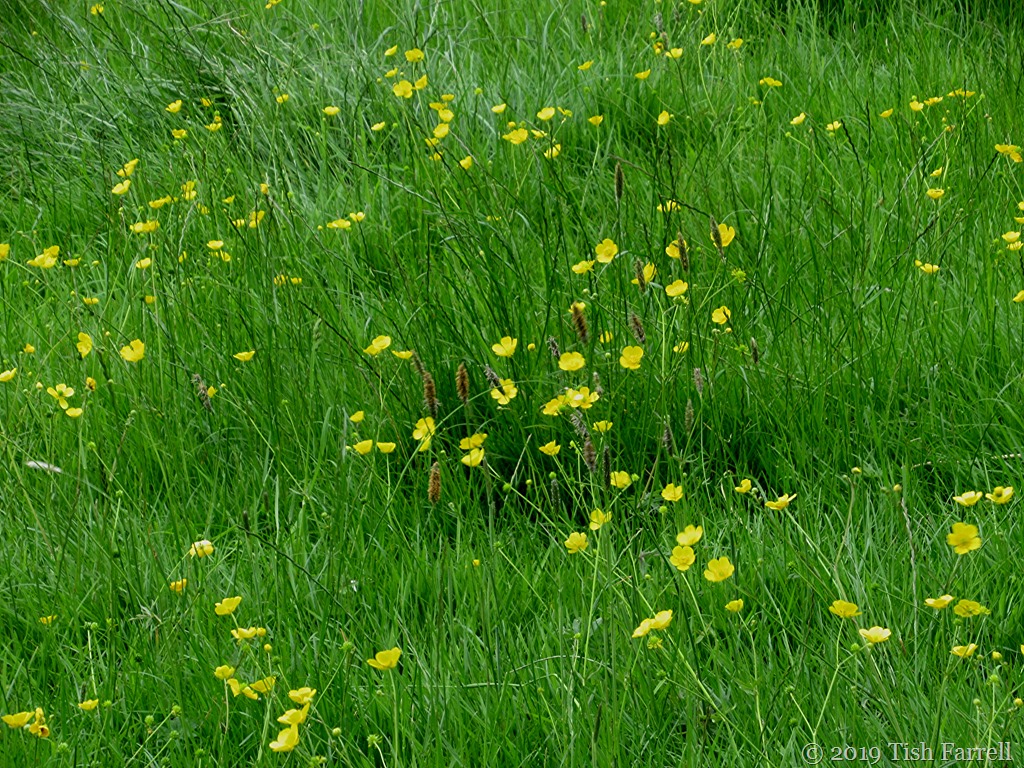
In the Cutlins meadow members of the MacMoo clan have been absent for a couple of weeks. Then on Thursday we saw they were back. There they were dreaming amongst the lush grass and knee-high buttercups.
*
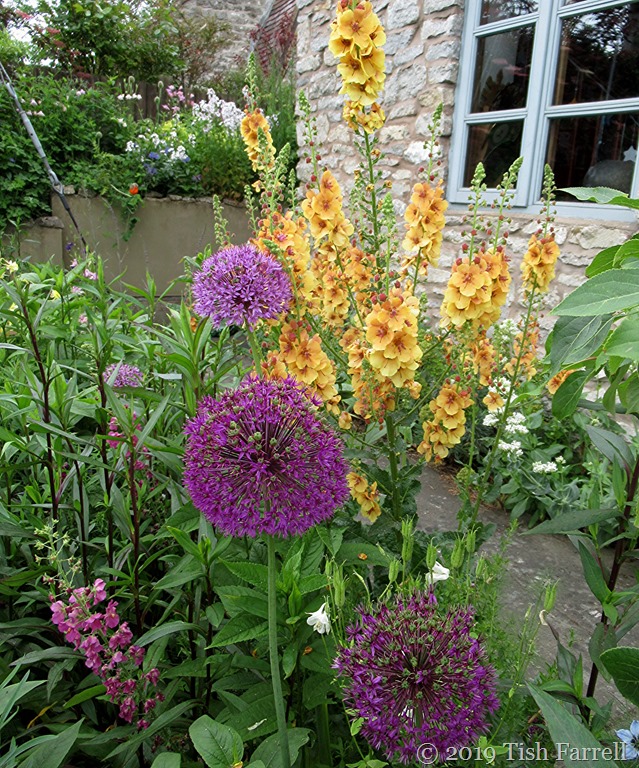
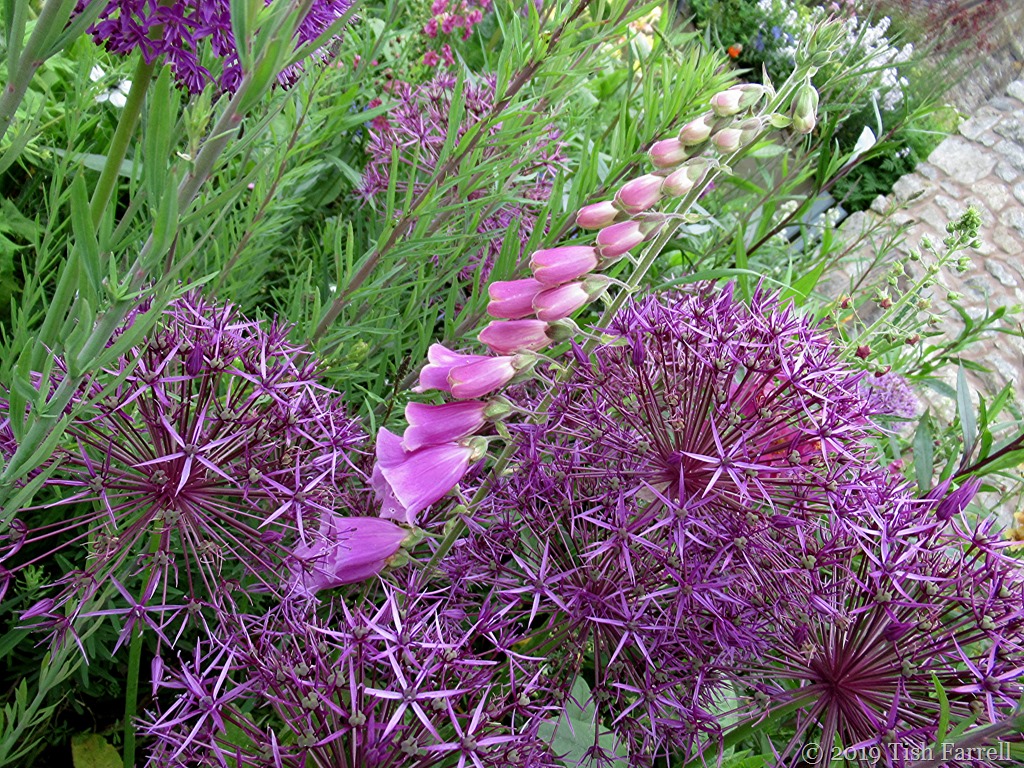
On the home front all is blooming. Yesterday morning I found our front garden – the one that slopes down to the main road – positively heaving with small bumble bees. The orange verbascum flowers had reached just the right state of ripeness, and the bees were gorging on them. The sparrows, too, have been enjoying the front garden, which goes to show – even a small roadside plot can make a bit of a wildlife sanctuary.
This week at the Lens-Artists, Tina explores the concept of harmony. There are of course many ways of thinking about it – physically and metaphysically, in terms of colour, music, flavours, composition, structures, relationships, (angelic choirs even). My first thought, though, was of the East African plains: harmony in the sense of the natural cycle of things; every species occupying its niche within the grasslands ecosystem; harmony with edge since eating and being eaten also come into it. This photo, taken at sundown, could also be seen as harmony – at least from the human perspective – a case of the pathetic fallacy perhaps: disparate creatures roaming and grazing peacefully together in the wilderness idyll, all bathed in golden late-day light. On the other hand, and I am not absolutely sure about this, but there could well be a hyena on the prowl – the tiny brownish entity, slightly dog-like, a zebra and a half in from the right, and just below the bough of the right hand thorn tree. Harmony about to be interrupted then.
This week Cee’s Black & White Photo Challenge is ‘vanishing point’. The photos here were taken in monochrome on the Mawddach Estuary in mid-Wales and at Marloes Sands, Pembrokeshire.
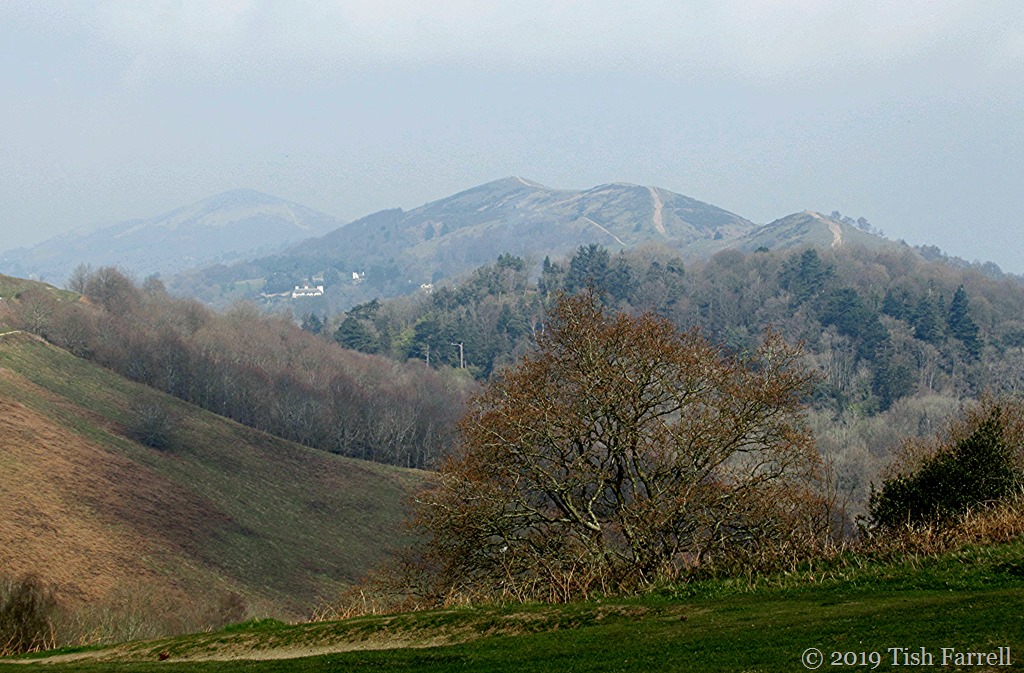
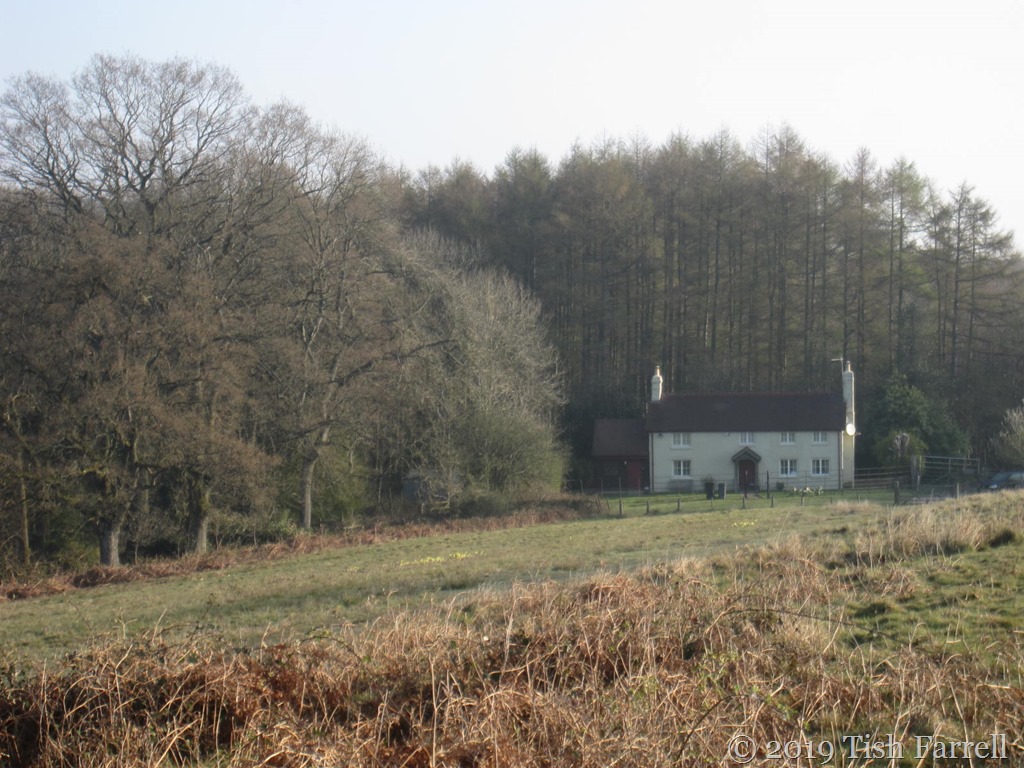
Lately I’ve been thinking you don’t need to go far from home to find other worlds; places where you feel taken out of yourself and far removed from familiar routines. And so it proved last weekend. We crossed the southerly border out of Shropshire, and climbed into the Malvern uplands. On either the hand, east and west, the farming shires of Worcester and Hereford spread out beneath us, Gloucestershire to the south; in every sense, then, the green pastoral heart of England. And it was all thanks to my sister Jo and her chap, Bob, who were kind enough to take us away with them for three nights in Peacock Villa in a quiet wooded corner of the Eastnor Estate.
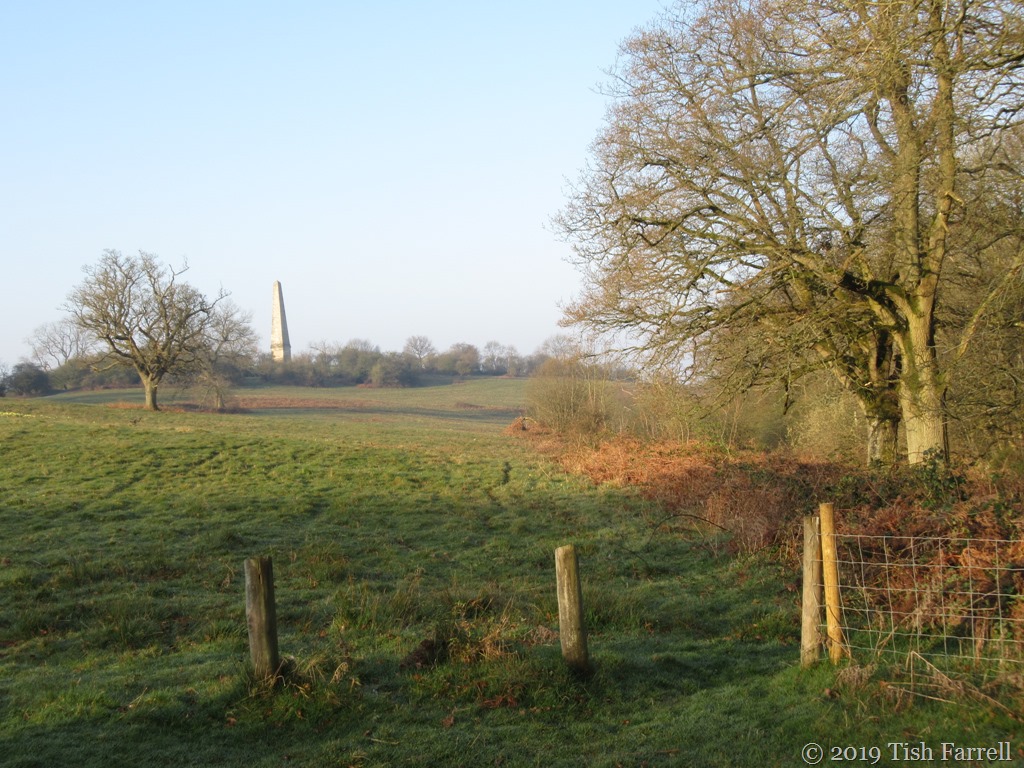
I should say at once that the cottage did not come with peacocks, but it did have a fine view of an obelisk. And there was silence too. Lots of silence when the pheasants weren’t calling or the woodpeckers drilling. And by night the kind of darkness that allowed you to gaze and gaze at the stars.
When I woke on Saturday morning this was the scene from the bedroom window.
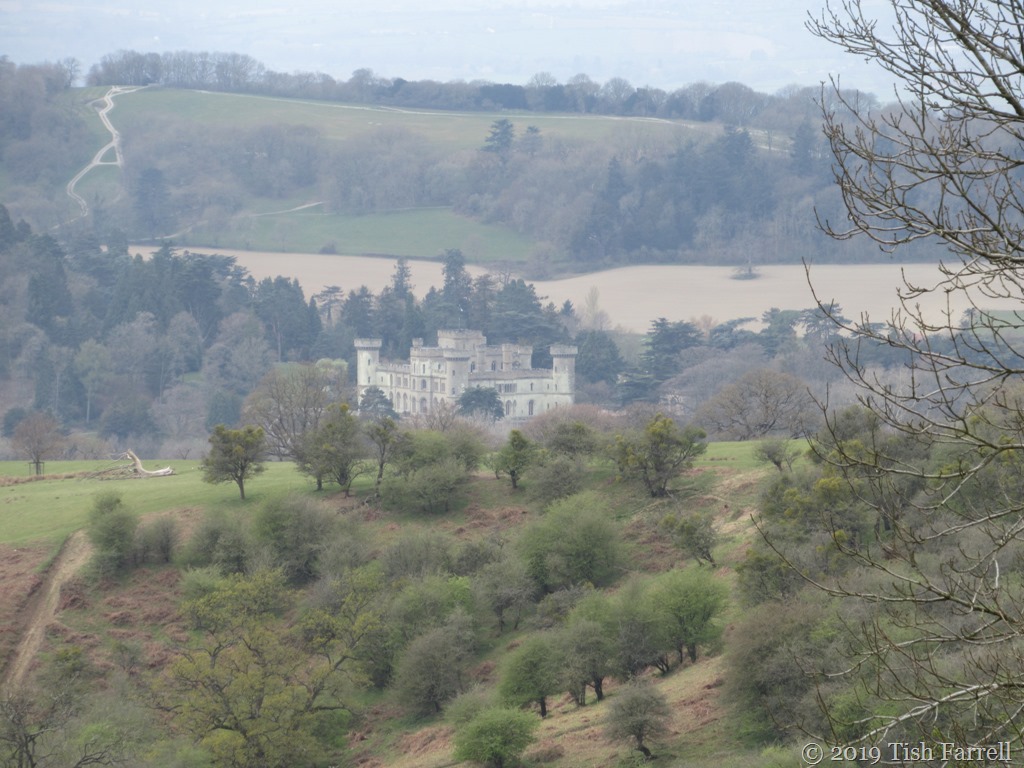
The 5,000 acre Eastnor Estate belongs to descendants of the Somers Cocks family whose antecedents arrived in Eastnor at the end of the 16th century. The family grew in wealth and status during the 18th century, and by 1811 was building for itself a Neo-Norman extravaganza that is Eastnor Castle, a country pile of (deemed) appropriate grandeur for the Ist Earl Somers. The obelisk, which stands on the highest easterly point from the castle displays inscribed highlights of the Somers Cocks family’s political successes and dynastic unions. It also commemorates the loss of a son, an intelligence officer on the Duke of Wellington’s staff who died in 1812 during the Peninsular War (1807-14) (wherein British forces were protecting Portugal during the conflict between Napoleon and Bourbon Spain). If you stand with your back to the westerly face of obelisk you can see the castle and the deer park. On a hazy late March day it all looks more than a touch surreal.
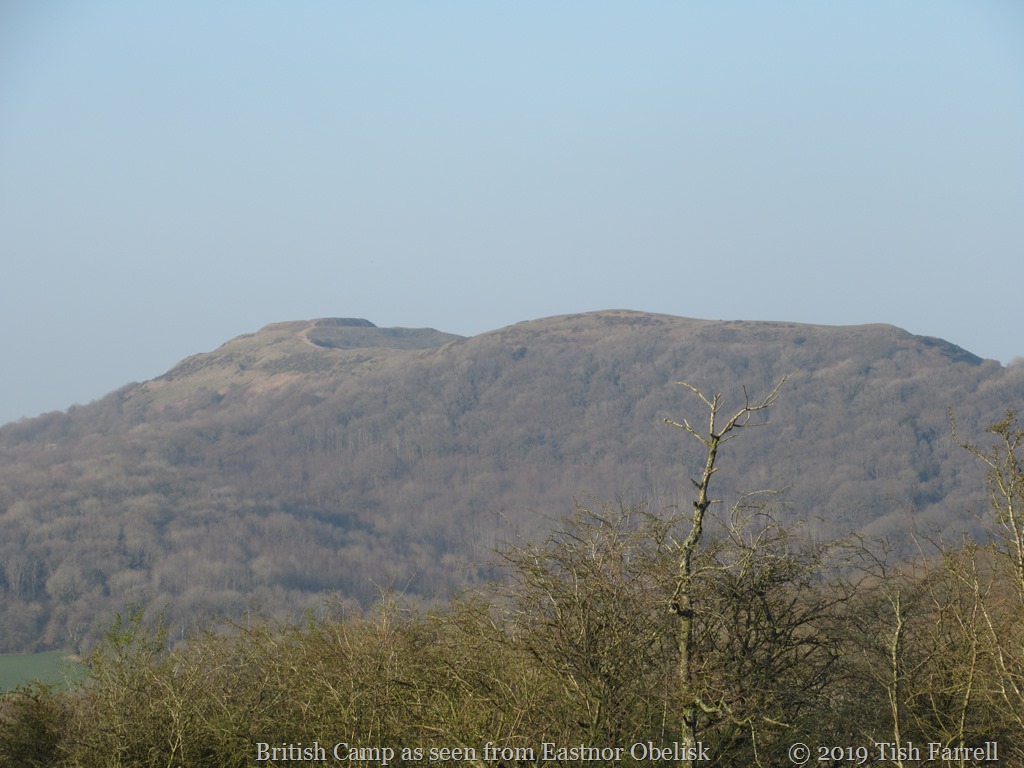
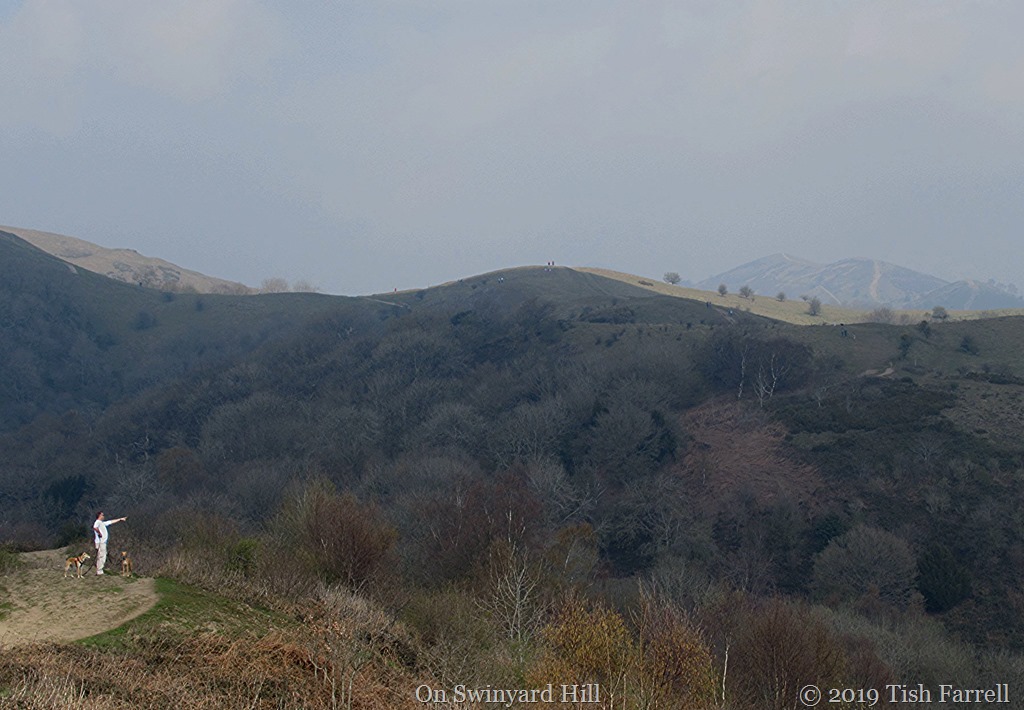
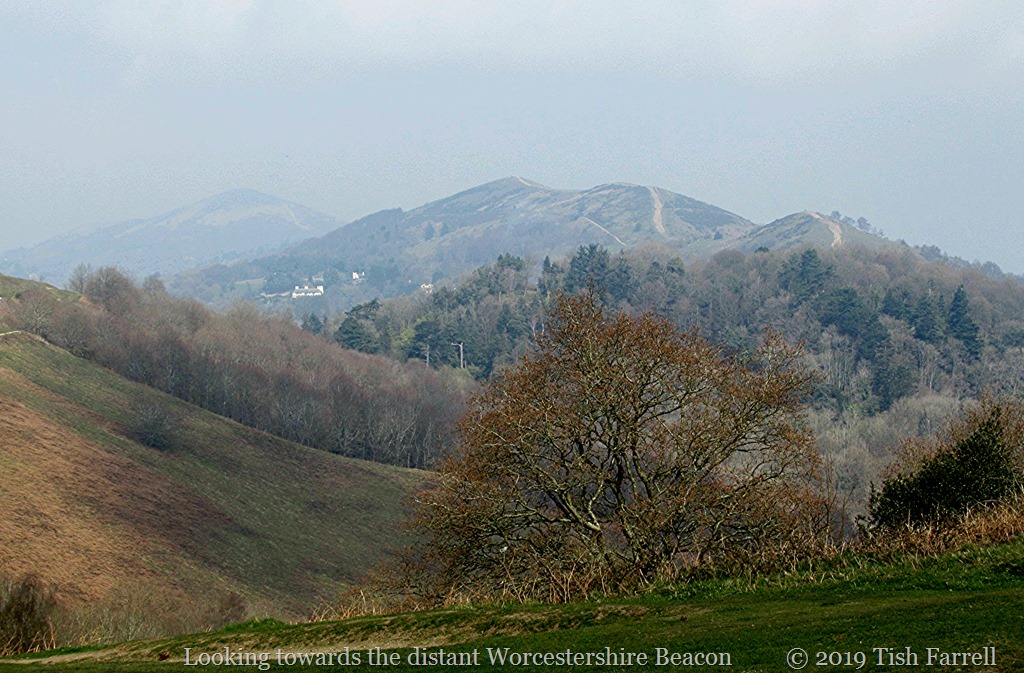
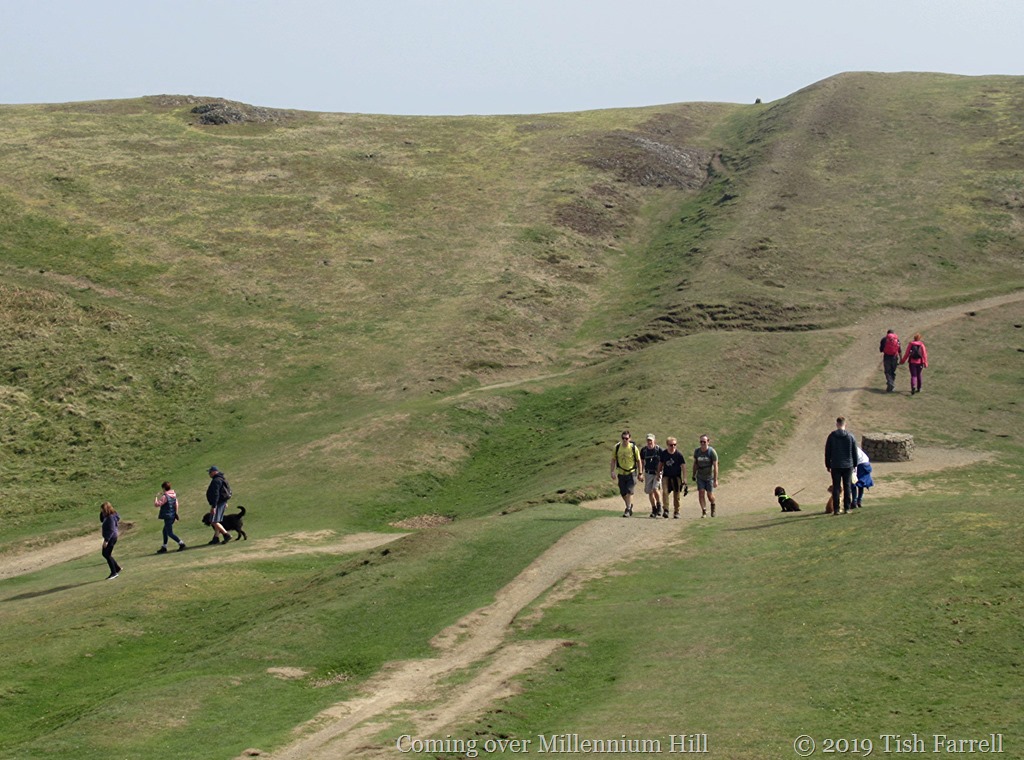
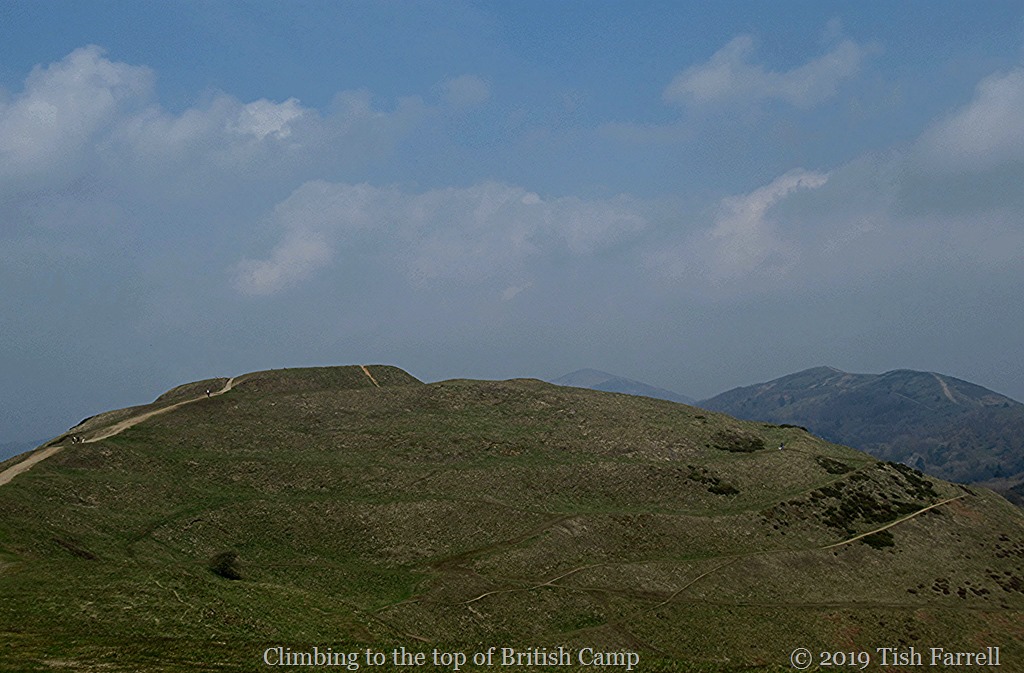
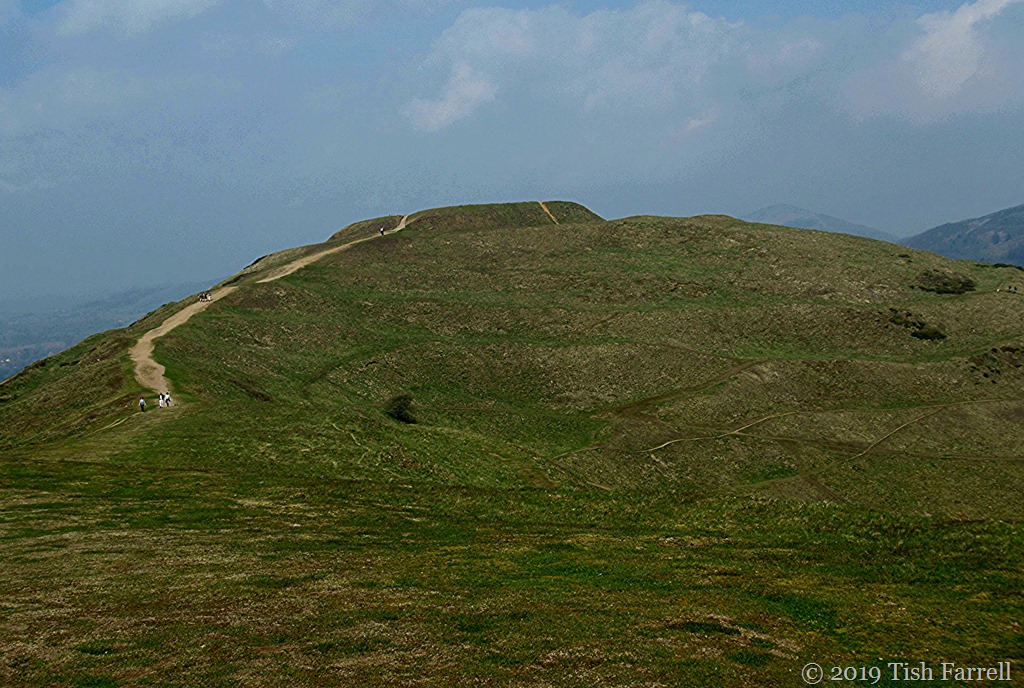
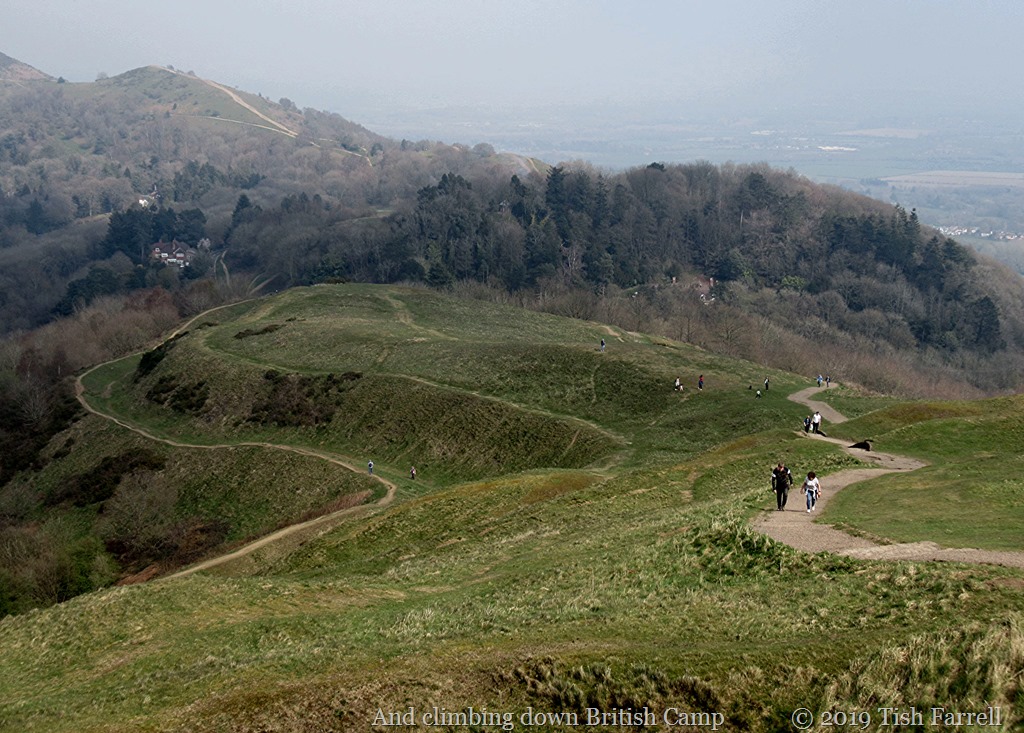
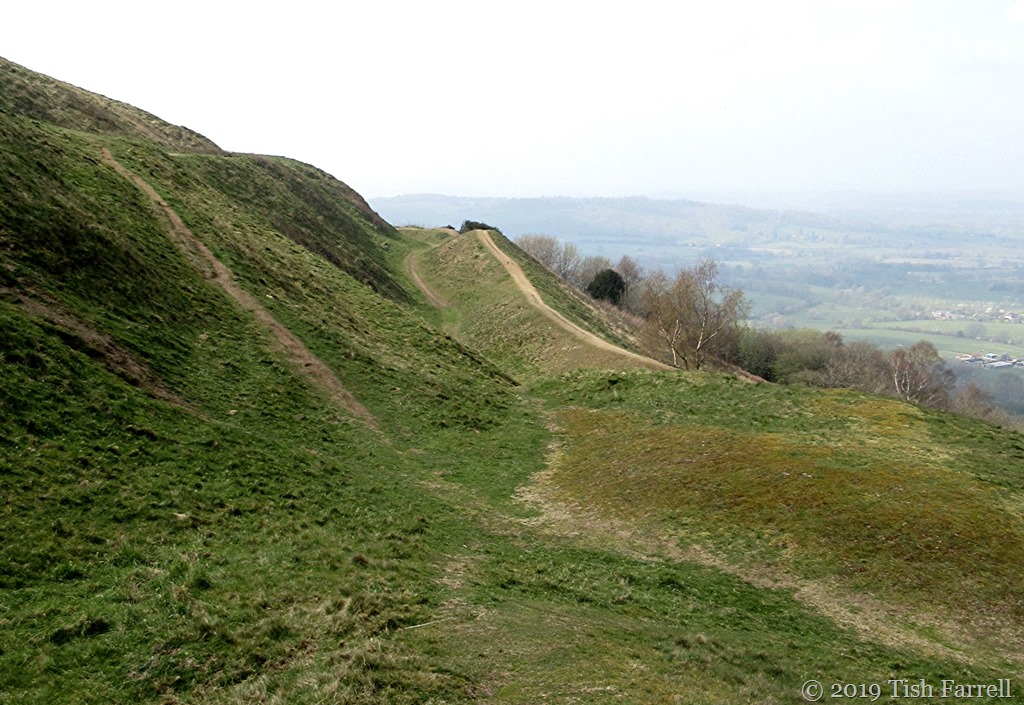
Later that morning we took to the path through Gullet Woods behind the house, climbing ever upwards on well-worn tracks to the Malvern Hills. Our objective, a mile or so along the ridgeway from Swinyard Hill (though after much upping and downing) was British Camp on the Herefordshire Beacon. This magnificent prehistoric cum early Middle Ages site, is a multi-phased hillfort begun in the Bronze Age three and half millennia ago, re-worked and massively ramparted and inhabited in the Iron Age and then, a thousand years on, adapted into a Saxon ring and bailey castle, perhaps by Earl Harold Godwinson himself (the future but short-lived king of England). Next, under Norman rule and during The Anarchy (1135-1153) of King Stephen’s reign, the motte and bailey were refortified and serially occupied by Waleran de Beaumont, 1st Earl of Worcester, and then by his brother, Robert de Beaumont, 2nd Earl of Leicester.
At its highest point British Camp stands at 1,109 feet (338 metres), and when you reach it and look out on the ridgeway tracks that snake over hill after hill you know you’ve reached the top of the world; that you’re standing on ground once walked over by prehistoric Celts, that resounded to the drumming hooves of horses as Harold and his men set off on a day’s hunting; that later rang to grim sounds of battle during The Anarchy, and finally to the shouts and hammering of determined demolition in 1155 under King Henry II.
All of which is to say my photos scarcely do British Camp justice, nor show the scale and immensity of the hand-dug Iron Age ramparts, but you can find some stunning aerial views and a detailed survey of the site HERE
A VERY BIG THANK YOU, JO AND BOB
And now for Elgar who loved and lived near these hills during different phases of his life.
If ever after I’m dead you hear someone whistling this tune on the Malvern Hills, don’t be alarmed, it’s only me.
See also Ken Russell’s marvellous, if rather dated b & w 1962 film on Elgar, Portrait of a Composer. This is the link to the first of 4 parts. Watch it, if only for the opening sequence:
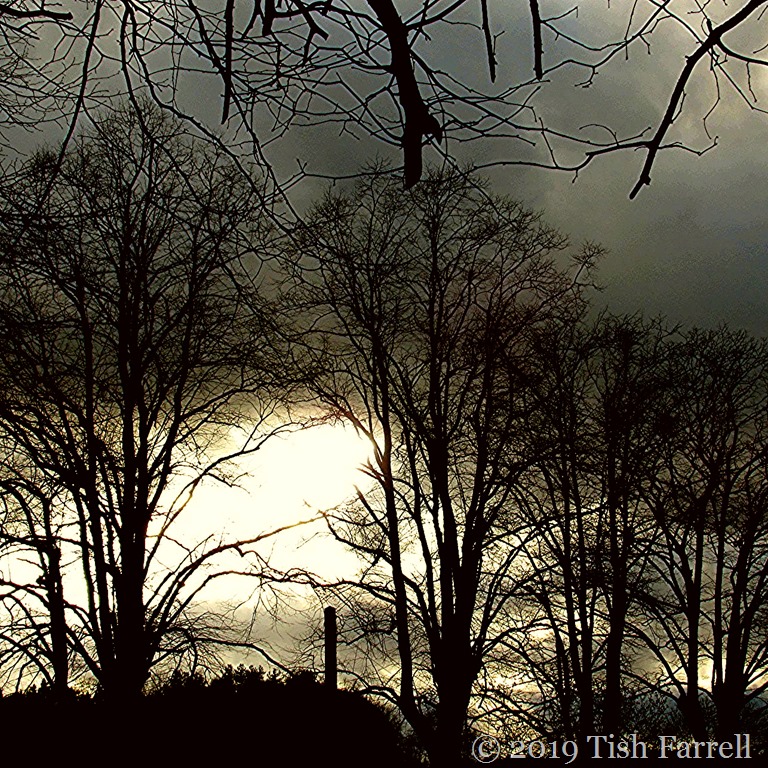
Usually when it comes to lime tree photos, I’m snapping the Linden Walk which is just a short trot from the house. But when I walked up there on Sunday afternoon the photos I took of it looked flat and gloomy. It was only as I was heading for home that there was a sudden change in the weather. Sun. Here it is shining through the lime trees that line the road beside the Linden Field. And here it is marking an end to our recent bout of storms and rain. At least for the next week or so. Time to get sowing and planting.
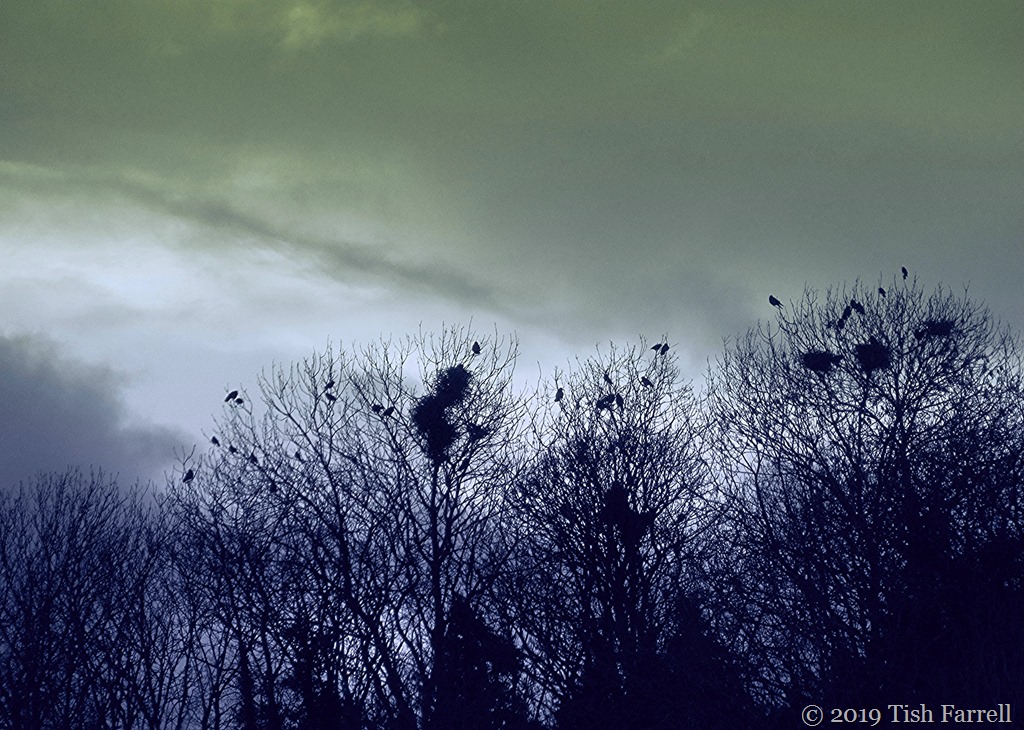
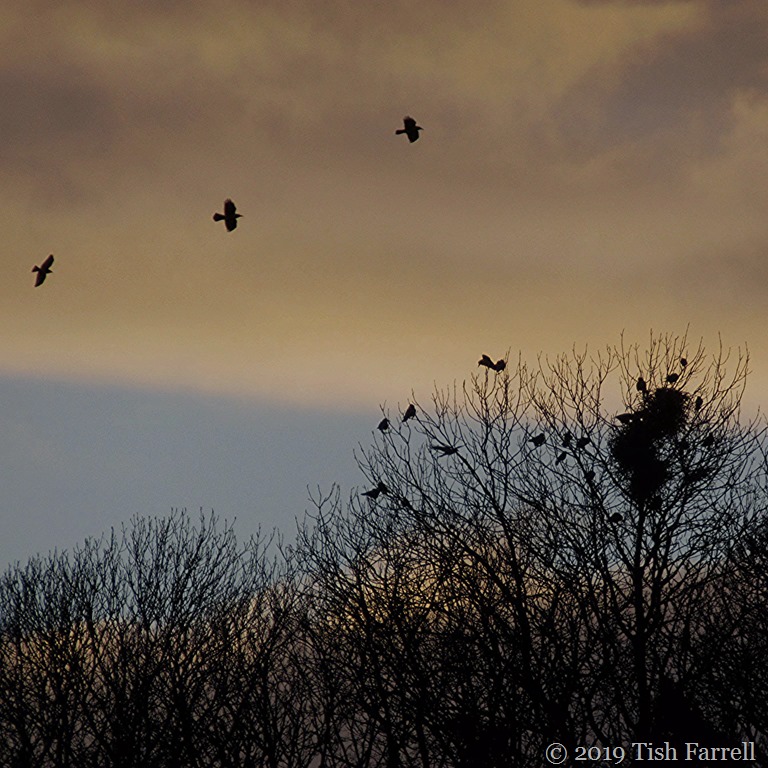
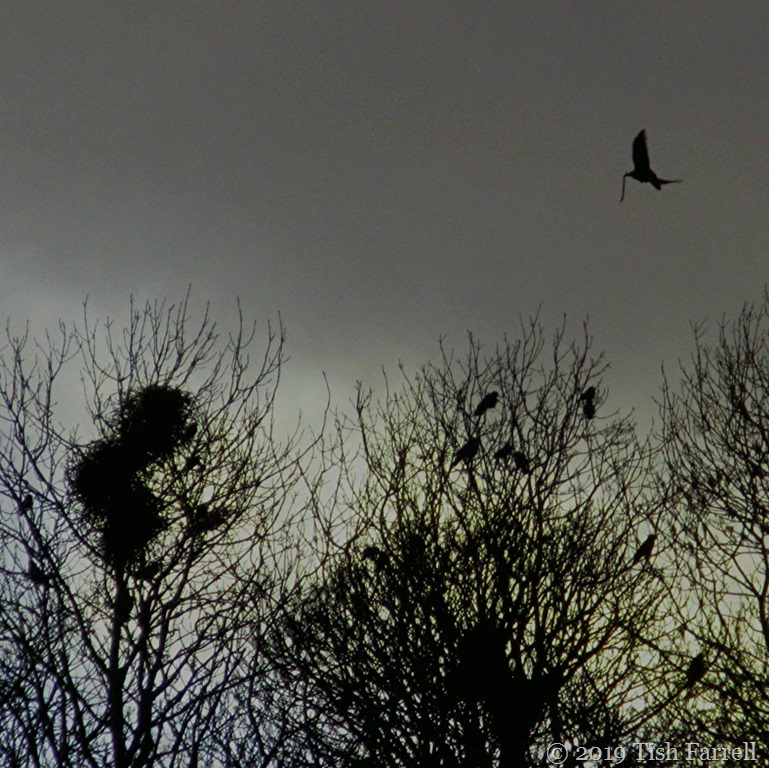
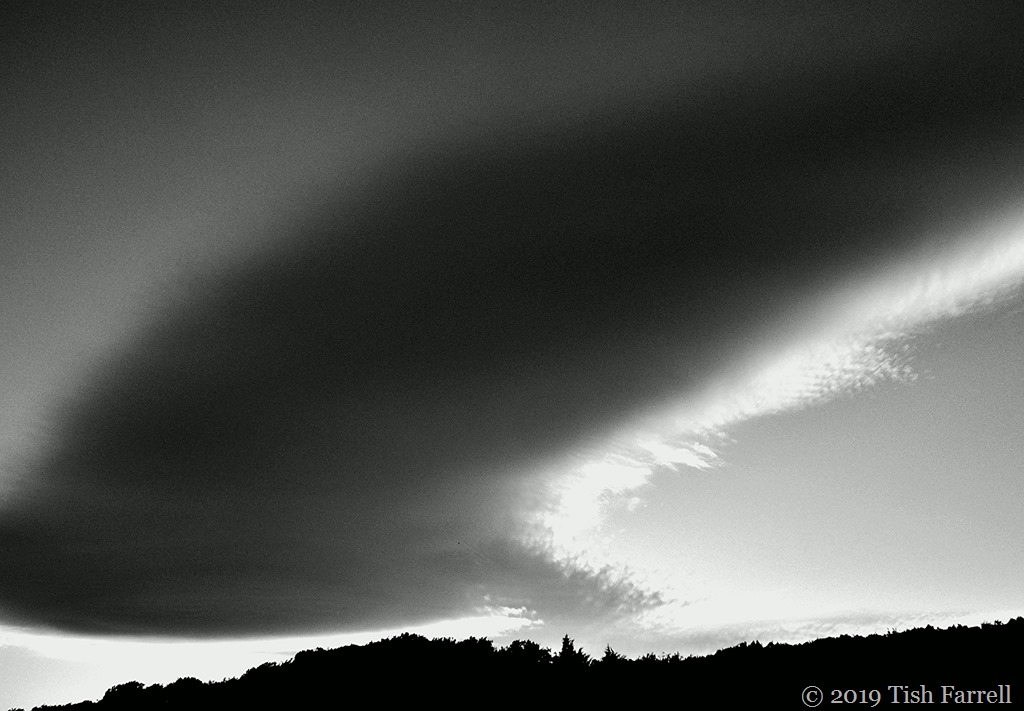
The things I do. Yesterday’s twilight with its magnificent post-storm sky had me standing on the cabin bed in my study and resting my camera on the open rooflight. If I use lots of zoom I can spy on the rooks in the wood on Sytche Lane. At this time of year there’s much to watch. For one thing they are making some serious extensions to their old nests.
For another, now is the time when the more spectacular ‘fly pasts’ begin. There seem to be two modes. The first kind involves a sudden outburst in the rookery (there are jackdaws in the wood too). For no apparent reason all the roosting birds whoosh out over the meadow, bowl around in a swirling mass and then return to the trees as if nothing had happened. The second kind is a much bigger production and usually happens around sunset or shortly afterwards. It seems to be about a gathering in of rook cohorts from the four quarters, a reconfirmation of rookery membership perhaps (?) – this after their day’s foraging around the fields.
As they return to the rookery so the aerial dance begins: sometimes high above Townsend Meadow, at others in high-speed mass swoops at ground level. It is very exhilarating. And perhaps that’s it. The display is an expression of rookish joi de vivre. And why not? If I were selling my house, I would say the view of rooks from the study rooflight is a very particular asset, though maybe not for the ornithophobic or anyone with a tendency to vertigo.
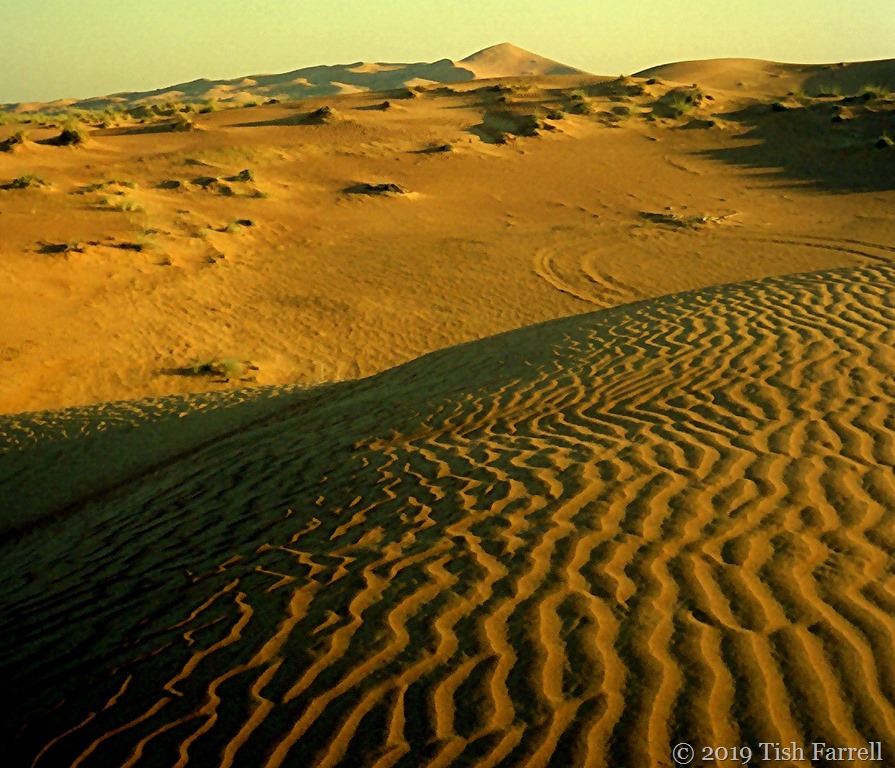
We’ve been suffering serious gales and wetness in the UK, and it’s set to persist, bluster and precipitate for several more days yet. Which has me thinking of dryness and deserts and heat and stillness and no wind. This photo was taken early one morning in the desert outside Dubai. It was around 5 a.m. and I had just given up the battle of trying to sleep in an igloo tent while close by our guide snored loudly in the open back of his 4×4. And when I walked out alone and saw all this, what could I say. Who cares about mangled limbs and a sleepless night? Why would I?
Thursday’s Special This month Paula challenges us to show her any or all of the following: inversion . circuitous . corniculate . sabulous . interstice . I’m definitely claiming the last two in this shot, and also some circuitous tyre tracks. And then there’s inversion – the up and down-ness of the dunes and sand ruts, the light versus shade, the cool of sunless valleys versus sun-warmed peaks. I suppose at a push too, you might say the distant small lumps and bumps are reminiscent of newly erupting horns?
The last day of February, and we had been promised a change in the weather, an elemental side-swipe from the Atlantic bringing an end to our surprise spring fling and our ‘nearly 10 degrees warmer than usual’. So I thought I’d better get this written yesterday as a small celebration of a final perfect day (cue Lou Reed). At lunchtime the errand of posting a letter turned into a full-scale ramble around the town. It had to be done. The sun was hot, the air still, and the lane to Downs Mill beckoned. But first there were the highland cattle to commune with, and bees and tortoiseshell butterflies in the Cutlins cherry blossom, and on the lane past the priory ruins there were sunny banks of violets and celandines, while in the parkland fields on either hand, sheep-mothers-to-be were quietly grazing, waiting for lambs to happen.
Here, then, are some scenes from my perfect Much Wenlock day. Thank you, beneficent nature entities, and especially for all those happy humming bees in the cherry tree.
*
And now for the ‘aaah’ moment:
This slideshow requires JavaScript.
P.S. The weather people were right. We woke to rain on the skylight and grey skies and February more as we know it.