A Shadowy Past

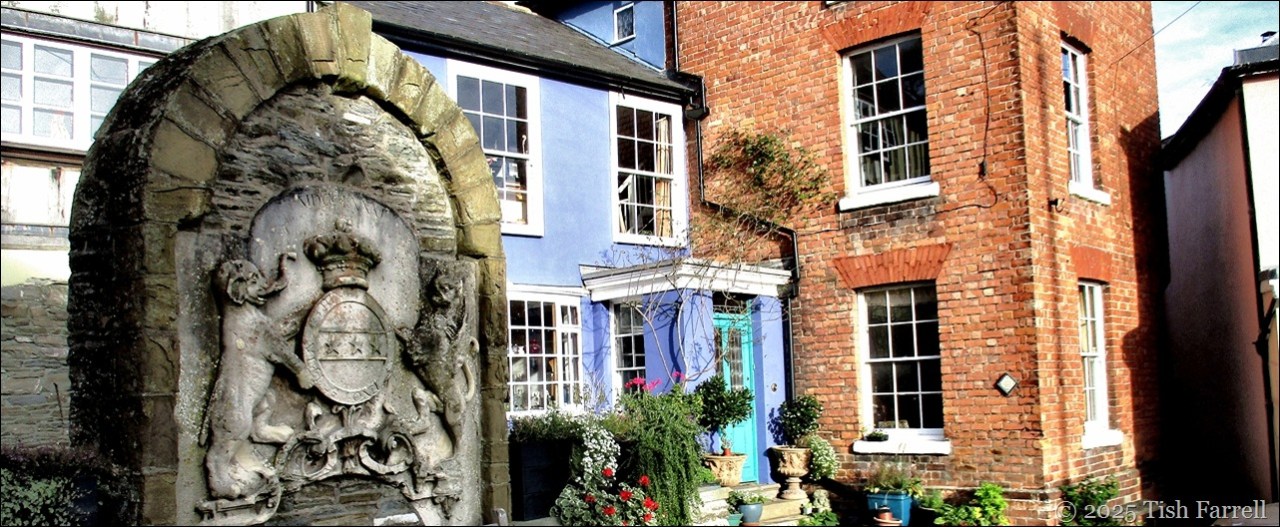
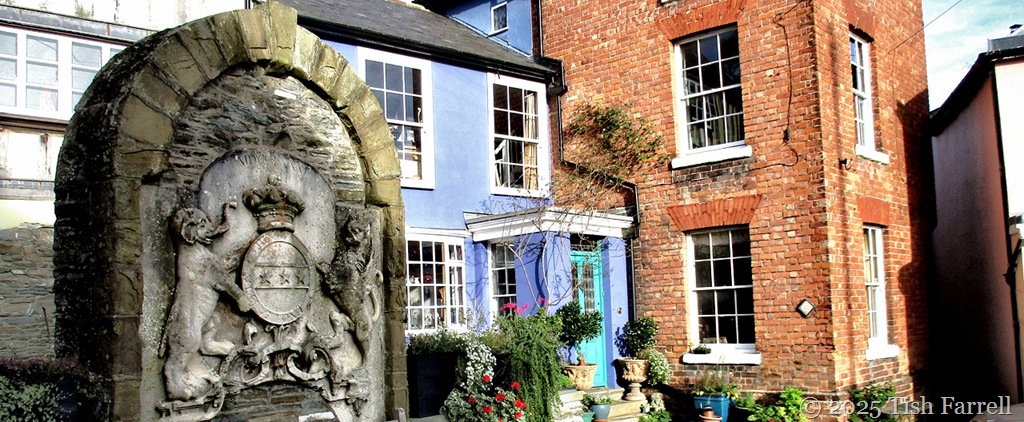
Clive coat of arms

This is a fine spot for catching one’s breath after climbing Bishop’s Castle’s steep High Street. The bench sits on the footprint of a long gone market hall, built for the town by Edward, eldest son of Robert Clive (as in Clive of India) in 1781. At this time (and until 1926) the manor of Bishop’s Castle was owned by the Clive family, and above the bench is some surviving evidence. This is the Clive family’s (acquired) coat of arms: an Indian elephant and a griffin that once adorned the market hall, and so stood above the town, proclaiming the Clive wealth and power.

top4

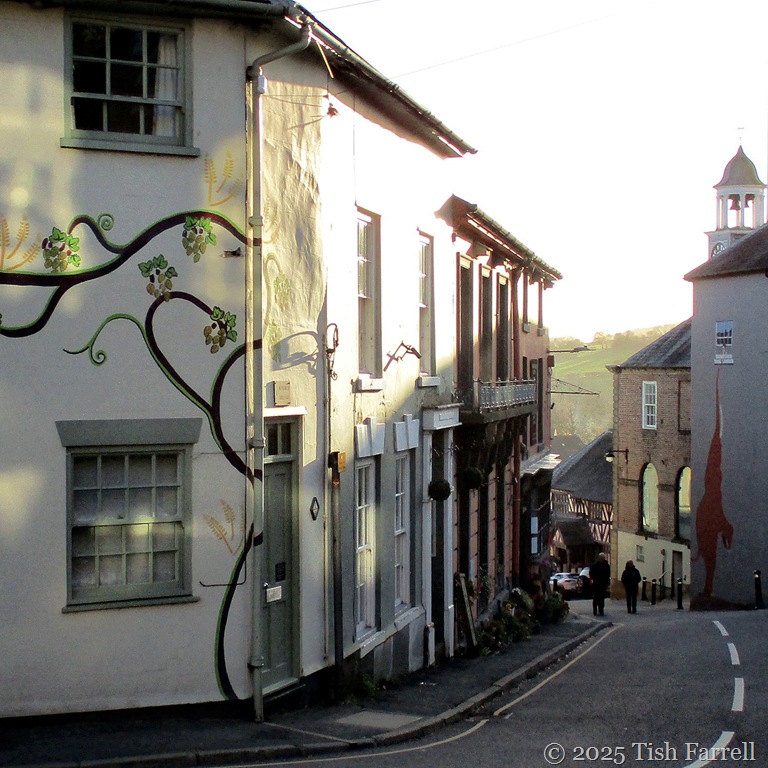
This, then,  is the view from the bench in the Market Square. (I included it the other day on our walk around the town). All very picturesque. Except, even on a bright autumn afternoon, that Clive coat of arms sheds dark shadows that still linger.

Robert Clive (1725-1774), was the pugnacious offspring of a Shropshire land-owning family. He began his meteoric career as a clerk in the East India Company Madras in 1744. Once in India, he proved an able administrator and ruthless military commander, so efficient in fact, he is credited with securing the power of the East India Company and thus the establishment of British Rule in India.

He returned to England with a vast fortune, equivalent to some 30 million pounds by today’s values. That he was the subject of a parliamentary enquiry for corruption (including examination of his punitive policies while running the East India Company) did not stop him from securing an Irish barony and buying his way into government.

He lived in Mayfair, London and owned estates in Surrey and Ireland, but bought the Shrewsbury  seat in 1761 and remained the town’s M.P. until 1774. (Shrewsbury is Shropshire’s county town and nowhere near London). He also deployed his wealth to secure the votes of Bishop’s Castle’s 150 burgesses, so ensuring that this town’s M.P. was also always a member of the Clive family fiefdom.  The town already had the reputation as a ‘rotten borough’ i.e. votes for whoever could best bribe the burgesses. Now it became a ‘Pocket Borough’ ruled by Clive friends and relations, a situation that continued until 1832 when The Electoral Reform Act ended direct representation for the town and other ‘rotten boroughs.’

It’s astonishing perhaps to think how one man’s shadow can reach so far – through time and across the world. But then what about those among us today whose material ambitions and global reach affect the lives of millions; I wonder what future historians will have to say of them.


November Squares #23

Jude’s Bench Challenge Anniversary

clive coat of arms header

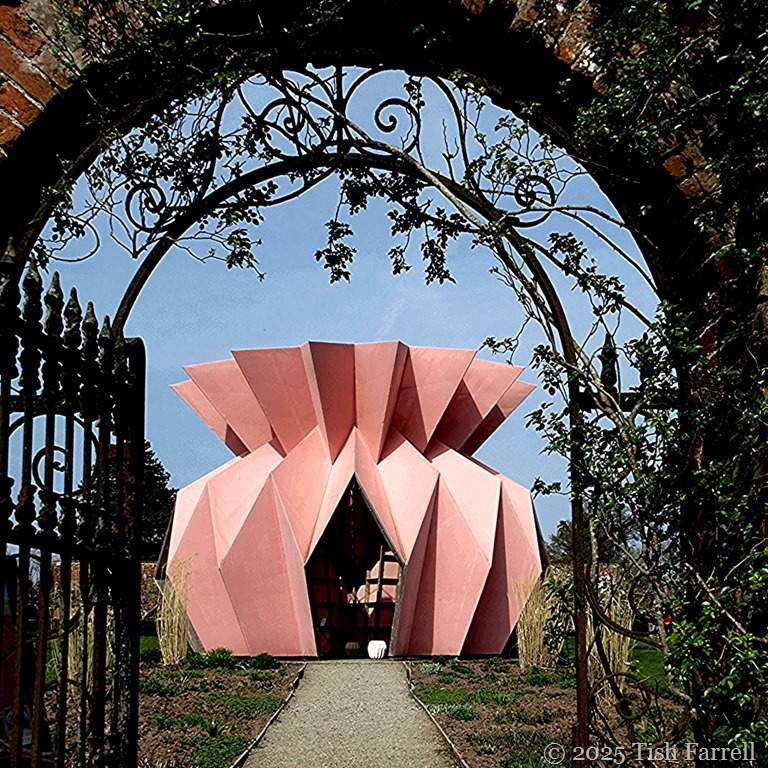
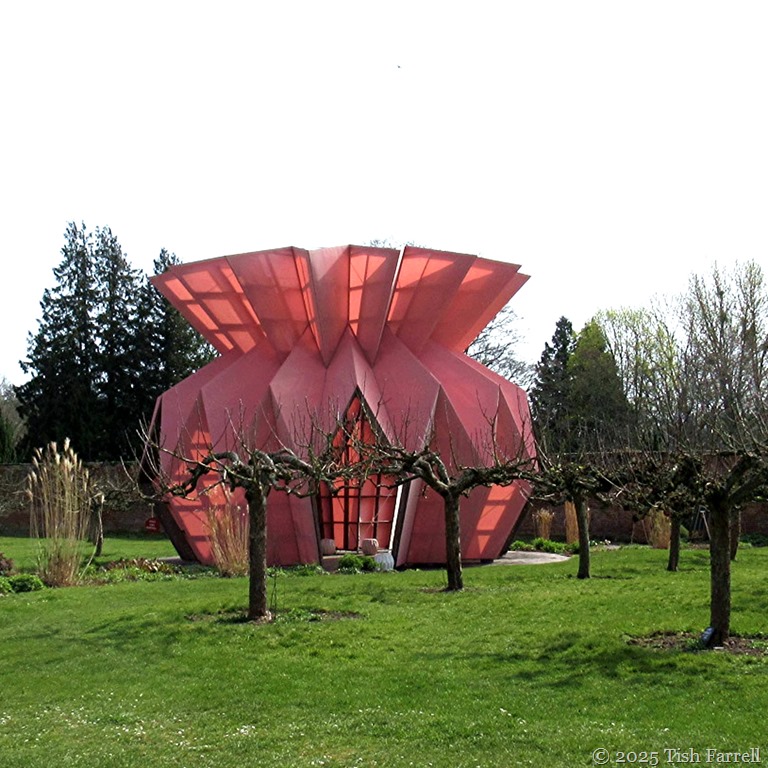
Fruitily Geometrical: The Pink Pineapple Pavilion

IMG_1328ed pineapple 2

Some of you will have seen this before, but I thought it deserved another outing; ideal for Becky’s #GeometricJanuary.

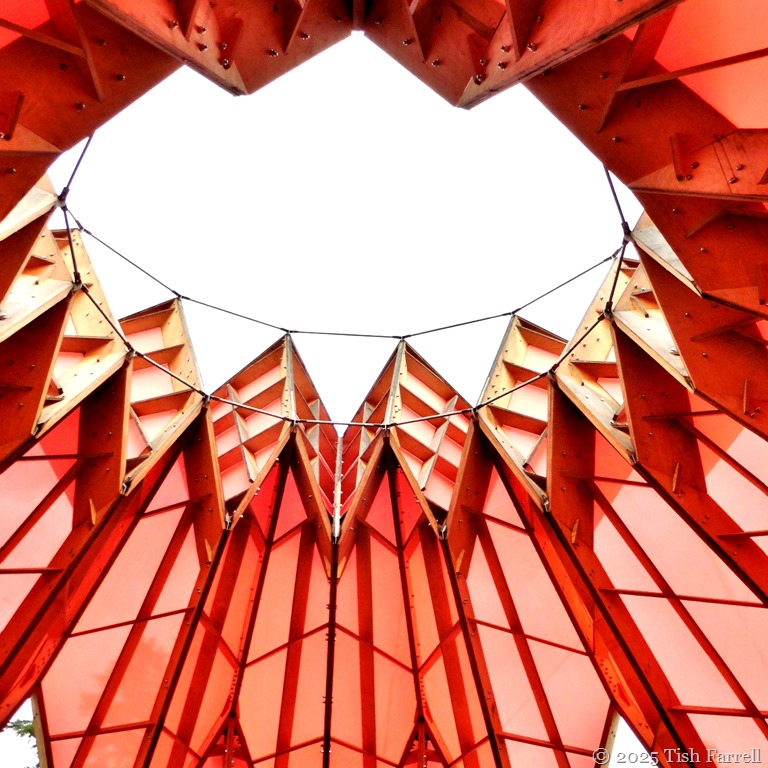
We came upon it a few years ago when visiting National Trust stately home, Berrington Hall, in Herefordshire. It is the work of installation artists Heather and Ivan Morison; their interpretation of the Georgian garden pleasure principle, which included all manner of temporary structures for dining, conducting assignations, or communing with the great outdoors. It’s called Look, Look, Look!

P1030075 sq pineapple 4

In the 18th century, Britain’s landed rich expended their often questionably-gotten gains in the creation of pleasure parks around their grand houses. These were places for promenading, a little sporting activity (fishing, sailing, archery), for re-enactments of famous naval battles (if you had your own lake); there were ‘eye-catcher’ summer houses, grottos, fake ruins, and classical temples. It was also the era of wholesale removal of villages from the sight-lines of the gentry in the ‘big house’. Garden tunnels were also dug so the horticultural workforce could go about their labours largely unseen. Above all, these gardens were ‘show off’ places, and if you wanted the best, you employed the likes of Lancelot ‘Capability’ Brown to design it.

IMG_1312 pineapple 3

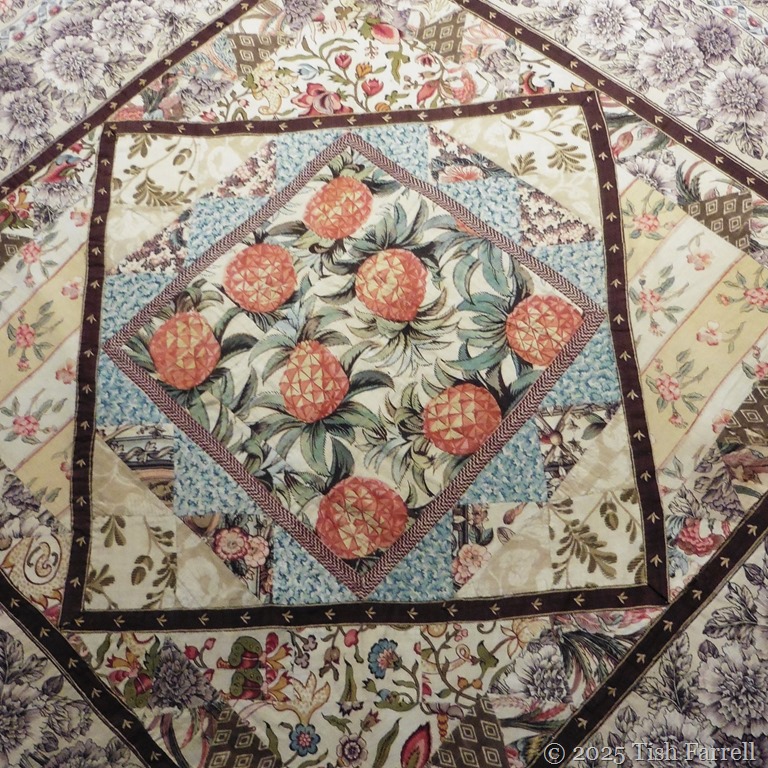
Another show-off item was exotic fruit, especially the pineapple whose possession, in the flesh, produced in your own very expensive-to-run hot house, or as architectural motifs about the house, demonstrated your wealth and prestige. At Berrington Hall there are both pineapple allusions, and  the surviving landscape contrivances of Capability Brown. The park is magnificent, and Brown’s last endeavour as a garden designer. There is currently an extensive garden restoration project which aims to recover his original groundworks.

pineapple quite

Inspired by the pineapple, detail from a Berrington Hall bed quilt

*

N.B. You can find full details of the Pink Pineapple’s construction, with architectural plans HERE.

#GeometricJanuary Day 5

Blue Waves ~ Geometrically Commemorative

IMG_1942 blue waves

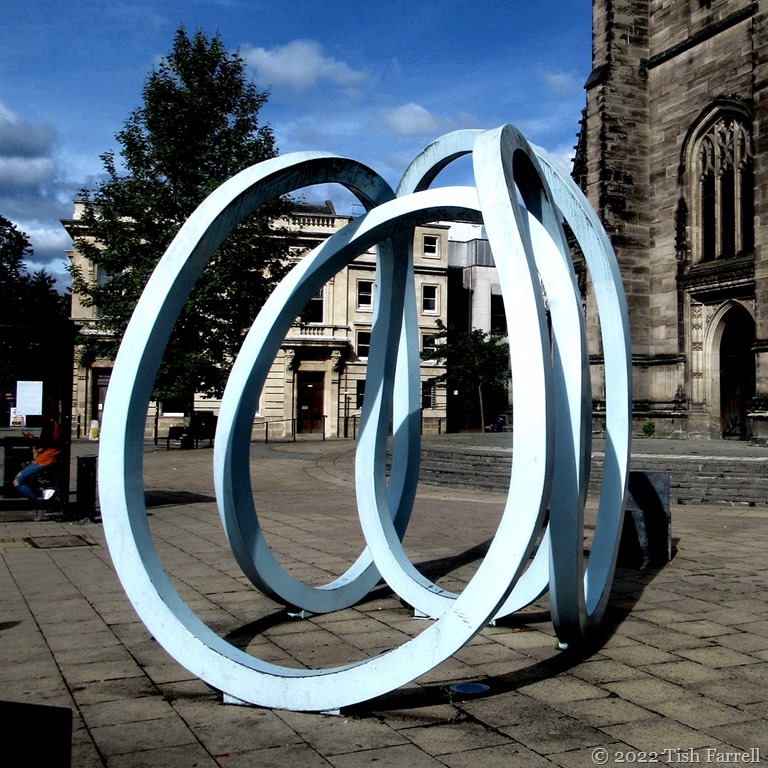
I’m all for public art enlivening urban spaces. But what does this sculpture say to you? Despite the blueness, I can’t help thinking of spaghetti, or maybe unravelled knitting, which doesn’t mean I don’t like it, though I’m thinking it might be better served in parkland surroundings.

The setting, however, is key. Bath Street (originally Bath Lane) is the place, and Blue Waves marks the source of Royal Leamington Spa’s claim to fame as a once fashionable place ‘to take the waters’.

Until 1800, the town, in its original format of Leamington Priors, was a very small village. The saline springs around the parish church had been known of for centuries, and in 1586 one Robert Camden had declared them healthful. But it was not until 1784, and the discovery of the Bath Street spring, that local worthies Messrs Abbott and Satchwell decided to exploit the resource and open the first bathhouse.

And so the village, spurred on by speculators, grew into an elegant resort with fine rows of classical town houses, parks with promenading avenues and ornate bandstands, and grand public buildings, including the Royal Pump Room And Baths and the Assembly Rooms.

All to cater for the great and the good. In fact the place was grand enough in 1838 to attract the likes of a young Queen Victoria, whose visit naturally conferred royal status on the enterprise. One wonders what was ailing her so early in her reign. The waters were said to ease stiff joints and tendons, and give relief to sufferers of rheumatism and gout. But perhaps it was the all round social whirl of the spa town that attracted her. She came again twenty years later.

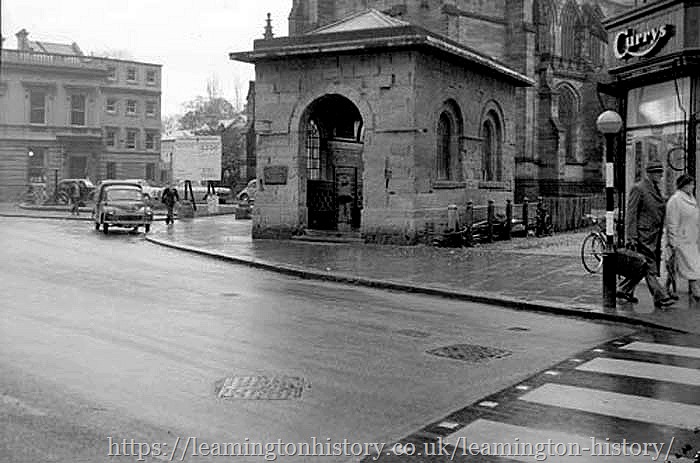
The local people, though, were not forgotten. The spot where Blue Waves is sited seems to roughly match the footprint of the first public well-house which was opened, also in classical style, in 1803, and known as Aylesford’s Well. Here’s a photo of it in the 1950s from Leamington Spa’s History Society website:

https://leamingtonhistory.co.uk/leamington-history/

aylesford-well, Leamington Spa

#GeometricJanuary 

Join Becky for a month of squares. Geometry is the theme and the header photo  must be square in format.

From The Grave Of The Good Burgess ~ Speaking Truth To Power

IMG_3897cr

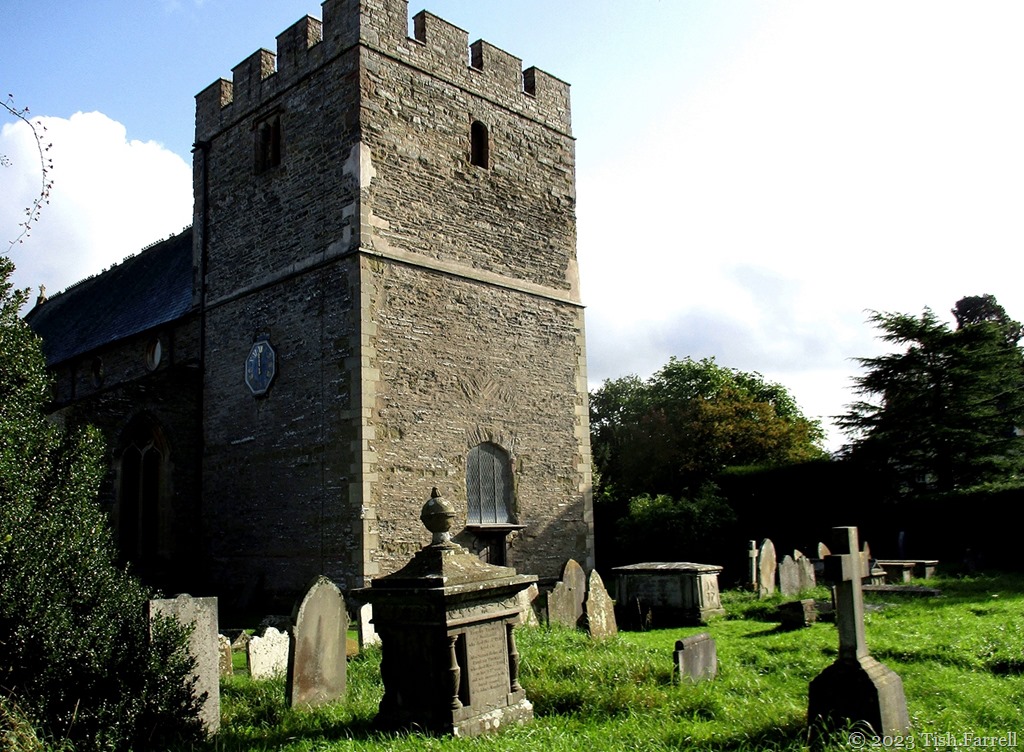
My last post featured a recent visit to Bishop’s Castle’s parish churchyard and the mystery surrounding the grave of an unnamed African who died in the town in September 1801. This week I returned to the visit another intriguing grave. It stands in sight of the great Norman tower of 1291, and marks a death that occurred in May 1802, a few months after I.D.’s burial, and also the year of a general election.

And what an epitaph it is. What a swingeing ticking off of the town’s ‘worthies’; very much in the vein of ‘you know who you are’.  (And doubtless everyone else in the town knew too).

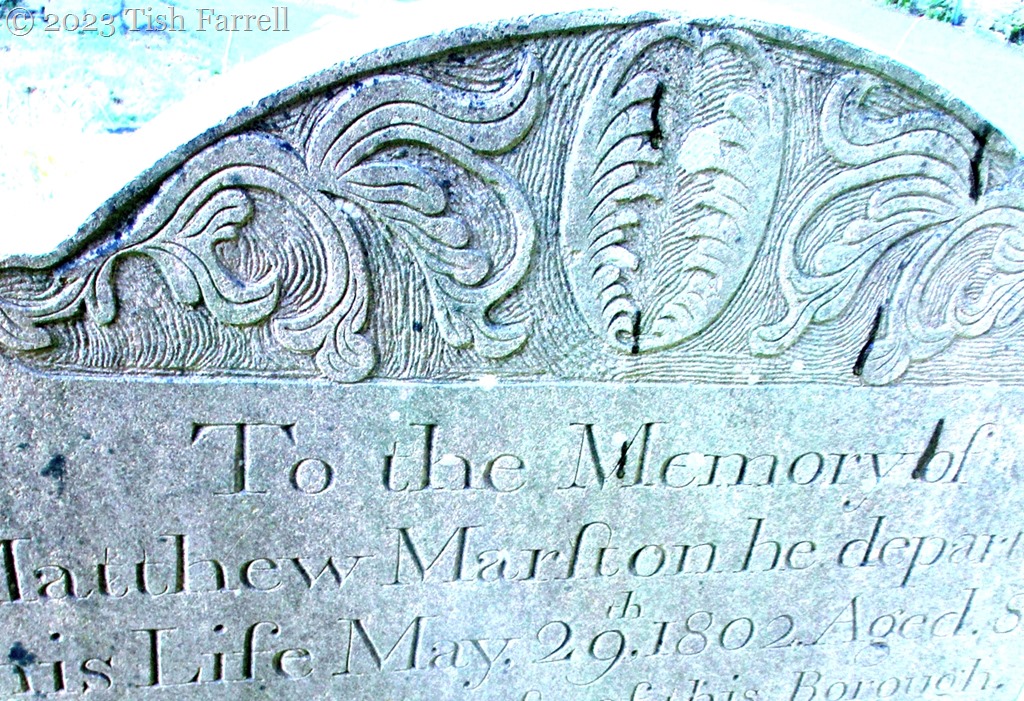
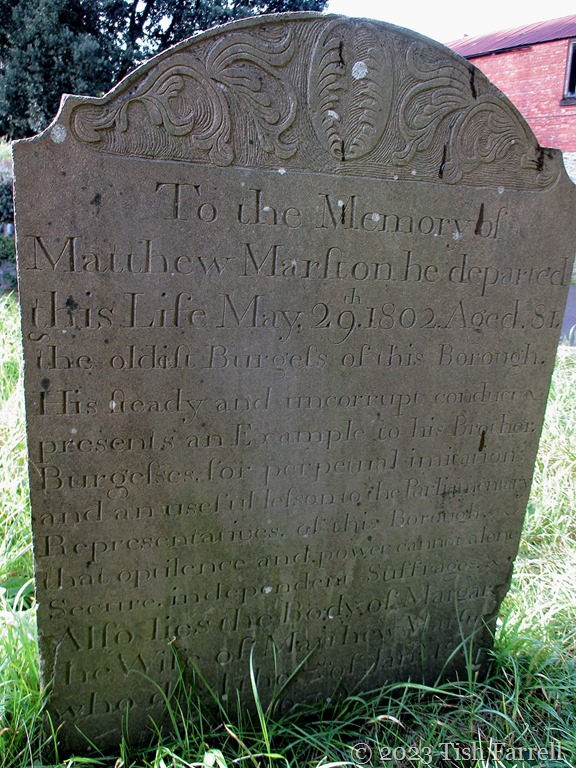
Here’s what the headstone says:

To the memory of Matthew Marston. He departed this life May 29th 1802 aged 81, the oldest Burgess of the Borough.

His steady and uncorrupt conduct presents an examples to his brother Burgesses for perpetual imitation and a useful lesson to the Parliamentary Representatives of the Borough that Opulence and Power cannot alone secure universal suffrage.

*

IMG_3903ed

*

And to what particular corrupt practice is the Marston stone referring?

Bribes for votes, that’s what, and the fact the town’s burgesses controlled the electoral roll. Only they could vote in elections, and only they had the power to admit new burgesses to the roll. And these were the men who managed all aspects of the town’s affairs, from market trading to judicial and coroner’s courts.

In 1802, when there were around 170 burgesses on the roll, the going rate for a vote was 25 guineas – well over a thousand pounds by today’s values, and enough then to buy 2 horses or 5 cows or employ a skilled tradesman for 173 days (National Archives currency converter).

For a small rural town, Bishop’s Castle seems to have earned itself a big reputation for shady political dealings: a ‘rotten borough’ from 1690-1763, and a ‘pocket borough’ from 1763 – 1832. During these years the town returned two parliamentary representatives, all members of the landowning class, or in the case of the pocket borough, all relatives or favoured associates of Robert Clive. (He had returned from India, where he had risen from lowly agent in the East India Company to Governor of the Bengal Presidency, amassing a fortune equivalent to 48 million pounds). Only with the Reform Act of 1832, did the parliamentary borough of Bishop’s Castle meet its end. We now have 5 regional county representatives.

During the rotten and pocket eras, parliamentary representatives were obviously intent only on furthering their own and sponsors’ interests and causes. This situation was compounded by the fact that several times the entire manor of Bishop’s Castle changed hands with the new owners seeking to secure a seat for their own man. In 1683 it featured in a marriage settlement between one Anne Mason and the Earl of Macclesfield. It was Anne’s ne’er-do-well cousin Richard Mason, seemingly the Earl’s ‘placeman’, who then bribed and bullied his way to Parliament, standing as M.P. for 30 years.

In 1718 the new Bishop’s Castle owners, the Harleys, appalled that their own candidate had failed to win a seat, roundly condemned the town’s burgesses (‘profligate wretches’) for their ‘villainous roguery’ and ‘perfidy’ in voting for Mason. They sold the manor on to the Earl of Carnarvon (Duke of Chandos)  who then, after considerable expense, secured his own placeman at the next by-election. His purposes doubtless served, he then sold the manor to his nephew, local landowner, John Walcot of Walcot Hall, who then found the means to further his interests through favoured candidates.  And so it went on. On and on.

But what of Bishop‘s Castle’s ordinary folk? Over all these centuries of political vested-interest, one might well wonder how did life go for the ploughman, dairymaid, tavern keeper, clerk, cowhand and stonemason, or for the cooper, brewer, carpenter, apothecary, farmwife, cook, curate and chamber maid? How indeed?

You can well see that the Marston family had a point when they erected this headstone to their kinsman, the good burgess: a lone voice of integrity?

IMG_3900ed

previous post The Man from Africa: I.D. unknown

source: The Story of Bishop’s Castle eds David Preshous, George Baugh, John Leonard, Gavin Watson, Andrew Wigley  2018 Logaston Press


And We Think Our Weather Is Chaotic, But What About 1821-22?

P1030781

Last night in Wenlock it was all howling wind and battering raindrops on the roof lights. Then this morning the gusts were positively whistling through the tiniest gap in the closed bathroom window. Shivery indeed. Yet the onset of this 40 mile per hour small gale was yesterday described by the weatherfolk  as ‘brisk’. A bit of an understatement methinks. But however one describes it, this current bout of wild and changeable weather now makes the week of lunch-in-the-garden back in March seem a long time ago. (Did it even happen?) And on top of that, it’s definitely curtailing gardening pursuits.

On the other hand, being confined indoors yesterday led to an interesting internet discovery of a wild-weather nature, this courtesy of the very fabulous Derbyshire Record Office which holds archive riches relating to Arctic explorer Sir John Franklin, he whose 1845 expedition to chart the Northwest Passage, tragically foundered in the ice. Among the treasure trove of documents listed in the archive is the transcription of an 1822 letter written in the May of that year by Franklin’s first wife, poet Eleanor Anne Porden. Franklin is away in the Arctic while Eleanor is writing from London, and filling him in on the dramatic events of England’s weather during 1821-1822.

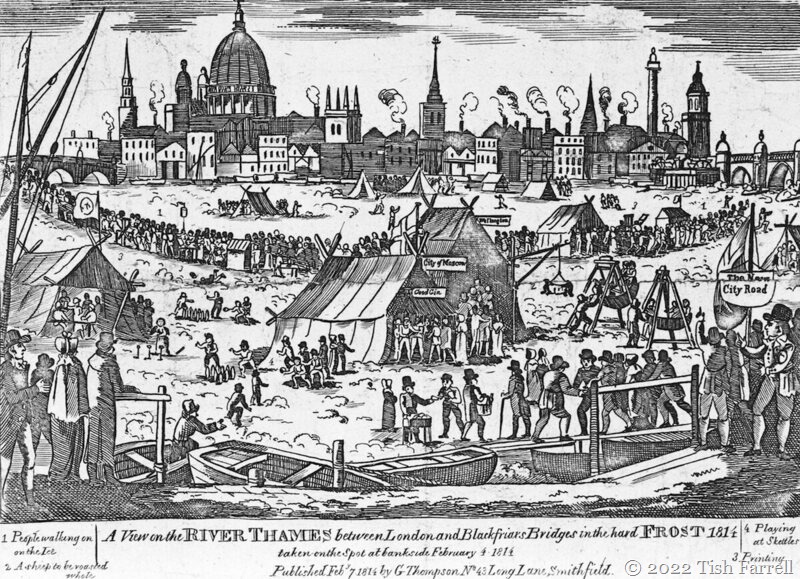
For someone who is used to forever hearing how our weather is set to become ever more chaotic, I found it fascinating to learn how very chaotic it already was in 1821 when Britain was emerging from the Little Ice Age (c. medieval period – 1850). Eleanor’s letter in fact makes reference to the last of the Thames’ Frost Fairs held in 1814.

A view of the river Thames: 1814

The Last Frost Fair of 1814 copyright Museum of London

Between 1600 and 1814 the Thames would freeze for up to 2 months creating an astonishing  venue for all manner of events and entertainment.

*

But first she broaches the weather topic by telling John Franklin that though matters may be peaceable in other domains, ‘the elements are in sad confusion.’

She goes on to say:

I should think that the mean temperature of last year was pretty nearly what it ought to be, but the seasons were all mixed together, and not well mixed neither; we had neither Spring nor Autumn, Winter nor Summer. Only two nights greeted us with the agreeable novelty of a frost, and the consequence was that a friend of ours saw the armies of two rival confectioners fighting for the thin cake of ice on a pond behind his house. As for snow, I think you had best bring a little home in a bottle, to shew as a curiosity to those who may have forgotten its colour.

Then she moves on to the storms ‘such as I never remember’ following one after another for three months:

Trees were torn up, and houses blown down, and from the coasts the accounts were dreadful- three Indiamen* were lost in sight of land.

* ships of the British East India Company

Next came the Christmas Thames’ floods in London’s Westminster and Vauxhall

forcing numbers of inhabitants to take refuge in the upper rooms of their houses, till they could be carried away in boats. At Staines it is said that the water was rushing in torrents through every house, and parts of Windsor were in similar condition.

She quips that people who usually travelled up to London for the Christmas season had abandoned their plans, not wishing to embark on a sea voyage in order to achieve that objective.

And then follows an account of the most bizarre event of all:

To complete my catalogue of marvels, in less than three months after, a strong south wind so drove back the waters of the Thames, that aided by a neap tide the channel was left nearly dry, and it was crost on foot between London and Blackfriars bridges, almost in the spot where an ox had been roasted whole on the ice just 8 years before…I understand that the tide afterwards flowed with unusual force for 3 days, and it has been thought that the extraordinary shape of the river must have been connected with some volcanic phenomenon.

And finally she concludes with mention of London’s May weather:

this week we were shivering over a fire, and now the thermometer is at 81⁰ in the shade.

You can read the whole lively letter HERE

Meanwhile, planting still curtailed, I shall cultivate a state of reduced grumpiness about Shropshire’s changeable elements. I am anyway much amused by Eleanor’s suggestion that Sir John Franklin should return home with a bottle of snow to remind the general populace what this unfamiliar substance looks like. The more things change, eh…

Odd Moment With A Sheep And Old Tales Of Dodgy Deals

P1060951cr

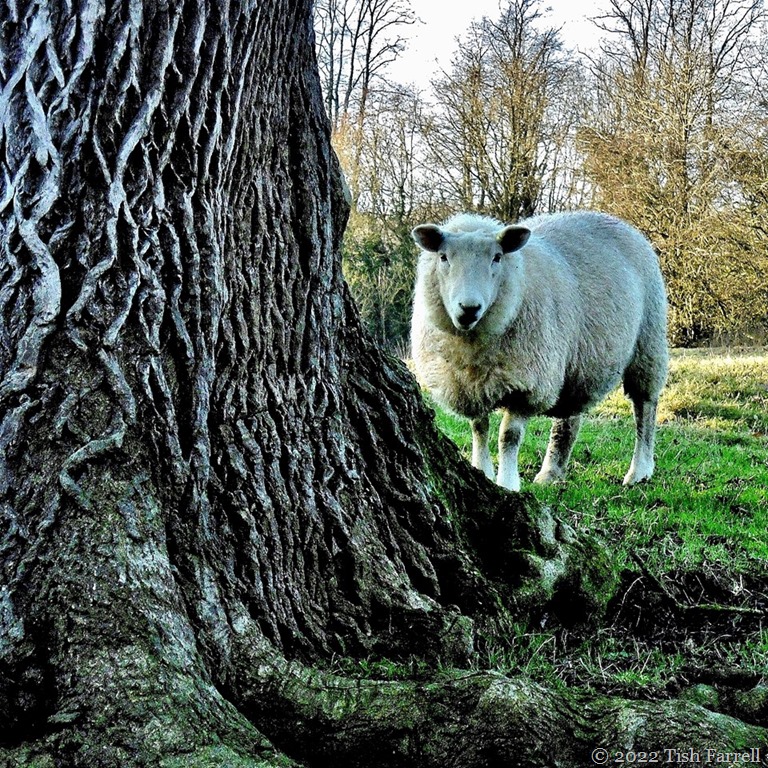
I don’t know about you, but I feel quite uncomfortable being so closely scrutinized by a member of the ovine tribe. It happens now and then as I tramp the lanes and byways of Much Wenlock.

This one was in the field opposite Wenlock Priory ruins, which interestingly had much to do with sheep rearing in the early Middle Ages. In fact the sale of wool from its flocks was an important source of the Priory’s wealth. And so you may imagine the brotherly fury (even to the point of murderous intent) that was roused  when, in the late 1200s, the then Prior, John de Tycford, engaged in some dirty dabbling in the futures market and sold 7 years’ wool crop in advance and then kept the proceeds.

One monk, William de Broseley was so incensed, he left the Priory and gathered a gang in the woods, all set to ambush and kill the Prior. News of this plan did not go down well with the higher authorities, who instructed sheriffs to arrest ‘vagabond monks of the Cluniac order.’ William was duly captured and received his just deserts (not defined by chroniclers, but doubtless deeply unpleasant).

Meanwhile the Prior, who also went in for monastic asset stripping as well as having a history of fraternizing with money-lenders, had friends in a very high place: first King Henry III and then his successor-son, Edward Longshanks, aka Edward I. De Tycford, it seems, was good at political intrigue and had been royally employed on a  diplomatic mission to nearby troublesome Wales. It did not seem to matter that he had run the Priory into debt. When he left Much Wenlock in 1285 it was to take up an appointment  as Prior of Lewes in Sussex, not only another grand Cluniac house, but also a politically sensitive location. The army of Henry III had retreated into the Priory in 1264 during the barons uprising led by Simon de Monfort. This had caused serious division between the monks, many of whom were later punished or banished back to France.

And so it goes. It’s how the world runs. Power and money control ALL aspects of our lives, although we’re mostly too distracted to see how deep and wide this goes. Perhaps the sheep is trying to tell me something. Perhaps I ought to tell it: I am not a sheep.

The Square Odds #15

Out Of The Archive: A Favourite Piece Of Historical Sleuthing

100_1225 - palace massena

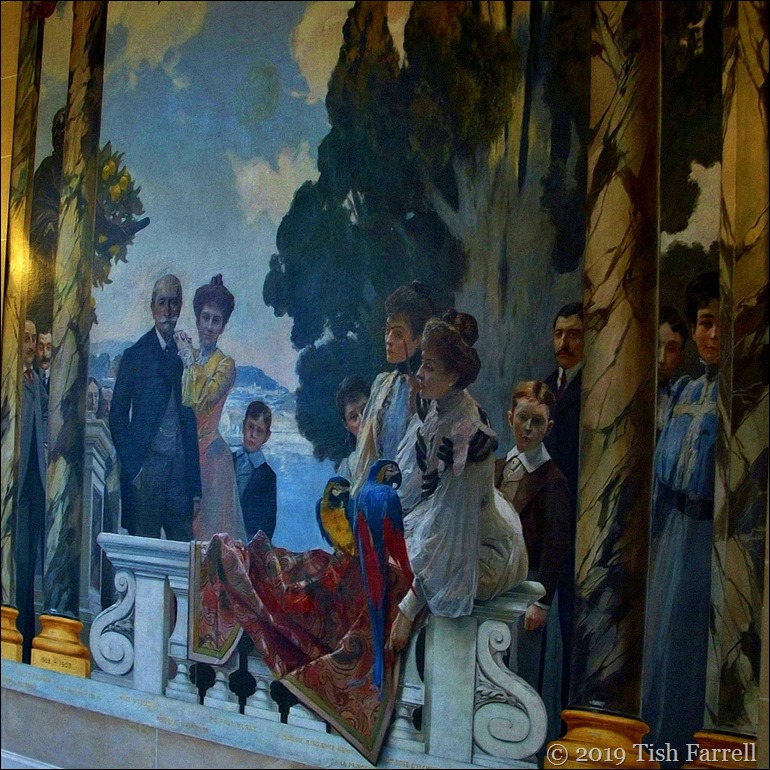
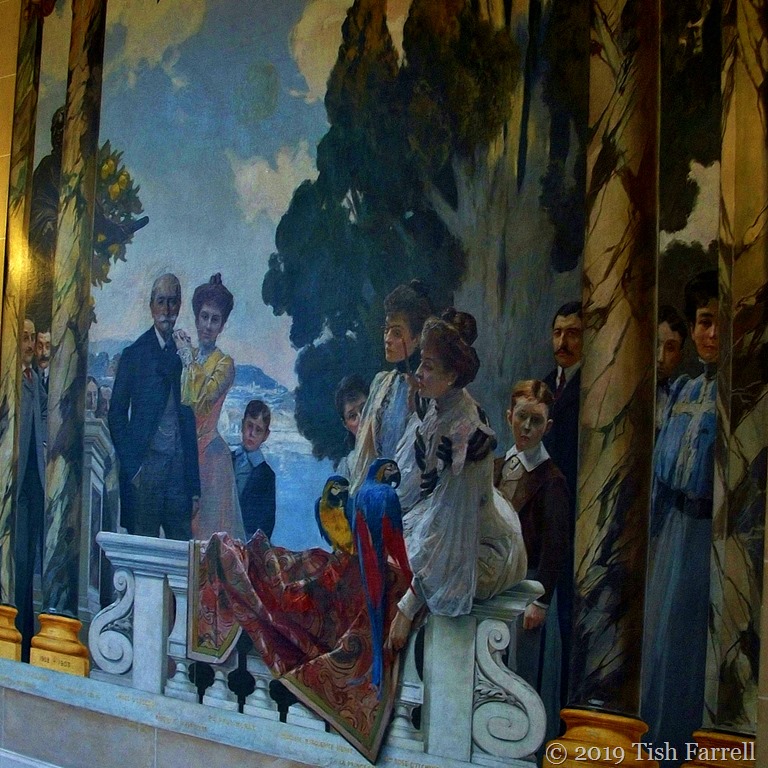
The family who lived in the Palais de Masena

Believe me, the family gathering depicted in these two murals has more tales to tell than most. They could be the very depiction of Tolstoy’s famous opening to the tragic novel Anna Karenina: (And I paraphrase) all happy families look alike, but the unhappy ones are unhappy in their own inimitable way.

The original post Nice Family? En famille at the Massena Palace continues HERE

*

So what spurred me to discover more about these set-piece murals wherein members of an elite Nice family gaze at one another across a palace staircase? Silly question really. It was the mysteries that cropped up – once I paid them closer attention.

For instance why has the blue-bloused woman of the second mural adopted such a vulgarly aggressive stance when the keys hanging from her waist suggest she is mistress of the house, the chatelaine? And who is the droopy waif leaning on her shoulder?And why are so many people lurking, or peering between marble columns. And who is the lovely woman with the macaws and exotic tapestry; is the blue-bloused woman’s look of contempt from across the stairwell meant for her? But most of all, one has to wonder why this family would commission well known French artist François Flameng to show them in this way? Was he having a joke at their considerable expense?

The proposed explanations are in the original post so I won’t repeat them here. But I will tell you that the family members are all descended through intermarriage from three ordinary men, plain soldiers, Masséna, Murat and Ney who through courageous acts rose to prominence in Bonaparte’s army, were appointed Marshals of Empire and thereafter acquired all manner of riches and other grandiose titles.

But the reason this archive post is one is one of my favourites is because the sleuthing involved was so fascinating. I was astonished at how much could be gleaned from a few hours trawling the internet. It seemed like magic – lead after lead revealing a few more snippets about a world distant from me in time and space. And I thought then – this is the world wide web at its best; this is what its creator intended: to share knowledge and information; to open minds and eyes; to enthrall, educate and entertain in positive ways. It could still be like that, couldn’t it…I mean without the hate and fakery?

July Squares #19

The Derbyshire Gate Post Mystery Explained?

P1080981

P1080294

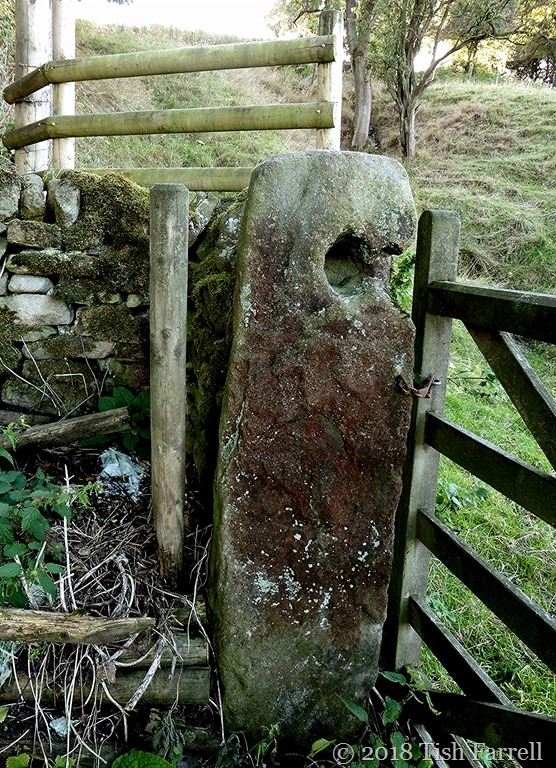
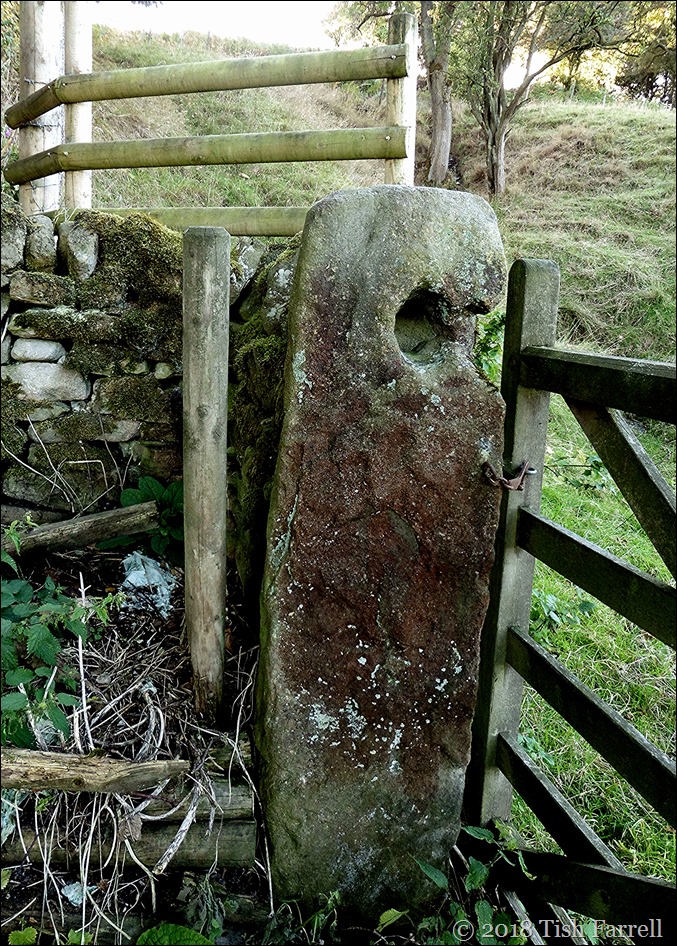
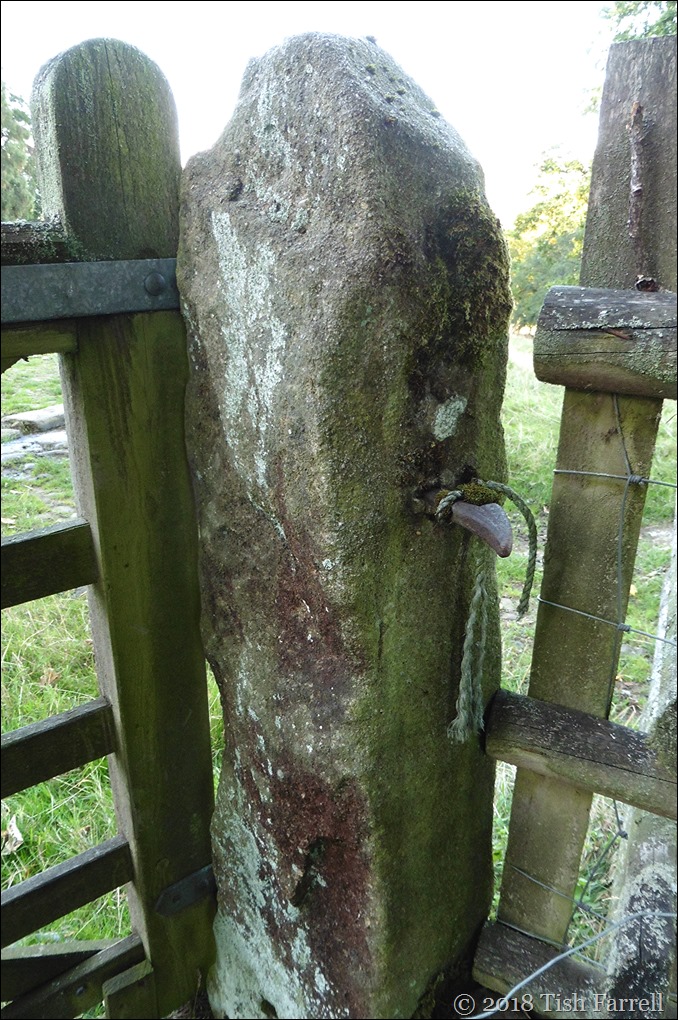
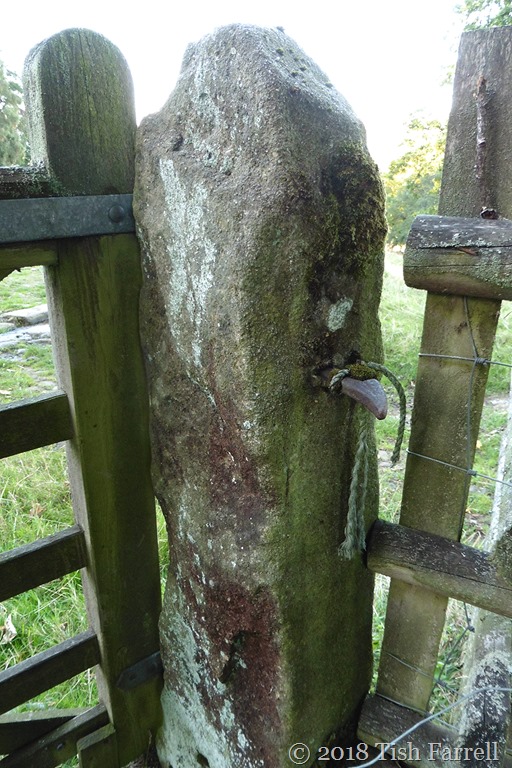
In the last post I queried the large perforations to be found in the tops of some Derbyshire stone gate posts or stoops. I thought they made handy viewfinders, but could find no other explanation. Then I found some more photos I’d taken at Callow Farm. These are a pair – one with a partial orifice, the other without.

And it’s at this point things may become as clear as Derbyshire mud. But I have found an explanation. The only problem is I don’t wholly understand it.

It comes from a worthy volume published in 1813 and available for free from Google. (How I hate it that they have laid claim to all the old books in the universe, but how I love being able to access such works without leaving my desk, this despite the fact that much of the scanning is often execrable.)

The book in question is volume 2 of General View of the Agriculture of Derbyshire by John Farey senior, Mineral Surveyor of Upper Crown Street, Westminster. This is what he says. I’ve increased the font in hopes comprehension might strike:

Anciently, the Gates in the Peak Hundreds were formed and hung without any iron-work, even nails, as I have been told; and some yet remain in Birchover and other places, where no iron-work is used in the hanging: a large mortise-hole is made thro’ the hanging-post, perpendicular to the plane of the Gate, at about four feet and a half high, into which a stout piece of wood is firmly wedged, and projects about twelve inches before the Post; and in this piece of wood, two augur holes are made, to receive the two ends of a tough piece of green Ash or Sallow, which loosely embraces the top of the head of the Gate (formed to a round), in the bow so formed : the bottom of the head of the Gate is formed to a blunt point, which works in a hole made in a stone, set fast in the ground, close to the face of the Post. It is easy to see, by the mortise-holes in all old Gate-Stoops, that this mode of hanging Gates was once general.

From this it seems clear that any iron hinges and latches were later additions to such old stoops. John Farey goes on to praise this kind of improvement:

A great contrast to these rude Gates, is exhibited, on the Farm of Mr. Thomas Harvey of Hoon Hay, who has four sets of hooks and catches, all adjustible by nuts and screws, fixed in his Gate-Posts, which are very stout, in the line of a private and bridle Road thro’ his Farm ; so that from whichever quarter the wind may come, in blowing weather, the Gates can readily be shifted, so as to be shut too by the wind, instead of being forced open thereby : there is also a screw for adjusting the top thimbles of these Gates, for making them shut more perfectly.

So there we have it – a loopy length of ash or willow used to do the job of a gate, though I still can’t quite picture it. But then instead of wondering about that, I found myself distracted by Mr. Farey’s genuine enthusiasm for more efficient gatery with all its iron trappings.

In this modern era we all assume a well functioning gate is a good thing – guarding property, keeping out vagrants and cold callers. But this notion of privately controlled land is fairly new. And to my mind it has had every one of us hoodwinked. Simon Fairlie puts it succinctly at the start of his very enlightening essay A Short History of Enclosure in Britain  from The Land magazine:

Over the course of a few hundred years, much of Britain’s land has been privatized — that is to say taken out of some form of collective ownership and management and handed over to individuals. Currently, in our “property-owning democracy”, nearly half the country is owned by 40,000 land millionaires, or 0.06 per cent of the population, while most of the rest of us spend half our working lives paying off the debt on a patch of land barely large enough to accommodate a dwelling and a washing line.

He then explains that from Saxon times, and continuing under Norman rule into the Middle Ages, the Open Field System was the norm. It was also the norm in much of Europe until modern times, wherein each family had its own plot within a communally managed ecosystem.

The notion of one man possessing all rights to one stretch of land would have been unthinkable to British medieval smallholders. The king or lord of the manor owned an estate, but not in the way we understand ownership. The peasant population also had rights and, at specified times of the year, could graze stock, cut wood or peat, draw water or grow crops on various pieces of land, often in a number of different places.  English farmers also met twice a year at the manor court where land management issues were discussed, and those taking more than their fair share of communal resources challenged.

The benefit of the Open Field System is explained as follows:

A man may have no more than an acre or two, but he gets the full extent of them laid out in long “lands” for ploughing, with no hedgerows to reduce the effective area, and to occupy him in unprofitable labour. No sort of inclosure of the same size can be conceived which would give him equivalent facilities. Moreover he has his common rights which entitle him to graze his stock all over the ‘lands’ and these have a value, the equivalent of which in pasture fields would cost far more than he could afford to pay. CS and C S Orwin The Open Fields, Oxford, 1938

A group of peasant farmers could also share equipment such as a good plough and a full team of oxen to haul it, a facility that would benefit them all. One herdsboy could supervise the daily grazing of the community’s cattle, taking them out after family milking, bringing back in for evening milking at their individual homesteads, so leaving farmers free to carry out other income producing pursuits. Everyone’s sheep could also be driven out to the common moorland to graze, each animal identifiable to their owners by a sheep mark.

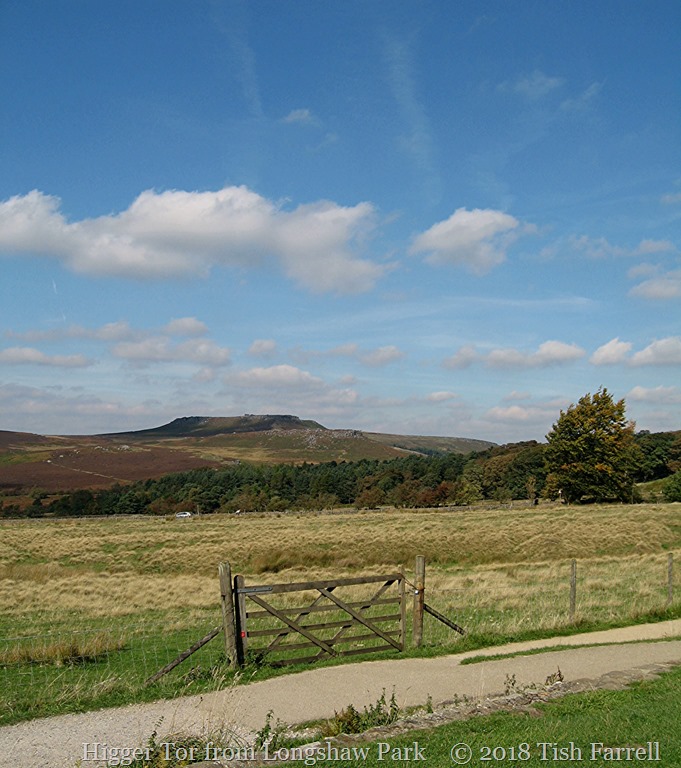
Somewhat strangely I have learned that the sheep mark of my Callow Fox ancestors was still in existence in 1930s, when the fiery right-to-roam campaigner G H B Ward, editor of the Sheffield Clarion Ramblers’ Handbooks went to interview my great uncle Robert Fox about the history of the Callow Foxes. Ward visited him in his cottage at Foolow and there saw the sheep mark belonging to an earlier Robert Fox (1780-1863), who used it to mark the horns of his sheep communally grazed on the Longshaw pasture. Enclosure took place there during the early 19th century, the Inclosure Act commissioners awarding the Duke of Rutland nearly 2,000 acres. And so the former sheepwalk used by William and Sarah Fox of Callow during the 18th century, and by their son George and grandson Robert into the early 19th century was turned into the headquarters of the largest grouse-shooting estate in the Peak District (David Hey The History of the Peak District Moors).

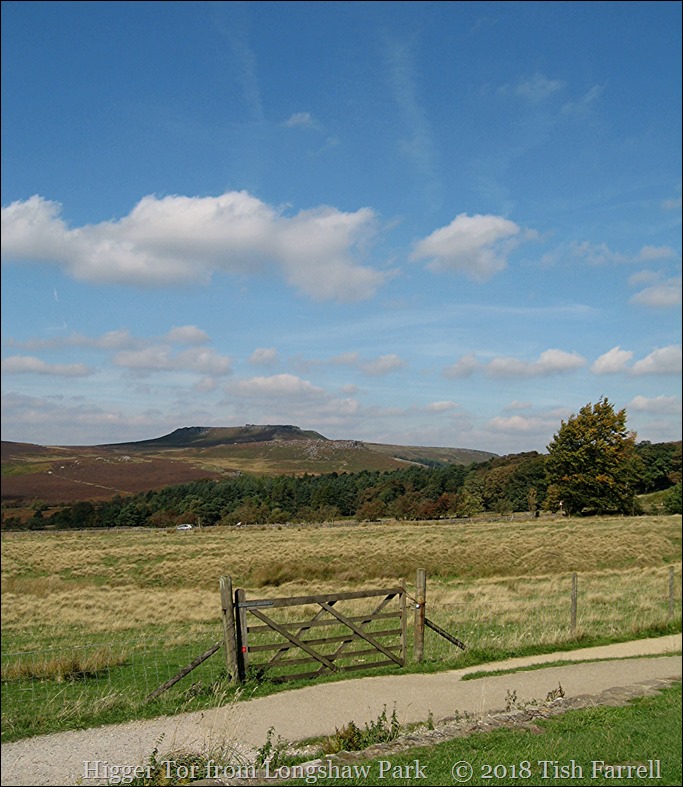
For nearly a century this former common land was policed by gamekeepers, and the general populace denied age-old rights including access to paths and bridleways. It was only with the mass trespasses of ramblers like G H B Ward during the early 20th century that the countryside began to be opened up once more. One cannot help but cheer when one learns that the decline in Rutland fortunes led to the sale of the estate in 1933. Ramblers and other members of public raised the necessary funds to buy the park and then handed it over to the National Trust. Sheffield Corporation bought the moors, which are now part of the Peak District National Park. Humanity is now free to roam there once more, as we saw on our recent visit – hundreds of families striding out in the fresh upland air.
IMG_1799

The fact remains though that Britain’s big landowners exploited the Inclosure Acts to enrich themselves by taking for their own use alone (and still hanging on to them) thousands of acres that were once communally used for centuries by their tenants.  But I leave the last words on the Commons land rights to Simon Fairlie. At the risk of sounding totally reductionist I contend that this is how we ended up where we are now; the wretched state of the planet; and the current tax-haven millionaires’ mortal fear of any notion of communal rights or shared resources. If we continue to let such people control and grow rich on resources which should benefit all – more fool us.

Britain set out, more or less deliberately, to become a highly urbanized economy with a large urban proletariat dispossessed from the countryside, highly concentrated landownership, and farms far larger than any other country in Europe. Enclosure of the commons, more advanced in the UK than anywhere else in Europe, was not the only means of achieving this goal: free trade and the importing of food and fibre from the New World and the colonies played a part, and so did the English preference for primogeniture (bequeathing all your land to your eldest son). But enclosure of common land played a key role in Britain’s industrialization, and was consciously seen to do so by its protagonists at the time.

copyright 2018 Tish Farrell

The Castle At Koroni

P1020683

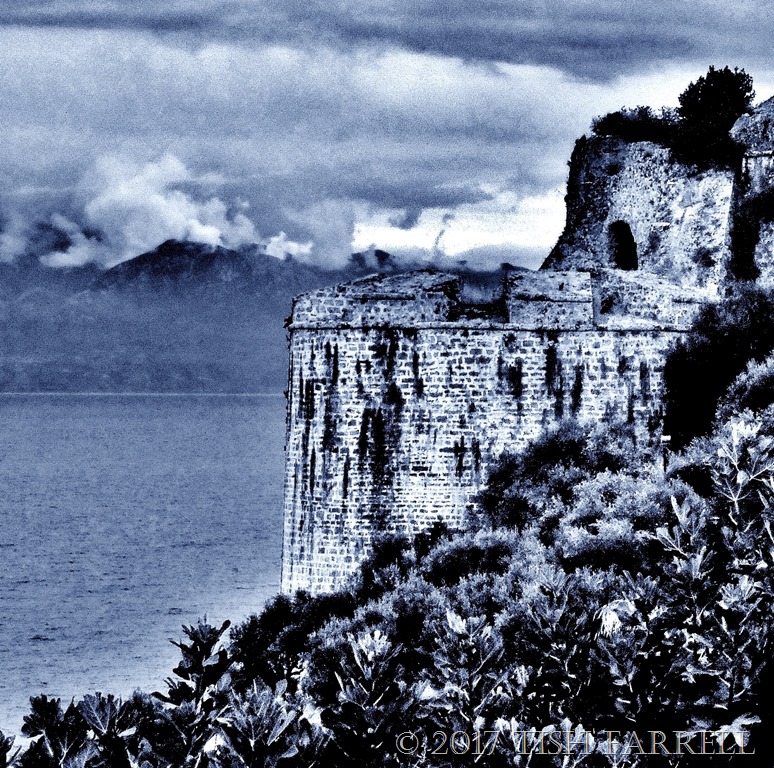
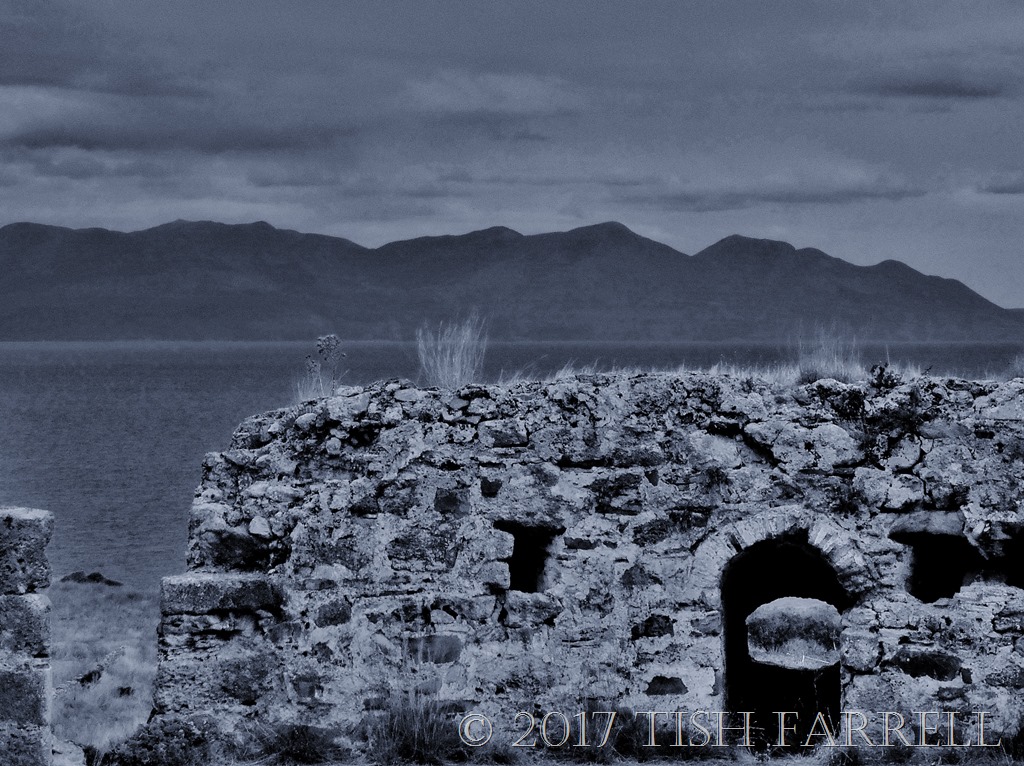
Over the past three thousand years the Messenian Peloponnese has suffered so many phases of foreign invasion it is hard to know where to start unravelling its history.  Best stick with the built remains then. This massive medieval bastion belongs to Koroni Castle, built in the early 1200s CE by the Venetians, and one of a string of Messenian coastal forts controlled by the Republic until 1500.

The Turks invaded next. After summary slaughter in neighbouring Methoni, so spurring Koroni to a quick surrender, they set about strengthening the  castle’s eastern defences, which perhaps included this tower. It is hard to track down details. One Greek writer, whose identity I am yet to discover, described Koroni Castle as ‘the architecture of hate.’ He had a point. Venice anyway regained control in 1685, and of course the Turks came back again later, staying until the Revolution of 1821, which finally ousted them.

Koroni’s historic heyday, though, was the thirteenth century. Under the first round of Venetian rule it was referred to as ‘the chief eyes of the Republic’, and as such, was one of the main ports of call for the ships and galleys of Venice’s Levantine trade. Its must-have product was cochineal, much desired by Venetians for the lustrous dye it yielded.  So now you know where that gorgeous Venetian red came from – this small corner of the Peloponnese.

P1020710 - Copy (2)

Today, you can spend many hours wandering around the castle’s 40 hectare interior. It is then you begin to grasp that before the Venetians occupied Koroni there were invader Franks on site – they of the French-Italian Crusader States. And before them, in the era of the Eastern Roman Empire of Constantinople, there was a Byzantine fort. This had apparently been built atop an ancient acropolis. And long before the Byzantine presence – that is from around 700 BCE and for a few hundred years, the Spartans were in occupation, so muddying the archaeological remains of the very much earlier Bronze Age Mycenaean period (1400-1100 BCE) and the ancient settlement of Assini.

And these are just the barest bones of Koroni’s history.

P1020707 - Copy (2)

There are also astonishing present-day aspects. The first that strikes you is that people actually live inside the castle. As you walk up from the towering seaward gateway, you find yourself on an ancient cobbled street, and next there are cottages with pretty gardens, and later we come on an olive grove and a small holding. As ever, there are many cats about. There is also a cemetery which is in current use, several churches, ancient and modern, used and disused, and a monastery that is now only inhabited by nuns. The latter has a tranquil garden and a gift shop and picturesque cottages where the nuns live, and you are free to wander around.

P1020713

*

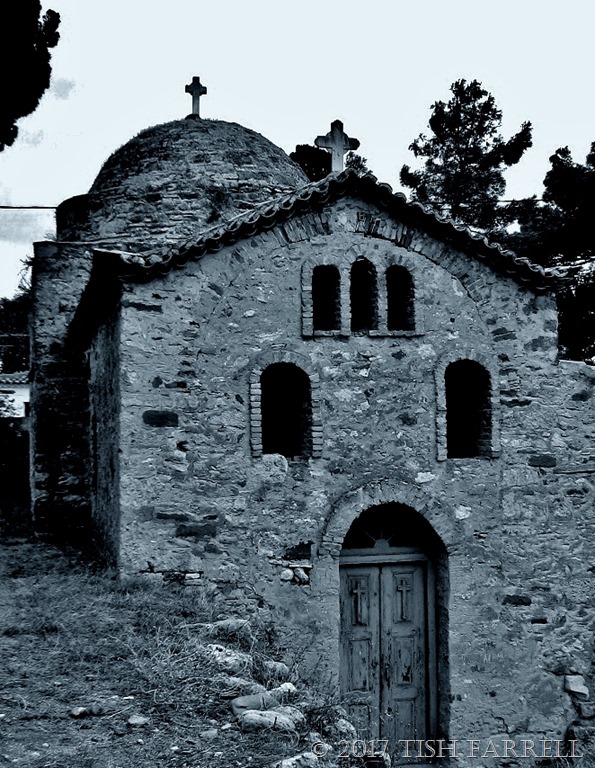
This next and final shot is was taken just outside the monastery entrance, one of the several sacred buildings built cheek by jowl in this part of the castle interior. It is dedicated to Saint Sophia and, dating from the 11th century Byzantine period, overlies the ancient temple precincts of Apollo. At which point you lose all grasp of time, since there is simply too much of it to fathom, and decide that a swift downhill return to a harbour taverna and an enlivening cappuccino is definitely called for.

IMG_2795

copyright 2017 Tish Farrell
castle 1688

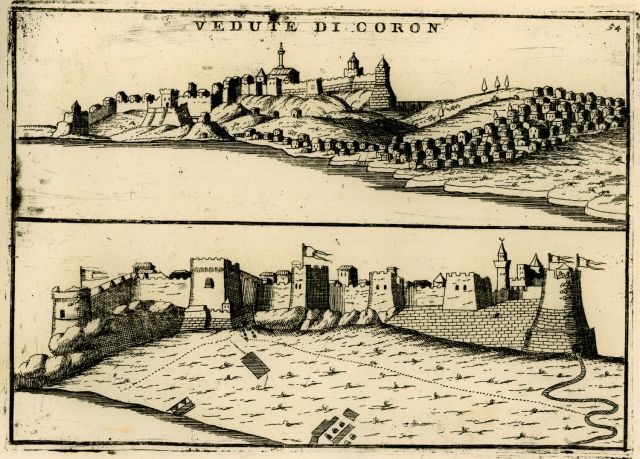
Koroni Castle CORONELLI, Vincenzo 1688  Aikaterini Laskaridis Foundation Library


Cee’s Black & White Challenge: Bricks or Stones

#PerouliaDreaming

Hafren, Sabrina, Severn ~ Please Meet Our Local Goddess Plus A Tale Of Madcap Daring

P1070722

She is most usually known by the Roman version of her name: Sabrina goddess of the River Severn. I told her story in the previous post, but thought this close up view fitted the bill for Paula’s ‘pick a word’ at this week’s Thursday’s Special. The five prompts are: confined, jazzy, patulous, momentous and serene. So I’m going for the first and  last – Sabrina serene but confined to her plinth in a pool in Shrewbury’s Dingle.

It also seems she is confined in other ways too.

The statue was the work of Birmingham sculptor Peter Hollins (1800-1886), and made for Shropshire worthy, the Earl of Bradford in 1846. I thought she was carved from stone, but a little googling reveals that the Public Monuments and Sculpture Association National Recording Project ( who knew of such a body?) thinks she may be cast in some sort of metal and then covered with plaster. They also say she is afflicted with a biological growth – so that has ‘patulous’ covered too, though they don’t say what it is. I’m wondering if it’s responsible for the vaguely luminous areas. Poor nymph.

The scarcely legible quotation underneath her comes  from John Milton’s Comus , a mask in which  Sabrina is one of the main characters. This  work also has Shropshire connections having had its premier showing at Ludlow Castle in 1634, presented before another worthy,  ‘the Earl of Bridgewater, then President of Wales.’

Sabrina fair,
listen where thou art sitting
under the glassie, cool, translucent wave,
in twisted braids of lilies knitting
the loose train of thy amber-dropping hair;
listen for dear honour’s sake,
goddess of the silver lake,
listen and save.

And if you find these words far too gluey and overwrought, then here’s an edgier Sabrina yarn, though I must warn you – it does not end well. It was the Public Monuments entry that put me on to it. It begins with a church spire – specifically the one atop St Mary’s Church in Shrewsbury and also one of the tallest spires in England.  This church has graced the town’s skyline for over 500 years, although parts of it are far older than this, dating back to Saxon times c AD 960. Also some of its stones were apparently cut by Roman masons, and carted in from the abandoned Roman city of Wroxeter some miles away.

P1020453

I think you might call the spire momentous – even before we get to what happens next.  It is over 200 feet tall.

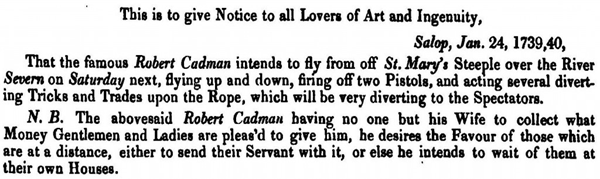
Enter one Robert Cadman, steeplejack and mender of weather cocks. It is the winter of 1739, time of the Great Frost, and Cadman has been employed to put right St. Mary’s weather cock that has been blown askew. He duly does the job, but he has further plans for the church spire. For Robert Cadman is also a stuntman and, for his daring descent from the cupola of London’s St Paul’s cathedral, blowing a trumpet while sliding down a rope,  he has already earned the nickname ‘Icarus of the Rope’.

He has handbills printed and spread about the town:

image

The History and Antiquities of Shrewsbury From Its First Foundation to the Present Time, Comprising a Recital of Occurrences and Remarkable Events, for Above Twelve Hundred Years, Volume 1, 1837

*

The River Severn is frozen solid, and so the Great Frost becomes an occasion for fun and festivities. An engraving of the time shows  skaters and people playing table tennis out on the frozen river; there are tents; there are sheep being roasted; several of the great Severn trow sailing barges are ice-bound; there’s even a printing press out there too. All in all, then, Sabrina is providing the perfect arena for the spectacle Cadman has planned.

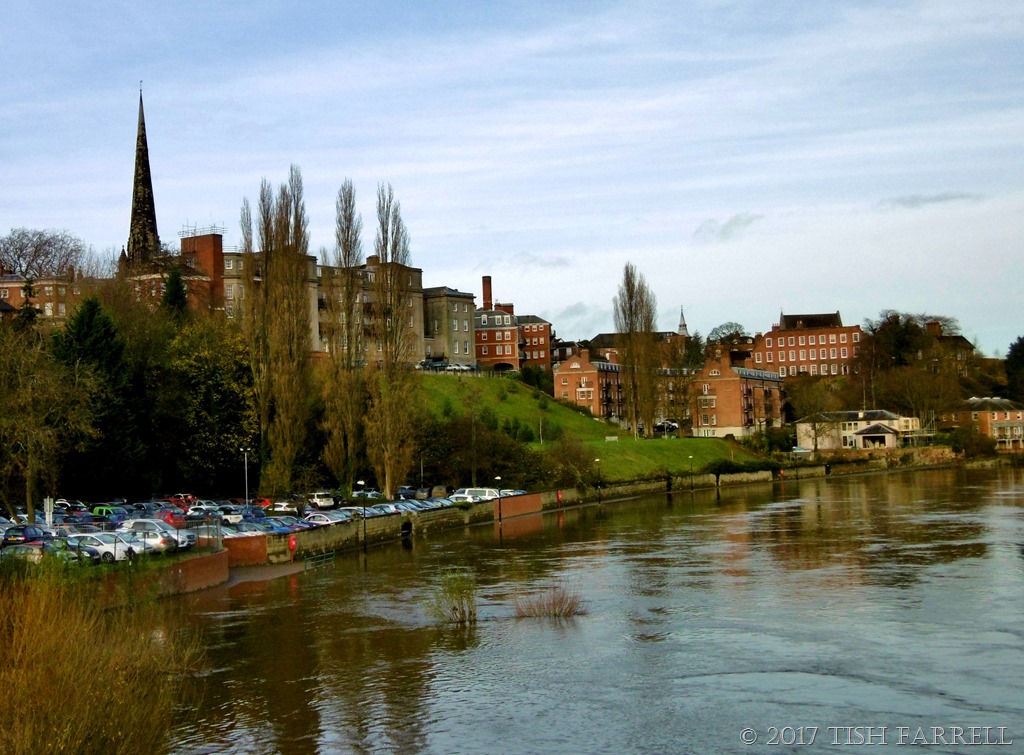
He attaches an 800 foot rope (240 metres) through a window on St. Mary’s spire. The other end is anchored across the river at Gay Meadow – (well out of shot on the right of the next photo). The show begins with Cadman’s walk up the rope towards the spire:
P1020440
His usual act is to ascend bare-chested, performing all kinds of stunts as he goes. When he performed in Derby this walk took around an hour. The return descent, or flight as it was termed then (since there was apparently quite a yen for this kind of flying  in the early 18th century), would be swift. For this part of the act our intrepid performer puts on a wooden breastplate which has a groove cut down the middle. He then lies on the rope and hurtles down, headfirst, blowing a trumpet, and accompanied by a stream of smoke as his breastplate burns with the friction of the rope. Whew!
But on this day, when Cadman reaches the spire, he decides the rope is too tight and signals across the river for it to be loosened. There is a misunderstanding. The rope is tightened, and half-way down, the rope snaps – whipping up in horrible coils as Cadman hits the iron-hard ground, his body apparently rebounding several feet in the air. Accounts have it that Cadman’s wife, who has been moving among the crowd of spectators collecting money, runs stricken to his corpse, throwing away the money as she goes.
Robert Cadman was buried at the foot of the spire and the sorry tale is commemorated in a plaque by the main door of St Mary’s church:

Let this small Monument record the name
of Cadman, and to future time proclaim
How by’n attempt to fly from this high spire
across the Sabrine stream he did acquire
His fatal end. ‘Twas not for want of skill
Or courage to perform the task he fell,
No, no, a faulty Cord being drawn too tight
Harried his Soul on high to take her flight
Which bid the Body here beneath good Night
Feb.ry 2nd 1739 aged 28

*

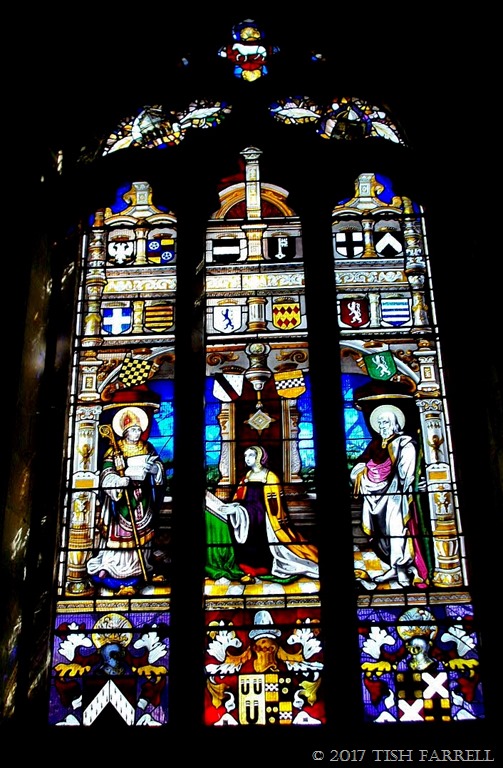
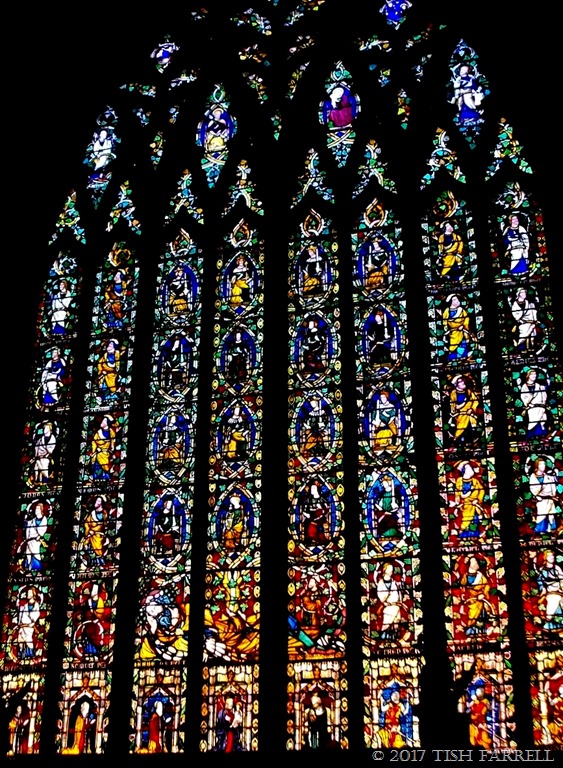
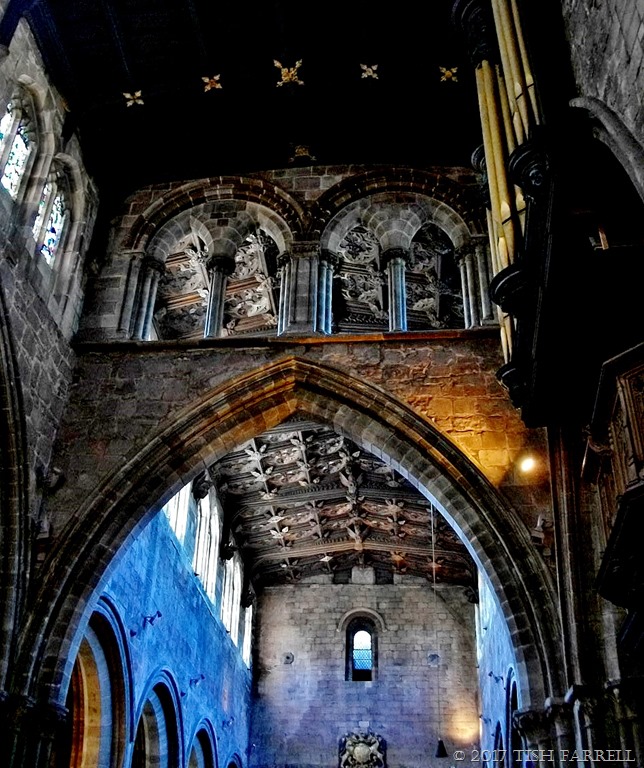
And now just to restore some sense of serenity, here are some shots of St. Mary’s interior. The church is now redundant, but it does have a very good cafe. It also contains some wonderfully ancient stained glass windows. The final image of the set is the Jesse window above the altar and dates from between 1330 and 1350.

100_5536

100_5537

100_5528

100_5534

copyright 2017 Tish Farrell