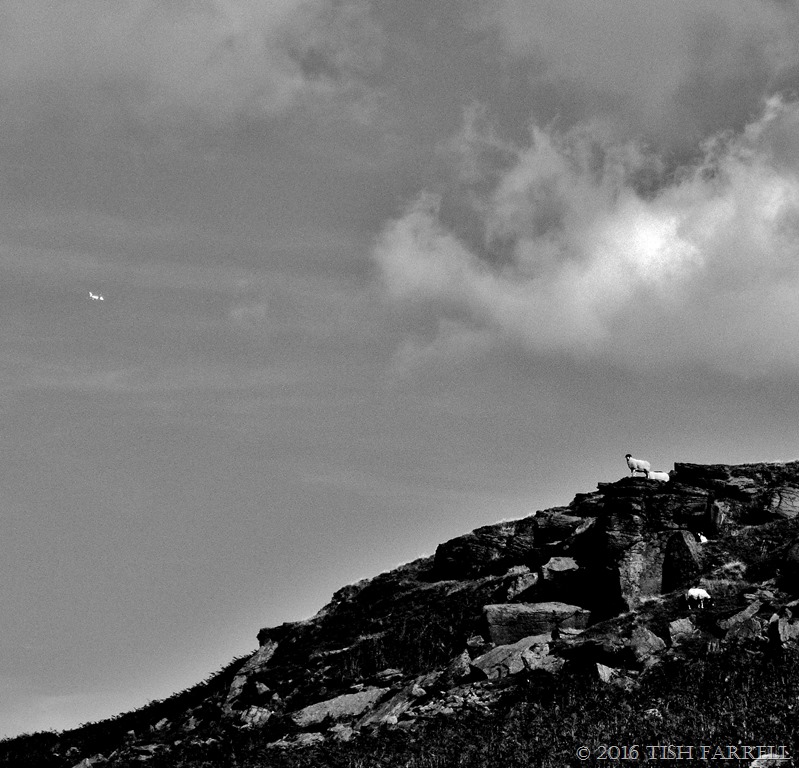
Disconnected Sunday: Plane…Sheep…Cloud…And Then…?

P1050650

I was attracted by the sheep doing an ovine impression of Landseer’s Monarch of the Glen –  as spotted last week during our short break in the Derbyshire Peak District. Its posing place of choice is Hordron Edge, below Moscar Moor and Stanage Edge. We were walking up here on what he-who-is-usually-the-team-leader suspected would turn out to be a Tish-type wild goose chase. In short we, or rather I was in pursuit of a Bronze Age Stone Circle, otherwise known as the Seven Stones despite the fact that there are apparently eleven stones in the circle, and three more besides nearby.

I should admit straight off that I’m not renowned for my accurate map-reading, and so once we’d passed the sheep, walked for ages in surprisingly hot sunshine for late September, and then found ourselves on a path which kept wending onwards and upwards with absolutely no sign of a megalithic monument anywhere on the sky-line where I was expecting it, even I began to think I’d misread the map, and that we were definitely on a wild goose chase. Worse still, we’d left the lunch picnic in the car, so there wasn’t even the possibility of making the best of a bad job. And it was just the day for a moorland picnic too, not a state of affairs you can rely on in England’s uplands whatever the time of year.

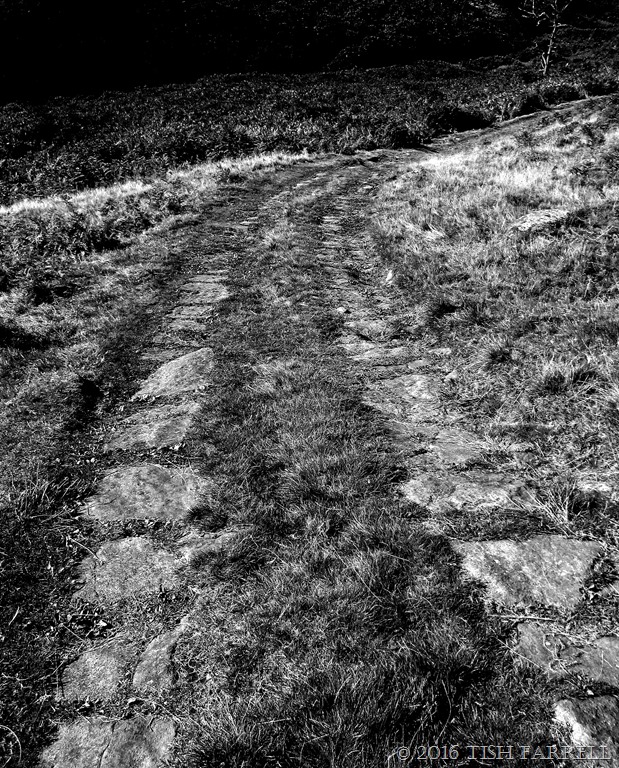
‘We’ll just go to the next bend’ – I said – ‘so we can see over the brow of the hill’. But as always happens in such situations, we never came to the bend’s end. In fact the path began to rise very steeply. Then we noticed that exposed here and there beneath the turf were signs of a stone-paved trackway. Very puzzling in this middle of nowhere, but at least it suggested that we were headed somewhere. (I surmised later that it must be the relic of an old packhorse road up to Stanage Edge whither the locals once went quarrying to make millstones and grind stones).

And so as we pushed on, drawn on by the stone road, and quite unexpectedly Moscar Moor and Stanage lay before us. It is an awe-inspiring landscape, and so it is scarcely surprising that this whole area is rich in prehistoric cairns, circles, and settlement remains.

Also, by now I could see that my map-reading had been spot on, although the stone circle really took some finding in the heather.
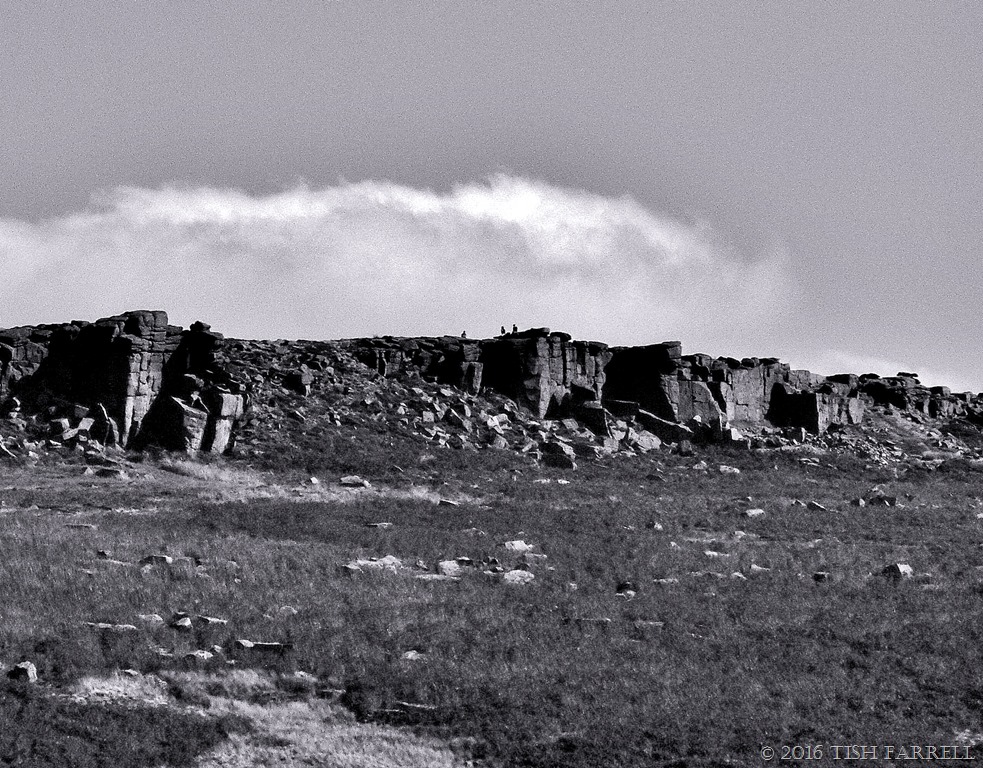
P1050637 (2)

So I hope you weren’t expecting Stonehenge. Because here it is – the Seven Stones Circle of Hordron Edge, probably dating from around four thousand years ago.
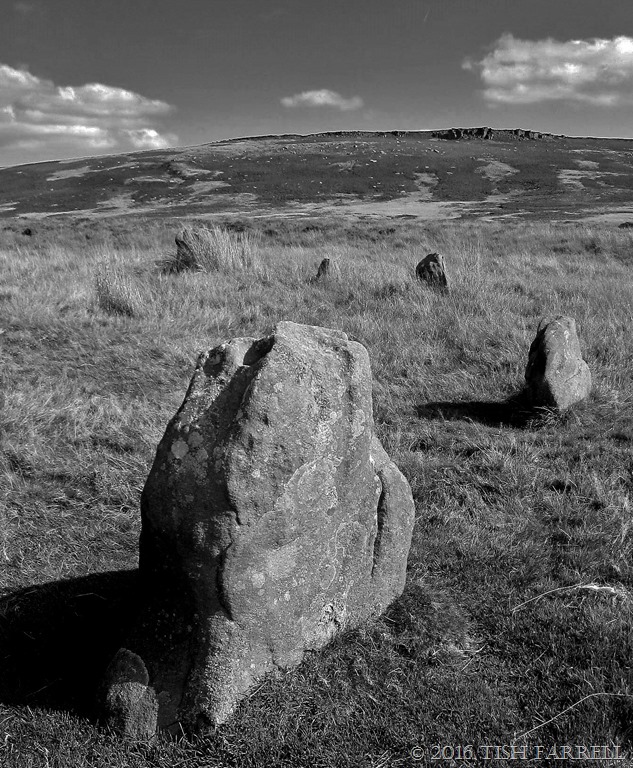
IMG_3319

The tallest stone is the one seen here in the foreground, and is about 1 metre high. It stands on the south west edge of the 16 metre circle, and has been dubbed the Fairy Stone. You can see it on the far right in the middle ground of the next photo. P1050638
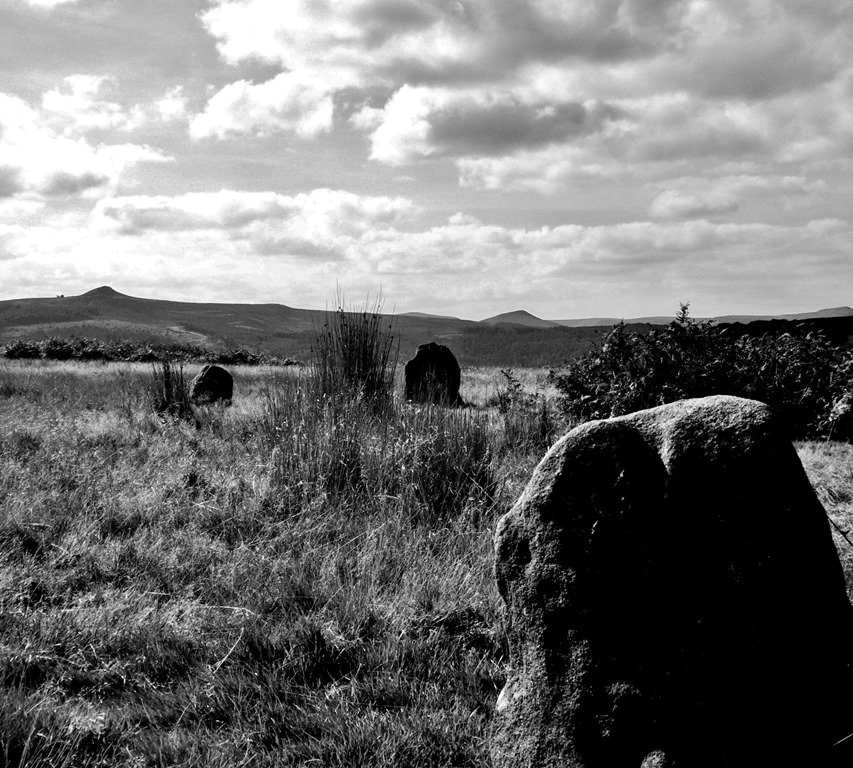
Its particular significance is taken to be its relationship to the two conical hill tops, Win Hill on the left and Lose Hill on the right, the top of the stone possibly mirroring the landscape features. Peak District archaeologist John Barnatt has apparently observed that at the traditional start of winter and spring, the times of age-old festivals, the setting sun appears to roll down Win Hill.

Perhaps the placement of stone had something to do with the gathering of sun-power? Or the marking of the seasons in relation to the farming calendar? We can never know. All we can be sure of is that these monuments were important to the people who created them – gathering places for discourse, rituals, trade, or all of these. More recent local folklore has its say too – hence the naming of the Fairy Stone, and tales of strange lights being seen around about it.

And what do these monuments say to me? Well the main thing is that we should never underestimate the capacities of our ancient antecedents. Also that we should never equate current technological whizz-kidery with intellectual superiority. These people  of the past  knew how to make a life in this challenging territory – a life charged with meaning and a deep sense of their place in the landscape. I feel too, we have lost much of our ancestors’ capacity for poetry and metaphor – the exchange between fellow humans that relied almost exclusively on language – the songs sung, the tales unfolded, the riddles set, the nuances of double and treble meanings.

But before I get too carried away with highfalutin notions, we decide that lunch is now too far away for comfort. We retrace our steps down the old stone trackway. It perhaps does date from much more recent medieval times. I’ve been unable to find out anything about it, although there is medieval packhorse road along the top of Stanage Edge.

As I descend the steep hill on a sunny Indian Summer day I wonder what it must have been like to urge pack horses up this route in a blizzard, the wind slicing under your cape, threatening to snatch your bonnet, the biting cold, the darkness. Just imagine…
IMG_3311 - Copy

copyright  2016 Tish Farrell

Hordron Edge Circle
Bronze Age Stone Circle
East of Ashopton, Derbyshire  OS Map Ref SK21528685
OS Maps – Landranger 110 (Sheffield & Huddersfield), Explorer OL1 (The Peak District – Dark Peak Area)
Spirit of the Past: Black & White Sunday

holiday 029

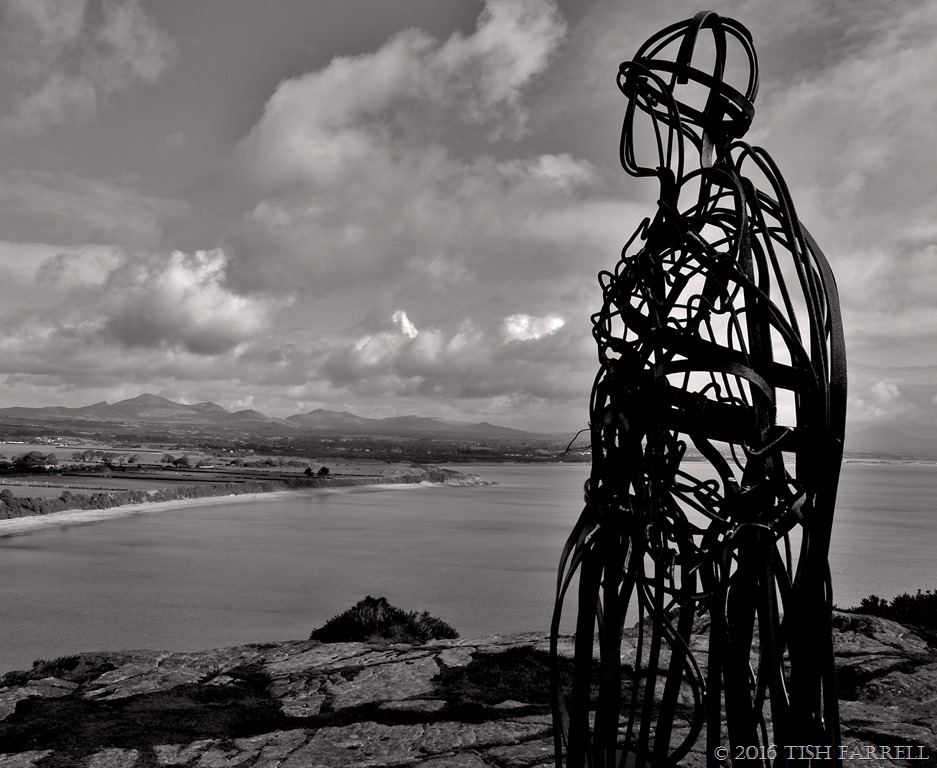
I’ve written about the Iron Man of Llanbedrog in other posts. (Personally I think it could be a woman – Boudica perhaps, the last of Britain’s Celtic warrior women). I’ve also posted variously edited versions of this shot before, but not this one exactly. This week at Black & White Sunday, Paula is reprising the popular Traces of the Past challenge, and I thought that although this iron figure is not especially old, everything about it speaks of the ancient Celtic spirit. And of course there are the ‘rocks of ages’ just visible in the distant mountain range of Snowdonia. In many senses, then, Wales is an old, old land, and the traces of the past are everywhere across the landscape.

 *

You can read more of the Iron Man’s story at Warrior Wind-Singer Of Llyn

The Railway Men 2 ~ Black & White Sunday

P1040806

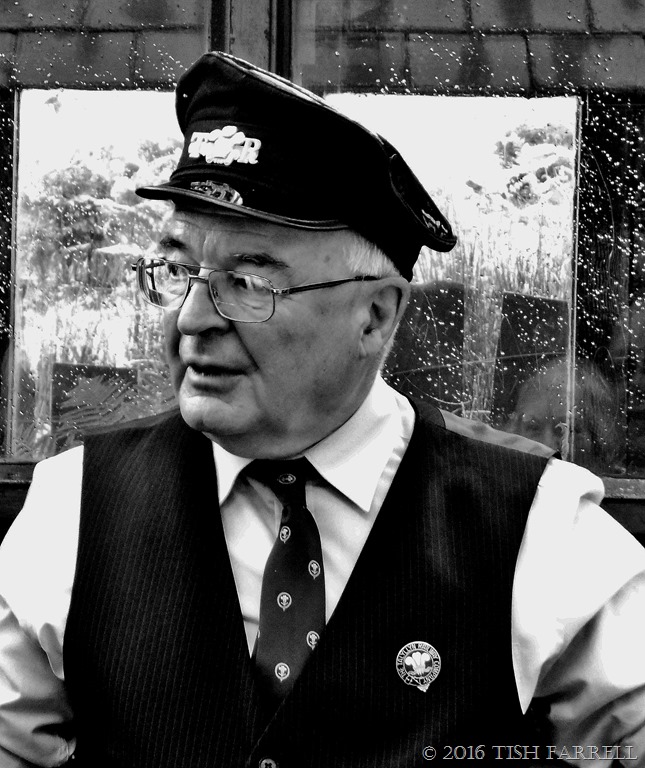
Here’s another portrait from our Victorian day out on the Talyllyn Railway in June. Looking at their website this morning I see they’ve got a very special trip coming up next month – The Halloween Steam and Scream. Oh what a hoot. I think I want to go. It’s my birthday too. There will be a choice of two Steam and Scream trains departing from Tywyn station at 5.15 and 7.15 on several October nights including the 31st. Everyone can dress up as ghouls, goblins and witches; there are prizes for the best carved pumpkin lantern, and you can book a feast at the railway cafe.

Join us for a fun spooky evening train ride along the Talyllyn Railway to the haunted woods at Dolgoch, says the blurb.  Those woods are pretty spooky in broad daylight, but on a dark autumn night in the Welsh hills…Watch out for the Hessian Horseman  and his Celtic brother. Yikes! And double yikes!

*

Now please visit Paula at Lost in Translation for more B & W Sunday portraits.


@TalyllynRailway

#RheilforddTalyllynRailway

Unexpected: Monochrome Mawddach Sunset

P1040714

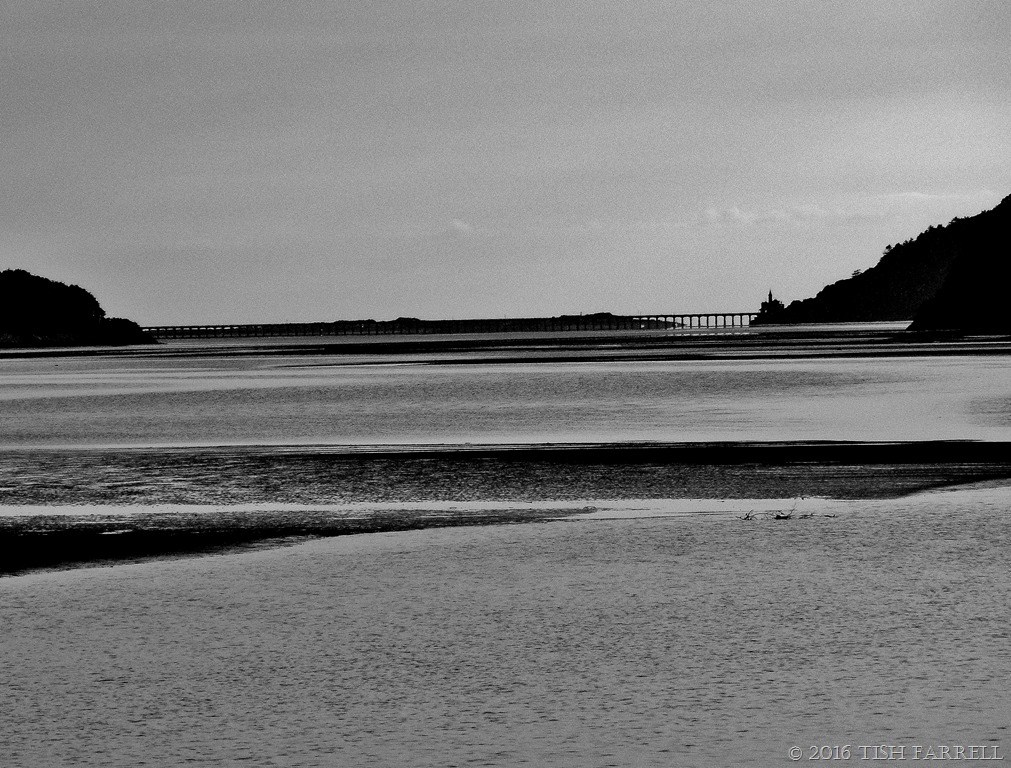
The most unexpected thing about this shot is that it came out at all in such low light conditions. I do love the Dynamic Monochrome setting on my Lumix. It creates all kinds of unforeseen magic, even with much added zoom.

I suppose the other piece of unexpectedness here is the perversity of shooting a limpidly pastel sunset in monochrome. But I like the way it silhouettes the old railway viaduct across the estuary mouth. In Welsh it is called Pont Abermaw, and in English, Barmouth Bridge. It was constructed mostly from wood during the 1860s, and included a drawbridge section that would open allow tall masted ships to pass through, sadly not a facility much needed these days.  It would be fine sight though, so please add your own sailing ship to this vista.

*

Black & White Sunday  This week Paula requests we show her the unexpected. Please drop in there for more creative renditions of the theme.


#MagesticMagicalMawddach

On The Diagonal ~ Around Wenlock In Winter And Summer

P1000582


P1010927


P1010920

P1000562 - Copy

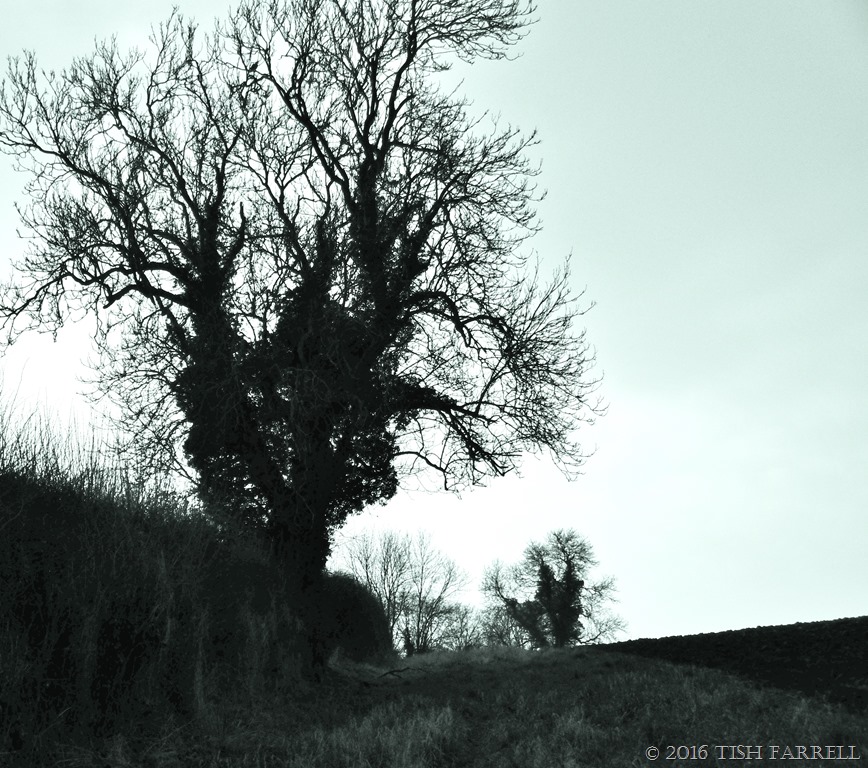
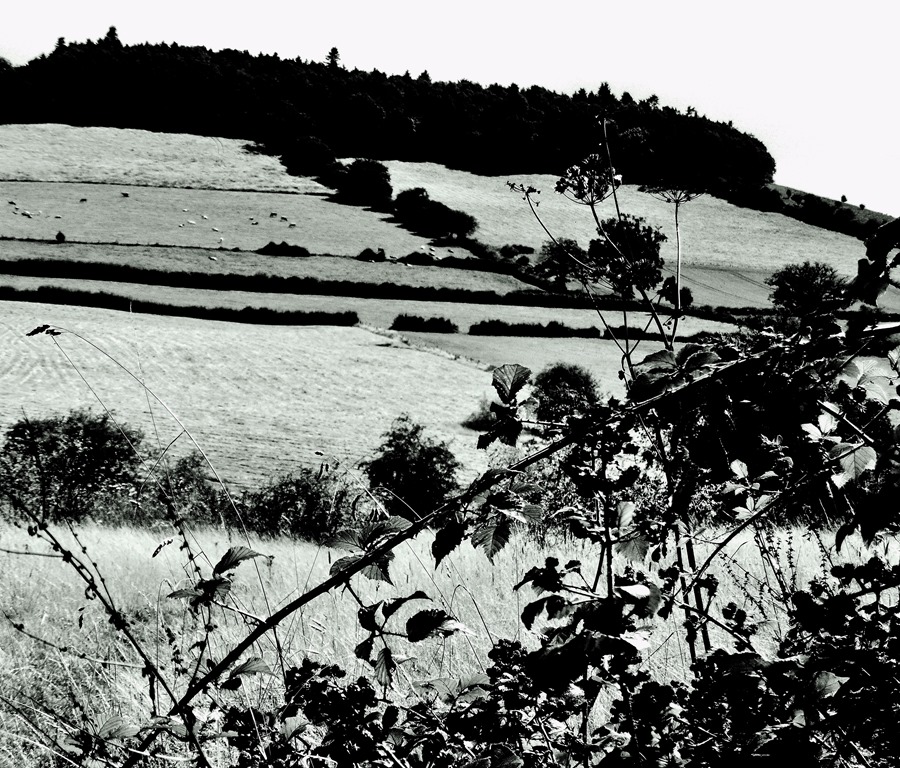
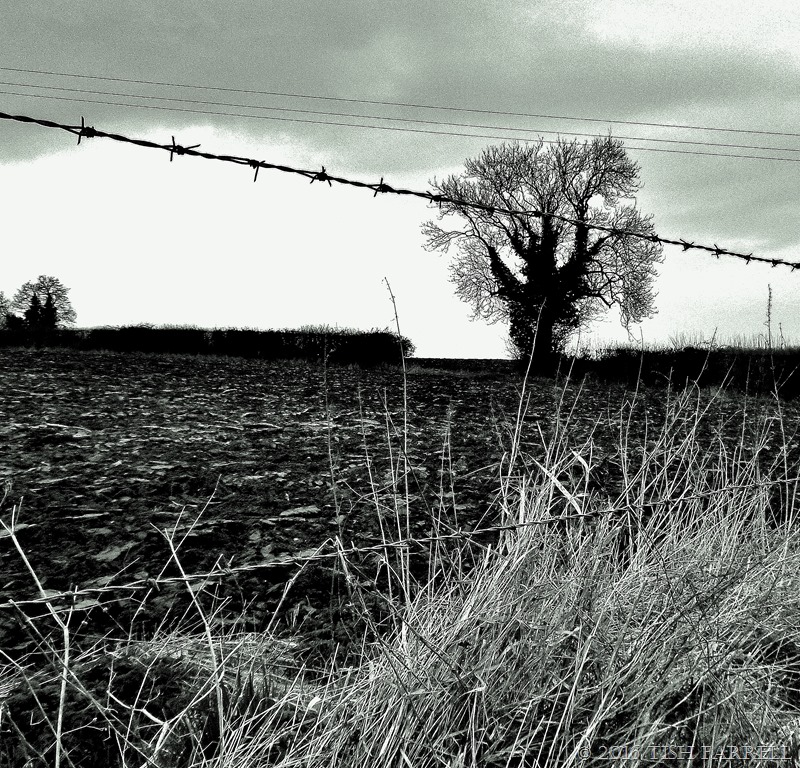
This week’s diagonals theme at Black & White Sunday is right up my street, or at least in my neighbourhood.  Looking through my file of Lumix monochrome images, it seems that the diagonal often features. I think it’s because it appeals to both my visual and my writing mind. Things on the slant; one thing leading to another that’s not quite in view; unexpected angles; the monochrome subliminally suggestive of the written word and printed pages: storytelling then.

The first photo was taken on my well-worn path to the allotment. It’s a scene I photograph in all seasons, but I especially like the ash tree silhouettes in winter, their boughs cloaked in ivy which always reminds me of Tolkein’s Ents. I think this is where the lost Ent Women ended up, guarding our Wenlock Edge field boundaries.

Photo 2 was taken from the old railway line, leaning over the fence and shooting from deep shade into bright sunlight and with some zoom – not quite the best thing to do, though it gives the hilltop wood a touch of dark mystery.

Photo 3 is the field path from Wenlock to Bradley Farm, once the site of a medieval settlement.

Photo 4 – we are back at the allotment, the field behind our plots looking at the ash trees from another angle. I like the way the barbed wire adds a bleak and faintly sinister air.

Now please visit Paula at the link above for more photo essays on the slant.

copyright 2016 Tish Farrell

Heading For The Light ~ Wenlock’s Linden Walk In Winter

P1000516

I consider myself well blessed to have this avenue of venerable lime trees within a stone’s throw of my house. The Linden Walk is one of Much Wenlock’s treasures. The limes on the right were planted in October 1869 by the town’s physician and philanthropist, Dr.  William Penny Brookes. He apparently had help from his friends to do the job. Forty two trees were planted and forty two trees still thrive. Thank you Dr. Brookes.

The limes on the left are possibly older, and our local tree expert surmises that they may have been planted by the railway company in 1860-ish to demarcate the railway line when it first arrived in Wenlock. Dr. Brooks was a prime mover in bringing the railway to town. It’s only a pity he can’t bring it back to us.

The avenue forms the southerly boundary of the Gaskell aka Linden Field, where from the 1850s  Dr. Brooks held the Annual Wenlock Olympian Games, an event of his devising for improving the health and wellbeing of the general populace of Wenlock and beyond. He even designed the ornate medals and paid for them himself. And it was these games that went on to inspire and inform the modern Olympic Movement. A crown of laurels to you, Dr. Brookes.

The good news is that, according to an international lime tree specialist, who was brought in to inspect them,  this avenue has another good century and a half of life left in it – as long as we continue to care for it. I’m sure we will.

In this winter view, taken in Lumix monochrome mode, the walk looks very mysterious. In summer, though, it is so flush with leaf vigour and the soothing notes of linden blossom that you can walk beneath the trees and get high as kite: so much juice and joy – to misquote Gerald Manley Hopkins.

*

Over at Paula’s Black & White Sunday the theme is ‘convergence’.  Please go and see her work, and others’ converging interpretations.