
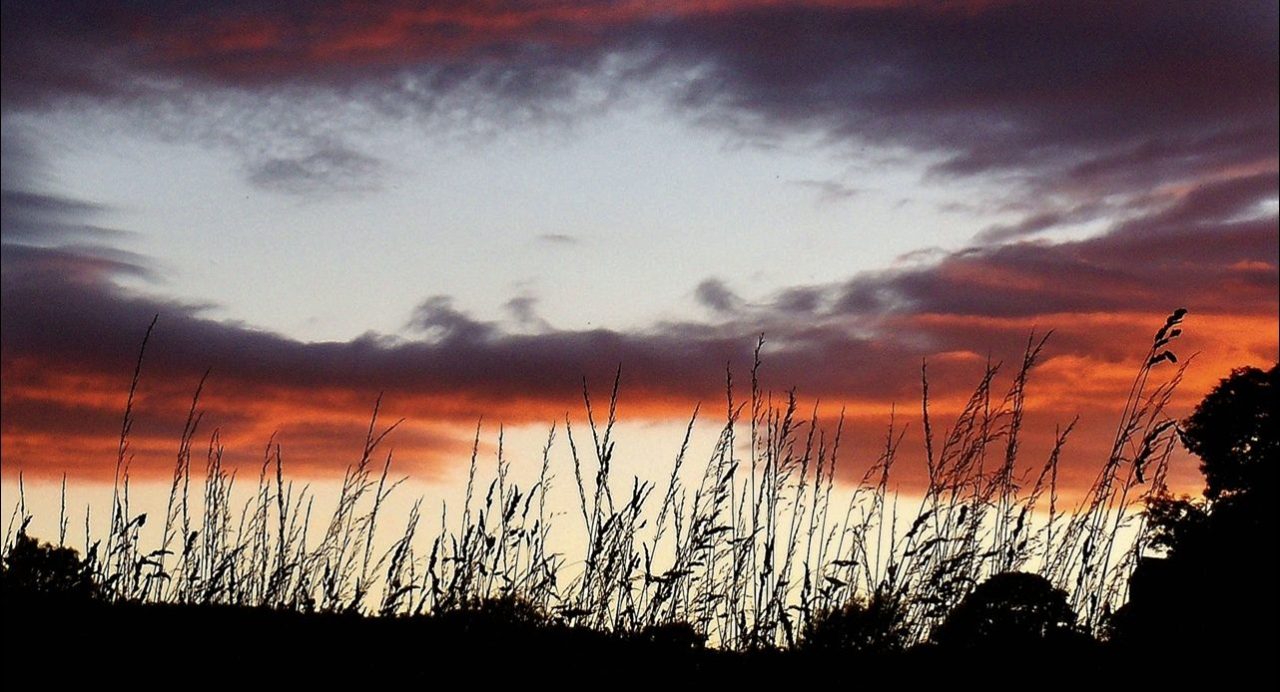
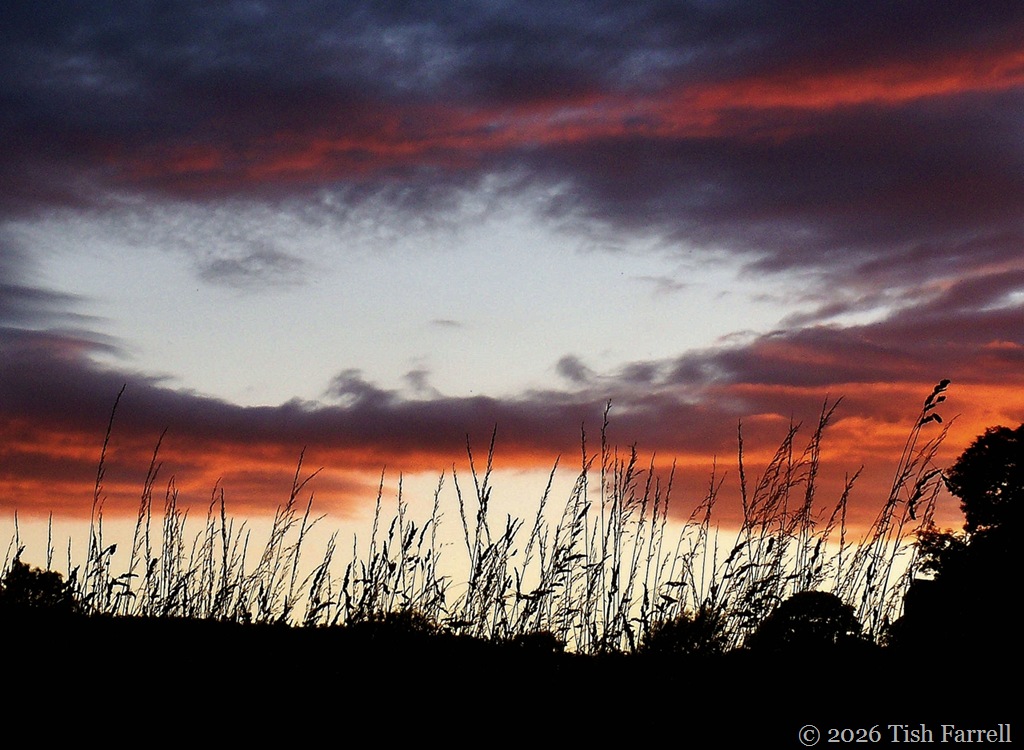
Grasses, sky and clouds on Wenlock Edge
*
Sometimes you need to lie down to take a photo; taking this header shot was one of those moments. I wondered how the thin stems of meadow grasses would look against the fiery sky. They had much to compete with. Some more distant treetops got a look in too. Earth to sky: we’re holding our own despite the light show.
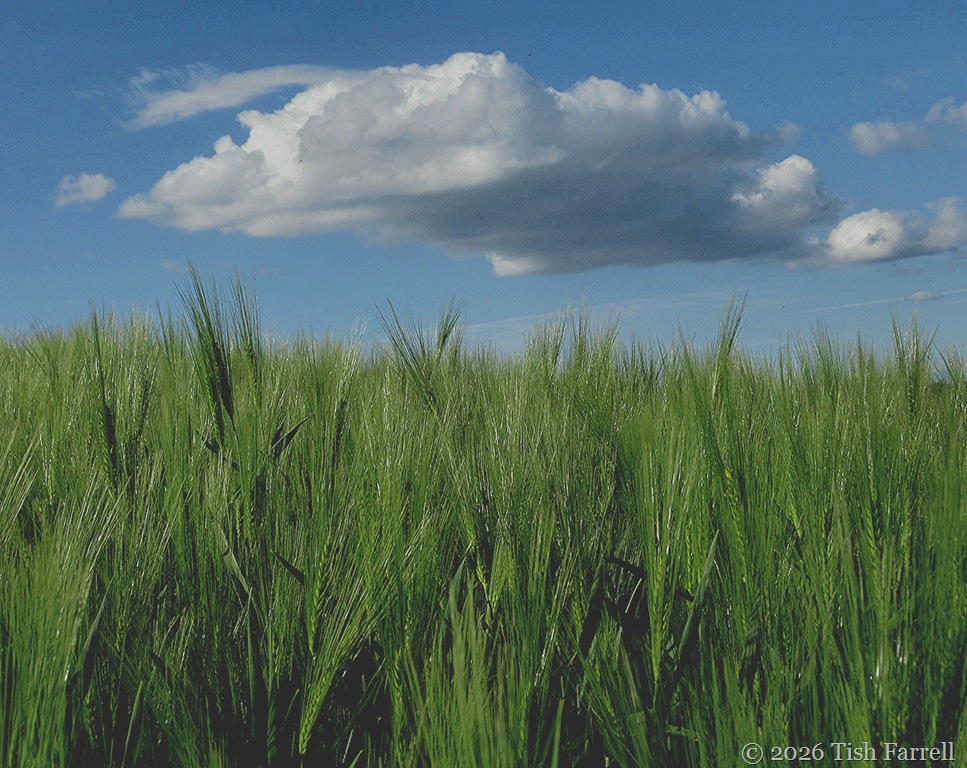
And a different take on earthly-aerial juxtapositions; this time a barley field, sun reflecting off the tufty awns that surround the grain. I liked the contrasting textures of spiky crop and meringue-soft cloud; the green against the blue, white-grey contrast:
*
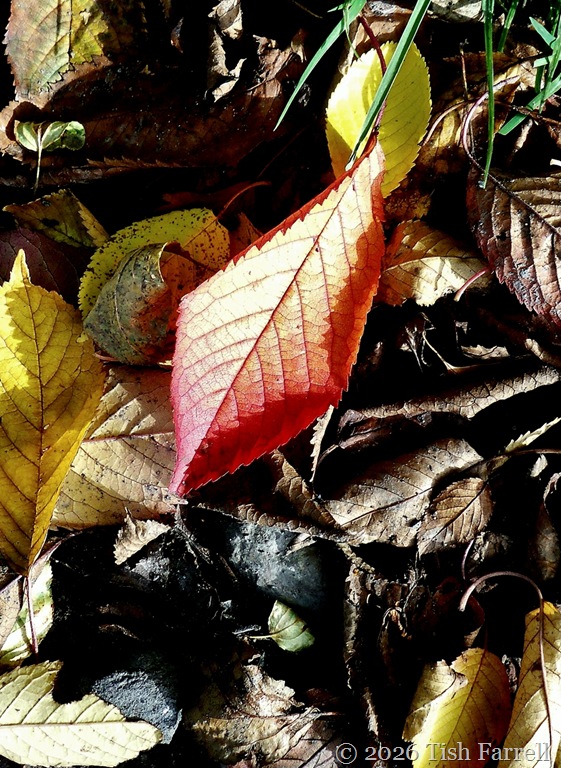
The colour red always makes its presence felt. Here a single red bird cherry leaf:
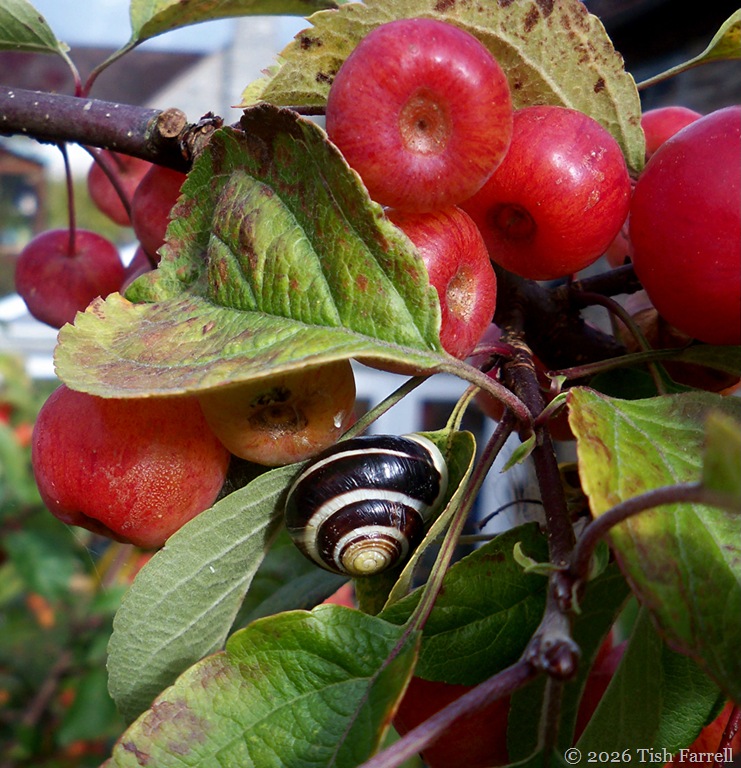
The showy crab apples somehow make a lowly snail all the more remarkable.
*
I do take an awful lot of landscape photos, but perhaps you can have too many ‘good views’. The presence of some living/moving element generally makes for a more engaging shot:
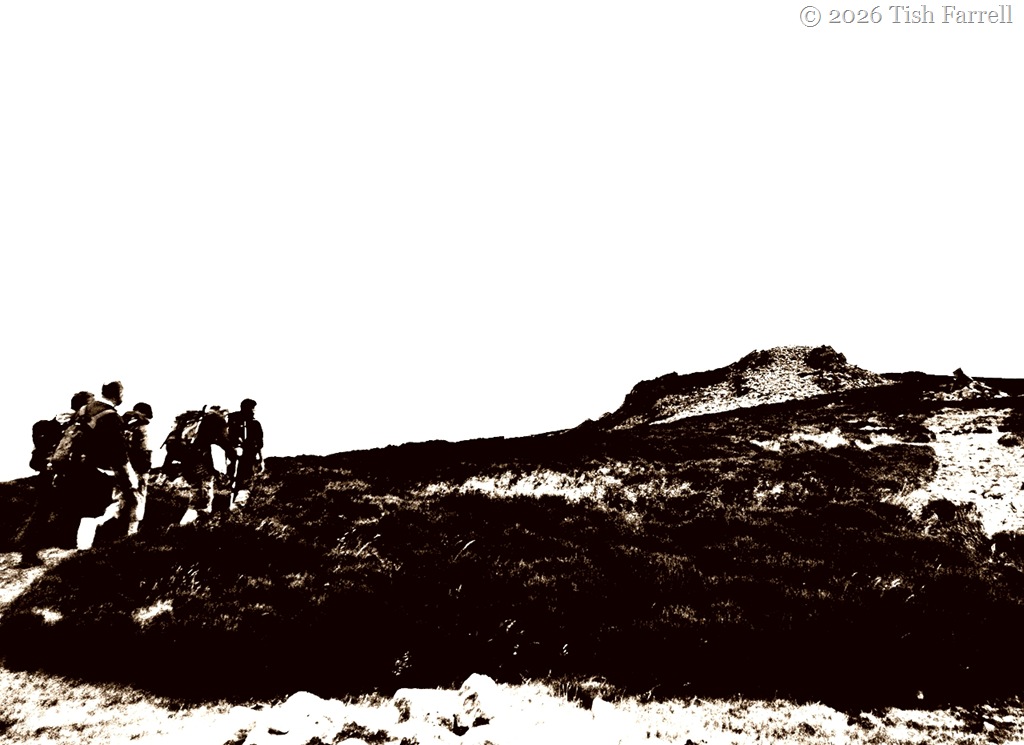
This rather strange view of a Stiperstones tor was shot in monochrome in gloomy midday light. Odd things seem to happen in this mysterious Shropshire upland: so who knows where the sky went. But then I liked the happenstance appearance of the tight-knit group of hikers. They walked into the shot, their group posture conveying group purpose: they will reach the top.
And you want to follow them.
*
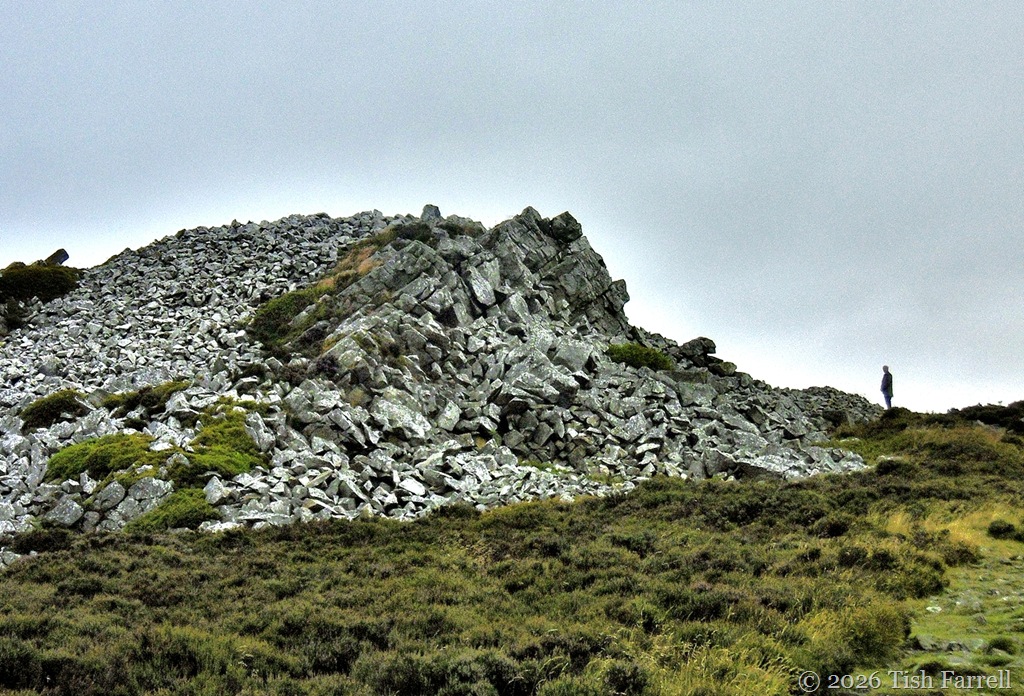
This is another chance Stiperstones photo, taken on the same day. Despite the poor light the tor does seem to radiate something. That’s my other half on the skyline. As ever he has stopped to see what had become of me, dawdling somewhere behind. I was so pleased when he stood still. There he is – a tiny human beside a momentous stack of geology, remnant of the ancient days when this quartzite ridge was crushed and fractured during the last Ice Age.
Back then, two great glaciers (one from Ireland, the other from the heights of Plynlimon in mid-Wales) convened in the Shropshire hills. They kept the ridge company, not covering it, but nudging the tops through alternating periods of freeze and thaw. Needless to say, this would not have been a human-friendly landscape. Even now, in bad weather, it is a brutally exposed spot.
*
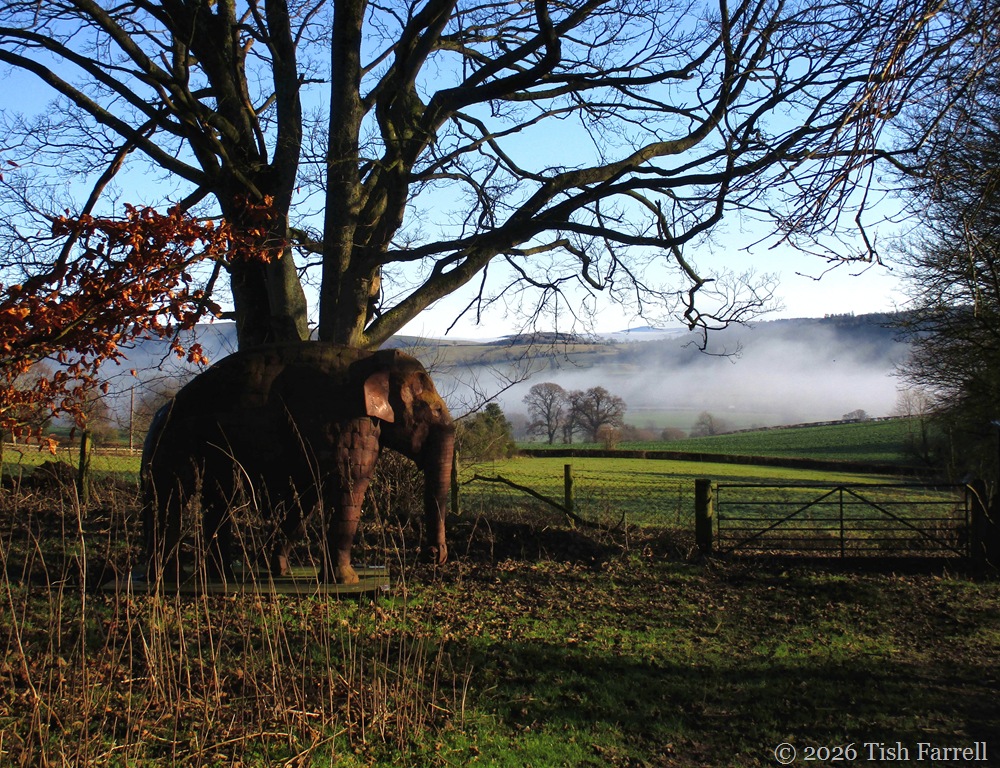
And closer to home, the not quite live elephant on Wintles Hill adds a certain something (if only viewer puzzlement) to this Shropshire autumn landscape. The different layers of sunlight and shadow also caught my eye:
Copyright 2026 Tish Farrell
#IAmNotACrop
Lens-Artists: the power of juxtaposition This week Patti at Lens-Artists asks us to consider the power of juxtaposition in our compositions. Please see her super post for guidance and inspiration.

I demand an explanation for the elephant! I know you didn’t bring him from Africa, Tish. Good to see you two out and about though xx
Hello Jo. It’s one of many tributes to elephants about the town. This one, near the campsite, is pretty much a life-size Asian ele. Reference is to to one or more elephants evacuated to the Castle Hotel during WW2.
Good to know, though I suspect I should have known that already? xx
I’m not sure we were quite so elephant bound when you visited BC. The various sculptures/wall paintings have multiplied in fairly recent years. The other connection is Clive of India, who pretty much owned the town in the 18th century. His coat of arms includes an elephant, and is still to be seen in the Market Square, opposite the house with all the bubbles.
Amazing images Tish and great for this challenge. My favorite is your husband standing near the Stiperstones.
Many thanks, Anne. Even at a distance and in miniature, that stance seems to suggests ‘now where is she!’ 🙂
😁
Funny, we both posted with glaciers references today and the last Ice Age. I like the name “Fantastic Erratic” for a large boulder on a local hike near us. Sounds like a Donovan Lp dunnit?
A ‘Fantastic Erratic’ is definitely Donovanesque, Bill. I loved your description of it – ‘a small car garage covered in moss’. I meant to come back and say so. And yes, funny how our Ice Age thoughts converged. And Ginger’s paw, dreaming her walks with you.
That’s so sweet! Ginger’s paw…good eye Tish. Thanks for this.
Superb captures, and those feathery barley heads look so soft you want to reach out and touch them.
Thanks, Lindsey. There’s nothing quite like a barley field at close quarters. You definitely want to stroke it 🙂
Amazing captures, Tish. Thanks for the perspective choices you created. I’ll have to remember to try that at some point.
Many thanks, Egídio.
You have a great set for this challenge. The landscape with elephant is a stunner. But I also love the barley field against the blue sky. That snail is also pretty, isn’t it?
Glad you liked the elephant and barley, I.J. That is certainly one smart little snail. Also known as a pooty (an old English name).
I’m a sucker for barley and blue skies – and the way the spikelets catch the light and the breeze as in your photo. I was amused by your other half standing in the distance – thinking he was cooperating with your photography and not wondering how far behind you had dawdled! By the way I’m impressed by your knowledge of the area’s geology and try to absorb what you write about.
I struggle to grasp geology, both as a discipline, and in relation to the actual processes involved – i.e. how it would have been at the time – so I keep revisiting info on the Stiperstones trying to get a grip on things. I think I’ve only scratched the surface… 🙂
I love the subject but I can barely imagine the findings like the glaciers scoring out valleys and hills
Quite apart from Carding Mill Valley, the steepness of the stream-carved Longmynd ‘batches’ is mind-boggling – well how to grasp the time-scale involved for one thing, quite apart from actual physical conditions. And then the Ice Ages are fairly recent agents of geoscape manufacture. All that stuff that went before – shifting and shunting, seditmentation, pyro-mechanics, ocean floor uptilt, mountain range folding – so astonishing…
spot on Tish with all that magnificence
I love the elephant of course, and the green barley / blue sky shot is both harmonious and contrasty at the same time, really showing the power of juxtaposition 🙂 But like Anne, my favourite is the one of your other half and the Stiperstones.
Well that will please him, Sarah. A bit of attention 🙂
Loved your response Tish,, some very clever juxtapositions. My favorite is the green grass/blue sky image but also loved the elephant (so weird!!) and the snail.
Thanks so much, Tina. Love the way you had the elephant and the snail in the same sentence 🙂 🙂
Well done for taking Juxtaposition to the countryside! I found town so much easier (yet to publish my effort). Actually, for sheer drama, I love that first shot of yours. Also becaause flinging myself down onto my stomach in the cause of Art is getting increasingly unwelcome …
y
Yes, now you mention it, caution is required these days in the flining down department. It’s the getting up again that needs to be factored in 🙂
ExACTly!
Nice! I enjoyed the apples and the snail the most all all. 😊
Thanks, Pepper.
Great choices, Tish – many comment on the elephant! My absolute favourite among these pictures is the barley and the soft sky together.
Many thanks, Ann-Christine. The barley-sky shot has a lightness about it somehow. An invitation to drift perhaps.
Wow!
🙂 🙂 🙂
It’s a wow from me too, Tish. The barley one is special.
Many thanks, Sofia.