
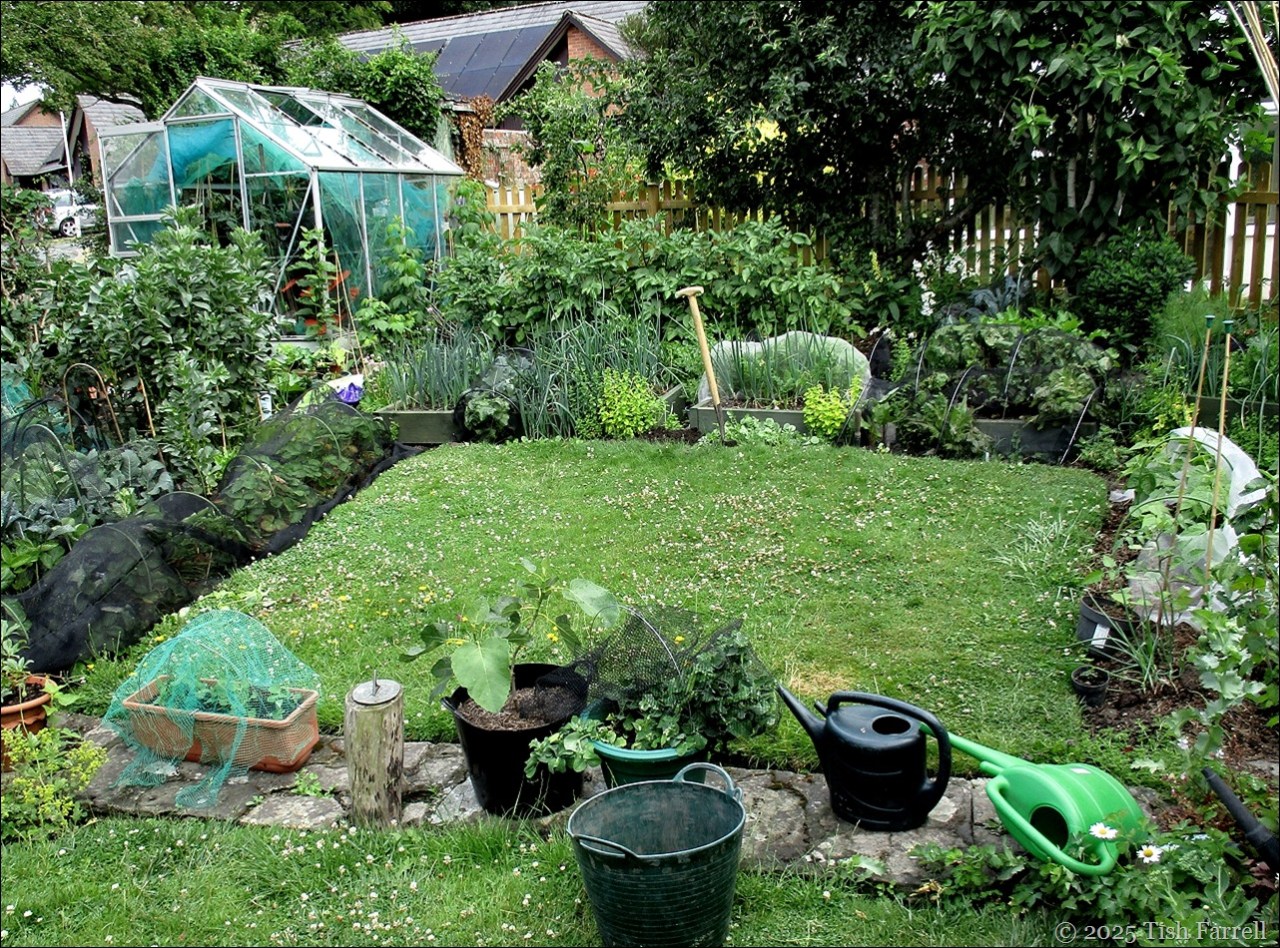
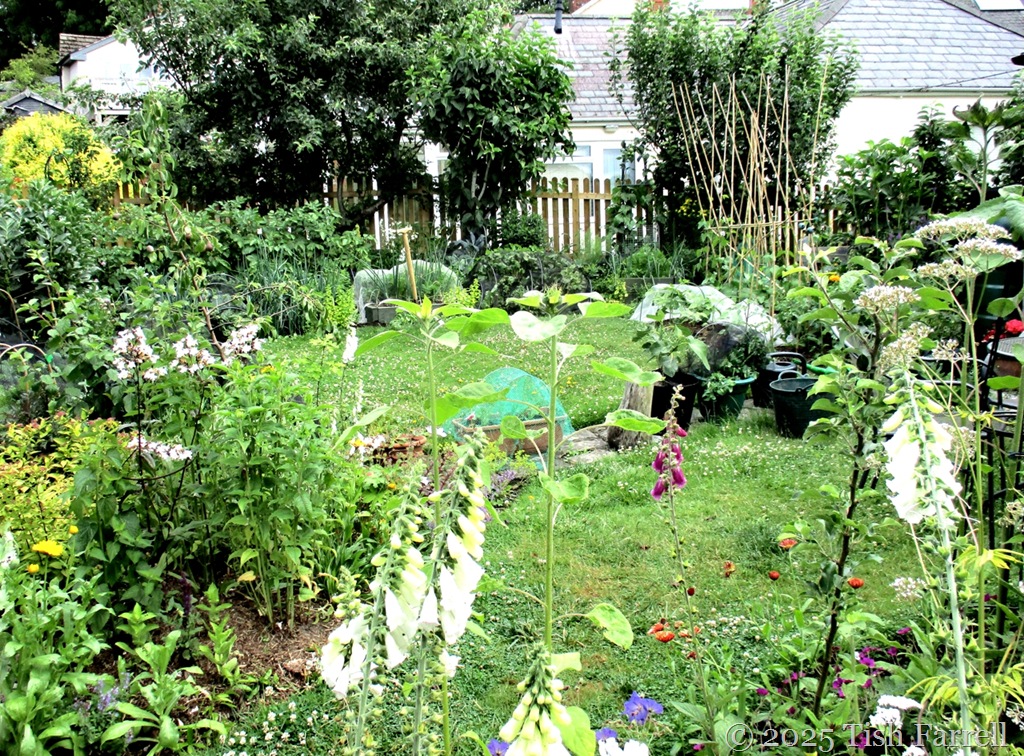
As you can see, the ‘upstairs’ garden behind our house is really rather modest. And here, currently, and probably for the foreseeable future, chaos reigns; this courtesy of a gardener who still thinks her growing spaces comprise two seventy by 15 foot allotment plots plus the home garden with its adjacent stretch of ‘guerrilla gardened’ field over the back fence. Heigh ho! Those were the days when we lived beside Wenlock Edge.
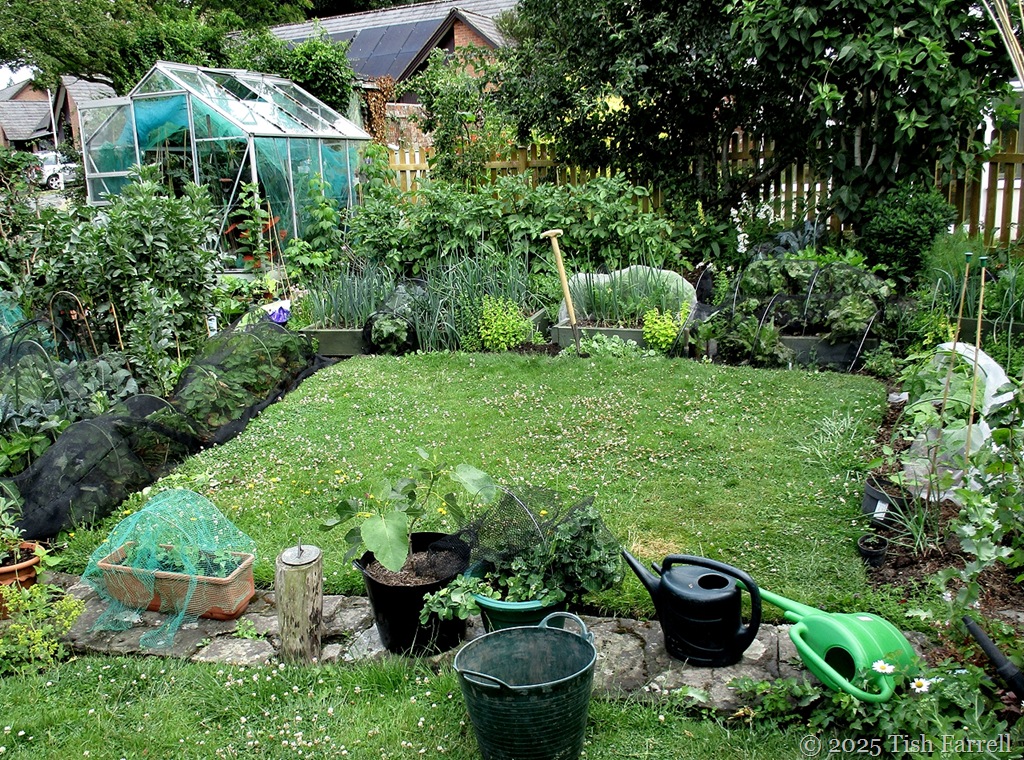
Now, mostly settled in our new home, I do know I must cut my cultivating cloth according to the physical means of production. (The lawns, though, do seem to keep shrinking). Also this year there’s been the matter of watering through the mostly rainless months of spring and early summer. This has been quite hard work. (I know mulching is much of the answer, but my hot compost bin can only yield so much stuff, and so far it’s spread rather too thinly). And then there are birds and cats and insects to contend with which means everything edible has to be netted, which is not very attractive. So, as I say, chaos presently reigns, but with a few organised segments in between.
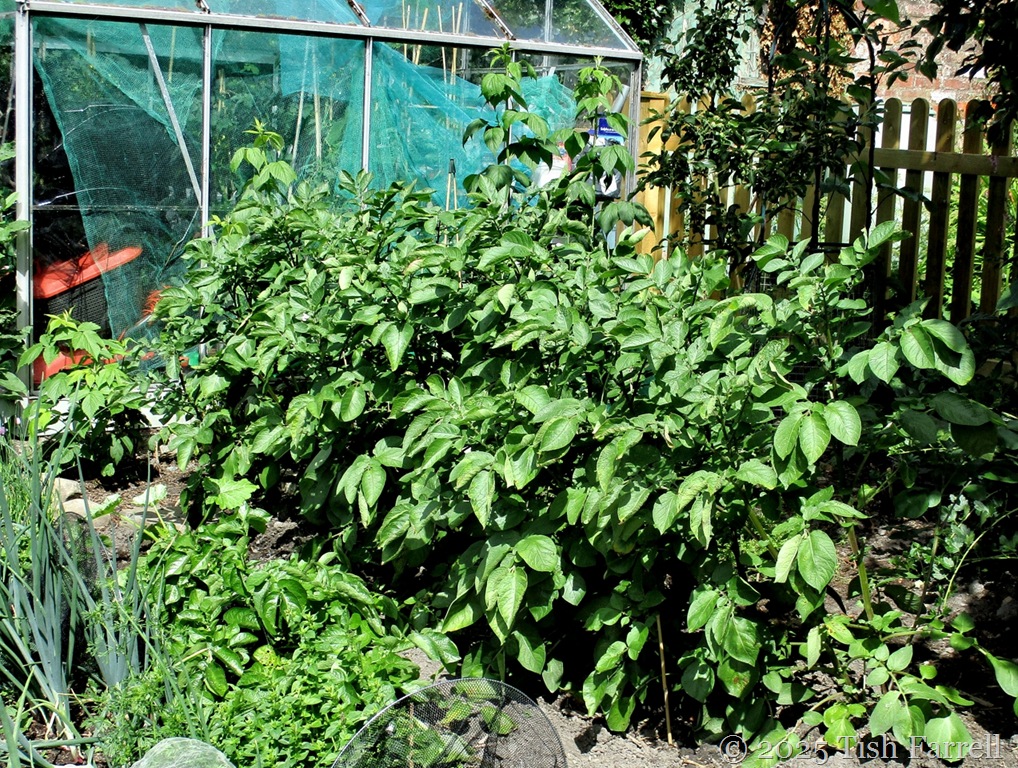
1.) The first of these to produce excitement in the Farrell household are the two short rows of potatoes. They were planted at the end of March, ten in each row. Even with little rain, and not much watering, the Belle de Fontenay have produced some lovely salad potatoes. (They’re also a main crop variety if left longer, but that’s unlikely to happen).
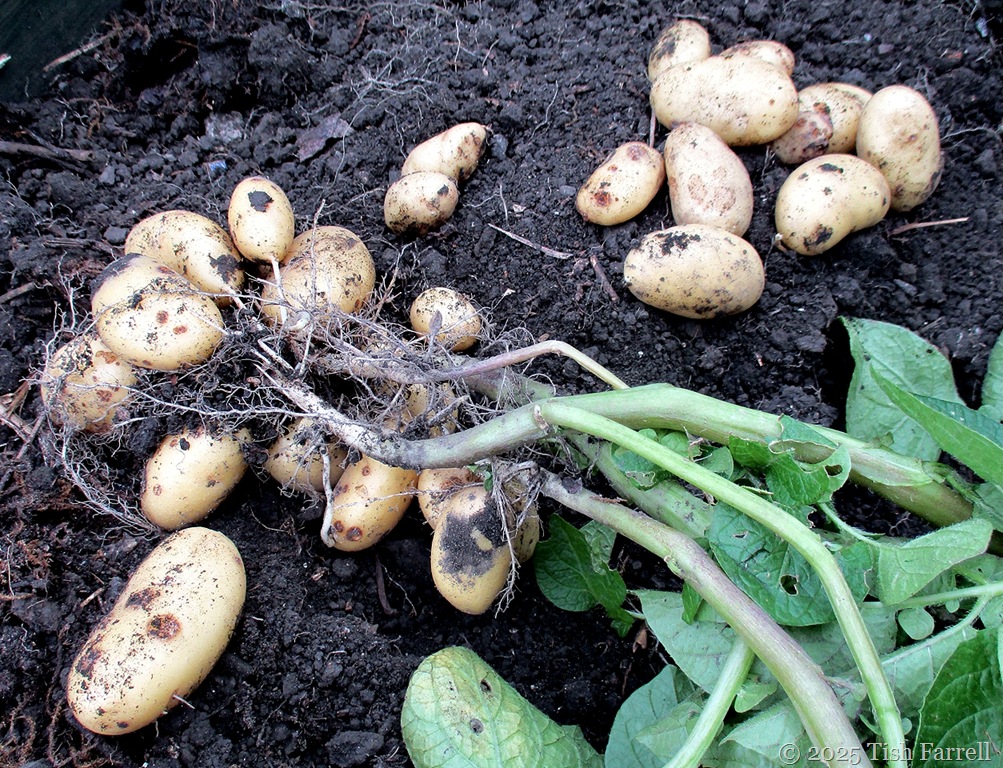
Behind them is a row of Rooster red spuds, also main crop. The plants have grown astonishingly tall, given the weather, while the Belle de Fontenay have flopped flat in front of them. I think the Rooster must have commandeered the downward flow of any available groundwater from the hill above.
*
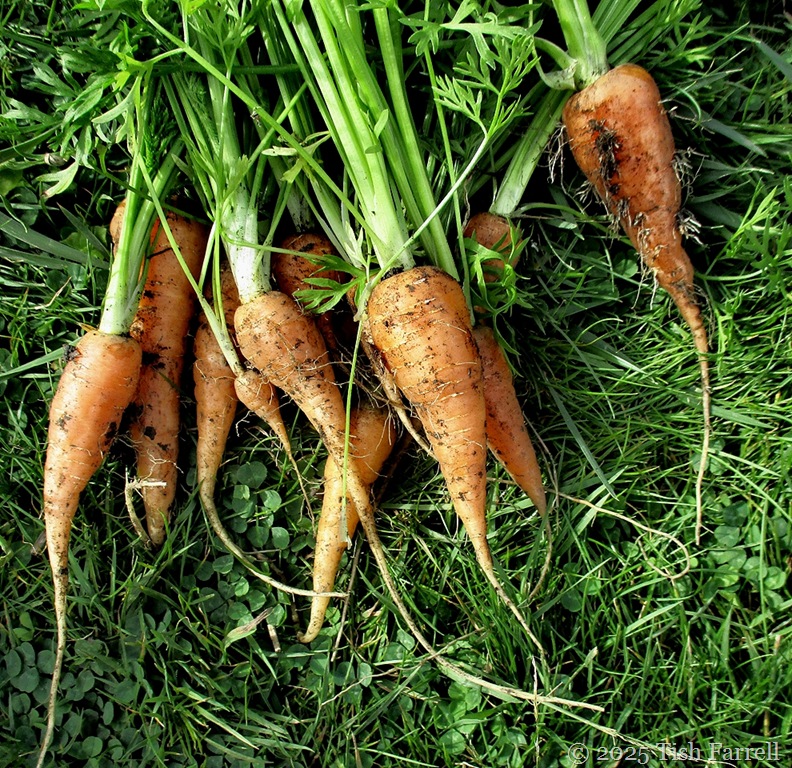
2.) The next excitement this week was a bunch of carrots, and not a single sign of carrot root fly in any of them. I have attempted to protect the rows by growing them in a raised bed, between onions and covered with some fine mesh. Last year all my carrots were root-flied.
*
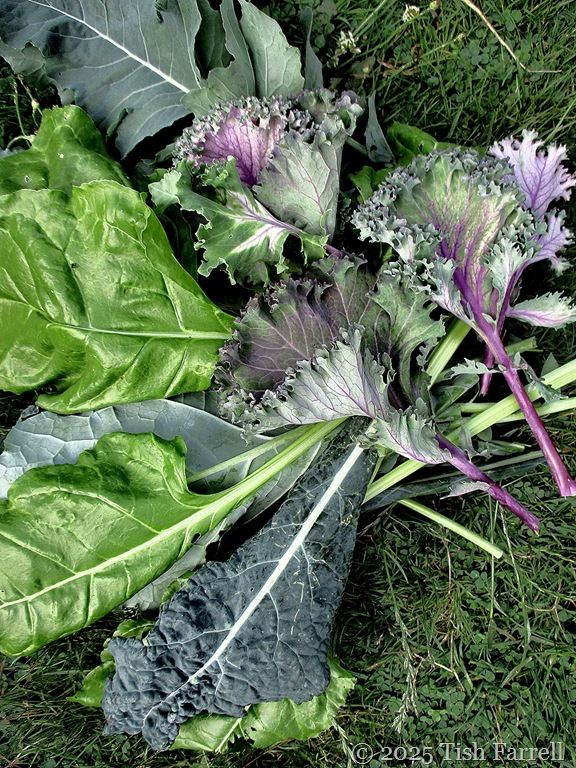
3.) We eat a lot of greens, and this year I’ve grown some different varieties of kale, including, pink frilly, Tuscan, and a crossed Tuscan and Daubenton’s perennial kale, the seed produced by a forest gardener on eBay. (There’s also some Swiss chard in the bunch below.) I know kale isn’t to everyone’s taste, and I’ve yet to try this, but I recently learned you can roast it till crispy. This involves ripping up the washed and dried leaves (without the stalks), tossing the pieces in oil, spreading them on a baking sheet and cooking for 15-20 minutes in a fairly hot oven. Sesame seeds and favourite spices along with sea salt and black may be added.
*
4.) Yesterday we ate our first homegrown courgette (zucchini), and very nice it was too, sliced and lightly browned in the fat from cooked lardons and then added to a salad.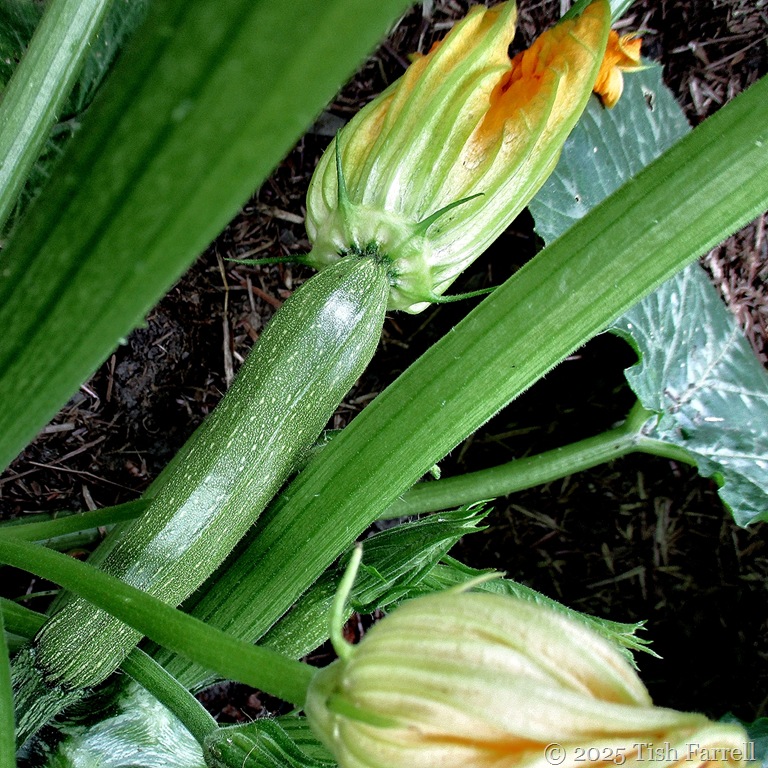
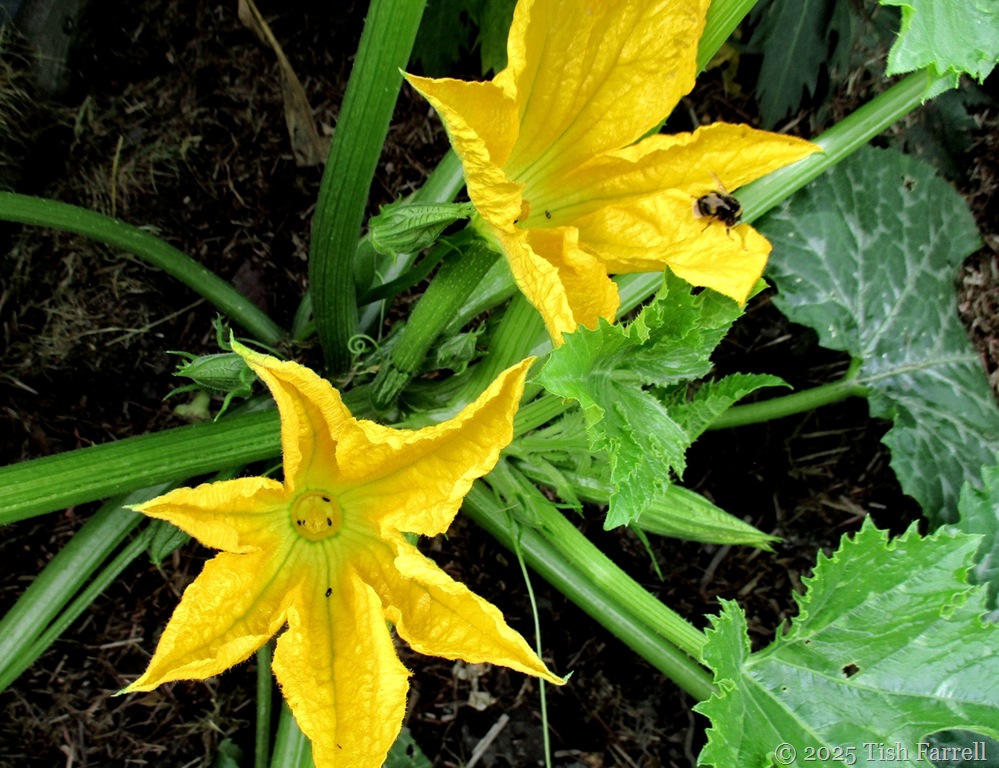
I put the plant in beside the compost bin, a position that clearly is suiting it. I have some yellow courgettes coming on nearby.
*
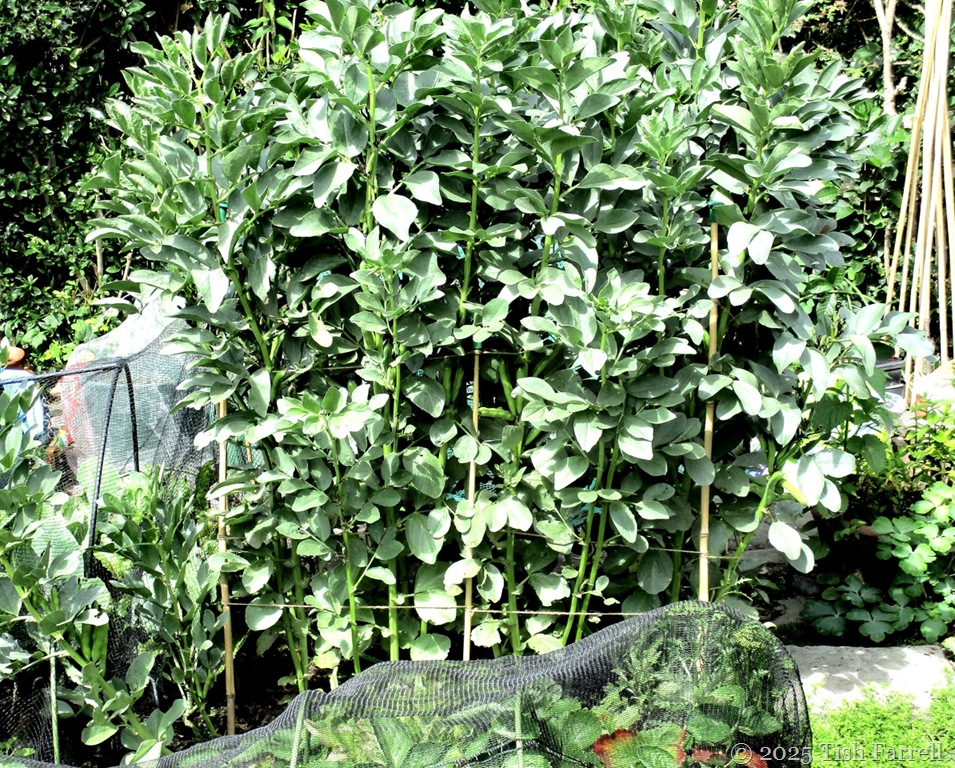
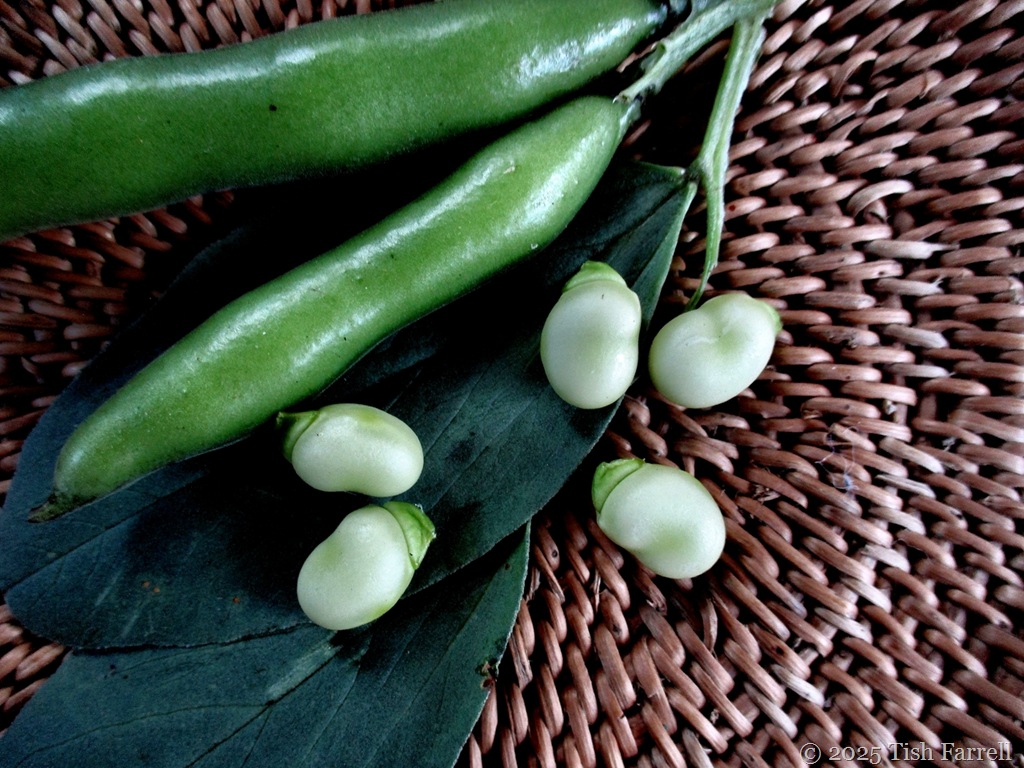
5.) Also in last night’s salad were the first of the field beans. These are a variety of broad (fava) bean, grown mostly in the UK as animal feed or as a green manure, ploughed back in the soil before producing beans. This, I feel, is a lost opportunity. The plants grow four or five feet and taller, while the beans themselves are little bigger than peas. But then the plants are prolific, and so ideal if you haven’t a large enough space to grow their bigger cousins. My field bean plot is around a square metre/yard.
They have anyway, become something of a summer staple in the Farrell household. Picked at the right moment they are deliciously tender and can work as a rather good imitation of guacamole. If they get over-ripe and a bit floury, they make excellent soup and refried beans. The downside is they are fiddly to pod. But then the mass of little pods is good fodder for the hot compost bin, as is all the vegetation (chopped up) when the plants are done.

*
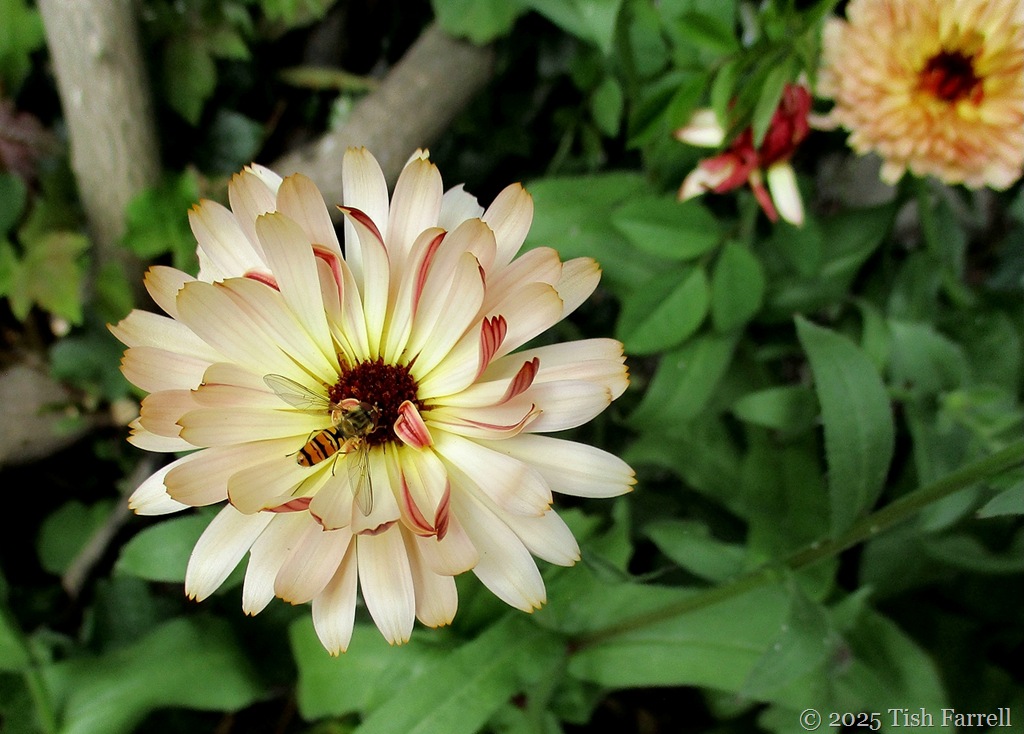
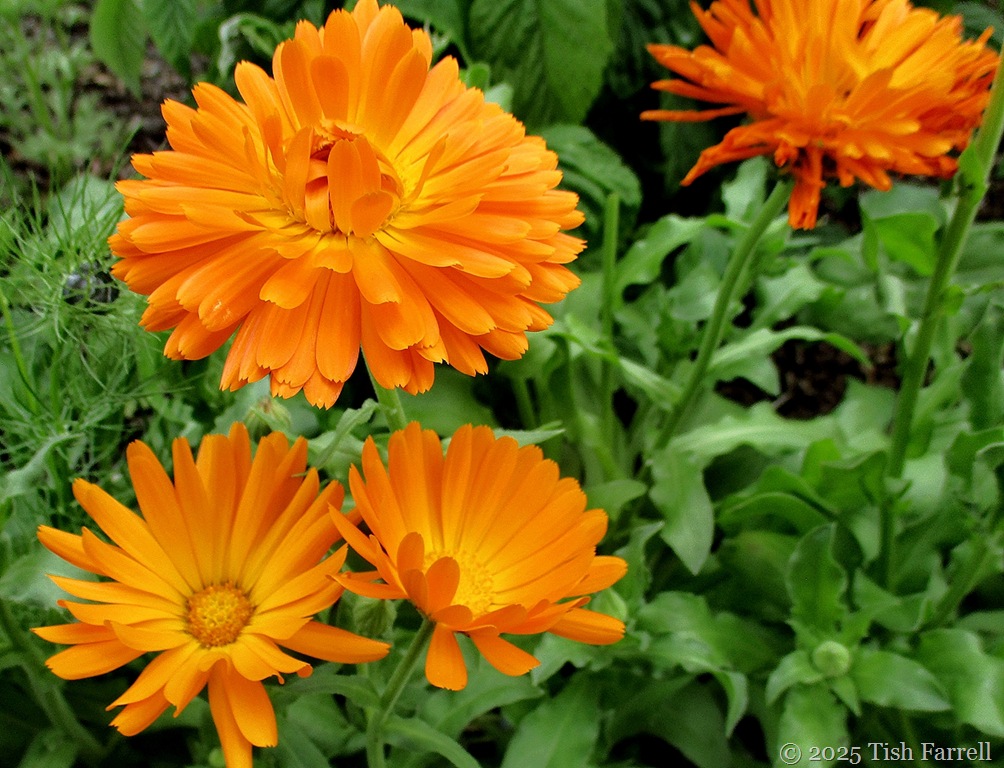
6.) Last but not least on the garden foraging front are the marigolds (Calendula officionalis). I use them in herbal tea. They contain all sorts of therapeutic properties, known and made use of for a couple of thousand years. But mostly I add the petals to salads, taking care not to include any passing hoverfly. This particular variety is called Sherbet Fizz. We also have lots of self-seeded bright orange and yellow ones from last year’s crop. I love them all. They have to be one of the most heartening of flowers. Simply to gaze on them lifts the spirits.
Six on Saturday: Please call on Jim. There’s always lots to look at and discover in his Cornish garden.

Lovely marigolds and agree roast kale is so good.
I will definitely try a spot of kale roasting. Thank you.
I love a productive vegetable patch even more than a flower garden, and this is one of the best! I’ve seen others recommend roasted kale, but I stll haven’t tried it. even though I like both kale and roasted veg. Doesn’t it taste quite simply – er – brassica-ish? And do you have to catch it JUST at the right moment before it burns?
Trial and error, I suspect, when it comes to kale roasting. But I have used the Tuscan variety (steamed first) to make a rather good pesto sauce which didn’t taste at all brassica-ish. Rather surprising.
That sounds worth a go – thanks.
Excellent, Tish. Regarding crispy kale, I use an air fryer, moving the torn leaves frequently so all get crispy.
Thanks for that, Ian. I’ve been pondering on an air fryer, but overwhelmed by choices of same. What sort’s yours.
I got a special deal from Amazon but it is no different from my father’s which cost £30 from Aldi.
Thanks. I will look into it.
An Italian former colleague used to recommend kale stir-fried in garlic oil. I tried it and can definitely recommend it!
That sounds good. Thanks, Helen.
Your industry always astounds me, Tish, and SO ‘much’ produce from your tiny patch. You are amazing xx
Thanks, Jo. It keeps me off the streets 😉
I am very impressed with your harvest.
Well done, Miss T.
😊
Winter down here so will be a couple of months before we can plant taters and wotnot.
But the peas and carrots are still harvesting!
Thanks, Ark. Good you can keep peas and carrots going. I guess as long as the soil doesn’t completely dry out, they’re fairly happy.
Quite a haul considering the challenging weather and various creatures to contend with. The spuds look great, I think we will harvest one of our big pots this weekend, the haulms have already been chopped back as they were beginning to look a little blighty. Nice idea for the courgettes, I might give that a go, sounds delicious!
I have tried one pot of spuds this year. (I had one seed potato spare from the row). It’s a first effort so I’ll be interested to see how they turn out. And yes blight. It’s often hard to decide when and if to chop the foliage. My plant pathologist OH is a little unhelpful on this. Sometimes he diagnoses natural senescence; sometimes he suggests blight. Hmph.
Dear Tish….your garden looks amazing and the veggies superb..xx
Sent from Outlook for Androidhttps://aka.ms/AAb9ysg
Thank you, Janet.
I love your chaotic garden Tish, so rustic and productive. How delicious all that home grown and lovingly produced vegs would be.
Many thanks, Pauline. I do so know growing stuff is a pursuit close to your heart 🙂
Yes just have pots now, but they add a splash of colour to the balcony
Pots are good for brightening up corners. I’m not very disciplined with watering mine though.
Such a beautiful garden Tish. I wish I had a drop of gardening DNA in my body, but alas, I don’t. I can admire your tenacity for gardening.
Thank you for the admiration, Anne. All encouragement welcome 🙂
looks like a great garden to me!
You’re clearly squeezing everything you can from this smaller space! The potatoes look wonderful (I’d love some of them for my favourite home-made potato salad), the purple kale very pretty and likewise the marigolds. I came across a great way of using fava beans in Sicily – the soft insides mashed with a little cheese and lots of herbs and fried in small patties as part of an antipasti selection 🙂
That sounds a most delicious bean recipe, Sarah. Must try to keep it in mind. Thank you.
Well, you really are getting the most from your new smaller garden. I’m always most impressed by what you succeed in producing.
Many thanks, Sue.
Wow, for a small garden you have a lot of healthy produce. I have courgette envy. Yours actually look like courgettes rather than the deformed offerings that grow in my horta. Seeing the picture of your marigolds reminds me I still have not planted the seeds I bought. The packet sits on my desk.
I can see you’ve been having a tough time without rain, Carole.
All those delicious edibles! Each time I scrolled down the next one, I salivated a little more…close to lunch time. Tee hee. Enjoy your healthy produce, and the Marigolds are lovely (and edible), too! Very impressive production in your small edible garden. I don’t grow many edibles because I have a very small patch of bright sun. So I appreciate small, productive gardens. 🙂
Many thanks, Beth. Happy you enjoyed my virtual edibles 🙂
Ah, Tish, your garden grows wonderfully with great produce too! Being a new gardener, I can only add my admiration!
Hello, Marina. Lovely to hear from you. Happy gardening!
Thank you, Tish! So much to learn! So far I’ve lost my cherries and courgettes to birds and unknown visitors! 🤣
So annoying when everyone else wants to lay claim to the outcome of your gardening efforts. And you never stop learning when it comes to gardening.
Very annoying! I suppose you are right about lifelong learning. xo
Your green fingers are enviable Tish, you are definitely the Queen of Edibles. I am impressed at how much you have squeezed in to your small space. Love the Calendula Sherbet Fizz, there are so many wonderful varieties and I am so disappointed that none of my last year beauties set seed.
That’s a shame about the marigolds. They’re usually so prolific.
I know. Most mysterious.
Wow!
I felt certain I’d done a six around vegetables on my allotment and committed to doing others at intervals. Looking back it seems I didn’t even do the first one. I love growing fruit and veg, it’s all so different from ornamental gardening, it’s great to see what others are up to. I look forward to seeing that lawn shrink in future posts. We had one once.
Many thanks for encouragement on the shrinking lawn front. After all, it rots down to such nice soil! Look forward to seeing your allotment doings and produce, and will try to suspend allotment envy 🙂
Must be delightful to grow your own. Do you use carrot leaves? We cook them sometimes, steam or blanch them to add to things. Also, many leaves and flowers in the Cucurbita genus are edible and I wouldn’t mind getting recipes which use leaves of zucchini.
Apart from sometimes poppint them into stock, I don’t use carrot leaves, though I often wonder why not. Cucurbit leaves are delicious, though I’ve not eaten them since we lived in Africa. You sometimes need to peel out the veins and stalks, otherwise I used to slice them and simply add to sauces e.g. satay, and to chicken casseroles/curries. When freshly picked they don’t need much cooking.
well this is all most impressive – my garden is still under review. Hopefully next year I will have decided what I am doing
Yes, deciding what one’s doing is a bit of a hurdle in the Farrell domain. Quite a lot of my planting is provisional, and what isn’t provisional is haphazard. Of course it’s gently suggested that I make an actual plan…
A woman after my own heart