


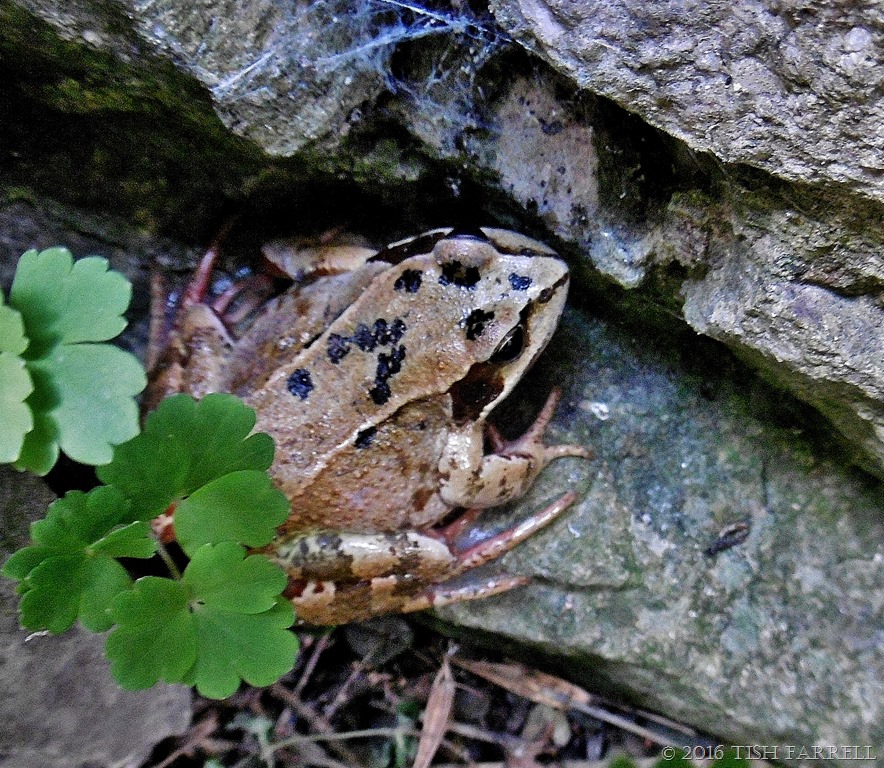
And I’ve the pictures to prove it – the frog whispering that is.
This handsome amphibian and I gave each other a shock on Sunday morning. I was tidying up the overgrowth of self-sown columbines and lady’s mantle outside the kitchen door. And there he was under a columbine leaf. We both froze, until I thought to grab my camera. By then he was on the move, but froze again as the Lumix closed in. Being Sunday I was finding it hard to focus, and thinking he was about to flee, I started talking to him very quietly. And darn me, if he didn’t sit right up and listen:

I don’t know how well frog-human relations have been documented beyond that seminal work of the Brothers Grimm, but I can report there was no clinch, and thus no princely transformation. And it being an unfocused Sunday morning, as I said, I soon ran out of things to talk about and so returned to garden work, while he hopped off to his drain pipe in the wall. A brief encounter then. We will probably never meet again. But at least I have the photos. I can dream…
copyright 2016 Tish Farrell

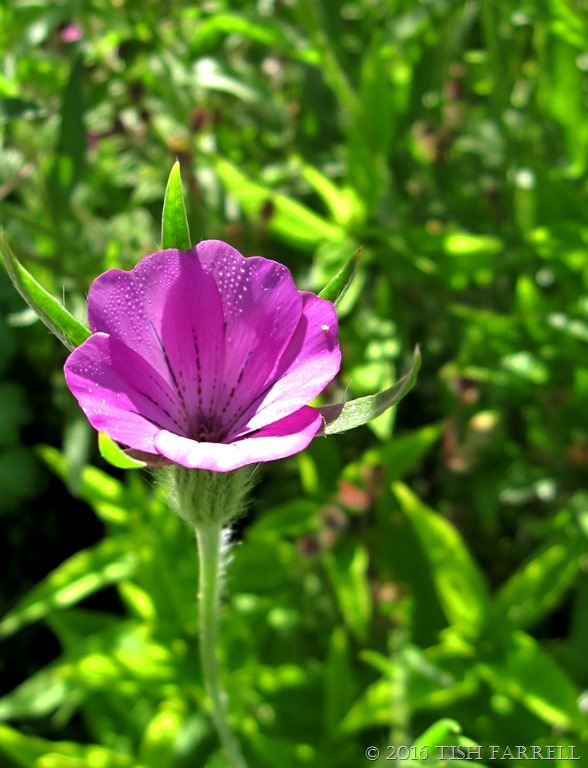
The flower is a wild corn cockle, and in real life it’s around an inch across, or two and a bit centimetres in alternative dimensions. The spider is utterly minute then, and the smallest I have spotted so far in the Farrell garden on Sheinton Street. In fact I only started noticing this species at all after Ark at A Tale Unfolds introduced me to the ones in his Johannesburg garden. Please check out his blog for more of his astonishing garden photos, though be warned – some of his close up arachnid shots might give spiderphobes a turn.
Also please visit Jude at her Macro Monday slot for more wonderful work. She’s featuring geraniums whose intricate beauty we perhaps do not appreciate enough.
Now here’s a less macro shot of the spider though it’s still larger than real life: hard to spot it beside the dewdrops:
The Olympic Games begin in Rio today – cue views of Copacabana Beach and Corcovado Mountain with its astonishing statue of Christ the Redeemer. Now switch scenes to a small town in rural England, to a meadow in Much Wenlock, and turn back the clock to 1850, for this is where it began – the source and the inspiration for the modern Olympic Movement.
The town’s physician, Dr William Penny Brookes was the man behind the revival of the ancient Athenian games. His objective was clear:
for the promotion of the moral, physical and intellectual improvement of the inhabitants of the town & neighbourhood of Wenlock and especially of the working classes, by the encouragement of out-door recreation, and by the award of prizes annually at public meetings for skill in athletic exercise and proficiency in intellectual and industrial attainments.
He had already started the Agricultural Reading Society and been hard at work raising funds from Shropshire’s gentry to establish a working man’s reading room, while lobbying every famous writer of the day to donate copies of their works to the cause. Much of the library still exists in the town’s archives and includes some heavy-going and esoteric histories of far-flung lands. It is hard to guess the appeal of such books to farm hands and quarrymen after their long day’s labours, but at least they would have had decent light to read by. Brookes was also behind the founding of the town’s gas works.
Wenlock’s Olympian Society grew out of the Agricultural Reading Society. The very first games were held on the town’s race course but in later years took place (as they still do every year) on the field below Windmill Hill, now known as the Gaskell Recreation Ground, or as Penny Brookes himself called it, the Linden Field.
Nor was it any rustic village fete affair. The local MP J M Gaskell provided seating on Windmill Hill to give everyone a fine view, and the event was heralded with much ceremony, the town streets decked out from end to end, a parade of competitors, flag bearers and officials all marching with the local band. From the start, then, pageantry was a key part of the games, lifting people from their humdrum, hardworking existences. And although there were many fun contests and traditional country sports, the athletic events were taken seriously, and attracted competitors from all over the country. Prizes included silver cups and ink stands presented by local worthies and Penny Brookes designed elaborate medals – gold, silver, bronze, and had them made at his own expense.
News of the games spread far and wide, and indeed were spoken of in very high places. In 1890, when the French aristocrat Baron Pierre de Courbetin had been charged with finding ways to improve the fitness of the French Army, he was advised to go and see the Wenlock games. He stayed in Brookes’ house on Wilmore Street during his visit, and what he saw and also learned from Brookes inspired him to found the International Olympic Committee. The IOC held their first games in Athens in 1896, and although Brookes did not live long enough to see the extent of his influence, de Courbetin gave him due recognition:
If the Olympic Games which modern Greece did not know how to establish again is revived today, it is not to a Greek that one is indebted, but to Dr. W P Brookes.
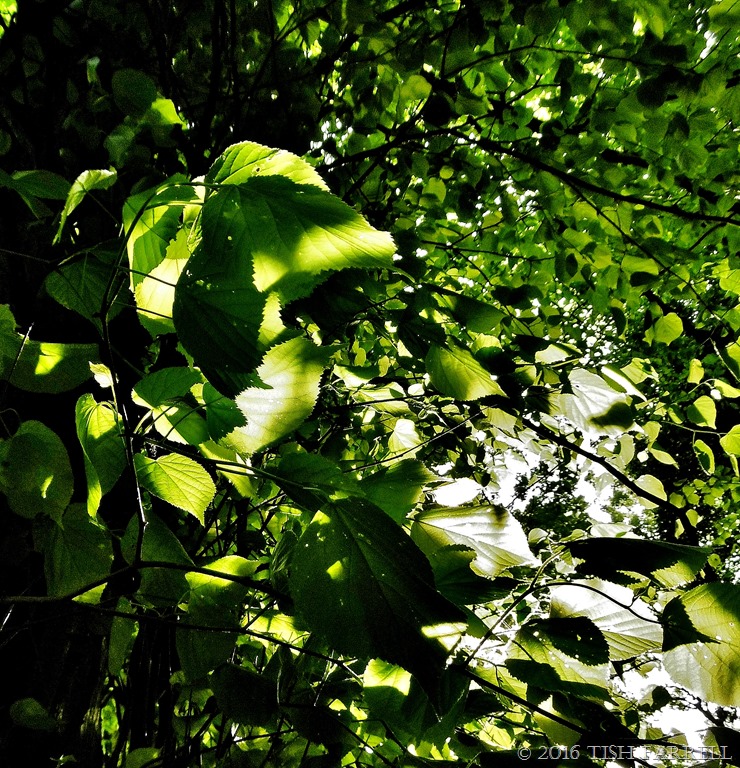
We the people of Much Wenlock are also indebted to Dr. Brookes for his planting of the lime tree avenue alongside the Linden Field where the games took place. As I’ve said before, it is one of the town’s enduring treasures. The trees are over 150 years old, and still in fine form. There is no time of the year when this avenue is not beautiful. In winter it is deeply mysterious, a colonnade to another reality. But whatever the season, there is always a play of light and shadow. And there is windrush in the high canopies, and crow call. And in summer the soporific scents of tiny green lime tree flowers.
Here, then, are a few more views, and so when you see the grand and glamorous opening of the Rio Olympics, give a thought also to this place and the Shropshire doctor, who with the well being of his townspeople in mind, inspired the modern Olympic Movement:


This post was inspired by Paula’s Thursday’s Special theme ‘shadow’. Please visit her blog and join in this week’s challenge.
#2016OlympicGames

The opium poppies that have been growing behind our sheds (aka the old privies) are on their last gasp now – one or two blooms amongst a phalanx of seed heads. But there’s still plenty of bee forage along the fence – pale mauve spires of spearmint, purple tufts of wild knapweed, the oregano coming into flower.
And there’s also much to entice them inside the garden.

These ornamental strawberry plants have colonized the gravel path. I might have to move them at the end of the summer. They definitely have world domination in mind. And although they make tasty Alpine type strawberry fruits, the blackbirds always seem to get to them first.
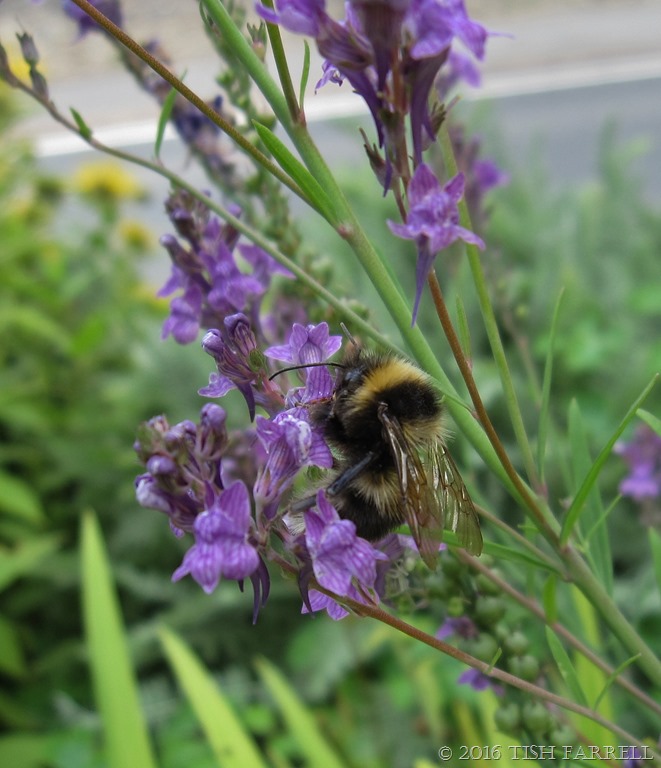
Purple Toadflax is another bee favourite, and it also grows itself around the garden.
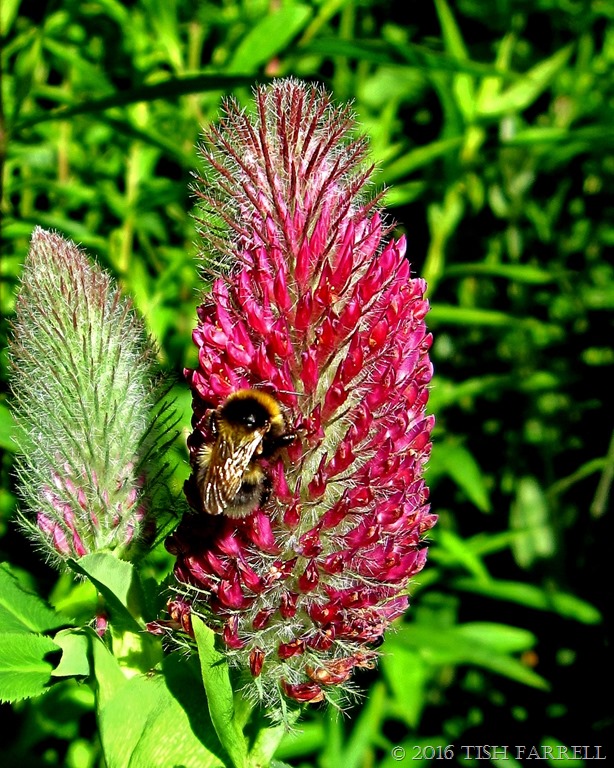
And finally, here we have a bee in clover, wings all of a dazzle in the midday sun:
Now for some really good close-up photography, please buzz off to Jude’s Macro Monday
