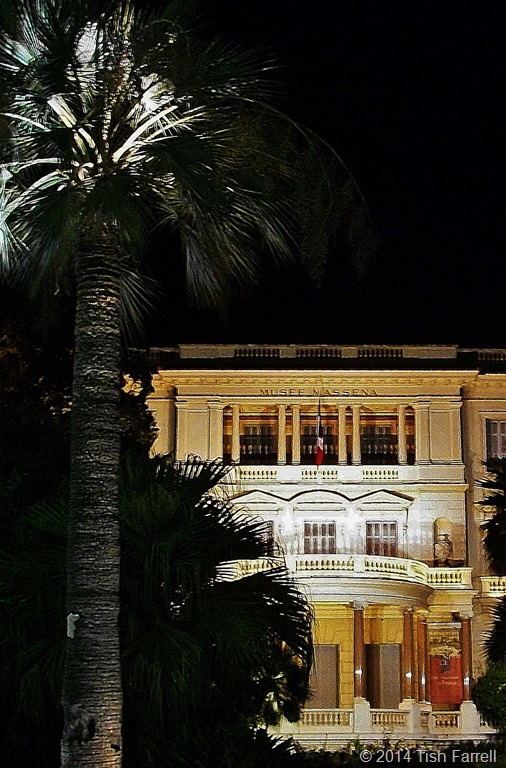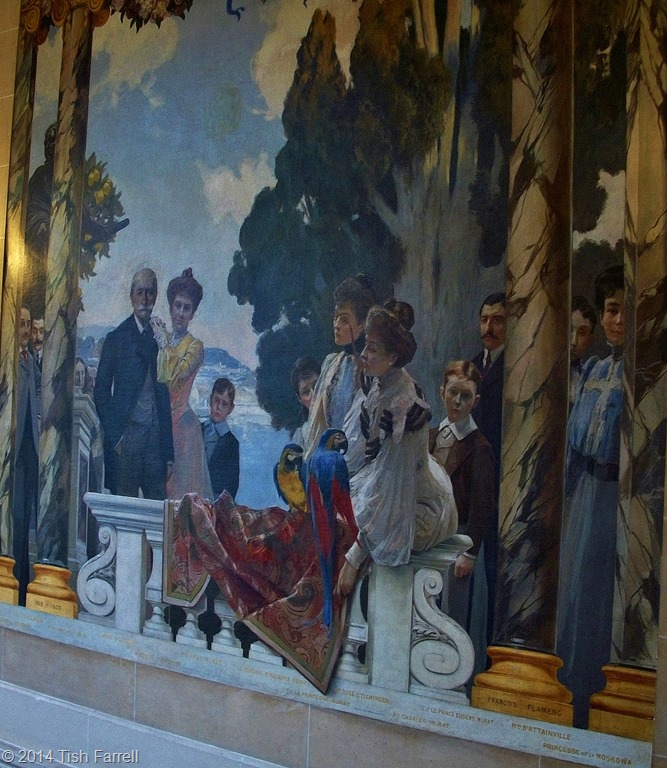
Nice Family? En famille at the Massena Palace

The family who lived in the Palais de Masena

100_1225.jpg
Believe me, the family gathering depicted in these two murals has more tales to tell than most. They could be the very depiction of Tolstoy’s famous opening to the tragic novel Anna Karenina: (and I paraphrase) all happy families look alike, but the unhappy ones are unhappy in their own inimitable way. I leave you to decide which sort we have here.

But before the stories, first a little about the murals’ setting. They face one another across the top of the grand staircase in the Palais Masséna in Nice. This imposing house was one of the last of its kind to be built on the Promenade des Anglais, looking
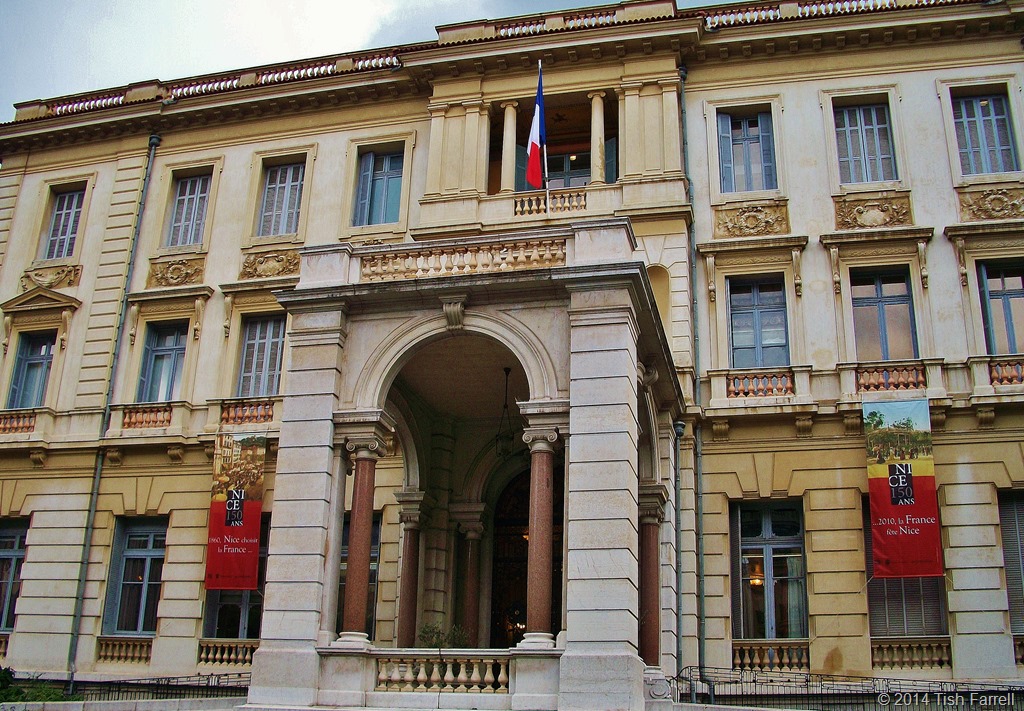
Palais de Masena

out on the sparkling blue Mediterranean.  It was designed by Danish architect Hans-Georg Tersling (1857-1920),  and  finished in 1901. By then Nice had long been a thriving upper class resort, a trend begun in the 1730s when British aristocrats such as Lord and Lady Cavendish first began to gather at Nice and along Côte d’Azur for the winter season. Back then Nice was an ancient fishing town. The Scottish poet, Tobias Smollett describes it in 1764. He went there in hopes that the benign winter climate would help improve his consumption:

“This little town, hardly a mile in circumference, is said to contain twelve thousand inhabitants. The streets are narrow; the houses are built of stone, and the windows in general are fitted with paper instead of glass. This expedient would not answer in a country subject to rain and storms; but here, where there is very little of either, the paper lozenges answer tolerably well. The bourgeois, however, begin to have their houses sashed with glass. Between the town-wall and the sea, the fishermen haul up their boats upon the open beach.”

As time went on the Tsars of Russia and the Romanov family made the South of France their second home, which circumstance, in 1912, prompted Tsar Nicholas II to build the Russian Orthodox Cathedral in Nice to serve the Russian nobility. Even Queen Victoria came on holiday to Nice, staying in the magnificent  Excelsior Régina Palace which looks down on the city and the sea from the hill of Cimiez. It was apparently built in response to her requirements for a place to stay that matched her status. And so the hotels and palaces grew up around the old town of Nice to provide for the royal, rich and famous.

Le_Regina_à_Cimiez_6_Fi_09_0041[1]

Excelsior Regina Palace built 1895-7; Photo: Nice Archives copyright expired

*

Angelo Garino Promenade des Anglais 1922[1]Detail from Promenade des Anglais 1922 by Angelo Garino  (1860-1945)

*

Some of these elite visitors and palace owners acquired their riches and nobility by rather questionable means, and this includes the erstwhile owners of the Palais Masséna. It was built for Victor Masséna, 3rd Prince d’Essling, 3rd Duc de Rivoli and the grandson of  André Masséna, son of a Nice shopkeeper who acquired wealth and royalty while serving and plundering in Bonaparte’s army.  More of him later.

The two family murals are dated 1902-3 and include members of the intermarried Masséna, Murat and Ney families. The reason for the elevated positions and princely titles is entirely due to Napoleon Bonaparte and his ambitions of military conquest.  The founders of their ennobled dynasties were three ordinary men from ordinary backgrounds who joined the French army. All three proved to be brilliant and courageous soldiers who ascended rapidly through the ranks to become Marshals of Empire.

Joachim Murat, an innkeeper’s son, married Bonaparte’s youngest sister, Caroline, and for services rendered was made the King of Naples. He ruled between 1808 and 1815. File:Murat2.jpg

*

Michel Ney, a public notary and surveyor of mines, gave up being a civil servant and enlisted in the hussars. After great battle victories he became 1st Prince de la Moskowa, 1st Duc d’Elchingen.

File:Marechal Ney.jpg

*

As mentioned above, André Masséna earned the titles 1st Duc de Rivoli and 1st Prince d’Essling.

File:Renault - André Masséna, duc de Rivoli, prince d'Essling, maréchal de France (1756-1817).jpg

*

But status and wealth are not everything. Nor were they enjoyed for long. Masséna, long suffering from ill-health, died in retirement after being serially dismissed by Napoleon, first for excessive war looting, and then (after reinstatement) for military failures against the British in the Peninsular War. In his last days before his death in 1817, he supported the restoration of King Louis XVIII to the French throne. Doubtless a wise move for his descendants.

In 1815, after the capture and  exile of Napoleon Bonaparte, both Murat and Ney were executed by firing squad for treason. Murat’s two sons went to North America in the 1820s; the elder stayed and became a citizen, but the younger, Napoléon-Lucien-Charles returned to France in 1848 when his title as Prince Murat was recognised by Napoleon III under the Second Empire.

*

And so we come back to the descendants of the three brave Marshals on the walls of the Palais Masséna. The more you look at these murals, the more curious they seem. They were painted by the then successful French artist François Flameng (1856–1923). He later went on to paint Great War battle scenes, and document new kinds of families, the close-knit comradeship of companies of men under siege.

300px-A_Machine-Gun_Company_of_Chasseurs_Alpins_in_the_Barren_Winter_Landscape_of_the_Vosges._painting_by_Francois_Flamenge[1]

A Machine Gun Company of Chasseurs Alpins in the Barren Winter Landscape of the Vosges, François Flameng, photo Wikimedia Commons.

*

DSCN4945[1]

I suppose my first question is why would the mural people wish to have themselves depicted in this way? Certainly there is a sense of entitlement and much self-regarding, but at the same time it is also as if they are not quite self-aware. Flameng verges on caricature for most of his subjects.  For surely there are suggestions of secrets, collusion, factions, conspiracy, loss of status within the gilded circle.  There are shared misfortunes and private sorrows; anxiety and repression; no one smiles; the children look utterly constrained. And then there are simply too many people peering round pillars, or only half seen despite their prestigious titles.

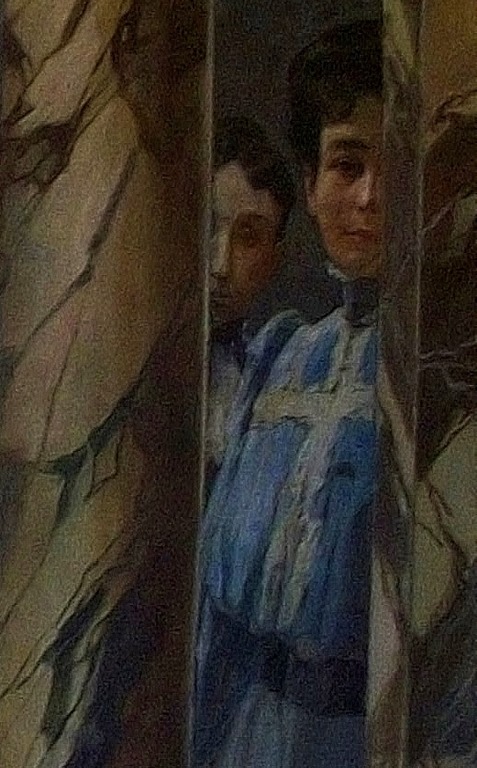
The two men on the far left of the second painting look distinctly rascally, their almost-smiles, sardonic, malicious.  They are related, brothers I think; the nearest to the viewer is Napoleon Ney, Prince de la Moskowa; behind him Claude Ney, Duc d’Elchingen. In 1903, the year the murals were completed, the Prince and Princesse de la Moskowa were divorced. La Princesse is the sad woman in the blue gown at the other end of the mural, only partially seen behind the column. Is Flameng intimating her loss of status in relation to the others? She is Eugénie, youngest daughter of Napoleon Bonaparte. She married the Prince in Rome at the Villa Bonaparte in 1898, and with all the Ney family in attendance. The couple had no children.

100_1225 (2)

100_1225 - Copy

Here is Eugenie on her wedding day. The photograph is attributed to Count Guiseppe Primoli.
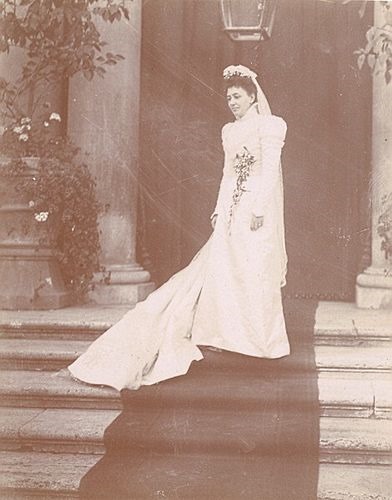
Eugenie Bonaparte 1898

*

Further along the mural from the Ney brothers is Victor Masséna, Prince d’Essling, the builder of the palace. His eldest daughter, Anne, has a proprietorial hold on his shoulder. He will die in 1810 in a Paris nursing home after an operation, and she will marry the Duc d’Albufera. The two faded souls at Victor’s elbow are his long-dead parents, also named Anne and Victor.
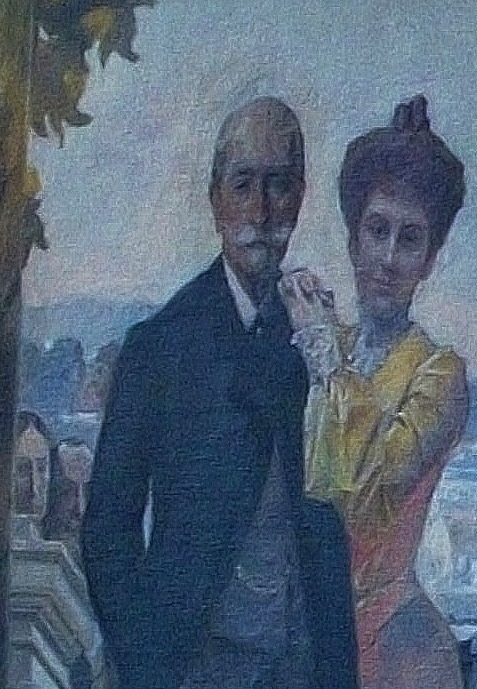
100_1225

The only calm and truly sympathetic face among the whole gathering is that of Rose Ney d’Elchingen. She leans over the balustrade accompanied by two macaws and an expensive tapestry. Beside her (with the pince nez) is the Princesse Joachim Murat, born Cecile Ney d’Elchingen, probably Rose’s sister. Her husband, Prince Joachim Murat, is across the stairs, lurking between a pillar and a large urn.  Rose, herself, will marry the distinguished Italian politician Duca Guiseppe Lanza di Camastra, and he will die prematurely in 1927 at the age of 31. Before that though, a 1916 newspaper photo will show Rose La Duchesse in full nurse’s gear, apparently assisting the surgeon with the war wounded at Val-de-Grâce military hospital in Paris. She is well-known for her beauty and philanthropy.
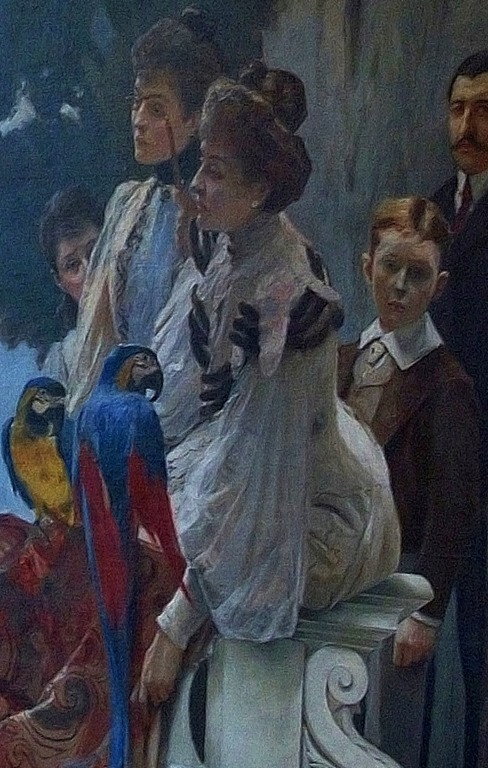
100_1225

Also in this mural detail is Prince Eugene Murat and the boy Charles Murat. The prince will die, aged 30, in 1906 when he overturns his car  while driving to Karlsbad. The report says he lived in Paris and left three children. It does not mention that he was married to the notorious Violette Ney d’Elchingen, Princesse Eugene Murat, and Rose’s sister. We are about to meet her across the staircase. They could not be less alike, at least in their demeanour.
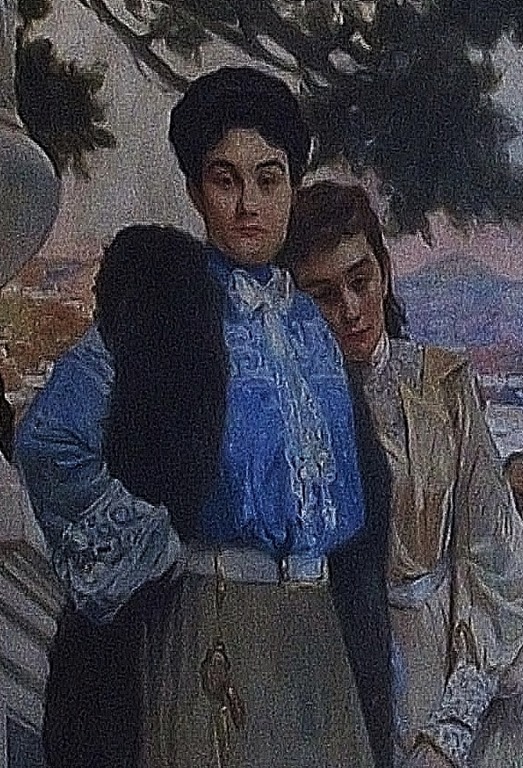
The family who lived in the Palais de Masena

In fact you can hardly miss her, can you, Madame in the royal blue blouse. She seems to dominate the gathering on both sides of le grand escalier. The hand on hip gesture looks coarse, suggestive more of a nicoise fishwife than a princess. She is also the only one taking an active, indeed aggressive stance. She looks out at us visitors as if we were something unpleasant she has stepped in.

But what did the artist Flameng mean us to understand from this image? And what is going on with sad, submissive girl who leans against the redoubtable Violette? After all, this is not mother and daughter. The girl is Victoire  Masséna, younger daughter of Victor. She is around 14 years old here. In 4 years she will be married to the Marquis de Montesquiou. She will have two sons and at 30 she will be dead. Perhaps she foresees her future. Perhaps when you know that Violette, besides being a mother of three, is also a predatory bisexual, you might think there is something more sinister here. But then maybe one should not jump to conclusions.

tumblr_m74mcdKjfO1qjm0dlo1_500[1]

Princess Eugene Murat c.1929; photo Berenice Abbott

*

In the decades of her widowhood, after the car-crash death of Eugene, Violette led a very gay life, and in all senses of the word. She was part of the Paris and Harlem Jazz Age scene. She entertained the likes of Stravinsky and Cocteau in her Paris home. She was a friend of the artist Augustus John who sketched her quite pleasingly while she introduced him to novel ways of taking hashish. In his autobiography he says:

“I had already tried smoking this celebrated drug without the slightest result. It was Princess Murat who converted me. She contributed several pots of the substance in the form of a compôte or jam. A teaspoonful was taken at intervals.”

She famously stormed out of a very famous Paris dinner party, held in 1922 for Europe’s artistic elite. The guests of honour included Diaghilev, Stravinsky, James Joyce, and Picasso. But it was the appearance of the reclusive Marcel Proust that evinced Princess Murat’s all too visible disfavour. At the time everyone who was anyone was trying to identify themselves and others in the characters of Proust’s À la Recherche du temps perdu. Violette, who was renowned for meanness had seemingly provided the model for an extremely miserly individual.

She was, in fact, exceedingly generous with the cocaine, or so we discover in Sebastian Faulks’ book The Fatal Englishman, which includes the biography of the English artist, Christopher Wood (1901-30). In it he describes Violette as “an enormous drug-addicted lesbian with a hunger for company.” She goes around with a bag of cocaine and lays out lines for Wood when he is struggling to complete a piece of work. Faulks tells, too, of Wood’s claim that she lost £5 or 6 million in the 1929 Stock Market crash. She ended her days, living in squalor, having overcome an earlier obsession with maintaining cleanliness, and died of barbiturate poisoning at the age of 58. A sad end to a damaged life.

And what was at the heart of this – sibling jealousy perhaps? Does that explain Flameng’s placing of the players in the murals – the beautiful Rose on one side of the stairs, blissfully unaware of her allure, and beloved even by the two family macaws? While opposite, the portly, coarse featured sister tries to outface her, and indeed the whole world that pays court to her much prettier sister. It’s a theory.

Finally, there is a more pleasing story, at least as far as the palace is concerned. Below on the left we see Victor Masséna’s heir, André, the future Prince d’Essling beside his mother, Princesse d’Essling. In 1919, with his father dead nearly ten years, he hands the Palais Masséna to the city of Nice on the understanding that it will be open to the public. Today it is the city’s local history and art museum.

The family who lived in the Palais de Masena

And so what is there left to say about this self-aggrandizing family. With hindsight one could say that in real life, when these murals were painted, the Belle Époque was drawing to its close. Did Flameng already sense this? The world was changing. Soon there would no longer be the annual winter retreat to the Palais Masséna.  Somehow, then, the murals do have a Proustian feel, perhaps a missing story thread from À la Recherche du temps perdu; the last moment of a perfect, and rarified age caught in two wall paintings, and now gawped at by the passing public.

And as for the three Marshals of France whose derring-do started all this social climbing, you  may find them lying quite close to one another in the Père Lachaise Cemetery, Paris. There they have long since made their residence – among the great and growing family of the dead.
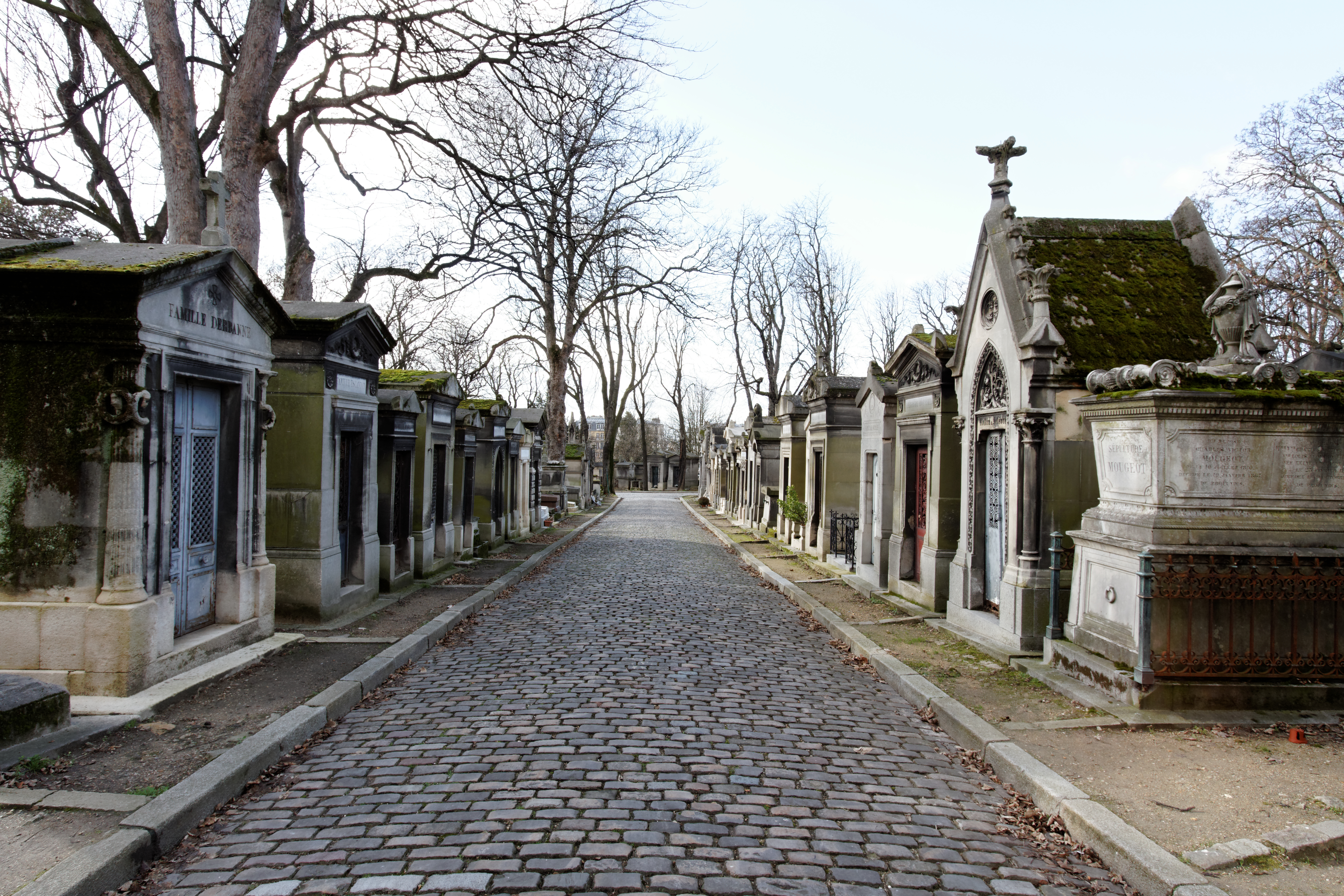
File:Père-Lachaise - chemin 01.jpg

Père Lachaise Cemetery, in Paris.Photo: Pierre-Yves Beaudouin / Wikimedia Commons / CC-BY-SA-3.0

*

Last but not least, I leave you with glimpses of former winter season glory chez Masséna.
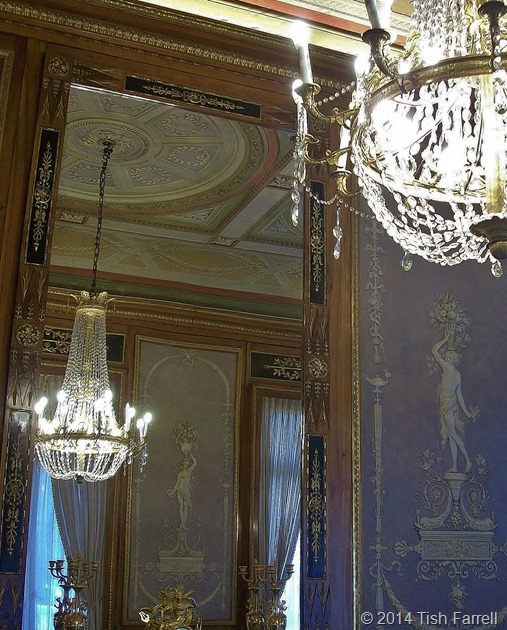
Nice is filled with chandeliers

Palais de Masena, now a museum

© 2014 Tish Farrell


Bright Fields on Llyn: windows in time, mind and space and other stories from Cymru

 The-bright-field-cropped_thumb9.jpg

Oh all right, I confess. My take on the WP photo challenge is a little tangential. Also I have combined it with Ailsa’s travel theme ‘illuminated’ and Frizztext’s ‘B’ challenge (links below). But for me, photographs are windows in their own right, focusing the eye, mind and sensibility. The ones in this post seem to reveal a glimpse of something that require my special attention. And while some shots do in fact include actual windows, most are about those tiny ah-ha moments: the event, image, artefact that opened a window in my mind, whether a crack, or a full-blown throw-back-the-shutters moment.

And so it was stormy September, and the holiday-season well and truly over when Nosy Writer and the Team Leader headed to Wales for a few days. G. had a brand new camera to learn. I, as ever, was happy to snap whatever caught my eye.

We stayed in an odd, but well-meant  B & B in Llanbedrog, and set off each day to explore North Wales’ Llŷn Peninsula. The weather was deeply discouraging. Wales has much wet weather, and, with it, an oppositely equal lack of indoor places to visit, especially out of season. The first day it rained so hard there was no choice but to head for the nearest large town in hopes of finding something to do under cover.  We drove up the coast to Caernarfon,and once there sat  in a car park for an hour while the rain teemed down on the windscreen. Finally, it eased off enough to venture out. By then, the ludicrousness of coming on holiday to sit in a Welsh car park watching supermarket deliveries was beginning to grate.

100_4474

Swathed in raingear we trailed around an impressive but dreary Caernarfon Castle, the remnant expression of Edward I of England’s systematic oppression of the Welsh people. In 1283 he extended a small Norman motte and bailey castle into a massive fortress – all the better to assert English rule over the Welsh and their princes. In design it is said to recall the walls of Constantinople, seat of Roman imperial power, thus invoking memories of more ancient times when the Romans also subdued the Welsh. These earlier invaders built the nearby fort of Segontium and, like the castle, it commanded the Menai Straits and the island of  Ynys Môn (Anglesey) beyond.

Segontium was built in AD77 by the Roman governor of Britain, Gnaeus Julius Agricola, in preparation for the capture Anglesey (see Island of Old Ghosts). Over a thousand years later the castle was built as one in a circle of mighty fortresses to control the people of North Wales. In 1284 Edward’s heir,  later Edward II, was born there, and thus proclaimed the first English Prince of Wales. Though English born and bred, I find this hard to swallow.

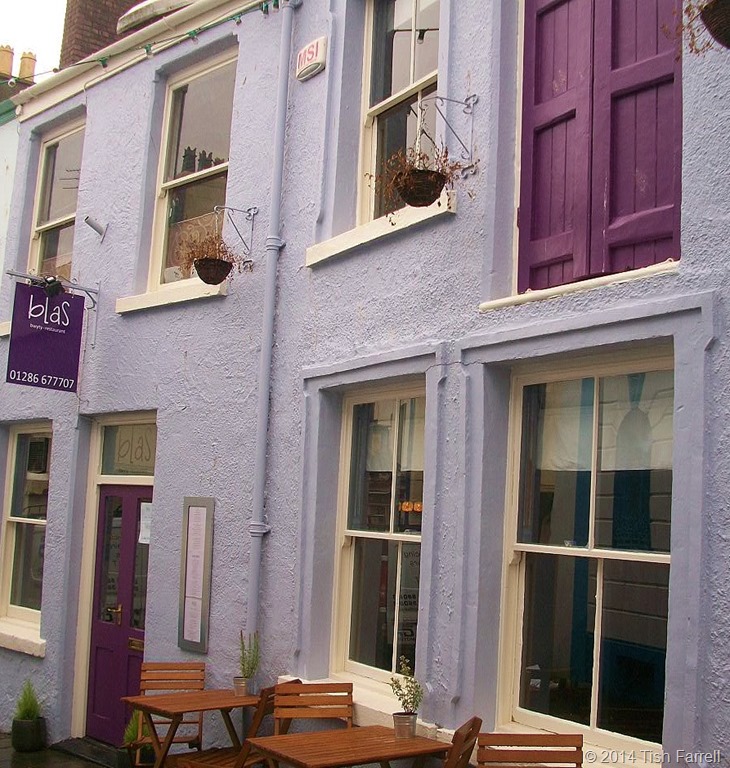
And so I think I would have found Caernarfon Castle depressing even in broad sunshine – too much death and domination. The best part of the day was definitely lunch in one of the town’s meandering back-streets. At the bistro Blas they welcomed us in from another downpour, and kindly allowed us to drip on their carpet while feeding us delicious food. Not only that, it was so soothingly lavender, both inside and out.

100_4493

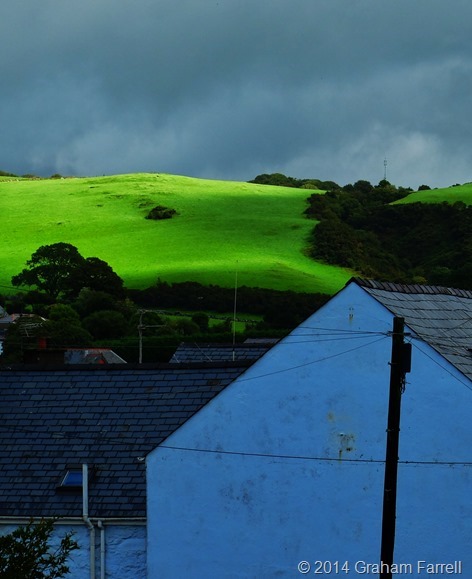
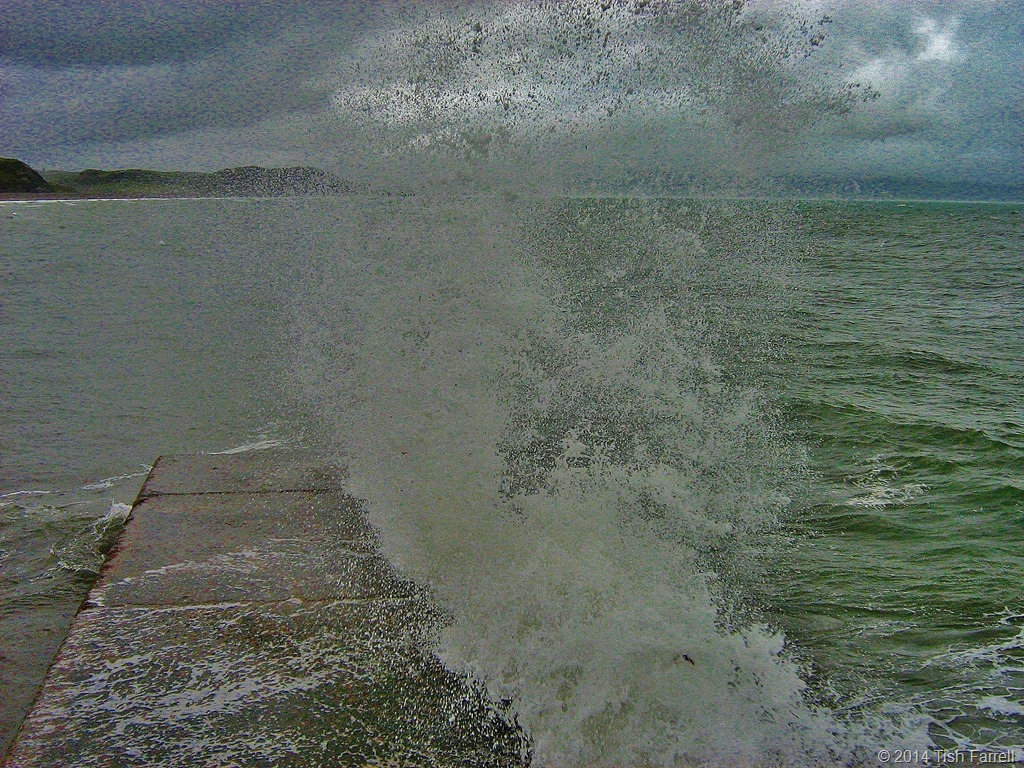
It was the next day, with the rain abating and the sea roiling over the Cricieth breakwater (beneath another Edward I castle) that we spotted the bright field in the first photo. G. thought it was a good opportunity to start getting to grips with his Fujicamera. I snapped the sea.

IMG_0620

But seeing that bright field, so astonishingly luminous against the grey sky, reminded me of the poem of the same name, written by the great Welsh poet-priest R.S.Thomas. This craggy, slab of a man was as redoubtable as one of Edward Longshanks’ castles.

In fact he might have been hewn  from the bed-rock of his native Wales. And like all such formations he had his fissures, faults and flaws. Many thought him morose, cantankerous, and rife with ambiguity and contradiction. For one thing, he abhorred the Anglicisation of Wales, yet he wrote in English despite being a Welsh speaker. In 1996 he was nominated for the Nobel Prize for Literature, but  lost out to Seamus Heaney. 

As a priest he was kindly and sympathetic to the hardships of his parishioners, although this would not stop him from hectoring them from the pulpit, urging them to foreswear any yearning for consumer durables such as refrigerators and washing machines. He could also be judgemental and, as a fierce Welsh Nationalist and political activist, withering about the failure of the Welsh to resist being swamped by Englishness.

Thomas’s poetry, then, can be both trenchant and transcendent. While I do not subscribe to his religion, I honour the spirit of his words. His poems are among those I love most. Here it is then:

The Bright Field

*

I have seen the sun break through

to illuminate a small field

for a while, and gone my way

and forgotten it. But that was the pearl

of great price, the one field that had

the treasure in it. I realize now

that I must give all that I have

to possess it. Life is not hurrying

*

on to a receding future, nor hankering after

an imagined past. It is the turning

aside like Moses to the miracle

of the lit bush, to a brightness

that seemed as transitory as your youth

once, but it is the eternity that awaits you.

R.S. Thomas

*

On our final day it was with R.S. Thomas in mind, and with a little sun at last, we drove down the narrow lanes of the Llŷn Peninsula  to Aberdaron where the poet served as a parish priest between 1967-78.

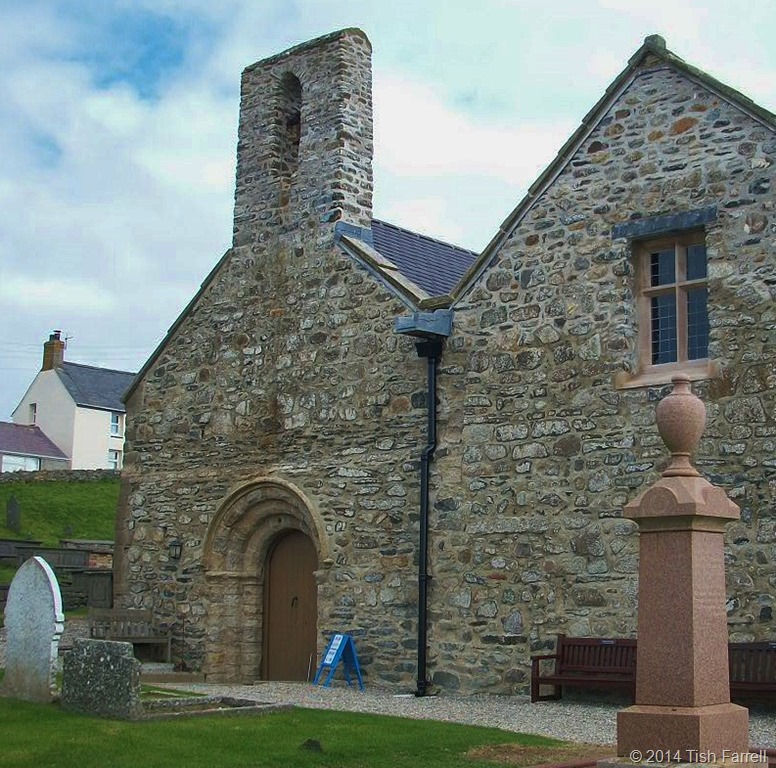
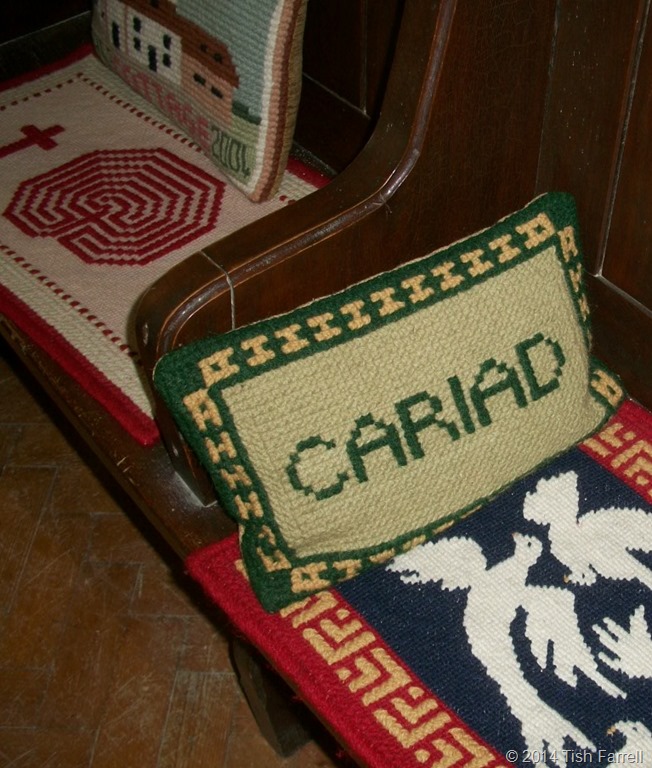
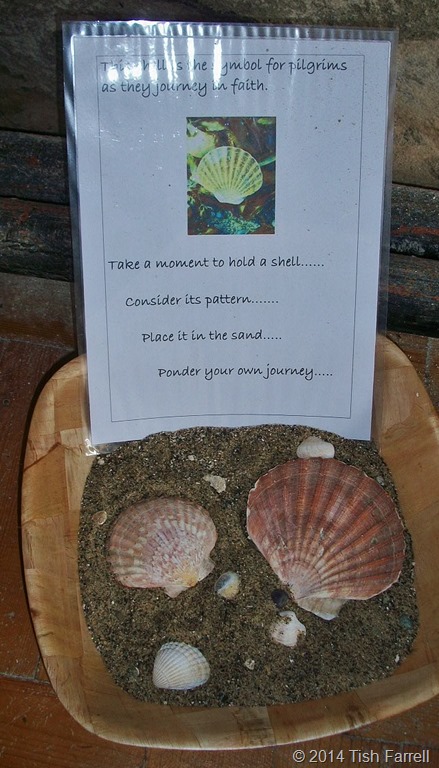
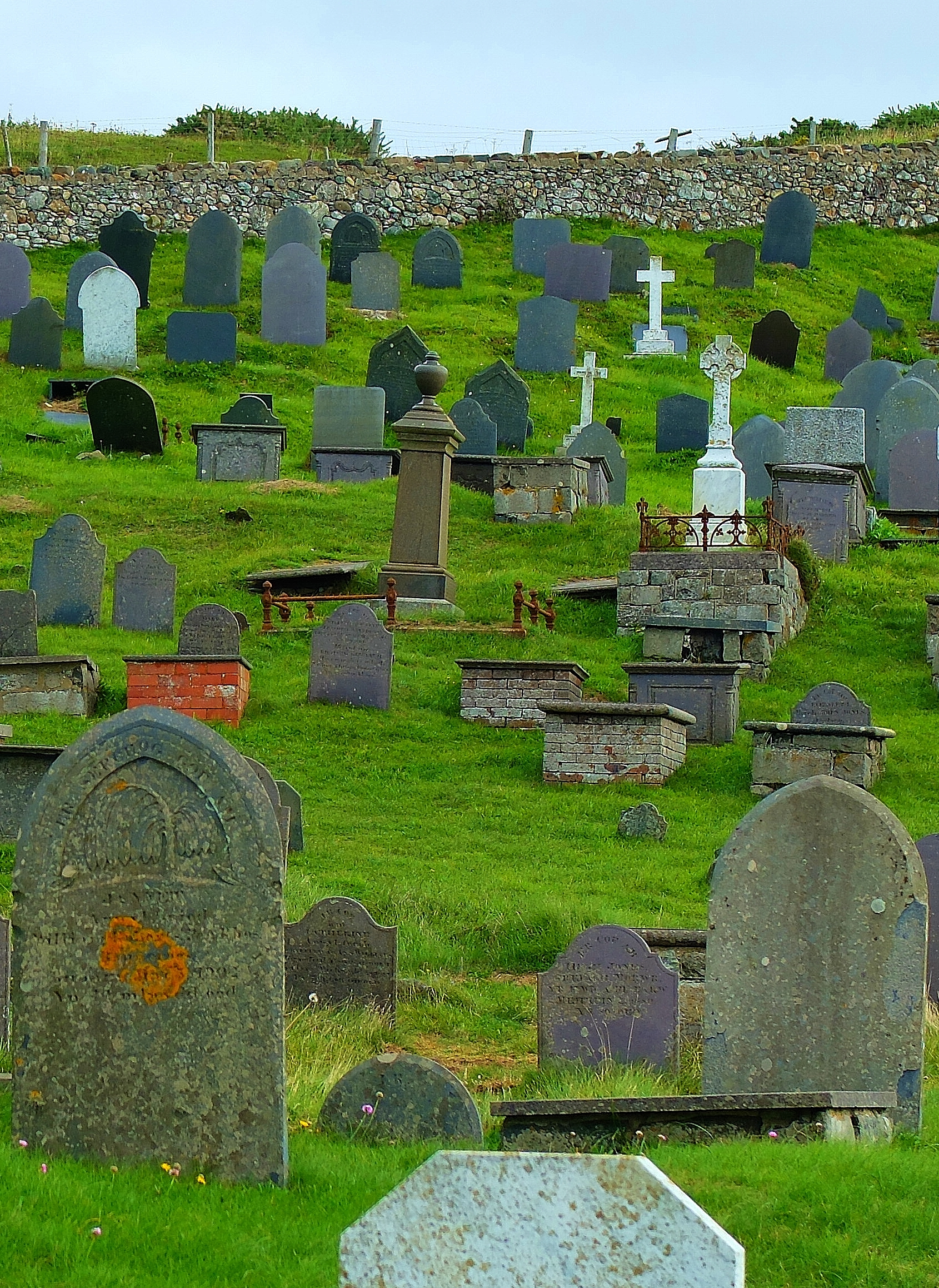
The ancient church of St. Hywyn’s stands right beside the sea. Since the Middle Ages, pilgrims have come there on their way to Bardsey Island, Ynis Enlli, Island of 20,000 Saints. Inside the church are two ancient grave stones belonging to Christian priests of the late 5th/early 6th century. There is also a welcome there: a bookshop full of R.S. Thomas’s poetry books; even a poem to take away. There are also piles of sea pebbles, shells for contemplating your journey, a kneeler that has been stitched with the single word cariad, beloved.

100_4798

100_4782

100_4779

100_4791

100_4797

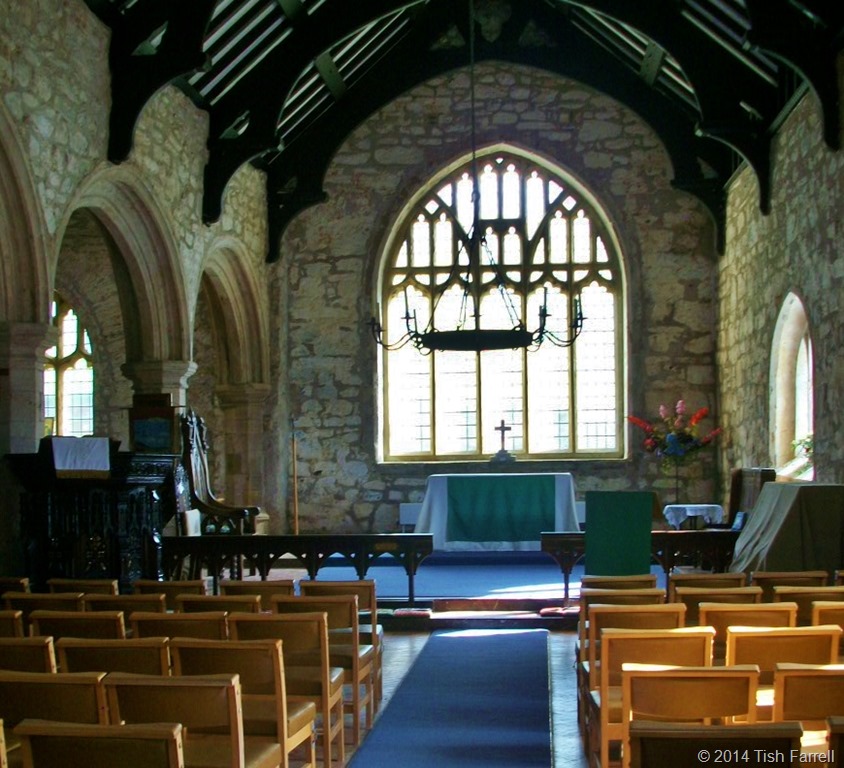
And beside the knave the clear glass window that needs no further embellishment looks out on the sea and islands of Gwylan Fawr and Gwylan Fach. And outside in the sea wind is the graveyard whose stones seem to cluster like a meeting of villagers in their own bright field. And so it is, as we ponder on all these things that our creedless souls, one atheist, one agnostic, know that we too are on a pilgrimage – to seek out the things that truly matter.

holiday 130

RS Thomas

R.S. Thomas 1913-2000 Photo: BBC Cymru Wales Walesart

See this brief biography of the poet, made in 1996 when it was thought he would win the Nobel Prize for Literature.

Related: Warrior Wind-Singer of Llŷn

© 2014 Tish Farrell

Flikr Comments Tagged ‘B’

Weekly Photo Challenge: Windows 

Ailsa’s travel theme: illuminated

Anthology Baobab: African Story Tree


“Knowledge is like a baobab tree; one person’s arms cannot encompass it.”

Ghanaian proverb

South Luangwa - mighty poachers' baobab 2

This baobab in Zambia’s South Luangwa was used as a poachers’ look-out

*

At the moment I’m working on a short story that includes a large and very ancient Adansonia digitata – in other words, a mighty baobab tree. These extraordinary trees have a way of finding their way into my stories (Mantrap, A Hare Who Would Not Be King amongst others). In fact, with so many legends about them, baobabs are nothing if not arboreal storybooks.

They are also like no other tree I can think of, although they are related to kapok trees. They grow in the hot lowlands of Africa and Madagascar and also in Vietnam and Australia. Their capacity to store vast quantities of water in their trunks has earned them the name Tree of Life.  A single tree can hold up to 4,500 litres /1,189 gallons.

In my story, however, the baobab has no such mundane function. It is a place of ritual – a spirit home on the Swahili coast, for here, as in other parts of Africa, it is believed that baobabs harbour the souls of the dead. And that is all I am revealing of my story  except to say that it also involves murder, unquiet spirits and unrequited love.

*

As for the trees, in real life they have a mass of practical, medicinal and nutritional uses – for humans and wildlife alike. It all begins with the pollination of these oddly striking flowers.

image

For nine months of the year, the baobab has no foliage. When the leaves come they are eaten like spinach by humans and browsed by both domestic and wild animals. The flowers, too, are short-lived. The bloom first at night, their pungent smelling nectar attracting bush babies and fruit bats which then pollinate the flowers. Bees also feed on the nectar, and farmers often hang their barrel beehives up in the branches of a baobab. Photo: Tuli Lodge, Botswana

image

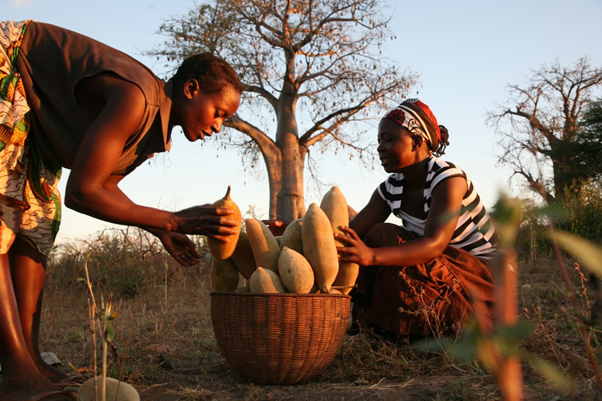
The resulting woody capsules enclose many seeds within an edible pulp. Both seeds and pulp are high in potassium, calcium and magnesium and are ideal foods for pregnant and breast-feeding women. The pulp is also rich in vitamin C, thiamine and antioxidants. Being high in pectin, it is useful for jam making and creating refreshing drinks. The seeds produce a fine oil that is used by the cosmetics industry. They can also be ground to make a coffee substitute. And so with all these attributes, the baobab has been classified as a superfood. Its many by-products are now sold worldwide. Photo: http://www.ifood.tv/blog/the-latest-superfood-from-africa-baobab

*

image

http://www.ifood.tv/blog/the-latest-superfood-from-africa-baobab

*

image

The growing world-wide demand for the baobab’s phyto-nutrients mean that seed harvesting has become a valuable source of income for many African families. This is one man’s story:

“My name is Andrew Mbaimbai and I am 63 years old. I live in Mtimbuka, a village in southern Malawi, with my wife, four daughters and eight grandchildren. In 2005, I heard that a new company was buying baobab and I knew this was a good opportunity for me.

“I collect and process baobab in my spare time because I also have a job as a cook. After gathering the fruit, I go to the processing centre, crack the shells and separate the fruit powder from the seeds. Then I sell it.

“I use the money to pay for my grandchildren’s school fees and to buy clothes for my family. Sometimes if a family member falls ill, I use the money to pay hospital bills. Without the money from selling baobab, I would not be able to meet all my family’s needs.”

http://baobabsuperfruit.com/andrew-mbaimbai/

As a consequence of ethically managed initiatives like the Eden Project’s programme in Malawi you will now find many baobab-derived products on line and in your local health food shops. Here is one of them. It can be added to anything and everything, creating, apparently, a  zesty flavour.

Baobab Fruit Powder Pouch

The Eden Project’s baobab powder.

*

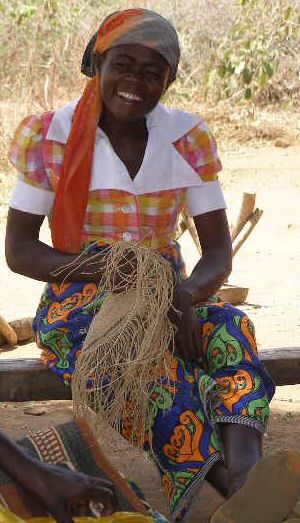
Then there are the baobab bark products. The trunk of the baobab is very fibrous and can be processed into cloth, twine and ropes. Kenyan women are famous for their kiondo bags which they make both from baobab and (increasingly) sisal string. You will see women walking along the road weaving these lovely baskets, and I can attest that they last for decades. I have at least four. In time the leather handles might need replacing,  but the baskets endure, becoming more beautiful as their pigment dyes fade.

image

Photos: africablogs

image

A Kenyan kiondo woven from baobab fibre.

*

Baobabs can of course grow to massive proportions  and into the oddest shapes. They may be thousands of years old.

The Legend of the Upside-down Tree

Photo: Eco Products

With age, many become hollow, creating large spaces within that are variously used as barns, churches, places to give birth, and for the burial of griots as in West Africa. In Botswana one was once used as a jail, the adjoining trunks for male and female prisoners.

image

Kasane, Botswana, now has a new prison but the architect ensured that the original one was preserved: http://www.ofm.co.za/article/67788/Voices

Big Baobab

Sunland Baobab

*

At Sunland Farm, Limpopo, South Africa, this baobab is used as a bar and wine cellar. It is believed to be the largest example in the world. It is 47 metres around (154 feet) and has a carbon date of around 6,000 years.  Below  are four of us trying to surround a much younger Kenyan baobab. This one is at Maweni on Tiwi Beach, South Mombasa.

023

*

And now for some of those baobab legends I mentioned. There are many variations of these tales throughout Africa.

I

When Creator was busy creating the world, the animals came to him and asked if they could help him finish his work. Creator was doubtful and said there were only the trees left to make. But the animals persisted, so Creator handed out specific seed types to each animal species, and they went away and planted them. Finally, only the baobab seeds remained, and these Creator handed to the hyenas. The outcome, of course, was to be expected, given the stupidity of hyenas. They planted the seeds upside down, and that is why the baobab always looks as if it has its roots in the air.

II

Long, long ago the very first baobab sprouted up beside a small lake. When it saw the other trees with their tall, smooth trunks and bright flowers and large leaves, it thought how beautiful they were. Then one day, when the lake surface was smooth as glass, the baobab caught sight of itself, and oh, what a shock. Its flowers were so pale, and its leaves so small. But worst of all, it was appallingly fat, and its skin looked like the wrinkling hide of an old elephant.

The baobab cried out to Creator, complaining of its lot. Creator in turn was huffy. Many things had been made that were not quite perfect, he said. He retreated behind a cloud. But the baobab did not stop whining and whingeing. Finally, Creator grew so cross that he leaned out of the sky, and yanking the baobab from the ground, replanted the tree upside down. And so ever since, the baobab has lived on in silence, unable to see its reflection in the lake, but making up for its transgression by doing many good deeds for humankind.

*

And if these baobab tales have not quite cheered you up, here are some clips from the life-enhancing Orchestra Baobab. This band from Senegal has had two lives, one back in the ‘70s, and now the current reprise which includes many of the original line-up, among them the Togolese guitarist, Barthélémy Attisso, who in the interim went away to become a lawyer. If you get the chance to see them live, go for  it.

© 2014 Tish Farrell

Frizztext’s ‘A’ Challenge

Valuing the past: how much for Old Oswestry Hill Fort?

nxeHdjNTMMiNFPH-556x313-noPad1_thumb.jpg

SIGN HERE: Change.org petition against developing land below the hill fort

*

Last Sunday it made the national press – the campaign to stop housing development beside Old Oswestry Hill Fort. You can read The Guardian/Observer article HERE.

Recently I wrote about the Great War poet, Wilfred Owen. Oswestry is his birthplace, and I mentioned that the garden of his former home has planning approval for several upscale houses. All of which leads me to ask, who values heritage the more – the developers trying to cash in on its cachet  and so add mega-K to their price tags; or the rest of us, who too often ignore, or take for granted threats to the historic fabric of our towns and countryside? Or who only find out after the event when it’s too late to speak up? Of course, some of us may not care at all: what has the past ever done for me?

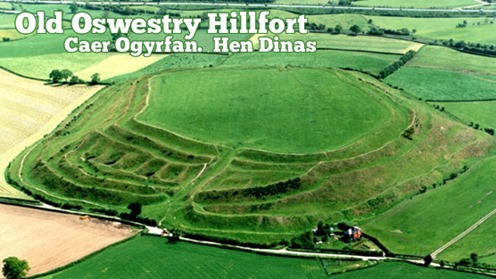
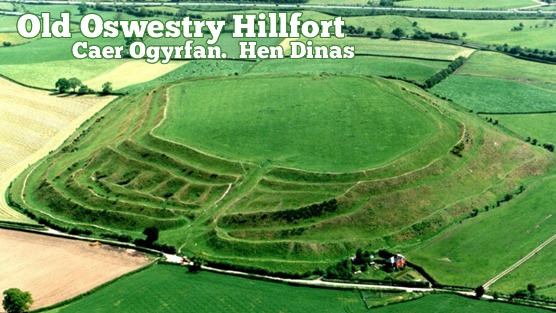
In Oswestry, however, they are rallying to the cause of their hill fort, and they have every reason to. It is one of the best preserved examples in Europe, built around 3,000 years ago. On its south side is another important monument – a section of the 40-mile long Wat’s Dyke, probably dating from the early post-Roman period.

Unusually, too, for a hill fort, Old Oswestry is very accessible, being close to the town; it is an important local amenity and landmark and currently in the care of English Heritage. This government funded body does appear to be objecting to at least some of the development plans, but not strongly enough in some people’s opinions. EH will apparently be meeting the developers to discuss matters in December.

Photo from: The Heritage Trust Old Oswestry Hill Fort Under Threat

*

The photo above shows (along the top edge) how close the town is to the fort. The farm complex in the upper left-hand corner, nearest the hill fort, is one of the sites allocated for upmarket housing. Hill Fort Close, Multivallate Avenue anyone?

Below is the view from the other direction, showing the proposed developments. These sites (in pink) are outside the town’s present development boundary. Usually there can be no development outside a development boundary, unless a good case can be made for an exception site for affordable houses. On such sites, houses must remain affordable in perpetuity and are thus normally managed by a housing association or social landlord. So, you may well ask, how come the environs of this hill fort are suddenly under threat, and not from affordable, but from upscale market housing?

Os28

*

SAMDev – who’s heard of it?

In Shropshire we have a thing called SAMDev (a nasty-sounding acronym standing for site allocation and management development). Shropshire is one of Britain’s largest counties, mostly rural and agricultural, but with light industry and retail zones on the edges of market towns like Oswestry. SAMDev is a response to National Planning Policy which enshrines the concept of presumption in favour of sustainable development. Spot the weasel word here.

Oswestry Map

For the last two years Shropshire Council has been ‘consulting’ (theoretically with the communities concerned) on areas of land outside existing development boundaries and identifying locations for housing and employment growth up to 2026. The final plan will be produced by the end of this year and it will be available for public scrutiny before going to an independent assessor.

As part of this process, land owners and developers have been invited to put forward their own development proposals. In other words, SAMDev is rather like a county-wide preliminary planning application. Developers are thus in negotiation with Council planning officers throughout this process. This usually happens anyway with any large development proposal.

This means that when a formal application is finally submitted, it is likely to be passed by the Planning Committee with little argument. The Planning Committee is made up of councillors, people who may have little understanding of planning matters. They rely on the reports presented to them by planning officers. It is the officers who are compiling the SAMDev document.

Although this entire process is available for public scrutiny (all draft plans including individual communities’ Place Plans are on Shropshire Council’s website)  I think it’s safe to assume that most people in Shropshire don’t know that SAMDev has been happening. They might have been invited to consult, but somehow they did not understand the invitation, or the implications of not responding. Most people have thus not participated in the consultation process.

The biggest problem is that most normal people do not understand the kind of words that planning  people use. I may be cynical, but is this not deliberate? What is clear is that inexplicable quantities of houses have been allocated for big and small towns throughout the county. SAMDev, through its provision of specific sites for specific purposes, is the means by which they will be realised.

*

A case close to home – Much Wenlock

In my small town of Much Wenlock the local landowner has offered up farmland along the southern and western boundaries of the town. This has enabled Shropshire Council’s Core Strategy to make an astonishing allocation of up to 500 new houses in the next 13 years – this in a flood-prone, poorly drained town of 2,700 people, where employment opportunities are poor, and the mediaeval road system is not fit for purpose, either for traffic or for parking. In other words, the town is already full, and its ancient centre cannot be changed, short of flattening it.

001 (3)

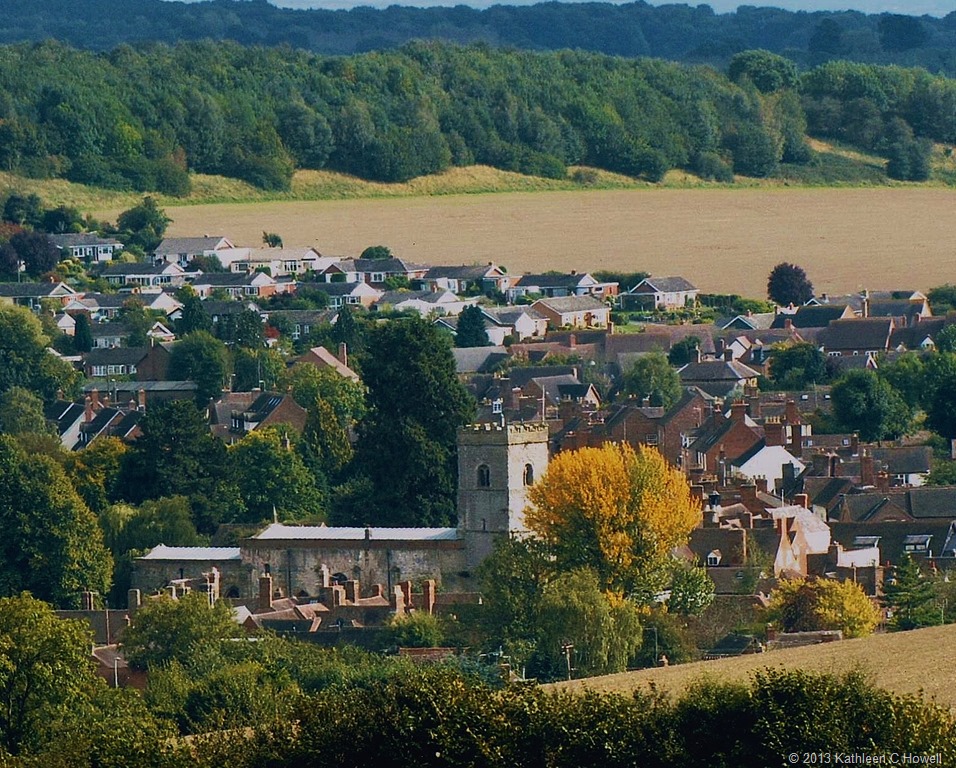
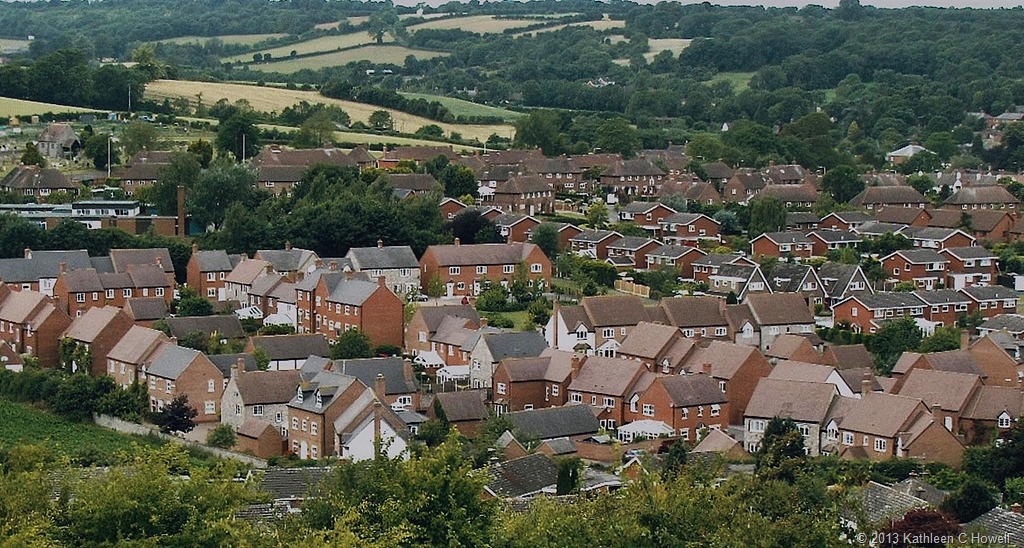
Shropshire Council’s Core Strategy states that Much Wenlock needs up to 500 new houses in the next 13 years, increasing the town’s footprint by another 50%. The town sits in a bowl with a river running through it. The development in the foreground is one of the newer ones. Its drains were apparently connected to the old town sewer instead of to the separate system for which it had approval. New developments like this have hidden costs for existing communities. This particular problem has not been rectified six years on from the 2007 flood that damaged up to 90 homes.

*

Development = Sustainable Growth?

The ensuing development fest that will be enabled once SAMDev is passed is seen as a means to stimulate growth. The argument seems to be that communities will die if they do not grow in huge tranches. But this is only a point of view, not an absolute truth. There are other models for sustainability, perhaps more meaningful ones. Besides, every community has its particular characteristics that might suggest other narratives; strategies that enable them to grow without necessarily expanding all over the landscape. Of course it is always easier, and presumably cheaper, to build over new ground than it is to reclaim old buildings and clean up brown field sites within existing settlements.  Perhaps this is the reason why Councils do not take over unoccupied homes in towns, even though they have the powers to do so?

*

Trading on the past

In places like Much Wenlock house prices are high because, to quote estate agents and developers, “everyone wants to live here”. People want the best of both worlds, a high-spec modern house with multiple en suites, but in close proximity to gentrified antiquity where people live in homes that be cannot double-glazed because of listed building regulations. The new-home dwellers perceive acquired value by association with the past, and are prepared to pay for it. The kind of properties envisaged for the upscaled farmyard site near Oswestry hill fort will doubtless command a premium for similarly nebulous reasons.

001 (2)

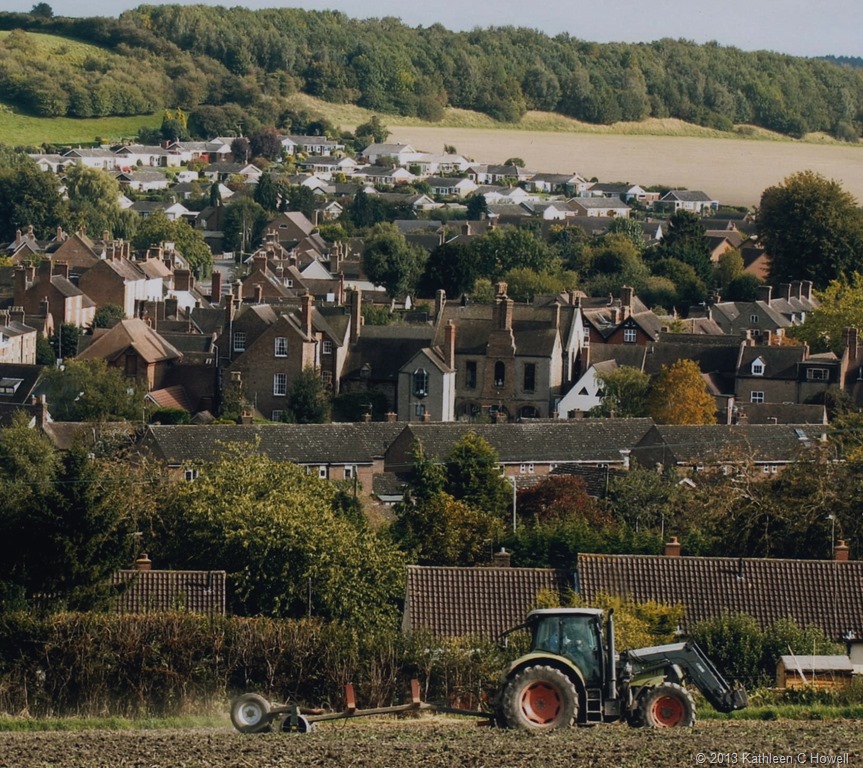
Much Wenlock – view towards the town centre, a ‘60s development on the far hillside.

*

In this way, then, developers trade on something that does not belong to them – the historic setting that is cared for and maintained by other people. Buyers buy into the connection, distracted by the ‘look of the thing’. It’s all rather Emperor’s New Clothes-ish. But then if student debt can now be sold on by banks as a commodity, perhaps heritage detraction can also be a tradable commodity. Communities should exact compensation directly from those developers whose poorly designed housing schemes erode the quality of their environment, whether visually or through added strain on existing infrastructure. (In places like Shropshire effective infrastructure provision does not precede any new housing development; nor, if Much Wenlock is anything to go by, does it follow it.) And I’m not talking here about the modest Community Infrastructure Levy (CIL) that developers must pay to communities to build the small but useful things like playgrounds and car parks that councils no longer provide. But something far more substantial.

*

How much for this ancient monument?

So what value do we set on a hill fort? Is it worth twenty million pounds say? Fifty? More? Perhaps august academic institutions around the world might invest in shares in our monuments for their scholarly worth, and provide us with the means to buy off developers, or at least keep them at a respectable and respectful distance.

And I am only half-joking here. It would not be so bad if developers in this country built wonderful, good quality eco-houses in versions to suit everyone’s financial capacity, but mostly they don’t. And in the case of Much Wenlock the cost of large new developments around the town has been high – homes flooded from backed up drains and flash-flood run-off.

*

Standing up for heritage

But where does this leave Old Oswestry and all those  who are campaigning against developing the nearby farmland?

Since the Guardian article, support has been gathering from across the country and beyond. You can follow the campaign at Old Oswestry Hill Fort on Facebook. But the problem is that there are only so many arguments  you can make against unwanted development, and they have to comply with planning law and the Local Authority’s Core Strategy. They include loss of amenity value, visual impact, access, safety and sustainability.

At present, planning laws and high property prices give all the power to developers. If planning authorities cannot base refusal on the strongest case, then developers will opt for a judicial review to get their way. This costs local authorities a lot of money, and so us a lot of money.  Developers’ planning consultants write letters to planning officers threatening legal action. You will find such letters in Council files. This is one reason why authorities cave in without a fight.

The heritage consultant’s impact report on the proposed development near Old Oswestry concentrates on view, THE VIEW of the development from the hill fort, and of the development looking towards the hill fort. The impact is considered to be negligible, but this again is a point of view. Housing developments also come with multiple cars, parking issues, garbage storage areas, satellite dishes, and people living their lives as they  might expect to do in their own homes. There is also the future to consider. The Trojan Horse concept is a familiar one in development: approval of one development in due course setting a precedent for the next one alongside.

*

So why protect our past?

One would hope that the land around the hill fort would remain as farmland; that the farm could be sold as a farm. Or it  might make a good visitor centre for the hill fort, using existing buildings. In reality there is no need to build anything at all in the vicinity of the hill fort. Better that Shropshire Council use its powers to take control of unoccupied dwellings in the town rather than sanction intrusion into the setting of a historic monument of  national importance.

After all, why would anyone think that this was a good idea? These ancient places are resorts, and in all kinds of ways. They feed our imaginations and spirits; for children they grow understanding of other times, and other ways of living: all things that in the end make us wiser human beings. And isn’t this the kind of development we really need? People development? And before we carry on building all over the planet, shouldn’t we stop to consider what we already have, and see if some creative re-purposing cannot shape un-used buildings and derelict sites for our future growth requirements? Or is this approach too much to ask of our elected representatives and public servants?

Copyright 2013 Tish Farrell

nxeHdjNTMMiNFPH-556x313-noPad1.jpg

SIGN HERE: Change.org petition against developing land below the hill fort

*

Find out about protecting your heritage at Civic Voice and Council for Protection of Rural England and join your local CIVIC SOCIETY

*

Related:

Petition to Shropshire Council at Change.org

Oswestry 21 Community Voices

Oswestry Eye

The Essential Oswestry Visitor Guide

Old Oswestry Hill Fort on Facebook

English Heritage Old Oswestry

The Heritage Journal Oswestry Hill Fort Under Attack

The Heritage Journal Old Oswestry Hill Fort: a campaigner asks – “why aren’t EH entirely on the side of the Public?”

The Heritage Journal Old Oswestry Hill Fort Safe?

The Heritage Journal Oswestry Hillfort “top level talks”: will those who care for it stand firm?

The Heritage Journal Oswestry Hill Fort: is it a forgone bad conclusion?

@ShropCouncil on Twitter

@EnglishHeritage on Twitter

Elecommunication: so many connections

Scan-131109-0009.jpg

Elephants: “The animal which surpasses all others in wit and mind.” Aristotle

*

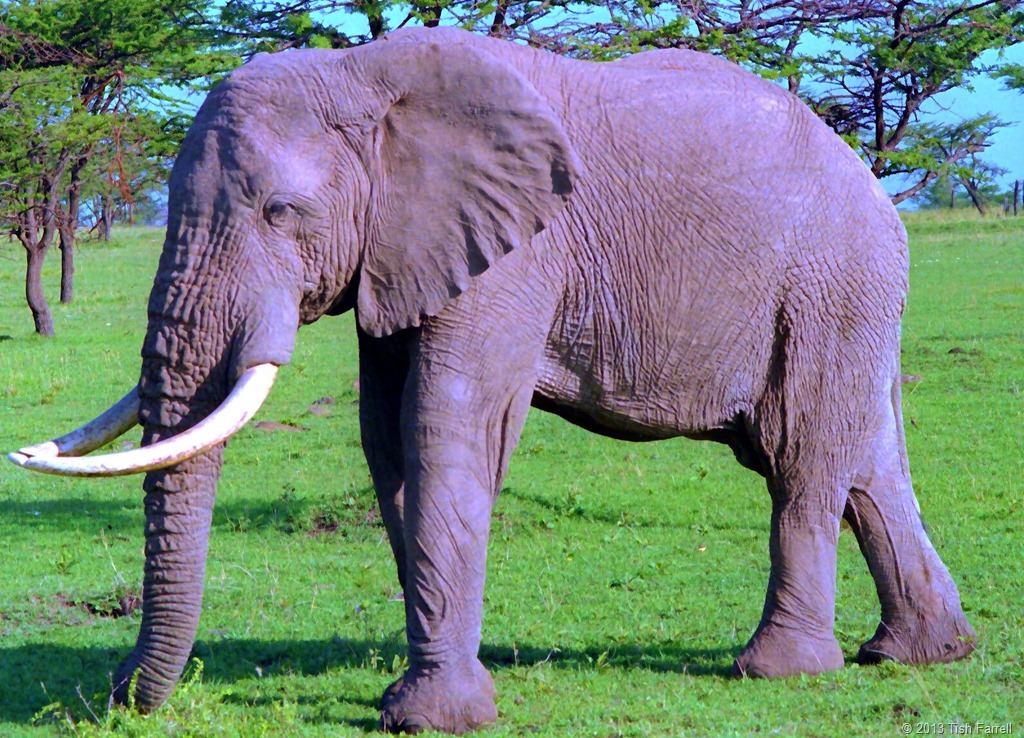
Do you remember when you first discovered there were such things as elephants? And didn’t childish intuition tell you at once that these animals were among the world’s most wonderful creatures?

Over the last few decades scientists have proved that they are in fact wonderful – and in all sorts of ways, not least their ability to communicate over large distances. Then there is their highly developed matriarchal society. They are also one of the most intelligent species on earth. They are good at problem solving. There are many cases of their altruistic acts. For instance they have been known to help wounded humans in the bush, even going so far as placing exposed individuals in the shade, and then keeping guard over them against predators.

But proof apart, it is probably anyway beyond most people’s comprehension that some forms of humanity see elephants purely as a resource – killing them for ivory, or a trophy head to brag about to their shooting chums.

Scan-131109-0004.jpg

The word elephant, I’ve just read somewhere on Google, comes from the Greek word elephas meaning ivory, so already we have a clue as to the literate world’s  (one hesitates to use the word ‘civilized’ here)  once primary relationship with elephants. But then this is not the only kind of man-elephant relationship. The killing of elephants is not always about the pursuit of luxury goods. Indigenous African peoples, such as the small-statured Mbuti hunters of the the Congo forests, have long hunted elephant for food, and also possibly scavenged dead ones. One beast, killed once in a while would keep a hunting band going for many days as well as providing large amounts of meat to trade with farming neighbours for other goods.

The fact that there have always been hunters like the Mbuti who will tackle an elephant, makes them in turn desirable allies and trading partners to less brave outsiders who crave only the ivory. In East Africa, from at least the start of the first millennium AD, Arab dhow merchants relied on locals like the Akamba people to bring ivory to the coast to trade. In the nineteenth century the Swahili slavers set off into the interior to grab for themselves a combination haul of humans and ivory, the poor human captives being forced, while they still lived, to carry the elephant tusks hundreds of miles back to the coast.

There are far older stories too.  The tomb biography of Prince Harkhuf of Elephantine records that four thousand years ago this Ancient Egyptian general headed at least four major expeditions into the African interior. One objective was to test the waters for a take-over of the neighbouring Kingdom of Nubia. But there were also valuable resources to garner: ivory, leopard skins, ebony, precious stones. One expedition went beyond the Mountains of the Moon, the Rwenzori Mountains on the borders of Uganda and Eastern Congo, and so into the territory of Mbuti hunters.

The tomb account includes a letter from Harkhuf’s Pharaoh, Pepi II Neferkare  who, on becoming Egypt’s ruler at the age of six, longed for nothing more than his own pygmy,  he “who danceth like the god”. The letter contains strict instructions as to the pygmy’s care, and especially on the voyage back down the Nile so that he does not fall in the river. Anyone who has read Colin Turnbull’s The Forest People, will know that the Mbuti are renowned for their performances of complex polyphonic singing and energetic dancing conducted in praise of their Forest Creator. Neferkare’s letter would suggest that the Mbuti were already well known to the Egyptians thousands of miles away, and the primary source of this relationship was mostly likely to have been the Mbuti’s provision of forest produce including ivory.

Scan-131109-0022.jpg

But the biggest assault on elephant-kind has all to do with the arrival of the gun. A major killing spree began in the late 1800s in the Congo – then a private fiefdom of Leopold II of Belgium (think Joseph Conrad’s Heart of Darkness and the Congo River stations set up especially to export ivory and wild rubber from the forest hinterland). In East Africa the slaughter began at a similar time under British colonial rule – first British and European aristocrats out to make their fortunes, then by hunters,like John Hunter,  employed by the colonial administration to protect settler plantations from elephant damage. The ivory hunters of course always sought out the animals with the biggest tusks. So much so, that when the likes of Denys Finch Hatton and aviator, Beryl Markham began scouting for ivory from the air, the big bulls of Tsavo were reputed to hide their tusks in the undergrowth whenever they heard a plane.

What was taking place, then, was a most unnatural selection. The biggest and best elephants had the biggest and best ivory. The gene pool of present day elephants has thus been ravaged by a century of mass killing. After the colonial era, the armies of civil war conflicts across the continent, continued the job started by colonial sportsmen and administrators. After the Idi Amin regime in Uganda when much wildlife was decimated, the tusks of the elephant population that gradually re-established itself were either puny or did not develop at all. And an elephant needs his tusks – not least for rearranging the landscape (clearing trees to favour grass growth) and mining for water sources and essential mineral salts.

And why did this killing begin? Because humans thought that ivory re-fashioned into billiard balls, piano keys, and objets d’art was more valuable than embedded in living, breathing elephants. Some people still think this.

001 (3)

But back to the elephants and those extraordinary things that scientists have been discovering about them. For one thing, the infra-sound throat rumbles that vibrate through the earth can convey information to other elephants at least six miles away. It would appear, too, that they can pick up seismic movements over far greater distances than this. Researchers have observed that when it started thundering in Angola, thus signalling the start of the rains and fresh browse in that quarter, elephants one hundred miles away in Etosha National Park, Namibia, set off there. Apparently the tips of trunks, toes and heels are especially sensitive to vibration. Working Asiatic elephants have also been known to detect tsunamis and make for higher ground, thus saving any humans who happened to be riding on them at the time.

When it comes to communicating amongst the immediate herd or with potential predators, elephants have a whole range of calls and gestures, depending on the circumstances. These include ear-splitting screams and trumpeting, rumbles and grunts, crying and barking, head shaking and ear-flapping, trunk slapping, dust-kicking, throwing missiles, ear spreading, standing tall, and making mock and real charges.

Scan-131109-0021

While their eyesight is not acute, and especially in bright light conditions, they have a keen sense of smell. An elephant will  thus continuously read its environment and, using the tip of its trunk like an antenna, decode all manner of messages by scanning urine, faeces, saliva, and the secretions from their fellows’ temporal glands (found on the side of the head mid way between the  eye and ear). Also, when it comes to acts of aggression from humans, elephants will remember these and continue to identify such aggressors by their smell.

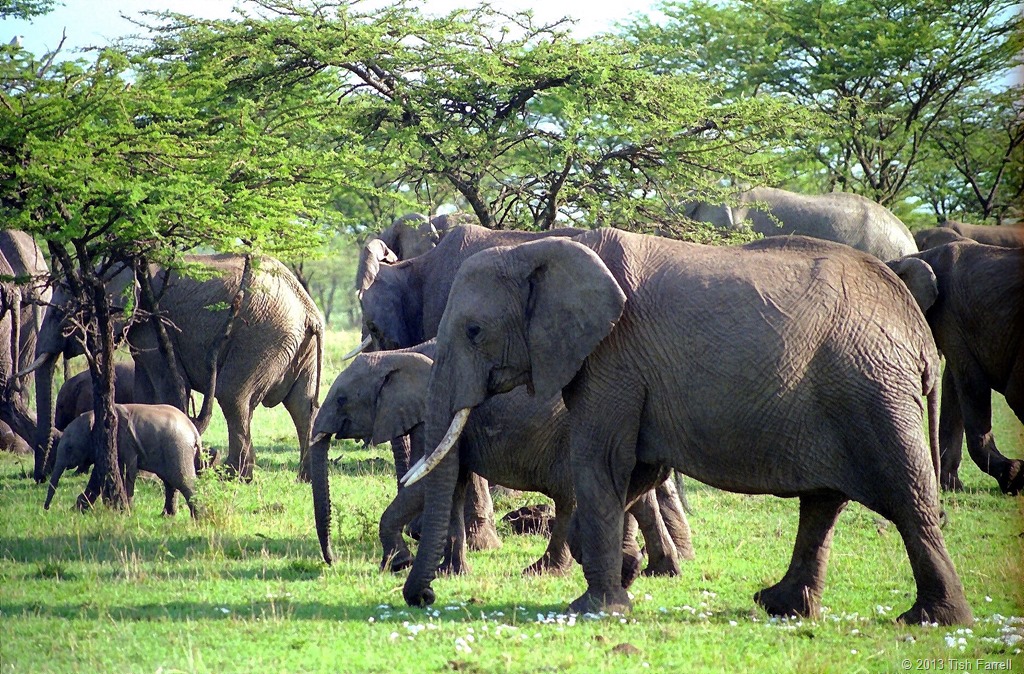
And that’s the other marvellous thing. Elephants do remember. For much of the year the males and females live separately usually only congregating for mating purposes. The females roam in small family groups led by an old matriarch. Within that matriarch’s head is a lifetime’s accumulated wisdom that she uses to manage her daughters, granddaughters and their offspring, and so keep them healthy and safe. Elephants left bereft of their elders through culling or poaching, are known to flounder and panic without the old ones’ guidance. 

Scan-131109-0032

010 (2)

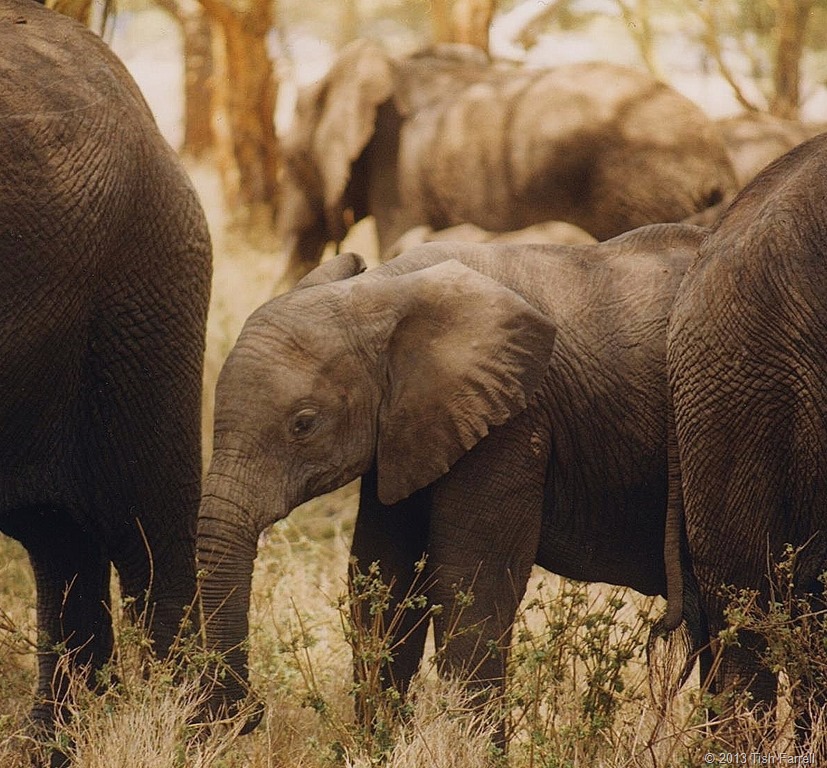
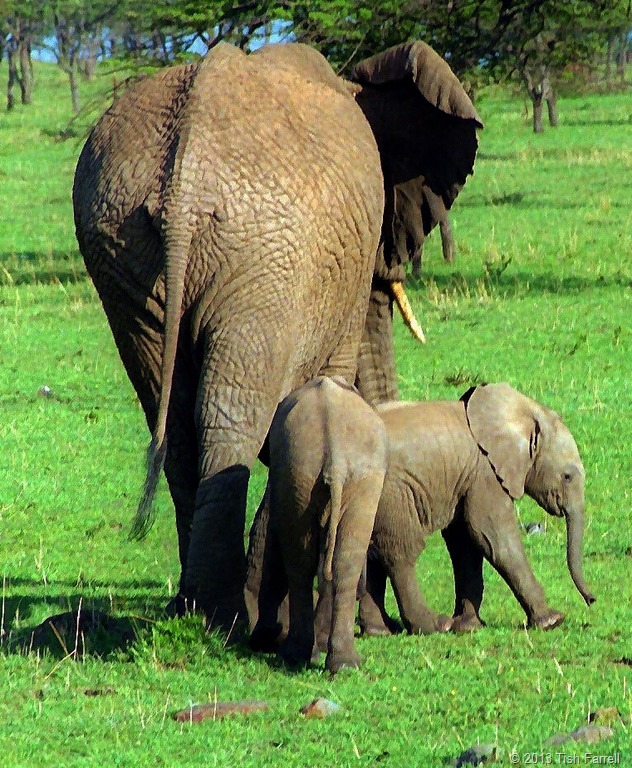
As you can see from some of these photos, mostly taken outside the national park  in Kenya’s Maasai Mara, elephants are not only highly sociable, but also very tactile. They spend much time wiggling against each other and touching each other with their trunks. Even older elephants like to play, and there are a whole range of gestures that they use to invite general romping. As the work of Daphne Sheldrick has shown at her Nairobi elephant orphanage, an orphaned elephant will die, not so much because it is short of food, although the right infant milk formula is very important, but because it does not have a continuous show of affection and reassurance from family members.

Sheldrick has learned how to provide for this vital need by assigning a human keeper-parent to every baby; duties, apart from feeding and playing, include spending the night with their charges. When the time comes to repatriate adolescent elephants to the wild, the lack of matriarchal knowledge creates a considerable challenge to making a viable transition. This was well shown in the BBC series The Elephant Diaries.

018

The Elephant Orphanage, Nairobi

*

More sobering to learn is the fact that elephants, not only have a similar life-span to us, but they also do understand death. In the past, conservationists have found to their cost that elephants are utterly traumatized by witnessing culling events. Where elephants have been wounded by poachers, their comrades will stay beside them and try to lift them or feed them grass. Once an elephant has died, the herd may remain with the corpse of several days. The young ones have been seen to cry. The survivors will then cover the dead one with branches, leaves and grass. During colonial times, a Kenyan district officer once confiscated a poachers’ stash of ivory, only to find that in the night, the local elephants broke into the store and carried off the tusks.

There is, though, another side of the elephant-man story, and especially where they compete for the same territory. In a single night’s  foraging, elephants can wipe out a whole season’s crops in a farmer’s smallholding, and that means starvation for the family concerned. They will also kill humans if they consider themselves provoked. Bulls in must are quickly irritated and are especially dangerous at such times, as are mothers with small calves.  In poor communities poaching ivory can become an attractive proposition where local bigwigs and foreign buyers seem to be offering them a small fortune to do so. The only way to protect both elephants and would-be local poachers is to give communities reasons to protect elephants. That means a fair cut of tourist dollars to provide for schools and clinics and a a better standard of living all round.

There are many thousands of elephants still roaming African, but they are always under threat. Most nations’ wildlife parks are under-resourced when it comes to vehicles, equipment and manpower. Much protection of wildlife is in fact done by owners of private game reserves in conjunction with local communities.  In the meantime, we need to thank those African rangers, men and women, who daily risk their lives for often little pay, to protect their countries’ wildlife from human rapine. They are indeed true heroes.  We might also stop to ponder on whether some of the resource grabbers funding the poachers  might not have closer connections to our own lives than we care to admit.

Ailsa’s Travel Theme: connections

© 2013 Tish Farrell

For more about ivory poaching:

Dear Kitty. Some blog Ivory trade legal in the USA

Scan-131114-0004

For more about elephants in general: Elephant Voices

Related posts:

Elephants, E-books and Enticing Reluctant Readers  #amwriting

Songs from an Inland Sea: “On Wenlock Edge”

This week’s Word Press writing challenge, with its musical theme, has set off a whole host of notions. In fact this may just be the post where all the strands of my  ‘writer on the edge’ blog come together. This, though, is only a proposition and by no means a promise.  One thing I can promise:  there is some very fine music at the end. And for those of you who do not know the  English composers Ralph Vaughan Williams (1872-1958)  and George Butterworth (1885-1916), then please consider this an early solstice gift. And if by chance you do not care for it, or indeed anyway, by all means pass it on.

So to return to the notions.  Those of you who  have read my past posts will probably know that I live on the edge of  Wenlock Edge, a twenty-mile limestone scarp that bisects the county of Shropshire from the River Severn above the Ironbridge Gorge, to Craven Arms on the borderland with Wales. Aeons ago this now wooded, much quarried ridge was once a shallow tropical sea lying somewhere off East Africa. Today, and especially now through bare wintery trees, you can look out from its summit and scan a great panorama – the farm fields, villages and hills of Shropshire.

*

As I’ve said in other posts, there is a lot of history in this place – over 400 million years’ worth. Too much to embrace. But in the recent past (geologically speaking), you might have looked out from the easterly end of the Edge onto the smog-laden valley of Coalbrookdale as the Quaker ironmasters stoked their blast furnaces and helped fuel an industrial revolution. Travel back a further 1500 years and to the north you would have gazed on the impressive public buildings and sprawling settlement of the Roman city of Viroconium. Or in earlier times still you might have witnessed the building of the great Iron Age hill forts on the Wrekin and in Mogg Forest, or perhaps glimpsed some Bronze Age smiths plying the ancient ridge-top trackway en route for Wales.

*

The Edge, then, is full of spirits, and  it is not surprising that it has long inspired artists, writers and composers. And so we come to the music, or rather, we come first to the work that inspired the music – A E Housman’s A Shropshire Lad.  This collection of sixty three poems has been described as a gift for composers. The poems are written in the style of traditional ballads. And if at first they seem too obvious in their rhyme and rhythm, then look again. These are songs of loss and fleetingness – lost youth, lost love, the soldier’s death. That they are set against some scene of suggested rural perfection only heightens their poignancy. The work, too, somehow anticipated the bleak waste of the Great War, and so it was that, when the time came,  A Shropshire Lad went with many a soldier into the trenches.

Housman’s  sense of melancholy and loss stem from his own life: his mother died when he was twelve, his brother Herbert was killed serving in the Boer War, and his deep love for another man was unrequited. Nor did his work A Shropshire Lad have a very good start. Although it has remained in print since publication in 1896, in the beginning Housman could not find a publisher and had to pay to have the first five hundred copies printed. At first, too, there was a lukewarm reception. But within a few years, and much to the writer’s surprise,  its popularity suddenly grew. This in part was due to the fact that several composers seized on some of the poems and set them to music.

In 1909 came Vaughan Williams’ song cycle On Wenlock Edge. The work’s title is taken from the opening line of poem XXXI: On Wenlock Edge the wood’s in trouble. You can hear the storm-driven trees in the opening of the first video clip where English tenor, Ian Bostridge goes on to talk about his recording of the work with Bernard Haitink.  You also see him in rehearsal singing one of the most moving poems. It is written in the voice of a ghostly young ploughman returning home to see how his girl is faring. Here are the first two stanzas.

XXVII

“Is my team ploughing,

That I was used to drive

And hear the harness jingle

When I was man alive?”

*

Ay, the horses trample,

The harness jingles now;

No change though you lie under

The land you used to plough.

*

The entire Vaughan Williams song cycle sung by Anthony Rolfe Johnson is performed in the third video below. Other composers inspired by the poems include Samuel Barber and Ivor Gurney (The Western Playland and Ludlow and Teme). I could not find clips of these works but I did find George Butterworth, who was a friend of Vaughan Williams. He set eleven of the poems to music including Is my team ploughing. He also composed the orchestral rhapsody A Shropshire Lad. It is yearning, elegiac piece, performed in the second video and accompanied by Shropshire scenes. Butterworth himself was killed on the Somme in 1916, his composer’s career barely begun.

So,  you may ask, how does this all fit with ‘Tish Farrell – writer on the edge’? Well I suppose it comes down to this. As a fiction writer, or indeed a blogger, my focus is ever on the evocation of place (both through time and space) and how it resonates through the lives of the people and events I write about. And so I love the fact that the place where I live and have known most of my life has inspired so much creative work. And, indeed, continues to do so. In fact, I’m planning to feature more of it on this blog – the artists of the Edge. I am, anyway, fascinated by the process by which, in wonderful synergy, one person’s work inspires another’s creative response, thus building into a  body of cross-referencing works. See what good things we can make when we listen in good faith to each other.
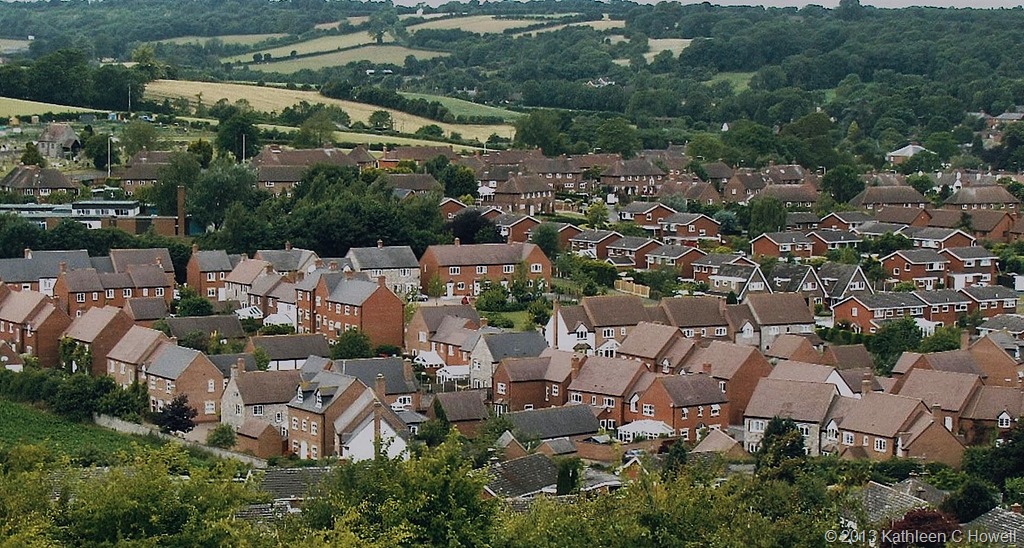
Wenlock Edge of course has its own music. I hear it most when I’m working on my allotment – the windrush in the woods, the mewing buzzards, the calls of rooks and jackdaws, and through it the chiming of the church clock. I screen out the traffic sounds of course. So here we have it: the rural idyll that never was, the music of Vaughan Williams and George Butterworth evoking the peculiarly human need to long for something we cannot have, and finally Housman’s  own words from poem XL:

   Into my heart an air that kills
From yon far country blows:
What are those blue remembered hills,
What spires, what farms are those?

That is the land of lost content,
I see it shining plain,
The happy highways where I went
And cannot come again.

*

And now, courtesy of Gutenberg Press, here is your copy of  A E Housman’s A Shropshire Lad.

100_2138

Frizz’s S-Challenge

Weekly Writing Challenge: Moved by Music

© 2013 Tish Farrell
 

In Much Wenlock An Inspector Calls

100_3606

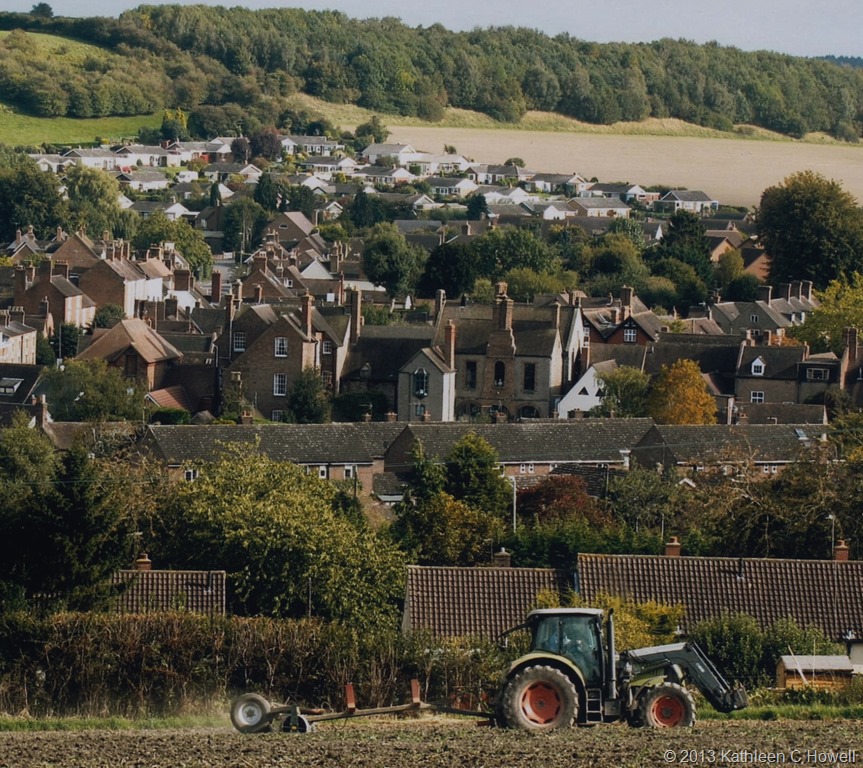
Much Wenlock, the place where I live,  is a small town with a big history. You could say it owes its existence to the discovery of some holy bones. And no, this is not the reason for the inspector’s visit.  I’ll get to him in a moment. (In fact his arrival in town relates to the making of some new history). But about those bones…

First of all, they are very, very old. In life they belonged to a Saxon princess, whom we know locally as Milburga, though she comes in other spellings. She was daughter of the Mercian King, Merewalh, who held sway over much of the English Midlands during the 7th century.  These were turbulent times – the spread of Christianity going hand in hand with securing territory. To this end, Merewalh was a man with a plan. Instead of arranging dynastic marriages for his three daughters, he established them as rulers of new religious houses across his kingdom. Even his own queen, a Kentish princess, in later life returned to faraway Kent to become Abbess of Minster. In this way Merewalh consolidated spiritual and political prestige, commanding both bodies and souls.

In preparation for the religious life, Milburga was sent for her education to the double monastery of Chelles in Paris. According to the historian, and her contemporary Saint Bede, this was common practice for English girls. Sometime towards the end of the 7th century Milburga then took charge of an abbey in Much Wenlock. This was also a dual monastery i.e. for both men and women, and each sex had their own church. It was also the most important religious house in the region. There she presided for the next thirty years, ministering to the people of her extensive domain lands. Many legends grew up: that she had the power of healing the blind and of creating springs of water. After her death in 725 AD there were more and more stories about her miracles, and so in due course she became Saint Milburga.

Fast forward to the Norman Conquest of Britain (1066), and now we have brow-beating Norman earls establishing their power bases across the land. Their plan was to use ‘big architecture’ to dominate the natives: castles, fortified manors, churches and monasteries – the bigger the better. In Much Wenlock, Earl Roger de Montgomery built a Benedictine priory on the site of Milburga’s abbey. It was affiliated to the monastery of Cluny in France, and so French monks came over to live in it. The building was an impressive enterprise too. Today, the picturesque ruins in the heart of the town do little to indicate the vast scale of the original.

File:St Milburga's Priory, Much Wenlock - geograph.org.uk - 1652411.jpg

Wenlock Priory and the ruins of 12th century Benedictine monastery that was built on the site of Milburga’s Saxon abbey. In its day, this was one of the biggest and most prestigious religious houses in Europe. Photo: Creative Commons, Chris Gunns


But building big is not everything. The Normans faced a problem that every interloper faces: how to give their occupation legitimacy. Milburga was a much-loved saint and a Saxon saint to boot. It was essential to confirm possession, not only of her extensive lands (which was quickly achieved), but also of her remains.

The last proved less easy and, it may well be imagined, then, that when the French monks arrived in Wenlock and found the silver shrine of Milburga empty but for “some rags and ashes”, there was much consternation. Where were the saintly bones?

100_4921

Bishop Odo unfolds the mystery in an account written after he visited the Priory in 1190. It appears that the nuns’ church of Milburga’s abbey (now our town church, Holy Trinity, above) still survived in Norman times, but lay in ruins. The monks decided on some restoration, and it was during work on the altar that a monastic servant found an ancient Saxon document. The monks, being French, could not read it and  so a reliable translator had to be found forthwith. Thus was discovered the testimony of a priest called Alstan who said that Milburga had been buried near the altar in the nuns’church.

Of course by now  nearly four centuries had passed since her death, but news of the document reached Anselm, Bishop of Canterbury and he gave the monks permission to excavate. But before this could happen, two boys playing by the dilapidated altar, caused the floor in front to collapse, which in turn led to the more rapid discovery of Milburga’s remains. This was in 1101 AD, and we know they were her bones because they were “beautiful and luminous” and accompanied by the requisite saintly fragrance deemed to be given off by such relics.

The discovery gave Much Wenlock instant pilgrim-appeal, and the monastic publicity machinery rolled. The Prior commissioned the leading writer on saints of the day, Goscelin,  to write about the life of Saint Milburga and so firmly establish the cult of miracles that surrounded her. From that time pilgrims flocked to Wenlock, and the town grew to cater for them. Some of the surviving public houses have their beginnings in the Middle Ages. The Priory itself was wealthy in land and employed a large workforce who were engaged in agriculture and early industrial development including coal mining and iron working. Artisans and merchants were attracted to the area. Trades and services developed to cater for the pilgrims and the Priory. And over all this human business presided the Prior, delivering both spiritual and temporal edicts. It was not until 1468 that the town was handed over to a secular authority.

And so here we have the little market town of Much Wenlock, continuously occupied for a thousand years and presently home of 2,700 souls. It sits below the long limestone ridge of Wenlock Edge whose geology is of international renown. After the monastery was dissolved by Henry VIII in 1540, the town continued to thrive as entrepreneurs moved in to develop the industrial potential of former monastic holdings. The cloth trade and tanning became important. Agriculture and quarrying continued as mainstays since Much Wenlock’s limestone was not only useful for building, but was also burned in kilns to use as fertilizer. Most importantly, as time went on, it became an essential ingredient in the making of cast iron, acting as a flux to remove impurities from the iron.

Indeed, it was at furnaces on Milburga’s former domains at Coalbrookdale, Madeley, and in Broseley that many breakthroughs in the iron industry were made, thus setting off the World’s Industrial Revolution. And the reason these technological innovations took place here was because the locality had all the vital ingredients:  limestone, ironstone, fireclay and coal. The tributaries of the Severn could be harnessed for water power, and the river itself provided a trading route down to Bristol. Not only that, generations of monastic workers meant there was a skilled workforce to be utilised when post-Dissolution entrepreneurs moved in to take over monastic mines, iron works and water mills.

041

100_3609

100_4919

100_4926

043

We have other claims to fame too. The reason why one of the Olympic mascots was called Wenlock was because it was here in 1850 the town’s physician, Dr William Penny Brookes began the first modern Olympian games. For the next few decades people flocked to Wenlock in thousands to see them.  Brookes passed his ideas on to Baron de Coubertin who often visited the town, and so began the International Olympic Committee. The Wenlock Olympian Games are still held every year and provide a popular competition venue for sportsmen and women from all over the country. 

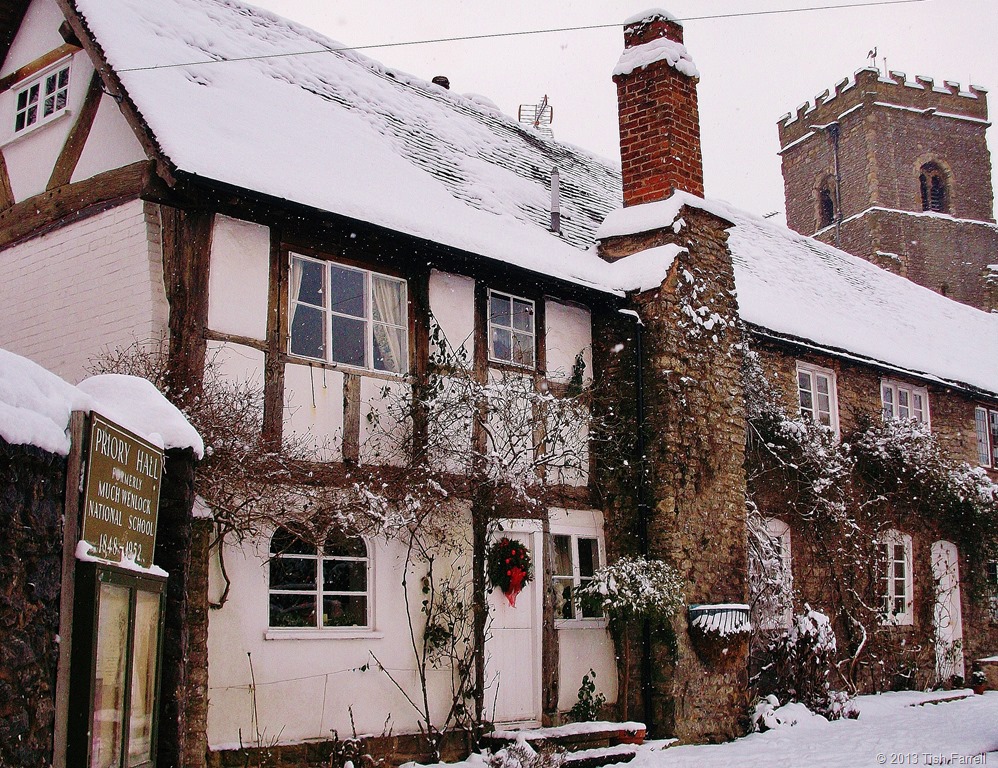
But back to the inspector who was left stranded at the top the page. Two years ago Much Wenlock was one of the seventeen front-runner communities in the country chosen by Government to create a Neighbourhood Plan. Since then, cohorts of Wenlock and other volunteers have worked with the community to produce a plan that sets out the kind of development we want in the parish over the next thirteen years. Last week the inspector, the man assessing the plan, came to the Priory Hall, the town’s community centre, to conduct a public hearing.
100_4923

For reasons that may become apparent by looking at the next photos, large scale development is not a popular proposition in the community. Most of us feel that we have had more than enough. The town sits in a basin. Wenlock Edge and surrounding hills drain through it down a culverted medieval watercourse once known as the Schittebrok. The Victorians did the culverting and there have been so-called remedial schemes since. Some argue these ‘improvements’ have made the problem worse. The town’s footprint has increased some 300% in the last decades with much unsympathetic development that has covered agricultural land with hard surfaces that speed up flooding. Our narrow medieval street system turns roads into rivers during heavy rain. The other serious problem then (apart from traffic congestion) is drains.

001 (4)

001 (3)

001 (2)

In 2007, after 91 homes were flooded due to a combination of flash flooding and poor drainage, the town held a referendum. The vote was 471 to 13 to have no more development until the town’s traffic and drainage problems were resolved. Nothing has been done to improve these matters, our sewage farm is under capacity. The bill for new drainage will cost millions and our private water company is unlikely to fork out. In the meantime the developers and major landowner informed the inspector that they are itching to build 85 houses in the near future, with a suggested total of 250 over all.

At the hearing the inspector gave them ample chance to make their case, and he himself gave no clue as to which side’s view would hold sway. The Neighbourhood Plan wants only small numbers of affordable homes for locals to rent, and a maximum of 25 market homes on a single low density development. But this is not how housing developers work. Much Wenlock’s property prices are high; it is a desirable place to live. They thus want to build up-scale houses with multiple bathrooms. Meanwhile our ageing community would like comfortable smaller places so they can downsize and release their homes to people with families. It is a divergence of objectives that appears to have no sensible resolution.

The British Government’s stance is that building houses is the only way to create ‘sustainable’ communities. So even if the Neighbourhood Plan is passed by the inspector, there is no knowing how far it will protect the town from inappropriate development.

As I said at the start, Much Wenlock is a small town with a big history. But perhaps our story has not yet been well enough told. Perhaps we are not shouting it loud enough. Events that occurred in and around Milburga’s former domain have helped change the world we all live in. A few miles away is the World Heritage Site of the Ironbridge Gorge (site of the world’s first cast iron bridge built in 1779). The iron, porcelain and decorative tile industries that grew up in this area traded their goods across the world. Monastic enterprise underpinned the development of  British industry.

Today if you visit Much Wenlock it may strike you as a Rip Van Winkle sort of place. It has a slumbering air, as if dozing under the weight of ancient timbers and stonework. But it can be lively too.There are some excellent shops including two excellent book shops and a gallery. There are small markets during the week, a museum, the church, the Priory, the Olympian trail, good pubs and hotels, many societies to join, a fully equipped leisure and arts centre. 

Above: glimpse of the Prior’s house, now a private home. Below: cottages on the Bull Ring

We have much  to protect and preserve here, and much to share with those who visit us. And we do want the town to grow and thrive, but on the community’s terms and according to their expressed needs. But looking over the last thousand years, this story does have a common theme. Whether we’re talking of Saxon kings, Norman earls or housing developers, those who have power and land do all the ruling, too frequently asserting their will over the wishes of the general populace. It remains to be seen whether the inspector will pass our plan. He said he would let us know in November. In the meantime, I, like others in the town, watch rainy skies with anxious eyes, if not for ourselves, then for vulnerable neighbours. Fingers crossed for Neighbourhood Planning and that it actually will serve our purpose.

© 2013 Tish Farrell
Related:

https://tishfarrell.wordpress.com/2011/06/27/of-silurian-shores/

https://tishfarrell.wordpress.com/2013/06/04/windows-in-wenlock/

https://tishfarrell.wordpress.com/2012/01/26/of-wolf-farts-windmills-and-the-wenlock-olympics/

twitter: @Wenlock_Plan

www.wenlockplan.org

https://www.facebook.com/pages/Wenlock-Edge/532033273535604?ref=profile

https://www.facebook.com/pages/Wenlock-Edge/119957538050970

BOOKS:

W F Mumford Wenlock in the Middle Ages 1977 re-published under ISBN 0950561606

Vivien Bellamy A History of Much Wenlock 2001 Shropshire Books ISBN 9780903802796

Paul Kabochi, Path-finder, Pharmacist 1942-2003


Scan-130602-0001


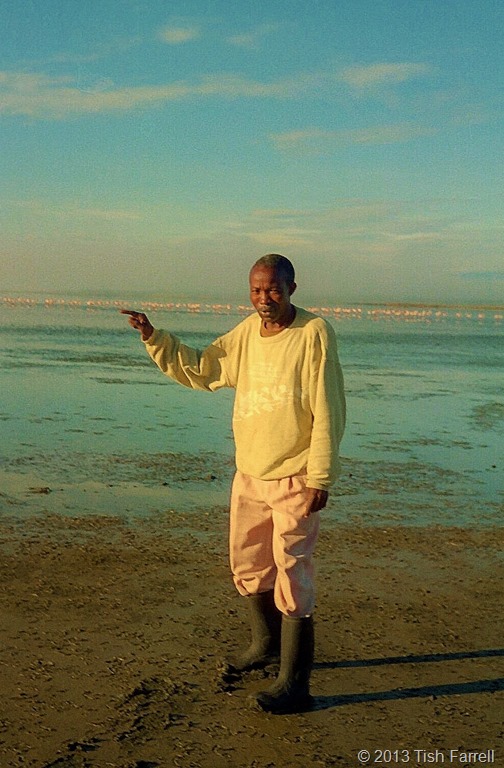
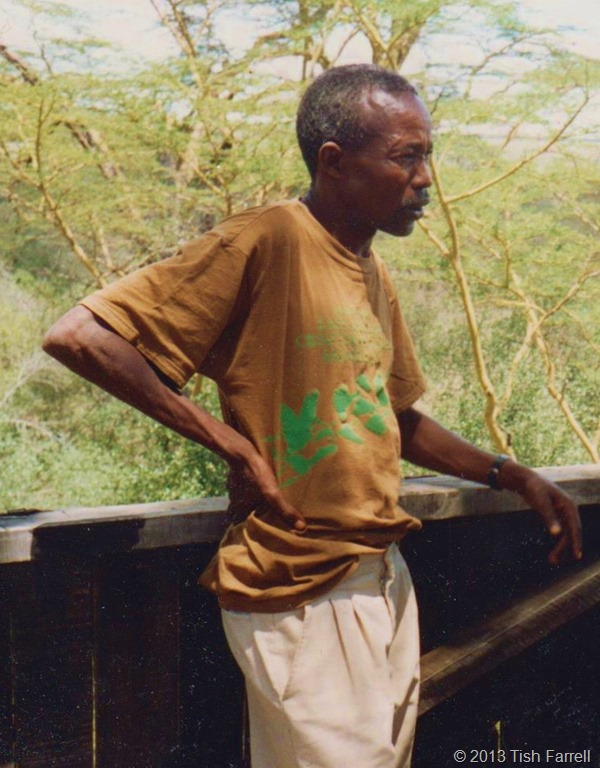
It was dawn on the muddy shores of Lake Elmenteita in Kenya’s Rift Valley, and I was walking alone, listening to the endless grunting of flamingos as they grazed the algae-rich water. Suddenly a safari truck swung out onto the mud flats. A Japanese tourist jumped out and began taking photographs of the distant flamingos. His driver and guide Paul Kabochi, also got out, moving more softly as was his way. He  came over to me while his guest went on shooting. “Hello,” he said. “What are you doing here?”

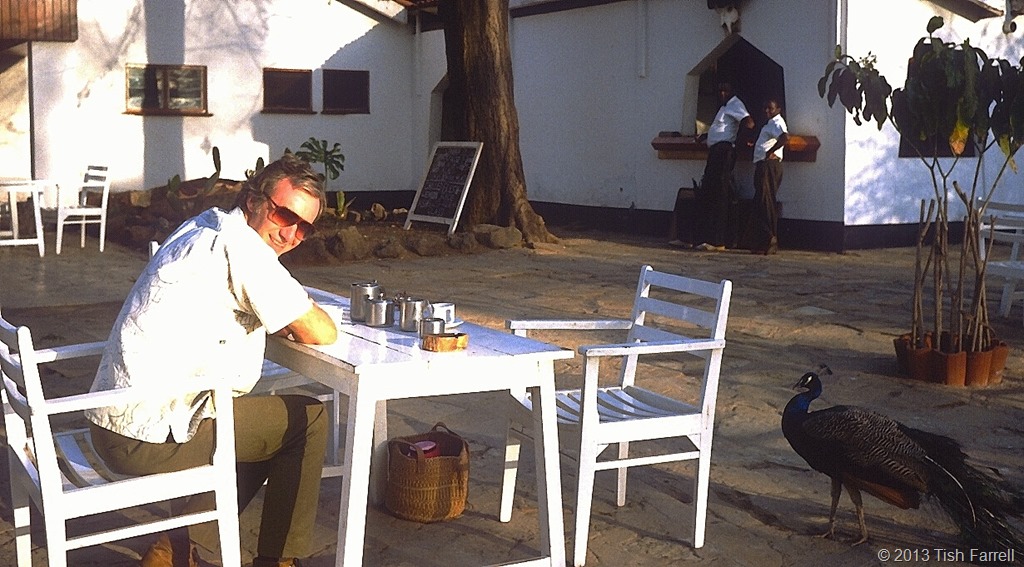
It wasn’t a question that expected an answer; it was just Paul being Paul, the wry smile, and the glittering eyes that missed nothing. On several visits to Elmenteita’s Delamere Camp he had taken me out on dawn walks, and he had been our guide on night drives around the Soysambu estate.  And so, as I had my camera with me, I asked him to pose by the lake, which he was more than pleased to do.

Paul Githinji Kabochi was a man I am lucky to have met, and I mourn his tragic loss in what was, for him, the strangest of accidents. He was a true path-finder, and not only for the likes of me, a traveller, wanting to experience the African bush with someone who knew it intimately, but also for august naturalists such as David Attenborough.  Paul had been one of the expert guides during the making of The Life of Mammals, and his special knowledge was often called upon by the BBC’s outpost in Nairobi.

I first met him on the afternoon ethnobotany walk run by Delamere Camp to keep guests amused until the night drive around Lord Delamere’s private estate (now Soysambu Conservancy). That day, on the walk, we did not get beyond the camp grounds. There were too many plants that required our attention.

Paul knew about the medicinal properties of both indigenous and introduced plant species. I remember him telling me to pick some lavender from the bush outside the camp dining room when I told him I had a headache; this after ascertaining whether it was “a headache of the stomach, or of the weather.” He told me to make tea with it. On other occasions he also explained how he treated skin cancers with a mixture of, among other things, baked sodom apple (Solanum family) and avocado. Then there was the little blue flowered Wandering Jew (Commelina) that was especially good for clearing adolescent acne. He also once told me that he had successfully treated a typhoid outbreak in the locality with decoctions of (I think) fever tree bark.  He meant to write a book, imparting all he knew, but when I last met him he was struggling with finding ways to fund the venture.

When he was not acting as guide for Delamere Camps, he had his own clinic in Rumuruti, and was also called on from time to time to consult at the prestigious Nairobi Hospital.

001

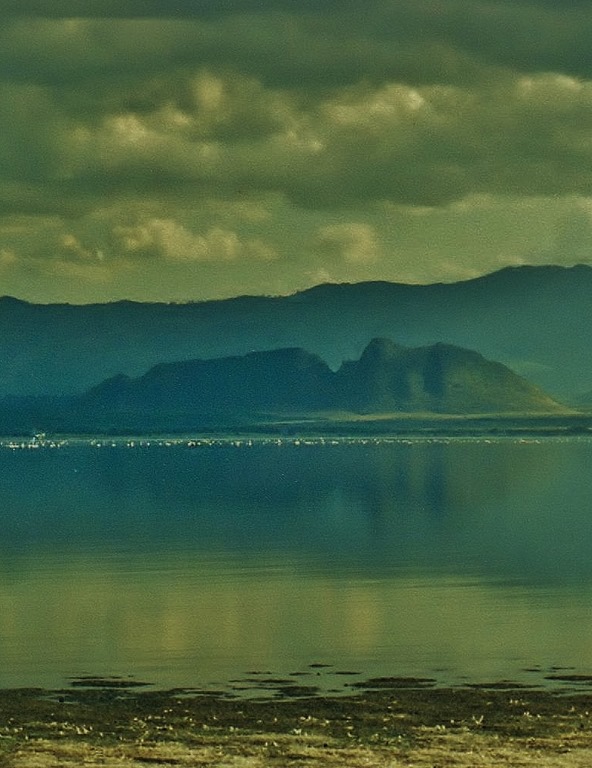
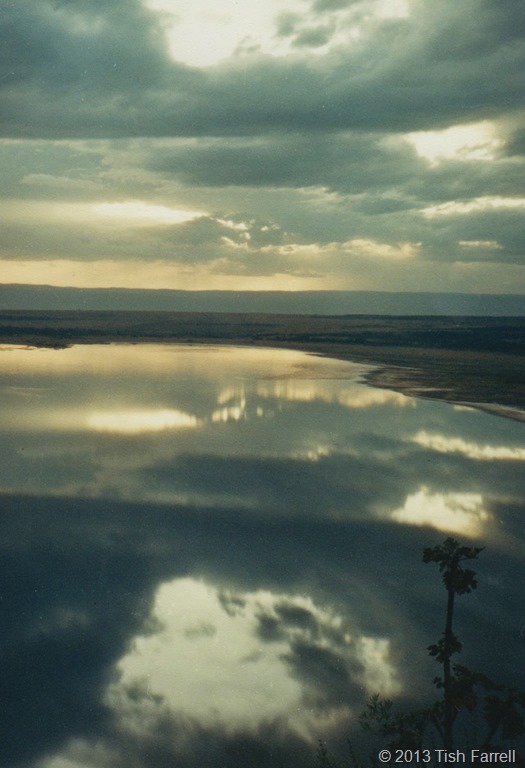
Lake Elmenteita looking towards the exploded volcanic crater known as The Sleeping Warrior. Large numbers of flamingos come to feed here, but it is more important as a breeding ground for white pelicans. Like many of the Rift lakes, the water is exceedingly alkaline. This particular lake is also very shallow, being only around 1 metre deep. At times it has been known to disappear altogether, leaving a dusty basin. The name comes from the Maasai ol muteita meaning dust place.

005

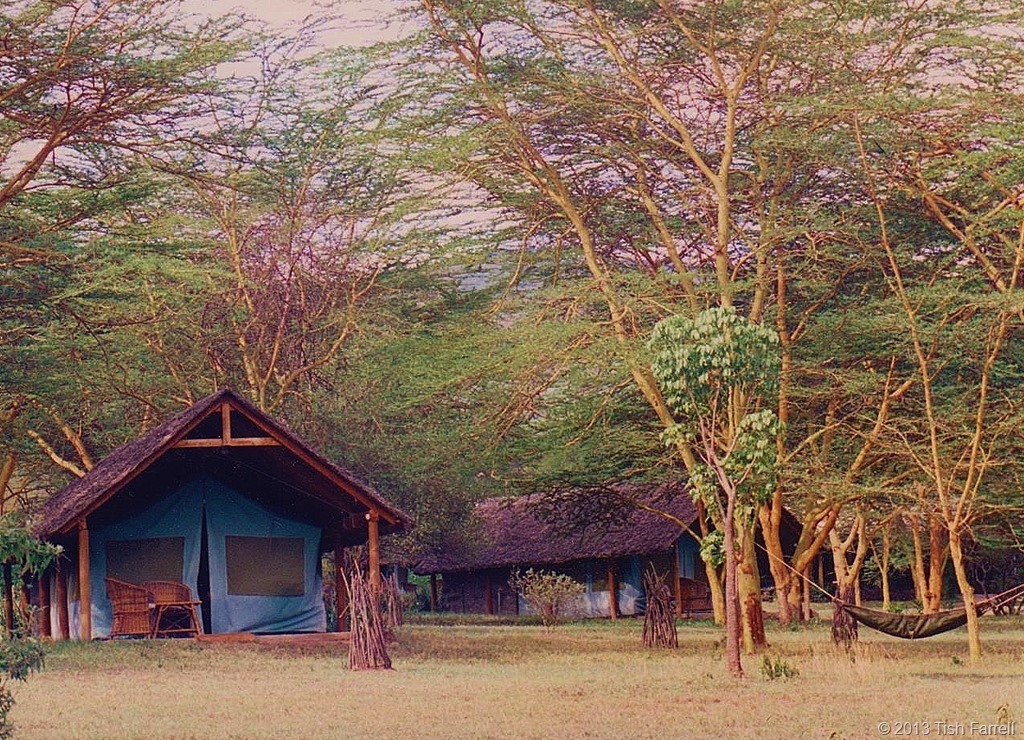
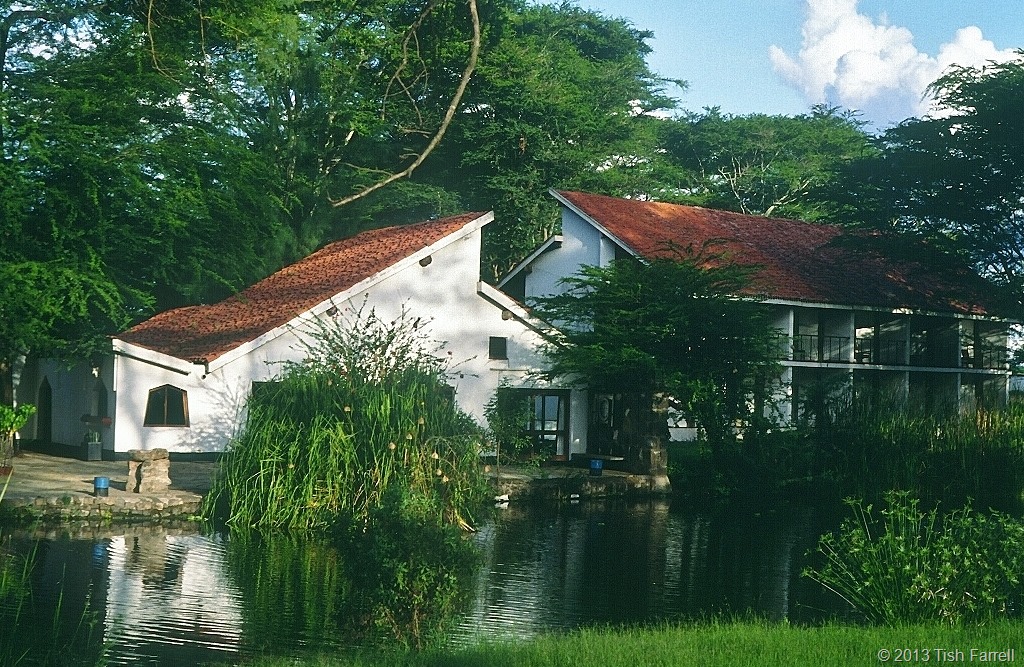
There were around twenty ‘thatched-roof’ tents – all with bathrooms. On cool evenings we would return from the night drive to find hot water bottles in our beds.

001 (2)

Paul was responsible for many of  the features that made staying at the Elmenteita camp so special. One of them was the tree house he built in a fever tree, and on whose roof terrace he is standing in the photo above. Small numbers of guests could spend the night there in the hopes of spotting the leopard that came to drink at  a nearby water hole. We stayed there once, but saw no leopard. Instead we were kept awake by chattering tree squirrels who spent all night raiding the sugar bowl which we had carelessly left uncovered. The night drive out there, though, had been fun. We had seen both a zorilla and an aardvark. And in the morning the camp staff drove up with a full hot breakfast, so we could dine on the roof amongst the bird call.

Scan-130601-0007

Paul said he came from the Ndorobo community, or Ogiek, a small, but remnant population of hunter-gatherers, who traditionally lived by honey gathering and hunting. These slight-framed people were possibly among the indigenous inhabitants of East Africa before the arrival of the Bantu farmers and Maasai pastoralists. Many became assimilated with the newcomers, adopting their languages, but there are still groups living in the forests of the Mau Escarpment, where they struggle to have their rights acknowledged by the Kenyan Government. Top on their list of priorities is preserving their forest domain, now constantly under threat from agriculture.

Before he became a guide, Paul worked for many years as an animal trapper for the National Museums of Kenya, capturing animals for museum study and display. He told me that he and his party had once been set on by bandits while he was trapping up in remote and arid Turkana. The works Land Rover was stolen at gunpoint and they were left to die. He survived on that occasion, but blamed the loss of many teeth on the days of near starvation in the wilderness.

In the years before he died, Paul was working down at Taita Ranch near the border with Tanzania. There he liaised with film crews and scientific expeditions of all kinds, giving them the benefit of his wisdom and wit. It was on the 8th February 2003, while he was out alone, and on foot, tracking dwarf mongoose, that he was surprised by a lone elephant and killed. It was some years after the event that I heard what had happened, and oddly, too, from a friend of a friend in rural Shropshire, someone whose sister lived in Kenya and whom I met while she was briefly over in England on a visit. It was a strange way to discover this sad news. Even now, I find it hard to believe that someone as smart and wily as Paul Kabochi could have been caught unawares by an elephant. They have such a strong smell for one thing, and he was not a man to take anything for granted.

Many academic research papers have been dedicated to him, but I notice, as time passes, internet  references to Paul Kabochi grow fewer. This makes me wonder, too, about the loss of all his pharmacological knowledge. I know he had children, but did he pass it on? In 2000 German documentary film maker Ralf Breier made a short film about Paul. Its English title is ‘Animal Magician’. Now that’s a film I would like to see.

003 - Copy

The photo above was taken from the Sundowner Look-out, above Lake Elmenteita.This was another of Paul’s ideas: that in late afternoon guests would either walk or be driven up to the cliff top behind Delamere Camp. There they would be given a few roast ‘bitings’ of game meat and a beer or soft drink, and sit on tree-stump seats and watch the sun go down. We have sat up there and viewed this scene with some of our dearest friends. Now I  look at the photo and think of Paul Kabochi. It is hard to think that he is not still treading softly along Africa’s wilderness trails. 

© 2013 Tish Farrell
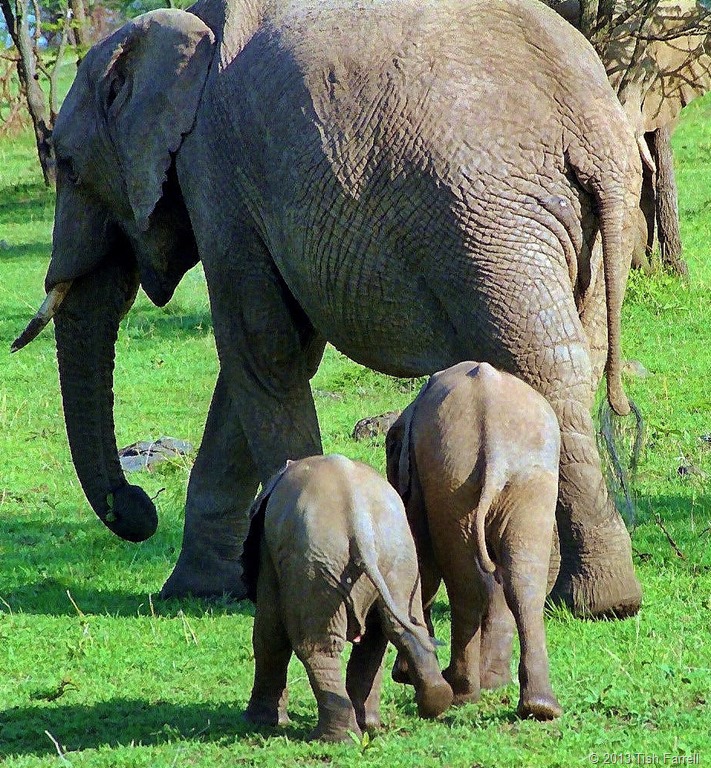
 

P.S. Delamere Camp is no more. Much of the former Delamere estate at Soysambu is now part of the Soysambu Conservancy. The soda lakes of Elmenteita and nearby Nakuru are now World Heritage Sites.


Nakuru is the next lake up the Rift from Elmenteita.


Grouchy Hippo, Laid-out Lions

It always seemed astonishing to me that, should you be lucky enough to locate them, you can simply drive up to dozing lions and take their photographs. Even if you sit doing this for half an hour or more, they will barely deign to register your presence. These big cat shots were all taken in Kenya, but it was while we were living in Zambia, and visiting South Luangwa, that our young South African guide briefed us on the proper protocol when encountering lions.

Scan-130429-0024


lions in the Taita reserve 1992

At the time we were driving around a Luangwa salt pan where we had come upon a pride of lions lying about in the thorn scrub. The guide told us that as long as  our profiles remained within the frame of the vehicle (in this case an open-topped safari truck) the lions would not give two hoots about us. To them we would appear to be part of the truck and from which they perceived no particular threat.

South Luangwa - out on the salt pan lion hunting

Out on the Luangwa salt pan, me in the back seat. The lions had been spotted earlier before the sun came up.

South Luangwa - spot the lions 1

Not a good photo, but the light was poor and I had only my Olympus trip.

*

However, I was scarcely reassured by this newly acquired knowledge of how-not-to-upset-a-lion when the next day, at 5 a.m., the same guide took us on a hike through the bush. It is all so very different on foot. For one thing, it can be hard to see  far ahead, what with all the tall grasses and potato bushes. The guide, though, seemed perfectly relaxed. He had already led us to within thirty paces of a browsing elephant, and assured us that it was entirely peaceable since its ears were not out, nor its trunk thrust to the side in charge mode. He had explained, too, how elephants move silently, in effect walking on tiptoes, the backs of their feet cushions of fat. For a time I kept looking behind me. It had never occurred to me before that something as large as an elephant could sneak up on me.

Our guide then spotted a herd of buffalo. This pleased him because he said that in Luangwa lions preyed on buffalo and the big cats were thus never far behind. And so keeping a careful watch on which way the wind was blowing our scent, he and our accompanying park ranger, White, set out to find some. This involved much careful manoeuvring, first around a small group of  passing elephants, and then around the buffalo herd.

Clearly, being on foot, the keeping-one’s-profile-inside-the-vehicle strategy would be quite useless. We had no vehicle. Instead we were told to stake out likely trees to scramble up. I eyed the leadwood and sausage trees doubtfully. A few decades had passed since I had done any tree-climbing. I did not think I could do it – not even to escape a charging  lion or buffalo.

Later I was to read a white settler tale of how if you were ‘treed’ by buffalo, they would lick any appendage you had not managed to haul high enough into the branches, and go on licking until your flesh was abraded to the bone. I’m glad I did not know that then. I already knew that buffalo were probably the most dangerous beasts in Africa, and it did not do to cross them- ever.

In the end we did not find lion. I was both disappointed and relieved. By then we had been out walking for several hours, and had only stopped for a tea break. The late morning sun burned down overhead, and we headed back to camp along the Luangwa River, me thinking mostly of breakfast. The members of our small party chatted amiably, enjoying the shimmering meanders of the river. We might have been walking in a city park for all the care we were taking. It was lucky, then, that we had White, the park ranger with us. It was he who drew our guide’s attention to the big bull hippo further along the track. The great beast was attempting to negotiate a shelving river bank, and having some difficulty. Several times he slithered half way down, but could not bring himself to take the final plunge.

The guide said it was most unusual to see a hippo out of the river so late in the day. They liked to be back in the river before sun-up, this after the night spent foraging for grass. He was clearly upset, but we were still some way off, so we stood and watched. Some of us were even laughing at the hippo’s dilemma. The bank was simply too steep. His huge bulk gleamed an angry red under the sun.

Then someone must have laughed too loudly, for suddenly the bull gave up trying to slide into the river. With a bellow he swung towards us and came charging down the path. While White took up a position behind a thorn bush, the guide urged us to move several hundred yards back along the path, across an old lagoon to where a fisherman’s big dug-out had been beached. We were to stand behind the dug-out until he came for us.

We did not need to be told twice. The boat looked reassuringly substantial, although it reminded me of the guide’s earlier tea break tale. We had stopped at a fisherman’s old campsite, and it was there that he told us how a fisherman had recently been mangled to death by a hippo. As we reached the dug-out I vaguely wondered if this boat had belonged to the poor man.

Meanwhile the ranger and the guide, held their position behind the thorn bush, and began to clap very loudly.

For too many seconds the bull came on. The ranger had his rifle at the ready. The guide kept clapping. Then at the last moment, the hippo ran out of steam and veered off into the undergrowth. There were sighs of relief all round.  When the guide came to round us up, he informed us that White had been more than ready to, as he put it,  part the bull from his brains, but they were nonetheless glad that this had not been necessary. Apart from being scared, the incident made me uncomfortable. I saw then that safari-going had its responsibilities, and was not simply an exciting jaunt. If White had been forced to shoot the hippo it would have been because we were intruding at a moment when the bull saw himself at great disadvantage. Who could blame him for charging?

South Luangwa - hippos and bull on the bank 2 wider view

The hippo when first sighted. You can just spot him under the tree on the right. Thereafter, I was running not snapping.

*

South Luangwa - traditional fishermen's dug-outs on a lagoon

The dug-out refuge point, and White leading us back to the path, the hippo now vanished from sight.

*

South Luangwa - dawn walk and hippos

Watching more peaceful hippo near our camp.

*

Back in camp it was of course a case of ‘travellers’ tales’.  We could sit around over a late breakfast, talking of all the things we had seen that morning, and especially of our near miss with one very angry hippo. At such times, and as so often happened in Zambia, life did not seem altogether real.

South Luangwa - Tenatena camp dining room under a rain tree

The dining room at Tena Tena camp, beside the river and under a rain tree


© 2013 Tish Farrell
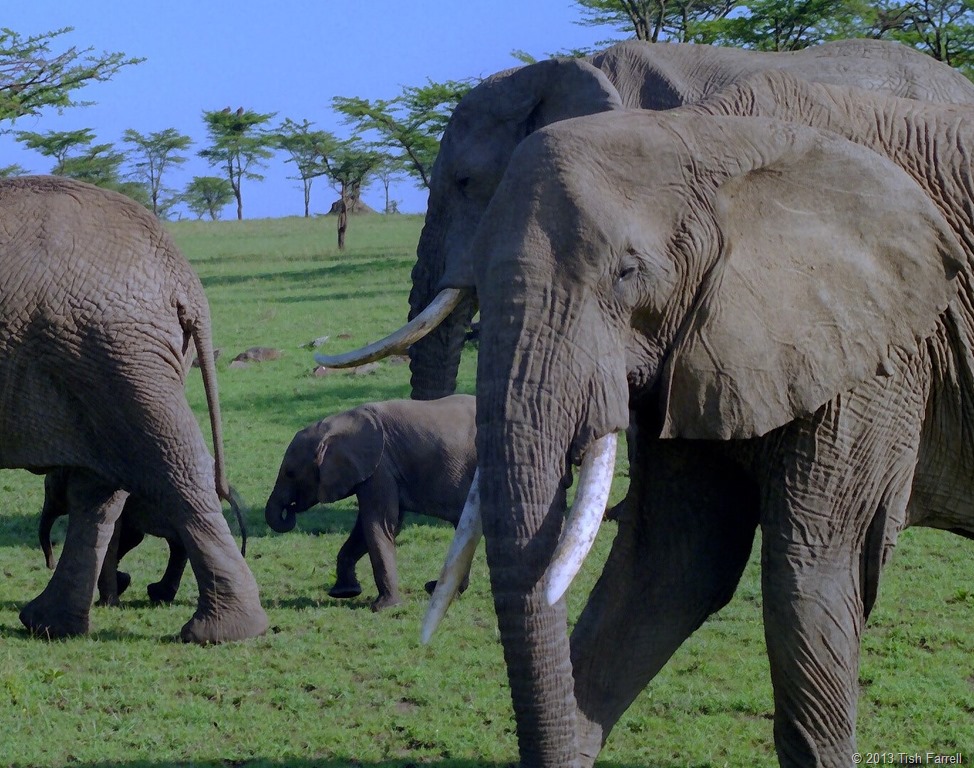
No way back from Africa: the road to Hunter’s Lodge

010

The road from the Range Station to Kiboko

*

I can pretty much bank on it. Once you have been in Africa you will never be the same. Nowhere else will you feel so alive, or so in love, or so entranced or indeed, afraid. In the physical sense, your blood and guts may well bear traces of the diseases and parasites you encounter there for years to come. Certainly the psyche will be forever afflicted by acute withdrawal symptoms, the loss of sensation, the no-longer-state of being always in the present – the only way to live back there.
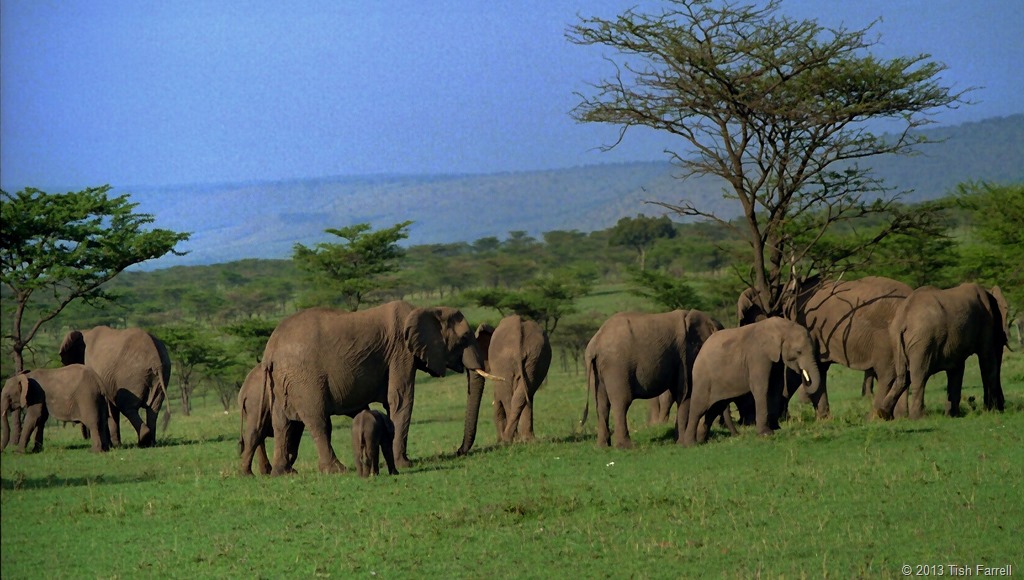
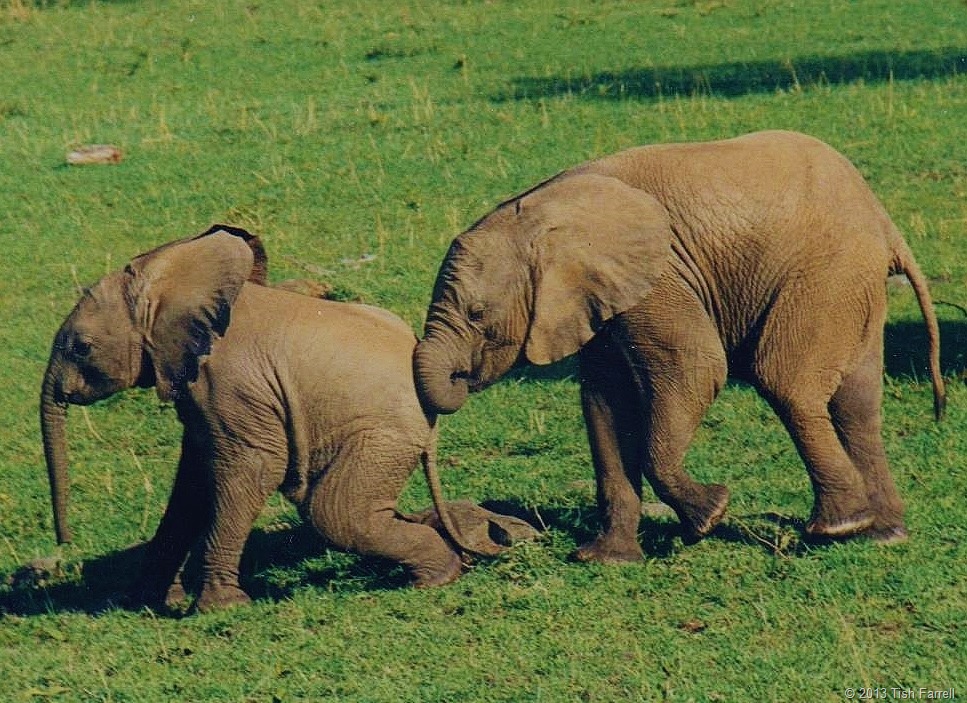
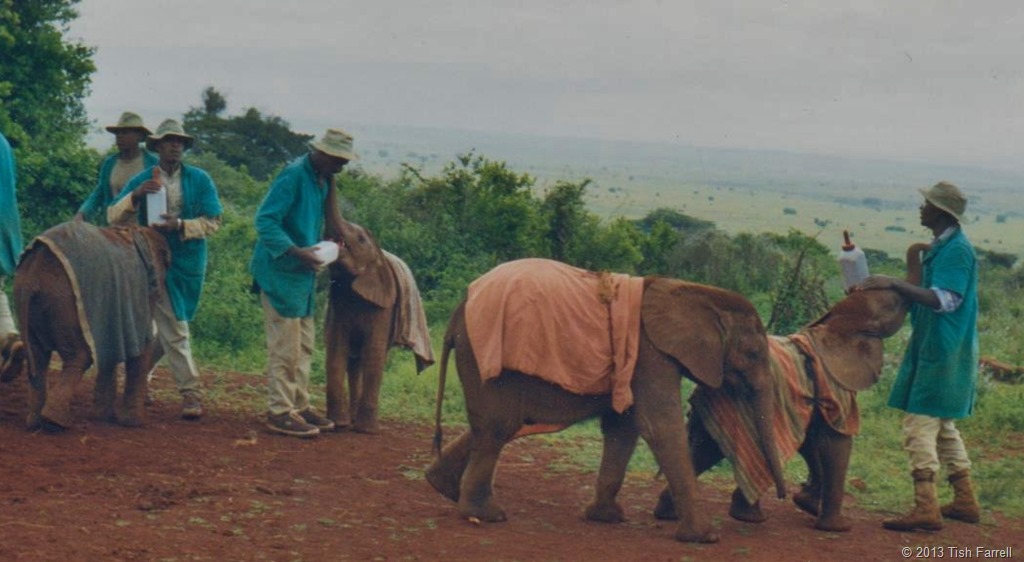
In elemental ways too, standing, for instance, in East Africa’s Rift Valley, you could well find yourself confronting your genetic heritage for the very first time: the dazzling revelation that this is the land where your ancestors stood up on their apes’ hind legs and marched onwards to the age of technological development that we like to call civilization. It is the moment that you understand that you and this landmass are intimately connected through every pore, cell and bone.

And the reason I can say this, daring such unbridled presumption, is because it happened to me, and to G, and to all who know us and visited us there. Africa gets under your skin and, to quote a dear old friend “up your nose and into your soul.”

003

Kilimanjaro caught from the Mombasa highway just south of Kiboko

*

For me the journey into Africa began, with auspicious timing, on the 14th February 1992. This was the day I ran away – to Kenya to be precise, leaving home, possessions, accountant spouse and several labradors in order to travel with a roving entomologist who had no home, no possessions – neither in Africa nor in England. He had recently been in Mexico researching the habits of the Larger Grain Borer (LGB), a small maize-eating beetle that ravages stored crops. Before this he had worked for two years in Tabora, Tanzania, as a volunteer Agricultural Extension worker, also advising farmers about LGB. (See earlier post On Kenya’s Farms)

In the 1980s this pest had arrived  in Africa (where it has no known natural predators), introduced on consignments of food aid from the Americas. In 1992, then, G was on a new LGB mission: to monitor the beetle’s spread from Mombasa on the Indian Ocean coast to Nairobi in the Kenya’s central highlands. For the next nine months we would lead a nomadic life, travelling up and down the Mombasa highway, which back then was little more than a ribbon of ragged tarmac running through the bush.

The road was fraught with dangers – from gargantuan potholes to car-jackers lurking in the thorn scrub. There were also successions of stranded trucks left where you least expected them, and the possibility of some belligerent buffalo insisting on a standoff in the middle of the highway; and then there were policemen flagging us down for lifts, or to give us speeding tickets when we had not been speeding.

sundowner

Hunter’s Lodge, Kiboko

*

During these nine months we stayed in roadside hotels, safari lodges, beach cottages, a Danish development workers’ guesthouse, and, best of all, at Hunter’s Lodge where we were usually to be found for three or four days each week. This one-time home and small hotel was begun by Great White Hunter, John Hunter, at a small place called Kiboko, some hundred miles south of Nairobi. The place had once been a regular resort for expatriates taking a weekend break from the capital, or a convenient overnight stop en route for Mombasa beach. This was in the days when the road was still an un-metalled cart track, and it took all day to get there (needless to say, covered head to toe in red plains’ dust). The coast was a further 200 mile-drive, including the long stretch of desolate Taru thorn scrub south of Voi.

Kiboko, then, was in every way an oasis. John Hunter had long had his eye on the location before he moved there in his retirement in 1958. He had arrived in British East Africa in 1908 in the wake of the first European settlers, and made a career of clearing unwanted game: first lions from the Uganda railway that ran nearby and later, on behalf of the colonial game department, elephant from settler farms, and marauding hyena from the African native reserves.

He also ran private safaris for counts and maharajas, and therefore rubbed shoulders with the likes of Karen Blixen’s white hunter husband, Bror Blixen, and her lover, Denys Finch Hatton (Out of Africa). In his time, Hunter was personally responsible for despatching over 1,400 elephants, and nearly as many rhinoceros. Local myth had it that Hunter gave up repairing the hotel sign which a vengeful rhino was intent on flattening. Besides, in those days, everyone who was anyone knew where Hunter’s Lodge was.

Graham and peacock 1992

Afternoon tea with the sugar-stealing peacock

*

The reason Hunter chose Kiboko to settle was because it had fresh water: a volcanic spring, and the only one for miles around. In the old days he had often watched elephant coming there at sundown to drink. He, however, set about damming the stream to make a small lake, this surrounded by a grove of graceful fever trees and wild figs. Given the general aridity of the surrounding bush country, it truly is a beautiful place, a resort not only for human travellers, but for some three hundred species of bird. When we were there, there was also talk that a leopard haunted the upper reaches of the pool, but we never saw it: only baboons and vervet monkeys, a bushbaby and a monitor lizard.

The bridge

The bridge to the vegetable shamba

*

And the reason that we often stayed there was because the Kenya Agricultural Research Institute had a small research station and laboratory just behind the lodge. On starting his job, Graham was gravely entrusted with a key to the back garden gate, so that at 7.30 am he could walk to work, and then walk back again for lunch at noon. The lab employed a dozen technicians, all working on the LGB project.

002

Graham's team at Kiboko Lab - the last day

Kiboko lab and staff

*

In 1992 Hunter’s Lodge rarely had many overnight guests. Sometimes G’s boss would be stay; sometimes a travelling salesman; sometimes an aid worker or two. Once, an Intermediate Technology N.G.O held a two-day seminar there. Once, a large group of Nairobi Asians came for a weekend party. The main trade, however, comprised passing travellers who dropped in throughout the day for snacks and drinks. These were served by smart bow-tied waiters on the bar terrace where you would be stalked by a bedraggled peacock, which sorely depressed since its mate had been swallowed by a python, sought pleasure in raiding the sugar bowl whenever it had the chance. It was a sad old bird.

The menu was limited: cheese sandwiches, steak and chips and omelettes. But the cook did prepare an amazing fresh lemon juice made from the lodge garden’s own lemons. It was sour enough to curl your teeth, but extraordinarily sweet too. We also soon took to carrying a plastic tea strainer around with us – to sieve the skin out of the milk, both from the breakfast wheatie flakes, and before we poured it into our tea.

The milk was brought daily by Maasai women and their donkies, and boiled within an inch of its life. Even so, it still tasted of the ash-scrubbed gourds that it was delivered in. This milk, coupled with the sulphurous water from the spring, made afternoon tea a daily strange experience. Only the lack of other things to do when G came home from work at five o’clock made us persist with it. Going for tea on the terrace was, after all, an outing – a different experience from the lunch and supper outing to exactly the same spot, or to the breakfast outing which was to the lodge dining room with its strange ogival doorways.

Scan-130520-0010_thumb.jpg

Looking toward the Lodge dining room

*

The best pursuit of the day, so long as there had been a calor gas delivery, was at sundown  to resort to the shower in our room. The shower fittings went under the manufacturer’s name of Steamy Steamy. After a dusty drive up or down the Mombasa highway, a good Steamy Steamy was the only thing we could think of.

Then by seven when it was quite dark, and we were duly steamed and dressed, the next treat would be to sit on our veranda and wait for the firefly display up and down the garden lake. This was followed by a trip to the bar and a couple of Tusker beers. If John, the young Maasai barman, was on duty, then we were in for some good conversation. He had opinions on everything. The local Akamba waiters would stand about and gaze at him in awe, whether he was talking to us or to them. He told us he owned 150 cattle, and had two wives. He had not wanted to marry a second time, he explained, but his parents had urged him because his mother had kidney disease and needed more household help. He had accepted the situation philosophically.

Once, John offered to take me on the back of his bicycle into the bush to his family’s ‘enkang and to see a female circumcision ceremony. I wished I’d had the guts to accept. He told me his home was only two hours away, as if I would manage the ride over bush tracks quite easily, me who had never ever balanced myself on a bicycle parcel rack.

005

Caught red-handed, a vervet raider eating our bananas

*

While G was at work, I wrote letters and read. But mostly I watched. I soon realized that the Lodge was run, not for guests, but for the benefit of its staff. Their daily routine of cleaning and tending went on whether or not there were any guests. The garden staff wore brown overalls. They mowed the lawn, and worked in the vegetable shamba across the lake. Around ten in the morning a bell rang and everyone disappeared for a tea-break. The manager wore a smart khaki Kaunda suit, and marched hither and thither, but to no apparent purpose.

Then there was Joyce, the chambermaid. Her husband worked down at Kibwezi and was a forestry officer. She lived with her two little boys in the staff bandas at the bottom of the garden. On her days off she went home to the family farm. She told me that I should learn Ki-Swahili since it was very easy. I agreed, but only learned a smattering. The hello, how are you: jambo, habari yako?

Between the gentle staff activity, there was only the wildlife to observe, vervet monkeys planning raids on our room, pied kingfishers diving, yellow weavers endlessly weaving, herons clattering their bills in the thorn tree heronry, marabou storks lurking like spectres on the lawn, hadada ibis winking out grubs with their curvy bills. And over all, the high-tension whine of crickets that could drive you mad when you were not feeling well.

Joyce our chambermaid

Joyce

*

One of the features of Kiboko, I soon discovered, was the wood carvers’ stalls opposite the Lodge. Sometimes I took my clothes down to Esther who ran such a stall, and traded them for Akamba carvings. She struck a hard deal, and I was a simpleton when it came to haggling. G was nonetheless impressed since it lightened the contents of my two bags.

Scan-130429-0155 (3)

Esther at her stall with son, Tom

*

And so it was that Hunter’s Lodge became a home of sorts. Whichever way we approached it on the Mombasa highway, my eyes would fix on the green grove of fever trees, and my spirits would lift as we turned off the road. There was Steamy Steamy to look forward to, the smoky taste of the tea, Reuben the breakfast waiter who always asked us if we were having eggs though we never did. Only later did we discover that we had paid for a full breakfast in with our room rate. There was the birdlife to watch, and the sleepy routine of the hotel staff to keep tabs on; there were the steaks that our weak teeth found impossible to process, the fireflies and the vervets, and there were the brief African sunsets as the light turned through lavender and orange to black, black night. There was irony too, for it was of course the metalled road that turned Hunter’s Lodge from oasis to backwater, making the coast accessible in a single day: an unintended consequence of progress. 

I remember the long nights I lay awake, listening to the whine of insects, the drone of trucks on the Mombasa highway, the hoot of the train on Uganda railway. We are in Africa, I would tell myself. And even when I was there, so very much present in every sense, it still seemed like a dream. Perhaps this land was the original Garden of Eden. When we left it, we took our self-regarding selves to material greatness. Maybe the price for this knowledge was the loss of wisdom. Even now, so many years on, I still travel the road to Kiboko, at least in spirit,  and ponder this conundrum. The great safari continues…

013

Letter from Kathleen Collins Howell, illustrator and best friend

Daily Prompt: on the road

© 2013 Tish Farrell