Windmill? What Windmill? Perspectives Through Time And Space

IMG_8622sq

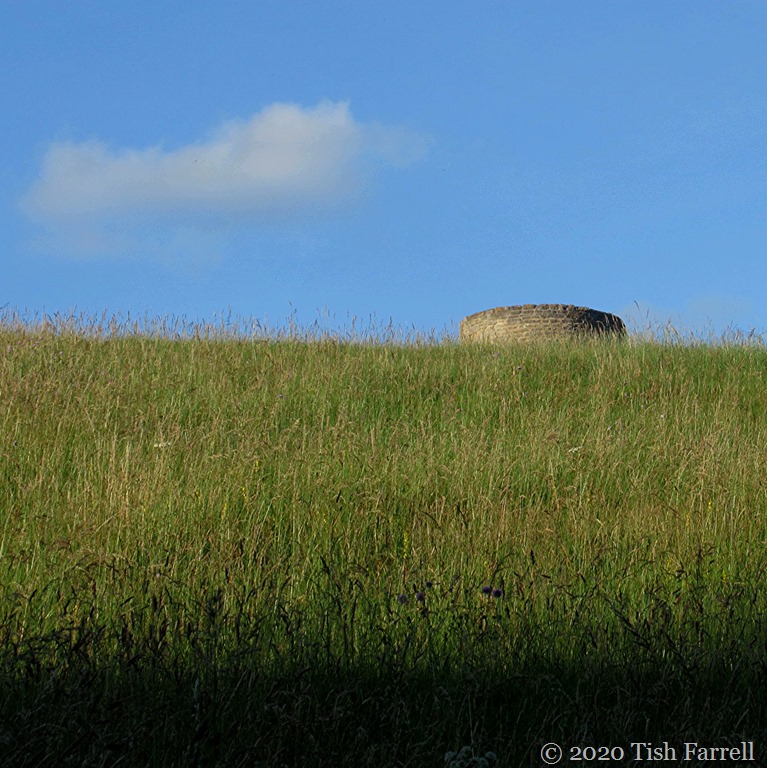
Those of you who come here often will know that Windmill Hill is my home town’s much loved landmark. Lucky for me it is only a five minute walk from the house, and that the walk there is mostly through the Linden Field (with its Linden Walk) where, from the 1850s the Wenlock Olympian Games, devised by William Penny Brookes, the town’s physician, were held every summer. In fact they still are an annual event, and should have been happening any day now, but for the pandemic panic.

Back in the Victorian era there were no large trees around the field as there are today and the slopes of Windmill Hill provided spectators with fine views of contesting hurdlers, hammer throwers and stone putters (featuring only local limestone quarry men and lime burners), football and cricket matches, tilting at the ring (lances wielded on horseback), long and high jumping, sprinting and cricket ball throwing. Needless to say these events did not feature women though there were knitting and sewing competitions for girls. And one year there was an ‘old woman’ race, for which the prize was a pound of tea.

Windmill Hill in 1850s

The above photo shows the Wenlock Olympian Games in action in 1867. I could find no copyright notice for it. It appears, source unacknowledged, in Much Wenlock Windmill  by M J Norrey.

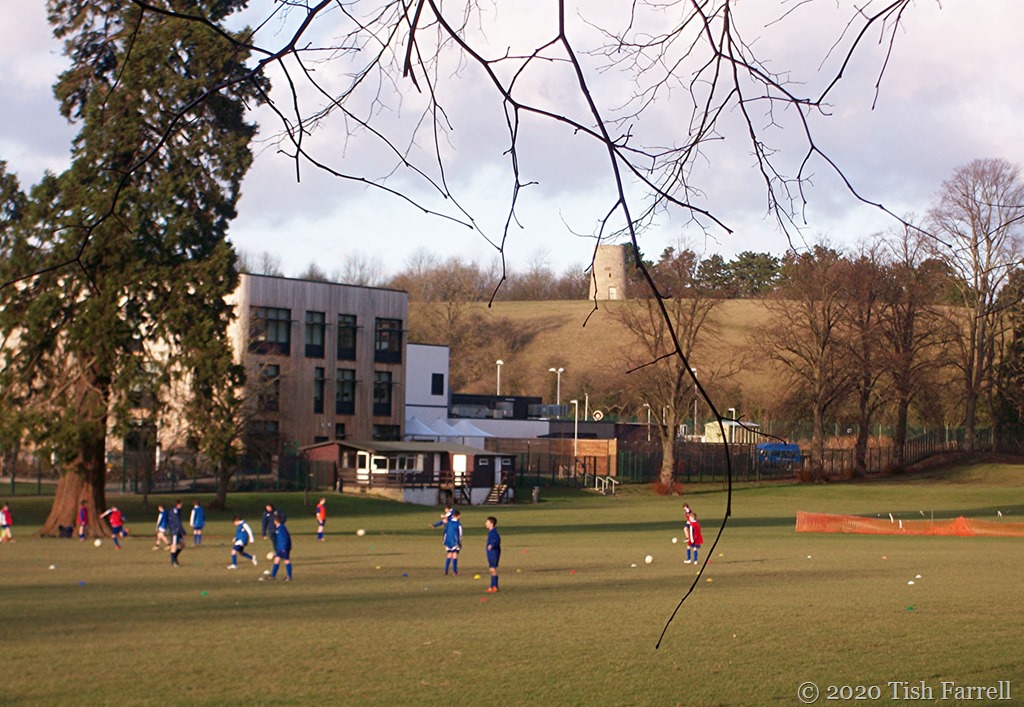
And here’s a more recent scene with the William Penny Brookes Academy on the left and some of its pupils during soccer practice. The oaks at the foot of Windmill Hill have all been planted to commemorate various events associated with the Olympian Games.
072

067

*

P1030046resized

The windmill itself is a bit of mystery. The Windmill Trust who take care of it have done extensive research, and although there are documents from the 1540s onwards relating to successive land owners (i.e. post the 1540 dissolution of Wenlock Priory, the original landowner), there is no information that is absolutely specific to the windmill. Physical surveys of the present tower, however, did uncover two dates of 1655 and 1657 carved within the stone construction layers, but there were no clues as to the kind of milling gear and superstructure that may once have existed here.

Here’s what the inside looks like. These were taken on an ‘open day’ a few years ago:

100_7454

100_7452

*

And here’s a cropped long-shot evening view taken from allotment three summers ago when oil seed rape was flowering in Townsend Meadow.

P1050568


Square Perspective #5

Deconstructed Artichokes And How I Tackle Them

IMG_8612

This year we’ve had masses of globe artichokes. I have several different varieties growing at the allotment, probably with the notion (as suggested by gardener-cook Sarah Raven) that doing this would extend the cropping season. It hasn’t. Well, not by much.

My usual way of cooking artichokes (one each) is to split then down the middle, cutting from stem to tip, scoop out the choke, drizzle the cut edges with lemon juice to stop discolouration (optional), then steam the halves for around 20 minutes. While that’s happening I put a dish on the hob and melt a big nugget of butter with a couple of cloves of crushed garlic (sometimes butter and olive oil), and when the artichokes are done, spoon this ‘sauce’ into each hollow.

After that it’s all a matter of pulling off the scaly leaves, dipping their bases in the garlic butter pool and sucking. By the time one gets to the flat juicy base, there’s no point in opting for a knife and fork, we’re all too butter fingered and dribbly chinned. Though a slice of wholemeal bread at this point may come in handy for general mopping up.

It is all incredibly messy, the kind of eating that Graham refers to as an ‘all over body experience’ and one that requires a thorough ‘hosing down’ afterwards. You also need to have ready a big dish for the debris. This later goes to ‘feed’ the hot composting bin.

Anyway, there’s only so much hedonistic dining a body can take, and I was just getting to the point of wondering who else at the allotment might like to eat our artichokes when I remembered Francesco da Mosto’s Venice TV series (2004!) It included a scene of women traders preparing buckets of what Francesco referred to as  ‘artichoke bottoms’, these to be sold to Venetian cooks who couldn’t  be bothered to confront this often challenging vegetable.

Artichoke bottoms! It had to be tried. The only problem, I quickly discovered, is that you need an incredibly sharp knife. Also most of my green globe heads were  supporting an insectopolis of aphids, ants and earwigs that required some determined flushing out. After that it was down to the bread knife to get to the bottom of the bottom. At least it got part of the job done, though I regreted my lack of Venetian finesse.

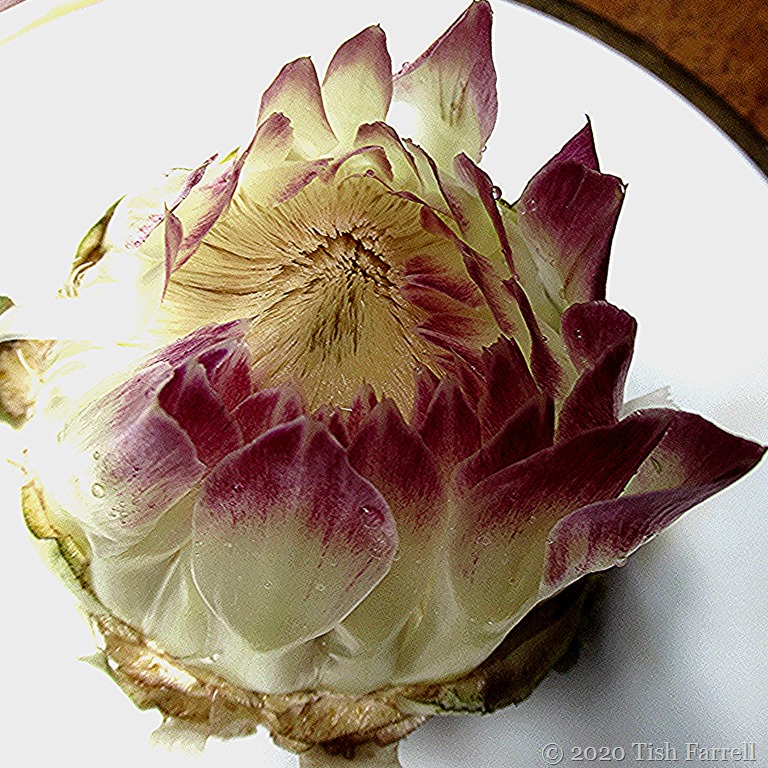
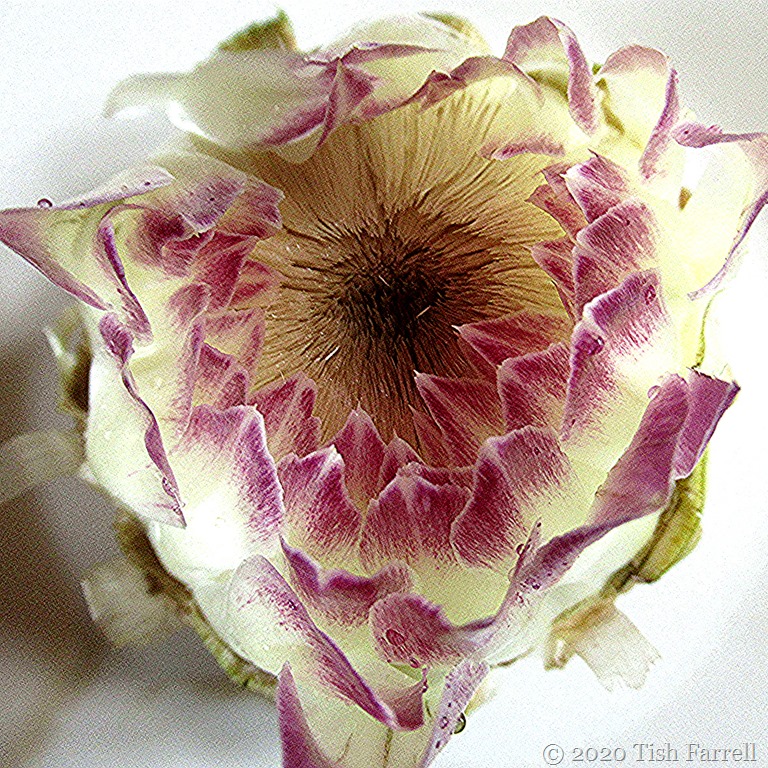
And so the photo. There comes a point when hacking can devolve to peeling (watching out for spiny leaf tips). As I reached the middle of this particular artichoke, and rather strangely, the last leaves clicked open in unison like a mechanical flower, so revealing the hairy choke and also providing this rather good imitation of a water lily.

I did not photograph the bottoms. After all the battling with bugs and wielding the contents of my knife drawer, there was not much to show for eight heads’ worth of artichoke. They are anyway not very pretty and seem to discolour whether or not you put them in acidulated water. But never mind. I braised them gently in olive oil with crushed garlic and fresh chopped oregano, added sliced baby courgettes and garden peas and served them sprinkled with pandano cheese. Delicious and also eaten using appropriate cutlery, so avoiding the dribbling and hosing down elements of my usual method. Some, of course, might think this drawback.

IMG_8609


Square Perspective #3

Small But Beautiful: Raindrops On Pea Flower

IMG_8275sq

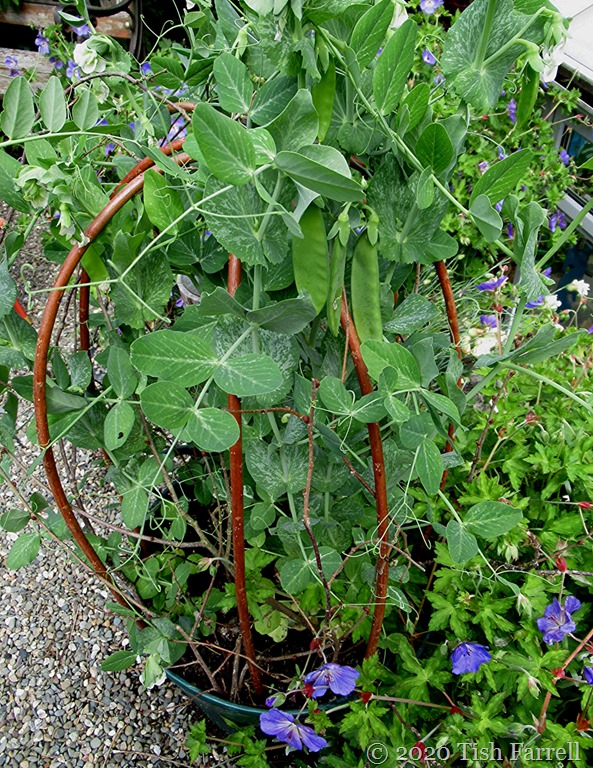
I have a few sugar snap peas growing in a bucket at the top of the garden by the seat. They have a few willow twigs for support and they seem quite happy surrounded by a profusion of geranium Rozanne. Also as I’m continually walking past them, I can easily spot the pods as soon as they’re ready for picking – usually enough to add to a stir fry or salad. So no glut of curly, tough and past-it pods. And then when these first plants have done their stuff, I have another bucket of later sown sugar snaps coming on beside them.

IMG_8448

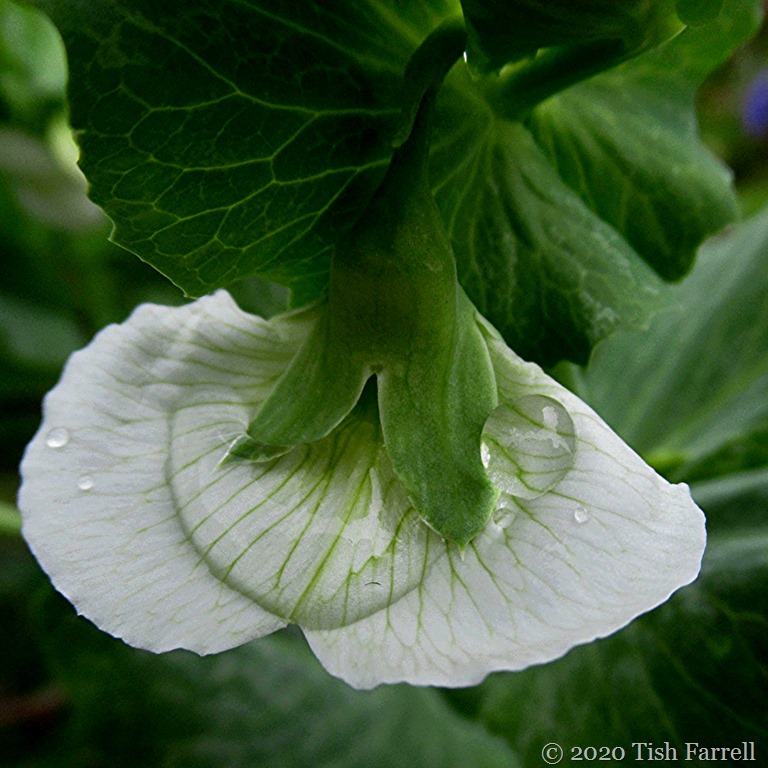
None of this was planned, but now that I’ve done it, I’m thinking it’s a good way to create small successions of this particular crop. Besides, the pea flowers provide ideal landing platforms for raindrops.


Square Perspective #2

Pop over the Becky’s to see her handsome pusscat perspective.

A Curious Perspective

IMG_8558

There is a particular time (just now) when the wheat in Townsend Meadow, having grown its tallest, conjoins with a particular spot along my homeward path from the allotment. Together they cause the rooftops on Sytche Lane to look like this.

Note to self: must remember to take another shot when the wheat has turned to gold.

Square Perspective #1  For the month of July, Becky challenges us to show her some perspective – contrive it how we will, just so long as it’s in square format.