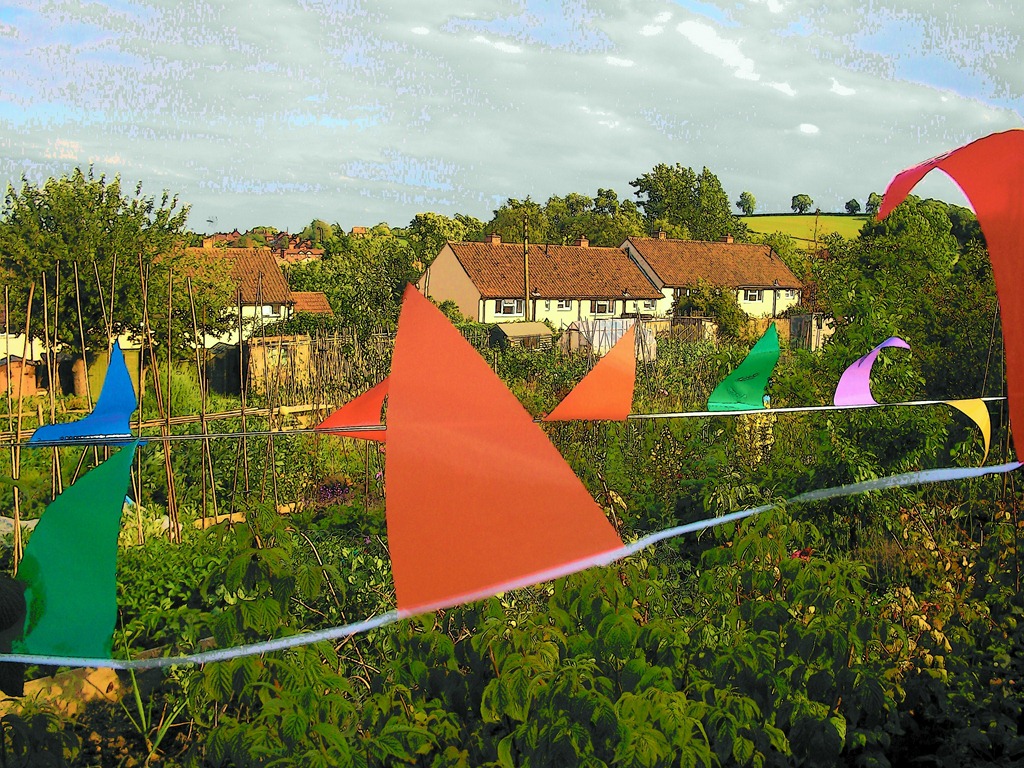
Rooti-toot-toot, it’s spring at the allotment: up close and vegetal

100_5367

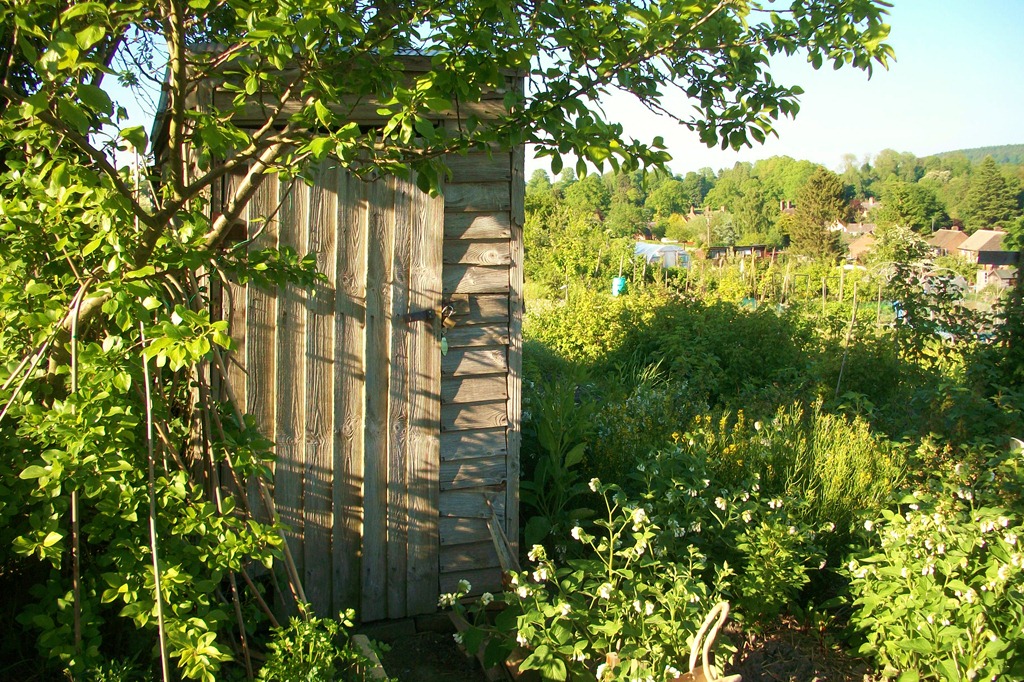
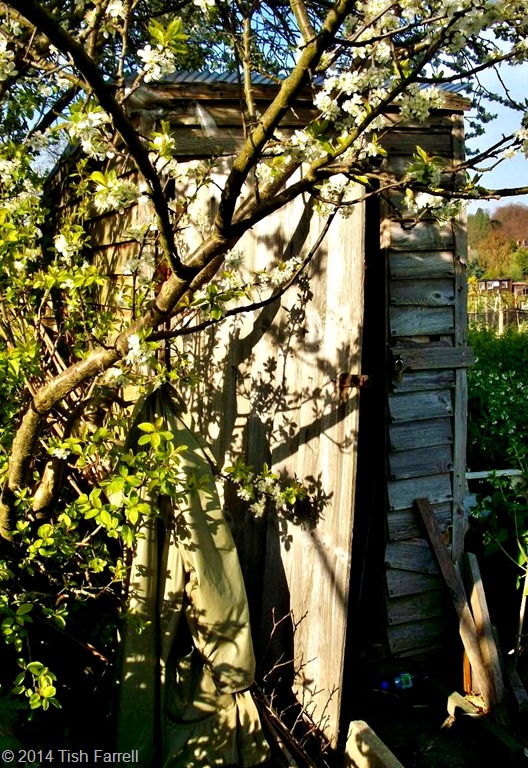
Well the old shed has made it through another year. A couple of bits have fallen off, but last year’s application of internal bracing by the Team Leader, aka Graham, has kept its tendency to list in an easterly direction in check. Would that we all had such a bracing. Over the winter it housed a poor mummified mouse, and snails still go to roost in there. I’m not showing you the inside, though. You definitely do  not want to see in there.
100_5374 (2)

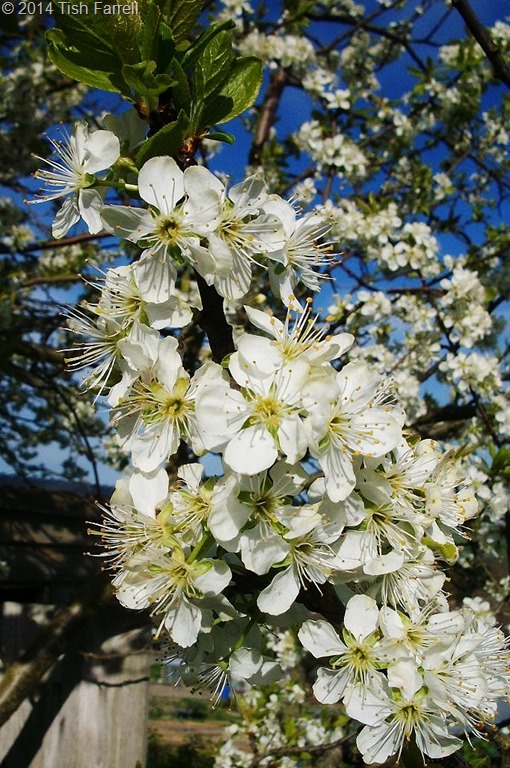
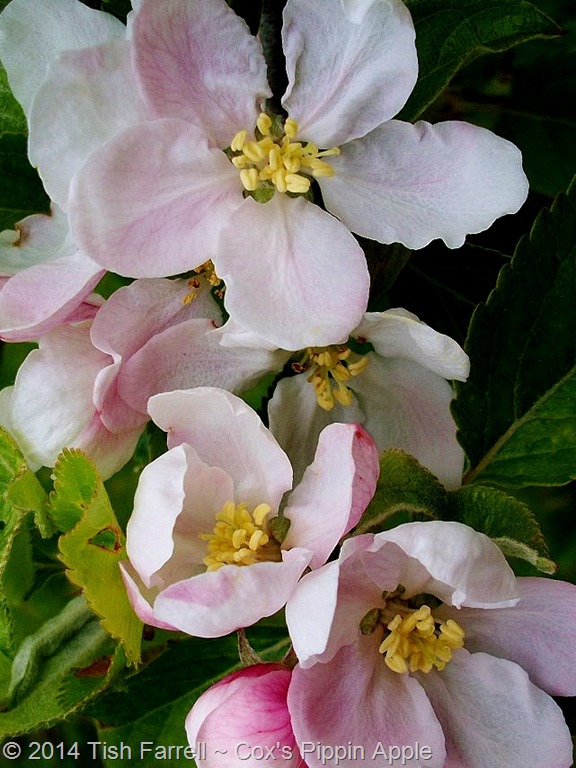
Instead, here is the ancient greengage tree with its delicate blossom. Already I’m wondering if it will give us some fruit this year. Greengages are notoriously temperamental, and after the magnificent crop in my first year of allotmenting that had us, and all our friends and relations, dribbling with delight over bucket loads of luscious harvest, it has borne very little. That was seven years ago. Maybe this year is the year then.
100_5362

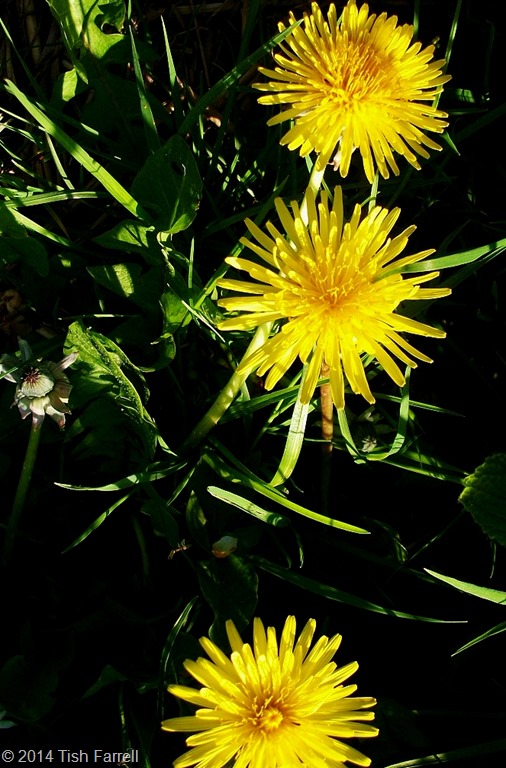
There are loads of jobs to do, not least digging. The endlessly wet autumn and winter meant that winter digging was impossible, so there has been much to catch up on. Meanwhile the weeds are literally having a field day, which makes this the the season of dandelion beheading. (Sorry, dandelions). They are sprouting up all along the paths between everyone’s plots, and I’m afraid I find great satisfaction in slicing off these cheery faces with my strimmer. Their replacements are anyway there the next day, beaming vigorously.
100_5637

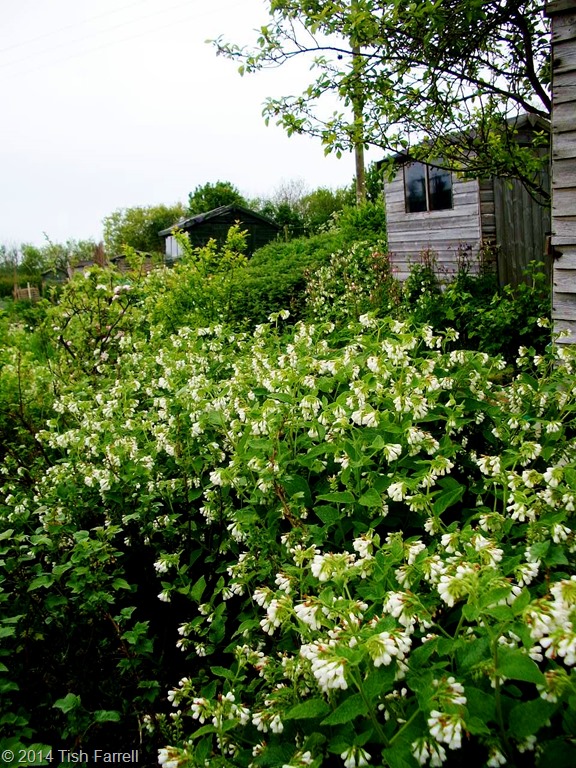
Then there is the comfrey forest to manage. This plant I crop and cherish. You cannot have too much of it, and it obligingly grows  itself in a huge clump beside the shed. If you cut it down after flowering, it will grow again and again during the summer.

Comfrey, as I have mentioned before, is the organic gardener’s dream plant. It comes in other shades, pink to purple through blue. Its ability to mine otherwise inaccessible  nutrients from the soil (dynamic accumulation I believe this is called) and repurpose them in its foliage make it an endless source of cost-free fertilizer. It is one of the reasons why you can’t look in my shed. I do my brewing in there. And no. It’s not what you think.
100_5645

For those who missed an earlier post on this, I stuff old compost bags with the comfrey’s  top growth, seal them with clothes pegs, cut a hole in the corner of each bag, and prop it over a bucket and wait. In the warmth of the shed the vegetation soon rots down, giving out a dark and evil looking liquid that collects in the buckets.  This stuff is pretty smelly, although nowhere near as pungent as the slimy residue left in the bag, which then ends up on the compost heap. The liquid I  decant  into old plastic bottles, and use as a feed through the growing season. It is 3 times richer in potassium that farmyard manure, but it must be diluted 1 part comfrey essence to 15 parts water.

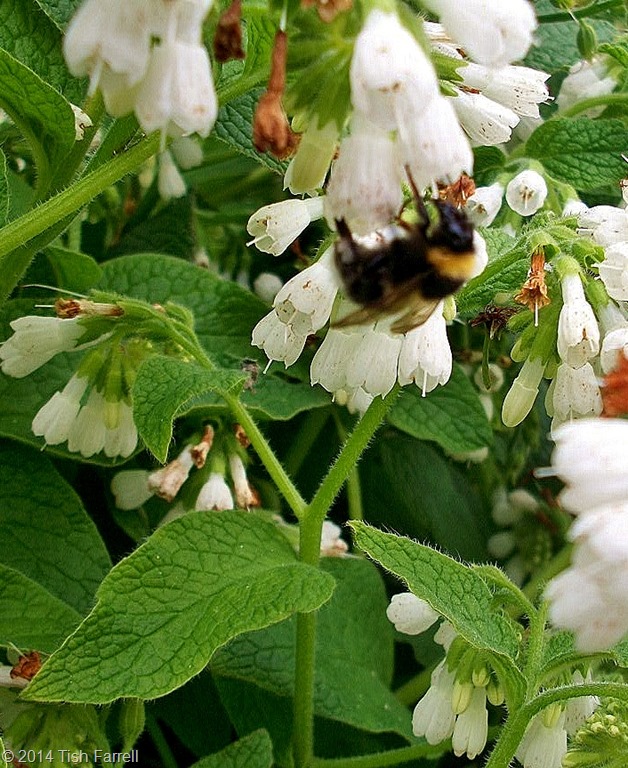
The blurry bee above would not stay still for the shot, but that’s another good thing about comfrey. Bees like it. As I took this, I spotted at least 4 different kinds: a honey bee and three bumbles of varying liveries and sizes. Having written of the dire things that are happening to bees, it’s heartening to see so many at the allotment doing their work. Thank you, bees.
100_5647

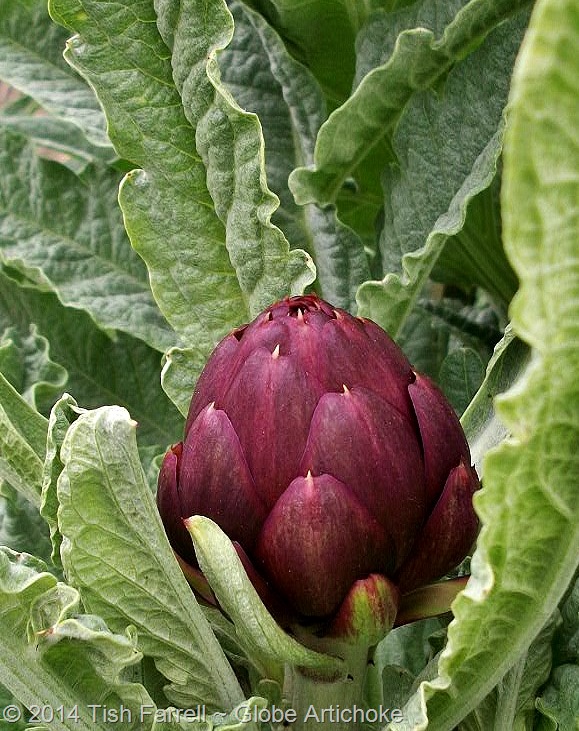
The mild winter has meant that many crops simply kept going without dying back. Yesterday I noticed that my globe artichokes have already made globes almost big enough to eat. In May? What is going on?  But thank  you, artichokes.
100_5611

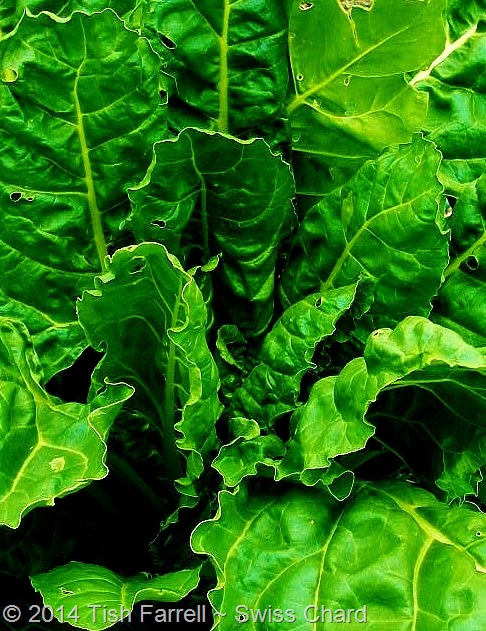
The Swiss Chard has been magnificent too and kept us going through the winter with fresh new leaves. It is only now going to seed. Nor did I sow it in the first place. It seeded itself around my plot from my neighbours’ plot. Thank you,  Pete and Kate.
100_4188

And now you can look at my Red Duke of York spuds, their foliage just pushing through the soil. I love the purple flush on the new growth.

100_5631

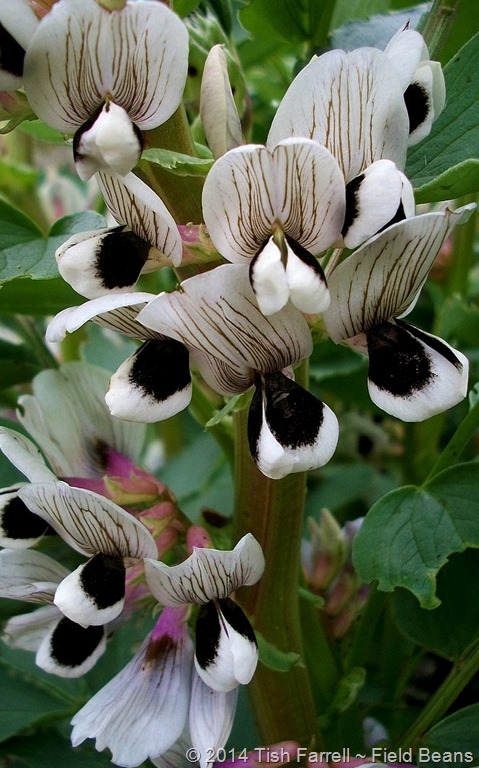
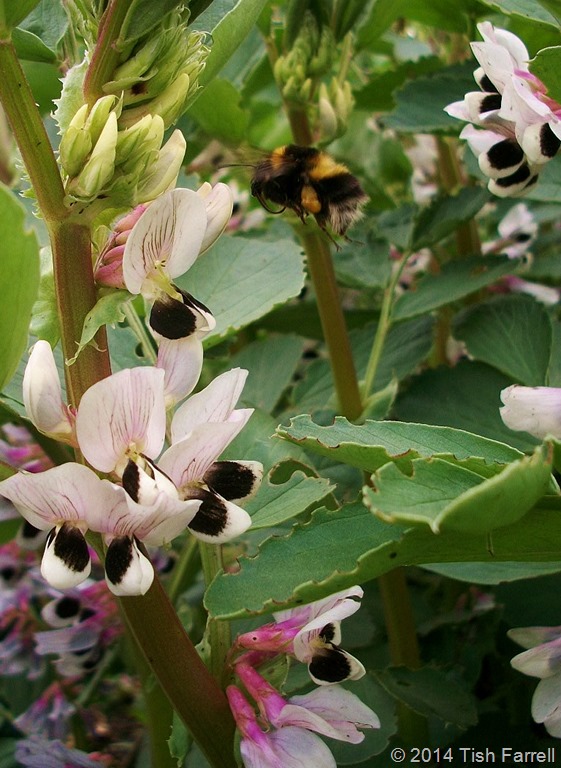
And next are my over-wintered field beans (rather like broad beans I am told, but smaller and tastier). This is the first year I have tried them. The metre tall stems are covered in blossom from tip to root, and the scent is glorious. The bees are busy here too.
100_5620

100_5619

*

And last but not least, the strawberries are flowering like crazy…

100_5616

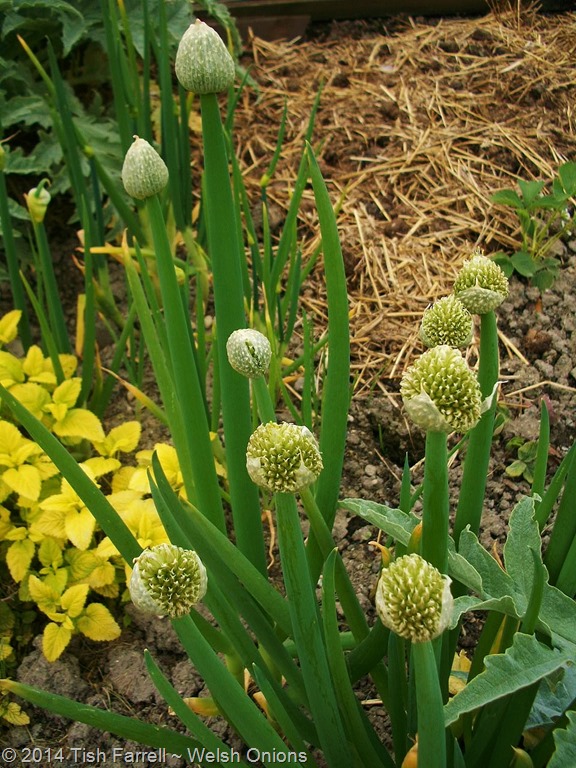
And the Welsh Onions are bursting into bloom beside the Lemon Balm, although I’m not sure whether I should be stopping them from doing this. On the other hand they will look rather splendid as the flowers open, and of course make lots more seed.
100_5613

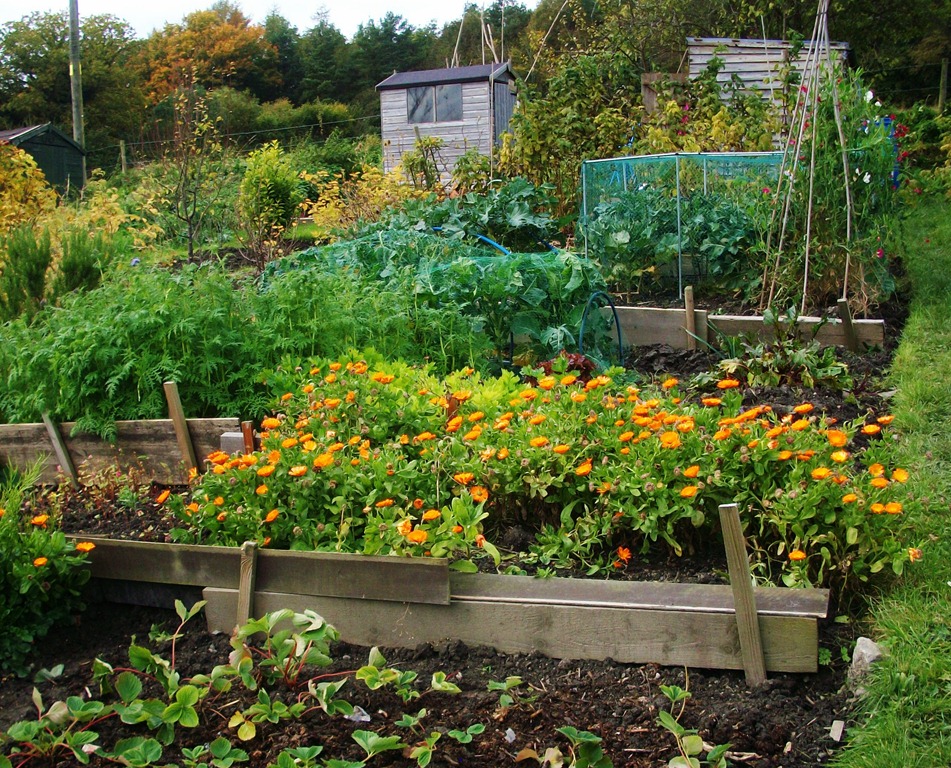
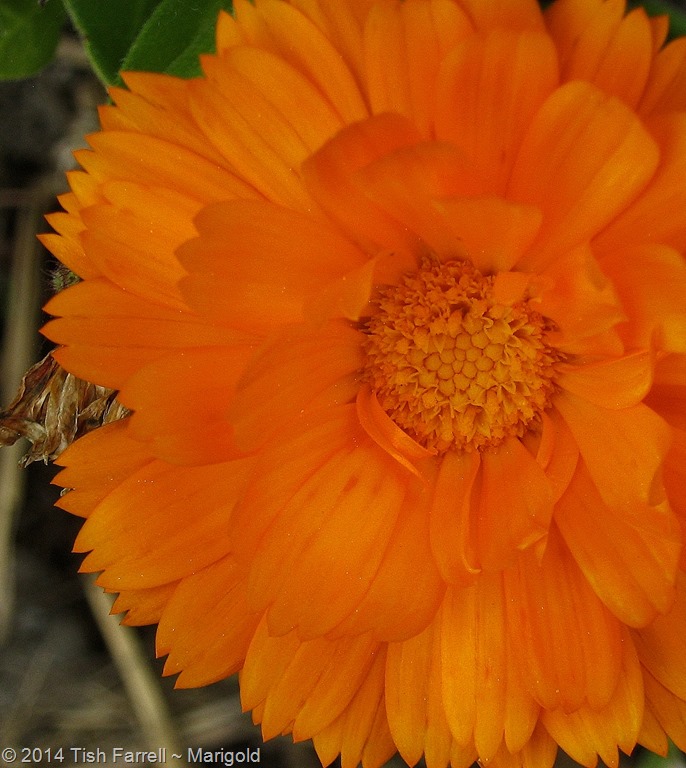
And finally, the brightest face of all at the allotment, other than mine after too much digging. This is yet another lovely plant that grows itself up there with no help from me, and flowers into the winter. Its petals are lovely in salads, and it makes a good herbal tea that is said to improve pretty much any condition. I can believe it. Simply looking at this flower does you good: the orange goes right through your eyes and into your immune system. A big hand then, for the marigold. TARRAAAAH!
IMG_1137

© 2014 Tish Farrell

Please go to all these places for lots more brilliant stories:

Frizztext’s tagged ‘R’

Ailsa’s Travel Challenge ~ Close-up

DP Weekly Photo Challenge ~ Spring

Errant Muse? But there’s still life at the allotment

100_4927

I’ve posted this photo of my last summer’s allotment produce to prove something. I thought it might be a good antidote to my dreary state of writing stuckness. (And may be yours too). For one thing it shows conclusively that if I can’t get to grips with the several novels now backed up in brain and filing cabinets, then I can at least produce beautiful vegetation. (In season of course). Most of it is edible too, although I would not recommend the zinnias. Marigolds are fine however – in salads and as herbal tea. Excellent for the immune system, or so a herbalist friend tells me.

100_4943

I sometimes think my allotment life is a metaphor for my writer’s life. Sometimes I think  it’s the other way around. This reminds me of the great Welsh poet, R S Thomas. In my post about him the film link shows him, in his elder years, out bird watching on the Welsh coast. Speaking to camera, and with a wry smile, the Nobel nominee says he is supposed to be a poet, but that when the poem is going badly, then he is a birdwatcher. Likewise for me, when the writing stalls, then I am a gardener. I am mostly a gardener.

100_4941

The common ground between growing and creating is obvious: seasons of  productivity followed by dead times when the creative flow seems to be, well, DEAD. This is the natural order of things. I know it. And so I am forgiving when it comes to the garden. I do not expect it to grow things in December and February (or at least not much). But when it comes to writing, I fret, fume and grow ever more despondent with myself because the ideas in my head cannot be rendered, as I would like them, to word, to screen, to finished work.  And I do not forgive this. I consider it a grave fault.

100_4945

Yet I know, too, that good growing and writing, require a fertile medium, one that is well turned and appropriately nourished. You need plans and timetables, while remaining open to alternative courses of action. You also need the right medium for the job in hand. All this takes time: years of learning, of preparation, and the application of improving strategies. You have to understand your ground from the inside out. And that brings me to another essential condition – good drainage. And  in my home town poor drainage is a problem; both brain and allotment, then, are equally afflicted. They are not free-draining. But at least I know how to improve the soil. Grit is good.

100_4954

In the absence of creative flow, ungoverned gathering of new material can start filling the gap. This in hopes of finding a  spark, some fresh inspiration to jump start the writing. The activity can of course have its good points. You may indeed find the very thing you need. Besides which, well rotted down and aerated compost improves content and structure for any future cultivation. On the other hand, ever growing stagnant piles of poorly decomposing matter simply overwhelm and add to the stalled flow problem. In other words, there comes a time when you simply have to give your brain a rest, leave the compost heap to rot down, and allow the period of dormancy to run its course. The hard thing is to keep faith during this process of seeming inactivity; to believe that you WILL recover and complete the works you began.

That wonderful woman, poet and Jungian psychoanalyst, Clarissa Pinkola Estés has some very heartening things to say about this. In her autobiographical exploration of the nature of story, The Faithful Gardener, she says that new seed is faithful, and that it roots most deeply where the ground is the most empty. In The Creative Fire she also says that everyone is an artist even if they have not lifted a brush to the canvass or opened a new Word file (I paraphrase). Finally she tells us that the only thing you need to create is to get out of the way.

And so in a bid to get out of the way, I leave you with some summer marigolds. Before your eyes they are passing through their natural cycle from bud, to falling flower to newly forming seed head. Perhaps if we stare at them long enough, absorbing all that very creative orangeness, we stalled creators will ‘hear’ what they are telling us.

100_4935

© 2014 Tish Farrell

*

Frizz’s Tagged E  Go here for more ‘E’ stories

*

Related:

Bright Fields on Llyn: windows in time, mind and space and other stories from Cymru

Onwards and upwards…the big New Year ‘do-over’

Weekly Photo Challenge: saturated – Baked Bramleys and Autumn Bliss

Weekly Photo Challenge: Saturated

IMG_0723

*

The fat Bramley apples came from the Women’s Institute market, held in Much Wenlock every Thursday morning. The trestle tables are set out in the old Corn Exchange outside the library and are invariably laden with home-baked cakes – Lemon Drizzle, Rich Fruit, Iced Ginger, Millionaire’s Shortbread. Then there are the jams and marmalade.

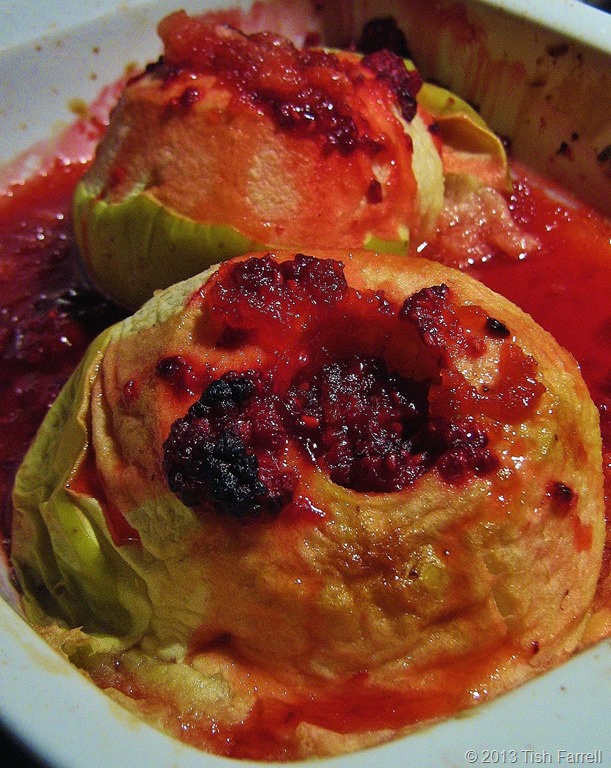
But in recent weeks – this being the season of over-laden fruit trees – there has also been garden produce, and in particular bags of Bramley cooking apples. And what better thing to do with a Bramley than to bake it, stuffed with the last of the allotment raspberries?

The raspberries are called Autumn Bliss, and deliciously live up to their name; and especially so when added to apple. The synergy of hot, fruity flavours hits every taste bud with a satisfying zing.

This is how I cooked them.

*

Baked Apples

*

Per person: one apple, a handful of fruit, a good teaspoon of honey, a sliver of butter

Set oven to 200 C, 190 C for fan versions

With a corer or sharp knife carefully remove the apple middles, making sure all  tough core bits are excised. 

Remove the peel from the upper half of the fruit, then place in a greased oven-proof dish.

Stuff the apple centres with raspberries, adding a good teaspoon of runny honey to each apple. I used fair trade wild Zambian honey, which is cold-pressed, and has a rich, slightly smoky flavour.

Scatter any spare raspberries over the top.

Slather a small nugget of  farmhouse butter over each apple.

Add half a cup of water to the dish.

Bake for around 30 minutes, basting with the juices half way through. Bramleys have a habit of exploding, as mine were about to do, so keep an eye on them.

*

Desert apples can also be baked, though they need longer, slower cooking and must be well basted. The result is not as ‘fluffy’ as a Bramley, and it’s better to remove all the peel. But desert apples often have a more distinctive flavour. Dip them first in in  water with a squeeze of lemon to stop them discolouring. 

Of course there are endless variations when it comes to stuffing apples. A good old English version is to use sultanas and raisins with a dollop of Golden Syrup.  You could make my version more sophisticated with a drizzle of an appropriate liqueur. Armagnac springs to mind. Or Creme de Cassis. And serve with some toasted almond flakes. But however you make them, they always go well with Greek yoghurt. (Or thick farmhouse cream…)

© 2013 Tish Farrell

Fresh strawberry and rhubarb cordial

WP weekly photo challenge: fresh

100_4181

Fresh to me means produce straight from  my allotment, pesticide-free and naturally fed plants. I’ll give you the recipe for the cordial at the end, but first I’m going to show off some of my harvest, which despite the burning heat-wave we’ve been having, and my erratic watering, seems  to be doing pretty well.  The strawberries have been delicious – warm off the stem, or made into ice cream. We even outfaced the heat by having some in a crumble (i.e. baked with a butter-sugar-flour crumb crust) and served with some Greek yoghourt.

100_4110

And now the raspberries and blackcurrants are beginning to ripen which means it’s time to make jam with the raspberries and coulis with the currants, or Summer Pudding with both.

100_4193

100_4194

And then there are gooseberries to make into gooseberry and ginger chutney, and gooseberry fool, or gooseberry sauce to have with grilled mackerel.

100_4198

On Saturday night, after a hard day’s picking, weeding and sowing, we had steamed artichokes served with crushed garlic in melted goat’s butter.

100_4095

And on Sunday night, after digging up some Charlotte and Red Duke of York potatoes, picking French and broad beans and broccoli, I steamed the vegetables and dished them up with salsa verde and a few grilled rashers of Wenlock Edge Farm bacon. Bliss.

100_4197

100_4200

And now I’ve teased your taste buds to extremes, here is the recipe I promised you:

Strawberry and Rhubarb Cordial

4 sticks of rhubarb chopped

300 gm/10 oz ripe strawberries, hulled and cut in half

320gm/11oz caster sugar

1 litre/1.75 water

juice of 2 lemons

Place fruit in heavy based pan, add sugar and simmer on low heat for 10 minutes. Add water and increase heat slightly. Cook for a further 15 minutes until the fruit is soft.

Leave to cool then strain through a sieve, pressing the pulp into the syrup. Add lemon juice and store in the fridge. To serve, dilute with chilled sparkling water, and add a sprig of mint if this appeals.

OR make a damn fine cocktail with some prosecco or other dry sparkling wine. I haven’t tried this myself yet, but I just know it will be wonderful – bellinis with bells on.

*

And finally a shot of the marigolds and sweet peas that I grow amongst my vegetables to make the bees happy, and me happy when they have pollinated everything else.

100_4175

Happy summer to everyone who takes the

time to read my blog – lovely

people all of you.

AAA Challenge: A For Allotments

http://flickrcomments.wordpress.com/2013/07/02/aaa-challenge/

100_3831

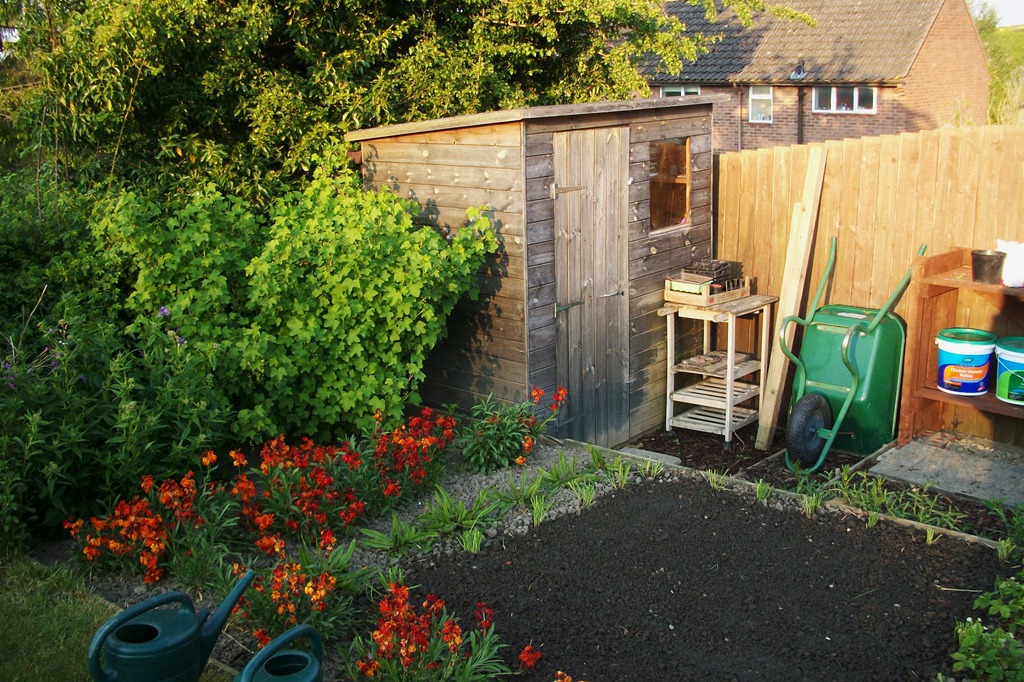
A is for Allotment, and here is mine.  I inherited the shed from previous allotmenteers. It leans and snails roost in it. Last year I found a 1725 halfpenny in front of the door. The Team Leader has to come at regular intervals, armed with hammer and electric screwdriver, to keep the old place upright. He does the same for the tenant – me that is, not the snails.

When I’m not writing, this is where you’re most likely to find me, so  thank you, Frizz, for your ‘A’ prompt. I’ve been toiling on this plot for around six years now, and when I first started, the soil was as heavy as lead. Gardening on the shores of the Silurian Sea is hard work. In between the layers of soil from a decaying tropical sea (c. 400 million years ago) is bentonite clay. As a substance this may have many useful properties. In the allotment, it is a guaranteed pain in the back. When remotely damp, it clings to the bottom of your wellies until you have giant’s feet. In dry weather, it goes crusty and it’s like digging through bricks.

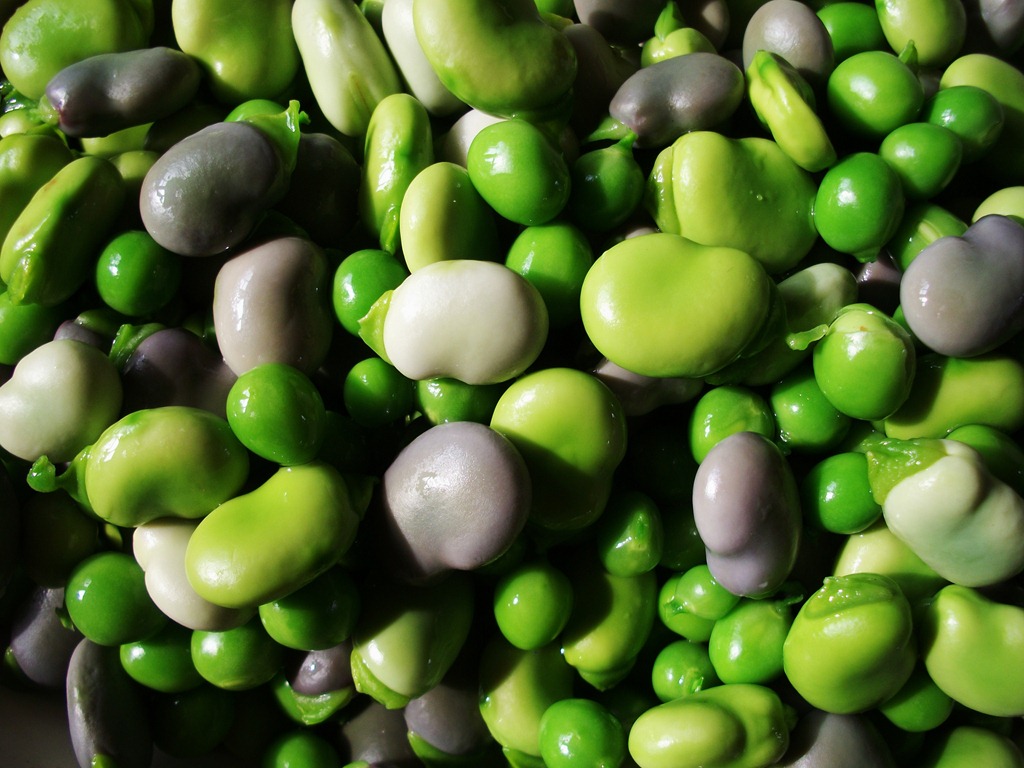
I have learned recently that this unappealing greyish clag is formed from volcanic ash. Sometime when Much Wenlock was lying down on the Equator, all those aeons ago as our world was shaping itself, there was a volcanic eruption of unimaginable proportions. I now grow my beans and peas its degraded outpourings. Below are some pickings from last year’s crop, so you can see it does work – with effort.

007

I grow several varieties of broad bean including the lovely rose coloured ones which go pale mauve when lightly steamed. They don’t seem to mind growing in the heavy soil.

100_3421

I’m afraid my plot looks a bit rackety, tidiness being sacrificed to the time needed to dig, weed, and keep the wretched pigeons away. Almost everything has to be netted or covered with enviromesh at some stage during its growing. Recently I have been following ‘Garden of Eve’ and suffering severe poly-tunnel envy.

100_3833

To improve the soil, I grow areas of green manure, in this case mustard, but also phaecelia, buckwheat and alfalfa. It can be sown late summer or early spring and then dug in before it goes to seed. The difference in the soil afterwards is truly remarkable.

100_3834

Comfrey grows itself all over my plot. I tear it up and use it to protect seedlings or newly planted young plants. I also fill old compost bags with it, cut the corner off the bags seal up the top with a peg, and balance them over buckets lined up inside my leaning shed. As the leaves rot down the resultant brown gunky liquid collects in the bucket. It can then be diluted with water – 15 parts water to 1 part comfrey to make a really good crop feed. Comfrey  also has valuable therapeutic properties, and has been used to mend injuries for centuries, hence the folk name ‘knit bone’. The bees like it too.

100_3794

Unlike me, my fellow grower, Phoebe, has a beautifully neat plot. She also kindly mows my path. And that’s one of the wonderful things about allotments, not only can you grow delicious food (pigeons willing) but you meet such lovely, generous and creative souls up there.

100_3792

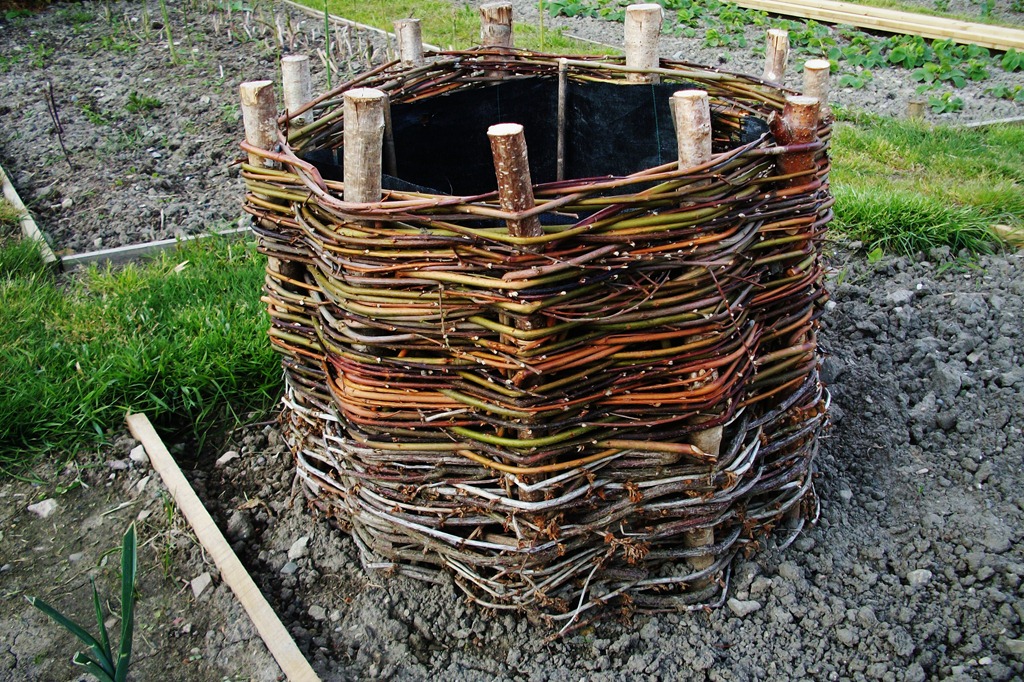
Phoebe has created these simple baskets across her plots at intervals. The uprights are embedded directly in the soil and the sides made with dogwood and hazel whips. Her aim is to use them for the rotting down of pernicious weeds like dandelion and couch grass, and then grow marigolds on top while this is all happening underneath. Gardening artistically.

100_3417

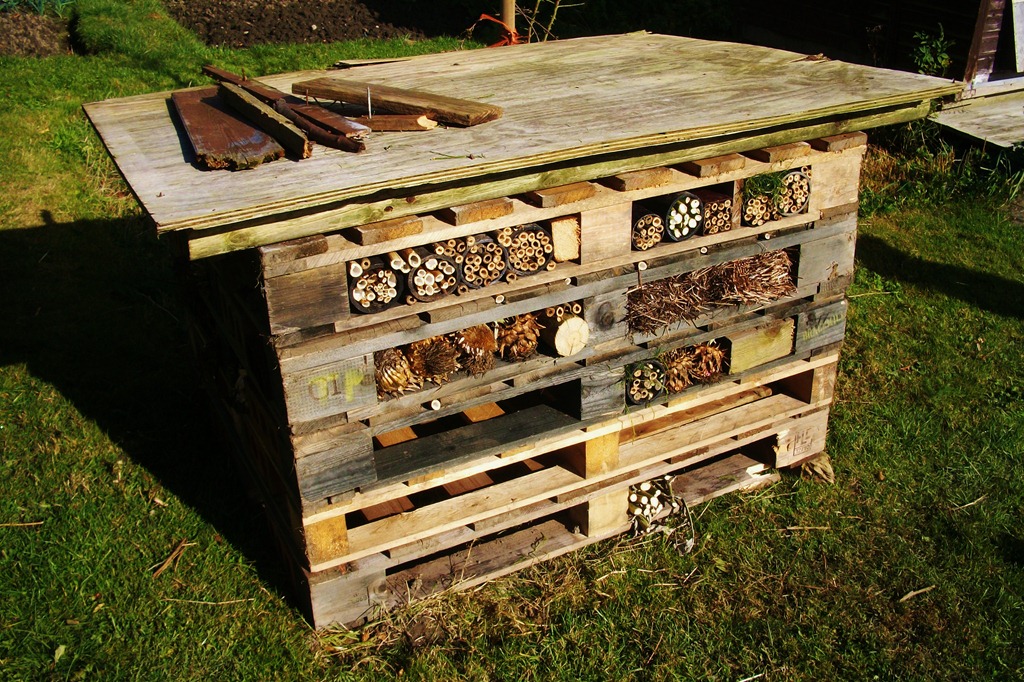
This is the allotment’s insect hotel to provide attractive accommodation for over-wintering insects. Also courtesy of Phoebe who begged some pallets from the local timber merchant. When he knew what they were for, he delivered them free to the allotment.

100_3787

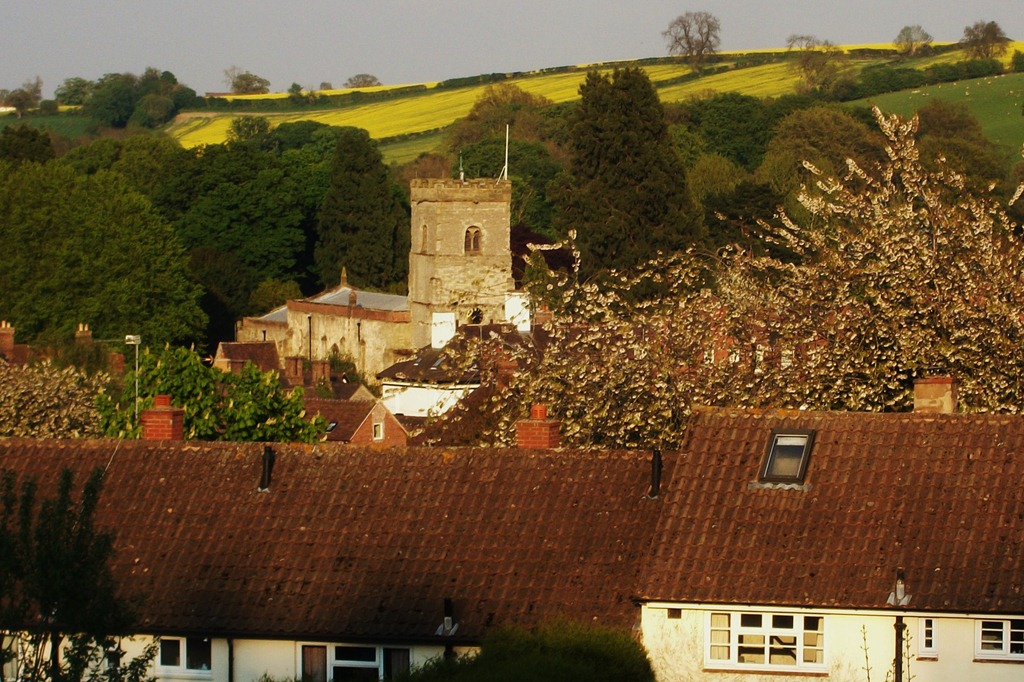
This is the view from my plot. I can hear the clock of Trinity Church chime as I work, and the mewing of honey buzzards over the fields behind.

100_3795

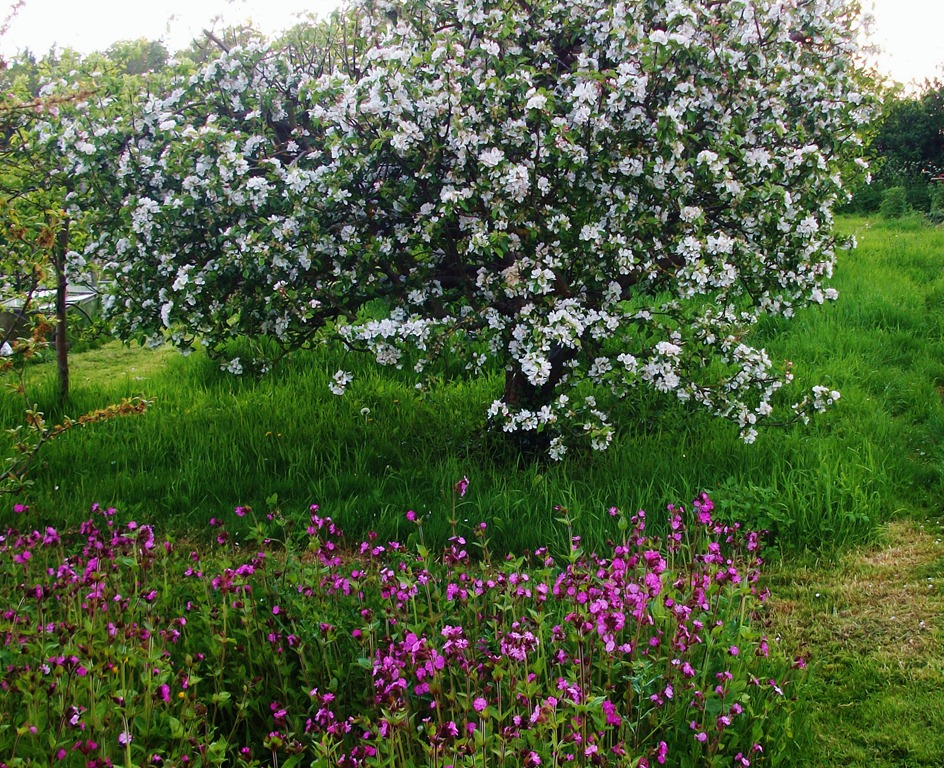
I call this the Garden of Eden tree, also The Tree of Life,  because it has gloriously red apples in September. Phoebe created the wild flower garden in the foreground – lots of pink campion this year.

The bunting makes the raspberries look very festive and sees off the birds.

Below are two blogs that are well worth following for lots of useful gardening advice.

http://gardenofyvonne.wordpress.com/ Garden of Eve

http://peopleexcitedaboutcoexistence.com/ People Excited About Co-Existence

And when you’ve grown the produce, here are two great cooking blogs. ENJOY!

http://fromthebartolinikitchens.com/ From the Bartolini Kitchens

http://nourishingchow.wordpress.com/ Nourishing Chow

http://flickrcomments.wordpress.com/2013/07/02/aaa-challenge/

© 2013 Tish Farrell