WP Challenge: In the Background (MMBA in Zimbabwe)

Graham at Great Zimbabwe

Weekly Photo Challenge: In the Background

There’s always a lot of background in Africa: MMBA as the colonial British frequently referred to it – Miles and miles of bloody Africa. The origin of this expression is variously attributed to Winston Churchill, Ernest Hemingway and Robert Ruark. In any event MMBA is always difficult to capture in a photograph.

The shot above was taken from the hilltop ruins above Great Zimbabwe. The original negative has degraded a little, but the photograph was also taken in winter-time when the landscape of southern Africa anyway takes on the aspect of an ‘old master’ oil painting.

As ever when Team Farrell go travelling, Team Leader Graham was striking out in front – ‘Our Man in Africa’, while Nosy Writer was busy being nosy and fumbling with the settings on her Olympus Trip. Inevitably, TL ended up walking into NW’s line of sight. Here, though, I’m glad he did. He may be in shadow, but he provides a handy foil for the backdrop. It could be a stage set, couldn’t it? There’s definitely a sense of unreality.
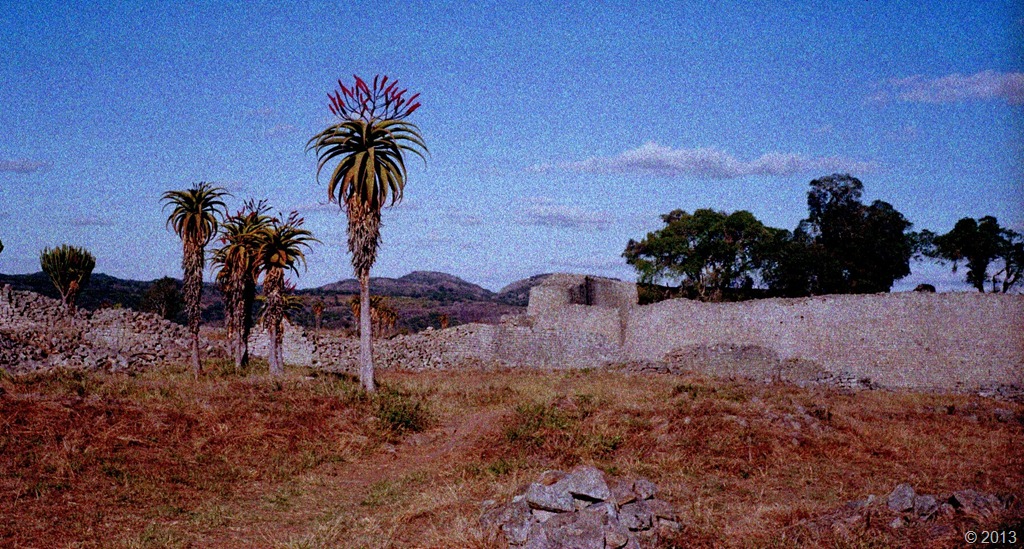
aloes and Great Zimbabwe

And here’s another painterly ‘in the background’ view: the Great Enclosure of Great Zimbabwe with giant aloes in the foreground. Of course, when it comes to the history of this World Heritage site, ‘in the background’ could well have another  and wholly insidious meaning. When geologist, Carl Mauch, first visited the site in 1871 he was convinced that the massive dry-stone granite walls were the remains of the Queen of Sheba’s lost city of Ophir.  (See also my post on The Swahili). For some decades this view persisted. It was not in the interests of pioneer imperialist Cecil Rhodes for it to be known that Africans had a sophisticated historical heritage. He financed the first excavation by James Theodore Bent whose brief was to ‘prove’ that the complex had been built by the Phoenicians or the Ancient Egyptians. In 1928-9 British archaeologist, Gertrude Caton-Thompson refuted this conclusion, pronounced it African-built but “the product of an infantile mind.”

Some people may be surprised to know how often archaeology is used as a political tool, but it was, and still is.

In the 1960s-70s when Zimbabwe, then Southern Rhodesia, was under the white rule of  Ian Smith’s regime, history was again re-written. Any historians who dared to state that Great Zimbabwe was built by indigenous Africans put themselves at risk, and their work was censored. This led to the departure from the country of many prominent Rhodesian archaeologists including Peter Garlake, both an expert on the ruins, and Rhodesia’s then Senior Inspector of Monuments. His excavations in the 1960s, and those of Paul Sinclair in 1986 fully demonstrate that from around 1200 AD to c. 1500 AD when it was abandoned, the Shona-speaking Karanga people built and lived in this extensive settlement.

Estimates for the population over this period range from 5-30,000. It was a wealthy centre for cattle rearing and for cereal and cotton growing. Gold from mines further inland was brought into Great Zimbabwe, its rulers acting as middle-men in the trade that extended to the Swahili city of Sofala on the Mozambique coast.  In return for gold and ivory, the Karanga imported luxury goods – fine textiles, Persian and Chinese wares, including Ming porcelain.

So much for Cecil Rhodes and his racist agenda. Although even in death this man manages to still make his presence felt. He chose to be buried in the Matobo Hills, territory of Ndebele people, and at a place known as Malindidzimu, Hill of Spirits. From here, also known as World’s View, I imagine that he thought he could continue to ‘rule’ Africa. The locals find the presence of his spirit here in their own sacred place quite offensive.
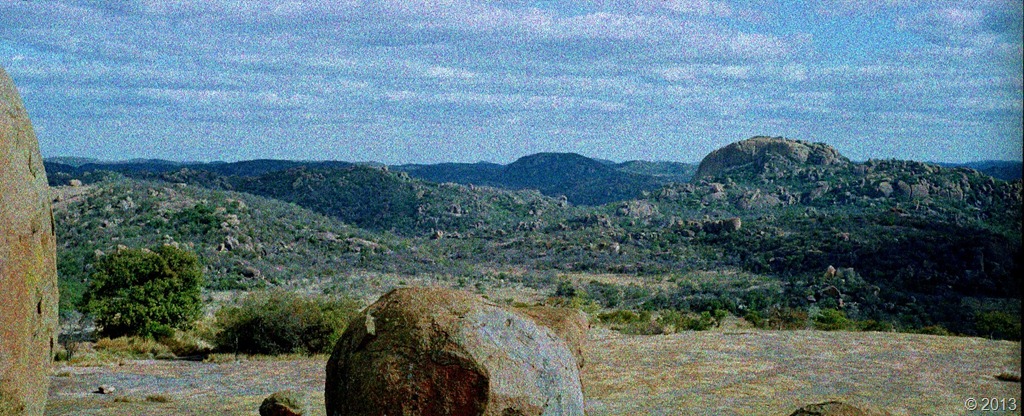
Matobo Hills - view north from Cecil Rhodes grave

View from Cecil Rhodes’ grave in the Matobo Hills, and his stated aim: “I contend that we are the finest race in the world and that the more of the world we inhabit the better it is for the human race. Just fancy those parts that are at present inhabited by the most despicable specimens of human beings what an alteration there would be if they were brought under Anglo-Saxon influence, look again at the extra employment a new country added to our dominions gives.”

From his 1877 Confession of Faith

And as an antidote to that dispiriting diatribe here are some more ‘in the background’ views in Zimbabwe:
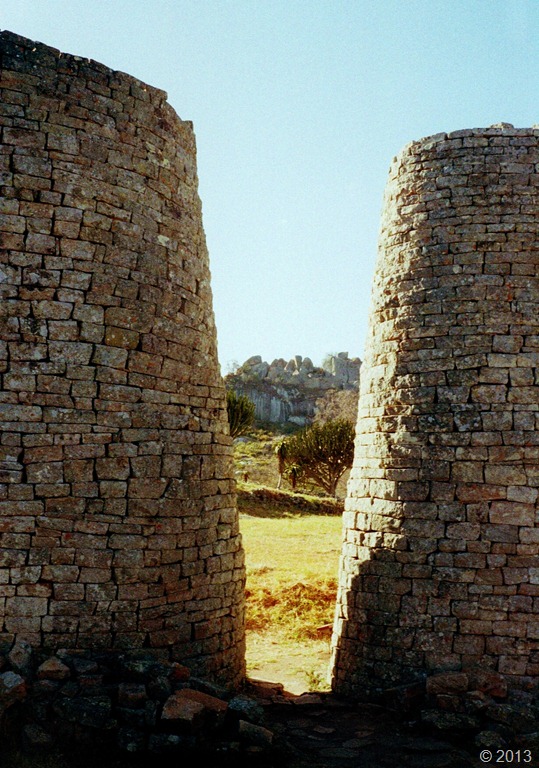
Great Zimbabwe entrance

Gateway in the Great Enclosure, Great Zimbabwe
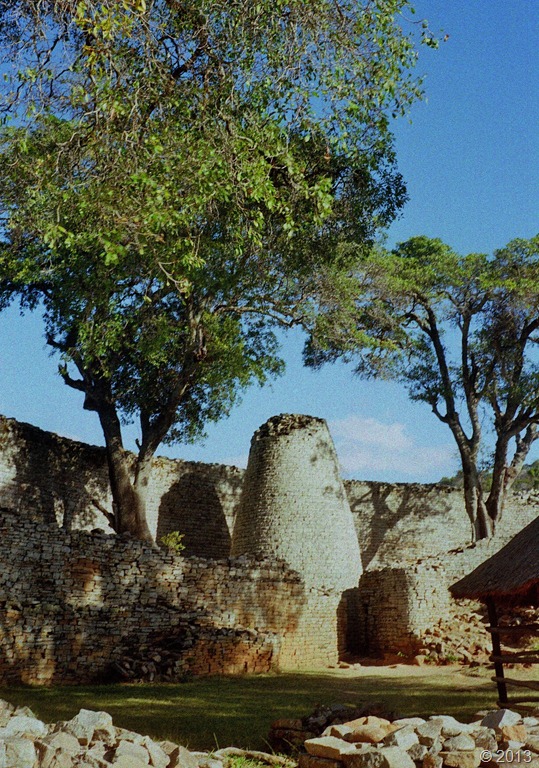
Great Zimbabwe inside the great enclosure

The mysterious tower inside the Great Enclosure

Great Zimbabwe -Tish inside the walls of Great Zimbabwe

Me looking small and very young inside the Great Enclosure. The walls are dry-stone granite – not a lick of mortar.
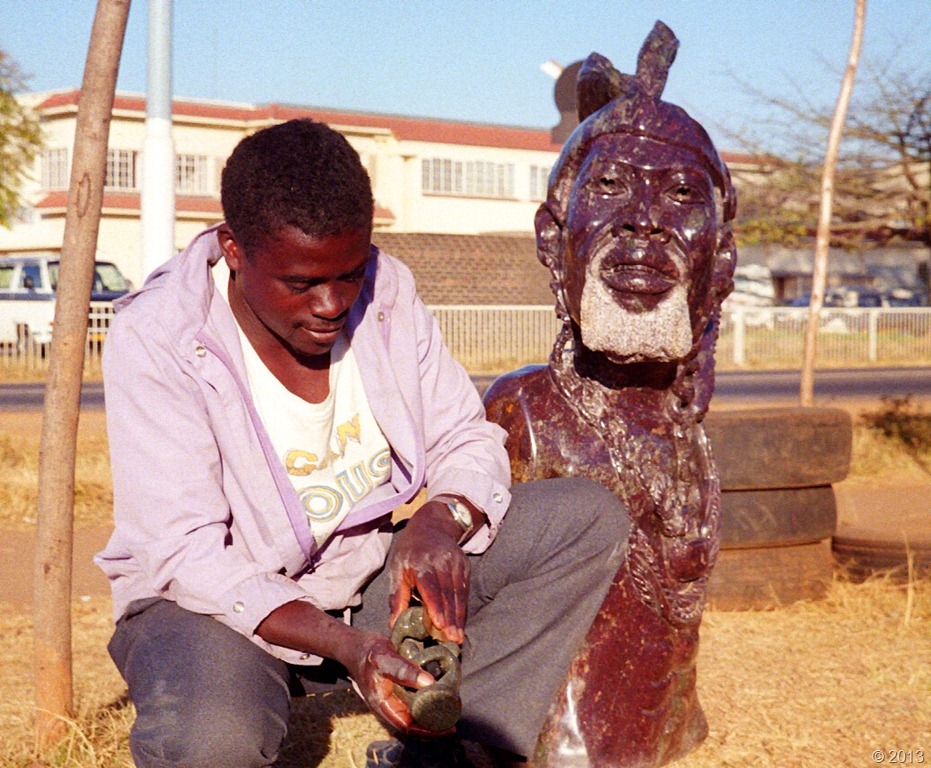
Harare soapstone carver

A roadside soapstone artist in Harare. This bust of a Shona elder is a common subject. Zimbabwe has produced some of the world’s outstanding sculptors.
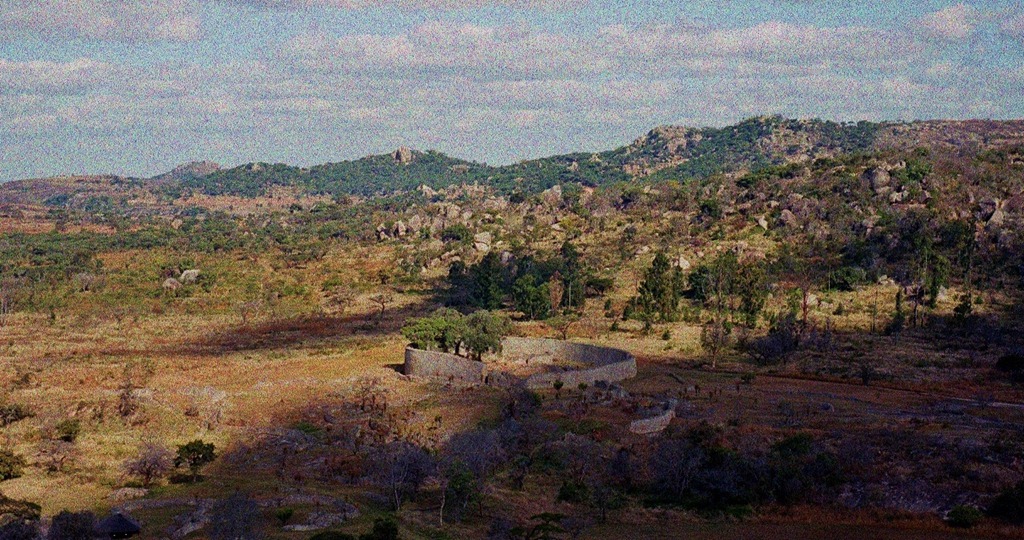
Great Zimbabwe landscape

Looking down on the Great Enclosure. For decades many Europeans refused to believe Great Zimbabwe was an African settlement.

Victoria Falls and buck

Victoria Falls through a misty spray of mighty Zambezi.

Zambia's Victoria Falls looking along knife-edge to Zimbabwe's falls

Victoria Falls from the Zambian side. Most of the water on this side of the Zambezi is abstracted. My wet kanga wrap nearly took me hang-gliding off the knife edge in a rainstorm, but that’s another story.

Hwange - Dete schoolgirls

Dete school girls, with a train in the background!
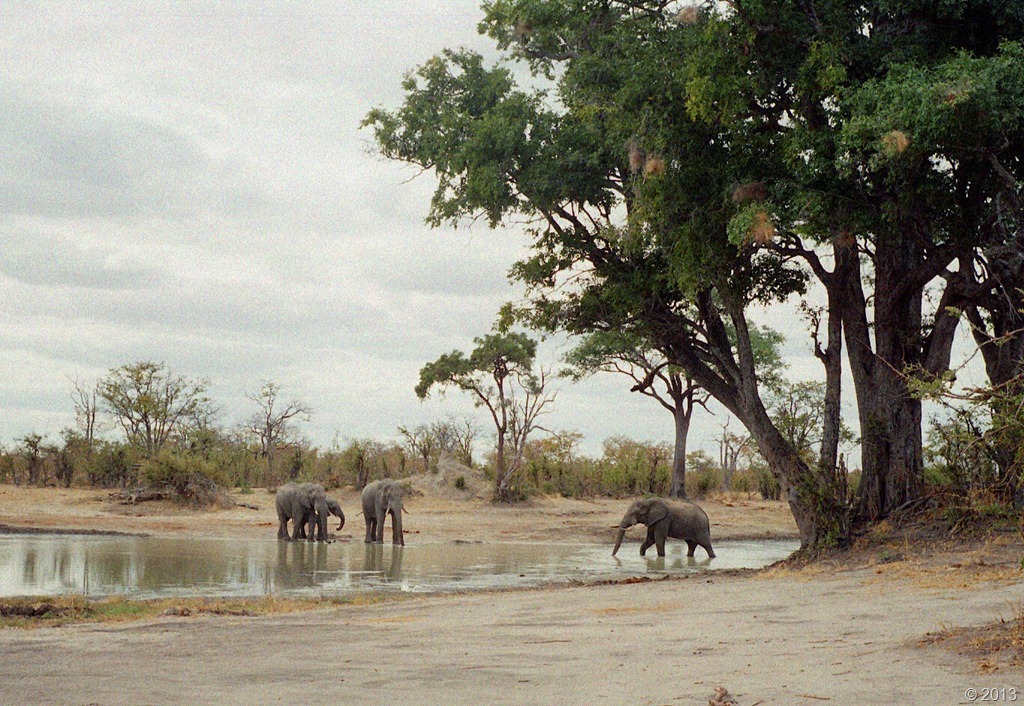
Hwange - waterhole and elephants 4

And finally, because this is Africa, there has to be shot with some elephants in the background. Taken in Hwange National Park.

© 2013 Tish Farrell
…of creation’s imperative

IMG_0453 - Copy

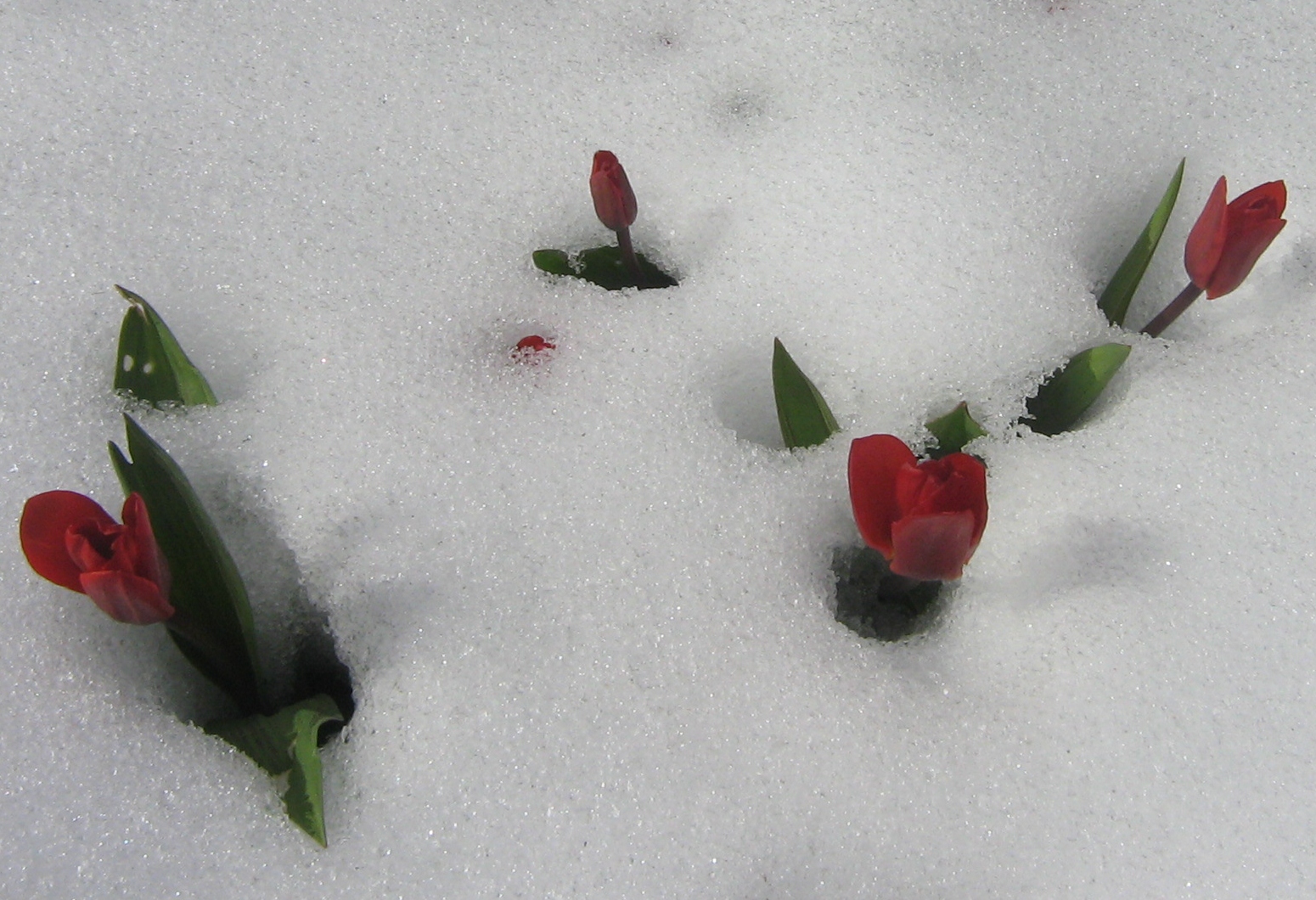
Snow at Easter! I took this photograph last week as the slightest thaw began. Earlier that day, the buds had loomed beneath the ice crust, looking like blood spots rising from the earth. But then the sun came out and the tulips, red-hot, burned their way out, leaving smooth hollows in the snow. For me, as voyeur, the wind was biting cold and I was soon frozen through. I dived indoors whining at the unseasonal frigidity, and then as ever, in whining-writer mode, began to take the tulips’ triumphal expression personally. What about my own creative impulse? Why cannot I manifest my intentions with such exuberance, and with such elegant economy? And under such extreme weather conditions too?

And so as one thing leads to another, I thought of Robert Louis Stevenson bemoaning how writers alone among artists are “condemned to work in mosaic with finite and quite rigid words” (The Art of Writing), or how the true author knows how “to judge his own stuff’s worth, without pity, and destroy most of it” (Colette). Or how if I were Tolstoy I would only ever write if I could dip my pen in the inkpot and leave behind a shred of my own flesh (and thus write later only from the stew of my own life force perhaps?) Then I uploaded the photo and studied it on my computer screen. Isn’t there a story, I thought, that begins with a silent, winter’s world, and a queen sitting and sewing at her castle window and, as she pricks her finger on the needle, three drops of blood fall into the snow…

text 2013 Tish Farrell

Trakai Island, LithuaniaPhoto by anjči from London, UK [CC-BY-2.0 (http://creativecommons.org/licenses/by/2.0)], via Wikimedia Commons

Trakai Island, Lithuania
Photo by anjči from London, UK [CC-BY-2.0] via Wikimedia Commons

…of wolf farts, windmills and the Wenlock Olympics

It has to be said that wolf farts are pretty hard to find, even with expert guidance. And yet I had been led to believe (and by the Guardian no less) that if I visited a certain, well-known location near me, I would most surely discover them. And so, on a sunny winter’s day last week, when I set out on the curious quest, I was not anticipating difficulty. Far from it. The ground was dry underfoot and visibility good and I had been well primed by Paul Evans’ Wenlock Edge column (Guardian 10 January 2012) which not only gave me full details of said quarry, but also included a very good photo for accurate identification. The piece seemed unequivocal too. Wolf farts were to be found on Windmill Hill, and in January too. What prospect could be more beguiling for the writer-prevaricator, and especially in the after-Christmas lull when not much is happening in the natural history line? So I pulled on boots and woollies and set out in search of them. It’s amazing how many ways there are to avoid writing the novel.

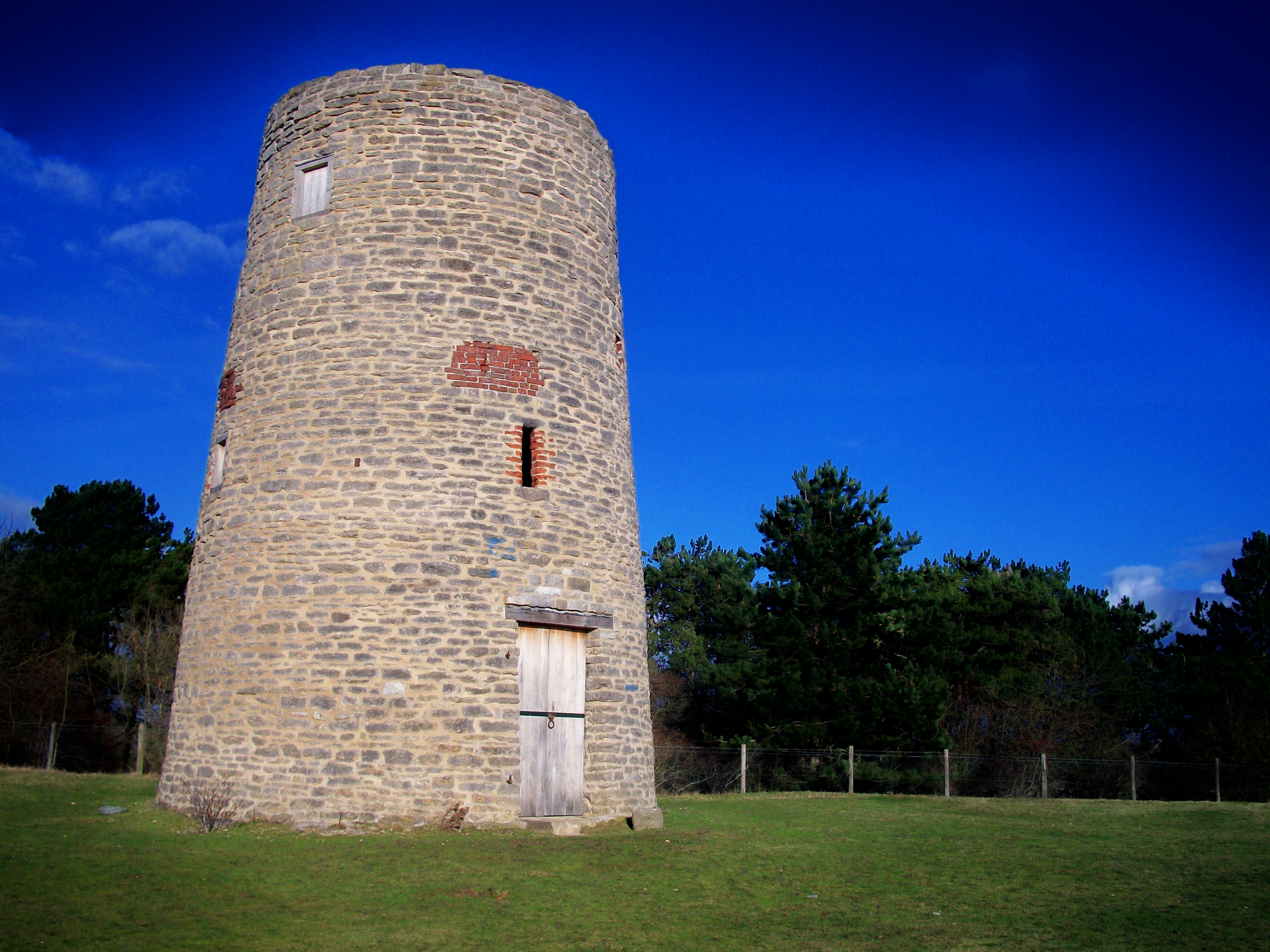
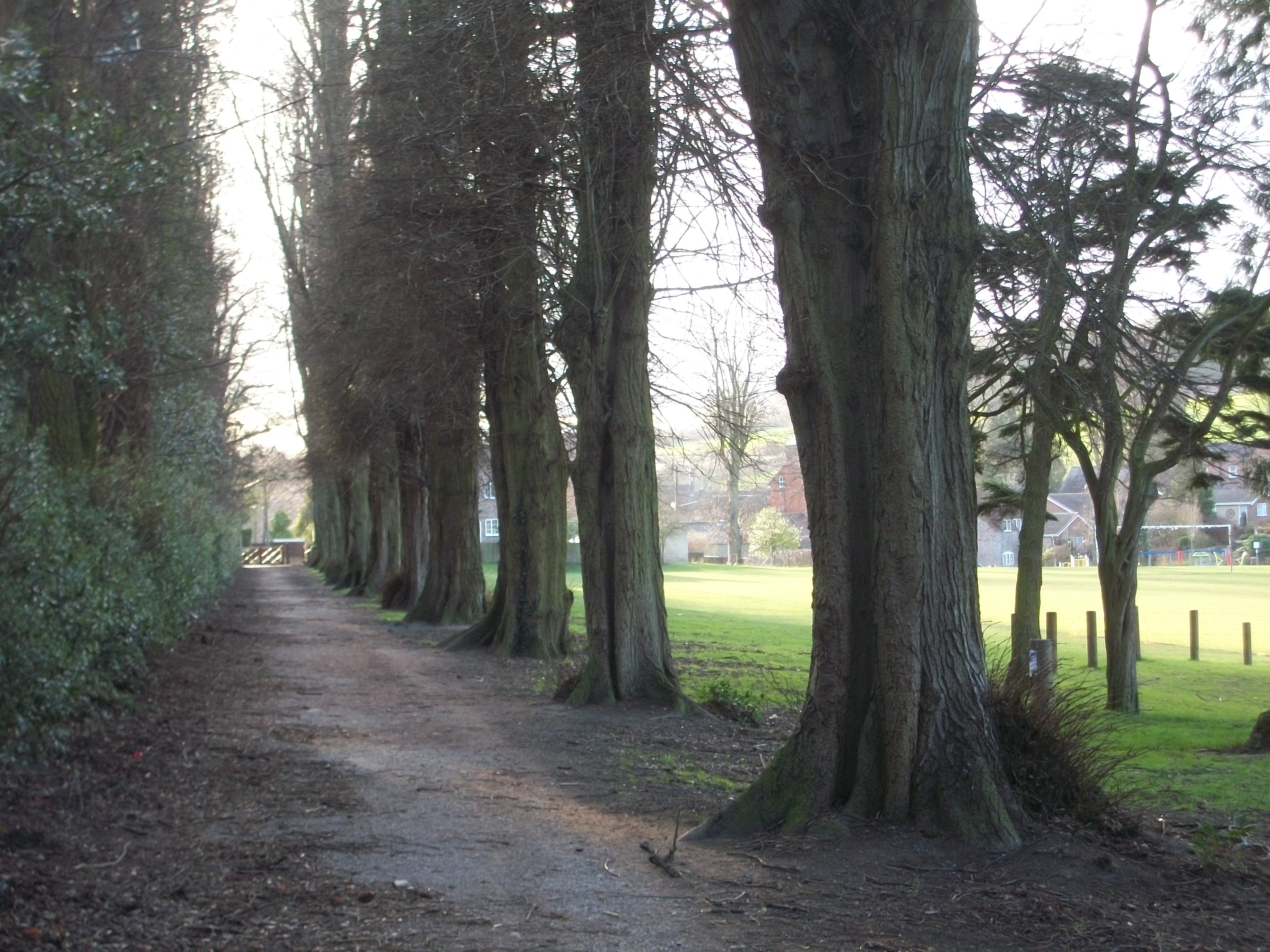
Finding Windmill Hill is the easy part of the enterprise. The old stone tower on its summit makes it a striking local landmark, though something of a mystery since there is no record of how this tower looked when complete and few clues as to what kind of windmill it once was. The limestone ridge on which it stands, with the disused Shadwell Quarry at its back, is a five-minute walk from my house. You can reach it either by striding across the Linden Field beside the new William Penny Brookes School, or you can follow the path beneath the towering limes of the Linden Walk. The trees form a cool sweet-scented arch of greenery in summer and Doctor Brookes, a trained herbalist and therefore well versed in the calming properties of lime flowers, planted them there over one hundred years ago. According to tree experts the limes could last another hundred and fifty years, although they wag their fingers at local cricket enthusiasts who, in season, drive over the roots while parking their cars for a good view of Sunday cricket on the Linden Field. The case of trees versus cars is guaranteed to raise tempers in the town.

The Linden Field once belonged to the Gaskell family, the town’s local worthies who lived in the Abbey beside the ruined Wenlock Priory, but in 1935 it was bequeathed to the people of Much Wenlock for their enjoyment and recreation. That the townspeople have problems hanging on to their rights as beneficiaries is another source of local irritation. But then the most important fact about the field is that it is the site of the Wenlock Olympian Games. These were begun in 1850 by the town’s doctor, William Penny Brookes, in a bid to improve everyone’s health and wellbeing, and later provided Baron Pierre de Coubertin with the model for the modern Olympic Movement. People argue about this too, but at the top of the field is the oak tree planted in 1890 to commemorate the Baron’s reconnaissance visit to the town to see the games for himself. Today, visitors who come to the field say there is nothing to see in the Linden Field. But then that’s history for you; invisible for the most part. However, should the see-nothings feel like returning between 12-15 July 2012 they will find the 126th Wenlock Olympian Games in full swing, with a wide range of serious athletic contests to be watched and enjoyed.

The old Penny Brookes games also included all the familiar events – pentathlon, archery, football, hurdles and long jump (called the running long leap), but there were also bicycle races on penny farthings and tilting at the ring, a mediaeval jousting sport wherein a galloping horseman speared a ring with his lance. Prizes were lavish with olive wreaths to crown the victors and Dr. Brookes himself designed and paid for the gold and silver medals. Then there were also the fun events – blindfold wheelbarrow racing, climbing the greasy pole and chasing the piglet. Something for everyone in fact and not a hint of a risk assessment. As might be expected, the games were hugely popular and spectators and competitors came from far afield, many arriving by train, since the line ran conveniently beside the field. And for those who wanted the best possible view of the games, then Windmill Hill provided the perfect spectator vantage point.

Which brings me back to the wolf farts. Not forgotten, but by the time I’ve hiked up the steep hill to the windmill, I’m a little out of breath and thinking I need to get into training, perhaps with some piglet chasing?  I begin to comb the limestone meadow that was cropped in autumn by a fleet of russet-coated Shetland ponies. This is where the wolf farts are supposed to be. Somewhere. It’s not a very big hill after all, and I can walk across the top in less than two minutes. I scour the northerly slope first, rooting among the weathered pony droppings and coarse vegetation from which, in late spring, will sprout spotted purple orchids, and later, agrimony, harebells and knapweed.

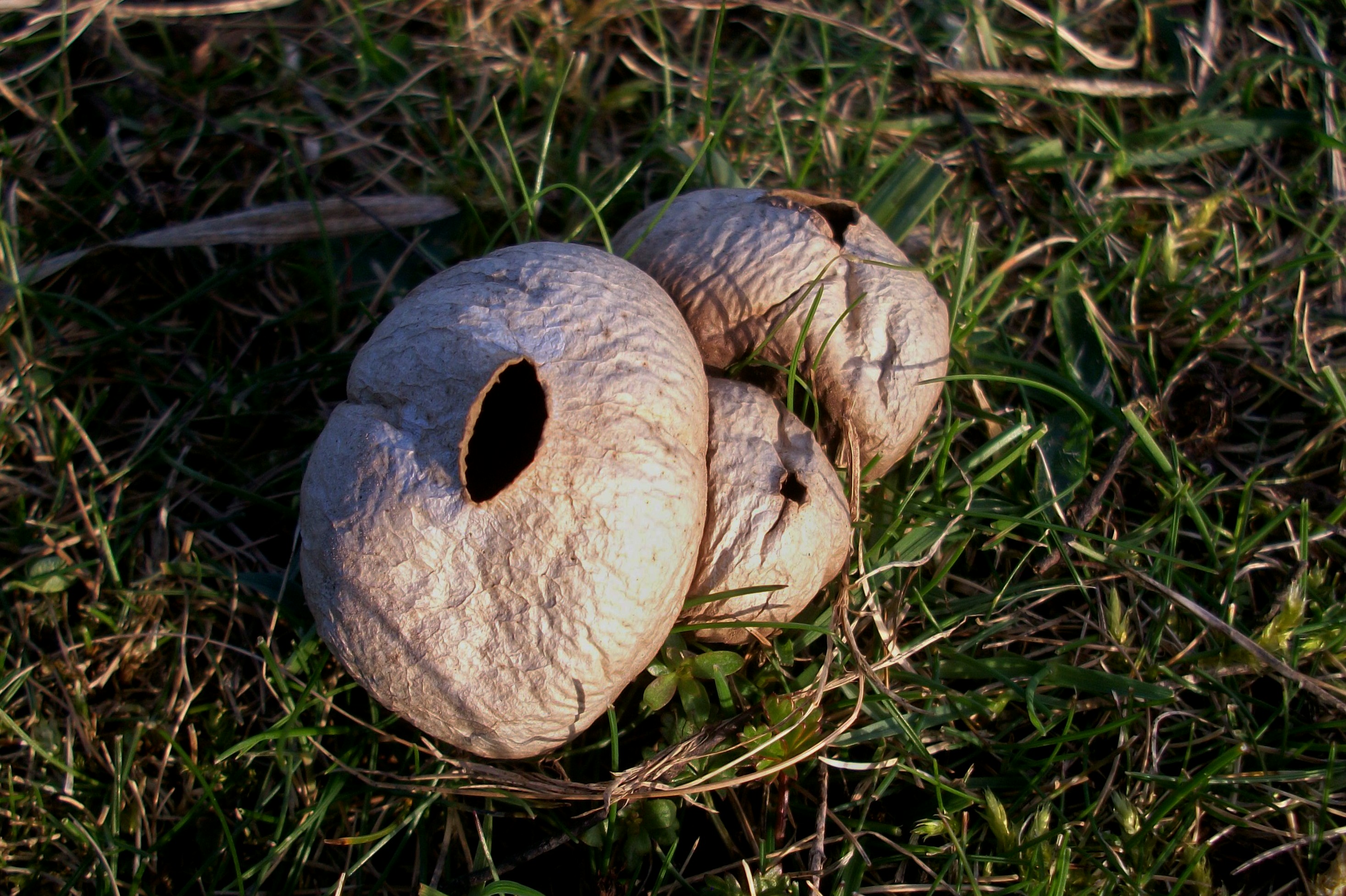
I decide that Paul Evans has been pulling my leg, but anyway work my way back in a southerly direction. And this is what I’m looking for:

the common puffball, Lycoperdon (from the Greek lycos wolf and perdomai to break wind). It has other names too, including the devil’s snuffbox. And finally I get my eye in. I had been seeking something altogether too substantial, imagining the white, marshmallow-like fruiting bodies of autumn. In fact the first one I find is quite tiny, paper-thin and bone coloured, the size of my fingernail. Then there are others – cigar coloured, a couple of centimetres across and yes, very like Shetland pony droppings. They are empty husks now, barely clinging to the thin soil, their spores spent, leaving tiny orifices like shocked little mouths. Then I find one still containing some spores and squeeze the sides. Out puffs the brown-black dust, as fine as photocopier ink. Later I read that inhaling too many spores can lead to lycoperdonosis, a life-threatening respiratory condition caused by the spores lodging in the lungs.  Won’t do that then. Won’t breathe them in. And that seems all there is to be said and done concerning wolf farts. Quest done, I lose interest, stand up and survey the old quarry behind the windmill. There’s a deep pool of unearthly blue water, apparently some seventy feet deep, and the surrounding land is going to be developed with holiday chalets and a dive centre. It’s then, as I’m looking for signs of building work, that I see large segments of the quarry have been staked out with low green plastic fencing. Later I discover this is newt fencing. Why it is there is another story, one that I don’t entirely believe – something to do with separating opposing amphibian gangs and newt fights. Oh come on! At this rate I’ll never get back to the novel. It’s far too exciting outside.

Copyright 2012 Tish Farrell

Paul Evans @ www.guardian.co.uk/environment/thenortherner/2012/jan/10/country-diary-wenlock-edge/

Wenlock Olympian Society @ http://www.wenlock-olympian-society.org.uk/