
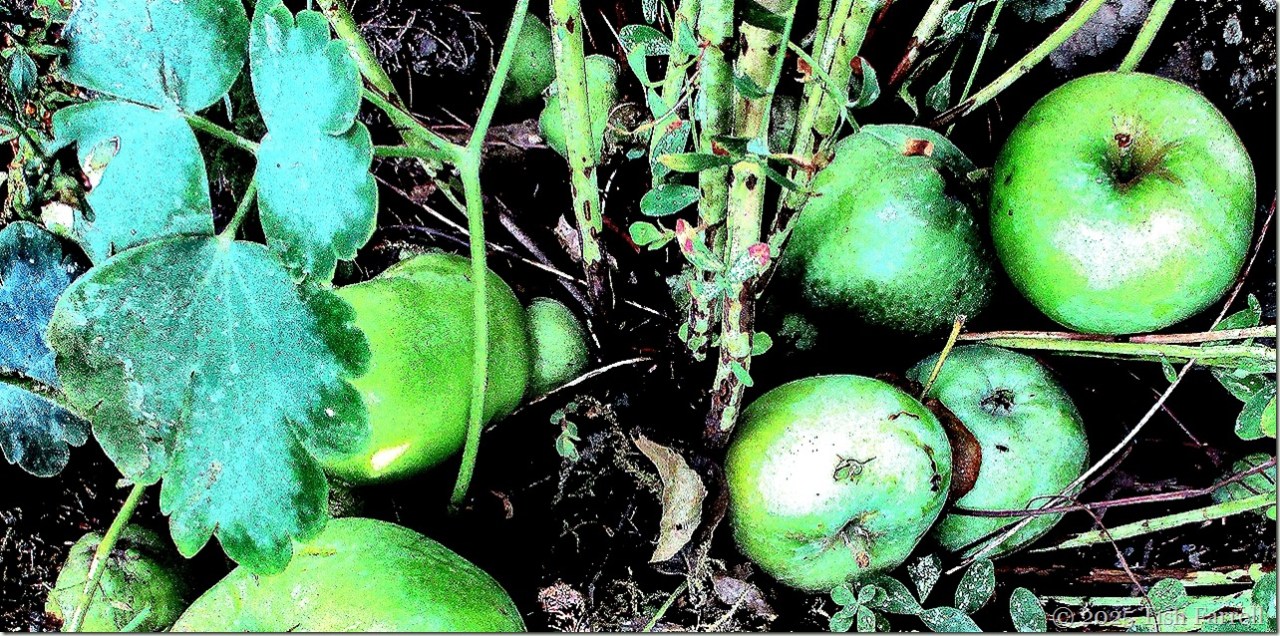
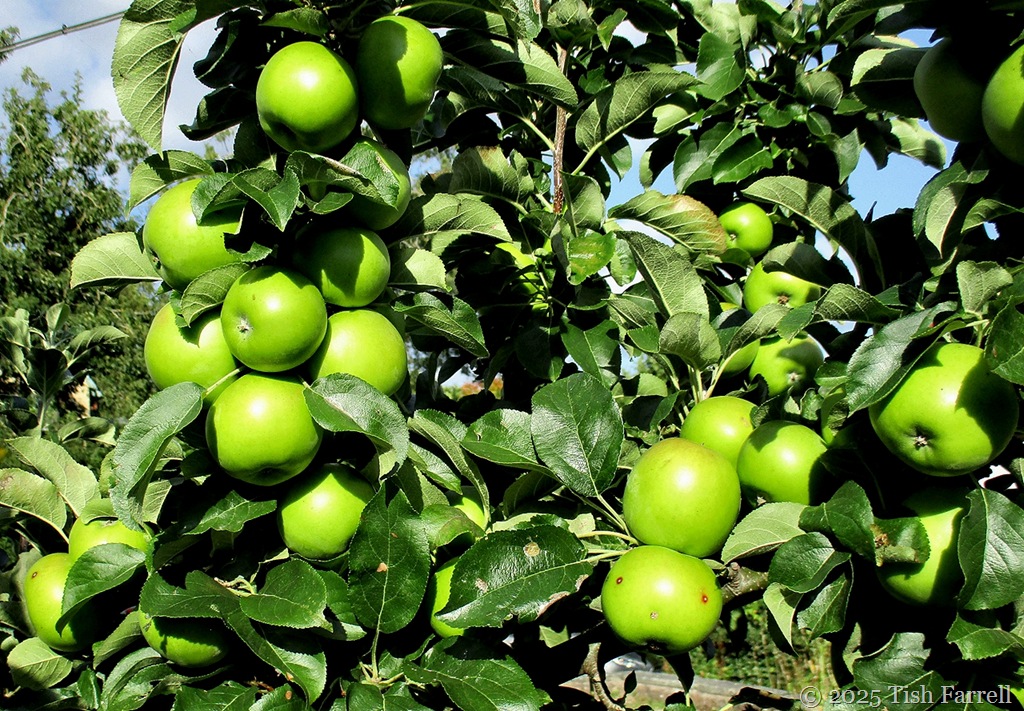
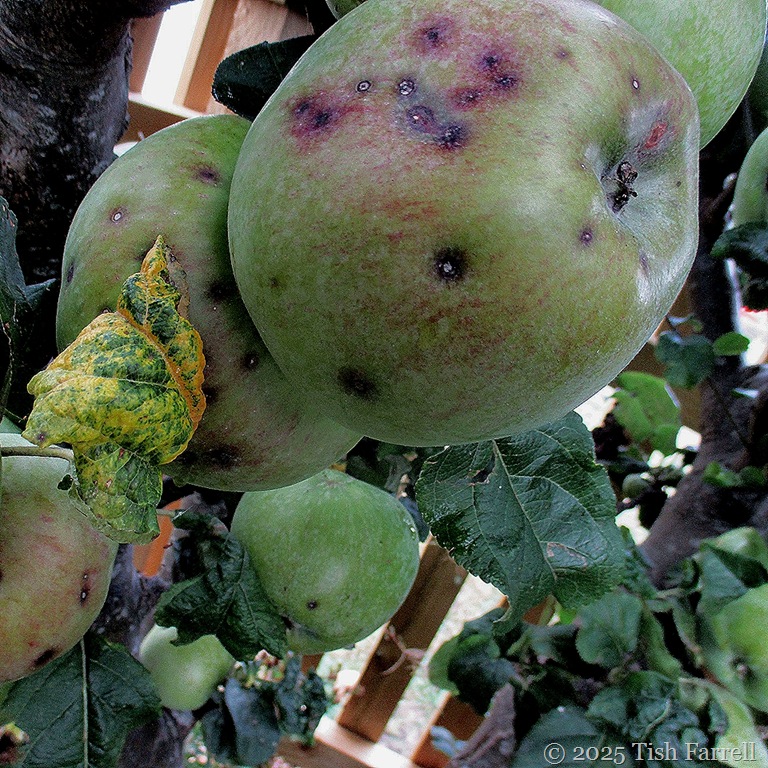
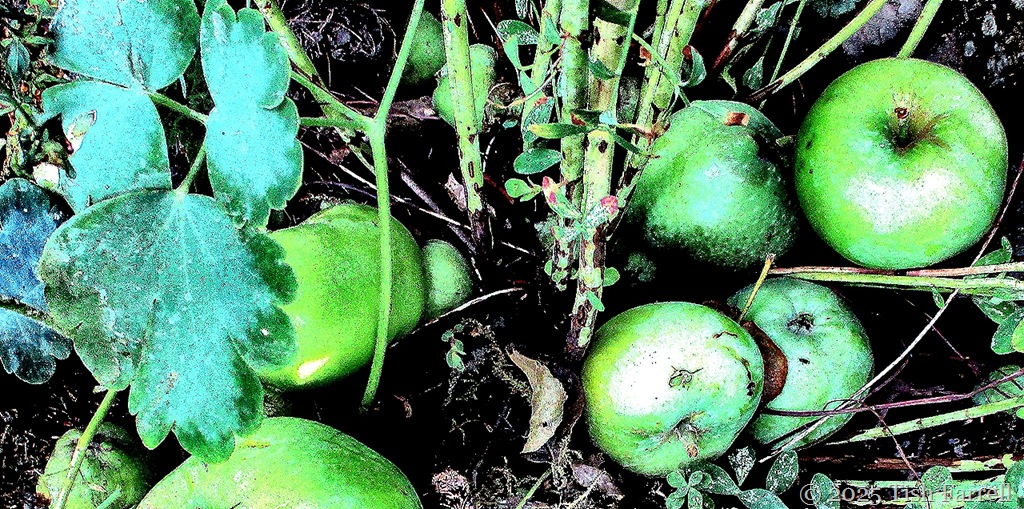
Around the garden peripheries there’s the heady scent of fermenting fruit. This year the apple (1) crop is phenomenal. Our three old trees are crammed with fruit, even though we’ve tried to thin them out. The apples are not ripe yet, but in the last few weeks many have been falling off. They are now rotting happily, giving the plants along the garden fence a rather solid (vaguely alcoholic) mulching. Of course the blackbirds and the wasps have been eating some of them. Many, too, were damaged, diseased or infested before the fall. We have yet to get to grips with what ails the two cooking apple trees. The Crispin eaters in the photo above seem fairly healthy, although they have been dropping a lot of unripe fruit. But the cookers look like this:
*
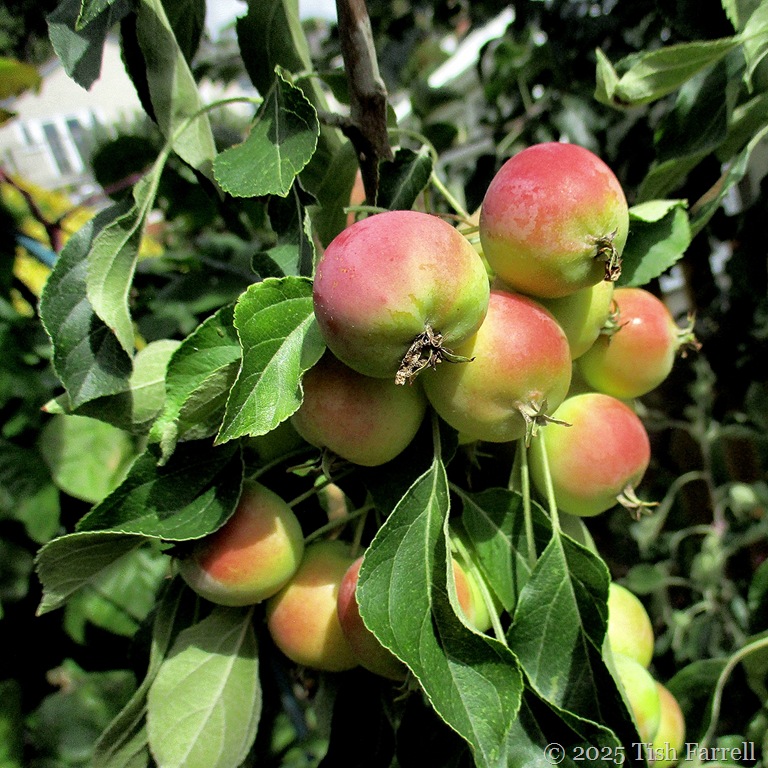
By contrast, the crab apples are taking on a rosy glow. The little tree at the top of the garden is now much happier since we’ve had some rain and cooler temperatures. The many weeks of drought certainly stressed it:
*
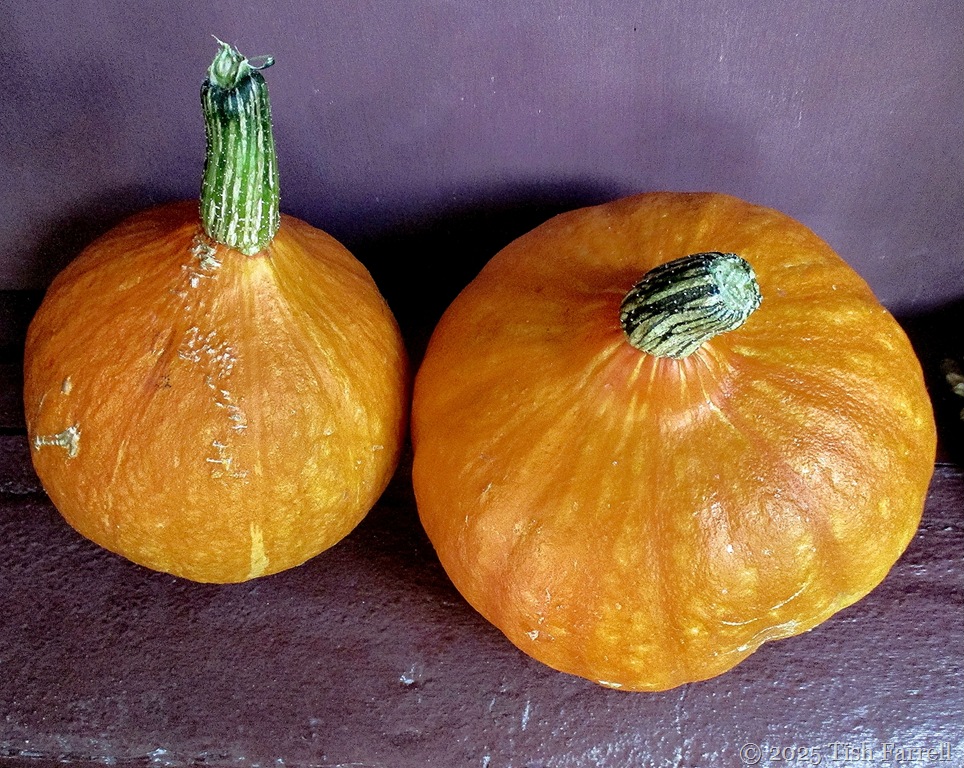
I’ve now harvested my two Uchiki kuri squashes (2), one from each plant on the side wall border. I was hoping for more (3-5 per plant were promised on the packet) but after a flying start and much vigorous growth (and feeding), the plants suddenly seemed to give up; three small squashes turned brown and died. I have two more plants (planted out later in the top garden) still looking hopeful, with a tiny squash each, but I notice there are now only male flowers being produced. These, on the other hand, are very lovely, smell delicious and are a magnet for bee-life (see previous post of bees on the razzle). Anyway here we have the outcome of all that bee foraging:
*
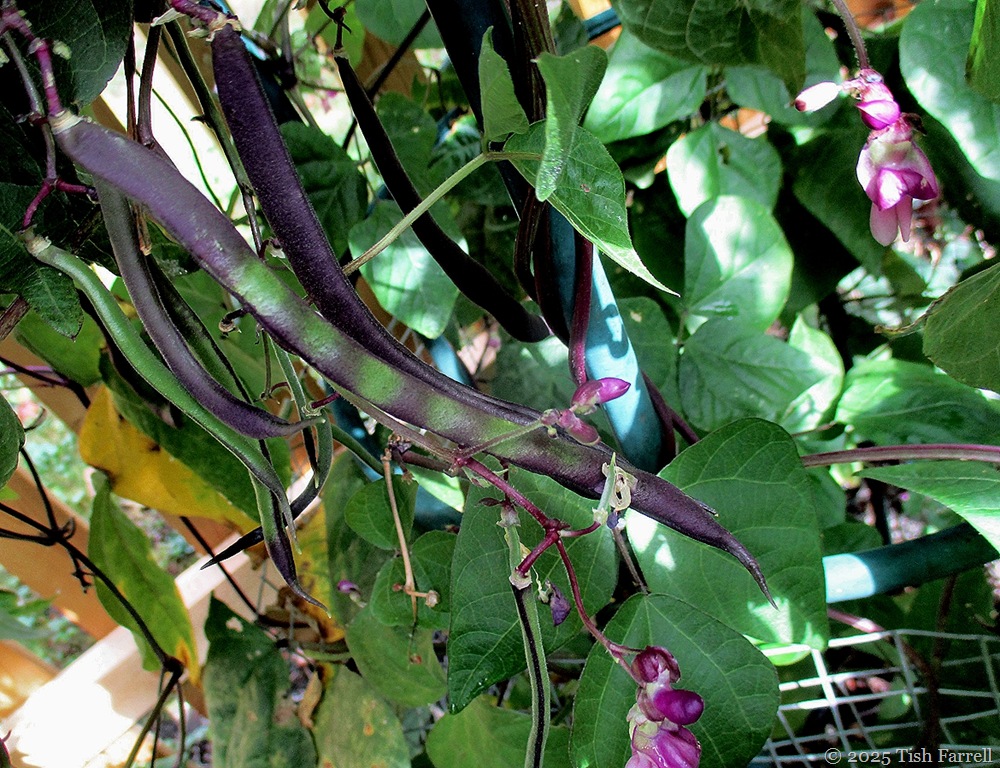
The bean (3) harvest has been somewhat sporadic too, although on two occasions I’ve had sufficient spare runner beans to make several pots of runner bean chutney – always welcome in the winter months with jacket spuds. Since this week’s rains, the plants look as if they are rallying and there’s more blossom along the pole tops. There are also signs of a further crop of Violette climbing French beans. They’ve been coming and going all summer, producing in usable quantities, but it’s meant no gluts to pass on to neighbours as happened last year.
*
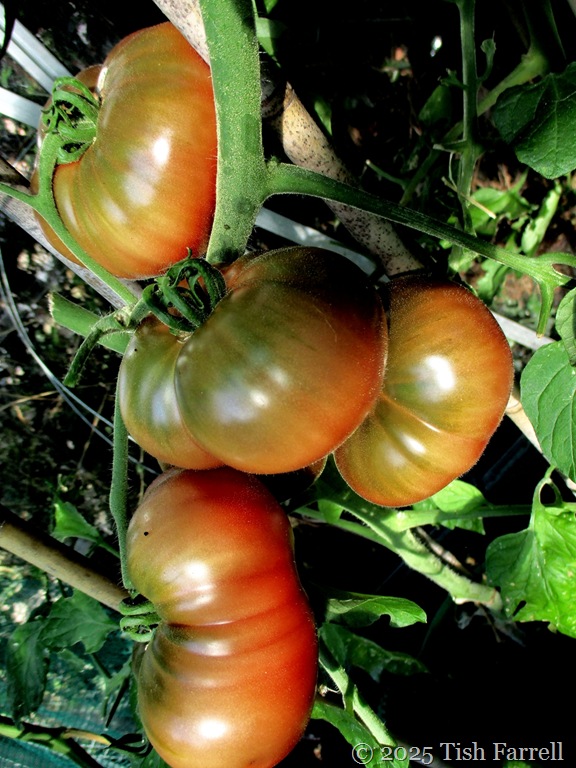
Also just ripening are my Cherokee tomatoes (4). They’re an heirloom variety I’ve not grown before, and I was a bit wary of giving up extra Sun Gold space in my small greenhouse. They started to form fruits and fatten early in the summer, and I wondered if they would ever ripen. The one plant I put in the garden by the runner beans has been leading the way.
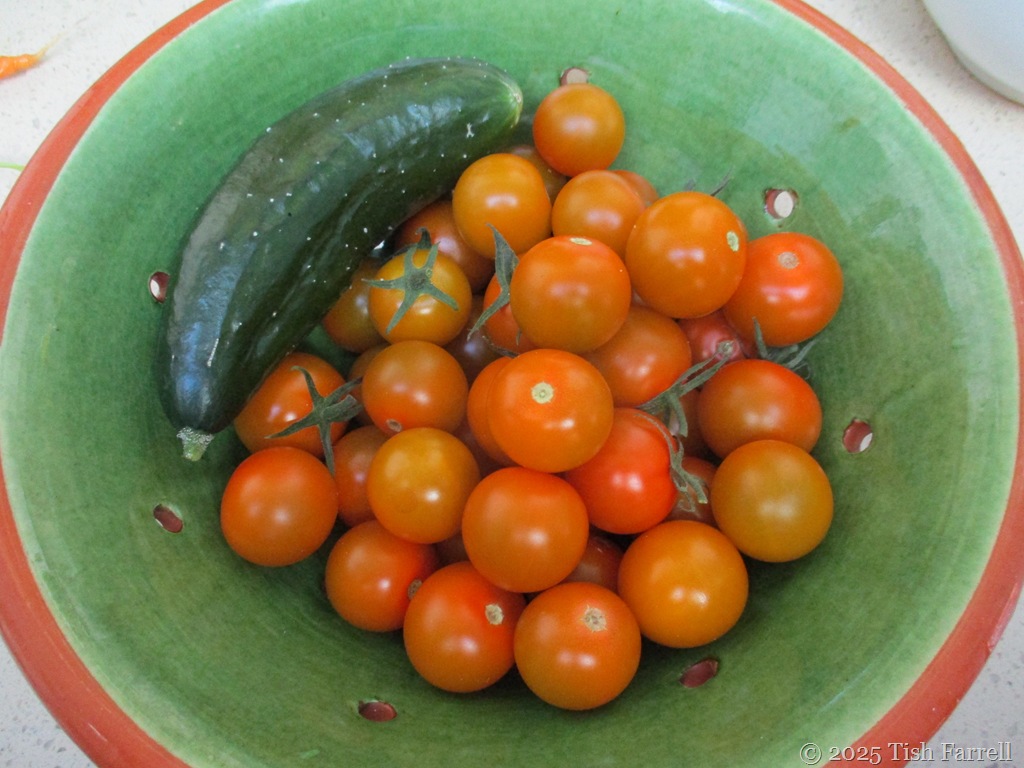
Meanwhile the Sun Gold cherry tomatoes have been producing a few handfuls every day, though look to be fizzling out in the greenhouse. Surprisingly, two rather ropey plants put outside fairly late, are now doing quite well. One growing up a Polka raspberry cane, and the other keeping close company with the big cooking apple tree.
*
And now is the time for the late summer flowers. The rudbeckia (5) are presently the stars of the borders, especially the Goldsturm which is a mass of flowers. I bought the original plant (since split into several more) at the Bishop’s Castle Michaelmas Fair, the month after we moved into The Gables two years ago.
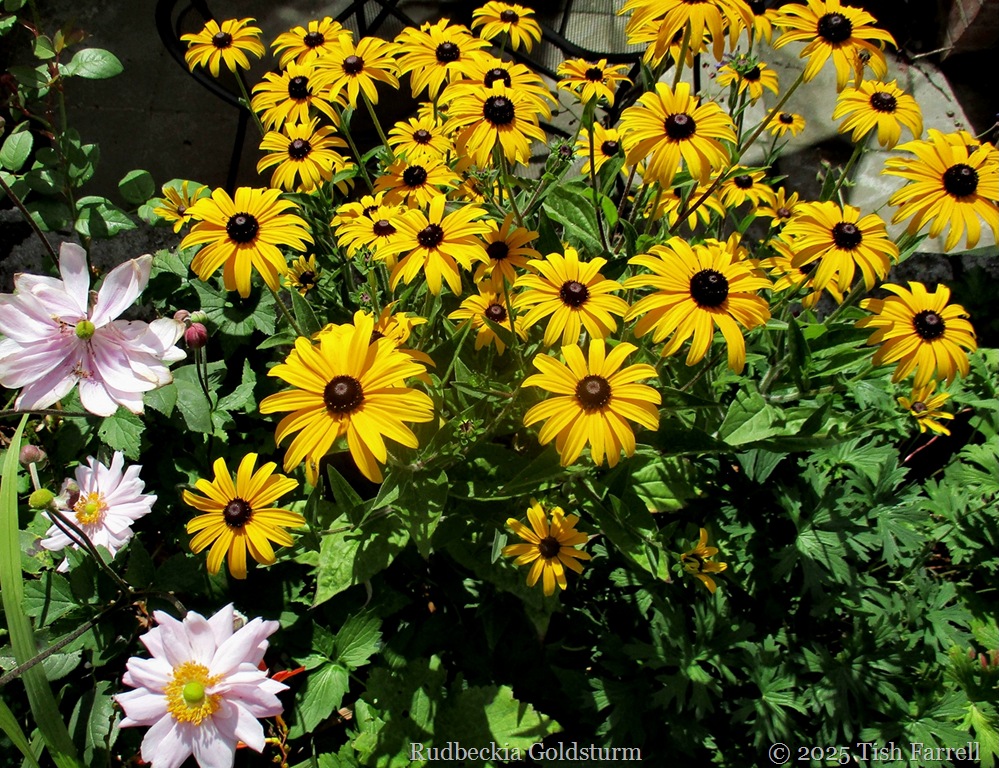
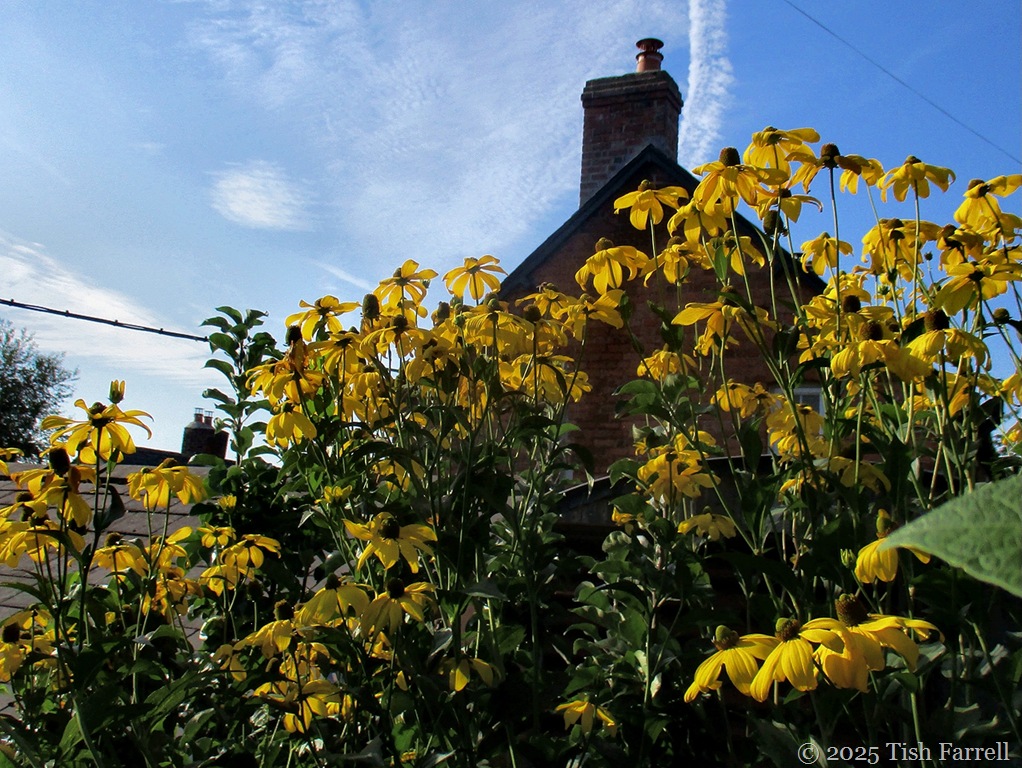
Then there’s the super-tall Rudbeckia lacinata Herbstone by the hot compost bin. It’s been going strong for several weeks now and looks to be about eight feet tall. I think the rotten apple mulch plus residue escaping the hot bin might be spurring it on.
*
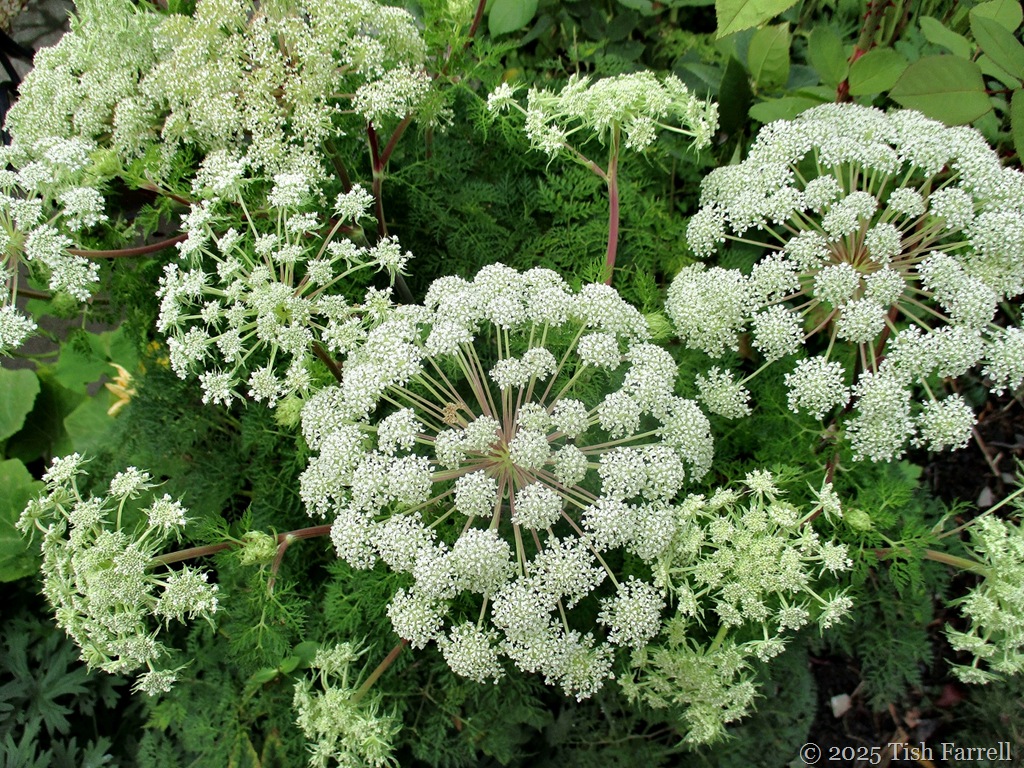
Finally, a plant I brought from our Wenlock garden – Selinum (6). I’m glad I did, although I was worried that it wasn’t thriving. It’s just coming into full flower after a summer show of ferny leaves that looked pretty droopy most of the time. It’s related to wild cow parsley (Queen Anne’s Lace) that flowers in late spring-early summer. But unlike her, puts on a welcome spread for insect-life in late season. I love its structural beauty, the filigree looks.
Six on Saturday Jim at Garden Ruminations is our host. Please go and see what he’s been up to.

The tomatoes look delicious, Tish. In Arizona, planting seasons are opposite from elsewhere. Don’t plant in summer! Too hot and dry.
They are delicious, Janet. V. juicy.
I love apples but here
I can’t grow them because of cedar trees.They don’t like each other. I’m impressed you have grown so much so well in short order..you must have a green thumb..or two.
That’s interesting that apples and cedars don’t get along. As to green thumbs, they are certainly often rather grubby thumbs.
Tish lives in England where it’s much easier to grow things like that. Apples are not a desert fruit tree. How are we do have lemons and grapefruit. We don’t have them personally on our property, but they grow in this part of the country.
I like the Selinum, very pretty. I think N20 gardener had a comment about a moth grub hitting the apples on today’s post, you could take a look at that. It might give you a clue with the apples.
Thanks for that, Rosie.
Well, plenty going on in that garden Tish! Tomatoes look great crab apples too, but the cookers don’t look too happy….
Still, there are so many, I’m hoping there should be some with enough unspoiled apple that’s cookable.
I do hope so
Lovely photos!
Thank you!
You’re welcome.
I wonder whether the apple problem is bitter pit, which is associated with dry conditions. I’m with you on the merits of Selinum, not sure why it isn’t better known.
Many thanks for that hint. I’ll look into bitter pit. The trees are on a lower slope of a steep gravelly hill. I’ve a feeling that the garden soil doesn’t go down very far. Not quite got to grips with the geology yet.
These all look so beautiful Tish 😍 I’m so happy that you get to enjoy this bounty…I’m enjoying the juiciness of the tomatoes vicariously 🍅
So happy to serve up vicarious juiciness, Athena 🙂
It does seem to be a good year for apple crops – we only have one small tree but it’s rammed with them! I hope you get to the bottom of whatever is infecting your cookers. I love that Selinum, the flowers are so delicate 🙂
The trees are pretty old and possibly not ideally planted, so that may not help. We had them well pruned two winters ago (they’d run wild). Now need to get the resident plant pathologist on to the case instead of building a car port that isn’t a car port.
👍😂
We just visited our local orchard and although we are in drought, they are having a good year. Our kitchen is now awash in fruit.
That’s a happy state to be in – awash in lovely fruit 🙂
Oh, I’m so impressed with your delicious (visually and I’m sure physically) produce! Wow, those apples, tomatoes, beans, and pumpkins! Thanks for the reminder that apple season is upon us. Happy September!
Many thanks, Beth. And a happy September to you too.
Mixed fortunes here, but plenty to eat and enjoy all the same. Note to self: source some crabapples ASAP. I do love a pot of crab apple jelly.
Yes, crab apple jelly making – I’m thinking about it too.
👍
The apples may not be the best but consider the apple cider vinegar you can make!
😊
Now that I had not thought of doing. Not very confident about fermenting stuff. Will ponder further. Thanks, Ark.
I learned to make an apple crumble from Jamie Oliver. All the cores I saved and after a few pies I had enough.
Put the cores in a large jar. Top. Up with water(preferably non chlorinated) weigh down to ensure all apples are under water, cover the jar – lid/or similar and after about a month you will have ACV(apple cider vinegar). You should stir it every other day or so.
There are loads of easy recipes on YouTube – where I found.Tastes great.
I now have several litres and won’t buy vinegar again.
Thanks for that, Ark. I may just be tempted to have a go.
You really should. For me it was an eye opener and loads of fun.
Furthermore, when I saw the price of organic ACV…
A virtual visit to your garden today means I now have one for the wishlist – the Japanese squash of course especially as it can be gown vertically and my veg plot is so small.
Violettes have been coy this year for me but I’m keen to try them again as I like the purple to dark green shade on cooking
Like you, I have a few dropped unripe apples – any clue as to the cause?
Selinum is a new one on me but research suggests you’ll be having some lovely overwintering seedheads
The Japanese squashes are splendid – not too big, and they store well apparently. One of my two later planted ones is growing vertically down the wall outside the kitchen door. It looks as if it might be making a viable squash too as well as being scenic.
One of my two obelisks of Violettes has just now had a second flush of beans. The other seems to have gone into prolonged suspended animation, yet has a lot of flowers. I guess what happens next depends on some useful pollination. Or not…gardening this year is proving too puzzling.
As to apple drop, most of our cooker fall is due to their various afflictions (a lot of insect damage by the look of them as has happened since we adopted them), but also (according to the resident plant pathologist) this year’s crop is just too heavy for them to hold on to. But then I also seem to remember Monty Don saying that apple trees usually shed their excess during July.
And selinum seed heads – yes, they should be good this year. Can post if required 🙂
Compliments on the tomatoes… Looks like you’ve settled well?
Tomatoes have been brilliant. They’ve been enjoying the sunshine.
As much as I’m way too lazy to invest time in a garden, I can imagine the pure joy you must have when Beauty comes out of the garden.