
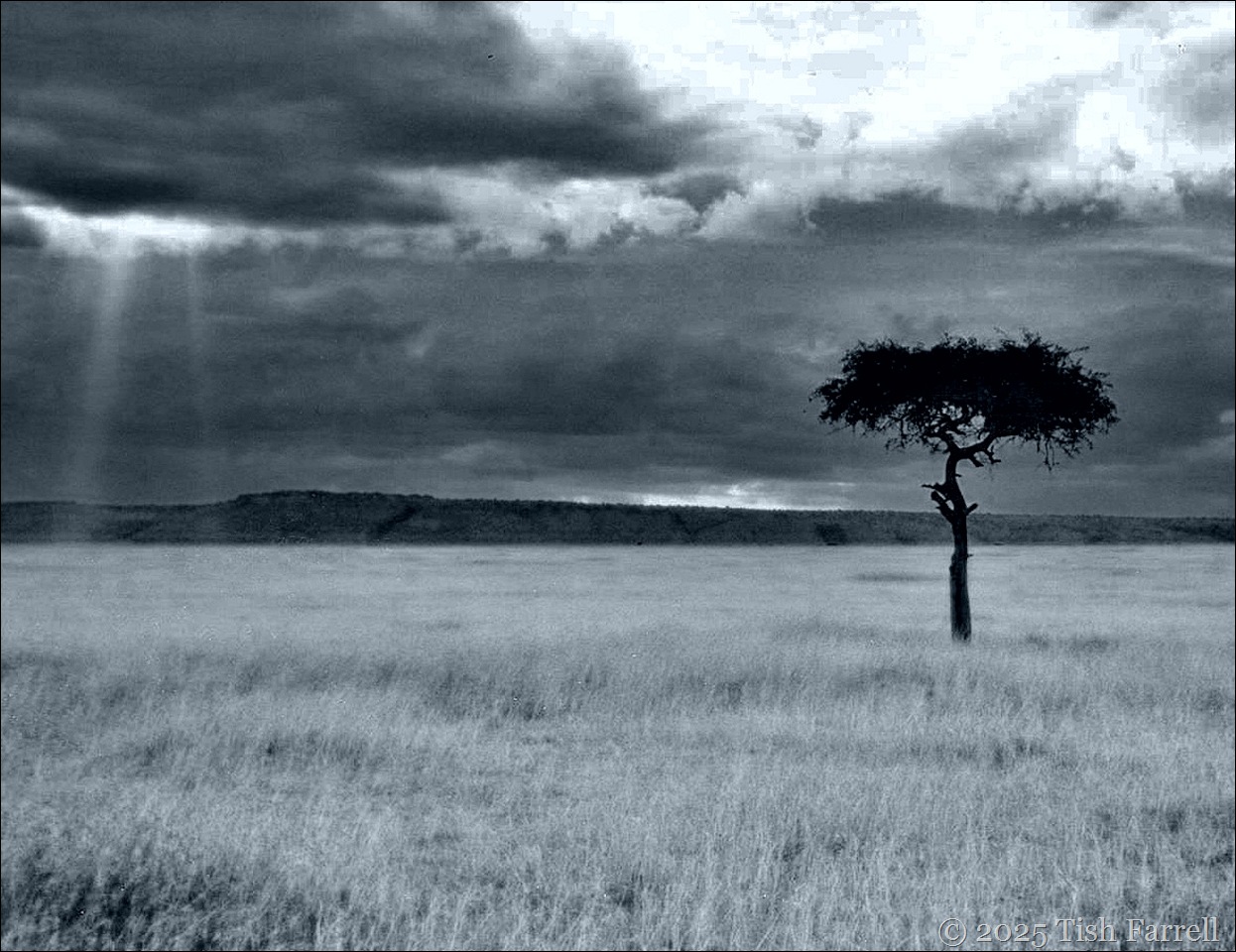
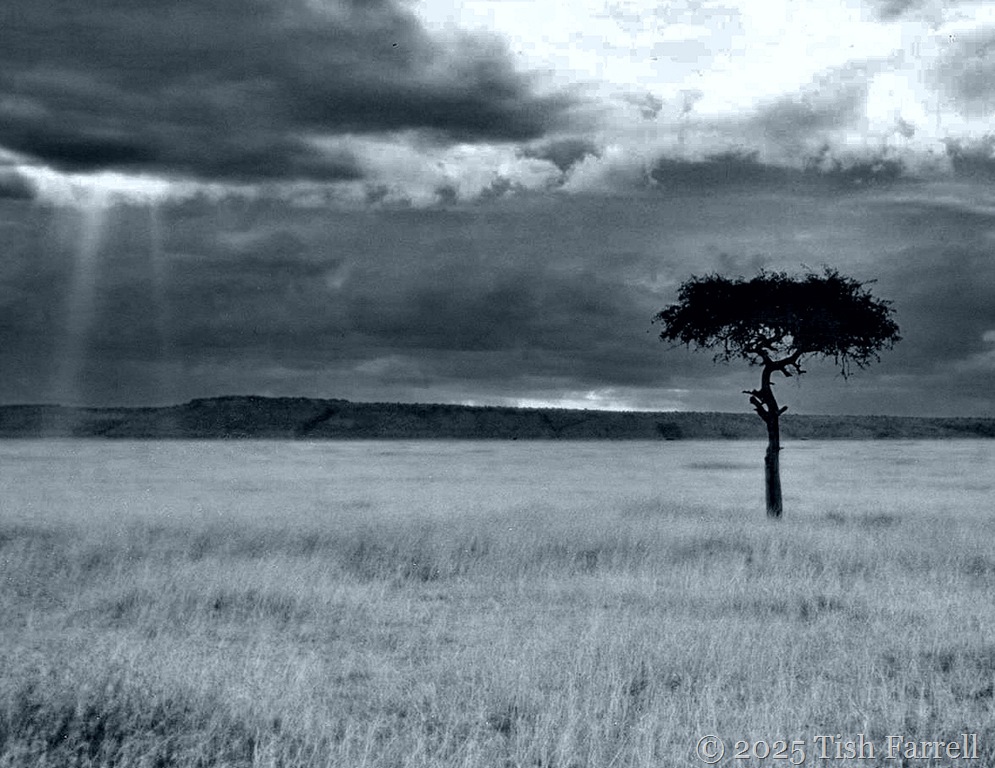
Maasai Mara with desert date tree
*
We’ve been living back in the UK since 2000, our years in Africa increasingly faraway. And yet…
And yet this spring and summer in Shropshire we’ve been very short on rain. The temperatures, too, have recently risen after a cold and windy spring. My gardening self grows anxious. Several times a day I do the rounds of my vegetable plots, checking on the kales, chard, beans and potatoes, the onions and leeks, examining the greenhouse tomatoes and cucumbers for signs of stress. My hands are always dirty, soil crushed under nails, as I prod the soil, testing for moisture levels around the plants.
It makes me think of Kenya days, pastoralists like the Maasai depending on rain to replenish the grasslands for grazing, cattle their life-blood in every sense; village farmers waiting for the November-December small rains for sowing; for the long rains March to May to bring the crops to harvest: lives and livelihoods dependent on monsoon weather systems that are nothing if not capricious.
Nor is this new. Oral history accounts, some going back two or more centuries, make reference to periods of drought and famine. One type of oral record is the memorized male circumcision list that survives in some communities. The rite was carried out every ten years or so, and the given year commemorated by some notable event. Food shortages were often inferred.
For instance the list for Maragoli in Western Kenya has 1760 as the time of Kgwambiti. Our Maragoli house steward, Sam, interpreted this as people behaving selfishly like animals, suggesting a food shortage. Likewise Vuzililili for the year 1800, a time when small insects fed on large insects. Then in 1900 Olololo-Lubwoni – refers to a time when jigger fleas (olololo) infested people’s feet, implying that that households were dusty and not swept properly. Lumbwoni is a very thin sweet potato, also suggesting drought and lean times.
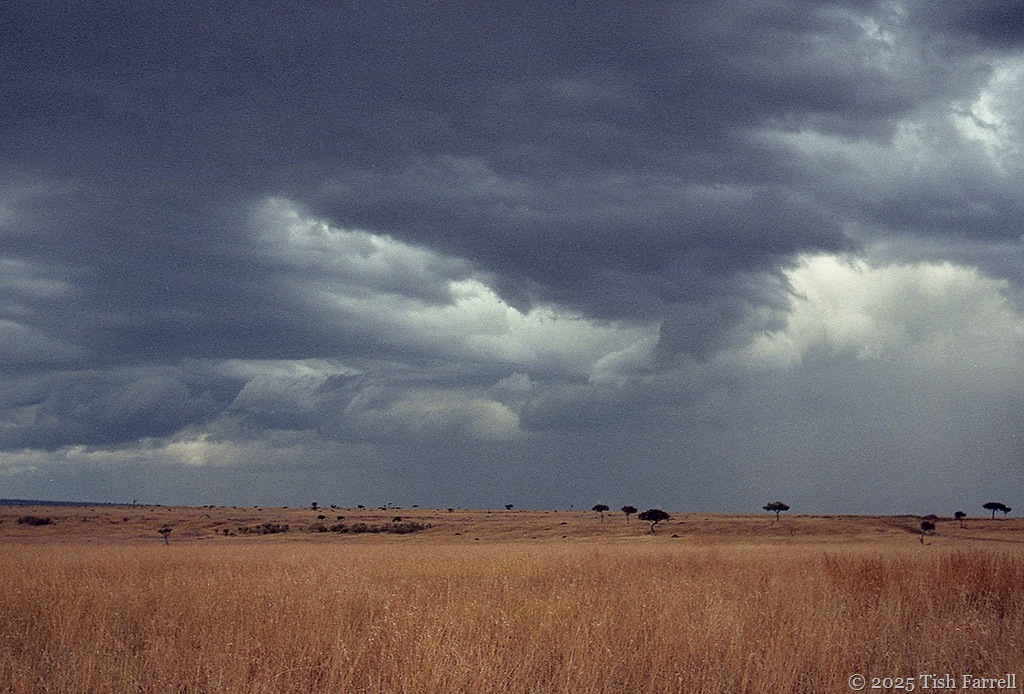
Another remarkable source of rains failure evidence is the revised historical events calendar used in the enumerators’ guide to the 1969 Kenya census. At this time many rural householders would have been born in the 19th century, or else reckoned family chronology according to particular past occurrences. For semi-arid Ukambani, a drought-prone region in southern Kenya, it was generally agreed that there had been six significant periods of famine in the 19th century: Ngovo (1868); Ngeetele (1870); Kiasa (1878); Ndata (1880); Nzana (1883) and Ngomanisye or Muvunga (1898).
In the past, too, it transpired that the Akamba people had established emergency strategies via extended kinship allegiances. This involved moving from the worst stricken areas and, for a time, living with relatives who were not so badly affected, or who had their own water-holes. Rules of reciprocity of course applied; this was not charity.
It was important, too, that in pre-colonial times the Akamba had a sphere of far-flung connections through their hunting and trading activities, one that extended into what is now Tanzania. This increased the scope for finding sanctuary from drought-stricken regions, but of course was curtailed when the colonial administration consigned each ethnic group to a designated reserve, basically drawing a line around the territory that each community apparently occupied at the time when the British arrived; self-determination being duly cancelled by a line on a map.
But perhaps the most compelling evidence for the enduringly random state of weather across East Africa is the deeply embedded cultural phenomenon of the rainmaker. Every community had them; perhaps still does. They were often rich and powerful individuals. And contrary to what may be imagined, the forecast of rain was mostly based on informed careful observation of natural phenomena, including the movement of clouds, wind directions, dew formation, the behaviour of particular hygroscopic plants and trees that respond to rises in ground water, the arrival of particular species of birds and insects. Such observations informed planting decisions, the particular crops chosen, the times and places they were sown.
It’s tempting to think our Met Office could learn and thing or two.
And so I ponder again on our lack of rain. Our lives do not depend on the success of our garden produce. The Co-op’s daily deliveries of fresh food are two minutes’ walk from the house. I anyway have an outside tap and a clutch of watering cans. The water is always there. (Or at least it is for now). A luxury however you look at it. But even so, the daily sight of parched soil does seem to trigger some bred-in-the-bone alarm system, all those generations of farmers and gardeners in my family tree worrying…
And so the sky-watching continues, the hopeful eyeing up of every darkening cloud.
And probably also, in the not too distant future when the rain comes, there will be the ungrateful complaint that it doesn’t seem to know when to stop.
*
copyright 2025 Tish Farrell
Lens-Artists: Stormy This week Beth wants to see scenes of storminess.

Tish, thank you so much for describing this interesting history of Kenya and how much rain or lack of rain affected so many people. It makes me even more grateful that all I have to do is turn on the tap and water comes out. I really like the two images you have included.
Many thanks, Beth. Your challenge was the spark to this piece.
I’m so glad my challenge inspired your to write this.
History does repeat itself and nature continues to play with us. Water rationing here is difficult. It is sad when the lakes are half way down and lawns are brown instead of green. Many of us have desert landscaping: rocks, bark, etc.
Yes, rocks and bark are good. In Kenya, farmers plant their banana and other fruit trees in holes and use rocks including volcanic clinker to mulch them and capture dew. But water rationing is hard, especially when we’ve come to expect the taps to flow on demand. I’m cross that we didn’t get organised with rain harvesting devices when we were building the extension. Can still be done of course…
This year, we have a high snow level so I’m thinking there won’t be any water restrictions during the summer. If we have restrictions, we only water on certain days and watch how we use our water indoors. Nothing we can’t live with.
Living in a desert area, I know about waiting for rain. I have a rain stick, but it’s not reliable. 😉. I very much like both your photos as well as the narrative. And your last sentence made me smile. It’s spot on.
I can’t imagine coping with desert living, Janet. Your rain stick sounds fascinating. What does it do, or not do?
Fascinating, Tish
Thanks, Ian.
I find it so hard to imagine UK in drought. My memory from the 1940’s to 60’s when I lived there, was always wet. What an interesting read about your time in Africa . Indigenous people could read the land so much better than present day scientists. I smiled at your last sentence, yes the weather is always an on going conversation
Yes, you’re right, Pauline. We’re usually so rain-prone. But then we do get very dry springs every now and then, which of course catches us out. Especially so, when we haven’t got our garden water butts set up in time.
Water tanks are an essential over here
Glorious read, Tish, so beautifully written.
Many thanks, Sofia.
Such a wonderful way these people supported one another. Great story, Tish.
Thanks for reading, Flavia.
I had to smile at your last sentence – it does seem, in this country at least, that we’re never happy with the weather. When it’s cool or wet we’re all wishing it would warm up, then when the sun does come out for a few days we start to complain it’s too hot and we need some rain. And I’m as guilty of that as anyone! Meanwhile, I love that opening photo, full of drama 🙂 It couldn’t be anywhere but Africa!
Thanks, Sarah. Yep, we are as capricious as the weather, aren’t we. It rarely suits us.
Such an interesting post, which you couldn’t have written with this particular slant even a very few years ago. I wonder how the weather has changed in ‘your’ part of Africa these last few years?
Hi Margaret. The timing of my ‘slant’? Actually the cycles of famine and drought have been studied since at least the 1900s (lots of academic papers over the last 50 years). I now discover the Kenya government met office has been working alongside traditional weather forecasters, so that forecasts can be tailored to specific locations and communities. Good old Kenyan pragmatism blending old and new techniques.
Deforestation of the highlands above the Rift Valley is a problem; destroying tree cover means less cloud cover and rainfall; also a lowering of the water table, with further knock-on effects of aridification. And then when it does rain, there can be mudslides and flash floods, especially in El Nino years. In fact I wonder if anyone has looked at how 65 years of colonial agricultural practices, with monocrops and big field ploughing of fragile tropical soils had an effect on local weather patterns. The reserve land use system of smallholder farms didn’t (still doesn’t) help matters either.
Thanks for this detailed and interesting appraisal of the situation in Kenya. Colonialism, as ever, seems probably to have played its negative part.
Stunning photographs, Tish! A slice of desert living so beautifully captured in pictures and words.
Many thanks, Sheetal.
Stunning images, Tish. That flash of light in the opener is gorgeous.
Many thanks, Egídio. Catching that light was a good moment 🙂
I always love your posts on your time in Africa Tish, and this one is no exception. Rain has a totally different meaning to those who depend on it, and/or to those who live through annual seasons where the rain does not seem to stop. Your post is a wonderful reminder of your time there and your incredible insight into how different life can be in such a remote place.
I’m so pleased you liked this, Tina.
This was of great interest to me. This method of cooperation and reciprocity is a great example of societies working to survive changing circumstances. I am glad you recorded method. Mankind may need to revisit this.
It is heartening, isn’t it, traditional knowledge given due respect. Acknowledged too is that although scientific meteorology has good generalized accuracy in terms of broadcast weather forecasts, what matters to farmers is what to expect in their own locality.
Flower, here’s a good link to the Nganyi weather forecasting: https://news.mongabay.com/2016/02/nganyi-the-tiny-forest-in-kenya-that-can-predict-the-weather/
Wow. I will enjoy this. Thanks Tish.
Beautiful photos.
Thanks, Jennie.
You’re welcome.
This was an inspired post and I enjoyed it – also, loved the ending note because yup – never fails – when the rain finally does come, there can then be complaints that it doesn’t seem to know when to stop. hmmmmm
So pleased you enjoyed this post, Yvette. Always an absorbing topic: THE weather 🙂
🙂🙂