
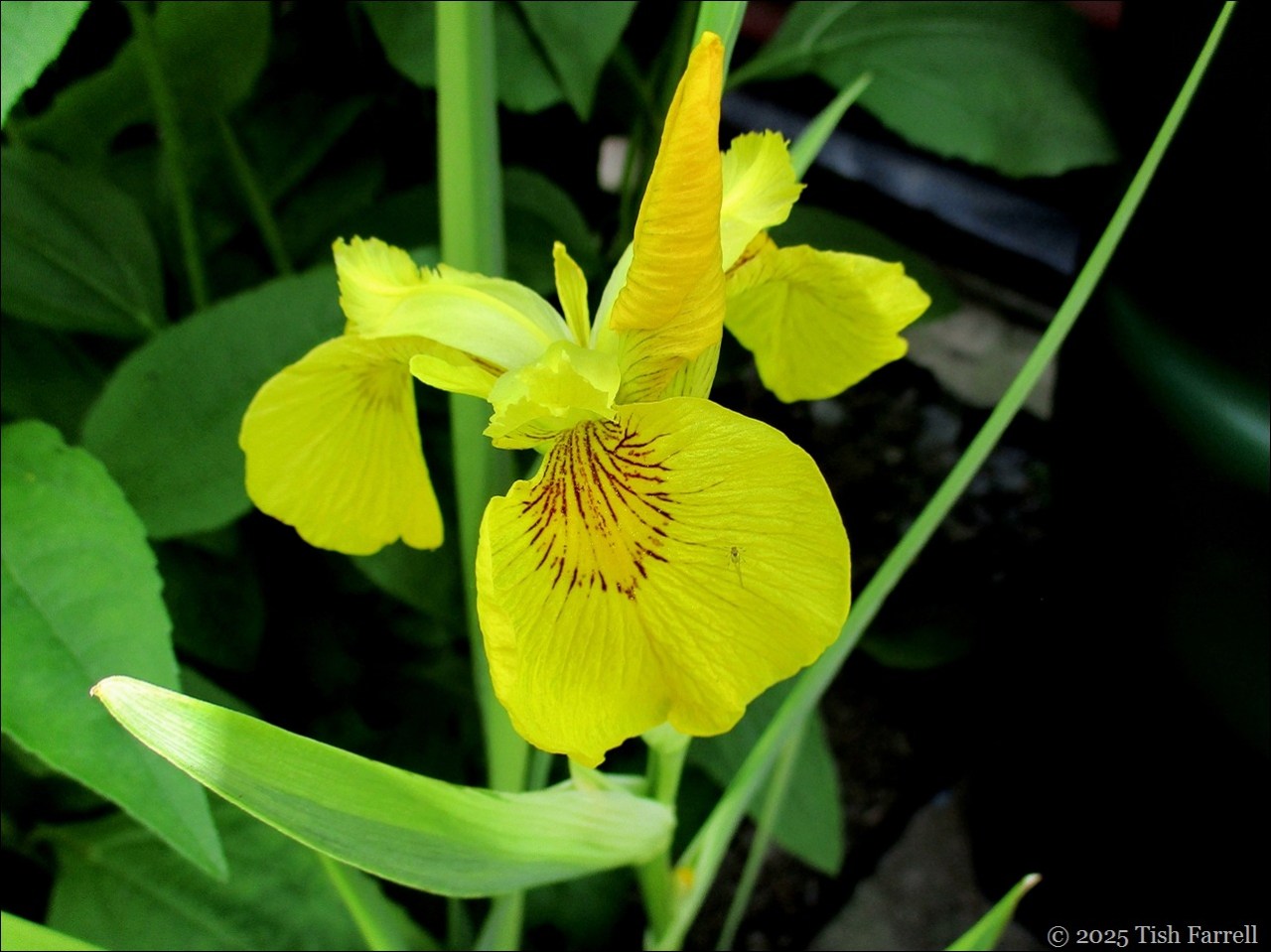

Well, this was a big surprise last week, and a very lovely one too. It is the unexpected outcome of a little rescue job performed over a year ago, not long after we’d moved into The Gables. Back then, in the August of 2023, I was making a start on de-jungling various flower beds and found some rhizome fragments swamped by phygelius and euonymus and assorted weedy thugs. They had small spikes of green and white leaves and I thought they might be Japanese iris so I replanted them in a cleared corner and pretty much forgot about them. They certainly didn’t do anything last summer, and when I looked at them early this spring I decided that they weren’t likely to either.
So it just goes to show what can happen when you’re not paying attention.
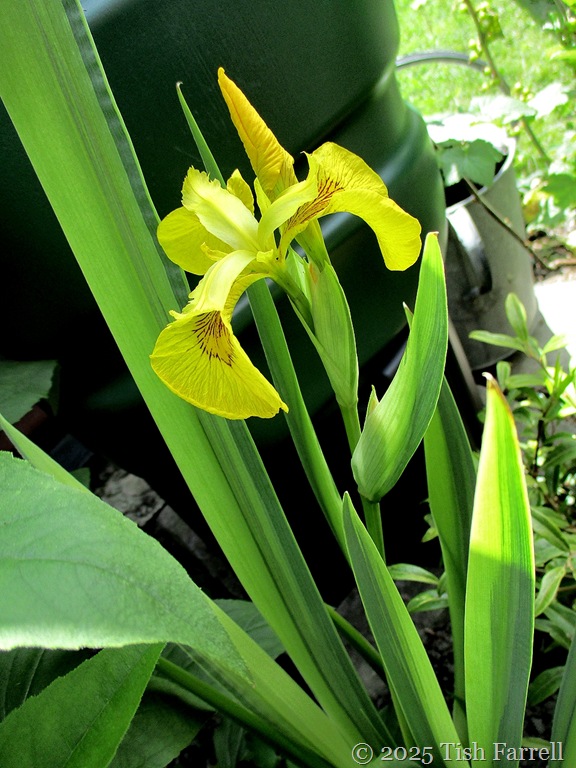
The spot where they’re growing is fairly sheltered, between Graham’s shed, a blackcurrant bush, the path and the hot composting bin. They are also being encroached on by some super-charged perennial helianthus ‘Lemon Queen’ (more of which in a moment). And here’s the puzzle.
When I first spotted the opening iris I couldn’t quite believe my eyes. It looked exactly like the wild yellow flag that grows in and near ponds and marshes. The only difference appeared to be the green stripy leaves. Some internet sleuthing was thus required, and this soon revealed that the iris was indeed a variegated cultivar of the wild form. But how come? There is no standing water in its vicinity. Until last week we’ve been many weeks without rain, and on sunny days, out of the wind, it’s been quite hot, leaving other herbaceous plants in parched beds.
Then I considered the size of the neighbouring helianthus clump. The first shoots are waist high already and the leaves huge. I then began to wonder if the hot compost bin has been having a hand in things. It does make a quantity of liquid gloop which, if I haven’t drained it, dribbles onto the path and onto the flower bed (?). Also the soil there is largely unimproved and thus dark and heavy; slow to dry out where the shed shades it.
Hm. Who knows? I’m just hoping that the iris will decide to stay. There are signs that the plant with the flowering stem is beginning to clump up. The smaller cuttings, in amongst a spreading geranium and rudbeckia, are also beginning to look promising. And now we’ve installed a nearby water butt, I’ve no excuse not monitor watering requirements.
All the same, all the gardening sites do call the variegated yellow flag a wetland plant, and also warn that it, too, can develop thuggish tendencies. A watching brief then.
*
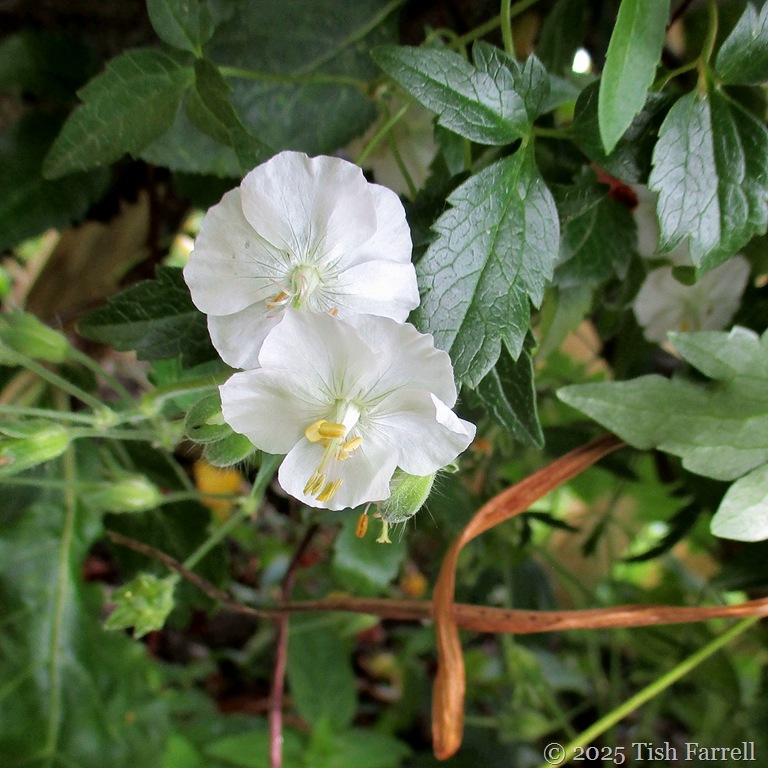
I rescued this geranium phaeum album early last summer. I discovered it behind the compost bin, lurking mostly under the fence with next door’s garden. It’s now growing under the apple tree at the bottom of the garden, though it’s a spot prone to drying out. It’s doing better in an open sunny border along with geranium Anne Thomson. Damp shadiness is supposed to suit it best.
*
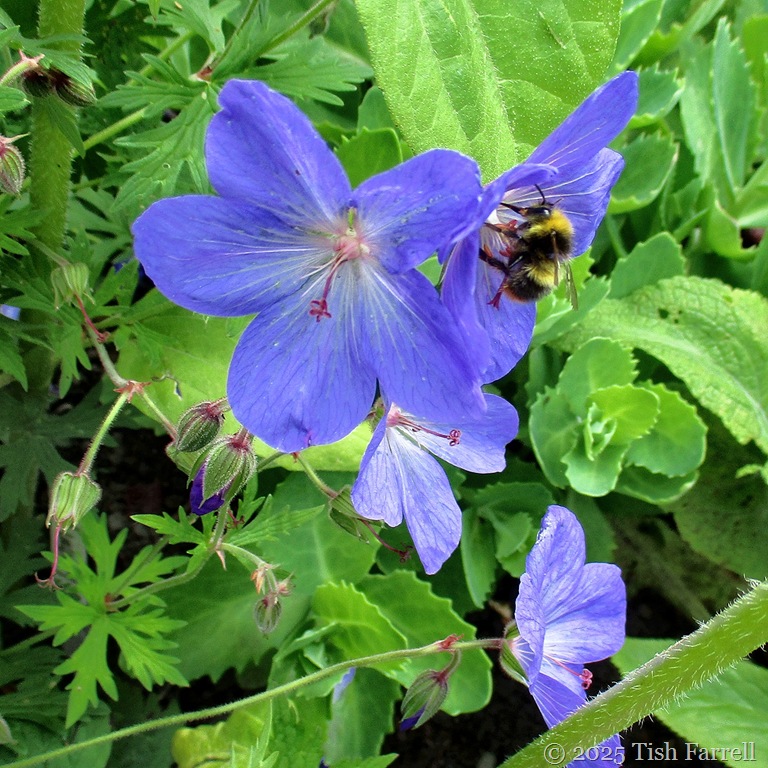
The recent downpours have bruised many of the geranium faces, but the rescued clumps of Johnson’s Blue (I think that’s what they are) have been putting on a good show and pleasing the bees.
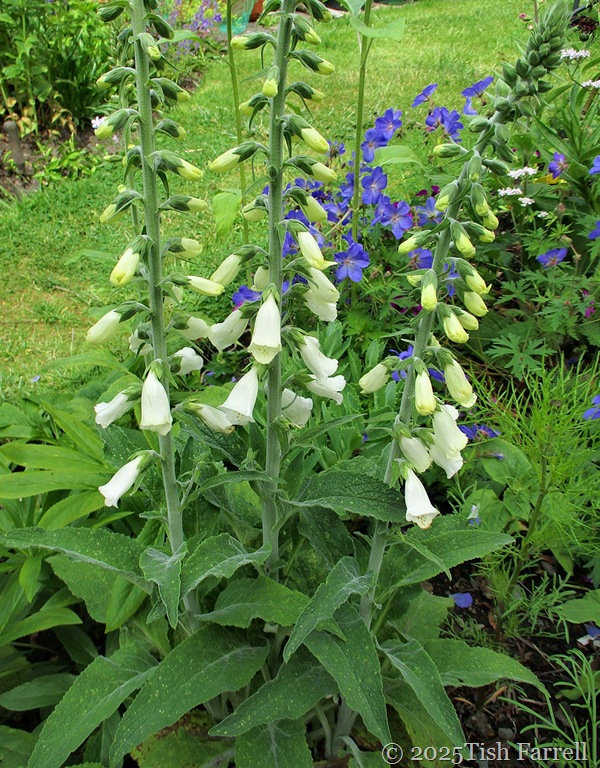
Here they are with this year’s number one self-seeders: white foxgloves. They are everywhere about the garden, although there was no sign of white ones over the last two summers. I love their cool and stately demeanour.
*
And at the hotter end of the colour palette, in the front garden we have a row of snapdragons, self-seeded along the wall in a remarkably orderly fashion. Anyone would think I’d put them there.
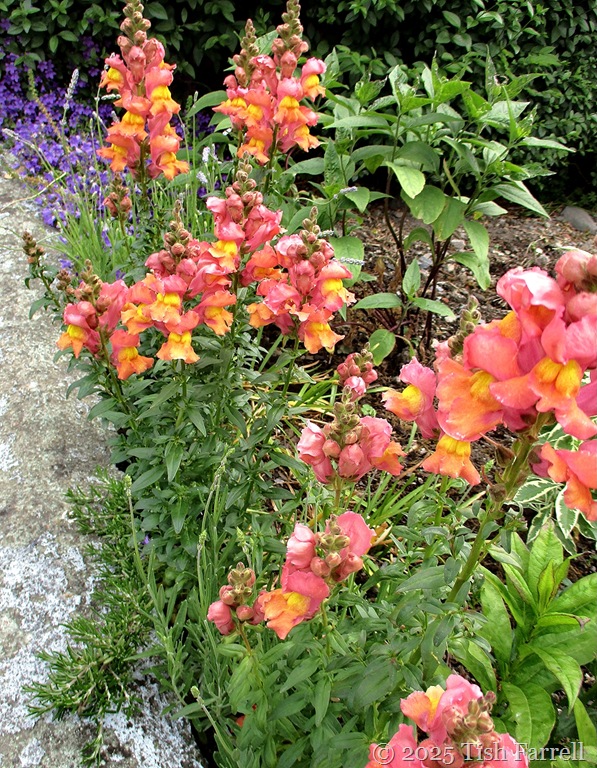
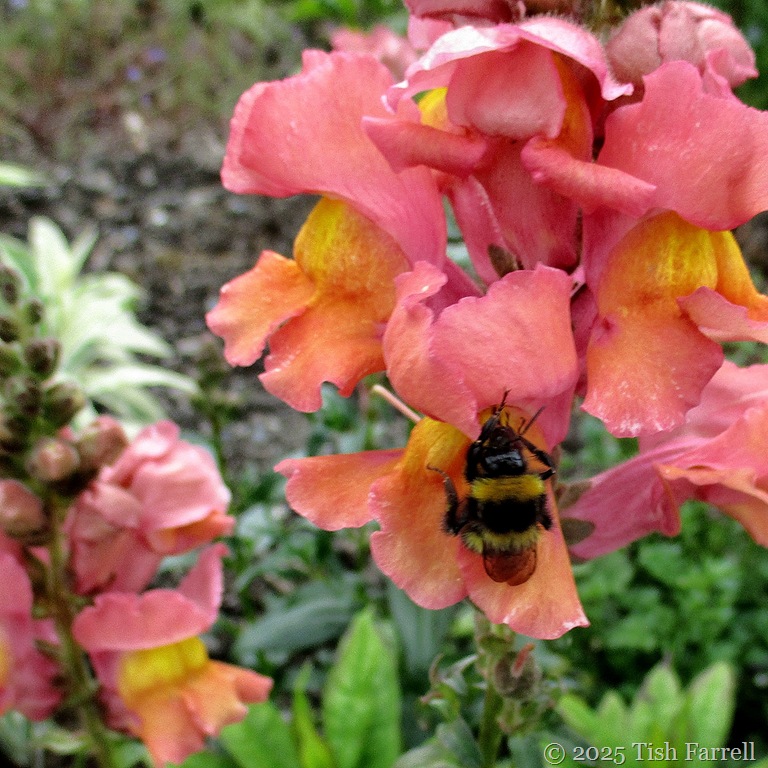
They glow in late afternoon sunshine.
*
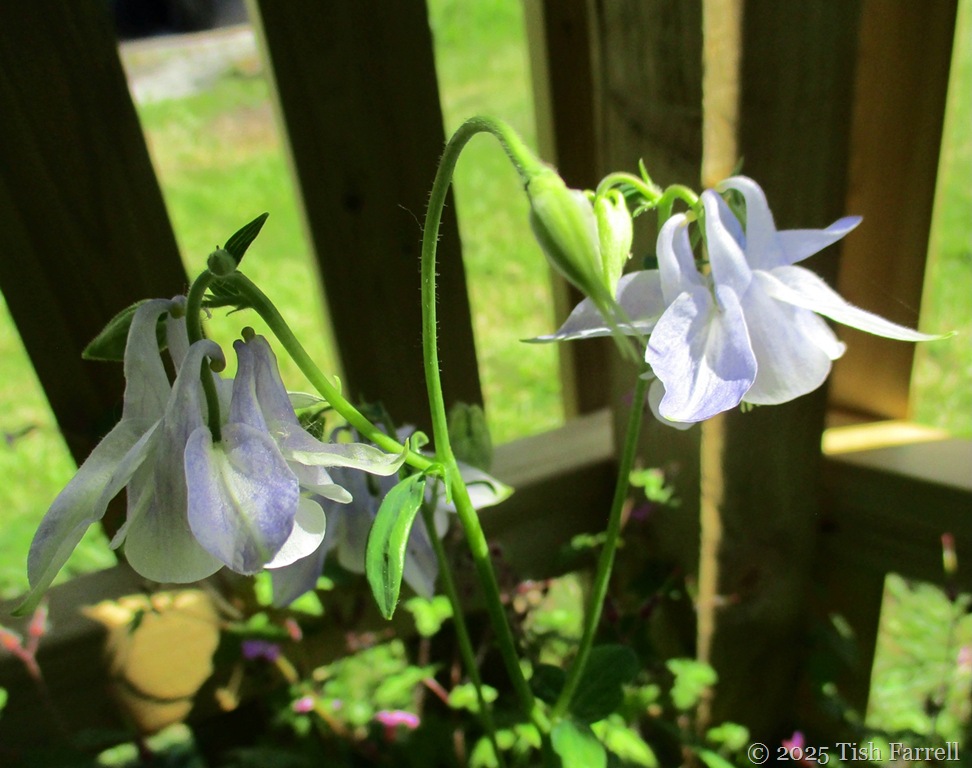
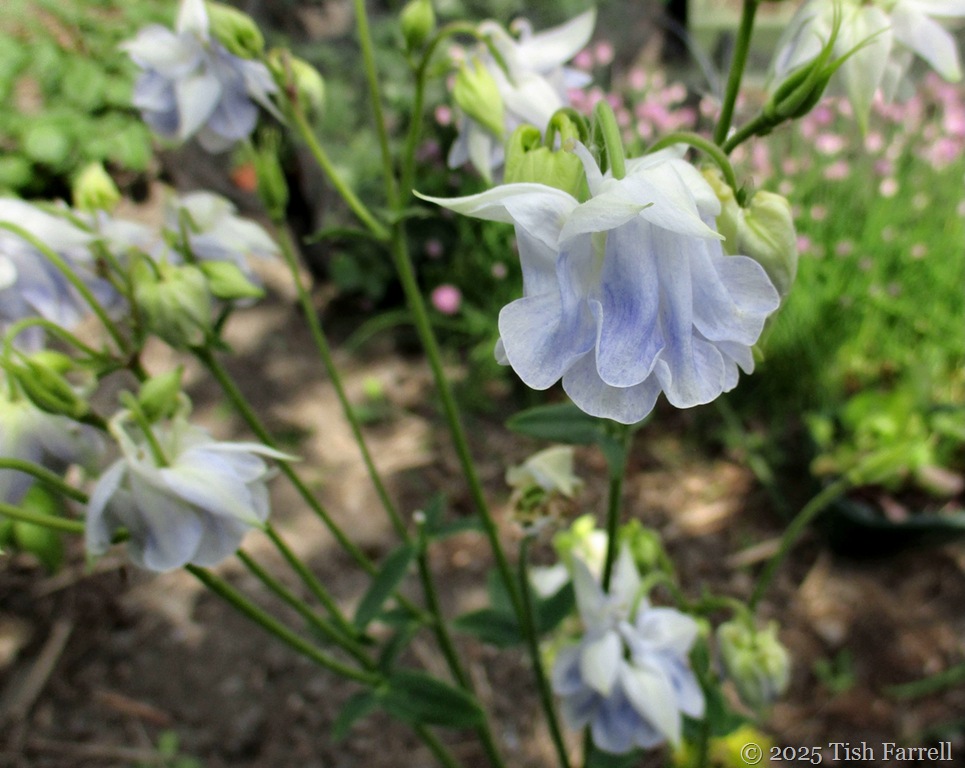
Throughout May we had profusions of columbines, mostly pink and dark mauve. They are actually too much of good thing on the self-seeding front, and I spend much time rooting seedlings out of the vegetable beds. But then amongst them were two plants of delicate lavender, each with a different ‘frock’, one by the green house, and another in the far corner behind an apple tree. They are over now. But I know where they are.
*
Six On Saturday Please visit host Jim’s lovely garden – so many treats to be found there.

What happy surprises!
I love it when the garden does its own gardening. Well, mostly 😉
👍
Glorious! If that yellow iris should prove a thug I would wekcome an offspring…. I am developing a long line of Iris along our firld ditch…. Meiji Gardens in Tookyo my inspiration!
A long line of iris sounds splendid.
The variegated iris is a beauty. Lucky you.
We have the Yellow Flag in the pond/pool. However, as welcome as it is it seems to have crowded out the blue Pickerel Plant, which did not go down well with Celeste. She still bemoans the loss even after we discovered it is an invasive.
I note a number of You Tubers are using the hot compost method. Charles Dowding made one and also Huw Richards. Maybe you should do a post? I would be interested to see how you and Graham set up yours.
And on that note… I have some compost to spread this morning.
T’ra.. Happy Weekend, Miss T.
😊
Hello, fellow composter, Ark. My hot bin is a ready-made item, built from heavy duty polystyrene. So in one way, not very environmentally friendly. They’re also expensive, initial outlay wise, but we’ve had ours quite a few years. It does take some managing, mixing in the right proportions of ‘brown’ and ‘green’. Lawn cuttings really speed/heat things up. In fact the bin did not work very well when we were in Wenlock and had no lawn. You also have to mix everything up well, and avoid layering. Anyway here’s the beast:
https://hotbincomposting.com/
Long as it does the job….
I had a pile of spare bricks from the front wall build last year and decided to make a ‘four bin’ compost area in the back garden.
No cement, just a double layer dividing wall so they don’t fall over and they seem to work just fine.
While I was turning compost in one bin I had a visit from a thrush which helped itself to a few worms in the adjacent bin I had just turned.
It was most definitely a smile moment.
Birds do keep their eyes on us, don’t they. Your compost system sound ideal. Apart from the hot bin, I’ve only room for one ordinary compost bin. But I do feed some of its contents into the hot bin.
I was only thinking about how many white foxgloves I had in my garden this year too! I wonder why that it?
I’ve noticed a lot around the neighbouring gardens too – all around the town in fact. It is surprising.
Not sure if my comment saved, sorry if you get double.
I was only thinking about how many white foxgloves that I had this year too. I wonder why that it?
WP is being a bit slippery today. They seem to be too busy fiddling with AI.
Lots of lovely things to admire here. White foxgloves are a favourite of mine, really pop out in a shady corner. Fabulous snapdragon and a happy iris discovery!
Sorry your comment didn’t show up. Just found you in SPAM. A happy iris discovery it has been. It looks like it’s ‘bulking up’ too.
The yellow iris would take my breath away – what a gorgeous surprise.
It certainly was/is a surprise, Flavia.
Those irises are a lovely surprise, while the rest of the garden is repaying all the hard work you’ve put into it 🙂
I like that notion, Sarah. An iris reward 🙂
Garden serendipity! I was surprised by a garden bed of purple lupine this year.
That must have been a lovely surprise. A whole bed!
Beautiful garden, Tish. YOur photos made me smile today.
I’m so happy to hear that, Thom. Hoping you are well.
It’s odd how the random arrivals come and go, I have a ‘Pam’s Choice’ type foxglove this year, not having grown it for four or five years and none have appeared in the meantime. Like the Columbines, there’s always that nagging certainty that the ones you’re weeding out are the fabulous ones, the ones you leave the ordinary ones.
Well Pam’s Choice is a fabulous returnee. I think perhaps the random comings and goings are good reminders to let go any tendencies of gardening control freakery 🙂
Thanks for the lovely pictures! I love yellow flag, but it is borderline invasive here, so I enjoy it where I see i and don’t have it in my yard. So pretty! I also love the Aquilegia – mine is the red/yellow one native to the US.
I should do a pot of snapdragons. My husband loves them but they do not love my clay soil. A trip to the garden center is in order. First, I need to postpone looking at the rest of the posts and go buy my replacement eggplants. I may need more bunny fence too, not sure I have enough to encircle my planned two plants. Naughty bunnies have never bothered my eggplants before, but I suppose just like humans, each has a preference, There is lettuce galore and a lot of other decent plants to eat… Nope, this year they fancy eggplant. Once they become woodier, it should be OK.
Oh I feel your pain – bunny eggplant snatchers! And snapdragons in a pot will be lovely. Also thank you for reminding me of your native red/yellow aquilegias. I had some in my last garden, courtesy of a packet of seeds bought while visiting the US. Not sure what became of the plants. I think the native UK ones must have seen them off.
Nature does surprise. Beautiful Tish!
It’s marvellous how it always has something up its sleeve, Anne 🙂
Beautiful colors Anne, particularly the last one, such delicate shade of lavender or maybe light blue?
Yes, lavender and a light blue blush.
Oh my goodness! so much happening in your garden! Love those marvellous yellow Irises
Yep. It’s all go on the garden front, Sue.
I love how you take the time to research your flowers. Funny how I look at foxgloves — your white ones in particular — and they remind me so much of the little white flowers on Solomon’s Seal. You haven’t had a lot of rain and it’s hot there, but we’ve had too much rain. What a pity we can’t set it aside and save it for when it stops raining for a few months and we grind our teeth waiting for rain to come after sometimes months of dryness. Living from a well tends to raise anxiety. So far, so good. Your gardens appear to be glowing with health. I think IF IT STOPS RAINING FOR A WHILE, we’ll have a bumper crop of daylilies and it looks like the hydrangea survived probably because the deer don’t like them.
Happy summertime! I’m sure it will get here (again) any day now. Any MINUTE.
We’re back to cool windy wet weather here – more like October than June. In fact I’m still in my winter layers. Even during May and April’s dry and sunny days, there was a cold wind lurking, and only warm if you could get away from it.
The garden, though, seems to have survived the long rainless period, albeit with some watering by me. And it’s certainly perked up after a few downpours. Wishing you some more summerly weather. We may be in for some warmer days next week.
The good news? We haven’t needed A/C. Today it’s sunny and cool as opposed to briefly (2 days) hotter, humid and hazy. Today? Cooler, dryer, hazy, sunny. Unpredictable weather makes planning meaningless. At least it isn’t the usual super hot and humid. Summer can be really unpleasant. So far, I guess this is a little better than average.
What a lovely surprise when an unexpected survivor suddenly appears. Your garden is blooming after all the hard work you put into it, so colourful.
Thanks for your appreciative words, Pauline. The garden in progressing, and it’s intriguing to see what comes and goes, irrespective of my input. Last year the garden was full of unusual corn poppies, wine red but with ash coloured middles. No sign of them this year.
The previous owner’s must’ve been gardeners
Oh yes, I think so, but back in the day.
Dear Tish
What a great surprise. This is what we would like in our garden as well.
With warm greetings from the stormy seaThe Fab Four of Cley:-) 🙂 🙂 🙂
And warm greetings to you Fab Four. Today the iris has three blooms on one stem.
Wow, that’s a beautiful Iris to start off, and all the other blooms are gorgeous, too! Self-seeded Foxgloves and Snapdragons–NICE!
Cheers, Beth.
How coincidental that we both post on incomers! I grew your alba phaeum in dry shade back in my London garden but it did not like it as much as samobor (which self sets even more keenly). I find foxglove seedlings all over the garden and put them together in in the woodland garden – all looking their upright best now had hoped for some white ones like your beauties. Also the snapdragons I grew from seed this year would look much better if growing as randomly zen as your incomers. And I pray for aquilegias but hey ho, no prayers answered yet
White foxgloves seem to be a Bishop’s Castle speciality. I’ve spotted them in all the gardens around us. So now I know where they came from. But it’s a shame about your lack of aquilegias; they’re such good early flowerers.
I have my eye on some ripening seed pods just outside a neighbours garden 😉
🙂