
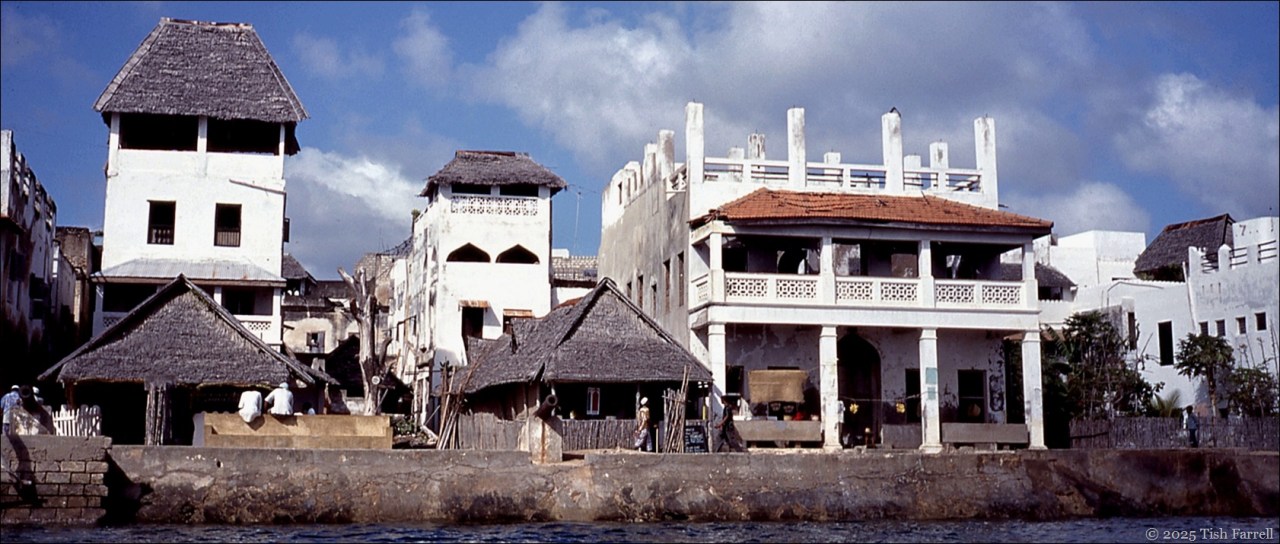
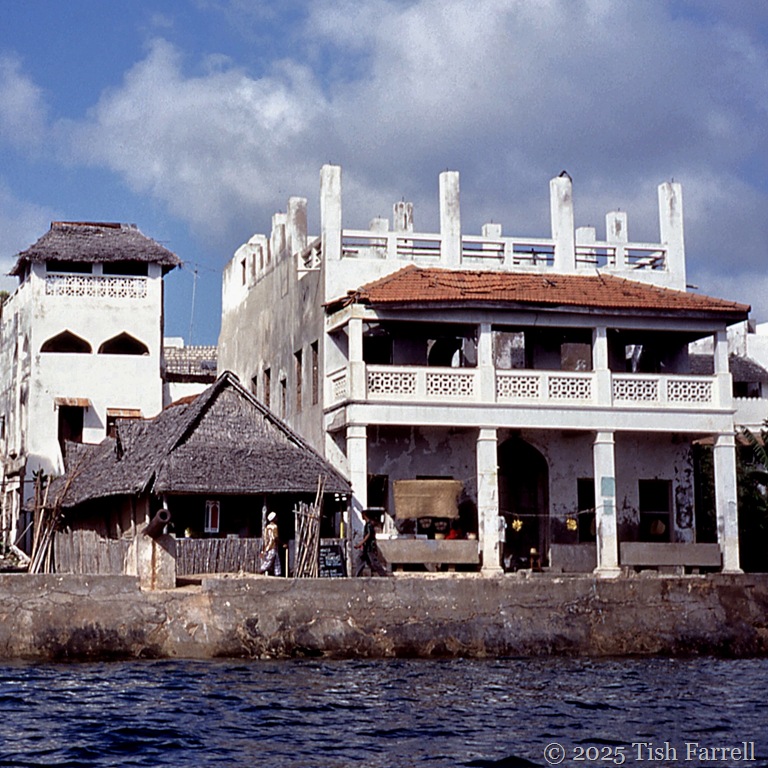
Long ago when we lived in Kenya, we spent one Christmas on the Indian Ocean island of Lamu – a never-to-be forgotten, all too brief safari. We stayed in the roof-top quarters of an ancient merchant’s house in Shela Village, a thatched eyrie that, being open on three sides, allowed to us eavesdrop on all our neighbours. It was breezy too, the natural air conditioning more than welcome in December’s steamy heat.
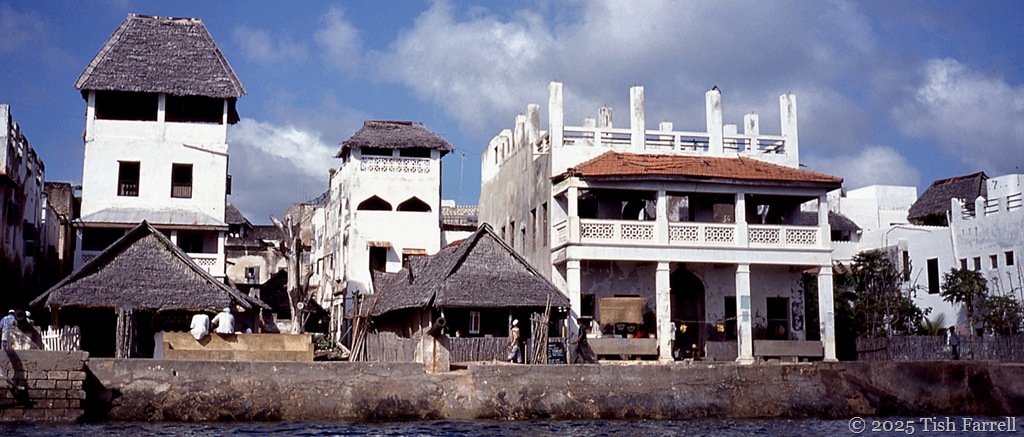
Our first view of Stone Town, Lamu’s main settlement, was on Boxing Day when we were taken on a dhow trip out to the reef. It was a good introduction, sailing along the entire quay, hints of Sinbad magic.
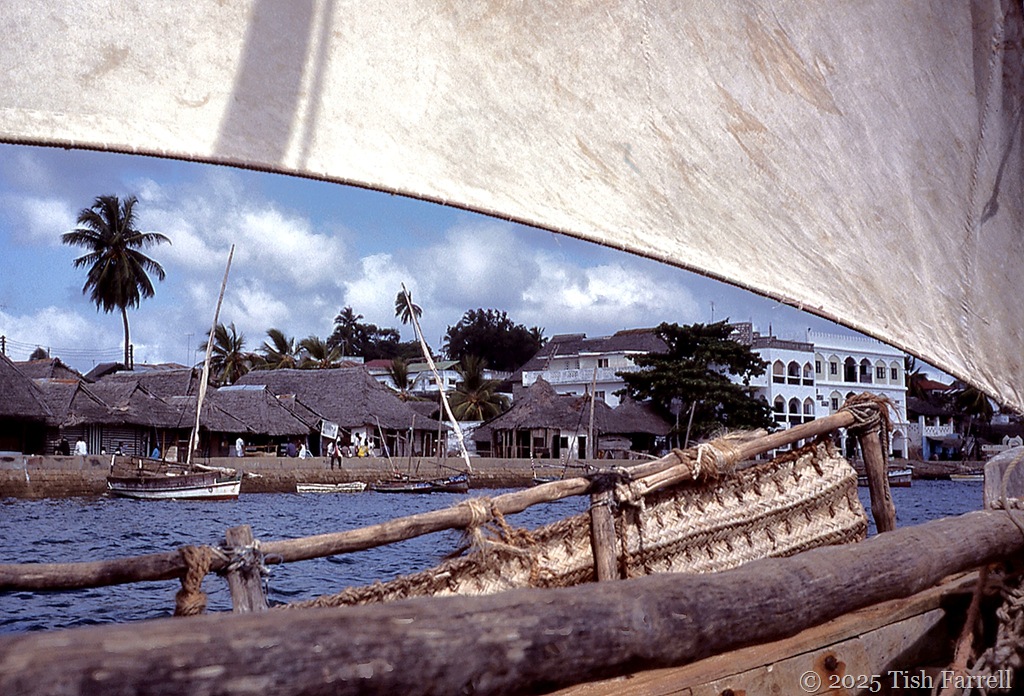
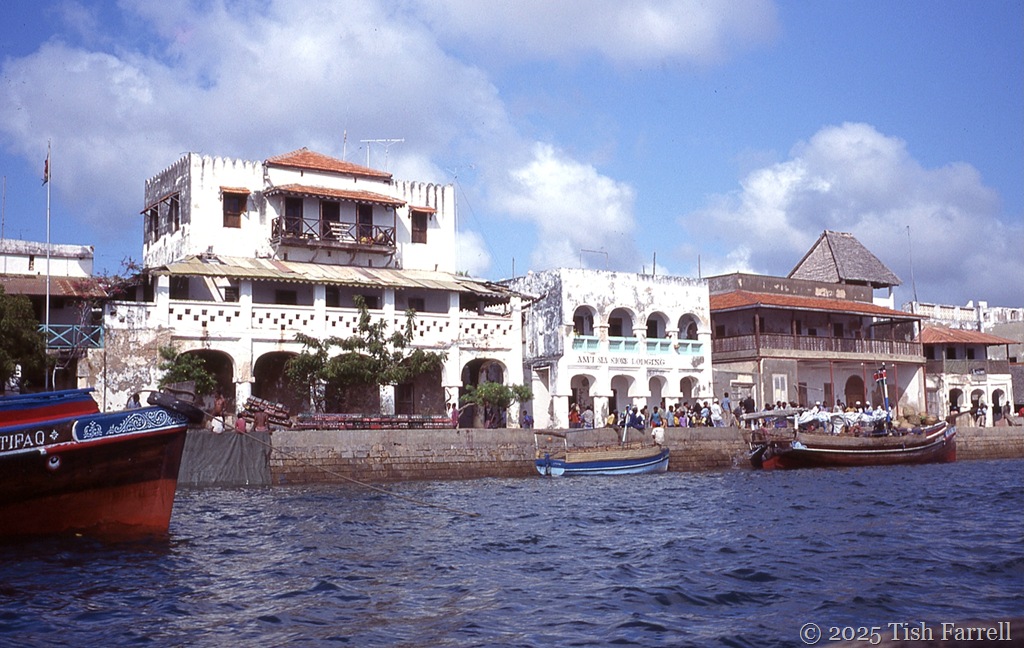
Lamu’s Stone Town is one of the best preserved Swahili towns on the East African coast, lived in for over 700 years. It is not one of the earliest by any means, nor the finest, but it has its own particular history as a one-time city state, ruled by its own sultan. Its wealth back then was built on the seasonal dhow trade with Arab seafarers. Now its residents make their living from tourism, fishing, boat building and farming. It is also a place of pilgrimage. Lamu is devoutly Muslim, and each year holds a five-day Maulid festival, celebrating the birth of the prophet, Muhammad.
For more about the Swahili people here’s a segment from an earlier post:
“You could say that Swahili culture was born of the monsoon winds, from the human drive to trade and of prevailing weather. For two thousand years Arab merchants plied East Africa’s Indian Ocean shores, from Mogadishu (Somalia) to the mouth of the Limpopo River (Mozambique), arriving with the north easterly Kaskazi, departing on the south easterly Kusi. They came in great wooden cargo dhows, bringing dates, frankincense, wheat, dried fish, Persian chests, rugs, silks and jewels which they traded with Bantu farmers in exchange for the treasures of Africa: ivory, leopard skins, rhinoceros horn, ambergris, tortoise shell, mangrove poles and gold.
By 700 AD many Arab merchants were beginning to settle permanently on the East African seaboard, and the earliest mosques so far discovered date from around this time. These new colonists would have married the daughters of their Bantu trading hosts and doubtless used these new local connections to expand their trading opportunities. Soon the African farming settlements were expanding into cosmopolitan port towns. Itinerant merchants and their crews would also have had plenty of chances to get to know the local girls. The weather served this purpose too. Between August and November the trade winds fail. Voyaging captains would thus put in to a known safe haven to wait for good winds. And while this was not a time to be idle, since boats had to be beached and the crew put to cleaning and sealing the underwater timbers with a paste of beef fat and lime, three months was a long time to be ashore and far from home… continues HERE
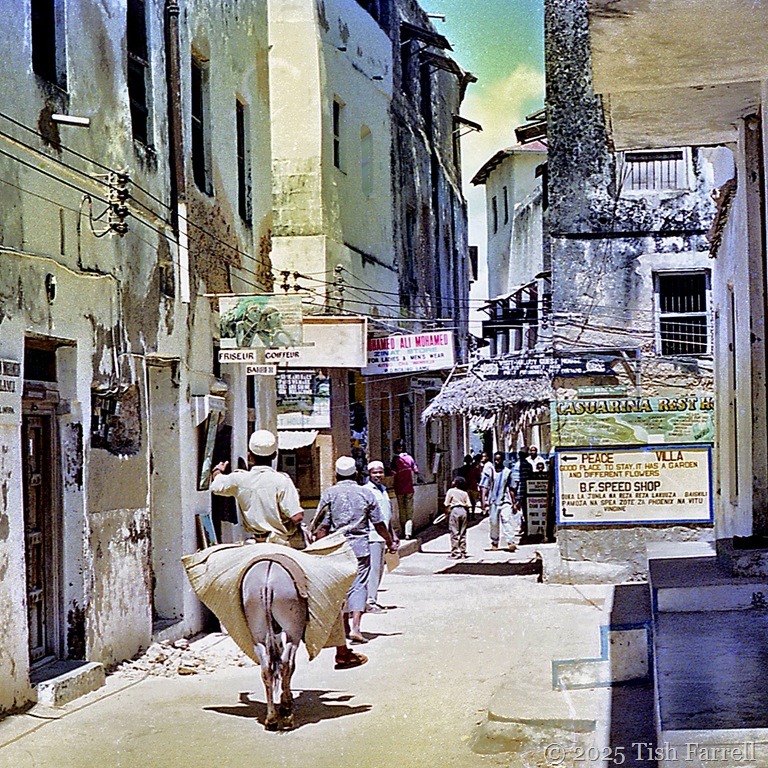
Main Street, Stone Town
*

Have you ever had the urge to go back and see what these places are like now? I’m so glad that the trade “… in exchange for the treasures of Africa: ivory, leopard skins, rhinoceros horn, ambergris, tortoise shell…” has (hopefully) stopped.
These days I do my travelling back on YouTube, Jude. In fact I’m rather heartened to see that things haven’t changed too much. Still no cars, and only donkey transport in the old town. A few motorcycles around. Some buildings a bit smarter too.
I also feel heartened things have not changed too dramatically
If cameras had been invented then, some of these shots could have been taken centuries ago, I guess.
what memories and what incredible opportunities you had – wonderful post. Off now to read more
Thanks, Becky.
This town is beautiful and old even at the time you photographed it. Thanks for sharing.
Thanks, Anne.
😊
Another wonderful part of the African saga, Tish.
I love that kind of architecture. There used to be a lot of places like that in New Orleans, much of which got washed away by Katrina. We even have a few places resembling it here on some of our bigger lakes and along the shore, but there’s nothing as lovely as your old pictures.
The old pics are taking on the looks of relics these days. But yes, very appealing architecture, a real fusion of Indian Ocean cultures with some Portuguese elements thrown in.
With such lovely results. I think that was true of the architecture in New Orleans as it represented the waves of people who came there to live. Of all the places in the U.S., it has a remarkable (and unique) population. No one imagined it would all wash away.
There’s some kind of parable there, Marilyn – the gathering waves of people: the washing away.
I’m pretty sure the world is over-populated. In my lifetime, the world’s population has more than doubled.
the stone colour extends even into the sails – all those neutrals set in aquamarine and it is the colour of your photos with the writings that emanate such nostalgia for these adventurous days
When it comes to our time in Kenya, it’s almost impossible to get oneself out of Out Of Africa mode. I almost think it comes with the territory, or it is how it is received with European eyes/sensibilities. Some sort of ‘kicked out of Eden’ syndrome (?) and possibly quite unbalanced. Tangible though. If I think of the bush, the red earth, the pungent sage smell of leleshwa bushes, I can feel it. Nostalgia is the nearest description, except one felt it in real time/i.e. back then at the time. So perhaps closer to the neoclassical compound origins ‘homecoming’ and ‘pain’. Nostos and algos. Just found that explanation on Wikipedia! Thanks for sparking that little thought safari, Laura.
this is the kind of travel writing that I love about your out of Africa posts Tish
Thank you very much, Laura.
How fascinating! We once spent a few days in Zanzibar’s Stone Town and I can see lots of similarities in the style of buildings, coastal setting and that main street. You’ve revived some vivid memories for me!
Yes, very similar to Zanzibar, Sarah, though the Lamu houses are perhaps rather plainer.
Wonderful insight into life there – love the architecture.
Many thanks, Flavia.
wow.. magical classic sights .. Lamu is one of the best coastal towns in Africa ..