
*
I rather miss having the Iron Bridge on our doorstep. It’s now a good hour’s drive across the county from our house in Bishop’s Castle. We used to like wandering along the Wharfage beyond the bridge, gazing up at the hanging woodland along Benthall Edge. It’s a great place for promenading, or at least it is when the River Severn is safely in its bed.
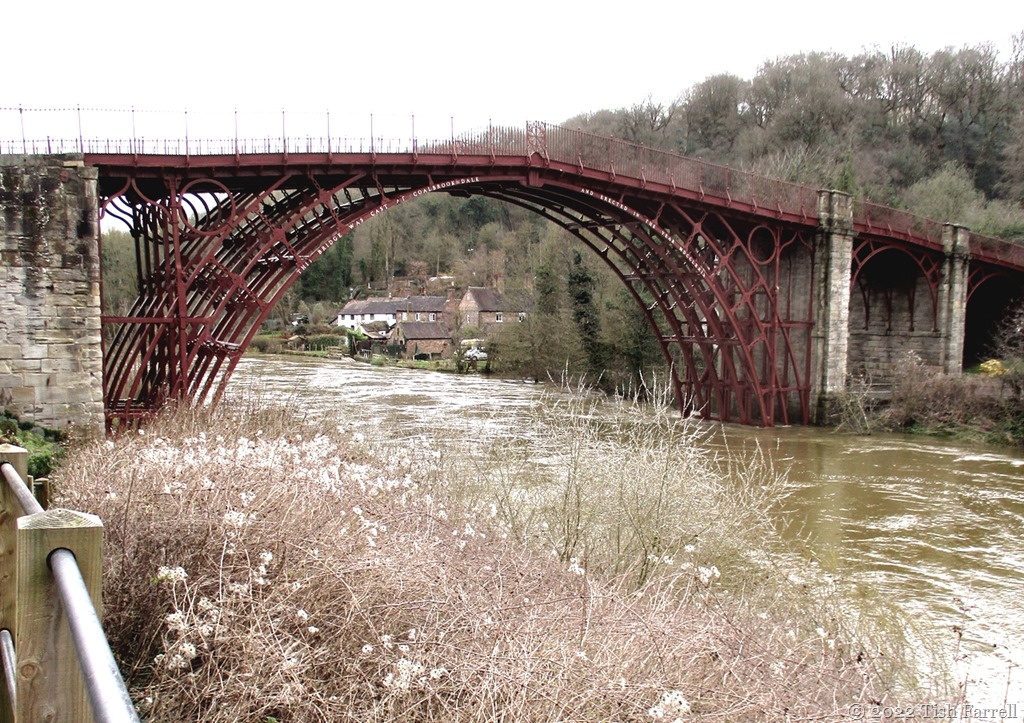
River Severn on the rise
*
The Iron Bridge, though, has withstood the most tremendous deluges, including the great flood of 1795 that took out most of the old stone bridges from Shrewsbury to Worcester. It was a show of resilience that proved to anyone who had doubted the capacities of large cast iron structures, that its builder, Abraham Darby III, had been right all along: cast iron was the material of choice for the industrial age.
Nor did its adoption take long. Soon it would be used to build the frames of factories; seen as a boon for the owners of textile mills whose combustible raw materials made them prone to ruinous conflagration. The several-storeyed iron-framed buildings that ensued were forerunners for the skyscrapers of the modern age.
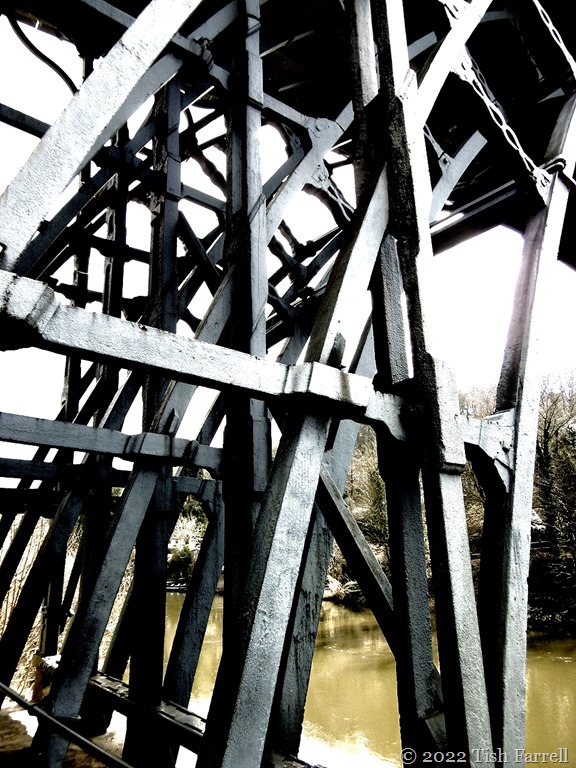
On closer inspection, though, Abraham Darby’s ‘world wonder’ innovation came with more than a hint of sticking to the tried and trusted. After all, the man was an ironmaster, from a dynasty of ironmasters, and thus a pragmatist, and while the use of cast iron for so big a project was breaking new ground, the hundred foot span was achieved by the jointing of over 1,700 castings, some weighing over 5 tons, and using centuries’ old woodworking techniques of dovetail, mortise and tenon joints.
Besides, there was something else he was wanting to prove: that a bridge with a single arch could be made to span a waterway, busy with large sailing barges. To achieve this meant another significant breakthrough: the Severn trows could pass beneath without the nuisance of lowering their masts. It was all good for publicity.
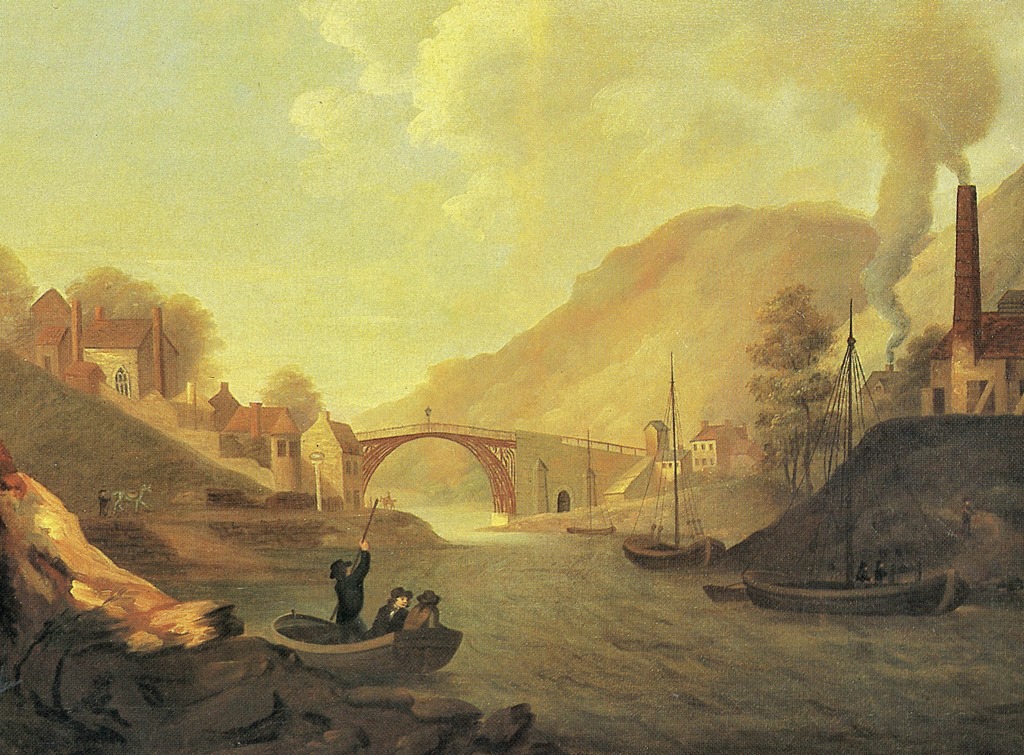
‘The Cast Iron Bridge near Coalbrookdale’ by William Williams 1780
*
The bridge and the foundries, furnaces and forges of Coalbrookdale became the tourist venue of the age. Engineers, ironmasters, industrial spies and scores of artists flocked to wonder at what many likened to a vision of hell. The William Williams image above was painted a year before the official opening of the bridge to the general public. You can see three trows moored along the right hand river bank.
*

And of course, as a World Heritage site, the Iron Bridge is still a huge tourist attraction, seen here spanning a quiet and sluggish summer river.

It certainly was a monster in its day.
It certainly astonished folks.
wow!
Marvellous to see again this iconic symbol of the Industrial Revolution.
It always bears a repeat visit – virtually or in person 🙂
Good post!
Many thanks.
it is such an incredible bridge – although think I prefer it now to its heyday. Must have been so noisy then
Oh yes, back then would’ve been incredibly clanging and smutty. The valley must have rocked to the banging of the steam hammers.
Take solace in the fact that although you are far from the iron bridge you can now visit things in and around Bishop’s Castle, Like:
The Three Tuns Brewery
Lydham Friday Market
Poetry Pharmacy
Bishop’s Castle Arts Festival
Oh yes, Thom – thank you for summoning all those favourite places, which are indeed on my doorstep, or almost, And then there’s that ‘iron’ elephant up the hill (a similar shade indeed to the bridge). And then the hill views…so much to be glad about 🙂
I neglected to mention the elephant. I read your post about him, just the other day. Bridges are interesting and even helpful when you need to cross the river but, IMO elephants and poetry are much more entertaining.
I’ll go with the elephants and the poetry too.
What a glory, Tish.
The Williams painting is also marvelous: the bridge, the church, the belching factory chimney and men in boats not afraid of having built structures so much larger than themselves not for worship or for remembrance but to aid and abet the living of ordinary lives. England in short, I suppose, Tish, in one painting. What a glory!
I only ever saw it once, Tish. It must have been nice to have it part of your wanderings.
It was, Jo. Still, many new wanderings ahead.
What an architectural wonder.
It’a certainly unique 🙂
Walking along the canals or streams in England, there’s always something to gleam. That iron bridge is no exception.
Thanks, Suzanne. You’re right. We have some fascinating waterways 🙂
Many we enjoyed walking along. Good memories.
What a beautiful and resilient bridge Tish. It also has a wonderful history.
It does have a very big history, Anne. Another part of the story is that it replaced a very dangerous ferry crossing. Many of the Coalbrookdale workers came from across the river in Broseley, so the bridge would have made a huge difference to them.
😊
I Can’t decide which i prefer, Ironbridge or Bishop’s Castle, i like them both.
I think that’s the best approach: and AND and 🙂
I like the sepia images you added.
Me too 🙂
The glory days when inventions and innovation were visible and tactile.
Yes, and you could tell whether they we really useful or not 🙂
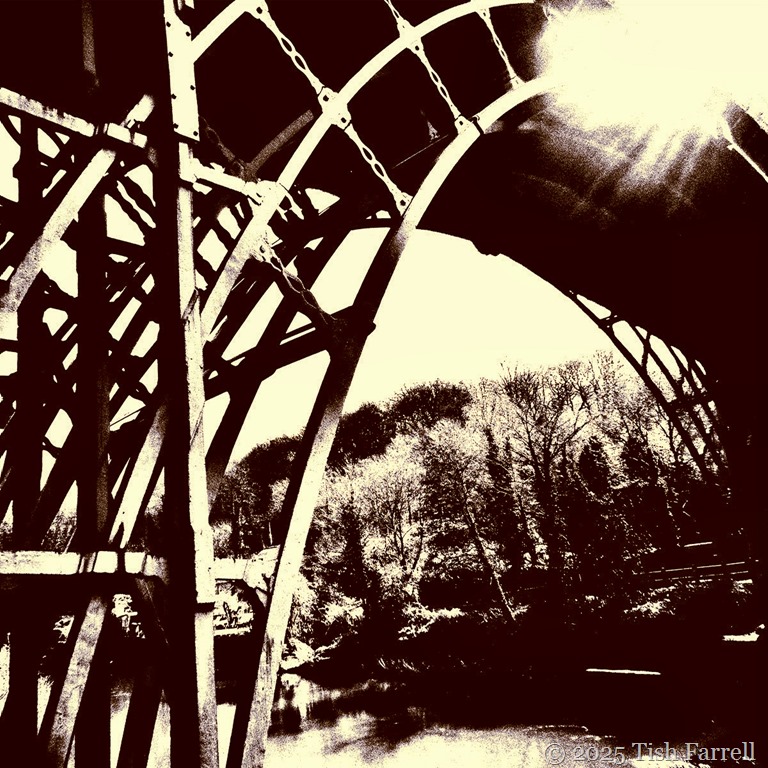
It’s years, no decades, since I saw the Iron Bridge! It certainly fits the bill for geometry and your sepia square has an interestingly abstract look 🙂 I never knew that it was put together using techniques taken directly from woodwork!
Once you start looking closely, it’s an increasingly extraordinary structure.
This is a great history/story of the World first cast iron bridge. And how nice it took place in this square-geometry challenge. Your photographs so impressive. I loved them. And also the painting in 1780 so beautiful. There is not so much change between past and present time. The nature is still there, and the bridge too and also I can’t see concrete hills around the river… I am really impressed. I can’t put any painting(even any photograph) from the past about my country that you can find in present time too. Thank you, Love, nia
Thank you for that lovely comment, Nia. It is extraordinary that this valley, where so much of the technology that fuelled the industrial revolution took place, is still such a picturesque place, and the landscape so little changed.
The iron bridge is very nostalgic I think. Well shared
Thanks, Priti.
A Grand Old Dame from a more civilised era. 😀
I spent my career as a bridge inspection engineer and in 1999 I traveled from the USA (Montana) to visit Iron Bridge. An experience that I’ve never forgotten. Thank you for this article that brought back such a wonderful memory .
My pleaseure, Dan.
Yes, an incredible bridge and place. That roaring Severn looks dangerous though!
It certainly can be dangerous when in spate, Georgina.
Gorgeous bridge and great photos of it.
Thank you, Melodie.