
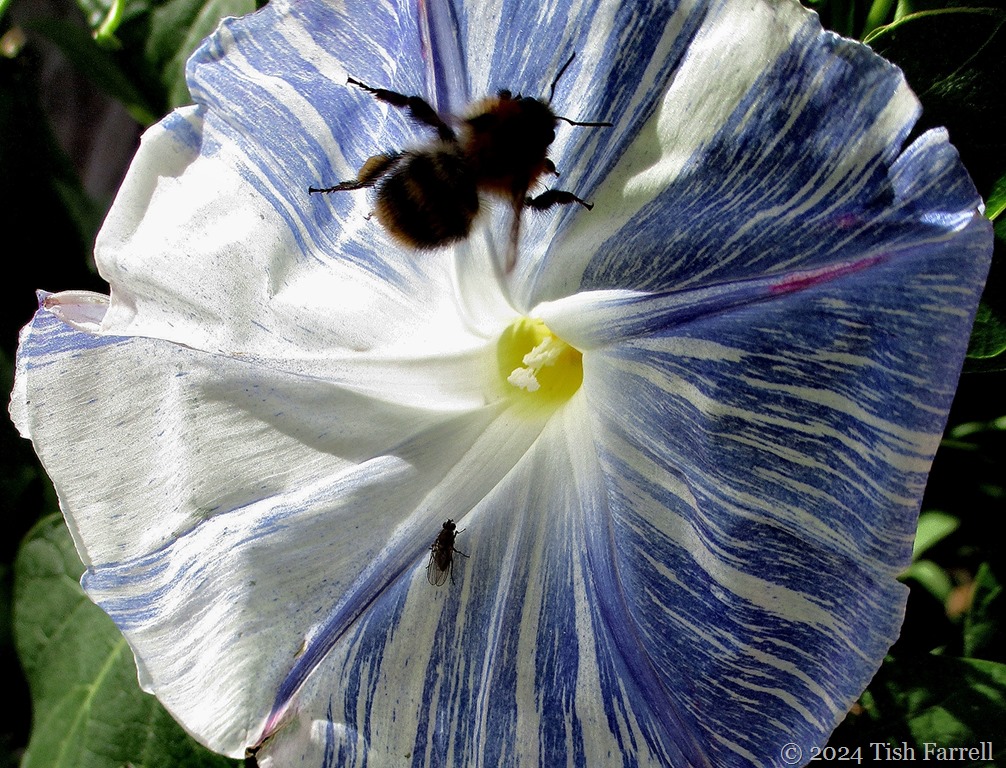

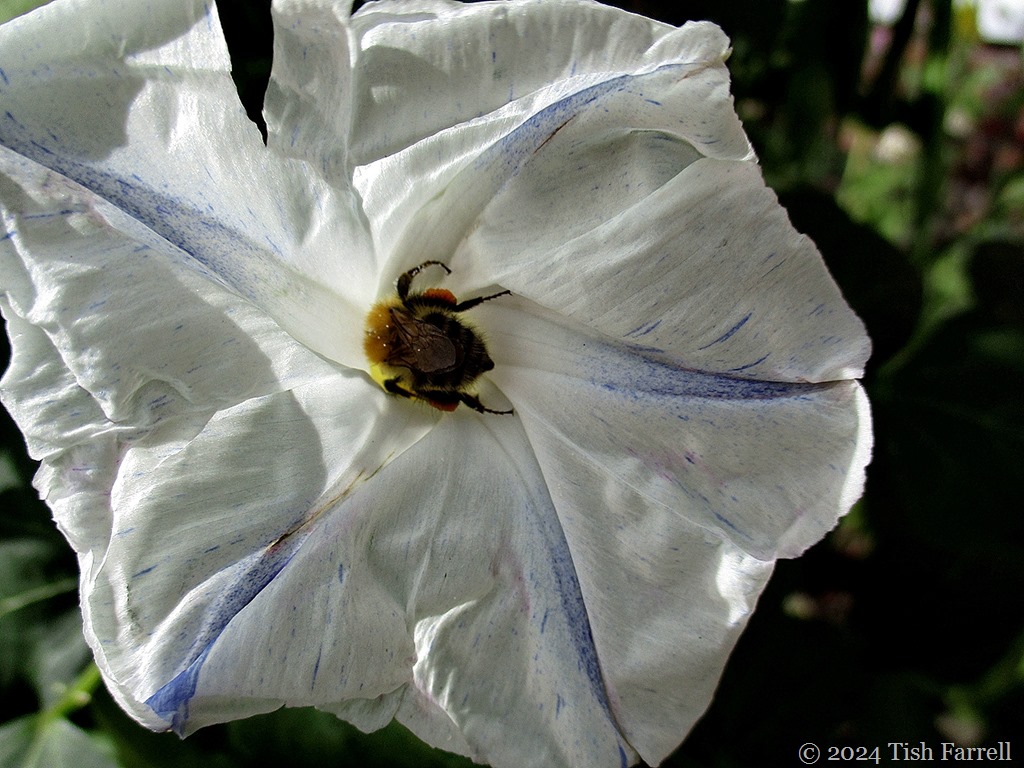
And no, we have no extra-terrestrial sightings here in Bishop’s Castle, at least not over The Gables, but I do have a few Flying Saucer Morning Glories. They are late on parade, growing up my obelisk of butter beans in the front garden. I wasn’t really expecting them: the seed was several years old. Yet here they are, busy luring insectkind.
*
Also in the front garden, in the opposite bed, the phacelia has been flourishing for the past few weeks, every day alive with bee hum.

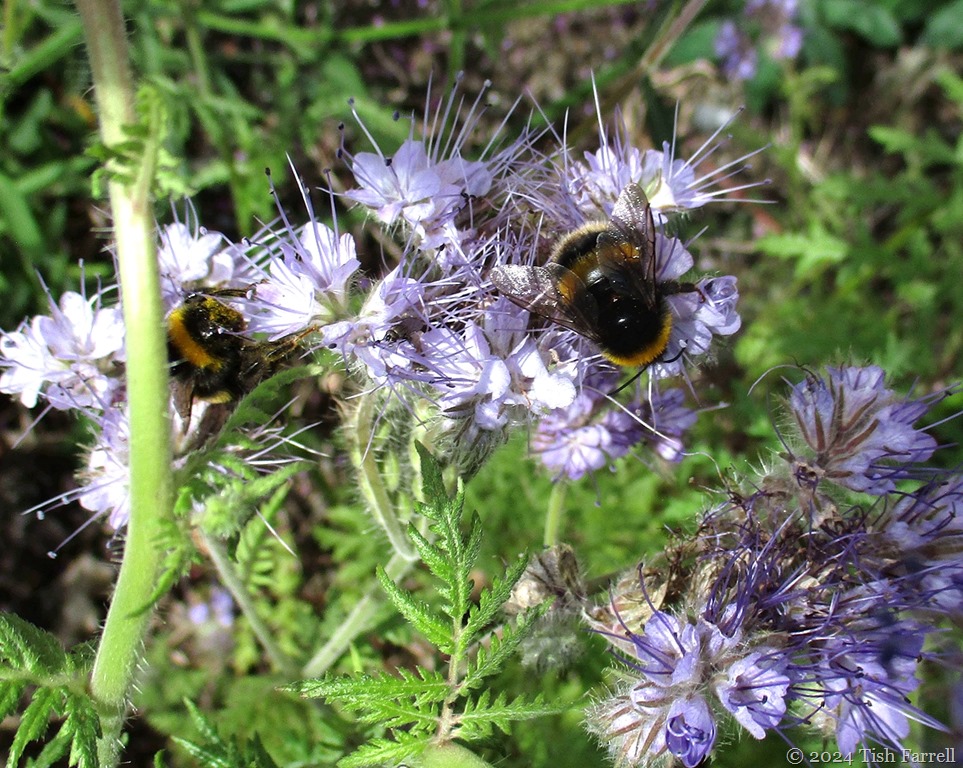
This borage family member hails from North and Central America where it also goes by the name of Scorpionweed, which sounds hair-raising. So far there has been no sign of cohabiting scorpions (no doubt a huge comfort to other half who was bitten on the foot by one while overlanding in the Sahara.)
I sowed the seeds quite late, probably around the beginning of July. As with the Flying Saucers, I was prepared for them not to germinate. The packet was left over from Wenlock allotment days. I grew it back then either as green manure or a cover crop. But then on a trip out in late June I’d spotted fields of it around Ludlow. I’d never seen it growing on an agricultural scale before. It was in full bloom and the fields seem to float in a mauve haze. More than a good enough reason to try it.
These days there is much farmer emphasis on improving soils and attracting insects on land taken out of food production (food security no longer seems to be a priority in government policy for British agriculture). Hairy crops like phacelia, vetch, linseed have been found to improve worm populations, this even in light and sandy soils.
I decided to try it on the ground where we had lifted paving slabs and left behind a layer of old mortar which had mostly been broken up into the soil. It looked very unpromising territory, and I wanted to see if anything would grow there. And it did. The seeds sprouted in a few days.
Usually if you’re growing phacelia to provide green manure, it should be dug in before it flowers to stop self seeding. But I thought never mind about that. The flowers are so pretty, their scent so subtle and, while they last, their kindness to insects immeasurable. The first frost will doubtless fell the plants, and I’ll probably leave them to dig in before spring.
*
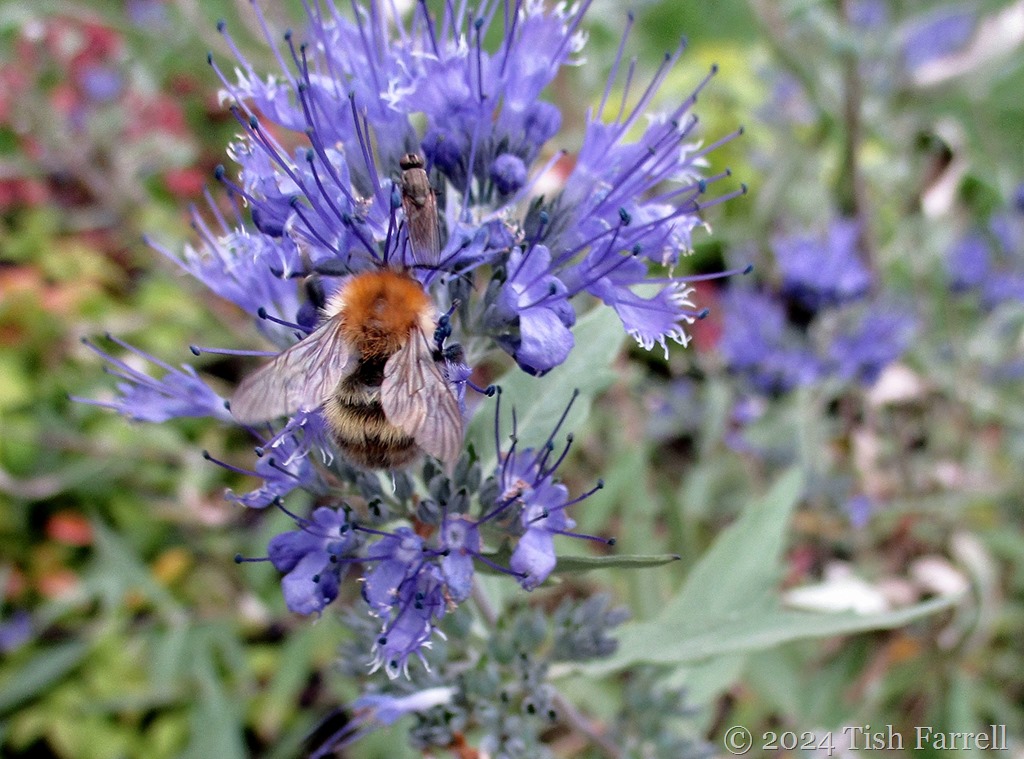
And here’s another insect friendly plant, doing its end of season feeding duty while looking lovely too: Caryopteris ‘Heavenly Blue’, a fairly compact hardy shrub bought back in the spring. It clearly loves our garden and has opened its branches so generously. The flowers are scented too, and it’s taken over catering duties from the neighbouring purple agastache, which is now a mass of dusky seed heads and no longer of interest to the bees.
Much of the rest of garden has a look of late-summer weariness. We had a couple of real summer days earlier this week, but there’s a real sense of autumn in the offing. My runner beans simply stopped producing at the end of August, for no reason that I can fathom. Although I did notice yesterday that a single plant has decided to grow a couple of strands worth. Perhaps one last small meal then.
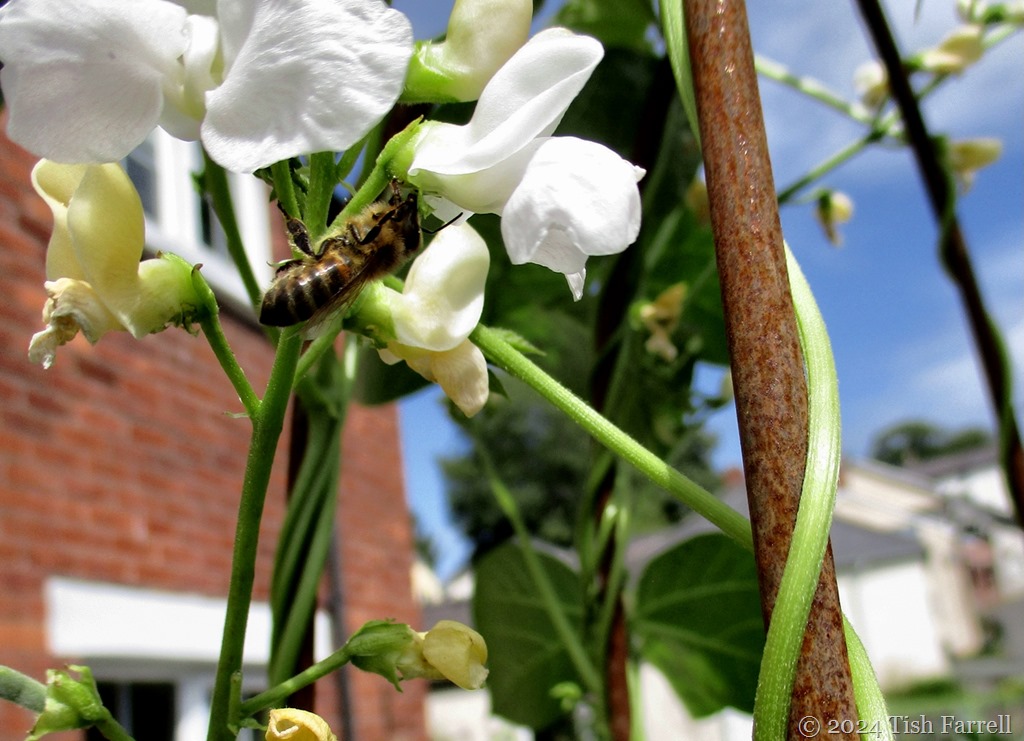
Meanwhile, the Flying Saucers’ hosts, the butter beans are still flowering like mad up the front garden obelisk. There are many pods but they are being very slow to fatten, doubtless down to the lacklustre summer and cold-spring start. I’m now hoping for an amiable October that might give the beans the chance to finish off. And for now, the blossom is still performing essential services.
*
The good news, though, is that the horrendous brassica gobbling has ceased, this after the cabbage white caterpillars ate every kale plant down to the stalks. It did not matter that I’d covered crops with so-called butterfly netting and fine grade enviromesh. Somehow the butterflies sneaked in to lay their eggs. Patrolling the plants even twice a day proved a losing battle. They made inroads in the pointy cabbages too, but I’ve managed to save some of those.
Ever hopeful, I’ve replanted Russian and Tuscan kale plantlets under extra-fine mesh. The butterflies are still about, but not in the flocks we experienced earlier in the summer. Fingers crossed.
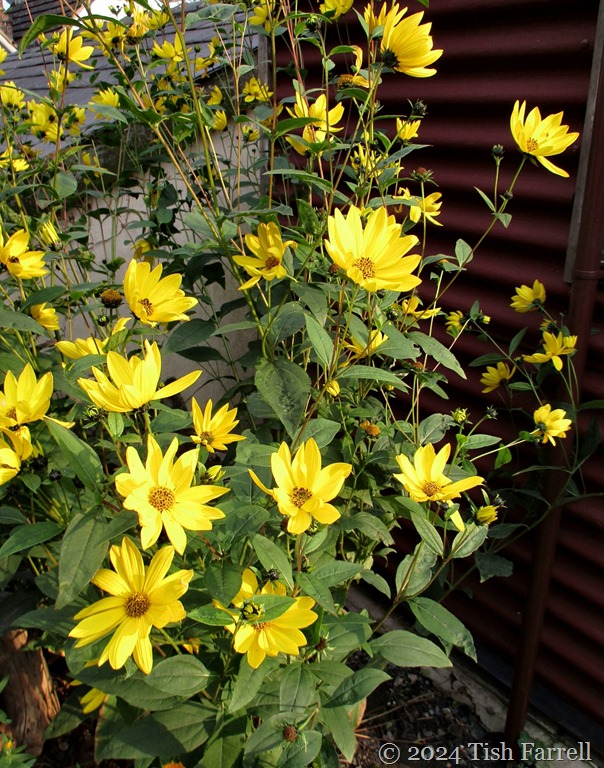
There are other bright corners in the garden, and especially this towering clump of helianthus, a perennial sunflower. Back in the spring when I planted it out, it was three single small stems with only a few roots between them. The cuttings came from my sister’s Little Stretton garden, descendants from plants that grew in our Aunt Miriam’s Devon garden. I’m so pleased to have it. I did not have a chance to grab a segment or two of my Wenlock helianthus before we moved. It used to be the star of the late summer guerrilla garden there. It’s growing even more vigorously in Bishop’s Castle.
And last but not least, but definitely with an eye to autumn in its new russet foliage, this is a newcomer to the Farrell garden, Japanese cherry kojo-no-mai. (Posing here with some very sweet violas).
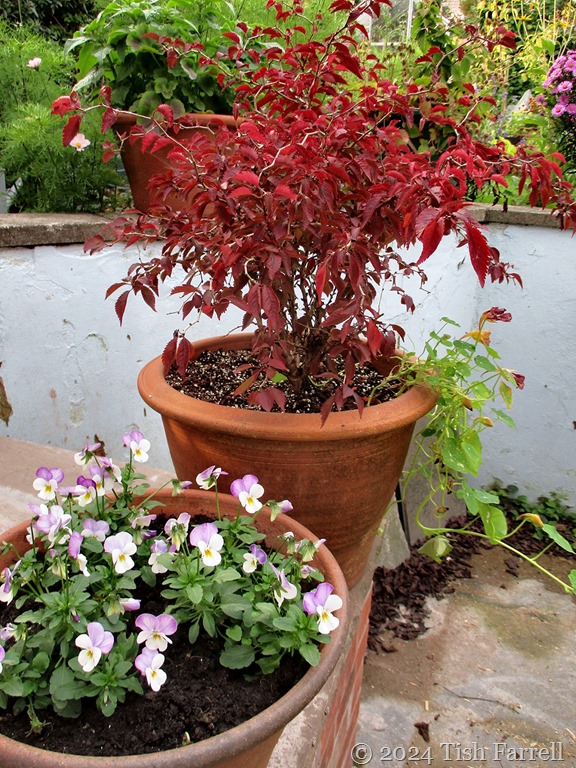
It will eventually grow into a small tree, but for now seems happy in this pot.
*
Six on Saturday Please visit Jim at Garden Ruminations. He needs some get-well wishes.

Beautiful pictures 🌹🌹
Many thanks, Satyam.
Welcome dear friend 🌹🌹
The morning glory is stunning and the phacelia can still improve soil even if you don’t use it as one might in an agricultural field. If you let the dead plant material stay there, or at least go to your compost pile, it will work its magic. I used to use buckwheat as a cover crop and now just let it self seed where it will. If in my way, I cult it down and chop it up where it was, otherwise it blooms and is loved especially by flower flies.
Yes, I plan to leave the phacelia to just die down where it is as the soil definitely needs improving, it being so full of building debris. Thanks for your comment.
Well, the bees seem enormously happy with your services, and it’s a treat for human eyes too.
Happy bees and happy humans – can’t ask for more. Hmmmm 🙂
Hummmmmmm. Bzzzzzzzz.
The plant and insect kingdom at your place seem to be in order..As to the scorpion bite..oh they hurt.I don’t have them here but we did when living in Texas..beware!
Hopefully the UK is too chilly to entice scorpions.
We have hardly seen a bee this year so this was a treat. Good luck with keeping them happy!
Certainly fewer bees than usual, especially earlier in the year. Will try to keep them happy for as long as possible 🙂
wonderful garden!
I will tell it you said so. Many thanks, Thom.
Your garden is beautiful Tish!
Thanks, Anne. It does have some pleasing spots. Need to think about some over all planning of the planting over the autumn. It’s been v. random this year. Plus random weather.
We bow to Mother Nature!
How lovely to see so many bees enjoying those flowers 🙂 And I love that Japanese cherry!
The cherry is lovely in early spring too.
Phacelia is definitely a bee magnet. I used it to fill a bare patch last year, oddly it hasn’t self seeded. Your garden is coming on well Tish. Plenty of evidence of your green thumbs.
Thanks, Jude.
Good to see plentiful bees…
Always a pleasing sight, Sue.