
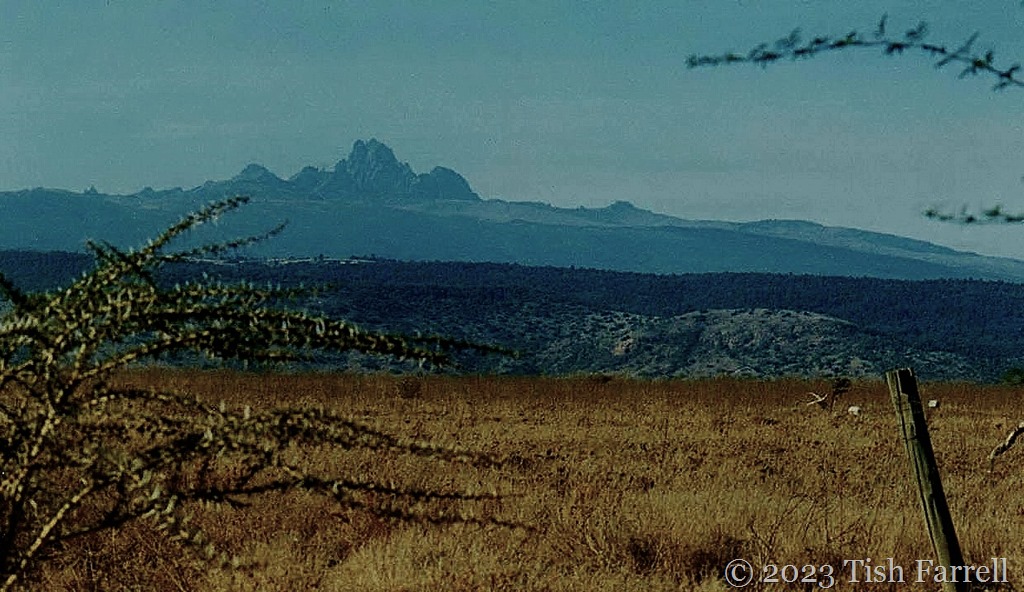
…this is one of his domains – the craggy summit of Kere-Nyaga, Mountain of Brightness, better known outside East Africa as Mount Kenya.
And the supreme being concerned is Ngai, maker of earth, the cosmos and everything. And it was to Ngai that the Kikuyu farmers of Mount Kenya’s southerly foothills once offered their sacrifices and prayers. Although they only did this in times of great crisis, since it was generally held that Creator was a remote figure, little concerned with human affairs. When his help was sought, he was addressed as Mwene-Nyaga, possessor of brightness (Jomo Kenyatta, Facing Mount Kenya 1938). Nyaga also has figurative connotations, meaning ostrich, but in this context suggestive of the white plumes of the male ostrich, a visual analogy for the glaciated zones among the dark mountain peaks.
You’ll see the thinking in this next photo:
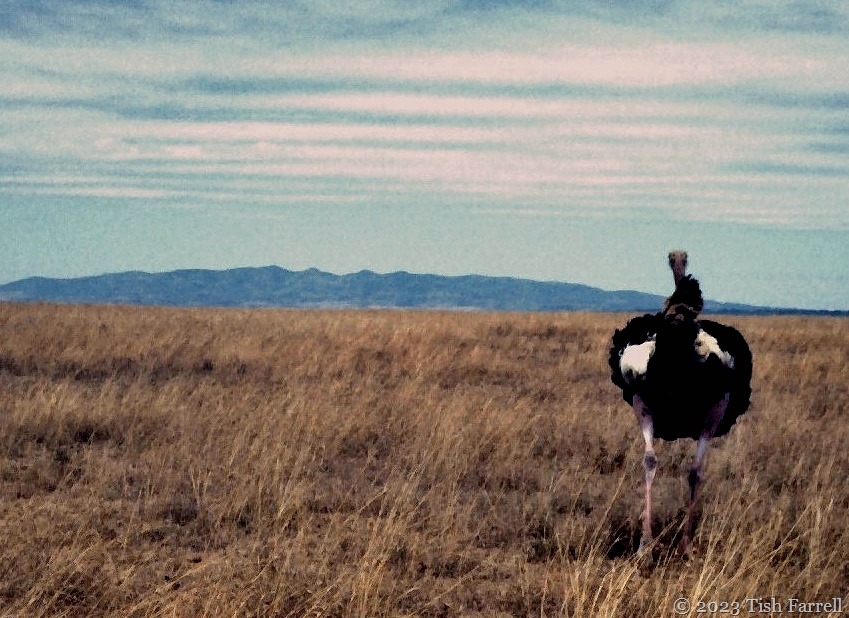
This shot of a retreating male ostrich also captures a distant view of the Ngong Hills, another landmark of spiritual significance, not least in recent times to Out of Africa writer Karen Blixen and her lover Denys Finch Hatton whose burial place it is. For that story see Caught inside a Kikuyu garden.
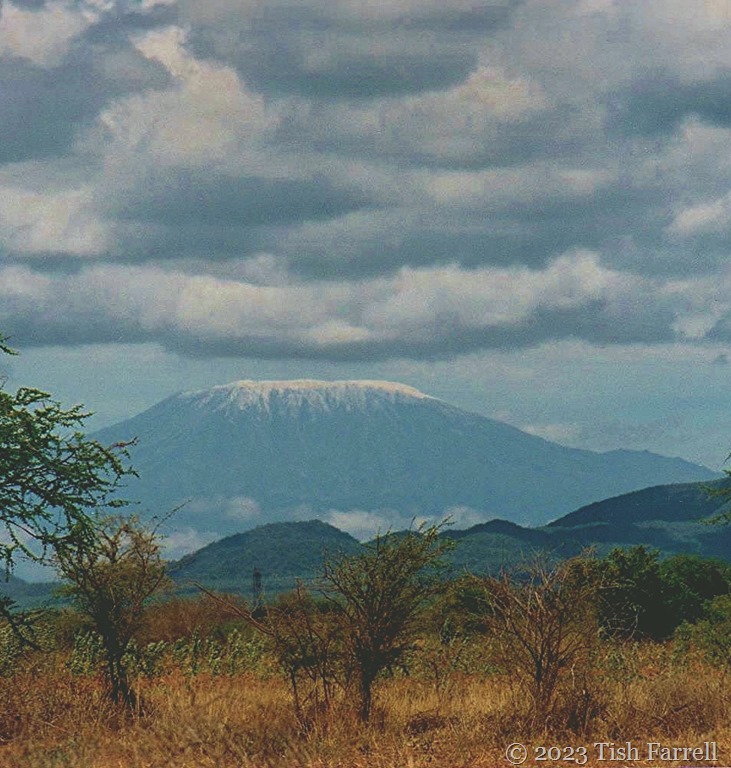
I’m sorry I don’t have more and better photos of Mount Kenya. The ones I do have are a little odd, as if the mountain meant to tease by showing off parts of itself at times and in places where it was not expected to be. I remember spotting it early one morning as I stood in the garden of the Outspan Hotel in Nyeri, the jagged summit floating gauzily above the horizon.
For several moments I was fixed to the spot. By the time I thought of taking a photograph it was gone – only empty sky in the place where it was, and a visceral sense of loss. Kilimanjaro just over the border in Tanzania, plays the same trick. Both mountains spend much of their time being mysteriously invisible. Yet there are travellers’ tales that claim occasions when, looking north and south, both mountains appeared simultaneously. Just imagine!
*
And now for the Mount Kenya photos I do have. The first one was taken from a small plane on our way to Lewa Downs:
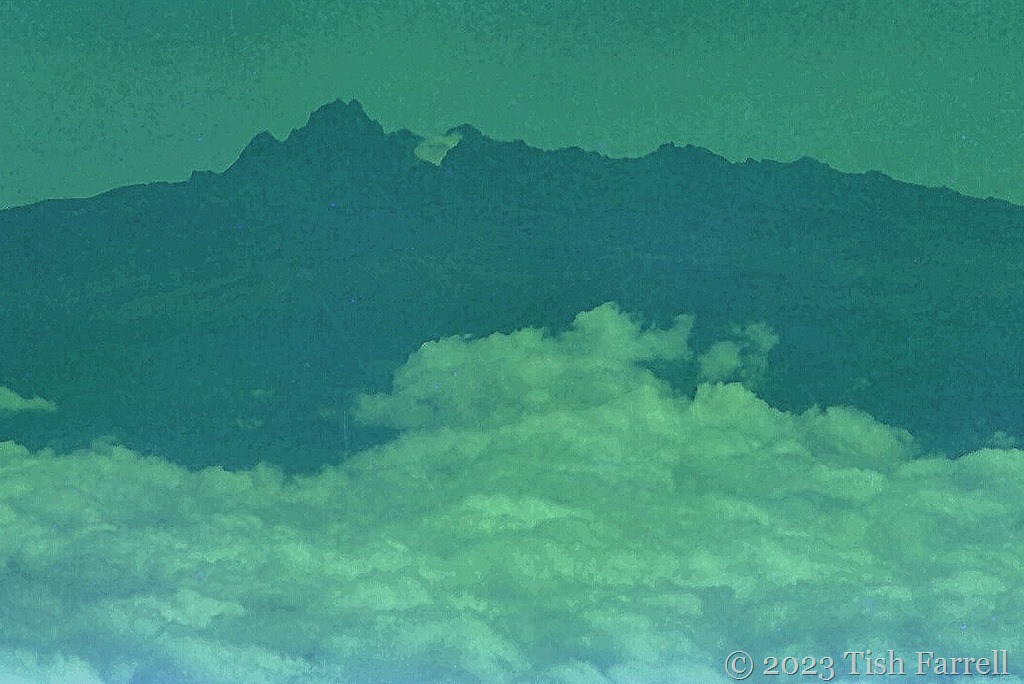

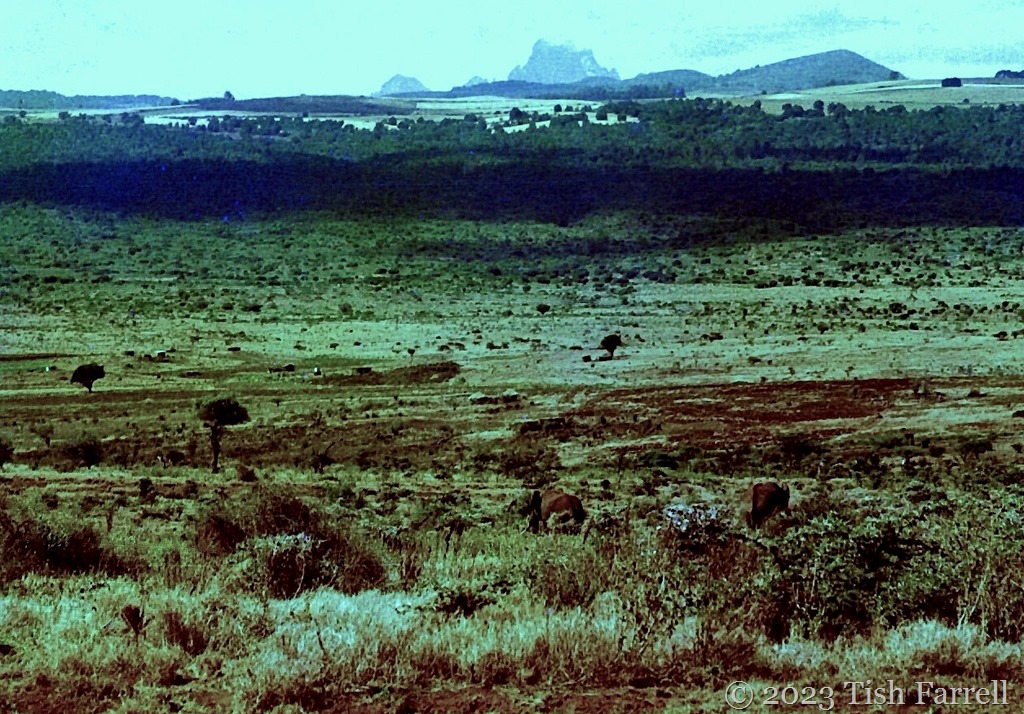
This photo was taken beside the Lewa Downs air strip. At the time, it was the two elephants, just visible in the foreground, that caught my eye. It was only when I was scanning the image that I noticed the odd geographical juxtaposition of Mount Kenya’s summit. What are its lofty peaks doing just there, and so sneakily? They are over 17,000 feet high.
*
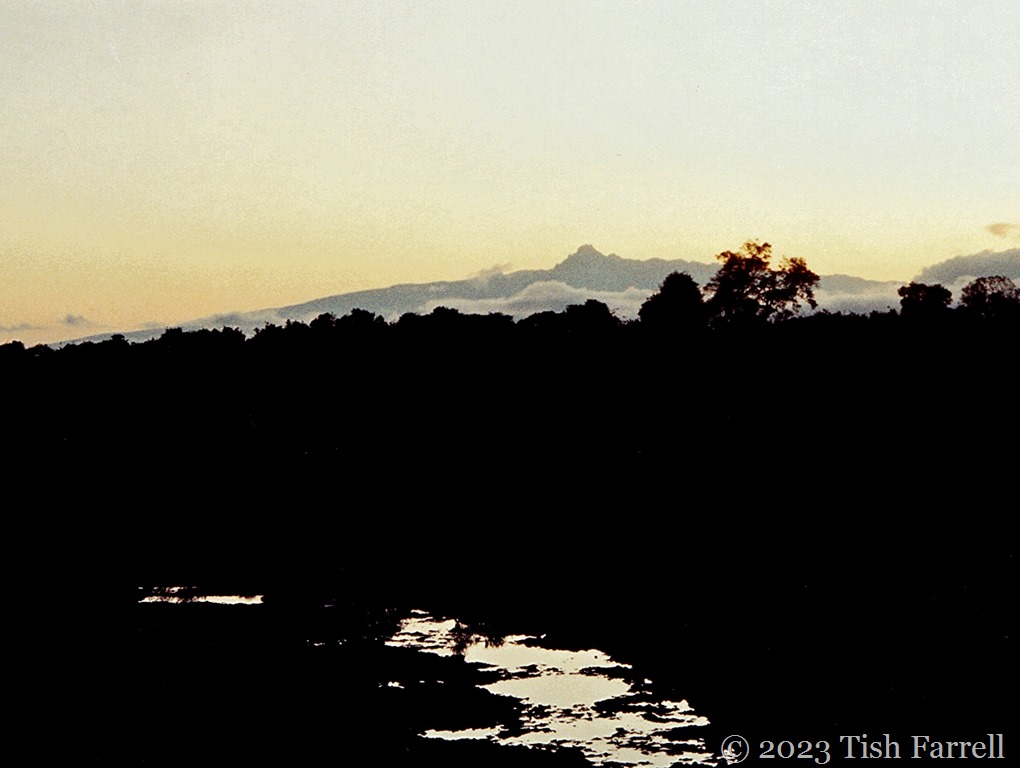
And finally a sunset view of Mount Kenya from the neighbouring Aberdares National Park. The Aberdare Range is also one of Creator’s dwelling places when he is checking out earthly doings. Its Kikuyu name is Nyandarua, which I believe means place of the crumpled hide – another interesting metaphor. Here’s an aerial view:

These vivid names for spiritual landscapes remind me that in traditional pre-literate societies, the natural world provided humans with unlimited scope for pondering, creating and observing. Its diverse parts were sources of inspiration and expression, things to think by, a resource for metaphor, analogy, riddles, song, dance and story telling as means for making sense of existence.
Particular mountains, trees, rocks, lakes, chosen as places to make sacrifices or pray to Creator, are gateways to congress with the divine, and so may be taken as sacred in the same way a church is sacred space for a Christian. More broadly, though, all land may be seen as sacred since it was made and given to humans by Creator.
And in this sense, then, there is no divide between spiritual and physical; all states exist in the same plane, which is interesting, if somewhat difficult for some of us to think about. We might call it respect. We might even call it love.
*
Lens-Artists: Spiritual Sites Tina sets this week’s fascinating theme. Please take a look at her inspriting post.

Beautiful Tish! Your narrative expresses how you feel about this site.
Many thanks, Anne.
A thought provoking and evocative post – words and images both.
Many thanks, Margaret.
A marvelous response Tish – your memories from your time there must be so cherished. I loved your descriptions of the mountains and their spiritual histories and meanings. Although your images were made with much earlier technology they stand the test of time and show us the world as you saw it then. Terrific.
I love that comment about the earlier technology. It was very trying at times too !
Tantalisingly mysterious images and above all a thought provoking narrative, Tish
Glad this hit the spot, Sue 🙂
Always fascinating to read how places leave their mark on peope
Tonight we were stargazing with friends and looking out at infinity, Tish. So much to understand in our universe whether we look backwards or forwards. I love your Out of Africa experiences ❤️
Lovely to conjure you star-gazing, Jo. And yes, so little that most of us understand about our universe.
🤗🌙💙
what an amazing and powerful place
Another back-in-Africa post. I love them and this one did not disappoint. I think it’s shame that too many Christians take God’s giving them/us the earth as permission to use it up rather than as being in charge and taking care of it so that it will take care of us.
Thanks, Janet. You make a very good point 🙂
Out of Africa….one of my faves when it come to movies. I could relate to it in several ways.
Oh this beautiful continent! Part of my blood, my bones and my soul.
You so echo my feelings, Dries. Sending you a hug to go with the earth-love.
What a beautiful post and really shows a love for the land there. I love the creation story too and the ostrich being more like the mountain than just ‘putting head in sand’!
Many thanks. Your ostrich comment made me smile 🙂
Inspirational, indeed
Cheers, Thom.
You’ve captured the traditional beliefs and respect for the natural world so well in this post, and I loved your thought-provoking conclusions. Meanwhile your photos are a reminder of much that I love about Africa and those wide open spaces. I especially like the one with the zebras in the foreground!
Happy to provide good Africa reminders, Sarah.
Beautiful!
I feel like you summed up the week with your photos and your thoughts, Tish. I think Tina did an outstanding job at encouraging us to look as you did. At every hill, mountain, water, we an find a place to ponder and be grateful for what we see…and feel.
Much appreciate that lovely comment, Donna.
like a ghost tree, in a way. Great pictures and very interesting ones, too.
Lovely captures!
Love the sunset view of Mount Kenya
Thank you.
You are welcome, my friend.
You capture more than beauty in your photos!
That is one very lovely comment, Jennie. Thank you.
You are most welcome, Tish!
“generally held that Creator was a remote figure, little concerned with human affairs” – a feeling many of us have but also after Tolkien and Lewis there is some return to such spiritual evocations even in these less exotic plains than Kenya. Your photos always conjure such nostalgia for time and place not least because of those days when perfection was less important than the moment. That Nyeri view has been developed on your ocular lens and has such clarity for just that!
That’s a v. interesting thought re. Tolkein and Lewis’s creator figures, Laura. The African notion of creator remoteness, I think, possibly relates to the fact that the living of life, as a clan member with a designated social position, is rigorously laid down according to ancestral laws, duties and obligations as mediated by the elders. This takes up the main field of sacred obervations – the rites of passage. Creator has bigger business to attend to.
whereas some here bother the creator for a parking place!
Ha!
Very interesting thoughts
Thanks, Pete.
Reblogged this on Hutts Ultra Blogging World.
Lovely photos!
They remind me of the wonderful tale “No picnic on Mount Kenya” about a band of Italian POWs who escaped from their camp during WWII to climb the mountain and then returned, having accomplished their project.
That is one brilliant little book. A real-life adventure! Thanks for mentioning it.
Oh what a beautiful post Tish, not just the stories about Mt Kenya and the Kikuyu, but also the whole idea that all is sacred, all is love.
Alison
Many thanks, Alison.
Tish, these are shots I would never have seen if you hadn’t shared them. These mountains look rugged and at that height, they would be. This sentence conjures up a vision of what it must have been like seeing all these natural wonders without any research having been done. “These vivid names for spiritual landscapes remind me that in traditional pre-literate societies, the natural world provided humans with unlimited scope for pondering, creating and observing.” With data available at our fingertips, we don’t have to ponder much. I’m glad they did and built a platform of thought we could learn from.
What a lovely comment, Marsha. Thank you. And thank you for that v. insightful final observation: ‘With data available at our fingertips, we don’t have to ponder much. I’m glad they did and built a platform of thought we could learn from.’
Can you imagine having nothing to build on? I can’t. This is a good age in which to live, I think. In spite of all the problems.
Oh my goodness. Such different landscapes. I love your title and your expressive narration. I am transported, as always.
Many thanks, Ju-Lyn.
Wapicha wazuri Memsahib. I particularly like the zebras, moving away a bit then turning back to look in pure curiosity at the strange wazungu.
And I do sympathize with elusiveness of those sacred mountains.
Not sure I have any decent shot of Mount Kenya, and as for the “Kili”, it looks different every time.
Thanks for the mention of Kere-Nyaga. No I know where the word KE(re)NYA(ga) comes from. Strange how Europeans never seemed to understand the local names, isn’t it?
Kwaheri sassa.
It’s good when we can do a spot of retro-safaring, isn’t it. As to Europeans and local names, it seems to me to be a case of (almost) unconscious bias. They’d rather be the ones doing the naming 😉 Kwaheri, mzee.
Probably was. Just couldn’t care less I imagine.
🙏🏻