The Tale Of A Hidden House That Once Hid A King

100_9663

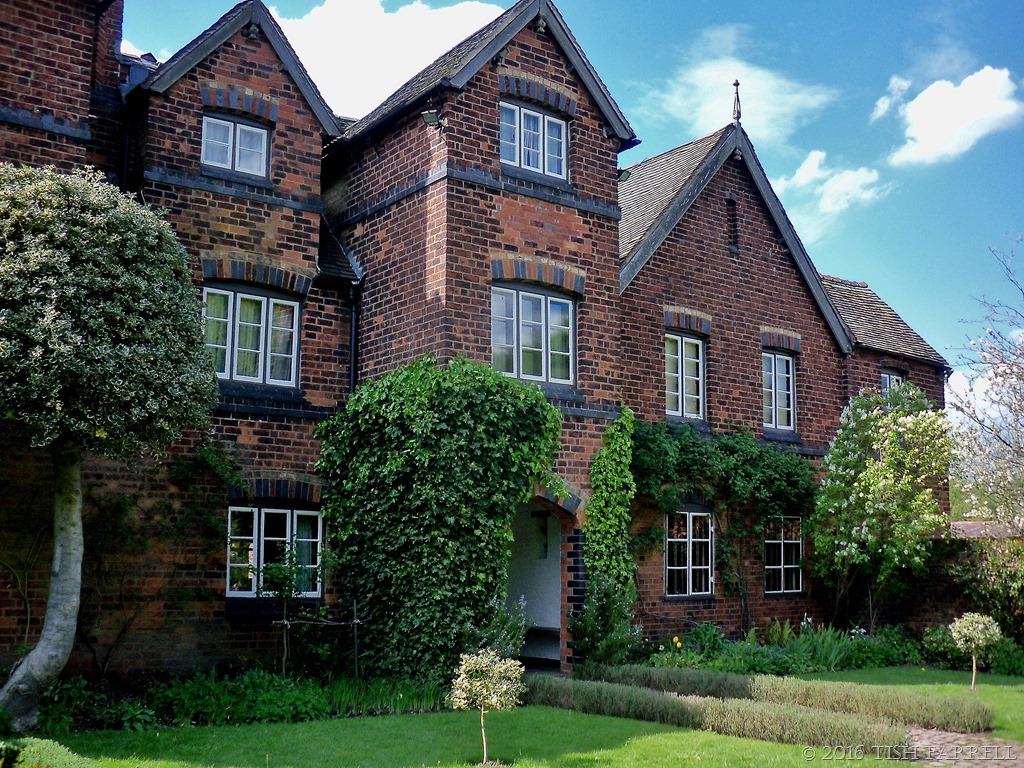
It’s something of a puzzle. When you first encounter Moseley Old Hall with its Staffordshire brickwork you feel sure you are looking at a Victorian building. And what’s more, rather than saying historic country manor, its looks suggest something urban and industrial, as if this might have been the home of some nineteenth century mill or mine owner.

Take another look from a different angle:

P1030952

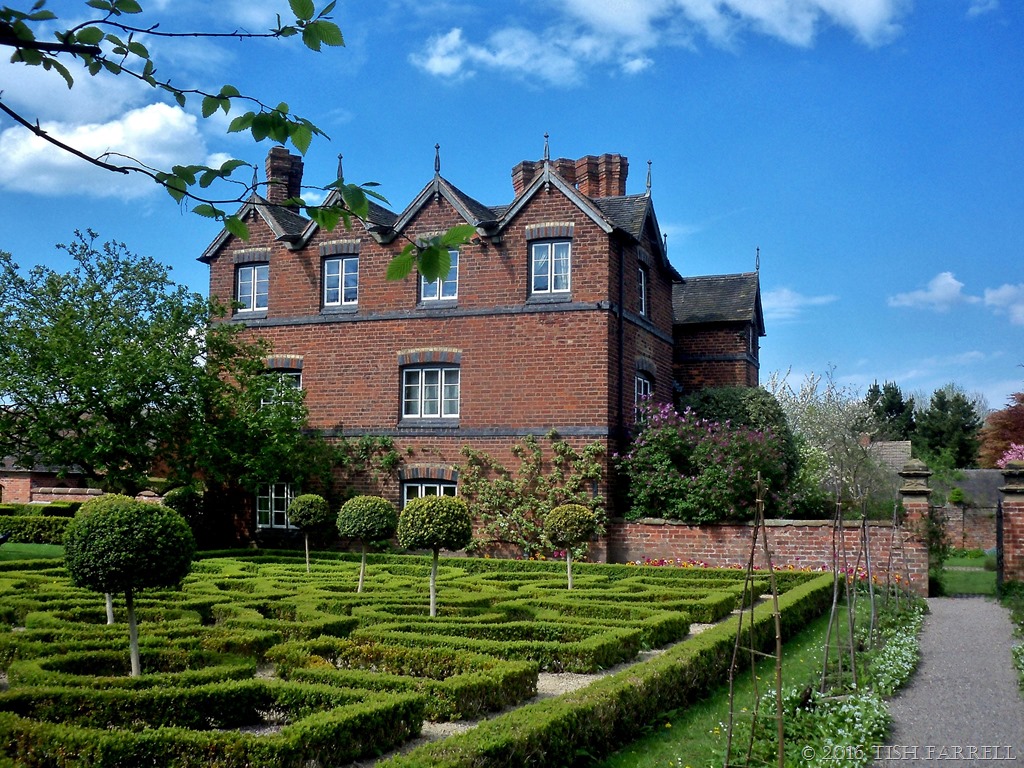
Now consider the side elevation coming up next. There’s an important clue here that all is not what it seems (a bit like Peter Greenaway’s film The Draughtsman’s Contract):

100_9677

Yes, here beside the house we have a restored knot garden of the 1600s. So what’s going on?

Time to put on the reading specs, and study the next three images:

http://www.historywebsite.co.uk/articles/oldhouses/oldhouses2.htm

Fig. 1

Source: Allan Fea Secret Chambers and Hiding Places

Now look at the photos again, and you have it. Moseley Old Hall, a timbered building of 1600 has been encased in a brick skin. This apparently happened in the 1860s, presumably as the easiest means of preserving the building. These drawings date from around 1850 before the cladding operation. Even though I have stared at the evidence, I still find it hard to accept that these are the same building. It’s like a variation on a ‘spot the differences’ puzzle. But just look at the placement of windows, eaves and bays. They are all pretty much the same whether in brick or half-timbering.

And now for the hiding of a king – and the year of 1651 when the house in timbered form played its part in British history, and sheltered Charles II after his disastrous defeat at the Battle of Worcester on September 3rd.

You can download the whole story in a free book at the following  link: Allan Fea The Flight of the King 1908  But the gist of the tale is this.

Moseley Old Hall is on the outskirts of Wolverhampton in the English West Midlands, and around 30 miles north of Worcester. After his army was crushed, Charles fled with a group of officers, and was guided to the Boscobel estate, not far from Moseley, by Colonel Charles Gifford who owned Boscobel. His properties there were in the care of servants, the five Penderel brothers.  This area on the Shropshire-Staffordshire border was a Catholic stronghold, and therefore most families were supporters of the king, although not necessarily brave enough to help a fugitive monarch. The stakes were far too high. Death being the likeliest outcome.

The cavalier officers who had been accompanying Charles left him in hiding at White Ladies Priory on the Boscobel estate, and carried on to Newport in Shropshire. It was thought the king would be safer travelling alone, and it was left to the Penderel brothers to effect the monarch’s disguise and scout out an escape route. The king wanted to get to London, but the roads east out of Boscobel were blocked and Cromwell’s militias were everywhere. He decided instead to head west into Wales where he had strong support.

Being over six feet tall, way above average height at the time, Charles was something of a challenge when it came to disguises. The Penderels cut his hair short, gave him coarse labourer’s gear, patched stockings, and a ‘greasy’ tall hat to wear. The shoes had to be cut to fit the king’s feet. These last were to cause the monarch much agony and multiple lacerations. Finally, after some lessons in local dialect and labourer gait, he was mounted on a farm horse. This beast was also to cause him much grief, and almost did for him when it stumbled. After that Charles had to walk cross-country tortured by the ill-fitting shoes.

The attempt to cross the River Severn into Wales failed. The crossings were all guarded, and Charles was forced to return to White Ladies. This was extremely dangerous. There were soldiers searching the woods all round, and Charles had to spend one whole day hiding inside an oak tree (the now famous Boscobel Oak). Meanwhile the Penderels were out searching the district for safer quarters.

So it was that Moseley Old Hall came to provide a safe haven. At the time it was lived in by Thomas Whitgreave and his widowed mother. Thomas was a Royalist but had not fought at Worcester due to ill health. Other occupants of the house were Father John Huddleston, a Benedictine priest, and his three pupils, who included two of Whitgreave’s nephews. The hall also had a priest hole, a relic of the earlier Catholic persecutions.

Charles was brought exhausted, and with bleeding feet to the hall where Father Huddleston set about tending to the king, and giving him fresh clothing and sustenance before showing him to a  comfortable bed. Meanwhile everyone else in the house was charged to keep a look out for the militias. (Can’t you see glimpses of those fearful faces peeping from every window around the hall?)

Thomas Whitgreave describes what happened next:

“In the afternoon [the King] reposing himself on his bed in the parlour chamber and inclineing to sleep, as I was watching at the window, one of the neighbours I saw come running in, who told the maid soldiers were comeing to search, who thereupon presentlie came running to the staires head, and cried, ‘Soldiers, soldiers are coming,’ which his majestie hearing presentlie started out of his bedd and run to his privacie, where I secured him the best I could, and then leaving him, went forth into the street to meet the soldiers who were comeing to search, who as soon as they saw and knew who I was were readie to pull mee to pieces, and take me away with them, saying I was come from the Worcester fight; but after much dispute with them, and by the neighbours being informed of their false information that I was not there, being very ill a great while, they let mee goe; but till I saw them clearly all gone forth of the town I returned not; but as soon as they were, I returned to release him (the King) and did acquaint him with my stay, which hee thought long, and then hee began to bee very chearful again.

“In the interim, whilst I was disputing with the soldiers, one of them called Southall came in the ffould and asked a smith, as hee was shooing horses there, if he could tell where the King was, and he should have a thousand pounds for his payns… This Southall is a great priest-catcher.”

After this episode the king no longer felt safe at Moseley. Another refuge had to be found and the means to get him there safely. It was at midnight, one week after the defeat at Worcester, that Thomas Whitgreave led Charles into the orchard of Moseley Old Hall where it had been arranged that Colonel John Lane would meet him with horses, and thence escort him to his home of Bentley Hall near Walsall.

This next stage of the escape was safely accomplished. Over the following weeks, and using various stratagems and much subterfuge, Charles dodged his enemies. Many attempts to find a boat and passage to France proved fruitless as he moved through Devon and along the south coast. There were even days when he hid at Stonehenge. Finally, on the 15th October, after six weeks on the run, he set sail from Brighton for France. It would be another nine years before he returned to claim his throne.

Now for more views of Moseley Old Hall. Another visit will be required before I can show you the interior. When we went on Sunday the weather was far too glorious to go indoors. So please enjoy a stroll around the gardens while imagining a battle-weary king with very sore feet arriving here secretly one September night. Look out, too, for Cromwell’s militia!


I’m linking this to Jo’s Monday Walk


Bee In My Bean Blossom

100_5619

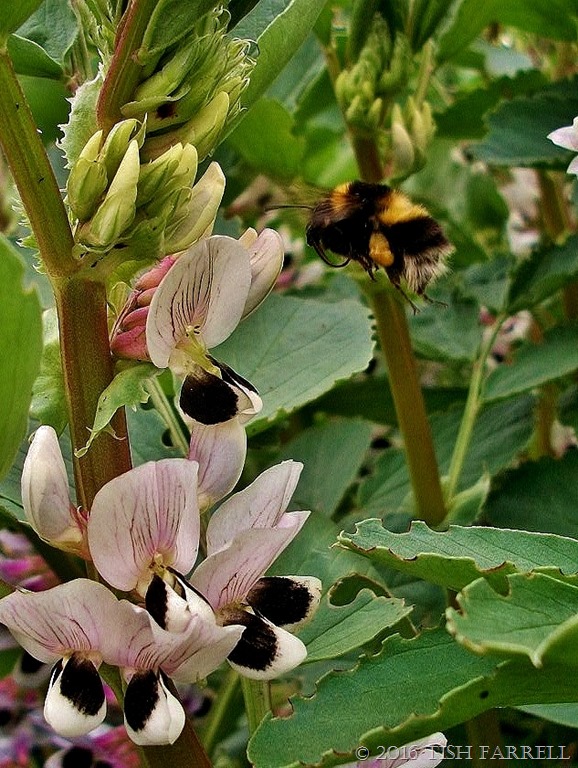
In April at The Earth Laughs In Flowers, Jude wants to see our garden macros. This is also the Day 5 of the 7-day nature photo challenge. So here we have a bumble bee heading for my field bean flowers. I don’t blame it. They smell divine on a still, spring day.

This photo was taken up on my allotment, probably last year. At the moment the current crop of field beans, sown in September-October and overwintered, is only a hand’s width tall, but they’re looking quite healthy. Once they get going, they will grow as tall as I am, and need some support. The photo also shows bean weevil damage on the leaves. This is one of the drawbacks of allotment gardening. Pests like this become endemic. On the whole, though, the beans seem to carry on regardless.

Field beans are related to the broad bean (aka fava or faba) and they look much the same, but are less than half the size. Mostly they are grown in the UK as a green manure, the plants dug in before flowering. I grow them to eat. They make great re-fried beans, soup and a bean version of guacamole, which is astonishingly good.

My crop was so productive last year, I was able to eat and freeze them, and save masses of seed to dry and sow for this year’s crop. It’s the first time I’ve done this, so it will be interesting to see how they turn out.  In consequence, I probably have grown too many. But once I see how the plants are faring, I shall sacrifice some of them. I mean to chop them down and leave them to rot on the soil surface, rather than digging them in. This will let the worms do the work, and keep the soil covered until I want to cultivate it.

I am beginning to see that digging is a very bad thing to do the earth. It wrecks the surface soil structure every time you do it, and so compromises fertility. Instead, the No Dig method relies on covering the soil surface with organic matter/compost every year, and then planting through it. The only problem is you need masses of compost. It also helps if you do your planting in raised beds. This way you do not walk on the soil, and can keep building up the fertility. Raised beds are easier to manage, and mulching the plants should massively cut down on the weeding, and the need to feed, or to water during dry spells.

Since last autumn I have been doing heavy labour on the new allotment plot that came with my polytunnel. (I hadn’t taken this into account when I got all excited about inheriting the tunnel from allotmenteers who were off to new territory.) The ground all round was heaving with dandelions and buttercups. And since this was before I discovered the no dig approach, I admit to using the quick and dirty method (though NOT weed killer) and slicing off the top layer of weeds, and dumping it in compost bins to rot down for a few years. The ground zero method of gardening.

I then commissioned He Who Does Not  Garden But Lives In My House to construct and install on my plot several raised beds made out of recycled builders’ yard pallets. A couple went into action straight away, and were planted up in October with over-wintering onion sets. The others I have been filling up over the past few weeks. So far the onions are looking healthy and a few weeks ago I sprinkled organic hen manure pellets over their beds, an alternative to sulphate of ammonia, which I didn’t have to hand.

By now you will be beginning to grasp the lengths that this writer will go to in order not to sit in front of her computer and cultivate the master work. So far I have shifted around 30 barrow-loads of an old garden rubbish heap that has apparently been in the corner of the allotment for the last forty years, and until recently was covered in brambles and nettles. Strangely too, it was my idea to recycle it.

Off course when I say heap, I really mean small mountain. It’s full of bonfires past, rodent nests, and decomposed leaves from the nearby ash tree, as well as nearly half a century of weeds and waste. There’s also broken glass, bits of plastic fertilizer bags, and all sorts of unidentifiable metal items that gardeners of yore thought could be disposed of in such a manner. As I sift through the heap, I think how good it is that I’m putting the field practice of my long ago archaeology degree course to some sort of use.

In fact I have been keeping an eye out for old coins, remembering that a few years ago I uncovered a 1725 halfpenny right outside my shed door. It helps to keep me amused during the boring process of extracting unwanted detritus and plant roots.

100_6630

I’ve also filled myself with a big enthusiasm infusion by deciding to dedicate one of the raised beds to growing flowering annuals to attract more bees. I shall also use it to grow on perennials (verbascum, heleniums, echinops) and biennial foxgloves that I’ve just germinated on the kitchen window sill. The thought of a raised bed bursting with summer flowers is so heartening. Doubtless you will see the results as time goes on.

But for now that’s enough talk about gardening. The sun is shining, and the weather forecast tells us we have a brief window of opportunity before the rain returns, so I’m off to the allotment with my pea and beetroot seedlings. I  may even sow some parsnips. Happy Sunday one and all.


#7-daynaturephotochallenge

The Writer’s Season: A Pursuit Of Active Dormancy

P1000347

NOTE TO SELF:

There is a time when it is all right for writers not to write. I’ll say this again so I’ll remember. There is a time when it is all right for writers not to write. It is time of preparation, and very much like putting over-cropped ground down to grass so the soil can regenerate. A time of fallowness then, but not of time wasting.

Before the real work can begin, there must be input, a drawing down of resources (like a tree in winter) – reading, researching and general planning.  And when I say ‘not writing’ I don’t mean give up on the writing practice – the brainstorming-stream-of-consciousness splurge, the morning pages, verbal doodling, keeping diaries. In fact do more. These are the equivalent of a musician practicing scales, or a dancer taking the exercise classes before working on a performance. This kind of practice strengthens fluency and, if you’re lucky, opens pathways to your subconscious thinking. It is all part of making ready for creating new work. None of this is for public consumption.

Yet doing sufficient groundwork is probably what most of us balk at. We have been fed with the notion that the best creation only comes in a white-hot blast of inspirational outpouring. We wait for it to happen. And it may never happen. More likely as not, such an approach will become a self-fulfilling blockage prophecy.

Then we may we tell ourselves the lie that if we are not busy producing words for the work in progress, then we cannot call ourselves writers. This may prompt us to start a work too soon simply to convince ourselves that we are being productive. Too often this will also end in confusion, blockage and despondency.

Only when we know our subject in our hidden depths, down in our roots and under the bark, can we best deploy our conveyances (our words) to bring it to the outer world. And I don’t mean ‘know’ in every last detail. Or not exactly. I have in mind Michael Morpurgo’s way. This well known English children’s writer is also a farmer. When he is thinking about a new book, he tells himself the story over and over until he dreams about it. Then he goes out in the early morning among his sheep and tells them the story. Only when he feels it is going down well with the ovine audience does he begin the act of serious writing. In this way he has proposed, explored, processed and internalized a narrative before he has written a word.

What emerges is more likely to be a  work that has intrinsic authenticity and consistency, as opposed to a narrative that has been imposed by the writer from outside, and often feels weak and poorly rooted.

So what do we need? Preparation, preparation, preparation.

But not too much either. I’m suddenly thinking of Edward Casaubon in George Eliot’s Middlemarch, he who ended up so obsessed with his researches that he left no time to write the book.  So a balance in all things. The knack, of course, is to recognize tipping point.

copyright 2016 Tish Farrell

Seasons


This Writer’s Path In Black & White? Or Search For The Lost Portal?


P1020698

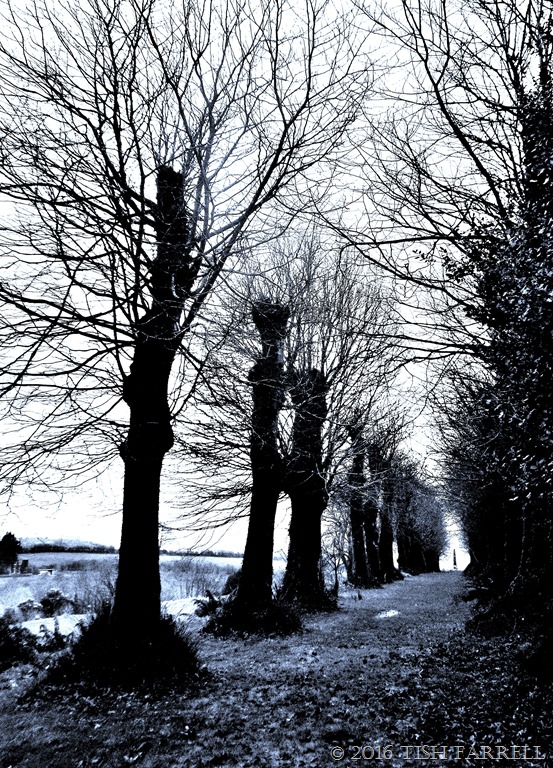
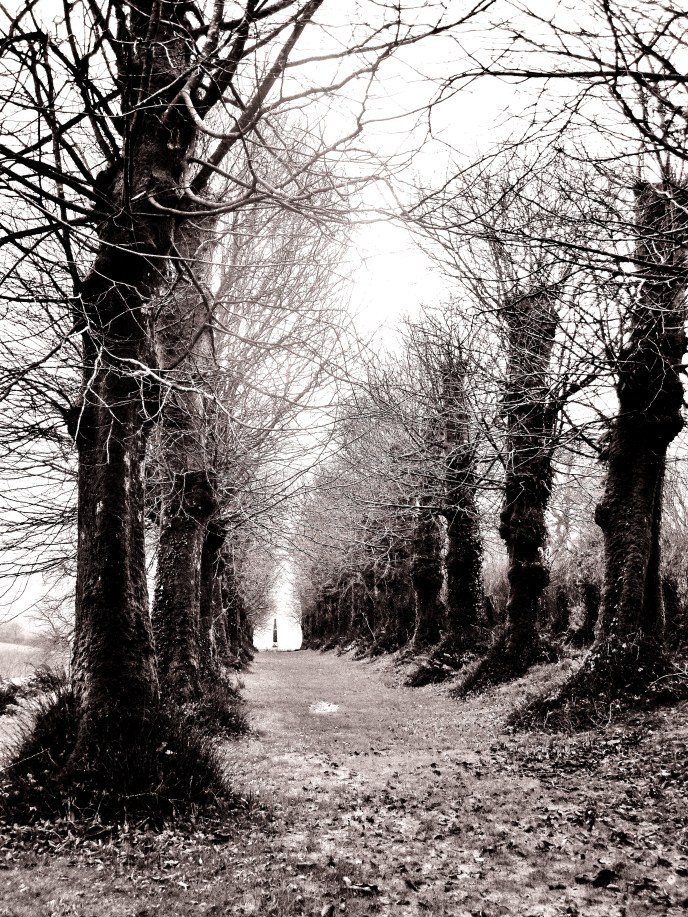
This image could be symbolic. You see the real problem is my mind keeps leaping ahead. Already it knows what is waiting for it beyond that distant obelisk. There is the final scene: redemption for a lost, old soul; rain falling in a rainless land. There is even the final sentence. The last full stop. I can see them all. But then, curiously perhaps, the mind’s-eye place that I rush towards is nothing like the place in the photograph – this rain-logged Cornish avenue of cropped limes. How could it be? My body may live in England now, but my mind still wanders in Africa where it endlessly struggles to create.

The yarn (aka the novel) that’s been churning in my head for countless months (years maybe) has its source in the thorny, arid plains of East Africa. And if ever it rains there, it smells nothing like the rain in temperate lands. In Africa you know your life depends on it – the fickle falling of rain. In England you simply expect it while grumbling at forever getting wet. This is one manifestation of the great divide between the famished and the over-fed.

And yet…

And yet there is congruence here.

When I discover the avenue at Christmas I am instantly fascinated. It’s like coming upon a lost garden, or some ancient megalith. I want to know where the path leads: simply to the obelisk, or is there something more beyond? The avenue itself, with its period formality, anyway evokes expectation of some pleasing and diverting progress along it.

But it isn’t the time for promenading. The weather is so gloomy and wet the avenue is almost too dark to photograph, let alone walk along. But still I return several times more, and pick my way back and forth among the trees, noting the clumps of daffodils and crocus, sprouting densely among the roots. I even patrol the grassy bank beside it, trying to grasp the avenue’s measure and meaning. Is it simply some vanity-planting by long-ago denizens of the small manor house that is now converted into holiday flats? And even though I can see it clearly issues from the carriage circle outside the house, does it actually go anywhere at all?

I can ask similar questions of my current work. Is it a piece of vanity writing, or something of substance? A story that is going somewhere special, or not? I am becoming aware, too, that knowing the ending (being in love with it almost) could be an (overwhelming) handicap: why bother to create what comes before it? Isn’t it all too hard? But then, on its own, that final scene has no meaning, no matter how much it may excite and lure my imagination away from the job in hand; snatching concentration from the down-and-dirty toil of how to get there.

So yes, yes, and yes. Of course it is the journey that counts; the grand excursion that must be planned and undertaken. Undergone. Borne. The delineation and experience of what happens on the way are key; in that yawning space between departure and arrival great transformations must take place. This, after all, is the point of fiction. Verbal alchemy.

When I finally slither and slide to the obelisk, I find the avenue strangely truncated. Behind the monument whose commemorative purpose is not obvious, I find a small wrought iron seat for two and, a step beyond and directly facing it at right-angles, a hedge. This is puzzling. How can the avenue end here? Surely it was once part of the main drive to the house. From its earliest days in 1690, and through the Victorian period, Duloe Manor was the rectory. And so, whether by carriage or cart, on horseback or on foot, parishioners must have approached its front door somehow.

A cursory scanning of the landscape suggests that any onward stretch of drive must have turned sharply at the obelisk and descended downhill to the lane. Now it is lost in an open meadow tailored for holiday guests who wish to exercise their dogs or simply amble. I also ponder why the seat looks onto a hedge. Then I see that, beneath the recent unseasonal growth spurts, the hedge had been shaped to allow a vista as if it were a balcony. As I stand beneath dripping lime trees, I conjure a clear day when rainclouds aren’t snagged on the fence tops. The panorama of Cornish countryside will be magnificent, I think; perhaps a distant glint of sea?

Looking at the photo now, I see only my task ahead – the making and moulding of the many stages through which a piece of work must pass. I have made a good start. Written many thousands of words. I know where I’m heading. Clearly then it is time to commit myself to the hardest part – the middle.

But here’s the rub – the discomforting, unnerving questions that this little excursion has sparked. Ones that must be answered before I take another step.
1: How seriously do I take my writer-self? Seriously enough to bring off this task?
2: Does the work itself have energy enough to make, or even warrant the journey?
3: Do I have energy enough?
4: And how will I feel if I never give myself the chance to write that final scene?

On reflection, an answer to this last might serve for the other three. It depends on the answer.

Later – today in fact – I discover that in times past one of the house guests at Duloe Manor was Charles Dodgson, aka Lewis Carroll. It is said he was working on Alice in Wonderland at the time. Suddenly this knowledge brings new possibility. Never mind the navel-gazing and writer-angst. Of course it is exhausting inhabiting two realities, and never being quite in either – body in one place, mind half a world away. Surely, then, what I need is Alice’s rabbit hole – to submerge, to blooming well get down there and on with it. In fact, look out there. I think I see him. Isn’t that the White Rabbit dodging through the lime trees? Quick, quick, I mustn’t lose sight of him.

Wait for me-eeeee, White Rabbit!

copyright 2016 Tish Farrell

P1020701

Maasai Cricket Warriors Against FGM ~ Warning: this post comes with a Sensitive Subject Sticker

7d653c00-9e4f-40c6-a781-e1e15d8116c7

‘The eye that leaves the village sees further’ Maasai wisdom

Photo courtesty of https://www.justgiving.com/MaasaiCricketWarriors/

*

It’s already been shown in Hollywood, but today in London sees the release of Warriors, a documentary by Barney Douglas. From next week there will be star showings across the UK, so if you have a chance to see it, do. You will see a glimpse of real, magnificent, originally-minded Africa, and not only that, 45% of the film’s proceeds will go towards one of the best community causes I can think of – changing attitudes to a rite that these young Maasai men say must go – female genital mutilation, aka female circumcision or FGM.

The stars of the film are a team of cricket playing Maasai warriors. They’ve been playing since 2009, and their ambition was to play at Lords, which they did this summer. They are a fine sight to behold in full morani gear plus bats and pads. And they are killer cricketers. They could even rouse my interest in a sport that usually makes my brain glaze over, despite that lovely sound of leather thwacking willow.

Working as volunteers, these young men have been using their growing popularity to spread the word against FGM and forced early marriages. Their far-flung travels have earned them the right to be heard by the elders back home, and now the young men are saying that they will refuse to marry a  girl who has undergone FGM. In a community that has clung to the rite despite the enactment of Kenya’s 2011 Anti-FGM law, this is a powerful stance. It will bring change.

This is what the team captain, Sonyanga ole Ngais had to say at the Warriors Premier:

Thank you for helping us with our inevitable war against FGM because we know that all gender inequalities are related to FGM. Eradicating FGM means that the girl-children shall not be forced to drop out of school in preparation for early marriage and early motherhood. This directly translates that the girls can be educated, gain a bargaining power to choose her own path, when to marry, her own chosen husband and when to get her children. It translates to better health, better economy and better self-esteem. Simply, an FGM free community is a healthy, empowered and wealthy community.

602447_539098019484652_331684898_n1

Photo: http://maasaicricketwarriors.co.ke/

You can see the trailer for Warriors  HERE


And now to my personal interest in this anti-FGM initiative from within a practicing community.

Back in 2002 I was asked to write an article on FGM for the inaugural issue of Zuri , a US magazine aimed at African American teen girls. Zuri means beautiful in Kiswahili and the magazine’s founder, and editor-in-chief, Donna D King wanted to produce an attractive bi-monthly journal that would raise young women’s aspirations in everything from their appearance to their values, beliefs and career choices. The publication had a strong Christian ethic, and Ms King also wanted to include articles that would deal plainly with issues that might affect young women of colour. (Sadly, the magazine is no longer around.)

IMG_0001

At the time of this commission, I had not long returned from Africa where we had been living for eight years.  For most of this time we were in Kenya, and throughout the 1990s the topic of female genital  mutilation, usually referred to as ‘female circumcision’, along with reports of forced teen marriages, was frequently covered by the national press. In theory, the rite was illegal in all its forms. In practice it did, and clearly still does take place.

In Britain FGM is a criminal offence, and rightly seen as a human right’s violation. Since the summer, all health care officials have been told they must report any suspected cases.

But this is only one side of the problem. We all know that making something illegal does not stop it, otherwise our nations would have no need for police forces, customs officials and judiciaries.  By far the most effective measures to end such practices, I would argue, must come from within the communities who practice them. Certainly in Kenya, this kind of community activism has been going on since the 1990s. It is a slow process for all kinds of reasons, which I go into below. But high-profile initiatives like the Maasai Cricket Warriors, and now the Maasai Cricket Ladies – YOU CAN SUPPORT THEM ON FACE BOOK – just make me want to give a loud resounding HURRAH!

Anyway, here’s what I wrote back in 2002 with one or two statistical updates:


The Cruellest Cut?

It is easy to condemn a stranger’s customs, and when it comes to a rite as hazardous as Female Genital Mutilation (FGM), it is not surprising that our first response is BAN IT.  In the United States, the UK and many industrialized nations, FGM is illegal, but in several Middle Eastern and many African countries, FGM is both legitimate and common. In a country like Kenya where 12 out of 40 ethnic communities ‘circumcise’* their young women, the debate for or against FGM has been simmering since 1929 when European missionaries first tried to stop the custom.

But despite all the laws and adverse criticism, the rite is not going away.

The World Health Organization estimates that up to 140 million girls and women have undergone one of the three main types of FGM.  Plan UK  further states that every year across Africa, 3 million more girls will  undergo the rite. And so today, as you go to school, cruise the mall, or watch TV, the genitalia of 5,000 girls will be cut off in unsanitary surroundings. The victims may be infants, five year olds or young teens. They may be cut by force or submit willingly. They will suffer it because those who love them most—their mothers, fathers, grandparents—say they must, and because it has always been done.

Then there is the side of this issue that most affects industrialized nations. When people from communities who practice FGM migrate from their homelands, they take the custom with them. For parents settling among strangers whose lives seem far from moral, the belief that FGM is the only way to protect their girls’ virginity is likely to be reinforced. If the rite is illegal in the adopted country, they will simply take their girls on a visit to their homeland.

In criminalizing FGM many nations, including the US, UK, Kenya and Egypt, have acted with the very best of intentions, and with aim of protecting vulnerable girls. FGM has serious health risks: haemorrhage, shock, septicaemia, sterility, abscesses, chronic pelvic and urinary infections, incontinence caused by rupture of urinary and rectal tracts, painful periods, painful sexual relations, keloids (raised spreading scars), long labour, frequent stillbirths, foetal damage, and depression.

Some mutilated girls bleed to death. Others die in childbirth. Very many suffer in silence their entire lives because talk of the rite is taboo. They may not even realize that FGM caused their chronic bad health problems.

So what precisely is female genital mutilation? The World Health Organization lists three main forms:

Type I. Clitoridectomy—removal of all, or part of the clitoris. This type of FGM includes the least damaging form, Sunna, which involves cutting off the prepuce or clitoral hood.

Type II. Excision—removal of the clitoris and part, or all of the labia minora. This can cause massive scar tissue and, later, difficulties in childbirth.

Type III. Infibulation—removal of clitoris, labia minora and labia majora. The raw surfaces of the vulva are then stitched together using thorns and gut. A pencil’s width hole is left for the passing of urine and menstrual blood. After this procedure, the girls’ legs may be bound together for up to 40 days to ensure the cut surfaces heal to make a permanent cover over the vagina.

The pain and trauma of infibulation haunts many women all of their lives. After marriage, the bridegroom cuts the sutures, and then replaces them later. During childbirth, the sutures must also be cut, but after the baby’s birth, the woman will be stitched at once to ensure her husband’s honour. This act of re-stitching causes further scar tissue and makes future childbirth hazardous.

The FGM ‘surgeons’, usually a caste of older women whose livelihood it is, rarely use any form of anaesthesia. They may also use unsterilized tools such as broken glass, scissors and razor blades for a procedure that can last as long as 20 minutes.

These, then, are the facts of FGM, but its cultural justifications are varied and complex, and the reasons for it deep-rooted in tradition. Also, the reasons for Types I and II are very different from the most extreme form, infibulation. The former are usually associated with traditional ceremonies that initiate adolescent girls into womanhood. In most of the African societies that practice FGM, Sunna, the least damaging form, is the one most commonly used to mark the transition to womanhood.

Initiation of this kind is usually associated with the onset of puberty and menstruation. Oral history sources suggest that in pre-colonial times girls did not begin to menstruate until they were at least  17 years old, and thus already old enough for marriage. When FGM took place it was in association with training for adult life. Young women would be secluded in special camps, often for several months. Here they would learn from their female elders everything they needed to know about married life and sex. They would be schooled in how to conduct themselves as good mothers and responsible community members. They would learn clan history and special songs and dances. They would be taught to behave with quiet dignity, and be prepared by their tutors to bear the cutting without showing fear or crying.

In every sense this process represented a graduation. Afterwards, when the girls returned to their community as proven brave young women who could endure extreme adversity, and so were ready to play their part, everyone showered them with gifts and praise, and the whole event was celebrated with general feasting and dancing.

Today, due to school attendance and church membership the valuable training associated with this rite of passage has long gone, but women still send their daughters and granddaughters for “the cut” because they see it as a badge of womanly status. Without it, they think their girls will be outcasts in the community and thought of as unclean, promiscuous, or childish and, therefore, wholly unfit for marriage. Traditionally, an unmarried woman in many African societies has absolutely no status.

For many poor rural women, then, FGM is seen as the only way they can gain some standing in their community. In such situations the women themselves are the main upholders of the rite. They are not prepared to lose the sense of status they believe it confers on them, even if this means crossing husbands’ and elders’ wishes. They will shrug off the dangers, saying the benefits far outweigh them. This situation was dramatically exposed in Ousmane Sembene’s award-winning Senegalese film Moolaadé (2004).

The Kenya situation also shows up the flaws in simply outlawing the practice. In 1982 when President Daniel arap Moi announced his plan to ban FGM, those communities that practiced the rite rushed to have their daughters cut before the law could be passed. In fact Kenya’s Anti-FGM law was not enacted until 2011, and even now it is difficult to enforce among remote communities. There has also been a trend to ‘circumcise’ girls at ever younger ages. But without the appropriate accompanying sex education, which neither school nor church tends to provide, the upshot has been an epidemic of school-girl pregnancies, and the inevitable abandonment of education.

Unexpectedly, too, sending girls to school may also help to keep FGM alive. Circumcised girls are said to apply fierce peer pressure by ostracizing uncut girls. Furthermore, since rural girls must often go to boarding school to receive an education, their parents believe that FGM will stop their daughters from misbehaving while they are away from home. They also think it will protect them from HIV infection.

All the social changes, coupled with the fear of AIDS, have often served to entrench the practice of FGM types I and II. Yet at the same time, the rite has lost much of its original meaning. Instead of being an important rite of passage that admits a girl to a higher social status, it now largely serves to control girls’ sexual behaviour in much the same way as type III infibulation does.

This, the most extensive form of FGM is practiced in deeply conservative societies, where virginity and wifely faithfulness are upheld as matters of high family honour. In Somalia, for instance, families commonly infibulate their girls by force by age five as former Somali model, Waris Dirie’s moving book Desert Thorn  painfully reveals.

Infibulation is also practiced in Egypt, Sudan, and parts of West Africa, where is often associated with the Muslim faith, despite the fact that FGM long pre-dates Islam. This form, then, presents anti-FGM campaigners with their biggest challenge; the communities who practice it are fiercely independent and do not care to be told that their customs are wrong.

So how, then, can FGM be stopped? Is criminalizing it the answer? Is legislation a viable answer when so many women choose it for their daughters and granddaughters?

In Kenya many community activists have realized that banning the rite can simply drive the practice underground. Since the late 1990s they have been devising more proactive approaches, in particular helping communities to create new ceremonies—ones that confer status but without the cut. One example is called “Ntanira na Mugambo,” translated as “Circumcision Through Words.” It has been promoted by Kenya’s national women’s group, Maendeleo ya Wanawake, and involves a new one-week ceremony.

Each ceremony is tailored to meet different cultural needs but, for all girls who attend, the objective is to teach them about personal health and hygiene, their future roles as parents, wives and community members, the importance of staying in school, and how to handle peer-pressure. In communities where the male view predominates, the building of self-esteem is also key. At the end of the week the young women graduates are given certificates and gifts by their community and generally feted in the manner of traditional ceremonies.

Little by little this new rite is gaining acceptance. But it is no quick-fix solution. The entire community must embrace the new rite. In particular elders, husbands and young men must be persuaded. In a bid to gain everyone’s support, campaigners organize preliminary discussion groups in churches and in youth groups. They encourage men, in particular, to carry the anti-FGM message to others.

Campaigners have also found that focusing on FGM’s health problems is the surest means of persuasion, whereas condemning cultural beliefs or sexual attitudes is very counter-productive. Finally, campaigners ask young men supporters of the new rite to swear an oath that their future wife need not be circumcised.

Because the rite does not exert a blunt prohibition on female genital mutilation being practiced in Kenya, but offers an attractive alternative, it is possible that it may become the most successful strategy towards more widespread elimination throughout the world.

César Chelala, global health consultant The Lancet 1998

These and similar initiatives are now proving powerful tools for change in Kenya and other African countries. They also have the support of international agencies such as the World Health Organization, the Program for Appropriate Technology in Health (PATH), and UNICEF.

Even so, no one underestimates the time it will take to eradicate FGM completely. No human being’s beliefs are easily changed, no matter who they are. Most campaigners agree that it will take at least three generations to end the practice. It also seems likely that informed and non-judgmental persuasion from within communities offers the best hope of success.

As onlookers we may justifiably feel horror, anger and disgust, but if we are honest, and think how we ourselves might react to outsiders’ condemnation of our cultural practices, we will see that judgmental pronouncements are more likely to harden attitudes than to change minds for the better.


* female circumcision is a term of convenience often used in practicing communities, but the large scale of mutilation in FGM in no way equates to male circumcision.

copyright 2015 Tish Farrell

Related:

Kenyan girls taken to remote places to undergo FGM in secret  The Guardian 2014

You can read a young Kenya woman’s personal account of FGM HERE

#FGM #MaasaiCricketWarriors #MaasaiCricketLadies

Tales from the walled garden #4: more about Alice

IMG_0005

A day or so after I had posted the last Walled Garden tale, When Alice met Charlie , I came across a mislaid fragment of a letter from my Aunt Evelyn. I think she had written it while we were still living in Africa. For some reason I have only kept the part that mentions my grandmother Alice. I’m not sure either what prompted Evelyn to launch into some family history, but this is what she says:

My mother was born and brought up in Streatham, a suburb renowned for its many ‘stage’ residents who were top Music Hall and Variety stars before the 1914-18 war. She knew them all and could sing their popular songs. She was the first female member of the Streatham Sainsbury’s branch when it opened on Streatham High Road. Alice Eaton (as we was then) became bookkeeper-cashier at the smart new grocery and provision store – all mahogany fixtures, and gleaming tiles and marble-topped counters.

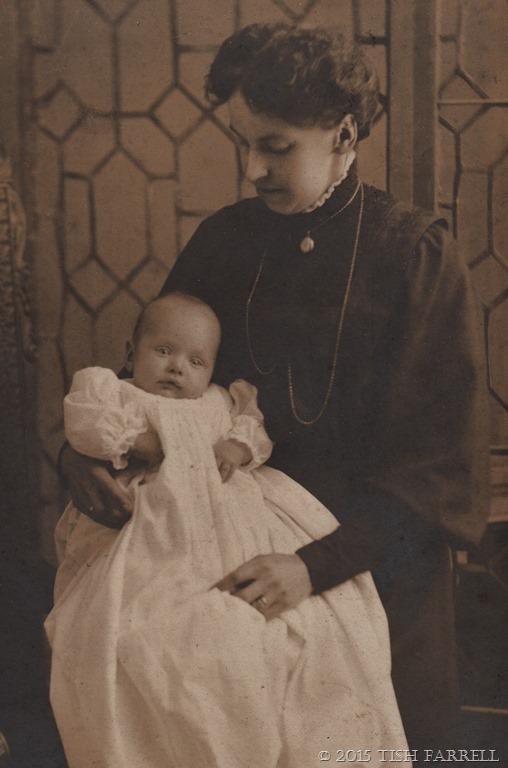
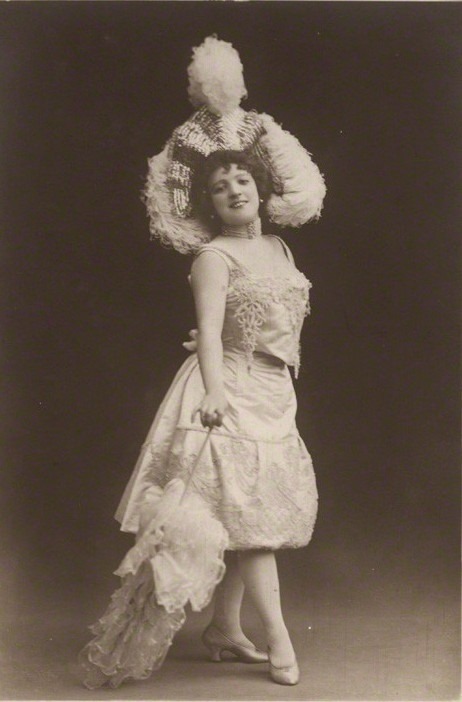
Evelyn goes on to say that Alice’s stage customers included stars like the male impersonator, Vesta Tilley, comedian-actor, Dan Leno, singer of risqué songs, Marie Lloyd, and Vesta (Daddy wouldn’t buy me a bow wow)  Victoria.  It is hard to imagine the demure Alice of the photograph (this was taken in 1910 after the birth of my father, Alex) singing rollicking music hall songs, and I’m pretty sure she would not have sung anything truly racy; but I can see that she may well have conveyed to my father her own delight in Streatham’s glamorous souls.

He in fact spent his long life expecting to be whisked off to a glittering world of fame and fortune. And in between, he veered between the somewhat contrary personas of Peter Pan on the one hand and, in his own words, the play boy on the other. It is the sort of fantasising that might well have provoked a man like Charlie to throw an axe at his only son. He believed in standards and showing by example, and clearly Alex had exasperated him beyond reason. But all this came much later, after the move to Cranleigh when my father was off on late-night escapades, and thought he could elude Charlie by returning to his bedroom by climbing up the drainpipe.

x-default

Marie Lloyd in the 1890s; public domain image

*

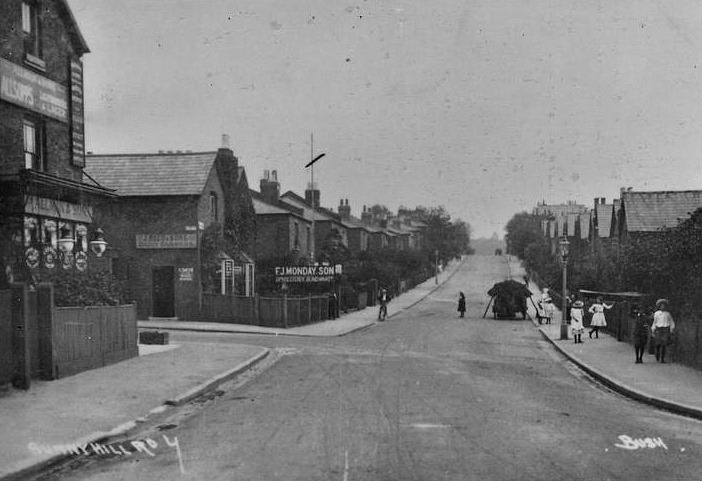
Alice and Charlie spent the first thirteen years of their marriage, living in a rented three-storey semi-detached house on Sunnyhill Road, Streatham. It was only a stone’s throw from Angles Road where Alice had been born and brought up, and also in walking distance of her widowed mother’s boarding house on Barcombe Avenue, part of Leigham Court Estate.

Sunnyhill Rod c1900

This view of Sunnyhill Road is much as it would have been in my grandparents’ day. They lived here until January 1918, when Charlie was appointed head gardener at Redhurst Manor. This photo is from the Sunnyhill Primary School website, the school my father probably went to.

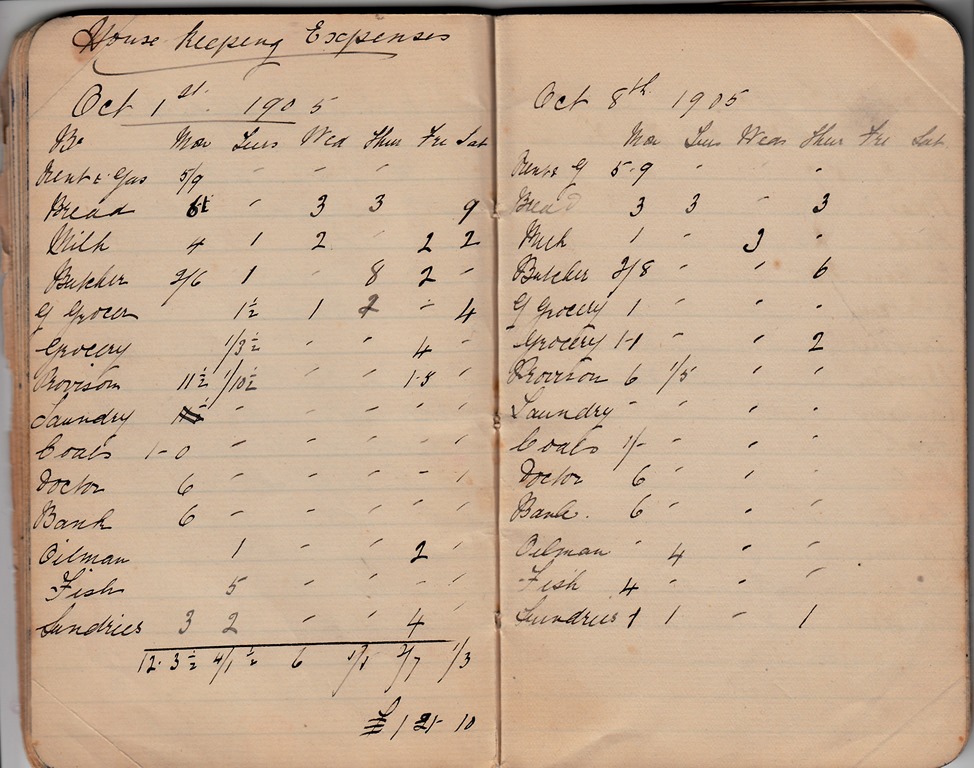
Recently amongst my aunt’s papers I discovered a telling glimpse into Alice and Charlie’s first weeks of married life on Sunnyhill Road. I found it in a small notebook that I had thought contained only my grandmother’s small archive of family recipes. However, several pages in, and following on from the instructions for making plum pudding, boiled brisket and apple pancakes, I came upon five weeks of household accounts, covering the second  month of their marriage from October-November 1905.

IMG (5)

The biggest and most important expense was the weekly rent of 5 shillings and 9 pence (20 shillings to the £1, and 12 pennies to a shilling). This also included payment for gas for the cooking stove and lights. Today, by breath-taking contrast, an internet property site lists the next door identical house as having a weekly rental value of £750, and a sale value pitched at around  £800,000. I think Alice and Charlie would have been speechless with disbelief to hear of such colossal sums of money attached to any property they might have lived in. Here it is below, looking a bit sorry for itself in more recent times. I remember my father telling me that, as a small boy, he stood in the passage between their house and the neighbours’, and watched the WW1 zeppelin raids on London…
156 Sunnyhill Road

IMG_0001 (5)

Alexander Charles Ashford – warrior brave c. WW1
*

The other repeat payments in Alice’s accounts were 6 pence for the doctor (perhaps settling a bill on easy terms?) and 6 pence to the bank, which was presumably their weekly savings. Then there was a shilling a week for coal, and a few pennies to the oilman for paraffin to light the household lamps (gas lighting apparently didn’t necessarily make for the best illumination if you needed light to see what you were doing). We can also see that the main food staples were bread and milk, plus a good three shillings’ worth of meat, and a little fish, making a total expenditure for the first week of October of one pound, one shilling and ten pence.
The rest of the notebook is filled with recipes, mostly of the ‘plain cooking’ variety, and clearly geared up to feeding a husband who worked out of doors. There are sturdy suet  crust puddings that required three and more hours of steaming – jam; prune; sausage and onion. There is also a steamed jam sponge called ‘Kiss Me Quick’ Pudding. She does not stint on butter, sugar, treacle, lard, dripping and eggs.

I was also surprised to find her using curry powder, and cayenne pepper, and in her ginger nut biscuit recipe, something that she calls ‘growing ginger’. I’m guessing she means fresh stem ginger. But then why should I be surprised? As a long-time employee in a Sainsbury’s upmarket grocer’s emporium, her cooking horizons were bound to have been  broadened.

I never met Alice. She died three years before I was born. But despite the stodgy sounding recipes, I do know she was a good cook. And I know this because my mother was not, but when on those occasions she prepared the dishes that Alice had taught her to make, the end result was invariably delicious. As a small child, I used to sit in my high chair, and post most of the food mother gave me into the dribbling mouth of our yellow labrador, Heather.  But there were some things I would never have shared, nor could eat enough of – Alice’s creamy long-baked rice pudding with a toffee-crisp skin, delicate egg custard dusted with nutmeg, fly-away Yorkshire puddings, shin beef broth, mouth-watering little oaty cakes. I can taste them still, decades on.

IMG_0006 (4)

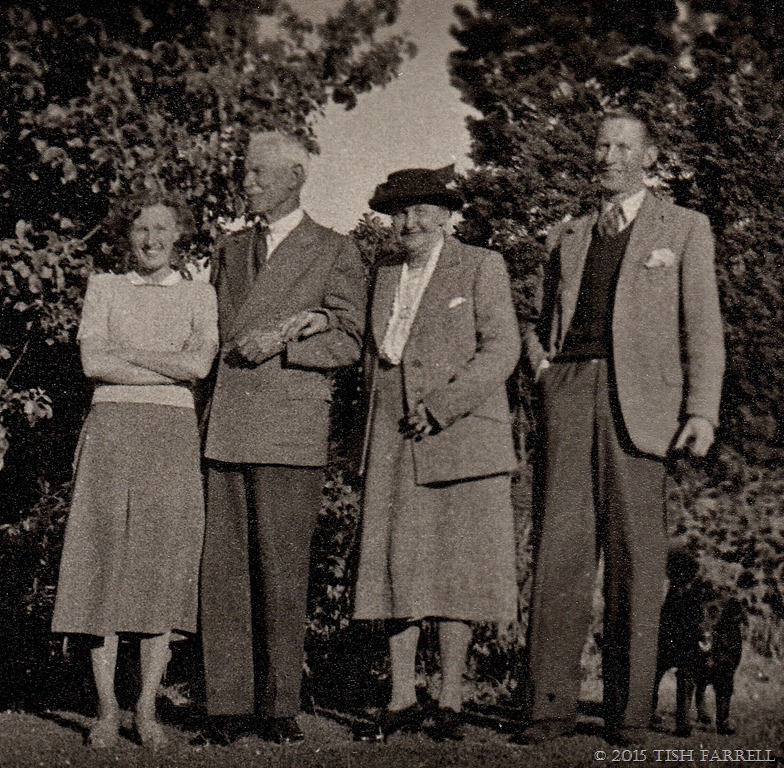
Alice with Charlie in 1949, the year she died. Flanked by my parents, Peggy and Alex and RAF the dog. Alice is 66.

*

And so it was that Alice went on nourishing us, long after she had died. She had been an invalid for years, and sometimes wheelchair bound. Before Evelyn married in 1946, the burden of caring for Alice most often fell to her. Yet Evelyn herself had suffered much unaddressed trauma during the war, having been bombed while travelling on a train from Guildford to Cranleigh  (see The Many Faces of Evelyn Mary Ashford). She also had a full-time job in a department store, as well as spending nights on ambulance duty. But once Evelyn left home to marry her war-time sweetheart, it was Charlie, then around 75 and still working as a gardener, who took on the caring role.

In her last letter to Evelyn, the only one I have, Alice is clearly struggling to get over a bad spell, and has been occupying herself with knitting. She starts off explaining how she has adjusted a pattern to make a pullover of a length that she knows Evelyn’s husband, Geoff, would prefer. I gather from a parting comment that they were working on this project together, and Alice wants Evelyn to understand her adjustments. Despite her physical difficulties (and they are not explained) the tone of the letter is very cheery, and chipper.

It begins ‘My Dear Nip’,  Evelyn’s nickname, and a family joke. It is an allusion to the ‘nippies’ or speedy waitresses of London’s J Lyons & Co tea shops, and to Evelyn’s own swift way of doing things. Once the sweater details have been dealt with, Alice goes on to assure Evelyn that they are coping without her, and that although ‘Dad is down 35 shillings a week’ he is not going back to work until Alice is able to get about again. She says he has turned the mattresses on her bed and shaken them up well, and remade all with fresh linen, and how he has been to the village to order coal and pay the milk bill and buy three eggs. She then says,

he came back and made our lunch. While having it he said, “I don’t see why I can’t make some pastry, say an apple pie for Sunday.” Well, I said. It is easier than a cake to make, so I guess he will Have-a-go. Really, all he has cooked for me has been very nice. So you see us old folks can manage.

Alice then turns to family gossip, and ends the letter, ‘Ever your loving Mother,’ followed by a final knitting instruction: ‘Don’t forget length under arm.’

It seems a fitting note to end with. Also, I am suddenly seeing my grandfather in whole new light, one uncoloured by my father’s view of him. I think he was a good soul, and that he and Alice were good souls together.

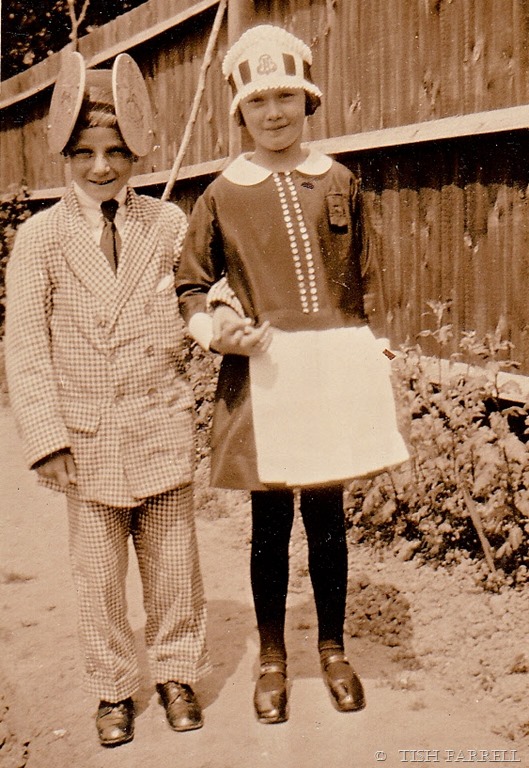
Finally, here is Evelyn, Nippy incarnate (you can compare her to the original HERE), aged seven, and setting off to the 1930 Cranleigh Carnival with Ronnie Russ. The caption says ‘Nippy and Bob’ so I’m assuming they are based on comic strip characters of the day. Does anyone know?

IMG (6)

copyright 2015 Tish Farrell

Tales from the walled garden #3: when Alice met Charlie

Charles Alice 2 (2)Charles Alice 2 (3)

I think I can safely say that  my genetic make-up, in parts of its configuration, is down to a malfunctioning umbrella. At least this is what I gather from my Aunt Evelyn’s brief account of how her parents, my paternal grandparents got together.

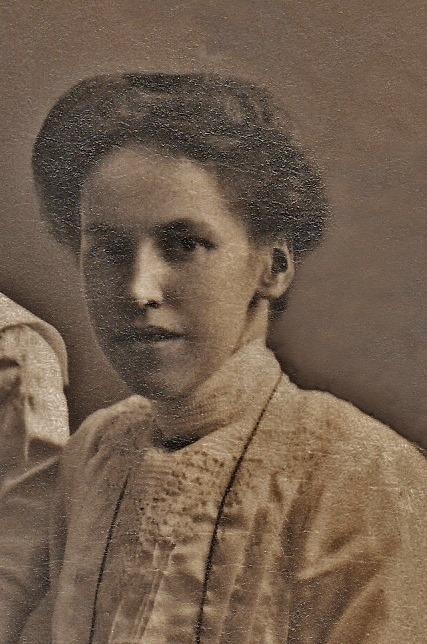
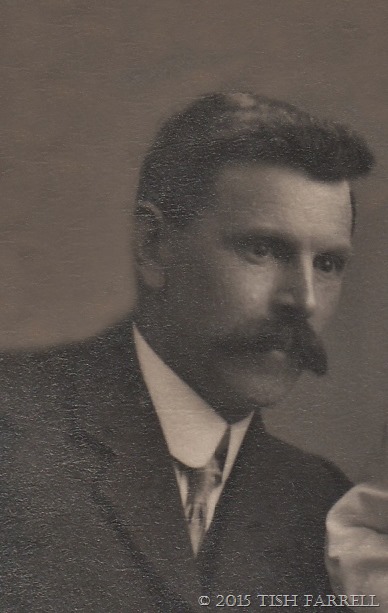
But before we get into the umbrella business, please meet my grandmother, Alice Gertrude Eaton, a grocer’s cashier from Streatham, London (I have a notion that it was an early Sainsbury’s store because the emporium’s founders, John James and Mary Ann Sainsbury had the policy that ‘lady clerks made the stores run better’), and grandfather, Charles Ashford, head gardener, born in Twyford, Hampshire. You have seen them in their latter years in my earlier posts from the walled garden (see: #1, #2)

In  many respects they are an unlikely couple. Alice was a city girl through and through. She is perhaps unusual, too, in that, as a young woman, she had a responsible cashier’s job in a big grocery store. There were racy theatrical connections too. Her customers were the music hall stars of the day (The first Sainsbury store was in the theatrical quarter of Drury Lane so this may well have been where she worked). G H Elliott, a well known variety star, whose trademark act (I’m sorry to say) was to perform minstrel-style with blacked up face and wearing a white dinner suit, was also some sort of relative. He made his first recording in 1904, and had a long recording career. Alice was very proud of the family association. Then one of the witnesses on her marriage certificate is her older brother, Charles Kisber Eaton, a professional cricketer. It seems their father, also Charles, a plumber gas-fitter, had backed the winner of the Epsom Derby in 1876, the year his son was born. Kisber was the famous, Hungarian-bred racehorse that also won the Grand Prix de Paris the same year.

Charles Kisber Eaton: it’s quite a name. The Eaton family then, it seems, had a bit of urban edge, the kind of street-wise flair that grandfather did not. He was a countryman, my aunt said, to the soles of his well polished boots. And so how did he end up marrying a Streatham girl? Well here is the backstory according to my aunt:

I must now tell you a bit about my father.

He was born in a village called Twyford, near Winchester, the second son of a family of eight – four boys and four girls. He left school when he was 12 years old, and went to work at Twyford Vicarage as a pantry boy. He got up in the morning at 5 am – sometimes earlier – stoked the kitchen fire, cleaned all the boots and shoes. Next he filled the coal scuttles, got the wood and paper ready for laying the fires and all before cook and the house maids appeared at 6.15. Next job was to clean the front steps and polish the brass on the front door, and then sweep the drive down to the front gate. After this he had to help the maids carry cans of hot water for the family to wash or bathe.

After breakfast there were knives to clean, followed by further fetching and carrying for the rest of the day. Twice a week he would have to walk into Winchester (5 or 6 miles each way) to collect a special brown loaf for the vicar’s wife. The coach man would very often pass him on the way, but was not allowed to pick up little Charlie Ashford. But he was well fed at the vicarage and grew into a tall, strong boy.

Perhaps he grew tired of all the household chores for when he was about fifteen he went to work at a great house called Arle Bury Park, at Arlesford, north of Winchester.

This time Charlie Ashford went for outdoor work and became a garden boy, one of a staff of eight. There he lived in the gardeners’ bothy with some of the other men and boys, and had to take turns preparing meals for his elders. He was reasonably happy there, for although strict, the head gardener was a kind man who saw that the boys were fairly treated and taught to be good gardeners.

After several years of learning his trade, he went to Streatham in London, to a big house in Leigham Court Road where he worked for the proprietor of the Church Times. It was a good job with plenty to do, and he could spend his spare time exploring 1900s London.

And so here we have countryman, Charlie, roaming London’s streets in his spare time. The 1901 census has him lodging on Barcombe Avenue, Streatham. By now he is 26 and his landlady is Louise Eaton, a 54-year old widow, who is ‘living on her own means’. She is Alice’s mother, and the means appear to be income from running a boarding house. It is a substantial red-brick three-storey terrace house. Alice is also living there with her three sisters Ellen, Harriet and Jessie (the last two are listed as dressmakers) and brother Charles, of race horse fame and the professional cricketer. There are three other boarders besides Charlie, all gardeners. And at the time of the census there are also two visiting grooms. A full house then.

My own feeling about Charlie Ashford is that he was a taciturn, self-contained man, who needed a bit of a prod when it came to courting young ladies. Perhaps Alice, who was nine years younger, had worked this out. Perhaps her sisters had dared her. In any event, one Sunday afternoon at Barcombe Avenue, when it was too rainy for Charlie to go out on his usual city explorations, there was a loud knock at his door. When he opened it, there before him was a slim young girl in her Sunday best. She was flushed and agitated. She thrust an umbrella into his hand and stammered, ‘T-t-take my umbrella. The t-t-top’s come off’.

And so it began. Alice and Charlie were married in September 1905 at St. Leonard’s Church, Streatham Common. In January 1910, their first child, my father, Alexander Charles Ashford was born. Here we have another ‘grand’ name, although to be fair to my grandmother she had simply wanted to call him Alec. For some reason the vicar thought this was not a real name, hence the Alexander. My father always told me that when he joined the armed forces in WW2, and the recruiting sergeant asked for his name, the scathing response on hearing it had been ‘And who the devil do you think you are? A ruddy author?’

In fact my father was always a fame-seeker, hoping to be ‘discovered’ at every turn. Perhaps it was his mother’s tales of meeting people like Marie Lloyd in her shop, or hearing her admiring talk of G H Elliott. He was anyway a ‘mummy’s boy’, and increasingly so as he persisted in earning his father’s disapproval. Alex rather revelled in the tale of the day when his father grew so enraged, that he threw an axe at his wayward son.

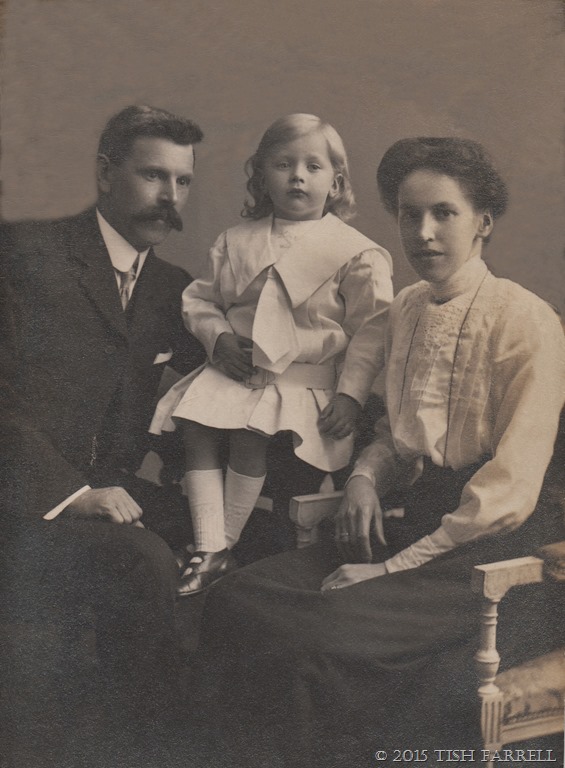
And now for the full picture from which I extracted the portraits of Alice and Charlie. Here, between them, is Alexander Charles aged three. As family portraits go, I feel this is quite striking:

Charles Alice 2

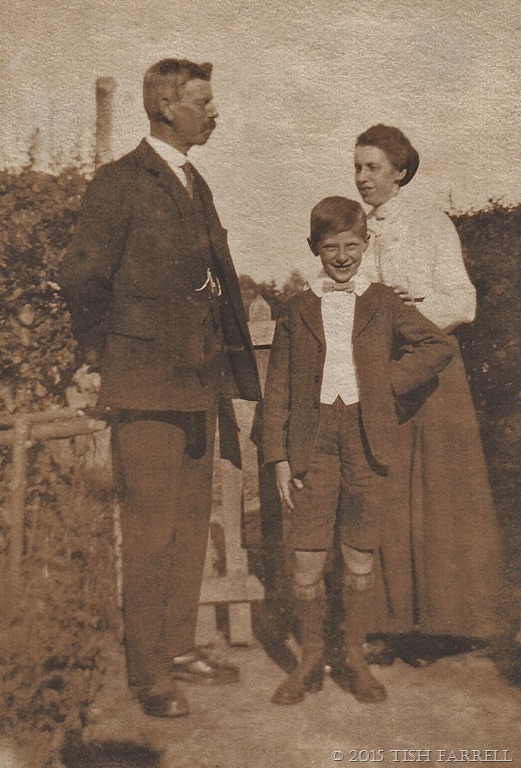
And next, here is a photo taken around 1919 when grandfather was engaged as head gardener at Redhurst, and moved his family from Streatham to live in a country estate cottage. Alex is eight or nine here, and isn’t he so pleased to pose – and with that barely felt touch of his mother’s protecting hand on his shoulder:

Charles Alice 1

This next photo is of Charlie by himself at Redhurst and was also taken around 1919. Perhaps he does have a bit of dash after all:

IMG (3)

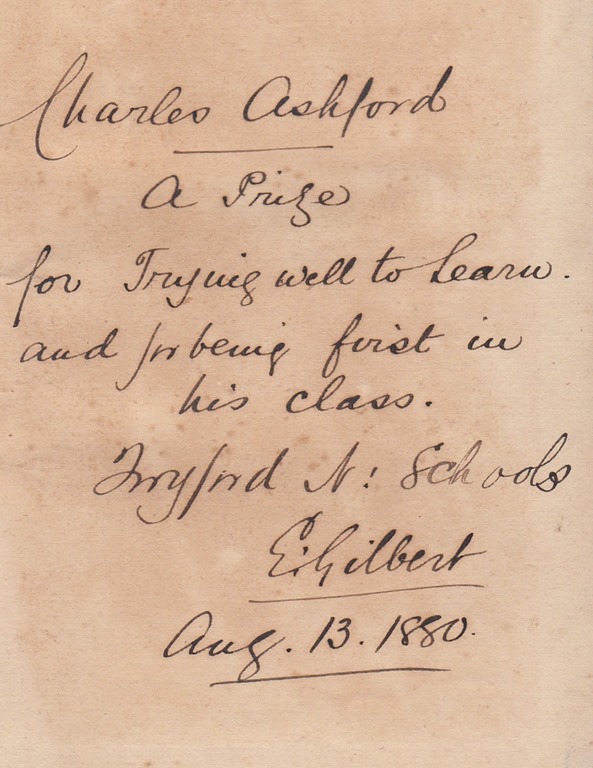
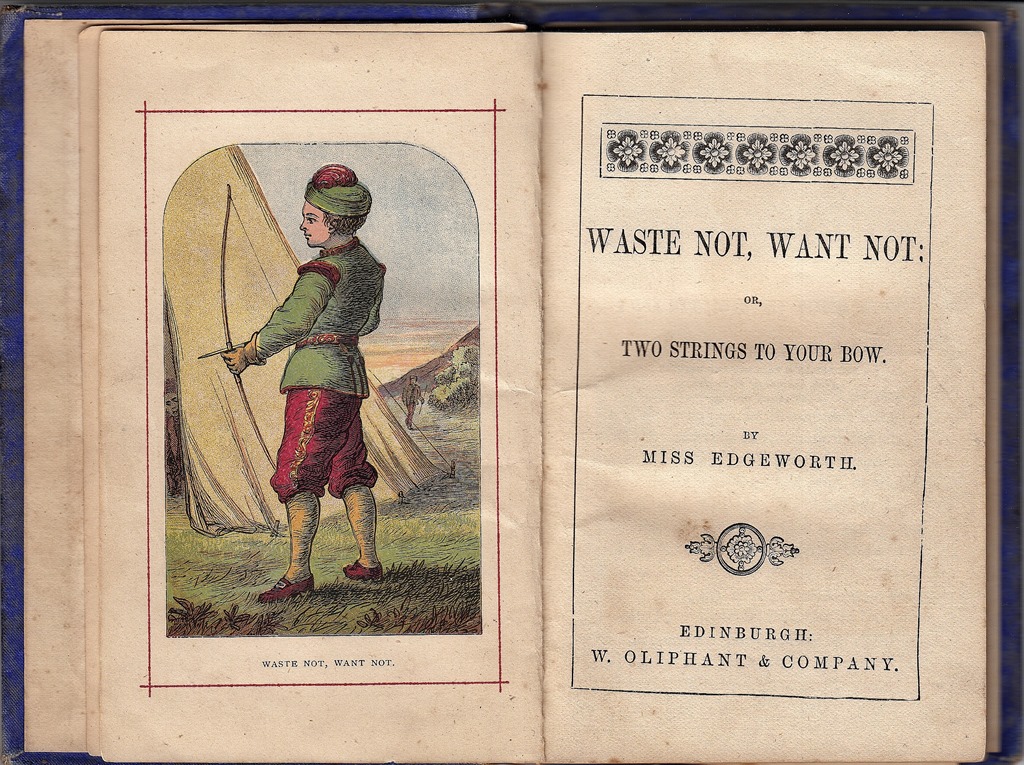
But mostly his life was about doing the ‘right thing’ without making a big show of it. I discovered among my aunt’s papers a little book that was Charlie’s school prize at the age of six.  The inscription to the little boy in this ‘improving’ slender volume is telling. I think he probably took its message well and truly to heart: waste not, want not…

IMG_0015 (2)


IMG_0016 (2)

*

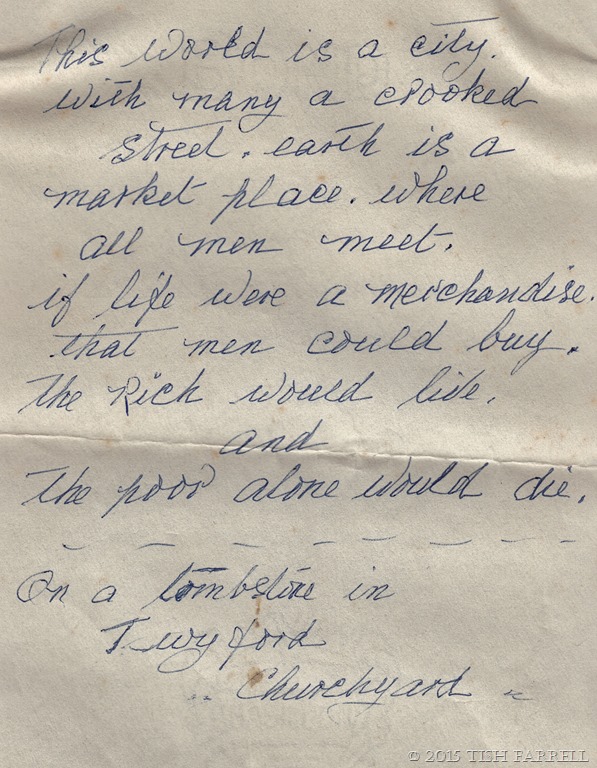
And finally another glimpse of the kind of man he was. The following is an inscription from a gravestone in the village graveyard of his Twyford birthplace that he has written down, perhaps from  memory in later life. I think the word ‘earth’ should be ‘death’, but either way these words still resonate:

This world is a city with  many a crooked street.

Earth is a market place where all men meet.

If life were a merchandise that men could buy,

The rich would live, and the poor would die.

IMG_0019

As for Alice, she spent much of her life from middle age onwards as an invalid, and died aged 65. It is not clear what ailed her exactly, but the burden of care usually fell on my teen-aged Aunt Evelyn. Evelyn was born when Alice was 40, thirteen years after Alex. My mother used to say that Charlie claimed that Evelyn wasn’t his when he first found out that Alice was pregnant again. Evelyn herself said she grew up feeling that her parents had reached a stage in their life where they didn’t want to be bothered with rearing a child. She said she never knew her father with anything other than his snow-white hair.

And so were they a happy family? Who can tell? This last photo from Evelyn’s album would seem to say so. And yet…?

IMG_0007

copyright 2015 Tish Farrell

Tales From The Walled Garden

IMG_0008

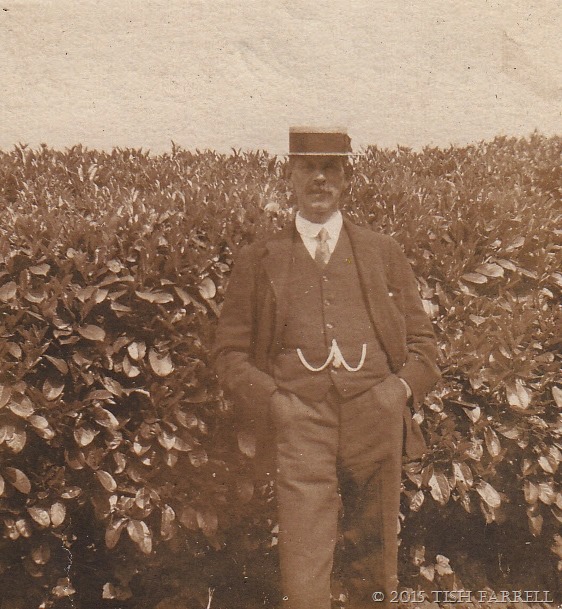
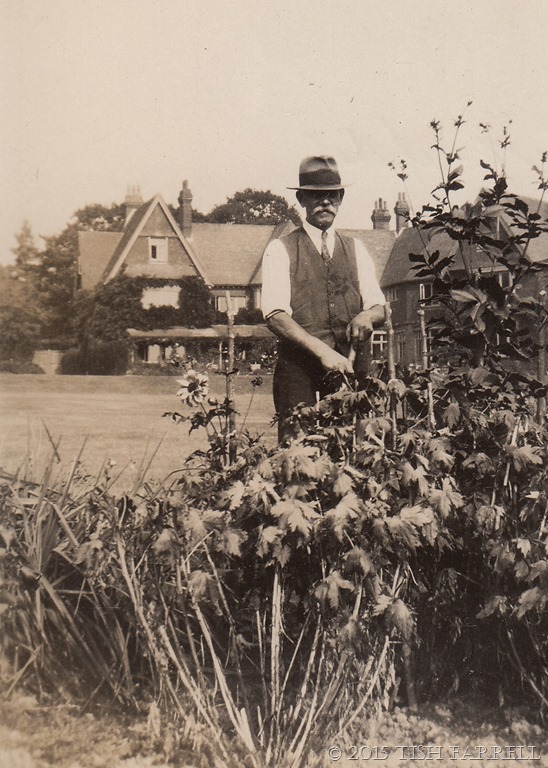
No, this is not the Tish Farrell ancestral pile, although my young aunt (standing) and my grandfather do look very much at home here. They are in the garden of Redhurst Manor, Surrey, where my grandfather, Charles Ashford was head gardener during the 1920s and ‘30s. My Aunt Evelyn was born in the gardener’s cottage on the estate, so you could say, in a way, that Redhurst  was their domain – at least for a time. Grandfather certainly ruled the garden and the men who worked under him. He was fastidious in his gardening discipline, and much else besides, and expected the same from others; a true Victorian then.

And given his sense of propriety, I think one can be pretty sure that this particular Ashford family gathering, with Grandmother Alice Ashford (nee Eaton) sitting so comfortably on the lawn (she’s the one in the dark frock, busily chatting) would not have been happening if the Major and his lady had been within.

When I was editing this photograph, I thought about cropping off a good deal of that velvet smooth lawn. But then I thought, no. The fine state of it was down to Grandfather and his team with the horse-drawn mower. I also know that  when Evelyn was small her mother used to smack her legs for rolling down that bank and getting her Sunday silk frock all green and grassy. Not the sort of the thing the very proper young lady in the photo would be doing.  She was very tall for her age, so was probably only fifteen or sixteen when captured here.

IMG_0012

I gathered from family stories that Grandfather’s employer was an Anglo-Irish cavalry man who had been burned out of his home in Ireland during the troubles. He had another house up in Yorkshire, where he and his wife would often go.

Sometimes Grandfather accompanied them if they were going up for the shooting season. He had the reputation for being a fine shot. Even so, however you look at it, this was a  most uncommon situation: a gentleman inviting his head gardener to a shooting party. My mother always said the Major’s lady was rather keen on Charles Ashford, and would invite him into her boudoir when he came to present her with the first peaches from the hot house. She would be dressed only in her silk negligee, reclining invitingly on a chaise. Mother could have made this up of course. In any case, Charles Ashford would have chosen not to notice such a state of shocking déshabillé in the presence of a member of the outdoor staff. 

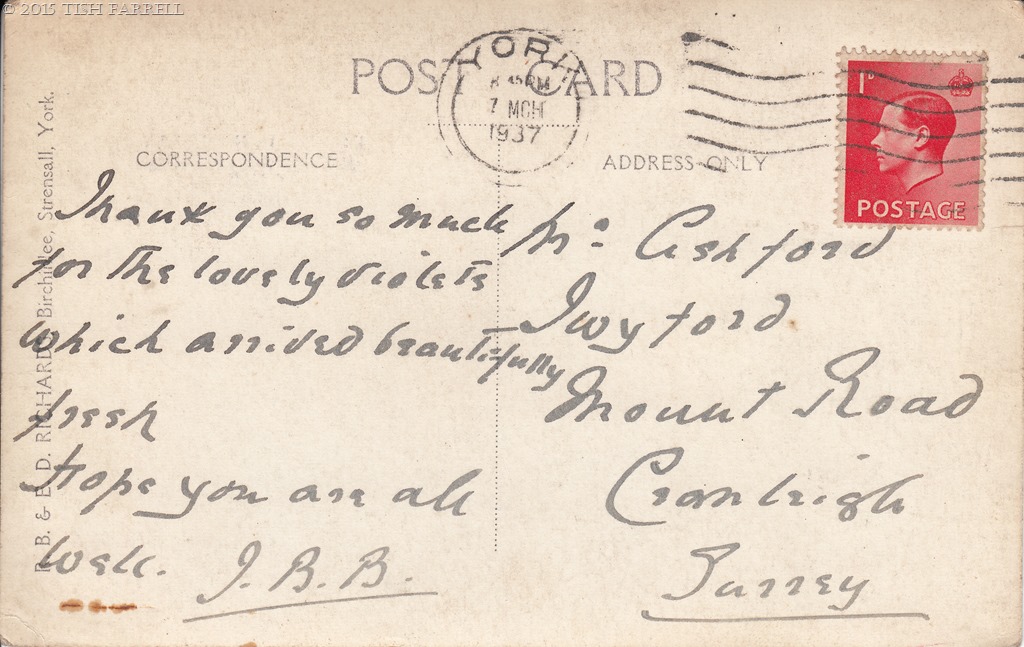
All the same, I do know he would take her sprigs of winter jasmine, arranged in little silver vases provided for him by Johnny the Butler, and selected specially by Grandfather from Johnny’s Butler’s Pantry. I also have a postcard sent to Grandfather in early March 1937, after he had left Redhurst and the Major moved permanently to Yorkshire. A touch of Lady Chatterly light?

IMG_0018

“Thank you so much for the lovely violets which arrived beautifully fresh. Hope you are all well. T.B.B.”

On the reverse side is this photo of what I assume is T.B.B.’s Yorkshire home. I am touched to think of Grandfather carefully packaging up the first spring violets to send to his former employer. I imagine him wrapping the stems with damp moss, adding swathes of paper to protect the flowers and placing all in a sturdy cardboard box, then taking the parcel to Cranleigh post office.

IMG_0017

IMG_0011

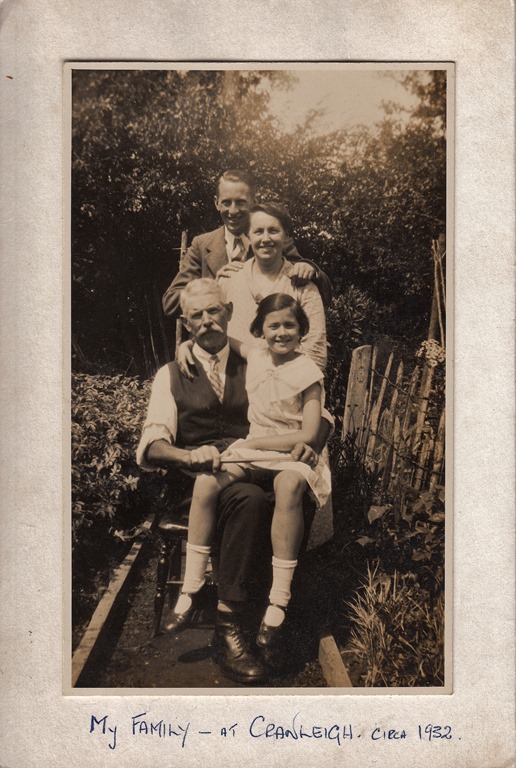
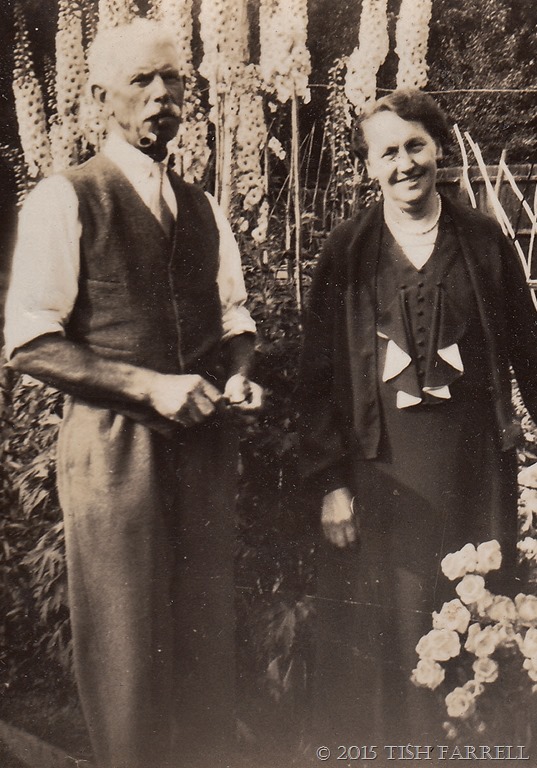
Here are my grandparents at around the time the postcard was sent. They are in the garden of their house on Mount Road, Cranleigh. Just look at those delphiniums.  They were Grandfather’s favourites, along  with heleniums. At the manor he had cultivated a big herbaceous border of mixed delphiniums and heleniums, using them to create a stunning screen between the walled kitchen garden and rest of the grounds. Such a planting scheme – spires of blue soaring through the golds, reds and oranges of heleniums, surprises me somehow; it sounds very modern – very nouveau garden designerish.

The kitchen garden was walled on three sides, and about half an acre in size. This was where Grandfather had his command post, and the reason I know this is because one of the treasures inherited from Evelyn were the notes of her talks given to her local gardening club. Charles Ashford was very much a feature. As  a small child she followed him around, taking in everything he did, although he expected her to work too. Here is her description of her father’s work place. It reveals  much about the man:

Imagine that we are standing in the holy of holies, my father’s potting shed. It was not all that large and the space was taken up with deep shelving on three sides of the shed. There was a door into the kitchen yard and another into the garden itself. On the back of one door were three large coat hooks to take the jackets that my father needed and also his green baize apron. On the other door hung his clean alpaca jacket which was worn when he went into the house, a dust coat to be used in the fruit room and his leather pruning apron with its thick, left-handed coarse leather glove sticking out of the pocket. These garments comprised his head gardener’s uniform; there was almost a ritual about putting them on for the various tasks.

My father’s own tools were hung in neat and spotless order on hooks to the left of the garden door. He insisted on clean tools and, after every task, the men had to be sure to wash, and then rub dry on old sacking any tool that had got even the slightest bit dirty. A little spot of oil was rubbed into the spades and trowels and forks until the metal shone. Wooden handles were treated with linseed oil which was thoroughly worked in. Only then could the tools be stored away. That is why, to this day, I am still using a well worn spade and fork that belonged to my father. There have been times when, if in a hurry I have hung my spade up dirty, I have gone scurrying back to give it a ‘a lick and a promise’. I can almost hear my father saying, ‘That won’t do, miss. Dirty tools make bad workmen.’

Reading these notes, I wish I had known him. I only remember meeting him twice. After Grandmother died, he lived with my aunt down in Wiltshire, and we lived miles away in Cheshire. But this next photo suggests that my father at least made one effort to visit him.

. IMG_0001 (2)

I’m about two years old here, and I’m guessing that this was Grandfather’s eightieth birthday. I have my own distinct  mental snapshot of him. Before lunch he was out in the vegetable garden in his shirt sleeves, sifting the stones from the soil in a big garden riddle. I remember being fascinated by this strange activity. My other snapshot is when he came to stay with us in Cheshire at Love Lane House. It must have been summer for I see him sitting in the sunshine outside the front door, shelling peas into a colander. I remember too, that he bought me a very beautiful little sailing yacht with a coffee coloured hull and ivory sails. I don’t think we had much luck sailing it though.  But although I did not know him, and grew up mostly with my father’s tales of Grandfather’s monumental temper, I do often think of him  -when I’m up at the allotment digging and weeding and seed sowing. I know he would be pleased to see me gardening, but I also know he would have some sharp words to say about my sloppy gardening habits.

copyright 2015 Tish Farrell

P.S. There will be more walled garden tales to follow

And here’s the answer, plus a bit of a scandal

100_5777

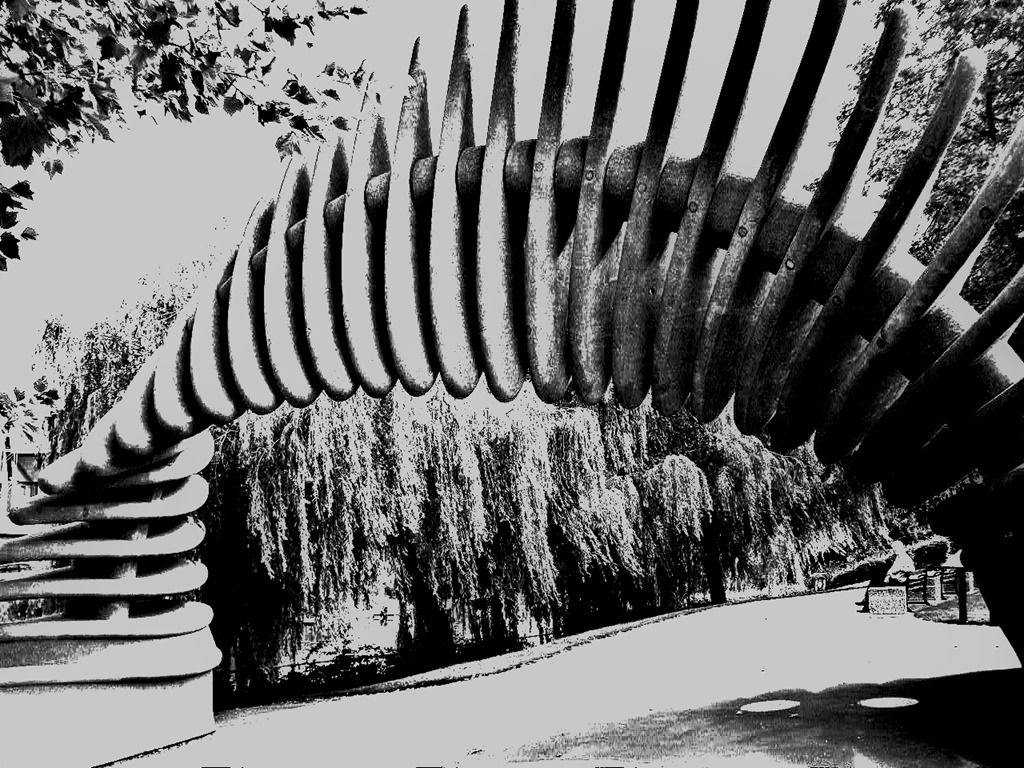
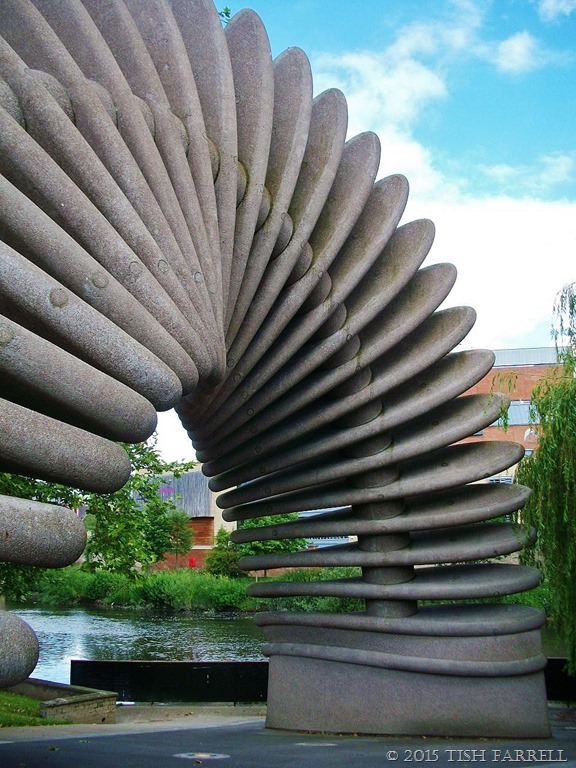
Earlier in the week I wondered what readers might make of this piece of public art, aka the ‘Shrewsbury Slinky’. Many of you picked up on the dinosaur bones, and the allusion to the double helix of DNA, both of which, we are told on the accompanying notice board, did indeed inform the thinking of the architectural designers, Pearce & Lal who conceived the structure. Some of you also guessed, or knew about the Charles Darwin connection.

Anyway, the work is called Quantum Leap, and as the explanatory board also states : “this geo-tectonic piece of sculpture has been designed through the influence of objects and materials central to the development of Darwin’s thought: rock, fossils, zoology…”

It was commissioned originally by Shrewsbury & Atcham Borough Council to commemorate the bicentenary of Darwin’s birth in 1809, and to mark the 150th anniversary of the publication of On the Origin of Species , both events well worth celebrating. The original cost to the public was expected to be around £200,000. But somehow, between the concept and its physical manifestation, things went awry on the costing front. More of which in a moment.

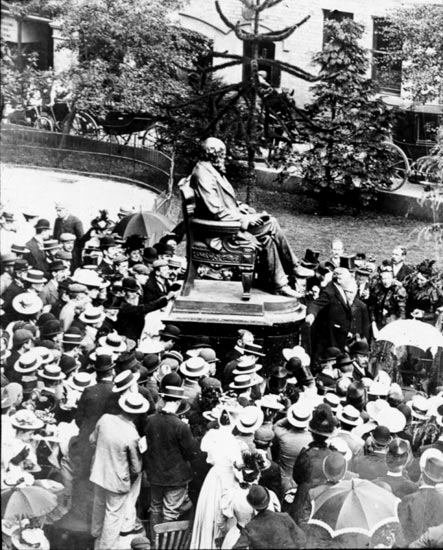
First, though, here is the man himself, sitting in his armchair outside the old Shrewsbury School, where as a youth he was student boarder. This more traditional tribute in bronze was unveiled in 1897:

100_5383

Here you can see the 1897 unveiling. By then the prestigious Shrewsbury School had moved to larger premises across the River Severn, and Darwin’s old school become the town museum and reference library. This photograph is from the Shropshire Museums collection.

image

I don’t suppose many know that Charles Darwin was a Shropshire lad, born and brought up in Shrewsbury. If we picture him anywhere at all it is probably voyaging around the world on HMS Beagle (1831-1836), surrounded by a myriad of fascinating specimens, or else lost in deepest thought, unpicking thorny issues on his Thinking Path at Down House, Kent where he lived with his family for the last forty years of his life.

The Darwin family lived on The Mount in Shrewsbury. Darwin’s father was a doctor and financier, and also a free thinker. Charles’ paternal grandfather was Erasmus Darwin, physician, natural philosopher, inventor and leading light of the Midlands Enlightenment. His maternal grandfather was Josiah Wedgwood, potter industrialist extraordinaire, and inventor. Both grandfathers were staunch slave trade abolitionists. Darwin thus grew up within the orbit of men for whom it was the norm to challenge and think outside the bounds of convention.

While his mother still lived, Charles and his siblings worshipped at Shrewsbury’s Unitarian Chapel. Charles also went to the preacher’s day school, and by an early age was already absorbed with his own natural history collections. But after Susannah Darwin’s death, Charles and his brother, Erasmus were sent off to board at Shrewsbury School. Later both would go to Edinburgh to study medicine, and Charles apparently spent the year of 1825 acting as apprentice to his father, and treating the poor people of Shropshire.

However, he found medicine dull, and seems to have spent his time in Edinburgh studying marine invertebrates and learning taxidermy from a freed slave called John Edmonstone, a man whose company he much enjoyed. An annoyed parent wisely chose not to press his son into the family profession, but sent him to Christ’s College Cambridge; he would get his degree and become an Anglican minister instead.

But once more Doctor Darwin’s plans for his son foundered. While at Cambridge, Charles continued to pursue his interest in natural history. When he graduated in 1831 he took the chance to embark on a ‘gap year’ to end all gap years, and set sail on HMS Beagle, travelling as the ship’s gentleman naturalist. The planned two year voyage turned into five. The rest, as they say, is history.

100_5792

And so back to Quantum Leap, a project that was indubitably inspired by the very best of intentions – to honour the life’s work of a native son. I’ve already mentioned the unsuitable setting, in a cramped little garden between the River Severn and the town’s busy inner ring road. It is not a part of the town where many visitors are likely to find themselves, or even wish to be. But perhaps my main objection is the material. Concrete seems such a rigidly dull substance with which to evoke structures from the natural world. I can also foresee it acquiring a slimy algal coat, which though admittedly a life form, is unlikely to add a life-enhancing effect from the viewer’s point of view. And given all the cuts in Local Authority funding, it seems unlikely that someone will be paid to come along and scrub the thing. Where would you begin?

I’m trying to think, too, what that magician of installation, Anish Kapoor, could do for it, if called on to do some remedial work. I’m imagining something in cast iron here, or in wrought iron, or polished steel. Or even wood. Or perhaps, as Marilyn Armstrong suggests in the comments on So what’s this all about?, people will just hate it so much it will be taken down. My own feeling is that it will simply be forgotten, and that is the worst outcome of all. So much for commemoration.

This brings me to the most shocking aspect of the project. As we headed into the unveiling year of 2009, Shropshire was becoming a Unitary Authority, and the Borough Council passing into obscurity. There followed various problems with the contractors assigned to construct the monument. Costs rocketed. There was a court case. According to press reports there was a chance for the Council to settle the bill when it hit £600,000. They declined. In the end the 2012 accounts revealed that the final cost had amounted to over £1,000,000. As one Labour councillor acidly pointed out, this was considerably more than the cost of Antony Gormley’s epic, acclaimed and truly colossal Gateshead landmark,  Angel of the North.

However you look at it, the final bill is staggering. In the face of austerity measures that have reduced some Shropshire residents to relying on Food Banks, and threatened so many social services, it is appalling to think of so much wasted money. But money aside, the whole enterprise now seems rather sad and silly. The original design concept for Quantum Leap has much to be said for it, but when it comes down to it, public art should serve the public who paid for it. It should be placed where everyone can enjoy it. It should be life-enhancing, spirit-raising, thought-provoking, a piece of wit or wisdom that becomes a point of attraction for locals and visitors alike. In other words, there should be returns on the investment, material and immaterial. It doesn’t of course mean that everyone has to like it. That would be too much to ask.

My other thought is that the town already has its monument to Charles Darwin. They got it right back in 1897. And although the statue might these days seem unadventurous, not to say a bit stuffy, it does at least show us the man – his intelligence, modesty and humanity – qualities that cannot be too highly valued. Not even the town’s incontinent pigeons detract from them. And so christened with bird lime he may be, but Charles Darwin looks a pretty decent old gent. His thinking changed the way we think. It took on superstition, and narrow-mindedness, and continues to challenge the scientific world to explore ever new ways to understand life on the planet. We Salopians can feel justly proud that he is one of ours.

copyright 2015 Tish Farrell


This is a follow up on my post for Paula’s Black & White Sunday theme of sculpture:  So What’s This All About?

Obsessive Compulsive Compost Disorder and why you should have it, or at least help someone who does (and that would be me)

100_4954

I truly cannot help it. I gather anything and everything that will go into my allotment compost bins. This includes not only our vegetable waste, but other people’s. My neighbours along Sheinton Street may indeed wonder how it is that the garden mowings and clippings that they throw over their back hedges can disappear so fast. I don’t really want to go round to their front doors and discuss it with them on the basis that my perceived eccentricity quotient in the town is already quite high enough. But they clearly don’t want the stuff, and they leave it in such handy piles beside the field path. I simply scoop them up on my way to the vegetable plot.

Compost foraging, however, does have its small hazards. It can, for instance, involve a close encounter with a slow worm – a copper and black snakish looking reptile that is actually a limbless lizard. They are quite harmless, but I still leap back in alarm when I touch one unexpectedly. I ought to know by now. They love warm piles of things to bask in during the day. They are to be treasured too, since they eat slugs. And yes I know that in the cycle of things slugs have their good points, and probably are useful in compost heaps, but I am utterly prejudiced against them, and admire anything that disposes of them. Toads are thus also heroes, though sadly in rather short supply.

P1010390

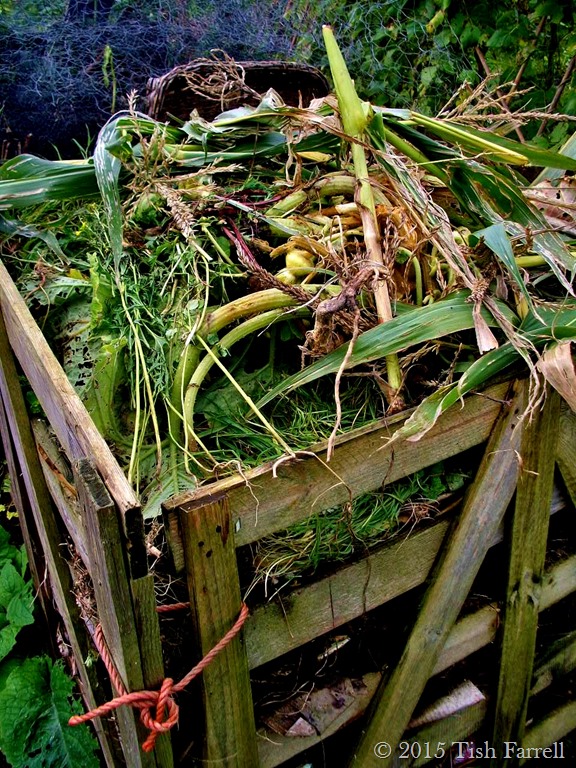
The manner of composting as formerly done by me, and displayed in the first photo is not to be emulated. A dedicated composter, and I am now trying to do this, chops big stems and stalks into short lengths to speed up the rotting down process.  It is also good have mixed layers e.g. brown, dry matter such as scrunched up pieces of brown corrugated cardboard, paper, wood shavings, leaves and small twigs. The aim is about 50:50 brown to green matter. This allows air into the mix, and so prevents a sour and smelly squidge.

Grass  mowings and animal manure will heat things up, and also aid decomposition. The heat kills any weed seedlings.  Other additives in my compost include tea bags, egg shells, vegetable parings, allotment weeds, turves from ground clearing, wood ash, hoover contents, and brown paper carriers. Every now and then I also add a layer of comfrey since it also a good compost activator.

*

IMG_1138

Comfrey is a good compost activator. It also makes an excellent plant food, keeps the bees happy, and helps mend human bones and inflamed tissues. The leaves can be made into tea or added to soup. The flowering tops contain vitamin B12 (source: Herbal Therapy for Women by Elisabeth Brooke MNIMH). Can you spot the bumble bee in the top photo? (Just testing).

100_5359

*

Ideally, the contents of the compost bin should be turned over during the growing season to aerate them, but if this is too daunting a task, and if there’s space, then three or four bins are the answer. The rotting down process will be slower, but when full, the first one is  simply left for a couple of years while the others are being filled. It’s also common practice to put a piece of old carpet over the top to help things along. My largest bin is made of four wooden pallets tied together.  It is easy to open once full, and the contents can be tipped out and turned over.

And why am I so keen on compost? Well, apart from the obvious that it feeds and improves the soil, it is also useful as a mulch, and MULCHING is my current theory on how to deal with  our increasingly ERRATIC WEATHER systems. The only problem is you need masses of it.

But applying a good deep layer around plants and between rows of crops, not only nurtures the plants, it gives them some protection in heavy rain, and stops the soil drying out in times of drought. To retain moisture it should thus be applied after watering/rain, and it will then reduce the amount of watering needed in the future. Strong, healthy, UNSTRESSED plants mean less pests and diseases. A sturdy cabbage will even withstand some slug damage.  For added protection, cover the lot with enviromesh.

My objectives for composting, however, are small potatoes compared with the goals of The Global Compost Project. Scientists involved with this brilliant initiative believe composting can mend the mess we’ve made of the planet, AND help reduce climate change. Here’s what they have to say:

“It also turns out that one easy, natural human invention is very important to boosting photosynthesis and cleaning up the mess we created.  It is Composting!

Fertilizer feeds plants nitrogen and compost feeds soil carbon.

According to Lawrence Berkeley National Laboratory and Marin Carbon Project, by spreading just 1/2 inch (1 cm) of compost on grazed rangelands, soil naturally starts to sequester more carbon out of the air via renewed photosynthesis at the rate of 1 ton per acre per year for up to 30 years.  This study was performed jointly by both organizations over a 7-year period, which clearly demonstrated proof of concept.

The results are delighting water conservationists, microbiologists, and climate change scientists around the world.  Compost replenishes the soil carbon  to balanced levels.  It is as if the eco-systems are rebooted, and within one year native grasses and wildlife rebound.  The carbon intake,  forage capacity, and water retention all fall into normal rhythms.”

For more about The Global Compost Project go HERE. And HERE for info on domestic composting from the Royal Horticultural Society.

*

And now excuse me while I go off to do some more compost foraging. Perhaps, after all, I should be enlisting my neighbours’ help. They might chuck me more stuff over their hedges instead of putting it in their recycling bins. But either way, recycling is good. So: Obsessive Compulsive Composting anyone? Just to encourage you, and to show off, here’s some of my last year’s summer and winter produce:

100_4197

P1000281

copyright 2015 Tish Farrell