Caught inside a Kikuyu garden: a memorial to Karen Blixen’s lover, Denys Finch Hatton

Denys Finch Hatton obelisk Ngong Hills

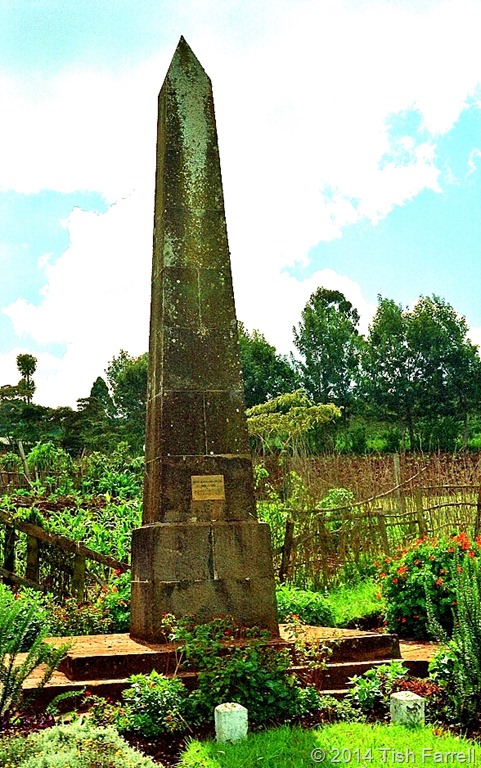
This was not supposed to happen. In fact you could say it adds insult to irony:  that a man so steadfastly dedicated to an unfettered life in the wilds should, in death, end up hemmed in, and so very domesticated within this small Kikuyu shamba. Yet here it is, the mournful stone obelisk, marking  the grave of Denys Finch Hatton,  son and heir of the 13th Earl of Winchilsea, Great White Hunter, and lover of two women far more famous than he is: writer Karen Blixen (Out of Africa) and aviator  and race horse trainer Beryl Markham (West with the Night). 

Finch Hatton's grave on the Ngong farm

Yet another woman, the one whose shamba this is, shows him a new kind of love, taking care of the garden around the obelisk.  If you want to visit the place it is not easy to find – either her little smallholding on the Ngong Hills, or the grave within. When we visited years ago we found only a hand-painted signpost nailed to a tree. We parked in a paddock outside the farmhouse door and were charged a few shillings. We could have bought a soda too, if we’d wanted. We could not see the grave though, and soon found that it was deliberately hidden from view by an enclosure of  old wooden doors. More irony here of course. More symbols of shut-in-ness. 

Denys spent most of his life in Africa avoiding any kind of confinement – out  in the Tsavo wilderness, running shooting safaris for the rich and aristocratic. His clients included the Prince of Wales (later Edward VIII) . In fact it was during the safaris for the Prince in 1928 and 1930 that Finch Hatton began to promote shooting on film rather than with a gun.

His lover, Karen (Tanne), Baroness von Finecke-Blixen lived in a small house below the Ngong Hills, some twelve miles outside Nairobi. By the time she started her affair with Denys she was divorced from her charming, but philandering husband, Bror, although they always remained friends. Her family had invested a great deal in the couple’s coffee farm, and Karen struggled to make a success of it. But the location was entirely wrong, and in the end she was forced to sell up and leave Kenya. It was during the period of selling the farm that she heard news of Denys’s death.

Scan-130429-0005

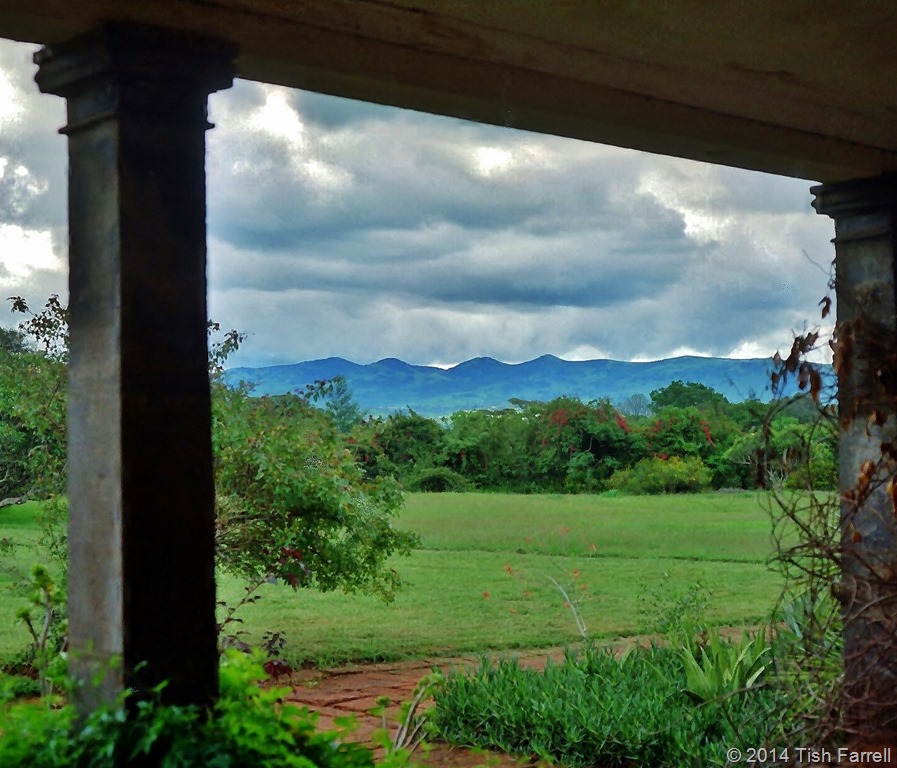
Looking towards the  Ngong Hills from inside the veranda at Karen Blixen’s house. The house now belongs to Kenya’s National Museums.

*

Scan-130429-0006

Denys Finch Hatton’s untimely end may be put down to his passion for flying. For those of you who remember Sydney Pollack’s 1985 film Out of Africa, some of the most elegiac moments of the film are when the celluloid version of Finch Hatton  (Robert Redford)  takes Karen Blixen (Meryl Streep)  into the skies above the Rift Valley.  Denys died in his Gypsy Moth in 1931, and in unexplained circumstances. He was taking off from the airstrip down in Voi in southern Kenya when his craft exploded. He and his Kikuyu co-pilot were killed. Denys was forty four.

Scan-130429-0018

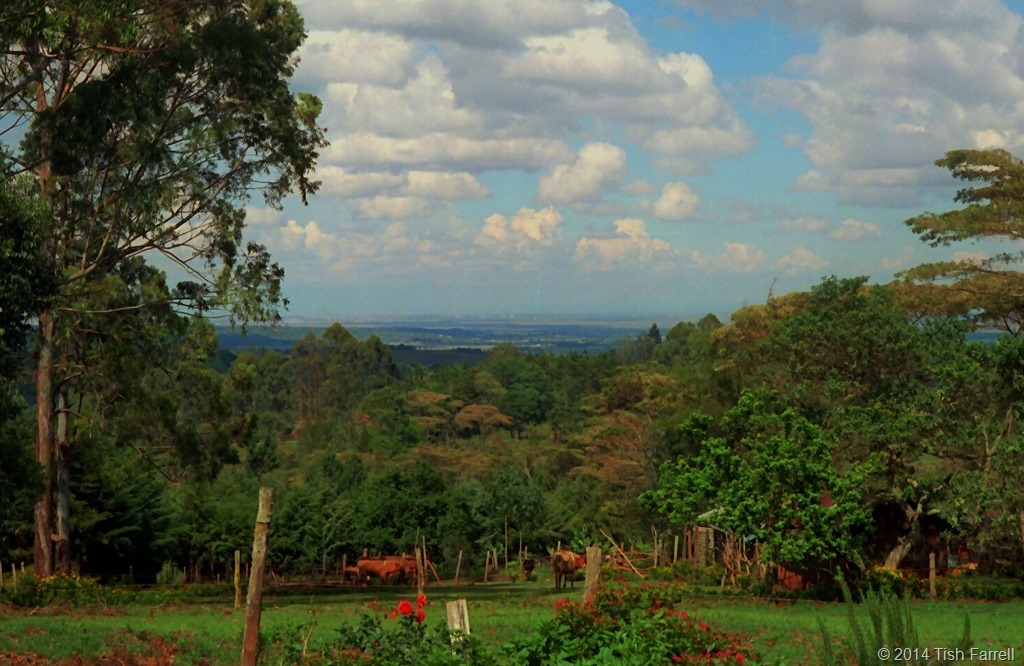
View towards Nairobi from Denys Finch Hatton’s Grave, and overlooking another Kikuyu smallholding.

*

By the time of his death, his relationship with Karen was  well on the wane, and he had already started an affair with the younger Beryl Markham. His biographer,  Sara Wheeler says in Too Close to the Sun, that there is circumstantial evidence to suggest that Beryl was pregnant with Denys’s child, but that she then had an abortion. To have known this would have truly broken Karen Blixen’s heart: her letters show that she had longed to have a child with Denys.

With yet another twist of irony, it was with his death, that Karen somehow reclaimed him, remembering that he had told her of his wish to be buried in the Ngong Hills. The spot he had chosen was one that Karen had decided on for her own grave.

013

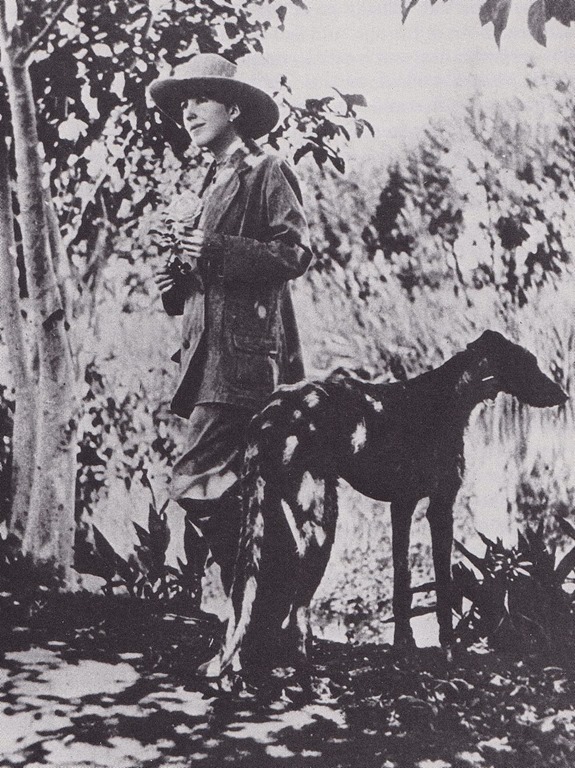
Denys Finch Hatton

Karen Blixen with her deerhound Dusk

012

There was a place in the hills, on the first ridge of the Game Reserve, that I…had pointed out to Denys as my future burial-place. In the evening, while we sat and looked at the hills from my house, he remarked that then he would like to be buried there himself as well. Since then, sometimes when we drove out in the hills, Denys had said: ‘Let us drive as far as our graves.’ Once when we were camped in the hills to look for buffalo, we had in the afternoon walked over to the slope to have a closer look. There was an infinitely great view from there; the light of the sunset we saw both Mount Kenya and Kilimanjaro. Denys had been eating an orange, lying in the grass, and had said that he would like to stay there.

Out of Africa

The obelisk was only put up later by Denys’s brother. During Karen’s last days in Kenya she had the site marked with white stones from her own garden, and as the grass grew up after the long rains, she and Farah, her Somali house steward, erected a pennant of white calico so she could see the spot from her house, some five miles away.

Sometime after she had returned to Denmark she received a letter with some strange news about the grave:

The Masai have reported to the District Commissioner at Ngong, that many times, at sunrise and sunset, they have seen lions on Finch Hatton’s grave in the the Hills. A lion and lioness have come there, and stood, or lain, on the grave for a long time…After you went away, the ground round the grave was levelled out, into a sort of big terrace. I suppose that the level place makes a good site for the lions, from there thy can have a view over the plain, the cattle and game on it.

Out of Africa

Scan-131109-0048 - Copy

copyright 2014 Tish Farrell

*

Tish Farrell is an award winning writer for young people. Her latest novella is on Amazon Kindle (5 star review):

Secrets, conspiracies, tragedy, dark comedy – a fast-paced novella of interwoven tales set somewhere in East Africa. For young adults and adults alike.

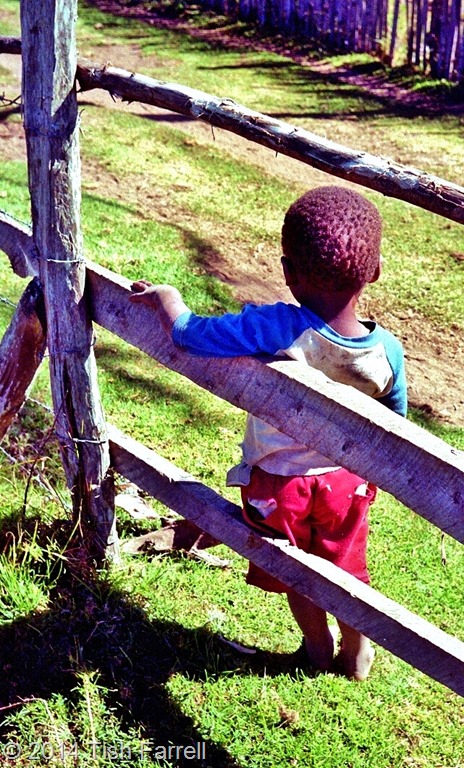
Feeling shy, but darned if I’ll show it

Kikuyu child

I took this photo while we were out on  Kenya’s highland farms looking for smut infested napier grass. You can read the full story HERE. This little boy was torn between wanting to know what we were doing on his farm, and not wanting to talk to us. I love the nonchalant drape of his arm on the fence post.

*

Go here for more bloggers’ compositions in response to the Daily Post photo advice: http://dailypost.wordpress.com/2014/02/27/rule-of-thirds/

Looking for Smut on Kenya’s Highland Farms

For those of you who read my recent post Valentine’s Day Runaway this is one of the things Team Farrell got up to next; it had a lot to do with smut. And no: it’s not what you think.

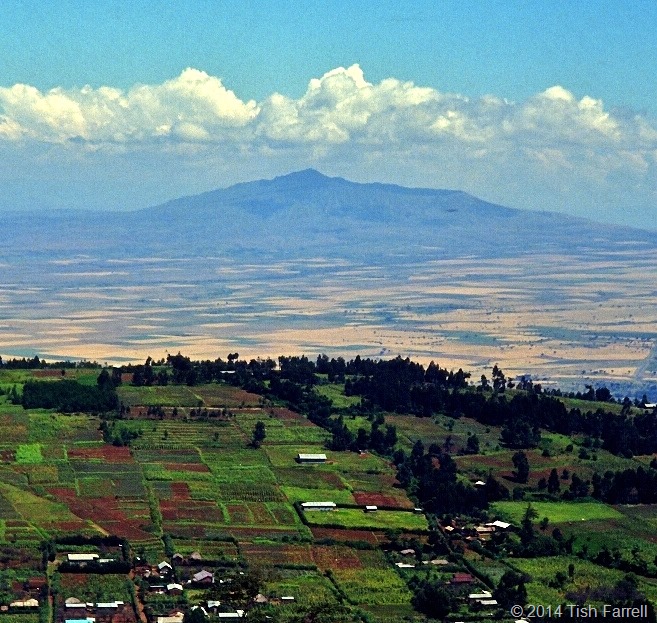
Rift Valley from Escarpment

Smallholder farms on the Great Rift Escarpment, Kenya

*

For most of the 1990s we were based out in Kenya, where Team Leader Graham, food storage expert and all-round fix-it man, was one of several  British scientists running a crop protection project alongside Kenyan scientists at the National Agricultural Research Laboratories (NARL). This work was funded by DFID, Britain’s Department for International Development, which in turn is of course funded by British taxpayers.

image

Most of Kenya’s farmers are women. Their efforts feed their families and feed the nation.

*

Many of the project’s programmes of work were done on farms, and involved helping farmers to devise their own research methods for controlling the numerous pests that attack their crops both before and after harvest. Since just about every Kenyan, from the President down, is some kind of farmer, or has a farm in the family, this was an important project, and just about everyone was interested in the outcomes. (Next time you are buying French beans or mange tout peas in the supermarket, look where they have come from. Much of this kind of produce is grown under contract on small farms like the ones below.)

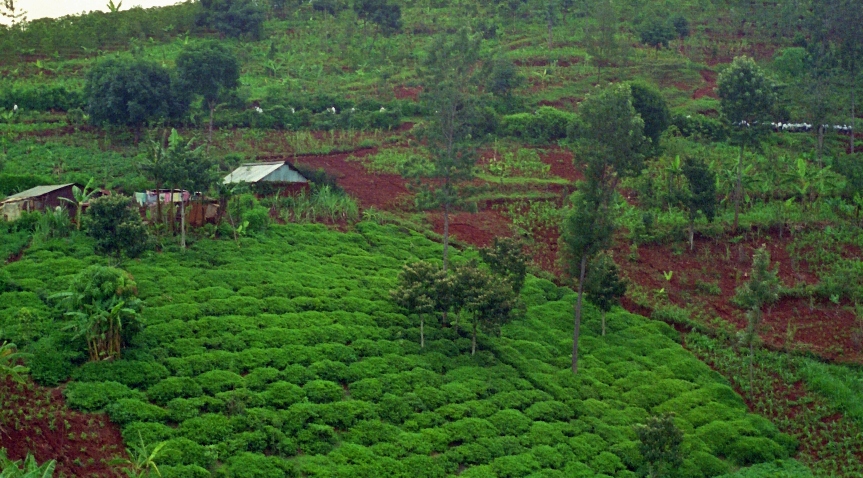
clip_image002

A typical farmstead in the Kenya Highlands north of Nairobi. The volcanic soil is very fertile, but also susceptible to erosion.

*

Today Kenya is undergoing a massive hi-tech revolution through the proliferation of cell phone and computer technology, but it still relies on agriculture for survival. When you discover that only 15% of Kenya’s landmass has enough rain or is fertile enough for arable production you may begin to see the scale of the problem for a nation that is only now beginning to industrialize. There are of course the big multinational outfits that grow wheat, coffee, tea, flowers and pineapples, but most of the food that Kenyans eat is grown on thousands of tiny farms, many less than an acre in area.

Escarpment lane

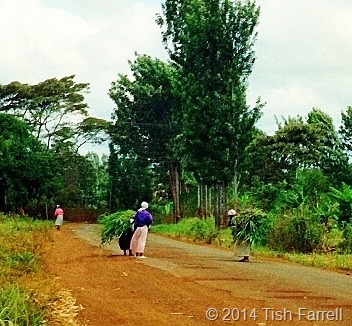
Gathering Napier Grass from roadside plots to feed ‘zero-grazed’ dairy cows. Most farms are so small that cattle are kept in small paddocks and their food is brought to them: yet another daily chore, along with gathering cooking fuel and attending to children and fields.

Kikuyu lane with woman carrying napier grass

Furthermore, most of Kenya’s farmers are women. Providing most of the the country’s food, they are in every sense the backbone of the nation. They stay in their rural homes, tending the crops and bringing up the children while husbands work away to earn extra cash to repair homes, buy fertilizer, educate their children and fund small business enterprises.

These men usually head to the cities where they work as security guards, clerks, hotel staff, house servants and drivers. Most take their annual leave at harvest and planting times so as to be back on their farms to help with the year’s most arduous tasks. So however you look at it, everyone in Kenya works very hard. Certainly in the nineties even most professional Kenyans believed that owning a plot of land to work at weekends was an essential insurance policy in a nation with no social services.

clip_image005

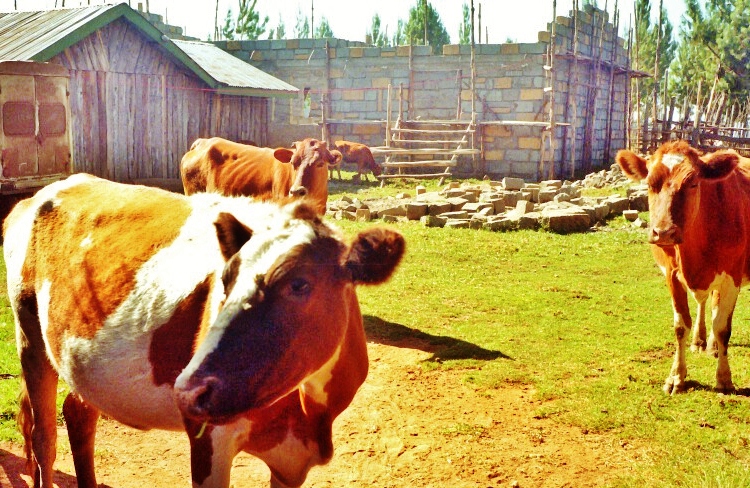
Most of the milk from smallholder’s cows is sold to provide cash to pay for children’s education and medical bills. While primary education has been free over the last few years, there are still expensive books and uniforms to buy, and secondary education is not free. On this farm the owner is also using any disposable income to bit-by-bit replace his timber farm house with a good stone house.

Kikuyu farmstead 24

*

So back in 1998, as part and parcel of protecting Kenya’s agricultural production, Team Leader Graham invited Nosy Writer (me) to accompany him on a fact finding mission around the farms north of Nairobi. We were on a quest to plot the incidence of SMUT, a fungal disease that was affecting Napier Grass, an important fodder crop. Most smallholders kept a small number of dairy cows because the selling of milk provided a valuable supplement to their income, helping to pay for school fees and medical expenses.

Most farms are too small to include pasture and so the cows are ‘zero-grazed’, that is, kept in small paddocks and their fodder (mostly Napier Grass) brought to them. This grass, if well-tended, grows into huge perennial clumps that can be cut at intervals. It can also be usefully grown on vertical banks to consolidate field terraces, or wherever the farmer can find a space, often on roadside verges. However, once smut gets a hold, the plant will gradually weaken and its food value decrease. Not only that, smut spores blow on the wind, and infect other plants. The only remedy is to root up the infected plants and burn them.

Graham and Kungu delighted to find smut on Waiyaki Way

Nothing pleases plant pathologists more than to find a nicely diseased plant. After a morning spent searching for smutted plants out on the farms, Doctors Graham Farrell and Jackson Kung’u are amused to spot a case back in the city. Here it is on a highway verge near the National Agricultural Research Laboratory in Nairobi. Smut lives up to its name and turns the flowering stems a sooty black. The fungus gradually weakens the plant and reduces it in mass and nutritional value.

*

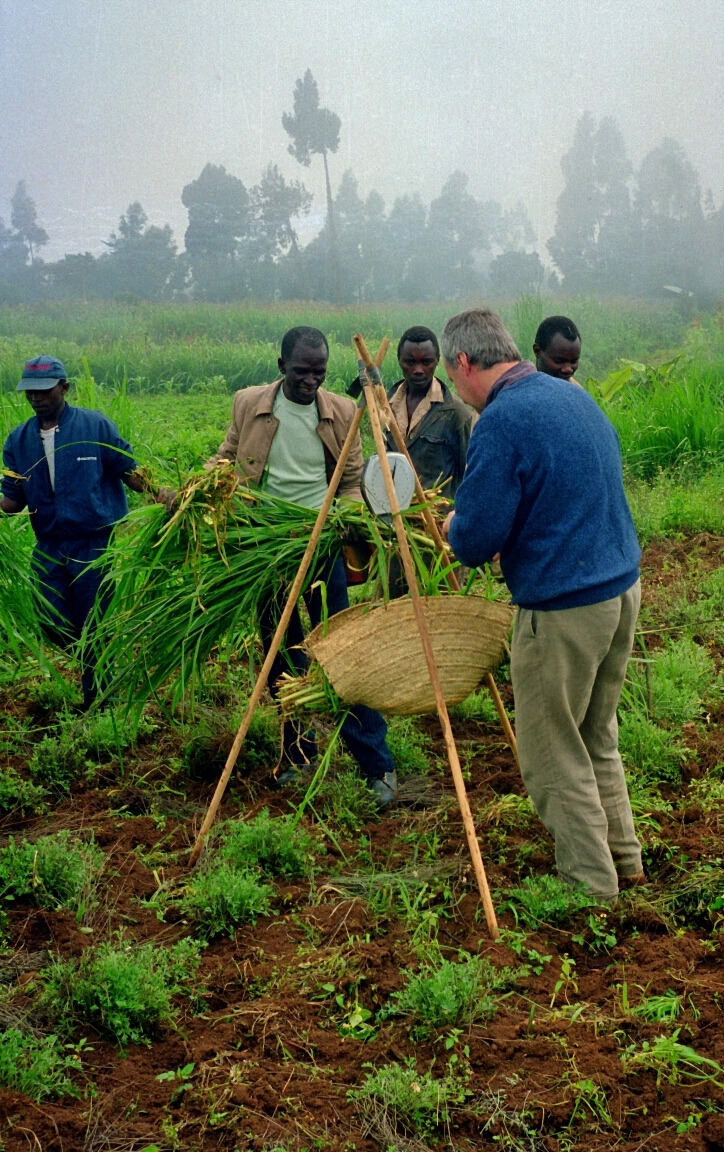
My job on the smut quest was to hold the clip-board and the other end of the measuring tape while we sampled farm plots. Our third, and  most essential team member, (in fact he was the real team leader) was Njonjo. He was the one who heroically drove us up and down the hilly Kikuyu lanes that had recently been ravaged by torrential El Nino rains.

clip_image009

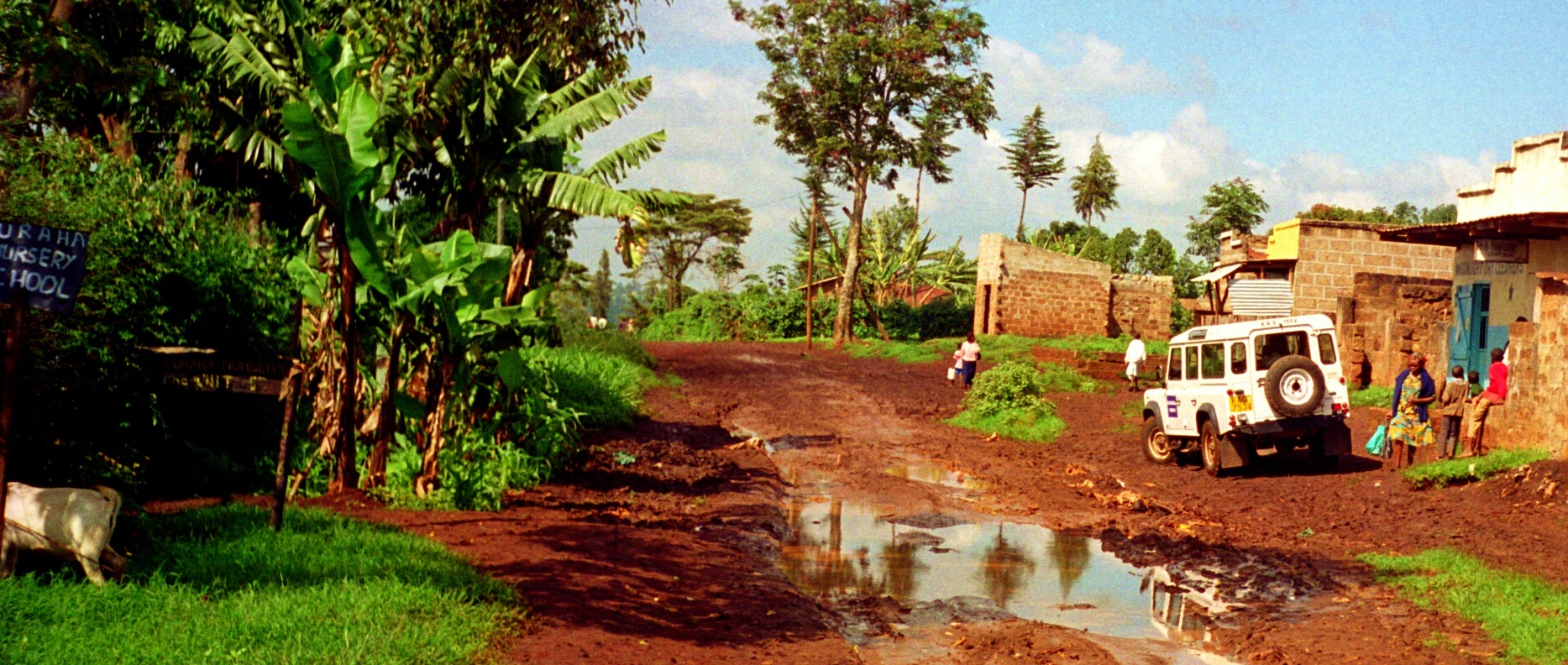
Rift lane after July downpour

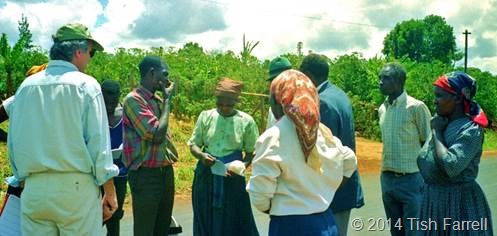
As well as being one of NARL’s top drivers, Njonjo was himself a farmer, and so had a vested interest in getting to the bottom of the smut infestation. Since Graham’s Kiswahili was a bit rusty, and many of the older farmers preferred to speak Kikuyu, Njonjo provided them with on-the-spot lectures on what they should do with their smut-infected plants. He also talked our way onto every farm, where we welcomed in with huge courtesy, despite arriving uninvited.

clip_image011

Njonjo and Margaret the farmer. She was busy making compost when we arrived on her farm.

Kikuyu farmer and sugar cane

This farmer was so grateful to be told about his smutted Napier Grass he presented us with some sugar cane. We also came home with chickens, maize cobs and bags of pears

*

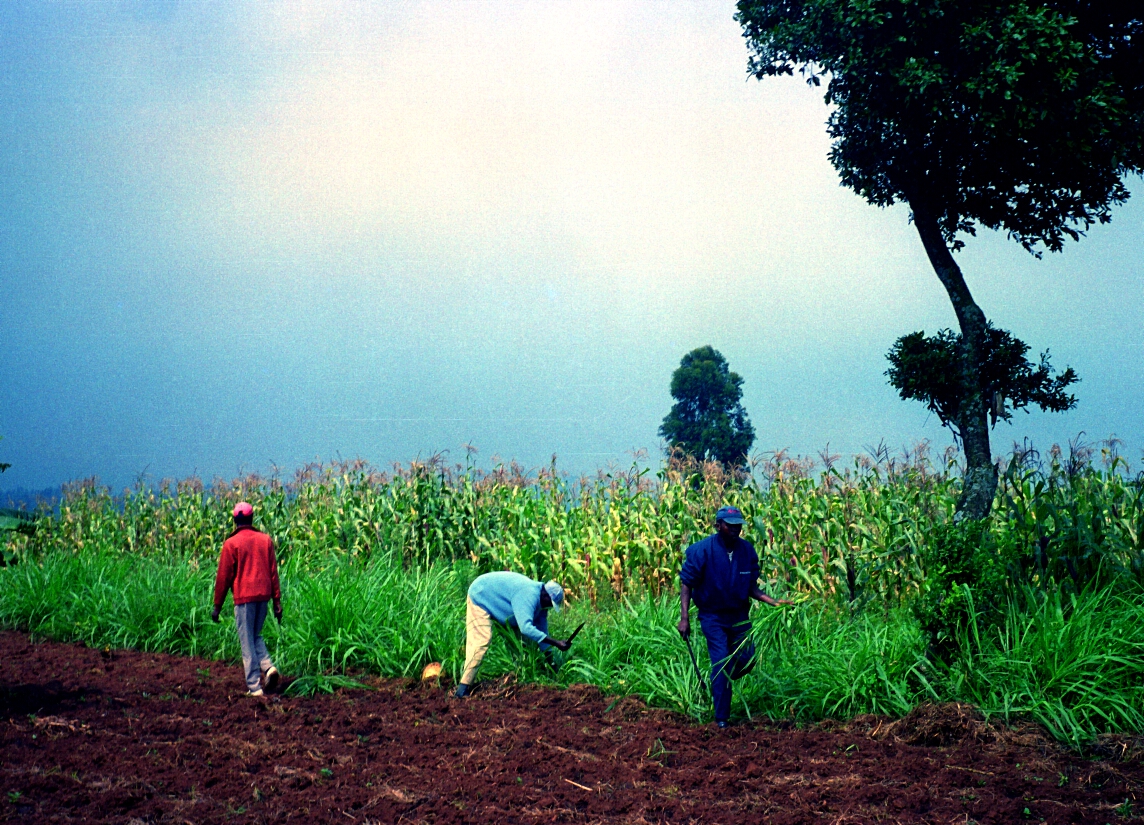
One of our tasks on the farm was to sample farmers’ Napier Grass plots to see how far they were infected, and to what extent the affected plants had lost mass. Njonjo organised a team of unemployed lads to help with the sampling.

clip_image015

clip_image017

clip_image019

Before the cell-phone revolution of recent years, farming information was hard to come by. Here Njonjo delivers his Smut Lecture to an impromptu gathering of smallholders who have spotted our arrival in their district and want to know what we are up to.

*

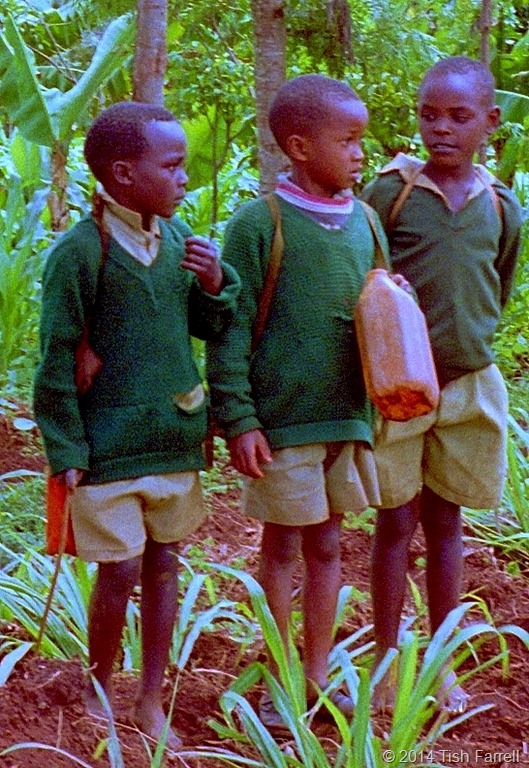
And here are three good reasons why Kenyans work so hard…

Kikuyu schoolboys

…education, education, education.

© 2014 Tish Farrell


Yellow Peril? Some Cut and Thrust Tactics on Kenya’s Matatus

002 (2)

Going down the Great Rift

*

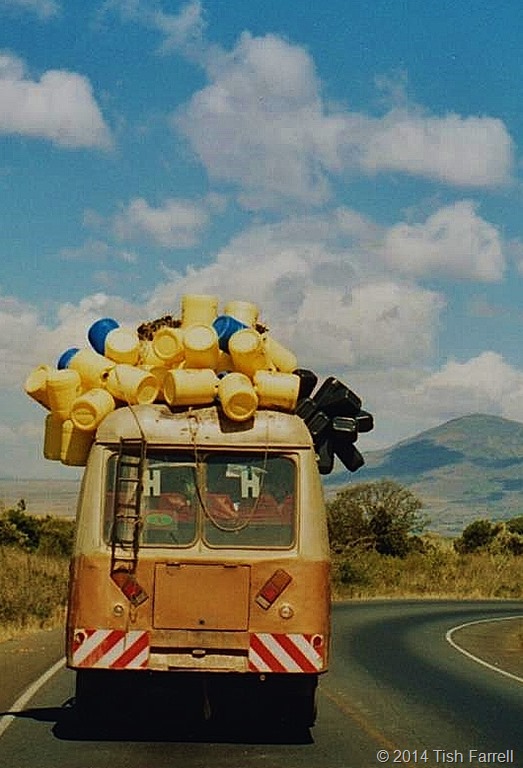
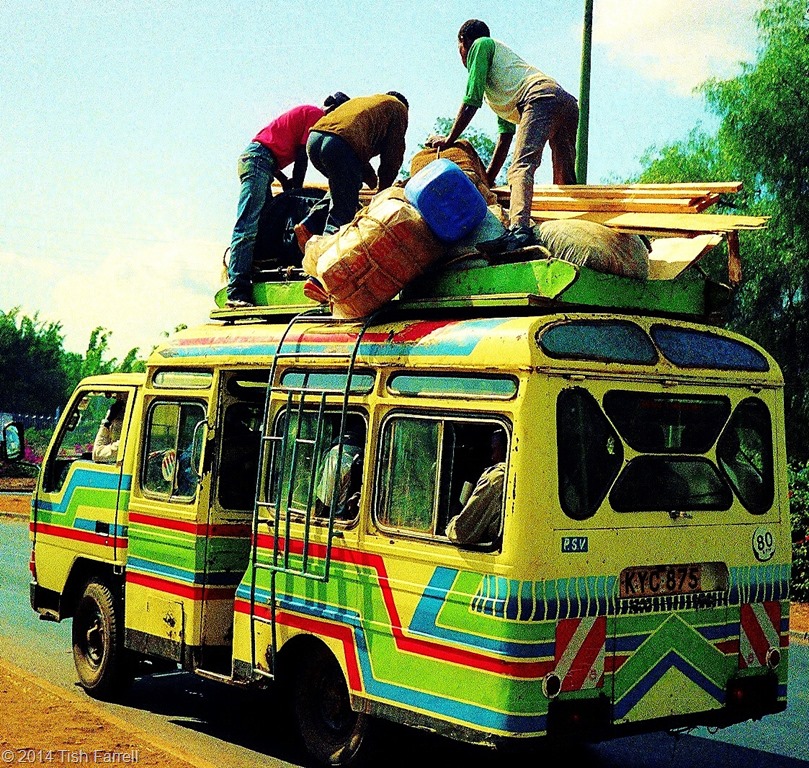
Meet the matatu, one of Kenya’s 24,000 privately owned and operated mini-buses. They are the country’s main form of public transport, taking 12 million Kenyan commuters to and from work each day. It can often be a grit-your-teeth-and-hope-to-live-to-tell-the-tale form of transport. The decrepit state of some of the vehicles, reckless driving and overloading are  frequent causes of the country’s large numbers of road deaths.

Government attempts to regulate the industry regularly stall. But whatever their shortcomings, there is always a matatu to be had, and their fares are relatively affordable. They provide the only means for many traders to transport their goods to market.

In fact you could say that matatus are an example of free market enterprise at its most vibrant/rampant – depending on your stance. This is especially true in the country’s capital Nairobi, now home to 3 million souls and counting. The competition to secure key commuter routes across the unregulated urban sprawl can be cut throat. Matatu owners hire young men as drivers and touts, and since they earn a cut of the takings, the inclination to make the maximum return from every journey, and to beat competitors  to the queue of waiting passengers, can lead to hair-raising practices. ‘Undertaking’ or cutting up on inside lanes and pavements is a particular Kenyan driving style. When we lived in Nairobi there were also anguished  letters to the local press from matatu users, saying how they had been physically ‘kidnapped’ by touts, forcing them to ride a particular bus when the did not want to.

And not only that, when it rains, the fares go up.

Scan-130603-0058

Matatu stop in Westlands, Nairobi

*

These two photos of yellow matatus were taken in the late ‘90s and are bit old hat when it comes  to the exterior paintwork. But even back then many buses were mobile art galleries. In recent times a vehicle’s ‘look’  has become part and parcel of the competition war. Owners commission the hottest young graffiti artists to paint their matatus’ livery.  The expectation is that a well ‘pimped’ vehicle will up the takings. And this is the vibrant side of the matatu business. It is creating employment opportunities for educated and creative young Kenyans who finish school but cannot find work. They have a lot to say for themselves and considerable flair. Their style is increasingly sophisticated and western influenced. Go matatu spotting and you will soon grasp what is trending in popular culture and political opinion.

Photo: Cheki.co.ke

*

Then there is the loud music, especially hip hop. This is another ‘on board’ feature designed to attract and secure clientele. The touts say it brings in the beautiful girls and stylish guys, and is all about creating a cool atmosphere.  Needless to say, the Kenyan Government has also attempted to ban the music, but enforcement is another matter.

The intense competition for business has been taking the matatu in other directions. Over 1,000  Nairobi matatus have recently gone high-tech. Commuter journeys from the city suburbs can take up to 2 hours, so providing free wi-fi has been proving a significant draw. Vuma Online was launched last April by Kenya’s biggest telecom company, Safaricom. Now passengers can pass the time stuck in the capital’s notorious traffic jams on their smart phones – checking emails and watching the news. People with particular views of what goes on in African countries may be surprised at the particular sophistication of this commuter facility. They shouldn’t be. Kenya is the East African hub of telecoms interconnectivity. This is the country that has pioneered the M-Pesa mobile phone money transfer and micro-financing system that is now facilitating so many small businesses.

But enough from me. If you want a flavour of what city life is like for ordinary Kenyans, take a look at these two short films.

Ailsa’s Travel Theme for more yellow entries besides these that caught my eye:

Melissa Shaw-Smith

Travel Words

Figments of DuTchess

PDJPIX

The Changing Palette

Photos by Emilio

The Tsavo Big Game Show: it’s a dangerous pursuit

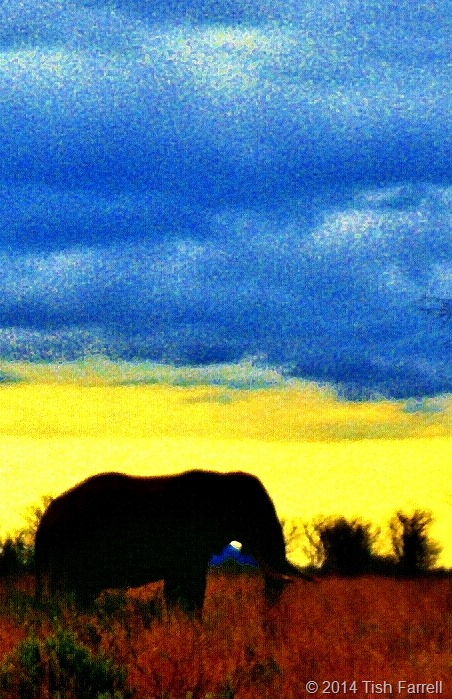
lone elephant at twilight

Night comes swiftly in the African bush but never quietly. As the sun drops behind the Chyulu Hills, so the pipe and whirr of frog and bug ratchet up a few decibels. It is like a million high tension wires being pinged and twanged. If you listen with both ears it can drive you mad. Likewise, if you allow yourself to succumb to the night’s sticky heat and the hypnotic scents of thorn flowers, then do not be surprised when the sudden scream of a tree hyrax stops your heart.

But we are not going mad. And our hearts are just fine. We think we have cracked this Africa lark. Well sprayed with insect-repellent, all accessible parts covered as can be, anti-malarials ingested, it seems safe to sit out on our veranda at Kilaguni Lodge  and do some night-time big game watching. 

Below our room is a barren stretch of red volcanic earth, and a water-hole lit up by two search lights. The illuminated circle that the lights create is like a stage set. It seems we are seated in a mysterious wildlife theatre waiting for the cast to appear.

The contrast is disturbing. By day, this self-same set is furnace red, littered with volcanic spoil; it is the haunt of the cadaverous-looking marabou storks and the occasional zebra. By night, all is softer, surreal. You feel you might dissolve through the light into perpetual darkness; for out there the night goes on forever, doesn’t it?

And so we go on gazing at the scene. It takes some time to realize that small groups of impala are emerging from the gloom. Their stillness is mesmerizing. Perhaps they are not there at all.

And then…

And then…

The impala are wary. You can almost see the charge of anxiety ripple through the herd. We hold our breath and stare into the dark behind the lights.

And then we see them – black hulks gliding through the thorn trees. Elephants. They have come so silently, walking always on tiptoes, their heels cushions of fat to muffle their footfalls. Slowly they move in from the bush. Even in the dimness beyond the pool, their hides glow red, irradiated by the igneous dirt they have blown over themselves.

In the wings the elephants pause. It is hard to say how many are there. After a few moments two peel away and the rest of the group retreats again into darkness. Two large matriarchs now head for the pool. At the water’s edge they part, and in matched strides stake out the water-hole from opposite directions. There’s an angry trumpeting when an impala fails to withdraw fast enough, and only when the entire bank is clear do the elephants go down and drink. But they have hardly taken a couple of gulps when they move back and take up guard duty, one at each end of the mud bank.

We are transfixed. We cannot fathom the plot, but note that, despite the elephants’ aggressive stance, there has been a concerted gracefulness to their routine. It crosses my mind that the great choreographer, Balanchine, once made a ballet for elephants. Now we see they have dances of their own.

And so we wait.

Slowly the rest of the group reappears, moving as one in the tightest huddle. As they enter the spotlight we understand. Tucked safely between the legs of four large cows are three infants. Like precious celebrities surrounded by an escort of heavies, the youngsters are guided to the water. There, with tiny trunks they cannot quite control, they drink their fill. The whole thing takes only a few minutes. Then, with this life-and-death task accomplished, the sentinels re-join the group, and the small herd leaves as silently as it came, melting into the backdrop.

So: this drama is over; the stage empty. After the thrill there is anti-climax, a strange sense of banishment; depression even. We go to bed, suddenly overcome by the heat and with too many insects on the brain.

Inside, though, the room is hotter still; windows shut fast against malarial mosquitoes. Even so, and despite the rock-like pillows, we sleep for a time. At midnight it is the menacing whine of a mosquito that rouses us to a bleary-eyed seek and destroy mission. At 2 a.m. we are awake again as two waterbuck lock in high-snorting combat below our veranda.

G. huddles back in bed. I press my nose to the window. It’s at times like this that Africa looms largest, that you know you are out of your element. Night stretches ahead like a herculean trial. I stare once more at pale stage in the bush. The impala have drifted back to the pool again, but they barely move. It is like watching a Samuel Becket play where nothing much happens.

And yet…

Suddenly the antelope are on full alert – rigid stance, ears pricked, noses twitching. I stare and stare. At last I spot movement, a sinuous shape pressing through the low scrub. The impala rise on hoof-tips, torn between staying and fleeing, and then the lioness steps out from the grass and pads down to the water.

The impala draw back, still unsure of the big cat’s agenda. The lioness parades around the waterhole, but does not drink. Instead she finds a clump of grass and lies down, head up, still as stone, commanding the pool  – a heraldic lion couchant. Now it is clear. None of the animals can drink. The tension is visible. This is a new kind of drama: feline power play.

But I cannot wait for the denouement. Worn out, I return to my hard pillow and tangled sheet.

The next time I wake it is light enough to know that I can abandon all efforts to sleep. It’s a huge relief. While G. slumbers on, I step out into cool of the veranda. In the dawn light I see that last night’s set has mystically expanded into a vast new backdrop. Now the Chyulu Hills rise above the dry plains, a vision of impossible greenness that belies the violence of their birth. For these hills are new, erupting around the time Sir Francis Drake was bowling off Plymouth Hoe and ignoring news of the advancing Armada. It’s hard to believe.

But this is not all. To the west, the snow-capped crown of Kilimanjaro breaks free of the earth and floats high on a wreath of pink clouds. It makes me want to hoot with laughter. Who does this Africa think she is? Does she really expect me to be taken in by  all her absurd illusions? Poof! The mountain snuffs out and leaves only sky. (Is this possible?) And I, like the victim of some worming parasite, know I am becoming infected. All our defences are useless. This land is creeping under my skin and invading all my senses. More likely than not I will never be the same again.

© 2014 Tish Farrell

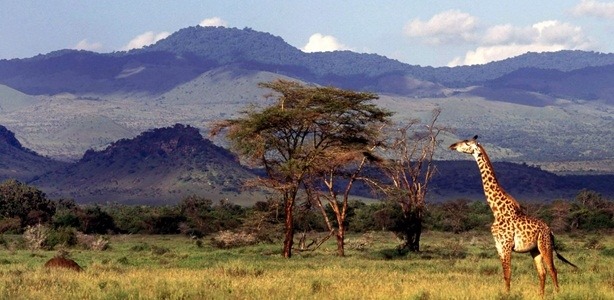
Kenya; Chyulu Hills; Campi ya Kanzi - Giraffe in the Chyulu Hills

Chyulu Hills. Photo: Abercrombie & Kent

Daily Post Prompt: write here, write now


Wind in the palms on Kenya’s coral shores

Scan-130603-0061

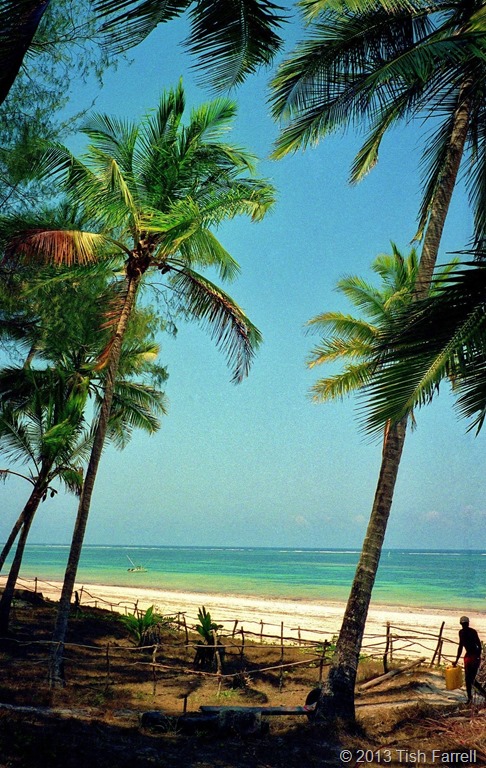
Tiwi Beach, South Mombasa

*

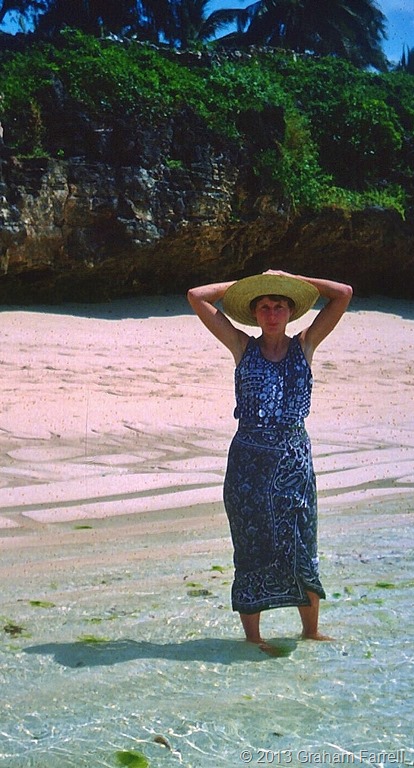
These leaning coconut palms and the photo of me holding on to my hat remind me that there is nearly always a breeze on Tiwi Beach. You need it too. In the hot season, around December to February, it makes the sticky tropical humidity bearable. It also keeps malarial mosquitoes at bay.

Scan-130520-0018

Don’t let go! Me, at Capricho Cove, too many years ago

*

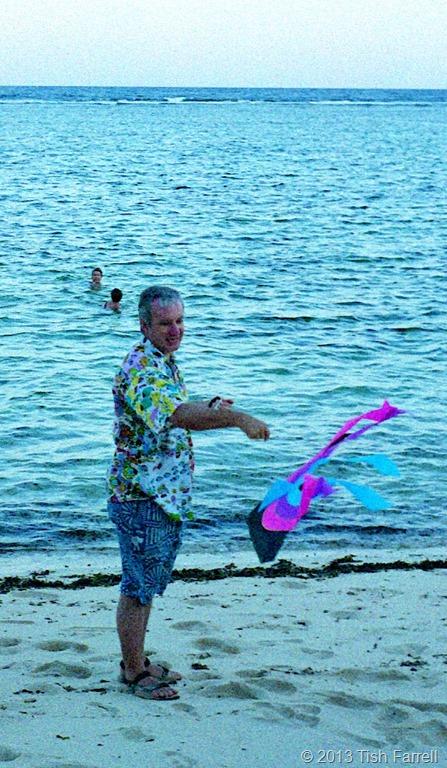
But the tropical breeze is not so good for kite launching. The team leader never did get his kite airborne.; the wind endlessly beating it into the sand. No matter. I think we decided that kite flying was probably too active an activity, even at the day’s end. Much better to crack open a Tusker beer, one almost chilled in

Graham tries to fly his kite

Graham not flying his kite at Maweni Cove.

*

the beach cottage’s rackety  refrigerator.

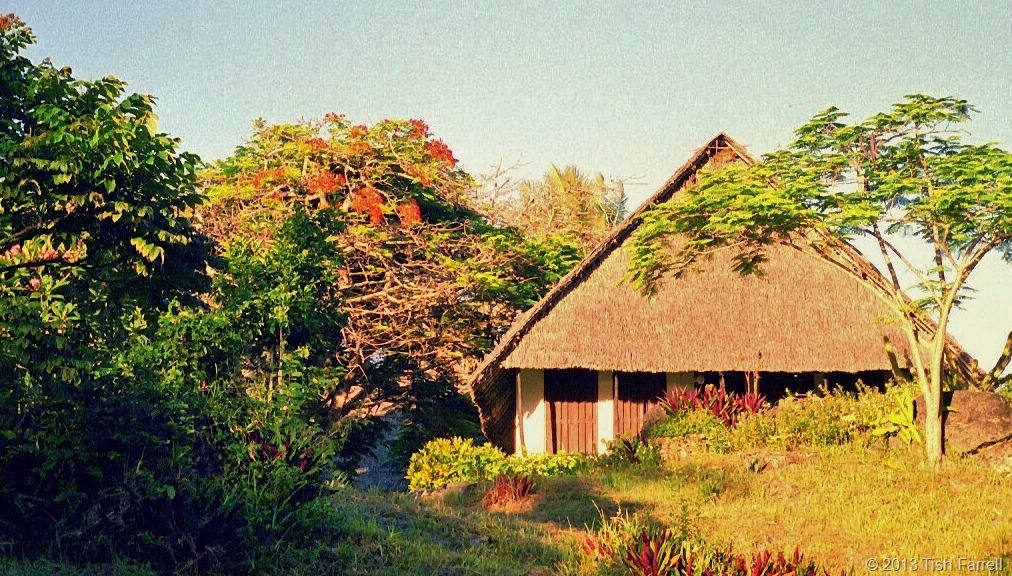
Maweni cottage at sunset

Maweni Cottages built in the Swahili style.

*

In the holiday season, and especially at Christmas, these beach villages tend to be the haunt of expatriates (especially aid workers), and mixed race families who do not always receive the best of treatment in Kenya’s fancy beach hotels. The cottages are designed to keep out too much sun and let in maximum draught: coral rag walls, high makuti  thatch, glassless windows and shutters with moveable slats. This is of course a European take on indigenous Swahili architecture.

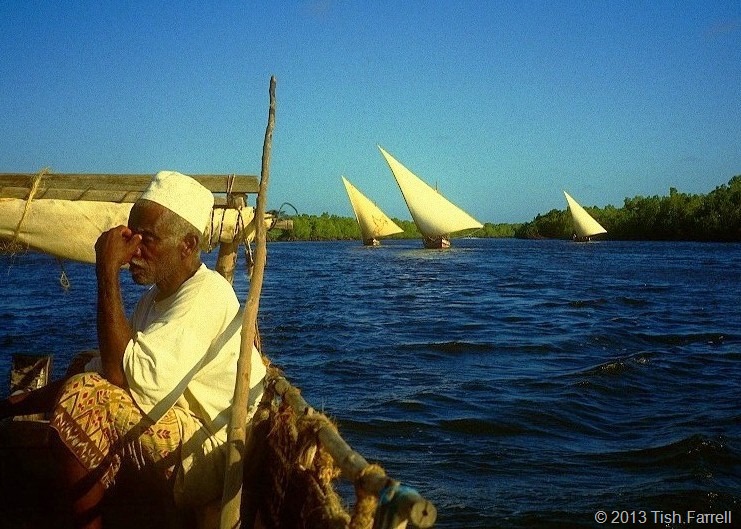
I have written in another post about Swahili culture and how it might be said to have been shaped by the monsoon winds: the north-easterly Kaskazi that for centuries brought Arab merchant ships down the coast of Africa; the south easterly Kusi that blew them away again after a windless sojourn during which sailing dhows were beached and repaired and liaisons with African communities forged.

From this age-old congress between Arab seafarers and Bantu farmer-traders, came a blending and melding of body, mind and spirit that evolved into the urban coastal people whom we know as the Swahili. Their language, KiSwahili, is also a fusion: of Arabic and Bantu vernaculars, and as such, presents a fascinating exemplar of multicultural integration that has forged a distinct identity of its own. That’s something to ponder on, isn’t it: how different races can create together; how it took the monsoon wind to bring them together?

Salamu (Greetings)

Scan-130429-0098

A Word A Week Photo Challenge: Wind: go here for more wind stories and see the ones below:

http://irenewaters19.com/2013/12/19/a-word-a-week-wind/

http://hamburgundmeehr.wordpress.com/2013/12/18/a-word-a-week-photograph-challenge-wind/

http://geophiliac.wordpress.com/2013/12/18/a-word-a-week-photography-challenge-wind/

http://bambangpriantono.wordpress.com/2013/12/18/a-word-a-week-photograph-challenge-wind-angin-the-wind-blown-flag/

http://schelleycassidy.wordpress.com/2013/12/17/a-word-a-week-challenge-wind/

http://mang0people.wordpress.com/2013/12/17/a-word-a-week-photograph-challenge-wind/

http://emiliopasquale.wordpress.com/2013/12/16/a-word-a-week-photograph-challenge-wind/

http://sillarit.wordpress.com/2013/12/16/a-word-a-week-photograph-challenge-wind/

Related:

Weekly Photo Challenge: Culture (The Swahili)

Travel Theme: Beaches (Mombasa)

Christmas on Lamu: views of a Swahili Community

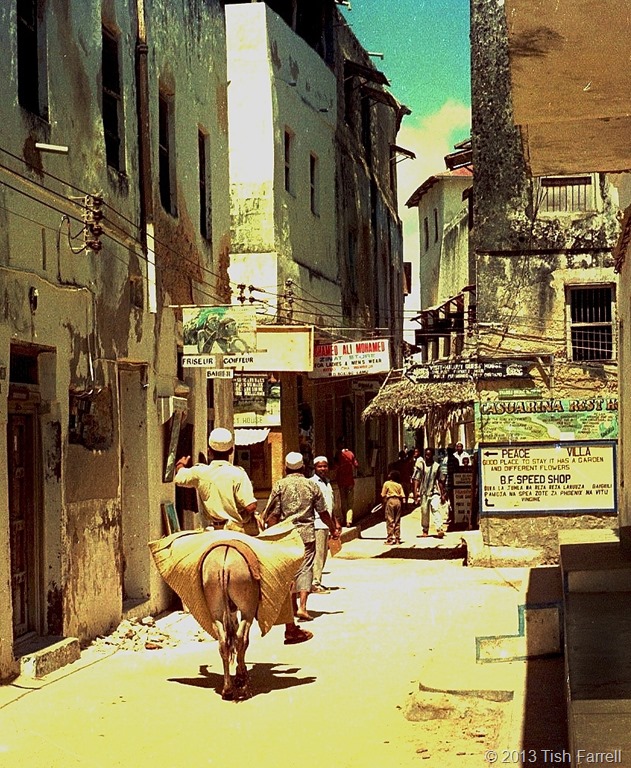
Scan-130428-0010

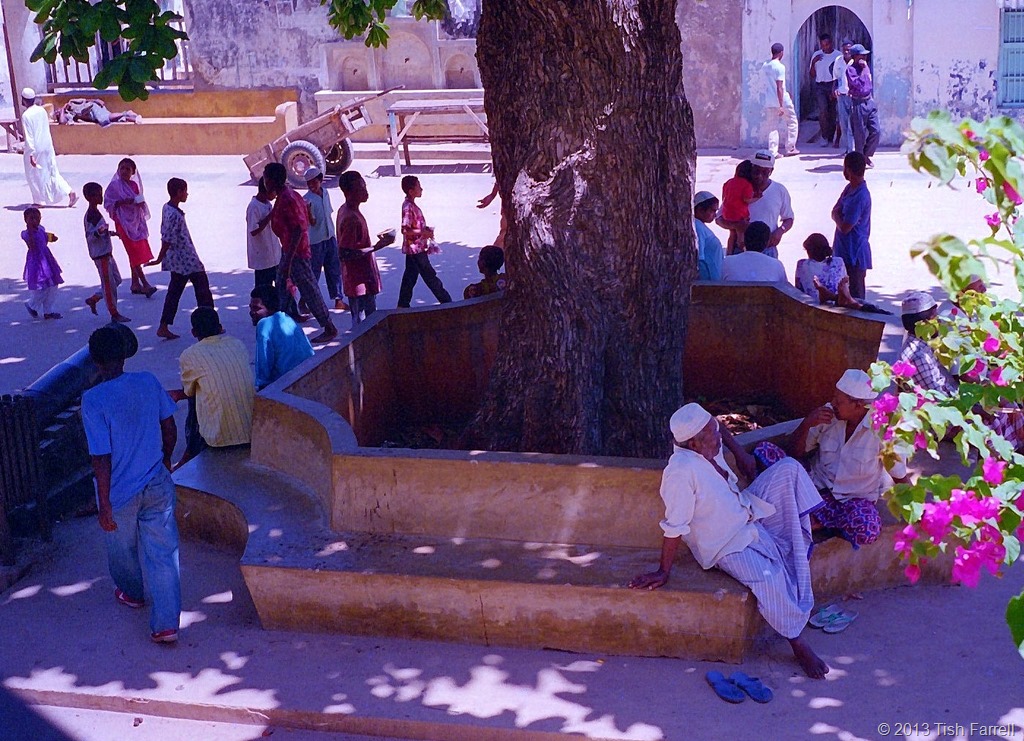
Main street, Stone Town, Lamu. No cars only donkey transport.

*

I learned a great deal about community when I was living in Kenya where it meant not only an affirmation of cultural identity, but also an expression of hospitality; the call to an absolute stranger of  “karibu,” “come on in!”

And so it proved to be one Christmas, when we spent a few days on the Indian Ocean island of Lamu. I suppose, in amongst the excitement of organising our flight there from Nairobi, I had wondered what it might be like to spend a Christian festival within a strongly Muslim community. Or perhaps I had gone there expecting simply to forget it. I know I had thought about clothing, packing only things that would not cause offence by too much inappropriate exposure.

Scan-130426-0012

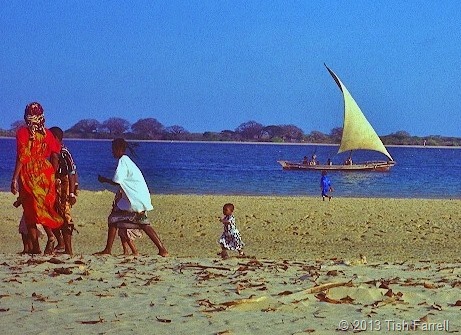
Christmas Day on Shela Beach, Lamu

*

But I had not expected to feel so  ‘gathered in’. From the moment we were picked up from the tiny Manda Island air field, and taken by dhow taxi to the Island Hotel in Shela Village we were quietly embraced by the locals.

Sensation was anyway heightened: it had just stopped raining as we stepped ashore and followed our guide up damp sandy paths. The sense of unobtrusive acceptance somehow fused with the scent of jasmine, the touch of steaming coral walls of deserted gardens and tumbled village houses, the warm salt breezes. 

Scan-130429-0029

At five a.m. on Christmas Day we woke to the call to prayer at the local mosque.  Allahu akbar  filled our room, and unavoidably so when the roof was only a thin layer of palm thatch and three of the walls were open to the elements. It seemed a transforming moment somehow. I lay in the little Lamu bed, and listened to the village stirring to life around us, hee-hawing donkeys, the clatter of kitchen pots and pans, radios quietly playing. It seemed a community well set in its ways, and for many generations. Yet later, when we set out to walk along the long strand to Stone Town, we were greeted from every side by smiling locals. “Happy Christmas!” they cried. “Happy Christmas!”

Scan-130426-0010

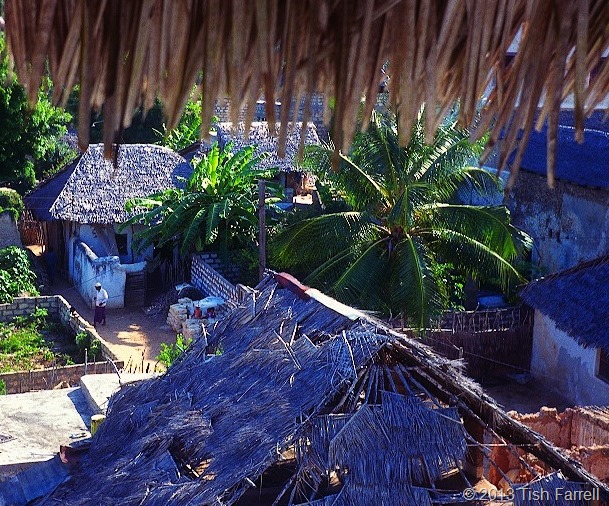
View from ‘the pent-house suite’, the Island Hotel, Shela

*

Scan-130426-0004

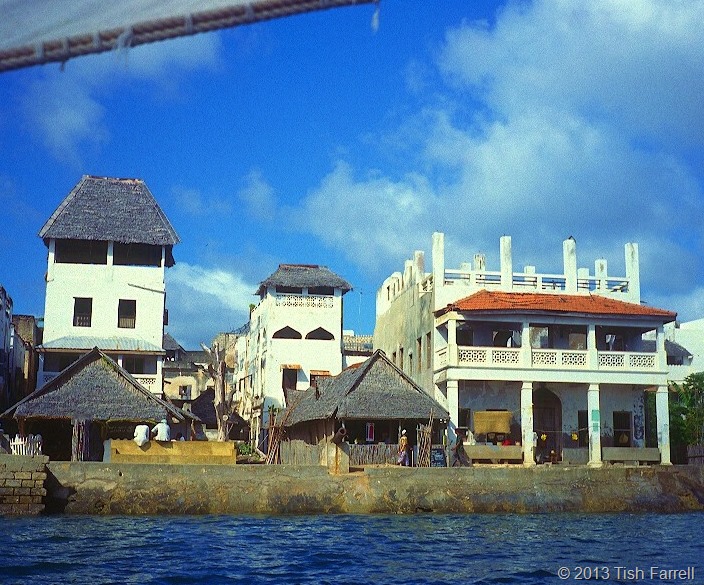
Stone Town, Lamu, now a World Heritage site

*

Scan-130428-0063

Christmas Day afternoon: a time for strolling, snoozing, chatting.

*

Scan-130426-0019.jpg

We went sailing with Uncle Lali: I see three ships…

Weekly Photo Challenge: Community

Daily Prompt: Memories of holidays past

Related:

Sleep (Lamu Dreaming)

Culture: the Swahili

© 2013 Tish Farrell


Blue Lagoon

Weekly Photo Challenge: Horizon

DP Daily Prompt: The Golden Hour

sea-and-sky-on-the-reef-at-Tiwi.jpg

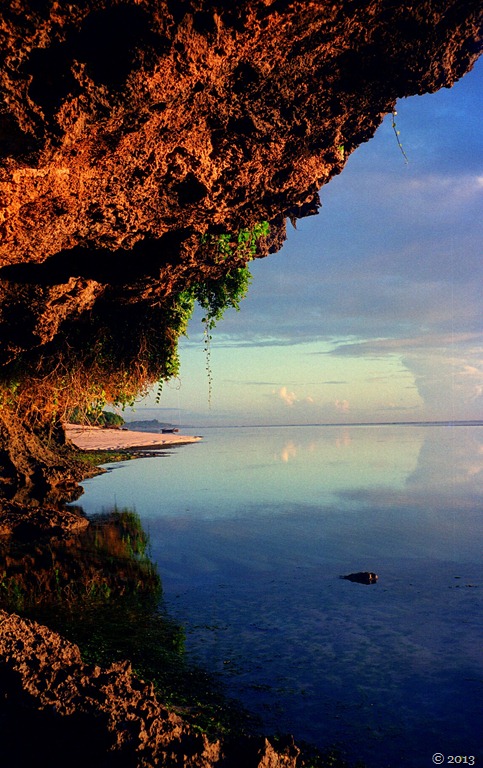
Beyond the shore, the reef, the sea, and then the sky: dawn one Christmas off Tiwi Beach, Mombasa

*

Other striking horizons:

Fractions of the World

Wind Against Current

Jolie Petite Maison

Hope*the happy hugger

Be Happy

Belgrade Streets

Artifacts and Fictions

vastlycurious

Northwest Frame of Mind

DARK CIRCLES, ETC

copyright 2013 Tish Farrell

No way back from Africa: the road to Hunter’s Lodge

010

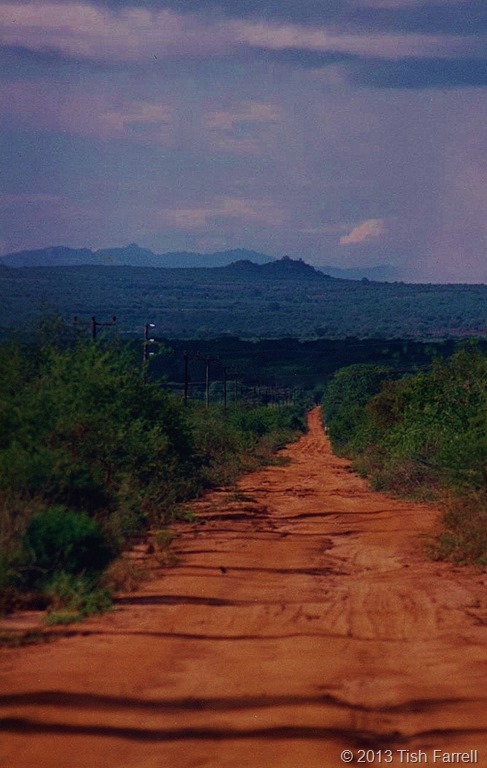
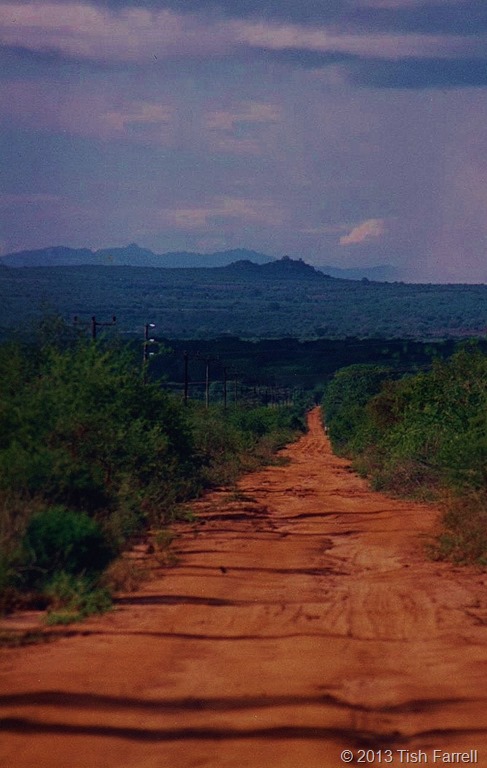
The road from the Range Station to Kiboko

*

I can pretty much bank on it. Once you have been in Africa you will never be the same. Nowhere else will you feel so alive, or so in love, or so entranced or indeed, afraid. In the physical sense, your blood and guts may well bear traces of the diseases and parasites you encounter there for years to come. Certainly the psyche will be forever afflicted by acute withdrawal symptoms, the loss of sensation, the no-longer-state of being always in the present – the only way to live back there.

In elemental ways too, standing, for instance, in East Africa’s Rift Valley, you could well find yourself confronting your genetic heritage for the very first time: the dazzling revelation that this is the land where your ancestors stood up on their apes’ hind legs and marched onwards to the age of technological development that we like to call civilization. It is the moment that you understand that you and this landmass are intimately connected through every pore, cell and bone.

And the reason I can say this, daring such unbridled presumption, is because it happened to me, and to G, and to all who know us and visited us there. Africa gets under your skin and, to quote a dear old friend “up your nose and into your soul.”

003

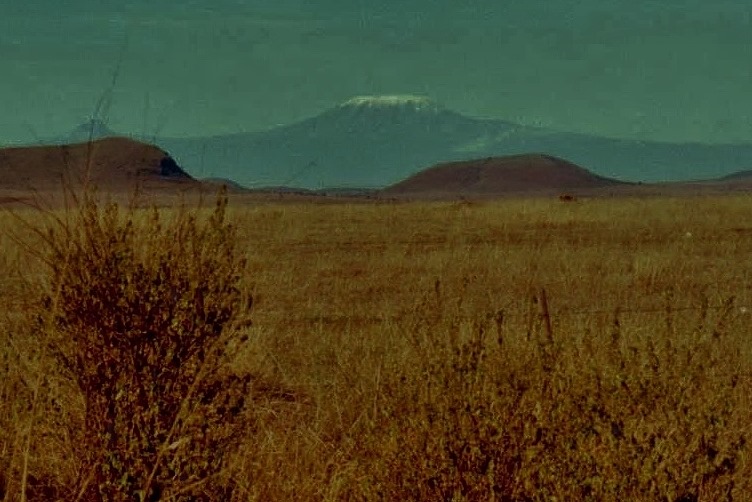
Kilimanjaro caught from the Mombasa highway just south of Kiboko

*

For me the journey into Africa began, with auspicious timing, on the 14th February 1992. This was the day I ran away – to Kenya to be precise, leaving home, possessions, accountant spouse and several labradors in order to travel with a roving entomologist who had no home, no possessions – neither in Africa nor in England. He had recently been in Mexico researching the habits of the Larger Grain Borer (LGB), a small maize-eating beetle that ravages stored crops. Before this he had worked for two years in Tabora, Tanzania, as a volunteer Agricultural Extension worker, also advising farmers about LGB. (See earlier post On Kenya’s Farms)

In the 1980s this pest had arrived  in Africa (where it has no known natural predators), introduced on consignments of food aid from the Americas. In 1992, then, G was on a new LGB mission: to monitor the beetle’s spread from Mombasa on the Indian Ocean coast to Nairobi in the Kenya’s central highlands. For the next nine months we would lead a nomadic life, travelling up and down the Mombasa highway, which back then was little more than a ribbon of ragged tarmac running through the bush.

The road was fraught with dangers – from gargantuan potholes to car-jackers lurking in the thorn scrub. There were also successions of stranded trucks left where you least expected them, and the possibility of some belligerent buffalo insisting on a standoff in the middle of the highway; and then there were policemen flagging us down for lifts, or to give us speeding tickets when we had not been speeding.
sundowner

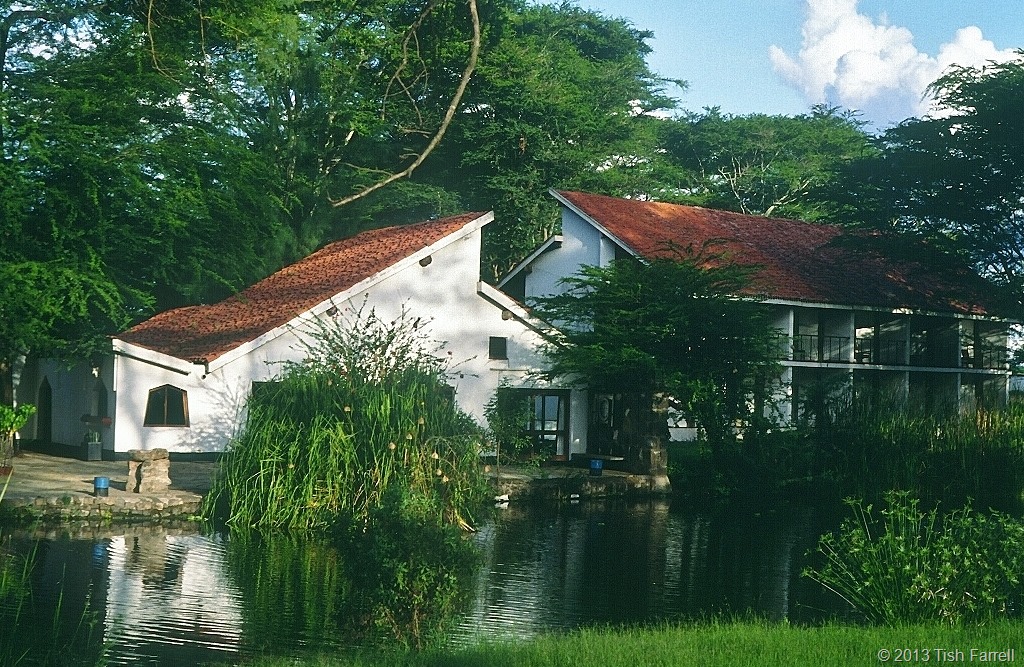
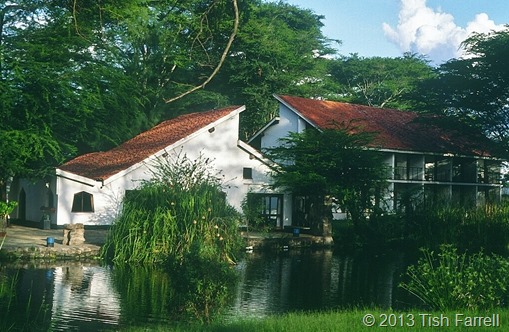
Hunter’s Lodge, Kiboko

*

During these nine months we stayed in roadside hotels, safari lodges, beach cottages, a Danish development workers’ guesthouse, and, best of all, at Hunter’s Lodge where we were usually to be found for three or four days each week. This one-time home and small hotel was begun by Great White Hunter, John Hunter, at a small place called Kiboko, some hundred miles south of Nairobi. The place had once been a regular resort for expatriates taking a weekend break from the capital, or a convenient overnight stop en route for Mombasa beach. This was in the days when the road was still an un-metalled cart track, and it took all day to get there (needless to say, covered head to toe in red plains’ dust). The coast was a further 200 mile-drive, including the long stretch of desolate Taru thorn scrub south of Voi.

Kiboko, then, was in every way an oasis. John Hunter had long had his eye on the location before he moved there in his retirement in 1958. He had arrived in British East Africa in 1908 in the wake of the first European settlers, and made a career of clearing unwanted game: first lions from the Uganda railway that ran nearby and later, on behalf of the colonial game department, elephant from settler farms, and marauding hyena from the African native reserves.

He also ran private safaris for counts and maharajas, and therefore rubbed shoulders with the likes of Karen Blixen’s white hunter husband, Bror Blixen, and her lover, Denys Finch Hatton (Out of Africa). In his time, Hunter was personally responsible for despatching over 1,400 elephants, and nearly as many rhinoceros. Local myth had it that Hunter gave up repairing the hotel sign which a vengeful rhino was intent on flattening. Besides, in those days, everyone who was anyone knew where Hunter’s Lodge was.

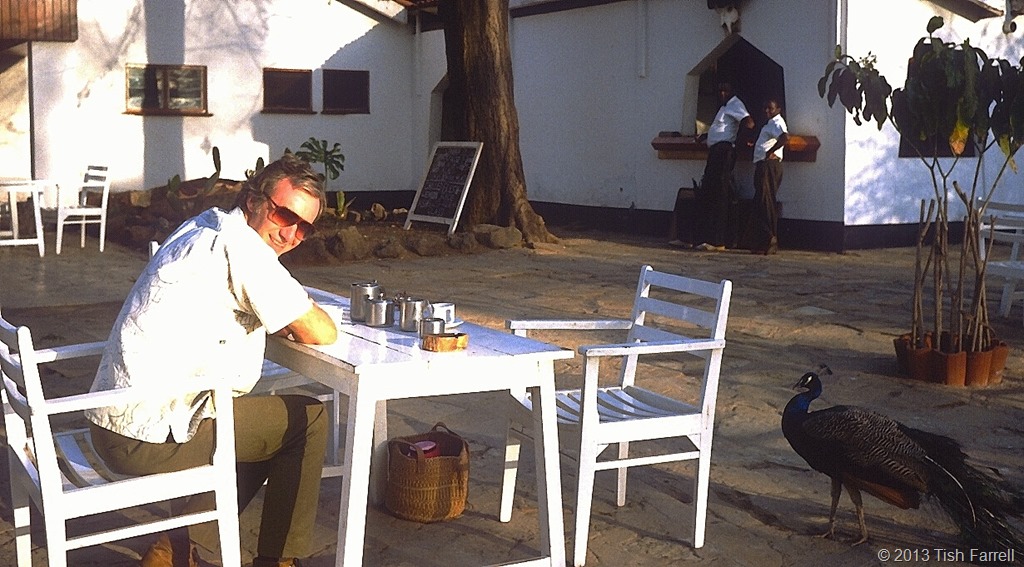
Graham and peacock 1992

Afternoon tea with the sugar-stealing peacock

*

The reason Hunter chose Kiboko to settle was because it had fresh water: a volcanic spring, and the only one for miles around. In the old days he had often watched elephant coming there at sundown to drink. He, however, set about damming the stream to make a small lake, this surrounded by a grove of graceful fever trees and wild figs. Given the general aridity of the surrounding bush country, it truly is a beautiful place, a resort not only for human travellers, but for some three hundred species of bird. When we were there, there was also talk that a leopard haunted the upper reaches of the pool, but we never saw it: only baboons and vervet monkeys, a bushbaby and a monitor lizard.

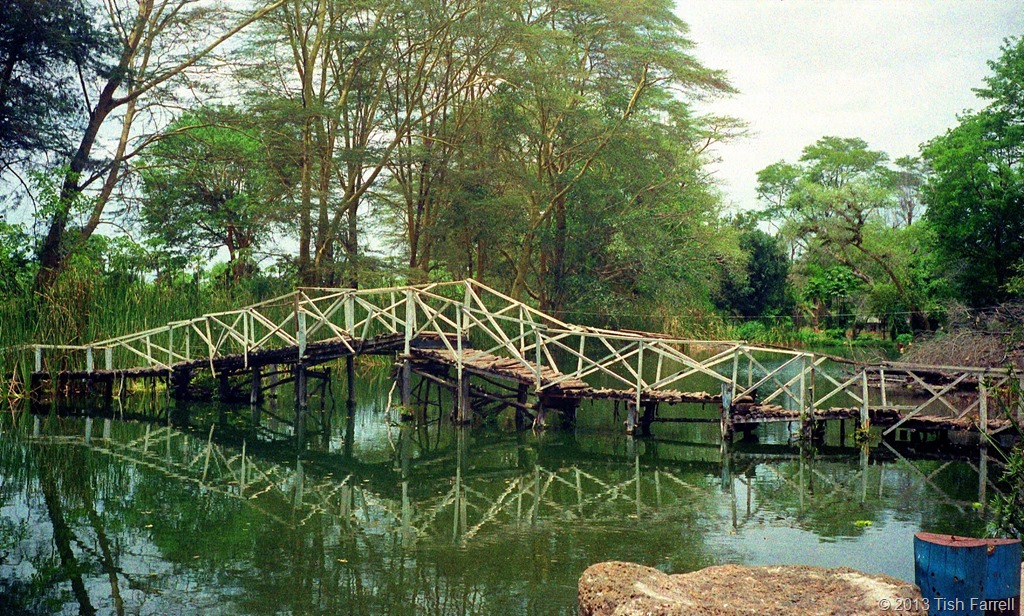
The bridge

The bridge to the vegetable shamba

*

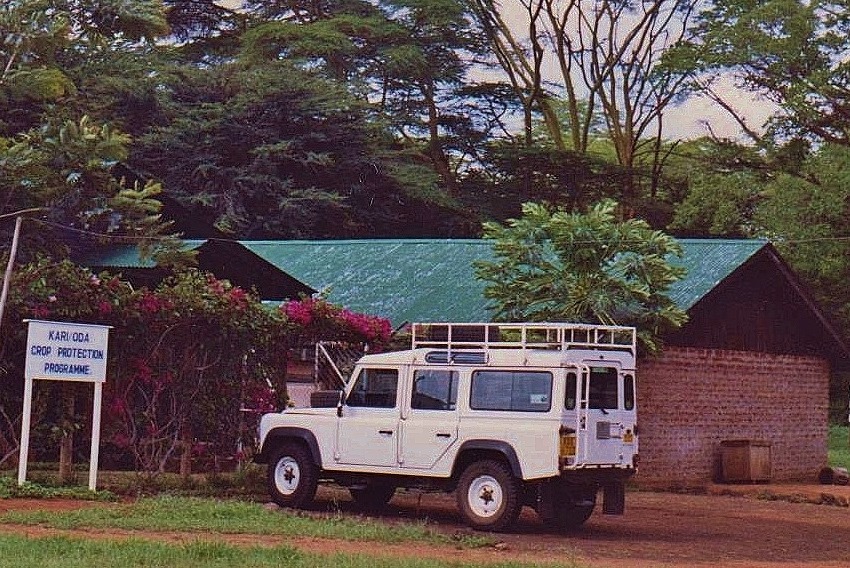
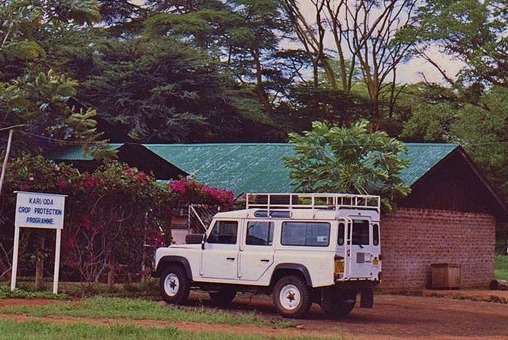
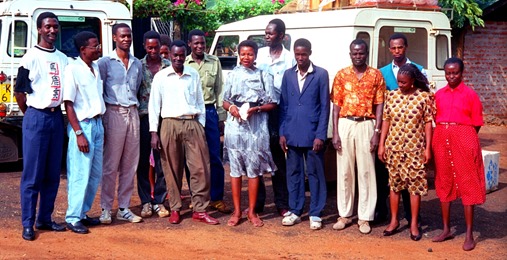
And the reason that we often stayed there was because the Kenya Agricultural Research Institute had a small research station and laboratory just behind the lodge. On starting his job, Graham was gravely entrusted with a key to the back garden gate, so that at 7.30 am he could walk to work, and then walk back again for lunch at noon. The lab employed a dozen technicians, all working on the LGB project.
002

Graham's team at Kiboko Lab - the last day

Kiboko lab and staff

*

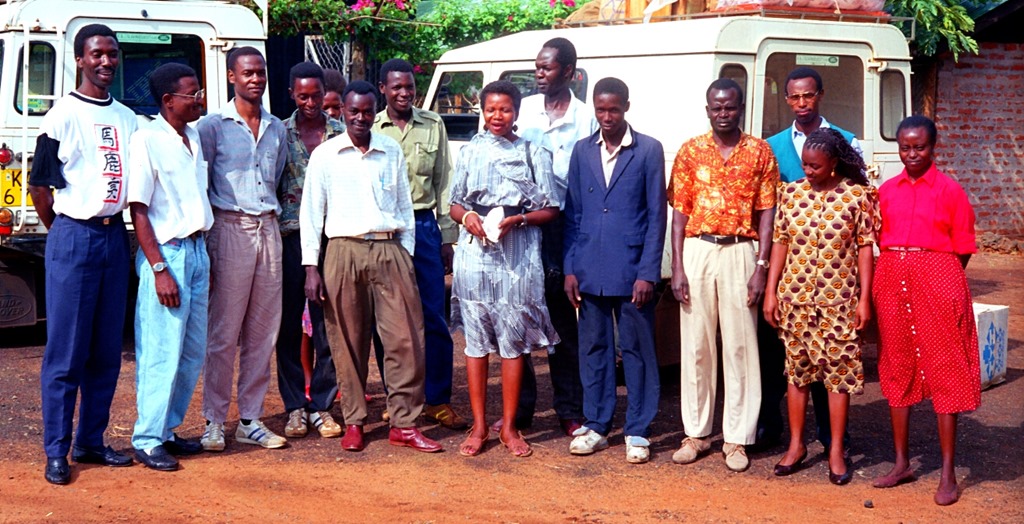
In 1992 Hunter’s Lodge rarely had many overnight guests. Sometimes G’s boss would be stay; sometimes a travelling salesman; sometimes an aid worker or two. Once, an Intermediate Technology N.G.O held a two-day seminar there. Once, a large group of Nairobi Asians came for a weekend party. The main trade, however, comprised passing travellers who dropped in throughout the day for snacks and drinks. These were served by smart bow-tied waiters on the bar terrace where you would be stalked by a bedraggled peacock, which sorely depressed since its mate had been swallowed by a python, sought pleasure in raiding the sugar bowl whenever it had the chance. It was a sad old bird.

The menu was limited: cheese sandwiches, steak and chips and omelettes. But the cook did prepare an amazing fresh lemon juice made from the lodge garden’s own lemons. It was sour enough to curl your teeth, but extraordinarily sweet too. We also soon took to carrying a plastic tea strainer around with us – to sieve the skin out of the milk, both from the breakfast wheatie flakes, and before we poured it into our tea.

The milk was brought daily by Maasai women and their donkies, and boiled within an inch of its life. Even so, it still tasted of the ash-scrubbed gourds that it was delivered in. This milk, coupled with the sulphurous water from the spring, made afternoon tea a daily strange experience. Only the lack of other things to do when G came home from work at five o’clock made us persist with it. Going for tea on the terrace was, after all, an outing – a different experience from the lunch and supper outing to exactly the same spot, or to the breakfast outing which was to the lodge dining room with its strange ogival doorways.

Scan-130520-0010_thumb.jpg

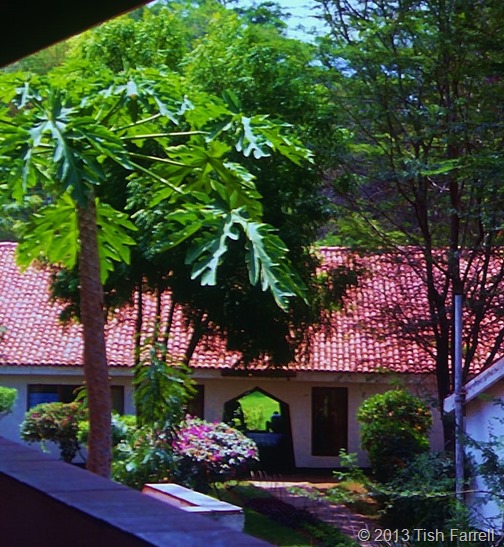
Looking toward the Lodge dining room

*

The best pursuit of the day, so long as there had been a calor gas delivery, was at sundown  to resort to the shower in our room. The shower fittings went under the manufacturer’s name of Steamy Steamy. After a dusty drive up or down the Mombasa highway, a good Steamy Steamy was the only thing we could think of.

Then by seven when it was quite dark, and we were duly steamed and dressed, the next treat would be to sit on our veranda and wait for the firefly display up and down the garden lake. This was followed by a trip to the bar and a couple of Tusker beers. If John, the young Maasai barman, was on duty, then we were in for some good conversation. He had opinions on everything. The local Akamba waiters would stand about and gaze at him in awe, whether he was talking to us or to them. He told us he owned 150 cattle, and had two wives. He had not wanted to marry a second time, he explained, but his parents had urged him because his mother had kidney disease and needed more household help. He had accepted the situation philosophically.

Once, John offered to take me on the back of his bicycle into the bush to his family’s ‘enkang and to see a female circumcision ceremony. I wished I’d had the guts to accept. He told me his home was only two hours away, as if I would manage the ride over bush tracks quite easily, me who had never ever balanced myself on a bicycle parcel rack.

005

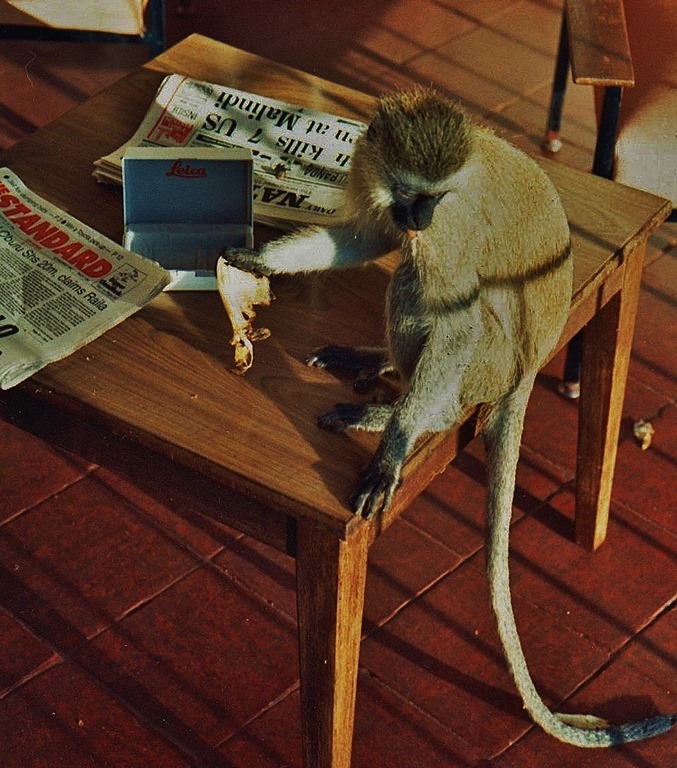
Caught red-handed, a vervet raider eating our bananas

*

While G was at work, I wrote letters and read. But mostly I watched. I soon realized that the Lodge was run, not for guests, but for the benefit of its staff. Their daily routine of cleaning and tending went on whether or not there were any guests. The garden staff wore brown overalls. They mowed the lawn, and worked in the vegetable shamba across the lake. Around ten in the morning a bell rang and everyone disappeared for a tea-break. The manager wore a smart khaki Kaunda suit, and marched hither and thither, but to no apparent purpose.

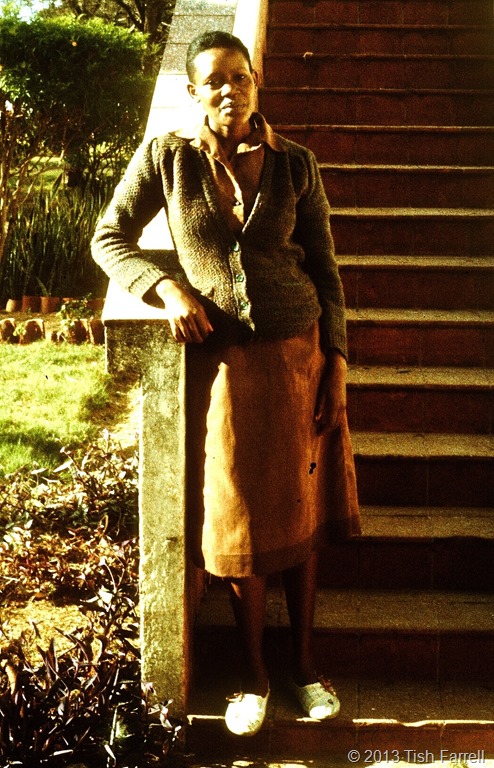
Then there was Joyce, the chambermaid. Her husband worked down at Kibwezi and was a forestry officer. She lived with her two little boys in the staff bandas at the bottom of the garden. On her days off she went home to the family farm. She told me that I should learn Ki-Swahili since it was very easy. I agreed, but only learned a smattering. The hello, how are you: jambo, habari yako?

Between the gentle staff activity, there was only the wildlife to observe, vervet monkeys planning raids on our room, pied kingfishers diving, yellow weavers endlessly weaving, herons clattering their bills in the thorn tree heronry, marabou storks lurking like spectres on the lawn, hadada ibis winking out grubs with their curvy bills. And over all, the high-tension whine of crickets that could drive you mad when you were not feeling well.

Joyce our chambermaid

Joyce

*

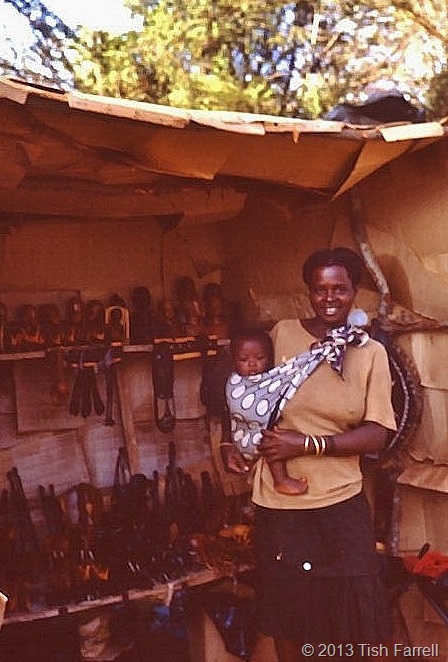
One of the features of Kiboko, I soon discovered, was the wood carvers’ stalls opposite the Lodge. Sometimes I took my clothes down to Esther who ran such a stall, and traded them for Akamba carvings. She struck a hard deal, and I was a simpleton when it came to haggling. G was nonetheless impressed since it lightened the contents of my two bags.

Scan-130429-0155 (3)

Esther at her stall with son, Tom

*

And so it was that Hunter’s Lodge became a home of sorts. Whichever way we approached it on the Mombasa highway, my eyes would fix on the green grove of fever trees, and my spirits would lift as we turned off the road. There was Steamy Steamy to look forward to, the smoky taste of the tea, Reuben the breakfast waiter who always asked us if we were having eggs though we never did. Only later did we discover that we had paid for a full breakfast in with our room rate. There was the birdlife to watch, and the sleepy routine of the hotel staff to keep tabs on; there were the steaks that our weak teeth found impossible to process, the fireflies and the vervets, and there were the brief African sunsets as the light turned through lavender and orange to black, black night. There was irony too, for it was of course the metalled road that turned Hunter’s Lodge from oasis to backwater, making the coast accessible in a single day: an unintended consequence of progress. 

I remember the long nights I lay awake, listening to the whine of insects, the drone of trucks on the Mombasa highway, the hoot of the train on Uganda railway. We are in Africa, I would tell myself. And even when I was there, so very much present in every sense, it still seemed like a dream. Perhaps this land was the original Garden of Eden. When we left it, we took our self-regarding selves to material greatness. Maybe the price for this knowledge was the loss of wisdom. Even now, so many years on, I still travel the road to Kiboko, at least in spirit,  and ponder this conundrum. The great safari continues…

013

Letter from Kathleen Collins Howell, illustrator and best friend

Daily Prompt: on the road

© 2013 Tish Farrell

Kevin, Kudu and Kirinyaga


006

004

003

005

002

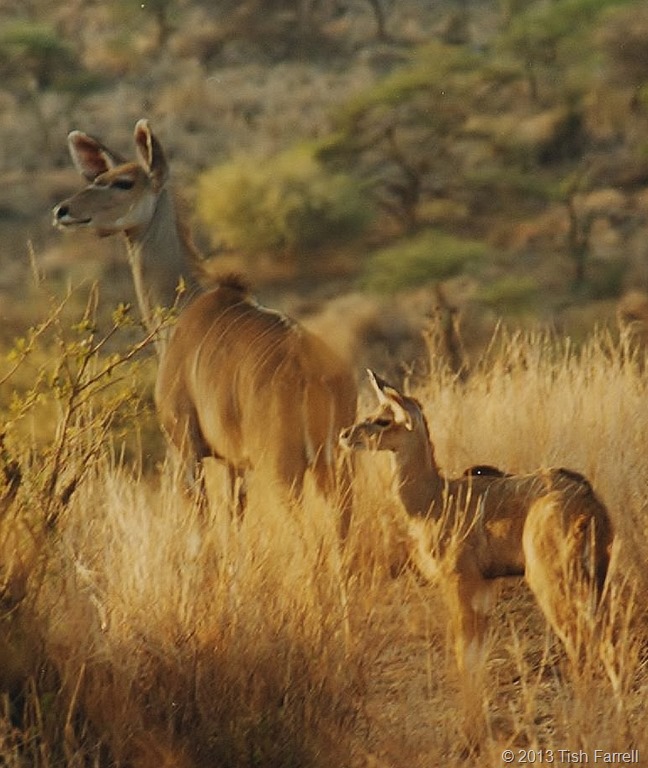
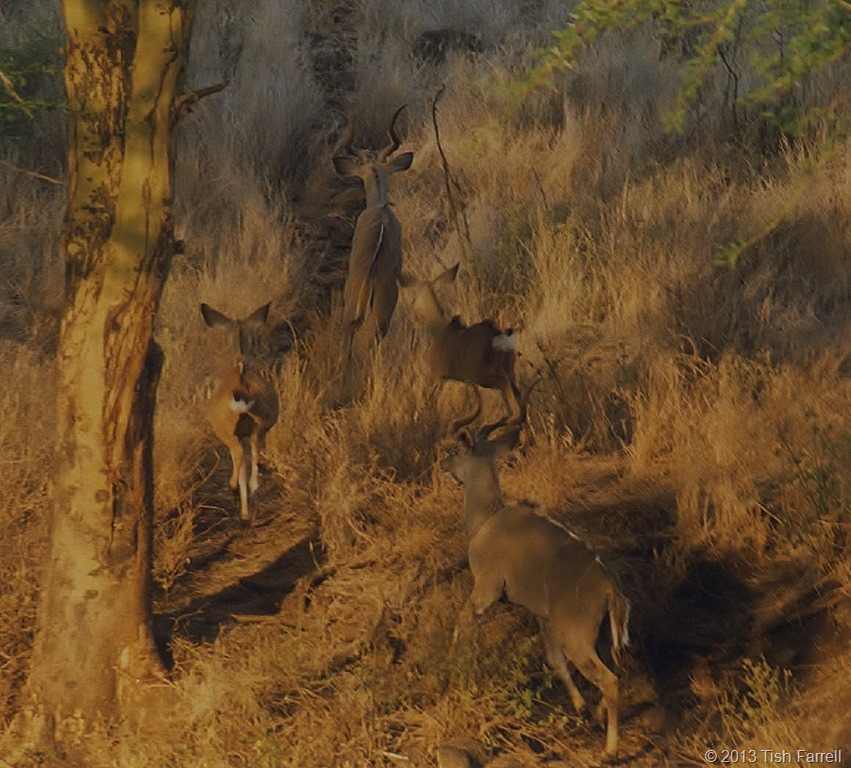
Kevin was the talented young naturalist who was our guide and driver when we visited the Lewa Conservancy Trust, north of Mount Kenya, many years ago. At sundown it was he who spotted the kudu in deep cover long before they emerged from the brush for us to see them. Wildlife photos tend to give you the wrong idea of what game spotting is really like. Often the sightings are frustratingly vague and fleeting. The second kudu shot is not really in focus but then it shows how it was – beautiful creatures melting silently into the bush.
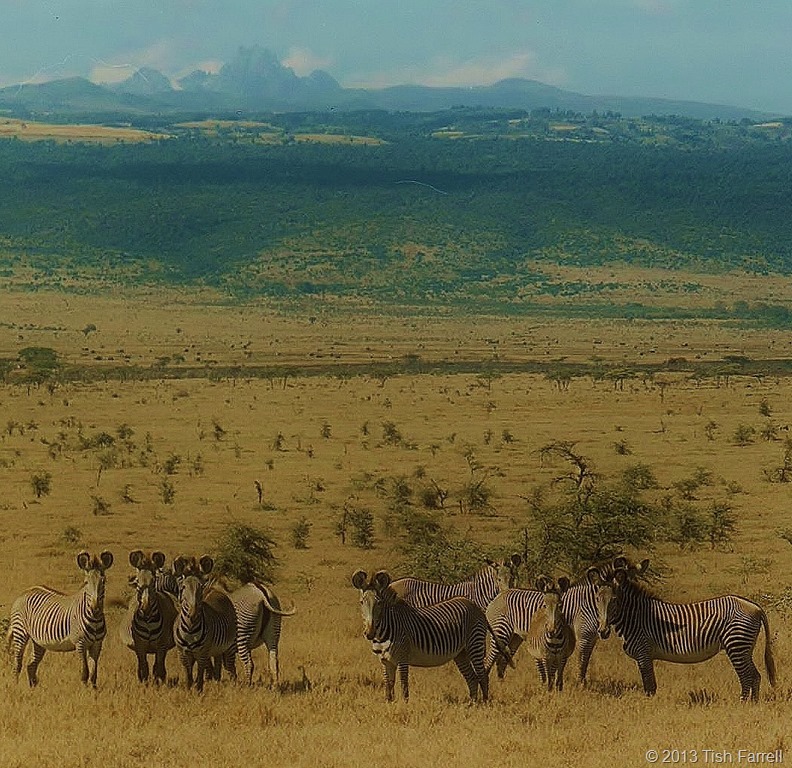
In the final photo you can see Grevy’s Zebra, a special focus of the conservation effort at Lewa. Kevin said he called them Micky Mouse because of their rounded ears. Their stripes are much finer than the common Burchell’s zebra.

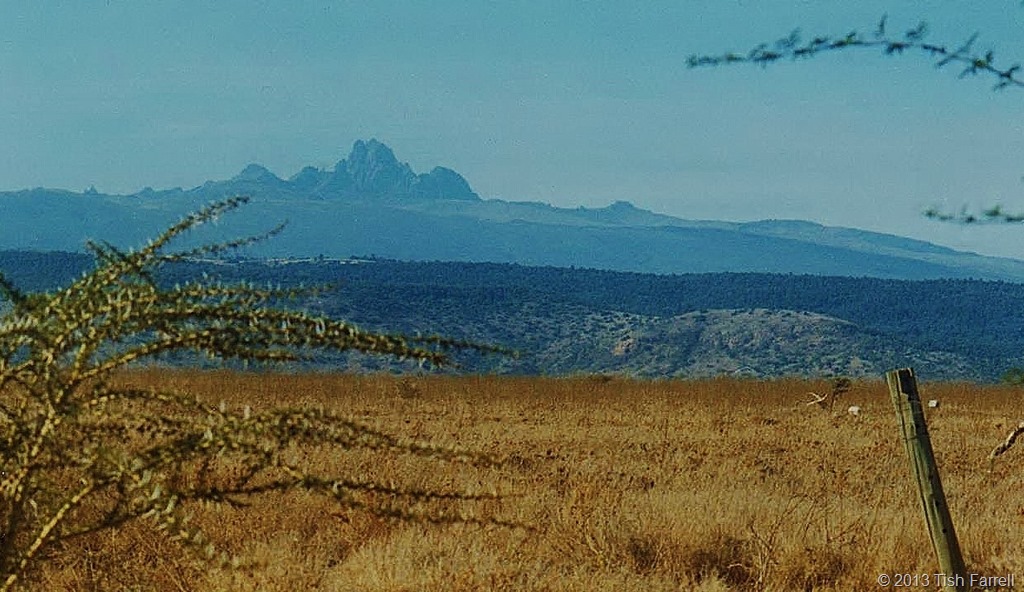
In the far distance are the misty spires of Mount Kenya, which  local people also know as Kirinyaga. The mountain top is one of the dwelling places of Ngai, the Creator of All, and has been considered a sacred place  for centuries – long before missionaries set foot in East Africa and tried to teach them about one God.

Lewa was once a colonial cattle farm, but now it is a private conservation enterprise working alongside local communities to improve the quality of life for humans and animals alike. In consequence, they have an impressive anti-poaching record. See the video below and take heart in the fact that conservation in Africa can also be a success story.


 http://flickrcomments.wordpress.com/2013/09/10/k-challenge/