Disconnected Sunday: Plane…Sheep…Cloud…And Then…?

P1050650

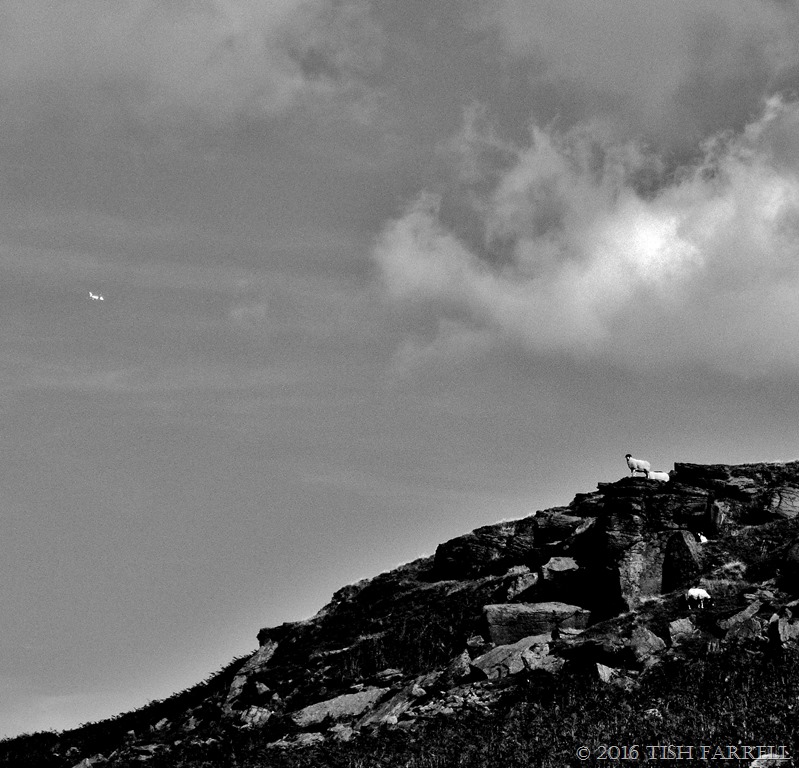
I was attracted by the sheep doing an ovine impression of Landseer’s Monarch of the Glen –  as spotted last week during our short break in the Derbyshire Peak District. Its posing place of choice is Hordron Edge, below Moscar Moor and Stanage Edge. We were walking up here on what he-who-is-usually-the-team-leader suspected would turn out to be a Tish-type wild goose chase. In short we, or rather I was in pursuit of a Bronze Age Stone Circle, otherwise known as the Seven Stones despite the fact that there are apparently eleven stones in the circle, and three more besides nearby.

I should admit straight off that I’m not renowned for my accurate map-reading, and so once we’d passed the sheep, walked for ages in surprisingly hot sunshine for late September, and then found ourselves on a path which kept wending onwards and upwards with absolutely no sign of a megalithic monument anywhere on the sky-line where I was expecting it, even I began to think I’d misread the map, and that we were definitely on a wild goose chase. Worse still, we’d left the lunch picnic in the car, so there wasn’t even the possibility of making the best of a bad job. And it was just the day for a moorland picnic too, not a state of affairs you can rely on in England’s uplands whatever the time of year.

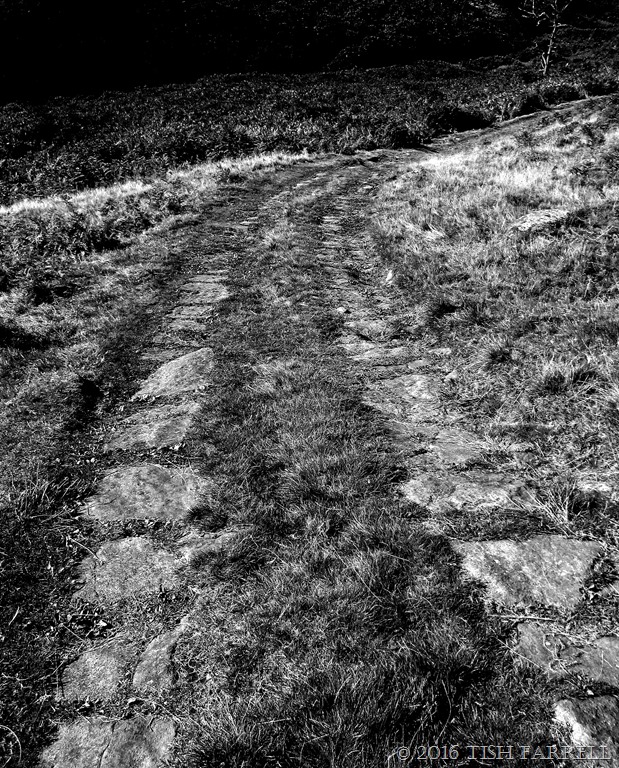
‘We’ll just go to the next bend’ – I said – ‘so we can see over the brow of the hill’. But as always happens in such situations, we never came to the bend’s end. In fact the path began to rise very steeply. Then we noticed that exposed here and there beneath the turf were signs of a stone-paved trackway. Very puzzling in this middle of nowhere, but at least it suggested that we were headed somewhere. (I surmised later that it must be the relic of an old packhorse road up to Stanage Edge whither the locals once went quarrying to make millstones and grind stones).

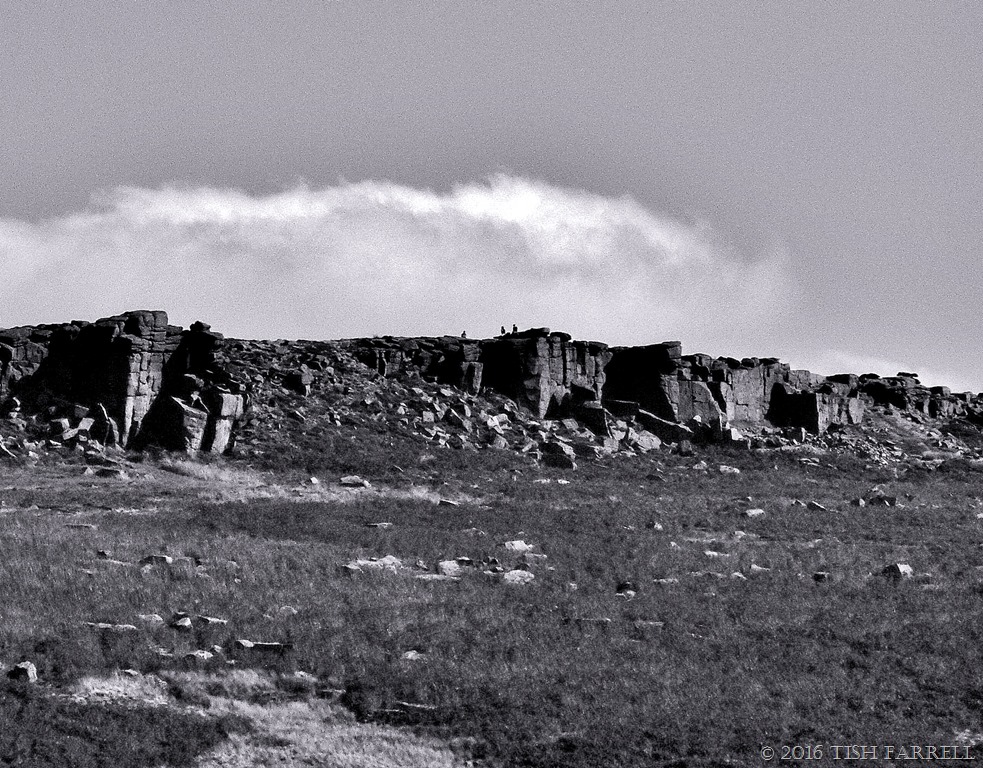
And so as we pushed on, drawn on by the stone road, and quite unexpectedly Moscar Moor and Stanage lay before us. It is an awe-inspiring landscape, and so it is scarcely surprising that this whole area is rich in prehistoric cairns, circles, and settlement remains.

Also, by now I could see that my map-reading had been spot on, although the stone circle really took some finding in the heather.
P1050637 (2)

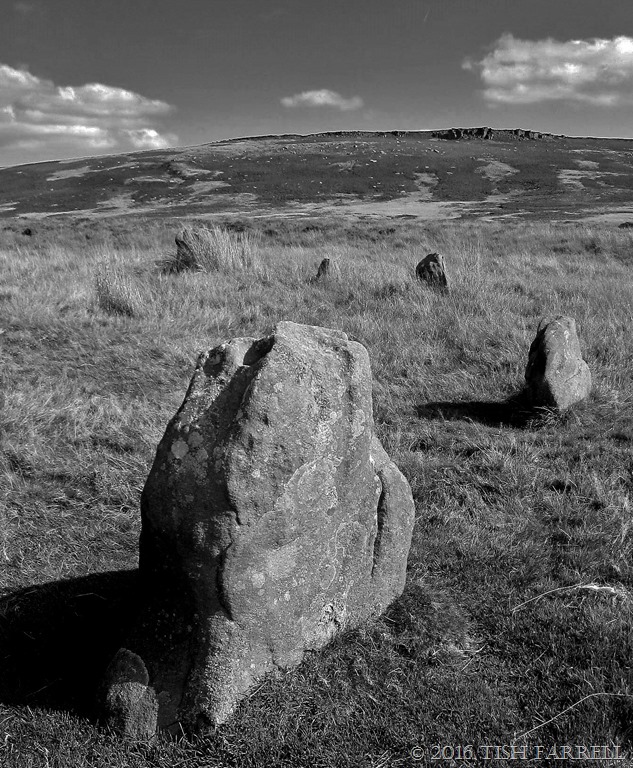
So I hope you weren’t expecting Stonehenge. Because here it is – the Seven Stones Circle of Hordron Edge, probably dating from around four thousand years ago.
IMG_3319

The tallest stone is the one seen here in the foreground, and is about 1 metre high. It stands on the south west edge of the 16 metre circle, and has been dubbed the Fairy Stone. You can see it on the far right in the middle ground of the next photo. P1050638
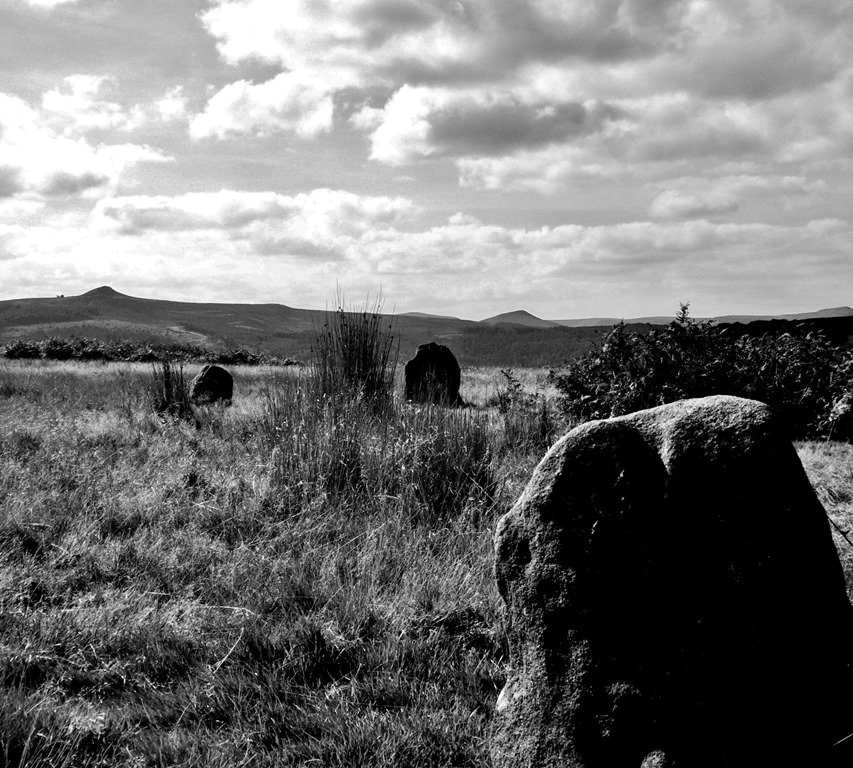
Its particular significance is taken to be its relationship to the two conical hill tops, Win Hill on the left and Lose Hill on the right, the top of the stone possibly mirroring the landscape features. Peak District archaeologist John Barnatt has apparently observed that at the traditional start of winter and spring, the times of age-old festivals, the setting sun appears to roll down Win Hill.

Perhaps the placement of stone had something to do with the gathering of sun-power? Or the marking of the seasons in relation to the farming calendar? We can never know. All we can be sure of is that these monuments were important to the people who created them – gathering places for discourse, rituals, trade, or all of these. More recent local folklore has its say too – hence the naming of the Fairy Stone, and tales of strange lights being seen around about it.

And what do these monuments say to me? Well the main thing is that we should never underestimate the capacities of our ancient antecedents. Also that we should never equate current technological whizz-kidery with intellectual superiority. These people  of the past  knew how to make a life in this challenging territory – a life charged with meaning and a deep sense of their place in the landscape. I feel too, we have lost much of our ancestors’ capacity for poetry and metaphor – the exchange between fellow humans that relied almost exclusively on language – the songs sung, the tales unfolded, the riddles set, the nuances of double and treble meanings.

But before I get too carried away with highfalutin notions, we decide that lunch is now too far away for comfort. We retrace our steps down the old stone trackway. It perhaps does date from much more recent medieval times. I’ve been unable to find out anything about it, although there is medieval packhorse road along the top of Stanage Edge.

As I descend the steep hill on a sunny Indian Summer day I wonder what it must have been like to urge pack horses up this route in a blizzard, the wind slicing under your cape, threatening to snatch your bonnet, the biting cold, the darkness. Just imagine…
IMG_3311 - Copy

copyright  2016 Tish Farrell

Hordron Edge Circle
Bronze Age Stone Circle
East of Ashopton, Derbyshire  OS Map Ref SK21528685
OS Maps – Landranger 110 (Sheffield & Huddersfield), Explorer OL1 (The Peak District – Dark Peak Area)
Clandestine Capture & Ancestor Sleuthing In Derbyshire: Thursday’s Special

P1050619

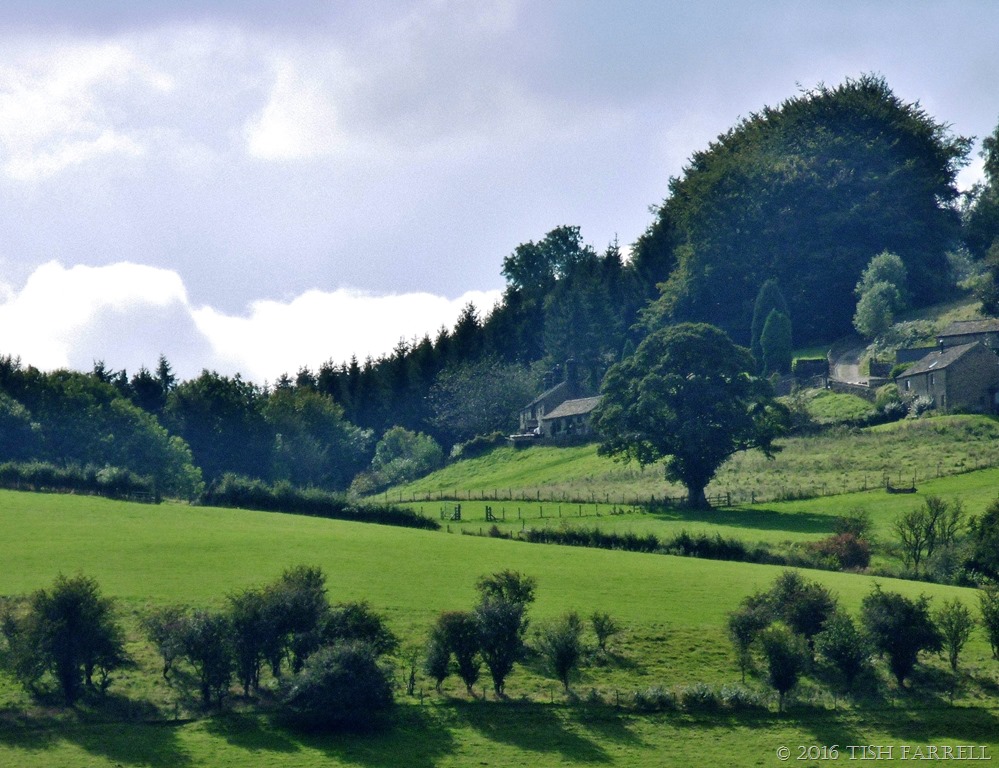
This was where I was last Thursday morning – not posting on Thursday’s Special, but trying to find a good spot on a field path outside Hathersage so I could photograph Callow Farm. This was the place where four generations of my Fox family ancestors were tenant farmers from around 1700 to 1892. Before that, during the late 1600s, they rented another Duke of Devonshire farm, The Oaks, up on the wilder heights of Offerton Moor, not far from Callow.

As you can see, the house (centre) is covertly situated, in the lee of the hill beside the wood. I had to use a lot of zoom, hence the hazy look, though such haziness is perhaps fitting for this piece of ancestral snooping. The more readily visible buildings on the right are the farm’s barns, now an upscale holiday let.

If you go to the previous post Stepping Stones Through Time you’ll find more of the story behind this photo. This was the reason why I  had hoped to cross the stepping stones, to achieve a closer view than this one. Ah well. Maybe next time.

*

There’s still time to take part in last week’s Thursday’s Special. Paula says ‘Pick a word in September’. Choose from: populated, time-sensitive, companionable, burgeoning, clandestine, but first go and see her gallery of photos and be inspired.

#thursdaysspecial


Textures Of My Ancestral Landscape

P1000999

These are some of the landscape textures that my maternal ancestors, the Fox family of Derbyshire’s High Peak would have known well – windswept moors and weathered scarps of millstone grit. They were yeoman farmers and lead miners, and they made a living from this bleak and beautiful country for hundreds of years.

Family legend has it that the Foxes arrived in England with William the Conqueror, but Fox is a name with Germanic origins so they may well have been Saxons, belonging to the conquered rather than to the conquering forces. The earliest records for Foxes in the Hope Valley, and Offerton in particular – where my Foxes farmed until the end of the nineteenth century, are around the thirteenth century, although I and my fellow Fox researchers are yet to establish direct lineage from these times.

There were centuries of prosperity when various family members lived in large stone farmhouses, made ‘good’ marriages, and owned land and lead mining concessions, but by the early twentieth century there was only one member of my Fox line left in the area, and he was living modestly in Eyam. The family farm of Callow where he was born, and by then owned by the Duke of Devonshire had been relinquished with a farm sale in 1892.   High rents were besetting many Derbyshire farmers at this time. The Mr Fox mentioned in the sale advertisement is my great great grandfather, George Brayley Fox:


The Sheffield & Rotherham Independent

Saturday 29 October 1892

Callow Farm Sale

Important Sale of 23 cows, heifers, steers and calves, two horses and foal, 30 sheep, hays stack, three wheat stacks, seven oat stacks, farm implements etc.

Mr Hattersley has been honoured with instructions from Mr Fox who is give up the Farm, to sell by Auction on Wednesday, Nov 3, 1892, the very superior LIVE and DEAD FARM STOCK, as briefly enumerated below:

Black Mare, believed to be in foal, excellent worker;

Valuable Brown Horse, six years old, with splendid action, believed to be sound, and quiet in all work;

Roan foal by Bedford;

One Cow in calf for December 25th, four in-calf cows for April, two barren cows in milk, four very choice heifers in calf for April, two barren heifer stirks, five strong bullock stirks, five spring-reared calves, 11 superior stock ewes, six fat sheep, one two-shear ram, 12 strong lambs, two very fine ducks, one fine drake.

Samuelson’s 2-horse combined mower and reaper, nearly new with additional shafts; wood tippler, horse rake, Cooke’s wood plough, set of wood harrows, nearly new; set of three harrows, swingtrees, fallow drag on wheels, stone roller, with shafts, horse turnip hoe, sheep troughs, joiner’s bench and tools, quarry tools, hay rakes and forks, 2 1-horse carts, winnowing machine, wheel chopper, with rising mouth, in excellent condition; corn chest, cart gears, stone cheese press, lever ditto, cheese rack and boards, nearly new; vats, garths etc, cheese pan, two brewing tubs, two oak chests, and a portion of furniture.

One stack of very prime new hay, three stacks of wheat, five stacks of white oats, two ditto of black oats and a quantity of table and other turnips.

Sale to commence 12 noon.

*

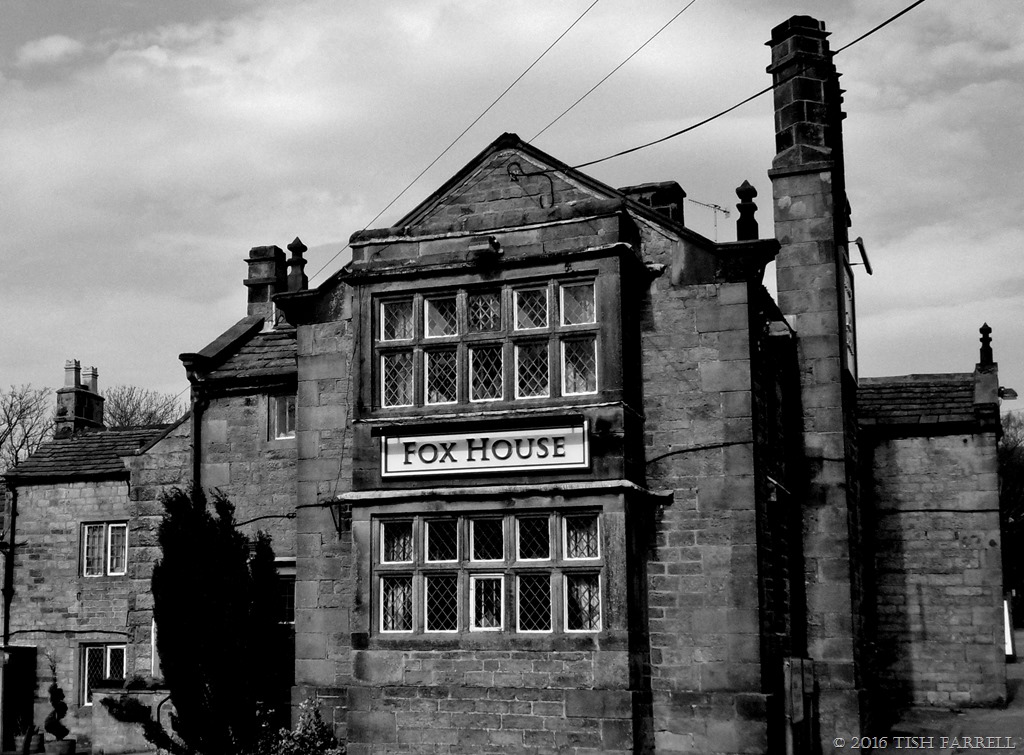
Every item here tells of great intimacy with the land. Just to read this notice gives me a painful sense of roots yanked up. I feel the touch and then the loss of the fine ducks, the strong lambs, the black mare in foal, the oats and the stone cheese press; even the turnips and the quarrying tools. But I would like to think, too, that somewhere in my bones are still traces of that High Peak millstone grit, the hardiness and courage that it took to carve a living from these uplands, and in my lungs the sharp, clean air of the moors of Longshaw where earlier generations of my family, so it is said, grazed four hundred sheep on their own run, and also owned the shepherd’s byre, that dating from 1399 was later sold and expanded into a handsome house for the Duke of Rutland’s agent, and is now the well known inn, Fox House, just outside Sheffield. Somewhere within this sturdy stone carapace is the earlier shepherd’s dwelling of quite another texture.

P1010003

copyright 2016 Tish Farrell


This week at Black & White Sunday, Paula has given us the theme of ‘texture’. She also included a quotation by novelist British Paul Scott, which is very much responsible for my take on the challenge:

“The past becomes a texture, an ambience to our present”

P.S. Paul Scott served in the Intelligence Corps of the British Army in India during the World War Two. He wrote the phenomenal Raj Quartet, set in India during these years, and which was made into a very excellent TV serial back in the 1980s. The TV version is available on DVD, and with its all star actors is well worth watching. But read the books too.

B & W Sunday ~ Stronghold ~ The Telling Of Family Tales

P1000972

Most families tell tales about their origins: legends of high-born connections, of inheritances lost or missed-out on, of forebears famous or notorious somewhere in the family tree. These stories, the ideas of who we are become strongholds of sorts; a defence against times when others make us feel ‘not good enough’, or just plain dull.

I seem to remember when I was eight or nine telling one very competitive school friend, and as a piece of deliberate one-upmanship on my part, that one of my ancestors was a well known poet and buried in Poets’ Corner in Westminster Abbey. Mother had told me so.

Indeed, Mother told me lots of family stories about her Derbyshire Fox and Bennett antecedents, and because a) she still had her own childhood interpretation of what her own mother had said, and b) was framing them in a way she thought I would also understand, the ensuing narrative, much like Chinese Whispers, came out more than a little garbled. In other words, our family connection to the poet ancestor is probably so much tosh.

From time to time I have little delving sessions on the internet in a bid to clear up the maternal myths, and last year came across two fellow searchers into the Fox family of Derbyshire’s High Peak. It turned out we were each descended from three siblings William, Robert and Deborah Fox, all born at Callow Farm in the manor of Highlow, in the 1770s. And it’s odd, but I find I treasure this present-day, albeit tenuous blood connection, almost more than anything I might find out about our mutual family past. I mean, well, who would have thought it; without the internet, we never would have found each other.

The Fox siblings’ father, George Fox, came from many generations of farmers. Over the years the family appears to have owned several pieces of land in the parishes of Hathersage, Longshaw, Eyam and Abney (one was a sheep run, others were possibly both farms and lead mine workings), but the Foxes, certainly in recent centuries, were mostly the tenants, first of the Eyres at Highlow Hall (pictured above), and later of the Dukes of Devonshire who came to rule much of Derbyshire from their own dynastic stronghold of Chatsworth.

If the Eyre name rings bells, well it is true (just to add another story thread) that Charlotte Bronte was staying with her friend Ellen Nussey in Hathersage in 1845, around the time she was writing Jane Eyre. Mr. Rochester’s Thornfield Hall is said to be drawn from another Eyre family stronghold, North Lees Hall. She and Ellen went visiting there. Other local features are also present in the book, including Hathersage itself, which was apparently the model for Morton, the village where Jane Eyre ends up after running away from Edward Rochester.

My Fox ancestors, it seems, were also good storytellers – fact mixed seamlessly with fiction. When Robert Fox’s son, my great, great grandfather George Brayley Fox was forced to sell up his possessions at Callow Farm in 1892, this piece appeared in the Derbyshire Courier:

Derbyshire Courier 25 March 1893

My own feeling about this ancestral yarn is that it was a bit of a face-saving exercise for a family that had indeed been part of the local scene for generations. Some of the details may well be based on some misremembered version of reality. Early medieval charters of the 12th and 13th centuries certainly have Foxes farming in pretty much the same location. Now, I and my two fellow Fox hunters are trying to tease the facts from the myths.

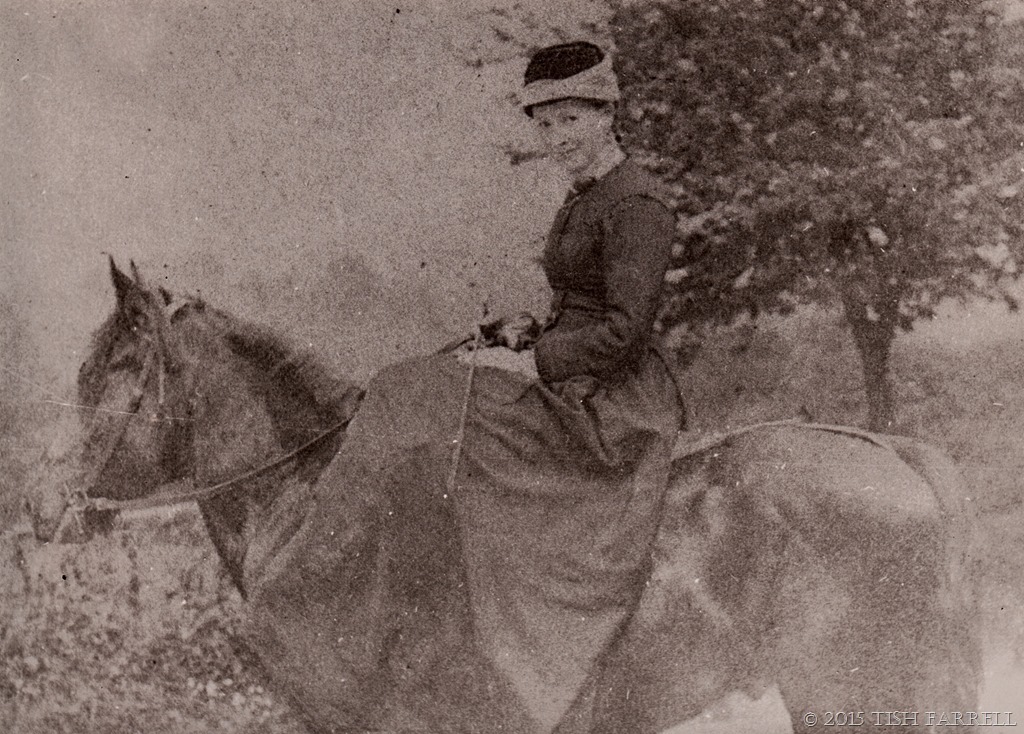
But one thing I do know (because I have the photo), my great grandmother, Mary Ann Fox, rode her pony along the winding lane from Callow Farm. She would have ridden past Highlow Hall on one of her regular missions. Grandmother said she went to Chatsworth Hall to deliver the farm tithe in eggs to the Duke of Devonshire. Here she is c1880s in her late teens, before she was silly enough to run off with a Manchester spindle manufacturer and, at thirty, end up the widow of a bankrupt with three young children and a stepson to support:

IMG

And here is Callow farmhouse, the photo taken by a family researcher in the 1970s. It sits on a hillside below Highlow Hall, and looks down on the River Derwent and the small town of Hathersage. If there is a house of 1391 here, as the newspaper article suggests, then it is very well hidden inside a very much later exterior:

Callow Farm, Hathersage c 1970s

But if I said that these images and family tales have not affected how I see myself, then this would not be true, although it is only recently that I have seen this. For some reason, too, in my later years, these particular maternal ancestors seem to mean more to me.

The thing that speaks most loudly is not so much the gentry connections – real or imagined – but the sense of landscape, of the bleak uplands, the rugged scarps of millstone grit, the arcane, but tough world of lead-mining in which all classes toiled from the Eyres downwards; the fact that men and women worked so hard in this land, lived on oat cakes and homemade butter, cheese and ale, reared often very large families, and (in a surprising number of cases) lived into their eighties and nineties.

Somehow the more I uncover of my ancestors’ world, the more it becomes my stronghold, the mental hinterland wherein I am truly rooted.  I stand up more strongly, look out across those moors with their prehistoric stone circles, and ancient burial cairns, the stone walls, and the sheep fields. The wind is in my face. My gaze broadens and lengthens. It is like standing on top of the world, looking down the endless spiral of time of which I am a part, and forever will be.

copyright 2015 Tish Farrell

Reference: For more about the Peak District

Black & White Sunday: Stronghold  Go here to Paula’s to her and others’ strongholds