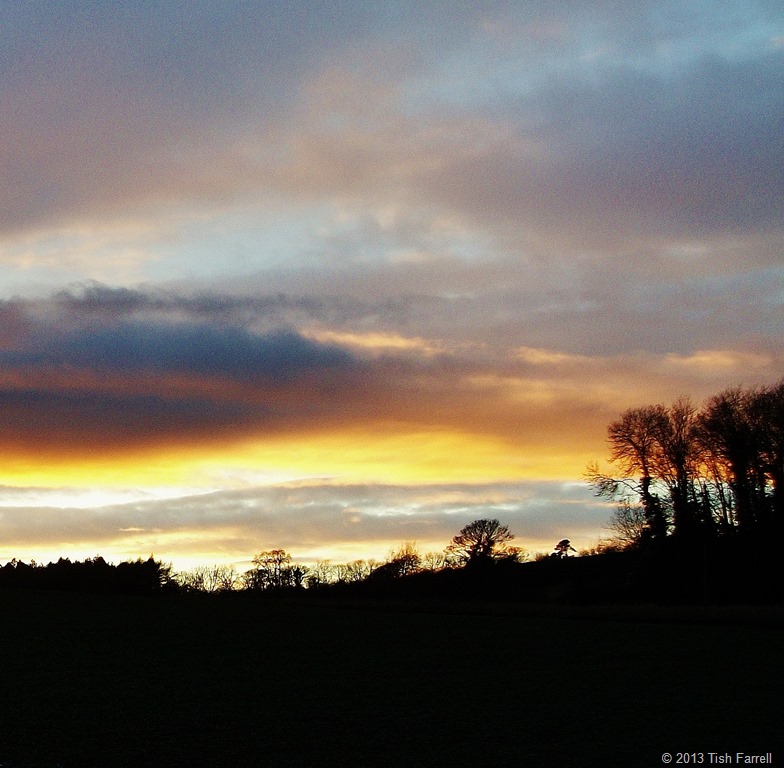
Songs from an Inland Sea: “On Wenlock Edge”

This week’s Word Press writing challenge, with its musical theme, has set off a whole host of notions. In fact this may just be the post where all the strands of my  ‘writer on the edge’ blog come together. This, though, is only a proposition and by no means a promise.  One thing I can promise:  there is some very fine music at the end. And for those of you who do not know the  English composers Ralph Vaughan Williams (1872-1958)  and George Butterworth (1885-1916), then please consider this an early solstice gift. And if by chance you do not care for it, or indeed anyway, by all means pass it on.

So to return to the notions.  Those of you who  have read my past posts will probably know that I live on the edge of  Wenlock Edge, a twenty-mile limestone scarp that bisects the county of Shropshire from the River Severn above the Ironbridge Gorge, to Craven Arms on the borderland with Wales. Aeons ago this now wooded, much quarried ridge was once a shallow tropical sea lying somewhere off East Africa. Today, and especially now through bare wintery trees, you can look out from its summit and scan a great panorama – the farm fields, villages and hills of Shropshire.

*

As I’ve said in other posts, there is a lot of history in this place – over 400 million years’ worth. Too much to embrace. But in the recent past (geologically speaking), you might have looked out from the easterly end of the Edge onto the smog-laden valley of Coalbrookdale as the Quaker ironmasters stoked their blast furnaces and helped fuel an industrial revolution. Travel back a further 1500 years and to the north you would have gazed on the impressive public buildings and sprawling settlement of the Roman city of Viroconium. Or in earlier times still you might have witnessed the building of the great Iron Age hill forts on the Wrekin and in Mogg Forest, or perhaps glimpsed some Bronze Age smiths plying the ancient ridge-top trackway en route for Wales.

*

The Edge, then, is full of spirits, and  it is not surprising that it has long inspired artists, writers and composers. And so we come to the music, or rather, we come first to the work that inspired the music – A E Housman’s A Shropshire Lad.  This collection of sixty three poems has been described as a gift for composers. The poems are written in the style of traditional ballads. And if at first they seem too obvious in their rhyme and rhythm, then look again. These are songs of loss and fleetingness – lost youth, lost love, the soldier’s death. That they are set against some scene of suggested rural perfection only heightens their poignancy. The work, too, somehow anticipated the bleak waste of the Great War, and so it was that, when the time came,  A Shropshire Lad went with many a soldier into the trenches.

Housman’s  sense of melancholy and loss stem from his own life: his mother died when he was twelve, his brother Herbert was killed serving in the Boer War, and his deep love for another man was unrequited. Nor did his work A Shropshire Lad have a very good start. Although it has remained in print since publication in 1896, in the beginning Housman could not find a publisher and had to pay to have the first five hundred copies printed. At first, too, there was a lukewarm reception. But within a few years, and much to the writer’s surprise,  its popularity suddenly grew. This in part was due to the fact that several composers seized on some of the poems and set them to music.

In 1909 came Vaughan Williams’ song cycle On Wenlock Edge. The work’s title is taken from the opening line of poem XXXI: On Wenlock Edge the wood’s in trouble. You can hear the storm-driven trees in the opening of the first video clip where English tenor, Ian Bostridge goes on to talk about his recording of the work with Bernard Haitink.  You also see him in rehearsal singing one of the most moving poems. It is written in the voice of a ghostly young ploughman returning home to see how his girl is faring. Here are the first two stanzas.

XXVII

“Is my team ploughing,

That I was used to drive

And hear the harness jingle

When I was man alive?”

*

Ay, the horses trample,

The harness jingles now;

No change though you lie under

The land you used to plough.

*

The entire Vaughan Williams song cycle sung by Anthony Rolfe Johnson is performed in the third video below. Other composers inspired by the poems include Samuel Barber and Ivor Gurney (The Western Playland and Ludlow and Teme). I could not find clips of these works but I did find George Butterworth, who was a friend of Vaughan Williams. He set eleven of the poems to music including Is my team ploughing. He also composed the orchestral rhapsody A Shropshire Lad. It is yearning, elegiac piece, performed in the second video and accompanied by Shropshire scenes. Butterworth himself was killed on the Somme in 1916, his composer’s career barely begun.

So,  you may ask, how does this all fit with ‘Tish Farrell – writer on the edge’? Well I suppose it comes down to this. As a fiction writer, or indeed a blogger, my focus is ever on the evocation of place (both through time and space) and how it resonates through the lives of the people and events I write about. And so I love the fact that the place where I live and have known most of my life has inspired so much creative work. And, indeed, continues to do so. In fact, I’m planning to feature more of it on this blog – the artists of the Edge. I am, anyway, fascinated by the process by which, in wonderful synergy, one person’s work inspires another’s creative response, thus building into a  body of cross-referencing works. See what good things we can make when we listen in good faith to each other.

Wenlock Edge of course has its own music. I hear it most when I’m working on my allotment – the windrush in the woods, the mewing buzzards, the calls of rooks and jackdaws, and through it the chiming of the church clock. I screen out the traffic sounds of course. So here we have it: the rural idyll that never was, the music of Vaughan Williams and George Butterworth evoking the peculiarly human need to long for something we cannot have, and finally Housman’s  own words from poem XL:

   Into my heart an air that kills
From yon far country blows:
What are those blue remembered hills,
What spires, what farms are those?

That is the land of lost content,
I see it shining plain,
The happy highways where I went
And cannot come again.

*

And now, courtesy of Gutenberg Press, here is your copy of  A E Housman’s A Shropshire Lad.
100_2138

Frizz’s S-Challenge

Weekly Writing Challenge: Moved by Music

© 2013 Tish Farrell
 

National Poetry Day

Today in Britain it is National Poetry Day, and this year’s theme is a quote from Coleridge’s Ancient Mariner: “Water, water everywhere…”

003.jpg

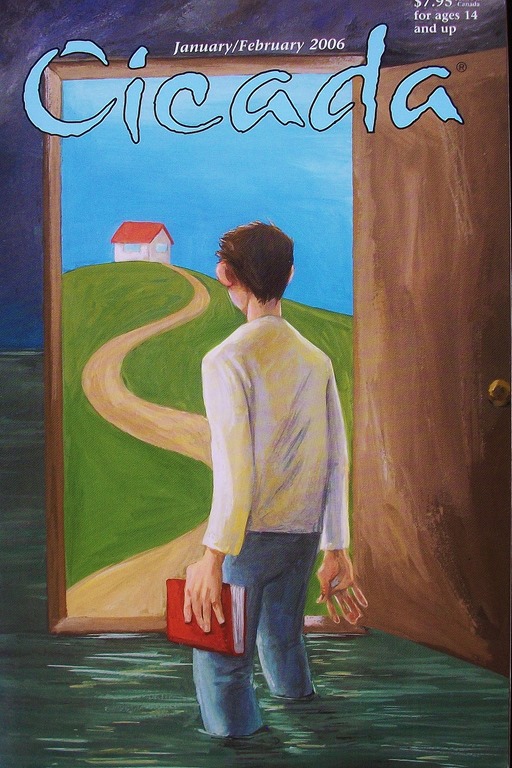
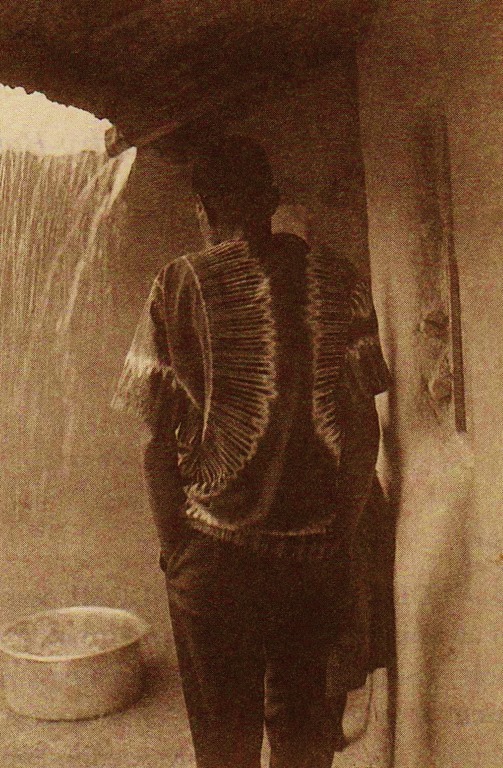
And since it is pouring in the UK, I thought I’d post a rainy-day poem written while  I was in Kenya. It was originally published in Cicada Magazine  March/April 2000, along with the picture above for which there was no attribution.

Long Rains

Rain days in Africa – roads run

rivers, mud blood red; and careless,

grey-dog skies shake out

their fill on ill-clad souls who

shuffle close in supermarket doors,

and moon-eyed in the drip and drip,

the backslap seep in thin-soled shoes,

no longer see the draggled flocks

of street boys perched in car park trees,

all glue-pot fused, nor show surprise

when sleek Mercedes cruise

the roads-turned-lakes and ditch their wake

on citizens whose only keep is

listless hope: that sometime soon –

the rains will stop…

*

And for all those interested in good reading and writing Cicada Magazine is part of the Cricket group of magazines published by Carus in the US. Each of their magazines – Babybug, Ladybug, Spider, Cricket and Cicada caters for a specific age group, from babes to teens and up. The house-style is literary rather than comic book, and with a strong multicultural element. Every story, poem or article in every edition is accompanied by specially commissioned artwork. The publishers accept submissions from both new and established writers and artists, but the emphasis is on quality.

100_3666

© 2013 Tish Farrell

No way back from Africa: the road to Hunter’s Lodge

010

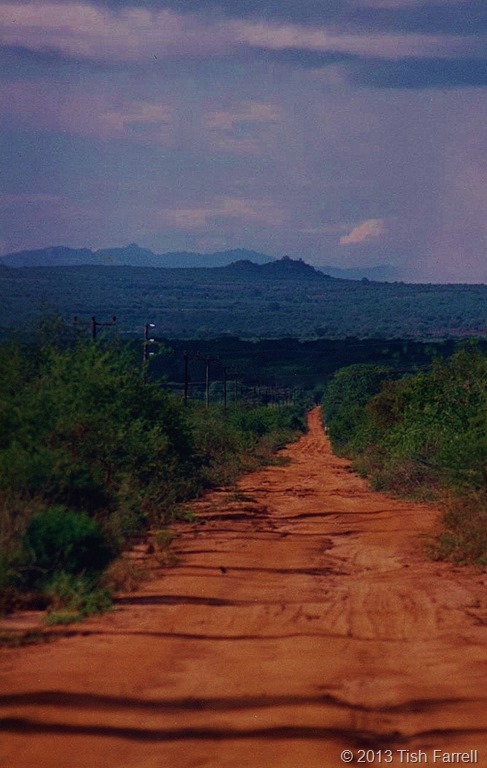
The road from the Range Station to Kiboko

*

I can pretty much bank on it. Once you have been in Africa you will never be the same. Nowhere else will you feel so alive, or so in love, or so entranced or indeed, afraid. In the physical sense, your blood and guts may well bear traces of the diseases and parasites you encounter there for years to come. Certainly the psyche will be forever afflicted by acute withdrawal symptoms, the loss of sensation, the no-longer-state of being always in the present – the only way to live back there.

In elemental ways too, standing, for instance, in East Africa’s Rift Valley, you could well find yourself confronting your genetic heritage for the very first time: the dazzling revelation that this is the land where your ancestors stood up on their apes’ hind legs and marched onwards to the age of technological development that we like to call civilization. It is the moment that you understand that you and this landmass are intimately connected through every pore, cell and bone.

And the reason I can say this, daring such unbridled presumption, is because it happened to me, and to G, and to all who know us and visited us there. Africa gets under your skin and, to quote a dear old friend “up your nose and into your soul.”

003

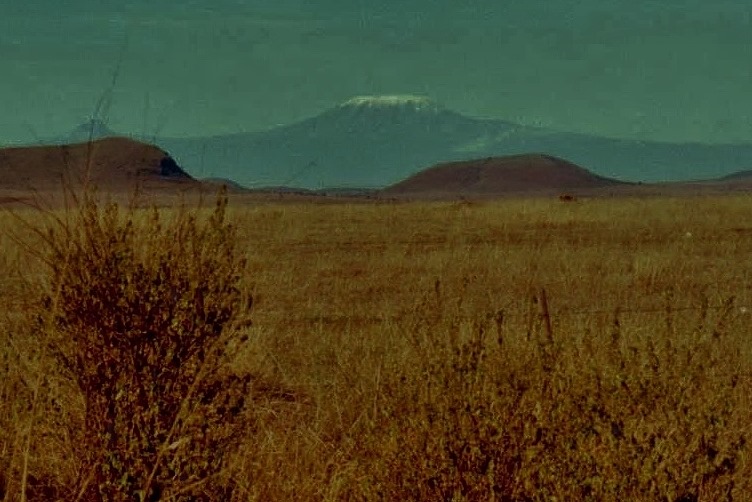
Kilimanjaro caught from the Mombasa highway just south of Kiboko

*

For me the journey into Africa began, with auspicious timing, on the 14th February 1992. This was the day I ran away – to Kenya to be precise, leaving home, possessions, accountant spouse and several labradors in order to travel with a roving entomologist who had no home, no possessions – neither in Africa nor in England. He had recently been in Mexico researching the habits of the Larger Grain Borer (LGB), a small maize-eating beetle that ravages stored crops. Before this he had worked for two years in Tabora, Tanzania, as a volunteer Agricultural Extension worker, also advising farmers about LGB. (See earlier post On Kenya’s Farms)

In the 1980s this pest had arrived  in Africa (where it has no known natural predators), introduced on consignments of food aid from the Americas. In 1992, then, G was on a new LGB mission: to monitor the beetle’s spread from Mombasa on the Indian Ocean coast to Nairobi in the Kenya’s central highlands. For the next nine months we would lead a nomadic life, travelling up and down the Mombasa highway, which back then was little more than a ribbon of ragged tarmac running through the bush.

The road was fraught with dangers – from gargantuan potholes to car-jackers lurking in the thorn scrub. There were also successions of stranded trucks left where you least expected them, and the possibility of some belligerent buffalo insisting on a standoff in the middle of the highway; and then there were policemen flagging us down for lifts, or to give us speeding tickets when we had not been speeding.

sundowner

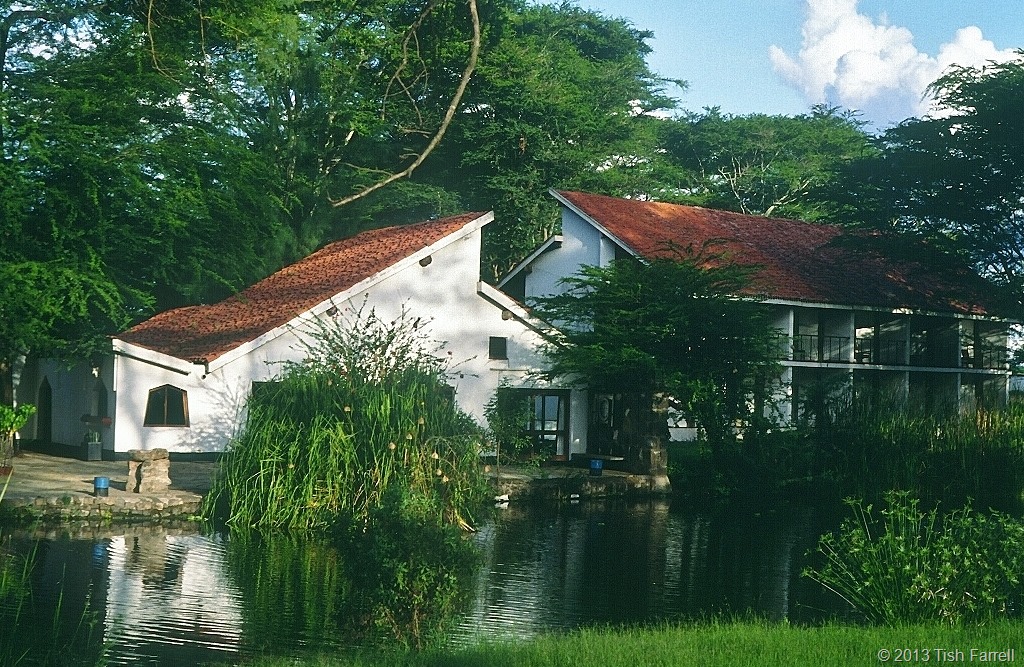
Hunter’s Lodge, Kiboko

*

During these nine months we stayed in roadside hotels, safari lodges, beach cottages, a Danish development workers’ guesthouse, and, best of all, at Hunter’s Lodge where we were usually to be found for three or four days each week. This one-time home and small hotel was begun by Great White Hunter, John Hunter, at a small place called Kiboko, some hundred miles south of Nairobi. The place had once been a regular resort for expatriates taking a weekend break from the capital, or a convenient overnight stop en route for Mombasa beach. This was in the days when the road was still an un-metalled cart track, and it took all day to get there (needless to say, covered head to toe in red plains’ dust). The coast was a further 200 mile-drive, including the long stretch of desolate Taru thorn scrub south of Voi.

Kiboko, then, was in every way an oasis. John Hunter had long had his eye on the location before he moved there in his retirement in 1958. He had arrived in British East Africa in 1908 in the wake of the first European settlers, and made a career of clearing unwanted game: first lions from the Uganda railway that ran nearby and later, on behalf of the colonial game department, elephant from settler farms, and marauding hyena from the African native reserves.

He also ran private safaris for counts and maharajas, and therefore rubbed shoulders with the likes of Karen Blixen’s white hunter husband, Bror Blixen, and her lover, Denys Finch Hatton (Out of Africa). In his time, Hunter was personally responsible for despatching over 1,400 elephants, and nearly as many rhinoceros. Local myth had it that Hunter gave up repairing the hotel sign which a vengeful rhino was intent on flattening. Besides, in those days, everyone who was anyone knew where Hunter’s Lodge was.

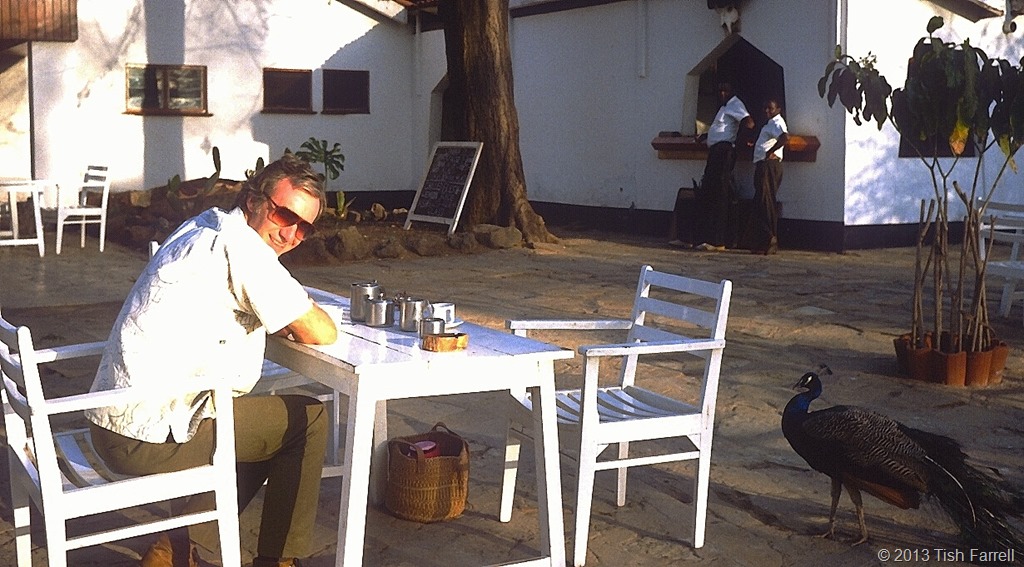
Graham and peacock 1992

Afternoon tea with the sugar-stealing peacock

*

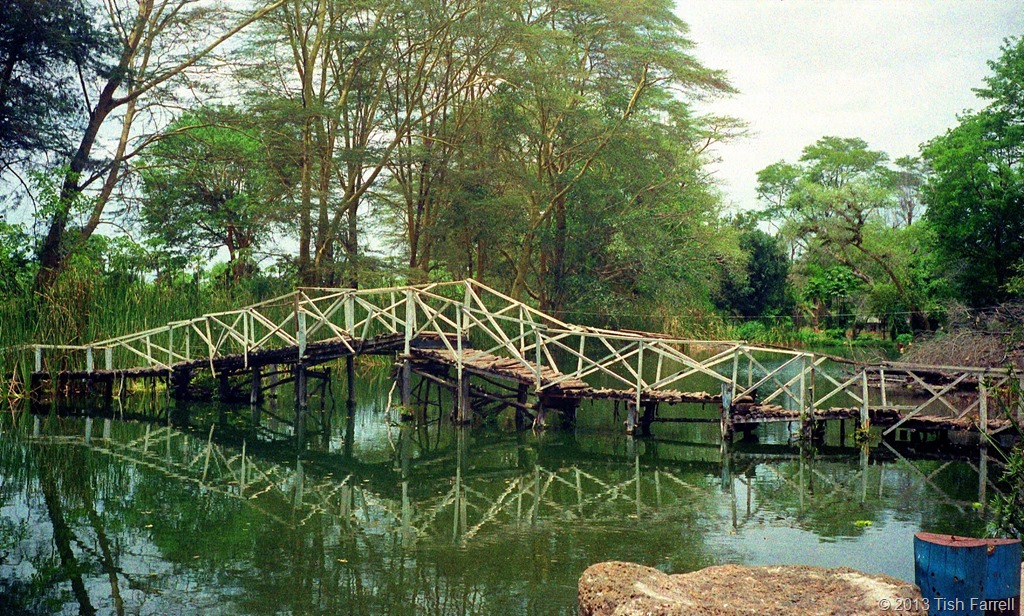
The reason Hunter chose Kiboko to settle was because it had fresh water: a volcanic spring, and the only one for miles around. In the old days he had often watched elephant coming there at sundown to drink. He, however, set about damming the stream to make a small lake, this surrounded by a grove of graceful fever trees and wild figs. Given the general aridity of the surrounding bush country, it truly is a beautiful place, a resort not only for human travellers, but for some three hundred species of bird. When we were there, there was also talk that a leopard haunted the upper reaches of the pool, but we never saw it: only baboons and vervet monkeys, a bushbaby and a monitor lizard.

The bridge

The bridge to the vegetable shamba

*

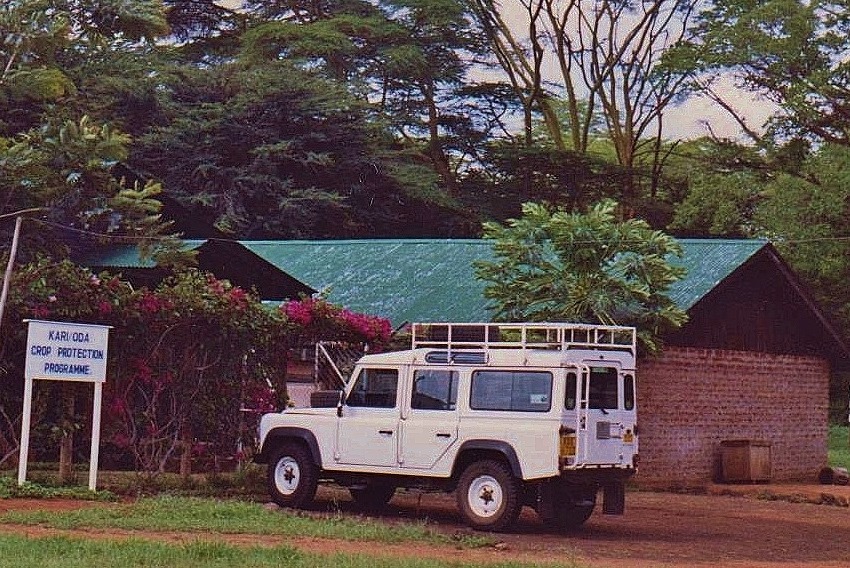
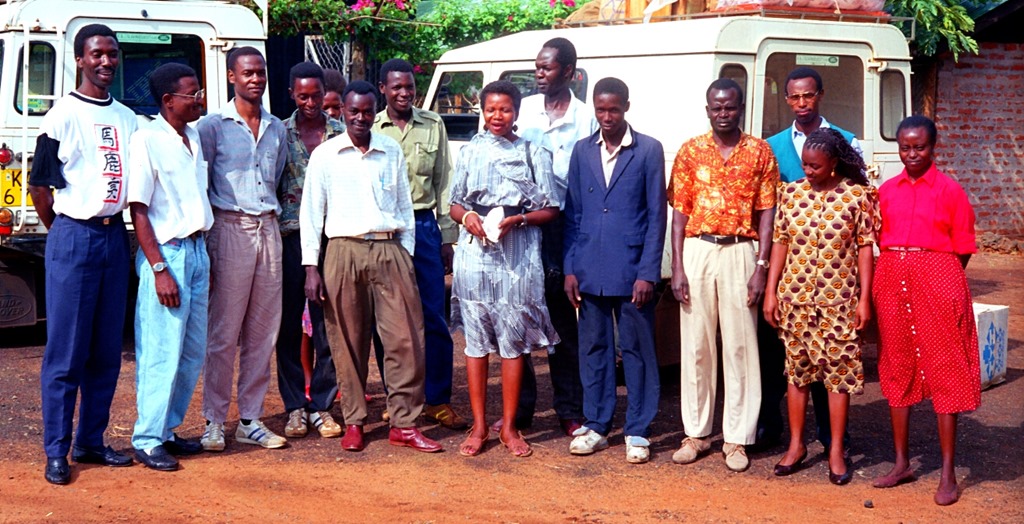
And the reason that we often stayed there was because the Kenya Agricultural Research Institute had a small research station and laboratory just behind the lodge. On starting his job, Graham was gravely entrusted with a key to the back garden gate, so that at 7.30 am he could walk to work, and then walk back again for lunch at noon. The lab employed a dozen technicians, all working on the LGB project.

002

Graham's team at Kiboko Lab - the last day

Kiboko lab and staff

*

In 1992 Hunter’s Lodge rarely had many overnight guests. Sometimes G’s boss would be stay; sometimes a travelling salesman; sometimes an aid worker or two. Once, an Intermediate Technology N.G.O held a two-day seminar there. Once, a large group of Nairobi Asians came for a weekend party. The main trade, however, comprised passing travellers who dropped in throughout the day for snacks and drinks. These were served by smart bow-tied waiters on the bar terrace where you would be stalked by a bedraggled peacock, which sorely depressed since its mate had been swallowed by a python, sought pleasure in raiding the sugar bowl whenever it had the chance. It was a sad old bird.

The menu was limited: cheese sandwiches, steak and chips and omelettes. But the cook did prepare an amazing fresh lemon juice made from the lodge garden’s own lemons. It was sour enough to curl your teeth, but extraordinarily sweet too. We also soon took to carrying a plastic tea strainer around with us – to sieve the skin out of the milk, both from the breakfast wheatie flakes, and before we poured it into our tea.

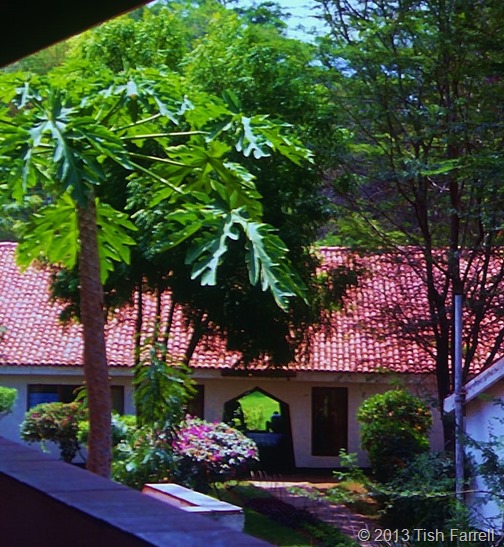
The milk was brought daily by Maasai women and their donkies, and boiled within an inch of its life. Even so, it still tasted of the ash-scrubbed gourds that it was delivered in. This milk, coupled with the sulphurous water from the spring, made afternoon tea a daily strange experience. Only the lack of other things to do when G came home from work at five o’clock made us persist with it. Going for tea on the terrace was, after all, an outing – a different experience from the lunch and supper outing to exactly the same spot, or to the breakfast outing which was to the lodge dining room with its strange ogival doorways.

Scan-130520-0010_thumb.jpg

Looking toward the Lodge dining room

*

The best pursuit of the day, so long as there had been a calor gas delivery, was at sundown  to resort to the shower in our room. The shower fittings went under the manufacturer’s name of Steamy Steamy. After a dusty drive up or down the Mombasa highway, a good Steamy Steamy was the only thing we could think of.

Then by seven when it was quite dark, and we were duly steamed and dressed, the next treat would be to sit on our veranda and wait for the firefly display up and down the garden lake. This was followed by a trip to the bar and a couple of Tusker beers. If John, the young Maasai barman, was on duty, then we were in for some good conversation. He had opinions on everything. The local Akamba waiters would stand about and gaze at him in awe, whether he was talking to us or to them. He told us he owned 150 cattle, and had two wives. He had not wanted to marry a second time, he explained, but his parents had urged him because his mother had kidney disease and needed more household help. He had accepted the situation philosophically.

Once, John offered to take me on the back of his bicycle into the bush to his family’s ‘enkang and to see a female circumcision ceremony. I wished I’d had the guts to accept. He told me his home was only two hours away, as if I would manage the ride over bush tracks quite easily, me who had never ever balanced myself on a bicycle parcel rack.

005

Caught red-handed, a vervet raider eating our bananas

*

While G was at work, I wrote letters and read. But mostly I watched. I soon realized that the Lodge was run, not for guests, but for the benefit of its staff. Their daily routine of cleaning and tending went on whether or not there were any guests. The garden staff wore brown overalls. They mowed the lawn, and worked in the vegetable shamba across the lake. Around ten in the morning a bell rang and everyone disappeared for a tea-break. The manager wore a smart khaki Kaunda suit, and marched hither and thither, but to no apparent purpose.

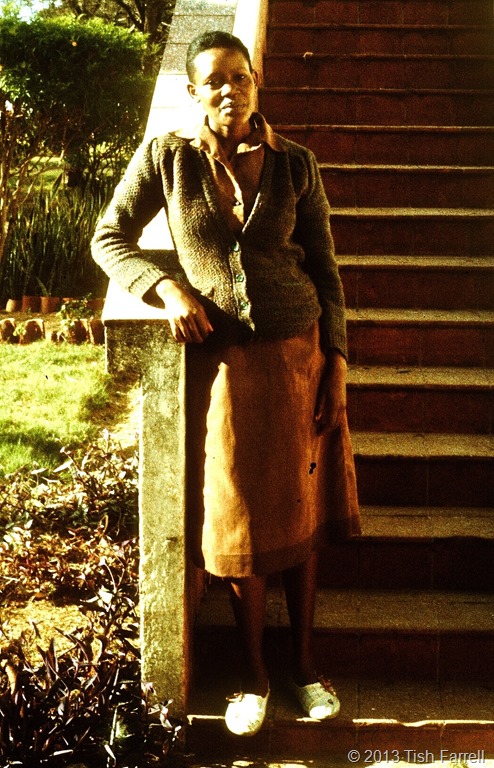
Then there was Joyce, the chambermaid. Her husband worked down at Kibwezi and was a forestry officer. She lived with her two little boys in the staff bandas at the bottom of the garden. On her days off she went home to the family farm. She told me that I should learn Ki-Swahili since it was very easy. I agreed, but only learned a smattering. The hello, how are you: jambo, habari yako?

Between the gentle staff activity, there was only the wildlife to observe, vervet monkeys planning raids on our room, pied kingfishers diving, yellow weavers endlessly weaving, herons clattering their bills in the thorn tree heronry, marabou storks lurking like spectres on the lawn, hadada ibis winking out grubs with their curvy bills. And over all, the high-tension whine of crickets that could drive you mad when you were not feeling well.

Joyce our chambermaid

Joyce

*

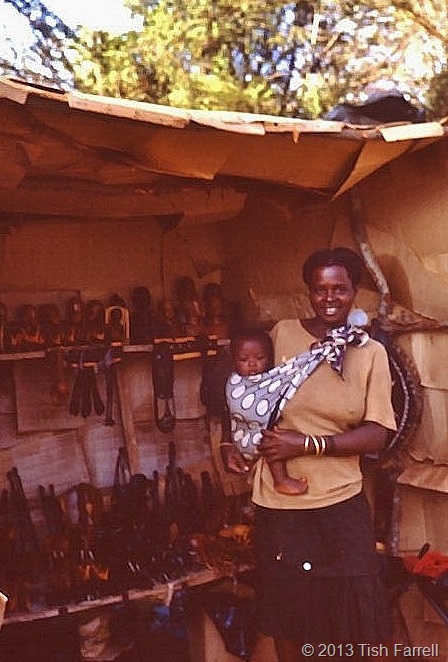
One of the features of Kiboko, I soon discovered, was the wood carvers’ stalls opposite the Lodge. Sometimes I took my clothes down to Esther who ran such a stall, and traded them for Akamba carvings. She struck a hard deal, and I was a simpleton when it came to haggling. G was nonetheless impressed since it lightened the contents of my two bags.

Scan-130429-0155 (3)

Esther at her stall with son, Tom

*

And so it was that Hunter’s Lodge became a home of sorts. Whichever way we approached it on the Mombasa highway, my eyes would fix on the green grove of fever trees, and my spirits would lift as we turned off the road. There was Steamy Steamy to look forward to, the smoky taste of the tea, Reuben the breakfast waiter who always asked us if we were having eggs though we never did. Only later did we discover that we had paid for a full breakfast in with our room rate. There was the birdlife to watch, and the sleepy routine of the hotel staff to keep tabs on; there were the steaks that our weak teeth found impossible to process, the fireflies and the vervets, and there were the brief African sunsets as the light turned through lavender and orange to black, black night. There was irony too, for it was of course the metalled road that turned Hunter’s Lodge from oasis to backwater, making the coast accessible in a single day: an unintended consequence of progress. 

I remember the long nights I lay awake, listening to the whine of insects, the drone of trucks on the Mombasa highway, the hoot of the train on Uganda railway. We are in Africa, I would tell myself. And even when I was there, so very much present in every sense, it still seemed like a dream. Perhaps this land was the original Garden of Eden. When we left it, we took our self-regarding selves to material greatness. Maybe the price for this knowledge was the loss of wisdom. Even now, so many years on, I still travel the road to Kiboko, at least in spirit,  and ponder this conundrum. The great safari continues…

013

Letter from Kathleen Collins Howell, illustrator and best friend

Daily Prompt: on the road

© 2013 Tish Farrell

International Women’s Day 8 March

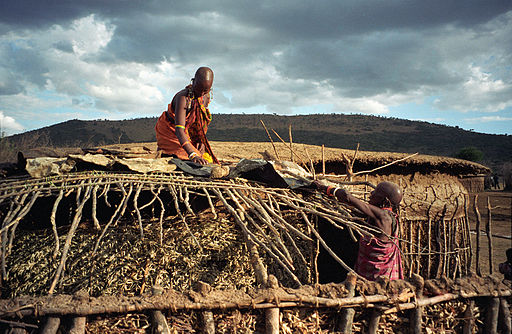
House BuildingCreative Commons photo: Jerzy Strzelecki

House Building
Creative Commons photo: Jerzy Strzelecki

I’m thinking of women whose life is immeasurably harder than mine. Could I, for instance, walk the Maasai woman’s barefoot daily trek across wild bush country, searching for firewood, fetching water, taking produce to market? Could I have reared children in the dung and wattle hut that I had built myself? Could I live obeying a husband’s commands even when I thought them wrong? What kind of bravery, tenacity and inner strength would I need to live this way, and to still live well? These days, things are slowly changing for Maasai women, not least because campaigners from their own communities are pressing for girls’ education, the end of genital mutilation and forced teen marriages. But for outsiders visiting the Mara it is all too easy to see only the grinding poverty and the reconstituted, fit-for-tourist shreds of former warrior glamour. But before jumping to too many conclusions about what is really going on, here is my version of a Maasai traditional story that sheds some light (literally) on their own views of the man-woman relationship.

And the moon still shines

Long ago Sun wanted a wife
so he married Moon and they made a pact,
to ply the sky in endless round,
Sun ahead, Moon behind.
And each month, tiring of the trek,
Sun carried Moon-Wife on his back.

But then one day they came to blows.
Moon crossed Sun and Sun lashed out,
beating his Moon-Wife black and blue.
Moon struck back. She slashed Sun’s brow.
He gouged her cheek, plucked out an eye.

Later Sun fumed: I’ll shine so hard
that none will ever see my scars.
While Moon tossed her head:
Why hide my wounds?
I still light up the night sky.

Creative CommonsPhoto: William Warby (flickr.com)

Creative Commons
Photo: William Warby (flickr.com)

Text: Copyright 2013 Tish Farrell